
PHDRUM84 - Musical instrument Pyle - Free user manual and instructions
Find the device manual for free PHDRUM84 Pyle in PDF.


| Product Type | Electronic Drum Set |
| Brand | Pyle |
| Model | PHDRUM84 |
| Number of Pads | 8 |
| Number of Cymbals | 4 |
| Sound Module | Built-in with 100+ voices |
| Connectivity | USB MIDI, 1/4" headphone and aux outputs |
| Dimensions (L x W x H) | 24 x 18 x 12 inches |
| Weight | 15 lbs |
| Power Supply | DC 9V adapter (included) |
| Display | LED screen |
| Functions | Record, playback, metronome, adjustable sensitivity, 10 preset songs |
| Maintenance | Wipe with dry cloth; avoid moisture |
| Safety | Keep away from water and heat sources |
| Spare Parts | Replacement cables, drumsticks (sold separately) |
| Reparability | Modules can be serviced by authorized technicians |
| Included Accessories | Drumsticks, power adapter, USB cable, user manual |
| Material | ABS plastic and rubber pads |
| Compatibility | Works with PC, Mac, and iOS via USB |
| Warranty | 1-year limited warranty |
Frequently Asked Questions - PHDRUM84 Pyle
User questions about PHDRUM84 Pyle
0 question about this device. Answer the ones you know or ask your own.
Ask a new question about this device
Download the instructions for your Musical instrument in PDF format for free! Find your manual PHDRUM84 - Pyle and take your electronic device back in hand. On this page are published all the documents necessary for the use of your device. PHDRUM84 by Pyle.
USER MANUAL PHDRUM84 Pyle
The Steel Pan Tongue Drum have the ability create a powerful connection between the player and their own inner-world regardless of age or musical experience. They can be used to attain a deep meditative state, for healing purposes, and for the care-free experimentation with music.
Drum Safety:
Steel Pan Tongue Drums are quite heavy, and they come with mallets and other small parts that can be hazardous to children if handled improperly or ingested!
\*Not recommended for children under 5 years old\*
- Steel Pan Tongue Drums are quite heavy and can cause severe damage to people or property if dropped on them. Be careful and make sure your hands are free of grease/water before attempting to pick up your instrument. This will ensure you have a solid grip on the drum and will not inadvertently drop it on anything or anyone.
- Do not leave young-children unattended with the mallets provided with the drums, and absolutely do not allow your child to put the mallets in their mouth! Although we preform our due-diligence when we produce our products, there is always a danger that a mallet-head could come off and it could become lodged in an airway. Never leave your child unattended with the mallets.
- Do not leave young-children unattended with your instrument! PyleUSA accepts no responsibility for incidents of damage or injury caused by the misuse or neglectful supply of our products to young-children. Use common sense! Stay safe!
How to play?
Steel tongue drums are really easy to play as they do not require much effort or any special skills. Even the least amount of pressure or force applied to drums bring out big sounds. The practice is the only key to expertise with these drums.
It is about your hands and the fingers that produce the most sounds. While you put your palm at the center, use your fingers to play at the tongue of the drums. This creates beautiful sounds from it. On one side, using hands to play the tongue drums with hands really creates a feeling of connection with the drums, while on the other hand, mallets or sticks are easy to use for beginners as these require minimal efforts to bring more music. In fact, the clearest sounds are made from the mallets.
Steel Pan Tongue Drum Instructions
Please read the following information carefully after receiving the goods:
STEP ONE: To flatten the drum face after receiving it.
Due to the bumpiness in the way of logistics, that the received drum with a curved tone tongue is a normal phenomenon and does not affect the tone of pronunciation. Using a thumb slightly, point at the top of tone tongue, press flat slightly down. If you have a concave tongue, open a round black hole at the bottom and push it slightly with a long stick. This method should be used to fine-tune the later period, will not affect the pronunciation and tone color.
STEP TWO: Avoid severe impact
If the drum appears severe impact deformation, even if it is reset, the tone color of the tone tongue will be affected because of the change of the resonator cavity. Do not place heavy objects above the product and avoid severe impact.
STEP THREE: Indoor storage
Drums are made of alloy materials. Please put it in a cool and dry indoor place and store in room temperature to avoid exposure to the sun and rain.
Steel Tongue Drum Tuning Problems
What if the instrument out of tune?
First of all, the steel tongue drum is a non-fixed instrument, it is a normal phenomenon that the test range of sound, generally positive or negative 10 points.
The steel tongue drum can be adjusted by fine-tuning: Pitch down by pressing the tongue for overtone, or by using a file with grinding (fig. A) to file it down at the root of the tongue, and the tone will be lowered; If it is low tone, please top up the tongue from its bottom. Generally speaking, our shipment product sound is a little higher, there is room for fine-tuning.
What is the correct method for testing intonation?
Steel tongue drum testing method must be accurate to test the true accuracy. Above all, the drum is to be flattened. You cannot measure intonation on an uneven surface. Secondly, to measure the tone of the target tongue, one should press on the other tongues (fig. B), and then point the target tongue to face the tuner (fig. C). If not, there will be 1-2HZ test errors. After knocking the head position of the tongue several times in a row when aiming the tuner, remember several times of continuous percussion, the tuner will appear a beating range (the steel tongue drum can only test the sound range value), this range is the intonation of the target test tongue tone.

natural_image
Close-up of a hand holding a small yellow object over a dark purple, textured surface (no text or symbols visible)fig. A

natural_image
Close-up of a hand resting on a dark, glossy black circular object (no text or symbols visible)fig. B

natural_image
Close-up of a hand painting a dark, textured spherical object with a red brush (no visible text or symbols)fig. C
What's in the Box
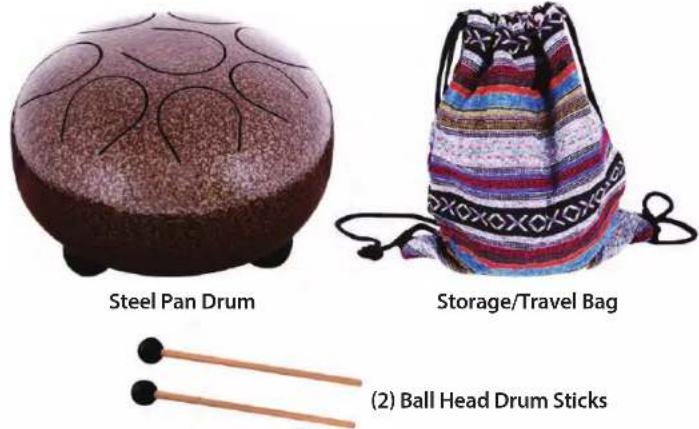
natural_image
Two decorative items: a wooden drum with patterned patterns and a colorful striped bag with two wooden sticks, both labeled (no text on the objects themselves)Correct scale sticker method

How To Play:
These instruments are meant for melodic exploration and the free expression of music, so we highly encourage you to find your own playing style. However here are a few tips to help you a long the way:
- Using your thumbs, finger-tips or mallets make soft strikes on the centre of the tongue, near the tip to create the best sound.
- You can use one hand to mute notes/sound while striking notes with your other hand or a mallet.
- Once you have the desired sound, begin to create patterns counting out the beats, such as 1-2-3-4 1-2-3-4, 1-2-3 1-2-3, etc.
- Try speeding up and slowing down smoothly, striking 2-3 notes at the same time to create chords, different styles of mallets, pausing and allowing space to enter your melody, experiment with every different way to play that you can! Have fun!
Music Score

Three Bears

Whitewasher

A Little Donkey

Twinkle Twinkle Little Star

Let's Sway Twin Oars

Kangding Love Song

How Rare the Moon

Kangding Love Song

Dont Hide Now

Rhyme Enlightenment

Rice Shop

To Say Goodbye

Wakening to Truth

The Story of a Small Town

You and Me
1=C 44


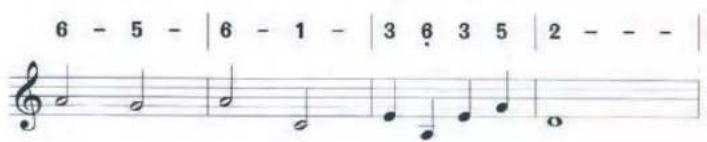
-
Avoid playing your Steel Tongue Drum extremely aggressively with the mallets. This can cause the tongues to bend and experience "Metal Fatigue" which can cause the tongues to fall out of tune. We suggest gentle playing with the mallets, or using the hands/fingers/thumbs. It is suggested that if you are attempting to play at comparable volumes to other loud instruments that you mic your Steel Tongue Drum.
-
Your drum is very tough, but it is susceptible to scratches and dings if rubbed against abrasive surfaces, or dropped.
-
Avoid exposing the drum to extremes in temperature.
For instance: Hot cars in the summer, snow, saunas.
Washing/Cleaning:
Your drum has been powder-coated, so it is relatively impermeable against moisture. We suggest using a light touch-up of clear nail-polish to coat scratches. Due to the nature of powder-coat used, the instrument cannot be re-coated if it gets scratched. However, if you treat it well it will last you a lifetime!
Troubleshooting:
1. I hear a rattle/buzz!
Please check to make sure that your wooden plug is affixed firmly in your instrument (It must be very snug to avoid buzzing). Make sure there is no debris inside the drum/no debris stuck to the tongues. If it is still sounding off please contact us.
2. There is rust forming at the base of the tongues!
We fine tune our instruments after they come out of the kiln by cutting the tongues slightly longer. Although we re-coat these areas on the drums with rust paint before they come to you, we may miss small areas. Please take a fine sandpaper, give the area a light sanding and use a desired metal paint to re-coat the area. Acetone free nail-polish will remove paint without hurting the finish.
- Drum Safety:
- \*Not recommended for children under 5 years old\*
- How to play?
- Steel Pan Tongue Drum Instructions
- STEP ONE: To flatten the drum face after receiving it.
- STEP TWO: Avoid severe impact
- STEP THREE: Indoor storage
- Steel Tongue Drum Tuning Problems
- What if the instrument out of tune?
- What is the correct method for testing intonation?
- How To Play:
- You and Me
- Washing/Cleaning:
- Troubleshooting:
- I hear a rattle/buzz!
- There is rust forming at the base of the tongues!
Brand : Pyle
Model : PHDRUM84
Category : Musical instrument