
340003 - Water heater Emga - Free user manual and instructions
Find the device manual for free 340003 Emga in PDF.


| Product Type | Electric Storage Water Heater |
| Brand | Emga |
| Model | 340003 |
| Capacity | Approx. 50 Liters |
| Power | 1500 W |
| Voltage | 230 V ~ 50 Hz |
| Dimensions (H x W x D) | Approx. 600 x 400 x 400 mm |
| Weight | Approx. 20 kg (empty) |
| Installation Type | Wall-mounted (vertical) |
| Energy Source | Electric |
| Temperature Control | Thermostat with adjustable range |
| Safety Features | Overheat protection, pressure relief valve, thermal cutoff |
| Material | Steel tank with enamel coating |
| Insulation | Polyurethane foam |
| Heating Element | Copper sheathed |
| Water Connection | 1/2" BSP male inlet/outlet |
| Max Working Pressure | 8 bar (116 psi) |
| Protection Class | IP24 (splash-proof) |
| Maintenance | Annual descaling recommended; check anode rod |
| Spare Parts Availability | Thermostat, heating element, anode rod, gaskets |
Frequently Asked Questions - 340003 Emga
User questions about 340003 Emga
0 question about this device. Answer the ones you know or ask your own.
Ask a new question about this device
Download the instructions for your Water heater in PDF format for free! Find your manual 340003 - Emga and take your electronic device back in hand. On this page are published all the documents necessary for the use of your device. 340003 by Emga.
USER MANUAL 340003 Emga
natural_image
White industrial water heater with black lid and glass handle (no visible text or symbols)
GRANTED THAT:
- The water softener has been built under closure surveillance of high-qualified personnel; it has been tested in order to eliminate any possible "negligence" during the building. During the testing nothing has resulted as defective.
- The water softener has been built in accordance with all the provisions for the system's safety and it as been built on this basis.
STATED THAT:
- The water softener is provided with precautionary labels that have to be strictly observed in order to avoid damages to persons. For any reason this labels must not be removed.
- It is an obligation for the purchaser to train the water softener's operator to the safety use of this considering:
- The warnings reported on the water softener and on this operating and maintenance manual;
- The legal and administrative penalties to which the operator is exposed in case of non-compliance of the correct terms of use of the machinery and general the rules in the workplace.

SAFETY WARNINGS
| REGULATIONS | Follow the rules of your country and the regulations of your premises and the premises of the water softener |
| O-RINGS,SEALS ANDPIGES | Seals, o-rings, flexible pipes that are not properly installed, damaged or consumed can cause losses and accidents. It is forbidden the use of diluents, solvents or acids in proximity of the water softener. |
| ALTERATIONS | It is strictly forbidden to modify/alter any part of the water softener |
| FLAMES | In order to avoid damages to persons, safety rules prohibit the use of flames and incandescent materials in the workplace. |
| SALT LOADING | Always insert the cover after the loading of salt or after any maintenance operation. |
| MAINTENANCE | In order to ensure the safe and efficient operation of the machinery verify the respect of the maintenance program. |
INDEX
- DEFINITION AND DESCRIPTION OF THE SYMBOLS USE IN THE MANUAL
1.1 Intended use
1.2 Uses and applications
1.3 Standard rules
- WATER SOFTENER DESCRIPTION
2.1 Storage
2.2 Transport and Handling
2.3 Assembly, installation, uninstall, reassembly
- DESCRIPTION OF THE EQUIPMENT
3.1 Equipment composition
3.2 Technical Data
- INSTALLATION
4.1 Environmental condition
4.2 Recommendation about prevention measures to be taken from the user
4.3 Checks to do before starting operation
4.4 Workplaces
4.5 Ergonomics
4.6 Testing
-
INDICATION CONCERNING THE REMOVAL / DISPOSAL OF WASTE MATERIALS
-
CLEANING
-
REPLACEMENT OF PARTS
-
MAINTENANCE, INSPECTION, REPAIR
1. DEFINITION AND DESCRIPTION OF THE SYMBOLS USE IN THE MANUAL
- MANUFACTURER: this term identifies the manufacturer of the machinery, showing his name on the Declaration of Conformity. Is the person responsible for introducing the machinery in the market.
- MACHINERY/DEVICE: this term identifies the water softener
- EXPOSED PERSON: persons in the proximity of the water softener
- RESIDUAL RISKS: this term identifies all the risks that are not evident and that cannot be eliminated during the design of the machinery, as appropriate countermeasures would compromise the functioning of the machine.

Symbol for important information

Safety warnings.
1.1 INTENDED USE
The water softeners that are described in this manual are constructed according to the good engineering practices. The aim is not to allow the deposit of limestone on parts that which involve the increase of water temperature, giving origin to a reduction in the section and in the transmission of the heat.

In case of non-potable water and in case of supply of food systems it is necessary to plan an adequate water purification system. Contact your dealer to acquire the kit of post-disinfection required

This softener is intended solely for the use for which it is intended. Any other use is considered improper and the manufacturer can not be held responsible for any damage caused by improper use or not expressly mentioned in this manual.
1.3 STANDARD RULES
This water softener is in accordance with the following provisions of law:
- Directive 2006/42/EC of the European Parliament and of the Council on machinery.
- Legislative Decree 27 January 2010, n. 17. Actuation of the Directive 2006/42/EC of the European Parliament and of the Council of 17 May 2006 on machinery, and amending Directive 95/16/EC (recast)
- Directive 2004/108/EC of the European Parliament and of the Council on the approximation of the laws of the Member States to electromagnetic compatibility. Directive 2004/108/CE of the European Parliament and of the Council of 15 December 2004 on the approximation of the laws of the Member States relating to Electromagnetic Compatibility and repealing Directive 89/336/EEC
- Directive 2006/95/EC of the European Parliament and of the Council on the approximation of the of the laws of Member States to electrical equipment designed for use within certain voltage limits.
■ UNI EN 414 Safety of machinery - Rules for the drafting and presentation of safety standards. - UNI EN ISO 12100-1 Safety of machinery. Basic concepts, general principles for design. Basic terminology, methodology
- UNI EN ISO 12100-2 Safety of machinery. Basic concepts, general principles for design. Technical principles
- UNI EN ISO 13857 Safety of machinery – Safety distances to prevent hazard zones being reached by upper and lower limbs
- UNI EN 349 UNI EN 349 Safety of machinery - minimum gaps to avoid crushing of parts of the human body.
- Ministerial Decree 25/2012 of 25th February 2012 no. 25. - Rules concerning technical equipment aimed at the treatment of water for human consumption and repealing Decree no. 443 of 21/12/1990.
■ Law no. 46 of 05/3/1990 - Standards for the safety of plant.
■ Ministerial Decree 22nd January 2008 no. 37 - provisions on the activities of installation of plant.
■ UNI 9182 - Power supply systems and distribution of cold and hot water - Criteria for design, testing and management (Defines the structural characteristics of the hydraulic circuits).
■ UNI 8065 - Treatment of water in heating systems for civil use.
■ Legislative Decree no. 31 of 02/02/2001 - Application of the Directive 98/83/EC on the quality of water intended for human consumption (water intended for human consumption requirements imposed by the Ministry of Health and the European Community).
■ Legislative Decree of 2nd February 2002, no. 27 (1). Amendments and additions of Legislative Decree 2nd February 2001, no 31, for the actuation of directive 98/83/EC relating to the quality of water intended for human consumption.
■ Ministerial Decree no. 174 of 06/04/2004 - Regulation on materials and articles which can be used in in
2. WATER SOFTENER DESCRIPTION
The water softener is presented simply packed in a carton box. Opening the packaging, within the machinery, you will find this manual. In case of damaged or incomplete document, please contact your dealer.

Do not install and place into operation when the water softener is accompanied by an incomplete or damaged documentation.
2.1 STORAGE
The water softener can be stored paying attention to impacts, atmospheric agents and humidity. Do not stack. They must be kept in adequate conditions in the event of temporary non-use. In addition, before being reactivated, it is necessary to bring them under the conditions provided by the law in force at the time of the new place in operation. For the maintenance of food safety please take the necessary precautions.
2.2 TRASPORT AND HANDLING
For transport and handling, water softeners do not require special precautions, a part from paying attention to impacts. When necessary, make use of pallet truck with pallet base. Sometimes shipping is done on kit ready to be put into operation therefore do not need special devices. Adopt the requirements for health and safety in the workplace in accordance with laws in force at the time of the put into operation. Similarly, for what concern health and hygiene issues.
2.3 ASSEMBLY, INSTALLATION, UNINSTALL, REASSEMBLY
Qualified personnel must perform all these operations. The details of the assembly this operations are indicated in the manual. Uninstall operation must be made following the steps of the installation performed in reverse.
3. DESCRIPTION OF THE EQUIPMENT
The machinery operate softening of the water using strong resins ion exchange. Resins replace the ions of calcium and magnesium, responsible for the formation of limestone, with the same quantity of sodium ions.

If water softener is powered with drinking water, the parameters of the water emitted from the device will comply with the parameters set by European Directive 98/83/EC (implemented in Italy by Legislative Decree 21 February 2001 N°31). In case of any doubt, provide for appropriate confirmatory analysis.
3.1 EQUIPMENT COMPOSITION
- Stainless steel tank AISI 304
- Top cover complete with closing handwheel for the loading of salt (NaCl - coarse kitchen salt)
- Food ion exchange resins to be regenerate with NaCl (sodium chloride – kitchen salt)
- No. 2 taps complete with filters inside the tank
- Operating and maintenance manual.
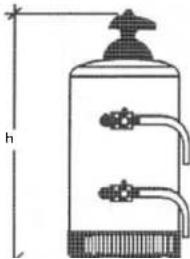
3.2 TECHNICAL DATA
natural_image
Diagram of a cylindrical water tank with two side pipes and a top valve, labeled 'h' (no text or symbols on the diagram itself)| Operating pressure | Min.: 1 bar |
| Max.: 8 bar | |
| Drinking Water Temperature | Min.: +5°C |
| Max.: +55°C |
4. INSTALLATION
The installation must be carried out in accordance with current regulations, according to the manufacturer's instructions and by qualified personnel. Incorrect installation may cause damage to persons, animals or things, for which the manufacturer cannot be held responsible.

In the case of supply of drinking water or for use in food production, check that the water is suitable for the contact with food. If necessary, please contact the manager of the managing authority.

WARNINGS / TESTS AND INSTALLATION

A - Water Input
B - Water Output
C - Water Input tap
D - Water Output
E - Pressure pipe
F - Regeneration pipe
The installation must be performed by qualified personnel, you must perform the following steps:
- Make sure that the installation location is suitable for both structural, architectural and engineering.
- Place the softener on a solid and leveled surface, protect it from cold and heat sources. The salt container (in the devices with double body) must be placed close to the resins container.
4.1 ENVIRONMENTAL CONDITION
The temperature of the installation environment of the machine must be from +5 °C to +40 °C.
4.2 RECOMMENDATION ABOUT PREVENTION MEASURES TO BE TAKEN FROM THE USER
Water softeners do not require the use of personal protection equipment during normal use.
Make sure that suppliers or management bodies of the network ensure the provisions of the legislation in force in relation to the supply of water and similar (this activity is provided by the customer).
At the first start-up of the devices, correct installation and proper functioning must be checked.
The user must carry out all these operations. The user should ensure the supply of electricity and water as described above. The water supply must be in accordance with the provisions of the current legislation and the relative connections must be done by qualified personnel for this purpose.
4.4 WORKPLACES
If the device is used in the food cycle, legal requirements for food must be guaranteed. For those aspects of safety and health in the workplace it must comply with the provisions of the legislation. Similarly, for what concerns health and hygiene.
4.5 ERGONOMICS
The legislative requirements necessary for the proper use of the equipment must be respected.
4.6 TESTING
The testing of water softeners is made directly by the manufacturer. For activities after the initial operation it is necessary that there are carried out by qualified personnel.

A mixing system is not designed for this water softener.
Please check if the laws of your country allows the use of this device.
If not, contact your dealer.
5.1 RESINS REGENERATION
The treatment of water softening depends on the capacity of the resins to perform ion exchange, which means the replacement of the ions of calcium and magnesium, responsible for the formation of limestone, with equivalent amounts of sodium ions.
This capacity tends with the time to exhaust. For this reason, it is necessary to proceed to the regeneration of the resins which has the purpose of bringing the resins in their initial state. This operation takes place by using common kitchen salt.
The regeneration of the resins should be performed with a frequency that varies according to the water that passes into the purifier. 1kg of salt regenerates approximately 12 - 15kg of coffee. Regenerate more often than necessary is not harmful, but perform this operation in a longer time means introducing water that form limestone.

The water softener object of this manual provides a regeneration of the manual, not automatic.
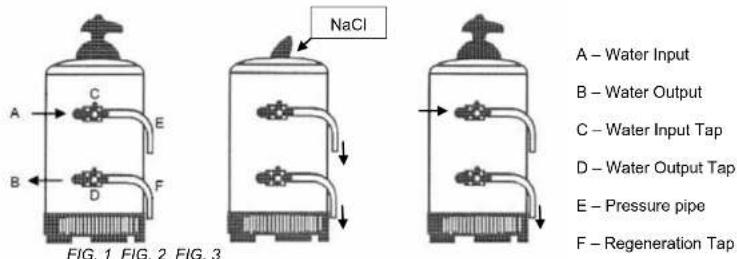
A - Water Input
B - Water Output
C - Water Input Tap
D – Water Output Tap
E - Pressure pipe
F - Regeneration Tap
Make the regeneration following the instructions below in the order listed:
- Open the by-pass tap if present (this is normally closed)
- Rotate clockwise levers (C) and (D) moving them from left to right, so as to block the input and output of water.
- Remove the cover by unscrewing the knob in the top of the water softener.
- Introduce the salt according to the prescribed amount depending on the model (see table B).
- Clean cap from any excess salt or resin.
- Replace the cap by tightening the knob strongly, without crushing the gasket too much.
- Rotate counterclockwise the lever (C) moving it from right to left, in order to reopen the flow of incoming water.
- Drain the salt water from the pipe of regeneration (F) until the water is clear and clean (about 40 minutes), so that all the salt is dissolved. Collect the water in a suitable container
- Rotate counterclockwise the lever (D) moving it from right to left, so as to reopen the discharge of water.
- Before starting the activity of the water softener check that all operations are properly completed, only after this reactivate the water softener. If in doubt, contact your supplier.
- Once the water softener will be put into service again, close the by-pass tap if this is present in the circuit.

- For the regeneration only use coarse salt. Do not use salt in large tablets.
- The time of regeneration varies depending on the amount of salt added in the softener. Therefore, before stopping regeneration make sure the water is not
6. DANGERS
The majority of defects in the operation occurs due to an incorrect use of the device.
All the dangers that can not be eliminated by the security measures adopted by the manufacturer are caused by incorrect use of the machine or by a failure in respecting part of the safety instructions in this manual by user.
7. INDICATION CONCERNING THE REMOVAL / DISPOSAL OF WASTE MATERIALS
9. REPLACEMENT OF PARTS
Only qualified personnel must perform the change of the parts of the device, and in any case, the unit must be turned off and placed in a safe condition in every respect. In any case, please contact the manufacturer.
10. MAINTENANCE, INSPECTION, REPAIR
Only qualified personnel should do the maintenance. Contact your dealer.
To ensure the proper functioning of the softener is recommended to use original spare parts. Otherwise, the warranty will expire.
The manufacturer declines any responsibility if maintenance is not carried out according to current regulations.
10.1 PERIODIC MAINTENANCE
Water softeners do not require periodic maintenance, if not the normal caution when operating.
10.2 EMERGENCY MAINTENANCE
Emergency maintenance consist in the operations of repair and replacement of one or more components. In case of substantial changes, the manufacturer can not be held responsible for any dangers that might arise.
11. DISPOSAL
If you decide not to use a water softener anymore, or to replace it with another type, you must proceed with dismantling and putting out of service. This operation must be carried out according to current regulations. In case of storage for long periods it must be disconnected the source of hydraulic supply. Protect the whole water softener including the top using the cardboard. During the put into operation after a period of storage strictly follow ALL of instructions in the manual of use and maintenance.

- GRANTED THAT:
- STATED THAT:
- SAFETY WARNINGS
- INDEX
- DEFINITION AND DESCRIPTION OF THE SYMBOLS USE IN THE MANUAL
- INTENDED USE
- STANDARD RULES
- WATER SOFTENER DESCRIPTION
- STORAGE
- TRASPORT AND HANDLING
- ASSEMBLY, INSTALLATION, UNINSTALL, REASSEMBLY
- DESCRIPTION OF THE EQUIPMENT
- EQUIPMENT COMPOSITION
- TECHNICAL DATA
- INSTALLATION
- WARNINGS / TESTS AND INSTALLATION
- ENVIRONMENTAL CONDITION
- RECOMMENDATION ABOUT PREVENTION MEASURES TO BE TAKEN FROM THE USER
- WORKPLACES
- ERGONOMICS
- TESTING
- RESINS REGENERATION
- DANGERS
- INDICATION CONCERNING THE REMOVAL / DISPOSAL OF WASTE MATERIALS
- REPLACEMENT OF PARTS
- MAINTENANCE, INSPECTION, REPAIR
- PERIODIC MAINTENANCE
- EMERGENCY MAINTENANCE
- DISPOSAL
Brand : Emga
Model : 340003
Category : Water heater