
Intuos Lens Cursor - Mouse WACOM - Free user manual and instructions
Find the device manual for free Intuos Lens Cursor WACOM in PDF.


| Product Type | Mouse (Lens Cursor) |
| Brand | Wacom |
| Model | ZC-210 (Intuos3 Lens Cursor) |
| Compatibility | Intuos3 tablets only |
| Technology | Electromagnetic resonance (cordless, battery-free) |
| Dimensions (approx.) | 120 x 70 x 40 mm |
| Weight (approx.) | 50 g |
| Power Source | Passive (powered by tablet) |
| Primary Functions | Pointing, clicking, scrolling, drag, double-click |
| Customizable Buttons | Yes (via Wacom Tablet control panel) |
| Fingerwheel | Scroll, keystroke, or disabled (customizable) |
| Tool ID | Unique identification for customization |
| Operating Mode | Mouse mode (relative positioning) |
| Storage | Do not leave on tablet when not in use |
| Cleaning | Use a soft, dry cloth |
| Spare Parts | Not applicable (no consumable parts) |
| Warranty | 2 years (excluding consumables) |
| Regulatory Compliance | FCC, CE, RoHS |
Frequently Asked Questions - Intuos Lens Cursor WACOM
User questions about Intuos Lens Cursor WACOM
0 question about this device. Answer the ones you know or ask your own.
Ask a new question about this device
Download the instructions for your Mouse in PDF format for free! Find your manual Intuos Lens Cursor - WACOM and take your electronic device back in hand. On this page are published all the documents necessary for the use of your device. Intuos Lens Cursor by WACOM.
USER MANUAL Intuos Lens Cursor WACOM
natural_image
Illustration of a stylus pen on a conical base (no text or symbols visible)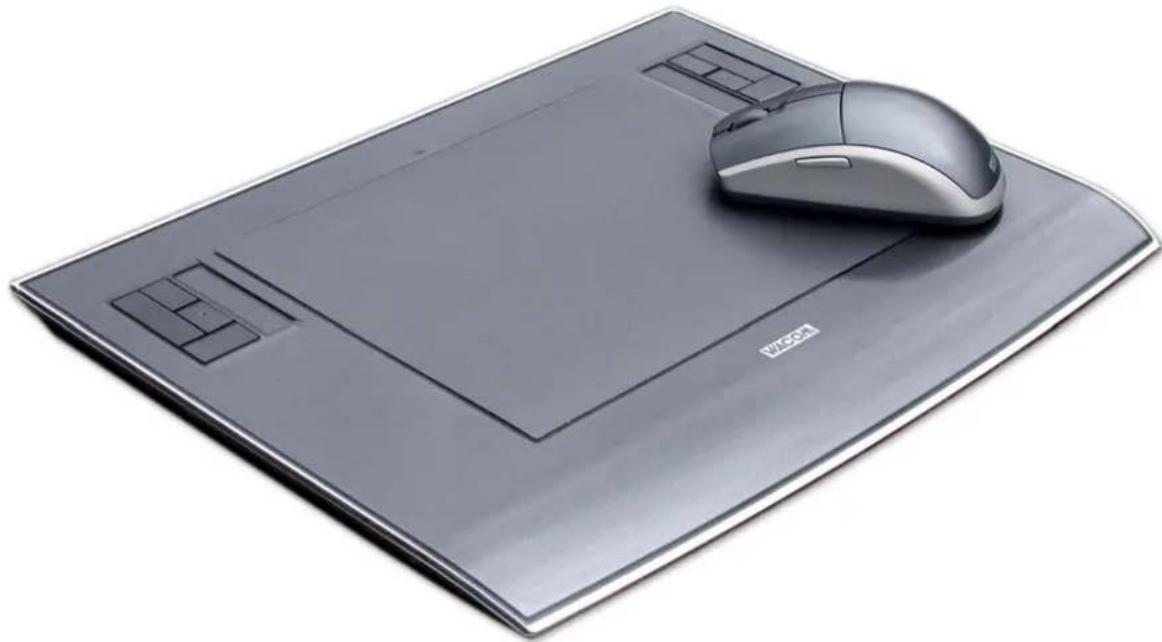
natural_image
Digital tablet with a silver mouse resting on top, no visible text or symbols on the device itself.User's Manual for Windows® & Macintosh®
Wacom Intuos ^® 3 User's Manual for Windows ^® & Macintosh ^®
English version 3.0, April 30, 2006
Copyright © Wacom Company, Limited, 2006
All rights reserved. No part of this manual may be reproduced except for your express personal use. Wacom reserves the right to revise this publication without obligation to provide notification of such changes. Wacom does its best to provide current and accurate information in this manual. However, Wacom reserves the right to change any specifications and product configurations at its discretion, without prior notice and without obligation to include such changes in this manual.

Reuse, recycling, and recovery. You are urged to recycle this product when replacing it with a newer product or when it has outlived its useful life by bringing it to an appropriate collection point for recyclable materials in your community or region. By doing this, you can help improve the environment of your community as well as minimize the potential negative effects created should any hazardous substance that may possibly be present within waste material reach the environment during the disposal process.
Within the European Union, users are required not to dispose of Waste Electrical and Electronic Equipment (WEEE) as unsorted municipal waste, according to the Directive 2002/96/EC of the European Parliament and of the Council of 27 January 2003, or the corresponding local laws of the Member States. Products for which this is applicable will be marked with the WEEE symbol shown at the beginning of this note unless this is not feasible because of the size or the function of the product. Wacom products are subject to the Directive 2002/96/EC and therefore you should always collect them separately and bring them to the appropriate collection point in your community or region.
Wacom professional pen tablet products comply with the European Union RoHS Directive 2002/95/EC (RoHS Directive).
Tool ID, QuickPoint, and DuoSwitch are trademarks, and Intuos and Wacom are registered trademarks of Wacom Company, Limited.
Adobe, Reader, and Photoshop are either registered trademarks or trademarks of Adobe Systems Incorporated in the United States and/or other countries. Microsoft, Windows, and Vista are either registered trademarks or trademarks of Microsoft Corporation in the United States and/or other countries. Apple, the Apple logo, and Macintosh are registered trademarks of Apple Computer, Inc., registered in the U.S. and other countries. Any additional company and product names mentioned in this documentation may be trademarked and/or registered as trademarks. Mention of third-party products is for information purposes only and constitutes neither an endorsement nor a recommendation. Wacom assumes no responsibility with regard to the performance or use of these products.
ExpressKey is a registered trademark of Ginsan Industries, Inc., and is used with permission.
CONTENTS
About the manual 5
Navigating the manual 6
WORKING WITH INTUOS3 7
Intuos3 tablet features 8
Intuos3 input tools 9
Intuos3 optional tools 10
Setting up your work area 11
Using the Grip Pen 12
Holding the pen 12
Pointing 13
Clicking 14
Dragging 14
Using the side switch 15
Drawing with pressure-sensitivity 16
Drawing with tilt 16
Erasing 17
Eye-hand coordination exercise 18
Using the mouse
Using the Airbrush and Art Pen
Working with the tablet
Using ExpressKeys
Using the Touch Strips 23
CUSTOMIZING
Opening the control panel
Control panel overview
Control panel settings
Customizing the pen
Adjusting tip feel and double-click 28
Adjusting eraser feel 29
Advanced tip and eraser pressure settings 30
Customizing tool buttons 31
Button functions 32
Customizing tilt sensitivity 35
Customizing the mouse 36
Customizing mouse buttons 36
Customizing the mouse fingerwheel 37
Tablet to screen mapping 38
Pen mode 38
Mouse mode 39
Orientation 39
Screen area 40
Force proportions 41
Tablet area 42
Mapping to multiple monitors 43
Customizing the tablet functions 44
Customizing ExpressKeys 45
Customizing tablet Touch Strips 46
Advanced Touch Strip settings 49
Customizing the Pop-up Menu 50
Working with multiple tools 51
Working with application-specific settings 52
Creating an application-specific setting 53
Changing settings for a specific tool and application 54
Removing application-specific settings 54
TROUBLESHOOTING 55
Testing your tablet 56
Testing your tools 57
Testing the ExpressKeys 58
Testing the tablet Touch Strips 58
Testing a pen 59
Testing a mouse 60
Troubleshooting tables 61
General problems 61
Windows-specific problems 64
Macintosh-specific problems 64

Technical support options 65
Obtaining driver downloads 66
APPENDIX 67
Caring for your tablet and tools 67
Replacing the pen tip 68
Uninstalling the software 68
Changing the tablet mode 69
Installing multiple tablets 69
Intuos3 lens cursor 70
Customizing the lens cursor 71
Testing the lens cursor 71
Working with AutoCAD 72
Configuring AutoCAD for a Wintab compatible digitizer 72
Configuring tablet menus and screen pointing areas in AutoCAD 73
Calibrating Intuos3 for AutoCAD 74
Product specifications
General specifications for all Intuos3 tablets 75
Intuos3 4x5 / A6 tablet (model PTZ-430) 75
Intuos3 4x6 / A6 Wide tablet (model PTZ-431W) 75
Intuos3 6x8 / A5 tablet (model PTZ-630) 75
Intuos3 6x11 / A5 Wide tablet (model PTZ-631W) 75
Intuos3 9x12 / A4-regular tablet (model PTZ-930) 76
Intuos3 12x12 / A4 Oversize tablet (model PTZ-1230) 76
Intuos3 12x19 / A3 Wide tablet (model PTZ-1231W) 76
Intuos3 Grip Pen (model ZP-501E) 76
Intuos3 mouse (model ZC-100) 76
Intuos3 Airbrush (model ZP-400E) 76
Intuos3 Ink Pen (model ZP-130) 77
Intuos3 Art Pen (model ZP-600) 77
Intuos3 Classic Pen (model ZP-300E) 77
Intuos3 lens cursor (model ZC-210) 77
Product information 78
Ordering parts and accessories 78
Other parts and accessories 80
Radio and television interference 81
FCC notice 81
CE declaration 81
License and Warranties
(Worldwide, Except for Europe, Africa
and Middle East) 82
Software License 82
Limited Warranty 82
Warranty Service in the U.S.A. and Canada 83
Warranty on Sales Outside of the U.S.A. and Canada 84
License and Warranty
(Europe, Africa and Middle East) 85
Software License Agreement 85
Entitlement to Use the Software 85
Limited Warranty 85
GLOSSARY 87
INDEX 89
About the manual
This interactive User's Manual provides quick access to information about Intuos3. Just click on a navigation button or highlighted word to move through the document. The information is common to Windows and Macintosh computers, and Windows screen captures are shown unless otherwise noted.
- In the contents you can go directly to a topic by clicking on it.
- Working with Intuos3 is the learning chapter, and introduces you to the many capabilities of your Intuos3 professional pen tablet. It describes the various tablet models, the features and functions of each Intuos3 tool, and includes exercises for new users.
- Customizing describes how you can change the control panel settings to optimize your Intuos3 tablet and tools for the way you like to work.
- Want to test your tablet and tools? Need troubleshooting guidelines? T roubleshooting is where you will find the answers to most common questions.
- The appendix includes a variety of information: tips on caring for your tablet and tools, a how-to on uninstalling the software, your license and warranty, and more. Also included are tips on working with AutoCAD. If you are using more than one tablet on your computer, you will find instructions on adding and working with multiple tablets.
Note: This manual does not contain information on installing your tablet. Please refer to your product Quick Start Guide and to the automated software installer (located on the Wacom Tablet CD) for details on installing your Wacom tablet.
If you are new to electronic documentation, be sure to read navigating the manual.
Here are some other points to keep in mind:
- The tablet size descriptions shown within this manual reflect usage for both the USA and European markets, and are separated by a “/”. For example, in the descriptor “4x6 / A6 Wide”, “4x6” is the tablet sizing descriptor for markets in the USA. “A6 Wide” is the descriptor for European markets. Within this manual, USA tablet size descriptors are always shown before the “/”.
- SMALL CAPITAL LETTERS are used to identify the names of keyboard keys, dialog boxes, and control pane options.
- Remember that you can always use the Adobe Reader zoom-in tool to increase the size of the manual on your display screen.
- The following kinds of information are not included with this product: information about your specific computer hardware or operating system, or information about your application software. Your best source for this information is the set of manuals and disks that came with your hardware, operating system, or application.
- Many graphics applications have built-in support for Intuos3 features (such as pressure-sensitivity, tilt, airbrush simulation, and fingerwheel input for the Intuos3 mouse). You can find a listing of applications that support these features at Wacom's web site (see product information). For information on how best to use Intuos3 features within a specific application, refer to the instructions in that application's manuals.
Navigating the manual
Use the navigation controls to move through the manual:

CONTENTS
Go to front page.
Go to table of contents.
INDEX
Go to index.


Go back to previous view.
Page back, or page forward.
HEADING TEXT
Go to beginning of section.
topic
Go to topic.

Topic continued.
Adobe Reader provides you with additional tools for using and printing the manual. Refer to the Adobe Reader help for more information.
WORKING WITH INTUOS3
This section introduces you to the Intuos3 professional pen tablet. Intuos3 consists of a tablet that serves as your work area and the Intuos3 input tools you use on the tablet. The quickest way to learn about Intuos3 is to become familiar with its appearance and features. If you are new to using a pen tablet, read the following sections to learn about your Intuos3 tools and how to use them with the tablet.
Note: Intuos3 tools will only work on an Intuos3 tablet. They will not work on an Intuos or Intuos2 series tablet. Likewise, older Intuos or Intuos2 input tools will not work on your Intuos3 tablet.
Intuos3 tablet features
Intuos3 input tools
Setting up your work area
Using the Grip Pen
Using the mouse
Using the Airbrush and Art Pen
Working with the tablet
Intuos3 tablet features

Note: Intuos3 6x8 / A5 tablet shown. To learn more about your tablet, see working with the tablet. For a complete listing of Intuos3 tablets, see ordering parts and accessories.
Intuos3 input tools
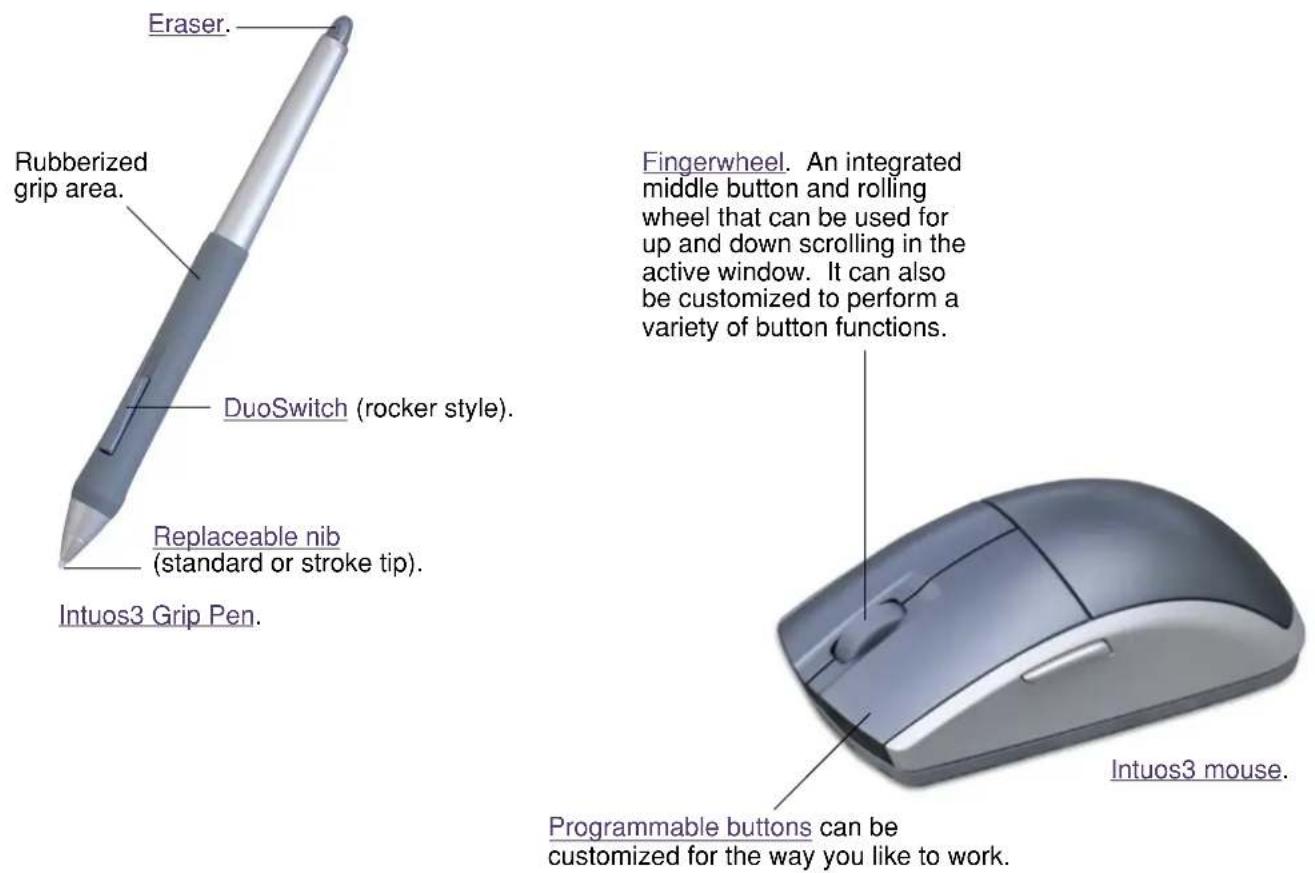
Various input tools are available for your tablet. All Intuos3 tools are cordless, battery-free, and ergonomically designed. Each tool also features a unique Tool ID, which enables you to work with multiple tools and to customize each tool differently.
The Intuos3 Grip Pen is a pressure-sensitive freehand tool for image editing and creating natural-looking pen and brush strokes.
If you prefer to use a mouse for general navigation, pointing, and clicking, just set aside your Intuos3 pen and place the Intuos3 mouse on the tablet – the mouse is cordless and symmetrically designed so you can use it just as easily in your left or right hand.
Note: Some product configurations may not include the Intuos3 mouse.
Intuos3 optional tools
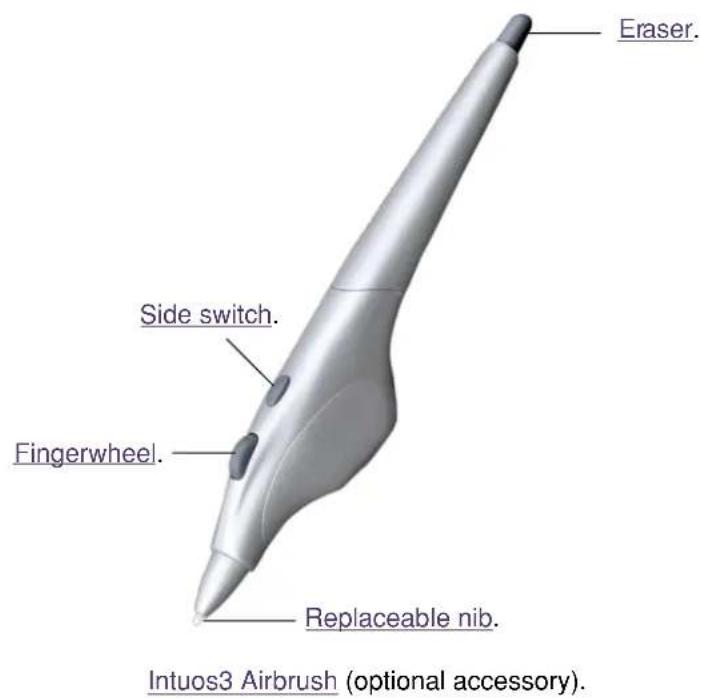
Like the Intuos3 Grip Pen, the optional Airbrush is a pressure-sensitive freehand tool for image editing and creating natural-looking pen and brush strokes.

natural_image
Close-up of a cylindrical pen with two metallic bands (no text or symbols visible)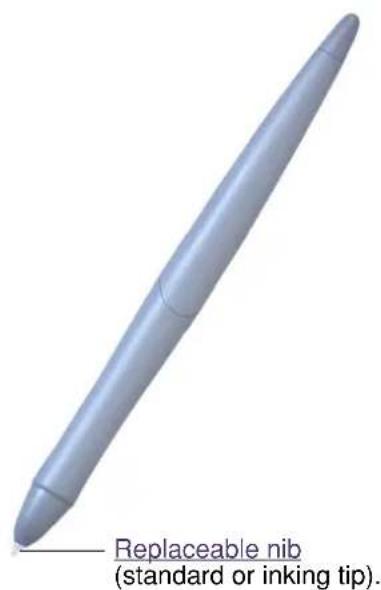
Intuos3 Ink Pen (optional accessory).
The Ink Pen is pressure-sensitive and comes with replaceable inking cartridges. With the Ink Pen you can write or draw as you do with a regular pen – just place a sheet of paper on your tablet and everything you write will be captured on paper and on your computer.
Intuos3 Art Pen (optional accessory).
The pressure-sensitive Art Pen also responds to the tilt and rotation you apply to the pen. With practice you can create almost any type of brush effect or marker stroke. The Art Pen comes with chisel-shaped nibs in both hard plastic and felt material for simulating different pen and brush feels.
For information on these and other available Intuos3 tablets, tools, or parts and accessories, see ordering parts and accessories. Visit Wacom's web site for a list of applications supporting the Art Pen rotation and Airbrush fingerwheel features. See product information.
Setting up your work area
To minimize fatigue, organize your work area so you can work comfortably. Position your tablet, input tools, and keyboard so they are easily accessible without unnecessary reaching. Your monitor should be positioned so you can view it comfortably with a minimum of eyestrain. For best results, orient the tablet so the screen cursor follows the same direction as your hand movements on the tablet.

natural_image
Man working at a desk with a computer monitor, no visible text or symbolsHere are some other points to keep in mind:
• Take short breaks between tasks to stretch and relax your muscles.
- Use a gentle grip when working with your tools.
• Alternate tasks and tools throughout the day.
- Maintain a good posture at all times. Minimize awkward postures and repetitive movements that cause discomfort.
- Change your position if you feel any discomfort due to your work position.
Note: Wacom makes no representation, promise or guarantee that Wacom products will cure or prevent, in whole or in part, mouse-induced repetitive stress symptoms, injuries or conditions. Individual results may vary. Always obtain competent medical advice to determine the most appropriate treatment for your specific situation.
See working with the tablet for additional information.
Using the Grip Pen
The Intuos3 Grip Pen is cordless, battery-free, and pressure sensitive. There are four basic techniques for using the pen: pointing, clicking, double-clicking, and dragging. With a bit of practice, using the pen will become second nature to you. If you are unfamiliar with using the pen, try the exercises on the following pages.
Holding the pen
Pointing
Clicking
Dragging
Using the side switch
Drawing with pressure-sensitivity
Drawing with tilt
Erasing
Eye-hand coordination exercise
Holding the pen
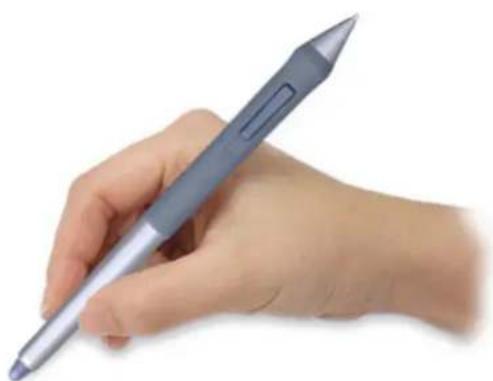
Hold the Intuos3 pen like you would a normal pen or pencil. Make sure the DuoSwitch is in a convenient location where you can toggle it with your thumb or forefinger, but not accidentally press the switch while drawing. You can tilt the pen in any way that feels most comfortable for drawing.

natural_image
Close-up of a hand holding a pen, no visible text or symbolsPosition for drawing.
natural_image
Close-up of a hand holding a stylus pen, no visible text or symbolsPosition for erasing.
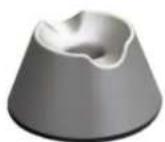
Your tablet comes with a free-standing pen stand that is used to hold your pen when it is not in use. Position the pen stand within easy reach of your tablet. When you are between tasks, store the pen either horizontally or vertically in the pen stand; this makes the pen available for quick, easy access when you are working.
Important: When the Intuos3 pen is not in use, place it in the pen stand or lay it flat on your desk. To maintain the sensitivity of your pen tip, do not store the pen in a container where it will rest on its tip or eraser. Leaving an Intuos3 tool on the tablet may interfere with screen cursor positioning when using other pointing devices. Also, leaving the pen on the tablet when not in use can prevent your computer from going to sleep.
Pointing
The Intuos3 pen positions the pointer (or cursor) on your screen. You can position the screen cursor two different ways, like a pen (PEN mode) or like a mouse (MOUSE mode).
- In PEN mode, the tablet's active area is a mapped representation of your computer screen where every point on the active area corresponds to exactly one point on the display screen; wherever you place the pen on the tablet, the screen cursor will jump to the corresponding point on the screen. This is the default setting for the pen.
- In M _OUSE mode, the default setting for the Intuos3 mouse, you move the cursor with a "pick up and slide" action similar to using a traditional mouse.

natural_image
Illustration of a desktop computer monitor with a stylus and a file icon on the screen (no text or symbols)Try moving the screen cursor by lifting the pen and placing the pen tip in a new location on the tablet. The cursor instantly jumps to the new location.
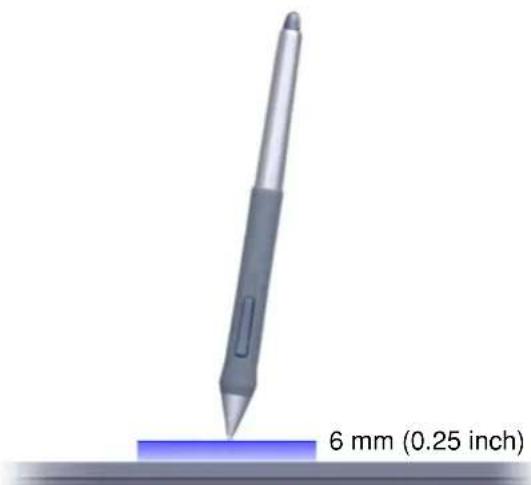
When positioning the screen cursor and operating the side switch, the pen tip needs to be within 6 mm (0.25 inch) of the tablet surface. You do not need to touch the tablet with the pen tip in order to move the screen cursor or use the side switch.
All Intuos3 tools, including the mouse, work only over the active area of the tablet.
Hints:
- If you are used to working with a mouse and find that using a pen is somewhat difficult, try the eye-hand coordination exercise.
- Pointing is easier when you orient the tablet so the screen cursor follows the same direction as your hand movements on the tablet.
Clicking
You typically click to highlight or select something on the screen, and double-click to open it.
Clicking. To click, tap the pen tip once on the tablet, or press the pen tip on the tablet with enough force to register a click. (There is no audible pen tip "click" sound.) Try clicking on a folder icon by moving the screen cursor over the icon and pressing down on the pen tip. The folder should highlight when you press.
Double clicking. To double-click, quickly tap the tablet twice in the same place with the pen tip. This is like clicking twice with a mouse button. Try double-clicking on a folder icon to open it.
Hints:
- Press the upper side switch to double-click. This is easier than tapping twice with the pen tip, and is the preferred method of double-clicking with a pen.
- Windows: You can make navigating with the pen easier by configuring Windows to select when the pen is over an icon and to launch the icon with a single click. To turn on this feature: Open a folder, select the TOOLS pull-down menu, and FOLDER OPTIONS.... From the GENERAL tab select the option SINGLE-CLICK TO OPEN AN ITEM (POINT TO SELECT).

natural_image
Illustration of a computer monitor with a stylus and a digital drawing tablet showing a file icon (no text or symbols on the device itself)Dragging
Dragging is used to select and move objects on the screen. To drag, first point to an object. Then press the pen tip to the tablet and slide it across the tablet surface. The selected object will move across the screen. To select text, move the screen cursor to the beginning of a text line, then drag the pen across the tablet until the text is highlighted.
First, try moving an icon on the screen. Then, within a document, select some text by pressing and dragging the pen tip across the text.

natural_image
Illustration of a digital drawing tablet with stylus pens and a computer monitor displaying file icons (no text or symbols on the device)Using the side switch
The Intuos3 Grip Pen is equipped with a DuoSwitch. This switch has two programmable functions that can be selected by rocking the switch in either direction. You can use the DuoSwitch whenever the pen tip is within 6 mm (0.25 inch) of the tablet's active area. You do not have to touch the pen tip to the tablet in order to use the switch.
The upper switch position is set to DOUBLE CLICK, and the lower switch is set to RIGHT CLICK by default.

Hint:
- Press the upper side switch to double-click. This is easier than tapping twice with the pen tip.
- Use a right-click to bring up application-specific or icon-specific menus.
Note: The DuoSwitch on the Grip Pen can be removed if you do not need the switch functionality. See other parts and accessories for information on ordering an alternate pen grip for use with the side switch removed.
To assign new switch functions, see customizing tool buttons.
Drawing with pressure-sensitivity
The Intuos3 pen responds to the nuance and inflection of your hand movements, enabling you to create natural-looking pen and brush strokes. Many graphics applications have drawing tools that respond to the pressure you place on the pen. For example, in some drawing programs sliders are used to vary brush characteristics (width, color, and opacity). These characteristics can be controlled much better by the pen's pressure-sensitivity – you can vary line width, blend colors, and change opacity with the pressure you exert upon the pen.
To draw with pressure-sensitivity, first select a pressure-sensitive tool from your application's tool palette. Then draw along the surface of the tablet while applying various amounts of pressure downward on the tip of the pen. Press hard for thick lines or dense color. Press gently for thin lines or softer color. To adjust the tip feel, see adjusting tip feel and double-click.
Visit our web site for a list of graphics applications that support pressure. See product information.

natural_image
Illustration of a computer monitor displaying a yellow spiral graphic and a stylus, with no visible text or symbols on the device itself.Drawing with tilt
As with pressure-sensitivity, the tablet recognizes when you tilt the pen from vertical to inclined positions. In some drawing applications, tilt can be used to control line shape and thickness. This is like working with an airbrush where tilt can be used to make a line thin when the tool is vertical, or wide when the tool is tilted. In other applications, you can adjust tilt to define brush characteristics such as width, color and opacity.
To test tilt, draw a curve in a graphics application (such as Painter) that supports tilt. Be sure that the tilt function in your application is active, then change the tilt of the pen as you draw to vary the shape and thickness of the brush stroke.
As an example, when the brush shape dynamics in Photoshop have been configured for tilt operation, tilting the pen results in an elongated pattern. This simulates the effects of an airbrush spray that is angled away from the paint surface.

natural_image
Illustration of a digital drawing tablet with a stylus and a monitor displaying a yellow flame (no text or symbols)To adjust the amount of pen tilt required to produce a desired tilt effect in your application, see customizing tilt sensitivity. Visit our web site for a list of applications that support tilt. See product information.
Erasing
The eraser on the Intuos3 pen works like the eraser on a pencil. In graphics applications that support the pen's eraser, you can erase intuitively and naturally. When you use the pen's eraser, the application will automatically switch to the eraser tool. In applications that support pressure-sensitivity, you can select pressure-sensitive tools in an application's tool palette to vary the width and depth of your erasures as you change the amount of pressure you exert upon the pen.
For Windows, you can also use the eraser in many standard office applications. The eraser will not be pressure sensitive in these applications, but you can use it to select and delete text or spreadsheet cells.

natural_image
Illustration of a computer monitor displaying a red apple with a green leaf, connected to a digital drawing tablet with a stylus (no text or symbols)For information on customizing your eraser, see adjusting eraser feel.
Visit our web site for a list of graphics applications that support the eraser (see product information). If the eraser is not supported in an application, you can still use the eraser for navigating and drawing.
Eye-hand coordination exercise
If you use a mouse, you may remember how long it took to get used to positioning the screen cursor. Your Intuos3 Grip Pen, likewise, will take a bit of practice to master the technique of positioning the screen cursor in PEN mode. This may seem difficult at first, but it is more natural and faster than in MOUSE mode.
This exercise is designed to retrain your eye-hand coordination for using the pen:
- Open any graphics application. Use the line tool to draw a rectangular grid with line spacings of about 20-25 mm (3/4 to 1 inch). You can use your traditional mouse to do this.
- Choose a free-hand tool in your application and use the pen to draw a dot at each grid intersection.
- Draw an X at each grid intersection.
- Now draw a circle around each intersection. Your screen should look like this:

- Clear your screen and make a simple drawing of your own. The more you use your Intuos3 pen, the easier drawing and navigation will become.
Using the mouse
The Intuos3 mouse is a cordless, battery-free, maintenance-free mouse that works on any Intuos3 tablet.
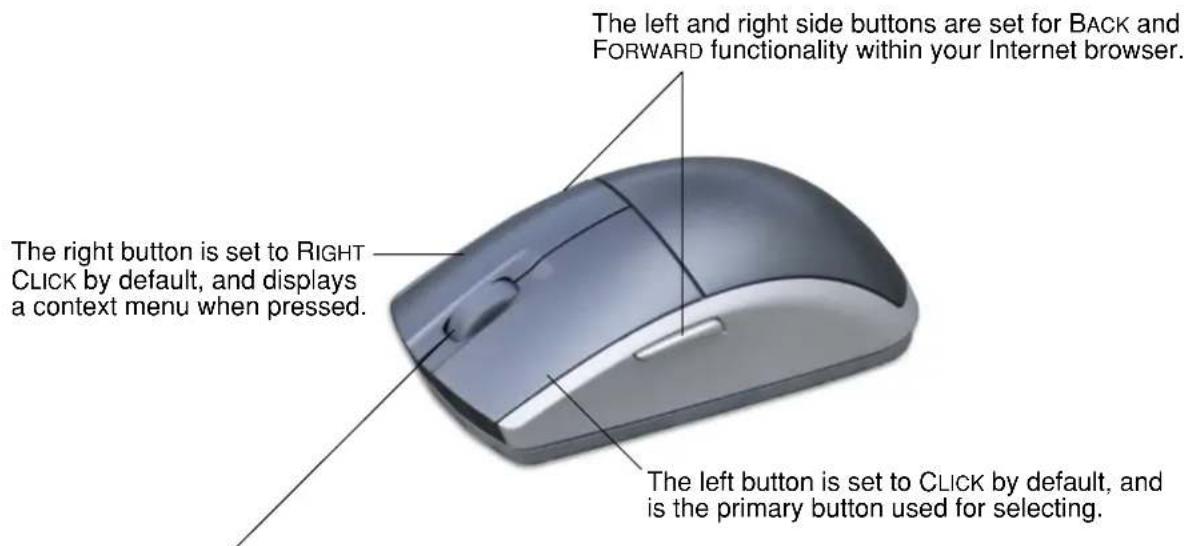
The fingerwheel can be rolled, or pressed down for an additional button function.
- Rolling. By default, rolling the fingerwheel will scroll in most windows and applications. Move the fingerwheel forward to scroll up, and back to scroll down. You can also set the fingerwheel to issue a custom keystroke for each notch of wheel movement. This is useful when working with repetitive functions, such as zooming in Photoshop or moving forward and backward within your Internet browser.
- Wheel button. Press down on the wheel to perform a button click. The wheel button is set to middle-click by default.
Hint: For MS Office applications that support a wheel mouse, press the CTRL key and move the fingerwheel to zoom in and out.
Note: Some product configurations may not include the Intuos3 mouse.
Important: When the Intuos3 mouse is not in use, place it on your desk. Leaving an Intuos3 tool on the tablet may interfere with screen cursor positioning when using other pointing devices, or may prevent your computer from going to sleep.
To learn how to adjust the mouse behavior for your preferences, see customizing themouse.
Using the Airbrush and Art Pen
The optional Intuos3 Airbrush works like the pen, but also includes a fingerwheel for an additional degree of control. With proper software support, you can simulate realistic airbrushing. For example, tilting the Airbrush can cause the spray pattern to elongate and feather out. Rolling the fingerwheel can adjust the spray intensity, and pressure on the tip can control the brush size.
All other functions work similarly to the pen. For additional information, see using the Grip Pen.
Important: When the Airbrush is not in use, lay it flat on your desk. To maintain the sensitivity of your Airbrush tip, do not store the Airbrush in a container where it will rest on its tip. Leaving an Intuos3 tool on the tablet may interfere with screen cursor positioning when using other pointing devices.
Hold the Airbrush with your thumb and middle finger. The fingerwheel should be in a convenient location for you to roll it with your index finger. Tilt the Airbrush to find a comfortable position that allows you to paint and draw with pressure-sensitivity.
For Windows, the side switch is set for a RIGHT CLICK by default. For Macintosh, the switch is set for DOUBLE CLICK.
Roll the fingerwheel backwards to increase ink flow or brush size, and forward to reduce it.
Your index finger should operate the wheel independently of the pressure you apply to the tip.

The optional Intuos3 Art Pen responds to the pressure, tilt, and rotation you apply to the pen.

natural_image
Close-up of a metallic cylindrical object with a dark center and light top, resembling a pen or stylus (no text or symbols visible)The Art Pen supports 360 degrees of rotation around the pen axis. As you draw within an application that supports rotation-sensitivity, simply twist the Art Pen to create lines that narrow or broaden. For example, while painting you can vary the rotation of a non-circular brush to change the stroke thickness.
Depending on the brush shape characteristics you have selected in your application, you can simulate calligraphy pens, broad felt tip markers, and any other non-circular brushes or tools.
Be sure to see the Intuos3 Tips and Tricks located on the Wacom Tablet CD for more information on using the Art Pen.
Visit Wacom's web site to learn where to purchase an Intuos3 Airbrush or Art Pen, and which applications currently support the Airbrush fingerwheel or Art Pen rotation. See product information.
Working with the tablet
The middle area of the Intuos3 tablet is the working, or active, area for the pen and mouse. Rest your hand on the tablet and then work with the pen on the active area of the tablet just as if you were using a ball point pen on a piece of paper. Wherever you place your pen on the tablet active area, the screen cursor will jump to the corresponding point on the screen. See using the Grip Pen and using the mouse for more information about using your input devices on the tablet.
To speed up your workflow in graphics and other applications, all Intuos3 tablets feature ExpressKeys and Touch Strip(s) located next to the tablet's active area. While using the pen with your dominant hand on the active area, you can simultaneously use your other hand to operate the ExpressKeys or Touch Strip. For example, you can change the properties of your tool without removing your hands from the Intuos3 tablet. (Note that 4x5 / A6 and 4x6 / A6 Wide tablet models come with ExpressKeys and a single Touch Strip located to the left of the tablet's active area.)

Touch Strip. Slide your finger over the Touch Strips to zoom, scroll, or perform custom keystroke actions. By default, the Touch Strips enable you to zoom in most graphics applications and to scroll in other applications. You can also set them to issue custom keystrokes. For example, you might set a Touch Strip function to change brush sizes when working in Photoshop.
Using ExpressKeys
Press the ExpressKeys with your secondary hand to toggle between tools or change tool properties while you are using your primary hand to work with your pen on the Intuos3 tablet. The default settings were chosen to optimize your workflow in Photoshop and other graphics applications, using the following modifier keys:
Button 1: CTRL modifier key for Windows. COMMAND (Apple key) for Macintosh.
Button 2: SHIFT modifier key.
Button 3: ALT modifier key for Windows. OPTION modifier key for Macintosh.
Button 4: SPACE key (spacebar).

6x8 / A5 tablet shown.
The ExpressKeys are chordable. For example, pressing keys 3 and 1 together simulates ALT+CTRL in Windows, or OPTION+COMMAND on Macintosh systems.
Tips:
- In Photoshop, pressing the spacebar (key 4 on your Intuos3 tablet) switches the currently selected tool to the hand tool and lets you pan (move) the image within the application window.
- In Photoshop and many other graphics applications, the ALT, CTRL, and SHIFT modifier keys modify a tool or switch to a complementary tool while the modifier key is pressed.
The ExpressKeys are fully customizable, enabling you to make the best possible use of them. You may want to consider the following ways of working with the ExpressKeys:
- Set a pair of keys to commonly used keystrokes, such as [ and ] to decrease and increase your brush size in Photoshop.
- Set a key to a commonly used keyboard shortcut in order to open files or start an application.
- If you prefer not to (or cannot) use the side switches on your Intuos3 pen, then set a key to right- or double-click.
- Choose from any of the other available functions.
See customizing ExpressKeys for more details on the available key settings.
If you require different key functions in different applications, you can easily set up application-specific settings for the tablet controls. See creating an application-specific setting for more information.
Using the Touch Strips
Slide your finger over the Touch Strip to quickly zoom in or out, scroll up or down, or perform other functions with your secondary hand while using your dominant hand to work with your pen or mouse. You can also set each Touch Strip to issue custom keystrokes. For example, you might set a Touch Strip action to cycle through layers when working in Photoshop. You can use the Touch Strips in three different ways:
- Standard operation: Slide your finger up or down to zoom, scroll, or issue the assigned keystroke function.
- Continuous operation: Press and hold your finger at either end of the Touch Strip to continuously scroll. This is useful for scrolling through long documents or web pages.
- Single step operation: Press and release your finger at either end of the Touch Strip to zoom, scroll, or issue the assigned keystroke function one step at a time.
Press and hold here for continuous operation, or press and release for single step operation.
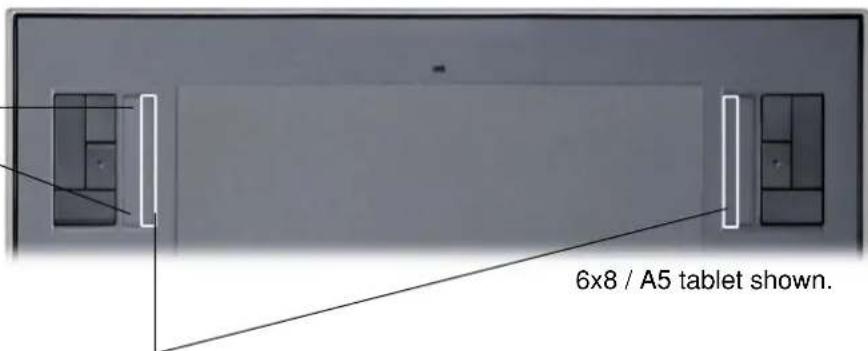
To use the tip of your Intuos3 pen to operate the Touch Strip, rest the pen tip against the edge of the Touch Strip adjacent to the tablet's active area. Then press hard enough to issue a click and move the pen tip up or down along the Touch Strip edge. (Only the inside edge of the Touch Strip responds to pen input.)
By default, the Touch Strips enable you to zoom in most graphics applications and to scroll in other applications. Each Touch Strip can be independently customized to meet your needs.
Tip: Photoshop users who frequently change brush sizes may want to assign the [ and ] keys to a Touch Strip. Sliding your finger up or down the Touch Strip will then change the brush size without the need to reach for the keyboard or access the Photoshop BRUSHES palette.
See customizing tablet Touch Strips and advanced Touch Strip settings if you would like to customize the way your tablet Touch Strip(s) work.
CUSTOMIZING
After you master the basics of using your Intuos3 professional pen tablet, you may want to customize the way Intuos3 works. This chapter describes how to use the Wacom Tablet control panel to adjust your Intuos3 tablet and tool settings.
Advanced users can learn how to further optimize Intuos3 by creating application-specific settings.
Opening the control panel
Control panel overview
Control panel settings
Opening the control panel
To open the control panel, use the Intuos3 tool you wish to customize on the tablet:
- Windows. Click on the Windows START button and choose ALL PROGRAMS. (For Windows 2000, choose the PROGRAMS group.) Then select WACOM TABLET and choose the WACOM TABLET PROPERTIES option.
- Macintosh. Open SYSTEM PREFERENCES from either the Dock, the Apple menu, or from the APPLICATIONS folder. Then click on the WACOM TABLET icon.
After you have opened the Wacom Tablet control panel, you can begin customizing Intuos3.
Control panel overview
Use the Wacom Tablet control panel to customize Intuos3.
The upper portion of the control panel displays icons representing your TABLET, TOOLS, and the APPLICATIONS with customized tool settings.
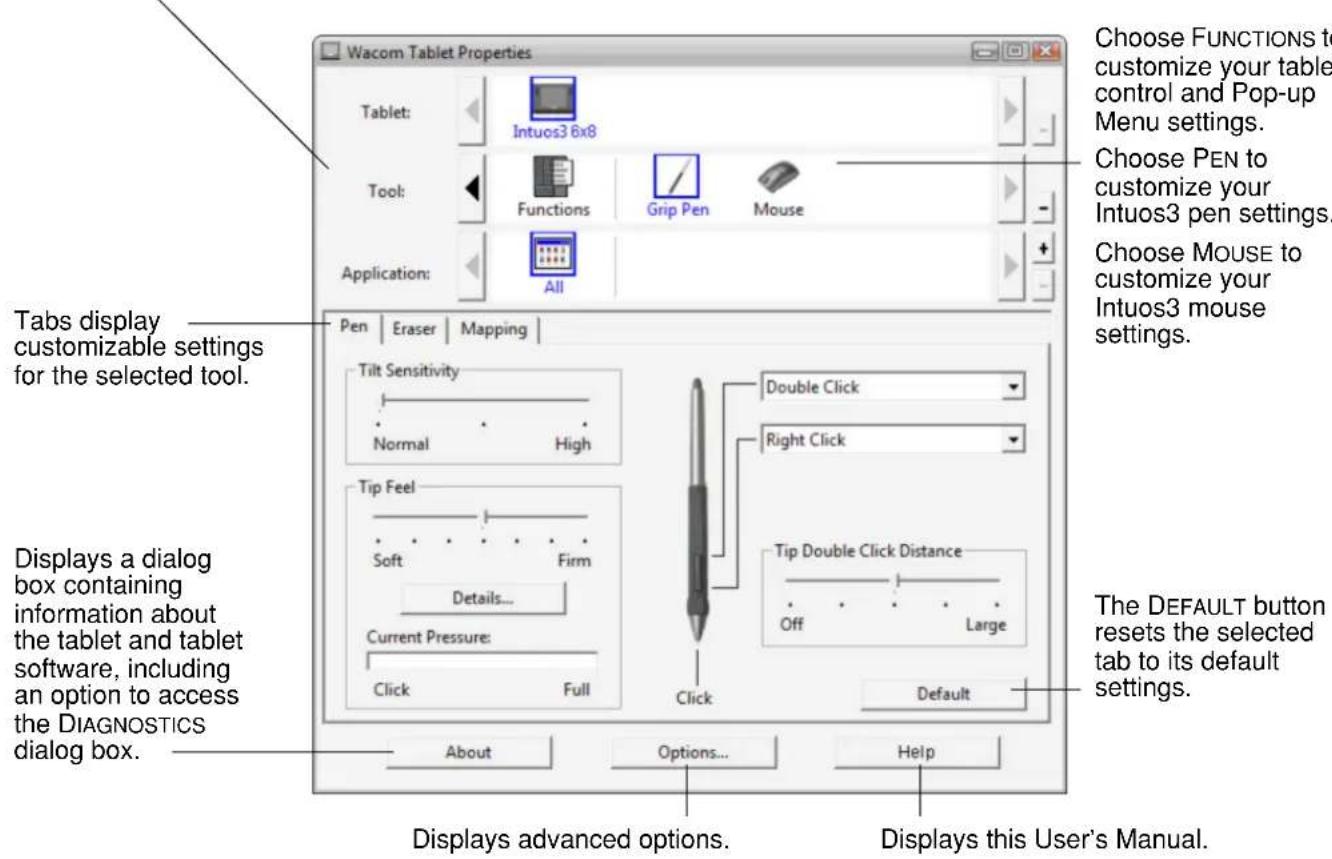
As you explore the control panel, experiment with different settings to find what works best for you. Any changes you make will take effect immediately, but you can always click DEFAULT to return a tab to the factory settings. See control panel settings for more information on the features and functions of each tab.
Tool Tips are available for most control panel items. Simply position the screen cursor over an item and let it rest there; in a few moments the Tool Tip will pop up.
Additionally, your keyboard tab and arrow keys can be used to navigate the control panel.

Control panel lists and tabs: The control panel TABLET, TOOL, and APPLICATION lists allow you to select the tablet, tool, or application for which you want to change settings. To change tool settings, open the control panel using the tool you wish to customize. The tool will be automatically selected in the TOOL list, and the appropriate tabs will be displayed. To customize settings for a different tool, select it from the TOOL list by clicking on its icon (the appropriate tabs will be displayed). See customizing the pen, customizing the mouse, and customizing the tablet functions for more information.
The TABLET list displays an icon for any supported tablet that has been installed on your system. All settings shown below this list apply to the selected tablet.
The TOOL list displays an icon for the tablet FUNCTIONS, and for each Intuos3 tool that has been used on the tablet. When a new tool is first used on the tablet it is automatically added to the tool list, and functions with the default settings. See also working with multiple tools.
The APPLICATION list lets you define tool settings that only apply to a specific application. See working with application-specific settings.

Your current selections are highlighted.
Note: The control panel APPLICATION list is for advanced users; it is not necessary to select or add applications in order to customize your Intuos3 tool(s).
Control panel settings
Use these sections as a reference when working with the Wacom Tablet control panel; they provide detailed information about each tab and some of the more complex topics. Many of the sections also contain useful customizing tips.
Customizing the pen Customizing the mouse Tablet to screen mapping Customizing the tablet functions Customizing the Pop-up Menu Working with multiple tools Working with application-specific settings
Customizing the pen
Customizing your Intuos3 pen is easy. First open the Wacom Tablet control panel using the pen. The pen will be selected in the TOOL list and the appropriate tabs will be displayed. Select a tab and choose from the available options.

Adjusting eraser feel
Customizing tilt sensitivity
Customizing tool buttons
Adjusting tip feel and double-click

Tablet to screen mapping


Working with application-specific settings
Adjusting tip feel and double-click
To adjust the tip sensitivity of your Intuos3 pen, select the PEN tab. To create broad brush strokes or to click with a light touch, use a soft tip setting. For maximum control while drawing thin lines, use a firm tip setting.
Customizes the amount of pressure needed to click or draw. Drag the slider to a softer or firmer setting.
Displays the tip FEEL DETAILS dialog box where you can further customize the tip sensitivity.
Press down on the tablet with your pen tip to test the current tip feel setting. You can use the CURRENT PRESSURE bar to determine how hard you must press on the pen to reach maximum pressure.

Adjusts the size of the double-click area. A larger setting makes double-clicking easier.
Drag the slider to the OFF position if you do not want double-click assist.
Returns the tab settings to their factory default conditions.
Hints:
- Use a soft TIP FEEL for a wider range of pressure values with most pressure-sensitive applications.
- In some applications a soft pressure setting can make the pen overreact – any small press on the pen is magnified on the screen. If you experience this, try a firmer TIP FEEL setting.
- Double-clicking: To make double-clicking easier, expand the tap area that accepts a double-click (the double-click distance).
Note: A large double-click distance may cause a delay at the beginning of your brushstrokes in some drawing applications. If you notice such effects, try setting a smaller double-click distance and using the side switch to double-click (see using the side switch). You can also set one of the ExpressKeys to double-click.
Adjusting eraser feel
To adjust the eraser sensitivity of your Intuos3 pen, select the ERASER tab. To erase with a broad stroke or to click with a light touch, use a soft eraser setting. For maximum control while erasing, use a firm eraser setting.

Advanced tip and eraser pressure settings
To further customize tip or eraser pressure settings, from the PEN or ERASER tab click on the DETAILS... button to display the FEEL DETAILS dialog box. The options within this dialog box enable you to change the tip or eraser pressure sensitivity and click threshold settings independently. (In the PEN and ERASER tabs, these settings are adjusted simultaneously with the TIP FEEL or ERASER FEEL slider.)
Important: The TIP FEEL or ERASER FEEL slider overrides the detail pressure settings. If you customize the detail settings, then drag the slider, your detail settings will be removed.
Drag the slider to select a pressure sensitivity setting. If you have a soft touch and want to achieve full pressure without having to apply full force to your pen, choose a softer setting.

The PROFILE graphically displays the selected pressure SENSITIVITY curve and CLICK THRESHOLD settings.
A curve that increases quickly makes the pen feel more sensitive.
Using your pen tip or eraser, make several strokes within the box to test the results of your changes.
Drag the slider to adjust the click threshold level. This setting determines the amount of force required to generate a tip click.

Customizing tool buttons
Select the PEN tab to change the functions assigned to the side switch and tip of your Intuos3 pen. Each tool button can be set to simulate a variety of mouse functions; the pull-down menus enable you to choose the function that will be performed.

Select the function to perform when pressing the upper or lower side switch.
When you bring the pen tip within 6 mm (0.25 inch) of the tablet surface without touching the tablet and press the upper or lower side switch, the selected function occurs.
Hint: To make double-clicking easier, set the side switch to double-click automatically by selecting DOUBLE CLICK.
Double-click here to change the function assigned to the pen tip.
- At least one tool button should be set to the CLICK function.
• The tip must be set to CLICK in order to draw in most graphics applications.
Returns the tab settings to their factory default conditions.
Note: For the precise placement of right- and middle-clicks, you can enable the SIDE SWITCH EXPERT MODE. Select the OPTIONS... button at the bottom of the control panel to display the OPTIONS dialog box. (SIDE SWITCH EXPERT MODE is the default setting on Tablet PCs.)
Button functions
The following list describes the options available for tool button, tablet control, or Pop-up Menu settings. Please note that not all options are available for all controls.
CLICK. This option simulates a primary mouse button click. Be sure at least one button performs this function so you can always navigate and click.
DOUBLE CLICK. Simulates a double-click. For easier double-clicking, use this function instead of tapping twice with the tip of your pen.
MIDDLE CLICK. Simulates a middle mouse button click.
RIGHT CLICK. Simulates a right mouse button click, which displays a context menu.
CLICK Lock. Simulates holding down the primary mouse button. Press the tool button once to initiate click lock. Press the button again to release click lock. Click lock is useful for dragging objects or selecting blocks of text.
4TH CLICK (BACK). Simulates a 4th mouse button click, which on Windows systems typically issues the BACK command in browser applications.
5TH CLICK (FORWARD). Simulates a 5th mouse button click, which typically issues the FORWARD command in browser applications.
APPLICATION DEFINED. Reports only the button number to the application. This is for applications, such as CAD programs, that have built-in support for the Intuos3 mouse or optional lens cursor.

DEFAULT. Returns a button to its default setting.
DISABLED. Disables the button function.
ERASE. Default setting for the eraser. See erasing for information on using the eraser.
INK TOGGLE. (Macintosh.) Toggles the Ink ANYWHERE function of Inkwell on and off. Inkwell automatically recognizes and converts your handwriting into text and inserts it into a document. Note that Ink must be turned on for this function to work. See your Macintosh help for information on working with Inkwell.
KEYSTROKE.... Enables you to simulate keystrokes.
MODE TOGGLE.... Toggles between PEN and MOUSE mode.
MODIFIER... Enables you to simulate modifier keys.
OPEN/RUN.... Opens an application, file, or script.
POP-UP MENU. Displays a Pop-up Menu on your screen. See customizing the Pop-up Menu for more information.
PRESSURE HOLD. Locks the pressure at the current pressure level until the button is released. For example, you can paint with pressure-sensitivity until you reach the brush size that you like. You can then press the button and continue painting with the same size brush until the button is released.
- Keystroke.... Enables you to simulate keystrokes. Selecting this option displays the DEFINE KEYSTROKE dialog box where you can enter a keystroke or keystroke sequence to play back.
You can manually enter a keystroke or keystroke combination in the KEYS entry box. Keystroke combinations can include letters, numbers, function keys (such as F3) and modifier keys (such as SHIFT, ALT, or CTRL for Windows, or SHIFT, OPTION, COMMAND, and CONTROL for Macintosh).
You can also select special keystrokes or keystroke combinations from the ADD SPECIAL drop-down menu. When you make a selection it is added to the KEYS entry box.
After defining a keystroke or keystroke sequence, click OK.
Important: Because the ENTER (Windows) and RETURN (Macintosh) keys can be selected as a defined keystroke, they cannot be used to select OK. You must use your Intuos3 tool to click on the OK button.
If prompted, enter a name for the keystroke definition. The name will be displayed with the respective control or in the Pop-up Menu list, as applicable.
You can create different keystroke functions for different applications. See working with application-specific settings for more information.

Clears the keystroke entry box.
Deletes only the last entry in the keystroke entry box.
• OPEN/RUN.... Opens a dialog box where you can select a specific application, file, or script to launch.
Click BROWSE... to locate an application, file, or script to launch. The selection you make appears in the APPLICATION TO RUN box.
Click OK to accept the selection. The dialog box will close and the OPEN/RUN... option you have selected will be assigned as your tool button option. If your selection is for the Pop-up Menu, it will be displayed in the Pop-up Menu list.
The next time you press the tool button or make a selection from the Pop-up Menu, the defined application, file, or script will launch.


- MODE TOGGLE.... Toggles between PEN mode and MOUSE mode. When first setting a tool button to MODE TOGGLE..., the MOUSE MODE dialog box is displayed where you can adjust the mouse acceleration and speed.

Note: MOUSE mode settings can be accessed from a number of different locations within the control panel. However, for each input tool and application that you are customizing, only one MOUSE ACCELERATION and SPEED setting can be made.
- M ODIFIER.... Enables you to simulate modifier key(s) (such as SHIFT, ALT, or CTRL for Windows, or SHIFT, OPTION, COMMAND, and CONTROL for Macintosh). Many applications use modifier keys to constrain the size or placement of objects. Selecting this option displays the DEFINE MODIFIER dialog box where you can assign one or more modifier key functions. After choosing the modifier function(s), click OK.
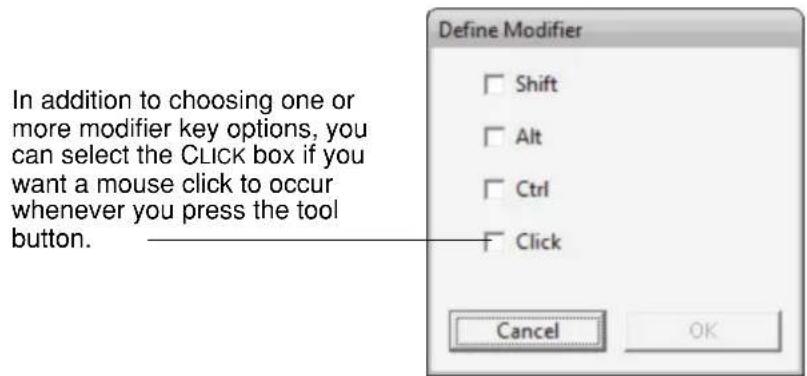
Customizing tilt sensitivity
To adjust the tilt sensitivity of your Intuos3 pen, select the PEN tab. Tilt sensitivity determines how far you have to tilt the tool to produce the maximum tilt effect in your tilt-sensitive applications; you need to tilt the pen less at high sensitivity than at low sensitivity. Like pressure-sensitivity, tilt can be assigned to control brush characteristics. Your tilt setting applies to both the tip and eraser of your tool.
Drag the slider to increase or decrease TILT SENSITIVITY. Then test your new setting in an application that supports tilt to be sure you are getting the desired effect.
Note: Tilt is direction-sensitive and can be used in some applications to control brush orientation.

Returns the tab settings to their factory default conditions.
Visit Wacom's web site for a list of applications that currently support tilt. See product information.
Customizing the mouse
Customizing your Intuos3 mouse is easy. First open the Wacom Tablet control panel using the mouse. The MOUSE tool will be selected in the TOOL list, and the appropriate tabs will be displayed. Select a tab and choose from the available options.
Customizing mouse buttons Customizing the mouse fingerwheel

natural_image
Modern computer mouse with silver and gray casing (no text or symbols visible)
Mouse mode settings

Working with application-specific settings
Customizing mouse buttons
To modify your Intuos3 mouse button settings, use your mouse to open the Wacom Tablet control panel and select the MOUSE tab. As with the Intuos3 pen, you can select a function to perform for each button from the pull-down menus. See button functions for a description of the available options.
Select the function to perform when pressing a button.
The mouse buttons are chordable; you can press two or more buttons simultaneously. For example, if you program one button to simulate the CTRL key and another to simulate an ALT keystroke, when you press both buttons a CTRL+ALT is simulated.
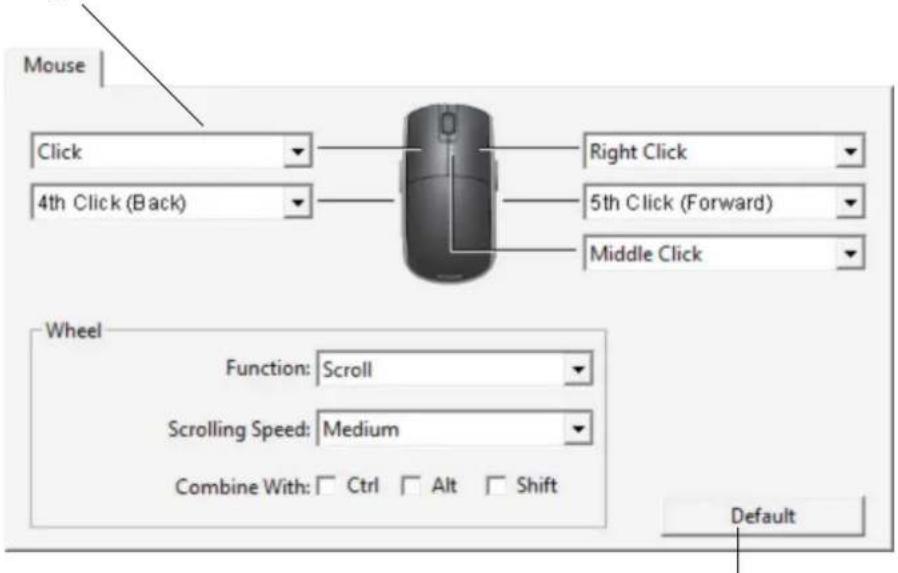
Note: To configure the Intuos3 mouse for left handed use, simply reassign the button functions as needed.
Returns the tab settings to their factory default conditions.
Customizing the mouse fingerwheel
By default, the fingerwheel controls scrolling in most windows and applications. To customize the fingerwheel, use your Intuos3 mouse to open the Wacom Tablet control panel and select the Mouse tab.
These options control the fingerwheel function. You can set the FUNCTION to SCROLL, KEYSTROKE, or DISABLED. The default setting is to SCROLL.
When you select SCROLL from the FUNCTION pull-down menu, the tab displays the custom scroll options.
Choose a scrolling speed that will be used for each notch of wheel movement. Roll the fingerwheel forward to scroll up, and back to scroll down.

Returns the tab settings to their factory default conditions.
When you select one or more COMBINE WITH: modifier key options, the selected option(s) will be sent to the application along with each scroll event. For example, this can be used to create custom zooming or other actions within an application.
Macintosh: The available options are OPTION, COMMAND (Apple key), CONTROL, and SHIFT.
When you select the KEYSTROKE option, the keystroke(s) that you set will be sent once for each notch of wheel movement. To learn which keystroke shortcuts are supported by a particular application, review the documentation that came with the application.
When you select KEYSTROKE, the tab displays the custom keystroke options.
To customize the keystrokes that will be sent for each notch of wheel movement in a particular direction, — click on a keystroke button to enter a keystroke function. The new keystroke setting will be displayed on the CLICK TO SET button.
The KEYSTROKE option is useful when working with repetitive functions, such as zooming in Photoshop or moving forward and backward within your Internet browser.

Hint: To double the speed of a keystroke action, enter the keystroke sequence twice within the DEFINE KEYSTROKE dialog box.
Tablet to screen mapping
To change the relationship between tool movement on your tablet surface and cursor movement on the monitor screen, select the MAPPING tab. The MODE options control how the screen cursor moves:
- Select PEN mode to set the screen cursor so that its movement corresponds with the position of your Intuos3 tool on the tablet – wherever you place your tool on the tablet, the cursor will jump to a corresponding point on the screen. This is known as absolute positioning, and is the default setting for all pens.
- Select M OUSE mode to move the screen cursor with a "pick up and slide" motion similar to using a traditional mouse. This is the default setting for the mouse.
Pen mode
The default MODE for the Intuos3 pen is PEN mode.
In PEN mode, the MAPPING tab looks like this:
The MODE you select controls how the screen cursor moves. In PEN mode, the screen cursor moves with absolute positioning.
Select the ORIENTATION of your tablet.
Note: The ORIENTATION setting is tablet-specific, and applies to all tools and applications. Other MAPPING settings can be customized for a specific tool and application.
SCREEN AREA. Select a monitor screen area for tablet to screen mapping.
FORCE PROPORTIONS. When checked, forces a proportional tablet to screen mapping relationship.
Select a TABLET AREA for tablet to screen mapping.
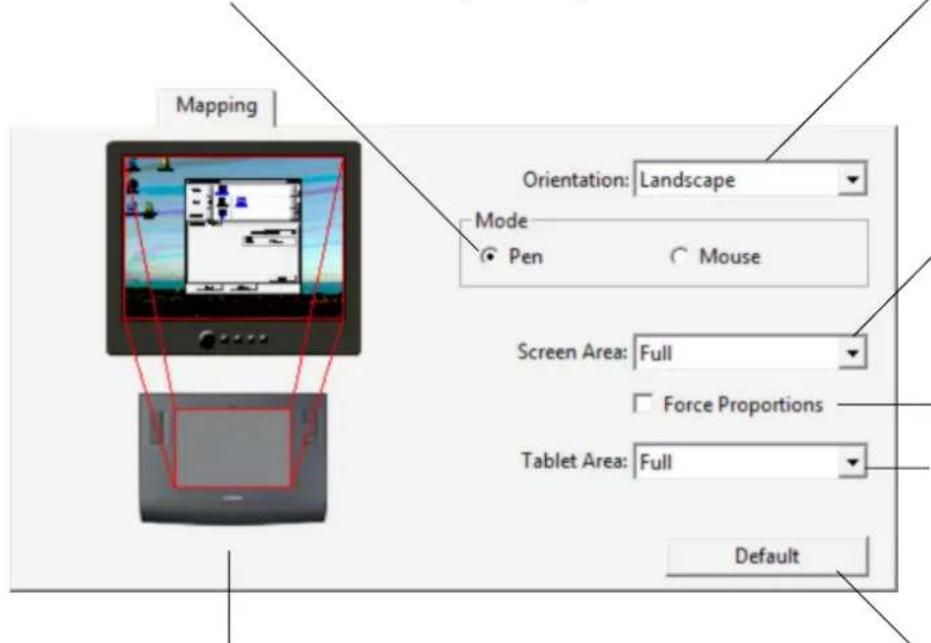
The tablet-to-screen image dynamically updates to illustrate the selected mapping relationship.
Returns the tab settings to their factory default conditions.
Mouse mode
The default MODE for the Intuos3 mouse is MOUSE mode.
With MOUSE mode selected, the MAPPING tab looks like this:
The MODE you select controls how the screen cursor moves. In MOUSE mode, the screen cursor moves with relative positioning.
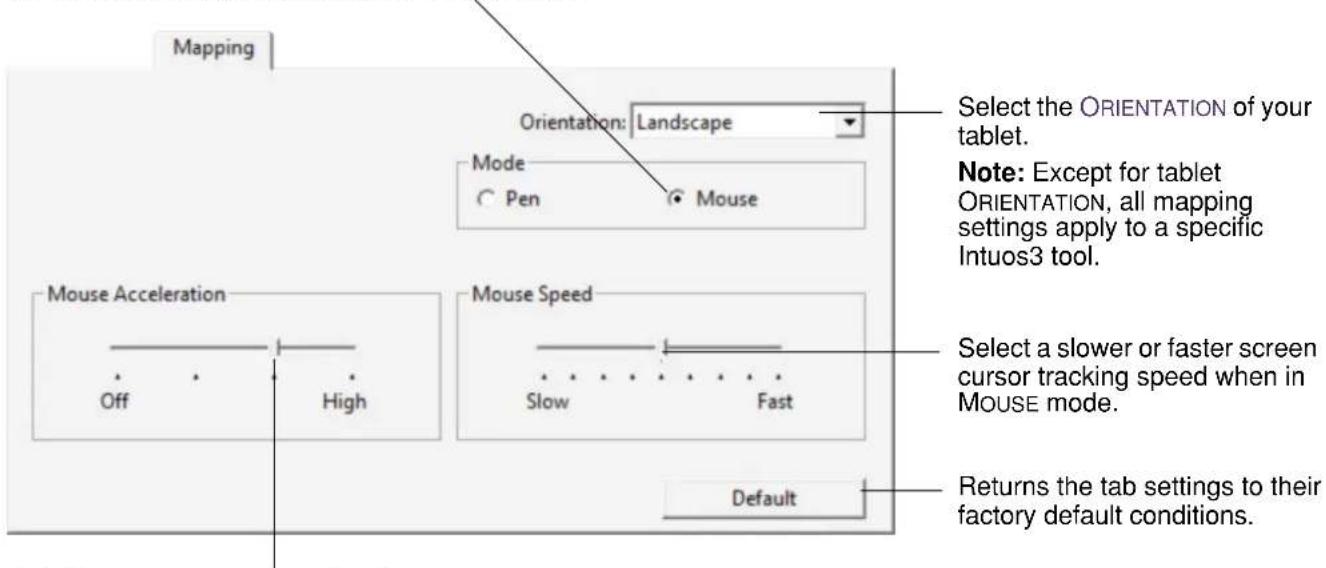
Sets the screen cursor acceleration when in MOUSE mode.
Note: You can also switch between PEN mode and MOUSE mode by using the screen Pop-up Menu. See customizing the Pop-up Menu for more information. If you frequently switch between PEN mode and MOUSE mode, you can assign the MODE TOGGLE... function to one of your tool buttons.
Orientation
You can choose a different tablet ORIENTATION and then physically rotate your tablet to match the selection you have made. This feature can be useful if you prefer to work with the tablet controls on the bottom or either side of your tablet, or if you are working with a tall monitor.
- L ANDSCAPE. Tablet orientation is horizontal, with the tablet status LED at the top. This is the default setting.
- P ORTRAIT. Rotate the tablet 90 degrees clockwise so the tablet status LED is located on the right side.
• LANDSCAPE FLIPPED. Rotate the tablet 180 degrees so the tablet status LED is located near the bottom. - PORTRAIT FLIPPED. Rotate the tablet 90 degrees counter-clockwise so the tablet status LED is located on the left side.
After making changes, verify you have the correct setting for your tablet orientation. Do this by moving your tool "up" on the tablet – the screen cursor should move up as well.
Note: The orientation you select applies to all tools and applications.
Screen area
In the MAPPING tab, the SCREEN AREA options allow you to define which portion of the display screen your tablet will map to:
- F ULL. When selected, the entire monitor(s) area is mapped. This is the default setting. See mapping to multiple monitors for more information.
- PORTION.... When selected, this option allows you to select a portion of the display for tablet to screen mapping. Selecting PORTION... brings up the PORTION OF SCREEN dialog box.
Choose a method for defining a portion of the display:
- Drag corners of the foreground graphic to select the screen area. The background graphic represents the entire screen area.
- Move the screen cursor to select the screen area. Select the CLICK TO DEFINE SCREEN AREA button. As you define PORTION OF SCREEN, follow any MESSAGE prompts to set the portion of your display screen that will be used for mapping.
- Enter pixel values for the TOP, LEFT, BOTTOM, and RIGHT boundary of the display screen area. Values are measured from the top left corner of the display. Be sure to follow any MESSAGE prompts.
After defining a portion of the screen, you may need to use a different input device to access other portions of the screen area.
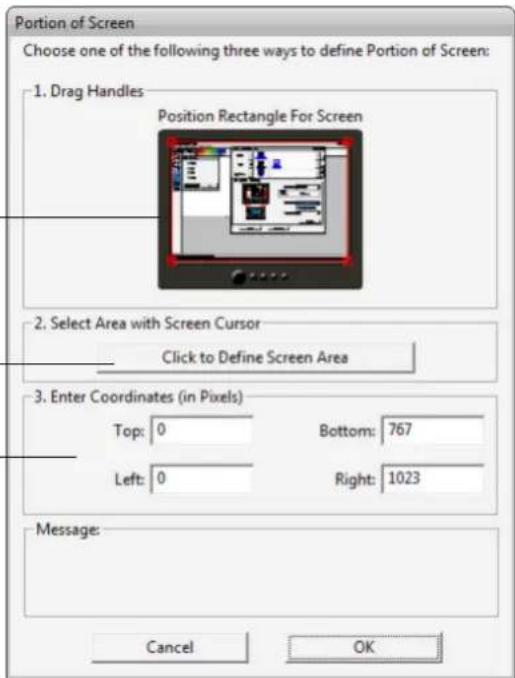
• MONITOR. When selected, the entire area of a single monitor that you choose is mapped. If more than one monitor is connected to your system, an option will be available for each monitor detected.
Force proportions
Check or uncheck the MAPPING tab's FORCE PROPORTIONS box to determine the tablet to screen mapping relationship.
When FORCE PROPORTIONS is unchecked, the correct scale or proportions are not maintained. The selected tablet area is mapped to the selected display area. Drawing a circle on the tablet may create an ellipse on the display screen. This is the default setting for all tools.

natural_image
Computer monitor displaying a red circular graphic on a white screen (no text or symbols visible)When FORCE PROPORTIONS is checked, the correct vertical and horizontal proportions are maintained between the tablet and display. Drawing a circle on the tablet results in a circle on the display screen. Depending on your settings, some portions of the tablet active area may no longer be usable when this option is selected.

natural_image
Computer monitor displaying a red circular graphic on a white screen (no text or symbols visible)Tablet area
The MAPPING tab's TABLET AREA options allow you to define the tablet area that will be mapped to the screen area:
- F ULL. When selected, the entire active area of the tablet is used for tablet to display mapping. This is the default setting.
- P ORTION.... When selected, this option allows you to select a portion of the tablet's active area for tablet to screen mapping. Selecting PORTION... brings up the PORTION OF TABLET dialog box.
Choose a method for defining a portion of the tablet:
- Drag corners of the foreground graphic to select the tablet area that will be mapped to your selected screen area. The background graphic represents the tablet.
- Use your tool on the tablet to select the tablet area. Select the CLICK TO DEFINE TABLET AREA button. As you define PORTION OF TABLET, follow any MESSAGE prompts to set the portion of your tablet that will be used for ____ mapping.
- Enter count values for the TOP, LEFT, BOTTOM, and RIGHT boundary of the tablet area. Values are measured from - the top left corner of the tablet's active area. A count equals one line of tablet resolution. Be sure to follow any MESSAGE prompts.

- QUICKPOINT LEFT and QUICKPOINT RIGHT. These options (available for Intuos3 9x12 / A4-regular, 12x12 / A4 Oversize, and 12x19 / A3 Wide tablets) divide the tablet into two independent areas: a large area for drawing, and a small area for quick navigation. Both areas are mapped to the screen area defined in the PORTION OF SCREEN dialog box, or to the entire display by default. These options can also be selected and deselected using the screen Pop-up Menu. See customizing the Pop-up Menu for more information.
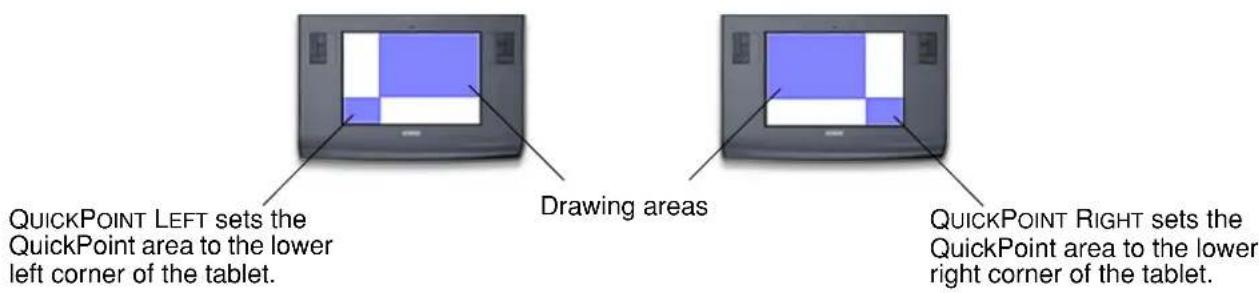
Note: The QuickPoint area and drawing area are indicated by crop marks on the tablet work surface.
Mapping to multiple monitors
When you are working with more than one monitor, your tablet will map to the monitors based upon how your system is configured. By default, if more than one monitor is in use and you are in extended monitor mode, the tablet will map to all monitors as if they were one large display. If you are in mirror mode, the tablet will map to the entire space on each monitor and the screen cursor will be displayed on each monitor simultaneously.
Please refer to your hardware and operating system documentation for details on configuring your computer and operating system for use with multiple monitors.
After you have correctly configured your computer for use with multiple monitors, you can then adjust the tablet mapping by opening the Wacom Tablet control panel and changing the appropriate options.
Customizing the tablet functions
It is as easy to customize your Intuos3 tablet as it is to customize the Intuos3 pen or mouse. Simply open the Wacom Tablet control panel and select the FUNCTIONS icon in the TOOL list. Select a tab to customize, and change settings using the available options.

natural_image
Simple diagram of a cabinet or enclosure with no text, numbers, or symbolsCustomizing ExpressKeys Customizing tablet Touch Strips
Pen
Mouse
QuickPoint Left
QuickPoint Right
Customizing the Pop-up Menu

All Other

Photoshop
Working with application-specific settings
Customizing ExpressKeys
Each key can be customized to perform a modifier, keystroke, or other function. When you select the ExpressKeys tab, the currently selected function of each key appears in the corresponding pull-down menu. See using ExpressKeys for the default key settings, and button functions for a description of the available options.
To customize a key, select an item from the corresponding pull-down menu. Note that only the EFT key group will be available when you are working with a 4x5 / A6 or 4x6 / A6 Wide tablet.
Note: ExpressKeys functions can be defined for use with specific applications, and any changes you make on this tab apply to the currently selected item in the control panel's APPLICATION list. Unless you define application-specific settings, the tab settings will apply to all applications.
Use the pull-down menus to choose a function that will be performed when the key is pressed.
Your choice will be displayed either within the pull-down menu or beneath the menu.
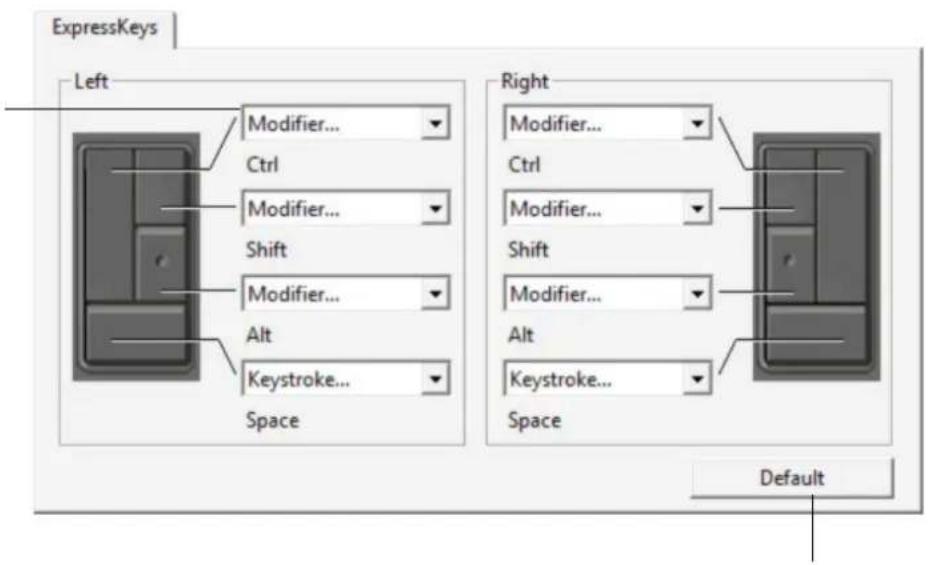
Returns the tab settings to their factory default conditions.
Customizing tablet Touch Strips
When you select the tablet TOUCH STRIP tab, the currently set function of each Touch Strip is displayed. Each Touch Strip can be customized to issue zooming, scrolling, or keystroke actions. You can also disable a Touch Strip until you choose to assign a new function or renew the default settings. Note that only the LEFT Touch Strip group will be available when you are working with a 4x5 / A6 or 4x6 / A6 Wide tablet. Using the Touch Strips gives you additional information on working with the Touch Strips.
Note: Touch Strip functions can be defined for use with specific applications, and any changes you make on this tab apply to the currently selected icon in the control panel's APPLICATION list.
To customize a Touch Strip, choose a Touch Strip FUNCTION to perform when the Touch Strip is in use.
- AUTO SCROLL/ZOOM is the default setting for each Touch Strip. When selected, the Touch Strip zooms in most graphics applications and scrolls in most other applications.
- Choose SCROLL to set custom Touch Strip scroll settings.
- Choose Zoom to set custom Touch Strip zoom settings.
- Choose KEYSTROKES to define Touch Strip keystroke settings.
- Choose DISABLED if you would like to deactivate the Touch Strip.
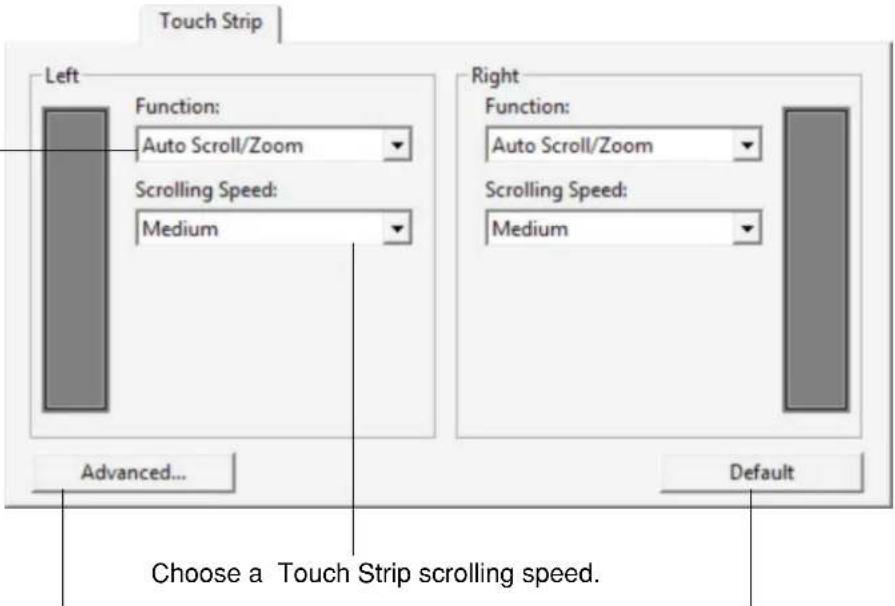
Click to display the ADVANCED TOUCH STRIP SETTINGS dialog box where you can enable or disable special Touch Strip function areas. Advanced Touch Strip settings gives you additional details.
Returns the tab and any advanced Touch Strip settings to their factory default conditions.
- Touch Strip scroll settings. Each tablet Touch Strip can be customized to issue scrolling only actions. When SCROLL is selected, an up or down motion on the Touch Strip will cause a scroll up or down action in most applications.
Note: Some applications may interpret scrolling events as zoom events, or may ignore scrolling completely.
When you select SCROLL from a Touch Strip's FUNCTION pull-down menu, the tab displays the custom scroll options for that Touch Strip.
Choose a Touch Strip scrolling speed.
When you select one or more — COMBINE WITH: modifier key options, the selected option(s) will be sent to the application along with each scroll event. This can be used, for example, to create custom zooming or other actions within an application.
Macintosh: The available options are OPTION, COMMAND (Apple key), CONTROL, and SHIFT.
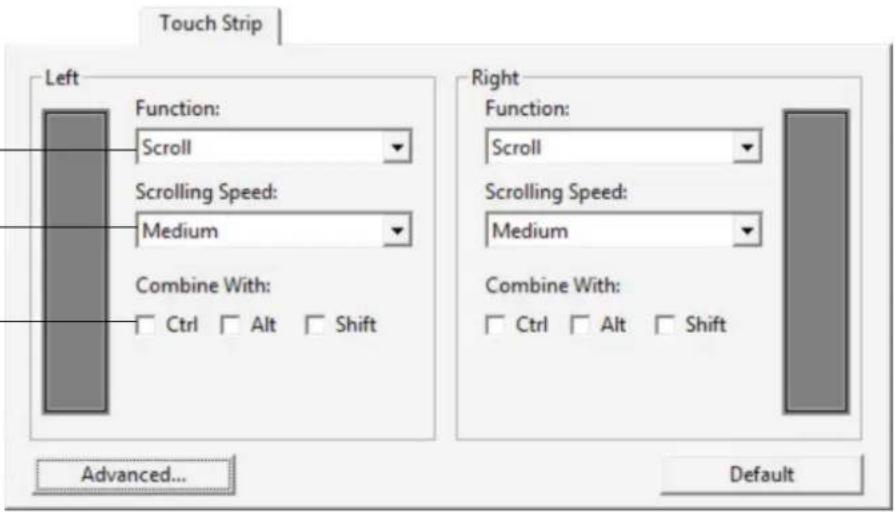
Tip: To zoom images around the current position of the screen cursor when working in Photoshop CS2, select the Touch Strip SCROLL option. Then in Photoshop CS2 select EDIT, PREFERENCES, and GENERAL OPTIONS. In the dialog box that appears, check the option ZOOM WITH SCROLL WHEEL and click OK.
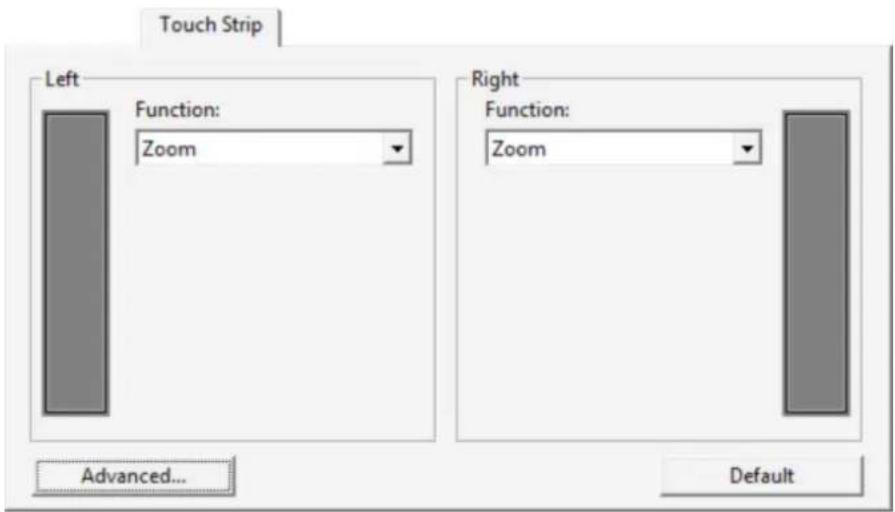
- Touch Strip zoom settings. Each tablet Touch Strip can be customized to issue zoom only actions. When Zoom is selected, an up or down motion on the Touch Strip will cause a zoom in or out action in most graphics applications.
Note: Some applications may interpret zoom events as scrolling events, or may ignore zooming completely.
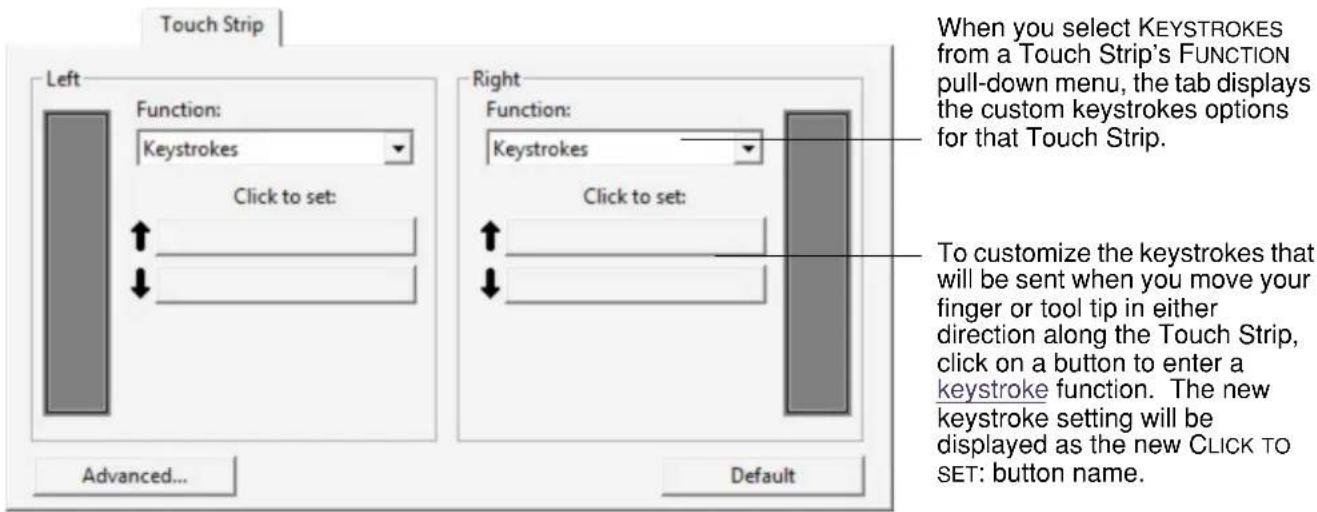
- Touch Strip keystroke settings. Each tablet Touch Strip can be customized to issue custom keystroke actions. After you have customized the Touch Strip for KEYSTROKES functionality, a single keystrokes action will be sent for each Touch Strip event.
Note: To learn which keystroke shortcuts are supported by a particular application, review the documentation that came with the application.
Advanced Touch Strip settings
The tablet Touch Strips can be further customized within the ADVANCED TOUCH STRIP SETTINGS dialog box.
When you click on the TOUCH STRIP tab's ADVANCED... button, the ADVANCED TOUCH STRIP SETTINGS dialog box is displayed. The settings within this dialog box are global, and apply to all applications.
If you prefer not to use the continuous and single — step operations of the Touch Strip, you can disable them by deselecting this box. This option is selected by default.
Using the Touch Strips gives you more information on working with the special function areas.
Check the LEFT or RIGHT box to disable touch — input for a Touch Strip while still allowing you to control the Touch Strip with your Intuos3 pen. Use these settings to avoid accidental operation of a Touch Strip as you move your hand over the Touch Strip area. The boxes are unchecked by default.
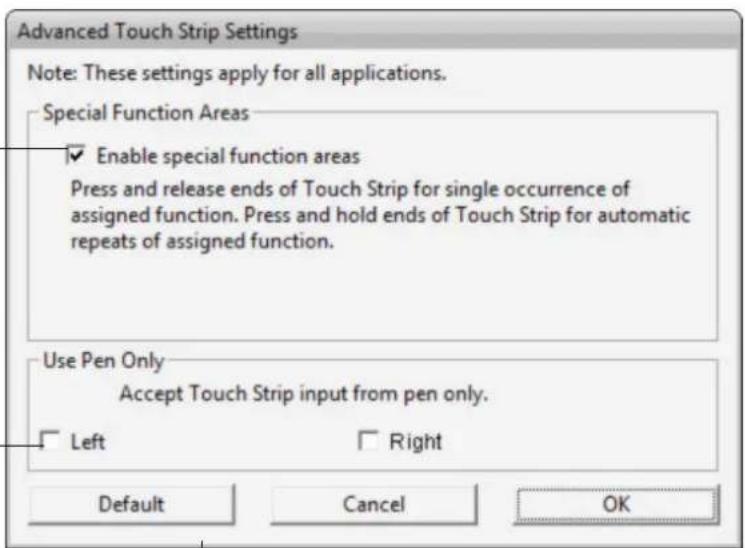
Resets the dialog box options to their original default conditions.
Customizing the Pop-up Menu
Use the POP-UP MENUS tab to define the available functions on the Pop-up Menu list.
To display the Pop-up Menu, set one of your tool buttons to the POP-UP MENU function. Whenever you press that button, the Pop-up Menu is displayed. Select from available items in the Pop-up Menu by clicking on them. To close the Pop-up Menu without making a selection, click outside of the Pop-up Menu.
Displays a list of functions that have been added to the Pop-up Menu. To change the order of an item, drag it to a new location. Double-click on an item to make edits.

Menu options enable you to change the appearance (FONT SIZE and POP-UP FONT) of the Pop-up Menu.
Returns all tab settings to their default values.
Important: This action will delete all Pop-up Menu items that have been defined.
Notes:
PEN places your tool in PEN mode.
MOUSE places your tool in MOUSE mode. When adding MOUSE mode to the Pop-up Menu list, the MOUSE MODE dialog box is displayed where you can adjust the mouse acceleration and speed.
The QUICKPOINT LEFT and QUICKPOINT RIGHT options are available for Intuos3 9x12 / A4-regular and larger tablets.
Working with multiple tools
The Wacom Tablet control panel is designed to help you customize and keep track of your Intuos3 tool settings. The tool you use to open the control panel is automatically selected, and the appropriate tabs for that tool are displayed.

Tip: You can give each tool a different name by double-clicking on the tool's icon and entering a new name. For example, "Drawing Pen" or "Paint Brush". You cannot rename the FUNCTIONS icon.
To add a tool to the control panel's TOOL list, simply use the tool on your Intuos3 tablet.
- When a new tool is placed on the tablet for the first time, it will function with the appropriate default settings for that tool, and not the custom settings of other tools, even if they are identical devices. If the Wacom Tablet control panel is open, the tool is automatically added to the TOOL list and you can customize the tool by changing the tab settings.
- When you select a tool that you have added to the T OOL list, the appropriate tab settings for that tool are displayed. Any changes you make to the tab settings will then apply to that tool. Your changes take effect immediately.
To remove a selected tool from the TOOL list, click on the TOOL list's [−] button. In the dialog box that appears, click DELETE to confirm your selection. The selected tool is removed from the list, along with any custom settings you may have created for it. (A removed tool can be added back to the TOOL list by placing it back onto the tablet.)
Note: The FUNCTIONS icon cannot be removed from the TOOL list.
Working with application-specific settings
You may wish to customize a tool for use with a particular application. For example, you may want a firm pen tip pressure setting in one application and a soft pressure setting in another. The APPLICATION list enables you to add an individual application to the list and then customize your tool settings for that application.
- When no application-specific settings have been created and a tool is selected from the T OOL list, the APPLICATION list displays the ALL icon containing tool settings that apply to all of your applications. In the example below, no application-specific settings have been added for the Intuos3 mouse so the ALL icon is displayed and the mouse will have the same settings in all applications.

- When application-specific settings are added to the APPLICATION list, the ALL icon changes to ALL OTHER, and an application icon is displayed for the newly added application(s). In the following example, application-specific settings have been added for the pen for both Photoshop and Painter.

In the example above, if you select the ALL OTHER icon and make changes to the tab settings, your changes will apply to the PEN in all applications except Photoshop and Painter, which have their own specific pen settings. If you select the icon for PHOTOSHOP and make changes to the tab settings, your changes will apply only to the pen while you are using Photoshop. Likewise, if you select the PAINTER icon and make changes to the tab settings, those changes will only apply while you are using Painter.
When you create application-specific settings, you are creating a separate group of settings for the selected tool and application. See the following sections for additional details:
Creating an application-specific setting
Changing settings for a specific tool and application
Removing application-specific settings
Creating an application-specific setting
To create an application-specific setting, first choose the tablet and tool for which you want to create an application-specific setting. Then click on the APPLICATION list's [ + ] button to display the ADD APPLICATION FOR CUSTOM SETTINGS dialog box.
Choose from one of two methods to select an application:
- Open the application for which you want to create custom settings, and then select that application from the CURRENTLY OPEN APPLICATIONS box.
• B ROWSE to select the executable file of any application installed on your computer.
Your selection is added to the SELECTED APPLICATION box.
Click OK to complete the process.
Note: If two programs have the same executable file name, they will share the same customized settings.
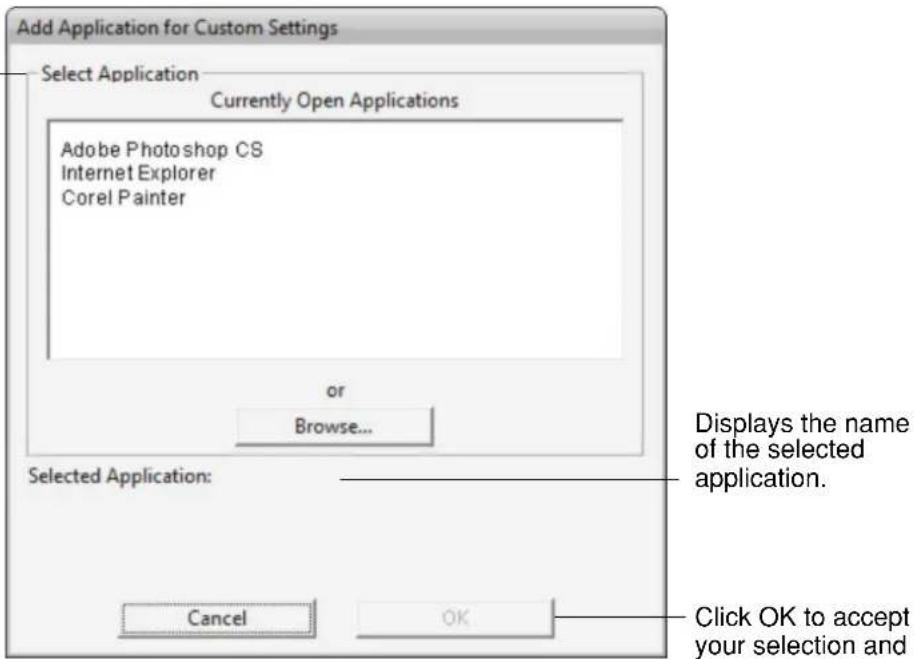
Displays the name of the selected application.
Click OK to accept your selection and close the dialog box.
After adding an application, its icon appears in the APPLICATION list whenever the respective tool is selected in the TOOL list. Select the application and then customize the control panel tab settings for your tool and the selected application.
Once you have created application-specific settings, applications that have not been customized in this manner will use the tool settings for ALL OTHER.
Tip: First customize settings for one application. When you feel comfortable with the process, you can create more application-specific settings.
Changing settings for a specific tool and application
To change tool settings for a specific application, select the tool and the application and then customize the tab settings.
Removing application-specific settings
To remove an application-specific setting:
- In the TOOL list, select the tool from which you want to remove the application-specific setting. Then, in the APPLICATION list select the application you want to remove from the list.
- Click on the APPLICATION list's [−] button. In the dialog box that appears, click DELETE to confirm your selection. The selected application is removed from the list, along with any custom tool settings that you may have created for it.
Hint: To quickly remove all application-specific settings from a single tool, remove the tool from the TOOL list. Then place the tool back on the tablet. The tool will be added back to the TOOL list using the default settings.
TROUBLESHOOTING
Most of the time your tablet will work flawlessly. But if you are having trouble, Wacom recommends you do the following:
- Look in the t roubleshooting tables. Your problem may be described there and you can try the solution offered.
- Open the Wacom tablet Read Me file for late-breaking information.
- Test your tablet and input tools. See testing your tablet and testing your tools.
- If you are having a compatibility conflict between Intuos3 and a new hardware or software product, check if a newer Wacom tablet software driver is available. See obtaining driver downloads for information on downloading an updated software driver. Wacom periodically updates the software driver to maintain compatibility with new products.
- Check the FAQs (Frequently Asked Questions) on the Wacom web site for your region.
- If you have tried the suggestions in this manual and still cannot resolve the problem, then contact Wacom for Technical Support. See the Read Me file for information on where to obtain support for your region.
Testing your tablet
Testing your tools
Troubleshooting tables
Technical support options
Obtaining driver downloads
Testing your tablet
Make sure your computer is turned on, the operating system has finished loading, and the tablet is properly connected to an active powered USB port. Then try the following tests:
- Check the tablet. The tablet's blue status LED will light whenever the tablet is properly connected and your computer has registered it as a USB device. If the LED is on, continue with step 2.
If the status LED does not glow when the computer is on and the system has fully loaded, then:
- Make sure the tablet USB cable is securely connected to an active USB port on your computer. Intuos3 requires that you connect to a primary USB port (located directly on your computer) or to a powered USB hub.
- If you are connecting the tablet to a powered USB hub, be sure the USB hub is properly connected to your computer and is active.
- Connect the tablet to a different powered USB port or try connecting to the powered USB port on another computer.
Note: For best results when troubleshooting no power to the tablet (status LED does not light), Wacom recommends plugging the tablet directly into the system USB port located on your computer. Temporarily eliminate any external hubs in use until you determine that the system recognizes the tablet and that it is functional. When the tablet is working properly, it is usually fine to then move the tablet to a powered USB hub.
If the tablet status LED does not illuminate after your computer is on and has finished booting up, your USB port may be disabled. It may be necessary to check your system BIOS setting to verify that you have connected the tablet to an active USB port.
See also testing your tools for detailed test information.
-
Check the Grip Pen.
-
Move your pen across the active area of the tablet; the screen cursor should move in the corresponding direction on your monitor or display screen.
- Press the pen tip against the surface of the tablet. The status LED should turn from blue to green.
- Next, without applying pressure to the pen tip, hold the pen tip within approximately 6 mm (0.25 inch) of the tablet surface and press the side switch. The status LED should again change from blue to green.
-
Turn the pen over and press the eraser against the surface of the tablet; the status LED should change from blue to green. See testing your tools for detailed test information.
-
Check any other tool(s). See testing your tools.
If these tests fail, you may have a defective input tool or tablet. See technical support options.
Testing your tools
If your tool does not work as you expect, it is a good idea to first check the assigned functions or to reset the tool to its default condition. A quick way to reset a tool to the default settings is to remove it from the TOOL list by clicking on the list's [−] button. After the tool has been removed, place it back onto the tablet and the tool will be re-added to the TOOL list with its default settings.
Open the Wacom Tablet control panel and click on the ABOUT button. In the dialog box that appears, click on the DIAGNOSE... button to open the DIAGNOSTICS dialog box. The DIAGNOSTICS dialog box displays dynamic information about the tablet hardware and pointing devices. This information is used when testing your tablet and tools.
If you have more than one tablet connected to your system, be sure to select the tablet for which you are testing your tool in the TABLET INFO column.
Note: When testing your tool buttons, if a button is set to POP-UP MENU or OPEN/RUN..., that function will occur when the button is pressed. In this case you may want to change that button's function before testing.
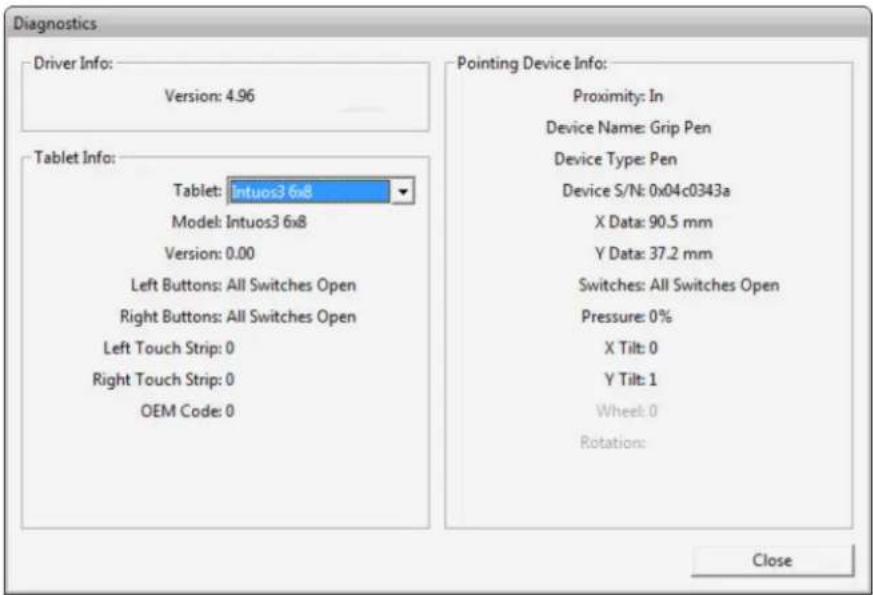
Testing the ExpressKeys
Testing the tablet Touch Strips
Testing a pen
Testing a mouse
Testing the ExpressKeys
- With the DIAGNOSTICS dialog box open, observe the TABLET INFO column as you test the ExpressKeys. If you have more than one tablet connected to your system, be sure to select the tablet in the TABLET INFO column.
- Test the keys on your tablet by clicking them one at a time. Each time you press a key, its number will be displayed next to either the LEFT KEYS or RIGHT KEYS category, depending on which keys group you are testing.
When you are done, click on the CLOSE button to exit the dialog box.
Testing the tablet Touch Strips
- With the DIAGNOSTICS dialog box open, observe the TABLET INFO column as you test the tablet Touch Strip(s). If you have more than one tablet connected to your system, be sure to select the tablet in the TABLET INFO column.
- First, slide your finger up or down along the entire length of the Touch Strip you want to test. As you touch and move your finger along the Touch Strip, a number will indicate the current finger position for the respective Touch Strip next to LEFT TOUCH STRIP or RIGHT TOUCH STRIP.
- Next, slide the pen tip up or down along the Touch Strip edge closest to the tablet's active area. As you move the tool tip along this area of operability, a number will indicate the current pen position for the respective Touch Strip next to LEFT TOUCH STRIP or RIGHT TOUCH STRIP.
- When you are done, click on the CLOSE button to exit the dialog box.
Testing a pen
-
While observing the POINTING DEVICE INFO column, bring your Intuos3 tool within 6 mm (0.25 inch) of the tablet's active area. A value for PROXIMITY, the DEVICE NAME, DEVICE TYPE, and a DEVICE S/N (serial number) should be displayed. If you have more than one tablet connected to your system, be sure to select the tablet for which you are testing your tools in the TABLET INFO column.
-
Move your tool along the tablet surface. The X and Y DATA values should change to reflect the tool position.
-
Test your Intuos3 pen switches. The tablet's status LED should change color from blue to green each time you click with the tool tip, press the side switch, or press the tool's eraser to the tablet.
- Click on the tablet surface with the tool tip – the S WITCHES state and PRESSURE value should change. (PRESSURE should change from approximately 0% with no pressure applied to approximately 100% when full pressure is applied.)
- Next, press the side switch without pressing the tip to the tablet – the S WITCHES state should change. (For the Intuos3 pen, do this for both positions of the DuoSwitch.)
Pen Tip = 1, DuoSwitch (lower position) = 2, DuoSwitch (upper position) = 3,
Eraser = 1
Airbrush Tip = 1, Side Switch = 2, Eraser = 1
- Press the tool's eraser to the tablet – the S WITCHES state and PRESSURE value will change. (PRESSURE should change from approximately 0% with no pressure applied to approximately 100% when full pressure is applied.)
- For the Airbrush, move the fingerwheel forward – the WHEEL value should decrease to a value of approximately 0 when the fingerwheel is all the way forward. Move the fingerwheel backward – the WHEEL value should increase to approximately 1000 when the fingerwheel is all the way back.
-
Test tilt for the x-axis by moving the pen from a vertical position toward the right; the X TILT value should change from approximately 0 to +60. Now move the tool to the left of vertical; the X TILT value should change from approximately 0 to -60.
-
Test tilt for the y-axis by moving the pen from a vertical position toward the bottom of the tablet; the Y TILT value should change from approximately 0 to +60. Now move the tool toward the top of the tablet; the Y TILT value should change from approximately 0 to -60.
-
If you are testing an Art Pen, test pen rotation by holding the pen vertically and twisting it around its axis. The displayed ROTATION value should change.
-
When you are done, click on the CLOSE button to exit the dialog box.
Testing a mouse
- With the DIAGNOSTICS dialog box open, place the Intuos3 mouse on the tablet's active area and test the buttons by clicking each button. The tablet status LED should change color, and the SWITCHES state should change for each button you click.

- When the D IAGNOSTICS dialog box is first opened the WHEEL status should be 0. Move the fingerwheel backward. The WHEEL status should change from 0 to +1.
- Move the fingerwheel forward. The WHEEL status should change to -1.
- When you are done, click on the CLOSE button to exit the dialog box.
Troubleshooting tables
If you encounter problems with your Intuos3 tools or tablet, refer to the following tables. Your problem may be described here, and you can try the solution offered. Be sure you refer to the Read Me file for the latest information updates.
For additional information, visit Wacom's web site at http://www.wacom.com/productsupport and follow the links to the FAQs.
General problems
Windows-specific problems
Macintosh-specific problems
General problems
| The computer does not have an available USB port. | Check if there is an available USB port on a powered USB hub. If not available you will need to add a powered USB hub or USB card. |
| The tablet status LED is off. | Verify that your tablet's USB cable is plugged into a primary USB port (directly into your computer) or into a powered USB hub. If you are connecting to a powered USB hub device, make sure the hub is connected to an active USB port and that the hub is active. |
| After plugging in the tablet, a message appears indicating that the USB device needs more power than is available. | Make sure the tablet is plugged into a primary USB port on your computer or into a powered USB hub attached to your computer. |
| The pen works only in MOUSE mode, and does not draw with pressure-sensitivity. | The tablet driver software was not installed or did not load properly.Make sure the tablet driver software is installed and functioning. Insert the Wacom Tablet CD into your computer and install the driver software for the tablet. |
| The pen does not draw with pressure-sensitivity. | Some applications require that you turn on the pressure capabilities within the application or selected tool before the pen will respond as a pressure-sensitive tool. |
| Clicking is difficult. | Try using a lighter TIP FEEL (see adjusting tip feel and double-click). |

Double-clicking is difficult. Be sure you are quickly tapping the tablet twice in the same place on the tablet's active area.
Using the side switch to double-click is recommended (review the techniques in clicking). See also adjusting tip feel and double-click.
Set one of the ExpressKeys to DOUBLE CLICK and use it to issue double-clicks.
Try increasing the TIP DOUBLE CLICK DISTANCE (see adjusting tip feel and double-click).
Try using a lighter TIP FEEL (see adjusting tip feel and double-click).
Windows: Try setting your system to launch programs with a single click. See clicking.
| The pen selects everything, will not stop drawing. | Open the Wacom Tablet control panel and go to the PEN tab. Move the TIP FEEL slider toward FIRM, or select the DETAILS... button and increase the CLICK THRESHOLD setting. If this does not help, see testing your tools. |
| The eraser selects everything or will not stop erasing. | Open the Wacom Tablet control panel and go to the ERASER tab. Move the ERASER FEEL slider toward FIRM, or select the DETAILS... button and increase the CLICK THRESHOLD setting. If this does not help, see testing your tools. |
| You notice a delay at the beginning of pen strokes. | Try decreasing the TIP DOUBLE CLICK DISTANCE (see adjusting tip feel and double-click). If that does not work, try dragging the TIP DOUBLE CLICK DISTANCE slider to the OFF position in order to turn off double-click assist. |
| You have to press hard with the pen when clicking or drawing. | Open the Wacom Tablet control panel and go to the PEN tab. Move the TIP FEEL slider toward SOFT, or select the DETAILS... button and decrease the SENSITIVITY and CLICK THRESHOLD settings |
| The pen tip does not function. | Make sure the status LED changes from blue to green when the tip is pressed. If it does not, you may have defective hardware (see testing your tools).Check the control panel's PEN tab and verify that the tip is assigned to a CLICK function. |
| Changing the function settings for the Intuos3 tools has no effect. | Make sure that you change the settings for the tool and the application that you are using. See working with multiple tools and working with application-specific settings. |

| The side switch does not work. | Be sure you press the side switch when the pen tip is within 6 mm (0.25 inch) of the tablet's active area – do this without pressing down on the pen tip.From the Wacom Tablet control panel, verify that the side switch is set to the function you are expecting to occur for the application and tool that you are using. Verify also that the SIDE SWITCH EXPERT MODE option is deselected. (This option is accessed by clicking on the control panel OPTIONS... button.)Make sure the tablet status LED changes from blue to green when you press the side switch. If it does not, you may have defective hardware (see testing your tools). |
| The screen cursor jumps back. | Do not place an Intuos3 tool on the tablet when it is not in use, or when you are using another pointing device. Leaving your tool on the tablet may interfere with screen cursor positioning when using other input devices. |
| Cannot move the cursor where you want to on the screen, or the line you are drawing does not line up with the location of the pointer in paint applications. | Open the Wacom Tablet control panel and go to the MAPPING tab. Verify that PEN mode is selected and that the SCREEN AREA is set to FULL for the selected tool and application. If this does not help, click on the DEFAULT button to reestablish tablet to screen mapping. If you are still having difficulty, remove the tablet preferences (see next tip). |
| You suspect the tablet preferences may be corrupted, or want to make certain that all settings are at their factory defaults. | Delete the tablet preferences as follows:Windows: Click the START icon and select ALL PROGRAMS. Then select WACOM TABLET and TABLET PREFERENCE FILE UTILITY. In the dialog box that appears, click on the REMOVE MY PREFERENCE FILE button to delete the preferences for the current user. To delete preferences for multiple users on Windows Vista or XP systems, click on the REMOVE ALL PREFERENCE FILES button. Note that administrator rights are required to delete preferences for all users. Relaunch any currently open tablet-aware applications that you may be running.Macintosh OS X: For a single user, delete the tablet preferences by first choosing your HOME folder from the GO menu. Then open your home LIBRARY folder. Within your home LIBRARY folder, open the PREFERENCES folder and delete the COM.WACOM.TABLETPREFERENCES file. Log out, then log back in. When the tablet driver loads it will create a new preferences file with the factory defaults.For multiple users, delete all tablet preferences by first opening the main APPLICATIONS folder. Then open the TABLET folder and run the REMOVE TABLET utility. When the utility starts, click on the REMOVE ALL PREFERENCE FILES button. Log out, then log back in. When the tablet driver loads, it will create new preferences files with the factory defaults.Note: Do not manually remove the WACOM TABLET.PREFPANE file from the main LIBRARY PREFERENCE PANES folder. This file is only to be removed when uninstalling the tablet software driver, and then only when using the REMOVE TABLET utility. |

| The computer does not go to sleep. | When you are not using your Intuos3 input tool(s), remove them from the tablet surface or the tablet will continue to send data, keeping the computer awake. |
| When using the tablet the screen cursor is very erratic or jumps around. | On rare occasions the tablet may receive interfering radio frequencies from a computer monitor or nearby AM radio station. If you notice interference from a monitor, try moving the tablet at least 6 inches away from the monitor, or change the monitor refresh rate or monitor resolution. |
| The Intuos3 pen does not work on the tablet Touch Strip. | Remember that the pen is active in a narrow band along the Touch Strip edge closest to the tablet's active area. |
Windows-specific problems
After changing right- and left- handed settings in the computer's mouse control panel, the pen tip no longer functions properly and Intuos3 mouse tool button functions are reversed.
This action will reverse the right and left button settings on your Wacom tools. Restart Windows for your Wacom tool settings to be correctly recognized.
Macintosh-specific problems
At startup, a dialog box appears telling you that either the driver failed to load or the tablet preferences have not yet been created.
The tablet was not detected at startup. Make sure the USB interface cable is securely connected and that the status LED on the tablet is blue. If your tablet is plugged into a powered USB hub, make sure the hub is connected and active.
From the Go menu, select APPLICATIONS and open the UTILITIES folder. Launch the APPLE SYSTEM PROFILER and select the DEVICES AND VOLUMES tab. A USB tablet should be displayed by the profiler. If a USB tablet was not found, check the USB tablet cable connection or try plugging the tablet into a different USB port.
If you are still having problems, go to the Applications/Utilities folder, open the Disk Utility program, and run REPAIR DISK PERMISSIONS from the FIRST AID tab. If this does not help, contact Wacom for Technical Support. See technical support options.

Inkwell does not work correctly with tablet.
There may be a problem with the Inkwell preferences. Remove the damaged preference files as follows. They will be recreated when you enable handwriting recognition.
-
From the Apple menu, choose SYSTEM PREFERENCES. From the System Preferences menu, choose SHOW ALL and select INK. Then turn off handwriting recognition.
-
From the G o menu, choose your HOME. Open the LIBRARY and PREFERENCES folders. Then remove the following preferences:
• com.apple.ink.framework.plist
• com.apple.ink.inkpad.plist
• com.apple.ink.inkpad.sketch
- Go back to SYSTEM PREFERENCES and INK, and then enable handwriting recognition.
- Test the Inkwell function using your Wacom tablet and pen.
- If this procedure does not resolve your problem with Inkwell, contact Apple Support for further assistance. Wacom is not the software manufacturer for Inkwell and we are limited in our abilities to support a third party software application.
Technical support options
If you have a problem with your Wacom tablet, first check the tablet installation guide to be sure the unit is installed correctly. Then review the toubleshooting procedures within this manual; your problem may be described there and you can try the solution(s) offered.
If you cannot find the answer in this manual, you may find updated information about your problem in the Read Me file for your platform (located on the Wacom Tablet CD). You can also check the product FAQs (Frequently Asked Questions) on the Wacom web site for your region.
If you have an Internet connection you can download the latest software drivers from the Wacom web site for your region. See obtaining driver downloads for your region.
If you cannot solve the problem and you think your Wacom tablet is not working properly, contact the Wacom support staff for the area where your product was purchased. See the Wacom tablet Read Me file, located on the Wacom Tablet CD, for contact information.
When you call, you should be at your computer with the following information available:
- This manual.
- Tablet serial and model number. (Look on the bottom of the tablet.)
- Driver version number. (See the Wacom Tablet CD or click on the Wacom Tablet control panel A BOUT button.)
- The make and model of your computer, and operating system version number.
- A list of peripheral devices attached to your computer.
- The software application and version you were using then the problem occurred.
- The exact wording of any error message that appeared on your screen.
- What happened and what you were doing when the problem occurred.
• How you tried to solve the problem.
Obtaining driver downloads
Wacom periodically updates the tablet software driver to maintain compatibility with new products. If you are having a compatibility problem between Intuos3 and a new hardware or software product, it may be helpful to download a new Wacom tablet software driver (when available) from the Internet.
USA, Canada, Central and South America
Worldwide Web: http://www.wacom.com/productsupport Driver downloads.
Europe, Middle East and Africa
Worldwide Web: http://www.wacom-europe.com Software updates.
Anonymous FTP Site: ftp://ftp.wacom-europe.com/pub/ Software updates.
Japan
Worldwide Web: http://tablet.wacom.co.jp Software updates. (Japanese)
Asia Pacific (English)
Worldwide Web: http://www.wacom-asia.com Software updates. (English)
China
Worldwide Web: http://www.wacom.com.cn Software updates.
(Simplified Chinese)
Korea
Worldwide Web: http://www.wacomdigital.co.kr Software updates. (Korean)
Taiwan
Worldwide Web: http://www.wacom.com.tw Software updates.
(Traditional Chinese)
APPENDIX
This section contains information and tips on caring for your tablet and tools, instructions on how to uninstall the tablet software, your license and warranty, and more.
Caring for your tablet and tools
Uninstalling the software
Changing the tablet mode
Installing multiple tablets
Intuos3 lens cursor
Working with AutoCAD
Product specifications
Product information
Ordering parts and accessories
Radio and television interference
License and Warranties (Worldwide, Except for
Europe, Africa and Middle East)
License and Warranty (Europe, Africa
and Middle East)
Caring for your tablet and tools
Keep your Intuos3 tools and tablet surface clean. Dust and dirt particles can stick to your tools and cause scratching and wear to the tablet's high-gloss surface. Regular cleaning with a soft, damp cloth will help to prolong the life of your tablet surface and tools; you can also dampen the cloth using a very mild soap diluted with water. Do not use volatile liquids, such as paint thinner or benzene, because they may damage the plastic case.
Keep your tablet and tools in a clean, dry place and avoid extremes in temperature. Room temperature is best. Also, your Intuos3 tools and tablet are not made to come apart. Twisting the pen case can break the pen. Taking apart the product will void your warranty.
Replacing the pen tip
The pen tip (nib) will wear with normal use. When the nib gets too short or develops a flat point, you can replace it with another nib. Simply clasp the old nib with a tweezer, needle-nosed plier, or similar instrument and pull it straight out of the pen. Then slide the end of the new nib straight into the barrel of the pen – firmly push the nib until it stops.

natural_image
Two hands holding small metallic tips, one pointing at a tip and the other holding a tip (no text or symbols visible)Important: When the Intuos3 pen is not in use, place it in the pen stand or lay it flat on your desk. When the optional Airbrush is not in use, lay it flat on your desk. To maintain the sensitivity of your pen or Airbrush tip, do not store the tools in a container where they will rest on their tip or eraser.
Warning: Prevent children from swallowing the pen tip or side switch. The pen tip (nib) or side switch may accidentally be pulled out if children are biting on them.
Note: Stroke nibs are spring-loaded, providing additional tactile feedback when you are working with the Intuos3 pen or Airbrush. Stroke nibs are gray in color and are installed in the same manner as a standard pen nib.
To order replacement parts, see other parts and accessories.
Uninstalling the software
Follow the appropriate procedure below to remove the Wacom tablet driver software from your system.
Important: When you remove the Wacom tablet driver software from your system, any other Wacom tablet connected to your computer will no longer operate with full Wacom tablet functionality.
Windows Vista: Click on the Windows START button and choose CONTROL PANEL. In the CONTROL PANEL window, click on UNINSTALL A PROGRAM. In the dialog box that appears, choose the TABLET option. Click on the REMOVE... button and follow the prompts to remove the tablet driver.
Windows XP or XP x64: Click START. In the start menu, select CONTROL PANEL. Then select ADD OR REMOVE PROGRAMS. In the ADD OR REMOVE PROGRAMS window, choose TABLET and click on the REMOVE button. Follow the prompts to remove the tablet driver.
Macintosh OS X:
From the Go menu, choose APPLICATIONS and open the TABLET folder. Double-click on the REMOVE TABLET icon and select the REMOVE TABLET SOFTWARE button. Enter your administrator login name and password. After the removal is completed, click OK.
Changing the tablet mode
Within the control panel's TABLET list, double-click on the tablet icon to display the TABLET MODE dialog box. The TABLET MODE setting applies to all tools and applications.

Installing multiple tablets
The TABLET list displays an icon for any supported tablet that has been detected on your system, and allows you to select the tablet for which your changes will apply.

To add a new tablet, connect it to your computer.
- For USB tablets, the system searches the USB ports. When the new tablet is found, it is automatically initialized.
- If multiple tablets are installed, the tablet used to open the Wacom Tablet control panel is selected as the default tablet.
To remove one of multiple tablets from the driver, in the Wacom Tablet control panel select the tablet to be deleted and click on the [−] button next to the TABLET list. Note that you will need to restart your computer before you can re-add the tablet to the driver.
Intuos3 lens cursor
Available for use with 12x12 / A4 Oversize and 12x19 / A3 Wide tablet models, the lens cursor is an ideal tool for entering precise coordinate position information into your computer. The lens cursor reports the position of the cross-hair to the computer. This makes the lens cursor especially useful for digitizing drawings into graphics and CAD applications.

Lens cursor equipped with programmable buttons.
The default setting for the Intuos3 lens cursor is MOUSE mode, enabling you to move the screen cursor with a "pick up and slide" action similar to using a traditional mouse. When using the lens cursor to digitize a drawing, the lens cursor must be set to PEN mode.
Important: When the lens cursor is not in use, place it on your desk. Leaving an Intuos3 tool on the tablet may interfere with screen cursor positioning when using other pointing devices.
For order information on this and other available Intuos3 tools, see ordering parts and accessories.

Working with application-specific settings

Mouse mode settings
Customizing the lens cursor
To modify your Intuos3 lens cursor button settings, use your lens cursor to open the Wacom Tablet control panel and select the MOUSE tab. As with the Intuos3 pen, you can select a function to perform for each button from the pull-down menus. See button functions for a description of the available options.
The lens cursor buttons are chordable; you can press two or more buttons simultaneously. For example, if you program one button to simulate the CTRL key and another to simulate an ALT keystroke, when you press both buttons a CTRL+ALT is simulated.
Note: To configure the Intuos3 lens cursor for left handed use, simply reassign the button functions as needed.
Testing the lens cursor
- With the DIAGNOSTICS dialog box open, place the Intuos3 lens cursor on the tablet's active area and test the buttons by clicking each button. The tablet status LED should change color, and the SWITCHES state should change for each button you click.

Intuos3 lens cursor
- When you are done, click on the C LOSE button to exit the dialog box.
Working with AutoCAD
AutoCAD can support the Intuos3 tablet as a Windows system pointing device or as a Wintab compatible digitizer. By default, AutoCAD is configured to use Intuos3 as a system pointing device. If you will be using Intuos3 with tablet menus or to digitize drawings to proper scale, you will need to follow the procedures below.
Note: To configure the lens cursor or mouse for left handed use in AutoCAD or similar applications, open the Wacom Tablet control panel, click on OPTIONS... and select LEFT in the HANDEDNESS group.
Configuring AutoCAD for a Wintab compatible digitizer
- Start AutoCAD. Open the TOOLS menu and select OPTIONS.
- From the OPTIONS window, select the SYSTEM tab.
- Under CURRENT POINTING DEVICE, select the Wintab compatible digitizer option.
- Decide from which device AutoCAD will accept input. Choose an option from the ACCEPT INPUT FROM section:
• D IGITIZER ONLY. The AutoCAD drawing editor only accepts input from Intuos3.
• DIGITIZER AND MOUSE. The AutoCAD drawing editor accepts input from both Intuos3 and your mouse.
- Click OK to close the OPTIONS window.
Configuring tablet menus and screen pointing areas in AutoCAD
A screen pointing area is a rectangular region on the tablet surface where the tablet acts like a system mouse. When the pointer is within a screen pointing area, the tablet can access windows, menus, and other applications outside AutoCAD's drawing area. You can configure both a fixed and floating screen pointing area.
Before you configure the tablet, its entire surface is the fixed screen pointing area. AutoCAD recommends that you change the size of the fixed screen pointing area so that a small screen area on your tablet maps to the entire monitor screen. AutoCAD also recommends that you select the default tablet menus, columns, and rows they provide.
After you configure the tablet menus, AutoCAD prompts you for the fixed and floating screen pointing areas. This allows you to designate a tablet area as a Windows system pointer.
The fixed screen pointing area is disabled when you digitize points into AutoCAD with TABLET MODE ON. This is due to the fixed correspondence between the tablet and AutoCAD's drawing area. To access menus from the tablet, you must use the floating screen pointing area. This allows you to access a menu from anywhere on the tablet surface, and to toggle it off when finished. You can define a tool button to toggle the floating screen area on and off.
Important. The floating screen pointing area takes precedence over menu areas, Tablet Mode On, and the fixed screen pointing area.
- From the D RAWING EDITOR, open the TOOLS menu (OPTIONS menu for Release 13).
- Select TABLET, and then CONFIGURE.
- Define tablet menu areas. Follow the prompts at the bottom of the AutoCAD Drawing Editor. Type the number of tablet menu areas you want (0-4) and press ENTER. If you do not want to use a menu template, type 0 (zero). Digitize the upper-left, lower-left, and lower-right corners of the menu area and then press ENTER. Next, enter the number of columns and press ENTER. Now enter the number of rows and press ENTER. Repeat for each menu area.
- Define the fixed screen pointing area. By default, the entire tablet is a fixed screen pointing area. If you are using a menu template, you should re-specify the fixed screen pointing area to match the template. Continue to follow the prompts at the bottom of the AUTOCAD DRAWING EDITOR screen.
- Define the floating screen pointing area – it allows you to access all areas of the screen. The floating screen pointing area takes precedence over TABLET MODE ON, the fixed screen pointing area, and the menu areas. Continue to follow the prompts at the bottom of the AUTOCAD DRAWING EDITOR screen.
Please check your AutoCAD documentation for additional information.
Calibrating Intuos3 for AutoCAD
If you are using Intuos3 to digitize a drawing, you will need to calibrate Intuos3 with the paper drawing's coordinate system. The calibration allows you to digitize points from the paper drawing into the appropriate coordinate system of your drawing file.
-
From the D RAWING EDITOR, open the TOOLS menu (OPTIONS menu for Release 13).
-
Choose the TABLET and CALIBRATE options, then:
-
Digitize point #1 on the paper drawing. Then enter the xy coordinate from the paper drawing at the digitized point.
- Digitize point #2 on the paper drawing. Then enter the xy coordinate from the paper drawing at the digitized point.
-
Digitize more points if necessary. More than four points may take more time than expected for AutoCAD to compute the best-fitting projective transformation.
-
Press E NTER when you are done.
When Intuos3 has been configured as a digitizer and calibrated, you can use CTRL+T to toggle between using Intuos3 as a digitizer and as a Windows system pointer.
Product specifications
General specifications for all Intuos3 tablets
Coordinate resolution 200 lpmm (5080 lpi)
Accuracy, pen +/- 0.25 mm (0.010 in)
Accuracy, mouse +/- 0.5 mm (0.020 in)
Accuracy, lens cursor +/- 0.15 mm (0.006 in)
Tilt range (all pens) +/- 60 degrees (+/- 50 degrees on Intuos3 4x5 / A6 and 4x6 / A6 Wide tablets)
Reading height 6 mm (0.25 in)
Maximum report rate 200 points per second
ExpressKeys stroke 1 mm (0.04 in), approximately
Touch Strips (L x W) 52 mm (2.0 in) x 12 mm (0.47 in)
Communication interface USB
Connector USB A
Cable length 2.5 m (8.2 ft)
Power requirements DC 5V, less than 300 mA, from primary USB port or powered USB hub
Power consumption Less than 1.4 watts
Operating temperature 5 to 40 degrees C (41 to 104 degrees F)
Storage temperature -10 to +60 degrees C (14 to 140 degrees F)
Operating relative humidity 20% to 80% noncondensing
Storage relative humidity 20% to 90% noncondensing
Certification and compliance FCC class B, VCCI class B, CE, BSMI, MIC, C-Tick, SASO
Intuos3 4x5 / A6 tablet (model PTZ-430)
Active area (W x D) 127.0 x 101.6 mm (5.0 x 4.0 in)
Physical size (W x D x H) 238.5 x 217.0 x 13.0 mm (9.4 x 8.5 x 0.5 in)
Weight 600 g (1.32 lb), approximately
Intuos3 4x6 / A6 Wide tablet (model PTZ-431W)
Active area (W x D) 157.5 x 98.4 mm (6.2 x 3.9 in)
Physical size (W x D x H) 270.0 x 216.0 x 13.0 mm (10.6 x 8.5 x 0.5 in)
Weight 800 g (1.76 lb), approximately
Intuos3 6x8 / A5 tablet (model PTZ-630)
Active area (W x D) 203.2 x 152.4 mm (8.0 x 6.0 in)
Physical size (W x D x H) 345.0 x 261.5 x 13.0 mm (13.6 x 10.3 x 0.5 in)
Weight 1 kg (2.2 lb), approximately
Intuos3 6x11 / A5 Wide tablet (model PTZ-631W)
Active area (W x D) 271.0 x 158.8 mm (10.68 x 6.26 in)
Physical size (W x D x H) 417.6 x 262.0 x 14.0 mm (16.5 x 10.3 x 0.6 in)
Weight 1.4 kg (3.1 lb), approximately
Intuos3 9x12 / A4-regular tablet (model PTZ-930)
Active area (W x D) 304.8 x 228.6 mm (12.0 x 9.0 in)
Physical size (W x D x H) 439.5 x 340.0 x 14.0 mm (17.3 x 13.4 x 0.6 in)
Weight 1.8 kg (3.96 lb), approximately
Intuos3 12x12 / A4 Oversize tablet (model PTZ-1230)
Active area (W x D) 304.8 x 304.8 mm (12.0 x 12.0 in)
Physical size (W x D x H) 439.5 x 429.3 x 36.4 mm (17.3 x 16.9 x 1.4 in)
Weight 2.1 kg (4.62 lb), approximately
Intuos3 12x19 / A3 Wide tablet (model PTZ-1231W)
Active area (W x D) 487.6 x 304.8 mm (19.2 x 12.0 in)
Physical size (W x D x H) 622.5 x 428.5 x 36.4 mm (24.5 x 16.9 x 1.4 in)
Weight 3.0 kg (6.60 lb), approximately
Intuos3 Grip Pen (model ZP-501E)
Pressure levels 1024 levels
Eraser tip travel 1.3 mm (0.05 in), approximately
Physical size (L x D) 174.8 x 14.8 mm (6.89 x 0.58 in)
Weight 17g (0.60 oz), approximately
Intuos3 mouse (model ZC-100)
Physical size (L x D x H) 112.0 x 58.0 x 38.0 mm (4.41 x 2.28 x 1.50 in)
Weight 105 g (3.7 oz), approximately
Button stroke 1 mm (0.04 in), approximately
Fingerwheel type Rotation, 24 clicks per revolution
Intuos3 Airbrush (model ZP-400E)
Fingerwheel travel 10 mm (0.39 in)
Fingerwheel resolution 1024 levels
Pressure levels 1024 levels
Eraser tip travel 1.3 mm (0.05 in), approximately
Physical size (L x W x D) 162.5 x 17.5 x 32.5 mm (6.40 x 0.69 x 1.28 in)
Weight 23.1 g (0.81 oz), approximately
The Airbrush is an optional accessory.
Intuos3 Ink Pen (model ZP-130)
Pen tip travel 0.2 mm (0.008 in) or less
Pressure levels 1024 levels
Physical size (L x D) 151.5 x 12.5 mm (5.97 x 0.49 in)
Weight 12 g (0.42 oz), approximately
The Ink Pen is an optional accessory.
Intuos3 Art Pen (model ZP-600)
Pen tip travel 0.2 mm (0.008 in) or less
Pressure levels 1024 levels
Physical size (L x W x D) 146.7 x 15.5 x 12.5 mm (5.78 x 0.61 x 0.49 in)
Weight 14 g (0.49 oz), approximately
The Art Pen is an optional accessory.
Intuos3 Classic Pen (model ZP-300E)
Pen tip travel 0.1 mm (0.004 in) or less
Pressure levels 1024 levels
Eraser tip travel 1.3 mm (0.05 in), approximately
Physical size (L x D) 150.7 x 12.2 mm (5.94 x 0.48 in)
Weight 12 g (0.42 oz), approximately
The Classic Pen is an optional accessory.
Intuos3 lens cursor (model ZC-210)
Physical size (L x D x H) 159 x 66 x 33 mm (6.26 x 2.60 x 1.30 in)
Weight 75 g (2.65 oz), approximately
Button stroke 1 mm (0.04 in), approximately
The lens cursor is an optional accessory for use with the Intuos3 12x12 / A4 Oversize and 12x19 / A3 Wide tablet models.
Product information
To learn more about which software applications are currently tablet enhanced to support the pressure-sensitivity, tilt-sensitivity, eraser, and other special functionality of your Intuos3 tablet and tools, visit the Wacom web site for your region:
USA, Canada, Central and South America http://www.wacom.com/productinfo
Europe, Middle East and Africa http://www.wacom-europe.com
Japan http://tablet.wacom.co.jp
Asia Pacific (English) http://www.wacom-asia.com
China (Simplified Chinese) http://www.wacom.com.cn/chanpin
Korea http://www.wacomdigital.co.kr
Taiwan http://www.wacom.com.tw
Thailand http://www.wacom-thai.com
Ordering parts and accessories
Your Intuos3 professional pen tablet is the ultimate master tool for creative professionals. The tablet, combined with your Intuos3 Grip Pen and other available Intuos3 tools, enables you to paint more intuitively, illustrate better, and edit imagery faster than ever before. Each Intuos3 Grip Pen and accessory features Tool ID, which means they always remember your preferences and work together seamlessly. To further expand the features of Intuos3, be sure to check out the accessories described on the following pages.
To purchase parts and accessories, refer to the tablet Read Me file and see who to call for your region.
You can also do the following:
To purchase parts and accessories in the USA or Canada, call 1.888.884.1870 (toll-free) or visit Wacom's web site at http://www.wacomdirect.com (USA only).
To purchase parts and accessories in Europe, call +49 (0)180 500 03 75 or send an email to parts@wacom-europe.com. Or, visit www.wacom-europe.com/solutionstore. You can also contact your local dealer, distributor, or Technical Support using the appropriate number for your region.
To purchase parts and accessories in other countries, please contact your local dealer or distributor.
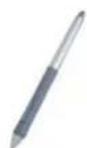
Intuos3 Grip Pen (ZP-501E). Sensitive to pressure and tilt, the Grip Pen is an all-purpose tool for use in drawing, erasing, and mouse operations. The easy-to-use DuoSwitch gives you two programmable switch functions. The pressure-sensitive pen has an ergonomic, waisted and rubberized grip area, optimum weight and balance, and superior tip sensitivity, making it the most natural freehand tool.

Intuos3 mouse (ZC-100). The cordless, battery-free, five button mouse is an ideal tool for performing any task you may have done previously with a standard mouse. It includes an integrated middle button and rolling fingerwheel that can be used for up and down scrolling, or it can be programmed for a variety of other actions.

Intuos3 Airbrush (ZP-400E). A true digital airbrush, the pressure-sensitive Intuos3 Airbrush incorporates a pressure-sensitive tip and eraser, tilt sensitivity, and a fingerwheel that provides an additional degree of control over the application of digital paint.

Intuos3 Ink Pen (ZP-130). This pressure- and tilt-sensitive drawing pen was created to provide immediate feedback at your pen tip on the drawing as well as on your computer screen. The pressure-sensitive Ink Pen comes with inking cartridges and two polyacetal tips for inkless drawing. It has a pressure-sensitive tip, but no eraser and no side switches.
Note: When you purchase an Ink Pen, it comes with a blank nib in the pen. Use the nib puller (silver ring) to gently remove the blank nib from the pen. Then insert one of the silver-colored cartridges that come with the Ink Pen. The cartridge tip has a waxy coating that you will need to rub off before you can begin inking.
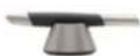
Intuos3 Art Pen (ZP-600). This specialty pen provides 360 degrees of barrel rotation and, like the Intuos3 Grip Pen, it is pressure and tilt sensitive. Combining these features with a unique chisel-shaped nib makes the Intuos3 Art Pen the most realistic tool for emulating brushes, markers, and calligraphic pens.

Intuos3 Classic Pen (ZP-300E). This pen has the same feature set as the Intuos3 Grip Pen, but with a slimmer profile that does not include a rubberized grip.

Intuos3 lens cursor (ZC-210). Available for use with 12x12 / A4 Oversize and 12x19 / A3 Wide tablet models, the lens cursor is a precise coordinate position input tool. It is ideal for digitizing drawings, for CAD processes, or for vector design applications where the precise input of coordinate information is critical. The moveable lens can be swung from left to right for comfortable positioning while you work.
Other parts and accessories
Description Part Numbers


| Pen stand, for Grip Pen PST-A034 | |
| Replacement nibs for Grip Pen, Airbrush, or Classic PenStandard nibs (white) PSI-A007 | |
| Stroke nibsStroke nibs are spring-loaded, providing additional tactile feedback when you are working with the Grip Pen. Airbrush, or Classic Pen.Stroke nibs are gray in color and are installed in the same manner as a standard pen nib. See replacing the pen tip. | PSI-A042 |
| Felt nibs PSI-A043 | |
| Intuos3 Grip Pen accessory kit. Includes pen grip (for pen use without side switch), replacement side switch, 5 standard nibs, 5 stroke nibs, 5 felt nibs, and a nib extractor tool. | FUZ-A118 |
For order information, see ordering parts and accessories.
Radio and television interference
The equipment described in this manual generates, uses, and can radiate radio-frequency energy. If it is not installed and used properly—that is, in strict accordance with Wacom instructions—it may cause interference with radio and television reception.
FCC notice
This device complies with Part 15 of the FCC Rules. Operation is subject to the following two conditions: (1) this device may not cause harmful interference, and (2) this device must accept any interference received, including interference that may cause undesired operation.
This equipment has been tested and found to comply with the limits for a Class B digital device, pursuant to Part 15 of FCC Rules. These limits are designed to provide reasonable protection against harmful interference in a residential installation.
This equipment generates, uses and can radiate radio frequency energy and, if not installed and used in accordance with the instructions, may cause harmful interference to radio communications. However, there is no guarantee that interference will not occur in a particular installation.
You can determine whether the tablet is causing interference by powering it off. If the interference stops, it was probably caused by the tablet.
If your tablet does cause interference to radio or television reception, you may be able to correct the interference by using one or more of the following measures:
- Rotate the television or radio antenna until the interference stops.
- Move the tablet farther away from the television or radio.
- Plug the tablet and computer into an outlet that is on a different circuit from the television or radio.
If necessary, consult your Wacom dealer or an experienced radio/television technician for help.
Changes or modifications to this product not authorized by Wacom could void the FCC Certification and negate your authority to operate the product.
CE declaration
The Intuos® 3 digitizing tablets, models PTZ-430, PTZ-431W, PTZ-630, PTZ-631W, PTZ-930, PTZ-1230, and PTZ-1231W have been tested and found to comply with the following harmonized European Norms:
• EN 55024 (electromagnetic immunity)
• EN 55022 Class B (electromagnetic emissions)
Based on the results of these tests, Wacom declares that the above mentioned devices conform to Article 10.1 of the European Council Directive 89/336/EEC, and their amendment Directive 93/68/EEC, and indicates this conformity by the CE-sign on each device.
The device must be installed and operated always in strict accordance with the instructions given in this handbook. Any changes or modifications to this product that were not specifically authorized by Wacom will invalidate this declaration.
License and Warranties
(Worldwide, Except for Europe, Africa and Middle East)
Software License
This legal document is an agreement between you, the end-user, and Wacom Technology Corporation (Wacom).
- Grant of License. The enclosed product includes computer programs embedded in firmware and accompanying diskette or CD-ROM (the "Software"). The Software is licensed, not sold, to you for use only with Wacom products upon the terms of this license, and Wacom reserves any rights not expressly granted to you. Wacom grants to you a non-exclusive right to use this copy of the Software in conjunction with a Wacom product at a single location.
- Ownership of Software. Although you may own the product in which the Software is originally recorded, Wacom retains ownership of the Software itself. You acknowledge that the Software is Wacom's property, and contains valuable confidential, unpublished information developed or acquired by Wacom at great expense, including data processing algorithms, innovations and concepts. The Software is protected by copyright and other federal and state laws. You agree to use your reasonable best efforts to protect the Software from unauthorized reproduction, distribution, disclosure, use, or publication.
- Copy Restrictions. Unauthorized copying of the Software is expressly forbidden.
- Use Restrictions. You may not decompile, reverse assemble, disassemble or reverse engineer the Software.
- Termination. This License is effective until terminated. This License will terminate automatically without notice from Wacom if you fail to comply with any provisions of the License.
- Miscellaneous. This License is governed by the laws of the United States of America and the state of Washington except in Asia Pacific and by the laws of Japan for Asia Pacific.
Limited Warranty
Wacom warrants the product, to the original consumer purchaser, except for the Software and consumable items such as the pen nibs, to be free from defects in materials and workmanship under normal use and service for a period of two (2) years, from the date of original retail purchase, as evidenced by a copy of the receipt and registration with Wacom by mail or online within 30 days of purchase.
The Software is licensed "as is." Wacom makes no warranty with respect to its quality or performance. Wacom cannot guarantee you uninterrupted service or the correction of any errors.
Upon discovery of a defect in the product, except in the Software, within the Warranty Period, you should contact Wacom Technical Support via telephone, email, or fax to obtain an RMA (Return Merchandise Authorization) number and instructions for shipping the product to a service location designated by Wacom. You should send the product, shipping charges prepaid, to the designated service location, accompanied by the return authorization number, your name, address and telephone number, proof of purchase date, and a description of the defect. Wacom will pay for return shipping by United Parcel Service or by an equivalent service as chosen by Wacom.

Wacom's sole obligation and entire liability under this warranty shall be, at Wacom's option, either the repair or replacement of the defective product or parts thereof of which Wacom is notified during the Warranty Period; provided, however, that you are responsible for (i) the cost of transportation of the product to the designated service location and (ii) any loss or damage to the product resulting from such transportation.
Wacom shall have no responsibility to repair or replace the product if the failure of the product has resulted from accident, abuse, misuse, negligence, or unauthorized modification or repair, or if it has been handled or stored other than in accordance with Wacom's storage instructions.
Any descriptions, drawings, specifications, samples, models, bulletins, or similar material, used in connection with the sale of the product, shall not be construed as an express warranty that the product will conform or comply with your requirements.
EXCEPT FOR THE LIMITED WARRANTY DESCRIBED ABOVE, THERE ARE NO OTHER WARRANTIES MADE BY WACOM ON THIS PRODUCT. NO ORAL OR WRITTEN INFORMATION OR ADVICE GIVEN BY WACOM, ITS DEALERS, DISTRIBUTORS, AGENTS, OR EMPLOYEES SHALL CREATE A WARRANTY OR IN ANY WAY INCREASE THE SCOPE OF THIS WARRANTY, AND YOU MAY NOT RELY ON ANY SUCH INFORMATION OR ADVICE. THIS WARRANTY GIVES YOU SPECIFIC LEGAL RIGHTS, AND YOU MAY ALSO HAVE OTHER RIGHTS WHICH VARY FROM STATE TO STATE.
WACOM LIMITS THE DURATION OF ANY LEGALLY IMPLIED WARRANTIES INCLUDING IMPLIED WARRANTIES OF MERCHANTABILITY OR FITNESS FOR A PARTICULAR PURPOSE, TO THE DURATION OF WACOM'S EXPRESS WARRANTY. SOME STATES DO NOT ALLOW LIMITATIONS ON HOW LONG AN IMPLIED WARRANTY LASTS, SO THE ABOVE LIMITATION MAY NOT APPLY TO YOU.
NEITHER WACOM NOR ANYONE ELSE WHO HAS BEEN INVOLVED IN THE CREATION, PRODUCTION, OR DELIVERY OF THIS PRODUCT SHALL BE LIABLE FOR ANY DIRECT, CONSEQUENTIAL, OR INCIDENTAL DAMAGES (INCLUDING DAMAGES FOR LOSS OF BUSINESS PROFITS, BUSINESS INTERRUPTION, LOSS OF BUSINESS INFORMATION AND THE LIKE) ARISING OUT OF THE USE OF OR INABILITY TO USE SUCH PRODUCT, EVEN IF WACOM HAS BEEN ADVISED OF THE POSSIBILITY OF SUCH DAMAGES. SOME STATES DO NOT ALLOW THE EXCLUSION OR LIMITATION OF INCIDENTAL OR CONSEQUENTIAL DAMAGES, SO THE ABOVE LIMITATION OR EXCLUSION MAY NOT APPLY TO YOU.
In the event that any of the above limitations are held unenforceable, Wacom's liability for any damages to you or any party shall not exceed the purchase price you paid, regardless of the form of any claim.
This Limited Warranty is governed by the laws of the United States of America and the state of Washington.
This Limited Warranty is valid for and only applies to products purchased and used inside the United States (and its territories or possessions) and Canada.
Warranty Service in the U.S.A. and Canada
To obtain Warranty service within the U.S. or Canada contact:
Wacom Technical Support
Phone: 1.360.896.9833
Fax: 1.360.896.9724
E-mail: http://www.wacom.com/productsupport/email.cfm
support@wacom.com
Warranty on Sales Outside of the U.S.A. and Canada
For products purchased or used outside of the United States and Canada, the warranty period is one (1) year from the date of original retail purchase. Upon discovery of a defect in the product, except in the Software, within the Warranty Period you should contact your local dealer or distributor. In all other respects the terms of the warranty as set forth above apply to such sales.
Should you have any questions about this Agreement, or if you desire to contact Wacom for any reason, please contact in writing:
In North and South America contact:
Wacom Technology Corporation
1311 SE Cardinal Court
Vancouver, Washington 98683
U.S.A.
In Japan contact:
Wacom Co., Ltd.
2-510-1 Toyonodai
Otone-Machi, Kitasaitama-Gun
Saitama, 349-1148
Japan
In Asia Pacific contact:
Wacom Co., Ltd.
Harmony Tower 18F, 1-32-2 Hon-Cho,
Nakano-Ku, Tokyo 164-0012
Japan
In Mainland China
(Except Hong Kong) contact:
Wacom China Corporation
Room 611 CNT MANHATTAN BUILDING
No. 6, Chaoyangmen Bei Road. Beijing, China 100027
E-mail: support@wacom.com.cn
License and Warranty
(Europe, Africa and Middle East)
Software License Agreement
Important Notice to Customers
This product contains copyrighted computer programs (“software”) which are the inalienable intellectual property of Wacom Europe GmbH (“Wacom”). This software is both integrated within the product and also contained on the accompanying data carrier. The purchase of this product from your dealer does not include Wacom's software and the associated rights of usage. Wacom grants you, the user, the right to use the software solely in accordance with the conditions of this software license agreement. By purchasing this product you agree to the terms of this license.
Entitlement to Use the Software
Wacom grants the customer a personal, non-exclusive license to use the software solely in combination with this product and for the proper operation of this product. This license may be transferred only in connection with this product.
The use of this software includes solely the permanent or temporary, complete or partial copying of the software by means of loading, displaying, executing, transmitting or saving for the purpose of executing the commands and data it contains or of observing, examining or testing the functions of the software.
The customer may not license, lease or loan the software to a third party, nor allow a third party to access the software in any other way. The customer may not without prior written authorization from Wacom copy, modify, transmit or edit the software, apart from the actions of copying necessary to create a backup copy and for the purposes outlined in section 2 above.
The customer may not decompile the software; if the software contains interfaces to software which is not supplied by Wacom, Wacom shall make the necessary information available to the customer upon request, provided that the customer can prove his/her entitlement to use the software and that he/she agrees to pay the copying and postage costs.
Limited Warranty
Wacom warrants to you as the original end-user that the product hardware is free from defects in materials and workmanship under normal use and service for a period of TWO (2) YEARS after the date of purchase (excluding consumable items such as the pen nibs), provided that they are unused at the time of such purchase. Wacom further warrants to you the accompanying data media against defects in materials and workmanship for a period of SIX (6) MONTHS after the date of purchase.
The Software is licensed and distributed "AS IS". Wacom makes no warranties, expressed or implied, with respect to its quality, performance, merchantability and fitness for a particular purpose (including related manuals and documentation). Wacom cannot guarantee you uninterrupted service or the correction of any errors.
Upon discovery of a defect in the product, except in the Software, within the applicable Warranty Period, you should return them in the original packaging to the place of your original purchase, together with your name, address, telephone number, a description of the problem and a copy of the original invoice. You are responsible for any loss or damage to the product resulting from such transportation. Wacom's sole obligation and entire liability under this warranty shall be, at Wacom's option, either the repair or the replacement of product or parts thereof that prove defective and that were returned within the applicable Warranty Period.
Wacom shall have no responsibility to repair or replace the product if (a), in the opinion of Wacom, the failure of the product has resulted from accident, abuse, misuse, negligence, misapplication, or unauthorized modification or repair, or (b) the product has been handled or stored other than in accordance with Wacom's storage instructions, or (c) the failure is due to normal wear and tear, or (d) you fail to fulfill your obligations as described above.
In case that any claim presented under warranty is found upon investigation to be either outside the duration or the scope of this warranty, or in case that the product is found to be not defective, then the cost of such investigation and repair shall be borne by you.
Any descriptions, drawings, specifications, samples, models, bulletins, or similar material, used in connection with the sale of the product, shall not be construed as an express warranty that the product will conform or comply with your requirements.
Should any provision of this agreement be declared invalid, that provision shall be treated as separate from the agreement, and the agreement shall remain in force without limitation in all other respects.
If this product is found to be defective, the purchaser may be entitled to institute legal proceedings against the seller on grounds of liability for deficiency. The statutory rights indicated with regard to the seller are not limited in any way by this warranty. Rather, this warranty affords the purchaser rights in addition to those indicated in the present text.
This limited warranty shall apply if the seller's corporate domicile is in the European Union or in Iceland, Norway, Jersey, Switzerland, Russia, the Ukraine, Romania, Bulgaria, Croatia, Serbia, Tunisia, Turkey, Syria, the Lebanon, Jordan, Israel, Egypt, the United Arab Emirates, Iran or South Africa.
This Limited Warranty and Liability is governed by the laws of the Federal Republic of Germany.
Should you have any questions about this Agreement, or if you desire to contact Wacom for any reason, please contact in writing:
Wacom Europe GmbH
Active area. The drawing area of the tablet where your Intuos3 tools are detected.
Application-specific settings. Intuos3 tool and tablet settings that have been customized for individual applications. The Wacom Tablet control panel enables you to customize a tool to behave uniquely in different applications. Your application-specific settings are in effect whenever you use the application. See also working with application-specific settings.
Aspect. The ratio between the vertical and horizontal dimension of the tablet or display.
Click force. The amount of force you must apply to the tip of your pen for a click to occur.
Double-click assist. A function of the Wacom Tablet control panel that makes it easier to double-click by setting the size of the double-click distance.
Double-click distance. The maximum distance (in screen pixels) that the cursor can move between clicks and still be accepted as a double-click. Increasing the double-click distance makes double-clicking easier, but may cause a delay in brush strokes in some graphics applications.
Double-click speed. The maximum time that can pass between clicks and still be accepted as a double-click.
Eraser-aware application. A software application that has built-in support for the Intuos3 eraser. These applications take advantage of the eraser in different ways, depending on what makes sense for the application.
Fingerwheel. The control wheel on the Intuos3 mouse and optional Airbrush.
Landscape. A tablet ORIENTATION setting. In landscape orientation, the tablet status LED is oriented to the top of the tablet. Rectangular tablets will be in a horizontal position. See also portrait.
Mapping. The relationship between your Intuos3 tool position on the tablet and the cursor position on the monitor screen.
Modifier. Modifier keys include SHIFT, ALT, and CTRL for Windows, or SHIFT, CONTROL, COMMAND, and OPTION for Macintosh. You can customize your Intuos3 tool to simulate a modifier key.
Mouse acceleration. A setting that allows you to adjust the screen cursor acceleration when your Intuos3 tool is in mouse mode.
Mouse mode. A method for positioning the screen cursor. When you place an Intuos3 tool on the tablet, you can move the screen cursor with a "pick up and slide" motion similar to using a traditional mouse. This is known as relative positioning, and is the default setting for the Intuos3 mouse or optional lens cursor. See also pen mode.
Mouse speed. A setting that allows you to adjust the speed at which your screen cursor moves when your Intuos3 tool is in mouse mode.
Nib. The replaceable pen tip.
Pen mode. A method of positioning the screen cursor. Wherever you place your Intuos3 tool on the tablet, the screen cursor will jump to the corresponding point on the screen. This is known as absolute positioning, and is the default setting for the Intuos3 pen. Also, PEN mode allows you to quickly position the screen cursor without having to first find it and then move it across the desktop. See also mouse mode.
Pixel. The smallest unit of measure on your monitor screen.
Pop-up Menu. A window that displays a list of keystroke functions and other actions you can perform. You can customize the buttons of your Intuos3 tools or tablet to display this menu.
Portrait. A tablet ORIENTATION setting. In portrait orientation, the tablet status LED is oriented to the side of the tablet. Rectangular tablets will be in a vertical position. See also landscape.
Pressure sensitive. A quality of the Intuos3 pen tip and eraser that senses the amount of pressure being applied. This is used to create natural-looking pen, brush, and eraser strokes in applications that are pressure-sensitive.
Pressure-sensitive application. Any application that supports pressure-sensitive input.
Proximity. The height above the tablet's active area where the Intuos3 tools are detected. See also the pointing section.
QuickPoint. The QuickPoint options divide the tablet into two independent areas: a large area for drawing and a small area for quick navigation.
Screen cursor. The pointer on the display screen. Screen cursors come in different shapes (such as an I-beam, arrow, or box), depending on which application you are running.
Tilt sensitive. A quality of the Intuos3 pen tip and eraser that senses the amount of tilt between the tool and tablet. This is used to create natural-looking pen, brush, and eraser strokes in applications that are tilt-sensitive.
Tool ID. A feature that makes each Intuos3 tool unique. If you are working with two identical pens, the tablet will recognize each one as a separate tool. This is particularly useful if you have customized each pen differently.
USB. Universal Serial Bus. A hardware interface standard for connecting computer peripheral devices. USB ports support hot-plugging, which allows you to connect or disconnect a USB device without turning off your computer.
Wintab. An interface standard used by Windows applications for receiving tablet information. Intuos3 supports all Wintab-compatible applications under Windows.
INDEX
About the manual 5
Accessories and parts
ordering 78
other parts and accessories 80
Adding a new tool 51
Airbrush
holding 20
replacing the tip 68
using 20
Application-specific settings
changing settings 54
creating 53
removing 54
working with 52
Art Pen, using 20
AutoCAD
calibrating for Intuos3 74
configuring for Intuos3 72
configuring screen pointing areas 73
configuring tablet menus 73
working with 72
Button functions
Care, for tools and tablet
CE declaration
Clicking, how to
Control panel
features 25
lists 26
opening 24
settings 26
tabs 26
Customizing
double-click 28
eraser feel 29
advanced 30
mouse 36
buttons 36
fingerwheel 37
pen 27
Pop-up Menu 50
tablet 44
ExpressKeys 45
Touch Strips 46
tablet to screen mapping 38
tilt sensitivity 35
tip feel 28
advanced 30
tool buttons 31
Touch Strips 46
advanced settings 49
keystroke settings 48
scroll settings 47
zoom settings 48
Diagnostics 57
Double-click, customizing 28
Double-clicking, how to 14
Dragging, with pen 14
Drawing
with pressure-sensitivity 16
with tilt 16
Driver downloads, obtaining 66
Environmental conditions 67
Eraser feel, customizing 29
advanced 30
Erasing 17
Eye-hand coordination exercise 18
FCC notice 81
Features
control panel 25
input tools 9
optional tools 10
tablet 8
Fingerwheel, mouse
customizing 37
using 19
Force Proportions 41
Functions, button 32
General problems, troubleshooting 61

Holding
Airbrush 20
pen 12
Information, product 78
Input tools, features 9
Installing multiple tablets 69
Interference, radio and television 81
Lens cursor 70
customizing 71
testing 71
Macintosh-specific problems, troubleshooting 64
Manual, about 5
Mapping to multiple monitors 43
Mode 38
Mouse
buttons, customizing 36
customizing 36
testing 60
using 19
fingerwheel 19
Mouse mode 39
Multiple
monitors, mapping to 43
tablets, installing 69
New tool, adding 51
Nib, replacing 68
Optional tools, features 10
Ordering parts and accessories 78
Orientation 39
Parts and accessories
ordering 78
other 80
Pen
clicking with 14
customizing 27
double-clicking with 14
dragging with 14
drawing
with pressure-sensitivity 16
with tilt 16
erasing with 17
holding 12
pointing with 13
replacing the tip 68
testing 59
using 12
using side switch 15
Pen mode 38
Pointing, with pen 13
Pop-up Menu, customizing 50
Pressure-sensitivity, drawing with 16
Product information 78
Proximity 13
Radio and television interference 81
Removing settings 54
Screen area 40
Settings
changing for specific application and tool 54
control panel 26
removing 54
Side switch, using 15
Software
driver downloads 66
uninstalling 68
Specifications, product 75
12x12 / A4 Oversize tablet 76
12x19 / A3 Wide tablet 76
4x5 / A6 tablet 75
4x6 / A6 Wide tablet 75
6x11 / A5 Wide tablet 75
6x8 / A5 tablet 75
9x12 / A4-regular tablet 76
Airbrush 76
Art Pen 77
Classic Pen 77
general 75
Grip Pen 76
Ink Pen 77
lens cursor 77
Mouse 76
Tablet
area 42
customizing 44
ExpressKeys
customizing 45
testing 58
using 22
features 8

mode, changing 69
storing 67
testing 56
Touch Strips
customizing 46
testing 58
using 23
working with 21
Tablet to screen mapping, customizing 38
Technical Support, contacting 65
Testing
ExpressKeys 58
mouse 60
pen 59
tablet Touch Strips 58
tablets 56
tools 57
Tilt
drawing with 16
sensitivity, customizing 35
Tip feel, customizing 28
advanced 30
Tip, replacing 68
Tool buttons, customizing 31
Tools, testing 57
Touch Strip
advanced settings 49
customizing 46
keystroke settings 48
scroll settings 47
testing 58
using 23
zoom settings 48
Troubleshooting
general problems 61
Macintosh-specific problems 64
tables 61
Windows-specific problems 64
Uninstalling software 68
Using
Airbrush 20
Art Pen 20
mouse 19
mouse fingerwheel 19
pen 12
Wacom international offices 92
Windows-specific problems, troubleshooting 64
Work area, setting up 11
Wacom international offices
Wacom Technology Corporation Wacom Europe GmbH
1311 SE Cardinal Court Europark Fichtenhain A9
Vancouver, WA 98683 47807 Krefeld
U.S.A. Germany
Telephone Telephone
General: ++1.360.896.9833 General: ++49.(0)2151.3614.0
Fax: ++1.360.896.9724 Fax: ++49.(0)2151.3614.111
Wacom Co., Ltd. Wacom Co., Ltd.
2-510-1 Toyonodai Asia Pacific Office
Otone-Machi, Kitasaitama-Gun Harmony Tower 18F, 1-32-2 Hon Cho,
Saitama, 349-1148
Japan
Internet: http://tablet.wacom.co.jp
Nakano-Ku, Tokyo 164-0012
Japan
Telephone
General: +81.3.5309.1513
Fax: 81.3.5309.1514
Wacom China Corporation
Room 611 CNT MANHATTAN BUILDING
No. 6, Chaoyangmen Bei Road. Beijing, China 100027
Telephone Telephone
General: ++86.(0)10.8528.2819
Fax: ++86(0)10.8528.2386
Wacom Digital Solutions Co., Ltd.
Gangnam Telepia B/D 9th Fl, 662-18
Yeoksam-dong, Gangnam-gu, Seoul, 135-080
Korea
General: +82.2.557.3894
Fax: +82.2.557.3895
Wacom Australia Pty. Ltd.
Level 9, 123 Epping Road,
North Ryde NSW 2113, Australia
Telephone
General: +61-2-8875-7755
Fax: +61-2-8875-7777
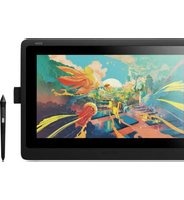


- CONTENTS
- About the manual
- Navigating the manual
- WORKING WITH INTUOS3
- Intuos3 tablet features
- Intuos3 input tools
- Intuos3 optional tools
- Setting up your work area
- Using the Grip Pen
- Holding the pen
- Pointing
- Hints:
- Clicking
- Dragging
- Using the side switch
- Hint:
- Drawing with pressure-sensitivity
- Drawing with tilt
- Erasing
- Eye-hand coordination exercise
- Using the mouse
- Using the Airbrush and Art Pen
- Working with the tablet
- Using ExpressKeys
- Tips:
- Using the Touch Strips
- CUSTOMIZING
- Opening the control panel
- Control panel overview
- Control panel settings
- Customizing the pen
- Adjusting tip feel and double-click
- Adjusting eraser feel
- Advanced tip and eraser pressure settings
- Customizing tool buttons
- Button functions
- Customizing tilt sensitivity
- Customizing the mouse
- Customizing mouse buttons
- Customizing the mouse fingerwheel
- Tablet to screen mapping
- Pen mode
- Mouse mode
- Orientation
- Screen area
- Force proportions
- Tablet area
- Mapping to multiple monitors
- Customizing the tablet functions
- Customizing ExpressKeys
- Customizing tablet Touch Strips
- Advanced Touch Strip settings
- Customizing the Pop-up Menu
- Notes:
- Working with multiple tools
- Working with application-specific settings
- Creating an application-specific setting
- Changing settings for a specific tool and application
- Removing application-specific settings
- TROUBLESHOOTING
- Testing your tablet
- Testing your tools
- Testing the ExpressKeys
- Testing the tablet Touch Strips
- Testing a pen
- Testing a mouse
- Troubleshooting tables
- Windows-specific problems
- Macintosh-specific problems
- Technical support options
- Obtaining driver downloads
- USA, Canada, Central and South America
- Europe, Middle East and Africa
- Japan
- Asia Pacific (English)
- China
- Korea
- Taiwan
- APPENDIX
- Caring for your tablet and tools
- Replacing the pen tip
- Uninstalling the software
- Macintosh OS X:
- Changing the tablet mode
- Installing multiple tablets
- Intuos3 lens cursor
- Customizing the lens cursor
- Testing the lens cursor
- Working with AutoCAD
- Configuring AutoCAD for a Wintab compatible digitizer
- Configuring tablet menus and screen pointing areas in AutoCAD
- Calibrating Intuos3 for AutoCAD
- Product specifications
- General specifications for all Intuos3 tablets
- Intuos3 4x5 / A6 tablet (model PTZ-430)
- Intuos3 4x6 / A6 Wide tablet (model PTZ-431W)
- Intuos3 6x8 / A5 tablet (model PTZ-630)
- Intuos3 6x11 / A5 Wide tablet (model PTZ-631W)
- Intuos3 9x12 / A4-regular tablet (model PTZ-930)
- Intuos3 12x12 / A4 Oversize tablet (model PTZ-1230)
- Intuos3 12x19 / A3 Wide tablet (model PTZ-1231W)
- Intuos3 Grip Pen (model ZP-501E)
- Intuos3 mouse (model ZC-100)
- Intuos3 Airbrush (model ZP-400E)
- Intuos3 Ink Pen (model ZP-130)
- Intuos3 Art Pen (model ZP-600)
- Intuos3 Classic Pen (model ZP-300E)
- Intuos3 lens cursor (model ZC-210)
- Product information
- Ordering parts and accessories
- Other parts and accessories
- Radio and television interference
- FCC notice
- CE declaration
- License and Warranties
- Software License
- Limited Warranty
- Warranty Service in the U.S.A. and Canada
- Warranty on Sales Outside of the U.S.A. and Canada
- In North and South America contact:
- In Japan contact:
- In Asia Pacific contact:
- In Mainland China
- (Except Hong Kong) contact:
- License and Warranty
- Software License Agreement
- Important Notice to Customers
- Entitlement to Use the Software
- INDEX
- Holding
- Mouse
- Multiple
- Parts and accessories
- Pen
- drawing
- Settings
- Software
- Tablet
- ExpressKeys
- Wacom international offices
- Wacom Technology Corporation Wacom Europe GmbH
- Wacom Co., Ltd. Wacom Co., Ltd.
- Wacom China Corporation
- Wacom Digital Solutions Co., Ltd.
- Wacom Australia Pty. Ltd.
Brand : WACOM
Model : Intuos Lens Cursor
Category : Mouse