
BFLW75 - Sink drain ARC - Free user manual and instructions
Find the device manual for free BFLW75 ARC in PDF.


| Product Type | Freestanding Washing Machine |
| Brand | ARC (Think Appliances) |
| Model | BFLW75 |
| Dimensions (H x W x D) | 855 mm x 595 mm x 565 mm |
| Wash Load Capacity | 7.5 kg |
| Maximum Spin Speed | 1200 rpm |
| Number of Wash Programs | 15 |
| Display | LED with cycle progress, delay start, remaining time |
| Control Type | Electronic with rotary dial and buttons |
| Delay Start | Up to 24 hours |
| Child Lock | Yes (press Spin Speed and Delay buttons together) |
| Water Inlet | Cold water only, 3/4" threaded connection |
| Drain Pump Filter | Clean every 10 washes (accessible at front) |
| Emergency Drain | Via drain pipe behind filter cover |
| Power Supply | 220-240 V, 50 Hz, 10 A (typical) |
| Energy Efficiency Class | 3* (wash only) |
| Wash Performance Class | 4.5* |
| Customer Service (AU) | 1800 444 357 (Service) / 1300 132 824 (Sales) |
| Spare Parts (AU) | Pronto Parts: 1300 306 973 |
| Website | www.thinkappliances.com |
Frequently Asked Questions - BFLW75 ARC
User questions about BFLW75 ARC
0 question about this device. Answer the ones you know or ask your own.
Ask a new question about this device
Download the instructions for your Sink drain in PDF format for free! Find your manual BFLW75 - ARC and take your electronic device back in hand. On this page are published all the documents necessary for the use of your device. BFLW75 by ARC.
USER MANUAL BFLW75 ARC
BFLW75 60 cm 7.5 kg Freestanding Washing Machine
INSTRUCTION MANUAL

natural_image
Simple line drawing of a fish with fins and tail, no text or symbols presentUSER MANUAL FOR YOUR BAUMATIC
BFLW75
60 cm 7.5 kg Freestanding washing machine

natural_image
Front view of a white Daumatis washing machine with digital display and control panel (no visible text or symbols)
NOTE: This User Instruction Manual contains important information, including safety & installation points, which will enable you to get the most out of your appliance. Please keep it in a safe place so that it is easily available for future reference; for you or any person not familiar with the operation of the appliance.
JW 18/10/12
Dear Customer,
Congratulations on purchasing your new product from Think Appliances.
To register your parts and labour warranty (some conditions apply please refer to your warranty card for more details) please contact out Customer Care team on:
1800 444 357
Our Customer Care centre is there to ensure you get the most out of your appliance. For example, should you want to learn more about recommended cooking temperatures, the various cooking functions available, how to set and program your LED clock, and importantly taking care of your appliance when cleaning, please call us because we are here to help you.
It is important that you read through the following use and care manual thoroughly to familiarize yourself with the installation and operation requirements of your appliance to ensure optimum performance.
We also carry a complete range of spare parts for all Think products. For all your spare parts enquiries please contact our team at Pronto Parts on:
1300 306 973
Again, thank you for choosing an appliance brought to you by Think Appliances and we look forward to being of service to you.
Kind regards
Management
Think Appliances
Contents
| E | n | v | i | r | o | n | m | e | n | t | a | l | |
| Important | safety | information | 6-8 | ||||||||||
| Specifications | 9 | ||||||||||||
| Description of the appliance | 1 | 0 | - | ||||||||||
| C | o | n | t | r | o | l | p | a | n | e | l | ||
| L | E | D | d | i | s | p | l | a | y | ||||
| D | e | t | e | r | g | e | n | t | d | r | a | w | |
| Preparing | the | wash | cycle | 14-18 | |||||||||
| Preparing | your | garments | for washing | ||||||||||
| A selection of wash care symbols | 15 | ||||||||||||
| D | e | t | e | r | g | e | n | t | s | a | n | d | |
| W | a | s | h | p | r | o | g | r | a | m | t | ||
| Wash | program | guidance | 18 | ||||||||||
| Selecting a wash program | 1 | 9 | - | ||||||||||
| S | e | t | t | i | n | g | a | w | a | s | h | ||
| E | n | d | o | f | c | y | c | l | e | ||||
| P | a | u | s | i | n | g | a | w | a | s | h | ||
| D | e | l | a | y | s | t | a | r | t | f | e | ||
| S | e | t | t | i | n | g | a | s | i | n | g | ||
| M | a | n | u | a | l | s | o | a | k | i | n | g | |
| H | i | g | h | t | e | m | p | e | r | a | t | u | |
| A | c | t | i | v | e | e | n | z | y | m | e | ||
| E | x | t | r | a | r | i | n | s | e | ||||
| C | h | i | l | d | l | o | c | k | |||||
| A | d | d | i | n | g | a | g | a | r | m | e | ||
| P | o | w | e | r | o | f | f | m | e | m | o | ||
| Maintenance and cleaning | 23-30 | ||||||||||||
| I | n | d | a | i | l | y | u | s | e | ||||
| Control panel and washing machine cabinet | 23 | ||||||||||||
| D | e | t | e | r | g | e | n | t | d | r | a | w | |
| The washing machine drum | 24 | ||||||||||||
| D | o | o | r | 2 | |||||||||
| Emergency drainage | 25 | ||||||||||||
| Cleaning the drain pump filter | 2 | 6 | |||||||||||
| Cleaning the water inlet filter | 27 | ||||||||||||
| W | i | n | t | e | r | s | t | o | r | a | g | e | |
| R | e | m | o | v | i | n | g | s | t | a | i | n | |
| S | t | a | i | n | r | e | m | o | v | a | l | ||
| S | t | a | i | n | r | e | m | o | v | a | l | ||
| Poor wash results - troubleshooting | 30 | ||||||||||||
| I | n | s | t | a | l | l | a | t | i | o | n | ||
| Removing the transit bolts | 31 | ||||||||||||
| L | o | c | a | t | i | n | g | y | o | u | r | ||
| Connecting to the mains water supply | 33 | ||||||||||||
| C | o | n | n | e | c | t | i | n | g | t | o | ||
| Levelling the appliance | 35 | ||||||||||||
| P | o | w | e | r | s | u | p | p | l | y | |||
| Before first use maintenance wash | 36 | ||||||||||||
| Error code failure system | 36 | ||||||||||||
| General troubleshooting | 3 | 7 | - | ||||||||||
| C | o | n | t | a | c | t | d | e | t | a | i | l | |
Environmental note
This appliance is marked according to the European directive 2002/96/EC on Waste electrical and Electronic Equipment (WEEE). By ensuring this product is disposed of correctly, you will help prevent potential negative consequences for the environment and human health, which could otherwise be caused by inappropriate waste handling of this product.
The symbol

accompanying the product, indicates that this appliance may not be treated as household waste. Instead it shall be handed over to the applicable collection point for the recycling of electrical and electronic equipment.
Disposal must be carried out in accordance with local environmental regulations for waste disposal.
For more detailed information about treatment, recovery and recycling of this product, please contact your local city office, your household waste disposal service or the shop where you purchased the product.

natural_image
Symbol of a trash bin crossed with diagonal lines, representing waste or discharge (no text or labels)
- The packaging materials that Baumatic uses are environmentally friendly and can be recycled.
- Please discard all packaging material with due regard for the environment.
Important safety information

Your safety is of the utmost importance to Baumatic. Please make sure that you read this instruction booklet before attempting to install or use the appliance. If you are unsure of any of the information contained in this booklet, please contact the Retailer where you purchased your unit.
General Safety
- Repairs to your appliance must only be carried out by an authorised service agent and only genuine spare parts should be used. Any attempt by an inexperienced person to repair the appliance, could result in injury or damage to your washing machine.
- This appliance is designed for household use only.
- If you notice that the mains cable is damaged. The appliance must not be used. The same applies if you notice that the worktop, control panel or base area is damaged. As this could allow access to the internal components of the machine.
- The appliance should be turned off and isolated from the mains supply, before either cleaning or maintenance work is attempted.
- The mains cable must not be used to pull the plug out of the electrical socket.
- The machine should not be sprayed with water.
- The glass of the porthole door may become hot during the higher temperature wash programs.
- The machine should be allowed to cool before carrying out an emergency drain or cleaning the drain filter.
- It is possible for vermin to chew either the mains cable or water hoses, which could cause an electric shock hazard.
Installation
- The installation instructions contained within this user manual should be followed.
- It is obligatory for the completed installation to comply with all relevant building regulations and local water authority requirements.
Before the first use of the appliance, we advise that a 95 degree cotton wash is completed. No garments should be placed inside the machine; however a small amount of detergent must be used.
During Use
- It is recommended that the appliance is unplugged and the water supply is turned off after the machine is used.
- This appliance is only designed to wash normal domestic wash loads. If you use your washing machine in any other way or it is incorrectly used, then Baumatic accepts no liability for any damage that might be caused and any guarantee will be void.
- No attempt should be made to alter or modify the specifications of this appliance.
- The detergents that you place in this appliance must be suitable for front load washing machines. With regards to dosage levels, the detergent manufacturer's recommendations should be followed.
- You should not wash garments that have been in contact with flammable materials.
- Your washing machine should not be used for dry cleaning purposes or commercial use.
- If you use either dyes or bleaching agents inside this machine, then you should consult with the manufacturer of these products to make sure they are suitable for use in your washing machine. Baumatic cannot be held responsible for any damage that may result. Avoid leaving bleach containing chlorine in the drum for an extended period of time.
Child Safety
- Your washing machine should only be used by adults. You should not allow children in the area of the machine unsupervised. You should not let them touch the controls or play with the appliance.
- This washing machine is not intended for use by persons (including children) with reduced physical sensory or mental capabilities, or lack of experience and knowledge, unless they have been given supervision or instruction concerning the use of the appliance by a person responsible for their safety.
- It could be possible for a child or pet to gain access to the washing machine through the porthole door. Therefore, please check inside the washing machine drum before using the appliance.
- Any packaging that is removed from the machine should be kept away from children.
- All detergents should be kept out of a child's reach and stored in a safe place.
Specifications
- 15 wash programs
- 7.5 kg wash load
- 1200 rpm maximum spin speed
o LED display - Electronic control operation
- Delay start
- Digital countdown indicator
- Spin speed regulation
o Temperature regulation - Wash phase indicator
- Door locked indicator
- Electronic aqua stop
- Stainless steel drum
- 180° door opening
o Failure detection system - Imbalance control system
- Overflow protection
- Foam protection
- Adjustable feet
○ Child lock
Appliance dimensions
| Height: | 855 | mm | |
| Width : | 595 | mm | |
| Depth: | 565 | mm |
Ratings
| Energy | efficiency | class | (wash | only) | 3* |
| Wash | performance | class | 4.5* |
For future reference please record the following information which can be found on the rating plate and the date of purchase which can be found on your sales invoice. The rating plate for your washing machine will either be located on the right hand side of the cabinet or behind the porthole door.
Model Number
Serial Number
Date of Purchase ....
Description of the appliance

Accessories

Control panel
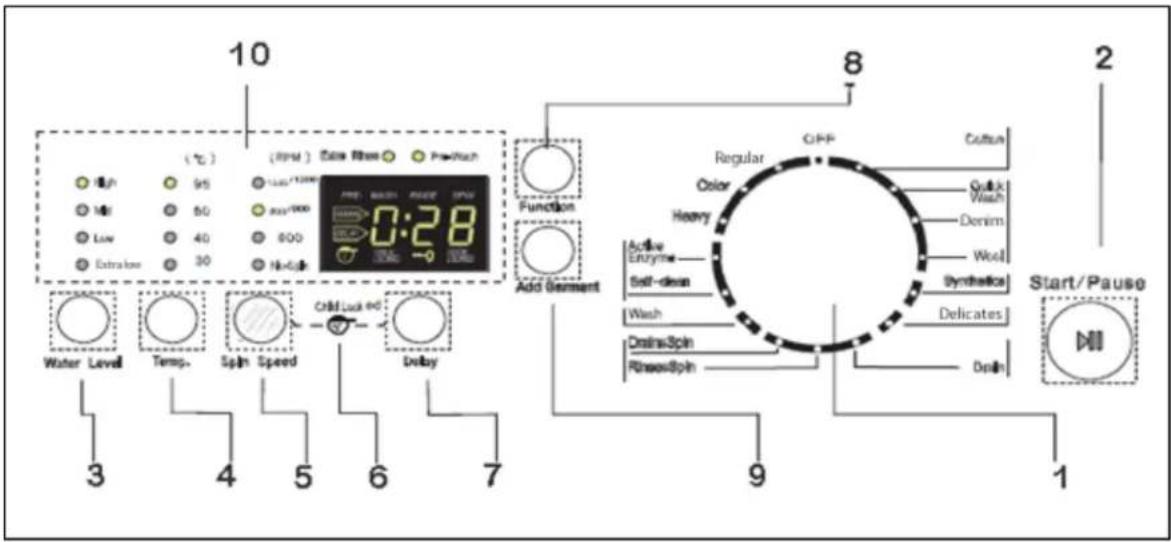
1) Washing program selection dial. Use this dial to select the required washing program.
2) Start / pause button. Press this button to start or pause a washing cycle.
3) Water level selection button. Press this button to select the required water level according to the amount of laundry from the following options:
$$ H i g h \rightarrow M i d \rightarrow L o w \rightarrow E x t r a L o w $$
4) Temperature selection button. Press this button to set the temperature of the water for a washing program from the following options:
$$ 9 5 ^ {\circ} C \rightarrow 6 0 ^ {\circ} C \rightarrow 4 0 ^ {\circ} C \rightarrow 3 0 ^ {\circ} C $$
$$ 1 2 0 0 \rightarrow 9 0 0 \rightarrow 6 0 0 \rightarrow N o S p i n $$
5) Spin speed selection button. Press this button to select the spin speed for the chosen washing program from the following options:
6) Child Lock symbol. Press the Spin Speed button and the Delay button together to activate/deactivate the child lock.
7) Delay start button. Press this button to delay the start of the washing cycle. Repeatedly press the button to choose a time between 0-24 hours.
8) Function button. Press this button to choose from two additional functions for your washing cycle. You can add an extra rinse or a pre-wash to get a better washing result.
9) Add Garment button. If you want to add a garment to the wash load during the cycle you can press this button to pause the wash cycle. The door will unlock and you can add the desired garments. Press the Start/Pause button to resume the wash cycle. (please refer to page 22)
10) LED display. (Refer to section below)
LED display

Wash cycle progress indicator. The current wash cycle phase will light on the display to indicate the progress of the program from "Pre-Wash", "Wash", "Rinse" and "Spin".
Delay start. The "Delay" icon will flash to indicate the delay time which has been set. The program will begin after the set delay time.
Remain indicator. After the washing cycle has begun, "Remain" will light and the remaining time will be displayed until the wash program ends.
Child locked. When the child-lock function is activated this icon will light. The light will go off when the lock is deactivated.
Door locked. When the door is in the lock state, this icon will light. The door can be opened only after the light turns off.
Detergent drawer

Main wash section

This compartment should have detergent placed in it (you should also put a water softening agent in this section, if you use one). The detergent will be added to the drum at the start of the main wash program.
Conditioner section

This compartment should be used for liquid conditioners (fabric softener, starch). They will be added to the wash load during the final rinse.
Pre wash section

This compartment should have detergent placed in it, if you are going to select a pre-wash before the main wash cycle.
Preparing the wash cycle
Preparing your garments for washing
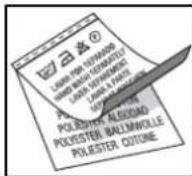
- Your washing should be sorted out, according to the fabric type and the wash care symbol that is printed on the garment's wash care label (see separate section on wash care symbols).
- Your washing should also be sorted out according to the degree of soiling.

- Check all pockets on a garment to make sure that they are empty and do not contain coins, clips or similar items as these can damage clothing and the washing machine.

natural_image
Illustration of a hand holding a small object, possibly a device or tool, with no visible text or symbols.- Remove any detachable metal items (badges, paperclips, safety pins, etc).
- Zips should be closed, duvet covers and pillow cases should be buttoned up and any loose straps should be tied up. This will help to prevent other garments from getting damaged during the wash.
- Woollens and knitted coloured fabrics should be turned inside out before being washed in the appliance.
o Small delicate items (tights, baby socks, etc) should be placed in either a washing bag or a zipped pillow case.
- Curtains should be handled with particular care. All plastic hooks or metal strips must be removed before being washed in the appliance.
- Coloured items and whites should be washed in separate wash cycles.
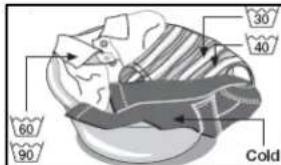
- New garments often contain an excess of dye, therefore it is advisable to wash them separately for their first wash.
o Garments should be unfolded and shook out before being placed inside the machine.
A selection of wash care symbols
| Washing |  Hot Hot |  Normal temp Normal temp |  Normal temp Normal temp |  Do not Do not |  Bleachable Bleachable watch watch |  Do not Do not |  Wool Wool |
| Dry cleaning |  Delicate temp Delicate temp |  Delicate temp Delicate temp |  Hand wash Hand wash |  All s All s  |  All but TRI All but TRI |  Benzine only Benzine only |  Do not clean! Do not clean! |
| Spin dryer |   |   |   |   dry! dry! |   |   |   |
 |   |   |   |   | |||
- The wash care symbols should be used to help you to select the most suitable wash program. They will also help you to sort your laundry into different loads, depending on the fabric type and the highest temperature which the garment can be washed at.
Detergents and conditioners
IMPORTANT: Only detergents suitable for use in front load washing machines should be used.
The amount of detergent that you need to use in your appliance, will depend on
- The degree of soiling. Lightly soiled garments in general require less detergent.
- The size of the wash load. A smaller wash load will require a reduction in the amount of detergent.
- The hardness of your tap water. The harder your water is, then the more detergent you will need to use. The detergent manufacturers normally give guidance as to how much extra detergent should be used, depending on the hardness of the water.
Liquid detergent
If you are using liquid detergent then all instructions on the detergent packaging should be followed.
Low temperatures
- The enzymes in biological washing detergents work best at low temperatures to provide excellent cleaning and stain removal results, but not as low as 20°C.
- Liquid or gel detergents are particularly suitable for low temperature washing as they dissolve easier and quicker than powders or tablets.
Water softening agents
If your tap water is hard, then it may be prudent to utilise a water softening agent. This will help to ensure that the appliance does not become clogged with hard water deposits. You may also find that it will allow you to lessen the amount of detergent that you are using.

When using any detergent or water softening agent, the recommendations of the manufacturer should be followed.
Wash program table
| Wash Cycle | MAX temp* (°C) | MAX Spin Speed (RPM) | MAX load capacity (kg) | Extra Rinse | Pre-Wash | Detergent Box | Default Operation Time (hr:min) | Fabric suggestions | ||
| Pre-Wash | Main Wash | ** | ||||||||
| Quick wash | 40 | 1000-1200 | 3.5 | Option | No Option | X | 0:28 | Lightly soiled cotton load | ||
| Cotton*** | 95 | 1000-1200 | 7.5 | Option | Option | √ | √ | √ | 3:44 | Normally Soiled Cotton Load |
| Wool | 40 | 800-900 | 2.5 | Option | No Option | X | 0:58 | Woollen Garments Marked Delicate | ||
| Synthetics | 60 | 800-900 | 3.5 | Option | Option | √ | √ | 1:11 | Polyester, Nylon | |
| Delicates | 30 | 600 | 2 | Option | No Option | X | √ | √ | 0:42 | Silk and items marked hand wash only |
| Underwear | 95 | 1000-1200 | 7.5 | Option | Option | √ | √ | √ | 1:52 | Normally Soiled Mixed Fabric Load |
| Colour | 40 | 1000-1200 | 3.5 | Option | Option | √ | √ | √ | 1:07 | Normally Soiled coloured load |
| Heavy | 60 | 1000-1200 | 3.5 | Option | Set | √ | √ | √ | 1:38 | Heavily soiled load |
| Active Enzyme | 60 (default) | 1000-1200 | 3.5 | Option | Must | √ | √ | √ | 2:16 | Protein Stained Garments |
| Self-clean | 95 (default) | 600 | / | No Option | No Option | X | √ | √ | 1:12 | Self-clean function (Refer to page 19) No detergent |
| Hand Wash | 95 | / | 7.5 | No Option | Option | √ | √ | X | 0:32 | Load that only requires a single wash Only |
| Rinse + Spin | / | 1000-1200 | / | No Option | No Option | X | X | √ | 0:21 | Load that only requires rinse and spin |
| Drain + Spin | / | 1000-1200 | / | Option | No Option | X | X | X | 0:12 | For hand washed garments |
| Drain | / | / | / | No Option | No Option | X | X | X | 0:01 | |
* The actual water temperature may differ from the declared cycle temperature.
** Conditioner [Symbol]
*** Energy test program according to AS/NZS 2040.1 & AS/NZS 2040.2: Cotton 60°C. This program is suitable for cleaning normally soiled cotton laundry and is the most efficient program.
o Detergent and softener only need to be added when required.
- The operation time of the appliance will change according to the water temperature, water level, amount of clothes, inlet water pressure and drain state.
Do not overload the washing machine as the loaded items may not wash properly. Please ensure that the wash program chart is referenced to determine the suitable loading capacity for each selected cycle.
Wash program guidance
○ A wash program option can only be selected if the program table advises that it is possible with the wash cycle you have selected.
○ Important: You should make sure that the selected spin speed is appropriate for the garments that you are washing.
o Important: Before opening the door of the appliance, you MUST spin the clothes and drain the water. See the section called "Spin only".
- The active phases will appear at the top of the LED display, as the wash program progresses.
- The LED display shows an approximate time for the selected wash cycle. Please note that factors external to the machine, e.g. the temperature of your water supply, your water pressure etc. can affect the time it takes for a wash cycle to complete.
Selecting a wash program
Setting a wash program
- Use the washing program selection dial (1) to select the required program.
- You can set the water level (3), temperature (4) and spin speed (5) by pressing the relevant buttons on the control panel.
- If you wish to add an additional function such as a pre-wash or an extra rinse to the cycle, press the function button (8).
Once the desired program has been selected, press the start / pause button (2) to begin the wash cycle.
End of cycle
- When the wash cycle ends a beep will sound.
- IMPORTANT: You should not attempt to open the porthole door until the door lock light has deactivated.
- When the door lock light has deactivated and you hear the door lock disengage, you can open the porthole door and remove the laundry.
- Turn off the water tap and rotate the program selection dial (1) to the OFF position.
- Disconnect the appliance from the electricity supply.
Pausing a wash program
- If you want to pause a wash program temporarily, you should press the start/pause button (2).
- When you want to restart the wash cycle, press the start/pause (2) button again.
Delay start feature
Your appliance has a delay start feature, which allows you to delay the start of a wash cycle until a later time.
When the delay start function is in use, the LED display only shows the delay start time. The "Delay" indicator will light. When the programmed time is reached, the indicator light will go off. The LED display will then show the remaining time of the wash cycle.
- The delay start time on the display informs you in how many hours the wash program will begin.
1) Use the program selection dial (1) to select the desired cycle.
2) You can adjust the water level (3), temperature (4) and spin speed (5) by pressing the appropriate buttons. You can also add a pre-wash and an extra rinse by pressing the function button (8).
3) Once the required cycle has been set, press the delay start button (7). Repeatedly press this button to set the length of time which you wish to pass before the washing cycle begins.
4) Press the start / pause button (2) and the machine will enter standby mode. The cycle will automatically begin when the delay start time is reached.
Setting a single wash
- You can choose from the following single cycles: "Wash", "Drain", "Drain and Spin" and "Rinse and Spin".
1) Use the program selection dial (1) to choose one of these cycles. Set the required spin speed or "No-Spin" option accordingly.
2) Press the start / pause button (2) to begin the program.
Manual soaking
1) Load the laundry into the washing machine drum
2) Put the detergent into the drawer according to the manufacturer's instructions.
3) Use the program selection dial (1) to select the required wash cycle. Press the start / pause button (2) to begin the cycle.
4) After approximately 10 minutes have passed, press the start / pause button (2) again to pause the cycle. The clothes are then able to soak in the water for your chosen length of time. Press the start / pause button (2) to continue the wash cycle.
High temperature self-clean
The self-clean cycle is specially designed to clean the drum and internal components automatically and improves machine hygiene. By selecting this program it applies a 95°C high temperature wash to ensure the machine does not accumulate any residues that remain after completing several wash cycles over a period of time.
- When this procedure is performed, clothes or other washing cannot be placed in the drum.
1) To set this cycle, use the program selection dial (1) to choose the "Self-clean" option.
2) Press the start / pause button (2) to begin the program.
Active enzyme
The active-enzyme program activates enzymes contained in the detergent powder by setting a temperature of 40^ C during the pre-wash and 60^ C in the main wash. This is suitable for clothes which are difficult to wash due to heavy soiling such as protein based stains.
1) Use the program selection dial (1) to choose the "Active enzyme" cycle. The other options will be set by default.
2) Press the start / pause button (2) to begin the wash cycle.
Extra rinse
- The extra rinse option should be selected to provide users who suffer from sensitive skin. The garments will undergo an additional rinse to remove more residues of detergent allowing garments to be free from detergent.
1) To program an extra rinse, press the function button (8) to choose the correct option before starting the wash cycle.
Child lock
Your appliance has a child lock option, if this is set, it will mean that nobody can alter the operation of the wash program once it has started.
- When the appliance is in use, press and hold the child lock buttons (5) & (7) for a few seconds to activate the child lock. No buttons on the control panel will be operable.
To deactivate the child lock, press the child lock buttons again. The buttons on the control panel will then be operable again.
Add garment
- This option will only work near the beginning of the washing cycle. It will not work when there is a high volume of water in the drum, or the temperature of the water in the drum is very hot, rendering the function unsafe to use.
Once the add garment button has been pressed, you will need to wait for the drum to stop rotating and for the door to unlock.
- When the machine is unlocked, add the garments you want to the wash load and close the door. Press the Start/Pause button to resume the washing cycle.
Power off memory
- If the power supply to the machine is cut off in the middle of a cycle, the machine will automatically maintain the cycle sequence. You will not be required to restart the cycle once the power has been turned on.
IMPORTANT: Please do not open the door by force when the power is off. Please call the Customer Care Department if you have to open the door.
Maintenance and cleaning
In daily use
Once a wash cycle has completed, you should pull out the detergent drawer slightly, so it can dry out.
Leave the porthole door ajar for a short while after a wash cycle has completed. This should help to prevent stagnant smells and to protect the door seal.
- After each washing program has finished, wipe up the remaining water on the rubber seal ring and seal fold to prevent any mildew and rot appearing.
- Close the water tap.
- We suggest that you disconnect the appliance from your mains supply, when it is not in use.
Control panel and washing machine cabinet.
IMPORTANT: Do not use any abrasive cleaner or household polish on either the control panel or operating parts.
- Wipe over the control panel and the external surface of the machine using a brand new damp cloth with warm water.
- If you ever spill any liquid detergent or conditioner from the detergent drawer onto the washing machine cabinet, then these should be cleaned up immediately as they could be corrosive.
Detergent drawer
Occasionally the detergent drawer should be cleaned, to remove any detergent residue that has built up.
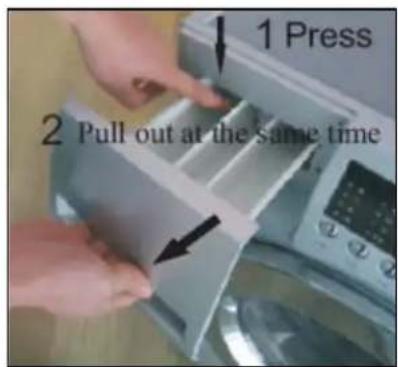
- Press the detergent drawer limit part and pull out the drawer at the same time to remove from the machine.
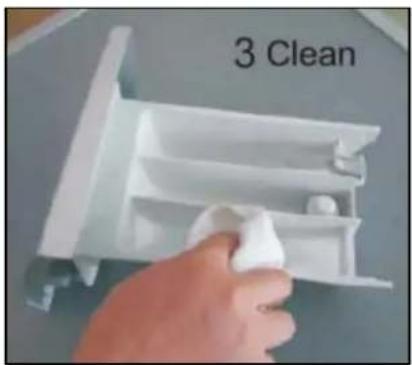
Detergent can also accumulate inside the detergent drawer recess, so you should also clean this out using warm soapy water and a soft cloth.
Once you have finished cleaning the detergent drawer and recess, you should slide the drawer back into its original position.
The washing machine drum
The drum of your washing machine is constructed from stainless steel. However if metal objects that can rust are placed inside the drum or have been left in the drum for an extended period of time, then it is possible for the drum to become stained/rust.
IMPORTANT: Do not use a descaling agent, iron/steel wool, a metal brush, or any other scouring agents to clean the drum of your appliance.
- Remove any rust stains on the drum surface with an appropriate stainless steel cleaning agent. Only use a sponge or a soft cloth during this process.
Door
- You should regularly check to see if any deposits have formed, or there are any foreign bodies inside or underneath the rubber door seal. This sits inside the opening of the porthole door.
Emergency drainage
IMPORTANT: Switch off your washing machine and disconnect the plug from your mains supply.
natural_image
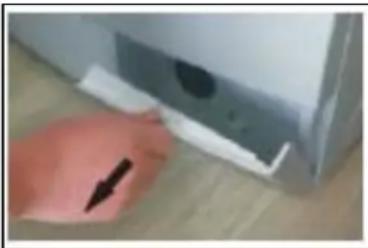
Close-up of a hand holding a small object near a white panel, with no visible text or symbols.1) Open the filter cover panel and place a container close to collect any water spillage.
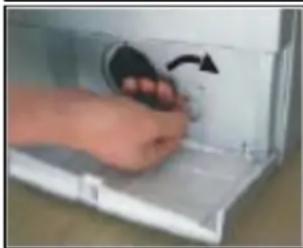
natural_image
Close-up of a hand holding a small circular device inside a transparent container, with an arrow indicating rotation (no text or symbols visible)2) Turn the emergency drain hole cap clockwise.
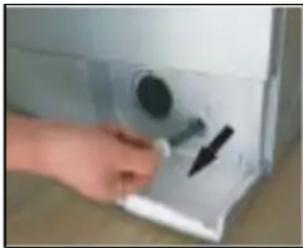
natural_image
Hand inserting a black circular component into a white container with a black arrow pointing to it (no text or symbols visible)3) Pull out the emergency drainage pipe

natural_image
Close-up of hands using a tool to adjust or install a device (no visible text or symbols)Emergency drainage pipe
Drainage pipe bung
4) Remove the bung from the end of the drainage pipe
IMPORTANT: If you are draining water from the bail hose and drain pump filter in an emergency, you should take care as the water coming from the machine mid-cycle could be hot, especially if the water is being drained in the middle of one of the hotter wash cycles.
Cleaning the drain pump filter
IMPORTANT: Switch off your washing machine and disconnect the plug from your mains supply.
You should clean out the filter approximately every ten washes. If the drain pump filter is not cleaned regularly, then your appliance may find it difficult to pump out water efficiently.
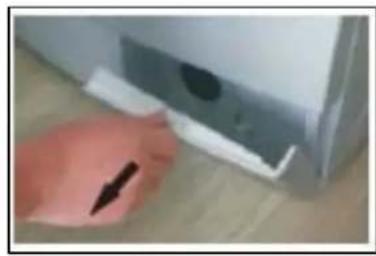
natural_image
Close-up of a hand holding a pen near a small electronic device (no visible text or symbols)1) Open the filter door and place a container close to it to collect any water spillage.
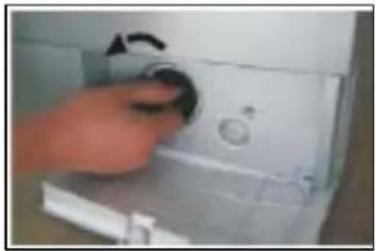
natural_image
Hand operating a washing machine with a rotary knob (no visible text or symbols)2) When no more water drains out, unscrew the pump cover and remove it. Always keep a cloth nearby to dry up any water spillage when removing the cover.

3) Remove any objects from the pump impeller by rotating it.

natural_image
Hand operating a rotary switch inside a device casing (no visible text or symbols)3) Screw the pump cover fully back on.

natural_image
Close-up of a hand pressing down on a white electronic device component (no visible text or symbols)4) Close the filter door.
IMPORTANT: Never remove the pump cover during a wash cycle. Always wait until the appliance has finished a wash cycle and is empty. When replacing the cover, ensure it is fully tightened to prevent leaks and to prevent children being able to remove it.
Cleaning the water inlet filter
- Clean the filter when the water is slow to fill or error code E10 is displayed
○ Always pull the power plug out before cleaning.

natural_image
Two-step photo showing hands using a tool to clean or adjust a circular component on a white appliance (no text or symbols visible)1) Unscrew the inlet water pipe.
2) Clean with a tooth brush.
Winter storage
- You should install your appliance in a location where it will not be subjected to freezing temperatures.
- If you are going to store your appliance in a location where the temperature will drop below freezing in winter, then you should follow the table below.
| To winterize the washer To use the washer again | |
| Turn off the water supply.Disconnect and drain the water inlet hoses.Run the washer on a drain and spin setting for one minute.Unplug the power supply cord. | Flush the water pies and hoses.Reconnect the water inlet hoses.Turn on the water supply.Reconnect the power supply cord. |
Removing stains
Garments that are covered in stains, grease or are heavily soiled may need to be pre-washed or soaked before being placed inside of the washing machine.
- Soaking helps to remove protein-type stains, like milk or grass.
o Pre-washing helps to loosen soil before the main wash.
Stain removal rules
- Use warm water for soaking or pre-washing stained laundry. Hot water can set stains.
o Most stains are easier to remove when they are fresh.
Before treating any stain try to establish; what kind of stain it is, how old the stain is, what the fabric type is and whether the fabric is colourfast (check the care label to find this out). - Washing and drying can fix some stains.
- When bleach is recommended, use mild fabric bleach that is safe for the fabric.
- If you need to use a stain remover, put the stained area face down on a paper towel or white cloth. Apply the stain remover to the back of the stain. This forces the stain off the fabric, instead of through it.
- When using chemicals to treat stains please take caution to ensure that all safety directions are followed in accordance with product packaging.
Stain removal guide
| Stain | Removal | Method | |
 | Alcoholic beverages | The stain should be first washed with cold water, then wiped with glycerine and water and rinsed with water mixed with vinegar. | |
 | Shoe polish | The stain should be rubbed with detergent and rinsed softly without ruining the material, If the stain is not removed, rub with 1 unit of pure alcohol (96 %) mixed in 2 units of water and then washed with lukewarm water. | |
 | Tea and coffee | Place and stretch the stained area of material on the top of a container and pour water as hot as the material can endure on it. If the type of material is suitable, wash it with caustic soda. | |
 | Chocolate and cocoa | Leave your clothes in cold water and rub with soap or detergent, wash it in the highest temperature that the material type can endure. If there is still a stain of oil left, wipe with oxygenated water (in proportion of 3%). | |
 | Tomato paste | Remove the dried pieces without ruining the material, then leave in cold water for about 30 minutes and wash by rubbing with detergent. | |
 | Meat broth/egg | Eliminate the dried stain residues and wipe with a sponge or soft cloth wetted in cold water. Rub with detergent and wash with diluted caustic soda. | |
 | Grease and oil stains | First wipe the residues. Rub the stain with detergent and then wash with luke warm soapy water. | |
 | Mustard First apply glycerine to the stained area. Rub with detergent and then wash. If the stain still does not disappear, wipe with alcohol (on synthetic and coloured cloth, a mixture of 1 unit alcohol, 2 units water should be used). | ||
 | Blood stain | Lay your clothes in cold water for 30 minutes. If the stain still does not disappear, lay in mixture of water and ammonia (3 table-spoons of ammonia in 4 litres of water) for 30 minutes. | |
 | Cream, ice-cream and milk | Lay your clothes in cold water and rub the stained area with detergent. If the stain has still not disappeared, apply caustic soda on the fabric of your clothes in proper proportion. (Do not use caustic soda on coloured clothes). | |
 | Mould Stmould stains should be cleaned as soon as possible. The stain should be washed with detergent, and if it does not disappear, it should be wiped with oxygenated water (in proportion of 3%). | ||
 | Ink Hold the stained area under cold running water and wait until the inky water completely runs off. Then rub with water diluted with lemon juice and detergent. Wait five minutes and then wash. | ||
 | Fruit Stretch the stained area of your clothes on the top part of a container and pour cold water on it. Do not pour hot water on the stain. Wipe with cold water and apply glycerine. Wait for 1-2 hours and rinse after wiping with a few drops of white vinegar. | ||
 | Grass stain Rub the stained part with detergent. If the type of fabric is suitable for use of caustic soda, wash it with caustic soda. Rub your woollen clothes with alcohol (for coloured fabric, a mixture of 1 unit of pure alcohol and 2 units of water). | ||
 | Oil paint The stain should be eliminated before it dries by applying thinners on it. Then it should be rubbed with detergent and washed. | ||
 | Burnt stain If your fabric is suitable for use of caustic soda, you can add caustic soda into your washing water. For woollen fabric, a cloth dampened in oxygenated water should be pressed on the stain and it should be ironed with a dry cloth on it. It should be washed after rinsing well. | ||
Poor wash results


My garments are looking grey and there are limescale deposits present in the drum of my washing machine.
- There is not enough detergent being added.
- The incorrect detergent is being used.
- Stains are not being pre-treated.
o The correct wash program or wash temperature was not selected.

I have followed the advice given above, but my garments are still coming out with grey stains on them.
- The garments are soiled with oils, ointments or grease and were washed without enough detergent.
- The wash temperature selected was too low.
Fabric conditioner has come into contact with the garments. If this happens try to wash out these stains as quickly as you can and try to avoid getting conditioner on the garments in future.

he final rinse, I can still see suds.
- Modern detergents can leave results with suds appearing in the final rinse, this does not mean that the washing is not being rinsed properly.

There is white residue on my garments when I remove them from the appliance.
- Modern detergents can contain insoluble contents; white residue after a wash cycle is not necessarily a sign of the garments being insufficiently rinsed by the washing machine.
- You should shake out the garment or brush it off. In future possibly turn the garment inside out before it is washed. You may wish to move from a powder detergent and switch to a liquid detergent instead.
Installation

IMPORTANT: THIS INSTALLATION MUST BE COMPLETED BY A SUITABLY QUALIFIED PERSON. BAUMATIC ONLY SANCTION THE INSTALLATION GIVEN IN THIS INSTRUCTION MANUAL. YOU SHOULD KEEP THE TRANSIT PACKAGING, IN CASE YOU NEED TO TRANSPORT THE MACHINE IN THE FUTURE.
Removing the transit bolts
IMPORTANT: Before installing or operating the washing machine, YOU MUST remove the transit bolts that hold the drum in position whilst the appliance is being transported.
- Keep the transit bolts in a safe location for further use during transportation. Please use a spanner for this procedure.

natural_image
Technical line drawing of a server rack with a magnified inset showing a wrench tool (no text or symbols present)1) Remove the four fixed bolts on the rear of the appliance using a suitable spanner.
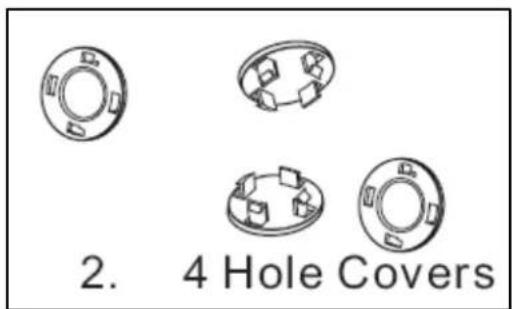
2) Insert the hole covers into the holes to close them.

natural_image
Line drawing of a front-mounted server unit with a circular inset showing a dial indicator (no text or symbols)Locating your washing machine

Before commencing installation, check the location where you intend to install the appliance. You should make sure that you have everything in place that is necessary for the correct installation.
Do not place or store your washing machine in a location where the ambient temperature could fall below 0^ C, otherwise the water in it could freeze up.
- Never place or store laundry products such as detergents on top of the appliance.
○ Install the washer on a flat, solid floor. If the washer is installed on an uneven or suspended floor, it could cause excessive noise and severe vibration, which may result in the malfunction of the appliance.

natural_image
Three identical line drawings of a washing machine on a surface, with no text or symbols present.- You should also level off the washing machine, using the adjustable feet on the base of the appliance.
There should be a gap of 2 cm either side of the washing machine; a 10 cm gap should be left behind the appliance.

Connecting to the mains water supply
IMPORTANT: The washing machine should never be connected to the water mains using an existing inlet hose, YOU MUST utilise the inlet hose that is provided with the appliance.
Your appliance should only be connected to a cold water supply.

natural_image
Simple line drawing of a coiled tube with two connectors (no text or symbols)1) Take out the attached inlet hose.

natural_image
Line drawing of a faucet with a flanged handle and a flanged base (no text or symbols)2) Attach the inlet hose vertically to the spiral tap for the washing machine.

natural_image
Illustration of a faucet with a valve and handle, showing a curved arrow indicating rotation (no text or symbols)3) Screw the tap tightly in the direction of the screw thread of the inlet hose.

natural_image
Line drawing of a hand inserting a cable into a device housing (no text or symbols)4) Connect the hose to the water inlet at the back of the washing machine.
IMPORTANT: When connecting the screw thread of the inlet hose and the inlet valve, prevent the screw thread from being secured incorrectly or it will wear or leak.
Do not over bend the inlet hose or this will cause damage.
Connecting to the water outlet

1) Please use an elbow to bend the drain hose at a proper angle and fix securely.

2) The correct position of the drain hose is one which will prevent any water leaking onto the floor or other surfaces.


IMPORTANT: Do not insert the drain hose too deeply into the water pipe, as this may cause siphoning.
3) To prevent siphoning, the installation height of the drain hose should be between 0.6 - 1 m and the end of the drain hose should not be immersed in water.
NEVER EXTEND THE DRAINAGE HOSE FROM ITS ORIGINAL LENGTH.
Levelling the appliance
- Place the washing machine on a solid and level floor surface.
DO NOT PLACE THE WASHING MACHINE ON A CARPET OR A SUSPENDED FLOOR.
- If the floor is obviously uneven, the appliance needs to be adjusted to prevent the drum from inclining or the machine from moving while in use. Use the adjustable feet to level the appliance.
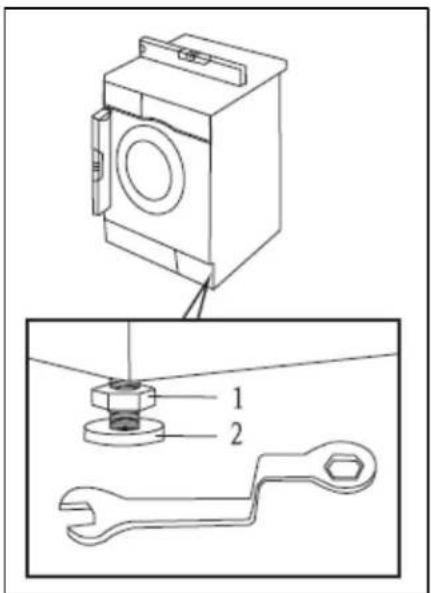
1) Unscrew the adjusting nut (1) with a spanner.
2) Adjust the height of the legs using the feet (2).
3) Screw the nut (1) to secure the levelling foot.
IMPORTANT: There should be no instability of the machine when the adjustable legs have been set to the correct level.
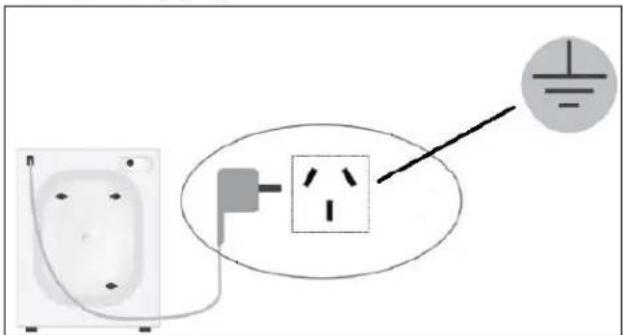
Power supply
natural_image
Pure electrical circuit lines without any symbolsIMPORTANT:
The electrical socket must still be accessible once the appliance is installed.
√ Consult the rating plate BEFORE making the electrical connections. Ensure that the voltage reaching the plug, is the same as that on the rating plate.
√ DO NOT REMOVE THE RATING PLATE AS THE INFORMATION ON IT IS IMPORTANT.
√ The moulded plug that is supplied with the appliance must be placed into an earthed and insulated socket.
√ Broken or damaged power leads must only be replaced by a suitably qualified person. A power lead of a similar type must be used in replacement.
√ IMPORTANT: We do not recommend that this appliance is connected to an extension lead.
Before first use maintenance wash
- When your washing machine has been correctly installed, we recommend that you perform a high temperature self-clean cycle, without any clothing being placed inside of the drum.
- This will check that all aspects of the installation are correct; it will also remove any deposits that may have been left on the drum by the manufacturing process.
Error code failure system
If your appliance senses that it is not operating correctly, then an error code may appear on the LED display.
The following error codes can possibly be remedied by the customer and the steps outlined below should be followed.
BEFORE COMPLETING ANY MAINTAINEANCE ON THE APPLIANCE, IT SHOULD BE DISCONNECTED FROM YOUR POWER SUPPLY.
| Error code | Reason | Solutions |
| E10 | Inlet water overtime. | Open the water tap to check if the inlet hose is squashed or kinked.Check if the filter in the inlet valve is blocked.Check if the water pressure is too low. |
| E21 | Overtime of the drainage. | Check if the drain pump is blocked (see relevant section). |
| E30 | The door has not been closed. | Check if the door of the washing machine is closed.Check if the clothes are preventing the door from closing properly. |
| E50 | Voltage is too high | Contact the Service Department or a qualified electrician |
| EXX | Other | Contact the Service Department. |

natural_image
Illustration of a classic office telephone with keypad and keypad (no text or symbols)If a fault code reappears after following the above advice and clearing the fault code. You should turn the washing machine off. Disconnect the appliance from your mains supply. Then arrange for an authorised technician to attend the appliance. You should contact the Customer Care Department.

IF A TECHNICIAN ATTENDS DURING THE WARRANTY PERIOD AND FINDS THAT A FAULT HAS BEEN CAUSED BY AN ITEM ON THE ERRO CODE LIST, WHICH COULD HAVE BEEN CLEARED BY THE CUSTOMER. THEN YOU MAY BE LIABLE FOR THE COST OF THE SERVICE CALL.
General troubleshooting
| Problem | Possible solutions |
| The washing machine does not work. | ○ Close the washing machine's door.○ Confirm and press the start button. |
| Water leakage. | ○ Correctly connect the inlet water pipe. |
| The spin of the clothes is abnormal. | ○ Reload and distribute the laundry evenly in the drum. |
| There is a peculiar smell in the washing machine. | ○ Run a self-clean cycle without any clothes. |
| No water is visible in the drum. | ○ No fault. The water is under the visible area. |
| There is remaining water in the softener compartment. | ○ No fault. The effect of the softener will not be affected. |
| The remaining detergent is left on the clothes. | ○ The water-fast component of the non-phosphorus detergent left on the clothes will cause lime scale. Select the rinse and spin program or brush away the detergent when the clothes are dried. |
| The washing machine does not fill. | ○ Open the water tap.○ Check the selection of the program.○ Check the water pressure to see if the water pressure is insufficient.○ Put through the feed-water.○ Close the machine's door.○ Check if the inlet water pipe is bent or clocked. |
| Spinning starts late or the machine does not spin. | ○ The imbalance control system has activated because the laundry is unevenly distributed in the drum,○ The appliance will redistribute the laundry by reversing the drum rotation. This may take several attempts before the laundry is evenly distributed and normal spinning can resume.○ If the laundry is still not evenly distributed after 10 minutes, the machine will not spin. In the event of this, redistribute the load manually and select the program again. |
| The washing machine fills and empties at the same time. | ○ Make sure the end of the drainage pipe is higher than the water level in the machine.○ Check if the drainage pipe have been sealed. If they have been, there will be poor ventilation which causes siphoning. |
| No drainage of the washing machine. | ○ Check if the drainage pump is blocked.○ Check if the drainage pipe is bent or blocked.○ Check the height of the drainage nozzle and make sure it is 0.6 - 1 meter from the bottom of the washing machine. |
| Vibration of the washing machine. | ○ Level the appliance.○ Fasten the footing.○ Check the transportation bolts have been removed. |
| The bubbles spill from the detergent drawer. | ○ Check if the detergent use is excessive.○ Put one scoop of softener mixed with 1/2 litre of water into detergent compartment II.○ Reduce the usage amount of detergent in the next wash. |
| The machine stops when the program has not finished. | ○ Power failure or water supply cut-off. |
| The drainage pump makes a noise during operation when the water has just been drained. | ○ The inner barrel water of the washing machine has been drained but there is still a small amount of water in the drainage pump and pipe. The drainage pump continuously operates and takes in the air, and at this time there is noise which is normal. |
| Machine stops for some time during a cycle. | ○ The machine adds water automatically.○ There are too many bubbles in the tube so the machine is cleaning the tube. |

IMPORTANT: If your appliance appears not to be operating correctly, then you should disconnect it from your mains supply and then contact the Customer Care Department.
DO NOT ATTEMPT TO REPAIR THE APPLIANCE YOURSELF.
Please note that if an authorised technician is asked to attend whilst the product is under warranty and finds that the problem is not the result of an appliance fault, then you may be liable for the cost of the call out charge.
The appliance must be accessible for the technician to perform any necessary repair. If your appliance is installed in such a way that the technician is concerned that damage will be caused to the appliance or your kitchen/ laundry, then they will not complete a repair.
This includes situations where appliances have been tiled in, sealed in with sealant, have wooden obstructions placed in front of the appliance, like plinths. Or any installation other than the one specified by Baumatic Ltd. has been completed.
Please refer to the conditions of the warranty that appear on the warranty card that you receive with the appliance.
IMPORTANT: Baumatic Ltd. operates a policy of continuous improvement and reserves the right to adjust and modify its products without prior notification.
Baumatic®
Think Appliances Pty Ltd.
416-424 Barry Rd
Coolaroo VIC 3048
Sales Telephone
1300 132 824
Service Telephone
1800 444 357
Website
www.thinkappliances.com
Applico Ltd.
Private bag 92900
Onehunga, Auckland,
New Zealand 1061
Website
www.applico.nz
- BFLW75 60 cm 7.5 kg Freestanding Washing Machine
- INSTRUCTION MANUAL
- USER MANUAL FOR YOUR BAUMATIC
- BFLW75
- cm 7.5 kg Freestanding washing machine
- 444 357
- 306 973
- Environmental note
- The symbol
- Important safety information
- General Safety
- Installation
- During Use
- Child Safety
- Specifications
- Appliance dimensions
- Description of the appliance
- Accessories
- Control panel
- LED display
- Detergent drawer
- Main wash section
- Conditioner section
- Pre wash section
- Preparing the wash cycle
- Preparing your garments for washing
- A selection of wash care symbols
- Detergents and conditioners
- Liquid detergent
- Low temperatures
- Water softening agents
- Wash program guidance
- Selecting a wash program
- Setting a wash program
- End of cycle
- Pausing a wash program
- Delay start feature
- Setting a single wash
- Manual soaking
- High temperature self-clean
- Active enzyme
- Extra rinse
- Child lock
- Add garment
- Power off memory
- Maintenance and cleaning
- In daily use
- Control panel and washing machine cabinet.
- The washing machine drum
- Door
- Emergency drainage
- Cleaning the drain pump filter
- Cleaning the water inlet filter
- Winter storage
- Removing stains
- Stain removal rules
- Poor wash results
- Removing the transit bolts
- Locating your washing machine
- Connecting to the mains water supply
- Connecting to the water outlet
- Levelling the appliance
- DO NOT PLACE THE WASHING MACHINE ON A CARPET OR A SUSPENDED FLOOR.
- Power supply
- IMPORTANT:
- Before first use maintenance wash
- Error code failure system
- BEFORE COMPLETING ANY MAINTAINEANCE ON THE APPLIANCE, IT SHOULD BE DISCONNECTED FROM YOUR POWER SUPPLY.
- Baumatic®
Brand : ARC
Model : BFLW75
Category : Sink drain