
TBR-185SR - Refrigerator Whynter - Free user manual and instructions
Find the device manual for free TBR-185SR Whynter in PDF.


| Product Type | Portable Tool Box Refrigerator with 2 Drawers |
| Model | TBR-185SR |
| Storage Volume | 1.8 cu. ft. |
| Default Temperature | 40°F |
| Net Weight | 72.1 lbs |
| Gross Weight | 89.3 lbs |
| Unit Dimensions (W x D x H) | 16.93” x 20.75” x 31.61” |
| Packaging Dimensions (W x D x H) | 20.47” x 24.3” x 33.8” |
| Refrigerant | R600a |
| Estimated Yearly Electricity Use | 237 kWh |
| Noise Level | 39 dB |
| Power Requirements | 115 V AC, 60 Hz, 15-20 amp, grounded outlet |
| Exterior Finish | Powder coated red with full steel exterior |
| Cooling System | Compressor cooling |
| Drawers | 2 roller guided metal drawers |
| Door Type | Stainless steel trimmed glass door with lock and two keys |
| Interior Light | LED with on/off switch |
| Temperature Control | Mechanical thermostat knob (OFF-COLD-COLDEST) |
| Wheel Casters | 4 total (2 with lock) |
| Installation Type | Freestanding (require 6 inches clearance back and sides) |
| Defrost Method | Manual (turn off or unplug; do not use mechanical devices) |
| Climate Class | 4 (30°C, 55% RH max) |
| Warranty | 1 year limited (continental US) |
Frequently Asked Questions - TBR-185SR Whynter
User questions about TBR-185SR Whynter
0 question about this device. Answer the ones you know or ask your own.
Ask a new question about this device
Download the instructions for your Refrigerator in PDF format for free! Find your manual TBR-185SR - Whynter and take your electronic device back in hand. On this page are published all the documents necessary for the use of your device. TBR-185SR by Whynter.
USER MANUAL TBR-185SR Whynter
Whynter Portable 1.8 cu.ft. Tool Box Refrigerator with 2 Drawers and L
Model # : TBR-185SR
INSTRUCTION MANUAL

natural_image
Red toolbox with white scroll rolls, no visible text or symbols on the main bodyCongratulations on your new Whynter product. To ensure proper operation, please read this Instruction Manual carefully before using this product. Keep this manual in a safe place for future reference.
| PAGE | |
| Safety Precautions | 3 - 4 |
| Parts and Accessories | 5 |
| Product Features I Technical Data | 6 |
| Installation | 7 - 8 |
| Installation I Operation and Controls | 9 - 10 |
| Cleaning and Maintenance | 11 - 12 |
| Troubleshooting | 13 - 14 |
| Warranty Information | 15 |
| WARNING | TO REDUCE THE RISK OF FIRE, ELECTRICAL SHOCK, OR INJURY WHEN USING YOUR TOOL BOX REFRIGERATOR, FOLLOW THESE BASIC PRECAUTIONS: |
| This appliance is not intended for use by persons (including children with reduced physical, sensor mental capabilities, or lack of experience and knowledge, unless they have been given supervision instruction con- cerning use of the appliance by a person responsible for their safetyChildren should be supervised to ensure that they do not play with the appliance.If the power cord is damaged, it must be replaced by the manufacturer or its service agent or a qualified person in order to avoid a hazard.Read all instructions before using the appliance.Never clean appliance parts with flammable fluids. The fumes can create a fire hazard. Do not use exces- sively wet cloth, industrial solvents, and oil-based products to clean this appliance.To clean the Tool Box Refrigerator, use only mild detergents. Never use harsh chemicals or solveDo not store or use gasoline or any other flammable vapors and liquids in the vicinity of this or appli- ance. The fumes can create a fire hazard.Do not abuse, sit on, or stand on the appliance.Ensure the Tool Box Refrigerator is unplugged before cleaning or if not in useUse the Tool Box Refrigerator only for its intended function. This appliance is designed for household, non-commercial use only. Any other use will void the warranty.Do not plug this Tool Box Refrigerator into the power source before setup is completed.An empty Tool Box Refrigerator can be dangerous for children and small animals. If disposing of Box Refrigerator, remove gaskets, latches, and the entire refrigerator door from your unused appliar that children or small animals cannot be trapped inside.The Tool Box Refrigerator is an electrical appliance. To avoid serious injury from electrical shock, operate the Tool Box Refrigerator with wet hands, while standing on a wet surface, or while stand water.To avoid the risk of shock, the product should never be used in bathrooms, shower rooms, or in steamy or wet areas.During installation, the power supply must not be excessively or dangerously bent or flattened.Do not tamper with controls.Make sure the power cord is placed fully and firm into the power source. If the wall receptacle is not adequately grounded or protected by a time delay fuse or circuit breaker, have a qualified electrician install an outlet that is appropriate to local electrical codes and requirements.Do not use multiple socket or an extension cord as it may overheat and become a risk of fire. that the Tool Box Refrigerator is plugged directly into the electrical outlet.The cord should be secured behind the unit and should not be left exposed or danglingMake sure the power cord is clean before usage.Make sure hands are dry when connecting the power cord. The appliance is equipped with a three-prong grounded plug on the power cord for your protection. Never modify, remove or attempt to repair t cord yourself.Never pull the power cord to disconnect the unit from an outlet. Grasp the plug directly and pullNever lift or carry the Tool Box Refrigerator by the power cord.Keep the power cord away from heated surfaces.Do not repair, disassemble and/or modify the appliance by yourself.Always turn off the appliance when cleaning or transporting. | |
WARNING:
- Transport the appliance in an upright position only.
• Always place the appliance on even and hard and level surface. - Close the tool box refrigerator door immediately after putting in any items to maintain the internal temperature of the unit.
- Avoid placing the tool box refrigerator near external heat sources or direct sunlight.
• Make sure the tool box refrigerator is placed on a flat, level, and solid surface. - Place your appliance on a hard and level floor that is strong enough to support it when it is fully loaded.
- Do not turn the tool box refrigerator upside down, on its side, or 45. or more off level.
- Keep fingers out of the “pinch point” areas; clearances between the door and compartment are necessarily small. Be careful closing drawers and door when children are in the area.
- Do not touch the cold surfaces in the tool box refrigerator compartment when hands are damp or wet, skin may stick to these extremely cold surfaces.
- Do not move this tool box refrigerator without securing the door in a closed and latched position.
- Do not drill holes or install other objects on the casing.
• This tool box refrigerator is not suitable for storage of pharmaceutical products.
• Performance may vary based on operational and ambient conditions.
DANGER:
- Risk Of Fire or Explosion. Flammable Refrigerant Used. Do Not Use Mechanical Devices To Defrost Refrigerator. Do Not Puncture Refrigerant Tubing.
- Risk Of Fire Or Explosion. Flammable Refrigerant Used. Consult Repair Manual/Owner's Guide Before Attempting To Install or Service This Product. All Safety Precautions Must be Followed.
- Risk Of Fire Or Explosion. Dispose Of Properly In Accordance With Federal Or Local Regulations. Flammable Refrigerant Used.
- Risk Of Fire Or Explosion. Flammable Refrigerant Used. To Be Repaired Only By Trained Service Personnel. Do Not Puncture Refrigerant Tubing.
- Risk Of Fire Or Explosion Due To Puncture Of Refrigerant Tubing; Follow Handling Instructions Carefully. Flammable Refrigerant Used.
ELECTRICAL CONNECTION
The power cord of this appliance is equipped with a 3-prong (grounding) plug which mates with a prong (grounding) wall outlet to minimize the possibility of electric shock hazard from this appliance. wall outlet and circuit checked by a qualified electrician to make sure the outlet is properly grounded standard 2-prong wall outlet is encountered, it is your personal responsibility and obligation to have with a properly grounded 3-prong wall outlet. Do not use an adapter. The refrigerator should always plugged into its own individual electrical outlet which has a voltage rating that matches the rating pl A 115 Volt AC, 60 Hz, 15- or 20-amp fused, grounded electrical supply is required. This provides performance and also prevents overloading house wiring circuits which could cause a fire hazard from overheated wires. Never unplug your refrigerator by pulling on the power cord. Always grip plug firm straight out from the outlet. Repair or replace immediately all power cords that have become frayed otherwise damaged. Do not use a cord that shows cracks or abrasion damage along its length or When moving the refrigerator away from the wall, be careful not to roll over or damage the power cord
EXTENSION CORD
Because of potential safety hazards, it is strongly recommended that you do not use an extension of this appliance. However, if you must use an extension cord, it is absolutely necessary that it be a ULICUL-Listed, 3- wire grounding type appliance extension cord having a grounding type plug and outlet and that the electrical rat-ing of the cord be 15 amperes and 115 volts. Failure to follow these instructions can fire, electric shock, or death.
THE MANUFACTURER DISCLAIMS ANY RESPONSIBILITY IF THE ABOVE INSTRUCTIONS ARE NOT FOLLOW

Caution: Risk of fire / Flammable materials
- The main plug of the unit must feature an earthing contact. Do not introduce plug into a socket without effective earthing (if in doubt, please consult a certified technician).
- Do not remove any protective features.
- Never work on the refrigerator with a hose or high pressure cleaner. All maintenance work must be carried by a certified technician.
- Disassembly must be carried out by certified technician. Keep the ventilation holes in the cabinet free from obstructions.
- Do not use any mechanical or other tool different from the ones recommended by the manufacturer, in c to speed up the defrosting.
- WARNING: Keep clear of obstruction all ventilation openings in the appliance enclosure.
- WARNING: Do not use mechanical devices or other means to accelerate the defrosting process, other than those recommended by the manufacturer.
- WARNING: Do not damage the circuit of the refrigerant circuit.
- WARNING: Do not store explosive su bstances such as aerosol cans with a flammable propellant in this a
- WARNING: Do not use electrical appliances inside the food storage compartments of the appliance, unless they are of the type recommended by the manufacturer.
- Do not use any electrical appliance, apart from the ones recommended by the manufacturer, inside the fr compartment.
- Keep enough space in order to easily reach the main plug. If the power cable is damaged, it must be the manufacturer or by its after sales service, or in any case by a person with similar title, to prevent a risk.
- Do not damage the refrigerant circuit.
- Do not puncture refrigerant tubing.
- Climate rating
The climate rating indicates the room temperature at which the appliance may be operated in order to a refrigeration performance.
Climate Classes according to ISO23953-2.
| Climate | Class | Temperature[°C] | Relative Humidity[%] |
| 0 | 20 | 50 | |
| 1 | 16 | 80 | |
| 2 | 22 | 65 | |
| 3 | 25 | 60 | |
| 4 | 30 | 55 | |
| 5 | 40 | 40 | |
| 6 | 27 | 70 | |
| 7 | 35 | 75 | |
| 8 | 23.9 | 55 |
Please check the rating label to know the climate class of this equipment. Do not operate the appliance outside the specified room temperature range.
A proper function of the unit cannot be guaranteed at higher temperatures. Please ensure that the ambient temperature does not exceed 30^ C 55% RH, Climate Class 4.
THE MANUFACTURER DISCLAIMS ANY RESPONSIBILITY IF THE ABOVE INSTRUCTIONS ARE NOT FOLLOWED.

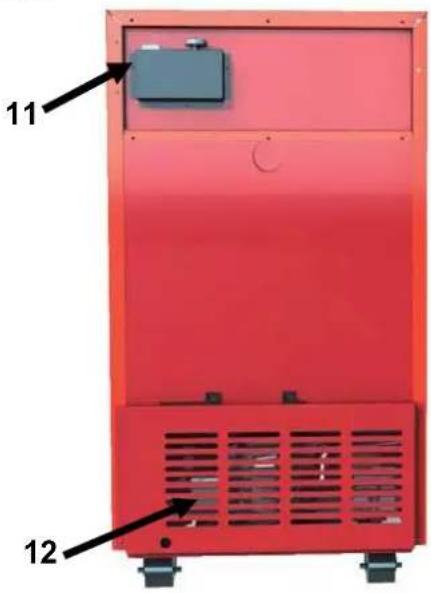
BOTTOM REAR SECTION
13
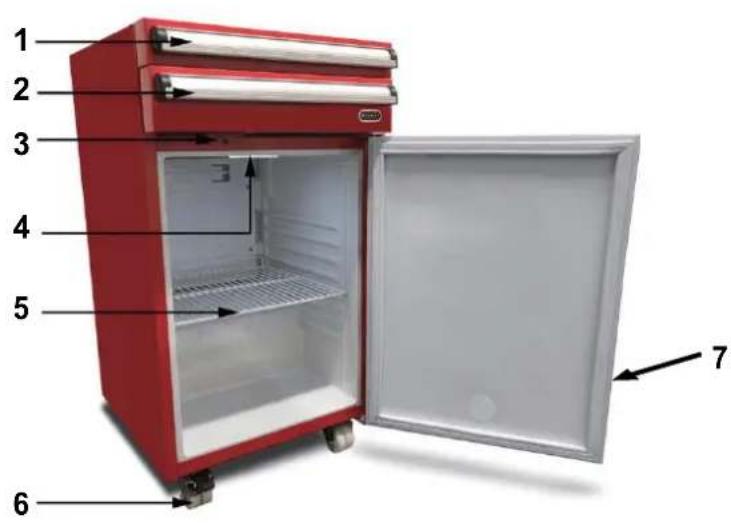
| 1. Small Drawer | 5. Slide-Out Refrigerator Wire Shelf (1) | 9. Refrigerator Handle Bars (4) | 12. Compressor (Rear) |
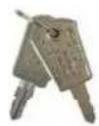
| 2. Large Drawer | 6. Wheel casters with lock (2) | 10. Wheel casters (2) | 13. Door Keys |
| 3. Door Lock Latch | 7. Refrigerator Door | 11. Temperature Control Knob I Light Switch (Rear) | |
| 4. Internal Light | 8. Lock Key Hole |
Product Features / Technical
Ideal for any small space where cold storage is needed, the Whynter Portable 1.8 cu.ft. Tool Box Refrigerator with 2 Drawers and Lock can also be used in the kitchen, offices, garages or basements. This space-saving Tool Box Refrigerator is designed with a flush back, allowing it to fit cleanly against the wall into corners. This freezer features a stainless steel trimmed glass door, adjustable temperature control, and a lock for securing the contents.
- Powder coated red with a Full Steel Exterior
• Powerful compressor cooling
• 2 Roller Guided Metal Drawers - for storing a wide variety of home tools and hardware - Default temperature 40^
- Wheel Rollers - lets you easily transport or move your tool box refrigerator whenever the need arises
- Soft interior LED lighting with onloff switch
• Inside cabinet drain
• Door lock and two keys
• Freestanding setup (clearance around the unit is needed)
TECHNICAL DATA
| MODEL : | TBR-185SR |
| Storage Volume | 1.8 cu. ft. |
| Default temperature | 40°F |
| Net Weight | 72.1 lbs |
| Gross Weight | 89.3 lbs |
| Unit Dimensions | 16.93” W x 20.75” D x 31.61” H |
| Packaging Dimensions | 20.47” W x 24.3” D x 33.8” H |
| Refrigerant | R600a |
| Estimated Yearly Electricity Use | 237kWh |
| Noise Level | 39 dB |
| UPC | 852749006733 |

WARNING

Excessive Weight Hazard
Two or more people should move and install tool box refrigerator. Failure to do so can result in injury.
REMOVE PACKAGING MATERIALS
IMPORTANT: Do not remove any permanent instruction labels or the data label on your tool box refrigerator
REMOVE TAPE AND GLUE FROM YOUR TOOL BOX REFRIGERATOR BEFORE USING
- To remove any remaining tape or glue, rub the area briskly with your thumb. Tape or glue residue can easily removed by rubbing a small amount of liquid dish soap over the adhesive with your fingers. Wipe warm water and dry.
- Do not use sharp instruments, rubbing alcohol, flammable fluids, or abrasive cleaners to remove tape or inside the refrigerator compartment. These products can damage the inside surface.
CLEANING BEFORE USE
• After you remove all of the packaging materials, clean the inside of your tool box refrigerator before using
INSTALLATIONCLEARANCES
Your tool box refrigerator should be conveniently located for day-to-day use in a dry, well-ventilated room. D install the tool box refrigerator where the temperature will go below 50°F or above 90°F, because it will not tain proper temperatures. Be sure to install your tool box refrigerator on a floor strong enough to support it is fully loaded.
FREESTANDINGINSTALLATION
A freestanding installation will allow you to install the tool box refrigerator in any place you desire provided that the required clearance space around the appliance is respected. In every setting, there must be adequate ventila and access for service. Never install or operate the unit in an enclosed area, such as a closed cabinet.
- Before connecting the tool box refrigerator to the power source, let it stand upright for approximately 4 h. This will reduce the possibility of a malfunction in the cooling system from handling during transportation.
- The normal operation of the tool box refrigerator depends on heat radiation from the condenser. Allow at 6 inches of space between the back and sides of the appliance, which allows the proper air circulation the compressor and condenser. The installation should allow the tool box refrigerator to be pulled forward servicing if necessary.
- This unit MUST be installed in an area protected from the elements, e.g., wind, rain, water spray or dri NOT use in an outdoor setting.
- The tool box refrigerator should not be located next to ovens, grills or other high heat resources.
- Too much humidity in the air will cause frost to form quickly on the evaporator requiring more frequent frosting of the tool box refrigerator.
- Avoid locating the appliance in area that may be exposed to excessive moisture.
- The tool box refrigerator must be installed with all electrical requirements followed.
- The unit should be located on a hard and level surface that can support the unit when it is full. It is for the tool box refrigerator to be level in order to work properly.
Installation
- A standard electrical supply (115 VAC only, 60 Hz, 10A), properly grounded in accordance with National Electrical Code and local codes and ordinances is required.
- IMPORTANT: Do not kink or pinch the power supply cord between the tool box refrigerator and wall or partment.
MOVEMENT OF YOUR APPLIANCE
- Position the tool box refrigerator in a dry and well-ventilated place. Keep the tool box refrigerator away 1 direct sunlight, heaters, and corrosive gases or chemicals.
- Clean the interior surface with lukewarm water using a soft cloth.
- Place your appliance on a hard and level floor that is strong enough to support it when it is fully load
- The tool box refrigerator can be simply moved from one room to another by using the pre-installed wheelers.
- If the appliance is needed to be lifted, two or more people should move tool box refrigerator. Failure to can result in back or other injury.
• We do not recommend installing the appliance on carpet.
To obtain the best possible results for your tool box refrigerator, it is important that you operate it properly. Your tool box refrigerator uses a mechanical thermostat control knob which can be located at the back side of the refrigerator. Default temperature 40^ F.
The temperature control knob is marked with the settings OFF-COLD-COLDEST in order of increasing coldness. When the unit is set to "OFF", the refrigerator stops running.
NOTE:
• Give your refrigerator time to cool down completely. It is best to wait for 24 hours before adding items
- This refrigerator is not designed for use as a freezer. The temperature range for this tool box refrigerated optimized for beverage storage. Perishable items may require a different storage environment.
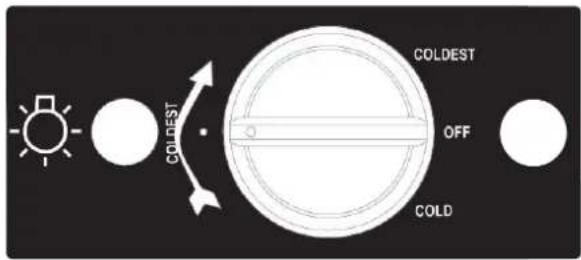
INTERIOR LIGHT
To turn on/off the interior light, flip the switch next to the thermostat control knob. Please note that the in light can only be controlled by this switch but not the opening and closing of the door.
CYLINDER LOCK
This tool box refrigerator is equipped with a lock to keep your beverages safe and secure. Please note that only the large roller tool drawer and refrigerator cabinet will be secured when the lock is used.
FRESH FOOD STORAGE
- Wrap or store food in the refrigerator in airtight and moisture – proof material. This prevents food odor taste transfer throughout refrigerator.
- Fruit – wash, dry and store in refrigerator in plastic bags or crisper.
- Leafy vegetables- remove wrapping and trim or tear off bruised and discolored areas then wash in cold water and drain. Place in plastic bag or plastic container and store in crisper.
- Fish – use fresh fish the same day as purchased.
- Meat – store most meat in original wrapping as long as it is airtight and moisture – proof. Re-wrap if essary.
- Leftovers – cover leftovers with plastic wrap or aluminum foil. Plastic containers with tight-seal lid can be used.
NOTE:
- For best performance, leave enough space in the refrigerator compartment for air to circulate around the packages. Also let enough room at the front so the door can close tightly.
DEFROSTING
Under most ambient conditions, the appliance does not need to be defrosted. In cold ambient temperatures and/or high humidity, some frost may build up. To defrost the appliance, set the thermostat dial to "OFF", move frozen or perishable items and defrosting should occur in a few hours. After defrosting, return the mostat dial to the desired position. For faster defrosting, remove all items from the appliance, unplug the apance and leave the door open. Never use a knife or other metal instrument to scrape ice/frost from the erator.
NORMAL SOUNDS
The unit is cooled by a compressor. The compressor pumps coolant through the cooling system, producing operating noise. Even when the compressor cuts out, noises caused by changes in temperature and pressure are unavoidable. Operating noise will be most audible immediately after the compressor comes on. It becomes quieter as the operating period continues.
The following noises are normal and occur from time to time:
• Gurgling sound, caused by the refrigerant flowing through the appliance's coils
- Humming noise made by the compressor. This noise can get louder for brief periods when the motor is switching on.
- Cracking/popping sounds, resulting from the materials contraction and expansion due to temperature variations.
- Fan operating sound, to circulate the air within the refrigerator compartment.
- Unusual noise is normally the result of improper installation.
- Where the unit is installed in open-plan kitchen or in partition walls, the level of operating noise will be heard more acutely. However, this is due to the surrounding architecture and not to the unit.
NOTE: An individual's perception of noise is directly linked to the environment in which the unit is located, well the specific type of models. Our appliances are in line with international standards for such appliance in line with the latest technical developments. Please remember that the noise of the compressor and the constant circulating in the system is unavoidable
Cleaning and Maintenan
CLEANING
Outside/Exterior
- Wipe with a clean cloth lightly dampened with appliance polish wax or mild liquid dishwashing detergent. Dry and polish with a clean, soft cloth.
- Do not wipe the tool box refrigerator with a soiled dishwashing cloth or wet towel. Do not use scouring pads, powdered cleaners, bleach, or cleaners containing bleach.
Inside
- Turn off the power, unplug the appliance, and remove all items including shelves.
- Use warm water and baking soda solution—about a tablespoon of baking soda to a quart of water. Rinse thoroughly with water and wipe dry.
- Do not use cleaning powders or other abrasive cleaners. An open box of baking soda in the tool box refrigerator will absorb stale tool box refrigerator odors. Change the box every three months.
- An open box of baking soda in the tool box refrigerator will absorb stale tool box refrigerator odors. Change the box every three months
CHANGING THE LIGHT BULBS
To change the light bulb, make sure to unplug tool box refrigerator or disconnect unit from power supply fore removing the bulb. Replace the bulb with an 8-watt LED bulb. Please note that not all bulbs will fit tool box refrigerator. Be sure to replace the bulb with one of the same size and shape. Plug in the tool refrigerator or reconnect tool box refrigerator to power supply after bulb replacement.
PREPARING FOR STORAGE
If the tool box refrigerator will not be used for a long time, or is to be moved to another place, it will I sary to defrost the unit and dry the interior.
- Disconnect the tool box refrigerator from the power supply by removing the power plug from the wall socket. WARNING: Do not touch the power plug when your hands are wet. Never unplug the unit by ing the cord.
- Leave the door open to allow air circulation and mold prevention. mildew and unpleasant smells.
CAUTION: Store the unit out of the reach of children. If you have children, you may want to take addition precautions such as locking the beverage refrigerator door.
VACATION TIME
- Short vacations: Leave the appliance operating during vacations of less than two days.
- Long vacations: If the appliance will not be used for an extended period, remove all items and turn off the appliance. Clean and dry the interior thoroughly.
MOVING YOUR APPLIANCE
- Remove all items inside the appliance.
- Securely tape down (we recommend using painter's tape) all loose items (shelves) inside your appli- ance.
- Turn the adjustable leg up to the base to avoid damage.
- Tape (we recommend using painter's tape) the door shut.
- Be sure the appliance stays secure in the upright position during transportation and protect the exterior of appliance with a blanket, or similar item.
ENERGY SAVING TIPS
- The appliance should be located in the coolest area of the room, away from heat-producing appliances or heating ducts, and out of any direct sunlight.
- Ensure that the appliance is adequately ventilated. Never obstruct the air vents.
- Close the door tightly and do not open the appliance too frequently or for a long period of time.
- Store the content in an organized way.
- Do not over-fill the appliance to allow air to circulate.
Troubleshooting
Many common tool box refrigerator problems are easily resolved. Try the troubleshooting suggestions below to see if the problems can be resolved before having to contact the service department.
| Problem | Possible Causes | Solutions |
| The machine won't operate | The tool box refrigerator is un- pluggedThe voltage is not in the correct rangeToo many appliances running form the same power circuit | Push the plug completely into the power souMake sure that the tool box refrigerator runs a dedicated power source that can support t maximum power consumption of the tool box - refrigeratorRun the tool box refrigerator on a dedicated pow- er source |
| Noise during operation | Unit is not on a leveled surfaCertain sounds are normal | Make sure unit is placed in a leveled surfadSee “Normal Sounds” |
| The compressor runs for 1 to 5 minutes and stops | The voltage is not in the correct range | Unplug and restart when the power is norma |
| The compressor runs but the inner liner does not get very cold | The ambient temperature is too highThe system is blocked | If temperature is higher than 90°F, the unit need longer to cool to the set temperatureContact Whynter Service Department via ema at service@whynter.com |
| The tool box refrigera- tor does not cool sufficiently | Tool box refrigerator door being opened frequentlyTool box refrigerator door left open for a whileNot enough adequate clearanceTool box refrigerator is overfilleAmbient temperature is too hig | Refrain from opening the tool box refrigerator door recurrentlyMake sure to close tool box refrigerator dooFollow recommended clearance measurementsIf temperature is higher than 90°F, the unit need longer to cool to the set temperature |
| The compressor does not run | The controller is faulty (the power indicator is not on)The thermostat is set too high and the ambient temperature is | Contact Whynter Service Department via ema at service@whynter.comSet the tool box refrigerator to a lower tempera- ture |
| Interior light does not work | No power at outlettool box refrigerator is unpluggLight bulb burned out | Replace fuse or reset the breakerPush the plug completely into the outletReplace light bulb |
| Door does not fully close | Unit is not on a leveled surfaStored items holding door oper | Make sure unit is placed in a leveled surfadMove stored item to a different location |
| Foods defrosting | The tool box refrigerator is un- pluggedFuse blownTool box refrigerator door being opened frequentlyTool box refrigerator door left open for a while | Push the plug completely into the power souReplace fuse or reset the breakerCheck to see if an object is holding the do |
| Excessive frost buildup | Door left open too frequent or too long door openingsHigh humidity | Check to see if an object is holding the doOpen the door less often |
Troubleshooting
Many common tool box refrigerator problems are easily resolved. Try the troubleshooting suggestions below to see if the problems can be resolved before having to contact the service department.
| Problem | Possible Causes | Solutions |
| Tool box refrigerator external surface is | The external tool box refriger- tor walls can be as much 30^ F warmer than room tempera-ture | This is normal while the compressor works to trans- fer heat from inside the tool box refrigerator com-partment |
| Moisture forms the tool box refrigerator walls | Weather is hot and humid, which increases internal rate of frost buildupDoor may not be closing properlyDoor is kept open too long is opened too frequently | This is normalCheck door installationOpen the door less often |
| Odors in tool box refriger- erator | Interior needs to be cleanedFood with strong odors are in the tool box refrigerator | Clean interior with sponge, warm water, and baking soda |
ONE YEAR LIMITED WARRANTY
This Whynter Tool Box Refrigerator is warranted, to the original owner within the 48 continental states, for o year from the date of purchase against defects in material and workmanship under normal use and service. making a warranty claim, please have the original bill or invoice of purchase with purchase date available. S your Whynter Tool Box Refrigerator prove defective within one year from the date of purchase, return the defective part or unit, freight prepaid (within two months of purchase; after two months to one year, customer be responsible for freight cost to Whynter's service department), along with an explanation of the claim to W LLC. A return authorization number issued by Whynter is required for all warranty claims and returns. Please package your Whynter Tool Box Refrigerator carefully in its original packaging material to avoid damage in tr it. The original box and packaging material should be retained, as Whynter is not responsible for the cost of replacement packaging. Under this warranty, Whynter will repair or replace any parts found defective at ou discretion. This warranty is not transferable. After the expiration of the warranty, the cost of labor and parts the responsibility of the original owner of the unit.
THIS WARRANTY DOES NOT COVER:
- Acts of God, such as fire, flood, hurricanes, earthquakes and tornadoes.
- Improper power supply such as power surge, low voltage, defective household wiring or inadequate fuses.
- Use in commercial or industrial applications
- Damage, accidental or otherwise, to the Whynter Tool Box Refrigerator while in the possession of a consumer not caused by a defect in material or workmanship;
- Damage caused by consumer misuse, tampering, or failure to follow the care and special handling provisions in the instructions.
- Damage to the finish of the case, or other appearance parts caused by wear.
- Damage caused by repairs or alterations to the product by anyone other than authorized by the manufacturer.
- Removal, Replacement Packaging, Freight and Insurance cost for the warranty service.
DISCLAIMER OF IMPLIED WARRANTIES; LIMITATION OF REMEDIES CUSTOMER'S SOLE AND EXCLUSIVE REMEDY UNDER THIS LIMITED WARRANTY SHALL BE PRODUCT REPAIR OR REPLACEMENT AS PROVIDED HEREIN, CLAIMS BASED ON IMPLIED WARRANTIES, INCLUDING WARRANTIES OF MERCHANTABILITY OR FITNESS FOR A PARTICULAR PURPOSE, ARE LIMITED TO ONE YEAR OR THE SHORTEST RIOD ALLOWED BY LAW, BUT NOT LESS THAN ONE YEAR. WHYNTER SHALL NOT BE LIABLE FOR C SEQUENTIAL OR INCIDENTAL DAMAGES SUCH AS PROPERTY DAMAGE AND INCIDENTAL EXPENSES RESULTING FROM ANY BREACH OF THIS WRITTEN LIMITED WARRANTY OR ANY IMPLIED WARRANTY, SOME STATES AND PROVINCES DO NOT AL-LOW THE EXCLUSION OR LIMITATION OF INCIDENTAL OF CONSEQUENTIAL DAMAGES, OR LIMITATIONS ON THE DURATION OF IMPLIED WARRANTIES, SO THESE LIMITATIONS OR EXCLUSIONS MAY NOT APPLY TO YOU. THIS WRIT-TEN WARRANTY GIVES YOU SPECIFIC LEGAL RIGHTS. YOU MAY ALSO HAVE OTHER RIGHTS THAT VARY FROM STATE TO STATE.
Please retain the original proof of purchase in order to obtain warranty services.
Warranty begins from the original date of purchase.
To obtain service or information, contact
Whynter LLC via email at support@whynter.com or call
866-WHYNTER.
Product contents and specifications may change without notice.
Copyright © 2023 Whynter LLC
WWW.WHYNTER.COM
- INSTRUCTION MANUAL
- WARNING:
- DANGER:
- ELECTRICAL CONNECTION
- EXTENSION CORD
- Caution: Risk of fire / Flammable materials
- Product Features / Technical
- WARNING
- Excessive Weight Hazard
- REMOVE PACKAGING MATERIALS
- REMOVE TAPE AND GLUE FROM YOUR TOOL BOX REFRIGERATOR BEFORE USING
- CLEANING BEFORE USE
- INSTALLATIONCLEARANCES
- FREESTANDINGINSTALLATION
- Installation
- MOVEMENT OF YOUR APPLIANCE
- NOTE:
- INTERIOR LIGHT
- CYLINDER LOCK
- FRESH FOOD STORAGE
- DEFROSTING
- NORMAL SOUNDS
- Cleaning and Maintenan
- CLEANING
- Outside/Exterior
- Inside
- CHANGING THE LIGHT BULBS
- PREPARING FOR STORAGE
- VACATION TIME
- MOVING YOUR APPLIANCE
- ENERGY SAVING TIPS
- Troubleshooting
- ONE YEAR LIMITED WARRANTY
- THIS WARRANTY DOES NOT COVER:
Brand : Whynter
Model : TBR-185SR
Category : Refrigerator