
XO122SMUA - Cap XO - Free user manual and instructions
Find the device manual for free XO122SMUA XO in PDF.


| Product Type | Under-Cabinet Range Hood |
| Model Numbers | XO122SMUA, XO128SMUA |
| Dimensions (W x D x H) | Approx. 30" x 18" x 6" |
| Weight | Approx. 25 lbs |
| Power Supply | 120V, 60Hz, 15A/20A circuit |
| Motor Speeds | 3 speeds + Intensive (4th) for 10 minutes |
| Lighting | 2 halogen bulbs, 3 brightness levels |
| Filter Type | Aluminum grease filter (dishwasher safe); optional carbon filter kit XORFRND |
| Ducting | 6" round or 3.25"x10" rectangular, metal only. Max 100 equivalent feet. |
| Installation Type | Under-cabinet, ducted or recirculating |
| Warranty | 2 years limited |
| Control Type | Push buttons; optional remote control |
| Timer Function | 5-minute delayed auto shut-off |
| Material | Stainless steel |
| Safety Features | Grounded, auto-off timer, overload protection |
| Accessories Included | Halogen bulbs, grease filters, mounting hardware |
| Recirculation Kit | Model XORFRND (optional, carbon filters not included) |
| Cleaning | Grease filters: wash every 2 months; carbon filters: replace every 4 months |
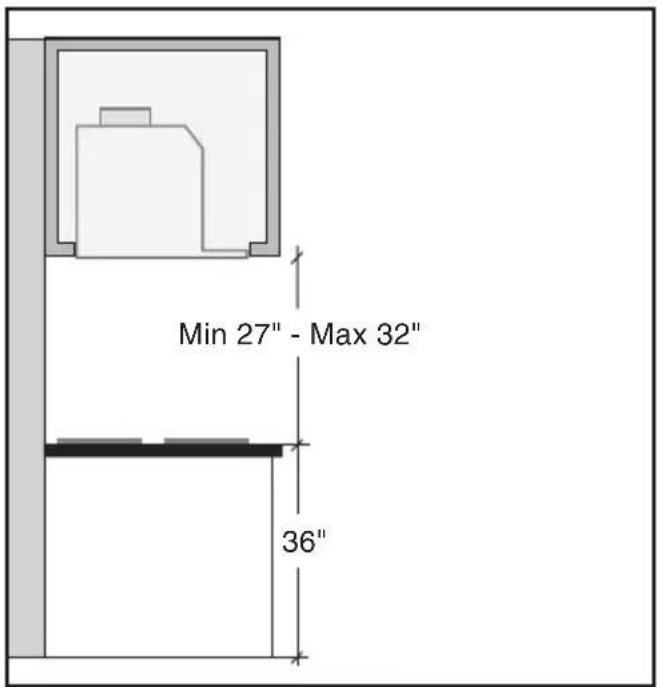
| Mounting Height | 27" to 32" above cooktop (min-max) |
| Electrical Connection | Hardwired; black (L), white (N), green/yellow (G) |
Frequently Asked Questions - XO122SMUA XO
User questions about XO122SMUA XO
0 question about this device. Answer the ones you know or ask your own.
Ask a new question about this device
Download the instructions for your Cap in PDF format for free! Find your manual XO122SMUA - XO and take your electronic device back in hand. On this page are published all the documents necessary for the use of your device. XO122SMUA by XO.
USER MANUAL XO122SMUA XO
natural_image
Technical line drawing of a 3D architectural enclosure or enclosure with two circular cutouts and a sloped roof (no text or symbols)XO122SMUA XO128SMUA
NEED HELP?
Call our ventilation experts toll free al 800-966-8300
AVEZ-VOUS BESOIN D'AIDE ?
Proof of original purchase date and invoice is needed to obtain service under warranty.
What is covered
Limited 2 Year Warranty.
For 2 years from the original date of purchase, we will provide, free of charge, parts and service labor in your home to repair or replace any part of the hood that fails because of a manufacturing defect.
The warranty is extended to the original purchaser for products purchased for ordinary home use in North America.
Should you require service for your XO product call a product service specialist at 800.966.8300
What is not covered
Improper Installation.
Service trips to the home to teach you how to use the product.
Resetting circuit breakers.
Damage caused after delivery.
EXPECT MORE FROM XO
When buying any XO appliance you can be confident
you have purchased a high quality, innovative, and stylish product, from a company who cares about you

■ IMPORTANT SAFETY INSTRUCTIONS
■ READ AND SAVE THESE INSTRUCTIONS
■ PLEASE READ ENTIRE INSTRUCTIONS BEFORE PROCEEDING.
■ IMPORTANT: Save these Instructions for the Local Electrical Inspectors use.
■ INSTALLER: Please leave these Instructions with this unit for the owner.
■ OWNER: Please retain these instructions for future reference.
■ Take care when using cleaning agents or detergents.
■ Suitable for use in household cooking area.
■ WARNING - To reduce the risk of fire or electric shock, do not use this fan with any Solid-State Speed Control Device.
■ CAUTION - To reduce risk of fire and to properly exhaust air, be sure to duct air outside – Do not vent exhaust air into spaces within walls or ceilings or into attics, crawl spaces, or garages.
■ CAUTION - For general ventilating use only. Do not use to exhaust hazardous or explosive materials and vapors.
■ CAUTION - To avoid motor bearing damage and noisy and/or unbalanced impellers, keep drywall spray, construction dust, etc. off power unit.
■ CAUTION - Please read specification label on product for further information and requirements.
■ WARNING – TO REDUCE THE RISK OF FIRE, ELECTRIC SHOCK, OR INJURY TO PERSONS, OBSERVE THE FOLLOWING:
A. Use this unit only in the manner intended by the manufacturer. If you have questions, contact the manufacturer.
B. Before servicing or cleaning unit, switch power off at service panel and lock the service disconnecting means to prevent power from being switched on accidentally. When the service disconnecting means cannot be locked, securely fasten a prominent warning device, such as a tag, to the service panel.
■ WARNING - TO REDUCE THE RISK OF A RANGE TOP GREASE FIRE:
A. Never leave surface units unattended at high settings. Boilovers cause smoking and greasy spillovers that may ignite. Heat oils slowly on low or medium settings.
B. Always turn hood ON when cooking at high heat or when flambeing foods (i.e.
Crepes Suzette, Cherries Jubilee, Peppercorn Beef Flambè).
C. Clean ventilating fans frequently. Grease should not be allowed to accumulate on fan or filter.
D. Use proper pan size. Always use cookware appropriate for the size of the surface element.
E. Keep fan, filters and grease laden surface clean.
F. Use high range setting on range only when necessary. Heat oil slowly on low to medium setting.
G. Don't leave range unattended when cooking.
H. Always use cookware and utensils appropriate for the type and amount off food being prepared.
■ WARNING – TO REDUCE THE RISK OF INJURY TO PERSONS IN THE EVENT OF A RANGE TOP GREASE FIRE, OBSERVE THE FOLLOWING:
A. SMOTHER FLAMES with a close-fitting lid, cookie sheet, or metal tray, then turn off the burner. BE CAREFUL TO PREVENT BURNS. If the flames do not go out immediately, EVACUATE AND CALL THE FIRE DEPARTMENT.
B. NEVER PICK UP A FLAMING PAN – You may be burned.
C. DO NOT USE WATER, including wet dishcloths or towels – a violent steam explosion will result.
D. Use an extinguisher ONLY if:
- You know you have a Class ABC extinguisher, and you already know how to operate it.
- The fire is small and contained in the area where it started.
- The fire department is being called.
- You can fight the fire with your back to an exit.
^a Based on “kitchen firesafety tips” published by NFPA
Proper maintenance of the Range Hood will assure proper performance of the unit.
■ INSTALLATION INSTRUCTIONS
WARNING – TO REDUCE THE RISK OF FIRE, ELECTRIC SHOCK, OR INJURY TO PERSONS, OBSERVE THE FOLLOWING:
A. Installation work and electrical wiring must be done by qualified person(s) in accordance with all applicable codes and standards, including fire-rated construction.
B. Sufficient air is needed for proper combustion and exhausting of gases through the flue (chimney) of fuel burning equipment to prevent back drafting. Follow the heating equipment manufacturer's guideline and safety standards such as those published by the National Fire Protection Association (NFPA), and the American Society for Heating, Refrigeration and Air Conditioning Engineers (ASHRAE), and the local code authorities.
C. When cutting or drilling into wall or ceiling, do not damage electrical wiring and other hidden utilities.
D. Ducted fans must always be vented to the outdoors.
E. This unit must be grounded.
■ WARNING - TO REDUCE THE RISK OF FIRE, USE ONLY METAL DUCTWORK.
■ WARNING - UNDER CERTAIN CIRCUMSTANCES DOMESTIC APPLIANCES MAY BE DANGEROUS.
A. Do not check filters with hood working.
B. Do not touch the lamps after a prolonged use of the appliance.
C. No food must be cooked flambè underneath the hood.
D. The use of an unprotected flame is dangerous for the filters and could cause fires.
E. Watch constantly the fried food in order to avoid the cooking oil flares up.
F. Before performing any maintenance operation, disconnect the hood from the electrical service.
■ The manufacturers will not to accept any responsibility for eventual damages, because of failure to observe the above instructions.
| duct pieces | Equivalent number length x used = | Total | |
| 3-1/4" x 10" Rect., straight | 1 Ft. x( ) = | Ft. | |
| 7" Round, straight | 1 Ft. x( ) = | Ft. | |
| 8" Round, straight | 1 Ft. x( ) = | Ft. | |
| 3-1/4" x 10" Rect.90° elbow | 15 Ft. x( ) = | Ft. | |
| 3-1/4" x 10" Rect.45° elbow | 9 Ft. x( ) = | Ft. | |
| 3-1/4" x 10" Rect.90° flat elbow | 24 Ft. x( ) = | Ft. | |
| 3-1/4" x 10" Rect. wall cap with damper | 30 Ft. x( ) = | Ft. | |
| 3-1/4" x 10" Rect.to 6" round transition | 5 Ft. x( ) = | Ft. | |
| 3-1/4" x 10" Rect.to 6" round transition 90° elbow | 20 Ft. x( ) = | Ft. | |
| 6" Round, 90° elbow | 15 Ft. x( ) = | Ft. | |
| 6" Round, 45° elbow | 9 Ft. x( ) = | Ft. | |
| Subtotal column 1 = | Ft. | ||
| duct pieces | Equivalent number length x used = | Total | |
| 6"-8" Round wall cap with damper | 30 Ft. x( ) = | Ft. | |
| 6"-8" Round, roof cap | 30 Ft. x( ) = | Ft. | |
| 6" round to 3-1/4" x 10" rect. transition | 1 Ft. x( ) = | Ft. | |
| 6" round to 3-1/4" x 10" rect. transition 90° elbow | 16 Ft. x( ) = | Ft. | |
| 7" or 8" Round, 90° elbow | 15 Ft. x( ) = | Ft. | |
| 7" or 8" Round, 45° elbow | 9 Ft. x( ) = | Ft. | |
| 7" or 8" Round wall cap with damper | 30 Ft. x( ) = | Ft. | |
| 7" or 8" Round, roof cap | 30 Ft. x( ) = | Ft. | |
| 7" round to 3 1/4" x 10" rect. transition | 8 Ft. x( ) = | Ft. | |
| 7" round to 3-1/4" x 10" rect. transition 90° elbow | 23 Ft. x( ) = | Ft. | |
| Subtotal column 2 = Subtotal column 1 = Total Ductwork = | Ft. | ||
| Ft. | |||
| Ft. | |||
Maximum Duct Length:
For satisfactory air movement, the total duct length should not exceed 100 equivalent feet.
■ WARNING FIRE HAZARD
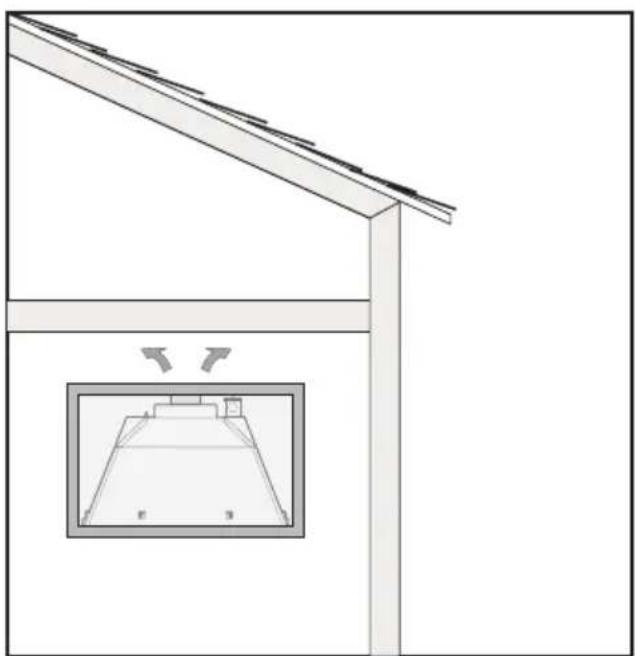
NEVER exhaust air or terminate duct work into spaces between walls, crawl spaces, ceiling, attics or garages.
All exhaust must be ducted to the outside, unless using the recirculating option.
Use single wall rigid Metal ductwork only.
Fasten all connections with sheet metal screws and tape all joints w/ certified Silver Tape or Duct Tape.
natural_image
Architectural diagram showing a roof structure with a central truss and directional arrows, no text or symbols present.
natural_image
Technical diagram of a structural support frame with directional arrows indicating motion (no text or symbols)INSTALL THE DUCTWORK:
NOTE: To reduce the risk of fire, use only metal ductwork.
- Decide where the ductwork will run between the hood and the outside.
- A straight, short duct run will allow the hood to perform most efficiently.
- Long duct runs, elbows, and transitions will reduce the performance of the hood. Use as few of them as possible.
- Install a roof or wall cap. Connect 6" round metal ductwork to cap and work back towards hood location. Use duct tape to seal the joints between ductwork sections.
PRODUCT DIMENSIONS AND CLEARANCE XO122S - XO128S:
Front of hood

Side of hood

Top of hood > Mounting height and

clearance:

1. FIXING THE HOOD TO THE LOWER PART OF THE WALL CABINET:
This type of appliance must be fitted inside a cabinet or inside another type of support structure. The overall measurements of the range hood are given in figure 1-2.
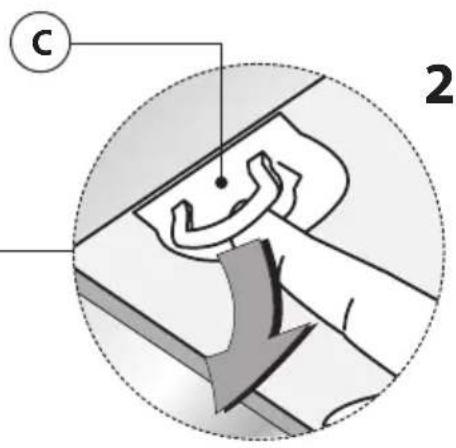
- Before proceeding with installation operations, remove the anti-grease filters in order to make handling the device easier: - Open panel B as indicated in Fig.3 - step 1.
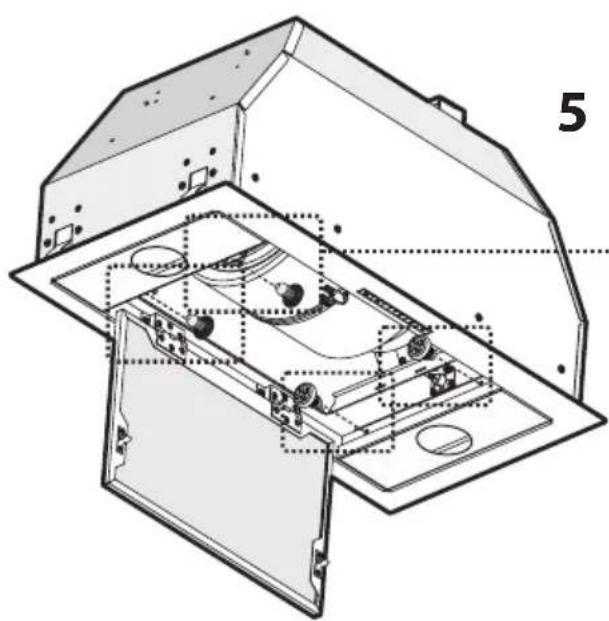
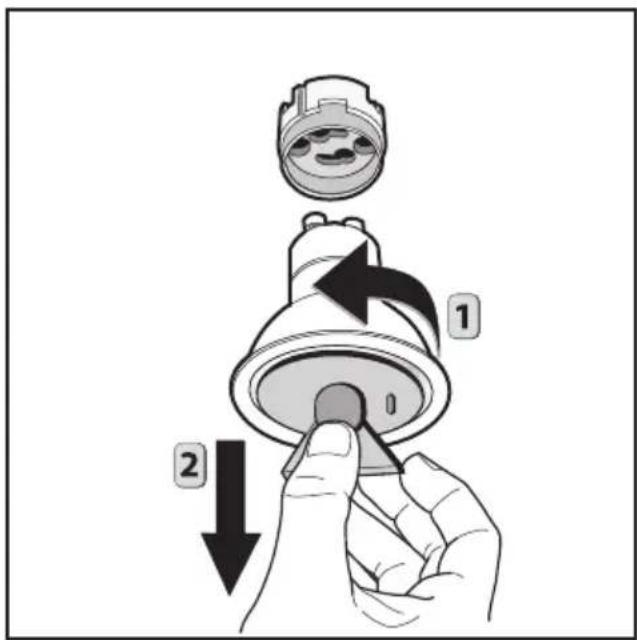
- Pull handle C as indicated in Fig.3 - step 2. - Remove the two light bulbs D turning them counterclockwise by means of a suction cup, as indicated in Fig.3 - step 3-4. - Remove the 4 screws E which secure the two light fixtures H (right and left) of the hood as indicated in Fig.3 - step 5.
- Remove the light fixtures H to make installation easier as indicated in Fig. 4 - step 6. - Make sure the thickness of the wall cabinet is within the measures indicated in Fig. 4 - step 8.1.
- Insert the hood inside the cabinet Fig. 4 - step 7 and make sure that the 4 springs F snap in place.
Fasten the hood to the wall cabinet using the screwdriver and the relative screws M and tighten until the device is flush against the cabinet Fig. 4 - step 8.
- Refit the two hood brackets H (right and left) and secure them with the 4 screws E which had been removed Fig. 5 - step 9-10.
- Screw the two light bulbs D back in place, turning them clockwise by means of a suction cup, as indicated in Fig. 5 - step 10-11.
IMPORTANT - The range hood must be secured to wall studs or use drywall anchors capable of supporting 75 lbs.

Fig.1

Fig.2



natural_image
Technical line drawing of an open electronic device casing with internal components and mounting holes (no text or symbols)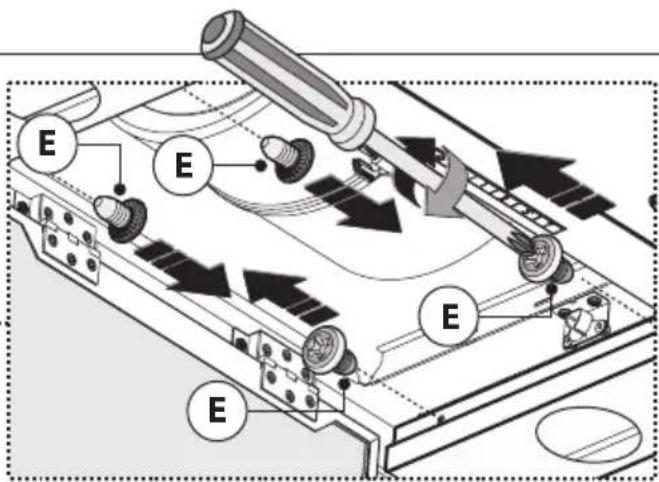
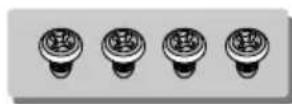
Fig.3

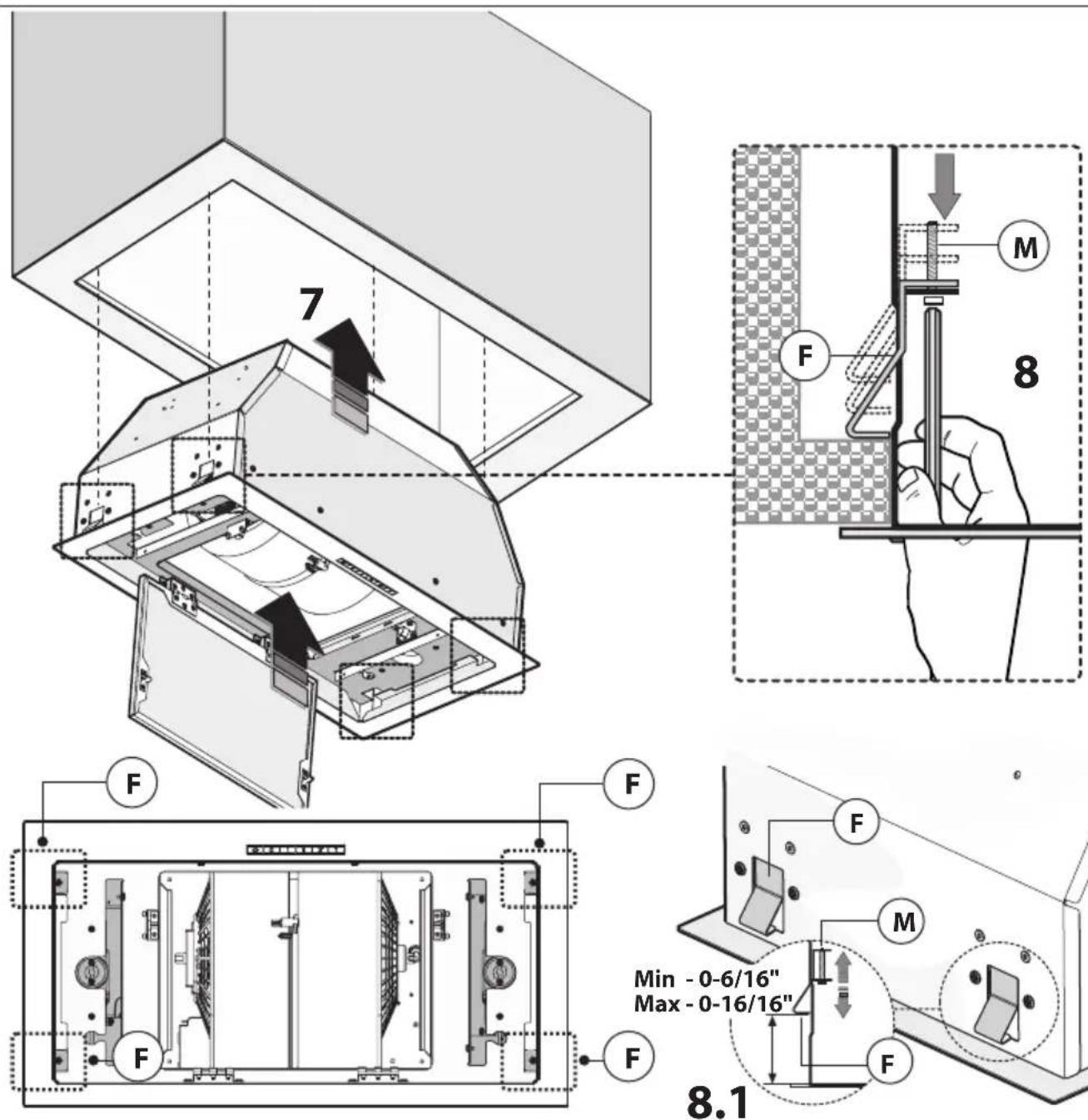
Fig.4

Fig.5
POWER SUPPLY:
IMPORTANT – (Please read carefully)
WARNING:
FOR PERSONAL SAFETY, THIS APPLIANCE MUST BE PROPERLY GROUNDED.
Remove house fuse or open circuit breaker before beginning installation. Do not use an extension cord or adapter plug with this appliance. Follow National electrical codes or prevailing local codes and ordinances.
Electrical supply:
These vent hoods must be supplied with 120V, 60Hz, and connected to an individual, properly grounded branch circuit, and protected by a 15 or 20 amp circuit breaker or time delay fuse.
• Wiring must be 2 wire with ground.
- If the electrical supply does not meet the above requirements, call a licensed electrician before proceeding.
- Route house wiring as close to the installation location as possible, in the ceiling or back wall. Refer to Wiring Locations on page 12.
- Connect the hood wiring to the house wiring in accordance with local codes.
WARNING: The improper connection of the equipment-grounding conductor can result in a risk of electric shock. Check with a qualified electrician or service representative if you are in doubt whether the appliance is properly grounded.
2. CONNECT ELECTRICAL:
• Power Supply Connection:
For connection to the power supply refer to the follows Fig.6:
BLACK = L line
WHITE = N neutral
GREEN/YELLOW = G ground
- A double-pole switch properly rated must be installed to provide the range hood power supply disconnection.
- Connect the electrical conduit to the Field Wiring Compartment using listed conduit fittings.
- Carry out the power supply connection in accordance with the national electric code, ANSI/NFPA 70-1999.
- Insert the wires into the box, then close the box cover, securing it using the screws that were previously removed.
The appliance should be installed at a minimum height of 27" up to a maximum height of 32" for optimal performance. If a connection ductwork composed of two parts is used, the upper part must be placed outside the lower part. Do not connect the range hood exhaust duct air to the same duct air used to exhaust hot air or fumes from other appliances other than electrical.
- In the FILTERING version it is necessary to apply a metal air exhaust tube M (Fig.7), with a minimum length of 15", connected to the flange of the collector. It must be positioned vertically and fastened to a specific opening made on the top part of the cabinet.

Fig.6
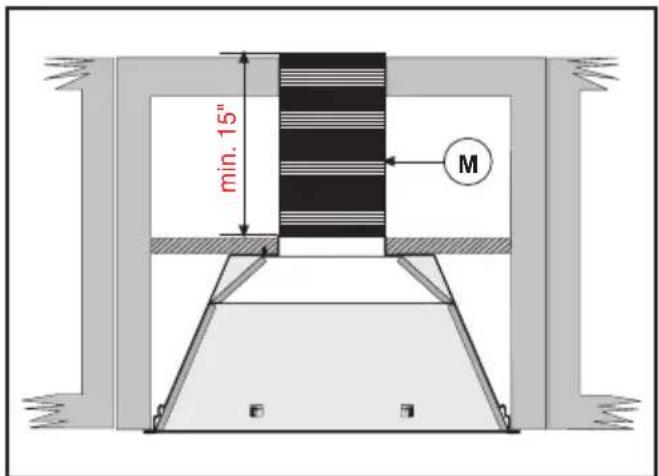
Fig.7
3. CONNECT THE DUCTWORK:
DUCTLESS RECIRCULATING OPTION:
natural_image
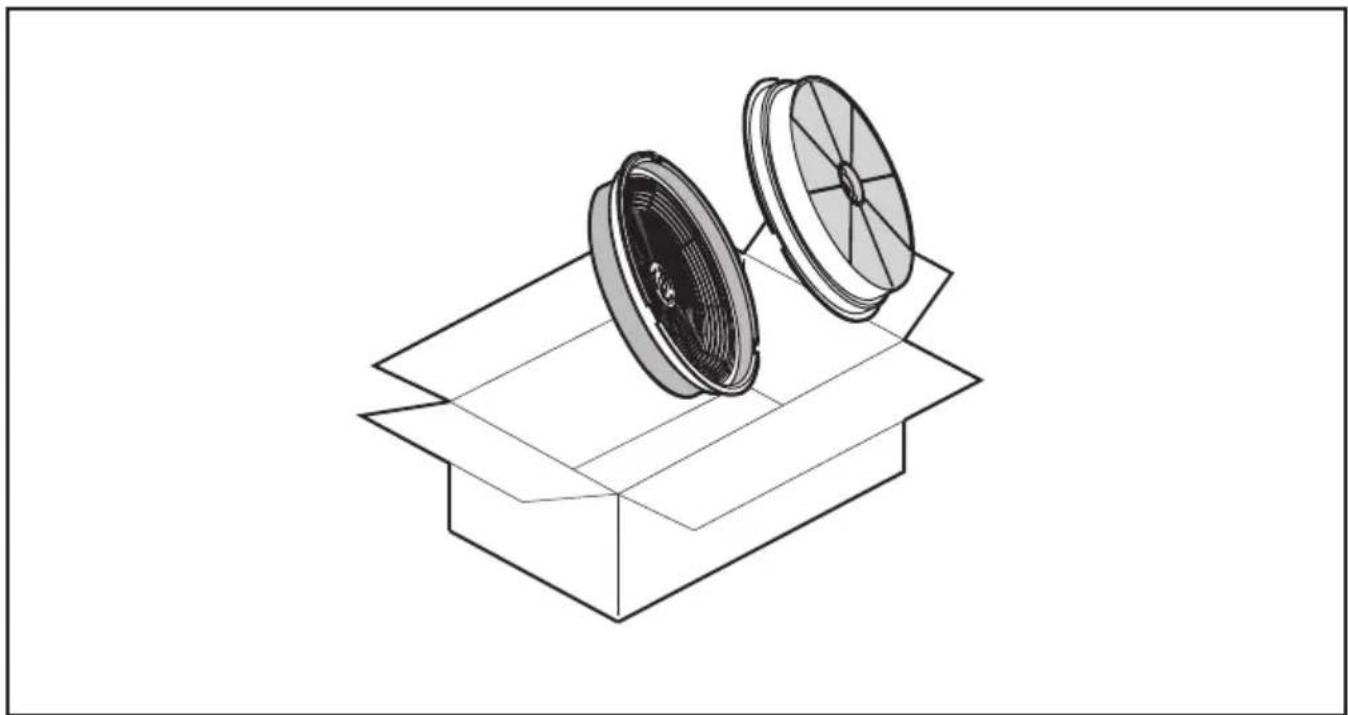
Line drawing of a box with two spools of film, no text or symbols presentModel XORFRND carbon filter kit

Fig.1: Remove the aluminum panels by pulling the lever 1 out and pushing downwards 2.
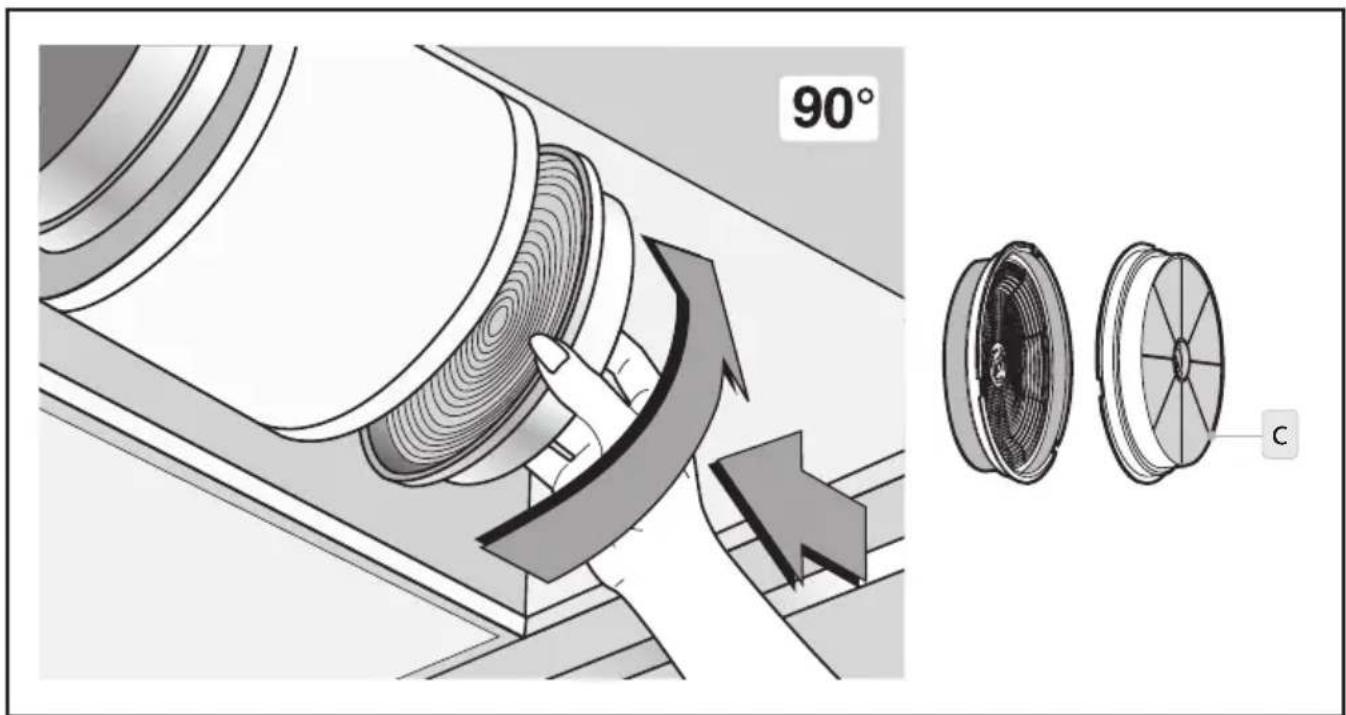
Fig.2: The filters C must be applied to the suction unit inside the hood, centering them inside of it and turning them 90^ until they snap into place.

Fig.3: Put the aluminum panels back in place.
Reciculating Installations
IT IS HIGHLY RECOMMENDED THAT PROFESSIONAL STYLE COOKING ALWAYS BE VENTEND TO THE OUTSIDE. For installations where ductwork is impossible or highly impractical Charcoal Filters, which attach to the blower assembly, absorb smoke and odors.


Some ductwork must be installed to exhaust the rengehood back into the kitchen either at the top or face of the cabinet or wood hood. This duct work must not terminate into a dead air space or inside the cabinet or custom hood.
Vent grate not included 6" round or 3 1/4" x 10" rectangular recommended for best performance
USE
- If the apparatus is equipped with the following controls:
PLEASE NOTE: with this command it is also possible to control the appliance using a remote control, available on demand.
- Synchronization:
ATTENTION! The remote control must be synchronized with the hood before you can use it.
To synchronize the remote control with the hood, proceed as follows:
-
Go near the appliance while it is not running and press the light key A of the hood control 4 seconds until its indicator light starts to blink for 5 seconds
-
When the indicator light of the hood lights blinks, press any key of the remote control. The remote control is now synchronized.
-
If synchronization failed, repeat the procedure.
Lights key (A) = Turns lights on/off.
- Press this key to adjust light intensity. - There are three brightness levels: high, medium, low.
When off, press once for the high level, twice for the medium level, three times for the low level and four times to turn the lights back off.
The light level goes in this cycle: high, medium, low, off.
OFF key (B) = Turns MOTOR AND LIGHTS on/off. When activated, the matching LED turns on for 1 sec.
Tasto (C) = 1st speed. When activated, the matching LED turns on.
Tasto (D) = 2nd speed. When activated, the matching LED turns on.
Tasto (E) = 3rd speed. When activated, the matching LED turns on.
Intensive Key (E) = With the motor running and any speed set, press key E for 2 Sec. to engage INTENSIVE speed (4th speed) for 10 minutes. While this function is active, the LED blinks, and the LED of the previously set speed turns off.
When 10 minutes are up, the hood goes back to the last set speed with the relative LED turning on.
- If you want to deactivate the function before 10 minutes are up, press the key E (back to 3rd speed). Pressing key B turns off the MOTOR and any LIGHTS still on.
- Even with the hood off, pressing key E for 2 seconds activates the INTENSIVE speed function.
Timer Key (F) = Activates or deactivates the Timer function (delayed shutdown).
The Timer function is active when the matching LED turns on.
If the motor is off, pressing key F activates the motor at 1st speed for 5 minutes, after which it turns off.

flowchart
graph TD
    A["A"] --> B["Sun Icon"]
    B --> C["0"]
    C --> D["1"]
    D --> E["2"]
    E --> F["3"]
    F --> G["T"]
If the motor is already running (at any speed, including Intensive), pressing key F switches it to 1st speed for 5 minutes, after which it turns off.
When the Timer function is active, the user can change motor speed using keys C-D-E without interrupting the 5-minute Timer function.
- If you wish to deactivate the function before the 5 minutes are up, press key F or B.
- After 5 minutes, at the end of the countdown, the hood switches off (motor and any lights still on).
MAINTENANCE
• We recommend that the range hood is switched on before any food is cooked. We also recommend that the appliance is left running for 15 minutes after the food is cooked, in order to thoroughly eliminate all contaminated air.
The effective performance of the range hood depends on constant maintenance; the anti-grease filter and the active carbon filter both require special attention.
- The anti-grease filter is used to any grease particles suspended in the air, therefore is subject to saturation (the time it takes for the filter to become saturated depends on the way in which the appliance is used). The grease filters should be cleaned frequently. Use a warm detergent solution. Grease filters are a dishwasher safe.
- To prevent potential fire hazards, the anti-grease filters should be washed a minimum of every 2 months (it is possible to use the dishwasher for this task).
- After a few washes, the colour of the filters may change. This does not mean they have to be replaced.
If the replacement and washing instructions are not followed, the anti-grease filters may present a fire hazard.
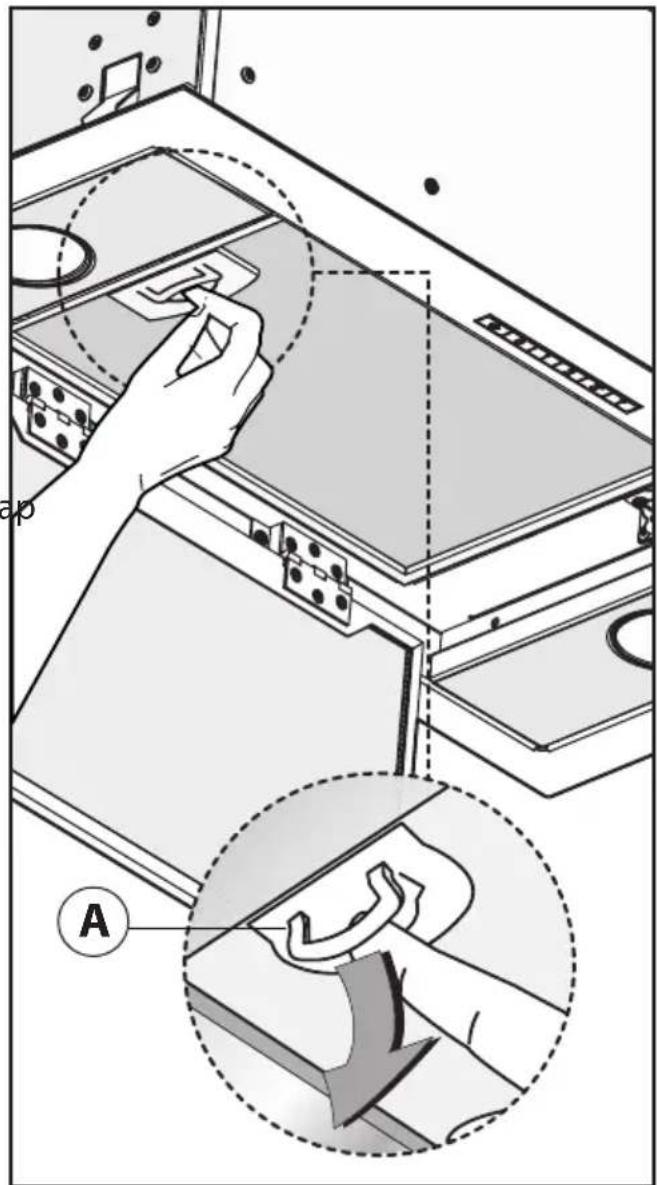
Fig.8
- The active carbon filters are used to purify the air which is released back into the room. The filters are not washable or re-usable and must be replaced at least once every four months. The active carbon filter saturation level depends on the frequency with which the appliance is used, the type of cooking performed and the regularity with which the anti-grease filters are cleaned.
- Clean the range hood frequently, both inside and outside, using a cloth which I been dampened with denatured alcohol or neutral, non-abrasive liquid detergents.
- The light on the range hood is designed for use during cooking and not for general room illumination. Extended use of the light reduces the average duration of the bulb.
- Hood Cleaning:
Stainless steel is one of the easiest materilas to keep clean. Occasional care will help preserve its fine appearance.
Cleaning tips:
- Hot water with soap or detergent is all that is usually needed.
- Follow all cleaning by rising with clear water. Wipe dry with a clean, soft cloth to avoid water marks.
- For discolorations or deposit that persist, use a non-scratching household cleanser or stainless steel polishing powder with a little water and a soft cloth.
- For stubborn cases, use a plastic scouring pad or soft bristle brush together with cleanser and water. Rub lightly in direction of polishing lines or “grain” of the stainless finish. Avoid using too much pressure which may mar the surface.
- DO NOT allow deposit to remain for long periods of time.
- DO NOT use ordinary steel wool or steel brushes. Small bits of steel may adhere to the surface causing rust.
- DO NOT allow salt solutions, disinfectants, bleaches, or cleaning compounds to remain in contact with stainless steel for extended periods. Many of these compounds contain chemicals with may be harmful. Rinse with water after exposure and wipe dry with a clean cloth.
Painted surfaces should be cleaned with warm water and mild detergent only.
• Replacing the aluminum panels:
To replace the aluminium panels, simply pull handle A as shown in Fig.8.
- Replacing halogen light bulbs:
To replace the dichroic lamps, rotate the lamp anticlockwise by means of a suction cup as shown in figure.
Replace the bulbs with new ones of the same type.


natural_image
Isometric line drawing of two spools inside a cardboard box (no text or symbols)Model XORFRND carbon filter kit
INSTALLATION PREPARATION:
Check installation hardware:
Locate the hardware package packed with the hood and check contents.


- XO122SMUA XO128SMUA
- What is covered
- What is not covered
- EXPECT MORE FROM XO
- Proper maintenance of the Range Hood will assure proper performance of the unit.
- ■ INSTALLATION INSTRUCTIONS
- Maximum Duct Length:
- ■ WARNING FIRE HAZARD
- INSTALL THE DUCTWORK:
- PRODUCT DIMENSIONS AND CLEARANCE XO122S - XO128S:
- FIXING THE HOOD TO THE LOWER PART OF THE WALL CABINET:
- POWER SUPPLY:
- WARNING:
- Electrical supply:
- CONNECT ELECTRICAL:
- • Power Supply Connection:
- GREEN/YELLOW = G ground
- CONNECT THE DUCTWORK:
- DUCTLESS RECIRCULATING OPTION:
- Reciculating Installations
- USE
- - If the apparatus is equipped with the following controls:
- - Synchronization:
- MAINTENANCE
- - Hood Cleaning:
- • Replacing the aluminum panels:
- - Replacing halogen light bulbs:
- INSTALLATION PREPARATION:
- Check installation hardware:
Brand : XO
Model : XO122SMUA
Category : Cap