
CTB-G - Hot plate Blodgett - Free user manual and instructions
Find the device manual for free CTB-G Blodgett in PDF.


| Product Type | Electric countertop stove with griddle and oven |
| Model | CTB-G |
| Brand | Blodgett |
| Configuration | CTB oven base with 30" wide griddle |
| Power Supply | 208V or 240V, 60Hz, single or three phase |
| Electrical Ratings (CTB-G) | 16.8 kW at 208V or 240V |
| Maximum Load (Amps) | 75A @208V 1ph, 65A @240V 1ph; 43A @208V 3ph, 38A @240V 3ph |
| Oven Temperature Range | 200-500°F (95-260°C) |
| Griddle Temperature Range | 0-400°F (0-200°C) |
| Griddle Surface | 30" wide, stainless steel, requires seasoning |
| Oven Capacity | Accepts 13" x 18" sheet pans, multiple racks |
| Fan | Convection fan with cool-down mode |
| Controls | Solid state thermostat, selector switch, cook timer, ready lights |
| Safety Features | Circuit breaker, restraints, warning labels for flammable materials |
| Cleaning | Griddle scraping, grill brick, mild soap; oven: ammonia solution, stainless steel cleaner |
| Maintenance | Annual venting system check, no lubrication required |
| Installation | Minimum 6" clearance from combustibles, leveling via casters with washers |
| Warranty | Original Equipment Warranty (excludes installation adjustments) |
| Dimensions (Approx.) | Width: 36", Depth: 30", Height: 36" (with casters) |
| Weight (Approx.) | 300-350 lbs |
Frequently Asked Questions - CTB-G Blodgett
User questions about CTB-G Blodgett
0 question about this device. Answer the ones you know or ask your own.
Ask a new question about this device
Download the instructions for your Hot plate in PDF format for free! Find your manual CTB-G - Blodgett and take your electronic device back in hand. On this page are published all the documents necessary for the use of your device. CTB-G by Blodgett.
USER MANUAL CTB-G Blodgett
PN 56631 Rev A (2/13)
© 2013 - G.S. Blodgett Corporation
Your Service Agency's Address:
Model
Serial number
Oven installed by
Installation checked by
IMPORTANT
WARNING: Improper installation, adjustment, alternation, service or maintenance can cause property damage, injury or death. Read the installation, operation and maintenance instructions thoroughly before installing or servicing this equipment.
FOR YOUR SAFETY
Do not store or use gasoline or other flammable vapors or liquids in the vicinity of this or any other appliance.
The information contained in this manual is important for the proper installation, use, and maintenance of this oven. Adherence to these procedures and instructions will result in satisfactory baking results and long, trouble free service. Please read this manual carefully and retain it for future reference.
ERRORS: Descriptive, typographic or pictorial errors are subject to correction. Specifications are subject to change without notice.
TABLE OF CONTENTS
INSTALLATION
Description and Specifications 2
Delivery and Location 3
4" Caster Installation....4
Adjustments Associated with Initial Installation....4
Utility Connections - Standards and Codes 5
Electrical Connection....6
OPERATION
Safety Information....7
Controls....8
General Guidelines for Operating Personnel.... 10
Suggested Times and Temperatures 11
MAINTENANCE
Cleaning and Preventative Maintenance 13
Troubleshooting Guide 14
Description and Specifications
The Blodgett Cooktop models offer versatility of convection and range top cooking within a small footprint. The Blodgett Cooktop is offered in four different configurations:
- CTB-GFB - CTB oven base with 18" griddle on the left and 2 french top burners on the right
- CTBR-GFB - CTBR oven base with 18" griddle on the right and 2 french top burners on the left
- CTB-G - CTB oven base with 30" wide griddle
- CTBR-G - CTBR oven base with 30" wide griddle
| ELECTRICAL RATINGS- CTB-G, CTBR-G, CTB-GFB & CTBR-GFB | ||||||||
| HZ | VOLTAGE | KW | PHASE | MAX LOAD (AMPS) ELECTRICAL CONNECTION AWG* | ||||
| L1 L2 | L2 N | |||||||
| CTB-G or CTBR-G | ||||||||
| 60 | 208 | 16.8 1 | 75 0 75 — 2 | |||||
| 16.8 3 | 43 43 43 — 6 | |||||||
| 240 | 16.8 1 | 65 0 65 — 3 | ||||||
| 16.8 3 | 38 38 38 — 6 | |||||||
| CTB-GFB or CTBR-GFB | ||||||||
| 60 | 208 | 17.6 1 | 85 0 85 — 1 | |||||
| 17.6 3 | 49 49 49 — 4 | |||||||
| 240 | 17.6 1 | 73 0 73 — 2 | ||||||
| 17.6 3 | 42 42 42 — 6 | |||||||
| * Electric connection wiring is sized for 60°C copper wire at 125% of rated input. | ||||||||
NOTE: Double units can have phase loads partially equalized by matching lines during hook-up. Otherwise, CTB-Double or CTBR-Double load ratings are twice the above data.
Delivery and Location
DELIVERY AND INSPECTION
All Blodgett ovens are shipped in containers to prevent damage. Upon delivery of your new oven:
- Inspect the shipping container for external damage. Any evidence of damage should be noted on the delivery receipt which must be signed by the driver.
- Uncrate and check for internal damage. Carriers will accept claims for concealed damage if notified within fifteen days of delivery and the shipping container is retained for inspection.
The Blodgett Oven Company cannot assume responsibility for loss or damage suffered in transit. The carrier assumed full responsibility for delivery in good order when the shipment was accepted. We are, however, prepared to assist you if filing a claim is necessary.
OVEN LOCATION
The well planned and proper placement of your oven will result in long term operator convenience and satisfactory performance.

WARNING - RISK OF FIRE
Do not install closer than 6" (15 cm) to a back wall, side wall, warming surface, other surface or combustible materials.
It is essential that an adequate air supply to the oven be maintained to provide a sufficient flow of combustion and ventilation air.
- Area must be accessible for proper servicing.
- Keep the oven area free and clear of all combustibles such as paper, cardboard, and flammable liquids and solvents.
- To ensure proper operation, ventilation must not be obstructed in any way. Tripping of the blower motor thermal overload protective device is caused by excessive ambient temperature on the control side of the oven resulting from insufficient ventilation. This condition must be corrected immediately to avoid permanent damage to the oven.
Before making any utility connections to this oven, check the rating plate to be sure the oven specifications are compatible with the electrical services supplied for the oven.
- The rating plate is attached to the underside of the oven upper ledge above the control panel.
Oven Assembly
4" CASTER INSTALLATION
- Lay the oven on its side.
- Thread casters into the four mounting nuts located in each corner on the bottom of the oven. make sure two locking casters are installed in the front of the oven.
NOTE: Be sure the casters are screwed in tightly and no threads are exposed.
OVEN LEVELING
After assembly, the oven should be leveled and moved to the operating location.
- If the casters need to be adjusted to level the oven, unstrew the effected caster and install one 1/8" thick washer provided in the kit. A second washer can be installed on the same caster if more adjustment is required.
- Reinstall the caster, making sure the caster is installed tight and not threads are exposed.

natural_image
Technical line drawing of a mechanical assembly with gears and shafts, no text or symbols presentFigure 1
ADJUSTMENTS ASSOCIATED WITH INITIAL INSTALLATION
Each oven, and its component parts, have been thoroughly tested and inspected prior to shipment. However, it is often necessary to further test or adjust the oven as part of a normal and proper installation. These adjustments are the responsibility of the installer, or dealer. Since these adjustments are not considered defects in material or workmanship, they are not covered by the Original Equipment Warranty. They include, but are not limited to:
• calibration of the thermostat
- adjustment of the doors
- leveling
- tightening of fasteners.
No installation should be considered complete without proper inspection, and if necessary, adjustment by qualified installation or service personnel.
Utility Connections - Standards and Codes
THE INSTALLATION INSTRUCTIONS CONTAINED HEREIN ARE FOR THE USE OF QUALIFIED INSTALLATION AND SERVICE PERSONNEL ONLY. INSTALLATION OR SERVICE BY OTHER THAN QUALIFIED PERSONNEL MAY RESULT IN DAMAGE TO THE OVEN AND/OR INJURY TO THE OPERATOR.
Qualified installation personnel are individuals, a firm, a corporation, or a company which either in person or through a representative are engaged in, and responsible for:
- the installation of electrical wiring from the electric meter, main control box or service outlet to the electric appliance.
- Qualified installation personnel must be experienced in such work, familiar with all precautions required, and have complied with all requirements of state or local authorities having jurisdiction.
U.S. and Canadian installations
All ovens, when installed, must be electrically grounded in accordance with local codes, or in the absence of local codes, with the National Electrical Code, ANSI/NFPA 70-Latest Edition and/or Canadian National Electric Code C22.2 as applicable.
The ventilation of this oven should be in accordance with local codes. In the absence of local codes, refer to the National ventilation code titled, "Standard for the Installation of Equipment for the Removal of Smoke and Grease Laden Vapors from Commercial Cooking Equipment", NFPA-96-Latest Edition.
General export installations
Installation must conform with Local and National installation standards. Local installation codes and/or requirements may vary. If you have any questions regarding the proper installation and/or operation of your Blodgett oven, please contact your local distributor. If you do not have a local distributor, please call the Blodgett Oven Company at 0011-802-658-6600.


Electrical Connection
Wiring diagrams are located in the control compartment area.
Ovens are supplied for operation in several voltage choices, single or three phase grounded circuits.
The electric motor, indicator lights and related switches are interconnected through the one power source supplied to the oven.
- The supply conduit enters through the rear of the oven and electrical block secured to the perforated panel at the back of the control compartment.
The Blodgett Oven Company cannot assume responsibility for loss or damage suffere
Safety Information
The information contained in this section is provided for the use of qualified operating personnel. Qualified operating personnel are those who have carefully read the information contained in this manual, are familiar with the functions of the oven and/or have had previous experience with the operation of the equipment described. Adherence to the procedures recommended herein will assure the achievement of optimum performance and long, trouble-free service.
Please take the time to read the following safety and operating instructions. They are the key to the successful operation of your Blodgett oven.

SAFETY TIPS
For your safety read before operating
General safety tips:
- If the oven needs to be moved for any reason, the supply cord must disconnected from the unit before removing the restraint cable. Reconnect the restraint after the oven has been returned to its original location.
- DO NOT remove the control panel cover unless the oven is unplugged.
Controls
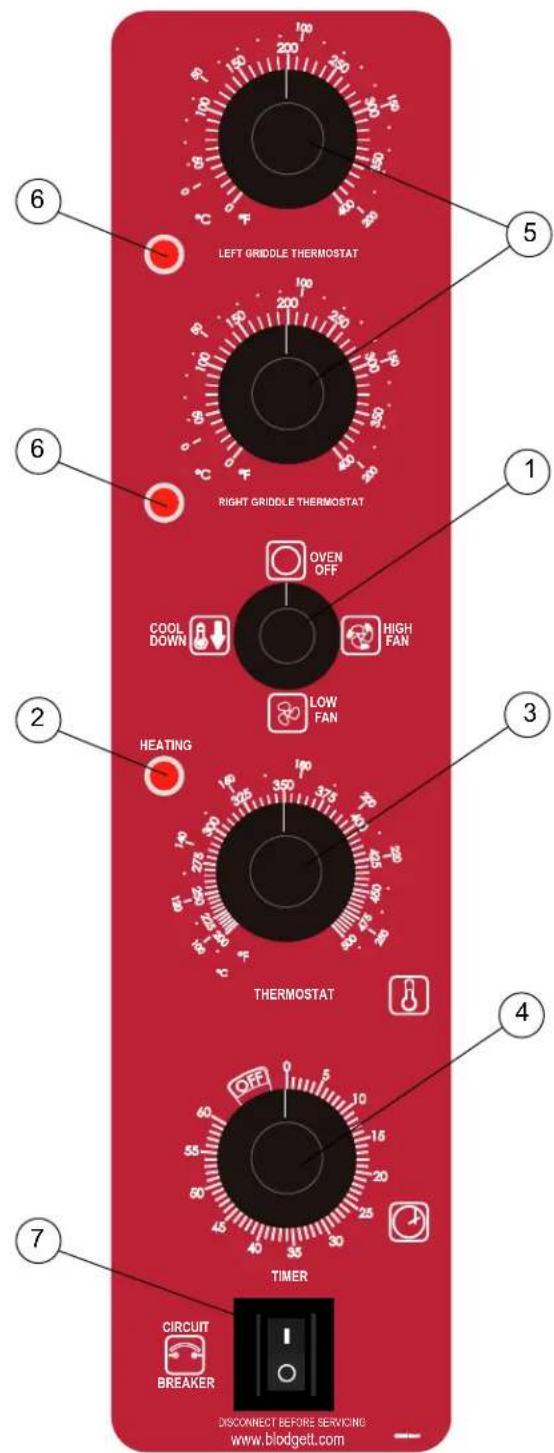
CTB-G & CTBR-G
CTB-GFB & CTBR-GFB
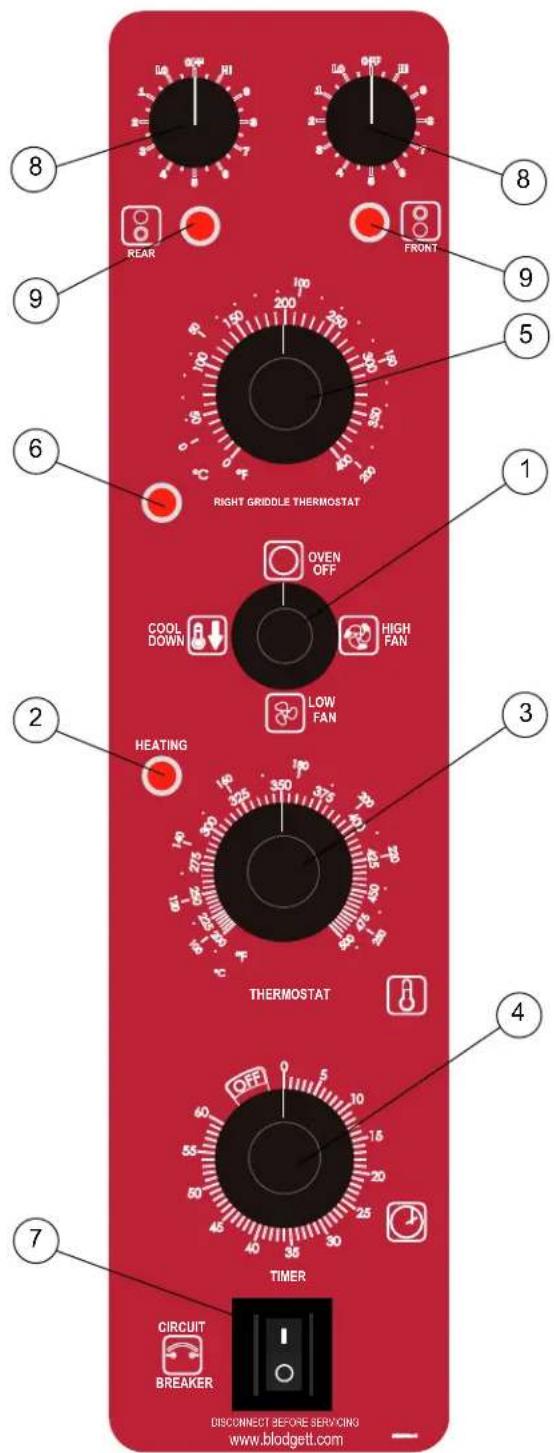
Figure 2
COMPONENT DESCRIPTION
- SELECTOR SWITCH - controls power to the oven fan speed and selects Cool Down mode.
- OVEN READY LIGHT - when lit, indicates heater operation. When the light goes out, the oven has reached operating temperature.
- OVEN SOLID STATE THERMOSTAT - allows an infinite selection of temperatures from 200-500°F (95-260°C).
- COOK TIMER - used to time the length of the cooking operation. When the set time expires an alarm sounds.
- GRIDDLE SOLID STATE THERMOSTAT - allows an infinite selection of temperatures from 0-400°F (0-200°C). Also controls power to the griddle.
- GRIDDLE READY LIGHT - when lit, indicates heater operation. When light goes out, the griddle has reached operating temperature.
- CIRCUIT BREAKER SWITCH - used to turn power to the unit ON or OFF.
- FRENCH BURNER THERMOSTAT - allows the power selection of the french burners from LOW to HIGH. Also control power to the french burners.
- FRENCH BURNER READY LIGHTS - when lit, indicates heater operation. When light goes out, the applicable french burner has reached operating temperature.
- Turn the SELECTOR SWITCH (1) to OVEN ON.
- Set the COOK THERMOSTAT (3) to the desired temperature.
- Preheat the oven until the OVEN READY (2) light goes out, indicating the oven has reached operating temperature.
- Load product into the oven. Set the COOK TIMER (4) to the desired time.
- When the buzzer sounds, remove the product from the oven. Turn the timer to OFF to silence the alarm.
- Turn the SELECTOR SWITCH (1) to OVEN OFF.
- Turn the GRIDDLE THERMOSTAT (5) to the desired temperature.
- Preheat the griddle until the GRIDDLE READY (6) light goes out, indicating the griddle has reached operating temperature.
- Turn the GRIDDLE THERMOSTAT (5) to 0^ to power off the unit.
FRENCH BURNER CONTROL OPERATION (if applicable)
- Place a pot or pan on the burner.
- Turn the applicable FRENCH BURNER THERMOSTAT (8) to the desired setting, HI being the hottest and LO being the coolest.

WARNING!!
DO NOT run the french burners without a load. Turn the thermostat to the OFF position when not in use.
General Guidelines for Operating Personnel
Seasoning will help to create and maintain a non-stick surface on your griddle.
To season the griddle:
- Turn on all thermostat switches and set knobs to 200^ F ( 93^ C).
- As the unit heats to 200^ F ( 93^ C), apply a light film of cooking oil or beef suet over the entire cooking surface, wiping off any excess build up. This step may be repeated as necessary to apply an even coating on the griddle surface.
- Allow the seasoned surface to sit for one hour at 200^ F ( 93^ C).
- Set the thermostats to your desired cooking temperature, once your griddle surface has reached temperature, apply another coating of seasoning oil. Wipe off any excess that may cause build up.
OVEN COOK TIMES AND TEMPERATURES
Preheating the oven
Always preheat the oven before baking or roasting. We recommend preheating 50^ F ( 28^ C) above the cook temperature to offset the drop in temperature when the doors are opened and cold product is loaded into the oven. Set the thermostat to the cook temperature after the product is loaded.
NOTE: For frozen product, preheat the oven 100^ F ( 56^ C) above the cook temperature.
Cook Temperatures
Generally, cook temperatures should be 50^ F ( 28^ C) lower than deck or range oven recipes. If the edges of the product are done but the center is raw, or if there is color variation, reduce the thermostat setting another 15-25^ F ( 10-15^ C). Continue to reduce the cook temperature on successive loads until the desired results are achieved.
NOTE: Cooking at excessive temperatures will not reduce cook time, it will produce unsatisfactory baking and roasting results.
Cook Time
Check the product in about half the time recommended for deck or range oven recipes. Record times and temperatures which provide best results for future reference.
NOTE: Cook time will vary with the amount of product loaded, the type of pan and the temperature.
OVEN OPERATING TIPS
Pans and Racks
Product or pan height determines how many racks are used. The oven holds 13" x 18" (33 x 45.7 cm) sheet pans.
Load the oven from the bottom, centering the pans on the rack. Never place a pan or aluminum foil on the bottom of the oven. This obstructs the flow of air and results in uneven baking and roasting.
Roasting
To reduce shrinkage when roasting, place meat directly on the racks. Place a sheet pan one-half full of water in the bottom rack position. The water evaporates, increasing humidity in the oven chamber. The pan catches grease from the meat, making oven cleaning easier.
Baking
Weigh the product to ensure equal distribution in each pan. Varying amounts of product will cause uneven baking results.
Fans
The fan must be operating for the oven to heat.
- Preheat the oven 25^ F ( 15^ C) above the baking temperature.
- Load the oven with product. Close the doors.
- Set the thermostat to the baking temperature.
- Turn the oven off.
- Allow the product to set for 5-7 minutes with the fan off. The residual heat in the oven sets the product.
- Turn the oven on for the remainder of the bake.
Suggested Times and Temperatures
OVEN TIMES AND TEMPERATURES
PRODUCT TEMPERATURE TIME # SHELVES
| Meats | |||
| Hamburger Patties (5 per lb) | 400°F (205°C) | 8-10 mins. | 10 |
| Standing Rib Choice (20 lbs, trimmed, rare) | 235°F (115°C) | 2 hrs 45 mins. | 2 |
| Banquet Shell Steaks (10 oz. meat) | 450°F (235°C) | 7-8 mins. | 5 |
| Swiss Steak after Braising | 275°F (135°C) | 1 hr. | 5 |
| Baked Stuffed Pork Chop | 375°F (190°C) | 25-30 mins. | 5 |
| Boned Veal Roast (15 lbs.) | 300°F (150°C) | 3 hrs. 10 mins. | 2 |
| Lamb Chops (small loin) | 400°F (205°C) | 7-8 mins. | 5 |
| Poultry | |||
| Chicken Breast & Thigh | 350°F (175°C) | 40 mins. | 5 |
| Chicken Back & Wing | 350°F (175°C) | 35 mins. | 5 |
| Chicken (21/2 lbs. quartered) | 350°F (175°C) | 30 mins. | 5 |
| Turkey Rolled (18 lb. rolls) | 310°F (155°C) | 3 hrs 45 mins. | 3 |
| Fish and Seafood | |||
| Halibut Steaks, Cod Fish (frozen 5 oz) | 350°F (175°C) | 20 mins. | 5 |
| Baked Stuffed Lobster (21/2 lb.) | 400°F (205°C) | 10 mins. | 3 |
| Lobster Tails (frozen) | 425°F (220°C) | 9 mins. | 5 |
| Cheese | |||
| Macaroni & Cheese Casserole | 350°F (175°C) | 30 mins. | 5 |
| Melted Cheese Sandwiches | 400°F (205°C) | 8 mins. | 10 |
| Potatoes | |||
| Idaho Potatoes (120 ct.) | 400°F (205°C) | 50 mins. | 5 |
| Oven Roasted Potatoes (sliced or diced) | 325°F (165°C) | 10 mins. | 5 |
| Baked Goods | |||
| Frozen Berry Pies (22 oz) | 325°F (150°C) | 35 mins. | 5 (30 pies) |
| Fresh Apple Pie (20 oz.) | 350°F (175°C) | 25-30 mins. | 5 (30 pies) |
| Pumpkin Pies (32 oz.) | 300°F (150°C) | 30-50 mins. | 5 (20 pies) |
| Fruit Crisp | 300°F (150°C) | 25 mins. | 5 |
| Bread (24 - 1 lb. loaves) | 325°F (155°C) | 30 mins. | 3 |
| Southern Corn Bread | 375°F (190°C) | 15-20 mins. | 5 |
| Baking Soda Biscuits | 400°F (205°C) | 6 mins. | 5 |
| Brown & Serve Rolls | 350°F (175°C) | 15 mins. | 5 |
| Sheet Cakes (5 lb. mixed batter per pan) | 325°F (160°C) | 16-18 mins. | 5 |
| Chocolate Cake | 325°F (160°C) | 20 mins. | 5 |
| Brownies | 325°F (150°C) | 15 mins. | 5 |
NOTE: Actual times and temperatures may vary considerably from those shown above. They are affected by weight of load, temperature of the product, recipe, type of pan and calibration of thermostat. Should your recipe vary, write in your proven time and temperature for ready reference.
Suggested Times and Temperatures
GRIDDLE TIMES AND TEMPERATURES
| PRODUCT TEMPERATURE TIME | ||
| Breakfast Items | ||
| Pancakes | 375°F (191°C) | 2 mins. |
| French Toast | 400°F (204°C) | 4-5 mins. |
| Breakfast Potatoes* | 375-400°F (191-204°C) | 15-20 mins. |
| Eggs | ||
| Scrambled | 300°F (149°C) | 3-4 mins. |
| Sunny Side Up | 225-300°F (107-149°C) | 3-4 mins. |
| Over Easy | 250-300°F (121-149°C) | 2-3 mins. |
| Over Hard | 225-300°F (107-149°C) | 3-4 mins. |
| Breakfast Meats | ||
| Sausage, Link and Patty | 350°F (177°C) | 3 mins. |
| Bacon | 350°F (177°C) | 2-3 mins. |
| Canadian Bacon | 350°F (177°C) | 2-3 mins. |
| Ham Steaks | 375°F (191°C) | 3-4 mins. |
| Broiled Ham | 375°F (191°C) | 2 mins. |
| Ham, Pre-Cooked | 375°F (191°C) | 2 mins. |
| Fish | ||
| Salmon 350°F (177°C) 6-8 mins. | ||
| Hamburgers | ||
| 2 Patties per lb. | 350°F (177°C) | 6-8 mins. |
| 4 Patties per lb. | 350°F (177°C) | 4-6 mins. |
| 6 Patties per lb. | 350°F (177°C) | 3-4 mins. |
| Steaks, etc. | ||
| 1/2" - 3/4" Thick, Medium | 375°F (191°C) | 5-7 mins. |
| 3/4" - 1" Thick, Medium | 375°F (191°C) | 8-10 mins. |
| Beef Tenderloin | 400°F (204°C) | 3-4 mins. |
| Sandwiches, etc. | ||
| Grilled Cheese | 375°F (191°C) | 3-4 mins. |
| Hot Dogs | 325°F (163°C) | 2-3 mins. |
| NOTE: Actual times and temperatures may vary considerably from those shown above. They are affected by weight of load, temperature of the product, recipe, and calibration of thermostat. Should your recipe vary, write in your proven time and temperature for ready reference. | ||
* Based on cubed potatoes brought to a boil then colled prior to finishing on griddle. To reduce burning and sticking of the potatoes coat the griddle surface with vegetable oil and turn potatoes frequently.
CLEANING THE GRIDDLE

WARNING!!
Wear protective gloves and clothing when cleaning the griddle. Hot surfaces may cause injury.
- Clean the griddle surface to prevent sticking and poor food product quality.
a. Scrape the griddle surface completely with a scraper to remove grease and food debris.
b. Use a grill brick or grill screen to clean any heavy build up of carbon from the griddle surface. Never use steel wool pads, small fibers may be left behind on the cooking surface.
c. Wipe the griddle surface clean. A mild soapy water solution may be used to clean the surface. Be sure to rinse the surface thoroughly to remove any soap residue. Be sure to remove any standing water.
d. When the griddle surface is cool, polish the surface with a non-abrasive, non-caustic cleaner that is approved for stainless steel.
e. It may be necessary to season the grill again after this cleaning. Refer to page 10 for seasoning instructions.
- Clean and wipe out grease chutes.
- Wipe down the exterior of the griddle with stainless steel cleaner.
- Remove and empty the grease box(es) of any and all debris. Also wipe down the inside of the grease box compartment to remove any food particles that may have come free from the grease box.

WARNING!!
The grease box is designed to contain grease run off from the griddle surface. The grease box should NEVER be allowed to overfill. Dispose of grease properly.
Cleaning and Preventative Maintenance
CLEANING THE OVEN
Stainless steel ovens may be kept clean and in good condition with a light oil.
- Saturate a cloth, and wipe the oven when it is cold.
- Dry the oven with a clean cloth.
On the stainless front or interiors, deposits of baked on splatter may be removed with any non-toxic industrial stainless steel cleaner. Heat tint and heavy discoloration may be removed with any non-toxic commercial oven cleaner.
- Apply cleaners when the oven is cold. Always rub with the grain of the metal.
The porcelain interior can be cleaned with any commercial oven cleaner. Be sure caustic cleaning compounds DO NOT come in contact with the temperature probe, aluminized steel heating element cover, and blower wheel.
- Remove the racks and rack supports from the oven.
- Soak the parts in a solution of ammonia and water.
- Reinstall after cleaning.
PREVENTATIVE MAINTENANCE
The best preventative maintenance measures are, the proper installation of the equipment and a program for routinely cleaning the ovens.
Annual Maintenance
This oven requires no lubrication, however, the venting system should be checked annually for possible deterioration resulting from moisture and corrosive flue products. If maintenance or repairs are required, contact your local Blodgett service company, a factory representative or the Blodgett Oven company.

WARNING!!
Always disconnect the appliance from the power supply before servicing or cleaning.
Troubleshooting Guide
| POSSIBLE CAUSE(S) SUGGESTED REMEDY | |
| SYMPTOM: Heating elements do not come on. | |
| Oven not plugged in.Power switch on the control panel is off.Control set below ambient temperature.Doors are open.Computerized controls - error code on display. | Plug in electrical supply cord.Set the control panel to COOK or OVEN ON.Set to desired cook temperature.Close doors.* |
| SYMPTOM: Oven does not come to ready. | |
| The oven has not reached preheat temperature.Fan delay feature may be activated, if applicable.Internal problem with main temperature control. | Wait for oven to reach preheat temperature.Deactivate fan delay feature.* |
| SYMPTOM: Convection fan does not run. | |
| Oven is not plugged in.Oven is not set to the cook mode.Circuit breaker tripped.Fan delay feature may be activated, if applicable.Doors are open | Plug in electrical supply cord.Set the control panel to COOK or OVEN ON.Reset the breaker.Deactivate fan delay feature.Close doors. |
| SYMPTOM: General baking problems. | |
| Thermostat out of calibration. * | |
| *Denotes remedy is a difficult operation and should be performed by qualified personnel only. It is recommended, however, that All repairs and/or adjustments be done by your local Blodgett service agency and not by the owner/operator. Blodgett cannot assume responsibility for damage as a result of servicing done by unqualified personnel. | |

WARNING!!
Always disconnect the power supply before cleaning or servicing the oven.
- IMPORTANT
- FOR YOUR SAFETY
- TABLE OF CONTENTS
- INSTALLATION
- OPERATION
- MAINTENANCE
- Description and Specifications
- Delivery and Location
- DELIVERY AND INSPECTION
- OVEN LOCATION
- WARNING - RISK OF FIRE
- Oven Assembly
- 4" CASTER INSTALLATION
- OVEN LEVELING
- ADJUSTMENTS ASSOCIATED WITH INITIAL INSTALLATION
- Utility Connections - Standards and Codes
- General export installations
- Electrical Connection
- Safety Information
- SAFETY TIPS
- General safety tips:
- Controls
- COMPONENT DESCRIPTION
- FRENCH BURNER CONTROL OPERATION (if applicable)
- WARNING!!
- General Guidelines for Operating Personnel
- To season the griddle:
- OVEN COOK TIMES AND TEMPERATURES
- Preheating the oven
- Cook Temperatures
- Cook Time
- OVEN OPERATING TIPS
- Pans and Racks
- Roasting
- Baking
- Fans
- Suggested Times and Temperatures
- OVEN TIMES AND TEMPERATURES
- CLEANING THE GRIDDLE
- Cleaning and Preventative Maintenance
- CLEANING THE OVEN
- PREVENTATIVE MAINTENANCE
- Annual Maintenance
- Troubleshooting Guide
Brand : Blodgett
Model : CTB-G
Category : Hot plate