
SV832DS - KVM switch StarTech.com - Free user manual and instructions
Find the device manual for free SV832DS StarTech.com in PDF.


| Product Type | 2-Console KVM Switch |
| Model | SV832DS |
| Brand | StarTech.com |
| Number of Console Ports | 2 |
| Number of Computer Ports | 8 |
| Maximum Computers via Cascade | 64 (with SV831 slaves) |
| On-Screen Display (OSD) | Yes |
| Front Panel Controls | 8 push buttons |
| Hot-Key Control | Yes |
| VGA Resolution Support | Up to 1600x1200 @85Hz |
| DDC2B Compatible | Yes |
| Mouse Support | PS/2 and Serial (with adapter) |
| Keyboard/Mouse Hot Plug | Yes |
| Automatic Mouse Conversion | Yes |
| Power Supply | 9V DC, 500mA |
| Dimensions (H x W x D) | 44 x 436 x 180 mm |
| Rack Mountable | Yes (optional kit) |
| Maximum Cable Length | 30m (100ft) at console and PC ports |
| Scan Interval Options | 3, 8, 15, 30 seconds |
| Password Security | Yes |
| Audio Support | Optional multimedia module |
| Operating System Independent | Yes |
Frequently Asked Questions - SV832DS StarTech.com
User questions about SV832DS StarTech.com
0 question about this device. Answer the ones you know or ask your own.
Ask a new question about this device
Download the instructions for your KVM switch in PDF format for free! Find your manual SV832DS - StarTech.com and take your electronic device back in hand. On this page are published all the documents necessary for the use of your device. SV832DS by StarTech.com.
USER MANUAL SV832DS StarTech.com
User's Manual
SV431
SV831
SV431D
SV831D
SV1631D
SV832DS
SV1632DS
Table of Contents
Introduction
Overview 1
Features 2
Configurations 3
Installation
Device Connection 6
Initial Power-Up 8
Optional Rack Mount Accessories 9
Operation
Front Panel Push Buttons 10
OSD (On-Screen-Display) Operation 11
Hot Key Commands 15
Cascade Configuration
Connection 17
Change Configuration while Running 19
Multi-access StarView
Overview 20
Connection 20
Operation 20
Configuration 21
Appendices
Specifications 22
Trouble Shooting 23
Introduction
Overview
One-Console StarView Switches
The StarView allows you to access multiple computers from one keyboard, mouse and monitor. There is no interface card or software to configure. Installation is as easy as connecting cables between the StarView and your computers. Operation is as simple as pressing push button, entering hot-key command and navigating through the user-friendly on-screen menu (available on models with OSD support). Depending on the model you have, it switches up to 4 (SV431, SV431D), 8 (SV831, SV831D) or 16 (SV1631D) IBM-compatible computers. The StarView is independent of the computer operating system.
Two-Console StarView Switches
The advanced multi-access StarView Switches enable you to control multiple computers from two different locations, remote and local with two keyboards, mice and monitors. SV832DS controls 8 computers and SV1632DS controls 16 computers.
On-Screen Display (OSD) Menu
For SV431D, SV831D, SV1631D, SV832DS, SV1632DS
For StarViews with built-in OSD control, you can name your computers, switch to a computer from a list, configure settings with easy-to-use menus, and view the name of the selected computer on-screen with programmable time interval. The OSD displays the system status throughout operation.
Automatic Mouse Conversion
The StarView Switch enable you to connect computers with PS/2 or serial mouse ports (using adapters supplied with each StarView Switch) and control the computers from one PS/2 mouse.
The StarView automatically identifies the mouse and switches to proper mouse protocol.
High Video Quality
StarView supports VGA resolution up to 1600x1200 @85Hz without any degradation. Advanced VGA circuit design guarantees smooth and flicker-free switching from one computer to the other with distance up to 100ft (30M)* at both Console and PC sides.
NOTE: This User's Manual is written for the following models.
| StarView Switch Models | |||||
| No. of console supported | 1 1 1 2 2 | ||||
| No. of PC supported | 4 8 16 8 16 | ||||
| No OSD SV431 SV831 | --- | ||||
| OSD | SV431D | SV831D | SV1631D | SV832DS | SV1632DS |
- Tested with high-quality UL2919-rated, low-loss and shielded cables.
Features
■Supports both PS/2 and serial mouse
■Cascade configuration expands system capability
■Auto-scan automatically selects computers sequentially
■Supports Microsoft IntelliMouse (Pro)
■Hot-key functions allow easy computer access
■Keyboard states automatically saved and restored when switching computers
■Operating system independent, transparent to all applications
■Plug and play system configuration
■Keyboard and mouse can be hot plugged at any time
■High VGA resolution 1600x1200
■DDC2B compatible
■Optional standard 19 inch rack mounting kit available
■Supports optional multimedia module for microphones and stereo speakers
Extra features for On-Screen Display model
■Assign computers with unique and meaningful names
■Identify and select computers by the names
■Programmable scan filters unused computers
■Store system settings and name entries to non-volatile memory
■Password security locks computer from unauthorized access
■Gain complete control with easy-to-use OSD interface
More features for multi-access models
■Manage multiple computers from two locations
■Different Console may have different type mouse i.e. generic PS/2 mouse and scroll button
■Selectable User Timeout
Configurations
StarView has several models each supporting a different number of computers. For applications with a large number of computers, StarViews can be cascaded in a master/slave configuration to support even more computers.
Single StarView Configuration
Connect a PS/2 keyboard, a PS/2 mouse and a VGA multi-sync monitor directly to the Master's CONSOLE port. Then, connect multiple sets of keyboard, mouse and monitor cables to the "PC x" ports of the StarView, as shown in figure 1.


flowchart
graph TD
    A["Master"] --> B["StarView"]
    B --> C["1"]
    B --> D["2"]
    B --> E["3"]
    B --> F["4"]
    B --> G["SV31D"]
    G --> H["PC1"]
    G --> I["PC2"]
    G --> J["PC3"]
    G --> K["PC4"]
    H --> L["Power"]
    I --> M["Power"]
    J --> N["Power"]
    K --> O["Power"]
Figure 1: A single StarView configuration
Cascade (Master/Slave) Configuration
You can connect a second level of one or more StarViews to "PC 1"\~"PC 4" (SV431) or "PC 1"\~"PC 8" ports (SV831 & SV1631) of a Master unit. Cascade configuration expands system ability allowing you to select computers connected to the Master or Slaves. There is only one Master, which has a mouse, a keyboard and a monitor connected to its CONSOLE port directly operated by a user.
Once connected, StarViews automatically configure themselves to either Master or Slave. Slaves of different StarView models can be mixed in cascade configuration. [NOTE: Master must have equal or more PC ports than that of Slaves, i.e., if SV831 is a master, SV831 and SV431 can be Slaves, but SV1631 can not.]
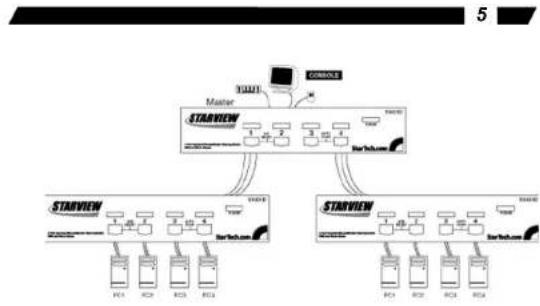
flowchart
graph TD
    A["STAINVIEW"] --> B["Master"]
    A --> C["Console"]
    B --> D["1"]
    B --> E["2"]
    B --> F["3"]
    B --> G["4"]
    C --> H["1"]
    C --> I["2"]
    C --> J["3"]
    C --> K["4"]
    D --> L["10"]
    E --> M["11"]
    F --> N["12"]
    G --> O["13"]
    H --> P["14"]
    I --> Q["15"]
    J --> R["16"]
    K --> S["17"]
    L --> T["18"]
    M --> U["19"]
    N --> V["20"]
    O --> W["21"]
    P --> X["22"]
    Q --> Y["23"]
    R --> Z["24"]
    S --> AA["25"]
    T --> AB["26"]
    U --> AC["27"]
    V --> AD["28"]
    W --> AE["29"]
    X --> AF["30"]
    Y --> AG["31"]
    Z --> AH["32"]
Figure 2: A cascade StarView configuration
Throughout this manual, Master is the StarView that has a physical keyboard, mouse and monitor connected to its CONSOLE port. Slave is a StarView that has its CONSOLE port connected to a Master's "PC x" port. Slave only exists in cascade configuration.
Installation
Device Connection
The monitor connected to the HD-DB-15 VGA port of a Master CONSOLE must be capable of synchronizing with the computer's video signal. If you are uncertain about the monitor type, please consult the monitor user's manual. Connect a PS/2 mouse and a keyboard to the CONSOLE port marked with a mouse and a keyboard respectively as shown in figure 3. [NOTE: Only a PS/2 mouse can be connected to the CONSOLE mouse port. The StarView's automatic mouse conversion system allows you to connect computers using serial mouse and control the computers from one PS/2 mouse.]
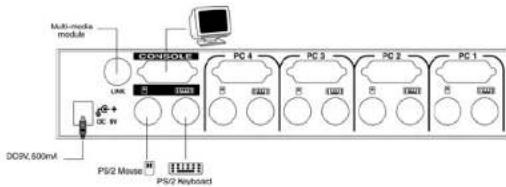
Figure 3: Master console connection
Determine the channel address of each computer. For computers using PS/2 mouse, connect the computer's mouse and keyboard cables to the StarView's connectors marked with a mouse and keyboard respectively, as shown in figure 4.

Figure 4: Master computer connection
For computers using serial mouse, connect the DB-9 to mini-DIN-6 adapter (supplied with the StarView) to the computer mouse port, then use PS/2 cables to connect the mouse to StarView, see figure 5. Connect the computer's monitor cable to the HD-DB-15 VGA connector. Repeat above steps for all remaining computers to be connected to the StarView.

Figure 5: Adapter and serial mouse connection
Initial Power-Up
Make sure all computers and StarViews are powered down during installation. You must power up the Master StarView before turning on any other devices.
For single StarView: 1) Apply a power adapter to the Master.
2) Turn on computers.
For cascade: 1) Apply a power adapter to the Master.
2) Apply power adapters to all Slaves. 3) Turn on computers.
Note: You may hot plug additional powered-down computer and Slave without turning any existing StarView or computer off after initial power up.
Replace Master Console Devices
You can replace a faulty keyboard or mouse of the Master CONSOLE port at any time without powering down the Master, as long as your computers are booted with proper device driver for the new device. Should you encounter any difficulty, just activate K/M RESET by holding both front-panel '1' and '2' push buttons down for 2 seconds.
Adhesive Rubber Foot
For desktop operation, you may stick the four round rubber feet (supplied with the unit) to the bottom of the StarView. NOTE: Do not use the rubber feet for rack mount operation.
Optional Rack Mount Accessories
Figure 6 shows how to attach optional mounting brackets to the StarView unit for standard 19-inch rack cabinet.
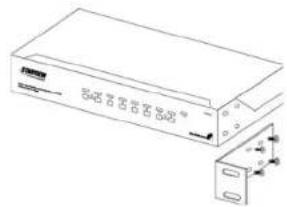
Figure 6: Attaching rack mount bracket
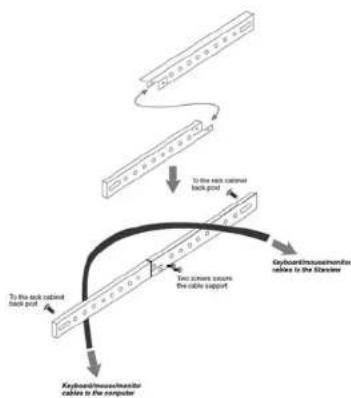
Figure 7 shows how to assemble rack cable support then screw it to the back and inside the rack cabinet vertical post.
flowchart
graph TD
    A["Start"] --> B["To the rack cabinet back post"]
    B --> C["Two captures secure the cable support"]
    C --> D["Keyboard/muscat monitor cables to the computer"]
    D --> E["End"]
Figure 7: Assembling rack cable support
Then, keyboard/mouse/monitor cables can be routed over the cable support. You can use plastic cable ties to bundle and label the cables through the rack cable support holes for easy identification.
Operation
Front Panel Push Buttons
You may select a computer by pressing the front panel push button directly, by issuing hot-key commands or by activating the OSD window (for models with OSD support). The front panel indicator changes to reflect the computer port selected (red) and whether the port is connected to a powered computer (green). The indicator flashes red when it is in either Auto Scan or Manual Scan mode.
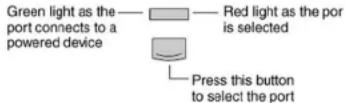
Figure 8: Front panel indicator
Some computers support 'keyboard/mouse power up' function, i.e., press certain keys or mouse buttons to startup the computers. Their corresponding green front indicators lit all the time even if the computers are 'off'.
■ K/M RESET
K/M RESET solves most problems developed by keyboard, mouse, device replacement or change of configuration. Press down both the front-panel number 1 and 2 push buttons for 2 seconds to re-configure the whole system without turning either the StarView Switch or any computer off.
■ AUTO SCAN
StarView provides an easy to use feature to start Auto Scanning. You can press down both the front-panel number 7 and 8 buttons for 2 seconds to start Auto Scanning.

flowchart
graph TD
    A["To an 8-port slave"] --> B["KVM MENU 5-6"]
    B --> C["Currently selected channel address"]
    C --> D["Eye mark enabled"]
    D --> E["To a 16-port slave"]
    F["Port channel address"] --> G["Highlighted by arrow keys"]
    G --> H["Security enabled port"]
    I["White as power off"] --> J["Green as power on"]
    J --> K["Master port name (group name)"]
    K --> L["User-input port names"]
    M["F1 Edit F2 *Switch F3 Security"] --> N["F4 More Esc Quit"]
    O["F2 *Switch F3 Security"] --> P["F4 More Esc Quit"]
Figure 9: OSD screen illustration
By hitting the left
The channel address of the currently selected computer is displayed in red, same as the front indicator, to the right of the OSD title 'KVM MENU'. The color of a device name is green if it has power and is
ready for selection (its corresponding front panel indicator is green), or the color is white as it has no power. OSD menu updates the color when it is activated. Use the
A triangle mark (▶) to the right of a name indicates the port is cascaded to a Slave; the number at the left of the triangle mark shows the number of ports the Slave has, i.e. 8▶ for SV831D.
An eye mark ( ) to the right of a name indicating the computer is selected to be monitored in Scan mode. In OSD, this mark can be switched on or off by function key
Press
● Function key
- Function key
- Function key
If you want to access the locked device temporarily, simply highlight it and press
If you forget the password, the only way to permanently disable the security function is to remove all possible power sources from the master StarView. You need to turn off all computers and unplug all power adapters, then restart everything.
- Function key
Available options will be shown in the middle of the screen. Again, using the
■ Auto Scan In this mode, the StarView automatically switches from one power-on computer to the next sequentially in a fixed interval. During Auto
Scan mode, the OSD displays the name of the selected computer. When Auto Scan detects any keyboard or mouse activity, it suspends the scanning till activity stops; it then resumes with the next computer in sequence. To abort the Auto Scan mode, press the left
■ Manual Scan
Scan through power-on computers one by one by keyboard control. Scan Type (
■ Audio Stick
An optional multimedia module can be LINKed to the back of each StarView for selecting microphone and stereo speaker signals. There are two options for Audio Stick: ON and Off. When set to 'On' audio selection follows computer selection. When set to 'Off', audio selection stops following computer selection. It is useful if you want to listen to a particular computer's audio signal while operating other computers. The non-volatile memory stores the Audio Stick setting.
■ Scan Type
Ready PC +: In Scan mode, scan through power-on and eye mark selected computers.
Ready PC: In Scan mode, scan through power-on computers. The non-volatile memory stores the Scan Type setting.
■ Scan Rate
Sets the duration of a computer displayed in Auto Scan mode. The options are 3 seconds, 8 seconds, 15 seconds and 30 seconds. The non-volatile memory stores the Scan Rate setting.
■ Keyboard Speed
StarView offers keyboard typematic setting that overrides the similar settings in BIOS and in Windows. Available speed options are Low, Middle, Fast and Faster as 10, 15, 20 and 30 characters/sec respectively. The non-volatile memory stores the Keyboard Speed setting.
■ Hotkey Menu
When you hit the left
■ CH Display
Auto Off: After you select a computer, the channel address and name of the computer will appear on the screen for 3 seconds then disappear automatically.
Always On: The channel address and name of a selected computer and/or OSD status displayed on the screen all the time. The non-volatile memory stores the CH Display setting.
■ Position
The position of the selected computer name and/or OSD status displayed on screen during operation. The actual display position shifts due to different VGA resolution, the higher the resolution the higher the display position. The non-volatile memory stores the Position setting.
UL as Upper Left, UR as Upper Right,
LL as Lower Left, LR as Lower Right.
MI as Middle,
- ESC: To exit the OSD, press the
Hot-key commands
Hot-key command is a short keyboard sequence to select a computer, to activate computer scan, etc. StarView interprets
keystrokes for hot-keys all the time. A hot-key sequence starts with two left
The short form hot-key menu can be turned on as an OSD function (
L-CTRL: is the
To select a computer by hot-key command, you must know its channel address, which is determined by the StarView connection. For a computer connected to a Master, its address is represented by the PC port label (1\~8 or A\~H). For a computer connected to a Slave, two characters represent its address. The first character is the channel address of the Master unit (1\~8) and the second one is the channel address of the Slave (1\~8 or A\~H). Please note that only Master's 'PC 1' \~'PC 8' ports can be connected to a Slave.
Left Ctrl + left Ctrl + 7
Selects a computer connected to port 7 of the Master.
Left Ctrl + left Ctrl + 6 + C
Selects a computer connected to port C of a Slave connected to port 6 of the Master.
■ To start Auto Scan, automatically scan power-on computers one by one at a fixed interval:
left Ctrl + left Ctrl + F 1
When Auto Scan detects any keyboard or mouse activity, it suspends the scanning till activity stops; it then resumes with the next computer in sequence. The length of the Auto Scan interval (Scan Rate) is adjustable, see below. To abort the Auto Scan mode, press the left Ctrl key twice.
Note: For OSD models, Scan Type determines whether eye mark is necessary during Auto Scan.
■ Manual Scan enables you to manually switch back and forth between power-on computers.
left Ctrl + left Ctrl + F2
Press ↑ or ↓ to select the previous or the next computer in sequence. And, press any other key to abort the Manual Scan.
Note: For OSD models, Scan Type determines whether eye mark is necessary during Manual Scan.
■ To adjust Scan Rate which sets the duration before switching to the next computer in Auto Scan:
left Ctrl + left Ctrl + F3
The StarView sends one to four beeps indicating scan interval of 3, 8, 15 and 30 seconds respectively.
■ To adjust keyboard typematic rate (characters/sec), this setting over-rides that of BIOS and any operating system:
left Ctrl + left Ctrl + F4
The StarView generates 1 to 4 beeps corresponding to 10, 15, 20 and 30 characters/sec respectively.
Audio Stick
An optional multimedia module can be LINKed to the back of each StarView for selecting microphone and stereo speaker signals.
There are two options for Audio Stick: ON and Off. When set to 'On', audio selection follows computer selection. When set to 'Off', audio selection stops following computer selection. It is useful if you want to listen to a particular computer's audio signal while operating other computers.
left Ctrl + left Ctrl + F5
The StarView generates 1 or 2 beeps corresponding to On and Off respectively.
Cascade Configuration
Connection
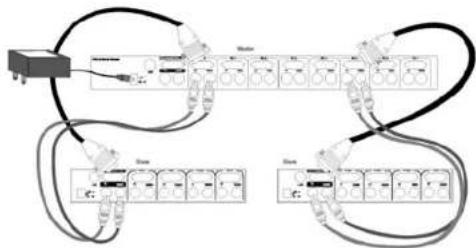
Before connecting a device (a computer or a Slave) to the Master under power, you must turn off the device. The Master must have
equal or more 'PC x' ports than that of the Slave, i.e., if SV831 is the master, SV831 and SV431 can be Slaves, but SV1631 can not. The ports labeled "PC 1"\~"PC 8" can be connected to either a computer or a Slave's CONSOLE port, as shown in figure 10. The ports "PC A"\~"PC H" can only be connected to a computer. A power adapter with DC 9V/500mA output rating must be connected
flowchart
graph TD
    A["Server Rack"] --> B["Switch"]
    A --> C["Switch"]
    A --> D["Switch"]
    A --> E["Switch"]
    A --> F["Switch"]
    A --> G["Switch"]
    A --> H["Switch"]
    A --> I["Switch"]
    A --> J["Switch"]
    A --> K["Switch"]
    A --> L["Switch"]
    A --> M["Switch"]
    A --> N["Switch"]
    A --> O["Switch"]
    A --> P["Switch"]
    A --> Q["Switch"]
    A --> R["Switch"]
    A --> S["Switch"]
    A --> T["Switch"]
    A --> U["Switch"]
    A --> V["Switch"]
    A --> W["Switch"]
    A --> X["Switch"]
    A --> Y["Switch"]
    A --> Z["Switch"]
    A --> AA["Switch"]
    A --> AB["Switch"]
    A --> AC["Switch"]
    A --> AD["Switch"]
    A --> AE["Switch"]
    A --> AF["Switch"]
    A --> AG["Switch"]
    A --> AH["Switch"]
    A --> AI["Switch"]
    A --> AJ["Switch"]
    A --> AK["Switch"]
    A --> AL["Switch"]
    A --> AM["Switch"]
    A --> AN["Switch"]
    A --> AO["Switch"]
    A --> AP["Switch"]
    A --> AQ["Switch"]
    A --> AR["Switch"]
    A --> AS["Switch"]
    A --> AT["Switch"]
    A --> AU["Switch"]
    A --> AV["Switch"]
    A --> AW["Switch"]
    A --> AX["Switch"]
    A --> AY["Switch"]
    A --> AZ["Switch"]
    A --> BA["Switch"]
    A --> BB["Switch"]
    A --> BC["Switch"]
    A --> BD["Switch"]
    A --> BE["Switch"]
    A --> BF["Switch"]
    A --> BG["Switch"]
    A --> BH["Switch"]
    A --> BI["Switch"]
    A --> BJ["Switch"]
    A --> BK["Switch"]
    A --> BL["Switch"]
    A --> BM["Switch"]
    A --> BN["Switch"]
    A --> BO["Switch"]
    A --> BP["Switch"]
    A --> BQ["Switch"]
    A --> BR["Switch"]
    A --> BS["Switch"]
    A --> BT["Switch"]
    A --> BU["Switch"]
    A --> BV["Switch"]
    A --> BW["Switch"]
    A --> BX["Switch"]
    A --> BY["Switch"]
    A --> BZ["Switch"]
    A --> CA["Switch"]
    A --> CB["Switch"]
    A --> CC["Switch"]
    A --> CD["Switch"]
    A --> CE["Switch"]
    A --> CF["Switch"]
    A --> CG["Switch"]
    A --> CH["Switch"]
    A --> CI["Switch"]
    A --> CJ["Switch"]
    A --> CK["Switch"]
    A --> CL["Switch"]
    A --> CM["Switch"]
    A --> CN["Switch"]
    A --> CO["Switch"]
    A --> CP["Switch"]
    A --> CZ["Switch"]
to the Master.
Figure 10: Slave console connection
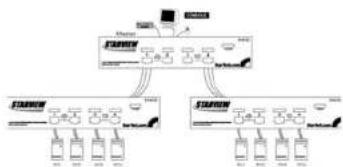
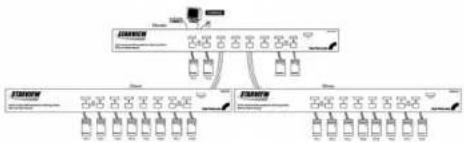
The maximum number of computers controlled by a master/slave configuration with all SV431s is 16 with 4 Slaves and each Slave connects to 4 computers, see figure 11. For an all SV831s configuration, the number is 64 with 8 Slaves and each Slave connects to 8 computers, see figure 12. For an all SV1631 configuration, the number is 136, see figure 13. The Master SV1631 connects to 8 Slaves and 8 computers, and each Slave connects to 16 computers.
flowchart
graph TD
    A["Central Processing Unit"] --> B["Output 1"]
    A --> C["Output 2"]
    A --> D["Output 3"]
    A --> E["Output 4"]
    A --> F["Output 5"]
    A --> G["Output 6"]
    A --> H["Output 7"]
    A --> I["Output 8"]
    A --> J["Output 9"]
    A --> K["Output 10"]
Figure 11: Cascaded 4-port StarViews
flowchart
graph TD
    A["Server"] --> B["1245"]
    A --> C["1246"]
    A --> D["1247"]
    A --> E["1248"]
    A --> F["1249"]
    A --> G["1250"]
    A --> H["1251"]
    A --> I["1252"]
    A --> J["1253"]
    A --> K["1254"]
    A --> L["1255"]
    A --> M["1256"]
    A --> N["1257"]
    A --> O["1258"]
    A --> P["1259"]
    A --> Q["1260"]
    A --> R["1261"]
    A --> S["1262"]
    A --> T["1263"]
    A --> U["1264"]
    A --> V["1265"]
    A --> W["1266"]
    A --> X["1267"]
    A --> Y["1268"]
    A --> Z["1269"]
    A --> AA["1270"]
    A --> AB["1271"]
    A --> AC["1272"]
    A --> AD["1273"]
    A --> AE["1274"]
    A --> AF["1275"]
    A --> AG["1276"]
    A --> AH["1277"]
    A --> AI["1278"]
    A --> AJ["1279"]
    A --> AK["1280"]
    A --> AL["1281"]
    A --> AM["1282"]
    A --> AN["1283"]
    A --> AO["1284"]
    A --> AP["1285"]
    A --> AQ["1286"]
    A --> AR["1287"]
    A --> AS["1288"]
    A --> AT["1289"]
    A --> AU["1290"]
    A --> AV["1291"]
    A --> AW["1292"]
    A --> AX["1293"]
    A --> AY["1294"]
    A --> AZ["1295"]
    A --> BA["1296"]
    A --> BB["1297"]
    A --> BC["1298"]
    A --> BD["1299"]
    A --> BE["1300"]
Figure 12: Cascaded 8-port StarViews
For OSD model:
After connection completes, you should re-activate the OSD menu to check if the Master recognizes the Slaves. A triangle mark (▶) is placed to the right of the channel name indicating the port is connected to a Slave not a computer. A number to the left of the triangle mark indicates the Slave model, i.e. 8▶ for SV831 or SV831D
Change Configuration while Running
Devices at any 'PC x' port can be changed at any time after initial power-up. If you change any one of the "PC 1" to "PC 8" ports connection from a computer to a Slave or vice versa, or replace the devices of a port; the OSD will update this change the next time it is activated. [NOTE: Any new device, a computer or a Slave, must be turned off before it is connected to the Master.
Multi-access StarView
Overview
The advanced multi-access SV832DS and SV1632DS have all the features of SV831D and SV1632D respectively. Both models have two console ports facilitate you to access multiple computers from
two different locations, local and remote. Thanks to the high-drive circuit design, you may connect high quality cables at Console and PC sides for up to 100ft (30m), a definite plus for server room applications. Now you can access all computers either in the server room when you have to physically access the computers such as software upgrade, or away from the server room for everyday use.
Connections
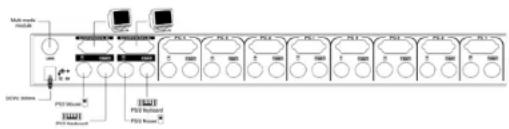
Connect two keyboards, mice and monitors to two CONSOLE ports. The built-in PS/2 mouse signal translation enables you to connect PS/2 mice of different type to the CONSOLE ports, i.e., a generic PS/2 mouse for one CONSOLE and a scroll mouse for another.
flowchart
graph TD
    A["Power Lines"] --> B["PDS1000"]
    B --> C["Control Unit"]
    C --> D["PDS1000"]
    D --> E["Output"]
    F["Main module"] --> G["Power Line"]
    G --> H["PDS1000"]
    H --> I["Control Unit"]
    I --> J["PDS1000"]
    J --> K["Output"]
Operation
On power up, the SV832DS and SV1632DS are in isle mode broadcasting VGA signal from the selected computer and detecting for keyboard and mouse activity. User LEDs (marked A and B) are both red indicating the StarView is not in use.
When keyboard or mouse activity is detected at one CONSOLE, the StarView immediately disables the other CONSOLE from accessing the computer. Only one User LED, at the front panel, remains lit indicating the StarView is under user operation. In the mean time, keyboard LEDs (Num/Caps/Scroll Lock) of the other CONSOLE start to flash as its access is denied and the monitor is blocked from VGA signal for security reason. After the user has finished his operation for a period of time (i.e., USER Timeout), the multi-access StarView Switch returns to idle mode. User Timeout has four options, 5 sec, 30 sec, 60 sec, and HOLD. Select HOLD when you plan to access the StarView for a long time. Pressing the
Timeout setting.
The User Timeout is available in the OSD menu by pressing the Function key
Configuration
To expand the number of computers under control, you may connect CONSOLE port of another StarView to "PC1"\~"PC8" port. Refer to the chapter Cascade Configuration for more detail. There are rules to apply for Master/Slave configuration. When SV832DS is a Master, its slave includes SV431, SV431D, SV831 and SV831D. When SV1632DS is a Master, its slave includes all the above and SV1631D. These multi-access StarView switches already come with OSD menu, their slaves do not have to be OSD equipped.
Appendices
Specifications:
| Specifications SV431 | SV831 | SV1631D | SV832DS | SV1632DS | |
| SV431D | SV831D | ||||
| User port number 1 1 1 2 2 | |||||
| Computer port number 4 8 16 8 16 | |||||
| Cascade control PC number | Up to 16* | Up to 64* | Up to 136* | Up to 64* | Up to 136* |
| On-screen display (OSD) | SV431D | SV831 | Yes | ||
| Front panel button control | 4 | 8 | 16 | 8 | 16 |
| Hot plug-and-play | Yes | ||||
| Hot-key control | Yes | ||||
| Rack-mount kit | Not Shipped With unit | Shipped With Unit | |||
| Automatic scan interval | 3, 8, 15, 30 seconds | ||||
| Programmable scan pattern | SV431D | SV831D | Yes | ||
| Cable length (Max) | 30M (100ft) at CONSOLE30M (100ft) at PC ports | ||||
| VGA | 1600 x 1200, DDC2B | ||||
| keyboard | PS/2 | ||||
| Computer mouse connector monitor | PS/2, serial (with adapter) HD-DB-15 male | ||||
| keyboard | PS/2 | ||||
| Console mouse connector monitor | PS/2 HD-DB-15 female | ||||
| H x W x D (mm) | 44x226x130 | 44x436x180 | 3.5x17.2x8.7 | 44x436x180 | 88x436x220 |
| (in.) | 1.7x8.7x5.1 | 1.7x17.2x7.0 | 3.5x17.2x8.7 | 1.7x17.2x7.0 | 3.5x17.2x8.7 |
| size | Compact | 10 | 20 | 10 | 20 |
| Power supply (min) | 9V DC, 500mA | ||||
- Cascaded with StarView Switches supporting the same number of PC ports. You can mix different models in cascade applications.
Troubleshooting:
Ensure that all cables are well seated. Check that keyboard/mouse cables are not swapped. Label and bundle the cables for each computer to avoid confusion when connected to the StarView.
Symptom Possible causes Recommended solutions
| No OSD screen | •No power to StarView•Loose monitor connectionMonitor not multi-sync | •Establish power by turning on computers, wait, press left CTRL keys several times.•Reconnect monitor•Use multi-sync monitor |
| Keyboard error on boot | •Loose keyboard connection | •Make sure keyboard cables are Well seated |
| Master/slave does not work | •Improper installation procedures | •Make sure slave's CONSOLE is connected to Master's PC 1~PC 8 port•Press and hold the 1 and 2 push buttons to initiate K/M reset•Remove any possible power supply to the slave (unplug all cables), before connecting it to the Master |
| Keyboard strokes shifted | •The computer was in shifted state when last switched | •Press both SHIFT keys |
| The ↑ and ↓ keys do not work in Manual Scan | •All PCs are off or only one PC is turned on. Scan mode works for power-on computers only•Scan type is eye mark selected but no PC is eye mark selected in OSD. | •Turn computers on.•Press any other key to abort Manual Scan mode.•Set proper Scan type in OSD and determine which PCs are eye mark selected, do it in OSD. |
| Auto Scan does not switch PC and StarView beeps from time to time and red indicator flashes | •All PCs are off or only one PC is turned on. Scan mode works for power-on computers only•Scan type is eye mark selected but no power-up PC is eye mark selected in OSD. | •Turn on computers•Set proper Scan Type in OSD and determine which PCs are eye mark selected, do it in OSD.•Press left CTRL key twice to abort Auto Scan mode.•Press any front button to select a PC, and Auto Scan stops. |
| Double OSD images at cascade configuration | •Improper slave connection procedure. | •Press push buttons 1 and 2 down for 2 seconds to activate K/M RESET.•Remove any possible power supply to the Slave (unplug all cables), before connecting it to the Master. |
| OSD menu is not at the proper position | •OSD menu has fixed resolution and its size varies due to computer VGA resolution changes. | •Use: More\Position to select UL or UR. OSD menu may appear near the middle of the screen when LL or LR is selected. |
| Computer can not use serial mouse | •Loose mouse adapter•Incorrect mouse adapter | •Secure the mouse adapter to computer's COM port•Use only the mouse adapter comes with the unit |
| Can not select a computer connected to a slave | •Improper Master unit connection•Improper slave unit connection•Too many levels of slaves | •Only Master ports PC1-PC8 can be connected to slaves.•Connect slave CONSOLE port to PC1-PC8 ports of the Master•Only one level of slave units is allowed. Pop up OSD again to check if Master recognizes the slave connection. Look for triangle mark and the number before it. |
| The StarView fails to function occasionally. | •Computers do not supply enough power. | •Make sure a power adapter with minimum of 9V 500mA-output rating is firmly connected to the power jack. |
Limited Warranty
IN NO EVENT SHALL THE DIRECT VENDOR'S LIABILITY FOR DIRECT OR INDIRECT, SPECIAL, INCIDENTAL OR CONSEQUENTIAL DAMAGES, LOSS OF PROFIT, LOSS OF BUSINESS, OR FINANCIAL LOSS WHICH MAY BE CAUSED BY THE USE OF THE PRODUCT EXCEEDS THE PRICE PAID FOR THE PDOCUDT.
The direct vendor makes no warranty or representation, expressed or implied with respect to the contents or use of this documentation, and especially disclaims its quality, performance, merchantability, or fitness for any particular purpose.
The direct vendor also reserves the right to revise or update the product or documentation without obligation to notify any user of such revisions or updates. For further information, please contact your direct vendor.
All the brand names and registered trademarks are the property of their respective owners.


- User's Manual
- Table of Contents
- Introduction
- Installation
- Operation
- Cascade Configuration
- Multi-access StarView
- Appendices
- Overview
- One-Console StarView Switches
- Two-Console StarView Switches
- On-Screen Display (OSD) Menu
- Automatic Mouse Conversion
- High Video Quality
- Features
- Extra features for On-Screen Display model
- More features for multi-access models
- Configurations
- Single StarView Configuration
- Cascade (Master/Slave) Configuration
- Device Connection
- Initial Power-Up
- Replace Master Console Devices
- Adhesive Rubber Foot
- Optional Rack Mount Accessories
- Front Panel Push Buttons
- ■ K/M RESET
- ■ AUTO SCAN
- ■ Manual Scan
- ■ Audio Stick
- ■ Scan Type
- ■ Scan Rate
- ■ Keyboard Speed
- ■ Hotkey Menu
- ■ CH Display
- ■ Position
- Hot-key commands
- Connection
- For OSD model:
- Change Configuration while Running
- Connections
- Configuration
- Troubleshooting:
- Limited Warranty
Brand : StarTech.com
Model : SV832DS
Category : KVM switch