
SV231USBAGB - KVM switch StarTech.com - Free user manual and instructions
Find the device manual for free SV231USBAGB StarTech.com in PDF.


| Product Type | 2-Port USB KVM Switch with Audio and USB 2.0 Hub |
| Model | SV231USBAGB |
| Brand | StarTech.com |
| Number of Connected Computers | 2 |
| Console Ports | 1x VGA, 2x USB Type A (keyboard & mouse), 2x 3.5mm audio (speaker & mic), 2x USB Hub ports |
| Computer Ports | 2x VGA, 2x USB Type B, 2x 3.5mm audio (speaker & mic) per computer |
| Video Resolution | Up to 2048x1536 (QXGA) @ 60Hz |
| Supported USB Devices | USB 1.1/2.0 keyboards, mice, and other peripherals |
| Audio Support | Switched 3.5mm stereo speaker and microphone outputs |
| Switching Methods | Front panel push buttons or keyboard hotkey combinations |
| Hotkey Commands | Scroll Lock based; programmable to Caps Lock, Num Lock, Esc, or F12 |
| Power Supply | 9V DC, 500mA (included adapter) - required only when using USB hub |
| Dimensions (approx) | 200 x 100 x 40 mm (7.9 x 3.9 x 1.6 in) |
| Weight (approx) | 450 g (1 lb) |
| Material | Steel casing |
| LED Indicators | Green: active computer (solid), no power (flashing); Red: USB hub active |
| Compatibility | Windows, macOS, Linux (with USB keyboard support) |
| System Requirements (Console) | USB keyboard, USB mouse, VGA monitor, optional speakers/microphone |
| System Requirements (Computer) | USB port, VGA output, optional audio ports |
| Cable Requirements | USB Type A to B cable and VGA switchbox cable per computer (not included) |
| Warranty | 2 years |
| Certifications | FCC Class B, CE |
| Reparability | No user-serviceable parts; contact StarTech.com support for warranty repairs |
| Cleaning Instructions | Disconnect power; clean with a soft dry cloth; do not use liquids |
Frequently Asked Questions - SV231USBAGB StarTech.com
User questions about SV231USBAGB StarTech.com
0 question about this device. Answer the ones you know or ask your own.
Ask a new question about this device
Download the instructions for your KVM switch in PDF format for free! Find your manual SV231USBAGB - StarTech.com and take your electronic device back in hand. On this page are published all the documents necessary for the use of your device. SV231USBAGB by StarTech.com.
USER MANUAL SV231USBAGB StarTech.com
2 or 4 Port Steel USB KVM Switch with Audio and USB 2.0 Hub
SV231USBA
SV431USBA
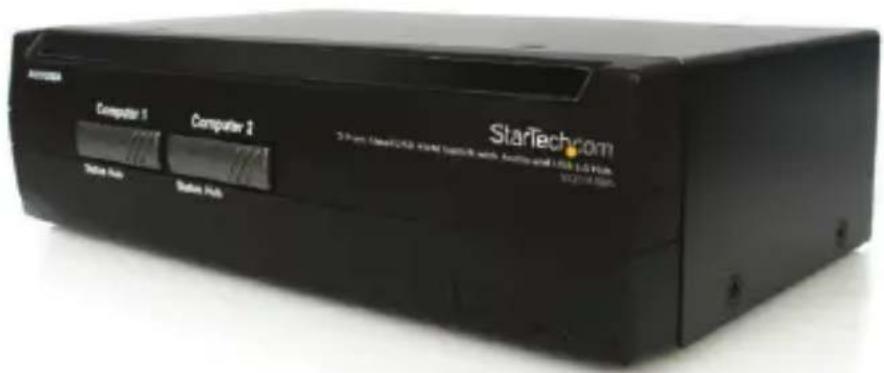
*actual product may vary from photos
For the most up-to-date information, please visit: www.startech.com
FCC Compliance Statement
This equipment has been tested and found to comply with the limits for a Class B digital device, pursuant to part 15 of the FCC Rules. These limits are designed to provide reasonable protection against harmful interference in a residential installation. This equipment generates, uses and can radiate radio frequency energy and, if not installed and used in accordance with the instructions, may cause harmful interference to radio communications. However, there is no guarantee that interference will not occur in a particular installation. If this equipment does cause harmful interference to radio or television reception, which can be determined by turning the equipment off and on, the user is encouraged to try to correct the interference by one or more of the following measures:
• Reorient or relocate the receiving antenna.
- Increase the separation between the equipment and receiver.
- Connect the equipment into an outlet on a circuit different from that to which the receiver is connected.
- Consult the dealer or an experienced radio/TV technician for help.
Use of Trademarks, Registered Trademarks, and other Protected Names and Symbols
This manual may make reference to trademarks, registered trademarks, and other protected names and/or symbols of third-party companies not related in any way to StarTech.com. Where they occur these references are for illustrative purposes only and do not represent an endorsement of a product or service by StarTech.com, or an endorsement of the product(s) to which this manual applies by the third-party company in question. Regardless of any direct acknowledgement elsewhere in the body of this document, StarTech.com hereby acknowledges that all trademarks, registered trademarks, service marks, and other protected names and/or symbols contained in this manual and related documents are the property of their respective holders.
Table of Contents
Introduction ....1
Features .... 1
Package Contents....1
System Requirements....1
Installation 2
Technical Support 6
Warranty Information 6
Introduction
Thank you for purchasing a StarTech.com USB desktop KVM switch with audio switching. This product allows you to switch 2 or 4 computers (depending on the model purchased) including the audio signal. Designed for today's cutting edge systems, it features native support for USB input devices and VGA video. You can save space and improve productivity by sharing one console among multiple computers without sacrificing the quality of your video signal by using converters and adapters.
Features
• Natively supports USB peripherals and VGA video
• Also switches audio for a complete multimedia sharing solution
- Choice of configurable hotkey command sequence or front panel buttons for control
Package Contents
• 1 x USB Desktop KVM Switch
• 1 x Power Adapter
• 1 x Instruction Manual
System Requirements
- Console: USB keyboard (1), USB mouse (1), VGA monitor(1), speakers (optional), microphone (optional)
- Controlled systems: USB support, VGA video out, speaker out (optional), microphone out (optional)
Additional cables required (not included): Each controlled computer will require a USB Type A to Type B cable (1) and VGA switchbox cable (1) or StarTech.com 2-in-1 USB VM cable (1), optional 3.5 mm phono male-to-male sound cable for speakers and microphone (2). See page 5 for StarTech.com part numbers for all required cables.
Installation
This section details how to connect your computers to the KVM switch. For best results,
ensure that all the computers to be controlled are located as close as possible to the KVM switch and console peripherals (monitor, keyboard, mouse). This will reduce the length of cabling required and reduces the chance of interference.
Installing the KVM Switch
Place the KVM switch in close proximity to the keyboard, mouse, and monitor you wish to use as the console controls.
- Connect the monitor to the VGA port under CONSOLE.
- Connect a USB keyboard to the Type A connector under CONSOLE, marked with a keyboard icon.
- Connect a USB mouse to the Type A connector under CONSOLE, marked with a mouse icon.
- Connect speakers to the green 3.5mm phono connector under CONSOLE (optional).
- Connect a microphone to the pink 3.5mm phono connector under CONSOLE (optional).
- Connect up to 2 other USB devices to the ports marked USB HUB (optional).
Plug the power adapter into a wall outlet or other suitable power source. Connect the opposite end to the port marked DC 9V on the KVM switch. (This step is optional, and is required only if you will be using the KVM switch as a USB hub for other devices as described in step 7. If you are not connecting devices to the USB HUB ports, the KVM switch will function as a self-powered device and does not require the power adapter.)
Connecting computers to the KVM Switch
This section describes how to connect a computer you wish to control to the KVM switch.
Repeat these steps for each computer you wish to connect.
- Remove any existing keyboards, mice, monitors, speakers, and microphones from the computer.
-
Using a KVM switchbox cable, connect one end to the video out connector on the computer. (This will be the same connector from which you disconnected the monitor in step 1, if applicable.) Connect the opposite end to the video connector on the KVM switch that corresponds to the computer number you wish to use for that system (marked PC 1 \~ PC 2 or PC 1 \~ PC 4 as applicable).
-
Using a USB Type A to Type B cable, connect the "A" (flat) end to an available USB port on the computer. Connect the opposite end to the "B" (D-shaped) USB connector on the KVM switch that corresponds to the computer number you wish to use for that system (directly under the monitor connection in step 2). This will provide both keyboard and mouse access to that system.
-
Optional: You can use 3.5mm male-to-male phono speaker cable to connect the speaker and/or microphone outputs on the computer to the corresponding connectors on the KVM switch, located under the monitor connector that corresponds to that computer on the KVM. Most computers have sound and microphone connectors that are color-coded to the standard used on the KVM switch: green for speakers, pink for microphone. See the documentation for the computer for assistance, if needed.
Using the KVM Switch

Green LED (solid) = Active Computer
Green LED (flashing) = No Powered Computer on that Port
Red LED (solid) = Active Control of USB Hub
Button = Switch control to that port
The KVM switch offers two convenient ways to switch console control of the attached computers. The first is by using the buttons on the front panel to select which computer is active. The second is using keyboard hotkey combinations, which also allow you to adjust several configuration options on the KVM. The reference chart on the next page describes the hotkey commands and their options in detail.
Note: If your computer is configured to use power-saving features (i.e. auto-standby after inactivity), you may experience intermittent difficulty using the KVM switch. For optimal performance we recommend configuring your computer's BIOS setup software to enable or disable (as applicable) the following options:
- Enable "USB Legacy Support"
- Enable "USB Keyboard and Mouse to bring computer out of standby"
- Disable "Power Saving Mode" for the USB hub
The names and location of these and similar options may vary from computer to computer. Consult your manufacturer's documentation for information on accessing and modifying the BIOS setup if necessary.
Command Name Hotkey Sequence Description
| Select active computer [ScrLk]+[ScrLk]+[x] | Switches access to the computer connected to the corresponding port number on the KVM. ([x]= a number on the keyboard) | |
| Select USB hub control [ScrLk]+[ScrLk]+[Fx] | Switches which corresponding port number has access to the devices connected to the KVM's USB hub ([Fx]= Function key: F1=Port 1, F2=Port 2, etc. | |
| Select Audio/Mic output | [ScrLk]+[ScrLk]+[Fy] | Switches which port's speaker and microphone output is active at the console ([Fy]= Function key: F5=Port 1, F6=Port 2, etc.) |
| Bind computer and USB hub control (default) | [ScrLk]+[ScrLk]+[Z] | When either the select active computer or select USB hub control commands are executed, both functions are switched to the selected port. |
| Unbind computer and USB hub control | [ScrLk]+[ScrLk]+[X] | The computer control and USB hub control can be executed separately; KVM control and USB hub control can be assigned to different ports at one time. |
| Bind computer and Audio/Mic control (default) | [ScrLk]+[ScrLk]+[Q] | When either the select active computer or select audio/mic output control commands are executed, both functions are switched to the selected port. |
| Unbind computer and Audio/Mic output control | [ScrLk]+[ScrLk]+[W] | The computer control and USB hub control can be executed separately; KVM control and Audio/Mic output control can be assigned to different ports at one time. |
| Select next/previous port | [ScrLk]+[ScrLk]+[▲,▼] | Selects the next (up arrow key) or previous (down arrow key) numbered port for control |
| Select previous port [ScrLk]+[ScrLk]+[BkSp] Selects the most recent previously active port. | ||
| Beep sound on/off [ScrLk]+[ScrLk]+[B] Enables/Disables audible responses from the KVM. | ||
| Define new Hotkey sequence | [ScrLk]+[ScrLk]+[H]+[y] | Change the standard [ScrLk] hotkey to a new value (see below) |
| Autoscan [ScrLk]+[ScrLk]+[S] | Automatically switch active ports in sequence every 10 seconds. (press any key to cancel) | |
| Autoscan with programmable display | [ScrLk]+[ScrLk]+[S]+[z] | Autoscan with a delay other than 10 seconds (see below). Press any key to cancel. |
Binding/Unbinding control: By default the switch will automatically switch USB hub and audio control to the KVM port you select to control (bound). If you choose to "unbind" control, you can assign control of the audio and/or USB hub to a port other than the active computer using the commands above. Valid hotkey sequences: If you enter the "Define new hotkey sequence" command
([ScrLk]+[ScrLk]+[H]+[y] the value of [y] replaces the [ScrLk]+[ScrLk] command with one of the following:
$$ \begin{array}{l} \text {[CapsLk] = [CapsLk]+[CapsLk]} \ \text {[Esc] = [Esc]+[Esc]} \ \text {[F12] = [F12]+[F12]} \ \text {[NumLk] = [NumLk]+[NumLk]} \ \text {[ScrLk] = [ScrLk]+[ScrLk] (if another key sequence has been enabled)} \end{array} $$
Programmable Autoscan delay time: [z] can be any one of the following values: 1=10 sec., 2=20 sec. through 9=90 sec., 0=100 sec. Note: Apple computers will need to be programmed using an IBM-compatible keyboard that has a Scroll Lock key.
Technical Support
StarTech.com's lifetime technical support is an integral part of our commitment to provide industry-leading solutions. If you ever need help with your product, visit www.startech.com/support and access our comprehensive selection of online tools, documentation, and downloads.
For the latest drivers/software, please visit www.startech.com/downloads
Warranty Information
This product is backed by a two year warranty.
In addition, StarTech.com warrants its products against defects in materials and workmanship for the periods noted, following the initial date of purchase. During this period, the products may be returned for repair, or replacement with equivalent products at our discretion. The warranty covers parts and labor costs only. StarTech.com does not warrant its products from defects or damages arising from misuse, abuse, alteration, or normal wear and tear.
Limitation of Liability
In no event shall the liability of StarTech.com Ltd. and StarTech.com USA LLP (or their officers, directors, employees or agents) for any damages (whether direct or indirect, special, punitive, incidental, consequential, or otherwise), loss of profits, loss of business, or any pecuniary loss, arising out of or related to the use of the product exceed the actual price paid for the product. Some states do not allow the exclusion or limitation of incidental or consequential damages. If such laws apply, the limitations or exclusions contained in this statement may not apply to you.
Hard-to-find made easy. At StarTech.com, that isn't a slogan. It's a promise.
StarTech.com is your one-stop source for every connectivity part you need. From the latest technology to legacy products — and all the parts that bridge the old and new — we can help you find the parts that connect your solutions.
We make it easy to locate the parts, and we quickly deliver them wherever they need to go. Just talk to one of our tech advisors or visit our website. You'll be connected to the products you need in no time.
Visit www.startech.com for complete information on all StarTech.com products and to access exclusive resources and time-saving tools.
StarTech.com is an ISO 9001 Registered manufacturer of connectivity and technology parts. StarTech.com was founded in 1985 and has operations in the United States, Canada, the United Kingdom and Taiwan servicing a worldwide market.


- or 4 Port Steel USB KVM Switch with Audio and USB 2.0 Hub
- FCC Compliance Statement
- Use of Trademarks, Registered Trademarks, and other Protected Names and Symbols
- Table of Contents
- Introduction ....1
- Installation 2
- Technical Support 6
- Warranty Information 6
- Introduction
- Features
- Package Contents
- System Requirements
- Installation
- Installing the KVM Switch
- Connecting computers to the KVM Switch
- Using the KVM Switch
- Technical Support
- Warranty Information
- Limitation of Liability
Brand : StarTech.com
Model : SV231USBAGB
Category : KVM switch