ZRC243W - Refrigerator Zanussi-Electrolux - Free user manual and instructions
Find the device manual for free ZRC243W Zanussi-Electrolux in PDF.


| Product Type | Refrigerator with 4-star freezer compartment |
| Model | ZRC243W |
| Brand | Zanussi-Electrolux |
| Gross Capacity (L) | 237 L (Frozen: 18 L, Fresh: 219 L) |
| Net Capacity (L) | 231 L (Frozen: 18 L, Fresh: 213 L) |
| Dimensions (W x H x D) | 550 mm x 1250 mm x 612 mm |
| Weight | 40 kg |
| Energy Consumption | 0.752 kWh/day (274 kWh/year) |
| Energy Class | A |
| Freezer Star Rating | **** (4 stars) |
| Rated Power | 110 W |
| Climate Class | SN, N, ST (ambient 10°C to 38°C) |
| Thermostat Control | Rotary dial (0 to 5), 0 = off, 5 = maximum cold |
| Refrigerant | Isobutane (R600a), flammable |
| Defrosting | Automatic defrost for fridge; manual defrost for freezer when frost exceeds 6 mm |
| Door Reversibility | Yes, reversible door (including freezer compartment door) |
| Interior Light | 15 W, E14 thread bulb |
| Adjustable Shelves | Yes, glass shelves and door shelves |
| Ice Cube Tray | Included |
| Voltage | 230 V, 13 A fuse (UK plug) |
| Guarantee | 12 months parts and labour |
| Maintenance | Clean interior with bicarbonate soda; dust condenser annually |
| Safety Features | Child lock, anti-short circuit, earthing required |
Frequently Asked Questions - ZRC243W Zanussi-Electrolux
User questions about ZRC243W Zanussi-Electrolux
0 question about this device. Answer the ones you know or ask your own.
Ask a new question about this device
Download the instructions for your Refrigerator in PDF format for free! Find your manual ZRC243W - Zanussi-Electrolux and take your electronic device back in hand. On this page are published all the documents necessary for the use of your device. ZRC243W by Zanussi-Electrolux.
USER MANUAL ZRC243W Zanussi-Electrolux
This instruction book contains safety precautions, information on use and helpful hints and tips.
To ensure you use this appliance effectively and safely, please read this instruction book carefully before installing or using this appliance and retain for future reference.
The symbols below help you to find things more easily:

Safety precautions
Warnings and Safety information

Hints, useful information

Environmental information
IMPORTANT SAFETY INSTRUCTIONS
These warnings are provided in the interests of your safety. Ensure that you understand them all before installing or using this appliance. Your safety is of paramount importance. If you are unsure about any of the meanings or these warnings contact the Customer Care Department.
Prior to installation
- Check the appliance for transport damage. Under no circumstances should a damaged appliance be installed. In the event of damage please contact your retailer.
Installation
- This appliance is heavy. Care should be taken when moving it.
- It is dangerous to alter the specifications or attempt to modify this product in any way.
- Ensure that the appliance does not stand on the electrical supply cable. If the supply cable is damaged, it must be replaced by a cable available from your local Service Force Centre.
- Make sure that the power plug has not been squashed or damaged during transit.
- A damaged power plug may overheat and cause a fire.
- As you unpack the appliance, check carefully for any signs of transit damage.
- Do not place heavy articles or the fridge/freezer itself on the power cord.
- There is a risk of a short circuit and fire.
- Do not remove the power cord by pulling on its lead, particularly when the fridge/freezer is being pulled out of its niche.
- Damage to the cord may cause a short-circuit, fire and/or electric shock.
- If the power cord is damaged, it must be replaced by a certified service agent or qualified service personnel.
- If the power plug socket is loose, do not insert the power plug.
- There is a risk of electric shock or fire.
- Any electrical work required to install this appliance should be carried out by a qualified electrician or competent person.
- Parts which heat up should not be exposed. Whenever possible, the back of the appliance should be close to a wall, but leaving the required distance for ventilation, as stated in the installation instructions.
- The appliance should be left for 2 hours after installation before it is turned on, in order to allow the refrigerant to settle.
Child Safety
- Do not allow children to tamper with the controls or play with the product.
- Keep packaging materials away from children, to prevent the risk of suffocation!
Safety precautions for isobutane Warning
- The refrigerant isobutane (R 600a) is contained within the refrigerant circuit of the appliance, a natural gas with a high level of environmental compatibility, which is nevertheless flammable.
- Keep ventilation openings, in the appliance enclosure or in the built-in structure, clear of obstruction.
- Do not use mechanical devices or other means to accelerate the defrosting process, other than those recommended by the manufacturer.
- Do not damage the refrigerant circuit.
- Do not use electrical appliances inside the food storage compartments of the appliance.
During Use
- This appliance is designed for domestic use only, specifically for the storage of edible foodstuffs. It is not intended for commercial or industrial use.
- Containers with flammable gases or liquids can leak at low temperatures. Do not store any containers with flammable materials, such as spray cans, fire extinguisher refill cartridges etc. in the appliance.
- Frozen food should not be refrozen once it has thawed out.
- Do not place carbonated or fizzy drinks in the freezer compartment.
- Ice lollies can cause 'frost/freezer burns' if consumed straight from the freezer.
- Do not remove items from the freezer compartment if your hands are damp/wet, as this could cause skin abrasions or frost/freezer burns.
- Bottles and cans must not be placed in the freezer compartment they can burst when the contents freeze.
- Manufacturers' recommended storage times should be adhered to. Refer to relevant instructions.
Maintenance and Cleaning
- Before cleaning, always switch off the appliance and disconnect from the electrical supply.
- When unplugging always pull the plug from the mains socket, do not pull on the cable.
Servicing
- This product should be serviced by an authorised engineer and only genuine spare parts should be used.
- Under no circumstances should you attempt to repair the appliance yourself. Repairs carried out by inexperienced persons may cause injury or serious malfunctioning. Contact your local Service Force Centre.
At the end of the Appliance Life
- When disposing of your appliance use an authorised disposal site.
- The symbol ☑ in the product or on its packaging indicates that this product may not be treated as household waste. Instead it should be taken to the appropriate collection point for the recycling of electrical and electronic equipment. By ensuring this product is disposed of correctly, you will help prevent potential negative consequences for the environment and human health, which could otherwise be caused by inappropriate waste handling of this product. For more detailed information about recycling of this product, please contact your local council, your household waste disposal service or the shop where you purchased the product.
- Remove the plug and ensure that any locks or catches are removed, to prevent young children being trapped inside.

The Appliance and the Environment
This appliance does not contain gases which could damage the ozone layer.
Avoid damaging the cooling unit.
The packaging used on this appliance marked with the

symbol is recyclable.
Keep this instruction book for future reference and ensure it is passed on to any new owner.
CONTENTS
Instructions for the User
Guide to use the instruction book 2
Important Safety Instructions 3
Instructions for the User 6
General Information 6
Description of the Appliance 6
Using the Appliance 7
Before Use 7
To Start the Appliance 7
Thermostat Control 7
Hints for storage 8
Storage time and temperature of foods 8
How to use the four-star frozen food compartment 8
How to make ice cubes 8
Storage Shelves 9
Hints and Tips 9
Normal Operating Sounds 9
Food Storage 9
Energy Saving Advice 9
In the Event of a Power Failure 9
Maintenance and Cleaning 10
Internal cleaning 10
External cleaning 10
Defrosting 10
Changing the Light Bulb 11
When the appliance is not in use 11
Something Not Working 11
Service and Spare Parts 12
Customer Care Department 12
Guarantee Conditions 13
Instructions for the Installer
Technical Specifications 14
Installing the Appliance 14
Transportation, Unpacking 14
Cleaning 14
Location 14
Ventilation Requirements 15
Levelling 15
Door Reversal 15
Door Reversal of Freezer Compartment 17
Electrical Connection 18
Storage Chart (1) 19
Storage Chart (2) 20
INSTRUCTIONS FOR THE USER
General information
This appliance is designed for the refrigeration of food in a domestic home. It has a four-star frozen food compartment for ice making and frozen food storage.
To ensure correct operation, the appliance should be located where the ambient temperature is between 16-32 °C.
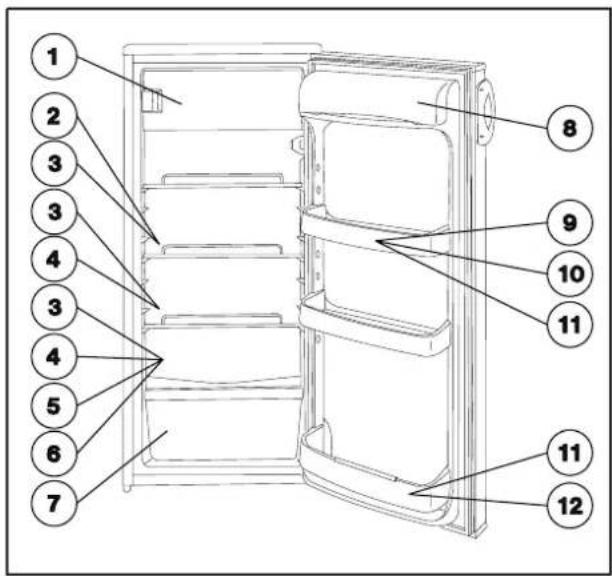
Description of the appliance


-
Frozen food compartment
-
Glass shelf
-
Defrost water drain
-
Glass shelf
-
Salad drawer
-
Rating Plate
-
Adjustable feet
-
Ice tray
-
Butter compartment
-
Interior light/Thermostat control
-
Door shelf
-
Gasket
-
Bottle shelf
-
Egg tray
-
Air circulation
-
Spacer
-
Condenser
-
Evaporator tray
-
Compressor
Using the Appliance
Before Use
Remove all securing tapes.
Wash the inside of the appliance with lukewarm water with a little bicarbonate of soda added (5 ml to 0,5 litre of water). Do not use soap or detergent as the smell may linger. Dry the appliance thoroughly.

Do not use detergents, abrasive powders, highly perfumed cleaning products, wax polishes or products containing alcohol.

To Start the Appliance
- Allow the appliance to stand for 2 hrs after installation.
- Plug in the appliance and switch on at the mains supply.
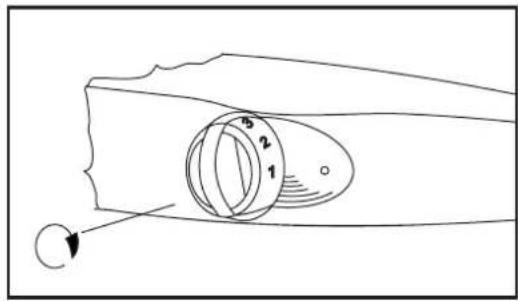
- Turn the thermostat control to the required setting. A setting of 3 - 4 is usually suitable for normal operation (see thermostat control).
- Leave the appliance for approximately 4 hours for the correct temperature to be reached before placing food inside.
Thermostat Control
The thermostat control situated inside the refrigerator regulates the temperature of the larder compartment. Thermostat control is marked from 1-5 the higher the number, the colder the setting.
Position 0 - Off
Position 1 - minimum coldness
Position 5 - maximum coldness
Hints for storage
Below is the recommended storage positions for various food types:
- Frozen food storage & ice making
- Ready-cooked foods
- Foods in dishes
- Opened cans
- Milk, dairy products
- Fresh meat, cold cuts, sausages, etc.
- Fruits, vegetables, salads
- Cheese, butter
- Eggs
- Yoghurt, Cream
- Small bottles, soft drinks
- Large bottles, drinks
Storage time and temperature of foods
The enclosed charts at the end of the instruction book give information about storage time in the frozen and the fresh food compartment.
The storage times quoted are intended as a guide only.
How to use the four-star frozen food compartment
The frozen food compartment is separated from the fresh food compartment.
Place the food to be frozen into this compartment.
Depending on the position of the thermostatic control knob and the temperature in the compartment (-18 °C or lower), frozen food can be stored here.
Do not allow fresh food to come into contact with foods that are already frozen.
How to make ice cubes
Fill the supplied ice cube tray 34 full with water and place in the freezer compartment. Turning up the thermostat control will speed up the freezing process, but remember to turn the thermostat control back to its original position.
To release the ice cubes, twist the tray along its length.
Do not use sharp or pointed items to remove a frozen ice cube tray from the freezer compartment.
Storage Shelves
The shelves in the refrigerator compartment are adjustable to allow storage of large items.
The shelves can be re-arranged by opening the door to 90°.
The door shelves are also adjustable.

To allow the air to circulate within the fridge compartment do not cover the wire shelves with paper or trays.
i Hints & Tips
Normal Operating Sounds
- You may hear faint gurgling or bubbling sounds when the refrigerant is pumped through the coils or tubing.
- When the compressor is on, the refrigerant is being pumped round and you will hear a whirring sound or pulsating noise from the compressor.
- A thermostat controls the compressor and you will hear a faint 'click' when the thermostat cuts in and out.
Food Storage
To obtain the best performance from your appliance:
- Do not store warm food or evaporating liquid.
- Avoid buying frozen food if you cannot store it straight away. The use of an insulated container is advisable. When you arrive home, place the frozen food in the freezer compartment immediately.
- Do not push food together too much.
• Do not store uncovered food.
- Ensure that food placed in the freezer compartment is dated and labelled and used in date order to ensure that food is consumed at its best.
- Lean food keeps better and longer than fatty food, salt reduces the storage time.
- Wrap the food in polythene or aluminium freezing bags or foil so that they adhere to the food and provide an airtight seal.
- Packaging which is swollen or has traces of refrozen water droplets on the pack could indicate that the product has not been kept at a suitable temperature and that it may have lost its original quality. Partially thawed food must not be refrozen, it must be consumed within 24 hours. Never exceed the storage times indicated by the manufacturer.
Energy Saving Advice
- Do not install the appliance close to sources of heat, such as a boiler or radiator.
- Locate the appliance in a cool well ventilated room and make sure that the air openings of the appliance are not obstructed.
- Avoid unnecessary frosting in the cabinet by packing all foodstuffs into airtight packages before placing them in the freezer compartment.
- Food which is to be frozen (when cool) should be placed in the fridge compartment before being transferred to the freezer compartment.
- Try to avoid keeping the door open for long periods or opening the door too frequently as warm air will enter the cabinet and cause the compressor to often switch on unnecessarily.
- Ensure there are no obstructions preventing the door from closing properly.
In the Event of a Power Failure
If there is a power failure during the storage of frozen foods, keep the door closed. If the temperature within your freezer compartment should rise, do not refreeze the food without checking its condition. The following guidelines should assist you:
Ice Cream: Once thawed should be discarded.
Fruits & Vegetables: If soft should be cooked and used up.
Breads & Cakes: Can be refrozen without danger.
Shellfish: Should be refrigerated and used up quickly.
Cooked Dishes: i.e. casseroles should be refrigerated and used up.
Large Pieces of Meat: Can be refrozen providing there are still ice crystals remaining within them.
Small Joints: Should be cooked and can then be refrozen as cooked dishes.
Chicken: Should also be cooked and refrozen as a fresh dish.
Maintenance & Cleaning

Before any maintenance of cleaning work is carried out DISCONNECT the appliance from the ELECTRICITY SUPPLY.
Internal Cleaning
Clean the inside and accessories with warm water and bicarbonate of soda (5 ml to 0.5 litre of water). Rinse and dry thoroughly.

Do not use detergents, abrasive powders, highly perfumed cleaning products, wax polishes or cleaning products containing bleach or alcohol.

Regularly check the door seals and wipe clean to ensure they are clean and free from debris.
External Cleaning
Wash the outer cabinet with warm soapy water.
Once or twice a year dust the condenser (black grille) and the compressor at the back of the appliance with a brush or vacuum cleaner, as an accumulation of dust will affect the performance of the appliance and cause excessive electricity consumption.
Defrosting
The refrigerator automatically defrosts every time the compressor stops. The water is discharged, via the pipe, into a tray located below the appliance, where it evaporates.

Important
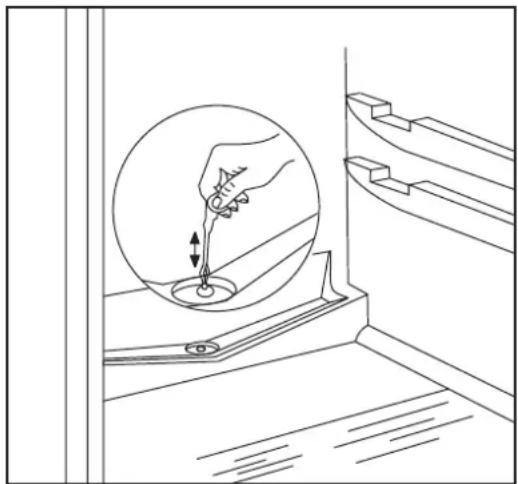
To avoid defrost water overflowing into the fridge, periodically clean the water discharge hole in the centre of the V shaped drip collector at the back of the refrigerator compartment behind the salad drawer(s). Use the special cleaner provided which you will find already inserted into the discharge hole.
While in operation the ****-star compartment becomes progressively covered with frost.
This frost, which acts as an insulator and thus prevents the cold from reaching the food should be removed whenever the thickness of the frost exceeds 6 mm (1/4").
To carry out complete defrosting proceed as follows:
- Remove any food from inside the ****-star compartment, wrap it in several sheets of newspaper and store in a cool dry place.
- Turn the thermostat knob to position << 0 >>. To accelerate defrosting, place a bowl of hot water inside the compartment (with a piece of cardboard underneath the bowl as protection).
- Remove any loose pieces of ice as soon as possible.
- When defrosting is completed, clean and dry thoroughly.
natural_image
Line drawing of a hand holding a tool inside a circular container, with no text or symbols present.Turn the thermostat knob to a medium position to restart the appliance.
After letting the appliance run for at least half an hour replace the previously removed food into the **** -star compartment.
When defrosting it is not necessary to remove the foods from the inner door and the refrigerator compartment.

Important
A temperature rise of the frozen food packs during defrosting may shorten their storage life.
Never use sharp metal tools to scrape off frost from the evaporator as you could damage it beyond repair.
Changing the Light Bulb
Should the light fail to work you can change it as below:
Disconnect the appliance from the electricity supply.
Remove the lamp cover retaining screws, then take the lamp cover off in the direction of the arrow and the bulb can be changed. (Type of the bulb: 230 V, 15 W, E 14 thread)
After changing the bulb replace the lamp cover, and retaining screws and reconnect the appliance to the electricity supply.
When the appliance is not in use
When the appliance is not in use for long periods disconnect from the electricity supply, empty all of the food and clean the appliance, leaving the door ajar to prevent unpleasant smells.

Something Not Working
If the appliance is not working correctly, please carry out the following checks before contacting your local Service Force Centre.
| Problem | Possible Cause | Solution |
| No power to the appliance | No power at the socket.There is a power cut.The fuse has blown.Thermostat control is set at „0“. | Check there is power at the socket.Check there is not a power cut by checking the household lights.Check the fuse has not blown.Check the thermostat control setting. |
| The temperature in the appliance is too high | The appliance is located in an unsuitable position.The thermostat control is set too low. | Check the ambient temperature is within the appliances operating limits of 16 °C to 32 °C.Check that the thermostat control knob is turned to the correct setting relative to ambient conditions. |
| The temperature in the appliance is too low | The thermostat control is set too high. | Set the thermostat control knob to a lower position. |
| Excessive frost and ice has built up | The door has been left open.Something is obstructing the door.The door gasket is dirty. | Check the door has not been left open.Check nothing is preventing the door from closing.Check the door gasket is intact and clean. |
| The appliance is noisy. | The appliance is not level. | Check if the appliance stands stable (all four feet should be on the floor). |
If after the above checks your appliance still does not operate correctly, contact your local Service Force Centre.
Please note that it will be necessary to provide proof of purchase for any in-guarantee service calls.
In-guarantee customers should ensure that the above checks have been made, as the engineer will make a charge if the fault is not a mechanical or electrical breakdown.
Service and Spare Parts
In the event of your appliance requiring service, or if you wish to purchase spare parts, please contact your local Service Force Centre by telephoning:-
08705 929929
Your telephone call will be automatically routed to the Service Force Centre covering your post code area.
For the address of your local Service Force Centre and further information about Service Force, please visit the website at www.serviceforce.co.uk
Before calling out an engineer, please ensure you have read the details under the heading "Something Not Working."
When you contact the Service Force Centre you will need to give the following details:
- Your name, address and post code
- Your telephone number
- Clear and concise details of the fault
- The model and serial number of the appliance (found on the rating plate)
- The purchase date
Please note that a valid purchase receipt or guarantee documentation is required for in-guarantee service calls.
Customer Care Department
For general enquiries concerning your Zanussi - Electrolux appliance or for further information on Zanussi - Electrolux products, please contact our Customer Care Department by letter or telephone at the addresses below or visit our website at www.zanussi-electrolux.co.uk
Major Appliances - Customer Care Department
Zanussi - Electrolux
Addington Way
Luton
Bedfordshire
LU4 9QQ
08705 727727 (*)
*calls to this number may be recorded for training purposes.
Guarantee Conditions
We Zanussi - Electrolux undertake that if within 12 months of the date of the purchase this ZANUSSI - ELECTROLUX appliance or any part thereof is proved to be defective by reason only of faulty workmanship or materials, the company will, at our option repair or replace the same FREE OF CHARGE for labour, materials or carriage on condition that:
- The appliance has been correctly installed and used only on the electrical supply stated on the rating plate.
- The appliance has been used for normal domestic purposes only, and in accordance with the manufacturer's instructions.
- The appliance has not been serviced, maintained, repaired, taken apart or tampered with by any person not authorised by us.
- All service work under this guarantee must be undertaken by a Service Force Centre.
- Any appliance or defective part replaced shall become the Company's property.
Home visits are made between 8.30am and 5.30pm Monday to Friday. Visits may be available outside these hours in which case a premium will be charged.
EXCLUSIONS
This Guarantee does not cover:
Damage or calls resulting from transportation, improper use or neglect, the replacement of any light bulbs or removable parts of glass or plastic.
- Costs incurred for calls to put right an appliance improperly installed or calls to appliances outside the United Kingdom.
- Appliances found to be in use within a commercial environment, plus those which are the subject of rental agreements.
- Products of Zanussi - Electrolux manufacture which are not marketed by Zanussi - Electrolux.
The guarantee is in addition to your statutory and legal rights.
EUROPEAN GUARANTEE
If you should move to another country within Europe then your guarantee moves with you to your new home subject to the following qualifications:
- The guarantee starts from the date you first purchased your product.
- The guarantee is for the same period and to the same extent for labour and parts as exists in the new country of use for this brand or range of products.
-
This guarantee relates to you and cannot be transferred to another user.
-
Your new home is within the European Community (EC) or European Free Trade Area.
- The product is installed and used in accordance with our instructions and is only used domestically, i.e. a normal household.
- The product is installed taking into account regulations in your new country.
Before you move please contact your nearest Customer Care Centre, listed below, to give them details of your new home. They will then ensure that the local Service Organisation is aware of your move and able to look after you and your appliances.
France Senlis +33 (0) 344 62 29 29
Germany Nurenberg +49 (0) 800 234 7378
Italy Pordenone +39 (0) 0434 39 4700
Sweden Stockholm +46 (0) 8 672 53 90
UK Luton +44 (0) 8705 727727
Instructions for the Installer
Technical Specifications
| Model | ZRC 243W |
| Gross capacity (l) | Frozen food comp.: 18Fresh food com.: 219 |
| Net capacity (l) | Frozen food comp.: 18Fresh food com.: 213 |
| Width (mm) | 550 |
| Height (mm) | 1250 |
| Depth (mm) | 612 |
| Energy consumption (kWh/day)(kWh/year) | 0,75274 |
| Energy class, according to EU Standards | A |
| Star rating of frozen food compartment | **** |
| Rated power (W) | 110 |
| Weight (kg) | 40 |
Installing the appliance
Transportation, unpacking
The appliance and the interior fitting are protected for transport.
- Remove all packaging and any adhesive tape.
- Any remnants of adhesive can be removed using white spirit.
- After transportation the appliance must not be switched on for 2 hours. This is to allow the refrigerant to settle.
Cleaning
Clean the accessories and the inside of the appliance with warm water and bicarbonate of soda (5 ml to 0.5 litres of water). Rinse and try thoroughly.
Do not use detergents, abrasive powders, highly perfumed cleaning products, wax polishes or cleaning products containing bleach or alcohol.
Location
The appliance should be positioned in a well ventilated, dry room.
Energy use is affected by the ambient temperature.
The appliance should therefore:
- not be installed next to radiators, cookers or other sources of heat
- only be installed at a location where the ambient temperature corresponds to the climate classification, for which the appliance is designed.
The climate classification can be found on the serial plate.
The following table shows which ambient temperature is correct for each climate classification:
| Climate Classification Ambient Temperature | |
| SN +10 to +32 °C | |
| N +16 to +32 °C | |
| ST +18 to +38 °C |
Ventilation Requirements
The appliance must have adequate ventilation to ensure correct operation.
Diagram shows the ventilation requirements when installed:
A:* Under a worktop, or cupboard.
* The clearance space of 10 cm above the appliance may be reduced to 5 cm providing a clearance space 2,5 cm is left on either side of the appliance.
B: When freestanding
Levelling
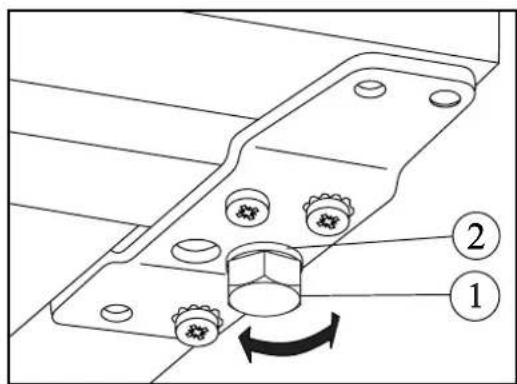
The appliance must be level. Level the appliance by adjusting the two adjustable feet (1) at the front of the appliance.
If required the washer (2) can be removed.
The plastic bag of accessories also contains two spacers to be fitted into special holes in the back of the appliance. Fit the spacers into the holes, taking care to ensure that the arrow (A) is positioned as shown in Figure. Then turn them through 45° (arrow (A) vertical) until they lock into place.
Door Reversal
If required the opening direction of the door can be changed as follows:
To reverse the bottom hinge assembly proceed as follows:
- Disconnect the appliance from the electricity supply.
- Tilt the appliance backwards, resting the top edge of the appliance on a stool or something similar.
- Unscrew the adjustable feet situated on both sides at the front (2 pieces). Remove the lower door hinge plate by unscrewing the 2 retaining screws.
- Remove the hinge pin from the bottom of the door.
- Slot the hinge pin into the hole in the hinge plate and relocate the hinge assembly to the opposite location and refit using the retaining screws.
- Put the cabinet in the upright position.



To reverse the top hinge assembly proceed as follows:
- Remove the 2 worktop retaining screws from the back of the appliance.
- Slide the worktop towards the rear and lift clear of the appliance.

natural_image
Line drawing of a refrigerated industrial machine with cooling fins and heat exchanger (no text or symbols)- Remove the 2 upper hinge plate retaining screws.
- Remove the hinge plate from the top of the door.
- Unscrew the hinge pin from the hinge plate and re-insert on the opposite side of the pate.
- Rotate the hinge assembly 180° and insert the hinge assembly into the opposite location.
- Refit the 2 hinge plate retaining screws.
- Relocate the worktop and refit the worktop retaining screws.

natural_image
Technical line drawing of a mechanical assembly with mounting brackets and a curved arrow indicating direction (no text or symbols)To reverse the handle proceed as follows:
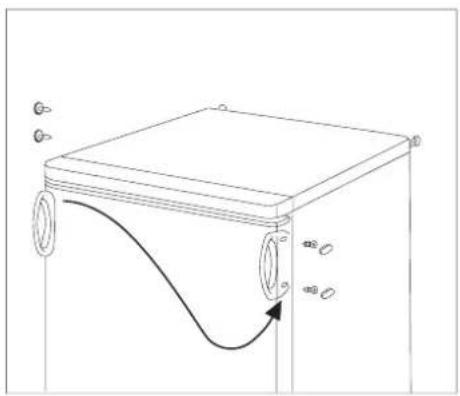
- Remove screw covers (if fitted) and handle retaining screws. Remove blanking plugs on the opposite side using a punch.
- Relocate the handle to the opposite side and refit retaining screws (covers if fitted), and push the plastic plugs supplied with the instruction book into the holes where the handle was previously fitted.
natural_image
Simple line drawing of a rectangular container with wheels and an arrow indicating flow or movement (no text or symbols)Door Reversal of Freezer Compartment
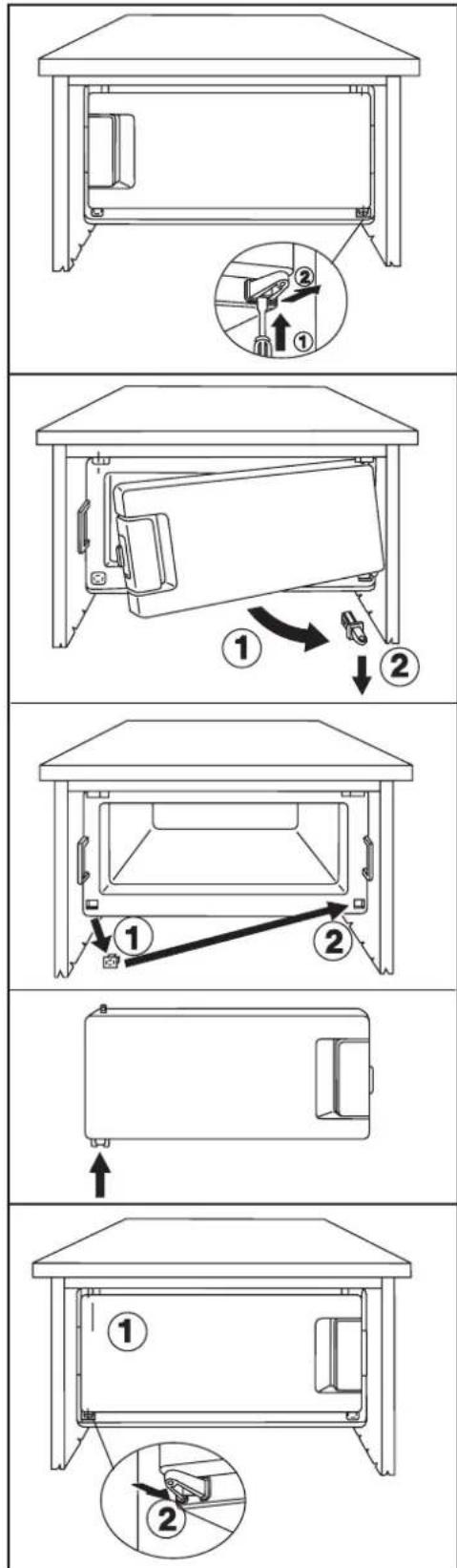
After reversing the refrigerator door, it is necessary to reverse the door of the frozen food compartment as well.
Proceed as follows.
- Press the retaining lever inside the lower doorhinge.
- Tilt the lower doorhinge out together with the freezer compartment door then remove it from the pin of the freezer compartment door. - Remove the rectangular plug and put it into the opening got free on the other side.
- Having the freezer compartment door turned by 180° put the lower hinge onto the lower pin of the freezer compartment door.
- Put the upper hinge pin of the freezer compartment door into the free opening, then push the lower hinge into its place together with the freezer compartment door.
This operation can be performed by your local Service Force Centre, in which case a charge will be made.
Electrical Connection

Any electrical work required to install this appliance should be carried out by a qualified electrician or competent person.
This appliance must be earthed.
The manufacturer declines any liability should these safety measures not be observed.
Electrical Requirements
Before switching on, make sure the electricity supply voltage is the same as that indicated on the appliance rating plate.
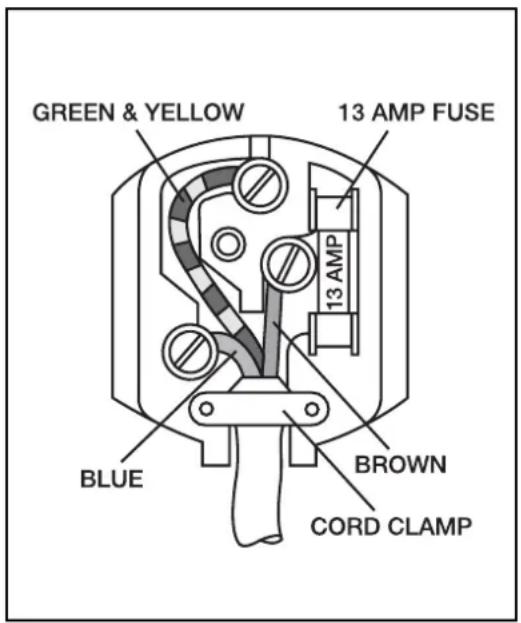
The appliance is supplied with a 13 amp plug fitted. In the event of having to change the fuse in the plug supplied, a 13 amp ASTA approved (BS 1362) fuse must be used. Should the plug need to be replaced for any reason. The wires in the mains lead are coloured in accordance with the following code:
Green and Yellow: Earth
Blue: Neutral
Brown: Live
The wire coloured green and yellow must be connected to the terminal marked with the letter "E" or by the earth symbol or coloured green and yellow.
The wire coloured blue must be connected to the terminal "N" or coloured black.
The wire coloured brown must be connected to the terminal marked "L" or coloured red.
Upon completion there must be no cut, or stray strands of wire present and the cord clamp must be secure over the outer sheath.
Important!
The plug must still be accessible after the appliance has been installed.
The appliance should not be connected to the electrical supply by means of an extension cable. In case that the electrical cable has to be replaced, please contact your local Service Force Centre.
Warning!
A cut off plug inserted into a 13 amp socket is a serious safety (shock) hazard. Ensure that it is disposed of safely.

This appliance complies with the following E.E.C. Directives:
- 73/23 EEC of 19.02.73 (Low Voltage Directive) and subsequent modifications,
- 89/336 EEC of 03.05.89 (Electromagnetic Compatibility Directive) and subsequent modifications.
Storage time chart (1)
Time and method of storage of fresh foods in the refrigerator
| Foods Storage time in days Method of packaging | ||||||||
| 1 | 2 | 3 | 4 | 5 | 6 | 7 | ||
| Raw meat X X x x x cling film, airtight | ||||||||
| Cooked meat X X X | x x x dish covered | |||||||
| Roasted meat X X X | x x dish covered | |||||||
| Raw minced meat X dish covered | ||||||||
| Cooked minced meat X X x x dish covered | ||||||||
| Cold cuts X X x x cling film, cellophane, grease- | proof paper | |||||||
| Fresh fish X x x | cling film, airtight | |||||||
| Cooked fish | X | X | x x dish covered | |||||
| Tinned fish, open | X | x | x | dish covered | ||||
| Fresh chicken | X | X | X | x | x | x | cling film, airtight | |
| Fried chicken | X | X | X | x | x | x | dish covered | |
| Fresh duck, goose | X | X | X | x | x | x | cling film, airtight | |
| Roasted duck, goose | X | X | X | X | x | x | x | dish covered |
| Butter unopened | X | X | X | X | X | X | X | original packaging |
| Butter opened | X | X | X | X | X | X | X | original packaging |
| Milk | X | X | X | x x original packaging | ||||
| Cream | X | X | x x plastic box | |||||
| Sour cream | X | X | X | X | x | x | x | plastic box |
| Cheese (hard) | X | X | X | X | X | X | X | aluminium foil |
| Cheese (soft) | X | X | X | X | x | x | x | cling film |
| Egg | X | X | X | X | X | X | X | |
| Spinach, sorrel | X | X | x x cling film | |||||
| Green peas, green beans | X | X | X | X | x | x | x | cling film |
| Mushroom | X | X | x x x cling film | |||||
| Carrot | X | X | X | X | X | X | X | cling film |
| Tomato | X | X | X | X | X | X | X | cling film |
| Cabbage | X | X | X | X | X | x | x | cling film |
| Fruits: strawberries, raspberries, etc. | X | X | X | x | x | cling film | ||
| Tinned fruits opened | X | X | X | x | x | dish covered | ||
| Cakes filled with cream | X | X | x | x | dish covered | |||
Notation:
X recommended storage time
x maximum recommended storage time
Storage time chart (2)
Storage time of deep-frozen and frozen products
| Foods In the fresh food In the **** | compartment +2 - +7°C comp | frozen food |
| -18°C | ||
| Vegetables:green beans, green peas, mixed vegetables, marrow, corn, etc. 1 day 12 months | ||
| Ready-cooked foods:vegetable dish, trimmings, with meat, etc. 1 day 12 months | ||
| Ready-cooked foods:sirloin steaks, stews 1 day 6 months | ||
| Soups: 1 day 6 months | ||
| Fruits:cherries, gooseberries, fruit cream, 1 day 12 months | ||
| Meat:chicken, duck, goose , tuna fish 1 day 5 months | ||
| Ice-cream, Ice-lollies | 1 day | 3 weeks |
© Electrolux plc 2007
ELECTROLUX HOME PRODUCTS OPERATIONS EUROPE

From the Electrolux Group. The world's No.1 choice.
The Electrolux Group is the world's largest producer of powered appliances for kitchen, cleaning and outdoor use. More than 55 million Electrolux Group products (such as refrigerators, cookers, washing machines, vacuum cleaners, chain saws and lawn mowers) are sold each year to a value of approx. USD 14 billion in more than 150 countries around the world.
- IMPORTANT SAFETY INSTRUCTIONS
- Prior to installation
- Installation
- Child Safety
- Safety precautions for isobutane Warning
- During Use
- Maintenance and Cleaning
- Servicing
- At the end of the Appliance Life
- The Appliance and the Environment
- CONTENTS
- Instructions for the User
- Guide to use the instruction book 2
- Important Safety Instructions 3
- Instructions for the User 6
- Using the Appliance 7
- Hints and Tips 9
- Maintenance and Cleaning 10
- Something Not Working 11
- Service and Spare Parts 12
- Customer Care Department 12
- Guarantee Conditions 13
- Instructions for the Installer
- Technical Specifications 14
- Installing the Appliance 14
- Electrical Connection 18
- Storage Chart (1) 19
- Storage Chart (2) 20
- General information
- Using the Appliance
- Before Use
- To Start the Appliance
- Thermostat Control
- Hints for storage
- Storage time and temperature of foods
- How to use the four-star frozen food compartment
- How to make ice cubes
- Storage Shelves
- i Hints & Tips
- Normal Operating Sounds
- Food Storage
- Energy Saving Advice
- In the Event of a Power Failure
- Maintenance & Cleaning
- Internal Cleaning
- External Cleaning
- Defrosting
- Important
- Changing the Light Bulb
- When the appliance is not in use
- Something Not Working
- Service and Spare Parts
- 929929
- Customer Care Department
- Guarantee Conditions
- EXCLUSIONS
- This Guarantee does not cover:
- EUROPEAN GUARANTEE
- Installing the appliance
- Transportation, unpacking
- Cleaning
- Location
- Ventilation Requirements
- Levelling
- Door Reversal
- Door Reversal of Freezer Compartment
- Electrical Connection
- Electrical Requirements
- Important!
- Warning!
- Storage time chart (1)
- Notation:
- Storage time chart (2)
- Storage time of deep-frozen and frozen products
Brand : Zanussi-Electrolux
Model : ZRC243W
Category : Refrigerator