
IPT-1G-HDMI - Audio / Video AJA - Free user manual and instructions
Find the device manual for free IPT-1G-HDMI AJA in PDF.


| Product Type | Video over IP Transceiver |
| Brand | AJA |
| Model | IPT-1G-HDMI |
| Video Input | 1x HDMI |
| Video Output | 1x HDMI |
| Network Interface | 1x Gigabit Ethernet (RJ45) |
| Supported Video Formats | Up to 1080p60, 3G-SDI compatible via HDMI |
| Audio Support | Embedded HDMI audio up to 8 channels |
| Streaming Protocols | RTSP, RTP, SMPTE 2022-6/7 |
| Power Supply | 12V DC, 1A (external adapter) or PoE+ (IEEE 802.3at) |
| Power Consumption | 10W typical |
| Dimensions (W x D x H) | 140 x 100 x 30 mm (5.5 x 3.9 x 1.2 in) |
| Weight | 0.45 kg (1.0 lb) |
| Operating Temperature | 0°C to 40°C (32°F to 104°F) |
| Housing Material | Aluminum chassis |
| Mounting | Desktop or optional rackmount kit |
| LED Indicators | Power, Link, Status |
| Configuration | Web GUI, DHCP/static IP |
| Management | HTTP web server, SNMP |
| Cooling | Fanless, passive cooling |
| Compliance | CE, FCC Class A |
| Warranty | 2 years limited (check local distributor) |
| Maintenance | Clean with dry cloth; do not use liquids |
| Safety | Use only with provided power supply; avoid moisture |
| Spare Parts / Repairability | Contact AJA support for replacement parts; not user-serviceable |
| General Information | Designed for professional AV-over-IP applications; supports one-way video transmission |
Frequently Asked Questions - IPT-1G-HDMI AJA
User questions about IPT-1G-HDMI AJA
0 question about this device. Answer the ones you know or ask your own.
Ask a new question about this device
Download the instructions for your Audio / Video in PDF format for free! Find your manual IPT-1G-HDMI - AJA and take your electronic device back in hand. On this page are published all the documents necessary for the use of your device. IPT-1G-HDMI by AJA.
USER MANUAL IPT-1G-HDMI AJA
Installation and Operation Guide
Trademarks
AJA® and Because it matters. are registered trademarks of AJA Video Systems, Inc. for use with most AJA products. AJATM is a trademark of AJA Video Systems, Inc. for use with recorder, router, software and camera products. Because it matters. is a trademark of AJA Video Systems, Inc. for use with camera products.
CION ® , Corvid Ultra ® , Io ® , Ki Pro ® , KONA ® , KUMO ® , ROI ® and T-Tap ® are registered trademarks of AJA Video Systems, Inc.
AJA Control Room™, KiStor™, Science of the Beautiful™, TruScale™, TruZoom™, V2Analog™ and V2Digital™ are trademarks of AJA Video Systems, Inc.
AirPort, Apple, Apple logo, AppleShare, AppleTalk, FireWire, iPod, iPod touch, Mac, Macintosh and ProRes, are registered trademarks of Apple Inc. Final Cut Pro, QuickTime and QuickTime logo are trademarks of Apple Inc.
Avid, Avid DNxHD and Media Composer are registered trademarks of Avid Technology, Inc.
Adobe is a registered trademark of Adobe Systems Incorporated in the United States and/or other countries.
HDMI, the HDMI logo and High-Definition Multimedia Interface are trademarks or registered trademarks of HDMI Licensing, LLC.
DVI is a registered trademark of DDWG.
TASCAM is a registered trademark of TEAC Corporation.
Dolby and the double-D Dolby logo are registered trademarks of Dolby Laboratories Licensing Corporation.
openGear® Ross, ROSS, ROSS®, and MLE are registered trademarks of Ross Video.
Dashboard Control System™ is a trademark of Ross Video.
All other trademarks are the property of their respective holders.
Copyright
Copyright © 2017 AJA Video Systems, Inc. All rights reserved. All information in this manual is subject to change without notice. No part of this document may be reproduced or transmitted in any form, or by any means, electronic or mechanical, including photocopying or recording, without the express written permission of AJA Video Systems, Inc.
Contacting AJA Support
When calling for support, have all information at hand prior to calling. To contact AJA for sales or support, use any of the following methods:
Telephone +1.530.271.3190
FAX +1.530.271.3140
Web https://www.aja.com
Support Email support@aja.com
Sales Email sales@aja.com
Contents
Notices 2
Trademarks 2
Copyright 2
Contacting AJA Support 2
Chapter 1 – Introduction .....5
In This Manual 5
Overview....5
Features....6
System Requirements....7
Simplified Block Diagram 7
I/O Connections 8
Ready, Lock, and LAN LED Behavior 9
Installation Overview....10
Initial Installation for IP Mini-Converters 11
Chapter 2 – eMini-Setup ..... 12
Overview....12
Acquiring eMini-Setup 12
eMini-Setup Documentation 12
Installing eMini-Setup 13
PC Installation 13
Mac Installation 14
Running eMini-Setup 14
PC Startup 14
Mac Startup 15
Operating eMini-Setup....15
Control Network Tab Screen 16
Media Network Tab Screen 17
Update Tab Screen. 18
Firmware Update Procedure.... 18
Info Tab Screen 19
Chapter 3 – IP Mini-Converter Web Interface. .....20
Overview....20
Remote Control Overview....20
Networking Option – Using Only the Media LAN Port for Control and Media
Settings 20
Web Browser via Ethernet 21
General Screen Information 21
IPT-1G-HDMI Status Screen 22
IPR-1G-HDMI Status Screen 23
Config Screen for IPT-1G Models 24
Config Screen for IPR-1G Models....26
Presets Screen 28
Presets Screen Controls....28
Network Screen 29
Firmware Screen 31
Downloading and Installing Updated Firmware 31
Booting the IP Mini-Converters from the Safeboot Firmware ..... 32
Appendix A – Frequently Asked Questions (FAQ) ..... 34
Appendix B – Example Configurations. ..... 36
Appendix C – Specifications ..... 37
IPT-1G-SDI Tech Specs 37
IPT-1G-HDMI Tech Specs 38
IPR-1G-SDI Tech Specs 39
IPR-1G-HDMI Tech Specs....40
Appendix D – Safety and Compliance ..... 41
Index. 49
In This Manual
| Chapter 1 - Introduction Introduces the | units through an overview, listing of features, system requirements, a block diagram, the I/O connections, and an installation overview |
| Chapter 2 - eMini-Setup Describes using | the eMini-Setup application to initially communicate with and configure an IP Mini-Converter over a direct USB connection. |
| Chapter 3 - IP Mini-Converter Web Interface | Describes the web interface, which is used to further configure and more fully control the unit. |
| Appendix A - FAQ Provides a set of frequently asked questions along with their answers. | |
| Appendix B - Example Configurations Pro | provides three diagrams with essential configuration information for point-to-point and multicast applications using static and DHCP IP addresses. |
| Appendix C - Specifications Provides tech | chnical specifications for each of the four IP Mini-Converter models. |
| Appendix D - Safety and Compliance Co | vers all necessary safety and compliance information. |
| Index The index offers an alphabetized | topical reference point into the content of the manual, mapped to the corresponding page numbers. |
Overview
AJA IP Mini-Converters are designed for point of use applications for encoding, transport, reception and decoding of IP based video sources. Rugged, compact and fanless, the IP Mini-Converters (models IPT-1G-SDI, IPT-1G-HDMI, IPR-1G-SDI, and IPR-1G-HDMI) provide the bridge between Baseband and IP video for a range of applications, such as transporting and receiving video over IP to or from remote facilities in post production, source monitoring, digital signage, and video walls. IP Mini-Converters ease the cost of extensive monitoring distribution in a facility.
The IPT-1G-SDI encodes SDI video and audio as VSF TR-01 compliant JPEG 2000 encapsulated within an MPEG-2 Transport Stream. Similarly, the IPT-1G-HDMI encodes HDMI 1.4 video and audio as VSF TR-01 compliant JPEG 2000 encapsulated within an MPEG-2 Transport Stream.
The IPR-1G-SDI decodes VSF TR-01 compliant JPEG 2000, and formats the data for SDI output. The IPR-1G-HDMI decodes VSF TR-01 compliant JPEG 2000, and formats the data for HDMI 1.4 output. The audio associated with the video stream is extracted, synchronized, and then embedded into the HDMI or SDI signal as well as output on an analog RCA audio interface.
IPT-1G-SDI
3G-SDI to JPEG 2000 IP Video and Audio Converter
- 1x 3G-SDI BNC output with 4:2:2 10-bits/pixel
• 1 x 3G-SDI BNC loop-through
• 1x RJ-45 (IEC 60603-7) for 10/100/1000Base-T Ethernet media output - Essence support: VSF TR-01 compliant JPEG 2000
• Rugged, fanless, portable design
• Full 10-bit pixel processing pipeline
• Network (LAN) control and status - Quick network setup with AJA eMini-Setup software
IPT-1G-HDMI
HDMI to JPEG 2000 IP Video and Audio Converter
• Full size HDMI 1.4 video input
• 1x RJ-45 (IEC 60603-7) for 10/100/1000Base-T Ethernet media output
- Essence support: VSF TR-01 compliant JPEG 2000
• Rugged, fanless, portable design
• Full 10-bit pixel processing pipeline
• Network (LAN) control and status
- Quick network setup with AJA eMini-Setup software
IPR-1G-SDI
JPEG 2000 IP Video and Audio to 3G-SDI Converter
• 1x RJ-45 (IEC 60603-7) for 10/100/1000Base-T Ethernet media input
- Essence support: VSF TR-01 compliant JPEG 2000
• Rugged, fanless design
• 2x 3G-SDI BNC output with 4:2:2 10-bits/pixel
- Embedded and analog audio outputs
• Full 10-bit pixel processing pipeline
• Network (LAN) control and status
- Quick network setup with AJA eMini-Setup software
IPR-1G-HDMI
JPEG 2000 IP Video and Audio to HDMI Converter
• 1x RJ-45 (IEC 60603-7) for 10/100/1000Base-T Ethernet media input
- Essence support: VSF TR-01 compliant JPEG 2000
• Rugged, fanless, portable design
• Full size HDMI 1.4 video output
- Embedded and analog audio outputs
• Full 10-bit pixel processing pipeline
• Network (LAN) control and status
- Quick network setup with AJA eMini-Setup software
Software
• Built in web server for full remote control and configuration
- eMini-Setup software with a USB connection for initial configuration
System Requirements
Remote computer configuration and control is accomplished using the IP MiniConverter's internal web server. A Mac OSX or Windows computer with a web browser installed is all that is required. A USB port is also required for the initial configuration using eMini-Setup.
NOTE: Safari is the preferred web browser for control on the Mac, and additionally Chrome and Firefox on Windows. Other web browsers may work, but AJA cannot guarantee consistent operation for all web browsers or web browser versions.
Simplified Block Diagram
Figure 1. IP Mini-Converters Simplified Block Diagram
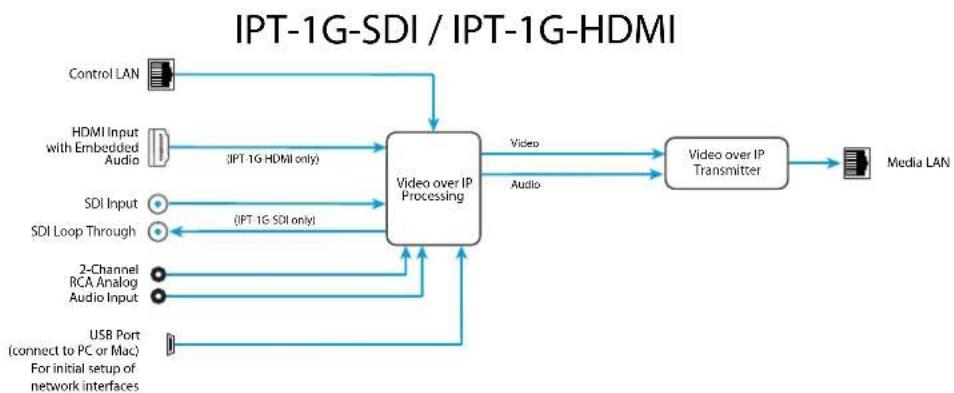
flowchart
graph TD
    A["Control LAN"] --> B["Video over IP Processing"]
    C["HDMI Input with Embedded Audio"] -->|IPT 1G HDMI only| B
    D["SDI Input"] -->|IPT 1G SDI only| B
    E["2-Channel RCA Analog Audio Input"] --> B
    F["USB Port (connect to PC or Mac) For initial setup of network interfaces"] --> B
    B --> G["Video"]
    B --> H["Audio"]
    G --> I["Video over IP Transmitter"]
    H --> I
    I --> J["Media LAN"]

flowchart
graph TD
    A["Control LAN"] --> B["Video over IP Receiver"]
    C["Media LAN"] --> B
    D["USB Port (connect to PC or Mac) For initial setup of network interfaces"] --> B
    B --> E["Video over IP Processing"]
    E --> F["Audio"]
    F --> G["SDI Transmitter (IPR-1G-SDI only)"]
    F --> H["HDMI Transmitter (IPR-1G-HDMI only)"]
    F --> I["Audio D/A"]
    G --> J["SDI Out 1"]
    G --> K["SDI Out 2"]
    H --> L["HDMI Output with Embedded Audio"]
    I --> M["2-Channel RCA Analog Audio Monitor Output"]
Figure 2. IPT-1G-SDI Connections
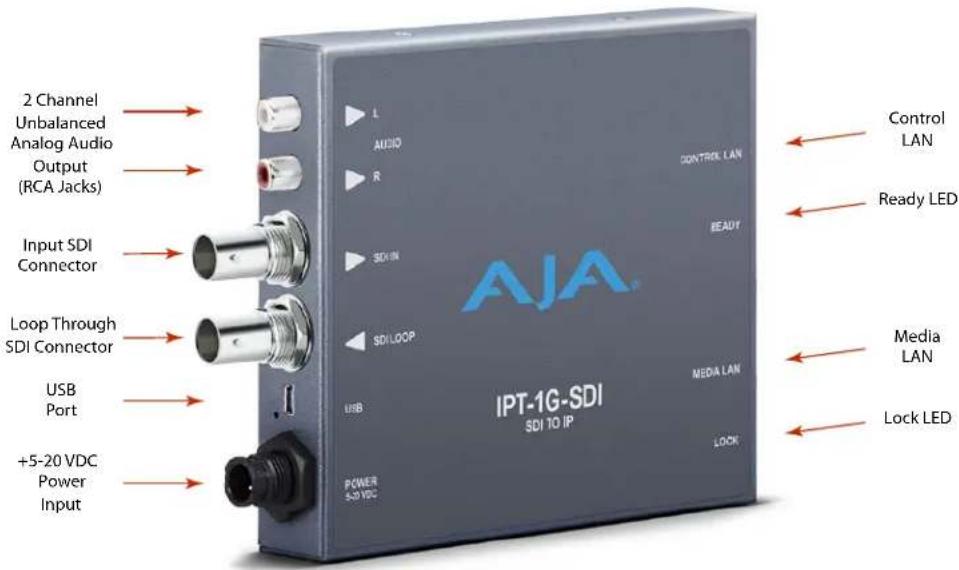
Figure 3. IPT-1G-HDMI Connections

Figure 4. IPR-1G-SDI Connections
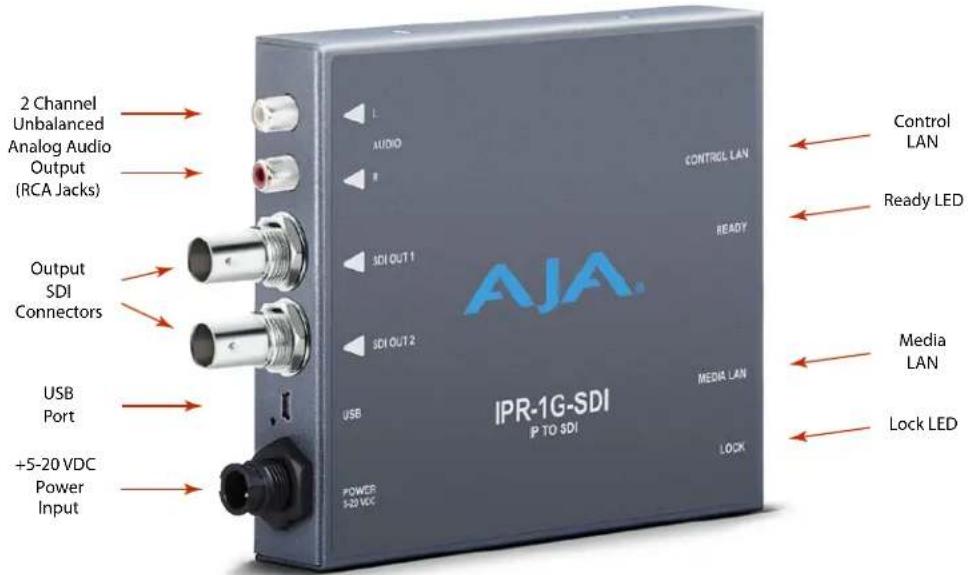
Figure 5. IPR-1G-HDMI Connections

Ready, Lock, and LAN LED Behavior
The Ready LED illuminates green when the unit has finished powering up and is ready to use.
The Lock LED behavior is as follows:
- Off (indicating not locked) when no Program Clock Reference (PCR) has been received.
- Illuminated amber when in the process of locking (PCR has been received, but Phase-Locked Loop (PLL) and/or genlock are not yet locked).
- Illuminated green when the PLL and genlock are both locked.
NOTE: Achieving locked status may take 5 or more minutes depending on network jitter behavior. The output of the unit will still function during the locking period.
The Control LAN and Media LAN LEDs illuminate to indicate a link. Blinking indicates activity. Yellow and Green indicate a 10Mbps connection. Green only indicates a 100Mbps connection. Yellow only indicates a 1000Mbps connection.
Installation Overview
Detailed instructions are provided in "Chapter 2 – eMini-Setup" on page 12 and "Chapter 3 – IP Mini-Converter Web Interface" on page 20 As an overview, however, IP Mini-Converters installation typically consists of the following steps:
- Apply power to the unit.
- Determine the unit's IP address (DHCP), or initially configure its network settings using eMini-Setup and a USB connection. This allows you to then access the unit's user interface through a web browser.
-
Close the eMini-Setup application, and disconnect the USB cable.
-
Connect the unit to your Ethernet network. Use the Control LAN to make configuration changes. Use the Media LAN for the incoming (for IPR-1G) or outgoing (for IPT-1G) video signal over IP stream.
-
Launch a web browser and access the IP Mini-Converters using its IP address. Continue device configuration as needed from the web interface.
-
Connect the IP Mini-Converters output.
-
Configure the IP Mini-Converters basic operation.
The current IP Mini-Converters configuration settings are retained, even when powered off, so subsequent installations for an identical decoding or encoding session can be done with the following simple steps:
- Apply power to the IP Mini-Converters.
- Connect the unit to your network using the Control LAN and Media LAN and connect the unit's output.
NOTE: Two LAN connections to the unit are not necessarily required on an ongoing basis. If it is desirable for your installation, after the IP Mini-Converters is set up, you can access all control parameters through the Media LAN with the appropriate network configuration. See "Networking Option – Using Only the Media LAN Port for Control and Media Settings" on page 20 for more information.
NOTE: The IP Mini-Converters pack an unprecedented feature set into mini converter boxes. As a result, the units use approximately 12 watts of power. They will be very warm to the touch, which is normal. The units are engineered to operate across the full temperature range, from 0 to 40 degrees C.
NOTE: For highest reliability, the mini converters rely on convection cooling instead of using a built-in fan. Therefore, when installing the units, mount in a location where they have access to air for proper cooling. Do not stack the IP Mini-Converters with other mini converters.
Network Configuration
The IP Mini-Converters require a network connection to encode or decode an IP stream. IP Mini-Converters are shipped from the factory with DHCP enabled, so if your network has a DHCP server, by simply connecting the IP Mini-Converters to your network with an Ethernet cable, the DHCP server will assign the units compatible IP addresses.
IP Mini-Converters are shipped from the factory with UPnP (Universal Plug and Play) services enabled, so they are discoverable through Windows Explorer (for networked Windows PCs).
The eMini-Setup application, available as a free download from the AJA website, is used to identify the IP Mini-Converters' current IP addresses, if configured, or to manually set the initial network configuration to work in your environment. Refer below to "Chapter 2 – eMini-Setup" on page 12 for information about installing and using AJA's eMini-Setup application.
Once configured and connected to your network, the IP Mini-Converters are ready for encoding and decoding.
Overview
This chapter describes using the eMini-Setup application to initially communicate with and configure an IP Mini-Converter over a direct USB connection. Once configured, the IP Mini-Converter can be accessed via an Ethernet network using a web browser. Subsequently, that device can then be reconfigured over that network, using its IP address and built-in web server.
NOTE: The eMini-Setup application is only used to setup selected Ethernet capable AJA devices, and cannot be used to connect to or setup other AJA Mini-Converters.
The general procedure is:
- Acquire eMini-Setup from the AJA website and install the eMini-Setup application onto a computer.
- Connect the IP Mini-Converter to that computer's USB port.
- Launch the eMini-Setup application.
- Go to the Control Network tab and Media Network tab, where the IP address settings are displayed. You can use the existing DHCP assigned IP address, or it can be changed manually.
- You can also use eMini-Setup to load firmware to the device, although this can also be done quickly and easily using the web browser interface.
Acquiring eMini-Setup
AJA's eMini-Setup application is available for download from the AJA website.
To download the latest eMini-Setup package, which includes the eMini-Setup application and documentation:
- Go to:
https://www.aja.com/family/software#eminisetup
- Click the link corresponding to the version you want to download for Mac or Windows.
eMini-Setup Documentation
Included with the eMini-Setup download is the AJA device's Installation and Operation Guide, which can be accessed from the eMini-Setup UI via the Help/Manual drop-down menu. This manual includes eMini-Setup information.
Documentation can also be accessed directly from the Mac eMini-Setup installer in the Documentation folder.
Documentation included with the eMini-Setup application is the version available at the time of distribution. However, AJA's documentation can be updated regularly, so newer versions may exist.
To download just the latest documentation, go to:
https://www.aja.com/products/mini-converters/ip-converters
Click the support button and open the Manuals link.
PC Installation
To install eMini-Setup on a Windows PC:
- Download the application from the AJA website. See "Acquiring eMini-Setup" on page 12.
- Open the AJA_eMini-Setup_win.zip file.
- Double-click on the AJA_eMini-Setup.msi file.
- The Setup Wizard will guide you through the installation.
Figure 6. eMini-Setup PC Wizard

- Click Next to begin. Answer the questions in the subsequent dialogues, including device software installation if displayed. When finished, an AJA eMini-Setup shortcut will be installed on the desktop, and you will be able to locate the eMini-Setup application in the AJA folder in the Programs listing.
NOTE: If the eMini-Setup application already exists on the PC, a different Setup Wizard appears.
Figure 7. eMini-Setup Wizard, Re-installation
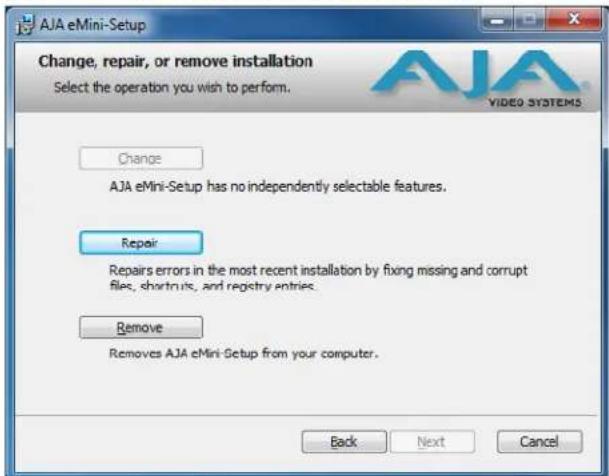
With this screen you can Repair (reinstall) or Remove (uninstall) eMini-Setup on the PC.
Mac Installation
To install the application on a Mac:
NOTE: Mac computers must be Intel-based (G5, G4 and earlier models will not work with eMini-Setup).
- Download the application from the AJA website. See "Acquiring eMini-Setup" on page 12.
- Unzip the file.
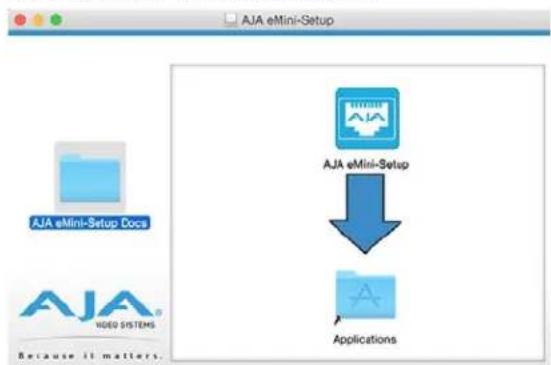
- Double-click on the AJA eMini-Setup.dmg file.
- Answer the prompt and a utility program will be launched.
Figure 8. eMini-Setup Mac Installer
flowchart
graph TD
    A["AJA eMini-Setup Docs"] --> B[" AjA eMini-Setup "]
    C[" AjA eMini Setup"] --> D[" AJA eMini-Setup "]
    E[" Video Systems "] --> F[" Applications "]
- To complete the installation drag the "AJA eMini-Setup" icon to the Applications folder.
Running eMini-Setup
Connect your Ethernet capable AJA device to the PC or Mac via the supplied USB cable, and then connect the external power supply (supplied) to that AJA device.
PC Startup
To run eMini-Setup on a PC, double-click on the AJA eMini-Setup icon on your desktop, or open the AJA folder in the program list and click on the AJA eMini-Setup application located inside the eMini-Setup folder.
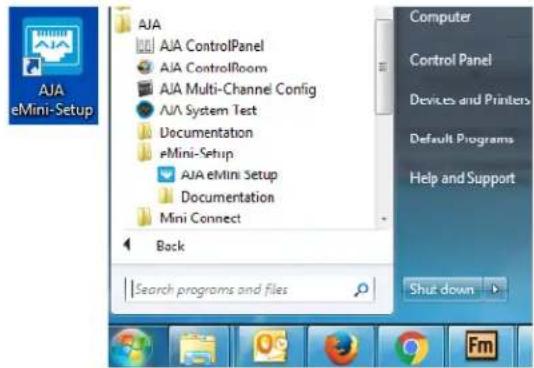
To run eMini-Setup on a Mac, open the Applications folder and locate the AJA eMini-Setup application. Double-click the application to launch it.
Operating eMini-Setup
The eMini-Setup application provides a graphical user interface for viewing settings, modifying settings, and updating software.
Figure 9. Example eMini-Setup Screen

Selecting an AJA device from the pull down menu on the upper right causes eMini-Setup to connect to the selected AJA device.
Version - The version of firmware installed in the AJA device is displayed below the graphic.
Sn - This is the factory set unique serial number of your AJA device. If you ever call AJA Support for service, you may be asked for this number.
A status field at the bottom of the screen shows if the eMini-Setup application is connected and communicating with an AJA device.
File Menu - The File drop-down menu on the eMini-Setup application bar has a Revert to Factory Settings menu item that allows you to change the settings back to the AJA device's factory defaults.
Edit Menu - The Edit drop-down menu has standard Cut, Copy and Paste functions for editing text.
Help Menu - The Help drop-down menu has a link to the AJA device's manual.
Control Network Tab Screen
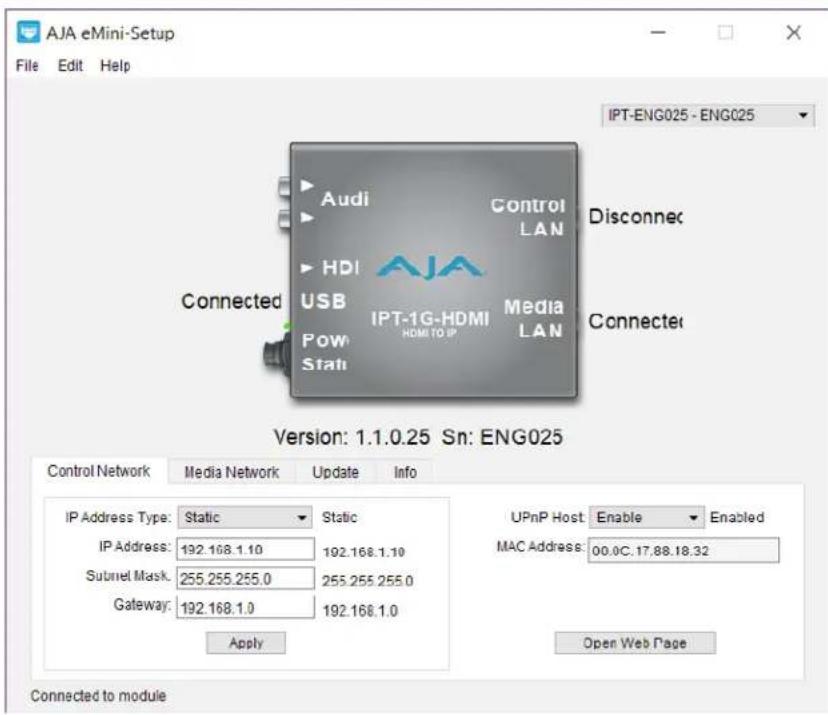
Use this Control Network tab to change the network setup on the connected AJA device. You must click the Apply button to initiate any network configuration changes.
IP Address Type - Choose from DHCP or Static IP Address.
NOTE: A basic setup would be to run an Ethernet cable directly between the device and your laptop and set both the computer and IPT/IPR to sequential static IP addresses. This provides a rapid way to set up to access the web user interface.
IP Address - The current IP Address is displayed. A different IP address can be entered.
Subnet Mask - The current Subnet Mask is displayed. A different subnet mask can be entered.
Gateway - The current Gateway address is displayed. A different gateway address can be entered.
UPnP Host - Choose from Enable or Disable to control whether the AJA device makes itself visible for Windows network browsing.
MAC Address - This is the permanent MAC address of the Control LAN Ethernet port of the AJA device.
Open Web Page - Opens the IP Mini-Converter's web interface in a web browser.
Media Network Tab Screen

Use this Media Network tab to change the media network setup on the connected AJA device. You must click the Apply button to initiate any network configuration changes.
IP Address Type - Choose from DHCP or Static IP Address.
NOTE: If you intend to directly connect an IPT to an IPR, then you will need to use sequential static IP addresses for both units (Transmit and Receive).
IP Address - The current IP Address is displayed. A different IP address can be entered.
Subnet Mask - The current Subnet Mask is displayed. A different subnet mask can be entered.
Gateway - The current Gateway address is displayed. A different gateway address can be entered. On the Media LAN, the gateway may be left blank. (A gateway is required on the Control LAN).
MAC Address - This is the permanent MAC address of the Media LAN Ethernet port of the AJA device.
Open Web Page - Opens the IP Mini-Converter's web interface in a web browser.
Update Tab Screen

Use this Update tab to install new firmware.
Installed - This field shows the version of the firmware currently installed.
Browse - This button opens a navigation window, allowing you to select the firmware and load that version of firmware into the AJA device's non-volatile memory.
Progress - This indicator bar shows the progress of firmware installation.
Firmware Update Procedure
- Check the AJA website for new firmware.
- If new software is found, download it and uncompress the file archive (.zip).
- Connect the device to a Mac or PC via a USB port on the computer.
- Click the Update tab. Click the Browse button. Navigate to the firmware (.ajas extension), open it, and confirm the update. Progress will be shown via the "Progress" bar.
- After the update, the AJA device must be rebooted by clicking on the Reboot button in the prompt window.
See also: "Firmware Screen" on page 31 regarding the process of working with firmware with the IP Mini-Converter's Web UI.
Info Tab Screen
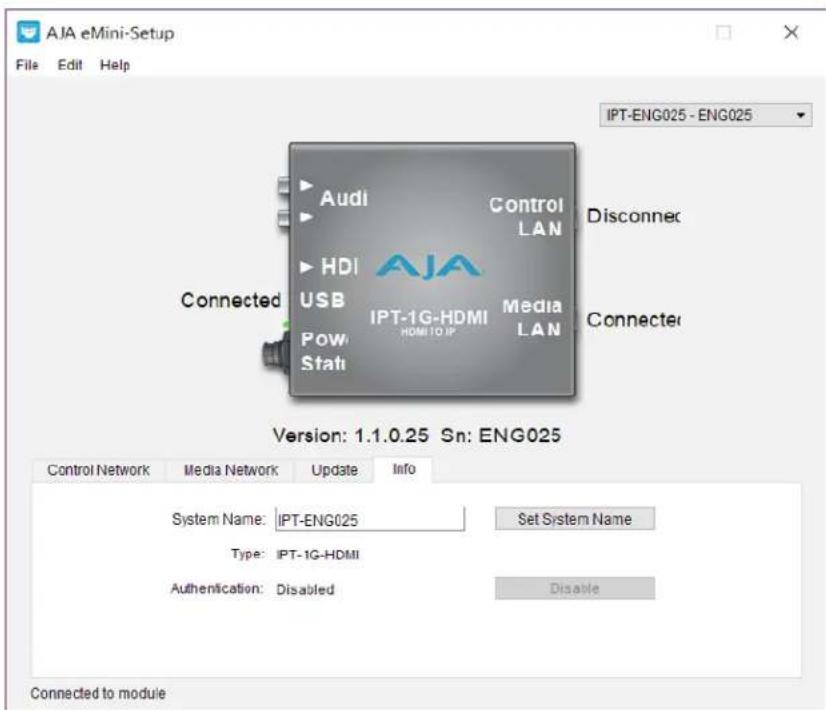
This tab provides basic information about the connected AJA device. This information is mostly useful when calling AJA Support for service or technical support.
System Name - This field allows you to give your AJA device a unique name. This can be useful if you have several attached to a Mac/PC via USB so you can distinguish between them easily.
Type - This is the factory set model name of the AJA device.
Authentication - If Authentication has been Enabled on the web browser Access tab, you can disable the security feature by clicking the Disable button.
Chapter 3 – IP Mini-Converter Web Interface
Overview
Once you have established network connectivity with the IP Mini-Converter, you can further configure and more fully control the unit through its web interface. Subsequently, eMini-Setup is no longer required to interface with the unit.
NOTE: It is often best to remove the USB connection once you have acquired the web interface. This prevents accidentally using eMini-Setup to change parameters already set via the web UI.
Remote Control Overview
An optimized web server in the IP Mini-Converter allows remote control and parameter setting adjustments via a browser client running on a network wired computer. The network can be a closed local area network, a direct connection between an IP Mini-Converter and a computer, or even exposed through a firewall to a WAN.
Each IP Mini-Converter uses a standard RJ-45 connector for the LAN connection. For 10/100 Mbps, the LAN connection uses Auto MDI-X. For 1000 Mbps, the LAN connection uses standard straight-through CAT 5 Ethernet cables or null-modem (cross-over) cables without any configuration or strapping required.
NOTE: Safari is the preferred web browser for control on the Mac, and additionally Chrome and Firefox on Windows. Other web browsers may work, but AJA cannot guarantee consistent operation for all web browsers or web browser versions.
To connect to the IP Mini-Converter, attach the unit to your network and enter its Control Network IP address into the web browser. If authentication has been configured, you may need to enter a password.
Networking Option – Using Only the Media LAN Port for Control and Media Settings
It is an option to setup your network connection to the IP Mini-Converter through an Ethernet switch so that only one Ethernet cable connects directly to the unit.
To implement this approach, follow these general steps:
- Note the IP address of the unit's Media LAN port. This should be a static IP address.
-
Connect the controlling computer's Ethernet port that is being used to control the unit into an Ethernet switch. This requires disconnecting the Ethernet cable from the Control LAN port of the unit.
-
Connect the Media LAN port of the unit into the Ethernet switch.
-
Connect the source of the Media IP stream into the Ethernet switch.
-
Set the controlling computer's Ethernet port that is being used to control the IP Mini-Converter to DHCP.
-
From the controlling computer, point a web browser to the IP address noted in step 1. The IP Mini-Converter's web user interface displays in the browser.
General Screen Information
All IP Mini-Converter web screens have certain areas and controls in common. Vertical and horizontal scroll bars appear when information extends past the border of a panel.
The round blue Up/Down arrow button on each panel and many status parameters opens and closes that pane or set of parameters.
Menu Panel
On the left of each screen is a Menu panel listing all the available screens. Click any of these links to jump to that screen.
Alarms Panel
Alarms are displayed in a panel on the left side of each screen. Clicking on the arrow opens or closes this panel to show or hide the alarms. Hovering the mouse over an alarm (red) or warning (yellow) may provide additional detail about the condition.
Connections Panel
On the right side of every screen is a Connection panel listing information for the connected IP Mini-Converter.
Network Panel
Also on the right is a Network pane that lists other IP Mini-Converters on the network. The gear icon opens the Network Screen, the same as selecting Network from the Menu Panel. Right-clicking on the name of an IP Mini-Converter in this list allows you to turn on the Identify feature, which will blink all four of the Ethernet LEDs of that device at a 1 second rate.
Parameters and Information
The rest of the screen displays all the parameter selections and information available for the selected IP Mini-Converter screen.

Dynamic Controls
- Hovering the mouse on a parameter name displays a brief description of its function.
- From the Config Screen, right clicking on the parameter name resets just that parameter to its factory default.
- For values with sliders, fine control is achieved using the arrow keys on the keyboard to move the slider the minimum amount. The numeric value can also be clicked on to enter a specific value.
IPT-1G-HDMI Status Screen

The Status screen reports the current status and settings for:
- Stream Status
- Network Status
- Firmware Status
Each group of parameters can be opened or closed.
IPR-1G-HDMI Status Screen
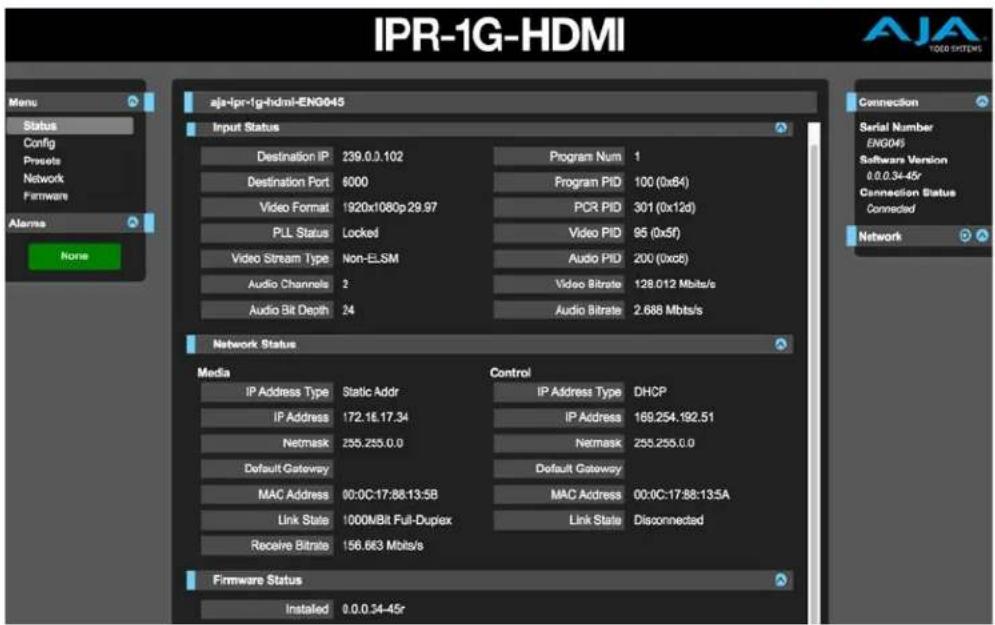
The Status screen reports the current status and settings for:
- Input Status
- Network Status
- Firmware Status
Each group of parameters can be opened or closed.
Config Screen for IPT-1G Models
Figure 10. IPT-1G-SDI Config Screen 1 of 2
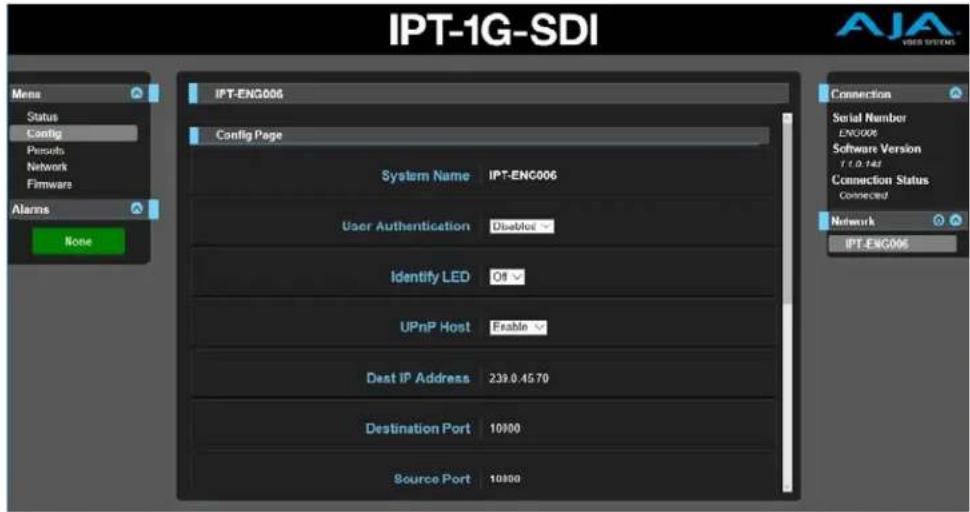
The IPT-1G Config Screen, shown in two parts, has the parameters required for the general operation of the IPT-1G Mini-Converters.
System Name - Defines a name for the system and gives it a unique identifier. This name is used when displaying systems through the web interface.
User Authentication - Enable or disable user password authentication for the web interface.
Identify LED - Enables flashing of the Ethernet LEDs on the unit.
UPnP Host - Enable or disable network discovery using Universal Plug and Play.
Dest IP Address - (Required) The destination IP address of the stream.
- Default Value: 239.0.0.1
Destination Port - (Optional) The UDP destination port of the stream.
• Value Range: 0 - 65535
- Default Value: 0
- A value of zero implies the destination port number of packets is to be ignored.
Source Port - (Optional) The UDP source port of stream.
• Value Range: 0 - 65535
- Default Value: 0
- A value of zero implies the source port number of packets is to be ignored.
Figure 11. IPT-1G-SDI Config Screen 2 of 2
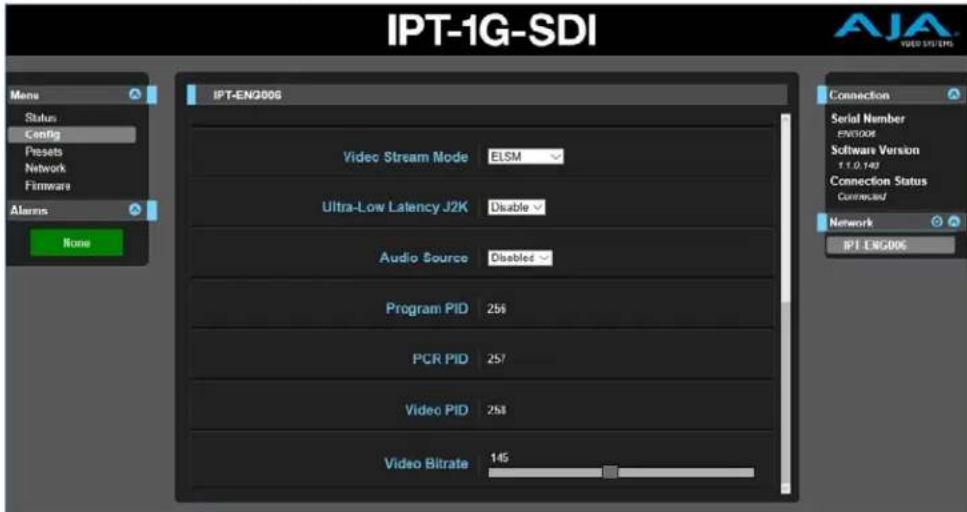
Video Stream Mode - Select ELSM or Non-ELSM. Select ELSM to add an elementary stream header to the video stream including image data metadata parameters associated with decoding and displaying the image data.
Ultra Low Latency J2K - Select Disable or Enable.
Audio Source - Select embedded (SDI or HDMI), Unbalanced RCA, or Disabled.
Program PID - Reports the PID of the selected program.
When the Program Selection is set to "Select Program PID," an editable Program PID field displays directly beneath Program Selection. Enter the Program PID of the desired Program, then press Return or Enter.
When the Program Selection is set to "Auto - First Program in PAT," "Auto - Lowest Program Num," or "Select Program Num," this field displays the auto-selected PID and cannot be edited.
• Value Range: 2 to 8190
- Default Value: 64
PCR PID - Reports the Program Clock Reference PID.
Video PID - Reports the PID of the selected video.
Audio PID - Reports the PID of the selected audio.
NOTE: Audio PID applies only to the IPT-1G-HDMI model.
Video Bitrate - Use the slider to select a value from 50 Mbps through 200 Mbps.
Config Screen for IPR-1G Models
Figure 12. IPR-1G-SDI Config Screen 1 of 2

The IPR-1G Config Screen, shown in two parts, has the parameters required for the general operation of the IPR-1G Mini-Converters.
System Name - Defines a name for the system and gives it a unique identifier. This name is used when displaying systems through the web interface.
User Authentication - Enable or disable user password authentication for the web interface.
Identify LED - Enables flashing of the Ethernet LEDs on the unit.
UPnP Host - Enable or disable network discovery using Universal Plug and Play.
3G SDI Level - Select Level A or Level B for the SDI Output if it is 3G.
NOTE: 3G SDI Level applies only to the IPR-1G-SDI model.
IGMP Version - Internet Group Management Protocol Version.
NOTE: IGMP Version applies only to the IPR-1G models.
NOTE: Selecting the wrong IGMP version for your network may cause long delays in processing multicast subscriptions. See your network engineer for more information.
Dest IP Address - (Required) The destination IP address of the stream.
- Default Value: 239.0.0.1
Source IP Address - (Optional) The source IP address of the stream.
- Default Value: 239.0.0.1
- An empty value implies the source IP address of packets is to be ignored.
Destination Port - (Optional) The UDP destination port of the stream.
• Value Range: 0 - 65535
- Default Value: 0
- A value of zero implies the destination port number of packets is to be ignored.
Source Port - (Optional) The UDP source port of stream.
• Value Range: 0 - 65535
- Default Value: 0
- A value of zero implies the source port number of packets is to be ignored.
Figure 13. IPR-1G-SDI Config Screen 2 of 2
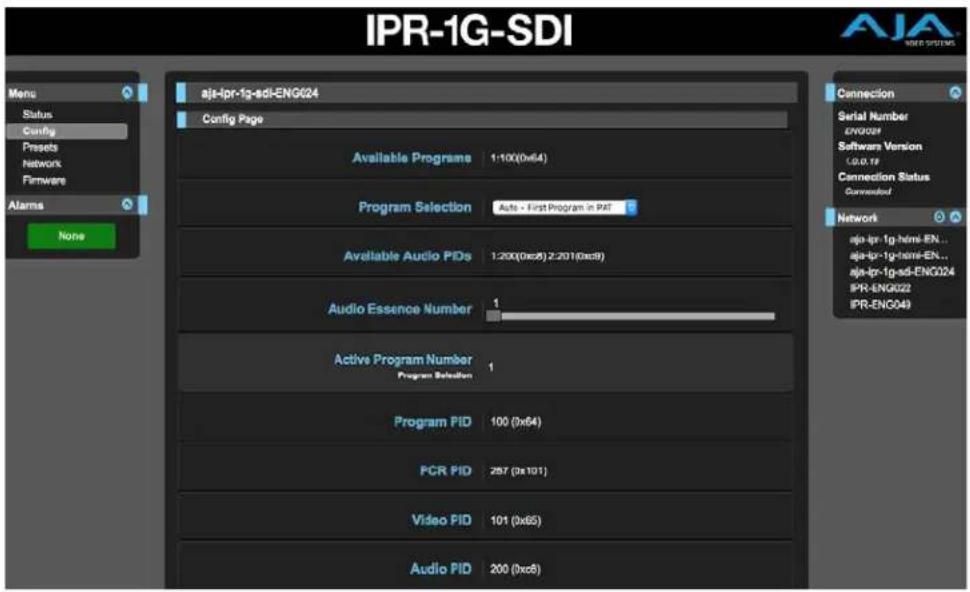
NOTE: The following is a list of acronyms used in this section of the Config Screen:
- Transport Stream (TS)
• Program Association Table (PAT)
• Program Map Table (PMT)
• Program Clock Reference (PCR) - Packet Identifier Code (PID)
Available Programs - TS Programs available on the incoming stream.
Program Selection - Determines how the program to receive is selected.
• Auto - First Program in PAT
• Auto - Lowest Program Num
- Select Program Num
- Select Program PID
- Default: Auto - First Program in PAT
Available Audio PIDs - Reports the Audio PIDs that are available in the selected program.
Audio Essence Number - Select the audio number from the program.
- Value Range: 1 to 4
- Default Value: 1
Active Program Number - Reports the program number of the selected program. Shows "-1" when no program is active.
When Program Selection is set to "Select Program Num," the field Program Number displays with a slider control. Use the slider control to select the Program Number.
When Program Selection is set to "Auto - First Program in PAT" or "Auto - Lowest Program Num," Active Program Num displays the auto-selected Program Number and cannot be edited.
Program PID - Reports the PID of the selected program.
When the Program Selection is set to "Select Program PID," an editable Program PID field displays directly beneath Program Selection. Enter the Program PID of the desired Program, then press Return or Enter.
When the Program Selection is set to "Auto - First Program in PAT," "Auto - Lowest Program Num," or "Select Program Num," this field displays the auto-selected PID and cannot be edited.
• Value Range: 2 to 8190
- Default Value: 64
PCR PID - Reports the Program Clock Reference PID.
Video PID - Reports the PID of the selected video.
Audio PID - Reports the PID of the selected audio.
Presets Screen
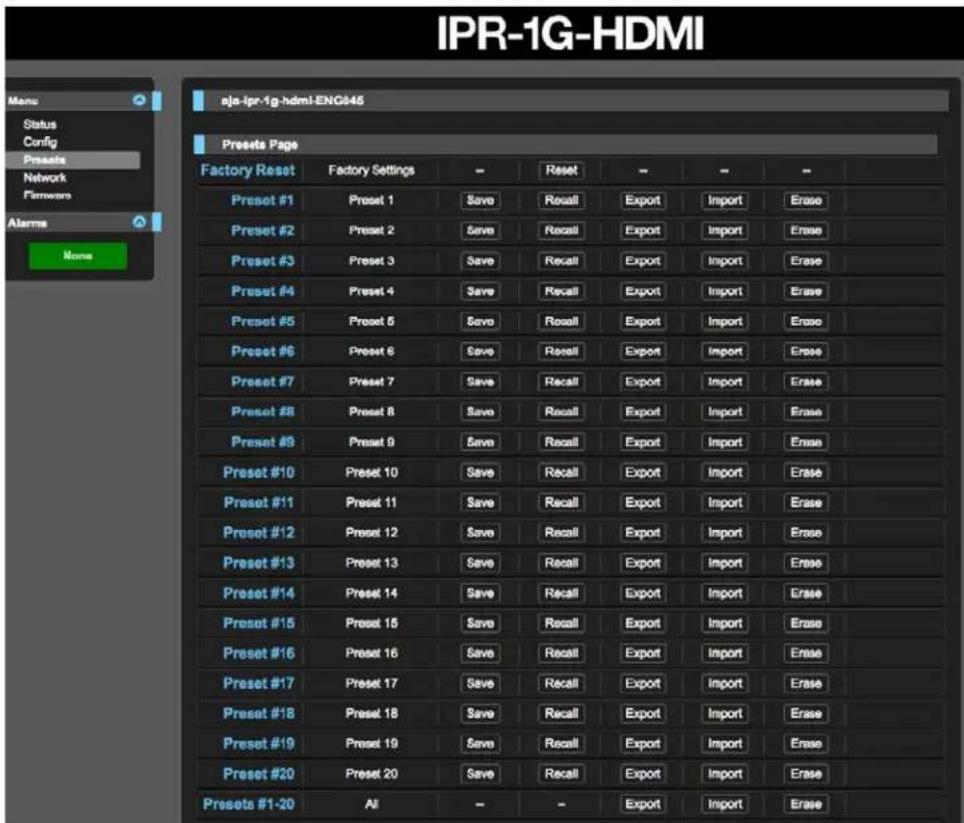
The Presets screen allows you to save Preset Configurations into 20 separate memory registers and recall the presets whenever needed.
The Presets screen also includes Export and Import functions that allow exporting one or all presets to your computer as files and importing exported preset files from your computer. A displayed message indicates successful or failed saves, recalls, exports, and imports.
Presets Screen Controls
Factory Reset - Factory Reset recalls all editable parameters to their factory default settings. Individual presets and Network settings, such as the IP Addresses, are not affected.
Recall - The Recall buttons recall the saved preset configurations.
CAUTION: When you recall a Preset Configuration, the recalled preset immediately replaces the system's existing configuration. All previous settings are lost unless you have previously stored them in another preset configuration or an exported file.
Store - The Store buttons let you save the current configuration into the preset register with the associated name and number. A preset is a set of all parameters as they were set at the time the preset was stored. Only editable parameters are saved in the presets. Non-editable parameters are not saved. To change a preset name, click in the name's text field, type a new name, and press Enter to save the name. After entering text, you can click the mouse outside of the edit box to exit without changing the name.
CAUTION: IP Mini-Converter stored presets may contain a web server access password. If you share an exported preset to someone, that person can extract the password. Before loaning the device to someone, or returning it as a rental, it is recommended that you clear the device of sensitive information.
Export - The Export buttons save the associated preset contents to a file on your computer. The file gets exported to the default download location specified in your browser options. The file name is the same as the preset name with the suffix .presets. If you export multiple files for the same preset, a number gets appended to ensure a unique file name. The file size is small, usually less than 100 kilobytes.
Import - The Import buttons let you browse for and import a preset file on your computer into the preset register associated with the selected button. A dialog box warns you that the operation will overwrite the current preset contents with the file contents. You can only import presets from an IP MiniConverter.
Erase - The Erase buttons erase the data in that preset.
Export Presets 1–20 (All) - Export All lets you save the contents of all presets to a file on your computer.
The file gets exported to the default download location specified in your browser options with the name all.presets. If you export multiple files, a number gets appended to ensure a unique file name.
Import Presets 1–20 (All) - Import All lets you browse for and import a previously exported all.presets file from your computer. A dialog box warns you that the operation will overwrite all 20 current preset contents with the contents stored in the file.
Erase Presets 1–20 (All) - Erase All erases all data from all the presets. A dialog box warns you that the operation will erase all 20 current presets.
Network Screen
Use the Network Screen: Control tab to configure or modify settings for the Control LAN Ethernet port.

Use the Network Screen: Media tab to configure or modify settings for the Media LAN Ethernet port.
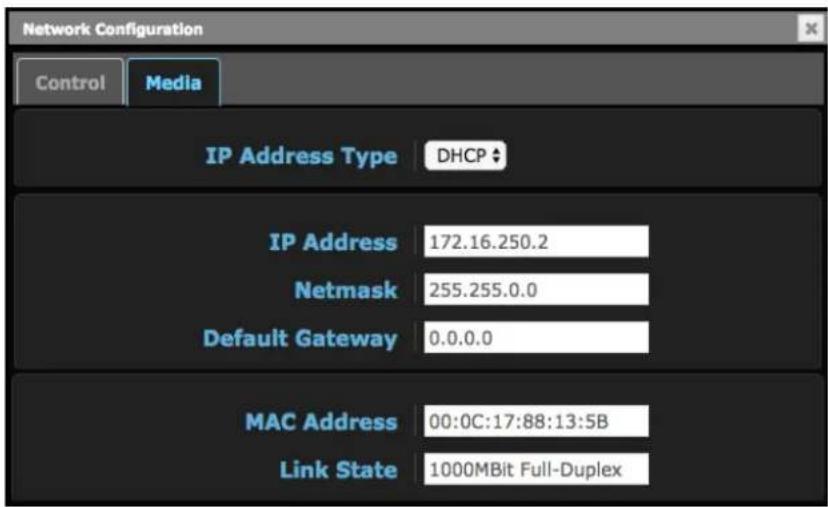
The Network screen allows you to view and change your IP Mini-Converter's network settings. Click Apply to activate any changes.
IP Address Type - IP Address Type determines the type of TCP/IP network configuration to be used. DHCP enables connecting to the network DHCP server, which assigns the IP Address, Netmask, and Gateway automatically. Static lets you set these parameters manually.
NOTE: If the IP Address Type is DHCP, the IP Address, Netmask, and Default Gateway are gray, indicating they are set automatically and cannot be changed unless IP Address Type is first set to Static. Changes are saved and activated upon confirmation using the Apply button.
- DHCP (default) - Selects automatic IP address assignment from the LAN DHCP server. If a DHCP server cannot be found, it fails over to the static IP address.
- Static - Assigns a static IP address manually. The factory default static IP address: 192.168.0.1.
IP Address - IP Address determines a static IP address to be used for TCP/IP networking. Consult your network administrator about how to set this value.
- If IP Address Type is set to DHCP, the IP address is set automatically by the network DHCP server and cannot be entered here.
- If IP Address Type is set to Static, enter an IP address compatible with your LAN here. Also enter a netmask and default gateway address in the following two parameters. Click Apply when you are ready to apply all three entries.
- If IP Address Type is set to DHCP and there is a DHCP failure, the IP address is set to the static IP address.
Netmask - Netmask determines the subnet mask to be used for TCP/IP networking.
- Enter a subnet mask compatible with your LAN. This is only needed for Static IP configurations. The factory default Subnet Mask is 255.255.255.0
- If IP Address Type is set to DHCP, the Subnet Mask is set by the DHCP server and cannot be changed by the user.
Default Gateway - Default Gateway determines the gateway or router used on your LAN for TCP/IP networking.
Without a properly configured default gateway (whether you have a router/ gateway or not), your IP Mini-Converter will be unable to see other IP Mini- Converters on the network, although you may still be able to control this IP Mini-Converter via a web browser. Also, without a proper gateway defined, the discovery feature on the Network web page will not list other units on the network.
- Enter a default gateway or router address. This is only needed for Static IP configurations. The factory Default Gateway is 192.168.0.1.
- If IP Address Type is set to DHCP, the Default Gateway is set by the DHCP server and cannot be changed by the user.
MAC Address - Reports the connected IP Mini-Converter's Media Access Control Address.
Link State - Reports the current status of the Ethernet connection.
Firmware Screen
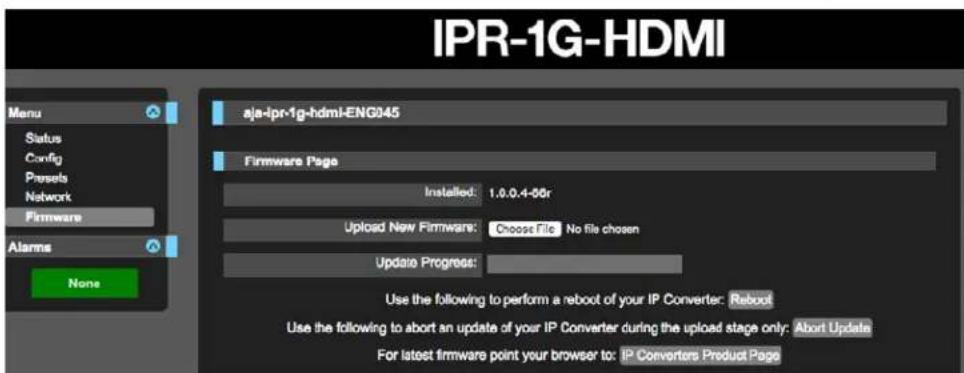
Downloading and Installing Updated Firmware
The Update Firmware screen allows you to download and install a firmware update from AJA.
To Download and Install Updated Firmware
- Visit the AJA website (aja.com) to locate and download the updated software. The following page provides support information and will include links to locations where you can download updates:
https://www.aja.com/products/mini-converters/ip-converters#support
- After downloading the software update to your local drive, use the Browse or Choose File button to locate the local software copy.
- Follow the prompts to load the new firmware into your unit.
- After the firmware has finished installing, reboot the unit by disconnecting power for a few seconds, then reconnecting power.
Booting the IP Mini-Converters from the Safeboot Firmware
The IP Mini-Converters contain primary firmware and safeboot (secondary) firmware. To boot from the primary firmware, just cycle the unit's power.
In the event that the primary firmware becomes corrupted, you can boot the unit using the safeboot firmware.
To Boot from the Safeboot Firmware
- Remove power from the device.
- Using a very narrow tool, such as the end of a paper clip, press down and hold the recessed safeboot button, making sure you feel the button depress. The recessed safeboot button is located next to the Control LAN port.
Figure 14. Location of recessed safeboot button

- While keeping the safeboot button depressed, apply power, then continue holding down the safeboot button for three seconds.
- Remove the paper clip from the safeboot button. The unit will boot from the safeboot firmware. After rebooting, the message "Safeboot" displays under the Alarms heading.
Figure 15. The Safeboot alarm message

- Finally, update the firmware as described above under "Downloading and Installing Updated Firmware" on page 31.
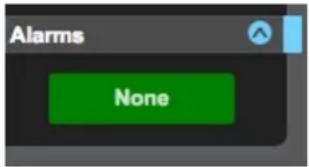
Following a successful firmware update and reboot, the message "None" displays under the Alarms heading.
Figure 16. The alarm message after a successful firmware update
Appendix A – Frequently Asked Questions (FAQ)
Question
How many channels of analog audio can be input to the IPT-1G-SDI and IPT-1G-HDMI for encoding?
Answer
2
Question
How many channels of analog audio can be output or monitored by the IPR-1G-SDI and IPR-1G-HDMI for decoding?
Answer
2
Question
How many channels of embedded SDI audio can be encoded by IPT-1G-SDI?
Answer
2
Question
How many channels of embedded SDI audio can be decoded by IPR-1G-SDI?
Answer
2
Question
How many channels of embedded HDMI audio can be encoded by IPT-1G-HDMI?
Answer
2
Question
How many channels of embedded HDMI audio can be decoded by IPR-1G-SDI?
Answer
2
Question
What video data rates are available when using IPT-1G-SDI and IPT-1G-HDMI?
Answer
Adjustable from 50Mbps through to 200Mbps using bit rate slider.
NOTE: Audio and transmission mux overhead are applicable over and above the video data rate.
Question
What ANC data is supported when using IPT-1G-SDI or IPT-1G-HDMI for encoding and transmitting and / or when using IPR-1G-SDI or IPR-1G-HDMI for receiving and decoding?
Answer
No ANC data support at this time.
Question
Can I use either Unicast or Multicast setups with IPT or IPR products?
Answer
Yes.
Question
Do I have to use a network switch when working with combinations of IPT-1G-SDI, IPT-1G-HDMI, IPR-1G-SDI and / or IPR-1G-HDMI?
Answer
You do not have to use a switch, as IPT to IPR connections can be point-to-point.
NOTE: You will need to use a switch if you are intending to take advantage of multicast and/or routing transmission data to multiple destinations.
Question
What is the end-to-end latency for an IPR to IPT based on point-to-point or ideal network conditions?
Answer
Around 3 to 4 frames.
Question
Is FEC supported?
Answer
No FEC support at this time.
Question
Is ULL supported?
Answer
No ULL support at this time.
Appendix B – Example Configurations
Static IP Addresses - Unicast (point to point)
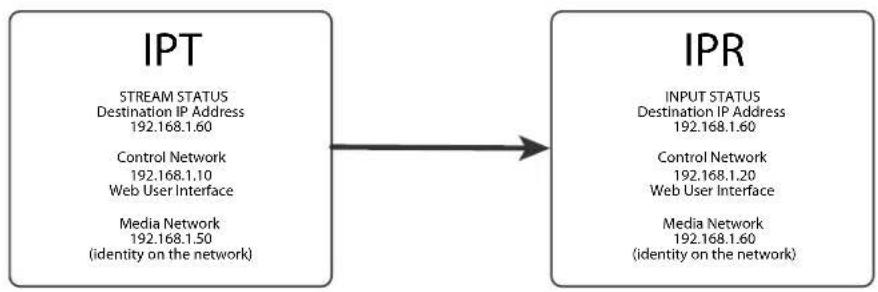
flowchart
graph LR
    A["IPT\nSTREAM STATUS\nDestination IP Address\n192.168.1.60\nControl Network\n192.168.1.10\nWeb User Interface\nMedia Network\n192.168.1.50\n(identity on the network)"] --> B["IPR\nINPUT STATUS\nDestination IP Address\n192.168.1.60\nControl Network\n192.168.1.20\nWeb User Interface\nMedia Network\n192.168.1.60\n(identity on the network)"]
Static IP Addresses - Multicast
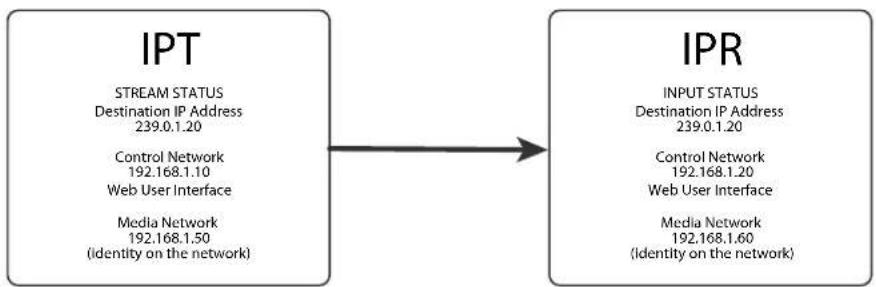
flowchart
graph LR
    A["IPT\nSTREAM STATUS\nDestination IP Address\n239.0.1.20\nControl Network\n192.168.1.10\nWeb User Interface\nMedia Network\n192.168.1.50\n(identity on the network)"] --> B["IPR\nINPUT STATUS\nDestination IP Address\n239.0.1.20\nControl Network\n192.168.1.20\nWeb User Interface\nMedia Network\n192.168.1.60\n(identity on the network)"]
DHCP IP Addresses - Multicast

flowchart
graph LR
    A["IPT\nSTREAM STATUS\nDestination IP Address\n239.0.1.20\nControl Network\n192.168.1.10\nWeb User Interface\nMedia Network\nDHCP\n(identity on the network)"] --> B["IPR\nINPUT STATUS\nDestination IP Address\n239.0.1.20\nControl Network\n192.168.1.20\nWeb User Interface\nMedia Network\nDHCP\n(identity on the network)"]
IPT-1G-SDI Tech Specs
Video Formats
• (2K) 2048 x 1080p 23.98, 24, 25, 29.97, 30, 50, 59.94, 60
• (HD) 1920 x 1080p 23.98, 24, 25, 29.97, 30, 50, 59.94, 60
• (HD) 1920 x 1080i 25, 29.97
• (HD) 1280 x 720p 50, 59.94, 60
• (SD) 625i 25
• (SD) 525i 29.97
Video Input Digital
- 1 x 3G SDI BNC
• 4:2:2 10-bits/pixel
• 1 x 3G SDI BNC loop-through
Audio Input Digital (user selectable)
• 2-Channel SDI embedded audio, 24-bit per channel, 48 kHz synchronous
Audio Input Analog (user selectable)
- 2 x RCA analog audio (2-Channel) - Levels at -10 dBu (nominal)
Essence Output
• 1 x RJ-45 (IEC 60603-7) for 10/100/1000 Base-T Ethernet (IEEE 802.3-2012)
• VSF TR-01 and other JPEG 2000 MPEG-2 TS workflows
User Controls
• 1 x RJ-45 (IEC 60603-7) for 10/100/1000 Base-T Ethernet (IEEE 802.3-2012)
- HTTP/1.1 (RFCs 7230, 7231, 7232, 7233, 7234, 7235)
• Web and REST clients supported
• 1 x USB 2.0 Mini-B (IEC 62680-1) connector
- AJA eMini-Setup of network parameters
Size (w x d x h)
- 5.53" x 4.48" x 0.954" (140.462mm x 113.792mm x 24.232mm)
Weight
• 0.6 lb (0.3 kg)
Power
- Uses AJA power supply model DWP-U-R1, included with purchase
• 100-240V, 50/60 Hz Universal input
• +5 to 20V DC regulated, 12 watts max
Environment
- Safe Operating Temperature: 0 to 40 degrees C (32 to 104 degrees F)
-
Safe Storage Temperature (Power OFF): -40 to 60 degrees C (-40 to 140 degrees F)
-
Operating Relative Humidity: 10-90% noncondensing
- Operating Altitude: <3,000 meters (<10,000 feet)
NOTE: IPT-1G-SDI uses approximately 12 watts of power and convection cooling. It will be very warm to the touch, which is normal. When installing the unit, mount in a location where it has access to air for proper cooling. Do not stack the IPT-1G-SDI with other Mini-Converters.
IPT-1G-HDMI Tech Specs
Video Formats
• (2K) 2048 x 1080p 23.98, 24, 25, 29.97, 30, 50, 59.94, 60
• (HD) 1920 x 1080p 23.98, 24, 25, 29.97, 30, 50, 59.94, 60
• (HD) 1920 x 1080i 25, 29.97
• (HD) 1280 x 720p 50, 59.94, 60
• (SD) 625i 25
• (SD) 525i 29.97
Video Input Digital
• 1 x HDMI Standard Type A connector
• HDMI v1.4a 24/30 bits per pixel, RGB/YUV
Audio Input Digital (user selectable)
• 2-Channel HDMI embedded audio, 24-bit per channel, 48 kHz synchronous
Audio Input Analog (user selectable)
• 2 x RCA analog audio (2-Channel)
• Levels at -10 dBu (nominal)
Essence Output
• 1 x RJ-45 (IEC 60603-7) for 10/100/1000 Base-T Ethernet (IEEE 802.3-2012)
• VSF TR-01 and other JPEG 2000 MPEG-2 TS workflows
User Controls
• 1 x RJ-45 (IEC 60603-7) for 10/100/1000 Base-T Ethernet (IEEE 802.3-2012)
- HTTP/1.1 (RFCs 7230, 7231, 7232, 7233, 7234, 7235)
• Web and REST clients supported
• 1 x USB 2.0 Mini-B (IEC 62680-1) connector
- AJA eMini-Setup of network parameters
Size (w x d x h)
- 5.53 × 4.48 × 0.954 (140.462mm x 113.792mm x 24.232mm)
Weight
• 0.6 lb (0.3 kg)
Power
- Uses AJA power supply model DWP-U-R1, included with purchase
• 100-240V, 50/60 Hz Universal input
• +5 to 20V DC regulated, 12 watts max
Environment
- Safe Operating Temperature: 0 to 40 degrees C (32 to 104 degrees F)
- Safe Storage Temperature (Power OFF): -40 to 60 degrees C (-40 to 140 degrees F)
- Operating Relative Humidity: 10-90% noncondensing
- Operating Altitude: <3,000 meters (<10,000 feet)
IPR-1G-SDI Tech Specs
Video Formats
• (2K) 2048 x 1080p 23.98, 24, 25, 29.97, 30, 50, 59.94, 60
• (HD) 1920 x 1080p 23.98, 24, 25, 29.97, 30, 50, 59.94, 60
• (HD) 1920 x 1080i 25, 29.97
• (HD) 1280 x 720p 50, 59.94, 60
• (SD) 625i 25
• (SD) 525i 29.97
Essence Input
- 1 x RJ-45 (IEC 60603-7) for 10/100/1000Base-T Ethernet (IEEE 802.3-2012)
• VSF TR-01 and other JPEG 2000 MPEG-2 TS workflows
Outputs
- 2 x 3G SDI BNC
• 4:2:2 10-bits/pixel (embedded audio) - 2 x RCA analog audio
• Levels at -10 dBu (nominal)
User Controls
- 1 x RJ-45 (IEC 60603-7) for 10/100/1000Base-T Ethernet (IEEE 802.3-2012)
- HTTP/1.1 (RFCs 7230, 7231, 7232, 7233, 7234, 7235)
• Web and REST clients supported
• 1 x USB 2.0 Mini-B (IEC 62680-1) connector - AJA eMini-Setup of network parameters
Size (w x d x h)
- 5.53" x 4.48" x 0.954" (140.462mm x 113.792mm x 24.232mm)
Weight
• 0.6 lb (0.3 kg)
Power
- Uses AJA power supply model DWP-U-R1, included with purchase
• 100-240V, 50/60 Hz Universal input
• +5 to 20V DC regulated, 12 watts max
Environment
- Safe Operating Temperature: 0 to 40 degrees C (32 to 104 degrees F)
- Safe Storage Temperature (Power OFF): -40 to 60 degrees C (-40 to 140 degrees F)
- Operating Relative Humidity: 10-90% noncondensing
- Operating Altitude: <3,000 meters (<10,000 feet)
IPR-1G-HDMI Tech Specs
Video Formats
• (2K) 2048 x 1080p 23.98, 24, 25, 29.97, 30, 50, 59.94, 60
• (HD) 1920 x 1080p 23.98, 24, 25, 29.97, 30, 50, 59.94, 60
• (HD) 1920 x 1080i 25, 29.97
• (HD) 1280 x 720p 50, 59.94, 60
• (SD) 625i 25
• (SD) 525i 29.97
Essence Input
• 1x RJ-45 (IEC 60603-7) for 10/100/1000 Base-T Ethernet (IEEE 802.3-2012)
• VSF TR-01 and other JPEG 2000 MPEG-2 Workflows
Outputs
• 1 x HDMI Standard Type A connector
• HDMI v1.4a 24/30 bits per pixel, RGB/YUV
- 2 x RCA analog audio
• Levels at -10dBu (nominal)
User Controls
• 1 x RJ-45 (IEC 60603-7) for 10/100/1000 Base-T Ethernet (IEEE 802.3-2012)
- HTTP/1.1 (RFCs 7230, 7231, 7232, 7233, 7234, 7235)
• Web and REST clients supported
• 1 x USB 2.0 Mini-B (IEC 62680-1) connector
- AJA eMini-Setup of network parameters
Size (w x d x h)
- 5.53 x 4.48 x 0.954 (140.462mm x 113.792mm x 24.232mm)
Weight
• 0.6 lb (0.3 kg)
Power
- Uses AJA power supply model DWP-U-R1, included with purchase
• 100-240V, 50/60 Hz Universal input
• +5 to 20V DC regulated, 12 watts max
Environment
- Safe Operating Temperature: 0 to 40 degrees C (32 to 104 degrees F)
- Safe Storage Temperature (Power OFF): -40 to 60 degrees C (-40 to 140 degrees F)
- Operating Relative Humidity: 10-90% noncondensing
- Operating Altitude: <3,000 meters (<10,000 feet)
Appendix D – Safety and Compliance
Federal Communications Commission (FCC) Compliance Notices
Class A Interference Statement
This equipment has been tested and found to comply with the limits for a Class A digital device, pursuant to Part 15, Subpart B of the FCC Rules. These limits are designed to provide reasonable protection against harmful interference in a residential installation. This equipment generates, uses, and can radiate radio frequency energy and, if not installed and used in accordance with the instructions, may cause harmful interference to radio communications. However, there is no guarantee that interference will not occur in a particular installation. If this equipment does cause harmful interference to radio or television reception, which can be determined by turning the equipment off and on, the user is encouraged to try to correct the interference by one or more of the following measures:
- Reorient or relocate the receiving antenna.
- Increase the separation between the equipment and receiver.
- Connect the equipment into an outlet on a circuit different from that to which the receiver is connected.
- Consult the dealer or an experienced radio/TV technician for help.
FCC Caution
This device complies with Part 15 of the FCC Rules. Operation is subject to the following two conditions: (1) This device may not cause harmful interference, and (2) this device must accept any interference received, including interference that may cause undesired operation.
Canadian ICES Statement
Canadian Department of Communications Radio Interference Regulations
This digital apparatus does not exceed the Class A limits for radio-noise emissions from a digital apparatus as set out in the Radio Interference Regulations of the Canadian Department of Communications. This Class A digital apparatus complies with Canadian ICES-003.
European Union and European Free Trade Association (EFTA) Regulatory Compliance
This equipment may be operated in the countries that comprise the member countries of the European Union and the European Free Trade Association. These countries, listed in the following paragraph, are referred to as The European Community throughout this document:
AUSTRIA, BELGIUM, BULGARIA, CYPRUS, CZECH REPUBLIC, DENMARK, ESTONIA, FINLAND, FRANCE, GERMANY, GREECE, HUNGARY, ICELAND, IRELAND, ITALY, LATVIA, LICHTENSTEIN, LITHUANIA, LUXEMBOURG, MALTA, NETHERLANDS, NORWAY, POLAND, PORTUGAL, ROMANIA, SLOVAKIA, SLOVENIA, SPAIN, SWEDEN, SWITZERLAND, UNITED KINGDOM
Declaration of Conformity
Marking by this symbol indicates compliance with the Essential Requirements of the EMC Directive of the European Union 2014/30/EU.

This equipment meets the following conformance standards:
Safety
EN 60065: 2014 (T-Mark License),
IEC 60065: 2014 (CB Scheme Report/Certificate)
Additional licenses issued for specific countries available on request.
Emissions
EN 55032: 2012, CISPR 32: 2015, EN 61000-3-2: 2014, EN 61000-3-3: 2013
Immunity
EN 55103-2: 2009, EN 61000-4-2:2009, EN 61000-4-3:2006+A1:2008+A2:2010,
EN 61000-4-4:2004+A1:2010, EN 61000-4-5:2006, EN 61000-4-6:2009, EN 61000-4-11:2004
Environments: E2, E3 and E4
The product is also licensed for additional country specific standards as required for the International Marketplace.

Warning! This is a Class A product. In a domestic environment, this product may cause radio interference, in which case, the user may be required to take appropriate measures.
This symbol on the product or its packaging indicates that this product must not be disposed of with your other household waste. Instead, it is your responsibility to dispose of your waste equipment by handing it over to a designated collection point for the recycling of waste electrical and electronic equipment. The separate collection and recycling of your waste equipment at the time of disposal will help conserve natural resources and ensure that it is recycled in a manner that protects human health and the environment. For more information about where you can drop off your waste for recycling, please contact your local authority, or where you purchased your product.
Korean KCC Compliance Statement
A급 기기 (업무용 방송통신기자재)
Class A (Broadcasting Communication Equipment for Office Use)
As an electromagnetic wave equipment for office use (Class A), this equipment is intended to use in other than home area. Sellers or users need to take note of this.
Taiwan Compliance Statement
警告使用者:
This is a Class A product based on the standard of the Bureau of Standards, Metrology and Inspection (BSMI) CNS 13438, Class A. In a domestic environment this product may cause radio interference in which case the user may be required to take adequate measures.
Japanese Compliance Statement
This is a Class A product based on the standard of the VCCI Council (VCCI V-3/2015.04). If this equipment is used in a domestic environment, radio interference may occur, in which case, the user may be required to take corrective actions.
Translated Warning and Caution Messages
The following caution statements, warning conventions, and warning messages apply to this product and manual.

Warning Symbol

Caution Symbol
Before Operation Please Read These Instructions

Warning! Read and follow all warning notices and instructions marked on the product or included in the documentation.
Warning! Do not use this device near water and clean only with a dry cloth.
Warning! Do not block any ventilation openings. Install in accordance with the manufacturer's instructions.
Warning! Do not install near any heat sources such as radiators, heat registers, stoves, or other apparatus (including amplifiers) that produce heat.
Warning! Do not defeat the safety purpose of the polarized or grounding-type plug. A polarized plug has two blades with one wider than the other. A grounding type plug has two blades and a third grounding prong. The wide blade or the third prong are provided for your safety. If the provided plug does not fit into your outlet, consult an electrician for replacement of the obsolete outlet.
Warning! Since the Mains plug is used as the disconnection for the device, it must remain readily accessible and operable.
Warning! Protect the power cord from being walked on or pinched particularly at plugs, convenience receptacles, and the point where they exit from the device.
Warning! Unplug this device during lightning storms or when unused for long periods of time.
Warning! Refer all servicing to qualified service personnel. Servicing is required when the device has been damaged in any way, such as power-supply cord or plug is damaged, liquid has been spilled or objects have fallen into the device, the device has been exposed to rain or moisture, does not operate normally, or has been dropped.
Warning! Do not open the chassis. There are no user-serviceable parts inside. Opening the chassis will void the warranty unless performed by an AJA service center or licensed facility.
Warning! Disconnect the external AC power supply line cord(s) from the mains power before moving the unit.
Warning! Only use attachments and accessories specified and/or sold by the manufacturer.
Enabling or Disabling 24, 26
Screen, Web UI 31
Status 23
Update Procedure 18
Updating from Web UI 31
Version Installed 15
Using Web UI Network Screen to
Access Media LAN Port Settings
30
LED Behavior
Ready, Lock and LAN 9
B
Block Diagram 7
C
Cable
CAT 5 Ethernet 20
Cross-Over 20
Disconnecting USB Cable 10
Ethernet 11, 20
USB Cable Supplied 14
Compliance 41
Config Screen 26
Configuration
Initial 7, 10, 11, 12
D
Decoding 5, 10, 11
DHCP
Assigned IP Address 12
Controlling Computer's Ethernet
Port 20
Enabled 11
Failure 31
IP Address 10, 16, 17
Server 11
Setting IP Address Type for
Media LAN Port 30
E
eMini-Setup 7, 10, 11, 12
Acquiring 12
Documentation 12
Downloading 12
Installing 13
Operating 15
Running 14
Screen 15
F
Features 6
Firmware
Corrupted 32
Downloading 31
Installing New 18
Loading 12
Safeboot 32
H
HDMI
Embedded Audio 5
|
Installation
eMini-Setup on Mac 14
eMini-Setup on Windows 13
Initial 11
Of Firmware Using eMini-Setup
18
Overview 10
I/O Connections 8
IP Address 20
Accessing Settings Through
eMini-Setup 12
Applying Changes with eMini-
Setup 16
Assigning from DHCP Server 30
Assigning Static 30
Choosing DHCP or Static with
eMini-Setup 16
Destination 24, 26
Determining 10, 11
Determining Type in Web UI 30
DHCP Server Assigning 11
Factory Default Static 30
Media LAN Port 20
Source 26
Using to Access Web UI 12, 20
L
LAN
Auto MDI-X 20
Behavior of Control LAN LEDs 10
Behavior of Media LAN LEDs 10
Connecting Unit to Network
with Control LAN and Media LAN 10
Entering Compatible IP Address 31
Using Control LAN to Make
Configuration Changes 10
Using Media LAN for Control and
Media 10,20
Using Media LAN for Incoming
Media 10
Using Standard RJ-45 Connector
20
Using Straight-Through CAT 5
Ethernet Cables 20
Using Web UI Network Screen
to Access Control LAN Port
Settings 29
N
Network Configuration
Accessing Control and Media
Parameters Through Media
LAN Only 10
Initial Installation 11
IP Address Type 30
Network Screen
Configuring Settings for Control
LAN Ethernet Port 29
Configuring Settings for Media
LAN Ethernet Port 30
O
Overview
eMini-Setup 12
Installation 10
Remote Control 20
Web Interface 20
P
Presets
Changing Name 29
Erasing 29
Exporting 28, 29
File Name Suffix 29
Importing 29
Recalling 28, 29
Register 29
Saving 28
Screen 28
Screen Controls 28
R
Remote Control 7
Overview 20
RJ-45
Connector 20
S
Safety and Compliance 41
SDI
3G SDI Level 26
Embedded Audio 5
Serial Number 15
Specifications 37
Technical 37
Status
eMini-Setup Application 15
Ethernet Connection 31
Firmware 23
Input 23
Network 23
Screen 23
Subnet Mask
Determined by Netmask 31
eMini-Setup 16, 17
Factory Default 31
T
Technical Support 2
U
Update
Firmware Screen 31
Updated
Documentation 12
Updated Software
Downloading 31
Update Procedure
Firmware 18
Update Tab 18
Installing New Firmware 18
USB Cable
Running eMini-Setup 14
USB Connection
Working with eMini-Setup 10
USB Port
Connecting to Unit from
Controlling Computer 12
Firmware Update Procedure 18
Required for Initial Configuration
Using eMini-Setup 7, 12
User Authentication
Enabling or Disabling for Web
Interface 24, 26
W
Web Browser
Accessing Unit Through Its IP
Address 10, 12
Accessing User Interface 10
Loading Firmware 12
Preferred 7
System Requirements 7
Web Server
Access Password 29
Built In 7, 12, 20
Unit's Internal 7
- Installation and Operation Guide
- Trademarks
- Copyright
- Contacting AJA Support
- Contents
- Notices 2
- Chapter 1 – Introduction .....5
- Chapter 2 – eMini-Setup ..... 12
- Chapter 3 – IP Mini-Converter Web Interface. .....20
- Appendix A – Frequently Asked Questions (FAQ) ..... 34
- Appendix B – Example Configurations. ..... 36
- Appendix C – Specifications ..... 37
- Overview
- IPT-1G-SDI
- IPT-1G-HDMI
- IPR-1G-SDI
- IPR-1G-HDMI
- Software
- System Requirements
- Simplified Block Diagram
- Ready, Lock, and LAN LED Behavior
- Installation Overview
- Network Configuration
- Acquiring eMini-Setup
- eMini-Setup Documentation
- PC Installation
- Mac Installation
- Running eMini-Setup
- PC Startup
- Operating eMini-Setup
- Control Network Tab Screen
- Media Network Tab Screen
- Update Tab Screen
- Firmware Update Procedure
- Info Tab Screen
- Chapter 3 – IP Mini-Converter Web Interface
- Remote Control Overview
- Networking Option – Using Only the Media LAN Port for Control and Media Settings
- General Screen Information
- Menu Panel
- Alarms Panel
- Connections Panel
- Network Panel
- Parameters and Information
- Dynamic Controls
- IPT-1G-HDMI Status Screen
- Config Screen for IPT-1G Models
- Config Screen for IPR-1G Models
- Presets Screen
- Presets Screen Controls
- Network Screen
- Firmware Screen
- Downloading and Installing Updated Firmware
- To Download and Install Updated Firmware
- Booting the IP Mini-Converters from the Safeboot Firmware
- To Boot from the Safeboot Firmware
- Appendix A – Frequently Asked Questions (FAQ)
- Question
- Appendix B – Example Configurations
- IPT-1G-SDI Tech Specs
- Video Formats
- Video Input Digital
- Audio Input Digital (user selectable)
- Audio Input Analog (user selectable)
- Essence Output
- User Controls
- Size (w x d x h)
- Weight
- Power
- Environment
- IPT-1G-HDMI Tech Specs
- IPR-1G-SDI Tech Specs
- Essence Input
- Outputs
- IPR-1G-HDMI Tech Specs
- Appendix D – Safety and Compliance
- Federal Communications Commission (FCC) Compliance Notices
- Class A Interference Statement
- FCC Caution
- Canadian ICES Statement
- European Union and European Free Trade Association (EFTA) Regulatory Compliance
- Declaration of Conformity
- Korean KCC Compliance Statement
- Taiwan Compliance Statement
- 警告使用者:
- Japanese Compliance Statement
- Translated Warning and Caution Messages
- Before Operation Please Read These Instructions
- B
- C
- D
- E
- F
- H
- |
- L
- N
- O
- P
- R
- S
- T
- U
- W
Brand : AJA
Model : IPT-1G-HDMI
Category : Audio / Video