
Systematic Creativity Toolbox - Building set LEGO - Free user manual and instructions
Find the device manual for free Systematic Creativity Toolbox LEGO in PDF.


| Product Type | Creativity Toolbox (Building Set) |
| Brand | LEGO |
| Model Number | 4000004 |
| Age Range | 6+ (recommended for children and adults) |
| Number of Pieces | Assorted LEGO bricks (exact count not specified) |
| Material | ABS Plastic |
| Dimensions (approx.) | 20 x 20 x 5 cm |
| Weight (approx.) | 0.5 kg |
| Power Source | None (manual, no batteries required) |
| Functions | Systematic creativity exercises, team-building workshops, creative problem-solving |
| Included Items | 1 bag of LEGO bricks, 1 booklet (40 pages) |
| Maintenance & Cleaning | Wipe clean with a damp cloth; do not use solvents |
| Safety Warnings | Choking hazard for small parts; not suitable for children under 3 years |
| Spare Parts & Repairability | Spare bricks may be available through LEGO Customer Service; no user-serviceable parts |
| Additional Information | Developed by LEGO Learning Institute; focuses on systematic creativity combining logic and play |
Frequently Asked Questions - Systematic Creativity Toolbox LEGO
User questions about Systematic Creativity Toolbox LEGO
0 question about this device. Answer the ones you know or ask your own.
Ask a new question about this device
Download the instructions for your Building set in PDF format for free! Find your manual Systematic Creativity Toolbox - LEGO and take your electronic device back in hand. On this page are published all the documents necessary for the use of your device. Systematic Creativity Toolbox by LEGO.
USER MANUAL Systematic Creativity Toolbox LEGO
LEGO® Learning Institute
4000004
Systematic Creativity TOOLBOX

natural_image
Close-up of a smiling child with blonde hair and red lipstick, framed in a teal circular border (no text or symbols visible)
natural_image
Close-up of a yellow LEGO character wearing a blue vest and white pants, holding a black object (no text or symbols visible)
natural_image
Close-up of a yellow LEGO brick with green base, partially enclosed by a green circular frame (no text or symbols visible)
natural_image
Abstract illustration of interlocking gears with a red circular border (no text or symbols)
natural_image
Close-up of a hand holding a green LEGO-shaped object against a black background (no text or symbols visible)
natural_image
Black-and-white photo of LEGO bricks and a metal frame, no visible text or symbols
IN THE BOX YOU WILL FIND:
A bag of LEGO® Bricks and a booklet describing:
○ ○
○ ○ An introduction to Systematic Creativity, and how to work with creativity.
○ ○ Exercises designed to help you become familiar with Systematic Creativity and how you use creativity in your daily life.
Guides to organize a Systematic Creativity workshop with friends, classmates or colleagues as a team-building exercise.
○ ○
INTRODUCTION
The LEGO® Learning Institute is delighted to present the findings of the research project on the unique kind of creativity, Systematic Creativity, that playing with LEGO bricks develops. This toolbox internalizes creativity and Systematic Creativity in a hands-on, minds-on way, by being engaged in play.
Creativity is frequently misunderstood, and often become mixed up with popular incorrect myths. Creativity is assumed to be a single ability that some people have, but research has shown that creativity is made up of many seemingly ordinary qualities such as conceptual thinking, memory, perception and reflective self-criticism.
Anyone can become more creative with practice. Therefore, the purpose of this toolbox is to understand creativity, to work with others creatively, and to grow as creative individuals.
- Ackermann, Edith, Gaundlett, David: Weckstrom, Cecilia Defining Systematic Creativity – Explaining the Nature of Creativity and How the LEGO System of Play relates to t, LEGO Learning Institute, Billund, 2009

natural_image
Yellow children playing on a playground slide under clear sky (no text or symbols visible)CONTENTS
-
Creativity......Page 6 Exercise 1......Page 7
-
Being Creative......Page 11 Exercise 2......Page 12
-
Systematic Creativity....Page 16 Exercise 3....Page 17
-
The Creative Process....Page 20 Exercise 4....Page 21
-
Creative Temperaments......Page 26 Exercise 5......Page 28
-
Becoming Systematically Creative.....Page 32 Workshop.....Page 34
-
About LEGO® Learning Institute......Page 36

natural_image
Simple yellow circular outline on black background (no text or symbols)
natural_image
Simple yellow circular outline on black background (no text or symbols)
natural_image
Simple yellow circular outline on black background (no text or symbols)SYSTEMATIC CREATIVITY
Systematic creativity is a particular form of creativity that combines logic and reasoning with playfulness and imagination.
1. CREATIVITY

WHAT IS CREATIVITY?
We hear a lot about the virtues of 'creativity'. Parents often want to encourage creativity in their children, and on a bigger scale, companies like to boast about their levels of creativity and innovation. But what does 'creativity' really mean?
A simple and useful definition states that creativity is:
"The ability to create things and ideas that are new, surprising, and valuable. Systematic Creativity is a particular form of creativity that combines logic and reasoning with imagination and playfulness."
Systematic Creativity - is important in many different types of activities and disciplines, including art, science, design, engineering, and business.
natural_image
Close-up of a LEGO robot with green grass and colorful legs, blurred human profile in background (no text or symbols)
natural_image
Lego toy with red helmet and black outfit, standing beside a mechanical device (no text or symbols visible)
natural_image
Close-up of a hand assembling a LEGO sculpture with a cow (no text or symbols visible)EXERCISE 1: Images of creativity
PART A
Suggested time: 5 - 10 minutes
REPRESENTING CREATIVITY
As you grew up and went to school, you probably acquired a particular sense of what 'creativity' is. Using the bag of LEGO® bricks that came with this toolkit, build a model that represents this notion of creativity.
natural_image
Two people interacting with a science exhibit, one holding a tool near a lab flask (no visible text or symbols)PART B
COMMON THEMES
When you have fi nished, refl ect on the model, and if you are doing this in a group – show and tell one another what you have made. What are the common themes?

natural_image
Illustration of a LEGO building with green roof and blue brick base, set against a yellow background (no text or symbols)PART C
Suggested time: 5 - 10 minutes
NOTIONS OF CREATIVITY
If the notion of 'creativity' that you hold today is different from the model you built, how would you change it to reflect your current view?
Change the models and discuss.
flowchart
graph TD
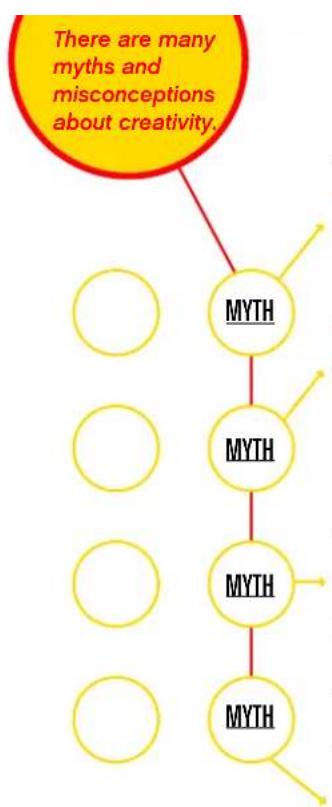
    A["There are many myths and misconceptions about creativity."] --> B["MYTH"]
    B --> C["MYTH"]
    C --> D["MYTH"]
    D --> E["MYTH"]
MYTHS ABOUT CREATIVITY
"You have to be an artist to be creative."
In fact, there are creative people in all fields and professions: scientists, business executives, journalists, and engineers.
"Only a small set of people are born with creative abilities.
In fact, creativity is not an innate 'gift', and everyone has the ability to be creative. Not everyone will produce innovations that are totally new to society, of course. But everyone can come up with ideas they've never had before, and create things that are new and surprising to their friends and community.
"Children are more creative than adults."
Although some kinds of school, college and professional work can have the effect of dampening an individual's creativity, adults have great creative abilities. Often these are locked up by social learning which has discouraged playfulness – but it can be unleashed through supportive accessible tools and an encouraging environment.
"Creativity comes from individuals working alone."
In fact, most creative ideas and inventions result from groups of people working together and interacting with one another.
natural_image
Portrait of a man in a black shirt with a wristwatch, resting his chin on his hand, with greenery and small objects in the foreground (no visible text or symbols)
natural_image
Profile view of a man wearing glasses, looking down at colorful LEGO building blocks (no text or symbols visible)MYTHS ABOUT CREATIVITY
"Creativity is spontaneous inspiration."
Cultural myths surrounding the 'creative artist' lead us to believe that creativity is spontaneous and almost magical. But it is no accident that most renowned artists have experienced a thorough formal training in the conventions and traditions of art. And every one of them has put in thousands of hours of practice. Individual creativity stems from understanding what went before, combined with an amount of inspiration, and plenty of hard work.
"Creativity must be 'free' and cannot be bound by tools and techniques."
Contrary to the notion that creativity only occurs in unbounded environments, it has been found that individuals are often most imaginative when faced with specific problems, rather than a 'blank page'. Similarly, materials with a system or 'logic' of their own often help to boost a maker's creativity.
MYTH
MYTH
Combination
Combining ideas or things... in new, surprising and valuable ways.

Exploration
By investigating, experimenting or making something.

Transformation
A dramatic change in form, structure, process, appearance or character.
WHY IS CREATIVITY IMPORTANT IN INNOVATION
Creativity plays an important part in innovation. We often create when we feel a restless need to improve or change something – meaningfully, wisely, and with impact.
"Innovation is about coming up with and successfully implementing ideas and things that are not only new, surprising and valuable to ourselves – but to others".
WHAT DOES CREATIVITY INVOLVE?
The most profound kind of creativity involves transformation – a dramatic change in form, structure, process, appearance or character – to the degree that the resulting idea or thing literally makes us see the world in a new light. This could involve a person, a process, a product, or an environment. Other forms of creativity involve combining ideas or things, or exploring, which results in new, surprising and valuable understanding being formed.

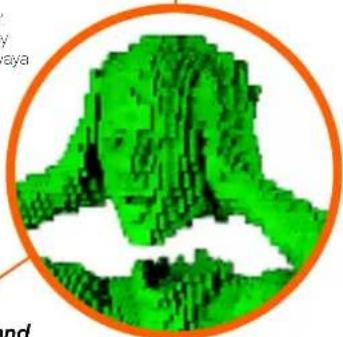
'Green Man' Sculpture by Nathan Sawaya
natural_image
Green pixelated mountain peak within an orange circular border (no text or symbols)ART
Artistic and imaginative expressions of creativity
natural_image
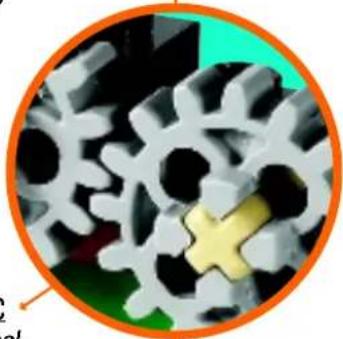
Close-up of interlocking gears with a yellow cross inside, enclosed in an orange circle (no text or symbols)SCIENTIFIC
Functional, scientifi c or utilitarian expressions of creativity
2. BEING CREATIVE

WHY DO WE CREATE?
Human beings seem to have always had a drive to make things, and to make their mark on the world. This served both utilitarian (functional) and aesthetic (beautiful) purposes even in the days of early humankind. The drawings in the Chauvet-Pont-d'Arc cave in southern France, for example, are at least 31,000 years old. These cave paintings are both instructional and artistic.
Creativity prompts us to contribute to making the world and our place in it more purposeful, beautiful, efficient, sustainable, and comfortable. Sometimes we create to experiment with new ideas, because our perceptions have shifted to embrace new points of view and learning.
Sometimes we create because something around us has changed. In essence, we create when we are moved and engaged to look for and invent new pathways and new solutions. Areas that arouse our curiosity and trigger our imagination not only support learning, but also our urge to be creative.

natural_image
Solid orange background with a faint green circular outline (no text or symbols)Suggested time: 5 - 10 minutes
natural_image
Close-up of a hand placing a colorful LEGO car model into a block, with no visible text or symbols.
natural_image
Colorful LEGO toy with green and yellow blocks on orange background (no text or symbols)EXERCISE 2: Why do you create?
Take apart your earlier LEGO® model, so that you are left with a pile of pieces again.
Now try to build a model that shows:
- What do you do when you are creative?
- What is it you like about being creative?
- What do you like about it
When you have finished, think about (and if in a group, show and discuss) what your model shows about why you create things.
CREATIVITY AND CONSTRAINTS
Many people assume that creativity starts from a blank page, with total freedom to make whatever you want. In fact, most creative activities involve both freedom and constraints. An architect, for example, is constrained by the properties of the building materials, the desires of the client, and the budget for the project. These constraints limit certain options, but also spark creative ideas and suggest new possibilities. For children to develop as creative thinkers, they also need constraints – a structure or framework to guide their activity, but also enough freedom to explore and experiment.

natural_image
Child playing with LEGO models on a table (no text or symbols visible)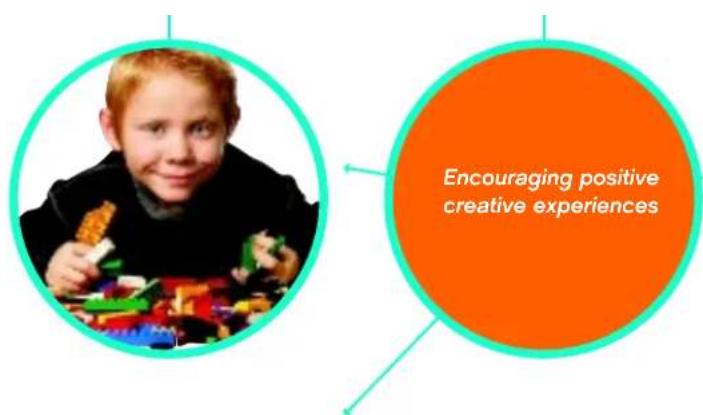
How you feel about yourself, your attitude towards risk taking, and your influence on your environment all impact how you create. You enter unchartered territory when you engage in a creative act. Some may feel excited, confident, engaged, curious, and eager to explore, while others may fear abandonment, loss, and being overwhelmed with more work.
How you feel about proceeding and your attitude towards success has a big influence on your actions. The feeling of being creative has been closely linked to a sense of Flow ^2 —a balance between one's abilities and the challenges at hand, which involves us in absorbing activity.
- Csikszentmihalyi, Mihaly: Creativity : Flow and the Psychology of Discovery and Invention. Harper Perennial, New York, 1996.
CREATIVITY IS MORE LIKELY TO OCCUR WHEN:
1 Clear goals exist, that are relevant to one's skills and abilities
2 Concentration is encouraged by limiting distractions
There are no elements that encourage self-consciousness
One's subjective sense of time is altered by removing obvious cues
5 Successes and failures are apparent, so that behaviour can be adjusted as needed
6 A balance exists between ability level and the challenge at hand
7 Individuals have a sense of personal control over the situation or activity
The activity is intrinsically rewarding, leading to an effort orlessness of action
○ 9 People are allowed to become absorbed in their activity

Promoting positive creative experiences
natural_image
Close-up of a person in red clothing interacting with small objects (no visible text or symbols)Emotions are part of the creative process, and positive emotions tend to support new actions more than negative ones. You can promote positive creative experiences by:
1. CURIOSITY
Replacing scepticism toward risks with a curiosity to learn from successes and failures.
2. MENTAL READINESS
Rather than focusing on what you feel you lack, appreciate your desire to move forward.
3. CONFIDENCE
Promoting your sense of self worth by knowing that you are devising a new and better reality for yourself and others.
4. POSITIVE FRAMING
Generating enthusiasm for the good you might find.
5. COMMITMENT
Choosing to make a difference.

natural_image
Child playing with a blue LEGO car on a table against an orange background (no text or symbols visible)
donut
| Stage | Value | |---|---| | Incubation | 15 | | Insight | 15 | | Positive Framing | 15 | | Evaluation | 15 | | Commitment | 15 | | Preparation | 15 | | Curiosity | 15 | | Confidence | 15 |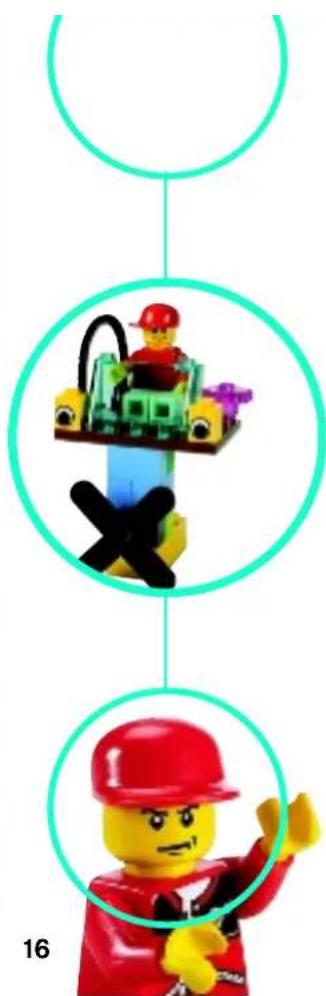
natural_image
Three cartoon LEGO figurines in different poses: one with a green building, one with a red helmet, and one with a yellow figure (no text or symbols)3. WHAT IS THE ROLE OF SYSTEMS IN CREATIVITY?
Systems help us channel our creativity into ideas and things that can be understood and appreciated by both ourselves and others. Systems of science channel creativity into solving specific problems (as in maths, physics and engineering). Systems of art channel creativity into unique expressions, giving form to imagination, feelings and identities (as in painting, music and sculpture).
The LEGO® system is one of the few systems able to blend the qualities of both kinds of systems into a creative medium that enhances both.

natural_image
Child playing with LEGO blocks, no visible text or symbols
natural_image
Child playing a colorful LEGO building with animal and landscape elements (no text or symbols visible)EXERCISE 3:
Discovering the components of systematic Creativity
PART A
Suggested time: 5 - 10 minutes
LOGIC AND REASONING
Using only the pieces in your toolbox, build the tallest tower you can, capable of supporting a minifi gure standing on the top and able to withstand an earthquake! Remember to test your structure as you go.
When you have finished, demonstrate if it can withstand an earthquake by putting a sheet of paper underneath your model on the table and shake it a bit.
PART B
Suggested time: 5 - 10 minutes
PLAYFULNESS AND IMAGINATION
Dismantle your bridge into separate LEGO® pieces and this time, invent a futuristic new mode of transport for the minifi gure. Also think about who he is and describe the universe he fi nds himself in.
If you are doing this in a group – show and tell one another your creations, how they work and any features they have. Invite questions from your peers. What did you find easy, and difficult, about this challenge?
natural_image
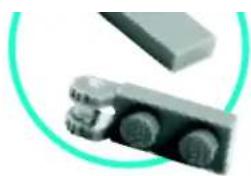
Close-up of a LEGO brick with three wheels and a rectangular block, no visible text or symbols
natural_image
Close-up of a four-pin electronic component with a square base and circular border (no visible text or symbols)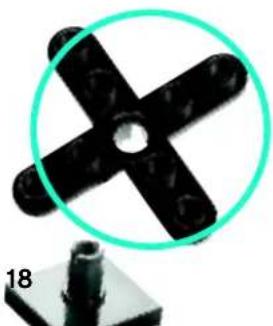
natural_image
Close-up of a black mechanical component with four arms, enclosed in a circular frame (no text or symbols visible)DISCOVERING THE COMPONENTS OF SYSTEMATIC CREATIVITY
Many toys support creativity by encouraging imagination and playfulness – clay for molding sculptures, crayons for drawing pictures. But for toys to support systematic creativity, they must also encourage logic and reasoning by:
- Providing a logical set of constraints that people can understand and master.
- Offering a system of parts that people can combine (and re-combine) in organized ways
By encouraging imagination and playfulness along with logic and reasoning, toys can provide both the structure and the freedom that people need for being systematically creative.

natural_image
Two women interacting with a laptop and assembling colorful electronic components (no visible text or symbols)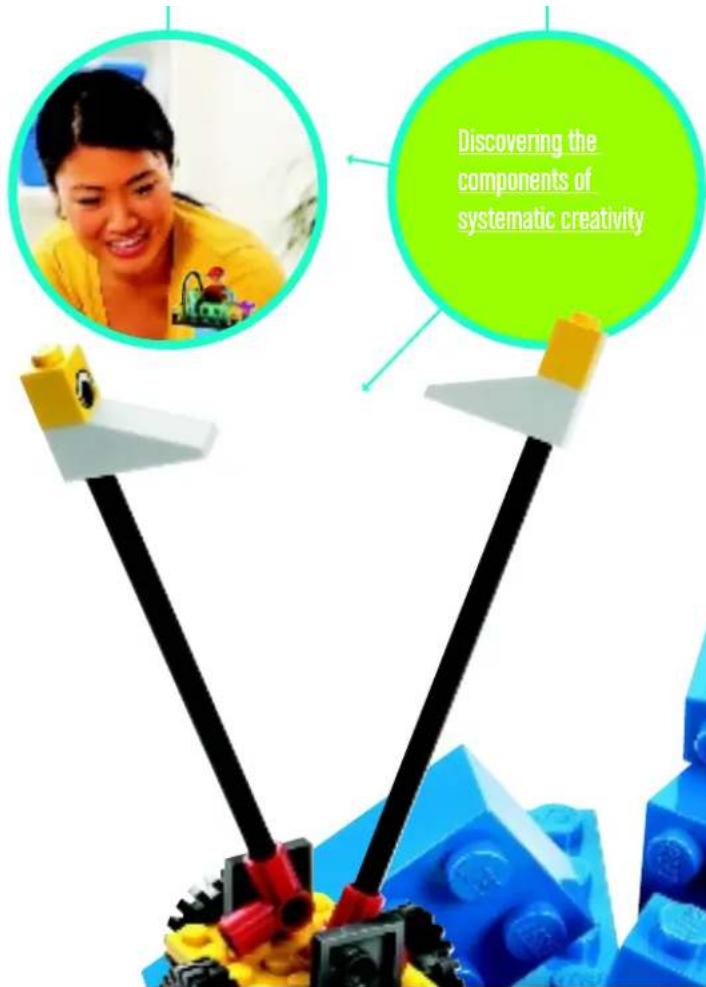
With LEGO® bricks you can solve a problem, like in Part A of the exercise you just did – encouraging the use of logic and reasoning as you experiment with different solutions. With LEGO bricks you can also express your playfulness and imagination, as in the example of Part B. When completing both building challenges, you will also have noticed that although the two exercises were very different, you most likely relied on a mix of logic and playfulness, as well as reasoning and imagination when completing each challenge, favouring one or the other depending on where you were in the process of completing the challenge.
The LEGO System of Play enables you to intuitively become familiar with both ways of thinking, as creativity depends on both.

natural_image
Simple green curved line on white background (no text or symbols)4. THE CREATIVE PROCESS

LEARNING AND CREATIVITY
Meaningful learning is more likely to happen when you yourself invent new ways of doing or seeing something. Meaningful learning requires a period of open-ended 'playing around' with the materials, before a new idea – or an alternative way of doing things – will surface. Inventing the idea yourself means it is easier to understand how it relates to everything you already know.
Systems, such as the LEGO® system, make it possible to give shape to your imagination, thus helping us break free to see things in a new way, whether to be creative or indeed, to learn something new. Creative ideas don't come from a single "Aha!" moment. Rather they result from an iterative process, sometimes called the Creative Learning Spiral.
In this process:
- People imagine new possibilities
- Create something based on their ideas
- Play and experiment with their creations
- Share their ideas and creations with others
- Refl ect on their experiences
All of which leads to imagine new ideas and new projects. People don't necessarily go through this process in a step-by-step progression. Rather, they weave together different parts of the process, as they try out new ideas, test boundaries, and explore alternatives.

natural_image
Simple green circle outline on white background (no text or symbols)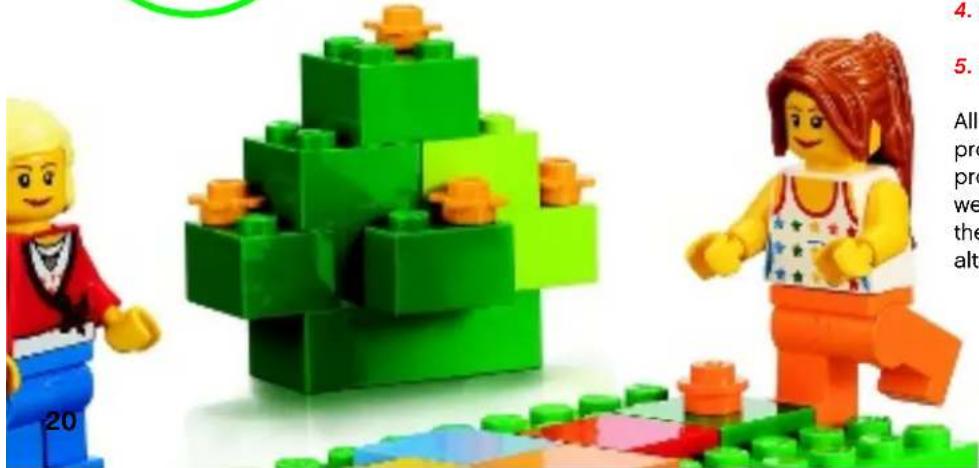
natural_image
Illustration of two LEGO-style figures, one standing and one standing with colorful blocks (no text or symbols)
natural_image
Abstract green geometric shapes on white background (no text or symbols)
EXERCISE 4: The Creative Process
Imagine a challenge, routine or function in your everyday work that you would like to improve.
For some people this involves everyday fixed routines that could be imagined in new ways through playfulness.
For other people it might be a complex set of different tasks, which could be optimised using logic and reasoning.
THEN TRY TO:
Build the situation you are in right now, and reflect on your experiences – what worked, what needs to be improved?
Imagine new possibilities and ways of improving the challenge/function – write it down.
Create a model of yourself in the situation that you have improved – how are you acting now?
Play and experiment with your idea – refine it or rebuild it.
Share your idea with others or colleagues to get input and feedback.

natural_image
Simple green curved line on white background (no text or symbols)
natural_image
Simple green circular outline on white background (no text or symbols)
natural_image
Lego mascot holding a flashlight and magnifying glass, no visible text or symbolsEVOLUTIONARY AND REVOLUTIONARY CREATIVE STYLES
Everyone is creative, and you can become more creative by working at it. Among adults in particular, being creative comes in two different flavours: the evolutionary and revolutionary styles. People of the evolutionary style prefer to approach problem-solving, decision-making, and change in step-by-step ways. They are often motivated to improve current conditions and connect it back to the people involved. When evolutionary creatives act on restlessness, they respond to it cautiously and incrementally, and prefer to minimise risk. The creative gifts of this style are frequently overlooked and taken for granted. People of the revolutionary style prefer to approach change in sudden leaps, transforming things amidst some chaos. They are often more interested in the ideas than the people involved, and prefer to discard what exists already to create from the ground up. Their ideas may be seen as risky and reckless.
Both styles, evolutionary and revolutionary, are creative and initiate change. Both approaches also have advantages and disadvantages, depending on the context. When an evolutionary solution is needed, a revolutionary approach will not do, and when a revolutionary solution is needed, evolutionary approaches will not be enough.

natural_image
Man assembling colorful LEGO blocks at a cluttered table (no visible text or symbols)REVOLUTIONARY CREATIVITY

EVOLUTIONARY CREATIVITY

natural_image
Lego character in blue and red outfit holding a weapon, enclosed in a green circular frame (no text or symbols)For an innovation to be successful, both of these creative styles come into play. In business, evolutionary creativity identifies ways to bring greater economy to resource use-planning a new strategy rollout one step at a time, focusing on important details. Revolutionary creativity imagines beyond what currently exists to invent a whole new process, procedure, business, or service function. Whatever your style and your level of influence, you experience a restlessness from which you are moved to solve problems, make decisions, and initiate some sort of change.
- More interested in ideas
- Approach changes in big leaps
- Ideas can be risky and reckless
- Less focused on the people involved
-
Often create from afresh and from the ground up
-
Continuous improvement
- Approach change in step by step ways
- Ideas can be safe and sound
- Ideas connected with people
- Sometimes overlooked

natural_image
Close-up of a LEGO character with green background (no text or symbols visible)

natural_image
Simple green curved line on white background (no text or symbols)CREATIVITY AND PLAY
An activity is playful when it is fully absorbing, intrinsically motivated, has elements of uncertainty or surprise, and involves a sense of illusion or exaggeration. Children develop the prerequisites for creativity through free play, where the elements of curiosity and playfulness are called upon. Curious minds seek evidence, ask 'Why?' and offer 'If... then...' explanations, turning the unfamiliar into something recognizable and familiar. Playful minds, in contrast, subvert realities into fantasy and fiction, and ask 'What if?', turning the familiar into the strange and incongruous. Both curious minds and playful spirits create and inspire, yet they do so in different ways. A spiral of curiosity and playfulness can open up new avenues and lead to unexpected places.

natural_image
Two children playing with LEGO models at a table, one wearing a yellow shirt with 'GRAF GOODS' text (no other visible)
natural_image
Lego toy figure in blue shirt holding black cable, standing against a green circular background (no text or symbols)
natural_image
A young girl smiling while assembling a LEGO structure at a table, with other children and colorful objects in the background (no visible text or symbols).CREATIVITY AND INNOVATION IN BUSINESS
Companies focus on innovation to improve their performance, and creativity starts that process. Some ways in which we express creativity in business include:
- Developing new products and experiences for consumers
- Building customer and consumer loyalty
- Establishing a clear vision of what the company is about and where to go in the future
- Improving the quality of decisions, processes and platforms to make the company run more efficiently
Idea generation, selection, implementation and ultimately innovation success depends on the people and teams involved. A greater understanding of our own creativity and that of our colleagues can only help us do more both alone and together, and in partnership with consumers.

natural_image
Two men interacting with a toy, one holding a bottle and the other handling items (no visible text or symbols)

5. CREATIVE TEMPERAMENTS
UNDERSTANDING CREATIVE TEMPERAMENTS AND HOW YOU EXPRESS CREATIVITY IN DAILY LIFE
Marci Segal provides an excellent view into the different styles around creativity in her recent work.
'Your brain is constantly making, breaking and sustaining patterns. You learn how to interact with your environment and the people in it through repeating a sequence of behaviours. You keep using patterns that brought you success over and over again.'
Temperaments are patterns too. They are patterns of things that we find energizing or exciting and are based on a core need we have as people. What is perceived as good and fun by one temperament pattern may be thought of as boring and useless by another.
- Segal, March Quick Guide to the Four Temperaments and Creativity - A psychological understanding of innovation, Telcs Publications, Huntington Beach, 2006
natural_image
Two children playing with a colorful LEGO building model against a red background (no text or symbols visible)
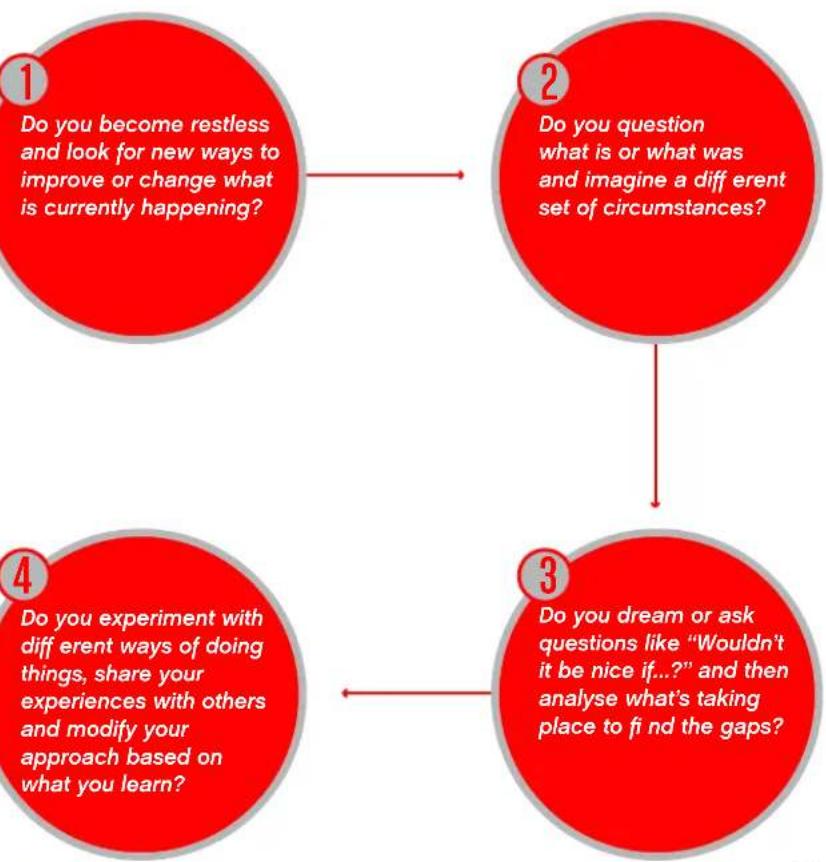
flowchart
graph TD
    A["1: Do you become restless and look for new ways to improve or change what is currently happening?"] --> B["2: Do you question what is or what was and imagine a different set of circumstances?"]
    B --> C["3: Do you dream or ask questions like “Wouldn’t it be nice if...?” and then analyse what’s taking place to find the gaps?"]
    C --> D["4: Do you experiment with different ways of doing things, share your experiences with others and modify your approach based on what you learn?"]
EXERCISE 5:
FINDING YOUR OWN CREATIVE TEMPERAMENT
PART A YOU AT YOUR CREATIVE BEST
Suggested time:
5 - 10 minutes
Build a LEGO® model which represents you at your creative best.
You might like to note down some of the thoughts you had when building the model, and of course, if you are in a group, show and discuss what you have made.
PART B INITIATING CHANGE
Suggested time:
5 - 10 minutes
Build a LEGO model which shows when and why you initiate change.
Again, note down some thoughts you had when building the model, and if you are in a group, show and discuss what you have made.
natural_image
Man assembling a LEGO structure with colorful blocks (no visible text or symbols)
natural_image
Split image showing a person assembling LEGO blocks and a smiling woman holding a ring (no text or symbols visible)
natural_image
Close-up of a red plastic object with circular holes, connected by a red string (no text or symbols visible) |  | The next step is to compare what you thought and said about your model to the table below – which creative temperament most accurately describes you? | |
| Championing a cause, inspiring others, unifying diverse factions, improving relationships among people, revitalizing morale, interpreting trends from a human dimension, empathizing with others, developing human potential, seeking common ground, mediating disputes. | Catalysts want to make a difference in meaningful ways. They synthesize ideas and harmonize people within groups to foster energy. | ||
 |  | Analysing problems, building prototypes, defining challenges, searching for systemic inefficiencies, producing theoretical models for explanation. They create conceptualizing potentials, classifying competencies, questioning ideas, forecasting, exploring probabilities, envisioning futures, deducing rudiments of global truths, | inventing strategies. Theorists want to understand and produce theoretical models for explanation. They create strategies with systems and variables in mind and knit both together into systems of cause and effect and continuous change. |
 |  | Assessing situations for safety and security, sequencing processes, getting the right resources to the right people, enforcing procedures, stabilizing chaos, specifying resources, protecting group accord and progress, organizing people and things, making plans more efficient. | Stabilizers want to eliminate chaos and create safe and secure environments. They standardize procedures and structure chains of events to bring about certainty and reliability. |
 |  | Adapting to the needs of a situation, making things happen, performing with skill and panache, negotiating agreements, entertaining others through speech and action, responding to the needs of the moment, improvising and troubleshooting, varying applications. | Improvisers want to create a 'wow' solution. They leverage opportunities in their immediate environment to produce simple solutions that work. |
THE FOUR TEMPERAMENTS
The Four Temperaments model, developed by Marci Segal, suggests that:
- If you feel that one pattern captures most of what you described when making and showing your LEGO® model, then clearly that is the temperament that you identify with.
- If you found yourself in two different temperaments, it is likely that your self-awareness is strong and that you are using two complementary patterns.
- If you find yourself in different temperaments, this may reflect uncertainty about your personal style – or it could be that you have matured into appreciating and using the different patterns available to you.


HOW TO USE THE TEMPERAMENTS
YOURSELF
You might use what you have learned about your creativity and engage in activities that require that focus. Learn and use skills associated with the other temperaments to grow further.
WORKING WITH OTHERS
Recognise and discuss each others' creative preferences and how you will work to accommodate the different temperaments and styles in your team. If this kind of conversation seems unnatural to you or your team, you might use the LEGO models to help.

natural_image
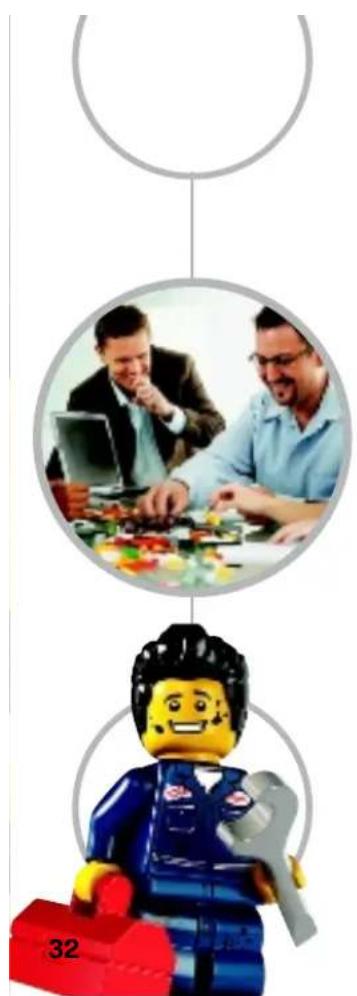
Two circular images: top shows two men in a lab setting, bottom shows a LEGO character holding a tool (no text or symbols)6. BECOMING SYSTEMATIC CREATIVE TIPS FOR RUNNING A WORKSHOP:
It is possible to be systematically creative by cultivating a set of qualities that make it easier to engage creatively at will, rather than randomly. These are:
Cultivating the positive emotions
- of curiosity, mental readiness, confidence, positive framing and commitment.
Learning to iterate
- recognizing when we are stuck, and being able to return to an earlier stage in the process to invent new ways of approaching the situation or problem.
Giving form to our imagination
- when we invest ourselves in the making of something, we come to understand it more deeply, and it feels more meaningful to us. Giving form to our ideas also helps us share our thinking with others and learn from it.
Mastering a tool
- developing the skills and confidence to use a tool, making it second nature to us, something we can think with, not just a tool to communicate our conclusion.
natural_image
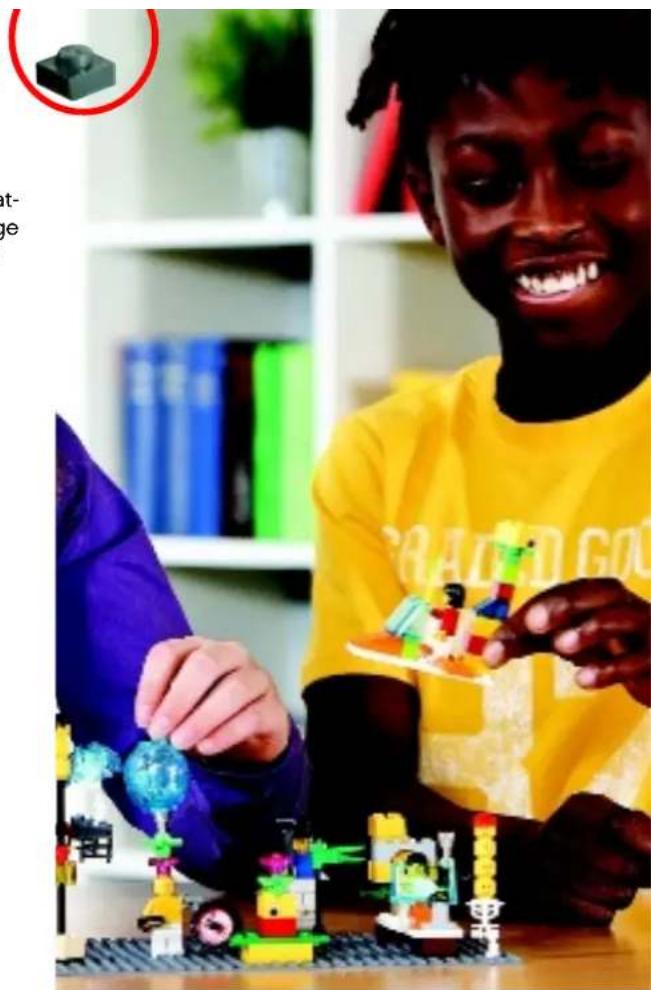
Child playing with LEGO blocks in a classroom setting (no visible text or symbols)
natural_image
Close-up of colorful LEGO bricks including red, green, yellow, black, and white blocks (no text or symbols visible)TIPS AND TRICKS
- It's important to set the participants' expectations up front so they feel comfortable with the workshop format and what's expected of them.
- Discussion and sharing is very important so make sure to allow for time for this.
- Pilot the workshop with a colleague a few days before the actual sessions to make sure you feel comfortable with the content and the flow of the format.

natural_image
Lego character in blue and orange outfit, waving hand (no text or symbols visible)PREPARATION
In order to run a successful workshop you'll have to prepare a few things in advance.
- Decide the format of the workshop you want to run.
- For a more informal approach you can each use the booklet to guide the building exercises and drop in and out of it, depending on what makes sense.
- Make sure you have one box per participant, containing a bag of LEGO® bricks.
- Find a comfortable space with seating and table(s) to make it easy to build the models.
- Have sheets of paper, pens or sticky notes to hand for note taking during and after the building challenges.
- If you want to you can use a workshop evaluation forms to ask for feedback from those who participated.

natural_image
Simple curved line drawing with no text or symbols45 minutes
A BASIC AGENDA:
PART 1
5 min. Introduction

natural_image
Simple gray circular outline with a small number '1' on the right edge (no text or symbols inside)EXERCISE 1:
10 min. Images of creativity 5 min. Share models and discuss
EXERCISE 2:
10 min. Why do you create 5 min. Share models and discuss
10 min. Conclusion

natural_image
Two children playing with LEGO bricks against a yellow background (no text or symbols)
natural_image
Lego-style toy of four cartoon characters climbing a gray building structure (no text or symbols visible)
natural_image
Close-up of two children's faces, one in grayscale and one in reddish-brown, framed by a red curved border (no text or symbols visible)45 minutes
PART 2
5 min. Introduction
45 minutes
5 min. Introduction
EXERCISE 3:
Systematic creativity
10 min. Part A: Logic and Reasoning
5 min. Share models and discuss
10 min. Part B: Playfulness and imagination
5 min. Share models and discuss
10 min. Conclusion
PART 3
10 min. 1: Build the situation you are in right now.
5 min. 2: Imagine ways to improve this, write it down.
10 min. 3: Create a model of yourself in the new situation.
5 min. 5: Share your idea with others and get feedback.
10 min. Conclusion
natural_image
Close-up of a LEGO toy car with a cartoon character inside, no visible text or symbols7. ABOUT LEGO® LEARNING INSTITUTE
The purpose of the LEGO® Learning Institute is to collaborate with leading academic experts to develop academic research relevant to the LEGO Group.
The institute holds the central role of integrating academic research into the LEGO Group, to understand what 'best' means for each of the LEGO values, and to translate this into LEGO products, services and experiences.
RESEARCH AREAS
The LEGO Learning Institute maintains four foundational research areas on creativity, learning, play and child development, and develops this research through a close collaboration with a network of external academic experts and institutions.
The LEGO Learning Institute is involved in a wide range of research projects with academic institutions, to understand how to 'inspire and develop the builders of tomorrow', and to build the capacity in the LEGO organization to best respect and nurture the way children play, learn, develop their creativity and thrive.

natural_image
Child in blue jacket using laptop with LEGO building background (no text or symbols visible)
natural_image
Composite image showing a woman in a yellow sleeve, a man holding a smartphone, and two inset circular insets depicting circuit board graphics (no text or symbols)- IN THE DIGITAL REALM
The role of Systematic Creativity described in this brochure has been expanded into the digital realm. The report on Systematic Creativity in the Digital Realm explores what it is like to 'grow up digital', and looks at the similarities and differences between physical and virtual activity. In the digital realm, the systematic and platform-based approach takes an even stronger role. Blending the physical and digital LEGO® idea enables systematic creativity through immersive play, learning and creative experiences for children of all ages.
Systematic Creativity in the Digital Realm is about mirroring the experience of the engineering brilliance behind 'clutch power' and expand it into the digital. This ability of LEGO bricks to be joined or disassembled easily, yet stay connected firmly, even in young hands – and the uncomplicated route to unlocking imagination and creativity through this easy and natural combination of elements.
Download the report, posters, presentations and video material from the internal website.
natural_image
Black-and-white photo of LEGO bricks with checkered patterns and a diagonal support structure (no text or symbols visible)USEFUL LINKS
The full Systematic Creativity report and video is available if you search for LEGO® Learning Institute on the LEGO intranet.
Here you can also find additional reports from the LEGO Learning Institute as well as updates on new reports, videos, activities and the academic network.
Information about the LEGO Learning Institute and the main research reports are also available for external use at 'learninginstitute.lego.com'.
LEGO® Learning Institute

- Systematic Creativity TOOLBOX
- IN THE BOX YOU WILL FIND:
- INTRODUCTION
- CONTENTS
- SYSTEMATIC CREATIVITY
- CREATIVITY
- WHAT IS CREATIVITY?
- EXERCISE 1: Images of creativity
- PART A
- REPRESENTING CREATIVITY
- PART B
- COMMON THEMES
- PART C
- NOTIONS OF CREATIVITY
- MYTHS ABOUT CREATIVITY
- "Creativity is spontaneous inspiration."
- "Creativity must be 'free' and cannot be bound by tools and techniques."
- Combination
- Exploration
- Transformation
- WHY IS CREATIVITY IMPORTANT IN INNOVATION
- WHAT DOES CREATIVITY INVOLVE?
- ART
- SCIENTIFIC
- BEING CREATIVE
- WHY DO WE CREATE?
- EXERCISE 2: Why do you create?
- CREATIVITY AND CONSTRAINTS
- CREATIVITY IS MORE LIKELY TO OCCUR WHEN:
- CURIOSITY
- MENTAL READINESS
- CONFIDENCE
- POSITIVE FRAMING
- COMMITMENT
- WHAT IS THE ROLE OF SYSTEMS IN CREATIVITY?
- EXERCISE 3:
- LOGIC AND REASONING
- PLAYFULNESS AND IMAGINATION
- DISCOVERING THE COMPONENTS OF SYSTEMATIC CREATIVITY
- THE CREATIVE PROCESS
- LEARNING AND CREATIVITY
- EXERCISE 4: The Creative Process
- THEN TRY TO:
- EVOLUTIONARY AND REVOLUTIONARY CREATIVE STYLES
- REVOLUTIONARY CREATIVITY
- EVOLUTIONARY CREATIVITY
- CREATIVITY AND PLAY
- CREATIVITY AND INNOVATION IN BUSINESS
- CREATIVE TEMPERAMENTS
- UNDERSTANDING CREATIVE TEMPERAMENTS AND HOW YOU EXPRESS CREATIVITY IN DAILY LIFE
- EXERCISE 5:
- FINDING YOUR OWN CREATIVE TEMPERAMENT
- PART A YOU AT YOUR CREATIVE BEST
- PART B INITIATING CHANGE
- THE FOUR TEMPERAMENTS
- HOW TO USE THE TEMPERAMENTS
- YOURSELF
- WORKING WITH OTHERS
- BECOMING SYSTEMATIC CREATIVE TIPS FOR RUNNING A WORKSHOP:
- Cultivating the positive emotions
- Learning to iterate
- Giving form to our imagination
- Mastering a tool
- TIPS AND TRICKS
- PREPARATION
- A BASIC AGENDA:
- PART 1
- EXERCISE 1:
- EXERCISE 2:
- PART 2
- PART 3
- ABOUT LEGO® LEARNING INSTITUTE
- RESEARCH AREAS
- - IN THE DIGITAL REALM
- USEFUL LINKS
Brand : LEGO
Model : Systematic Creativity Toolbox
Category : Building set