DEVA - Uncategorized Xaoc - Free user manual and instructions
Find the device manual for free DEVA Xaoc in PDF.


| Product Type | Eurorack Synthesizer Module |
| Brand | Xaoc |
| Model | DEVA |
| Width | 10 HP |
| Depth | 30 mm (approx.) |
| Height | 128.5 mm (3U) |
| Weight | 120 g (approx.) |
| Power Supply | +12V / -12V via Eurorack bus board |
| Power Consumption | +12V: 80 mA, -12V: 40 mA |
| Audio Inputs | 2x 3.5 mm mono jacks |
| Audio Outputs | 2x 3.5 mm mono jacks |
| CV Inputs | 4x 3.5 mm jacks (0-10V) |
| Control Type | Potentiometers, switches, and CV control |
| Main Functions | Multi-effect processor: reverb, delay, chorus, flanger, phaser |
| User Interface | Front panel knobs and buttons, LED indicators |
| Firmware Update | Via USB or SD card (check manual) |
| Operating Temperature | 0°C to 50°C |
| Storage Temperature | -20°C to 70°C |
| Compliance | CE, RoHS |
| Warranty | 2 years limited hardware warranty |
Frequently Asked Questions - DEVA Xaoc
User questions about DEVA Xaoc
0 question about this device. Answer the ones you know or ask your own.
Ask a new question about this device
Download the instructions for your Uncategorized in PDF format for free! Find your manual DEVA - Xaoc and take your electronic device back in hand. On this page are published all the documents necessary for the use of your device. DEVA by Xaoc.
USER MANUAL DEVA Xaoc
Thank you for purchasing this Xaoc Devices product. Deva ['dɛva] is an expander for the Xaoc Devices Timiszoara Eurorack digital multi-effect module. It adds an external stereo analog loop to Timiszoara, allowing you to combine the power of digital effects with analog processing. The left and right channels each have a pair of send and return jacks, a polarity switch, an analog VCA, and a voltage-controlled tilt-type filter. Deva also features a CV input and indicator for the internal clock that drives Timiszoara's DSP engine; this allows for speeding up or slowing down the rate of computing which affects the scale of time and frequency, allowing for effects such as long lo-fi delays and crunchy reverbs.
INSTALLATION
The module requires 8hp worth of free space in the Eurorack cabinet. Deva does not require connecting to bus board power, as power is supplied from Timiszoara via the same ribbon cable that provides communication between modules. Connect your Deva to Timiszoara using the supplied 10-pin ribbon cable, paying close attention to polarity orientation. A mark on both boards indicates the red stripe's downward position. The cable supplied with Deva is deliberately short to ensure low signal interference and make it difficult to connect the wrong way.
ATTENTION: NEVER CONNECT A POWER CA- BLE TO ANY PIN HEADER ON THE BACK OF YOUR DEVA; IT WILL DESTROY THE UNIT!
Both Deva and Timiszoara modules should be fastened by mounting the supplied screws before powering up.
MODULE OVERVIEW
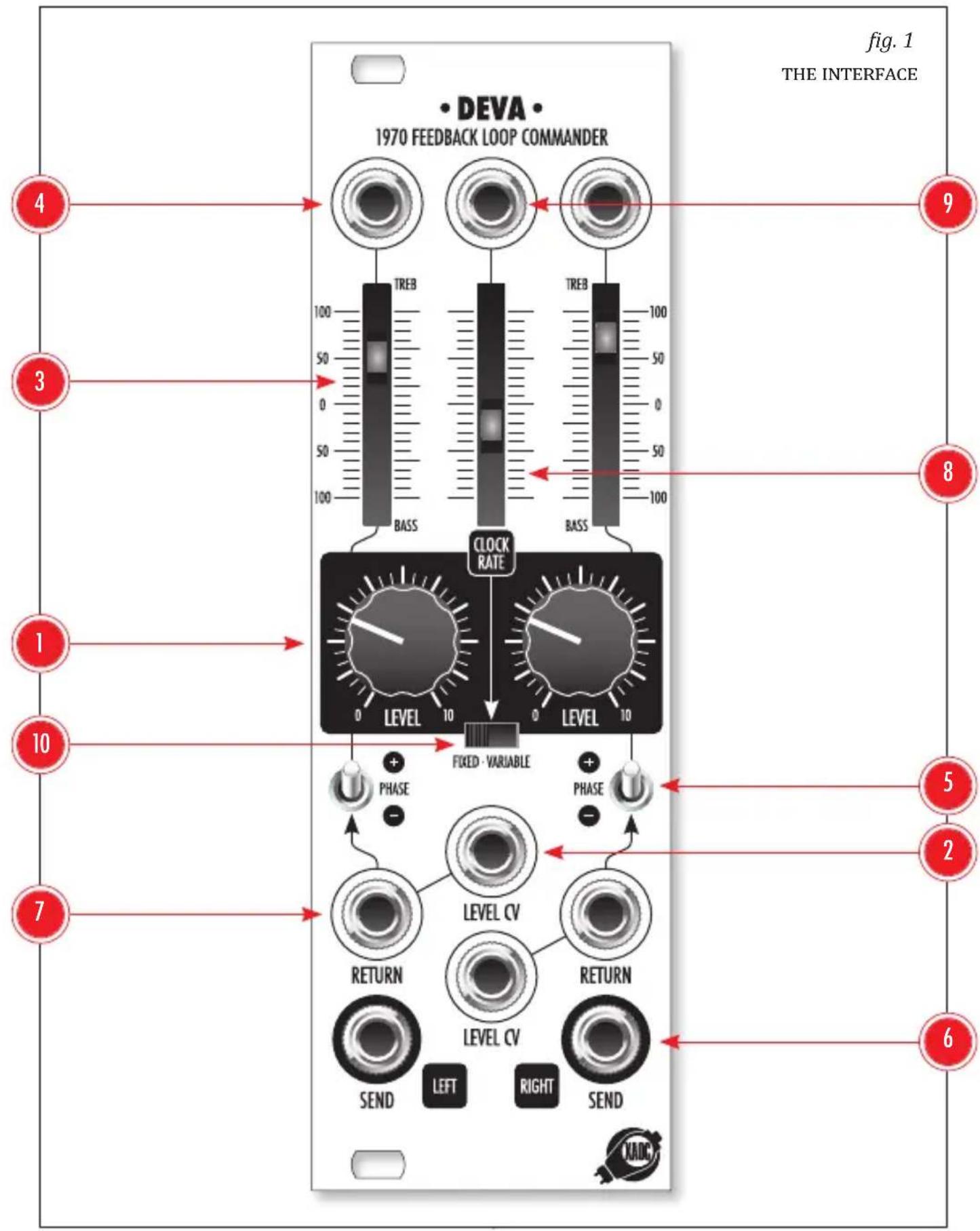
The front panel of Deva is shown in fig. 1. The two channels have separate controls and signal jacks, creating an analog signal loop that feeds some of Timiszoara's wet DSP output back to its input with voltage control over the amount of feedback, filtering, analog saturation, and optional external processing.
Two rotary LEVEL potentiometers at the center ① are manual attenuators for the feedback return. They have an optimized response that rapidly increases the feedback when turned CW from zero while also offering more precise control near the maximum. Their max position corresponds to the self-oscillation point, provided the DSP code in Timiszoara does not modify the signal gain. Feedback depth may also be modulated by CV via the two LEVEL CV inputs ②. Positive values of these voltages (up to +8V) increase the feedback gain; however, it is limited by an internal threshold at 0dB. Similarly, negative values (down to -8V) subtract from the value set by the potentiometers, allowing one to reduce the feedback to zero.
The feedback signal in each channel is filtered by a tilt-type filter controlled by a TREB/BASS slider potentiometer ③ as well as control voltage (-5V to +5V) plugged into the jack above it ④. The illuminated bi-color LED in the slider indicates whether the high frequen-
cies (red) or low frequencies (green) dominate in the signal.
PHASE toggle switches located below the feedback LEVEL potentiometers 5 allow for flipping the polarity of the signal.
The wet stereo signal from Timiszoara (before the wet/dry mix) is available in the pair of outputs labeled SEND 6. Above them are a corresponding pair of inputs labeled RETURN 7. These pairs of jacks allow for inserting external processing into the feedback loop. The RETURN inputs are normalled to the corresponding SEND outputs, thus closing the loop when nothing is patched.
The middle CLOCK RATE slider potentiometer ⑧ and the CV input above ⑨ control the DSP clock rate. The bi-color LED in the slider indicates whether the clock rate is above the nominal 32kHz (red) or below it (green). Note that the neutral point (nominal clock speed, LED unlit) is located at 3/4 of the travel to give finer control over the more interesting
low range. At any point, you can disengage this control by using the miniature switch 10.
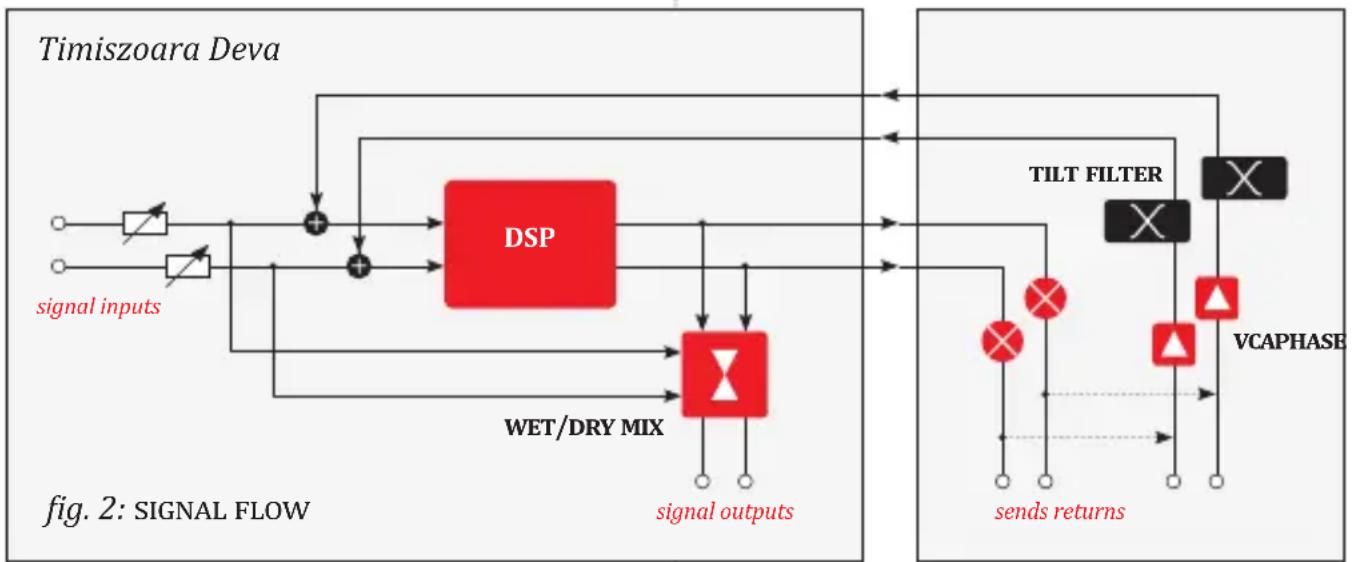
Figure 3 shows the signal flow between Timiszoara and Deva. The stereo pair of wet audio signals from the DSP in Timiszoara is fed to Deva via the ribbon cable. Deva's signals are buffered, and their polarity can be changed using the front panel switches. These signals are delivered to the pair of front panel jacks labeled SEND, and also normalled to the RETURN pair of jacks. Therefore, plugging any module or a chain of modules between sends and returns introduces external processing into the feedback loop while leaving it unpatched automatically closes the loop.
The returned signals are further processed by VCA blocks, allowing separate manual and CV control of the feedback amount for each channel. In addition, these VCAs feature a soft-clipping circuit to prevent hard distor-
flowchart
graph TD
    A["signal inputs"] --> B["DSP"]
    C["WET/DRY MIX"] --> D["WET/DRY MIX"]
    B --> E["signal outputs"]
    D --> E
    F["TILT FILTER"] --> G["VCAPHASE"]
    G --> H["sends returns"]
    style B fill:#ffcccc,stroke:#333
    style D fill:#ffcccc,stroke:#333
    style F fill:#ccffcc,stroke:#333
    style G fill:#ccffff,stroke:#333
tion if your signal becomes too hot for the subsequent circuits.
The last stage of processing is a voltage-controlled tilt filter allowing you to cut the lows or the highs with a soft 6dB/octave slope. Finally, the filtered signal is returned to Timiszoara via the ribbon cable and mixed at the DSP's input.
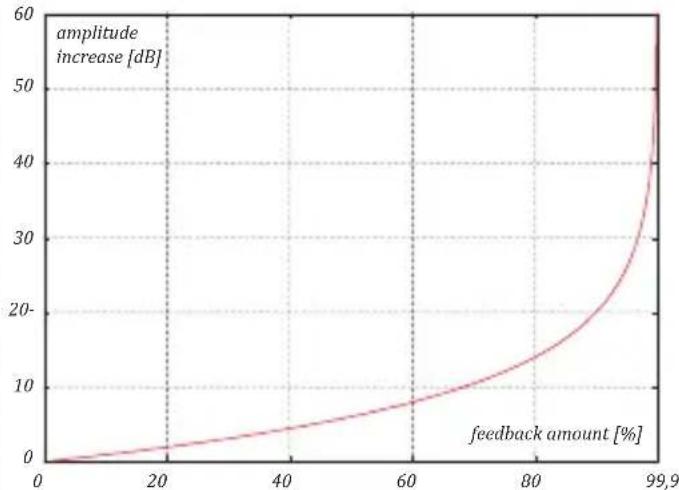
It is important to remember that adding feedback around a signal processing device usually increases the signal's strength because the energy recycled in the loop adds to the new incoming energy, and this process continues infinitely. Figure 3 shows how much the signal increases with positive feedback around a memoryless device. While this increase is spread in time whenever there is a delay within the loop, it is easy to see that it can quickly run out of control and cause distortion.
Many effect PROGRAMS in Timiszoara already feature internal digital feedback as a part of the algorithm. However, adding additional external analog feedback with Deva can cause a situation where more than 100% of the processed signal is returned to the input yielding extreme overdrive and clipping distortion. Therefore, start your experiments with the internal feedback at minimum (in reverb algorithms, this is the SIZE parameter) and operate only the external analog feedback in Deva.
In some cases, however, an essential part of processing (e.g., a pitch change) is performed within the internal digital feedback, so it might be necessary to open the internal feedback enough for the processing to take effect.
line
| feedback amount [%] | amplitude increase [dB] | | ------------------- | ------------------------ | | 0 | 0 | | 20 | ~2 | | 40 | ~5 | | 60 | ~8 | | 80 | ~15 | | 99.9 | ~50 |fig. 3: INCREASE OF SIGNAL AMPLITUDE WITH A MEMORYLESS DEVICE WITH POSITIVE FEEDBACK
Depending on the nature of some effect PROGRAMS, they may gracefully respond to moderate and even high amounts of feedback or instantly blow up, producing a wall of nasty distortion (which, depending on taste, may be desirable or unbearable). For example, delay effects benefit from analog filtered feedback up to 99%, while reverbs (often already operating at the edge of self-oscillation) lose most of their subtlety with more than a few percent of additional feedback.
The response of the LEVEL potentiometers and the VCA blocks in Deva is carefully crafted to allow precise feedback control near 99%. The level starts quickly from the CCW position and reaches about 90% near half of the turn. Note that this response is affected by the gain of devices patched between the SEND and RETURN jacks.
PHASE/POLARITY
When discussing the impact of feedback, there is often a distinction between positive and negative feedback, but this distinction only makes sense for memoryless devices. When there is any delay involved, various spectral parts of the signal are shifted in phase differently; hence the whole is no longer in phase with the original, and its inverse is no longer anti-phase. Deva features manual PHASE switches (which actually change the polarity) that sometimes offer a different flavor of the feedback effect. Neither option is truly positive or negative feedback; thus, cancellation and reinforcement of certain frequencies may be unpredictable.
TILT FILTER
The TREB/BASS tilt filter is an efficient solution for timbre control using only one potentiometer (and CV input). The middle position of the slider suggests a neutral setting; however, it is deliberately not flat and instead gently attenuates at both ends of the signal spectrum while adding analog warmth.
Setting the slider above the middle causes the filter to attenuate low frequencies making it sound thinner. For example, with a delay effect, this results in brighter echoes (NOTE: the filter does not accentuate higher frequencies). A similar effect is obtained by feeding a positive voltage (up to +5V) to the CV input.
Setting the slider below the middle causes the filter to attenuate mid and high frequencies, thus introducing darker coloration to the signal returned to Timiszoara. For example, with a delay effect, this results in darker echos. A similar effect is obtained by providing a negative voltage (down to -5V).
DSP CLOCK CONTROL
By default, the Spin FV-1 chip at the heart of Timiszoara operates with a system clock of 32768Hz that determines both the sampling rate of the signals (and bandwidth of 16kHz), the computing speed, and the algorithms' timing. Since the internal memory is precisely 32768 words, this results in a maximum of 1 second of total delay.
Deva offers manual and voltage-controlled over- and underclocking of the DSP chip from 2x down to 1/16 of the normal speed. With the miniature switch in the VARIABLE position, setting the central CLOCK RATE slider at maximum changes the clock to over 64kHz, signaled by the LED turning red. A CV of 5V plugged into the jack above it achieves a similar effect. Setting the slider at the minimum position changes the sampling frequency to 2kHz, shown by a green LED. Using a negative CV has a similar effect.
It is important to remember that while the sampling and processing rate of the signal changes with the clock, the bandwidth of the analog input and output filters in Timiszoara do not change. Therefore, with low-frequency sampling, aliasing artifacts are very audible. For example, at the lowest speed, the effective bandwidth is only 1kHz, so all spectral com-
ponents above it will be aliased. On the other hand, all time-based effects will sound quite different because they will be stretched proportionally.
PATCH EXAMPLES
- LO-FI GRIT: One of the first and easiest things you can do with your Deva is to use the DSP clock rate control to add some nice signal degradation to color the sound. Engage the CLOCK RATE control (set it to VARIABLE) and set the CLOCK RATE slider somewhere around the middle position for a start (adjust it later to taste). Keep the feedback LEVEL potentiometers at their minimum position and enjoy some longer and grittier delays and dirtier reverbs. Remember that your dry signal is unaffected by the clock rate change—only the wet signal receives the lo-fi treatment.
- ANIMATED FILTERING AND DISTORTION: One interesting idea is to use a sequencer to control the DSP clock rate. Experiment with different sequences. Try setting your sequencer to bipolar output (our Moskwa II can do that) and combine the sequencing of the CLOCK RATE with two medium to slow LFOs running slightly out of phase patched into the feedback return LEVEL CV control jacks to get some proper panorama movement. Try this setup with the LP_VINT PROGRAM from the FILTER BANK (CUTOFF around the middle, RESO in the upper half, DIST almost all the way up) for a patch that works particularly well with drums.
- CRAZY GLITCHING: The setup from the previous patch also suits the GLITCH BANK, es-
pecially the RAND+GRIT PROGRAM. Keep the Deva settings from the ANIMATED FILTERING AND DISTORTION patch and set the RATE parameter of the algorithm to just above the middle position, RAND_MOD a tiny bit higher, and the BUFFER control slightly lower than the leftmost slider. Overzealous glitching galore! Remember to keep the MIX slider close to the minimum position so the processed signal doesn't overwhelm the input audio.
- SOPHISTICATED DELAYS: This patch explores using Deva's feedback loop with an external processor. Load the PING+FILT PROGRAM from the DELAY_MS BANK. Set Deva's feedback return LEVEL potentiometers to a position just below noon and the CLOCK RATE slider to somewhere in the middle. Patch two medium to slow LFOs running slightly out of phase into the feedback return LEVEL CV control jacks. Patch the left and right feedback SENDS to inputs of Xiaoc Devices Koszalin (or any other stereo frequency shifter). Sequence Koszalin's frequency with a sequencer via the LIN TZ FM input (attenuated to taste). Set the REGEN and DENSITY controls somewhere above the middle position and engage the COMBI feedback mode. Patch Koszalin's UP-SHIFTED outputs to Deva's RETURN jacks and enjoy this delay effect with a continuously evolving frequency shifted wet signal.
ACCESSORY
Our Coal Mine black panels are available for all Xiaoc Devices modules. Sold separately. Ask your favorite retailer. •
WARRANTY TERMS
XAOC DEVICES WARRANTS THIS PRODUCT TO BE FREE OF DEFECTS IN MATERIALS OR WORKMANSHIP AND TO CONFORM WITH THE SPECIFICATIONS AT THE TIME OF SHIPMENT FOR ONE YEAR FROM THE DATE OF PURCHASE. DURING THAT PERIOD, ANY MALFUNCTIONING OR DAMAGED UNITS WILL BE REPAIRED, SERVICED, AND CALIBRATED ON A RETURN-TO-FACTORY BASIS. THIS WARRANTY DOES NOT COVER ANY PROBLEMS RESULTING FROM DAMAGES DURING SHIPPING, INCORRECT INSTALLATION OR POWER SUPPLY, IMPROPER WORKING ENVIRONMENT, ABUSIVE TREATMENT, OR ANY OTHER OBVIOUS USER-INFLECTED FAULT.
LEGACY SUPPORT
IF SOMETHING GOES WRONG WITH A XAOC PRODUCT AFTER THE WARRANTY PERIOD IS OVER, THERE IS NO NEED TO WORRY, AS WE'RE STILL HAPPY TO HELP! THIS APPLIES TO ANY DEVICE, WHEREVER AND WHENEVER ORIGINALLY ACQUIRED. HOWEVER, IN SPECIFIC CASES, WE RESERVE THE RIGHT TO CHARGE FOR LABOR, PARTS, AND TRANSIT EXPENSES WHERE APPLICABLE.
RETURN POLICY
THE DEVICE INTENDED FOR REPAIR OR REPLACEMENT UNDER WARRANTY NEEDS TO BE SHIPPED IN THE ORIGINAL PACKAGING ONLY AND MUST INCLUDE A COMPLETED RMA FORM. XAOC DEVICES CAN NOT TAKE ANY RESPONSIBILITY FOR DAMAGES CAUSED DURING TRANSPORT. SO BEFORE SENDING US ANYTHING, PLEASE CONTACT US AT SUPPORT@XAOCDEVICES.COM. NOTE THAT ANY UNSOLICITED PARCEL WILL BE REJECTED AND RETURNED!
GENERAL INQUIRIES
FOR USER FEEDBACK SUGGESTIONS, DISTRIBUTION TERMS, AND JOB POSITIONS, FEEL FREE TO CONTACT XAOC DEVICES AT INFO@XAOCDEVICES.COM. PLEASE VISIT XAOCDEVICES.COM FOR INFORMATION ABOUT THE CURRENT PRODUCT LINE, USER MANUALS, FIRMWARE UPDATES, TUTORIALS, AND MERCHANDISE.
WORKING CLASS ELECTRONICS®

ALL RIGHTS RESERVED. CONTENT COPYRIGHT ©2023 XAOC DEVICES. COPYING, DISTRIBUTION, OR COMMERCIAL USE IN ANY WAY IS STRICTLY PROHIBITED AND REQUIRES WRITTEN PERMISSION FROM XAOC DEVICES. SPECIFICATIONS ARE SUBJECT TO CHANGE WITHOUT PRIOR NOTICE. EDITING BY BRYAN NOLL.
FEATURES
Two external feedback loops (left and right) with positive and negative feedback
Tilt filters for treble/bass tone control
DSP clock control (over and underclocking Timiszoara's CPU)
CV control over everything
SPECIFICATION
Eurorack syn- thesizer format compatible
8hp wide, 43 mm deep (including the ribbon cable and bracket)
Current drawn from Timiszoara: +90mA/-55mA
Brand : Xaoc
Model : DEVA
Category : Uncategorized