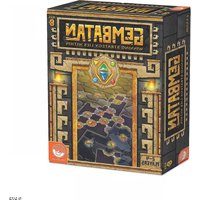
Gembatan - Board game MindWare - Free user manual and instructions
Find the device manual for free Gembatan MindWare in PDF.


| Product Type | Board Game |
| Brand | MindWare |
| Model | Gembatan |
| Category | Strategy Board Game |
| Box Dimensions (approx.) | 27 x 27 x 6 cm |
| Weight (approx.) | 0.6 kg |
| Number of Players | 2 to 4 |
| Recommended Age | 8 and up |
| Playing Time | 30-45 minutes |
| Game Objective | Build the most valuable path of stones to score points |
| Game Type | Tile-laying / Pattern building |
| Difficulty Level | Medium |
| Language | English |
| Components | Game board, 60 stone tiles, 4 player markers, rules booklet |
| Rules Included | Yes, printed manual |
| Storage | Box with insert |
| Production Year | 2020 |
| Warranty | 30 days against defects |
| Cleaning | Wipe with dry cloth; avoid moisture |
| Safety | Choking hazard - small parts. Not for children under 3 |
Frequently Asked Questions - Gembatan MindWare
User questions about Gembatan MindWare
0 question about this device. Answer the ones you know or ask your own.
Ask a new question about this device
Download the instructions for your Board game in PDF format for free! Find your manual Gembatan - MindWare and take your electronic device back in hand. On this page are published all the documents necessary for the use of your device. Gembatan by MindWare.
USER MANUAL Gembatan MindWare
OBJECT
To earn more points than your opponents by placing and making chains of gems on the board.
GAME SET UP
• Gather a pencil and paper to keep score.
- Arrange the tiles in the tray as shown.

- Place the gems face down in the gem tray.
• Each player draws 4 gems and 4 tiles from the tray without looking and places the pieces face up in front of them for all players to see. - Draw and place one tile face up in the middle of the table to start the board.
- Choose a player to go first.
GAME PLAY
On your turn, add one or more tiles to the board according to the rules of tile placement.
TILE AND GEM PLACEMENT
- For every tile you play, you must also play the connecting gem with the colors aligned as shown below.

- Gems may be placed in either a socket created when you add a new tile to the grid, or by filling in a socket left empty by another player.
- Each tile you play after the first of your turn must connect to a tile you already played that turn.
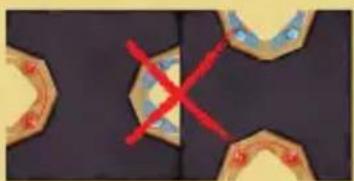
- Your tile cannot cut off a socket.
- If placing a tile creates more than 1 socket, you are only required to place a gem in 1 of those sockets.
When your turn is over, play passes clockwise to the next player.
Score your play according to the scoring rules.
SCORING
Every gem you add to the grid counts for one point, this includes gems played to fill an existing open socket.
If a gem that you add creates a diagonal chain of 3 or more gems that share a color, score one point for each gem in the line. You cannot form horizontal or vertical chains.
You score points for every gem in the chain, even if you are adding to a chain created by another player.
If you form a chain that shares both colors on the gems, you earn points for each color separately.
If you are able to play all 4 of your gems on your turn, you have scored a Gembatan worth 4 bonus points. (You do not need to play all four of your tiles to earn this bonus, just your gems.)
See scoring examples on back page.
TRADING IN
If you can't play, or in place of your turn, you can turn in any or all of your gems and / or tiles.
- Set aside any gems or tiles that you want to discard.
- Draw enough new gems or tiles to refill your inventory to 4 gems and 4 tiles.
- Return any discarded gems to the gem tray and return discarded tiles randomly in the tile holder.


WINNING
Play continues until there are no gems left in the tray, and either:
• One player uses up all of their gems, or
• A round passes with no player able to make any plays.
Each player then deducts one point for each gem they have left. The player with the most points wins!
SCORING EXAMPLE 1
If you placed the center gem, you would receive 3 points for the red chain, 3 points for the blue chain and 1 point for placing the gem for a total of 7 points.
![graph TD A["Start"] --> B["Block 1"] B --> C["Block 2"] C --> D["Block 3"] D --> E["Block 4"] E --> F["Block 5"] F --> G["Block 6"] G --> H["Block 7"] H --> I["Block 8"] I --> J["Block 9"] J --> K["Block 10"] K --> L["Block 11"] L --> M["Block 12"] M --> N["Block 13"] N --> O["Block 14"] O --> P["Bl…](/content/2026/05/1092872/images/2530e3b375f000636c7cf20f709dc5b6794c8bfcdea517a5f92226f6123b5980.jpg)
SCORING EXAMPLE 2
If you placed the top gem, you would receive 3 points for the red chain 3 points for the blue chain and 1 point for placing the gem for a total of 7 points.

STRATEGY TIP:
When making your chains, observe the tiles and gems that other players have. Make sure they won't be able to add to your chains on their turn!

Brand : MindWare
Model : Gembatan
Category : Board game