
H380 - Smoke detector FIRST ALERT - Free user manual and instructions
Find the device manual for free H380 FIRST ALERT in PDF.


| Product Type | Heat Alarm (Thermistor) |
| Power Source | 9V battery (Gold Peak 1604A, 1604S, Eveready 1222, Duracell MN1604, EVE CR9V-P, Ultralife L9VL) |
| Battery Life | Approximately 1 year under normal use |
| Alarm Loudness | 85 dB at 10 feet |
| Operating Light (LED) | Flashes every 45 seconds in standby; steady on/off indicates fault |
| Test Button | Yes, tests sensitivity, circuitry, battery, and horn |
| Alarm Pause (Silence) | Press test button; LED flashes every 10 seconds; auto reset after ~10 minutes |
| Low Battery Warning | Beep every 45 seconds |
| Detection Technology | Thermistor heat sensing element |
| Installation | Ceiling mount only; fixings supplied; avoid corners, walls, high humidity, turbulent air |
| Operating Temperature Range | 5°C to 39°C (40°F to 100°F) |
| Humidity Range | Avoid high humidity areas (bathrooms, showers) |
| Maintenance | Vacuum interior and exterior every 6 months |
| Warranty | 5 years from date of purchase (excluding battery) |
| Compliance | BS 5446-2:2000 |
| Dimensions | Approximately 4.5 inches diameter, 1.5 inches height |
| Weight | Approximately 0.3 lbs (with battery) |
Frequently Asked Questions - H380 FIRST ALERT
User questions about H380 FIRST ALERT
0 question about this device. Answer the ones you know or ask your own.
Ask a new question about this device
Download the instructions for your Smoke detector in PDF format for free! Find your manual H380 - FIRST ALERT and take your electronic device back in hand. On this page are published all the documents necessary for the use of your device. H380 by FIRST ALERT.
USER MANUAL H380 FIRST ALERT
- A large number of people who are doing business as a professional or administrative unit, such as the company's subsidiaries, which are not necessarily a member of the company, and should be responsible for doing business as a professional or administrative unit. The full name of registrant(s) is/are: ____
GARANTIE LIMIÈE
«Ère de la Béa de la Béa de la Béa de la Béa de la Béa de la Béa de la Béa de la Béa de la Béa de la Béa de la Béa de la Béa de la Béa de la Béa de la Béa de la Béa de la Béa de la Béa de la Béa de la Béa de la BéA, «Ère de la Béa de la Béa de la Béa de la Béa de la Béa de la Béa de la Béa de la Béa de la Béa de la Béa de la Béa de la Béa de la Béa de la BéA, «Ère de la Béa de la BéA de la BéA de la BéA de la BéA de la BéA de la BéA de la BéA de la BÉA, «Ère de la BéA de la BéA de la BéA de la BÉA, «Ère de la BÉA de la BÉA, «Ère de la BÉA, «Ère de la BÉA, «Ère de la BÉA, «Ère de la BÉA, «Ère de la BÉA, «Ère de la BÉA, «Ère de la BÉA, «Ère de la BÉA, «Ère de la BÉA, «Ère de la BÉA, «Ère de la BÉA, «Ère DE LA BÉA, «Ère DE LA BÉA, «Ère DE LA BÉA, «Ère DE LA BÉA, «Ère DE LA BÉA, «Ère DE LA BÉA, «Ère DE LA BÉA, «Ère DE LA BÉA, «Ère DE LA BÉA, «Ère DE LA BÉA, «Ère DE LA BÉA, «Ère DE LA CÉDE, «Ère DE LA CÉDE, «Ère DE LA CÉDE, «Ère DE LA CÉDE, «Ère DE LA CÉDE, «Ère DE LA CÉDE, «Ère DE LA CÉDE, «Ère DE LA CÉDE, «Ère DE LA CÉDE, «Ère DE LA CÉDE, «Ère DE LA CÉDE, «Ère DE LA CÉDE | S.A. »»»»»»»»»»»»»»»»»»»»»»»»»»»»»»»»»»»»»»»»»»»»»»»»»»»»»»»»»»»»»»»»»»»»»»»»»»»»»»»»»»»»»»»»»»»»»»»»»»»»»
gen in walsu verzakanging can look, can passando according to our veranwoodoléjkoid. RAPDPLUEG Iuv verzakringsgenit
Brands' Health Investors (BRA) brands Europe Ltd. (quansubond door Spure Safety Products Ltd ("Distribuera") gerandeet da hare
ЗЕРЕККИЕ СКАНИТЕ
informer bil uw verzekarimgagent.
invisiditäts-, Levens- of andere verzekarisingen, geschikke verzekeringsdakking is uw ersten verantwortellicheid.
WARBSCHUWING: ALS ER ENICE TWUEL IS OVER DE
-
Controller of the parallel (list) is as opposed to
-
Concurrent do durante descursing
2013.9.04 - 131 YU390V
IMPORTANT: PLEASE READ AND RETAIN THIS OWNERS MANUAL. WHEN INSTALLING THIS ALARM FOR USE BY OTHERS, PLEASE LEAVE THIS MANUAL OR A COPY WITH THE END USER.
PLEASE KEEP THIS MANUAL IN A SAFE PLACE.
2502-B0030
DETECTION TECHNOLOGY
Thermistor heat sensing element for accuracy, reliability and stability.
SUPERIOR FEATURES
- Battery operated
- Operating light (LED). Flashes approximately every 45 seconds for up to 30 days when the battery needs replacing
- Sensitivity Test Button. Tests sensitivity, circuitry, battery and horn.
- Loud 85 Decibel Piezo Electric Alarm. Automatically resets when hazardous condition has passed
- Easy installation Fixings supplied
SPECIAL FEATURES
Alarm Pause - silence your heat alarm by momentarily pressing the test button. Ideal when non-emergency heat (eg from cooking) causes nuisance alarms. LED flashes every 10 seconds to remind you that the heat alarm has been silenced. A double beep indicates that the alarm has automatically reset after approximately 10 minutes.
BE PREPARED
Smoke and heat alarms properly installed and maintained are an essential part of a good home safety programme. Review fire hazards and eliminate dangerous conditions whenever possible. When fire strikes, a prepared and practised escape plan could prove vital. Your local fire brigade may be willing to advise you. Call them and ask. Consider and discuss the following hints:
- Ensure everyone is familiarised with the alarm signal.
- Always test doors with your hands before flinging them open. If they feel warm, fire may have walled up behind them – leave closed and find another escape route.
- Don't waste time collecting possessions. Arouse all occupants and leave the building. Your life is more valuable!
• GET OUT, STAY OUT, GET THE FIRE BRIGADE OUT
- Keep everyone in a set meeting place after you escape
- If trapped inside, stay close to the floor, cover your mouth
with a cloth and conserve breath as you crawl to safety.
- Keep all windows and doors closed except for escape purposes.
• Prepare and practice an escape plan before a fire starts.
Draw a floor plan. Have fire drills often. Practise your escape.

WHERE TO LOCATE
- For best protection heat alarms should be installed as part of a complete fire protection system that also includes smoke alarms. Heat alarms are best suited to areas such as boiler rooms, kitchens, laundry rooms and garages where dust, fumes and moisture can cause nuisance alarms in smoke detectors. Heat alarms should not be installed in escape routes instead of smoke alarms. They should only be used in the above applications and where possible be interlinked to smoke alarms. (Smoke alarms should be installed in circulation areas forming part of
escape routes and in every room in the home).
When heat alarms are installed in a room, they should be placed on the ceiling, ideally in the centre of the room. They should be at a distance no greater than 5.3m from the farthest wall no greater than 5.3m from a door to any room in which a fire might start and no greater than 5.3m from the next heat alarm. NOTE: Heat alarms should not be wall mounted.
- Closed doors and other obstructions will interfere with the path of heat to an alarm and may prevent occupants from hearing an alarm on the other side of a closed door. Install sufficient alarms to compensate for closed doors and obstacles.
For further help and information on types and location of fire detection alarms refer to BS5839 pt 6 and the Fire Safety guidance given by the Department of Transport, Local Government and the Regions (DTLR).
CAUTION: Research indicates that substantial increases in warning time can be obtained with each properly installed additional alarm. It is strongly recommended that the advice in 1 above be followed to ensure maximum protection.

Single storey, one sleeping area
Single storey, two sleeping areas
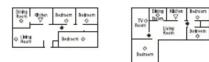
• Smoke alarms for limited protection
- Additional smoke alarms for better coverage
- Heat alarms
IMPORTANT: These heat alarms are intended primarily for use in single occupancy private dwellings. For use in other applications the manufacturers advice should be sought.
LOCATIONS TO AVOID
DO NOT locate heat alarms:-
-
In turbulent air from fans, heaters, doors, windows, etc.
-
In high humidity areas such as bathrooms and shower rooms or where the temperature exceeds 39°C (100°F) or falls below 5°C (40°F)
-
At the peak of an 'A' frame ceiling – dead air at the top may prevent smoke and heat from reaching the alarm to provide an early warning.
-
Less than 300mm (12 inches) from a wall when mounted on the ceiling.
-
In very dusty or dirty areas – dirt and excessive dust can impair the performance of the alarm.
-
Within 300mm (12 inches) of a light fitting or room corners.
-
In locations that would make routine testing or maintenance hazardous. (e.g. over a stairwell).
-
On poorly insulated ceilings.
-
Near objects such as ceiling decorations that might impede the path of heat to the alarm.
-
Within 1500mm (5 feet) of a fluorescent light fitting
Further help and information may be found in BS5839 Part 6.
INSTALLATION
IMPORTANT: Read previous sections "WHERE TO LOCATE" and "LOCATIONS TO AVOID" before installing the alarm.
-
Open the cover and handle the unit with care to avoid damage.
-
Locate keyhole slots.
-
Mark hole through the alarm base then remove alarm. Drill two 4.75mm holes. DO NOT drill with the alarm in position, as this will contaminate the unit with dust.
-
Insert the plastic anchors and screw the alarm base to the mounting surface.
WARNING: Storage in low humidity and certain transportation conditions may cause electrostatic charges to build up in the alarm system housing. Although harmless they may increase the length of time that the horn sounds upon battery insertion or test button operation. The condition may be cleared by wiping the inside and outside of the plastic cover with a clean, damp cloth.
-
Check LED operating light flashes approximately every 45 seconds in standby mode.
-
Depress and hold the test button until alarm sounds. It may be necessary to press the test button for up to 20 seconds for the alarm to sound. (NOTE: Operating the test button will place the alarm in Pause mode). Alarm is indicated by a loud continuing pulsating sound. Alarm may continue for up to 10 seconds after the button is released.
After installation.
- Press test button until the alarm sounds, then release. Repeat test weekly.
WARNING: The electronic test button provides a full test of the alarms functionality. DO NOT try to test the alarm with a naked flame, as this might present a fire hazard in itself.
BATTERY
Your alarm requires one 9V battery. Use Only Gold Peak 1604A,1604S, Eveready 1222, Duracell MN1604, EVE CR9V-P or Ultralife U9VL batteries. Other batteries may be inadequate. Under normal use the battery should last approximately one year.
SIMPLE MAINTENANCE
Vacuum every six months to help keep the unit working efficiently. Open cover and gently vacuum the interior of the detector. Vacuum exterior. Keep vacuum from touching unit. Problems are indicated by three events:
-
The alarm does not sound upon pressing the test button
-
The operating light remains steadily on or off (i.e. does not flash approximately every 45 seconds, when the unit is not in alarm).
-
The alarm beeps every 45 seconds as a low battery warning.
TRY THE FOLLOWING
-
Inspect for obvious damage.
-
Check that the unit contains the recommended battery type
-
Check that the battery is properly connected
-
Gently vacuum as recommended above.
-
Replace battery
If these procedures do not correct the problem, DO NOT ATTEMPT REPAIRS. In the first instance contact the manufacturer for further advice.
NOTE: A dying "Beep" during or after battery disconnection is normal.
If the alarm is within the warranty period and terms, return the unit with proof of purchase to the distributor, indicating the nature of the problem. Units beyond warranty cannot be economically repaired. For address see the below.
FALSE ALARMS
Abnormal air conditions may cause the highly sensitive alarm to give a 'false' alarm. DO NOT DISCONNECT THE BATTERY. If no fire is apparent, ventilate the room.
WARNING: IF THERE IS ANY QUESTION AS TO THE CAUSE
OF THE ALARM ALWAYS ASSUME THAT THIS IS AN ACTUAL FIRE AND FOLLOW YOUR FIRE EMERGENCY PLANS. Do not assume the alarm is a nuisance alarm and press the reset button to activate alarm pause.
Dust can have an adverse effect. Vacuum as recommended above. Do not paint the unit. Other factors such as nicotine contamination may also affect the alarm.
LIMITATIONS OF HEAT AND SMOKE ALARMS
Quality heat and smoke alarms are designed to provide the earliest possible warning of fire and smoke at reasonable cost. Early warnings can mean the difference between safe escape and no escape at all. Alarms do, however have limitations
Alarms cannot work without power. Battery operated alarms will not work without proper batteries, with dead batteries of it the batteries are not properly installed. AC powered alarms will not work if the power supply is cut off by an electrical fire, an open fuse, a circuit breaker or for any other reason. If you are concerned about the reliability of either batteries or the AC supply for any of the above reasons, you should install both AG and battery powered alarms in your home, or mains powered alarms incorporating a back up power supply. (In the event of an AC power failure the back up supply will only work for a limited period, such a period is dependant on the condition of the standby battery or the retained charge in the standby capacitor).
Alarms are incapable of sounding until heat reaches the sensor. Anything preventing this such as a closed door may delay or prevent an alarm. A heat alarm cannot detect a fire in the walls, chimney or roof unless and until a significant amount or heat reaches it. An alarm on any given floor should not be relied upon to detect fire on any other floor. For these reasons a smoke or heat alarm should be installed in accordance with the section heading 'WHERE TO LOCATE' earlier in this handbook.
Heat and smoke alarms may not provide protection for a smoker smoking in bed, for children playing with matches or from violent explosions resulting from escaping gas. Installation of heat and smoke alarms is only a part of a complete home fire safety programme.
First Alert heat and smoke alarms are manufactured to the highest standards to ensure faultless operation and long life. The manufacturers do however recommend that no alarm should be used for more than 10 years in order to minimise the chance of a fault occurring.
Your heat and smoke alarms are not a substitute for property, disability, life or other insurance of any kind. Appropriate insurance coverage is your responsibility. Consult your insurance agent.
GUARANTEE
The BRK/First Alert alarm ("the BRK Brands Europe Ltd product") as distributed by Sprue Safety Products Ltd ("the Distributor") excluding the battery, is guaranteed by the Distributor to be free from defects in materials and workmanship for a period of 5 years from the date of purchase. If the unit is faulty within this period, return it to the supplier with proof of purchase date.
This warranty only covers defects in material or workmanship in normal residential use and does not cover damage resulting from negligent handling, misuse or lack of reasonable care.
YOUR ALARM IS NOT A SUBSTITUTE FOR PROPERTY, DISABILITY OR OTHER INSURANCE OF ANY KIND. APPROPRIATE COVERAGE IS YOUR RESPONSIBILITY, CONSULT YOUR AGENT.
This guarantee does not affect a consumer's statutory rights in any way.
In the event of a problem with your alarm or if you have any questions concerning use and care of the product or concerning service, please consult your owners manual.
If you require further help or clarification
please write to:
Sprue Safety Products Ltd
Unit 6. Carter Court, Davy Way
Waterwells Business Park
Waterwens Business Park, Oudgeley, Gloucester, CL2 2DF, UK
Quedgeley, Gloucester. GLZ ZDE. OR www.firstalert.eu | www.brkelectronics.eu
www.m3

BS 5446-2: 2003
KM597991
First Alert® BRK
Brand : FIRST ALERT
Model : H380
Category : Smoke detector