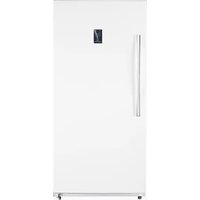
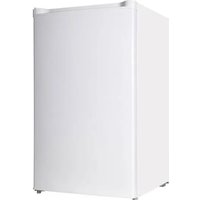
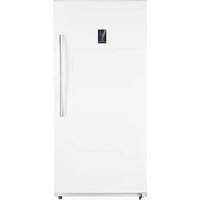
PAL177FZ - Freezer Palsonic - Free user manual and instructions
Find the device manual for free PAL177FZ Palsonic in PDF.


| Product Type | Freezer |
| Brand | Palsonic |
| Model | PAL177FZ |
| Freezer Capacity | 177 liters |
| Energy Efficiency Class | A+ |
| Annual Energy Consumption | 250 kWh |
| Climate Class | SN-T |
| Noise Level | 42 dB |
| Freezing Capacity | 12 kg/24h |
| Storage Time During Power Failure | 20 hours |
| Dimensions (H x W x D) | 84 x 60 x 60 cm |
| Weight | 32 kg |
| Power Supply | 220-240 V ~ 50 Hz |
| Power Consumption | 100 W |
| Refrigerant Type | R600a |
| Defrost System | Manual defrost |
| Interior Light | Yes, LED |
| Temperature Control | Mechanical thermostat |
| Door Type | Solid door |
| Shelves / Drawers | 4 wire shelves |
| Cleaning Recommendation | Unplug before cleaning; use mild detergent and warm water |
| Safety Features | Overload protection, temperature fuse |
| Spare Parts Availability | Contact Palsonic support or authorized service |
Frequently Asked Questions - PAL177FZ Palsonic
User questions about PAL177FZ Palsonic
0 question about this device. Answer the ones you know or ask your own.
Ask a new question about this device
Download the instructions for your Freezer in PDF format for free! Find your manual PAL177FZ - Palsonic and take your electronic device back in hand. On this page are published all the documents necessary for the use of your device. PAL177FZ by Palsonic.
USER MANUAL PAL177FZ Palsonic
The AUSTRALIAN Company
User's Manual
PAL177FZ
177 Litre Upright Freezer

Airmaster
natural_image
Simple line drawing of a rectangular box with a lid (no text or symbols)TABLE OF CONTENTS
IMPORTANT SAFETY INSTRUCTIONS .... 1
Installation....1
Child Safety 1
Maintenance and Cleaning 1
Servicing....1
At the End of the Appliance Life 1
Prescription of the appliance 2
USING THE APPLIANCE 2
Before Use 2
Thermostat Control....2
To Start the Appliance 3
Normal operating sounds....3
The Freezer Compartment .... 3
Freezing Fresh Food 3
Frozen Food Storage 4
HINTS AND TIPS 4
Food storage....4
Notes......5
In the Event of a Power Failure....5
MAINTENANCE AND CLEANING....5
Internal cleaning....5
External cleaning 6
Defrost 6
Trouble shooing....6
Door Reversal 7
Installation Requirements 8
Ventilation Requirements 9
Leveling....9
Moving 9
Guide to use the instruction book
The following Symbols will be found in the text to guide you through the instructions
Safety instructions
Hints and Tips
Step by step instructions Environmental Information
IMPORTANT SAFETY INSTRUCTIONS
These warnings are in the interests of your safety. Ensure that you understand them all before installing or using this appliance. Your safety is of paramount importance. If you are unsure about any of the meanings or these warnings contact the Customer Care Department.
Installation
● This appliance is heavy. Care should be taken when moving it.
- It is dangerous to alter the specifications or attempt to modify this product in any way.
- Ensure that the appliance dose not stand on the electrical supply cable. If the supply cord is damaged, it must be replaced by a special card available from your local service force Centre.
● Any electrical work required to install this appliance should be carried out by a qualified electrician or competent person.
- Parts which heat up should not be exposed. Whenever possible, the back of the appliance should be close to a wall but leaving the required distance for ventilation as stated in the installation instructions.
● The appliance should be left for 2 hours after installation before it is turned on, in order to allow the refrigerant to settle.

Caution: You must keep the appliance stand in the place where is ventilative anytime.
Child Safety
- This appliance is not intended for use by young children or infirm persons unless they have been adequately supervised by a responsible person to ensure that they can use the appliance safely.
● Young children should be supervised to ensure that they do not play with the appliance.
During Use
● This appliance is designed for domestic use only, specifically for the storage of edible foodstuffs only.
- Frozen food should not be refrozen once it has thawed out.
- Do not place carbonated or fizzy drinks in the freezer.
- Ice lollies can cause “frost/freezer burns” if consumed straight from the freezer.
- Do not remove items from the freezer if your hands are damp/wet, as thus could cause skin abrasions or frost/freezer burns.

Please read this instruction book carefully before use and retain for future reference.
Maintenance and Cleaning
- Switch off, and unplug the appliance before carrying out any cleaning or maintenance work.
- Do not use sharp instruments to scrape off frost or ice. (See defrosting instructions).
Caution: You must not use any mechanical equipment or other way that quicken up the defrosting process to defrost the appliance.
Do not damage the refrigerant circuit.
You must not use any electric appliance inside the appliance except which is commended by the manufacturer.
Servicing
● This product should be serviced by an authorized engineer, and only genuine spare parts should be used.
● Under no circumstances should you attempt to repair the machine yourself. Repairs carried out by inexperienced persons may cause injury or serious malfunctioning. Contact Palsonic Customer Service 1300 657 888.
At the End of the Appliance Life
Note: Before discarding an old fridge, switch off and disconnect it form the power supply. Cut off and render any plug useless. Ensure that the door cannot jam (removing it is best), regardless of whether or not it can be pushed open from inside.
AN OLD FRIDGE CAN BE A DEADLY PLAYTHING FOR CHILDREN!
CAUTION: At the end of the function life of the appliance it must be disposed in accordance with the W. E. E. E directive (See below). Your appliance contains R600a refrigerant and inflammable gas in the insulating foam.
Prescription of the appliance
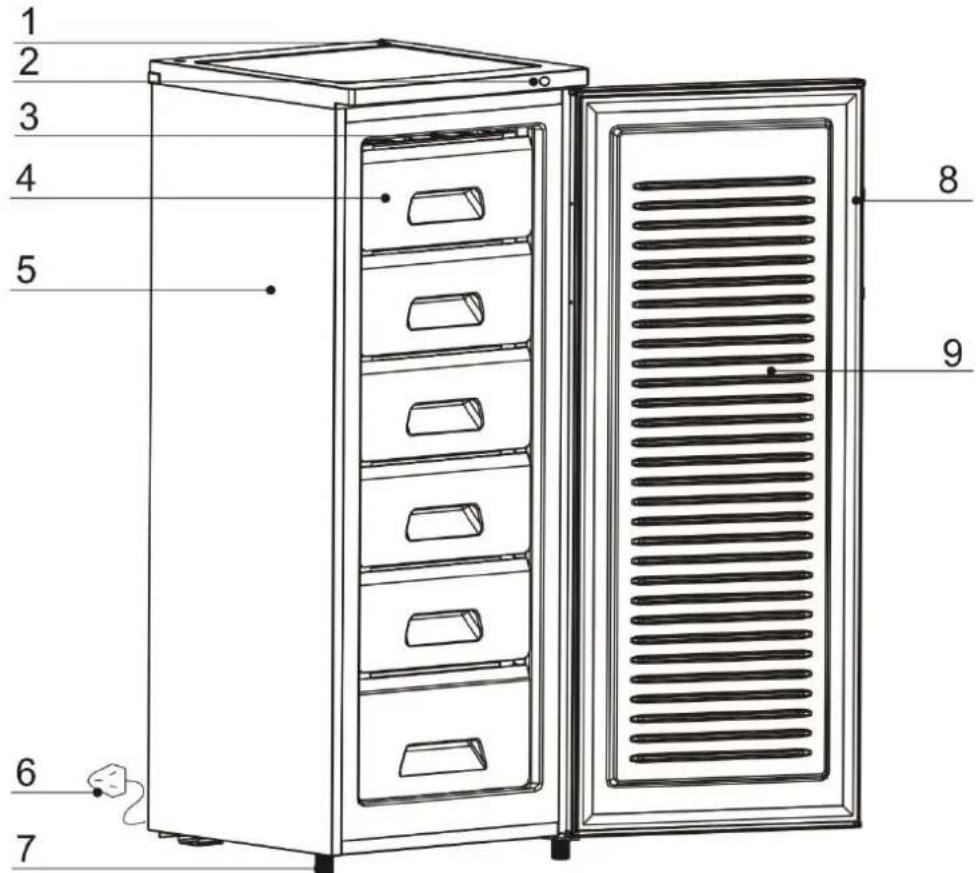
- Screw Cover 2. Temperature Controller 3. Freezer 4. Drawer in Freezer 5. Refrigerator 6. Power supply cord with plug 7. Leg Regulator 8. Door Gasket 9. Door
Note: Due to unceasing modification of our products your fridge may be slightly different from this Instruction Manual, but its functions and using methods remain the same.
USING THE APPLIANCE

This appliance is designed for domestic use only, specifically for the storage of edible foodstuffs.
This appliance is designed to operate in ambient temperatures (surrounding air temperature) between 16 (C50Fand 32C
If these temperatures are exceeded I.e., colder or warmer, the appliance will not operate correctly. Should the ambient temperatures be exceeded for long periods, the temperature in the freezer section will rise above -18°C and food spoilage may occur.
Before Use
Remove all securing tapes and foam under the condenser at the back of the cabinet. Wash the inside of the appliance with lukewarm water with a little bicarbonate of soda added (5ml to 0.5 litre of water). Do not use soap or detergent as the smell may linger. Dry the appliance thoroughly.
Thermostat Control
The thermostat control situated in the control panel regulates the temperature of the freezer compartment.
- Position MIN-Cold
- Position MID-Colder. Normally setting at this position.
- Position MAX -Coldest
The temperature will be affected by:
- Room temperature
● How often the door is opened
● How much food is stored - Position of the appliance
In determining the correct temperature control setting, all these factors have to be considered and some experimentation may be necessary
Do not allow children to tamper with the controls or play with the product.
Do not use detergents, abrasive powders, highly perfumed cleaning products, wax polishes or products containing alcohol.
To Start the Appliance
- Allow the appliance to stand for 2 hours after installation.
- Plug in the appliance and switch on at the mains supply.
- Turn the thermostat control to the required setting. A midway setting is usually suitable for normal operation (see thermostat control).
- Leave the appliance for about 4 hours for the correct temperature to be reached before placing food inside.
Normal operating sounds
- You may hear faint gurgling or bubbling sounds when the refrigerant is pumped through the coils or tubing at the rear, to the cooling plate/evaporator.
- When the compressor is on, the refrigerant is being pumped round, and you will hear a whirring sound or pulsating noise from the compressor.
- A thermostat controls the compressor, and you will hear a fain 'click' when the thermostat cuts in and out.
The Freezer Compartment
The symbol means that your freezer will store frozen food at-18(-0.4) or colder allowing for long term frozen food storage and freezing of fresh food. The freezer temperature is controlled automatically by the thermostat situated in the control panel.
Due to the different installations, methods of usage and weather conditions, adjustments to the temperature settings may be required.
These are best assessed against a temperature reading on thermometer buried in frozen food. The reading must be taken quickly as the thermometer temperature will rise rapidly after removal.
Freezing Fresh Food
The maximum quantity of food you can freeze in 24 hours is 6.5kg. Place the fresh food on the freezer compartment. Food may need rearranging to achieve this.
During the freezing process the temperature of fresh food should be reduced quickly so that ice crystals are kept as small as possible to prevent damaging the structure of food. If freezing takes places slowly large ice crystals form and these will affect the quality of food once it has defrosted.
Packets to be frozen should be placed in the basket in contact with baskets surface as far as possible and spaced apart to allow cold air to circulate among them. They should not touch existing packets.
Frozen food should not be refrozen once it has thawed out.
Do not remove items from the freezer if your hands are damp/wet, this could cause skin abrasions or
"frost/ freezer burns."
Frozen Food Storage
- Pre packed commercially frozen food should be stored in accordance with the manufacturer's instructions for a 4 star frozen food compartment and should be put in the freezer as soon as possible after purchase. Your freezer provides for long term storage which generally means up to 3 months but the length of the time can vary and it is important to follow the recommended times shown on packets of commercially frozen food.
Do not place sealed containers or carbonated liquids such as fizzy drinks into the container which may cause it to explode resulting to damage to the freezer.
ice cubes and ice lollies should not be consumed immediately after removal from the freezer as it may result in low temperature skin abrasions.
Manufacturer storage time should be adhered to.
i Hints and Tips
Any opened packets of frozen food, should be rewrapped in airtight materials to prevent surface evaporation which cause drying or 'freezer burn'.
Frozen food which is thaw accidentally should be used immediately or thrown away. Alternatively if the food is uncooked and has not been completely defrosted it can be cooked and then re-frozen.
Check dates on packets and rotate food regularly. Although storage longer than recommended is not harmful unless flavors and textures begin to change.
The use of freezer drawers
The freezer compartment is fore storing the food need frozen.
- Freezer drawers. Frozen food should be packing before storage. It is advisable to cut large food into once edible size and packed separately then place in the freezer drawers. It can reduce exhalation of food and open door cause frost and energy consuming as well as avoid the food going bad because of thaw and refrozen.
HINTS AND TIPS
Food storage
- Do not place the foods on the temperature sensor and the inner back wall of the refrigerator.
- Remove suspect food from your refrigerator and clean, refer to cleaning and maintenance.
- Radish, banana, pumpkin, onion and canned foods need not be stored in the refrigerator.

natural_image
Simple line drawing of a bottle, a cross symbol, and a pill tray (no text or labels)Notes
● This fridge cannot store medical, inflammable and explosive articles.
Energy Saving Advice
- Do not install the appliance close to sources of heat, such as a cooker, dishwasher or radiator.
- Locate the appliance in a cool well ventilated room and make sure that air opening of the cabinet is not obstructed.
- Avoid unnecessary frosting in the cabinet by packing all foodstuffs in to airtight packages before placing them in the freezer.
● Food which is to be frozen (when cool) should be placed in the fridge before being transferred to the freezer. - Thaw frozen food in the fridge, this will ensure safer defrosting of food and reduce the work of the refrigeration unit.
- Try to avoid keeping the food open for long periods, or opening the door too frequently as warm air will enter the cabinet, and cause the compressor to switch on unnecessarily offer.
- Ensure there are no obstructions preventing the door from closing properly.
- It is advisable to periodically clean the refrigeration system at the back of the appliance with a duster or vacuum cleaner.
● Hot foods should be cooled down to room temperature before storage; otherwise, it would affect their preservation and increase energy consumption.
In the Event of a Power Failure
If there is a power failure during the storage of frozen foods, keep the door closed. If the temperature within your freezer should rise do not refreeze the food without checking it's condition. The following guidelines should assist you:
Ice cream: Once thawed should be discarded.
Fruit and vegetables: If soft should be cooked and used up.
Bread and cakes: Can be refrozen without danger.
Shellfish: Should be refrigerated and used up quickly.
Cooked Dished: i.e. casseroles should be refrigerated and used up.
Large Pieces of Meat: Can be re-frozen providing there are ice crystals remaining within them.
Small Joints: Should be cooked and then re-frozen as cooked dishes.
Chicken: Should be cooked and re-frozen as a fresh dish
MAINTENANCE AND CLEANING

Before any maintenance or cleaning work is carried out
DISCONNECT the appliance from the ELECTRICITY supply.
Internal cleaning

natural_image
Illustration of a woman cleaning a cabinet with a hand near the front (no text or symbols)Clean the inside and accessories with warm water and bicarbonate of soda (5ml to 0.5litre of water). Rinse and dry thoroughly.

Do not use detergent, abrasive powers, highly perfumed cleaning products, wax polishes or cleaning products containing bleach or alcohol.
External cleaning
Wash the outer cabinet with warm soapy water.

Do NOT use abrasive products.
There are sharp edges on the underside of the product so care should be taken when cleaning.
Once or twice a year dust the compressor at the back of the appliance, with a brush or vacuum cleaner, as an accumulation of dust will affect the performance of the appliance and cause excessive electricity consumption.

Do not spray water to the fridge directly, otherwise it would weaken the electrical insulation and use the metal part rusty.
Defrost
- The defrost in the refrigerator compartment is an automatic cycle by compressor on and off, no need to operate by man. The defrost water flow to the compressor through the drainage pipe behind the wall of the refrigerator compartment. The drainage pipe must be installed firmly to avoid the water drips to the compressor electrical box and the floor.
-
If the frost in the freezer compartment is too thick, it will have an effect on the cooling performance, so, if it is more than 5mm thick, please defrost timely,
-
Wrap any food in layers with newspaper or blankets.
- Switch the appliance off at the wall socket and remove the plug.
- Open the freezer door.
- Place a suitable container to collect the defrost water.
- After defrosting, clean and dry the interior.
- switch the appliance on and replace any frozen food.
i
Defrosting can be speed up by putting bowls of hot (not boiling) water in freezer and loosening the frost with a suitable plastic scraper.
If the temperature of frozen is allowed to rise during defrosting, its storage life may be shortened.
Notice: It is prohibited to use sharp tools to scrape the frost or use hot water or hair drier blow the cabinet wall directly to accelerate defrost, as to avoid damaging the cabinet wall.
When the Appliance is Not in Use
When the appliance is not in sue for long periods, disconnect from the electricity supply, empty all of the food and clean the appliance, leaving the door ajar to prevent unpleasant smells.
Trouble shooing
BEFORE asking for your local service force center for help when something goes wrong with your fridge, check the following points:
| SYMPTOM | SOLUTION |
| Stop operating | Check there is power at the socket. |
| Check the fuse has not blown. | |
| Check if the thermostat knob is at ‘0’ position. | |
| Check if the fridge is under direct sunshine or near heating source. | |
| The temperature in the freezer section is too high | Check the ambient temperature within appliance operating limits of 16°C to 32°C. Relocate the appliance if necessary. |
| Check the thermostat is turned to correct Setting relative to ambient conditions. | |
| The freezer door will not open | -Has the door just been opened?If so leave for a few minutes to allow the air pressure to equalize. |
| Excessive frost and ice has build up | Ensure the door is not left open. |
| Check that nothing is preventing the door from closing | |
| Is the door gasket intact and clean? | |
| Has advised periodic defrosting been carried out? | |
| Sound like water running | Refer to normal operating running |
| Unusual noise | The fridge is not placed steadily or touching the wall |
| Drain-tray water is falling off. | |
| The outer refrigeration-tubes are touching each other or refrigeration tube is touching the inner side of the cabinet. | |
| Dew on two sides of the fridge | In the moist season (like raining day) dew appears on two side of the fridge. As pour the cold water in the glass, the dew appears on the glass.This is not malfunction; you can wipe it with a dry cloth. |
| Warm on the two and the front frame of the fridge. | It is not malfunction, as there are condensers inside the two sides and the front frame of fridge. They are warm when the fridge works. |
| Insufficient refrigeration | Adjust the thermostat to give correct temperature control. See page 5. |
| Check that the door is close. | |
| Large quantities of food have recently been placed in the cabinet/and door is frequently opened. | |
| Check that air ventilation is not obstructed. |
After checking the points above, if it still goes wrong, call your local Service Force center.
In-guarantee customers should ensure that the above checks have been made as the engineer will make a charge if the fault is not a mechanical or electrical breakdown.
Please note that proof of purchase is required for in-guarantee service calls.
Door Reversal
This fridge can be opened either from the left or right side. The default way of opening the door is frame the right side. If you want to open the door from the left side, please follow the instructions below.

- Screw cover 2. Screw 3. Top cover 4. Leg regulator 5. Upper hinge 6. Hole cover 7. Door 8. Lower hinge
- Remove the screw cover(1), remove the screws(2) and the top cover(3) and the screws of the upper hinge(5) and then remove the upper hinge.
- Remove the hole cover (6) and then transfer it to the opposite side of the door (7). Then remove the door remember to keep the padded surface of the door upwards to prevent the scratching.
- Remove the lower hinge (8) and the leg regulator of the lower hinge then transfer the leg regulator on the opposite side of the lower hinge.
- Fix the lower hinge on the cabinet and then transfer the leg regulator (4) on the opposite side.
- Put the door (7) on the lower hinge (8), keep the door level, then fix the upper-hinge (5) on the cabinet.
- Fix the top cover (3) with the screws (2) and then fix the screw cover (1).
Warning! When changing the side at which the door opens, the appliance must not be connected to the mains. Remove plug from the mains beforehand.
Installation Requirements
To ensure correct operation this appliance must not be located where the temperatures will fall

natural_image
Cartoon illustration of a smiling rectangular character with arms and legs, standing on a base (no text or symbols)below16 or rise above 32
Avoid the following locations: unventilated kitchen, out house, conservatory, garage. For correct operation this appliance must be installed:
In a dry atmosphere.
Out of direct sunlight.
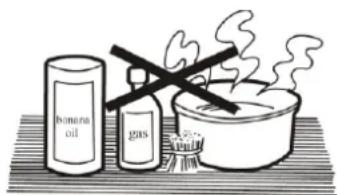
Away from extreme temperature (not next to a cooker or other sources of heat). Away from any volatile or combustible materials such as gas, petrol, alcohol, lacquer, and banana oil, etc. The above mentioned object should not be stored in fridge.
Your appliance will be heavy when loaded with food and must therefore be stood on a strong firm floor.
Ventilation Requirements
Gently push into place until the back of the freezer keeps a required distance from wall,
When in the position a 50mm (2" )clear space above the appliance should be maintained.
If space above the appliance is not available, clearance of 25mm(1" ) should be maintained on both sides.


Ensure that the appliance does not stand on the electrical supply cable.
Parts which heat up should not be exposed. Whenever possible, the back of the appliance should be close to a wall but leaving the required distance for ventilation.
Leveling
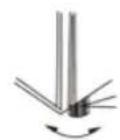
The appliance should be level, to eliminate rocking:
Ensure the appliance is upright and both adjusters are in firm contact with the floor so that the cabinet is level.
Adjust the level by allowing out the appropriate level adjuster at the front, free your form or

Palsonic
The AUSTRALIAN Company
Palsonic Customer Service
Telephone (Australia) 1300 657 888
Palsonic Corporation Pty Ltd ABN 34 000 474 108
1 Joynton Avenue, Waterloo NSW 2017 Australia
Telephone (02) 9313 7111 Facsimile (02) 9697 0655
www.palsonic.com.au
- The AUSTRALIAN Company
- PAL177FZ
- TABLE OF CONTENTS
- IMPORTANT SAFETY INSTRUCTIONS .... 1
- Prescription of the appliance 2
- USING THE APPLIANCE 2
- The Freezer Compartment .... 3
- HINTS AND TIPS 4
- MAINTENANCE AND CLEANING....5
- Trouble shooing....6
- Door Reversal 7
- Installation Requirements 8
- IMPORTANT SAFETY INSTRUCTIONS
- Installation
- Child Safety
- During Use
- Maintenance and Cleaning
- Servicing
- At the End of the Appliance Life
- Prescription of the appliance
- USING THE APPLIANCE
- Before Use
- Thermostat Control
- To Start the Appliance
- Normal operating sounds
- The Freezer Compartment
- Freezing Fresh Food
- Frozen Food Storage
- The use of freezer drawers
- HINTS AND TIPS
- Notes
- Energy Saving Advice
- In the Event of a Power Failure
- Internal cleaning
- External cleaning
- Defrost
- When the Appliance is Not in Use
- Trouble shooing
- Door Reversal
- Installation Requirements
- Ventilation Requirements
- Leveling
- Palsonic
Brand : Palsonic
Model : PAL177FZ
Category : Freezer