
AE-A184J - Air conditioner SHARP - Free user manual and instructions
Find the device manual for free AE-A184J SHARP in PDF.


| Product Type | Split Air Conditioner (Cooling and Heating) |
| Brand | Sharp |
| Model | AE-A184J |
| Cooling Capacity (BTU/h) | 18000 |
| Heating Capacity (BTU/h) | 20000 |
| Refrigerant Type | R32 |
| Compressor Type | Inverter (DC) |
| Indoor Unit Dimensions (W x H x D) | 920 x 295 x 240 mm |
| Outdoor Unit Dimensions (W x H x D) | 800 x 550 x 300 mm |
| Indoor Unit Weight | 12 kg |
| Outdoor Unit Weight | 45 kg |
| Power Supply | 220-240V, 50Hz, 1 Phase |
| Cooling Power Input (kW) | 1.5 |
| Heating Power Input (kW) | 1.6 |
| Energy Efficiency Ratio (EER) | 3.5 (Cooling) |
| Main Functions | Cool, Heat, Dehumidify, Fan, Auto Swing, Turbo Mode, Sleep Mode |
| Remote Control | Infrared with LCD Display |
| Filter Type | Washable Pre-filter + Anti-Allergy Enzyme Filter |
| Airflow (m³/h) - High | 600 (Indoor Unit) |
| Noise Level Indoor (dB) | 21-45 (Low-High) |
| Noise Level Outdoor (dB) | 55 |
| Timer | On/Off Timer up to 24 hours |
| Maintenance Interval | Clean filter every 2 weeks; professional servicing annually |
| Spare Parts Available | Remote control, filters, fan motor, PCB, compressor |
| Safety Features | Earth leakage circuit breaker, auto restart, refrigerant leak detection |
Frequently Asked Questions - AE-A184J SHARP
User questions about AE-A184J SHARP
0 question about this device. Answer the ones you know or ask your own.
Ask a new question about this device
Download the instructions for your Air conditioner in PDF format for free! Find your manual AE-A184J - SHARP and take your electronic device back in hand. On this page are published all the documents necessary for the use of your device. AE-A184J by SHARP.
USER MANUAL AE-A184J SHARP
natural_image
Line drawing of a car air conditioner with a handle and blade (no text or symbols)Thank you for purchasing a Sharp Split Type Room Air Conditioner. Please read this manual carefully before operating the air conditioner, and keep this manual and the Installation Manual as handy references.

SPLIT TYPE ROOM AIR CONDITIONER
OPERATION MANUAL
• MAIN FEATURES ....2
- PRECAUTIONS FOR USE 3
• TIPS ON SAVING ENERGY 3
• PART NAMES 4
• USING THE REMOTE CONTROL......8
- BASIC OPERATION
AUTO MODE 10
HEAT MODE 12
COOL MODE.... 13
DRY MODE 14
FAN ONLY MODE 15
• ADJUSTING THE AIR FLOW DIRECTION 16
- SAVE MODE 17
• TIMER OPERATION
TIMER ON 18
TIMER OFF 19
- ONE-HOUR TIMER 21
• USING THE AUXILIARY MODE ..... 22
• USING TEST RUN MODE 22
• IMPORTANT OPERATIONAL POINTS .... 23
• MAINTENANCE 24
• ADDITIONAL NOTES ON OPERATION.... 26 - BEFORE CALLING FOR SERVICE...... 27
- SPECIFICATIONS 28
MAIN FEATURES
AUTOMATIC OPERATION
(When the mode is set to AUTO.)
When using the AUTO mode, the temperature setting and mode (HEAT, COOL or DRY) are automatically selected based on the room temperature when the unit is turned on.
AUTO SLEEP FUNCTION (TIMER OFF)
When this feature is selected, the air conditioner will automatically vary the room temperature while you sleep to prevent you from becoming too hot or too cold.
WAKE UP FUNCTION (TIMER ON)
When this feature is selected, the unit will automatically turn on up to 30 mins before the pre-programmed time so that the room temperature reaches the desired level by the time you wake up.
ONE-HOUR TIMER
At the press of one button, the unit can be programmed to turn off after one hour.
WARNING:
For your safety ensure that your new air conditioner is installed by a licenced electrical contractor in accordance with the SAA WIRING RULES.
CAUTION:
To ensure that your warranty is not cancelled, both the indoor/outdoor units and supply/interconnecting cables must be installed with the application of GOOD WORKMANSHIP.
PRECAUTIONS FOR USE
USE A 230-240 VOLT POWER CIRCUIT ONLY.
Using a power circuit with improper voltage and frequency can result in damage to the unit and possibly fire. Use a circuit with a 230-240 volt ( ± 10%) rating.
VENTILATE THE ROOM OCCASIONALLY DURING USE.
Open the window or door periodically to ventilate the room, especially when using gas appliances.
DO NOT INSERT OBJECTS INTO THE INLET OR OUTLET.
Inserting objects into the unit could result in injury due to rotation of the high-speed fans.
DO NOT PULL, HANG ON, OR OTHERWISE MISUSE THE POWER CORD.
Pulling the power cord may result in damage or electrical shock. Do not misuse the power cord.
WHEN USING THE AIR CONDITIONER FOR INFANTS, CHILDREN, OR ELDERLY, BEDRIDDEN, OR DISABLED PEOPLE
Make sure the room temperature is suitable for those in the room.
ALWAYS USE A FUSE WITH THE CORRECT CURRENT RATING.

This unit is designed for human comfort. Do not use for applications such as a kennel or nursery to raise animals or plants.
TIPS ON SAVING ENERGY
Below are some simple ways to save energy when you use your air conditioner.
SET THE CORRECT TEMPERATURE
- Setting the thermostat 1°C higher in COOL mode, and 2°C lower in HEAT mode than the desired temperature will result in a 10% saving in electricity.
- Setting the temperature colder than necessary during cooling will result in excess power consumption.
- Make an effective use of the SAVE MODE. (Refer to page 17)
KEEP OUT DIRECT SUNLIGHT AND DRAFTS
- Keeping out direct sunlight when cooling will aid in reducing the power consumption.
- Close the windows and doors when heating and cooling the room.
SET PROPER AIR FLOW DIRECTION
- Set the louvres to obtain the best air circulation.
KEEP FILTER CLEAN
- Keep the filter clean to ensure the most efficient operation.
MAKE MOST OF TIMER
- Make the most of the AUTO SLEEP (TIMER OFF) function.
UNPLUG THE POWER CORD WHEN THE UNIT IS NOT TO BE USED FOR AN EXTENDED PERIOD
- Unplug the power cord when the unit is not to be used for a long period of time. The indoor unit still consumes a small amount of power when it is not operating.
PART NAMES
INDOOR UNIT
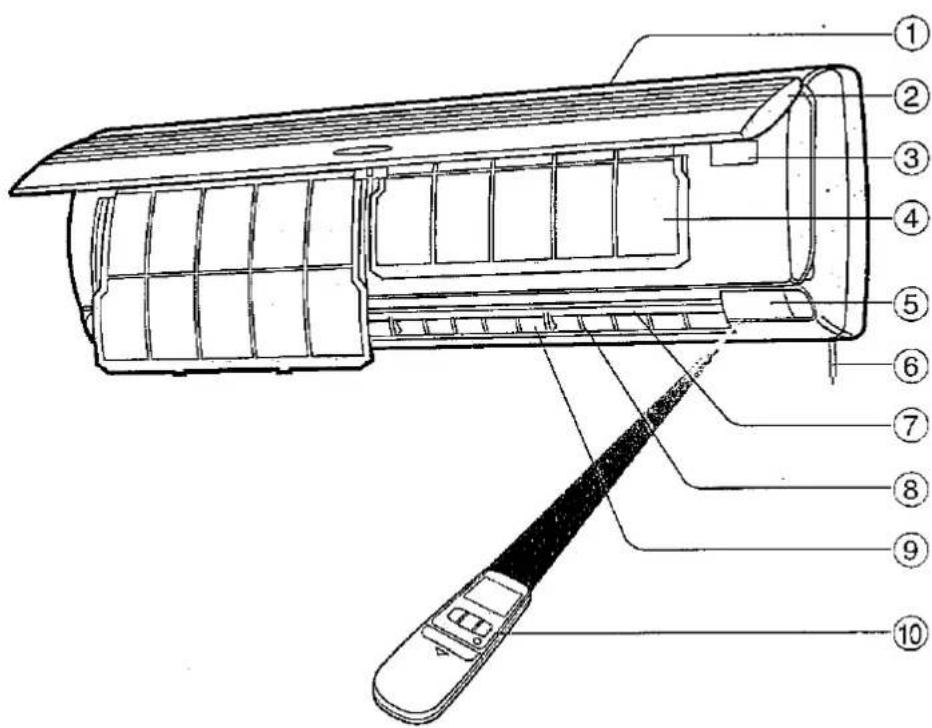
① Inlet (Air)
② Filter Cover
③ Operation panel
④ Air Filters
⑤ Indicator Panel
⑥ Power Supply Cord (AY-A184J only)
⑦ Vertical Adjustment Louvre
⑧ Horizontal Adjustment Louvres
⑨ Outlet (Air)
⑩ Remote Control
OUTDOOR UNIT

⑪ Inlet (Air)
⑫ Refrigerant Tube and Interconnecting Cord
⑬ Drainage Hose
⑭ Outlet (Air)
NOTE: Actual units may vary slightly from those shown above.
OPERATION AND INDICATOR PANELS

Hold the bottom corner of the filter cover on both sides and gently pull outwards.
① TEST RUN Button
Used only for checking the operation of the unit. Do not use this feature during normal operation. (See p. 22)
② AUX. Button
Used to operate the unit when the remote control is not available. (See p. 22)
③ TIMER Lamp (yellow)
Lights up when the timer is set.
Lights up while the unit is operating.
⑤ RECEIVER Window
Receives the signal from the remote control.
PART NAMES (Continued)
REMOTE CONTROL

① TRANSMITTER
Sends the control signal to the unit.
② DISPLAY (Liquid Crystal Display)
Indicates the operation modes, set temperature, fan speed and time. (See p. 7)
③ ON/OFF Button
Press to start or stop the unit.
④ THERMO. (Thermostat) Button
Used to select the desired room temperature.
⑤ ONE-HOUR TIMER Button
Used to operate the unit for just one hour or to turn the unit off after one hour.
⑥ MODE Button
Used to select the desired mode: AUTO, HEAT, COOL, DRY, or FAN ONLY.
⑦ AUTO-SWING Button
Press once to make the vertical adjustment louvre move up and down continuously. Press the button again to make the louvre stop.
⑧ FAN Button
Used to select the fan speed mode: AUTO, HIGH, LOW, or SOFT.
Press to select the SAVE MODE and press it again to cancel.
⑩ TIMER SET/CANCEL Button
Used to set or cancel the timer operation mode.
⑪ CLOCK Button
Used to set the current clock time.
⑫ TIME ADVANCE Button
Used to set the timer, or the clock. Press to advance time.
⑬ TIME REVERSE Button
Used to set the timer, or the clock. Press to reverse time.
⑭ TIMER ON Button (for setting the timer)
Used to set the time for the unit to switch on. (1-24 hours)
⑮ TIMER OFF Button (for setting the timer)
Used to set the time for the unit to switch off. (1–24 hours)
L.C.D. REMOTE CONTROL DISPLAY
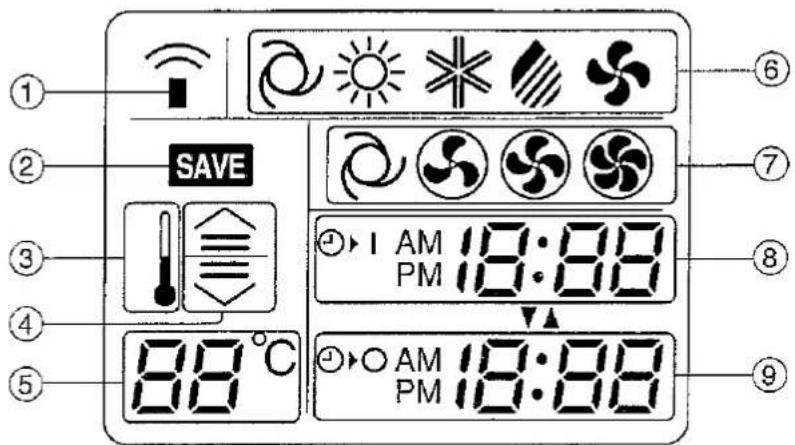
① TRANSMITTING SYMBOL
Appears when a control signal is being transmitted by the remote control.
② SAVE OPERATION MODE SYMBOL
Indicates that the unit is in the save (energy-saving) mode.
③ TEMPERATURE SYMBOL
Appears in the AUTO, COOL, HEAT and DRY modes.
④ THERMOSTAT SETTING IN AUTO MODE
When the thermostat setting is changed in the AUTO mode and DRY mode, a bar appears above or below the base line.
⑤ TEMPERATURE INDICATOR
Temperature is displayed in the HEAT and COOL modes.
⑥ MODE SYMBOL
Indicates the set mode.
Q: AUTO
The operation mode is selected based on the room temperature when the unit is turned on. (See p. 11)
☀ : HEAT
*:COOL
: DRY
: FAN ONLY
⑦ FAN SPEED SYMBOL
Indicates the fan speed setting.
: AUTO
The fan slows down automatically when the room temperature gets close to the set temperature.
:SOFT
: LOW
: HIGH
⑧ TIMER ON INDICATOR/CLOCK
Indicates the timer-on time or current time.
⑨ TIMER OFF INDICATOR
Indicates the timer-off time or one hour timer setting.
USING THE REMOTE CONTROL
LOADING BATTERIES
Use two high-quality size-AAA (R03) batteries.
1 Open the remote control cover by sliding it in the direction of the arrow. Remove the cover by pressing the mark " ▽" and carefully pulling it in the direction of the arrow.
2 Insert the batteries in the compartment, making sure the ⊕ and ⊖ polarities are properly aligned.
- The remote control automatically resets when the batteries are loaded.
- AM 6:00 will appear on the display when the batteries are properly loaded.
3 Replace the cover.

NOTES:
- The battery life is approximately one year with normal use.
- When you replace the batteries, always use two new ones of the same type.
- When the batteries are replaced, AM 6:00 will appear on the display.
- If the remote control does not operate normally after replacing the batteries, take off the batteries and replace them again after 20 seconds.
HOW TO USE THE REMOTE CONTROL
Point the remote control towards the unit's receiver window and press the desired button. A beep will sound when the unit receives the signal.
- Make sure no objects, such as a curtain, are between the remote control and the unit.
- The remote control operates from up to 7 meters away.

natural_image
Illustration of a hairbrush with a textured handle, no text or symbols present
CAUTION
- Do not expose the receiver to strong, direct sunlight, which can adversely affect its operation. In such case, close the curtains to block the sunlight.
- Use of a fluorescent lamp with a quick starter in the same room may interfere with transmission of the signal.
- The unit may be affected by signals emitted from the remote control of a television, VCR or other equipment used in the same room.
- Do not leave the remote control in direct sunlight or near a heater. Also, protect the unit and remote control from moisture and shock which can discolour or damage them.
- If you will not be using the unit for a long time, remove the batteries from the remote control.
SET CURRENT CLOCK TIME
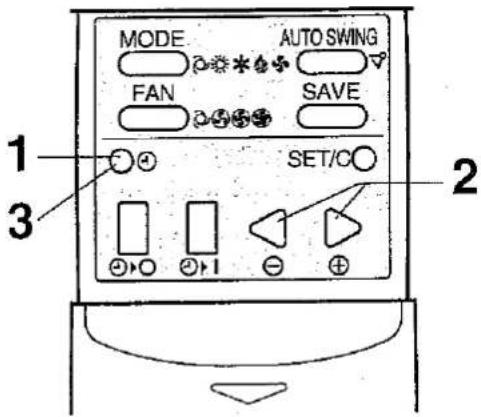
Example:
If the current time is 7 o'clock in the afternoon.
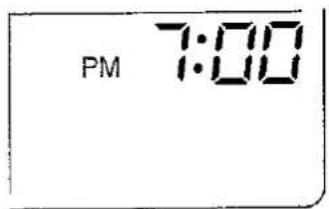
1 Press the CLOCK button.
2 Press the TIME ADVANCE or REVERSE buttons to set the current clock time. Keep pressing each button to fast-forward or reverse the time display. Make sure "a.m." or "p.m." is set correct.
3 Press the CLOCK button.
- The colon (:) blinks to indicate that the clock is functioning.
NOTES:
- The current time cannot be set, when the timer mode is programmed.
- At midday/midnight the clock will display 0:00 AM/PM similar to a 24 hour clock.
BASIC OPERATION
In this mode, the temperature setting and mode (HEAT, COOL or DRY) are automatically selected depending on the room temperature when the unit is turned on.
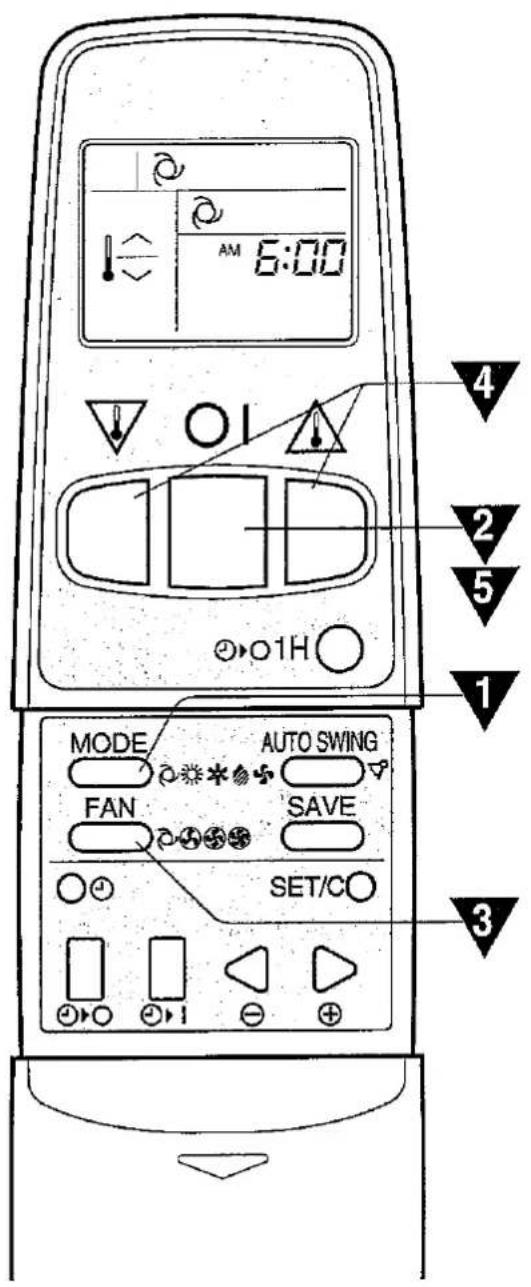

NOTES:
- The temperature indicator does not appear on the display in the AUTO mode.
- In the DRY mode, the fan speed cannot be changed.
In AUTO MODE, the HEAT, COOL, or DRY mode is selected based on the room temperature when the unit is turned on.
| Room temp. when the unit turned on | Automatic Operation | |
| Mode Selected | Thermostat Setting | |
| Below 21°C | HEAT | 23°C |
| 21°–24°C | DRY | Room Temp. at start-up |
| 24°–26°C | COOL | 24°C |
| 26°–28°C | COOL | 25°C |
| Above 28°C | COOL | 26°C |
BASIC OPERATION (Continued)
HEAT MODE

1 Press the MODE button to select the HEAT mode. (☀️)
2 Press the ON/OFF button to start operation.
- The red OPERATION lamp of the unit will light up.
3 Press the THERMO button to set the desired temperature.
- The recommended temperature range is from 20 to 23^ .
4 Press the FAN button to set the desired fan speed.
The AIR SWING mode can be selected, or AIR FLOW direction adjusted by pressing the "AUTO SWING" button. (See p. 16 for detail)
5 To turn off the unit, press the ON/OFF button again.
- The red OPERATION lamp of the unit will go out.
NOTES:
- The indoor fan will not rotate until the unit has pre-heated.
COOL MODE
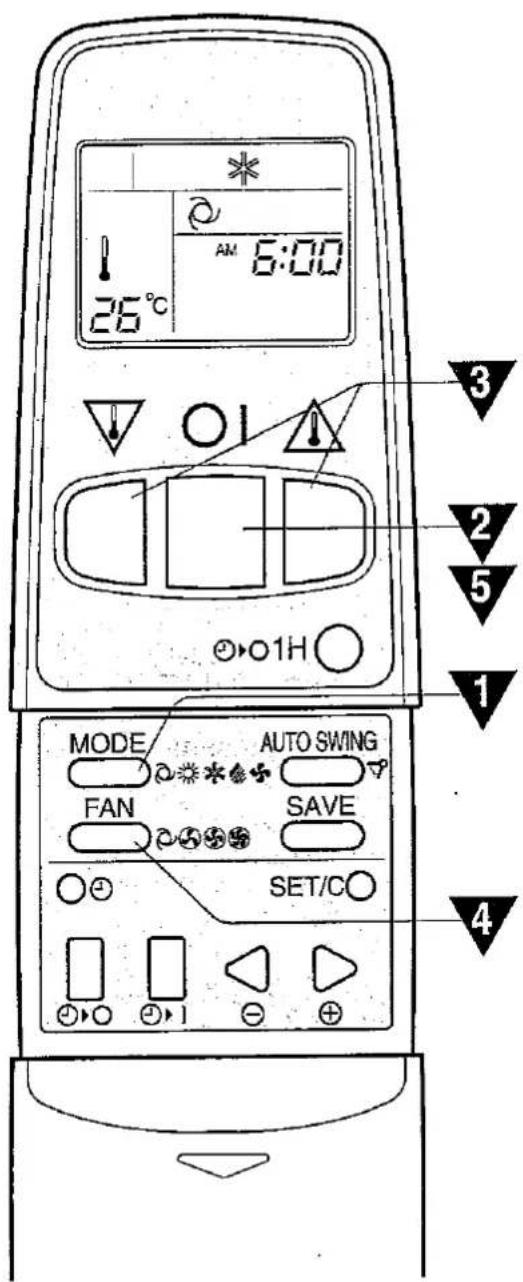
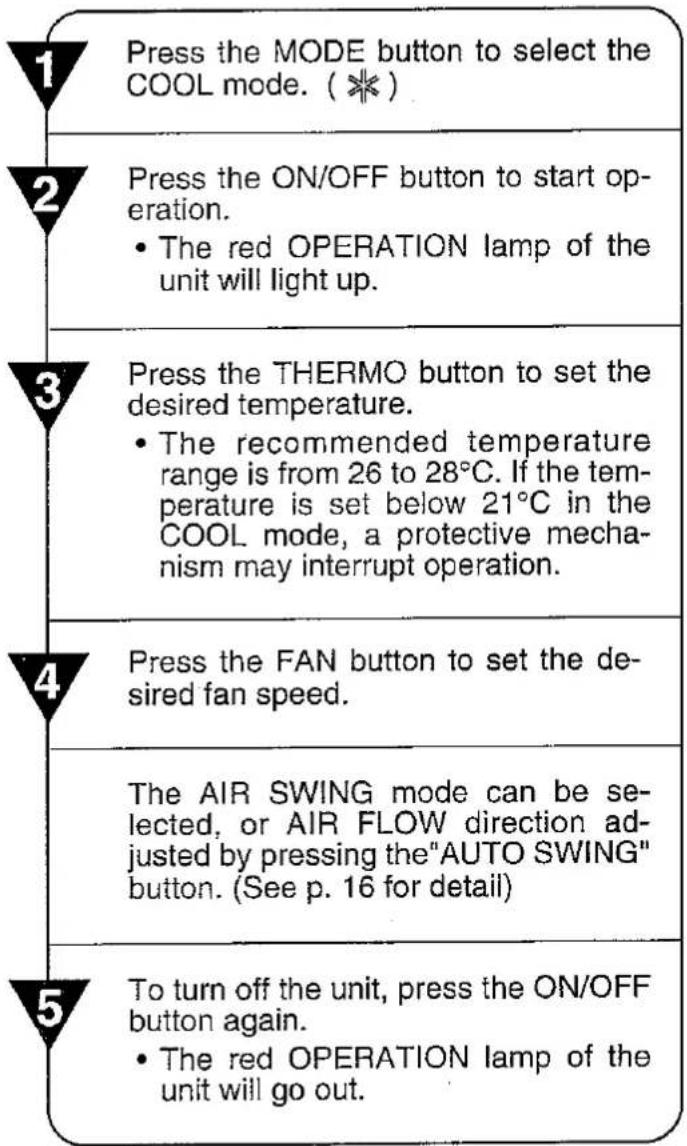
BASIC OPERATION (Continued)
DRY MODE

In the DRY mode, the air conditioner reduces the humidity in the room without lowering the room temperature.
Press the MODE button to select the DRY mode. ( )
- The fan speed and temperature settings are set automatically.
Press the ON/OFF button to start operation.
- The red OPERATION lamp of the unit will light up.
Adjust the thermostat setting, if desired, by pressing the THERMO buttons.
The indicator bars represent changes in temperature as follows.
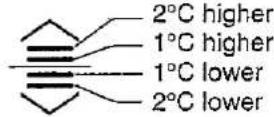
The AIR SWING mode can be selected, or AIR FLOW direction adjusted by pressing the "AUTO SWING" button. (See p. 16 for detail)
To turn off the unit, press the ON/OFF button again.
- The red OPERATION lamp of the unit will go out.
NOTES:
Since operation is automatically controlled in the DRY mode, you cannot change the fan speed setting.
FAN ONLY MODE
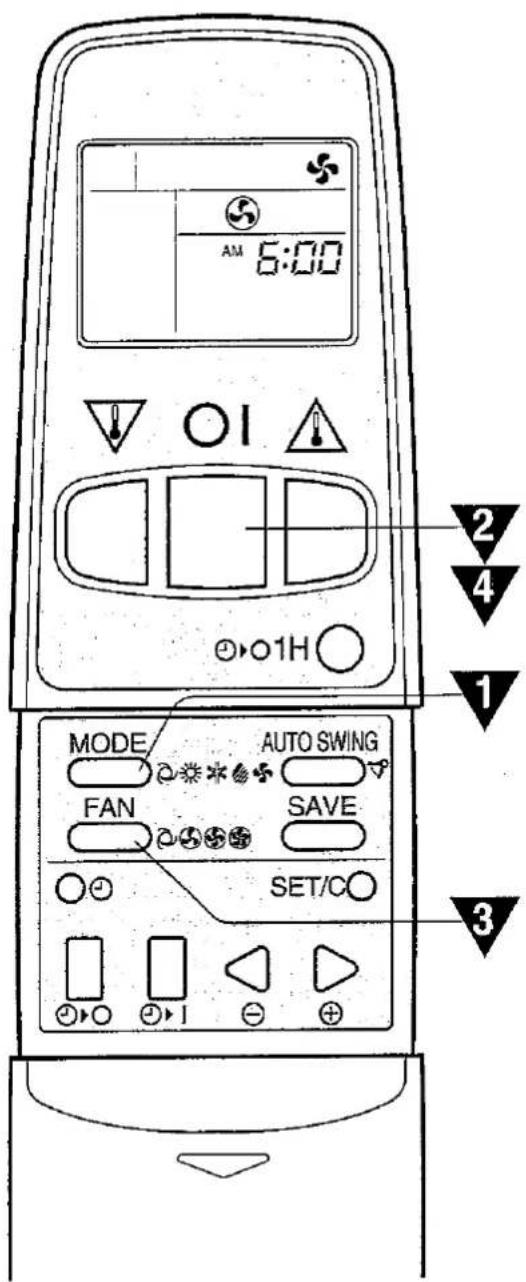
1
Press the MODE button to select the FAN ONLY mode. ( ✿ )
2
Press the ON/OFF button to start operation.
- The red OPERATION lamp of the unit will light up.
3
Press the FAN button to set the desired fan speed.
- Fan speed AUTO ( Ⓞ ) cannot be set.
The AIR SWING mode can be selected, or AIR FLOW direction adjusted by pressing the "AUTO SWING" button. (See p. 16 for detail)
4
To turn off the unit, press the ON/OFF button again.
- The red OPERATION lamp of the unit will go out.
ADJUSTING THE AIR FLOW DIRECTION
VERTICAL AIR FLOW

The direction of the air flow is automatically preset for the optimum effect in each mode as follows;
| COOL and DRY mode | Horizontal air flow |
| HEAT and FAN ONLY mode | Diagonal air flow (45°) |
The air flow direction can be changed as desired.
AIR SWING MODE
Press the AUTO SWING button once.
The vertical adjustment louvre will swing continuously within the range shown.
Adjustment range
COOL and DRY mode
HEAT and FAN ONLY mode

The range is more narrow to prevent condensation from forming.

The range is wider for increased air circulation.
HOW TO ADJUST THE AIR FLOW DIRECTION
Press the AUTO SWING button once. The vertical adjustment louvre will move up and down.
Press the AUTO SWING button again when the desired position is reached and the louvre will stop.
HORIZONTAL AIR FLOW
Hold the horizontal adjustment louvre levers as shown and adjust the air flow direction. There are four louvre levers.

natural_image
Line drawing of a hand adjusting a structural component with arrows indicating force or movement (no text or symbols)Louvre levers

CAUTION
Never attempt to adjust the vertical adjustment louvre manually.
- Manual adjustment of this louvre can cause the unit to malfunction when remote-controlled later.
- When the COOL or DRY modes are used for an extended period of time with the vertical adjustment louvre manually adjusted so that the air flows downward, condensation may form.
SAVE MODE
Designed for greater energy efficiency, use of this mode reduces power consumption and offers energy savings by up to 10% compared with the normal operation.
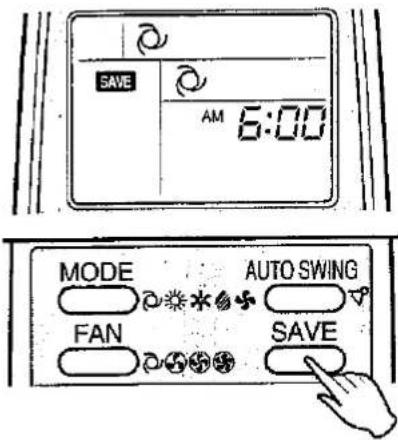
1 To activate the SAVE mode, press the SAVE button during operation.
- SAVE is displayed on the remote control.
• The temperature display disappears.
2 To cancel the save mode, press the SAVE button again.
*The SAVE display disappears and the unit returns to the former mode.
ADVANTAGE OF USING SAVE MODE
The save mode reduces power consumption by approximately 10% compared with the normal operation.

line
| Beginning of SAVE MODE | Power consumption | | --------------------- | ----------------- | | Start | High | | End | Approx. 10% reduction |NOTES:
- You cannot use the SAVE mode during the DRY and FAN ONLY mode.
- You cannot set the temperature during the SAVE operation.
TIMER OPERATION
NOTE:
Before setting the timer, check to see if the current clock time is properly set.
"WAKE UP" FUNCTION (TIMER ON MODE)
Use the "WAKE UP" function to turn the unit on at a programmed time.

1 Press the TIMER ON (☐) button.
2 The TIMER ON indicator will blink; press the TIME ADVANCE or REVERSE buttons to set the desired time. (The time can be set by 10 minutes.)
3 Point the remote control at the receiver window of the unit and press the TIMER SET (SET/C) button.
4 Select the operation you wish to program.
Operation mode setting → MODE BUTTON
Fan speed setting → FAN BUTTON
Temperature setting (The temperature is set automatically in AUTO MODE.) → THERMO BUTTON
- The yellow TIMER lamp on the unit lights up.
- An audible sound indicates that the unit has received the signal.
- The unit will turn on prior to the time set to allow the room to reach the desired temperature by the programmed time.
TO CANCEL TIMER MODE
Press the TIMER CANCEL button "SET/C". The yellow TIMER lamp of the unit will go out. The current clock time will be displayed on the remote control.
TO CHANGE TIME SETTING
First, cancel the TIMER, and then set it again.
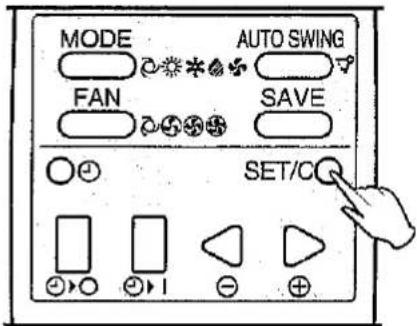
TO CHANGE FAN SPEED, MODE, AND/OR THERMOSTAT SETTING AFTER SETTING TIMER
Press each button to change the settings as desired.
"AUTO SLEEP" FUNCTION (TIMER OFF MODE)
Use the "AUTO SLEEP" function to turn the unit off at a programmed time. During this mode, the room temperature is automatically adjusted slightly to prevent the room from becoming too hot or too cold while you sleep. (See explanation below)
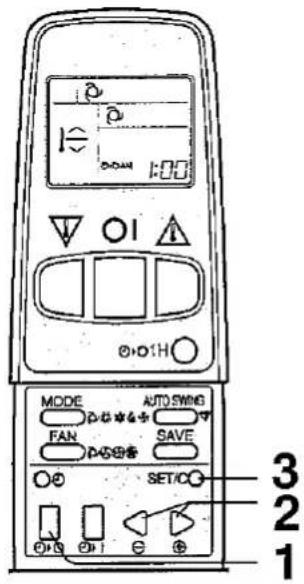
1 Press the TIMER OFF (④▶○) button during operation.
2 The TIMER OFF indication will blink; press the TIME ADVANCE or REVERSE buttons to set the desired shut-off time. (The time can be set by 10 minutes.)
3 Point the remote control at the receiver window of the unit and press the TIMER SET(SET/C) button.
- The yellow TIMER lamp on the unit lights up.
- An audible sound indicates that the unit has recieved the signal.
HOW THE "AUTO SLEEP" FUNCTION WORKS
When the "AUTO SLEEP" FUNCTION is selected;
DURING COOL/DRY MODE
One hour after timer operation has begun, the temperature rises 1°C higher than the thermostat setting to prevent the room from getting too cool for sleeping.
DURING HEAT MODE
One hour after timer operation has begun, the temperatures drops 3 °C lower than the thermostat setting to prevent the room from getting too warm for sleeping.
NOTE:
The "AUTO SLEEP" function will not activate during the FAN ONLY mode.


TIMER OPERATION (Continued)
COMBINED USE OF ON AND OFF TIMERS
Stop → ON → OFF

To obtain the desired room temperature by 5:30 p.m. and to stop operation at 11:00 p.m.
1 Set the TIMER ON to 5:30 p.m.
- The yellow TIMER lamp on the unit lights up. - An audible sound indicates that the unit has received the signal.
2 Set the TIMER OFF to 11:00 p.m.
- An audible sound indicates that the unit has received the signal.
3 Select the operation you wish to program.
Operation mode setting → MODE BUTTON Fan speed setting → FAN BUTTON Temperature setting → THERMO BUTTON
Operation OFF ON
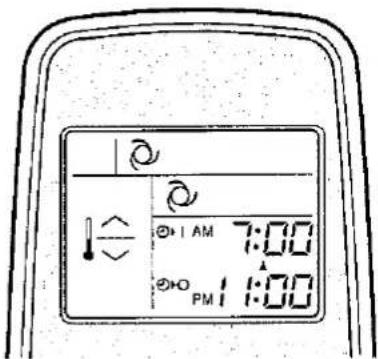
Stop operation at 11:00 p.m. and resume operation (using the same settings) to obtain the desired room temperature by 7:00 a.m.
1 Set the TIMER OFF to 11:00 p.m. during operation.
- The yellow TIMER lamp on the unit lights up. - An audible sound indicates that the unit has received the signal.
2 Set the TIMER ON to 7:00 a.m.
- An audible sound indicates that the unit has received the signal.
The arrows (▼ or ▲) between the TIMER ON indicator and TIMER OFF indicator shows which timer will activate first.
TO CANCEL THE COMBINED TIMER
Press the TIMER CANCEL button (SET/C).
Both TIMER ON and TIMER OFF will be canceled. The yellow TIMER lamp of the unit will go out and the current clock time will be displayed on the remote controller.
NOTES:
- You cannot program the ON and OFF timers to different temperatures or other settings.
- Either timer can be programmed prior to the other.
ONE-HOUR TIMER
When ONE-HOUR TIMER is set, the unit will turn off automatically after one hour.
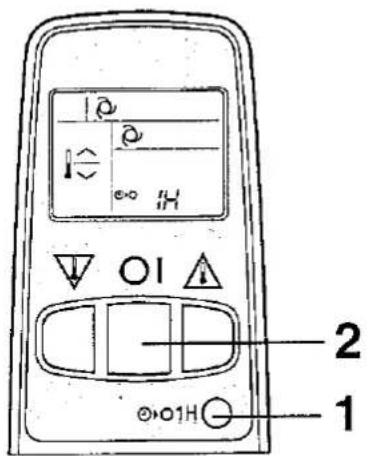
1 Press the ONE HOUR TIMER button.
- "1 H" will be displayed on the remote control.
• The unit will operate for one hour.
2 To turn off the unit within one hour, press the ON/OFF button.
• The OPERATION lamp on the unit will go out.
If you wish to operate the unit additionally for another one hour, press the ONE-HOUR TIMER button again during operation.
NOTES:
- When the ONE HOUR TIMER button is pressed in the stop mode, the unit begins operating and turns off automatically after one hour.
- The ONE HOUR TIMER operation has priority over other timer operations, such as the TIMER ON and TIMER OFF.
Example 1:
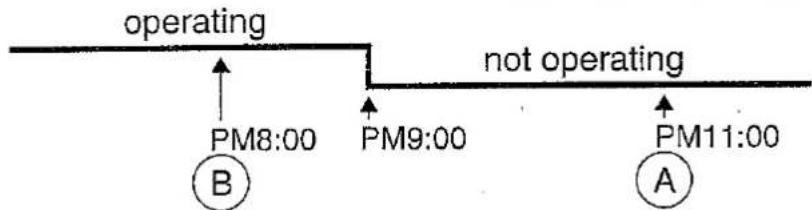
If the timer off is set to 11:00 p.m. (A) and the ONE HOUR TIMER button is pressed at 8:00 p.m. (B),
flowchart
graph TD
    A["operating"] --> B["PM8:00"]
    B --> C["not operating"]
    C --> D["PM9:00"]
    D --> E["PM11:00"]
    style A fill:#f9f,stroke:#333
    style B fill:#ccf,stroke:#333
    style C fill:#cfc,stroke:#333
    style D fill:#fcc,stroke:#333
    style E fill:#cff,stroke:#333
the unit will turn off at 9:00 p.m. The TIMER OFF indicator of the remote control will reappear after the "1H" indicator goes off. The TIMER OFF will be activated if you turn on the unit again before 11:00 p.m.
Example 2:
If the timer on is set to 8:00 a.m. (A) and the ONE HOUR TIMER button is pressed at 5:00 a.m. (B),

flowchart
graph LR
    A["not operating"] --> B["operating"]
    B --> C["not operating"]
    C --> D["operating"]
    B --> E["AM5:00"]
    C --> F["AM6:00"]
    D --> G["AM8:00"]
    style A fill:#f9f,stroke:#333
    style B fill:#ccf,stroke:#333
    style C fill:#cfc,stroke:#333
    style D fill:#fcc,stroke:#333
    style E fill:#ffc,stroke:#333
    style F fill:#ffc,stroke:#333
    style G fill:#fcc,stroke:#333
the unit will operate for one hour from 5:00 a.m. to 6:00 a.m. The TIMER ON indicator of the remote control will reappear after the "1H" indicator goes off. The unit will turn on when the TIMER ON (8:00 a.m.) activates.
USING THE AUXILIARY MODE
Use this mode when the remote control is not available.
TO TURN ON
Lift the panel of the indoor unit and press the AUX. button on the operation panel.
- The red OPERATION lamp on the unit will light up and the unit will start operating in the AUTO mode.
- The fan speed and temperature setting are set to AUTO.
TO TURN OFF
Press the AUX. button on the operation panel again.
- The red OPERATION lamp on the unit will go out.
NOTE:
If the AUX. button is pressed during normal operation, the unit will turn off.

USING TEST RUN MODE
Use this mode to check the operation of the unit. Since the thermostat control does not function and runs in a continuous operation mode, do not use this mode during the normal operation.
Make sure the unit is turned off before conducting this test.
TO TURN ON
Lift the panel of the indoor unit and press the TEST RUN button on the operation panel.
- The red OPERATION lamp on the unit will blink and the unit will start operating in the COOL mode.
TO TURN OFF
Press the TEST RUN button on the operation panel again.
• The red OPERATION lamp on the unit will go out.
NOTE:
To conduct a test run in the HEAT mode, press the MODE button on the remote control to set the HEAT( ) mode.

IMPORTANT OPERATIONAL POINTS
DURING THE AIR CONDITIONER OPERATION
- A built-in protective device may prevent the unit from operating when the ambient temperature is extremely high or low.
- Dew may form on the air outlet when the unit operates continuously in the COOL or DRY mode when the humidity is over 80%.
3-MINUTE PROTECTION
After the unit has been turned off, a protective mechanism prevents it from being turned on again for three minutes.
FAN SPEED
- When the fan speed is set to AUTO in the COOL mode, the fan speed automatically decreases as the room temperature nears the thermostat setting.
- When the room temperature reaches the thermostat setting in the HEAT mode, the compressor stops and the indoor fan changes to the SOFT setting or stops.
- In the DRY mode, the fan speed is controlled automatically.
PREHEATING FUNCTION
In the HEAT operation, the indoor fan may not start for 2-5 minutes after the unit is turned on to prevent the air from circulating before the unit is sufficiently warmed up.
DE-ICING FUNCTION
- When ice forms on the heat exchanger in the outdoor unit during the HEAT operation, an automatic de-icer provides heat for about 2-10 minutes to remove the ice. During de-icing, the inside and outside fans stop operating.
- After de-icing is completed, the unit automatically resumes operation in the HEAT mode.
HEATING EFFICIENCY
- The unit employs a heat pump that draws heat from the outside air and releases it into the room. The outside air temperature therefore greatly affects the heating efficiency.
- If low outside temperatures adversely affect the heating efficiency, use an additional heater.
- It takes time to warm up and heat the entire room because this unit employs a forced air circulation design. To warm up the room in advance, use the timer in the HEAT operation.
MAINTENANCE
Be sure to unplug the power cord from the wall outlet or turn off the circuit breaker before performing any maintenance.
CLEANING THE FILTERS
natural_image
Illustration of hands using a tool to cut a textured rectangular object (no text or symbols)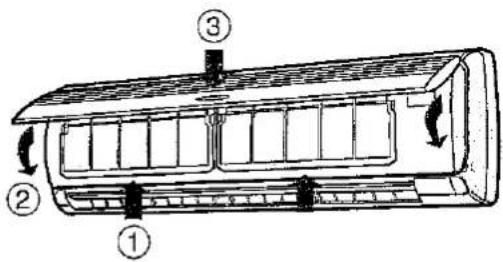
The air filters should be cleaned every 2 weeks. Clean the filters once a week, however, if there is a lot of dust in the room.

TURN OFF THE UNIT.

REMOVE THE FILTERS.
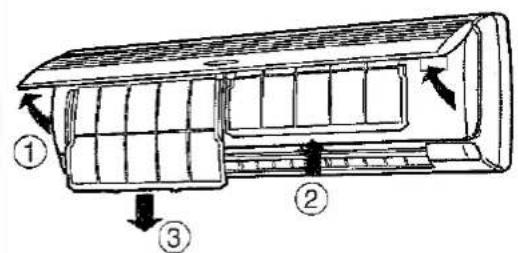
1 Lift up the cover.
2 Push the air filters up slightly to unlock them.
3 Pull the air filters down to remove them.

CLEAN THE FILTERS
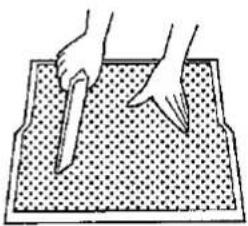
Use a vacuum cleaner to remove the dust. If the filter is dirty, wash it with warm water and a mild detergent. Dry the filters in the shade before reinstalling.

REINSTALL THE FILTERS
1 Align and fit the filters in place.
2 Close the cover.
3 Push the centre of the cover firmly to lock it in place.
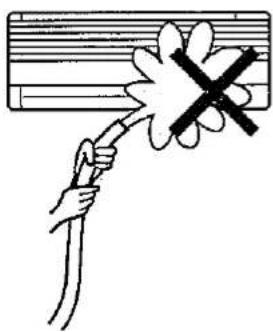
AVOID SPLASHING UNIT WITH WATER
Do not splash or pour water on the unit or the remote control. It could result in electrical shock or damage to the product.
To clean the unit or the remote control, wipe them with a soft cloth.
natural_image
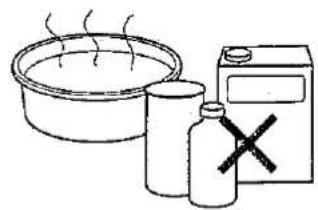
Illustration of a hand holding a tool with a cross symbol, next to a striped panel (no text or symbols present)DO NOT USE HOT WATER OR SOLVENTS
Do not use hot water, thinner, abrasive powders or strong solvents to clean the unit or the remote control.
natural_image
Simple line drawing of a cooking pot, a cylindrical container, and a bottle with a cross mark (no text or symbols)MAINTENANCE (Continued)
When you have finished using the unit for the season, run it in the FAN ONLY mode for about half a day to allow the mechanism to thoroughly dry.
If you are using the home circuit breaker exclusively for the air conditioner, turn off the air conditioner, then turn off the circuit breaker.
CLEAN FILTERS
Clean the filters, then reinstall them.

natural_image
Cartoon illustration of a smiling face holding a grid-patterned object (no text or symbols)SEASONAL INSPECTION
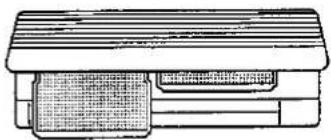
ALWAYS INSTALL THE FILTERS
If the unit operates without a filter in place, dust can enter the machine and damage it.
natural_image
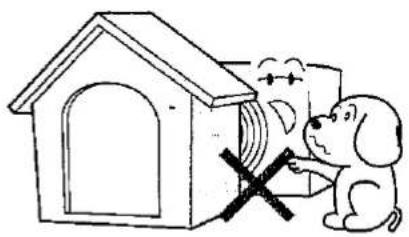
Technical line drawing of a mechanical component with no visible text or symbolsDO NOT BLOCK AIR INLET AND OUTLET
Blocking the air inlet and outlet can result in poor operation.
natural_image
Cartoon illustration of a dog and a dog inside a doghouse, with a crossed-out 'X' symbol (no text or symbols present)CHECK OUTDOOR UNIT MOUNTING RACK
Check the outdoor mounting rack periodically for wear and to make sure it is firmly in place.
ADDITIONAL NOTES ON OPERATION
| THE FOLLOWING ARE NORMAL CONDITIONS FOR THE UNIT. | |
UNIT DOES NOT OPERATEIf you restart the air conditioner within 3 minutes after turning it off, or change the mode during operation, a protective device will work to shut off the unit for 3 minutes.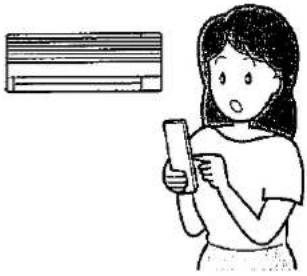 | LOW NOISEA soft, swishing noise can be heard during operation or immediately after the unit is turned off. This is the sound of the circulating refrigerant. |
WARM AIR DOESN'T COME OUTWarm air does not come out of the air outlets in the preheating or the de-icing operation.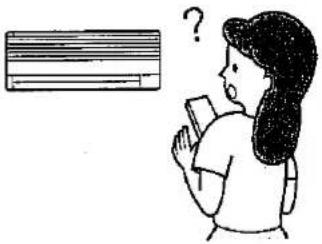 | WATER VAPOURIn the COOL and DRY operation, water vapour can sometimes be seen coming from the air outlet due to the difference in temperature between the room air and the outlet air.In HEAT operation, water vapour may come out of the outdoor unit during the de-icing operation. |
ODORSOdors present in the room, such as those from the carpet or furniture, may be emitted from the unit. | INDOOR UNIT FAN SPEEDWhen using the air swing mode, the speed of the indoor fan may vary slightly as the louvre moves up and down. |
BEFORE CALLING FOR SERVICE
If the unit appears to be malfunctioning, check the following points before calling for service.
| IF THE UNIT FAILS TO OPERATE |
| Check to see if the circuit breaker has tripped or the fuse has blown. |
| IF THE UNIT FAILS TO COOL THE ROOM PROPERLY | ||
| Check the filter. If it's dirty, clean it. | Check the outdoor unit to make sure nothing is blocking the air inlet or outlet. | Check whether the thermostat is set properly. If it is set too high in the COOL mode or too low in the HEAT mode, the unit may fail to operate properly. |
| Make sure all windows and doors are closed tightly. Air entering from outside can prevent the room from cooling sufficiently. | A large number of people in the room can prevent the desired temperature from being reached. | The use of heat-generating appliances in the room will adversely affect cooling efficiency. |
| IF THE UNIT FAILS TO RECEIVE THE REMOTE CONTROL SIGNAL | ||
| Check whether the remote control batteries have become old and weak. | Check whether the remote control batteries are installed in the proper polarity. | Try to send the signal again with the remote control pointed properly towards the unit's receiver window. |
| PRECAUTIONS FOR INSTALLATION |
| LOCATIONThe unit may not function well in locations where there is excessive dust, fumes or moisture in the air.REMOVALDo not attempt to remove the unit yourself. Consult your dealer or other qualified service personnel for assistance. |
SPECIFICATIONS
| Models | AY-A184JAE-A184J | AY-A244JAE-A244J |
| Rated A.C.voltage | 230-240V | 230-240V |
| Rated frequency | 50Hz | 50Hz |
| Cooling Capacity | 4.98kW | 6.53kW |
| Heating Capacity | 5.90kW | 7.83kW |

- SPLIT TYPE ROOM AIR CONDITIONER
- MAIN FEATURES
- AUTOMATIC OPERATION
- AUTO SLEEP FUNCTION (TIMER OFF)
- WAKE UP FUNCTION (TIMER ON)
- ONE-HOUR TIMER
- WARNING:
- CAUTION:
- PRECAUTIONS FOR USE
- USE A 230-240 VOLT POWER CIRCUIT ONLY.
- VENTILATE THE ROOM OCCASIONALLY DURING USE.
- DO NOT INSERT OBJECTS INTO THE INLET OR OUTLET.
- DO NOT PULL, HANG ON, OR OTHERWISE MISUSE THE POWER CORD.
- WHEN USING THE AIR CONDITIONER FOR INFANTS, CHILDREN, OR ELDERLY, BEDRIDDEN, OR DISABLED PEOPLE
- ALWAYS USE A FUSE WITH THE CORRECT CURRENT RATING.
- TIPS ON SAVING ENERGY
- SET THE CORRECT TEMPERATURE
- KEEP OUT DIRECT SUNLIGHT AND DRAFTS
- SET PROPER AIR FLOW DIRECTION
- KEEP FILTER CLEAN
- MAKE MOST OF TIMER
- UNPLUG THE POWER CORD WHEN THE UNIT IS NOT TO BE USED FOR AN EXTENDED PERIOD
- PART NAMES
- INDOOR UNIT
- OUTDOOR UNIT
- OPERATION AND INDICATOR PANELS
- PART NAMES (Continued)
- REMOTE CONTROL
- L.C.D. REMOTE CONTROL DISPLAY
- USING THE REMOTE CONTROL
- LOADING BATTERIES
- Use two high-quality size-AAA (R03) batteries.
- NOTES:
- HOW TO USE THE REMOTE CONTROL
- Point the remote control towards the unit's receiver window and press the desired button. A beep will sound when the unit receives the signal.
- CAUTION
- SET CURRENT CLOCK TIME
- BASIC OPERATION
- BASIC OPERATION (Continued)
- COOL MODE
- DRY MODE
- 1
- 2
- 3
- 4
- ADJUSTING THE AIR FLOW DIRECTION
- VERTICAL AIR FLOW
- AIR SWING MODE
- Adjustment range
- HOW TO ADJUST THE AIR FLOW DIRECTION
- HORIZONTAL AIR FLOW
- SAVE MODE
- ADVANTAGE OF USING SAVE MODE
- TIMER OPERATION
- NOTE:
- "WAKE UP" FUNCTION (TIMER ON MODE)
- TO CANCEL TIMER MODE
- TO CHANGE TIME SETTING
- TO CHANGE FAN SPEED, MODE, AND/OR THERMOSTAT SETTING AFTER SETTING TIMER
- "AUTO SLEEP" FUNCTION (TIMER OFF MODE)
- HOW THE "AUTO SLEEP" FUNCTION WORKS
- DURING COOL/DRY MODE
- DURING HEAT MODE
- TIMER OPERATION (Continued)
- COMBINED USE OF ON AND OFF TIMERS
- TO CANCEL THE COMBINED TIMER
- Example 1:
- Example 2:
- USING THE AUXILIARY MODE
- Use this mode when the remote control is not available.
- TO TURN ON
- TO TURN OFF
- USING TEST RUN MODE
- IMPORTANT OPERATIONAL POINTS
- DURING THE AIR CONDITIONER OPERATION
- 3-MINUTE PROTECTION
- FAN SPEED
- PREHEATING FUNCTION
- DE-ICING FUNCTION
- HEATING EFFICIENCY
- MAINTENANCE
- CLEANING THE FILTERS
- AVOID SPLASHING UNIT WITH WATER
- DO NOT USE HOT WATER OR SOLVENTS
- MAINTENANCE (Continued)
- CLEAN FILTERS
- SEASONAL INSPECTION
- ALWAYS INSTALL THE FILTERS
- DO NOT BLOCK AIR INLET AND OUTLET
- CHECK OUTDOOR UNIT MOUNTING RACK
- ADDITIONAL NOTES ON OPERATION
- BEFORE CALLING FOR SERVICE
- SPECIFICATIONS
Brand : SHARP
Model : AE-A184J
Category : Air conditioner