
Kappa Perfect 12DVQ - Subwoofer INFINITY - Free user manual and instructions
Find the device manual for free Kappa Perfect 12DVQ INFINITY in PDF.


| Product Type | Subwoofer |
| Brand | Infinity |
| Model | Kappa Perfect 12DVQ |
| Size | 12 inches (300 mm) |
| Power Handling (RMS) | 400 Watts |
| Power Handling (Peak) | 1600 Watts |
| Frequency Response | 23 Hz – 400 Hz |
| Impedance per Voice Coil | 4 Ohms (Dual Voice Coil) |
| Sensitivity (2.83V/1m) | 89 dB |
| Voice Coil Diameter | 3 inches (77 mm) |
| Mounting Depth | 7 inches (178 mm) |
| Overall Diameter | 12.375 inches (315 mm) |
| Cut-Out Diameter | 10.875 inches (277 mm) |
| Basket Displacement | 0.108 ft³ (3.06 L) |
| Maximum Linear Excursion (Xmax) | 0.6875 inches (16.75 mm) |
| Variable Q Inserts | LowQ, MidQ, None (included) |
| Recommended Enclosures | Sealed, Vented, Bandpass |
| Free-Air Resonance (Fs) | 22.19 Hz |
| Total Q (Qts) with LowQ Insert | 0.30 |
| Total Q (Qts) with MidQ Insert | 0.47 |
| Total Q (Qts) without Insert | 0.60 |
| Compliance Volume (Vas) | 3.38 ft³ (96.43 L) |
| Moving Mass (Mms) | 182.7 g |
| Voice Coil DC Resistance (Revc) | 3.42 Ohms |
Frequently Asked Questions - Kappa Perfect 12DVQ INFINITY
User questions about Kappa Perfect 12DVQ INFINITY
0 question about this device. Answer the ones you know or ask your own.
Ask a new question about this device
Download the instructions for your Subwoofer in PDF format for free! Find your manual Kappa Perfect 12DVQ - INFINITY and take your electronic device back in hand. On this page are published all the documents necessary for the use of your device. Kappa Perfect 12DVQ by INFINITY.
USER MANUAL Kappa Perfect 12DVQ INFINITY
Thank you for purchasing an Infinity Kappa Perfect VQ subwoofer. Kappa Perfect VQ subwoofers are engineered to provide unparalleled audio reproduction at even the highest output levels, and are constructed using state-of-the-art materials for unequalled performance and longevity. To ensure the best subwoofer performance possible, we recommend that a qualified professional perform the installation. Although these instructions provide enclosure specifications and explain how to install a Kappa Perfect VQ subwoofer in a general sense, they do not show specific box-construction details or vehicle-specific installation methods. If you don't feel you have the knowledge, experience or necessary skills to install the subwoofer yourself, ask your authorized Infinity dealer about professional installation options.
Remember to keep your sales receipt and this manual in a safe place so they're available for future reference.
INTRODUCTION
A FEW WORDS ABOUT POWER HANDLING
The power-handling capability of any woofer is related both to its ability to dissipate heat and to the maximum excursion limits of its suspension. Once the speaker's voice coil moves outside the magnetic gap, power can no longer be converted into motion and all the amplifier's power is converted into heat in the voice coil. Voice-coil heating is the greatest detriment to speaker longevity, so overexcursion should be avoided. Since excursion characteristics are very different for each type of enclosure, power handling will be different for each enclosure type.
Sealed enclosures exert the most control over the motion of the subwoofer at the very lowest frequencies because the air inside the box acts as a spring, opposing the motion
of the woofer's cone. Larger boxes allow more excursion, providing more low-frequency output than the same woofer in a smaller box, for any input power level. When placed in a sealed box much larger than the equivalent compliance (Vas) of the subwoofer, it will perform as if it were in an infinite-baffle application, with the attendant lower excursion-limited power handling.
Vented and bandpass enclosures allow the least excursion for the amount of sound output (near and above the resonance frequency of the enclosure). The mass of air contained in the port provides an acoustic load to the woofer's cone at the tuning frequency, and this added mass decreases excursion so that the subwoofer's motor is, essentially, coupled to the air in the port. Vented boxes do not provide adequate control below the frequency at which the box is tuned, so proper design and a subsonic filter are important. A vented bandpass box will allow the least cone excursion, provided a subsonic filter is used.
Infinite-baffle, or "free air," mounting allows for greater excursion than does mounting subwoofers in enclosures. The power handling of a subwoofer mounted in an infinite baffle will be reduced by nearly half its rated-power-handling spec.
Voice-coil overheating and burning have only one cause – exposure to too much power for too long. An amplifier driven into severe clipping or square-wave can output much more average power than the average power of a clean sine wave of the same level. Audible distortion in the sound is a clear indication of amplifier clipping and should serve as an indication that your speakers may be in danger of being damaged.
VARIABLE Q (PATENT PENDING)
Kappa Perfect VQ Series subwoofers are unique because they provide variable Q. Q adjustments may allow the subwoofer to be optimized for a particular enclosure or application and may provide the user with optimum performance for several applications in a single enclosure.
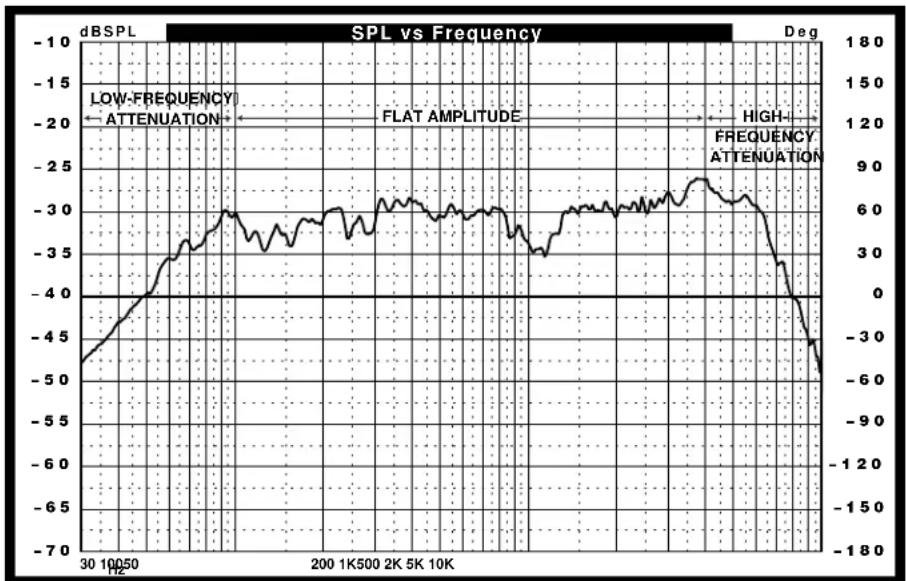
The frequency response of every speaker includes three distinct regions characterized by flat amplitude (passband), high-frequency attenuation (stopband-high) or low-frequency attenuation (stopband-low) (see Figure 1). Midrange speakers and, to a lesser extent, tweeters are used to reproduce frequencies in the region where they exhibit flat frequency response. Subwoofers, on the other hand, are used in a region of low-frequency attenuation, but those low frequencies are what we want the subwoofer to reproduce. Subwoofer system design is almost entirely an effort to extend the region of flat response to the lowest possible
frequency or to shape the frequency response in the band of reproduced frequencies. Qes and, consequently, Qts are the parameters that best describe the behavior of a subwoofer in the range of frequencies it is most often used to reproduce.
line
| Frequency | SPL (dB SPL) | | --------- | ------------ | | 30 | -4.5 | | 10050 | -3.5 | | 200 | -3.0 | | 1K500 | -2.8 | | 2K | -2.7 | | 5K | -2.6 | | 10K | -2.5 | | 100000 | -2.4 | | 1000000 | -2.3 | | 10000000 | -2.2 | | 100000000 | -2.1 | | 1000000000| -2.0 | | 10000000000| -1.9 | | 100000000000| -1.8 |Figure 1. Frequency response of a speaker.
VARIABLE Q
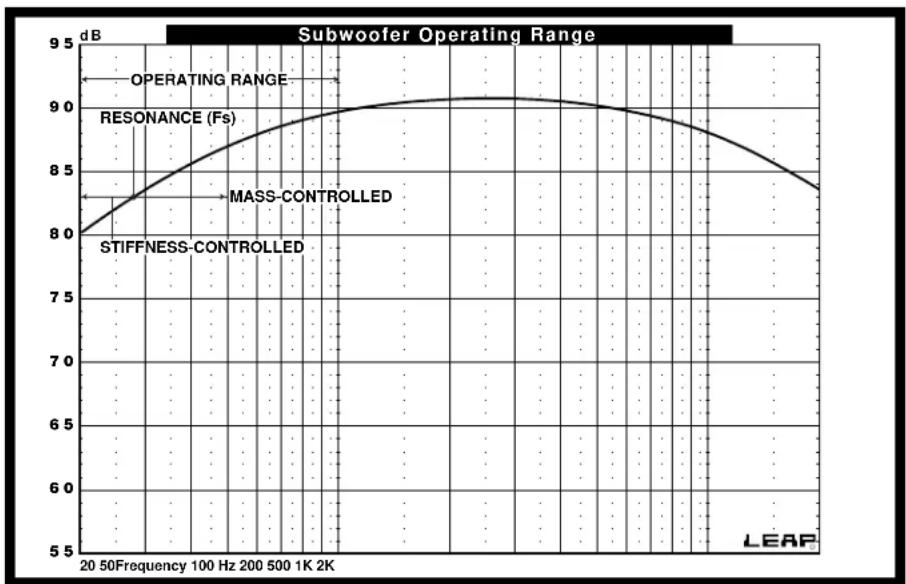
The operation of a subwoofer (or any moving-coil loudspeaker) is divided into two regions. Below resonance, where the motion of the cone is "stiffness-controlled," the subwoofer's suspension does a great deal of the work of opposing the inertia of the moving assembly – the stiffness of the suspension controls the motion of the cone. Above resonance, where the motion of the cone is "mass-controlled," the subwoofer's suspension has little effect on the motion of the cone, and the motor must do all the work of opposing the inertia of the moving assembly – the motor controls the motion of the cone. "Opposing inertia" simply means starting and stopping the motion of the cone.
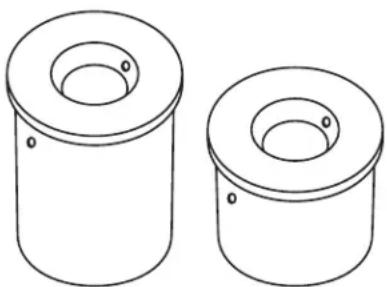
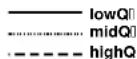
The metal inserts included with your Kappa Perfect VQ Series woofer are used to adjust the amount of force the motor can exert on the inertia of the moving assembly. The largest of the two inserts (LowQ), when installed in the woofer's polepiece, will provide the highest motor force and, consequently, the lowest Q (see Figure 3). The smaller of the two inserts (MidQ) will provide less motor force and somewhat higher Q and the woofer used without an insert will have a much higher Q. (continued)
natural_image
Two identical cylindrical mechanical components with central holes, shown from different angles (no text or symbols)Figure 3.
line
| Frequency | Operating Range (dB) | | --------- | -------------------- | | 20 | 8.0 | | 50 | 8.5 | | 100 | 9.0 | | 200 | 9.0 | | 500 | 8.8 | | 1K | 8.5 | | 2K | 8.0 |Figure 2. Subwoofer operating range.
VARIABLE Q (CONTINUED)
Kappa Perfect VQ woofers are designed to provide optimum system Q and frequency response in infinite-baffle applications or in very large enclosures with no insert installed in the polepiece. The smaller of the two inserts is intended to be used with woofers mounted in medium-sized sealed boxes and vented boxes. The largest insert is intended to provide optimum Q for very small sealed or vented boxes or for use with woofers used in SPL competition, where the enclosure is designed to provide the highest output possible at a single frequency.
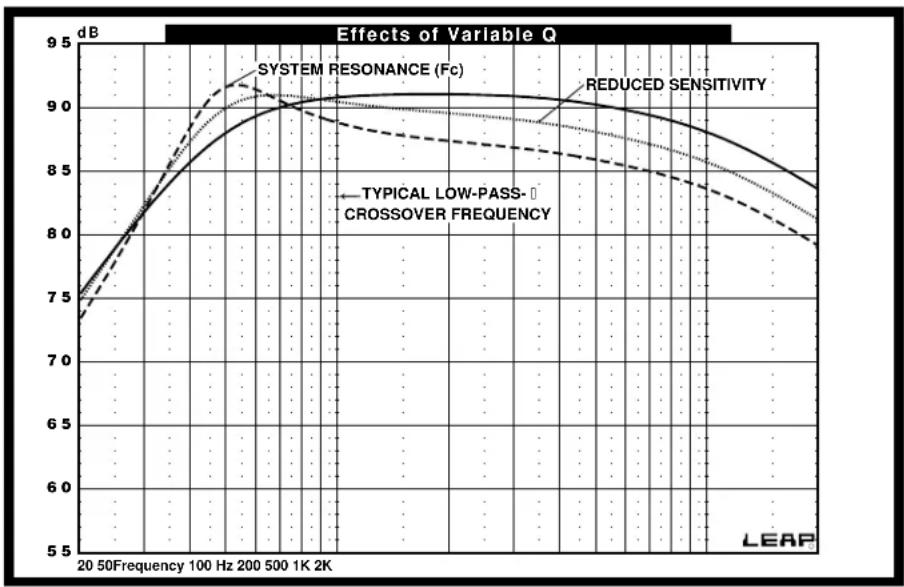
While it may seem that the most forceful motor will provide the best performance in all applications, in reality that is not the case. When a woofer is mounted in an enclosure, the resonance of the woofer becomes the resonance of the combination of the air inside the box and the woofer, and Qts (speaker Q) becomes Qtc (system Q). For example, Figure 4 shows the response of a Kappa Perfect VQ subwoofer in a sealed box optimized for use with the MidQ insert. Pictured on the graph are the responses of the woofer and enclosure combination with the LowQ insert installed; with the MidQ insert installed; and without an insert installed (HighQ). The difference in the performance of the woofer with its various adjustments is increased output at and slightly above system resonance (Fc) with increasing Q, but reduced output at the lowest reproduced frequencies. The reduced motor force supplied by the lower-Q designs results in reduced sensitivity (SPL 2.83V/1m), but the effects of that reduced sensitivity are greatest above 100Hz. Subwoofers in cars are typically used for frequencies below 100Hz, so the reduced sensitivity is inconsequential. The difference in behavior for vented and bandpass enclosures is similar, but the enclosure design is more complex and should be given special attention.
Although Kappa Perfect VQ subwoofers were designed with specific uses for the inserts in mind, there are many different enclosure and insert combinations that may suit your taste. The intended combinations are highlighted as "optimum" on the charts in the section titled "Choosing an Application and Enclosure"; several other applications are also included.
line
| Frequency | SYSTEM RESONANCE (Fc) | REDUCED SENSITIVITY | TYPICAL LOW-PASS-☐ CROSSOVER FREQUENCY | | --------- | --------------------- | ------------------- | -------------------------------------- | | 20 | 75 | 75 | 75 | | 50 | 85 | 85 | 80 | | 100 | 90 | 90 | 85 | | 200 | 90 | 90 | 85 | | 500 | 90 | 90 | 85 | | 1K | 90 | 90 | 85 | | 2K | 85 | 85 | 80 |Figure 4. Effects of Variable Q.
INSTALLING AND REMOVING THE INSERTS
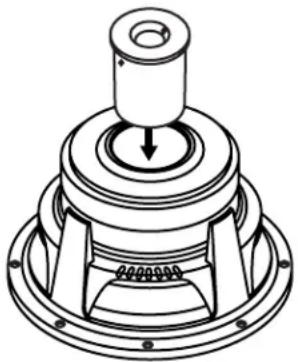
Your Kappa Perfect VQ subwoofer is shipped from the factory without an insert installed. After determining which application and enclosure is most suitable for your system, install the appropriate insert in the woofer's polepiece by aligning the insert with the hole in the woofer's polepiece and simply dropping the insert into place (see Figure 5).
Figure 5. Installing the insert.
natural_image
Technical line drawing of a speaker assembly with a central hub and base mount (no text or symbols)To remove the insert, squeeze the insert tool to compress the area between the two tabs, insert the end of the tool into the vent in the center of the insert and align the two tabs with the two small holes inside the vent. The tabs should lock into the two holes. Pull firmly on the tool to remove the insert (See Figure 6).
Figure 6. Removing the insert.
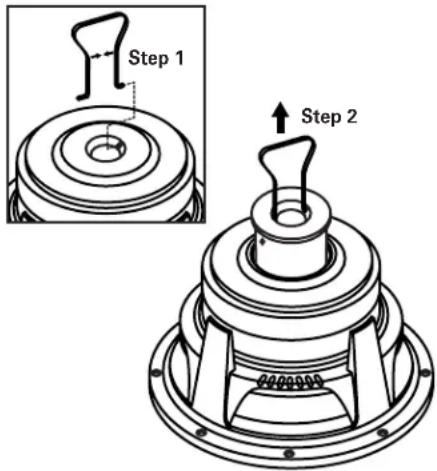
Note: Magnetic force holds the insert in place. Don't be afraid to pull hard on the insert to remove it.
CHOOSING AN APPLICATION AND ENCLOSURE
Study the sample curves on pages 5, 6 and 7 and read each explanation carefully. The charts that follow specify enclosure volumes and vent dimensions (where applicable) and indicate the shape of the response curve both in-car and out-of-car.
PERFECT VQ IN SEALED ENCLOSURES
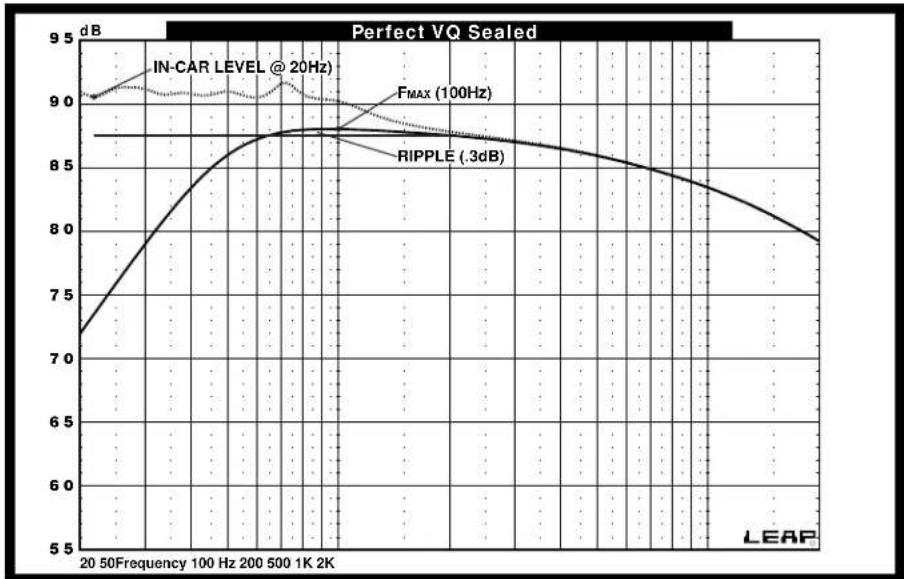
The sample curve below shows typical in-car and out-of-car frequency response curves for a Perfect VQ woofer in a sealed enclosure. The charts that follow give some sealed enclosure volumes that may be used for each of the Perfect VQ woofers. The associated terms (defined below) describe the woofer's performance in the enclosure.
• Vb – Enclosure volume
- F3 – F frequency at which the subwoofer's output is attenuated by 3dB
- Fmax – Frequency at which output is at a maximum
- Ripple – Deviation from flat response above roll-off
- Insert – Indicates which insert should be used (LowQ, MidQ or none)
- In-car level @ 20Hz – Indicates level at the lowest frequency. A positive number indicates a response that rises with decreasing frequency and a negative number indicates a response the falls with decreasing frequency. (continued)
The highlighted combinations will provide the best compromise between low-frequency extension and flat response and high-output, and are considered optimum. Higher ripple values indicate a "boomier" sound and provide higher output at the expense of flat frequency response and low-frequency extension.
| Vb (ft^3) | F3 (Hz) | Fmax (Hz) | Ripple (dB) | Insert | In-Car Level @ 20Hz |
| Kappa Perfect10 VQ and 10d VQ, Sealed | |||||
| 0.3 | 58 | 100 | 0.3 | low | -2 |
| 0.4 | 53 | 100 | -1 | low | 0 |
| 0.5 | 45 | 80 | 1 | mid | 1 |
| 0.75 | 42 | 90 | 0 | mid | 3 |
| 1 | 35 | 54 | 2 | none | 4 |
| infinite baffle | 26 | 90 | -0.5 | none | 11 |
| Kappa Perfect12 VQ and 12d VQ, Sealed | |||||
| 0.4 | 60 | 100 | 2 | low | -4 |
| 0.6 | 58 | 100 | 0 | low | 0 |
| 0.75 | 47 | 76 | 2 | mid | -2 |
| 1 | 42 | 62 | 0.75 | mid | 1 |
| 1.25 | 35 | 50 | 2 | none | 3 |
| infinite baffle | 20 | 80 | 0 | none | 15 |
line
| Frequency | F_MAX (100Hz) | RIPPLE (.3dB) | | --------- | ------------- | ------------ | | 20 | 90 | 72 | | 50 | 91 | 80 | | 100 | 92 | 85 | | 200 | 91 | 87 | | 500 | 90 | 86 | | 1K | 89 | 85 | | 2K | 88 | 84 |CHOOSING AN APPLICATION AND ENCLOSURE (CONTINUED)
PERFECT VQ IN VENTED ENCLOSURES
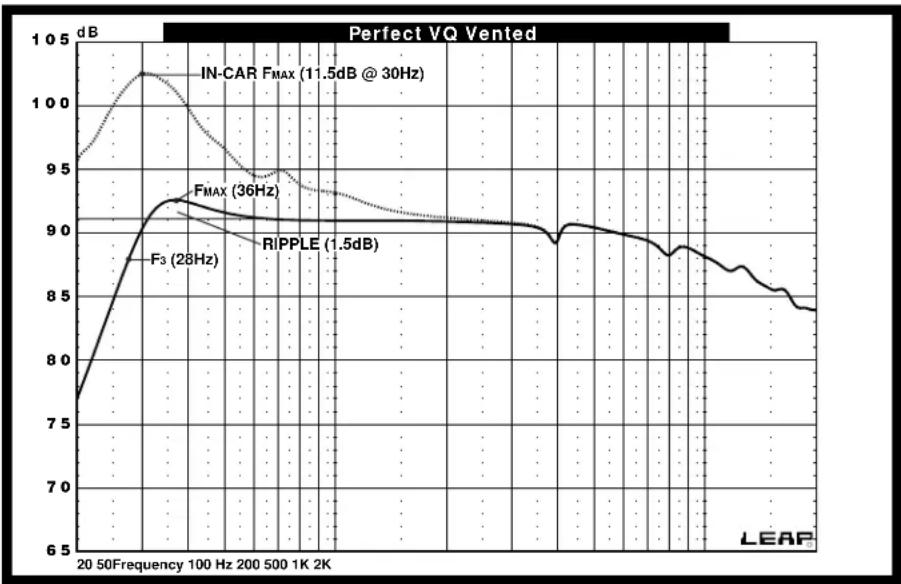
Use the sample curve and the charts at right to choose the vented box that best suits your application. Some additional terms used with vented enclosure specifications are defined below. We recommend the use of round, flared ports to minimize distortion caused by air moving through the port at high output.
- Pd – Port diameter
- PL – Port length
- In-car Fmax – Vented enclosure and woofer systems always exhibit a peak in their frequency response in the car. This term indicates the frequency of the peak and its amplitude.
Highlighted combinations are optimum.
| Vb (ft^3) | Pd (in) | PL (in) | F3 (Hz) | Fmax (Hz) | Ripple (dB) | Insert | In-Car Fmax (Hz) |
| Kappa Perfect10 VQ and 10d VQ, Vented | |||||||
| 1.25 | 3 | 11.5 | 28 | 35 | 3 | low | +10 @ 30 |
| 1.75 | 3 | 12 | 21 | 27 | 2 | mid | +12 @ 25 |
| 1.75 | 3 | 7.5 | 27 | 32 | 4 | mid | +13 @ 30 |
| 2.5 | 3 | 11.5 | 15 | 24 | 2 | mid | +16 @ 23 |
| 2.5 | 3 | 9.5 | 17 | 25 | 3 | mid | +15 @ 25 |
| 2.5 | 3 | 11 | 20 | 21 | 2 | none | +16 @ 20 |
| Kappa Perfect12 VQ and 12d VQ, Vented | |||||||
| 1.75 | 4 | 14.5 | 27 | 36 | 1 | low | +11 @ 30 |
| 2.25 | 4 | 14 | 25 | 32 | 1 | low | +12 @ 28 |
| 2.25 | 4 | 14 | 28 | 38 | 3 | mid | +13 @ 30 |
| 2.25 | 4 | 10.5 | 30 | 40 | 3.5 | mid | +15 @ 35 |
| 3 | 4 | 16 | 22 | 32 | 1 | mid | +15 @ 22 |
| 3 | 4 | 13 | 28 | 35 | 5 | none | +16 @ 30 |
CHOOSING AN APPLICATION AND ENCLOSURE
PERFECT VQ IN BANDPASS ENCLOSURES
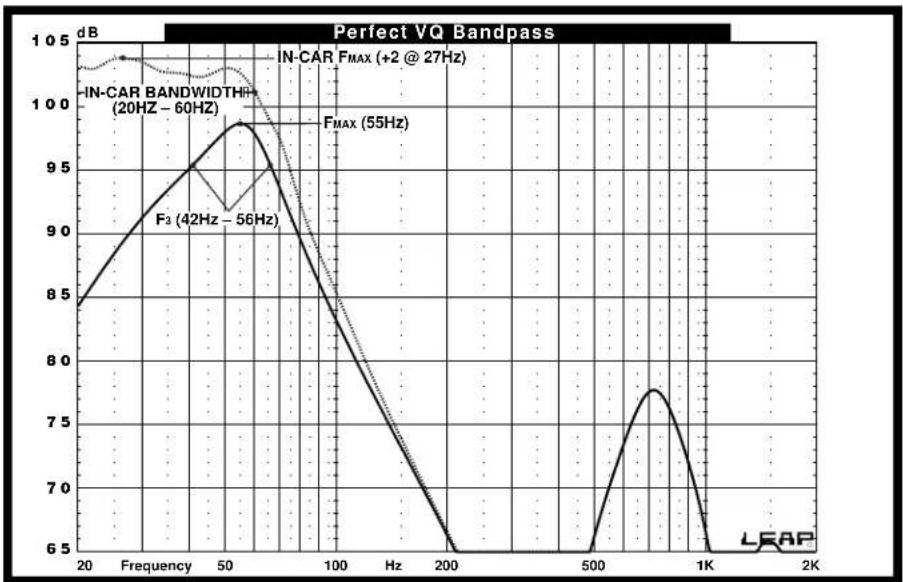
Use the sample curve and the charts that follow to choose the bandpass box that best suits your application. Some additional terms used with bandpass-enclosure specifications are defined below. We recommend the use of round, flared ports to minimize distortion caused by air moving through the port at high output.
• Vbs – Sealed-enclosure volume
• Vbv – Vented-enclosure volume
- Bandwidth – Indicates the passband (range of frequencies between the region of high-frequency attenuation and the region of low-frequency attenuation)
- In-car bandwidth – Indicates the passband with the enclosure mounted in the car
Highlighted combinations are optimum.
| Vbs (ft^3) Vbv (ft^3) Pd (in) PL (in) F3 (Hz) Fmax (Hz) Insert Bandwidth (Hz) Fmax (Hz) | ||||||||
| Kappa Perfect10 VQ and 10d VQ, Bandpass | ||||||||
| 0.6 | 0.35 | 3 | 10 | 42-82 | 65 | low | 20-80 | +2 @ 30 |
| 0.6 | 0.35 | 3 | 10 | 40-80 | 70 | mid | 20-80 | +.5 @ 27 |
| 0.6 | 0.75 | 4 | 11.5 | 35-70 | 70 | none | 20-70 | +4 @ 35 |
| Kappa Perfect12 VQ and 12d VQ, Vented | ||||||||
| 1 | 1 | 4 | 10.5 | 38-68 | 51 | low | 20-60 | 0 @ 40 |
| 2 | 1.2 | 4 | 6.8 | 40-70 | 55 | mid | 20-65 | +1.5 @ 26 |
| 2 | 1.2 | 4 | 10 | 30-63 | 55 | none | 20-55 | +6 @ 26 |
line
| Frequency | IN-CAR Bandwidth (dB) | F_max (dB) | | --------- | --------------------- | ---------- | | 20 | 85 | 100 | | 50 | 98 | 100 | | 100 | 85 | 100 | | 200 | 65 | 65 | | 500 | 75 | 75 | | 1K | 65 | 65 | | 2K | 65 | 65 |OTHER APPLICATIONS
Although there are quite a few enclosures and applications listed here, there are many other applications that may suit your preferences. If you have a computer and enclosure-design software, the following Thiele and Small parameters and the aforementioned examples will provide you with all the information and a starting point from which you can experiment.
Because the inserts may be installed and removed repeatedly, you may find that a particular enclosure may serve several applications using different inserts. However, if you are using several Kappa Perfect VQ woofers in a single enclosure, the woofers must all use identical inserts simultaneously.
THIELE AND SMALL PARAMETERS
| Perfect10 VQ Perfect10d VQ Perfect12 VQ Perfect12d VQ | ||||
| Diameter 10" (250mm) 10" (250mm) 12" (300mm) 12" (300mm) | ||||
| Sensitivity @ 2.83V/1m 87dB 90dB 89dB 92dB | ||||
| Power Handling | 400W RMS/1600W Peak | 400W RMS/1600W Peak | 400W RMS/1600W Peak | 400W RMS/1600W Peak |
| Frequency Response 25Hz - 400Hz 25Hz - 400Hz 23Hz - 400Hz 23Hz - 400Hz | ||||
| Impedance per voice coil | 4 ohms | 4 ohms | 4 ohms | 4 ohms |
| Voice-Coil Diameter | 3" (77mm) | 3" (77mm) | 3" (77mm) | 3" (77mm) |
| Mounting Depth | 6-1/2" (166mm) | 6-1/2" (166mm) | 7" (178mm) | 7" (178mm) |
| Overall Diameter | 10-1/2" (267mm) | 10-1/2" (267mm) | 12-3/8" (315mm) | 12-3/8" (315mm) |
| Cut-Out Diameter | 9-5/16" (237mm) | 9-5/16" (237mm) | 10-7/8" (277mm) | 10-7/8" (277mm) |
| Basket Displacement | .072 ft^3 (2.04 L) | .072 ft^3 (2.04 L) | .108 ft^3 (3.06 L) | .108 ft^3 (3.06 L) |
| Voice-Coil DC Resistance Revc | 3.32 ohms | 1.66 ohms | 3.42 ohms | 1.66 ohms |
| Voice-Coil Inductance Levc | 1.2mH | .8mH | 1.14mH | .81mH |
| Driver Radiating Area Sd | .344 ft^2 (.0323M^2) | .344 ft^2 (.0323M^2) | .441 ft^2 (.0491M^2) | .441 ft^2 (.0491M^2) |
| Motor Force Factor BL w/LowQ Insert w/MidQ Insert 13.05 w/No Insert | 15.05 | 11.5532 | 15.55 | 11.86 |
| 9.33 | 12.19 | 9.6 | 8.28 | |
| Compliance Volume Vas | 1.61 ft (45.88 L) | 1.32 ft (37.65 L) | 3.38 ft (96.43 L) | 3.31 ft (94.28 L) |
| Suspension Compliance Cmd | 309.68uM/N | 254.13uM/N | 281.68uM/N | 275.39uM/N |
| Moving Mass, Air Load Mms | 153.44g | 157.9g | 182.7g | 189.8g |
| Moving Mass, Diaphragm Mmd | 150.1g | 154.56g | 176.44g | 183.54g |
| Free-Air Resonance Fs | 23.09Hz | 25.13Hz | 22.19Hz | 22.01Hz |
| Mechanical Q Qms | 9.67 | 10.24 | 10.29 | 10.52 |
| Electrical Q Qes w/LowQ Insert w/MidQ Insert w/No Insert | .33 | .31 | .36 | .31 |
| .44 | .46 | .5 | .47 | |
| .68 | .61 | .79 | .64 | |
| Total Q Qts w/LowQ Insert w/MidQ Insert .42 w/No Insert | .32 | .30 | .34 | .30 |
| .44 | .47 | .46 | ||
| .63 | .57 | .74 | .60 | |
| Magnetic-Gap Height Hag | 3/8" (10mm) | 3/8" (10mm) | 3/8" (10mm) | 3/8" (10mm) |
| Voice-Coil Height Hvc | 1-11/16" (43.5mm) | 1-11/16" (43.5mm) | 1-11/16" (43.5mm) | 1-11/16" (43.5mm) |
| Maximum One-Way Linear Excursion Xmax | 11/16" (16.75mm) | 11/16" (16.75mm) | 11/16" (16.75mm) | 11/16" (16.75mm) |
A valid serial number is required for warranty coverage.
- INTRODUCTION
- A FEW WORDS ABOUT POWER HANDLING
- VARIABLE Q (PATENT PENDING)
- VARIABLE Q
- VARIABLE Q (CONTINUED)
- INSTALLING AND REMOVING THE INSERTS
- CHOOSING AN APPLICATION AND ENCLOSURE
- PERFECT VQ IN SEALED ENCLOSURES
- CHOOSING AN APPLICATION AND ENCLOSURE (CONTINUED)
- PERFECT VQ IN VENTED ENCLOSURES
- PERFECT VQ IN BANDPASS ENCLOSURES
- OTHER APPLICATIONS
Brand : INFINITY
Model : Kappa Perfect 12DVQ
Category : Subwoofer