
PW400TFR - Refrigerator Palsonic - Free user manual and instructions
Find the device manual for free PW400TFR Palsonic in PDF.


| Product Type | Refrigerator |
| Brand | Palsonic |
| Model | PW400TFR |
| Total Capacity | 400 liters (approx.) |
| Dimensions (H x W x D) | 1700 mm x 700 mm x 700 mm (approx.) |
| Weight | 45 kg (approx.) |
| Power Supply | 220-240 V, 50 Hz (standard) |
| Energy Consumption | Approximately 350 kWh per year |
| Climate Class | N/ST (normal to subtropical) |
| Temperature Range | 0 to 8 °C (refrigerator); -18 to -24 °C (freezer if applicable) |
| Refrigerant | R600a (environmentally friendly) |
| Noise Level | 42 dB (approx.) |
| Interior Lighting | LED light (automatic on door open) |
| Reversible Door | Yes (can be opened from left or right) |
| Adjustable Thermostat | Yes (mechanical dial inside) |
| Defrosting | Manual (recommended when ice buildup exceeds 5 mm) |
| Cleaning | Unplug before cleaning; use mild soap and damp cloth |
| Safety | Do not store flammable substances; keep ventilation clear |
| Spare Parts Availability | Contact Palsonic service centers for genuine parts |
| Repairability Index | Not specified (check local regulations) |
Frequently Asked Questions - PW400TFR Palsonic
User questions about PW400TFR Palsonic
0 question about this device. Answer the ones you know or ask your own.
Ask a new question about this device
Download the instructions for your Refrigerator in PDF format for free! Find your manual PW400TFR - Palsonic and take your electronic device back in hand. On this page are published all the documents necessary for the use of your device. PW400TFR by Palsonic.
USER MANUAL PW400TFR Palsonic
natural_image
Line drawing of a two-tier refrigerator with front and back panels (no text or symbols)CONTENTS
1 Safety warnings
1.1 1Warning
1.2 Meanings of safety warning symbols 2
1.3 Electricity related warnings 2
1.4 Warnings for using 3
1.5Warnings for placement 3-4
1.6Warnings for energy 4
1.7 Warnings for disposal 4
2 Proper use of the refrigerator
2.1 Placement 5
2.2 Leveling feet 6
2.3 Changing the Light 7
2.4 Starting 7
2.5 Energy saving tips 7
3 Structure and functions
3.1 Key components 8
3.2 Functions 9
4 Maintenance and care of the refrigerator
4.1 Overall cleaning 10
4.2 Defrosting 10
4.3 Out of operation 10
5 Frequently asked questions
5.1 Frequently asked questions 11
1 Safety warnings
1.1 War nning

Warning: risk of fire / flammable materials
RECOMMENDATIONS :
This appliance is intended to be used in household and similar applications such as staff kitchen areas in shops, offices and other working environments; farm houses and by clients in hotels, motels and other residential type environments; bed and breakfast type environments; catering and similar non-retail applications.
For EN standard: This appliance can be used by children aged from 8 years and above and persons with reduce physical sensory or mental capabilities or lack of experience and knowledge if they have been given supervision or instruction concerning use of the appliance in a safe way and understand the hazards involved. Children shall not play with the appliance. Cleaning and user maintenance shall not be made by children without supervision.
For IEC standard: This appliance is not intended for use by persons (including children) with reduced physical, sensory or mental capabilities, or lack of experience and knowledge, unless they have been given supervision or instruction concerning use of the appliance by a person responsible for their safety.
Children should be supervised to ensure that they do not play with the appliance.
If the supply cord is damaged, it must be replaced by the manufacturer, its service agent or similarly qualified persons in order to avoid a hazard.
Do not store explosive substances such as aerosol cans with a flammable propellant in this appliance.
The appliance has to be unplugged after use and before carrying out user maintenance on the appliance.
WARNING: Risk of fire / flammable materials.
WARNING: Keep ventilation openings, in the appliance enclosure or in the built-in structure, clear of obstruction.
WARNING: Do not use mechanical devices or other means to accelerate the defrosting process, other than those recommended by the manufacturer.
WARNING: Do not damage the refrigerant circuit.
WARNING: Do not use electrical appliances inside the food storage compartments of the appliance, unless they are of the type recommended by the manufacturer.
WARNING: Please abandon the refrigerator according to local regulators for it use flammable blowing gas and refrigerant.
Do not use extension cords or ungrounded (two prong) adapters
DANGERRisk of child entrapmen Before you throw away your old refrigerator or freezer:
-Take off the doors
-Leave the shelves in place so that children may not easily climb inside The fregerator must be disconnected from the source of electrical supply before attempting the installation of accessory
Refrigerant and cyclopentane foaming material used for the refrigerator are flammable. Therefore, when the refrigerator is scraped, it shall be kept away from any fire source and be recovered by a special recovering company with corresponding qualification other than be disposed by combustion, so as to prevent damage to the environment or any other harm.
2 Meaning of safety warning symbols

Prohibition symbol
This is a prohibition symbol.
Any incompliance with instructions marked with this symbol may result in damage to the product or endanger the personal safety of the user.

Warning symbol
This is a warning symbol.
It is required to operate in strict observance of instructions marked with this symbol; or otherwise damage to the product or personal injury may be caused.

Note symbol
This is a cautioning symbol.
Instructions marked with this symbol require special caution. Insufficient caution may result in slight or moderate injury, or damage to the product.
This manual contains lots of important safety information which shall be observed by the users.
13 Electricity related warnings


natural_image
Simple line drawing of a plug with a circular socket and a warning symbol (no text or labels)
natural_image
Simple line drawing of a room interior with a window and desk, no text or symbols present
natural_image
Simple line drawing of a refrigerator with a mounted air conditioner unit (no text or symbols)- Do not pull the power cord when pulling the power plug of the refrigerator. Please firmly grasp the plug and pull out it from the socket directly.
-
To ensure safe use, do not damage the power cord or use the power cord when it is damaged or worn.
-
Please use a dedicated power socket and the power socket shall not be shared with other electrical appliances. The power cord should be firmly contacted with the socket or else fires might be caused.
- Please ensure that the grounding electrode of the power socket is equipped with a reliable grounding line.
- Please turn off the valve of the leaking gas and then open the doors and windows in case of leakage of gas and other flammable gases. Do not unplug the refrigerator and other electrical appliances considering that spark may cause a fire.
- Do not use electrical appliances inside the food storage compartments of the appliance, unless they are of the type recommended by the manufacturer.
14 Warnings for using

natural_image
Simple line drawing of a refrigerator with a sad face, crossed out by a screwdriver and a wrench, and a prohibition symbol (no text or labels)- Do not arbitrarily disassemble or reconstruct the refrigerator, nor damage the refrigerant circuit; maintenance of the appliance must be conducted by a specialist
- Damaged power cord must be replaced by the manufacturer, its maintenance department or related professionals in order to avoid danger.

natural_image
Simple line drawing of a hand holding a vertical object with a starburst effect, no text or symbols present.- The gaps between refrigerator doors and between doors and refrigerator body are small, be noted not to put your hand in these areas to prevent squeezing the finger. Please be gentle when switching off the refrigerator door to avoid falling articles.
- Do not pick foods or containers in the freezing chamber when the refrigerator is running, especially metal containers in order to avoid frostbite.

natural_image
Line drawing of a refrigerator with a person climbing the door, no text or symbols present- Do not allow any child to get into or climb the refrigerator; or otherwise suffocation or falling injury of the child may be caused.
natural_image
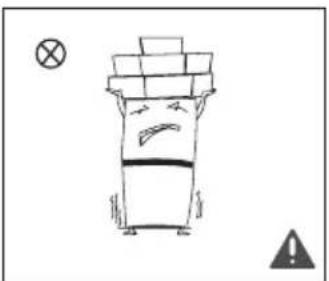
Cartoon illustration of a sad figure with a frowning expression, surrounded by a crossed-out 'X' symbol and an exclamation mark (no text or labels)- Do not place heavy objects on the top of the refrigerator considering that objectives may fall when switching the door, and accidental injuries might be caused.
- Please pull of the plug in case of power failure or cleaning. Do not connect the freezer to power supply within five minutes to prevent damages to the compressor due to successive starts.
1.5 Warnings for placement

- Do not put flammable, explosive, volatile and highly corrosive items in the refrigerator to prevent damages to the product or fire accidents.
- Do not place flammable items near the refrigerator to avoid fires.

- The refrigerator is intended for household use, such as storage of foods; it shall not be used for other purposes, such as storage of blood, drugs or biological products, etc.

- Do not store beer, beverage or other fluid contained in bottles or enclosed containers in the freezing chamber of the refrigerator; or otherwise the bottles or enclosed containers may crack due to freezing to cause damages.
1.6 War nings for energy
Warning for energy
1) Refrigerating appliances might not operate consistently (possibility of defrosting of contents or temperature becoming too warm in the frozen food compartment) when sited for an extended period of time below the cold end of the range of temperatures for which the refrigerating appliance is designed.
2) The fact that effervescent drinks should not be stored in food freezer compartments or cabinets or in low-temperature compartments or cabinets, and that some products such as water ices should not be consumed too cold;
3) The need to not exceed the storage time(s) recommended by the food manufacturers for any kind of food and particularly for commercially quick-frozen food in food-freezer and frozen-food storage compartments or cabinets;
4) The precautions necessary to prevent an undue rise in the temperature of the frozen food while defrosting the refrigerating appliance, such as wrapping the frozen food in several layers of newspaper.
5) The fact that a rise in temperature of the frozen food during manual defrosting, maintenance or cleaning could shorten the storage life.
6) The necessity that, for doors or lids fitted with locks and keys, the keys be kept out of the reach of children and not in the vicinity of the refrigerating appliance, in order to prevent children from being locked inside.
1.7 War nings for disposal

Refrigerant and cyclopentane foaming material used for the refrigerator are flammable.
Therefore, when the refrigerator is scraped, it shall be kept away from any fire source and be recovered by a special recovering company with corresponding qualification other than be disposed by combustion, so as to prevent damage to the environment or any other harm.

When the refrigerator is scraped, disassemble the doors, and remove the seal of the lower door and shelves; put the doors and shelves in a proper place, so as to prevent trapping of any child.

Correct Disposal of this product :
This marking indicates that this product should not be disposed with other household wastes throughout the EU. To prevent possible harm to the environment or human health from uncontrolled waste disposal, recycle it responsibly to promote the sustainable reuse of material resources. To return your used device, please use the return and collection systems or contact the retailer where the product was purchased. They can take this product for environmental safe recycling.
2 Proper use of refrigerators
2.1 Placement

natural_image
Simple line drawing of a person pushing a cardboard box next to a refrigerator (no text or symbols)- Before use, remove all packing materials, including bottom cushions, foam pads and tapes inside of the refrigerator; tear off the protective film on the doors and the refrigerator body.

natural_image
Simple line drawing of a refrigerator with a sad face and a potted plant, next to a sun (no text or symbols)- Keep away from heat and avoid direct sunlight. Do not place the freezer in moist or watery places to prevent rust or reduction of insulating effect.
- Do not spray or wash the refrigerator; do not put the refrigerator in moist places easy to be splashed with water so as not to affect the electrical insulation properties of the refrigerator.

natural_image
Simple line drawing of a refrigerator and a door (no text or symbols)- The refrigerator is placed in a well-ventilated indoor place; the ground shall be flat, and sturdy (rotate left or right to adjust the wheel for leveling if unstable).

natural_image
Simple line drawing of a smiling refrigerator inside a cabinet (no text or symbols)- The top space of the refrigerator shall be greater than 30cm, and The refrigerator should be placed against a wall with a free distance more than 10cm to facilitate the opening and closing and heat dissipation.
Precautions before installation:
Information in the Instruction Manual is only for reference. The physical product may differ. Before installation and adjusting of accessories, it shall be ensured that the refrigerator is disconnected from power.
Precautions shall be taken to prevent fall of the handle from causing any personal injury.
2.2 Leveling feet
1) Schematic diagram of the leveling feet

( The picture above is only for reference. The actual configuration will depend on the physical product or statement by the distributor )
3) Adjusting procedures:
a. Turn the feet clockwise to the is refrigerator;
b. Turn the feet counterclockwise to lower the refrigerator;
c. Adjust the right and left feet based on the procedures above to a horizontal level.
2 Changing the Light
Any replacement or maintenance of the LED lamps is intended to be made by the manufacture, its service agent or similar qualified person.
2.4 Starting
natural_image
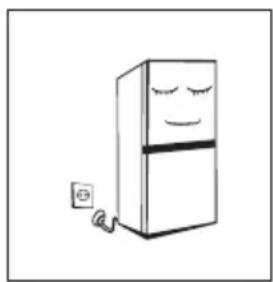
Simple line drawing of a smiling refrigerator with a power outlet (no text or symbols)- Before initial start, keep the refrigerator still for half an hour before connecting it to power supply.
- Before putting any fresh or frozen foods, the refrigerator shall have run for 2-3 hours, or for above 4 hours in summer when the ambient temperature is high.

- Spare enough space for convenient opening of the doors and drawers or statement by the distributor.
2.5 Energy saving tips
- The appliance should be located in the coolest area of the room, away from heat producing appliances or heating ducts, and out of the direct sunlight.
- Let hot foods cool to room temperature before placing in the appliance. Overloading the appliance forces the compressor to run longer. Foods that freeze too slowly may lose quality, or spoil.
- Be sure to wrap foods properly, and wipe containers dry before placing them in the appliance. This cuts down on frost build-up inside the appliance.
- Appliance storage bin should not be lined with aluminum foil, wax paper, or paper toweling. Liners interfere with cold air circulation, making the appliance less efficient.
- Organize and label food to reduce door openings and extended searches. Remove as many items as needed at one time, and close the door as soon as possible.
3 Structure and functions
3.1 Key components


( The picture above is only for reference. The actual configuration will depend on the physical product or statement by the distributor )
Refrigerating chamber
- The Refrigerating Chamber is suitable for storage of a variety of fruits, vegetables, beverages and other food consumed in the short term.
- Cooking foods shall not be put in the refrigerating chamber until cooled to room temperature.
- Foods are recommended to be sealed up before putting into the refrigerator.
• The glass shelves can be adjusted up or down for a reasonable amount of storage space and easy use.
Freezing chamber
- The low temperature freezing chamber may keep food fresh for a long time and it is mainly used to store frozen foods and making ice.
- The freezing chamber is suitable for storage of meat, fish, rice balls and other foods not to be consumed in short term.
- Chunks of meat are preferably to be divided into small pieces for easy access. Please be noted food shall be consumed within the shelf time.
Note: Storage of too much food during operation after the initial connection to power may adversely affect the freezing effect of the refrigerator. Foods stored shall not block the air outlet; or otherwise the freezing effect will also be adversely affected.
3.2 Functions

1)Gears
①Gear
②Gear
③Gear
④ Géar
⑤ Gear5
2) Gearting
Clockwise rotation the "TEMP. control" once, the gear will be changed once 4.5 seconds after setting the gear, the refrigerator will be running in accordance with the set value. The gear can be set to: The set temperature will be reduced by 1°C and it can be set circularly.
Gear1 Gear2

Gear3

Gear4

Gear5 Gear


3 Setting the freezer temperature
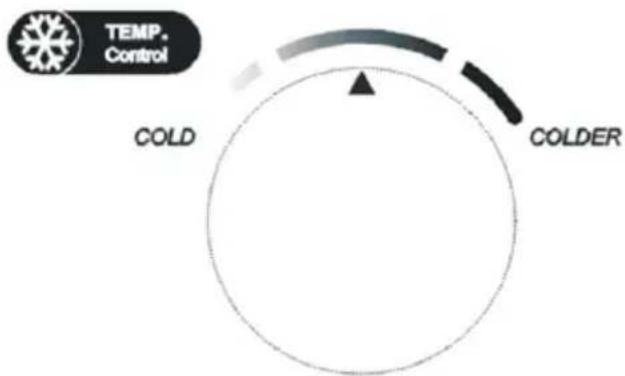
Turn the controls to adjust the freezer temperature allow 24 hours for the freezer to adjust and stabilize.
Place frozen food into the freezer as quickly as possible after purchase.
Pay attention to the storage time on the food packaging instructions The storage life of frozen foods varies and the recommended storage time should not be exceeded.
when it is set at colder position, the temperature of freezing chamber will be colder, but it causes the cooling capacity sent to refrigerating chamber will be lower.
4. Maintenance and care of the appliance
4.1 Overall cleaning
- Dusts behind the refrigerator and on the ground shall be timely cleaned to improve the cooling effect and energy saving. The interior of the refrigerator should be cleaned regularly to avoid odor. Soft towels or sponge dipped in water and non-corrosive neutral detergents are suggested for cleaning. The freezer of shall be finally cleaned with clean water and dry cloth. Open the door for natural drying before the power is turned on.
- Do not use hard brushes, clean steel balls, wire brushes, abrasives, such as toothpastes, organic solvents (such as alcohol, acetone, banana oil, etc.), boiling water, acid or alkaline items clean refrigerator considering that this may damage the fridge surface and interior.
- Do not rinse with water so as not to affect the electrical insulation properties.

Please unplug the refrigerator for defrost and cleaning.

4.2 Defrosting
- The refrigerator is made based on the air-cooling principle and thus has automatic defrosting function. Frost formed due to change of season or temperature may also be manually removed by disconnection of the appliance from power supply or by wiping with a dry towel.
4.3 Out of operation
- Power failure: In case of power failure, even if it is in summer, foods inside the appliance can be kept for several hours; during the power failure, the times of door opening shall be reduced, and no more fresh food shall be put into the appliance.
- Long-time nonuse: The appliance shall be unplugged and then cleaned; then the doors are left open to prevent odor.
- Moving: Before the refrigerator is moved, take all objects inside out, fix the glass partitions, vegetable holder, freezing chamber drawers and etc. with tape, and tighten the leveling feet; close the doors and seal them with tape. During moving, the appliance shall not be laid upside down or horizontally, or be vibrated; the inclination during movement shall be no more than 45°.

The appliance shall run continuously once it is started. Generally, the operation of the appliance shall not be interrupted; or otherwise the service life may be impaired
5 Frequently asked questions
5.1 You may try to solve the following simple problems by yourself. If them cannot be solved, please contact the after-sales department.
| Failed operation | Check whether the appliance is connected to power or whether the plug is in well contactCheck whether the voltage is too lowCheck whether there is a power failure or partial circuits have tripped |
| Odor | Odorous foods shall be tightly wrappedCheck whether there is any rotten foodClean the inside of the refrigerator |
| Long-time operation of the compressor | Long operation of the refrigerator is normal in summer when the ambient temperature is highIt is not suggestible having too much food in the appliance at the same timeFood shall get cool before being put into the applianceThe doors are opened too frequently |
| Light fails to get lit | Check whether the refrigerator is connected to power supply and whether the illuminating light is damagedHave the light replaced by a specialist |
| Doors cannot be properly closed | The door is stuck by food packages Too much food is placedThe refrigerator is tilted |
| Loud noise | Check whether the floor is level and whether the refrigerator is placed stablyCheck whether accessories are placed at proper locations |
| Door seal fails to be tight | Remove foreign matters on the door sealHeat the door seal and then cool it for restoration(or blow it with an electrical drier or use a hot towel for heating) |
| Water pan overflows | There is too much food in the chamber or food stored contains too much water, resulting in heavy defrostingThe doors are not closed properly, resulting in frosting due to entry of air and increased water due to defrosting |
| Hot housing | Heat dissipation of the built-in condenser via the housing, which is normalWhen housing becomes hot due to high ambient temperature, storage of too much food or shutdown of the compressor is shut down, provide sound ventilation to facilitate heat dissipation |
| Surface condensation | Condensation on the exterior surface and door seals of the refrigerator is normal when the ambient humidity is too high. Just wipe the condensate with a clean towel. |
| Abnormal noise | Buzz: The compressor may produce buzzes during operation, and the buzzes are loud particularly upon start or stop. This is normal.Creak: Refrigerant flowing inside of the appliance may produce creak, which is normal. |
Palsonic
The AUSTRALIAN Company
Palsonic Customer Service
Telephone (Australia) 1300 657 888
Palsonic Corporation Pty Ltd ABN 34 000 474 108
1 Joynton Avenue, Waterloo NSW 2017 Australia
Telephone (02) 9313 7111 Facsimile (02) 9697 0655
www.palsonic.com.au
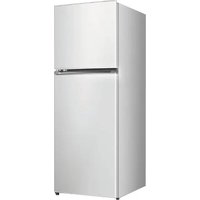
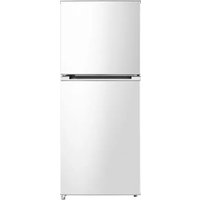
- CONTENTS
- Safety warnings
- Proper use of the refrigerator
- Structure and functions
- Maintenance and care of the refrigerator
- Frequently asked questions
- War nning
- RECOMMENDATIONS :
- Meaning of safety warning symbols
- Electricity related warnings
- Warnings for using
- Warnings for placement
- War nings for energy
- Warning for energy
- War nings for disposal
- Proper use of refrigerators
- Placement
- Precautions before installation:
- Leveling feet
- Changing the Light
- Starting
- Energy saving tips
- Key components
- Refrigerating chamber
- Freezing chamber
- Functions
- Maintenance and care of the appliance
- Overall cleaning
- Defrosting
- Out of operation
- Palsonic
- The AUSTRALIAN Company
Brand : Palsonic
Model : PW400TFR
Category : Refrigerator