
NR-BE647AS - Refrigerator PANASONIC - Free user manual and instructions
Find the device manual for free NR-BE647AS PANASONIC in PDF.


| Product Type | Refrigerator |
| Model | NR-BE647AS |
| Brand | Panasonic |
| Dimensions (H x W x D) | 1760 x 795 x 680 mm |
| Weight | 70 kg |
| Power Supply | 220-240 V, 50 Hz |
| Power Consumption | 120 W (average) |
| Refrigerant | R600a |
| Climate Class | SN, N, ST, T |
| No Frost Technology | Yes (Freezer) |
| Compressor Type | Inverter |
| Cooling System | Multi Air Flow |
| Interior Lighting | LED |
| Capacity Refrigerator | 348 L |
| Capacity Freezer | 132 L |
| Total Gross Capacity | 480 L |
| Energy Efficiency Class | A++ |
| Noise Level | 39 dB(A) |
| Temperature Control | Electronic |
| Defrost Method | Automatic (No Frost) |
| Shelves Material | Tempered Glass |
| Door Hinge | Right (reversible) |
| Maintenance | Clean with mild soap and water; avoid abrasive cleaners |
| Safety Features | Child lock, high temperature alarm |
| Spare Parts | Available through authorized service centers |
| Warranty | 2 years (manufacturer) |
Frequently Asked Questions - NR-BE647AS PANASONIC
User questions about NR-BE647AS PANASONIC
0 question about this device. Answer the ones you know or ask your own.
Ask a new question about this device
Download the instructions for your Refrigerator in PDF format for free! Find your manual NR-BE647AS - PANASONIC and take your electronic device back in hand. On this page are published all the documents necessary for the use of your device. NR-BE647AS by PANASONIC.
USER MANUAL NR-BE647AS PANASONIC
Model No : NR-BE647ASQA Model No NR-BE647ASAE NR-BE647ASAS NR-BE647ASSA NR-BE647AWSA
The smart way of using the refrigerator leads to energy saving.
- Thank you very much for purchasing "Panasonic" Refrigerator.
- Before operating this unit, please read these instructions completely.
- Before using this product, please pay particular attention to the "Safety precautions" for a safe use.
- Please keep operating instructions surely, and read them when you need.
According to changes in the inside temperature, the motors run at different speed. At normal temperature, the motors run at a lower speed. (Energy saving & lower noise).
When powerful cooling is required, the motors run at a higher speed.

• The transformer
ECONAVI records the usage pattern in different times such as how often and how long the doors are opened and detects the level of lighting around the fridge. The fridge would automatically turn to the ECONAVI mode to adjust the operation rate to save energy.
◎ When the ECONAVI mode is on, the indicator light would be on; when the mode is off, the indicator light would be off. When the light has been on for five minutes, its brightness will be reduced to general brightness due to energy saving. The light would turn off when the ECONAVI mode is off.
Notice: To enter the ECONAVI mode, you need to set the Freezer temperature setting at the Med temperature.
Preparation and checks
Preparation and checks
SAFETY PRECAUTIONS Please be sure to follow
HOW TO MAKE ICE CUBES
HOW TO REMOVE AND ATTACH INDIVIDUAL COMPONENTS
Please be sure to follow
Please follow
The following explanations are provided for the items you should know to prevent personal injuries and property damages related to the users and other people.
The following expressions are used to distinguish the degree of danger or damage caused when the product is used incorrectly by disregarding the instructions provided in this manual.
This expression presumes possibility of death or serious injury.
This expression presumes possibility of personal injury or material damage.
The following symbols and explanations are provided to explain the types of act complied by the user. (Shown below are the examples of pictograms used)
This pictogram indicates a "Prohibited" type of act.
This pictogram indicates a "Mandatory" item to be performed.
■ Do not install the product where water splashes are possible.
Deteriorating electrical insulation may lead to an electrical shock and fire.
■ Do not block the ventilation port of the refrigerator or spaces around it.
Leaked refrigerant may cause a fire and result in an explosion.
■ Provide a grounding connection or install a ground-fault interrupter when the product is installed in a moist or watery location.
Ground leakage by a product malfunction may cause an electrical shock.
- Be sure to contact your distributor when installing a ground connection or ground-fault interrupter.
Do not connect many plugs to a single outlet by exceeding the rated current or to an outlet other than 220 V a.c. ~ 240 V a.c. Too many plugs in a single outlet may generate abnormal heat and possible fire.
■ Do not plug or unplug with wet hands. Electric shock is possible.
■ Insert the power plug fully into the outlet.
Incomplete insertion may cause electrical shock and/or fire from overheating.
- Do not use damaged power cords or loose receptacles.
■ Remove dust periodically from the power plug.
Dust accumulation on the power plug may cause an insulation failure with humidity and possible fire.
- Unplug the power cord and wipe with dry cloth.
■ Do not damage the power cord or power plug.
Do not damage the cord, modify, bring close to a heating device, bend, twist, pull, place a heavy item on, pinch with the refrigerator or bundle the cord.
Use of a damaged cord or plug leads to an electrical shock, short-circuit or fire.
Consult your distributor if you need to repair the power cord or plug.
Supply cord and plug.
If the supplied cord or plug of the appliance is damaged, it must be replaced by the manufacturer, its service agent, or a similarly qualified person in order to avoid a hazard.
Do not splash water or liquid detergents on the back of the refrigerator or into the mechanism room at the bottom of the back side of the refrigerator. Splashed water could permeate into electrical parts and cause an accidental fire or other dangers.
When you detect a burning smell, remove the power plug to stop operation.
Be careful to avoid an electric shock or a fire.
This appliance is not intended for use by people (including children) with reduced physical, sensory, or mental capabilities, or lack of experience and knowledge, unless they have been given supervision or instruction concerning the use of the appliance by a person responsible for their safety.
Children should be supervised to ensure that they do not play with the appliance.
When leakage of flammable gas (propane gas, city gas) is detected, do not touch the refrigerator and open the window for ventilation.
Power plug connection/disconnection operations may cause sparks, which can lead to fire, explosion, or burn.
Flammable gas is used for insulation in this refrigerator.
When you dispose of this unit, please discard it by a proper method.
Removal of the back cover is prohibited except by service personnel.
May cause injury, burn, or electrical shock.
■ Always unplug the power cord when cleaning the refrigerator.
May cause electrical shocks and/or injury.
■ Do not place a water container over the refrigerator.
Spilled water may damage insulation of electrical components and cause electricity leakage, fire or electrical shocks.
■ Do not store flammable items in the refrigerator.
Benzine, ether, LP gas, paint thinner, adhesive etc may catch fire.
• Tightly cap the alcoholic beverage bottles.
■ Do not hang on the door or ride on the drawer compartment.
Injury is likely by a fallen refrigerator or body parts being pinched.
■ Do not damage the cooling circuit (piping) in the refrigerator body.
Electrical insulation deteriorates and may cause shocks or fire.
■ Absolutely, do not disassemble, repair or modify the refrigerator.
An unexpected fire or movement may cause injuries.
- Consult with your distributor when you need a disassembly/repair.
- Do not place objects that are prone to fall on top of the refrigerator.
The vibration caused by the operation of the refrigerator may cause the object to fall.
- Keep ventilation openings, in the appliance enclosure or in the built-in structure, clear of obstruction.
Do not use mechanical devices or other means to accelerate the defrosting process, other than those recommended by the manufacturer.
Do not use electrical appliances inside the food storage compartments of the appliance, unless they are of the type recommended by the manufacturer.
This appliance is intended to be used in household and similar applications such as
- staff kitchen areas in shops, offices and other working environments;
- farm houses and by clients in hotels, motels and other residential type environments; • bed and breakfast type environments; • catering and similar non-retail applications.
■Do not store chemicals or scientific specimen.
Home-use refrigerator can not store those requiring a strict control.
The insulation blowing gas and refrigerant is flammable. When disposing of the appliance, do so only at an authorized waste disposal centre. Do not expose to flame.
■ WARNING: When positioning the appliance, ensure the supply cord is not trapped or damaged.
■ WARNING: Do not locate multiple portable socket-outlets or portable power supplies at the rear of the appliance.
- Do not store explosive substances such as aerosol cans with a flammable propellant in this appliance.
■ Do not attempt to dismantle, repair or tamper the refrigerator, otherwise an electrocution, fire or explosion accident may occur.
■ Since a flammable refrigerant is used, be sure to open the window for ventilation if the Cooling Loop (piping) is faulted and then contact the Panasonic Service Station; otherwise an electrocution, fire or explosion accident may occur.
The refrigerator should be placed in a well-ventilated location.
Do not attempt to use mechanical tools or other tools to speed up the defrosting process.
Do not damage the refrigerant loop. (Remark: This warning is applicable only for the tools that can be used by the user to touch the refrigerant loop.)
Except for the suggested tools, do not use other tools in the food refrigerating compartment.
Before moving the refrigerator, be sure to remove the power plug and then connect the power after relocating to the designed location securely.
If the refrigerator is damaged, be sure to contact Panasonic manufacturer or the personnel of Panasonic Service Station to avoid hazard.
If the refrigerant circuit is damaged:
- Avoid open flames and sources of ignition.
- Thoroughly ventilate the room in which the appliance is situated.
If you are discarding the refrigerator, remove the door completely as a safe way against small children being trapped inside.
Do not insert your hand into the bottom of the refrigerator.
Inserting your hand during cleaning in the bottom may cause injury by the sheet metal edge.
Do not slide your hand on the rail and metal edges during interior cleaning.
You may injure yourself.
When opening the bottom drawer, do not place your feet too close to the refrigerator.
The drawn compartment may hit your feet.
Install the glass shelves securely.
The glass shelf, if dropped, may break or cause injuries.
Do not use the wheels on the bottom when placed on a floor that is easy to mar.
The bottom wheels may damage the floor.
Do not transport refrigerators in a horizontal position.
Laying a refrigerator horizontally may damage the piping.
Do not place any protruding item out of the shelf area.
Bottles may drop and cause injuries.
When opening a door or when another person touches the refrigerator, make sure the moving door does not pinch anyone's fingers.
The moving door may hit fingers and cause injuries.
Do not eat any food that smells or has changed color.
Rotten food may cause illness.
The compressor and the copper pipeline are high-temperature parts. Do not touch them, or you may get burnt.
When carrying the appliance, do it with horizontal movements; never tilt or lay the refrigerator.
Suitable location for the refrigerator
Install at a location not affected by heat or direct sunshine.
For minimizing deterioration of cooling power and avoiding wasted electricity.
Install at a low-humidity, keep ventilation openings in the appliance enclosure or in the built-in structure, clear of obstruction.
For suppressing rust generation and avoiding wasted electricity.
Do not place items over the refrigerator. Secure a space of 2 cm on the both sides and 10 cm or over the refrigerator. The back surface may be fitted to the wall.
(Leave a space when vibration noise occurs)
The refrigerator dissipates heat around it for cooling the food inside.
Proper installation will help you get the most use out of your refrigerator.
To prevent the refrigerator from tumbling down due to an earthquake or shaking of the refrigerator, a nylon cord or robust string may be tied to the refrigerator on the lugs on the top of the back side of the refrigerator and hung to a hook on the wall.
Sturdy and flat floor
Turn the adjustable leg to firmly fit on the floor to prevent vibration or noise. When the floor is covered with carpet, tatami or vinyl, place a solid board under the refrigerator to avoid color change by heat.
To ensure the refrigerator structure not being affected by an uneven ground, please adjust the level carefully with the following steps.
Ensure the rear feet (left and right) are standing firmly. In case of unevenness, please shim the suspending portion until it is firmly supported.

Step 3:
Adjust the left front foot to just contact the ground. * Excessively lifting the height of the left front foot may result in a skewed body and a slanted door of the refrigerator.

Step 2:
Adjust the right front foot so that the refrigerator slants backward slightly, leaving the roller about 0.5cm above the ground.
(Method: Insert a flat screwdriver into the gap of the adjustable foot and turn clockwise; this will move the adjustable foot downward.)
- The interior plastic parts may smell in the beginning, but the odor gradually goes away when the interior gets cold.
The interior does not get cold immediately after turning the power on.
- The exterior surface of the refrigerator gets hot in the beginning of use or when the ambient temperature is high as in summer, but it is not abnormal.
- It requires approximately 12 hours in a normal condition until the interior gets cold.
- It may take more than one day until reaching the set temperature in hot season.
- Refrain from opening the doors until it gets fully cold.
Wait more than ten minutes to re-start the refrigerator after you stop it once.
■ Regarding replacement of the LED light
- If the LED light does not work, please contact the service center to check what the problem is. Do not remove or replace the LED light by yourself.
- Leave spaces among foods to help air circulation. Blocking the air flow will cause warm temperature in the refrigerator compartment.
- Cool hot dishes to room temperature before placing them in your refrigerator. Cover juicy foods with tight lids, plastic film or foil.
- Do not keep the door open any longer than necessary, particularly in hot, humid weather.
- Do not put carbonated liquids (fizzy drink, etc.) in the freezer compartment as they may burst.
- Do not give children lollipops directly from the freezer compartment. They may burn their lips by "freezer burn" due to low temperature.
- For temporary storage of immediately used items.
- For storing drinks.

[Food examples]
- Beer cans
- Juice / milk / pudding
- Tofu / raw eggs • Jelly • Vegetables in sealed tray
- For 10 eggs. (2 PCS)
- A useful, provided for storing food to be kept fresh, in lower temperature not freeze and eat fresh food soon after you purchase.
A short excerpt from his memory.
Please put vegetables and fruit into the Vegetable Case.
Temperatures in the Fine Chilled case can be very low. It is not suitable for storing puddings, bean curd, or tropical fruits.
Tips and notes:
Vegetables or fruits placed on the Glass Shelf, especially those near the vent port, are prone to freeze. Avoid doing this as much as possible.
This machine, equipped with Ag Bio Filter sterilization apparatus and a powerful freezer fan circulation device, can reduce the number of bacteria inside the refrigerator to keep the air clean.
Temperature control of the refrigerator compartment
The thermostat, specially designed for this refrigerator, functions to maintain the optimum inside condition for food storage at the "MED" dial setting, regardless of ambient temperature variations. In addition, to meet your individual requirements, the refrigerator temperature as you desire can be obtained by adjusting the temperature control dials. Lower temperature can be obtained by turning the dial clockwise on the controls.
Food may be frozen under the following conditions.
- When the temperature setting is left at "MAX" → change the setting to either "MED" or "MIN".
- When placing watery food (tofu, etc.) and eggs near the cold air outlet → please avoid doing so.
Tips and notes:
- For storing frozen foods.
- For storing frozen desserts.
- For storing dried foods. Frozen storage is suited for tea leaves, coffee, or seaweed that deteriorate with moisture.

- Frozen foods
- Lollipops – Ice cream • Sherbet
- Tea leaves
- Seaweed, etc.
Do not place the food over capacity.
The unseated top case causes incomplete closure of the drawer and malfunctions such as frosting in the compartment or failure in freezing.
(Use caution for these items)
- Long items
- Tall items in bags. • Excessive quantity of items in plastic bags.
- Tall items in boxes.
How to make frozen foods (QUICK FREEZING)
(Blue light turns on)
• The freezing ends in the longest 150 minutes. (The blue light turns on) - Press the "QUICK FREEZING" button again for stopping the operation. (The blue light turns off)
- When the blue light is blinking after touching the "QUICK FREEZE" button, the refrigerator is in a defrosting process.
Automatic rapid freezing will start after defrosting.
Tips and notes:
The temperature for the freezer compartment can be set in nine steps, more detailed than as "MIN" and "MED" and "MAX" as shown in the table.
- Set "MIN" with the "FREEZER CONTROL" button.
- Press the "FREEZER CONTROL" button (for 10 seconds).
- Set by pressing the "FREEZER CONTROL" button. To reset the setting, repeat steps 1, 2 and 3.
When operating the refrigerator for the first time, after connecting the plug, adjust the temperature to the center position of each control and leave it for 24 hours for an effective cooling operation. After that, adjust the temperature as you prefer. If you want to save energy, do not adjust the temperature lower than the actual operating condition.
Note:
Cutting food into thin and small pieces and storing in small packages is convenient when using.
Thin and small pieces
To prevent drying during storage and transfer of odors.
Cool down the food first.
Storing cooked foods while still warm would adversely affect other items.
Cool the food first
Use up the entire quantity once thawed. Refreezing substantially deteriorates taste and nutrition and is also unhygienic.
Do not refreeze
Pour water into the ice tray up to the water level line and place it on the ice tray rail.
Twist the ice tray and let the ice cubes drop as shown in the illustration.
NOTE
If you put wet ice cubes in the ice server, they may stick together.
You never need to defrost the compartment because your refrigerator is designed to defrost itself completely and automatically. Defrost water flows to the collector pan where it is forcibly evaporated into the air.
When moving the refrigerator in a tilted position, make sure the defrost water is drained out so that no water spills when it is moved.
Draining device
1
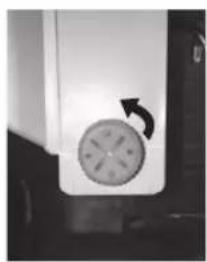
- Turn the drainage cap counterclockwise to remove it.
- Use a sharp tool with forward rotation to open the draining hole. (Only required for the first time; the defrost water will drain out immediately after opening.)
- Let the water drain from the part marked with arrows. Collect the water with a container to avoid wetting the floor.
- After draining, remember to reinstall the cover. (Turn clockwise)
Do not use the following items.
Cleaning fluids that are indicated as alkaline or acidic in the property column of kitchen cleaning agents.
- Plastic parts may break with the agent.
Toothpaste, powder soap, petroleum, boiling water, scrubber, acids, benzine, paint thinner, alcohol, etc.
• Deteriorates the surface, coating, or plastic parts.
When using a chemical wiper, comply with the cautions given with the product.
■ Make sure to unplug the power cord before starting.
■ Do not handle the power plug with wet hands.
May cause injuries or electrical shocks.
■ Do not splash water on the exterior or interior surface.
May cause a fire or electrical shocks.
■ Periodically remove the dust on the power plug.
Dust accumulation on the power plug leads to insulation failure by moisture and may cause a fire.
- Unplug the power cord and wipe with a dry cloth.
■ Do not rub rails or metal edges strongly.
Injuries are likely.
How to take care of your Refrigerator
Inspection after caring
Inspection after cleaning
Wipe with cloth soaked with lukewarm water.
When a surface spot does not come off, use a neutral kitchen cleaning product and then wipe off with the cloth soaked with lukewarm water and tightly wringed.
- Wipe off with soft dry cloth.
※ If press any keys which change setting while wiping operation panel, please reset setting.
- Wipe off with damped soft cloth.
※ This product is high gross metal, please avoid cleaning it with rough face of cleaning cloth and contact with sharp object to prevent surface damage. (such as metal, magnet, etc.)
Use a dry or tweaked-dry cloth to clean, preventing water or impurities from residing in the refrigerator, so as to prolong the service lifespan of steel sheets of the refrigerator.
- Are there any damages on the power cord?
- Is the power plug hot?
- Is the power plug securely inserted into the outlet?
In case of any doubt, please contact your dealer immediately.
Panasonic Service Station.
Immediately when soiled
The door gasket (especially the bottom portion) can be damaged by spilled milk, juice, etc.
To protect the gasket, it should be kept clean at all times.
Any spilled liquid will collect in the gap under the bottle rack. Then, if it overflows, it will collect in the gap located at the lower front section of the inner wall.
Be sure to wipe off such spillage before it overflows from these gaps.
HOW TO REMOVE AND ATTACH INDIVIDUAL COMPONENTS
① Pull out the drawer to the outermost position.
② Slightly lift up the drawer, then pull it out.
① Lift the back of the tempered glass shelf.
② Pull the tempered glass shelf toward you.
When the door of the refrigerator compartment is opened after 1 minute, the "QUICK FREEZING" light is red.
The "QUICK FREEZING" light is off when the door of the refrigerator compartment is closed.
- The buzzer stops sounding when the door is closed.
(The buzzer does not sound when the door opening is small).
ECONAVI Mode turns off
ECONAVI items, just this
◎ There may be one of the following circumstances occurring:
- The ECONAVI Mode will be off when the freezer is in fine-tuning mode.
- The ECONAVI Mode will be off when the refrigerator is defrosting. The mode will be on again after defrosting is finished.
- The temperature setting of the freezer is not on “MED”.
- The refrigerator door is opened and closed too frequently or a hot food is put into the refrigerator.
- The ECONAVI Mode will be off when the refrigerator is frequently being used according to the records. • After a power outage, ECONAVI will start recording again until the records are restored.
- When the "QUICK FREEZING" indicator flashes in blue, it indicates the Quick Freezing is in a standby resulting from one of the following conditions: * The freezer is defrosting
Press the "QUICK FREEZING" button, and the Quick Freezing function will be activated immediately after the completion of the defrosting process.
Quick Freezing indicator lights in red
- If the "QUICK FREEZING" indicator lights in red when the freezer preserve door is close, you need to call the Panasonic service station or the dealer for a repair.
When the five signal lights on the control panel turn on at the same time and turn off after 3 seconds
- Isn't the power cord unplugged?
- Is there a power failure?
- Has the circuit breaker tripped?
- Is the temperature control set to "MIN"?
- Is a food item blocking the cold air outlet?
- Is direct sunlight shining on the refrigerator?
- Is there any heating device nearby?
- Is sufficient space secured around the refrigerator?
- Is a hot item stored, are doors opened frequently, or is too much food stored?
- Is the temperature setting of the refrigerator or freezer "MAX"?
- Is the ambient temperature 5°C or below?
- Is odor-generating food stored without wrapping?
- Odor often attaches to the interior plastic walls. Wipe off with a cloth soaked in lukewarm water.
The air pressure caused by closing a door sometimes opens other doors momentarily.
The air entering the compartment is rapidly cooled and the interior pressure becomes lower than the exterior.
Heat dissipation pipes run under the surface to prevent condensation.
You may feel hot at the beginning of operation or in summer season, but this is quite normal.
- Is the floor firmly supporting the refrigerator?
- Doesn't any problem exist in the installation?
- Isn't any item such as a tray dropped in the gap and making vibration noises?
- Bubbling sound → Refrigerant flowing in the cooling devices.
- Hissing sound → Defrosting heater makes this noise even during stopped operation.
- Zooming sound → Fan operation noise.
- Clicking sound → Operation of electrical component or refrigerant (gas) adjustment valve.
- Snapping sound → Parts expansion/contraction noise by refrigerant (gas) adjustment valve.
Operation sound goes up and down
This refrigerator adjusts the rotation speed of the compressor by using an inverter control. The operation noise is higher with a high-speed operation when the ambient temperature is high, frequent door openings, after defrosting, or immediately after installation.
Frost and ice accumulate on the freezer case
This condition occurs when humidity is high, door was kept open for a long time, or opened frequently.
Dewdrops accumulate in the vegetable compartment
The compartment is kept high in humidity for preventing the vegetables from being drying up and preserving freshness.
Dewdrops are generated when humidity is high. Simply wipe with a dry cloth. Continuous use of "QUICK FREEZING" may cause dew accumulation.
* If you have further questions, please contact your distributor.
*1 This appliance is intended to be used at an ambient temperature between 16 °C and 43 °C. *2 Energy consumption "336" kWh per year, based on standard test results for 24 hours. Actual energy consumption will depend on how the appliance is used and where it is located.

- SUITABLE LOCATION FOR THE REFRIGERATOR
- PROPER INSTALLATION WILL HELP YOU GET THE MOST USE OUT OF YOUR REFRIGERATOR
- STEP
- REGARDING REPLACEMENT OF THE LED LIGHT
- TEMPERATURE CONTROL OF THE REFRIGERATOR COMPARTMENT
- DO NOT PLACE THE FOOD OVER CAPACITY
- HOW TO MAKE FROZEN FOODS (QUICK FREEZING)
- (BLUE LIGHT TURNS ON)
- COOL DOWN THE FOOD FIRST
- NOTE
- DO NOT USE THE FOLLOWING ITEMS
- HOW TO TAKE CARE OF YOUR REFRIGERATOR
- INSPECTION AFTER CARING
- WIPE WITH CLOTH SOAKED WITH LUKEWARM WATER
- IMMEDIATELY WHEN SOILED
- HOW TO REMOVE AND ATTACH INDIVIDUAL COMPONENTS
- QUICK FREEZING INDICATOR LIGHTS IN RED
- OPERATION SOUND GOES UP AND DOWN
- FROST AND ICE ACCUMULATE ON THE FREEZER CASE
- DEWDROPS ACCUMULATE IN THE VEGETABLE COMPARTMENT
Brand : PANASONIC
Model : NR-BE647AS
Category : Refrigerator