
EB-GD76 - Mobile Phone PANASONIC - Free user manual and instructions
Find the device manual for free EB-GD76 PANASONIC in PDF.


| Product Type | Mobile Phone |
| Brand | Panasonic |
| Model | EB-GD76 |
| Network Support | GSM 900 / 1800 |
| Display | Monochrome LCD, 128x128 pixels |
| Dimensions (HxWxD) | 100 x 50 x 20 mm |
| Weight | 100 g |
| Battery Type | Li-Ion 800 mAh |
| Standby Time | Up to 200 hours |
| Talk Time | Up to 5 hours |
| Charging | Travel charger via dedicated port |
| Internal Memory | 1 MB (shared) |
| Phonebook | Up to 200 contacts |
| Messaging | SMS |
| Additional Functions | Calculator, alarm, calendar |
| Security | PIN code, phone lock |
| Cleaning | Wipe with soft dry cloth |
| Spare Parts | Battery, charger |
| Repairability | Battery replaceable; service by qualified technician for other repairs |
| General Information | User manual available in PDF |
Frequently Asked Questions - EB-GD76 PANASONIC
User questions about EB-GD76 PANASONIC
0 question about this device. Answer the ones you know or ask your own.
Ask a new question about this device
Download the instructions for your Mobile Phone in PDF format for free! Find your manual EB-GD76 - PANASONIC and take your electronic device back in hand. On this page are published all the documents necessary for the use of your device. EB-GD76 by PANASONIC.
USER MANUAL EB-GD76 PANASONIC
Operating Instructions EB-GD76
Digital Cellular Phone

Before operating this equipment, please read these instructions completely.





Important Information


Important Information
We, Matsushita Mobile Communications Development of Europe Ltd, declare that the EB-GD76 conforms with the essential and other relevant requirements of the directive 1999/5/EC. A declaration of conformity to this effect can be found at http://www.panasonicmobile.com/support
Safety Considerations
The following information should be read and understood as it provides details which will enable you to operate your phone in a manner which is both safe to you and your environment, and conforms to any legal requirements regarding the use of cellular phones.

This equipment should only be charged with approved charging equipment. Other usage will invalidate any approval given to this apparatus and may be dangerous. The use of approved charging equipment is recommended to ensure optimum performance and avoid damage to your phone. Ensure the voltage rating of the Travel Charger is compatible with the area of use when travelling abroad.
A Travel Charger (EB-CAD95xx*) is supplied with the Main Kit. Other recommended equipment for charging: Car Charger (EB-CDD95), Handsfree Car Kit (EB-HFD75Z).
Note: xx identifies the Charger region, e.g. CN, EU, HK, UK.

Switch off your cellular phone when in an aircraft. The use of cellular phones in an aircraft may be dangerous to the operation of the aircraft, disrupt the cellular network and may be illegal. Failure to observe this instruction may lead to the suspension or denial of cellular phone services to the offender, or legal action or both.

It is advised not to use the equipment at a refuelling point. Users are reminded to observe restrictions on the use of radio equipment in fuel depots, chemical plants or where blasting operations are in progress. Never expose the battery to extreme temperatures (in excess of 60°C).


Important Information

It is imperative that the user exercises proper control of your vehicle at all times. Do not hold a phone while you are driving; find a safe place to stop first. Do not speak into a Handsfree microphone if it will take your mind off the road. Always acquaint yourself thoroughly with restrictions concerning the use of cellular phones within the area you are driving and observe them at all times.

Care must be taken when using the phone in close proximity to personal medical devices, such as pacemakers and hearing aids.

For most efficient use, hold the phone as you would any normal phone. Your GD76 cellular phone is fitted with an internal antenna, located in the upper portion of the phone, above the display screen. To avoid deterioration of signal quality or antenna performance, do not touch the antenna area while the phone is switched on. Unauthorized modifications or attachments may damage the phone and violate applicable regulations. The use of an unapproved modification or attachment may result in the invalidation of your guarantee – this does not affect your statutory rights.
This Panasonic mobile phone is designed, manufactured and tested to ensure that it complies with the specifications covering RF exposure guidelines applicable at the time of manufacture, in accordance with EU, USA FCC, and Australian ACA regulations; or as specifically stated in the separate declaration leaflet enclosed with this product.
Please refer to our website for latest information/standards compliance in your country/region of use. www.panasonicmobile.com/health


Care and Maintenance


Care and Maintenance


Pressing any of the keys may produce a loud tone. Avoid holding the phone close to the ear while pressing the keys.
Extreme temperatures may have a temporary effect on the operation of your phone. This is normal and does not indicate a fault.
Do not modify or disassemble the equipment. There are no user serviceable parts.
Do not subject the equipment to excessive vibration or shock.
Avoid contact with liquids. If the equipment becomes wet, immediately remove the power and contact your dealer.
Do not leave the equipment in direct sunlight or a humid, dusty or hot area.
Keep metallic items that may accidentally touch the terminals away from the equipment.
Always charge the battery in a well ventilated area, not in direct sunlight, between +5°C and +35°C. It is not possible to recharge the battery if it is outside this temperature range.
Do not incinerate or dispose of the battery as ordinary rubbish. The battery must be disposed of in accordance with local legislation and may be recycled.
When disposing of any packing materials or old equipment, check with your local authorities for information on recycling.
iii


Quick Reference
Quick Reference



Menu


"Press ( ) to select".
Direction which the user can move around the display screen using the Navigation key.
Press a key once for a particular phone operation.
"Press and hold" a key for a particular phone function.
Representation of screen menu option.
Phonebook key.
Right hand Option Key.
Numeric key pads.
Answer a call or call a dialled number.
To end a call or return to Idle screen or +Hold to switch the phone off.
Indicates that a function is SIM Dependent.
Indicates that a function is Network Dependent.
Switches Discreet Mode on and off.


Contents
Important Information....i
Safety Considerations.
Care and Maintenance . . . . . . . . . . . . . . . . . . . . . . . . . . . . . . . . . . . . . . . . . . . . . . . . . . . . . . . . . . . . . . . . . . . . . . . . . . iii
Quick Reference i v
Getting Started.... I
Fitting the SIM
Removing the SIM 2
Fitting the Battery 2
Removing the Battery 2
Charging the Battery 3
Operation of Battery Level Indicator. 3
Disconnecting the Travel Charger 3
Low Battery Warning 4 Getting to Know Your Phone 4
Getting to Know Your Phone ....4 The Many System ....5
The Mendi System 5 Display: lases
Display Icons . . . . . . . . . . . . . . . . . . . . . . . . . . . . . . . . . . . . . . . . . . . . . . . . . . . . . . . . . . . . Information
Information....6 Navigation Prompt 6
Navigation Prompt....6 Using the Menu System 6
To Select a Function 7
Basic Operation 8
Switching the Phone On/Off 8
Making a Call 8
International Dialling 8
Emergency Calls 9
Automatic Redial 9
Ending a Call 9
Answering a Call 9
Caller Identification. 9
Earpiece Volume Control 10
Locking the Phone 10
Using the PIN 10
Setting Vibration Alert. 11
Setting Discreet Mode 11
Setting Ring and Key Volume 12
Phonebook....13
Store a Number....13
Overwrite Protection....14
Browsing Phonebook.
Retrieve a Number 14
Editing Phonebook Entries 15
Grouping Phonebook Entries 16
My Numbers....18
Personalising Your Phone 19
Add a Start-up Greeting. 19
Displaying Animations 19
Changing the Ring Tone. 19
Download Melody. 20
Download Logo 21
Setting the Backlight Time 22
Using Voice Commands. 22

V


Voice Dial Entry Setup 22 Recalling Voice Dial Entries 23 Dialling Voice Dial Entries. 23 Editing the Voice Dial Entries 23 Changing the Language 24 Restoring the Default Phone Settings 24
Phone Security. 25 Using Key Guard 25 Disabling Key Guard. 25 Changing the Security Codes 25 Restricting Calls 26
Applications 28 Clock 28 Initially Setting the Home Time 28 Setting the Clock Format 28 Altering the Time/Date 28 Setting the Clock for Summer Time 29 Setting the Alarm 29 Muting the Alarm 29 Setting a Power On/Off Time 30 Calculator 30 Currency Converter 31
Text Messages 32 Setting the Phone for Short Text Messages....32 Setting the Message Centre Number 32 Creating a Text Message 32 User Messages 33 Receiving Text Messages 33 Message Options 33 Cut / Copy & Paste Message Text 34 Manage Messages Lists 34 Chat SMS 35
Parameters 36
Call Information 38 Recent Numbers 38 Call Duration 39 Call Charges 40 Setting the Unit Price 40 Setting the Maximum Unit Level 40 Setting a Warning Level 40 Call Identification.
Advanced Operation 42 Diverting Calls 42 Holding Calls and Call Waiting 42 Making a Second Call 42 Receiving a Second Call 43 Accept a Second Call 43 Reject a Second Call 43 End Current Call and Receive Second Call 43 Operation During Two Calls 43 Call Transfer 44 Multi-party Calls 44 Changing to a New Network 46


Schedule 47
Creating a Reminder 47
Viewing Reminders 47
Deleting Reminders 47
Setting a Holiday Reminder 48
Deleting Holiday Reminders 48
Jump to Future Date 48
Games 49
Racing Game 49
Ball Game 49
WAP Browser 50
Browser Settings 50
Activating the Browser 51
Navigating Content 5
The Browser Menu 51
Using Bookmarks 52
Deactivating the Browser 53
Setting the Linger Time 53
Last Error 5
Additional Features 5 4
Desktop Handsfree 54
Voice Memo. 5 4
DTMF Tones 5 5
Note Pad 56
Second Clock. 56
Setting Clock Display 56
Accessory Related Features....57
Text Entry 58
T9 Text Input 59
Other Text Modes 59
Editing Text 59
Menu Structure 60
Troubleshooting 61
Important Error Messages 63
Glossary of Terms 65
Specifications 67
Phone (Including Battery) 67
Personal Settings 68
SAR 69
Notes 70
vii



Getting Started
Thank you for purchasing this Panasonic digital cellular phone. This phone is designed to operate on the Global System for Mobile Communications (GSM), GSM900 or GSM1800. Ensure the battery is fully charged before use.
Before operating this phone please read the "Important Information" section - see page i.
These operating instructions detail use of the equipment contained in the Main Kit.
Some services detailed, are network dependent and are indicated by ( ) or may only be available on a subscription basis. Some functions are SIM dependent and are indicated by ( ). For more information contact the Service Provider.
Fitting the SIM
The SIM is inserted into the back of the phone underneath the battery. Remove the battery - see "Removing the Battery" page 2. Unlock the SIM retainer by sliding it up towards the top of the phone (1). Gently lower the SIM retainer. Place the SIM into its recess, ensuring the bevelled corner is positioned in the top left corner (2). Move the SIM retainer back into position and secure by sliding downwards. The SIM retainer is properly locked when it has clicked into position (3).
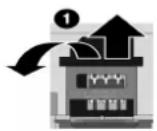


Note: Ensure the SIM retainer is properly locked into position. Failure to do so will inhibit the fitting of the battery and the battery cover.


Getting Started
Removing the SIM
Unlock the SIM retainer by gently pushing towards the top of the phone (1). Gently lower the SIM retainer (2) and remove the SIM (3). Ensure the SIM retainer is correctly locked before re-fitting the battery and battery cover.
Fitting the Battery
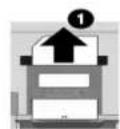
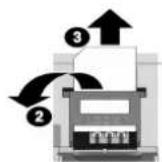
Ensuring the label is uppermost, locate the two lugs at the top of the battery into the rear of the phone (1). (The base of the battery will stay slightly raised at this point). Locate the two lugs at the top of the battery cover into the rear of the phone (2). Using light pressure, push the bottom of the battery cover into place and lock by pushing up on the battery cover release clip (3).



Removing the Battery
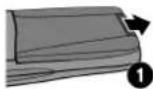
Push the battery cover release clip down (1). The base of the battery cover will raise out of the recess (2). Remove the battery cover. The battery can now be removed from the phone (3).




Getting Started
Charging the Battery
Connecting the Travel Charger
The battery must be fitted in the phone before the charger is connected. Ensure the arrows on the plug are to the front of the phone. Insert the charger into the base of the phone.
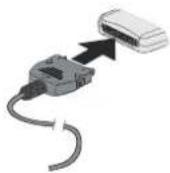
Note: DO NOT force the connector as this may damage the phone and/or the charger.
Connect the charger to the mains power supply. The charging indicator will light and the battery level indicator will scroll right to left when charging.
Operation of Battery Level Indicator
| While charging Charging complete | ||
| Phone on | ||
| Phone off | LCD Battery Indicator off | |
When charging is complete, turn off the mains power supply and disconnect the charger from the phone. See "Disconnecting the Travel Charger" page 3.
Disconnecting the Travel Charger
Disconnect the charger from the mains power supply.
Squeeze together the two buttons on the plug of the charger (1) and while maintaining pressure, extract the plug from the base of the phone (2).


Getting Started
Low Battery Warning
When the battery power is low a warning tone will sound and a flashing LOW BATTERY message will be displayed. If this occurs during conversation, finish your call immediately. The power will automatically shut off after the warning tone. Fully recharge the battery. See "Charging the Battery" page 3. (Calls can be made and received while the phone is charging)
It is recommended that the battery is fully discharged between charges to maintain optimum battery life and performance.
Getting to Know Your Phone
Location of Controls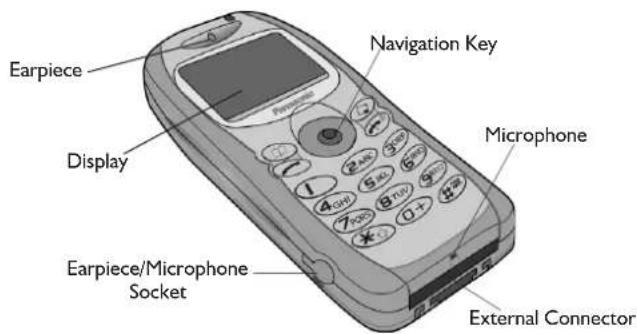

Navigation key - moving up/down/left/right navigates through the options in the Main Display area. Pressing this key activates the function currently displayed in the Main Option area

Cancel key - this key is mainly used to cancel the current operation and return to the previous menu level. In certain menus it has other functions

Primarily used for accessing the Phonebook or switching character types

Makes a call or recalls recently dialled phone numbers

Ends a call or 📂 + Hold enables the user to switch the phone on/off
4


Getting Started

Digit keys 0+ to 9, and #* - #* will switch on and off Discreet Mode
The Menu System
The menu system allows the user to access all the functions of the phone that are not accessible purely by key strokes.
Display Icons
Following some operations, the display will automatically clear after three seconds or after pressing any key.
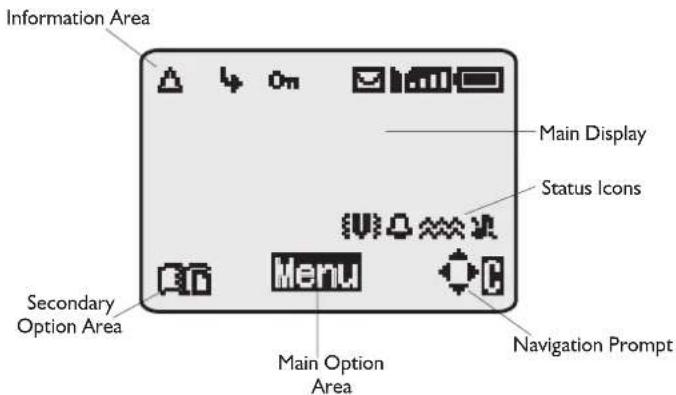
Status Icons
The status icons are displayed according to the currently activated functions. The Antenna, Signal, and Battery icons are displayed when the handset is switched on and connected to a network.

is displayed when you are registered to a non-home network - roaming

is displayed when call divert is enabled

is displayed when vibration alert is enabled

is displayed when Discreet Mode is enabled

is displayed when all tones or ring volume is off
Getting Started
flashes when an unread message is stored or lights when message area is full
On is displayed when phone lock is enabled
indicates that it is possible to make emergency calls
indicates the received signal strength: - weak signal, strong signal
indicates the received GPRS signal strength: - weak signal, - strong signal
indicates the battery level: - full, (flashing) - low battery
Information
Icons are used to indicate the current top level menu, the sub-menu number, text entry mode, Phonebook source, Phonebook location number, or the alarm set icon depending on the current mode of operation.
indicates alarm is set
indicates current Phonebook entry is sourced from the Mobile Phonebook
indicates current Phonebook entry is sourced from the SIM Phonebook
Navigation Prompt
This area indicates the available directions in which the Navigation key can be pressed according to the current mode of operation
Using the Menu System
The menu system provides the means for accessing all the functions which do not have their own dedicated buttons on the keypad.
The menu functions are selected using the five-way Navigation key.
Getting Started
To Select a Function
then use the navigation key as a joystick to move around the icons on the screen in any of the four directions (○, ◯, ○, ▶). When a particular menu is highlighted, and a submenu is displayed. From any submenu, use ◯ until the required item is highlighted,
Example:
From Idle 🎨, select Personalise > Display Setting > Animation 🎨
In detail:
1. To enter the menu system, press the menu key. 2. Use the navigation key to highlight the Personalise menu. 3. Press the menu key to enter the menu. 4. Use the navigation key three times to highlight the Display Setting menu. 5. Press the menu key to enter the menu. 6. Use the navigation key twice to highlight the Animation menu. 7. Press the menu key to enter the menu.
8. Use the navigation key to select Off, Theme 1, or Theme 2.
Following some operations, the display will automatically clear after three seconds. If this is not the case, press the end key to return to Idle.
Shortcuts
When familiar with the layout of the menu, use the keypad to enter the Menu Number. This will allow the user to obtain the required function without having to navigate through the display menus. For example, press the menu key to enter the menu and then press 4 to take you directly to the Animation menu.
Basic Operation
Basic Operation
Switching the Phone On/Off
To switch the phone on or off, press and hold the power key.
When the phone is switched on, a greeting will be displayed and then the phone will go into Idle.
Making a Call
Ensure that the phone is switched on, the network operator logo is displayed, and the signal strength meter shows network coverage is available in the current area.
1. Enter area code and phone number.
2.
International Dialling
Using the automatic international access code (+) you will be able to dial international numbers without having to know the code for the international exchange.
If the international number is known then it can be entered in the normal fashion followed by the area code and phone number.
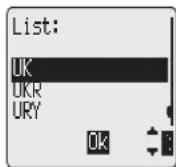
1. From Idle, press and hold ☐+ until “+” is displayed.
2. Use ⬆ to cycle through the abbreviated international names 📂 to choose the required code.
3. Enter area code and phone number.
4.
Note: Many countries / regions include an initial "0" in the area code. This should, in most cases, be omitted when dialling international numbers. If you have difficulties making international calls, contact your Service Provider.
8


Basic Operation
Emergency Calls
To make an emergency call the antenna symbol (T) must be present.
Enter 112 📋 or if no SIM is fitted to the phone 📋 🔍
Automatic Redial
When a call is unsuccessful you may want the phone to redial the number again automatically.
When your connection is unsuccessful, 📄 when OK is displayed and a timer will countdown in seconds to the next redial.
To stop redialling, press ☐ when Cancel is displayed in the main option area or ☐ when C is displayed in the secondary option area.
When a call is connected a beep will be emitted.
If a call is repeatedly unsuccessful you will not be able to automatically redial the phone number. In this case you must redial the phone number manually.
Ending a Call
Press
Answering a Call
To receive a call the phone must be switched on and the signal strength meter must be displayed.
any key except 📂 to answer a call
to reject the call
during an incoming call, and you will be given the option to Accept or Reject the call. Use to select an option and
If a call is not answered, or is rejected, the number of incoming calls missed will be displayed.
any key to clear the display
Caller Identification
This feature allows you to identify incoming calls and accept or reject them. The caller's phone number, and name if stored in Phonebook, will be displayed.
Note: Caller Identification may not always be available.
9


Basic Operation
Earpiece Volume Control
The volume level may be adjusted during a call:
Use o to decrease the volume, use ô to increase the volume
Note: Volume control for Personal Handsfree accessory is adjusted in the same manner.
Locking the Phone
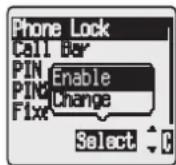
With the Phone Lock enabled you will be restricted to answer incoming calls and make emergency calls only. The Phone Lock Code is factory set to "0000".

2 Select Enable
3 Enter the 4-digit code,


The phone will be locked and the lock icon (0-n) will be displayed.
Unlocking the Phone
To restore normal operation, enter your Lock Code. The lock icon will be removed from the display. However, once you turn the phone off and on again the Lock Code will need to be re-entered. When the correct code has been entered.
Disabling Phone Lock
The phone must be unlocked before the phone lock can be disabled.

Using the PIN
The PIN (Personal Identification Number) protects your SIM against unauthorized use. If you enable the PIN, every time the phone is turned on you will be prompted to enter the PIN.
The PIN2 controls security for the Fixed Dial Store, Call Charge metering and Barred Dial.
10


Basic Operation
Enabling/Disabling the PIN
From Idle, select Phone Menu > Security > PIN
2. Use select Enable / Disable or Change PIN. 3. Enter PIN (Between 4 and 8 digits)
Setting Vibration Alert
When required, the phone can be set up to vibrate when a call is received. Vibration alert enables the user to choose between Continuous, Intermittent vibration alerts when a call is received.
From Idle, select Personalise > Vibration Alert.
Choose the vibration setting required, Continuous, Intermittent or Disable.
When activated, the phone will vibrate briefly.
Note: When Discreet Mode is enabled, its profiles will supersede those of the Vibration alert.
Setting Discreet Mode
Discreet Mode will allow the user to choose between "Vibrate only", "ring tone only" or both.
From Idle select Personalise > Discreet Mode

Use ⬇ to select Ring Volume or Vibration
Use to select the required vibration type or ring tone volume
to select the required vibration type or ring tone volume
From Idle + Hold #※
Note: If the ring tone volume is increased beyond "Max" volume it will set an escalating ring tone.


Basic Operation


Setting Ring and Key Volume
Changing either the ring volume/key volume is done in the same manner. If you increase the ring volume above maximum it will set an escalating ring tone. If you turn the ring volume off, the silent indicator icon (♪) will be displayed.
From Idle 📄, select Personalise > Tones 📄
Select Ring Volume or Key Volume
Use to set the volume level
12


Phonebook

Phonebook
It is possible to store phone numbers in two locations:
In the SIM Phonebook (☐)
In the Mobile Phonebook. This means that if you change the SIM, the numbers in the phone are not lost
The Mobile Phonebook has the advantage that you can group your phonebook entries together.
Store a Number
To Store a Number in the SIM Phonebook
From Idle enter the phone number and
2 To select SIM Phonebook
3 Enter the name – see "Text Entry" page 58,

4 Enter location number


You can choose not to enter a location number
and the entry will be placed in the next available location. Simply
when Any is displayed.

To Store a Number in the Mobile Phonebook
From Idle enter the phone number and

2 Use o to select Mobile Phonebook and

3 Enter the name - see "Text Entry" page 58,

4 Confirm phone number

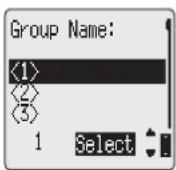
5 Use ♂ to select a group - see "Grouping
Phonebook Entries" page 16 - into which to
place the entry

6 Enter location number

A location number does not have to be specified, in this case the entry will
be placed in the next available location. Simply 📄 when Any is displayed.
13


Phonebook
Overwrite Protection
If a location is occupied, a prompt will be displayed to confirm that the current information is to be overwritten.

Note: If you amend an entry stored in your phonebook that has a Voice Dial Command assigned to it, you will need to delete and reassign that Voice Dial Command - see "Editing the Voice Dial Entries" page 23.
Browsing Phonebook
You can search the Phonebook by either Name or Location. The default setting for browsing is by name. When browsing by name pressing a lettered key will take you to the first entry starting with that letter.

Retrieve a Number

Once you have selected a phone number or name, there are a number of actions that you can perform. To dial the selected number
Note: The Phonebook you last viewed will be the default when you next press 📄. To change the default, use the Phonebook menu to select a particular phonebook.
Speed Dial a Number Stored in SIM Phonebook

14


Phonebook
Editing Phonebook Entries
It is possible to Detail, View, Recall, Edit, Delete or Create information in the Phonebook. To access any of these functions follow the same procedure for each one. With a phone number or name displayed:
| Use
to cycle through Detail, View, Recall, Edit, Delete or Create
2
to select an option
Detail
Displays each element of the selected Phonebook entry. Use ♂ to display the next/previous element of the entry. Each element may be edited - ⚡️, edit as required ⚡️ twice to save any changes.
View
Displays an individual name and phone number in the names list. If an e-mail address is present in the Mobile Phonebook this will be displayed along with the name and number.
Recall
Displays the phone number, enabling you to either change it or call the number.
Edit
Displays the entry allowing you to make changes as required. twice to save any changes.
Delete
Deletes the entry from the Phonebook.
Create
Creates a new entry in the Phonebook
Phonebook
Grouping Phonebook Entries
The ability to group phonebook entries together is an extra function of the Mobile Phonebook.
Retrieving a Number from a Group
Groups are used to collect together types of Phonebook entries, for example business and personal. Each group can be suitably titled for quick access to the entries contained within.
An alert profile can be attributed to groups, or a phone number, thus allowing incoming calls to be tailored to indicate the type of caller. See "Using Alert Profiles" page 16.

Retitling Group Names

Using Alert Profiles
Alert Profile enables you to identify callers with a particular ring tone, display picture, making it easier to distinguish between callers or groups of callers.
Creating an Alert Profile

16


Phonebook
6 Use ♂ to select the ring tone that you wish to use for this profile

7 Use ⬇ to select the picture 📂
Hot Key Phone Numbers
It is possible to dial phone numbers from the Phonebook or Service Dial part of Phonebook very quickly. Some Hot Key Phone numbers may be reserved by the Service Provider, for example the first three Hot Key Phone numbers may be linked to Service Dial ( ).

Setting the Hot Key Dial Source
I From Idle 📄, select Phonebook > Hot Key Dial

2 Use ♂ to select SIM Phonebook or Mobile Phonebook and
Service Dial Numbers
Your Service Provider may program some special phone numbers into your SIM ( ). It is not possible to modify the Service Dial numbers.

The phone number pointed to can only be recalled or dialled.
Review the Phonebook
The Review function in the Phonebook menu shows how many locations are available in the Phonebook.

A summary of the selected Phonebook will be displayed.
3 Use ⬇ to gain a detailed view of the Phonebook locations. Occupied locations are shown with “■”
My Numbers
My Numbers
My Numbers is a convenient part of Phonebook where voice, fax and data phone number(s) can be stored and viewed. (☐)
Adding Numbers
1 From Idle 📄, select Phonebook > My Numbers 📄

2 Use ♂ until Create is displayed 📄 3 Enter the name - see "Text Entry" page 58, and use ♀
Note: If using T9® text input then move o▶ before moving ♀ otherwise an alternative word will be selected.
4 Enter the phone number twice 5 Enter location number or select Any
Viewing Stored Numbers
1 From Idle, select Phonebook > My Numbers

2 If more than one number is available then use the down arrow to cycle through the listed numbers
18


Personalising Your Phone
Add a Start-up Greeting
A personalised greeting can be programmed for when the phone is switched on.
1 From Idle, select Personalise > Display Setting > Greeting
2 Use the text entry facility to add a greeting twice - see "Text Entry" page 58
Displaying Animations
Animations can be displayed when the phone is switched on.
1 From Idle, select Personalise > Display Setting > Animation
2 Use the down arrow to cycle through the animated themes available
3 to select either the desired theme, or switch off the animation
Changing the Ring Tone
The ring tones of the phone can be changed to one of many pre-defined sounds or to a voice ringer (a voice recording used as a ring tone).
Each voice, fax, data, and message can have a different ring tone.
Alternatively, you can use the Melody Composer to generate a custom ring tone. See "Composing a Melody" on page 20.
Setting up a Pre-defined Ring Tone
It is possible to choose from a selection of tones and melodies.
1. From Idle, press ⚙, select Personalise > Tones > Ring.
2. Use the navigation key to select the appropriate call type to be changed. 3. Use the navigation key to select the desired ring tone.
Recording a Voice Ringer
1. From Idle, press ⚙, select Personalise > Tones > Voice.
Personalising Your Phone
2. Use the navigation key to select the appropriate voice ringer to be changed.

3. Press ⚡ and start speaking into the microphone. The recording will stop automatically, or earlier if Ⓞ is selected.
4. To play back the recording, use the navigation key to select the appropriate voice ringer, then select Playback.
Composing a Melody
From Idle, select Personalise > Tones > Melody Composer.
Using the following table as reference, enter the notes (from the choice of low, middle and high), rests, and the durations of each, to generate your composition.
Note: At any time during composing, press to play back the current melody.
When the composition is complete, press twice to save it.
| Key 1st | press | 2nd press | 3rd press | 4th press | 5th press | 6th press |
| 1 | C | C# | low C | low C# | high C | high C# |
| 2AB | D | D# | low D | low D# | high D | high D# |
| 3DEF | E low | E high E | ||||
| 4SH | F | F# | low F | low F# | high F | high F# |
| 5KL | G | G# | low G | low G# | high G | high G# |
| 6WM | A | A# | low A | low A# | high A | high A# |
| 7WS | B | low B | ||||
| 8TJ | ||||||
| 9WV | ||||||
| 10+ | rest | |||||
| 11 | 1/8 | 1/16 | 1/1 | 1/2 | 1/4 | |
| 12 | 1/2 | 1/1 | 1/16 | 1/8 | 1/4 |
20


Personalising Your Phone
Editing your Melody
Once the melody has been saved, the following operations can be used for re-editing purposes:
To delete the character to the left of the cursor, use to navigate the cursor around the screen. Use the relevant keys to insert new notes/rests.
Disabling all Tones
From Idle
2
In Idle, select Personalise > Tones to disable all tones. When Idle is resumed, the silent indicator icon (musical) will be displayed.
Repeat the process to enable all tones.
Download Melody
Melodies may be downloaded to the phone from the Internet, via a short text messages service supplied by a third party. Details of this service are available on our website.
These services are network dependent.
For further information see:
http://www.panasonicmobile.com/support/ringtones
The service may not be available in all countries due to regulatory restrictions so please check the above site for availability.
Downloaded melodies overwrite pre-defined ring tone numbers 16-20
When a message has been received containing a melody:
1 to acknowledge receipt of the melody 2 Use twice to select the ring tone number to overwrite
The melody is now stored and can be selected as a pre-defined ring tone.
Download Logo
Logos may be downloaded to the phone from the Internet, via short text messages.
For further information see:
http://www.panasonicmobile.com/support/logo
Downloaded logos overwrite 5 pre-defined logos in the logo menu.
Personalising Your Phone
When a message has been received containing a logo:
1. To acknowledge receipt of the logo,
2. Use ⬇ to select the logo location 📄 twice.
The logo is now stored and can be selected as an idle screen option from the Personalise menu.
Setting the Backlight Time
1. From Idle ⚙, select Personalise > Display Setting >
Backlight Time
2. Use ⬇ to cycle through the times available.
3. Press to select the desired time.
Using Voice Commands
Before any of the phone's voice activated functions can be used, it is necessary to configure the phone so that it will recognize a particular voice and intonation.
Voice Dial Entry Setup
This function allows the user to recall and dial numbers from the Phonebook using voice commands.
1. From Idle Ⓞ, select Personalise > Voice Command
Voice Dial
2 to add a new Voice Dial entry to the list
3 Browse through the Phonebook to select an entry which is to be attributed with a voice command, twice
Note: Each recording is short in length, so be prepared to speak soon after initiating the recording.
4 When ready, the user should hold the phone approximately 20cm from his/her mouth, and speak clearly into the microphone to record the name of the selected Phonebook entry
When the recording has stopped, it will be necessary to repeat the name.
5 When prompted, and repeat the name
When recording is completed for a second time, the display will indicate if the recording was successful or not. If unsuccessful, repeat from step 4.


Personalising Your Phone
Recalling Voice Dial Entries
From Idle move and hold the navigation key ( Ô ) in any one of the four directions Ô,Ô,Ô or Ô . Speak clearly the name you wish to recall (exactly as recorded) and wait.
The above procedure will recall the phone number and the recorded Voice Dial entry is repeated; to initiate the call 📄.
Dialling Voice Dial Entries
Using Permission
From Idle 📄, select Personalise > Voice Command > Permission 📄
With this function enabled, a recalled phone number is automatically dialed without further intervention.
Repeat this process to disable the Permission function, returning to Voice Dial recall only.
Editing the Voice Dial Entries
It is possible to add to, play, or delete any of the Voice Dial entries. With a Voice Dial entry displayed:
and use to select Add, Play, or Delete to select the desired option.
Add
To add a new Voice Dial entry.
Play
To listen to the recording of a Voice Dial entry.
Delete
To delete an entry.
Personalising Your Phone
Changing the Language
It is possible to change the language that the phone uses for either display messages and/or text entry.
From Idle mode, select Personalise > Language

2 Use ⬇ to select Display Language or Tegic Language (text entry) that you wish to change.
3 Use ⬇ to select the desired language.

Restoring the Default Phone Settings

Any personal settings can be returned to their factory default, with the exception of some features, such as the Phone Lock code and the Language.
Any personal settings can be returned to their factory default, with the exception of some features, such as the Phone Lock code and the Language.
2 to restore the default settings.
24
Phone Security


The phone features a number of security functions that protect against unauthorized use, and enable the user to restrict access to certain features - see "Using the PIN" page 10. It is recommended that all security codes are memorized. If it is necessary to make a note of any security codes, never write them in a way that they can be recognized by another person. If forgotten, contact the dealer for the Phone Lock Code or the Service Provider for PIN and PIN2.
The phone features a number of security functions that protect against unauthorized use, and enable the user to restrict access to certain features - see "Using the PIN" page 10. It is recommended that all security codes are memorized. If it is necessary to make a note of any security codes, never write them in a way that they can be recognized by another person. If forgotten, contact the dealer for the Phone Lock Code or the Service Provider for PIN and PIN2.
The Key Guard function is used to prevent any keys from being accidentally pressed e.g. when the phone is being carried.
The Key Guard function is used to prevent any keys from being accidentally pressed, e.g., when the phone is being carried.
From Idle, select Key Guard twice to enable Key Guard, or press and hold Ⓞ, select Key Guard, then press twice.
When a call is received, Key Guard will be disabled temporarily, allowing the user to press any key except Ⓜ to answer the call. Emergency calls can still be made - see “Emergency Calls” page 9.

Note: When making emergency calls with the "Key Guard" enabled, there will be no audible or visual indication that the number is being dialed.
Disabling Key Guard
When Free Keypad: is displayed,
Changing the Security Codes
From Idle, select Phone Menu > Security
Use the arrow keys to select Phone Lock, PIN, or PIN2
Use the up arrow to select Change
Enter the current code
Enter the new code
Verify the new code


Phone Security
Restricting Calls
Call Barring
The Call Bar function is used to restrict certain outgoing and/or incoming calls. Call Bar is controlled by a security password that is supplied by the Service Provider. When updating or checking the status of Call Bar, the phone must be registered with a network. Different Call Bar restrictions can be used for voice, fax, and data calls. Any combination of call restrictions can be set.
From Idle, select Phone Menu > Security > Call Bar
Use the arrow keys to select Bar Voice, Bar Fax, or Bar Data twice
3 Use ♂ to select the level of call barring that needs to be applied and
4 Enter Call Bar password and
Barred Dialling
The Barred Dial function enables the user to bar all phone numbers pre-programmed in the SIM from being dialled on the phone. To use this function PIN2 is required.
1 From Idle Dial, select Phone Menu > Security > Barred 2 Enter PIN2
Fixed Dial
The Fixed Dial Store is part of Phonebook, but with additional security. When the security feature Fixed Dial is enabled it is only possible to make calls with phone numbers that are in the Fixed Dial Store.
When Fixed Dial is enabled any manually dialled phone numbers must match a phone number in the Fixed Dial Store.
To store, edit or delete a phone number in the Fixed Dial Store the Fixed Dial function must be enabled. With Fixed Dial enabled, all phone numbers can be added, edited or deleted as normal, but you will be prompted for PIN2.


Phone Security

"Wild" Numbers
Wild numbers are spaces that can be stored in a phone number. The "wild" numbers must be filled before the phone number is dialled. Used in conjunction with Fixed Dial calls can be restricted, for example, to a specific area by storing the area code of a phone and when recalled the remainder can be added. The "wild" numbers can be anywhere within a stored phone number.
1 Hold 0+ until _ is displayed to enter a wild number. 2 When the phone number is recalled pressing a numeric key will fill in a "wild" number.


Applications
Applications
Clock
This phone incorporates a clock with date/time, an alarm and a power on/off feature.
A second clock for dual time is also included - see "Second Clock" page 56.
Initially Setting the Home Time
From Idle Ⓞ, select Applications
Clock Function > Clock Set >
Home > Time Set
Use ♂ to select whether you require
Summer Time setting on or off and
©
Enter the digits for the date in the format
day/month/year
Enter the digits for the time using 24 hour
clock

Setting the Clock Format
From Idle, select Applications > Clock Function > Clock Format > Display Format.
Use the navigation keys to cycle through the different clock and/or date formats.
2 Use ♂ to cycle through the different clock and/or date formats
Altering the Time/Date
From Idle, select Applications > Clock Function > Clock Set > Home > Time Set.
From Idle, select Applications > Clock Function >
Enter the digits in the format day/month/year.
Press to accept the date.
Press and hold to remove the current time.
Enter the digits using the 24-hour clock.
Press to accept the time.
28
28


Applications
Setting the Clock for Summer Time
From Idle, select Applications > Clock Function > Clock Set > Home > Summer Time
2 to set Summer Time On or Off
Setting the Alarm
If the clock hasn't been set, the user will be prompted to do so prior to setting the alarm.
There are four separate alarms, each of which may be set independently.
From Idle, select Applications > Clock Function > Alarm Set
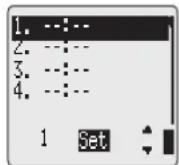
Use the down arrow to select the alarm to be set.
Enter the digits for the time.
Use the center button to select the frequency of the alarm.
Use the down arrow to select the ring type.
When the alarm has been set, a checkmark will be displayed when the phone is in Idle.
The alarm is activated in accordance with the current clock (Home or Second).
Muting the Alarm
When the set time is reached, the alarm will sound and the display will flash with an alarm message. The alarm will sound for 30 seconds. If the alarm is due during a call, it will activate vibration alert.
To end the alarm:
Press any key.
Disabling the Alarm
From Idle mode, select Applications > Clock Function > Alarm Set.
Use the navigation keys to select the alarm to be disabled, then press the Select key twice.
Use the navigation keys to select Disabled.
When disabled, following the same procedure will re-enable the alarm.
Applications
Adjusting the Alarm Time
From Idle mode, select Applications > Clock Function > Alarm Set.
Use the navigation keys to select the alarm to be adjusted. Press and hold the Confirm key to remove the current alarm time.
Enter the digits for the time. Use the Confirm key to select the frequency of the alarm. Use the Confirm key to select the ring type.
Setting a Power On/Off Time
The phone can be set to turn itself on or off automatically at a specified time using the Power On/Off feature. The procedure for setting/adjusting the Power On/Off automatically is similar to that for setting the time on the clock. For either setting or adjusting the time, you need to select Power On Time or Power Off Time in the Clock Function menu.
Caution: Ensure that the setting of the Alarm or Power On function will not contravene any regulations whereby it may automatically power on when in an aircraft or medical facility etc. - see "Important Information" page i.
Calculator
The four function calculator will enable the user to perform simple arithmetic calculations (addition/subtraction/multiplication and division).
From Idle, select Applications > Calculator.
Enter a number (maximum 10 digits) and it will be displayed on the upper right of the display. If a decimal point is required, press and hold ①.
Use ◆ to select the arithmetic operation you wish to perform (o to multiply, o to add, o to divide, o to subtract).
Enter a number (maximum 10 digits) and it will be displayed next to the operation symbol.
If ◆ is used to select another arithmetical operation to perform, an intermediate calculation will be performed and the result displayed on the top line.
Press 5 to complete the calculation when = is displayed in the centre of the operation field.
30


Applications
Currency Convertor
The currency convertor enables the user to convert from/to a home currency using a conversion rate that you enter.
From Idle, select Applications > Currency.

Entering an Initial Conversion Rate
1 2 Enter an abbreviation for the home currency (up to 3 characters) 3 Enter an abbreviation for the foreign currency (up to 3 characters) twice 4 Enter the currency conversion rate twice

Converting a Value
I Check the conversion rate is the one you require twice 2 Enter the value to be converted twice
The conversion rate will be retained in the phone once entered. The next time the convertor is used, the conversion rate / currency abbreviation can be edited while in the Currency / rate display. Then use to select Edit.
Swapping the Currency Conversion
When you have accepted the conversion rate and are ready to enter the value to be converted, you can swap the currencies to convert from the foreign currency into the home currency.
I, use to select Swap 2 Enter the value for conversion twice
Text Messages
Text Messages
It is possible to receive, display, edit and/or send text messages of up to 459 characters, (depending on the language being used) to mobile phones on the same network or any network that has a roaming agreement. Messages will be sent as one message, but will be received as (up to) three messages. (Depending on the recipient's phone parameters).
Setting the Phone for Short Text Messages
Before a message can be sent, it is necessary to enter the Message Centre number into Parameters (the Service Provider will supply the Message Centre number).
The Message Centre number may have been preprogrammed on the SIM.
Setting the Message Centre Number
From Idle, select Messages > Parameters > Message Centre
Enter message centre number in international dial format – see "International Dialling" page 8.
Creating a Text Message
From Idle, create and select Messages >
Create a text message (up to 459 characters) - see "Text Entry" page 58

The Character menu is not available in "Numeric mode" and may only be accessed by 🎨 ⚙ when using T9. To access the character menu in other text modes, use 🎨 + Hold ⏱ - Ⓞ-
to exit the character menu
2 Use to navigate through the message and add or delete text
3 twice
The user may be prompted to send the message; if the message is not to be sent, it will be stored.
4 and enter the destination phone number (or recall a number from the Phonebook) - see "Retrieve a Number" page 14 twice
32


Text Messages
5 The user may be asked if delivery confirmation is required. If not required, use to select No. If yes, use to select Yes
The default setting for delivery confirmation can be enabled/disabled using the Report parameter in the Parameters menu.
User Messages
When creating a text message, it is possible to use short messages stored in the phone.
From Idle, select Messages > Create.
2. Use the selection key to select User Msg.
3. Use the navigation key to select a saved message.
The text message can now be sent. See "Creating a Text Message" page 32.
Receiving Text Messages
When a Short Text Message is sent to the phone, the message indicator will flash in the display, with an audible tone or vibration. This indicates that a new message has been received.
When Read is displayed, press the read key to read the message. Use the navigation key to navigate through the message and to identify the sender and the time the message was sent.
Note: If the message indicator is displayed constantly (does not flash), this indicates that the message area is full and you will need to delete old messages in order to be able to receive new messages in the future.
Message Options
Reply to a Message
When a message is received and read, the option to reply to the sender may be selected.
Press the reply key twice. This will allow the user to create a reply message.
Delete a Message
1. Use the selection key to select Delete. 2. Press the delete key to delete the message.
To enable the auto-deletion of messages, see "Parameters" on page 36.
Text Messages
Edit a Message
1. Use ⬆ to select Edit. 2. Press 📄 to edit the message.
This will give the option to send the edited message (see "Creating a Text Message" on page 32). If it is not necessary to send the message, it will be stored in the Send List.
Cut / Copy & Paste Message Text
This function allows the user to cut or copy message text from a user-defined message or a user-created message, into a new or existing message. It can also be used to paste text to a previously sent message (see "Edit a Message" on page 34).
When message text is displayed, press 📄, then select Cut or Copy.

2. Use 🔗 to position the cursor at the beginning of the text to be cut or copied.
3. Use ◆ to highlight the required text.
The cut or copied text will remain in the phone memory until other text is cut or copied.
4. Select the required text screen for the cut or copied text to be pasted into.
5. Select Paste.
To cut or copy text from a received message, select Forw'd and repeat steps 1-3.
Manage Messages Lists
All messages, whether sent or received, will be stored on the SIM until they are deleted. Selecting a stored message allows it to be replied to, edited or deleted.
Receive List
Messages received will be stored in the Receive List. A ☑ in the receive list indicates an unread message.
When reading a message, the sender's information is displayed below the text. Press ⬆ to show the sender's ID (if available), the time the message was sent, and the message centre number. Press 📄 twice to reply to the message.
34


Text Messages
Send List
When a message has been sent or edited, it will be stored in the Send List.
Create
This allows the user to create a new message or reply to a received message.
Review
Review allows you to check usage of the message area.
Chat SMS
Chat enables the user to read sent and received messages on one screen when in Chat SMS mode with another party.
When reading a previously sent or received message, to select chat: 2. Enter the destination phone number, 3. Enter your nickname (up to 18 characters) - see "Text Entry" page 58.

It is now possible to chat with the other party, provided they have the chat SMS facility on their phone. Enter your message - see "Text Entry" page 58.
When receiving a message in chat mode, the text will appear automatically above your previous message.
4. Select OK to continue the chat.
If the phone is not in chat mode when receiving a reply to a chat message, it will be received as a normal SMS. If a voice call is received when in chat mode, the phone will allow the user to accept the incoming call and return to chat mode at the end of the call.
5. To exit chat mode.
The last sent message will be stored in the Send List.
The last received message will be stored in the Received List.
All other messages from the latest chat will automatically be deleted from the phone.
It is also possible to initiate chat mode from the Messages menu.
Text Messages
Parameters
From Idle, select Messages > Parameters.
The following parameters can be set:
Recipient Group
There are 5 different recipient groups, allowing you to store up to ten destinations in each.
Recipient Group enables the user to pre-define the destination of text messages.
Setting Recipient Group
From Idle, select Messages > Parameters > Recipient Group.
To enter a new name, select Rename and enter the name of the recipient. See "Text Entry" page 58, then Save.
Twice select Entry, use to select the required name from the phone book, select Menu > Recall > Ok to add the name to the group, then Ok.
Use to choose an existing entry in the group, and to select the group required.
Auto Delete
When set, will erase messages automatically:
Received Read - will overwrite the oldest read message.
Received Any - will overwrite the oldest message, even though it may not have been read.
Lifetime
This is the duration that your message is stored at the Message Centre. Delivery attempts will be repeated until the message has been delivered or the Lifetime expires.
Message Centre
Allows the Message Centre phone number to be edited - see "Setting the Phone for Short Text Messages" page 32.
Report
When your message has been delivered, a confirmation will be received if Report is set to Yes.
36


Text Messages
Protocol
The Message Centre may be able to convert the message to the format specified by the selected protocol.
Broadcast
You need to specify the topic(s) of information that you wish to receive as broadcasts before you can receive them.
From Idle Topics, select Messages > Broadcasts >
2 twice to insert a new topic
3 Use ⬇ to cycle through the available topics
4 to insert the currently displayed topic into your broadcast list
Enabling/Disabling Broadcasts
From Idle, select Messages > Broadcasts
2 Select Receive
When enabled, following the same procedure will disable broadcasts.
Message List
This is a store for the last received broadcast messages. Messages can be deleted from here.
Language
The language in which broadcast messages are displayed can be changed.
Call Information
Call Information
Recent Numbers
Recently dialled phone numbers will be stored in Last Dialled.
If Caller Identification is available, the caller's phone number for an answered call will be stored in the Answered menu, and an unanswered call will be stored in the Unanswered menu.
If Caller Identification is not available, calls will still be stored but will have the date and time attributed to them.
When the store is full, the next phone number will overwrite the oldest.
1. From Idle

2. Use 🔒 to select Last Dialled, Answered, or Unanswered.
3. Use ♂ to select the phone number (or name) you wish to redial.
You can edit or delete the phone number before dialling – see "Editing Phonebook Entries" page 15.
If you wish to store the selected number in Phonebook, while the number is displayed – see “Store a Number” page 13.
Calling the Last Dialled Number
To redial your last called phone number, press the call key twice.
Returning an Unanswered Call
When the display shows that you have received calls but not answered them.
I
The last caller's phone number will be displayed if it is available.
Use the navigation key to select the phone number you wish to dial.
3

38


38
38
38
38
38
38
38
38
38
38
38
38
38
38
38
38
38
38
38
38
38
38
38
38
38
Call Information
Call Duration
I From Idle
Calls

●, select Phone Menu > Call Service >

Note: The Calls function is SIM dependent (☐). If the SIM does not support this function then items under Calls menu will be found directly under Call Service menu.
2 Use

select one of the functions described below, and


The Last Call function will display the duration and call charge if available, of the last call. Times are indicated as: hours (0-99), minutes (0-59), seconds (0-59) - HH:MM:SS.
The All Calls function displays the accumulated duration and call charge, if available, of Incoming and Outgoing calls. The lock code or PIN2 is required to reset the timer and call charge.
GPRS Call Duration
From Idle

Select Phone Menu > Call Service >
Connections

Note: The Connections function is SIM dependent (☐).
Use

select one of the functions described below, and


The Last Connection function will display the duration and amount of data transfer of the last call. Times are indicated as: hours (0-99), minutes (0-59), seconds (0-59) - HH:MM:SS.
The All Connections function displays the accumulated duration and amount of data transfer. The lock code or PIN2 is required to reset the timer.
The Call Priority function is used to determine whether or not an incoming voice call should interrupt a data call.
Call Information
Call Charges
To maintain control over the cost of calls that are made, the phone can be set to restrict use to a finite number of units overall. (☐)
Setting the Unit Price
Firstly, a price per unit must be entered. This is the cost that the Service Provider charges for one unit of call time. (☐)
From Idle, select Phone Menu > Call Service > Service Charges > Price/Unit
to edit the values
At this point you will be asked to enter your PIN2 or Lock code. Enter a currency unit (up to three characters) e.g. GBP twice.
Enter a price twice.
Setting the Maximum Unit Level
This function allows the user to pre-determine the maximum cost of calls made.
From Idle, select Phone Menu > Call Service > Service Charges > Max Cost
twice to edit the values
At this point you will be asked to enter your PIN2 or lock code.
Enter a value (number of units) which is to be the maximum permitted, and the corresponding cost will be displayed.
twice to accept
Note: The duration of one unit may vary during the day, peak and off-peak times. Therefore, the call charge can be calculated accordingly. However, call charge information may not give an accurate reflection of the tariffs charged by your Service Provider.
Setting a Warning Level
A warning can be set as an indication that the maximum cost is about to be reached. This function is SIM dependent.
From Idle, select Phone Menu > Call Service > Service Charges > Warning at
twice to edit the value
40


Call Information

3 Enter a value (in units) at which time you would like the warning to sound twice
Call Identification
In the Call Service menu, the Caller's ID and Withhold ID functions allow you to check the status of whether a Caller's Identification is sent or can be received. (Withhold ID)
Note: When checking the status the phone must be registered with a network.
41


Advanced Operation
Advanced Operation
Diverting Calls
Voice, fax and data calls can be diverted using different circumstances and to different numbers. For example you may wish voice calls to be diverted to Voicemail in the event that the phone is switched off.
From Idle

● select Phone Menu > Call Divert

to select the type of calls to divert, twice
3 Use
to select the circumstances to initiate the divert
4
Enter phone number to divert to twice
When a divert situation is enabled the divert icon is displayed.
When updating or checking the status of Call Divert the phone must be registered with a network.
Holding Calls and Call Waiting
Holding a Call
During a call:
1

2 Use
to select Hold

Resuming a Call
1

2 Use
Press to select Resume

Making a Second Call
Enter phone number (or recall from Phonebook – see "Retrieve a Number" page 14)
2

The first call will be placed on hold.
42


Advanced Operation
Receiving a Second Call
A second call can be received, if Call Waiting is switched on. This is enabled from the Phone Menu > Call Service menu. It is not possible to have more than one fax or data call. All voice calls must be ended before you can make or receive a fax or data call.
Accept a Second Call

The current call will be placed on hold.
Reject a Second Call

End Current Call and Receive Second Call

Operation During Two Calls
Swapping Between Calls
The □→▼ prompt in the display screen indicates the current call.

End Current Call

The held call will remain held.
End Both Calls

43


Advanced Operation
Call Transfer
With two calls connected, Call Transfer enables the user to connect them together, ending your connection, leaving the other parties to talk together. (☐)
When two calls are in use:
Use ⬆ to select Trans. 📄
The two calls will be connected to each other and your call will be ended.
Note: Two call transfer cannot be utilized while in Multi-party mode.
Multi-party Calls
A Multi-party call enables three to five people to be in conversation at the same time. It is possible to swap between a Multi-party call and another call in the same way as with two separate calls. (☐)
Enabling Multi-party
With two calls connected (one active, one on hold):
1. Use ⬆ to select Merge.
A multi-party call has been enabled; all three people will be able to talk to each other.
Adding to Multi-party
It is possible to add to the multi-party call (up to a maximum of five), either by making a call or accepting an incoming call. The call can then be merged into the multi-party.
Note: When making a call or accepting an incoming call, the multi-party call will be placed on hold. The callers in the multi-party call can continue to communicate with each other while on hold.
Splitting a Multi-party
The user can select an individual from the multi-party and remove their connection. This enables you to talk privately without the participation of the rest of the multi-party.


Advanced Operation


During a multi-party call:
1. Use to select Option. 2. Use ⬇ to select a caller in the multi-party. 3. Use to select Split.
The selected caller will be split from the multi-party call, and the multi-party call will be placed on hold (the remaining multi-party call callers can still communicate).
Ending Multi-party Calls
The user can either select an individual in the multi-party and end the call, or end the entire multi-party call. If a call is held, or another call is incoming, then an individual call cannot be ended.
Ending a Single Connection
During a Multi-party call
1 Use to select Option 3 Use ⬇ to select a caller in the Multi-party 4 5 Use to select End
Ending all Connections
During a Multi-party call:
to end all the calls at once
Advanced Operation
Changing to a New Network
When not in your home Country / Region, the user may use a network that is not directly subscribed to, this is called ROAMING. National Law may not permit roaming in your home region.
The New Network function is used to manually select a network that is available in your current location.
I From Idle Network 🐎, select Phone Menu > Network > New
2 Use ⬇ to select one from the list of available networks
An X will be displayed in the information area if you cannot register with the selected network.
When the Search Mode is set to Automatic the phone will automatically reselect a new network in order to maintain optimum network availability. With the Search Mode set to Manual the phone will only use a selected network. If coverage is lost another network should be selected.
The Network List is used when the Search Mode has been set to Automatic. The location numbers in the Preferred Network List show the search priority.
Selecting Insert stores a new network in the currently displayed location and then moves other networks down, Edit overwrites the old network with a new one, and Add stores a new network at the end of the list.
Schedule

Schedule
The Scheduler can be used to register reminders for personal events as well as planning holiday periods.
Caution: Ensure that any settings made in the Scheduler will not contravene any regulations whereby the phone may automatically power on when in an aircraft or medical facility etc. - see "Important Information" page i.
Creating a Reminder
From Idle, select Schedule.
Use the Navigation key to select the date for your reminder.
Press twice to create a new entry when the required date is highlighted.
Enter the digits for the time using 24 hour clock.
Use the down key to select the frequency of the reminder.
When selecting Daily, Weekly or Yearly you will be given the option of using the "Repeat Count", which allows you to set the frequency of the alarm.
Enter the memo for the reminder – see "Text Entry" page 58.
Use the down key to select a ring type for the reminder.
To indicate that a reminder has been set, the date will appear as a white number on a dark background.
Viewing Reminders
When in the Schedule menu, select the required date using the Navigation key (◇) to view reminders for that date.
Deleting Reminders
1. From Idle, select Schedule. 2. Use ◀ to select the required date of the reminder. 3. Use ⬆ to select the reminder to be deleted. 4. Use to select Delete twice.


Schedule
Setting a Holiday Reminder
1. From Idle

select Schedule.

2. Use the Navigation key (
→) to select the day of your holiday.


3. Use
to select Function.

4. Use
to select Holiday Set.

5. Use
to select Day, Day of the week

three times to
update the Holiday List
Repeat process for each day of holiday as required.
Note: To indicate that a holiday reminder has been set, the date/s will be emboldened
Deleting Holiday Reminders
To delete holiday reminders:
From Idle

select Schedule

Use the Navigation key
(→) to select the
day of your holiday to be
deleted

Use
to select Function

4 Use
to select Holiday Set

5 Use
to select Holiday List,
to select date for deletion
twice or to delete all holiday Reminders use ♂, select All
Clear twice
Jump to Future Date
I From Idle

, select Schedule

2

3 Use
to select Jump

4

to remove the current date
5 Using

enter the date (using chosen date format) to
which you want to 'jump' to

48


48


Games

Games
Racing Game
The object of the game is to control a racing car around a circuit avoiding other cars in the fastest time possible & avoiding obstacles on the track i.e. Oil spillages.
Each time a new game is started, the player is credited with three "lives".
Play the Game
I From Idle twice


2 Use
to select a skill level


nter the game screen
Approximately three seconds after entering the game screen, the timer will begin.
3 Use


There is a gear change indicator on the right hand side of the display, showing current gear position.
4 Use


Ball Game
The object of the game is to control a character between elevating platforms and achieve a high score without allowing the character to fall to the bottom of the screen or to get hit by a fireball.
A life will also be lost if the character is allowed to the top of the screen.
Play the Game
| From Idle


2 Use


3 Use


After a short demonstration, the game will begin.
4 Use


The current score is displayed on the right hand side of the screen.


WAP Browser
WAP Browser
The phone's WAP (Wireless Application Protocol) Browser enables the user to access Internet services supported by the network, such as news, weather reports, sport, etc.
Browser Settings
Before Internet services can be accessed, the SIM must be data enabled and the relevant configuration information entered into the phone.
These settings may have been pre-programmed by the network operator.
Note: Modifying previously entered settings can cause failure of the Browser.
1. From Idle, select Browser > Browser Settings.
2. Two servers may be set up on the phone. Use the up arrow to select one or the other of the server settings.
3. Use to select Edit.
A list of configuration parameters will be displayed. The parameter Name will be highlighted and Edit will be displayed.
4. Enter the name of the WAP server twice.
6. Use the down arrow to select each of the other parameters in turn, edit the information twice.
7. After all parameters have been entered, press to return to the previous menu level.
8. Select the server setting that you have just edited. Use to select Set.
Record your WAP settings in the table at the rear of this booklet for easy reference.
50


WAP Browser
Activating the Browser
To activate the Browser:
From Idle mode, select Browser > Start Browser.
The first time that the browser is activated there will be no content stored so the Home URL content will be displayed (as defined by the network operator). The Home URL will be recalled from the cache, each time the browser is activated. (Cache is the phone's memory that stores content downloaded in the past). When recalling content from cache the phone remains off-line (not connected to a WAP server).
Navigating Content
Use the Navigation key to scroll through the content on the screen as follows:
Use the up/down arrow keys to scroll up/down on the current page.
Use the left arrow key to return to the previous page.
Use the right arrow key to return to the next page (only applicable if returned to previous page).
When linked text (underlined text) is highlighted, press the select key to load the page represented by the link.
Indicates a table - with View displayed, press the select key to view contents of table.
Indicates an image which cannot be displayed.
Indicates on-line browsing (Non Secure).
Indicates on-line browsing (Secure)
The Browser Menu
The Browser also contains its own menu which is applicable when content is currently being displayed (either on-line or off-line).
To access the Browser menu when Menu is displayed at the bottom left of the display.
This menu is used as follows:
Home Deck
Displays the Home URL content as defined by the network operator.
WAP Browser
Bookmark
Use, add, delete and rename bookmarks.
Enter URL
Type in a URL directly to go to a known site.
Reload
Will reload and update the current page.
Reset
Deletes the content in cache and displays the Home URL content.
Exit
Deactivates the Browser.
Using Bookmarks
Frequently accessed pages may be bookmarked to save time. This prevents the need to re-enter the URL each time.
Adding a Bookmark
1. While viewing content, 2. Use the select key to choose Bookmark, 3. Press twice to register the bookmark.


Recalling Pages Using Bookmarks
1. With content displayed, 2. Use the down arrow to select Bookmark, 3. Use the select key to choose the relevant bookmark from the list.


Renaming a Bookmark
1. With content displayed,
2. Use the select key to choose Bookmark, 3. Use the select key to choose the relevant bookmark from the list, 4. Press and hold to remove the bookmark name, then re-type the name required, 5. Press twice.



















WAP Browser
Deleting Bookmarks
1. With content displayed
2 Use ô to select Bookmark
3 Use ô to select the relevant bookmark from the list,
4 Use ⬆ to select Delete 📄 twice
Deactivating the Browser
The Browser can be deactivated as follows:
When browsing on-line 📄 to review cache off line.
When browsing off-line 📄 to return to Idle mode.
Setting the Linger Time
The phone will be automatically disconnected from the WAP server after a set period of non-interaction. This period is defined in seconds by the Linger Time setting.
I From Idle 📄, select Browser > Browser Setting

2 Use ⬇ select one of the server settings
3 Use ° select Edit 📂
4 Use ⬇ select Bearer Type 📂
5 Use ° select Circuit Switch
6 Use♂ select Edit 🍴
7 Use ♂ to select Linger Time
8 + Hold to remove the current linger time, then re-enter the value required twice
Note: This function is not required when using GPRS
Last Error
If an error should occur when using the Browser, use this function to inform the network operator of the last error which occurred with the phone, to assist with a diagnosis of the problem.
From Idle 📂, select Browser > Last Error 📂
Additional Features
Additional Features
Desktop Handsfree
Desktop Handsfree enables you to hold a conversation without having to hold the phone to your ear.
Note: Do NOT hold the phone to your ear in Handsfree mode.
Swapping Between Handsfree and Handheld Calls
During a Handheld call:
I
2 Use ⬆ to select H'free 📂
During a Handsfree call:
twice to revert to Handheld operation
Answering a Call Handsfree:
To answer a call using Handsfree, press 📂 + Hold 🏠
Voice Memo
You can record a two-way conversation during a call. If a different SIM is installed, any voice memos will be lost.
Caution: Security of a recorded message is your responsibility. You MUST ask for the other party's consent before recording.
Record a Voice Memo
A
Use ⬆ to select Memo
A tone will sound when recording starts. When the recording stops, a tone will sound.
If you press 🐘 while recording a voice memo, recording will stop but no tone will sound to either party.
54


Additional Features

Play Back a Voice Memo
From Idle screen, select Applications > Voice Memo Play
Playback
To stop playing, press the End key twice.
The Note Pad function is available during playback - see "Note Pad" page 56.
Volume Control During Playback
While playing back:
Use the volume keys to adjust the volume of the voice memo.
Delete Memo
From Idle screen, select Applications > Voice Memo Play
Press the Delete key twice.
DTMF Tones
DTMF tones can be sent during conversation. These are often used to access voice mail, paging and computerized home banking. For example, you may need to input a number to remotely access voice mail messages. A phone number may be stored in the Phonebook with DTMF tones, allowing the number to be dialed upon recall and the DTMF number to be sent automatically.
Send DTMF Tones During a Call
Enter digits (0-9, # and *)
Pause Dial
Using pauses allows you to send DTMF tones automatically.
1. Enter phone number
2. Press and hold ①+ until a P is displayed at the end of the phone number entered
3. Enter DTMF digits after the pause, e.g. enter the number to access voice mail messages.
4.
When the call is successful, DTMF tones will be sent after 3 seconds or press 📄 to send the DTMF tones manually.
If the DTMF tones are unsuccessful, then the destination of your call may require that the length of the tones be increased.


Additional Features
5. From Idle Ⓞ, select Personalise > DTMF Length

Note Pad
During a call, numbers can be entered which you may wish to dial when the call has ended.
During a call:
1. Enter phone number
2. When the call has ended, to call that number
To store in Phonebook, while the number is displayed – see "Store a Number" page 13.
Second Clock
The Second Clock can either be set to auto-adjusting, whereby the second time will be automatically set from the code of the current network, or a specified time difference can be set manually.
Setting Clock Display
From Idle, select Applications > Clock Function
Clock Format > Display Pattern
Use to select Second Time or Home Time
Setting Auto Adjustment
If travelling to a country / region which has a roaming agreement with the users' home network, the Second Clock will be automatically adjusted. However, for countries / regions which have several time zones in the same area manual adjustment is required.
From Idle, select Applications > Clock Function
Clock Set > Second > Auto Adjustment > Home area

56


Additional Features


Enabling Auto Adjustment
From Idle, select Applications > Clock Function >
Clock Set > Second > Auto Adjustment > Auto
Adjustment
Repeat to disable Auto Adjustment.
Setting Manual Adjustment
From Idle Ⓞ, select Applications > Clock Function
Clock Set > Second > Time Difference
2 Use ⬤ to select the time difference required to set the
value
Setting Summer Time
From Idle ⚙, select Applications > Clock Function >
Clock Set > Second > Summer Time
Once enabled, following the same procedure will disable Summer Time.
Accessory Related Features
When Auto Answer is switched on, and Personal Handsfree is connected, a call will be answered without pressing any keys. Any call waiting should be answered in the normal way.
This is also applicable to the Handsfree Car Kit accessory.
See the documentation provided with the relevant Accessory for operation details.
The phone provides a means for entering alphanumeric characters to enter details into the Phonebook, to create text and e-mail messages etc. This section details the characters that can be entered and the relevant keys to press.
| Text Mode | |||||
| Key T9 | 5 | Normal(ABC) | Greek(ABΓ) | Extended(AÄÄ) | Numeric(0-9) |
| 0+ | Alternatives + _ + _ + _ 0+P | – | |||
| 1 | Punctuation .@/:;##+-", !;?&_()[] ()' &\^|◇=£f#&§ 1 | ||||
| 2m | abc ABCabc ABΓ AÄÄEBCŞaääääabc 2 | ||||
| 3w | def DEFdef ΔEZ DEÉFdeéèf 3 | ||||
| 4z | shi GHIghi HBI GHIghii 4 | ||||
| 5c | jkl JKLjk1 KNM JKLjk1 5 | ||||
| 6w | nno MNOmno NZO MNNOömnöööö 6 | ||||
| 7z | pars PORSpars NPE PORSpqrsß 7 | ||||
| 8v | tuv TUVtuv TY¶ TUÜVtuüüv 8 | ||||
| 9w | wxyz WXYZwxyz XYQ WXYZwxyz | 9 | |||
| 10 | Shift/Lock* Shift/Lock* | Shift/Lock* | × | ||
| 11 | Space Space Space Space # | # | |||
* once to enter a single capital letter (subsequent characters will be lower case). twice acts as a keyboard CAPS LOCK function and subsequent characters will be uppercase. a third time, to return to lowercase character entry.
Alternatively, 📄+ Hold any of the numeric keys to enter the character menu, which allows the user to navigate around the menu (💡) until the required character is highlighted. 🔍 to select.

C to return to the message screen.


Text Entry


T9 ® Text Input
Using this mode of text entry dramatically reduces the number of key presses required:
Press a key once for any letter you require on that key. The desired letter may not be displayed. Continue pressing other keys until the end of a word is reached; then check that the word has been typed correctly before continuing on to the next word.
If the combination of letters typed has produced a word which is not the one you require, press 0+ repeatedly until the correct word is displayed. Continue to the next word.
If the word you require is not in the internal dictionary (i.e. It is a proper noun or a rarely used word) then it should be entered using the Normal (ABC) mode.
Other Text Modes
To access any of the other text entry modes use Ⓗ to cycle through until the desired mode is displayed in the Information Area.
When using Normal (ABC), Greek (ABΓ) or Extended (AÄÄ) text entry modes, each time a key is pressed in quick succession it will display the next character available on that key. Releasing the key, or pressing another key will enter the currently displayed character and the cursor will move to the next position.
Editing Text
Pressing ♂ will move you up or down one text line (or field in Phonebook). Pressing ⏻ will move you left or right one character. When the cursor is moved over a character and another key pressed this will insert the new character immediately before the selected character. Pressing ⏱ will delete the character to the left of the cursor or delete the current line when pressed and held.
T9® is a trademark of Tegic Communications Inc. T9® Text Input is licensed under one or more of the following: U.S. Pat. Nos. 5,818,437, 5,953,541, 5,187,480, 5,945,928, and 6,011,554; Canadian Pat. No. 1,331,057; United Kingdom Pat. No. 2238414B; Hong Kong Standard Pat. No. HK0940329; Republic of Singapore Pat. No. 51383; Euro. Pat. No. 0 842 463 (96927260.8) DE/DK, FI, FR, IT, NL, PT.ES, SE, GB; and additional patents are pending worldwide.
59


Menu Structure
Menu Structure
From Idle 🔍 to display a menu of phone features. To select a feature, use 🔍 to navigate to the icon of the feature you require.
when the icon is highlighted.
To exit the current menu and return to the previous level 📄. To exit completely out of the menu structure, 📄 + Hold 📄, or 📄 (except during a call).
During a call a restricted menu will be available.
| Personalise
Language
Tones
All Tones
Ring Volume
Ring Type
Melody Composer
Voice Ringer
Key Volume
Key Tone Type
Warning Tone
Voice Command
Voice Dial
Permission
Display Setting
Idle Screen
Greeting
Animation
Contrast
Backlight Time
Vibration Alert
Continuous
Intermittent
Disable
Discreet Mode
Ring Volume
Vibration
Continuous
Intermittent
Disable
User Msg.
Auto Answer
DTMF Length Defaults
2 Games
Racing Game
Ball Game
3 Phonebook
Browse
Create
Alert Profile
Group Setting Review
Review My Numbers?
Hot Key Dial
4 Key Guard
5 Browser
Start Browser
Browser Setting
Last Error
6 Messages
Receive List
Send List
Create
Chat SMS
Review
Parameters
Broadcasts 2
7 Phone Menu
Call Service
Calls
*Last Call
*All calls
*Call Waiting 1
*Caller's ID
*Withhold ID
*My number
*Service Charges
Connections
Last Connections
All Connections
Call Priority
Call Divert
Voice Calls
Fax Calls
Data Calls
Cancel All
Cancer Air Status
Security
Phone Lock
Call Bar
PIN 2
PIN RIN27
Fixed Dial 2
Fixed Dial Barred Dial
Barred Bar Network
New
NEW NETWORK
Search Mode
Network List
8 Applications
Games
Voice Memo Play
Download Data
Melody
Logo
Clock Function
Clock Set
Clock Format
Alarm Set
Power On Time
Power Off Time
Calculator
Currency
9 Schedule
1 Function is Network Dependent (λ)
2 Function is SIM Dependent (☐)
* Will move up a level if the SIM does not support Calls function
60


Trouble Shooting
Trouble Shooting
Should any problem persist contact your dealer.
| Problem Cause Remedy | ||
| Phone will not switch on | Check that the battery is fully charged and correctly connected to the phone | |
| Extremely short battery life for a new battery | The network you are using and the condition of the battery can affect battery life | |
| Short battery life for an old battery | The battery has worn out | Replace with a new fully charged battery |
| The charging indicator does not light, the battery level indicator does not appear and the phone cannot be switched on when charging | The battery is not attached to the phone or when the battery has been deeply discharged the phone will take a short time until the indicator lights | Leave the phone charging the battery for a few minutes before the indicator is lit and attempting to switch it on |
| Battery fails to charge | The battery is not attached to the phone | Ensure the battery is fitted to the phone prior to commencing charging. |
| Battery has been connected to the phone after the Travel Charger has been switched on | ||
Troubleshooting
| Calls cannot be made | The phone is locked | Unlock the phone |
| Outgoing calls are barred | Disable the outgoing call barring, or barred dial | |
| The phone is not registered to a network | Move to a coverage area and operate your phone after it has registered with a network. | |
| Calls cannot be made from Fixed Dial Store | Check your SIM supports Fixed DialCheck if the Fixed Dial is switched onCheck the phone number is stored in the Fixed Dial | |
| Calls cannot be received | The phone is not switched on | Switch the phone on |
| Incoming calls are barred | Disable the incoming call barring | |
| The phone is not registered to a network | Move to a coverage area and operate your phone after it has registered with a network. | |
| Emergency calls cannot be made | You are not in a GSM coverage area | Check that the antenna symbol is displayed - move to a coverage area and operate your phone when the antenna symbol is displayed |
| Phone numbers cannot be recalled from Phonebook | The phone is locked | Unlock the phone |
| Phone number has been restricted | Switch off restriction |
Troubleshooting
Important Error Messages
These are some of the most important error messages which may be displayed:
| Area Not Allowed | Roaming in the selected area is not allowed |
| Network Not Allowed | Roaming with the selected network is not allowed |
| Security Failure | The network has detected an authentication failure because your SIM is not registered with that network - contact your Service Provider |
| SIM Blocked / Contact Service provider | The SIM is blocked because one of the PIN/PIN2 unblocking keys (PUK/PUK2) has been entered incorrectly ten times - contact your Service Provider |
| SIM Error | The phone has detected a problem with the SIM - switch the phone off and then back on; if the message is still displayed contact your Service Provider |
| SIM Invalid | The SIM has failed one or more of the SIM personalisation checks - contact your Service Provider |
| Function Unavailable | The selected feature is either not supported by the SIM or is not available with the current subscription - contact your Service Provider |
| PIN2 Invalidated | The PIN2 is blocked permanently because the wrong PUK2 has been entered ten times, services controlled by PIN2 cannot be used - contact your Service Provider |
| Message Rejected Store Full | A message has been received but the message store is full - to receive messages, delete some of the currently stored messages or set messages to Auto Delete |
| Phone Number Too Long (Max:20) | The edited or newly created Phonebook number is too long for the SIM |
| Warning Store Full Continue? | The message area is full. Your messages cannot be stored until some of the currently stored messages are deleted |
Troubleshooting
| VerificationFailure | On changing the phone lock code, verification of thenew code is incorrect - retry changing the lock codewith correct verification |
| Incorrect LockCode | Disabling or enabling the lock code has failed due toincorrect entry of the lock code - re-enter lock code |
| Incorrect PIN /PIN2 / PUK /PUK2 | The entered code is incorrect - re-enter codecorrectly |
| Auto Redial ListFull | Redial list of unsuccessfully dialled numbers is full -switch the phone off and then on again |
64


Glossary of Terms
| APN | Access Point Name. Directs the user to the gateway or the required service. |
| Cut | Permanently removes selected text from short text message |
| Copy | Copies selected text from short text message without removing it from the original message |
| CHAP | Challenge Handshake Authentication Protocol. A security feature for the GPRS network. |
| DTMF Tones | Dual Tone Multi-Frequency tones allow you to communicate with computerized phone systems, voice mailboxes etc. |
| GPRS | General Packet Radio Service. The Technology the phone uses. |
| GSM Global System for Mobile Communications. The name given to the advanced digital technology that your phone uses. | |
| Network Operator | The organization responsible for operating a GSM network. |
| PAP | Password Authentication Protocol. A security feature for the GPRS network. |
| Password | Used for the control of the Call Bar. Supplied by your Service Provider. |
| PIN | Personal Identification Number used for SIM security. Supplied by your Service Provider. If the PIN is entered incorrectly 3 times, the PIN will be blocked. |
| PIN2 | Personal Identification Number used for the control of Fixed Dial Store and Call Charge metering. Supplied by your Service Provider. If the PIN2 is entered incorrectly 3 times, the PIN2 will be blocked. |
Glossary of Terms
| PUK/PUK2 | PIN/PIN2 Unblocking Key. Used to unblock the PIN/PIN2. Supplied by your Service Provider. If the PUK/PUK2 is entered incorrectly 10 times, the PUK/PUK2 will be blocked. |
| Registration | The act of locking on to a GSM network. This is usually performed automatically by your phone. |
| Roaming | The ability to use your phone on networks other than your Home network. |
| Service Provider | The organization responsible for providing access to the GSM network. |
| SIM | Subscriber Identity Module. A small smart-card which stores unique subscriber and user-entered information such as Phonebook and Short Messages. Supplied by your Service Provider. |
| WAP | Wireless Application Protocol. The communication standard which enables you to download resources from the Internet to your phone |
Specifications
Specifications
Phone (Including Battery) *
| Type | GSM900 Class 4GSM1800 Class I |
| Temperature Range | |
| Charging | +5°C - +35°C |
| Storage | -20°C - +60°C |
| Weight 82g | |
| Dimensions (mm) | |
| Height x Width x Depth | 106 x 46 x 16 |
| Supply Voltage | 3.7V DC, 650mAh Li-ion |
| Standby Time (hrs) | Up to 150 |
| Talk Time (Min) | Up to 360 |
| Charge Time (Phone off) | Up to 90m (Travel Charger)Up to 120m (Car Charger) |
| Antenna Internal | |
| SIM Type 3V only | |
| phonebook Memory 200 + SIM | |
| Animation Themes 2 | |
| Voice Memo 1 x 16 seconds | |
| User Composed Melody One | |
| Download Melody Up to 5 | |
| Download Logo Up to 5 | |
| Recordable Ringer | 2 x 10 seconds |
| Games 2 | |
| Back light colours | I (Light Blue) |
| Ring tones | 23 Fixed & Variable |
| Scheduler | Up to 100 Entries |
| Alarms 4 |
Note: Charge time will be longer when the phone is turned on. Battery life is affected by the network being used and the condition of the battery.
Personal Settings
Personal Settings: Use the table below to record your GSM/GPRS WAP settings.
| Item Provisioning | Information SettingNo 1 | ProvisioningInformation SettingNo 2 |
| Name | ||
| Home URL | ||
| Gateway IP | ||
| Security Non secure / Secure(Delete One) | ||
| Bearer Type | ||
| Circuit Switched (GSM) | ||
| Digital Dial # | ||
| Analogue Dial # | ||
| Circuit Type | ||
| User Name | ||
| Password | ||
| Linger time | ||
| Packet Switched (GPRS) | ||
| Access Point Name | ||
| User Name | ||
| Password | ||
| Authentication Normal/Encrypted/None(PAP) (Chap) | ||


SAR


SAR
69


| The Serial Number can be found on the outside of the phone under the battery. For your convenience we recommend that you note the following details as a record of your purchase. | |
| Part Number | |
| Serial Number | |
| Dealer Name | |
| Purchase Date | |
CE
CP8 PATENT
© Matsushita Mobile Communications Development of Europe Ltd 2002. Information in this document is subject to change without notice. No part of these instructions may be reproduced or transmitted in any form or by any means without obtaining express permission from Matsushita Mobile Communications Development of Europe Ltd.





Matsushita Communication Industrial Czech s.r.o, Pardubice, Czech Republic
Printed in Czech Republic
www.panasonicmobile.com





- IMPORTANT INFORMATION
- SAFETY CONSIDERATIONS
- CARE AND MAINTENANCE
- QUICK REFERENCE
- MENU
- CONTENTS
- GETTING STARTED
- FITTING THE SIM
- REMOVING THE SIM
- FITTING THE BATTERY
- REMOVING THE BATTERY
- CHARGING THE BATTERY
- OPERATION OF BATTERY LEVEL INDICATOR
- DISCONNECTING THE TRAVEL CHARGER
- LOW BATTERY WARNING
- GETTING TO KNOW YOUR PHONE
- THE MENU SYSTEM
- DISPLAY ICONS
- STATUS ICONS
- INFORMATION
- NAVIGATION PROMPT
- USING THE MENU SYSTEM
- TO SELECT A FUNCTION
- SHORTCUTS
- BASIC OPERATION
- SWITCHING THE PHONE ON/OFF
- MAKING A CALL
- INTERNATIONAL DIALLING
- EMERGENCY CALLS
- AUTOMATIC REDIAL
- ENDING A CALL
- ANSWERING A CALL
- CALLER IDENTIFICATION
- EARPIECE VOLUME CONTROL
- LOCKING THE PHONE
- UNLOCKING THE PHONE
- DISABLING PHONE LOCK
- USING THE PIN
- ENABLING/DISABLING THE PIN
- SETTING VIBRATION ALERT
- SETTING DISCREET MODE
- SETTING RING AND KEY VOLUME
- PHONEBOOK
- STORE A NUMBER
- TO STORE A NUMBER IN THE SIM PHONEBOOK
- TO STORE A NUMBER IN THE MOBILE PHONEBOOK
- OVERWRITE PROTECTION
- BROWSING PHONEBOOK
- RETRIEVE A NUMBER
- EDITING PHONEBOOK ENTRIES
- DETAIL
- VIEW
- RECALL
- EDIT
- DELETE
- CREATE
- GROUPING PHONEBOOK ENTRIES
- RETRIEVING A NUMBER FROM A GROUP
- RETITLING GROUP NAMES
- USING ALERT PROFILES
- CREATING AN ALERT PROFILE
- HOT KEY PHONE NUMBERS
- SETTING THE HOT KEY DIAL SOURCE
- SERVICE DIAL NUMBERS
- REVIEW THE PHONEBOOK
- MY NUMBERS
- ADDING NUMBERS
- VIEWING STORED NUMBERS
- PERSONALISING YOUR PHONE
- ADD A START-UP GREETING
- DISPLAYING ANIMATIONS
- CHANGING THE RING TONE
- SETTING UP A PRE-DEFINED RING TONE
- RECORDING A VOICE RINGER
- COMPOSING A MELODY
- EDITING YOUR MELODY
- DISABLING ALL TONES
- DOWNLOAD MELODY
- DOWNLOAD LOGO
- SETTING THE BACKLIGHT TIME
- USING VOICE COMMANDS
- VOICE DIAL ENTRY SETUP
- RECALLING VOICE DIAL ENTRIES
- DIALLING VOICE DIAL ENTRIES
- EDITING THE VOICE DIAL ENTRIES
- ADD
- PLAY
- CHANGING THE LANGUAGE
- ANY PERSONAL SETTINGS CAN BE RETURNED TO THEIR FACTORY DEFAULT, WITH THE EXCEPTION OF SOME FEATURES, SUCH AS THE PHONE LOCK CODE AND THE LANGUAGE
- THE PHONE FEATURES A NUMBER OF SECURITY FUNCTIONS THAT PROTECT AGAINST UNAUTHORIZED USE, AND ENABLE THE USER TO RESTRICT ACCESS TO CERTAIN FEATURES - SEE "USING THE PIN" PAGE 10. IT IS RECOMMENDED THAT ALL SECURITY CODES ARE MEMORIZED. IF IT IS NECESSARY TO MAKE A NOTE OF ANY SECURITY CODES, NEVER WRITE THEM IN A WAY THAT THEY CAN BE RECOGNIZED BY ANOTHER PERSON. IF FORGOTTEN, CONTACT THE DEALER FOR THE PHONE LOCK CODE OR THE SERVICE PROVIDER FOR PIN AND PIN
- THE KEY GUARD FUNCTION IS USED TO PREVENT ANY KEYS FROM BEING ACCIDENTALLY PRESSED E.G. WHEN THE PHONE IS BEING CARRIED
- DISABLING KEY GUARD
- CHANGING THE SECURITY CODES
- PHONE SECURITY
- RESTRICTING CALLS
- CALL BARRING
- BARRED DIALLING
- FIXED DIAL
- WILD" NUMBERS
- APPLICATIONS
- CLOCK
- INITIALLY SETTING THE HOME TIME
- SETTING THE CLOCK FORMAT
- FROM IDLE, SELECT APPLICATIONS > CLOCK FUNCTION > CLOCK SET > HOME > TIME SET
- SETTING THE CLOCK FOR SUMMER TIME
- SETTING THE ALARM
- MUTING THE ALARM
- TO END THE ALARM
- DISABLING THE ALARM
- ADJUSTING THE ALARM TIME
- SETTING A POWER ON/OFF TIME
- CALCULATOR
- CURRENCY CONVERTOR
- ENTERING AN INITIAL CONVERSION RATE
- CONVERTING A VALUE
- SWAPPING THE CURRENCY CONVERSION
- TEXT MESSAGES
- SETTING THE PHONE FOR SHORT TEXT MESSAGES
- SETTING THE MESSAGE CENTRE NUMBER
- CREATING A TEXT MESSAGE
- USER MESSAGES
- RECEIVING TEXT MESSAGES
- MESSAGE OPTIONS
- REPLY TO A MESSAGE
- DELETE A MESSAGE
- EDIT A MESSAGE
- CUT / COPY & PASTE MESSAGE TEXT
- MANAGE MESSAGES LISTS
- RECEIVE LIST
- SEND LIST
- REVIEW
- CHAT SMS
- PARAMETERS
- RECIPIENT GROUP
- SETTING RECIPIENT GROUP
- AUTO DELETE
- LIFETIME
- MESSAGE CENTRE
- REPORT
- PROTOCOL
- BROADCAST
- ENABLING/DISABLING BROADCASTS
- MESSAGE LIST
- LANGUAGE
- CALL INFORMATION
- RECENT NUMBERS
- CALLING THE LAST DIALLED NUMBER
- RETURNING AN UNANSWERED CALL
- CALL DURATION
- GPRS CALL DURATION
- CALL CHARGES
- SETTING THE UNIT PRICE
- SETTING THE MAXIMUM UNIT LEVEL
- SETTING A WARNING LEVEL
- CALL IDENTIFICATION
- ADVANCED OPERATION
- DIVERTING CALLS
- HOLDING CALLS AND CALL WAITING
- HOLDING A CALL
- RESUMING A CALL
- MAKING A SECOND CALL
- RECEIVING A SECOND CALL
- ACCEPT A SECOND CALL
- REJECT A SECOND CALL
- END CURRENT CALL AND RECEIVE SECOND CALL
- OPERATION DURING TWO CALLS
- SWAPPING BETWEEN CALLS
- END CURRENT CALL
- END BOTH CALLS
- CALL TRANSFER
- MULTI-PARTY CALLS
- ENABLING MULTI-PARTY
- ADDING TO MULTI-PARTY
- SPLITTING A MULTI-PARTY
- DURING A MULTI-PARTY CALL
- ENDING MULTI-PARTY CALLS
- ENDING A SINGLE CONNECTION
- ENDING ALL CONNECTIONS
- CHANGING TO A NEW NETWORK
- SCHEDULE
- CREATING A REMINDER
- VIEWING REMINDERS
- DELETING REMINDERS
- SETTING A HOLIDAY REMINDER
- DELETING HOLIDAY REMINDERS
- JUMP TO FUTURE DATE
- GAMES
- RACING GAME
- PLAY THE GAME
- BALL GAME
- WAP BROWSER
- BROWSER SETTINGS
- ACTIVATING THE BROWSER
- NAVIGATING CONTENT
- THE BROWSER MENU
- HOME DECK
- BOOKMARK
- ENTER URL
- RELOAD
- RESET
- EXIT
- USING BOOKMARKS
- ADDING A BOOKMARK
- RECALLING PAGES USING BOOKMARKS
- RENAMING A BOOKMARK
- DELETING BOOKMARKS
- DEACTIVATING THE BROWSER
- SETTING THE LINGER TIME
- LAST ERROR
- ADDITIONAL FEATURES
- DESKTOP HANDSFREE
- VOICE MEMO
- RECORD A VOICE MEMO
- PLAY BACK A VOICE MEMO
- VOLUME CONTROL DURING PLAYBACK
- DELETE MEMO
- DTMF TONES
- SEND DTMF TONES DURING A CALL
- PAUSE DIAL
- NOTE PAD
- SECOND CLOCK
- SETTING CLOCK DISPLAY
- SETTING AUTO ADJUSTMENT
- ENABLING AUTO ADJUSTMENT
- SETTING MANUAL ADJUSTMENT
- SETTING SUMMER TIME
- ACCESSORY RELATED FEATURES
- T9 ® TEXT INPUT
- OTHER TEXT MODES
- EDITING TEXT
- MENU STRUCTURE
- DURING A CALL A RESTRICTED MENU WILL BE AVAILABLE
- PERSONALISE
- KEY GUARD
- BROWSER
- MESSAGES
- PHONE MENU
- TROUBLE SHOOTING
- TROUBLESHOOTING
- IMPORTANT ERROR MESSAGES
- SPECIFICATIONS
- PERSONAL SETTINGS
- SAR
- CE
- CP8 PATENT
Brand : PANASONIC
Model : EB-GD76
Category : Mobile Phone