
Successor - Audio Compressor Heritage Audio - Free user manual and instructions
Find the device manual for free Successor Heritage Audio in PDF.


| Product Type | Discrete Stereo Compressor/Limiter |
| Channels | 2 (Stereo) |
| Circuit Design | Class A, discrete, transformer-coupled |
| Controls | Threshold, Ratio, Attack, Release, Gain Makeup, Bypass, Link |
| Ratio Settings | 2:1, 4:1, 10:1, and variable |
| Attack Time | 0.1 ms to 50 ms |
| Release Time | 50 ms to 2 s |
| Metering | VU meter for gain reduction and output level |
| Input Impedance | 600 ohms (balanced) |
| Output Impedance | 600 ohms (balanced) |
| Maximum Input Level | +24 dBu |
| Maximum Output Level | +24 dBu |
| Frequency Response | 20 Hz – 20 kHz (±0.5 dB) |
| Signal-to-Noise Ratio | >80 dB |
| THD+N | <0.05% at 1 kHz |
| Power Supply | Internal linear, 115/230 V AC (selectable) |
| Dimensions | 483 x 44 x 200 mm (19", 1U) |
| Weight | 2.5 kg |
| Construction | Full steel chassis, extruded aluminum front panel |
Frequently Asked Questions - Successor Heritage Audio
User questions about Successor Heritage Audio
0 question about this device. Answer the ones you know or ask your own.
Ask a new question about this device
Download the instructions for your Audio Compressor in PDF format for free! Find your manual Successor - Heritage Audio and take your electronic device back in hand. On this page are published all the documents necessary for the use of your device. Successor by Heritage Audio.
USER MANUAL Successor Heritage Audio
USER MANUAL
Thank you for choosing the SUCCESSOR. Heritage Audio is dedicated to bringing you 'the sound of yesterday for tomorrow'. We specialize in capturing that unique, enticing sound that everybody has fallen in love with. For years engineers, producers and musicians have been yearning for that classic vibe. Usually the only option is to search for old, used original equipment that is almost always in a questionable state of operation. This brings with it a whole lot of other issues, making the experience less than desirable. Not to mention the very high prices asked for this equipment, which makes them virtually unobtainable for the great majority. Now it's possible to obtain that same sound with a brand new piece that will give you all the problem-free, heavy-duty use you'll need for years of music making history.
Peter Rodriguez
CEO
Heritage Audio - Madrid, Spain

© 2022 Heritage Audio S.L. is the sole owner of the copyright of all information and drawings contained in this manual which are not to be copied or reproduced by any means or disclosed in part or whole to any third party without written permission.
Heritage Audio reserves the right to alter specifications without notice. The information in this manual has been carefully checked and is believed to be accurate at the time of publication. However, no responsibility is taken by us for inaccuracies, errors or omissions nor any liability assumed for any loss or damage resulting either directly or indirectly from use of the information contained within it.
TABLE OF CONTENTS
| INTRODUCTION | 2 |
| CONTENTS | 2 |
| DESCRIPTION | 3 |
| GETTING STARTED | 5 |
| APPLICATIONS | 6 |
| SPECIFICATIONS | 9 |
| SIGNAL FLOW | 9 |
| TROUBLE SHOOTING | 10 |
| WARRANTY STATEMENT | 11 |
| REGISTRATION | 11 |
| RECALL SHEETS | 12 |

Classic British Diode-bridge Compression
The Heritage Audio SUCCESSOR stereo mixbus compressor is a first in its class, finally allowing creative engineers, producers and musicians to apply warm, colorful and fat compression. Until its release all that was previously available was clean and transparent VCA-based processors for these duties. While often adequate for the Mix Bus, they just don't have anywhere near the mojo, energy and vitality that the SUCCESSOR can offer.
Traditionally, bus compression has been taken care of by VCA-style devices, based on ICs, which are wholly unrelated to the warmth, fatness and character typically associated with discrete Class A technology, including chunky transformers and diode bridge-based gain reduction.
The Heritage Audio SUCCESSOR brings all of this...and more.
Adopted early by top class engineers such as Chris Lord-Alge, the SUCCESSOR will let you feel how your separate tracks interact and blend together in a way not possible when Master Bus compression duties are relegated to the mastering stage.
A fully Carnhill transformer coupled input and output unit, the SUCCESSOR is a true-stereo diode bridge-based bus compressor with advanced sidechain filtering and built-in parallel processing capabilities, with the Class A 73 type output stage that Heritage Audio is famous for.
Carnhill input transformers are hand wound at the Oxford factory exclusively for Heritage Audio, enclosed in green mu metal cases for modern day studio noise immunity. The vintage character is indeed guaranteed and you won't find them in any other brand's products.

natural_image
Two electronic components: a green and red transformer with visible wiring and terminal numbers, placed on a textured surface (no text or symbols on the main subjects)Based on legendary vintage diode designs, the SUCCESSOR keeps the sonic character of such units, but the added features have already taken it into legendary status on its own. It is a new beast on its own and will make your mixes shine in modern production environments.
Ultra-fast attack and releases allow for larger than life drum bus compression sounds, snare drums can be more present and the stereo image widens as there is more natural room for tracks to breathe. To make things even more versatile, a complex sidechain filter has been implemented, departing for the traditional, simple high pass one. Sophisticated sidechain filters let you sculpt your mix in ways not previously possible. And not only does the SUCCESSOR contain a great selection of internal sidechain filters but it is also possible to use an external sidechain when necessary with its back panel 14 jack connections.
From FET-like, all-buttons-in drum sounds (and in stereo!) to VCA-style mix bus with the added warmth and fatness only custom transformers can supply, the Heritage Audio SUCCESSOR is designed to live permanently hooked up to your Mix or instrument busses and make your mixes shine. Now vocals stand out in the mix without being overwhelming or mudding out your guitars or other instruments. Unlike vintage diode bridge designs, the HA SUCCESSOR has a range of attack and release times that goes from ultra-fast, FET like values, to very slow, VCA like gentle timings, making this unit arguably the most versatile bus compressor up to date.
As always, experimentation will help you to learn exactly how this beast of a compressor will respond and we highly recommend it. But just to get you going here are some ideas to keep in mind...
Playing around with ATTACK and RELEASE will change the sound A LOT. Very fast attack times will eat up transients and may make your sounds less punchy but more detailed at the same time. While a slower ATTACK combined with a quicker RELEASE will help accentuate the transients and make your sounds jump.
BLEND Control can help you restore punchiness to your sounds. When you've applied a heavy amount of compression you can sometimes lose the definition of your sounds. Simply mixing in a bit of the DRY signal can really help out.
CAUTION: Very Fast ATTACK and RELEASE times along with heavy amounts of compression may make your music unusable due to the unit self-oscillating. This depends on the program and its frequency content. Any artifacts caused by excess of compression at fast timings are not a sign of a defective unit, but a sign of misuse (or intentional creativity!).
The sidechain filter is another control that can have dramatic results in your music.
High Pass filter at 80 Hz makes bass heavy sounds such as kick drum not to dominate the compression. 160 Hz does so with Kick and Snare. 800 Hz boost allows to moderate mixes with too much lo mid content on them (such is the case when snare drum is too loud in the mix or a honky vocal is dominating). 3 kHz boost does the same with too loud vocals or fuzzy guitars. 5 kHz lo pass allows you to almost de-ess the mix when cymbals are too loud or shrieky.

natural_image
Interior view of an electronic circuit board with labeled components (L, R) and connectors (no readable text beyond labels)
| 1 | 2 | 3 | 4 | 5 |
| GAIN REDUCTION METERMeasures gain reduction in dB. It is illuminated when Dynamics IN button is pressed. | ADJ. METER(not a user control) Allows for calibrating the meter. DO NOT TOUCH. | DYNAMICS IN buttonTurns dynamic processor ON or OFF.It's worth noting that when it is OFF, signal is passing through all the circuitry so it benefits from the sound of the transformers and class A 1073 type amplifiers even if no compression is desired. | THRESHOLDWith an extended range from +20dBu (all clockwise) to -20dBu (all counterclockwise) on a stepped precision potentiometer. | RATIOFrom a very gentle 1.5:1 to a full LIMIT function. On a 6-position rotary switch. |
| 6 | 7 | 8 | 9 | 10 |
| ATTACKOn a 6-position rotary switch. From ultra-fast 50 microseconds to very gentle 20 milliseconds a n everything in between. | RELEASEOn a 6-position rotary switch. From ultra-fast 25 milliseconds to 0.4 seconds and 2 automatic release times (fast on peaks, slow on sustained program). | SIDECHAIN FILTEROFF, 80 and 160 Hz high pass, 800 Hz and 3Khz bell type boost and 5Khz low pass. These allow for unprecedented flexible tweaking of your compression. Implemented on a 6-position rotary switch. | GAIN MAKEUPAllows for restoring the gain loss in 2 dB steps, on a 6-position rotary switch. | BLEND ON buttonActivates the BLEND potentiometer, which means that if BLEND is OFF the potentiometer is disengaged and signal is all WET. |
| 11 | 12 | 13 | ||
| BLEND %From 100% DRY (compression bypassed all counterclockwise) to 100% WET (DRY signal bypassed all clock w is e ) a n d e v e r y t h ing in between (50-50 at 12 o'clock). On a steeped precision potentiometer. | EXT.SIDECHAIN buttonTakes the detector signal from the Sidechain return jack on the back of the unit. | POWERTurns power ON. | ||

| 1 | 2 | 3 | 4 | 5 |
| POWER INPUTTo Be Connected to the external Power Supply (PSU03) | LINE INPUTGold plated Female XLR Connector | LINE OUTPUTGold plated Male XLR Connector | SENDUnbalanced Female jack Connector | RETURNUnbalanced Female jack Connector |

BASS
RECORDING
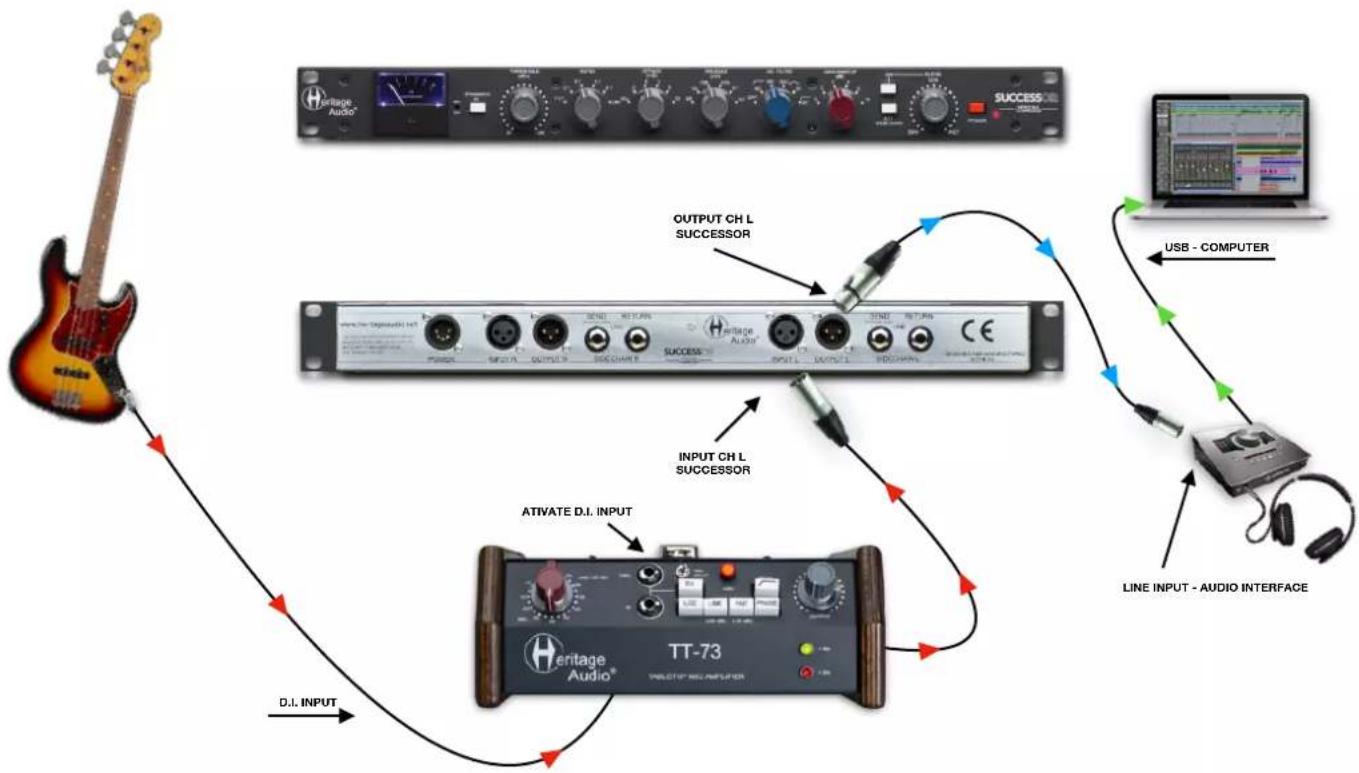
flowchart
graph TD
    A["Chassis Model"] -->|D.I. INPUT| B["Line Input - Audio Interface"]
    B -->|USB - COMPUTER| C["Output CH L SUCCESSOR"]
    C -->|DISE| D["Line Input - Audio Interface"]
    D -->|ATIVATE D.I. INPUT| E["Line Input - TT-73"]
    E -->|DISE| F["Line Input - Audio Interface"]
    F -->|USB - COMPUTER| G["Output CH L SUCCESSOR"]
    G -->|DISE| H["Line Input - Audio Interface"]
GUITAR
RECORDING
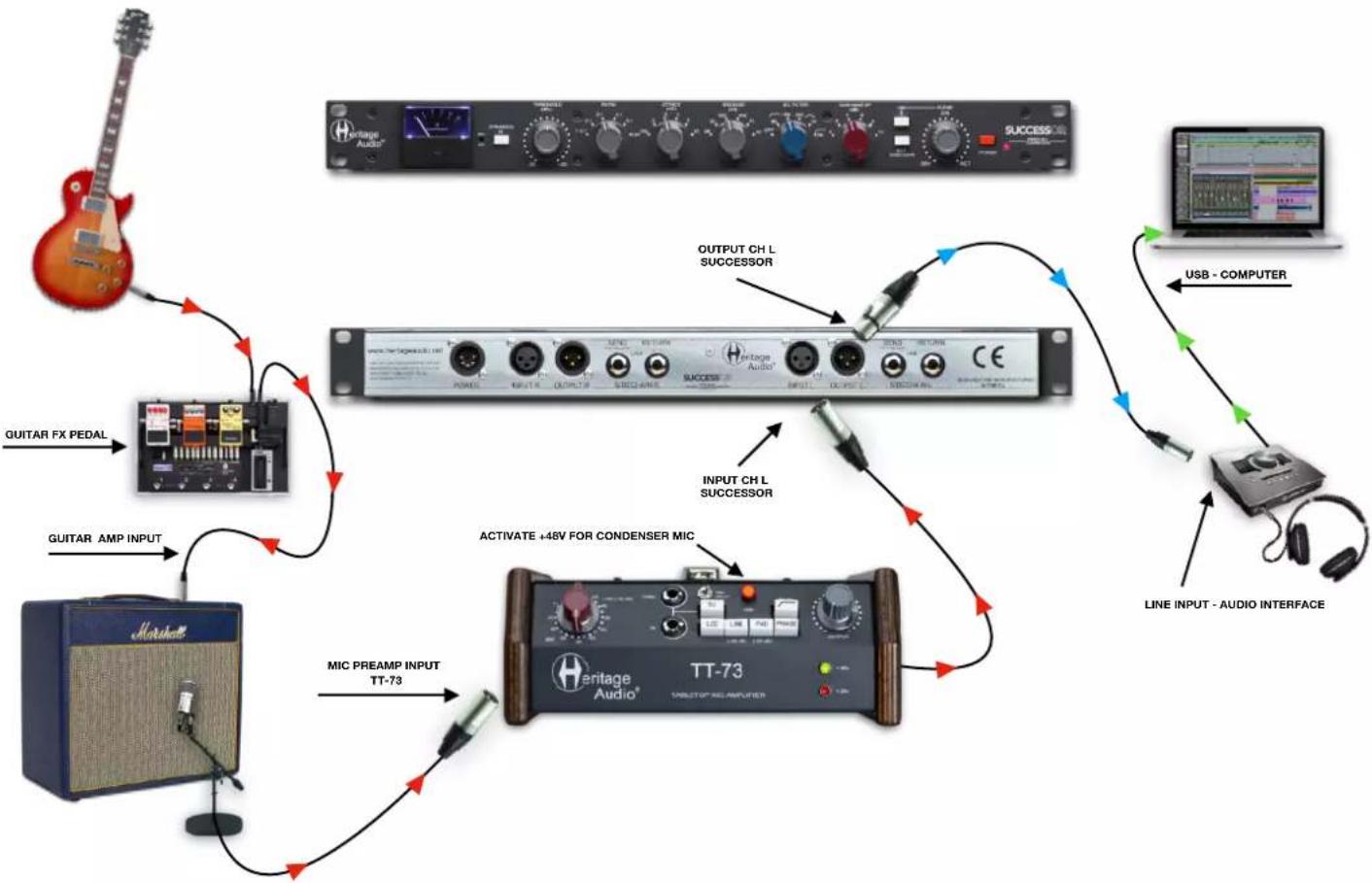
flowchart
graph TD
    A["Guitar FX PEDAL"] --> B["Output CH L SUCCESSOR"]
    C["Guitar AMP INPUT"] --> D["Input CH L SUCCESSOR"]
    E["Mic PREAMP INPUT TT-73"] --> F["Activate +48V FOR CONDENSER MIC"]
    G["Line INPUT - AUDIO INTERFACE"] --> H["USB - COMPUTER"]
    I["Line INPUT - AUDIO INTERFACE"] --> J["Line INPUT - USB - COMPUTER"]
    K["Line INPUT - Audio Interface"] --> L["Line INPUT - USB - COMPUTER"]
    M["Line INPUT - Audio Interface"] --> N["Line INPUT - USB - COMPUTER"]
    O["Line INPUT - Audio Interface"] --> P["Line INPUT - USB - COMPUTER"]
    Q["Line INPUT - Audio Interface"] --> R["Line INPUT - USB - COMPUTER"]
    S["Line INPUT - Audio Interface"] --> T["Line INPUT - USB - COMPUTER"]
    U["Line INPUT - Audio Interface"] --> V["Line INPUT - USB - COMPUTER"]
    W["Line INPUT - Audio Interface"] --> X["Line INPUT - USB - COMPUTER"]

flowchart
graph TD
    A["Input CH R SUCCESSOR"] --> B["OUTPUT CH L SUCCESSOR"]
    B --> C["OUTPUT CH R SUCCESSOR"]
    C --> D["INPUT CH 1 SUCCESSOR"]
    D --> E["OUTPUT CH L SUCCESSOR"]
    E --> F["OUTPUT CH R SUCCESSOR"]
    F --> G["MONITOR SPEAKERS"]
    G --> H["THUNDERBOLT COMPUTER"]
    H --> I["Laptop"]
    G --> J["MONITOR SPEAKERS"]
    J --> K["OUTPUT CH 1 & 2"]
    K --> L["INPUT DAW CH 1"]
    L --> M["OUTPUT CH 2"]
    M --> N["INPUT DAW CH 1 & 2"]
    N --> O["OUTPUT CH 1 & 2"]
    O --> P["OUTPUT CH 2"]
    P --> Q["OUTPUT CH 1 & 2"]
    Q --> R["OUTPUT CH 2"]
    R --> S["OUTPUT CH 1 & 2"]
    S --> T["OUTPUT CH 2"]
    T --> U["OUTPUT CH 1 & 2"]
    U --> V["OUTPUT CH 2"]
    V --> W["OUTPUT CH 1 & 2"]
    W --> X["OUTPUT CH 2"]
    X --> Y["OUTPUT CH 1 & 2"]
    Y --> Z["OUTPUT CH 2"]
    Z --> AA["OUTPUT CH 1 & 2"]
    AA --> AB["OUTPUT CH 2"]
    AB --> AC["OUTPUT CH 1 & 2"]
    AC --> AD["OUTPUT CH 2"]
    AD --> AE["OUTPUT CH 1 & 2"]
    AE --> AF["OUTPUT CH 2"]
    AF --> AG["OUTPUT CH 1 & 2"]
    AG --> AH["OUTPUT CH 2"]
    AH --> AI["OUTPUT CH 1 & 2"]
    AI --> AJ["OUTPUT CH 2"]
    AJ --> AK["OUTPUT CH 1 & 2"]
    AK --> AL["OUTPUT CH 2"]
    AL --> AM["OUTPUT CH 1 & 2"]
    AM --> AN["OUTPUT CH 2"]
    AN --> AO["OUTPUT CH 1 & 2"]
    AO --> AP["OUTPUT CH 2"]
    AP --> AQ["OUTPUT CH 1 & 2"]
    AQ --> AR["OUTPUT CH 2"]
    AR --> AS["OUTPUT CH 1 & 2"]
    AS --> AT["OUTPUT CH 2"]
    AT --> AU["OUTPUT CH 1 & 2"]
    AU --> AV["OUTPUT CH 2"]
    AV --> AW["OUTPUT CH 1 & 2"]
    AW --> AX["OUTPUT CH 2"]
    AX --> AY["OUTPUT CH 1 & 2"]
    AY --> AZ["OUTPUT CH 2"]
    AZ --> BA["OUTPUT CH 1 & 2"]
    BA --> BB["OUTPUT CH 2"]
    BB --> BC["OUTPUT CH 1 & 2"]
    BC --> BD["OUTPUT CH 2"]
    BD --> BE["OUTPUT CH 1 & 2"]
    BE --> BF["OUTPUT CH 2"]
    BF --> BG["OUTPUT CH 1 & 2"]
    BG --> BH["OUTPUT CH 2"]
MIXING MIXBUS

flowchart
graph TD
    A["Input CH R SUCCESSOR"] --> B["THUNDERBOLT COMPUTER"]
    C["OUTPUT CH R SUCCESSOR"] --> B
    D["INPUT CH L SUCCESSOR"] --> B
    E["OUTPUT CH L SUCCESSOR"] --> B
    F["INPUT CH 1 EQUALIZER"] --> B
    G["INPUT CH 2 EQUALIZER"] --> B
    H["OUTPUT CH 2 COMPRESSOR"] --> B
    I["INPUT CH 1 EQUALIZER"] --> B
    J["OUTPUT CH 1 EQUALIZER"] --> B
    K["OUTPUT CH 2 COMPRESSOR"] --> B
    L["OUTPUT CH 1 COMPRESSOR"] --> B
    M["OUTPUT CH 2 DAW"] --> N["MONITOR SPEAKERS"]
    O["INPUT DAW CH 2"] --> N
    P["INPUT DAW CH 1"] --> N
    style N fill:#f9f,stroke:#333,stroke-width:2px

flowchart
graph TD
    A["MONITOR SPEAKERS"] --> B["THUNDERBOLT COMPUTER"]
    B --> C["OUTPUT L EQUALIZER"]
    C --> D["OUTPUT R EQUALIZER"]
    D --> E["GRAPHIC EQUALIZERS"]
    E --> F["OUTPUT L EQUALIZER"]
    F --> G["OUTPUT R EQUALIZER"]
    G --> H["SIDECHAIN - SEND R"]
    H --> I["SIDECHAIN - RETURN R"]
    I --> J["SIDECHAIN - SEND L"]
    J --> K["SIDECHAIN - RETURN L"]
    K --> L["POWER"]
    L --> M["OUTPUT R"]
    M --> N["SIDECHAIN R"]
    N --> O["OUTPUT L EQUALIZER"]
    O --> P["OUTPUT R EQUALIZER"]
    P --> Q["SIDECHAIN - SEND R"]
    Q --> R["SIDECHAIN - RETURN R"]
    R --> S["SIDECHAIN - SEND L"]
    S --> T["SIDECHAIN - RETURN L"]
    T --> U["POWER"]
    U --> V["OUTPUT R"]
    V --> W["SIDECHAIN R"]
    W --> X["SIDECHAIN - SEND R"]
    X --> Y["SIDECHAIN - RETURN R"]
    Y --> Z["SIDECHAIN - SEND L"]
    Z --> AA["SIDECHAIN - RETURN L"]
    AA --> AB["SIDECHAIN - SEND R"]
    AB --> AC["SIDECHAIN - RETURN R"]
    AC --> AD["SIDECHAIN - SEND L"]
    AD --> AE["SIDECHAIN - RETURN L"]
• Maximum input level: Over +22 dBu.
• Maximum output level: Over +26 dBu into 600 Ω.
- Self Noise: Less than -75 dBu.
- THD+N (50 Hz - 20 kHz): DYNAMIC IN not engaged, less than 0.07% at +20 dBu.
• Frequency response: ± 0.5dB, 15 Hz-30 kHz.
- Input impedance: 10 KΩ, transformer balanced and floating.
- Output impedance: Less than 75 Ω, transformer balanced and floating, Class A driven.
- Dimensions (W x H x L): 482mm x 44mm (1 Rack unit) x 185mm.
• Weight: 3.380 Kg.
SIGNAL FLOW

flowchart
graph TD
    A["Input"] --> B["WET"]
    B --> C["-6 dBu"]
    C --> D["Audio Patch"]
    D --> E["-31 dBu"]
    E --> F["Intermittent Array"]
    F --> G["-14 dBu"]
    G --> H["Output"]
    I["Vu Meter"] --> J["Dynamics IN"]
    J --> K["Sidechain"]
    L["CONTROL"] --> M["Attack"]
    M --> N["Robbose"]
    N --> O["Ratio"]
    O --> P["Trachean"]
    P --> Q["Sidechain filters"]
    Q --> R["-14 dBu"]
    R --> S["Lx sidechain"]
    T["SEND/RETURNS"] --> U["Ratio"]
    U --> V["0 dBu"]
    V --> W["Output"]
    X["COMPRESSOR"] --> Y["AUDIO PATCH"]
    Y --> Z["BLEND"]
    Z --> AA["Bland ON"]
    AA --> AB["Faster Area"]
    AB --> AC["-4 dBu"]
    AC --> AD["Output"]
    AE["Return"] --> AF["0 dBu"]
    AF --> AG["Output"]

natural_image
Abstract black-and-white graphic of a question mark with a human profile silhouette and a small 'H' symbol below (no text or symbols present)
natural_image
Illustration of a glowing incandescent light bulb with a stylized 'H' symbol on its side (no text or labels)| PROBLEMS | SOLUTIONS |
| There is almost no sound coming from the SUCCESSOR. | Make sure you have raised the GAIN MAKE-UP to a sufficient level to recover from any gain reduction taking place. |
| There doesn’t seem to be any compression occurring. | Make sure you have adjusted the THRESHOLD level to a reasonable setting as well as selecting an appropriate RATIO for the signal. |
| I’m getting way too much compression for what I need and it’s too aggressive. | Try adjusting the THRESHOLD and/or RATIO to alter the amount and/or intensity of the compression. |
| I’m still getting way too much compression for what I need. | Try adjusting the SC FILTER to make the SUCCESSO less sensitive to the lower frequencies. |
| The compression I am getting is still altogether too aggressive for what I am looking for. | Try different settings on the ATTACK and RELEASE controls to soften the effect. |
| The readings on the VU meter don’t seem to correspond with what is actually happening. | Sounds like it’s time for some calibrating. |
| The is no compression happening. | Make sure you have pressed the ‘DYNAMICS IN’ button. |
| I need to do some very special frequency dependent compression. | Push the ‘EXT SIDECHAIN’ button and make sure you have connected a (e.g., graphic equalizer) and adjusted it accordingly. |
| There seems to be no compression happening in spite of the drastic settings I’ve chosen. | Check to see if you have left the BLEND control all the way CCW, in the DRY position. |
| I’m having trouble determining the correct RELEASE time for the material I’m processing. | Try the automatic release times A1 and/or A2. |
* For any further doubts or questions please get in contact with us at: support@heritageaudio.com
LIMITED 2 YEAR WARRANTY
Heritage Audio SUCCESSOR is warranted by Heritage Audio SL to be free from defects in materials and workmanship for the period of 2 years to the original purchaser. In the event of such defects, the product will be repaired without charge or, at our option, replaced with a new one if delivered to Heritage Audio prepaid, together with a copy of the sales slip or other proof of purchase date. The warranty excludes problems due to normal wear, abuse, shipping damage or failure to use the product in accordance with the specifications.
Heritage Audio shall not be liable for damages based upon inconvenience, loss of use of the product, loss of time, interrupted operation or commercial loss or any other damages, whether incidental, consequential or otherwise.
This warranty is not transferable.
Heritage Audio and the Heritage Audio "H" logos are registered Trademarks owned and/or licensed by Heritage Audio.

natural_image
Interior of a audio recording studio with multiple speakers and a Hitago Audio audio receiver (no visible text or labels on the device body)REGISTRATION
Please visit our website: https://heritageaudio.com/registration/

Session / Title: ____ Track: ____ Connected Equipment: ____
Date: ____ Instrument: ____ Notes: ____
Switch ON
Switch OFF

Session / Title: ____ Track: ____ Connected Equipment: ____
Date: ____ Instrument: ____ Notes: ____
✓ Switch ON □ □ Switch OFF □

natural_image
Abstract black and white diagonal line design (no text or symbols)
www.heritageaudio.com
HERITAGE AUDIO. C/ Alfonso Gómez, 38, 3C. 28037 Madrid – Spain. Tel: +34 917 266 189
info@heritageaudio.com
Brand : Heritage Audio
Model : Successor
Category : Audio Compressor