 ManualGo.com
28HT5404-01Z - TV PHILIPS - Free user manual and instructions
Find the device manual for free 28HT5404-01Z PHILIPS in PDF.



Download the instructions for your TV in PDF format for free! Find your manual 28HT5404-01Z - PHILIPS and take your electronic device back in hand. On this page are published all the documents necessary for the use of your device. 28HT5404-01Z by PHILIPS.
USER MANUAL 28HT5404-01Z PHILIPS
External Loudspeaker Allow the user to connect an external loudspeaker. The minimum impedence is 16 Ω.
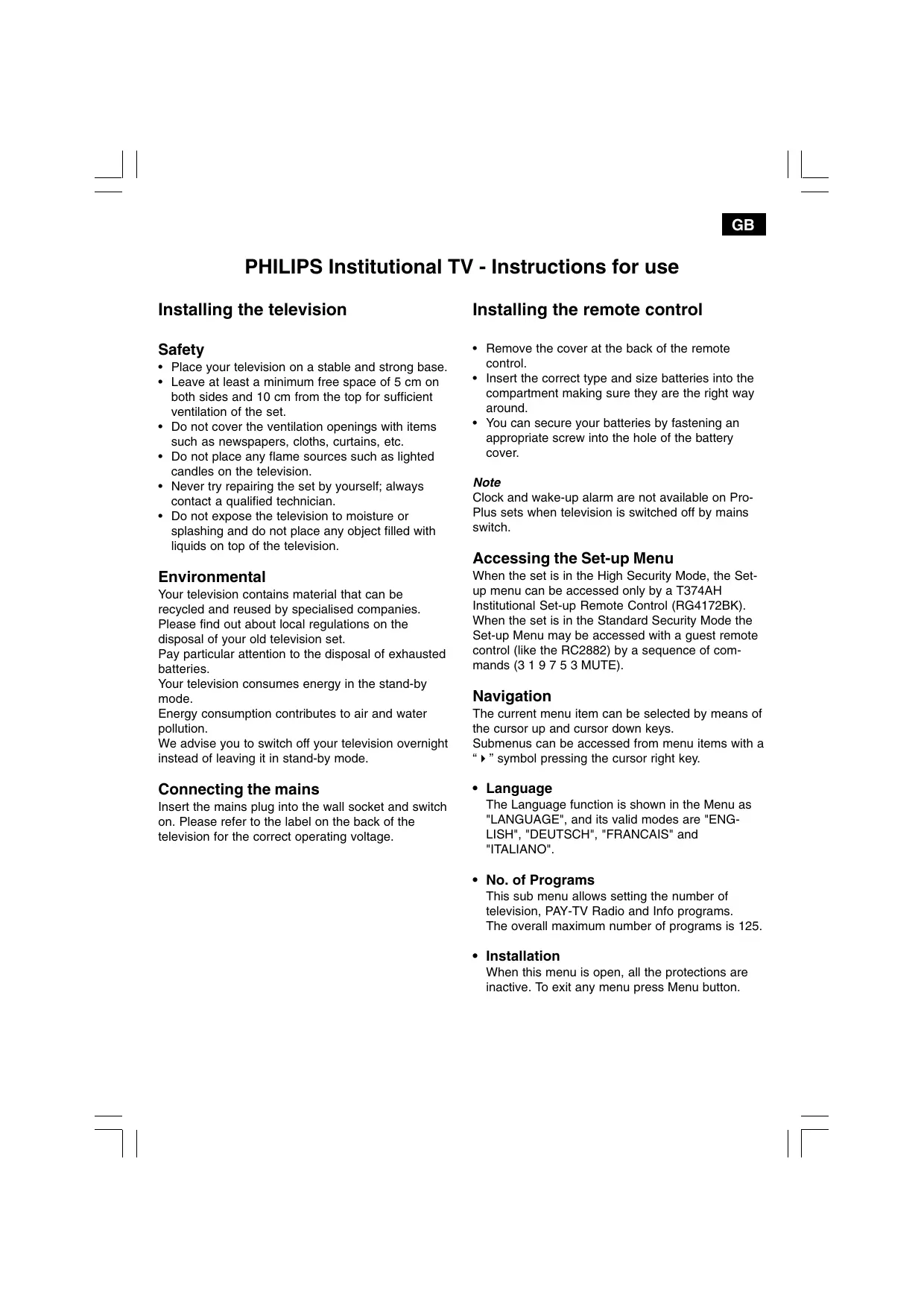
PHILIPS Institutional TV - Instructions for use Installing the television Installing the remote control Safety
- Remove the cover at the back of the remote control.
- Insert the correct type and size batteries into the compartment making sure they are the right way around.
- You can secure your batteries by fastening an appropriate screw into the hole of the battery cover.
- Place your television on a stable and strong base.
- Leave at least a minimum free space of 5 cm on both sides and 10 cm from the top for sufficient ventilation of the set.
- Do not cover the ventilation openings with items such as newspapers, cloths, curtains, etc.
- Do not place any flame sources such as lighted candles on the television.
- Never try repairing the set by yourself; always contact a qualified technician.
- Do not expose the television to moisture or splashing and do not place any object filled with liquids on top of the television. Environmental Your television contains material that can be recycled and reused by specialised companies. Please find out about local regulations on the disposal of your old television set. Pay particular attention to the disposal of exhausted batteries. Your television consumes energy in the stand-by mode. Energy consumption contributes to air and water pollution. We advise you to switch off your television overnight instead of leaving it in stand-by mode. Connecting the mains Insert the mains plug into the wall socket and switch on. Please refer to the label on the back of the television for the correct operating voltage. Note Clock and wake-up alarm are not available on ProPlus sets when television is switched off by mains switch. Accessing the Set-up Menu When the set is in the High Security Mode, the Setup menu can be accessed only by a T374AH Institutional Set-up Remote Control (RG4172BK). When the set is in the Standard Security Mode the Set-up Menu may be accessed with a guest remote control (like the RC2882) by a sequence of commands (3 1 9 7 5 3 MUTE). Navigation The current menu item can be selected by means of the cursor up and cursor down keys. Submenus can be accessed from menu items with a “"” symbol pressing the cursor right key.
- Language The Language function is shown in the Menu as "LANGUAGE", and its valid modes are "ENGLISH", "DEUTSCH", "FRANCAIS" and "ITALIANO".
- No. of Programs This sub menu allows setting the number of television, PAY-TV Radio and Info programs. The overall maximum number of programs is 125.
- Installation When this menu is open, all the protections are inactive. To exit any menu press Menu button. Input The "Input" menu item selects the desired input source that will be assigned to the program. Possible values are Front End, AV1, AV2 and AV2YC (internal interface for system televisions only), and RADIO. System WEST EU (PAL/SECAM-BG) and EAST EU (PAL/ SECAM-DK), UK (PAL-I), FRANCE (SECAM-L/L'). Manual Search Digits can be entered for a frequency in MHz. Right cursor starts an auto search; during frequency entry the digits not yet entered are displayed as dashes "-". Enter “0” for frequencies below 100 MHz. Program no. The programme type can be selected with the cursor left/right buttons. These buttons will toggle between all available types: "TV", "INFO", "PAYTV" and "RADIO". If the program number of a certain type is 0, the corresponding type is not displayed. In order to display a program number of the above-mentioned types, always enter two numbers, for example: “01” for TV1 or digit “1” and up/down cursor. Store The present program information is stored after pressing the cursor left/right button. Press Menu to exit without storing. Fine Tune Using the "control left/right" commands starts finetuning. Protection This function indicates whether the selected program has a protection or not. With the cursor left/right keys the protection can toggle between "YES" and "NO". Label This menu item will be used to add a label/name for each program. Pressing the left/right buttons you may enter or exit the label field; pressing the up/down cursor you may insert alphanumeric characters. Pressing M (Menu button) you may exit the Label Menu item. Teletext Language This menu enables the user to select the Teletext character set to be used for the selected channel. With cursor left/right you can select a letter corresponding to the different language clusters. “W”: Pan European (Latin) / West option “E”: Pan European (Latin) / East option “G”: Greek “A”: Arabic “C”: Cyrillic Video Blank This item can change between "YES" and "NO" to activate or deactivate picture mute. Audio Mute This item can change between "YES" and "NO" to activate or deactivate sound mute. Remarks TELEVISION up/down, INFO up/down, PAY-TV up/down and RADIO up/down are active in menu mode and the television reacts the same way as in TV mode.
- Clock set-up The Clock set-up menu can be entered from this menu item The Menu items actually displayed depend on whether a LED clock display is available or not. Display (OSD only) Defines whether the actual time is displayed on the screen or not. Display Standby (LED only) This menu item will be used to set the intensity of the clock display when the television is in standby mode. Display On (LED only) This menu item will be used to set the intensity of the clock when the television is in the ON mode. Time Setting This menu item will be used to set the time for the clock. Teletext Time Download This menu item is used to activate or deactivate the function for automatic time downloading by means of Teletext. Download Program This menu item is used to select the channel from which to retrieve the correct time from the Teletext. When this item is selected the television set tunes to the selected program. Time Offset This menu item is used to set the offset needed to adjust the time received from the Teletext channel to represent the current time in the current location.
- Brightness The brightness control contains 63 discrete values from the minimum to maximum setting.
- Colour The colour control contains 63 discrete values from the minimum to maximum setting.
- Contrast The contrast control contains 63 discrete values from the minimum to maximum setting.
- Sharpness The sharpness control contains 63 discrete values from the minimum to maximum setting.
- Forced mono (for stereo televisions only) This command is used to activate or deactivate the stereo feature in stereo sets. Toggle YES, NO using the right/left cursor.
- Balance (for stereo televisions only) To balance the output sound from TELEVISION’s speakers left and right
- Treble (for stereo televisions only) To set the treble frequencies of sound output from TELEVISION’s speakers.
- Bass (for stereo televisions only) To set the bass frequencies of sound output from television’s speakers.
- AVL (Automatic Volume Leveller) The Automatic Volume Leveller feature is shown as “AVL” in the menu and its valid states are “YES”; “NO”.
- Volume Bar To display volume bar when adjusting volume, select "YES". Select “NO” to hide the bar.
- Min Volume This item sets the limit for minimum volume allowed for the television set. Use right/left cursor to adjust.
- Max Volume This item sets the limit for the maximum volume allowed for the television set. Use right/left cursor to adjust.
- Switch on Volume This item sets the television’s volume at switch on. Use the right/left cursor to adjust.
- Buzzer Volume This item sets the volume of the alarm buzzer. Use the right/left cursor to adjust.
- Switch On Program This item sets the television’s program at switch
- Power On The Power On menu function defines the behaviour of the television whenever AC Power is applied. The valid states are "FORCED", "STANDARD" and “STANDBY”. When “FORCED”, the television can only be switched OFF by means of the main switch or a set-up remote control or by ESP function (Energy Saving Programmability controls the maximum continuous viewing time allowed by the control system). When “STANDARD”, the television switches on the previous status, ON or Stand-by. When “STAND-BY”, the television always switches on in Stand-by.
- Step Tuning (YES/NO) If YES, TV programs (1 to 9) are tuned immediately when a digit is pressed. If NO, tuning is performed only after the dash disappears.
- Volume Fixed The valid toggle states are "YES" and "NO": if YES, the volume is fixed at a certain volume, if NO, the volume contains 63 discrete values. This is the time-out to enter the second digit for TV program 10 onwards.
- Program Display Program Display values can be: Number, Label, All, None.
- Keyboard Lock In Commercial Mode, the Keyboard Lockout menu function disables the television’s local keyboard for volume and program control.
- Free protected programs With this item all protected programs can be freed. If "free protected programs" is set to "YES", all programs are accessible for the user, if the item is "NO" protected programs are skipped. A TV program can be selected by relevant digit but with picture blanked and sound muted.
- Auto Scart Enable/ disable automatic switching to external Scart source.
- Welcome Message Press cursor left/right to display Welcome message entry menu: Welcome Message, Line 1, and Line 2. With the cursor up/down you can set the message characters.
- Program Guide This feature will enable/disable in a "list" or "page", the program numbers with the associated labels.
- ESP Energy Saving Programmability Mode (ESP) controls the maximum continuous viewing time allowed by the control system. It allows the establishment to limit the time the Television remains activated once a Guest has checked-out. The ESP Menu function is shown as "ESP", and its valid values are 00 - 99 (in hours). 00 value means OFF.
- Interface This item is only present in "system" sets and it is used to enable or disable communication with the DCM (Data Communication Module).
- Audio / Video Mute The Audio/Video Mute menu function determines whether the video should be blanked and the audio should be muted if the currently tuned channel has no signal (Blue, Black, Off). This menu function is shown as "REMINDER", and its states are "YES": "NO".
- Security The menu function "SECURITY" allows the user to select one of two states "HIGH" or "STANDARD". The default is "STANDARD". While the set is in the Security High Mode the setup menu can only be accessed by a T374AH Institutional Set-up Remote Control While the set is in the Security Standard Mode the Set-up Menu may be accessed with a guest remote control by a sequence of commands (3 1 9 7 5 3 MUTE).
- TV Installation > No. of Programs (Poèet pøedvoleb) Installation (Instalace) Brightness (Jas) Sharpness (Ostrost) Switch on Volume (Áñ÷éêÞ ¸íôáóç)
- Volume Fixed (Vast Volume)
- Volume Bar (Volumebalk) Brightness (Jasnoæ) Sharpness (Ostroæ) Language (Dil) No. of Programs (program Sayýsý) Brightness (Parlaklýk) Colour (Renk) Sharpness (Netlik) Volume Fixed (Sabit Ses) Volume Bar (Ses Çubuðu) Min Volume (Minimum Ses) Max Volume (Maksimum Ses) Switch on Volume (Açma Sesi) Buzzer Volume (Zil Sesi) Step Tuning (YES/NO) Kademeli Kanal Seçme (EVET/HAYIR) Keyboard Lock (Panel Kilidi) No. of Programs - poèet programov Bass basy (iba pre TV stereo) Power On - zapnutie Information for users in the UK Positioning the TV For the best results, choose a position where light does not fall directly on the screen, and at some distance away from radiators or other sources of heat. Leave a space of at least 5 cm all around the TV for ventilation, making sure that curtains, cupboards etc. cannot obstruct the air flow through the ventilation apertures.The TV is intended for use in a domestic environment only and should never be operated or stored in excessively hot or humid atmospheres. General Points Please take note of the section entitled 'Tips' at the end of this booklet. Interference The Department of Trade and Industry operates a Radio Interference Investigation Service to help TV licence holders improve reception of BBC and IBA programmes where they are being spoilt by interference. If your dealer cannot help, ask at a main Post Office for the booklet "How to Improve Television and Radio Reception". Mains connection Before connecting the TV to the mains, check that the mains supply voltage corresponds to the voltage printed on the type plate on the rear panel of the TV. If the mains voltage is different, consult your dealer. (not applicable outside the UK) Important This apparatus is fitted with an approved moulded 13 Amp plug.To change a fuse in this type of plug proceed as follows:
1. Remove fuse cover and fuse.
2. Fit new fuse which should be a BS1362 5A,
A.S.T.A. or BSI approved type.
3. Refit the fuse cover.
In order to maintain conformity to the EMC directive, the mains plug on this product must not be removed. Connecting the aerial The aerial should be connected to the socket marked : at the back of the set.An inferior aerial is likely to result in a poor, perhaps unstable picture with ghost images and lack of contrast. Make-shift loft or set-top aerials are often inadequate.Your dealer will know from experience the most suitable type for your locality. Should you wish to use the set in conjunction with other equipment, which connects to the aerial socket such as TV games, or a video camera it is recommended that these be connected via a combiner unit to avoid repeated connection and disconnection of the aerial plug. Fitting the stand (if provided) Use only the stand provided with the set, making sure that the fixings are properly tightened.A diagram showing how to assemble the stand is packed with the stand. Never use a make-shift stand, or legs fixed with woodscrews. L01 ITV 3111 256 1903.1
Printed on recycled paper