USER MANUAL FF1325SS Summit
natural_image
Interior view of a fully open refrigerator with visible door, shelves, and top panel (no text or symbols)
Owner's Manual
Read this guide before installing your refrigerator.
Write Serial No. (on back of unit) here:
Felix Storch, Inc.
Summit Appliance Division
770 Garrison Avenue
Bronx, New York 10474
www.summitappliance.com
IMPORTANT SAFEGUARDS
- Plug into a grounded 3-prong outlet, do not remove grounding prong, do not use an adapter, and do not use an extension cord.
- Replace all panels before operating.
- It is recommended that a separate circuit serving only your appliance be provided. Use receptacles that cannot be turned off by a switch or pull chain.
- Never clean appliance parts with flammable fluids. These fumes can create a fire hazard or explosion. And do not store or use gasoline or other flammable vapors and liquids in the vicinity of this or any other appliance. The fumes can create a fire hazard or explosion.
- Before proceeding with cleaning and maintenance operations, make sure the power line of the unit is disconnected.
- Do not connect or disconnect the electric plug when your hands are wet.
- Unplug the appliance or disconnect power before cleaning or servicing. Failure to do so can result in electrical shock or death.
- Do not attempt to repair or replace any part of your appliance unless it is specifically recommended in this manual. All other servicing should be referred to a qualified technician.

DANGER

Risk of child entrapment!
Child entrapment and suffocation are not problems of the past. Junked or abandoned appliances are still dangerous, even if they will “just sit in the garage a few days”.
Before discarding your old refrigerator:
• Take off the doors.
- Leave the shelves in place so that children may not easily climb inside.
- Use two or more people to move and install the appliance. Failure to do so can result in back or other injury.
- To ensure proper ventilation for your appliance, the front of the unit must be completely unobstructed. Choose a well-ventilated area with temperatures above 60^ F ( 16^ C) and below 90^ F ( 32^ C). This unit must be installed in an area protected from the elements, such as wind, rain, water spray or drips.
- The appliance should not be located next to ovens, grills or other sources of high heat.
- A standard electrical supply (115 V AC only, 60 Hz), properly grounded in accordance with the National Electrical Code and local codes and ordinances, is required.
- Do not kink or pinch the power supply cord of the appliance.
- The size of the fuse (or circuit breaker) should be 15 amperes.
- It is important that the appliance be leveled in order to work properly. You may need to make several adjustments to level it.
- Never allow children to operate, play with or crawl inside the appliance.
- Do not use solvent-based cleaning agents or abrasives on the interior. These
cleaners may damage or discolor the interior.
- Use this appliance only for its intended purpose as described in this Owner's Manual.
- Keep fingers out of the "pinch point" areas. Clearances between the doors and between the doors and cabinet are necessarily small. Be careful closing doors when children are in the area.
Table of Contents
Important Safeguards 1 - 2
Location of Parts ....3
Before Connecting Your Refrigerator ....4
General instructions
Placement
Leveling
Installing Your Refrigerator 5 - 6
Electrical connection 5 - 6
Warming of areas near the freezer 6
First connection 6
Operation 6 - 8
Fresh food compartment temperature control 6
Defrosting and air circulation ....7
Crisper drawer(s) 7
Humidity control 7
To remove the drawer 7
Shelves 7
Door bins 8
Tips for Using the Refrigerator 8
Cleaning Your Refrigerator 9
General Information 10 - 11
Trips and absences 10
Moving 10
Problems with the electrical supply 10
To replace the light bulb 10
Normal operating sounds 10 - 11
Safety Instructions ....11
Troubleshooting 12
Limited Warranty 15
Location of Parts

Before Connecting Your Refrigerator
General instructions:
Remove the base, packaging and accessories.
Remove the adhesive tape residue with a cloth soaked in a solution of water and a mild liquid soap.
Choose the location for the refrigerator. The area should be kept clean and dry to avoid rust.
Placement:
Allow the following minimum spacing to ensure adequate air circulation, especially if the appliance is going to be fixed to the wall: 2 to 3 cm (roughly 1") on each side, 10 cm (4") at the back and 5 to 10 cm (2 to 4") on top.
Do not install the refrigerator near heat sources like stoves or radiators, or in direct sunlight, as this will cause it to overwork and be less efficient, thereby increasing its consumption of electrical energy.
Do not lean the refrigerator against a wall. By complying with this, you will help ensure the correct positioning of the product, preventing your appliance from coming directly into contact with walls or furniture and thereby avoiding disagreeable noise and allowing for adequate air circulation.
Leveling:
Use the two leveling screws to level the refrigerator. Insert and adjust them so that they rest firmly on the floor.
The front of the refrigerator should be a little higher than the rear, which should lean slightly backwards. This facilitates the automatic closing of the doors and helps maintain the temperature inside the unit.

Installing Your Refrigerator
Before inserting the plug into the AC outlet, clean the interior of your refrigerator using a cloth or soft sponge and mild soap, or a solution of bicarbonate of soda and water.
Electrical connection:
For residential use, a 120V AC, 60Hz power source is required. Ideally your set-up should be equipped with a main switch and separate balanced circuit, protected by fuses and/or a circuit breaker with a maximum of 15 to 20 Amps.
Your refrigerator comes equipped with an AC power cord with integrated grounding. Under no circumstances should the grounding be removed to connect an adapter plug, nor should the grounding be cut and/or replaced by a 2-prong plug.
For your safety when installing the refrigerator, refer to Figure A. If your electrical installation is not equipped with this kind of AC outlet, obtain one and have it installed by a qualified electrician. Any personal accidents and/or material damage cause by the product resulting from failure to do this will be the full responsibility of the client. Read the instructions printed in red on the label attached to the power cable.
Connect your refrigerator to the closest AC outlet. Avoid using an extension cord. If you must use an extension cord, consult a qualified electrician so that he can advise you on the type of cord that can be used for maximum safety.
Use of extension cords: Because of potential hazards under certain conditions, we strongly recommend against the use of an extension cord. However, if you still choose to use an extension cord, it is absolutely necessary that it be UL-listed, 3-wire grounding type plug and outlet and that the electrical rating of the cord be 15 amperes (minimum) and 120 volts.
Do not connect another electrical appliance to the refrigerator AC outlet while the refrigerator is in use. By doing this you will avoid power surges and the overheating of your refrigerator.
To disconnect your refrigerator, grip the plug firmly and pull straight out from the AC outlet. Never pull on the electrical cord.

Ask a qualified electrician to inspect the wall outlet and the electrical circuit, to ensure that the circuit is properly grounded.
If the power cord is damaged, it must be replaced by an electrician from an authorized service center in order to avoid any risk of accident.
Warming of areas near the freezer:
Your freezer comes equipped with a device that prevents condensation. The heating of some external zones of your refrigerator is normal. This prevents condensation of drops of water on the exterior of your refrigerator. However, in conditions where there is high atmospheric temperature and humidity, a light film of condensation could form. Dry this with a soft cloth.
First connection:
- Once your refrigerator is in place, wait 4 to 6 hours before connecting it so that the gas and compressor oil have a chance to settle.
- Before connecting the refrigerator, turn the temperature control or adjust the temperature level of the display to mid-position (between 4 and 6).
- Connect the plug to the wall AC outlet.
- Allow it to operate empty and with the doors closed for 4 hours before loading with food.
- Avoid opening the door so that the unit can reach the desired temperature.
- If you want to relocate your refrigerator, disconnect it before moving.
- Once it is in its new location, repeat the previous steps.
Operation
Fresh food compartment temperature control:
To regulate the temperature of the fresh food compartment, turn the temperature control knob to the desired position. The refrigerator temperature control is found inside the compartment. It may be necessary to use a coin to turn the control.
Suggested settings:
| Temperature | Position | Use |
| Minimum cooling 1 to 3 | Only a few food items stored. Refrigerator door seldom opened. |
| Medium 4 to 6 | Normal use | |
| Maximum cooling 7 to 9 | Many food items stored. Door frequently opened. |
Notes: The interior temperature can vary depending on the ambient temperature. The temperature control may need to be to lowered in summer and raised in winter.
Defrosting and air circulation:
It is not necessary for you to defrost your refrigerator since it defrosts automatically.
The cooling system guarantees the even circulation of cold air and its distribution to all parts of your refrigerator, thus maintaining the optimum temperature throughout.
It is important that the air vents are never obstructed.
Crisper drawer(s):
The crisper drawer is designed to keep fruits and vegetables fresh. If your model has two drawers, they can be used to separate fruits and vegetables or to optimize their placement.
In some models the drawer or drawers have humidity controls.
Humidity control:
The crisper drawer maintains a suitable temperature and humidity for the storage of fresh produce, thereby preserving the natural characteristics of the foods.
The correct usage of the humidity control ensures the adequate flow of air into the interior of the drawer.
If it appears that excessive moisture is building up on the foods inside the crisper drawer, rotate the humidity control to a more open position.

natural_image
Three-step diagram showing a refrigerator interior with storage, cleaning, and cleaning of an egg in the refrigerator (no text or symbols)
To remove the crisper drawer:
Remove the drawer by lifting it slightly to remove it from its tracks and then pulling it out.
If you want to remove the drawer and its cover together, open the drawer slightly, grasp the cover, lift and pull out.
Shelves:
The shelves are multi-positional.

natural_image
Close-up of a metal shelf with horizontal shelves and a vertical shaft (no text or symbols visible)
If you wish to move a shelf:
- Remove all foods and objects placed on it.
-
Place both hands on the front edge of the shelf with fingertips underneath, and lift while gently pulling the shelf toward you. Be sure to have a firm grasp.
-
To replace the shelf in another location, hold it as before and maneuver it over the tracks toward the back until you feel it snap into position.
Door bins:
The bins on the doors can be used to store cans, large and small bottles, and in some models, eggs. The bins are designed ergonomically so that items can be reached easily.
Tips for Using the Refrigerator
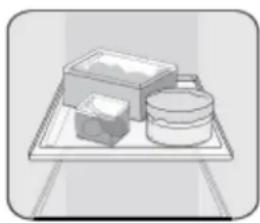
We recommend storing food in containers with lids or wrapped in airtight materials such as aluminum foil, plastic containers or plastic wrap.
It is also a good idea to place ice cubes and food that you would like to freeze rapidly on the freezer shelf.
Do not store hot foods in the fresh food compartment or freezer. You should wait until they have cooled down to room temperature.
Only open the doors for the time necessary to store or remove food or drink items. By doing this you will reduce energy consumption and improve the performance of your refrigerator.
natural_image
Illustration of a tray with three items: a rectangular block, a cylindrical container, and a small cube (no text or symbols)

It may be difficult to open the door again after having opened and closed it to introduce or remove foods. This is
normal due to the vacuum that forms in the interior of the refrigerator caused by the exchange of air at different temperatures. If this happens, wait 10 to 15 seconds before trying again and the doors should open easily.
Always store onions in a plastic bag or a hermetically-sealed container to prevent their odor from penetrating other foods.
Do not store garlic inside your refrigerator as a cold, dark environment promotes its germination.
Always take note of the manufacturer's expiration date on frozen products.
Once food has been defrosted, it cannot be refrozen.
Liquids increase in volume when frozen. For this reason, do not fill containers up to the brim with liquids.
Do not store closed glass containers containing liquids in the freezer. The breakage of glass containers could badly damage the freezer.
Cleaning Your Refrigerator
Always disconnect the refrigerator plug from the outlet before cleaning or before starting a technical revision.
Never use toxic products (ammonia, bleach, etc.), abrasive substances (pastes) or fibers as they can damage the refrigerator.
Use a soft sponge or a cloth that has been soaked in a solution of mild soap in water. Rinse and dry well with a clean, dry cloth. You can also use a solution of one spoon of bicarbonate of soda and two quarts of warm water to clean the interior.
Do not use fibers or sharp or pointed objects which can scratch your refrigerator or the interior shelves.
To clean the condenser (on the models that have them), use a brush, cloth or sponge to eliminate accumulated dust. Do this at least every six months.

To periodically clean the freezer:
- Disconnect the plug from the wall.
- During the cleaning, do not let accumulated liquid filter into the interior of the refrigerator as this could damage the unit. Dry well.
- After cleaning, reconnect the unit to the electric socket.
Trips and absences:
For prolonged absences, disconnect the plug from the wall outlet.
Leave your refrigerator empty and clean. This includes the ice trays.
Leave the door ajar, placing an object behind it to prevent it from closing. This facilitates air circulation and discourages the formation of mold and odors.
During short absences, your refrigerator can stay connected. But be aware that there is always the possibility of power outages while you are away.
Moving:
If you need to place the refrigerator in a horizontal position in order to transport it, place it only on its left side (when viewed from the front).
Before changing your refrigerator's location, screw the leveling screws in as far as they will go.
natural_image
Simple illustration of a delivery truck (no text or symbols)
Problems with the electrical supply:
The majority of power outages are corrected in a few hours. The interior temperature of your refrigerator will not be affected for 4 hours. If the electrical failure persists for more than 6 hours, we suggest that you place ice bags in both compartments to help preserve the food.
To replace the light bulb:
- Disconnect power to the refrigerator.
- Lift the light shield.
- Remove the old bulb and replace with a new one of the same size, shape and power rating as the original bulb.
Normal operating sounds:
Some sounds are normal when your refrigerator is operating. The following list describes the different sounds that are characteristic of its functioning.
Crunching
Crunching is heard when ice breaks. This is the same noise that is heard when ice trays are removed from the freezer and exposed to room temperature.
Compressor hum
This is a normal sound caused by the running of the motor. It means the compressor is functioning.
Gas expansion
The expansion of gas is a characteristic of a refrigeration system. It is similar to the noise heard when filling a gas cylinder.
Defrosting
This sounds like running water. It occurs when the refrigerator is going through the defrosting process.
Bubbling sound
This occurs during the defrosting cycle and stops heat from entering the unit.
Safety Instructions
Do not touch the interior walls of the freezer with wet hands.
Do not allow children to hang from the doors and/or play near the refrigerator when the door is open as they could get injured or trapped inside.
When changing light bulbs, disconnect the refrigerator from the power supply. Failure to do so could result in personal injury.
Troubleshooting
If there is a problem with your refrigerator, before calling an authorized service center, carry out an investigation by consulting the following table. If after performing these tests you are still in doubt, you can contact our service center at 800-932-4267 and it will be our pleasure to assist you.
| Problem Probable Cause Possible Solution | |
| Refrigerator does not run. | There is no current. | Check fuses in electric system.Make sure plug is tightly pushed into the outlet. |
| Defective outlet | Connect another appliance to the outlet to confirm whether outlet is defective. |
| Plug disconnected Connect the plug. |
| Power cord damaged Call an authorized service center. |
| Installed in an unsuitable location See "Installation" instructions. |
| Refrigerator is not level. Adjust the leveling screws. |
| Abnormal sounds | Crunching sound | See "Normal operating sounds" under General Information. |
| Compressor sound See "Normal operating sounds". |
| Gas expansion sound See "Normal operating sounds". |
| Defrosting sound See "Normal operating sounds". |
| Ventilation system sound See "Normal operating sounds". |
| Refrigerator does not get cold. | Air does not seems to be circulating efficiently. | Remove air vent obstructions. |
| Doors are opened frequently. | Instruct people to open doors only when necessary. |
| External condensation | High humidity in the atmosphere (normal in certain climates and seasons). | Install the refrigerator in a well-ventilated location. |
| External condensation near the magnetic seal | Magnetic door seal does not adhere properly. | Adjust the leveling screws to gently tilt the refrigerator backwards. |
| The doors are opened frequently. | Instruct people to open doors only when necessary. |
| Internal condensation | Foods are not wrapped up, are not in airtight containers or are hot. Liquids may be in containers without lids, thus generating excessive moisture. | Wrap up the foods and put lids on containers of liquids. |
| Do not store hot foods. |
| Excessive moisture in the foods in the crisper drawer | Humidity controls are in the wrong position. | Adjust the humidity controls of the drawer to a more open position. |
| Ice crystals form in the freezer. | Moisture filtration through the door | Make sure that nothing is preventing the door from closing correctly. If necessary, reorganize the foods in the freezer. If formation of ice continues, call your authorized service center. |
| The internal light bulb does not come on. | Light bulb has blown. Replace light bulb. |
Notes
Notes
Limited Warranty
ONE-YEAR LIMITED WARRANTY
Within the 48 contiguous United States, for one year from the date of purchase, when this appliance is operated and maintained according to instructions attached to or furnished with the product, warrantor will pay for factory-specified parts and repair labor to correct defects in materials or workmanship. Service must be provided by a designated service company. Outside the 48 states, all parts are warranted for one year from manufacturing defects. Plastic parts, shelves and cabinets are warranted to be manufactured to commercially acceptable standards, and are not covered from damage during handling or breakage.
5-YEAR COMPRESSOR WARRANTY
- The compressor is covered for 5 years.
- Replacement does not include labor.
ITEMS WARRANTOR WILL NOT PAY FOR:
- Service calls to correct the installation of your appliance, to instruct you how to use your appliance, to replace or repair fuses or to correct wiring or plumbing.
- Service calls to repair or replace appliance light bulbs or broken shelves. Consumable parts (such as filters) are excluded from warranty coverage.
- Damage resulting from accident, alteration, misuse, abuse, fire, flood, acts of God, improper installation, installation not in accordance with electrical or plumbing codes, or use of products not approved by warrantor.
- Replacement parts or repair labor costs for units operated outside the United States.
- Repairs to parts or systems resulting from unauthorized modifications made to the appliance.
- Expenses for travel and transportation for product service in remote locations.
- The removal and reinstallation of your appliance if it is installed in an inaccessible location or is not installed in accordance with published installation instructions.
DISCLAIMER OF IMPLIED WARRANTIES;
LIMITATION OF REMEDIES
CUSTOMER'S SOLE AND EXCLUSIVE REMEDY UNDER THIS LIMITED WARRANTY SHALL BE PRODUCT REPAIR AS PROVIDED HEREIN. IMPLIED WARRANTIES, INCLUDING WARRANTIES OF MERCHANTABILITY OR FITNESS FOR A PARTICULAR PURPOSE, ARE LIMITED TO ONE YEAR. WARRANTOR SHALL NOT BE LIABLE FOR INCIDENTAL OR CONSEQUENTIAL DAMAGES. SOME STATES DO NOT ALLOW THE EXCLUSION OR LIMITATION OF INCIDENTAL OR CONSEQUENTIAL DAMAGES, OR LIMITATIONS ON THE DURATION OF IMPLIED WARRANTIES OF MERCHANTABILITY OR FITNESS, SO THESE EXCLUSIONS OR LIMITATIONS MAY NOT APPLY TO YOU. THIS WARRANTY GIVES YOU SPECIFIC LEGAL RIGHTS AND YOU MAY ALSO HAVE OTHER RIGHTS, WHICH VARY FROM STATE TO STATE.
FELIX STORCH, INC.
770 Garrison Avenue
Bronx, NY 10474
Phone: (718) 893-3900
Fax: (718) 842-3093
www.summitappliance.com

For parts and accessory ordering, troubleshooting and helpful hints, visit:
www.summitappliance.com/support