
E-A-Rsoft FX - Kopfhörer 3M - Kostenlose Bedienungsanleitung
Finden Sie kostenlos die Bedienungsanleitung des Geräts E-A-Rsoft FX 3M als PDF.


| Produkttyp | Gehörschutzstöpsel (Einweg) |
| Marke | 3M |
| Modell | E-A-Rsoft FX |
| Material | Polyurethanschaum (langsam zurückstellend) |
| Schalldämmung (NRR) | 29 dB (gemäß EPA-Kennzeichnung) |
| Anwendung | Einmalgebrauch |
| Farbe | Gelb/Orange (typisch) |
| Verpackungseinheit | 200 Paare pro Spenderbox (üblich) |
| Zertifizierung | EN 352-2 |
| CE-Kennzeichnung | Ja |
| Herstellungsland | USA |
| Entsorgung | Über den Hausmüll (nicht recyclingfähig) |
| Haltbarkeit | 5 Jahre ab Herstellungsdatum (in Originalverpackung) |
| Lagerung | Kühl, trocken, vor direkter Sonneneinstrahlung geschützt |
| Lieferumfang | Passende Ohrstöpsel (je nach Verpackung) |
| Wiederverwendbarkeit | Nicht wiederverwendbar (Einweg) |
| Reinigung | Nicht erforderlich – Einwegprodukt |
| NRR-Anpassung (Derating) | NRR um 7 dB reduzieren und durch 2 teilen |
Häufig gestellte Fragen - E-A-Rsoft FX 3M
Benutzerfragen zu E-A-Rsoft FX 3M
0 Frage zu diesem Gerät. Beantworten Sie die, die Sie kennen, oder stellen Sie Ihre eigene.
Eine neue Frage zu diesem Gerät stellen
Laden Sie die Anleitung für Ihr Kopfhörer kostenlos im PDF-Format! Finden Sie Ihr Handbuch E-A-Rsoft FX - 3M und nehmen Sie Ihr elektronisches Gerät wieder in die Hand. Auf dieser Seite sind alle Dokumente veröffentlicht, die für die Verwendung Ihres Geräts notwendig sind. E-A-Rsoft FX von der Marke 3M.
BEDIENUNGSANLEITUNG E-A-Rsoft FX 3M
How to Use the Noise Reduction Rating (NRR)
The NRR describes the average sound level reduction (attenuation) provided by a hearing protection device (HPD) in a laboratory test. Since the NRR is based on laboratory testing, it does not take into account the loss of protection that occurs when hearing protectors are not fit properly or when they are not worn for the entire time that the wearer is exposed to noise
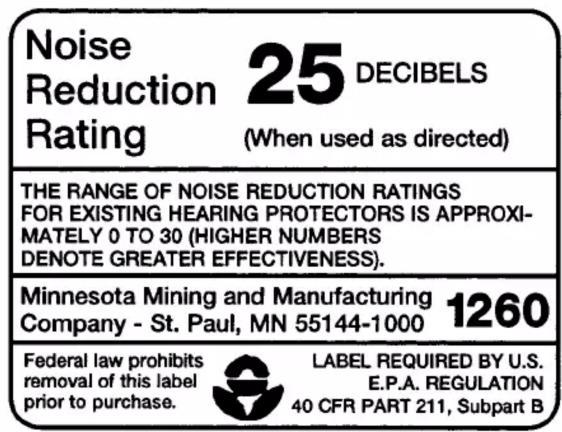
For most wearers, the NRR identified on the current EPA label (shown here) significantly overestimates the protection of the hearing protector in the workplace. This rating is based on an “experimenter fit” method of measuring HPD attenuation.
Using the EPA Noise Reduction Rating (Experimenter Fit)
The NRR on the EPA label shown to the right is based on the average amount of attenuation provided by an HPD when it is worn by 10 different people during a laboratory test. During this test, the person conducting the test fits the hearing protector on each person. This “experimenter fit” method results in ratings as high as 33 dB. Since research indicates that these ratings overestimate the protection that many wearers will receive in the real world, 3M RECOMMENDS REDUCING THE NRR before attempting to estimate the effectiveness of an HPD as follows:
- Subtract 7 dB from the NRR if noise is measured on the A-weighted decibel scale (dBA). (Skip this step if noise is measured on the C-weighted dB scale)
- Divide the result of step 1 (NRR-7) by 2. This is known as "derating".
in the real world. For more information about the NRR (SF), contact 3M Technical Service at 800 243-4630.
Estimating Noise Reduction for Individual Users
The labeled values of noise
An Example of Reducing the NRR
8-hour TWA noise exposure: 93 dBA
NRR of hearing protectors: 29 dB
Subtract 7 dB from the NRR: 29 dB - 7 dB = 22 dB
Divide by 2: 22 ÷ 2 = 11 dB
Subtract 11 dB from the
8-hour TWA noise exposure: 93 dBA - 11 dB = 82 dB
Decide if 82 dB (known as the “Protected Exposure”) is below the PEL for noise
reduction are based on laboratory tests. It is not possible to use these data to reliably predict levels of protection achieved by a given individual in a particular environment. To ensure
A New Rating: NRR (SF)
A new “subject fit” method of measuring HPD attenuation will be used in the future to calculate a different rating; the NRR (SF). The people (subjects) in this laboratory test fit their own protector according to the manufacturer’s instructions without the help of the person conducting the test. Compared to the NRR shown on the current EPA label, the NRR (SF) is usually a lower rating that may be closer to the performance of the hearing protector
protection, those wearing hearing protectors for occupational exposures must be enrolled in a hearing conservation program. Non-occupational users should have a hearing evaluation by an audiologist, physician, or other qualified professional, on a regular basis.


Marke : 3M
Modell : E-A-Rsoft FX
Kategorie : Kopfhörer