
Whozit? - Brettspiel Gamewright - Kostenlose Bedienungsanleitung
Finden Sie kostenlos die Bedienungsanleitung des Geräts Whozit? Gamewright als PDF.


| Produkttyp | Brettspiel |
| Marke | Gamewright |
| Modell | Whozit? |
| Kategorie | Familienspiel / Partyspiel |
| Altersempfehlung | ab 8 Jahren |
| Spieleranzahl | 2–6 Spieler |
| Spieldauer | ca. 20 Minuten |
| Spielinhalt | 60 Karten, 1 Sanduhr, 1 Anleitung |
| Material | Karton, Papier |
| Abmessungen (Box) | 15 × 10 × 3 cm |
| Gewicht | ca. 200 g |
| Sprache | Deutsch |
| Batterien erforderlich | Nein |
| Lernziele | Logisches Denken, Kommunikation, Kreativität |
| Pflegehinweis | Karten trocken und staubfrei aufbewahren; bei Verschmutzung vorsichtig mit einem trockenen Tuch abwischen |
| Sicherheitshinweis | Achtung! Nicht geeignet für Kinder unter 3 Jahren – Verschluckbare Kleinteile |
| Reparatur / Ersatzteile | Keine reparierbaren Teile; Ersatzteile nicht einzeln erhältlich |
| Garantie | Herstellergarantie: 2 Jahre bei Material- und Verarbeitungsfehlern |
Häufig gestellte Fragen - Whozit? Gamewright
Benutzerfragen zu Whozit? Gamewright
0 Frage zu diesem Gerät. Beantworten Sie die, die Sie kennen, oder stellen Sie Ihre eigene.
Eine neue Frage zu diesem Gerät stellen
Laden Sie die Anleitung für Ihr Brettspiel kostenlos im PDF-Format! Finden Sie Ihr Handbuch Whozit? - Gamewright und nehmen Sie Ihr elektronisches Gerät wieder in die Hand. Auf dieser Seite sind alle Dokumente veröffentlicht, die für die Verwendung Ihres Geräts notwendig sind. Whozit? von der Marke Gamewright.
BEDIENUNGSANLEITUNG Whozit? Gamewright
A Word from Gamewright
We believe that party games should capture some of the essence of, well, a party: a little bit of mystery, a few celebrity name checks, a bit of lively debate, and of course — lots of laughing! That's why we were drawn to Whozit? by inventor Romaric Galonnier, which strikes a great balance between whimsy and cooperation. Whether you play with friends, family, or a little of each, we know this game will be a delightful addition not only to your games shelf, but to your next social gathering as well!

Game by: Romaric Galonnier Licensed with permission from Cocktail Games
Godzilla
Bob Ross
Mister Rogers

bowling champion
Michelle Obama
Cleopatra
Batman
GAMEWRIGHT®
70 Bridge Street, Newton, MA 02458 email: jester@gamewright.com / Gamewright.com ©2019 Gamewright, a division of Ceaco, Inc. All rights reserved.
FOLLOW US!


youtube.com/gamewright facebook.com/gamewright @gamewright
WHOZIT?
The Cooperative Guess Who Game 2+ players • Ages 10 and up
Contents 100 character cards
50 clue cards 10 number cards 10 number tokens
1 scoreboard 1 clue meter 1 pawn
Overview
Whozit? is a cooperative party game where players work toward a shared goal. Put on your thinking caps and use your clues to deduce which mystery character is your mark! If you can make it all the way to the final square by the end of five rounds, then WHO-ZAH! you are truly some super sleuths!
Set Up
-
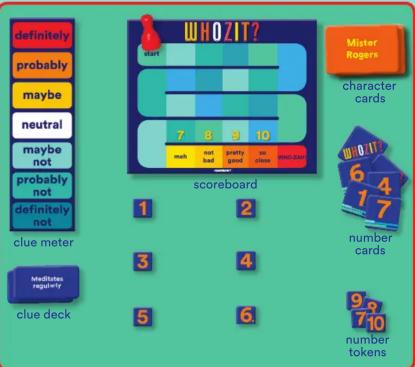
Place the scoreboard and clue meter in the center of the play area.
-
Place the 1 - 6 Number tokens next to the board with enough space to place a card near each number.
- Place the team pawn on the "Start" square.
- Shuffle the Character deck and stack it near the board.
- Shuffle the Clue deck and stack it near the meter.
- Remove the 7, 8, 9, and 10 Number cards and place them off to the side, along with the corresponding Number tokens. (These are used only in the fifth and final round of the game.)
How to Play
Whozit? is played over five rounds. Whoever most recently solved a mystery starts as the Clue Giver for the first round. To start rounds 1 - 4, the Clue Giver will do the following in order:

Draw 6 random Character cards and place one near each of the six Number tokens. Each card is double sided, with famous people on one side and more generalized occupations and individuals on the other. You may use either side and are encouraged to mix it up!
Notes: Some cards refer directly to the players around the table. Don't hesitate to replace them if players don't know each other. Similarly, as a team you may elect to replace a character if you don't know who they are. In the event that two cards refer to the same player, replace one of them.
For example: “the player to the Clue Giver’s right” and “the youngest player at the table” (or in a very special game, “the player to the Clue Giver’s right” and “Big Bird”).
![graph TD 1["1"] --> A["Darth Vader"] 2["2"] --> B["Lady Gaga"] 3["3"] --> C["player to the clue giver's right"] 4["4"] --> D["gym teacher"] 5["5"] --> E["Michelle Obama"] 6["6"] --> F["Big Bird"]](/content/2026/05/833173/images/648e7c19ffe2150252f6306f6f669e04b242223297dd53d5729e66313d988a57.jpg)
![graph TD A["definitely"] --> B{probably} B --> C{maybe} C --> D{neutral} D --> E{maybe not} E --> F{probably not} F --> G{definitely not} H["Medicates regularly"] --> I["drives an expensive car"]](/content/2026/05/833173/images/66abe36d1b9bf97b73636db2178f30b00af3f8dffbec8f27f50648e3ddb7149b.jpg)
2 Shuffle the 6 Number cards face down. Randomly draw and secretly look at one of them. This number corresponds with the character for the round.
3 Draw 2 random Clue cards and read each side. Pick the two clues that you think will give your teammates the best shot at guessing your secret character, then place them next to the clue meter, on a scale from “definitely” to “definitely not”.
4 Mum's the word! You've done your best and now it's time to zip your lips, hold your tongue, be hush-hush, and go silent. From here on out it's up to your teammates!
The rest of the team now talks amongst themselves to deduce the correct suspect, and eliminate any unlikely candidates. They must eliminate characters one by one. Each time the team elects to eliminate a suspect that card is removed from play. For every correct elimination the Clue Giver should move the pawn forward one space on the scoreboard.

Note: Every now and again you may find that your team has difficulty coming to a unanimous decision on which character to eliminate next. While we encourage teams to make their final choice as a group, we realize not all players may see it the same as us. In the event that you are referring back to this rules guide because your teammates are fitting this description then we offer the following guidance:
- Majority rules. Eliminate the character that has received the most votes. If the majority is correct and your team pawn moves forward a space —huzzah! — go team. If the minority was correct, bestow bragging rights upon them for the rest of the evening.
- If both characters up for elimination have an equal number of votes, then whoever switches their vote to the other option first (resulting in a 'Majority rules' outcome) gets to be the designated tie breaker during the next stalemate. Bear in mind that bragging rights remain the same as above.
Ending Rounds 1 - 4
A round ends either when the other players have successfully eliminated all other suspects leaving only the Clue Giver's secret Character card, or immediately following the elimination of the Clue Giver's secret character. Discard all the used Character and Clue cards, and shuffle the Number card back into the stack. The role of Clue Giver passes to the player on the left who draws 6 new characters, 2 new clues, and a facedown Number card to start the next round.
Final Round/End of the Game
The game concludes at the end of the fifth round. If your team hasn't reached the 10 square by the start of this round, move the pawn to that space. During the fifth round your team will add 0 - 4 additional Character cards so that the total number of Character cards matches the number on your pawn's square. For example: if your pawn is on the "8" square at the start of round five, add two extra characters for a total of eight. Lay out any additional Number tokens and shuffle in their corresponding Number cards (if necessary), then begin your final round!
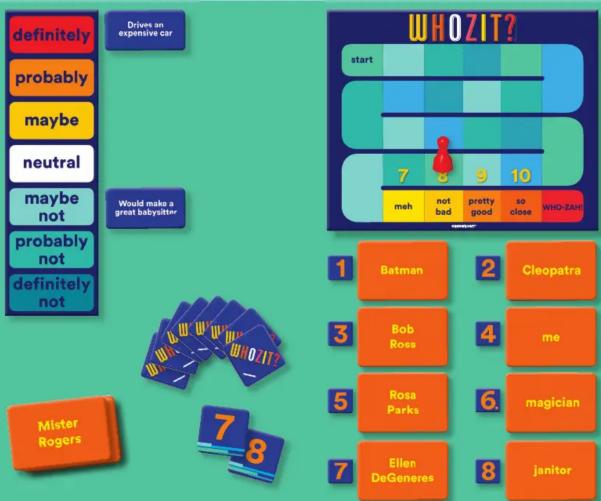
Now that the game has ended, take a look at your pawn's square to see how your team's powers of deduction measured up:
Meh – You might want to keep your day job.
Not bad – But not good either.
Pretty good – How about one more game?
So close – Teamwork is making this dream work!
WHO-ZAH! – You're super sleuths! Is this your day job?

Marke : Gamewright
Modell : Whozit?
Kategorie : Brettspiel