BEDIENUNGSANLEITUNG VT720 Voice Technologies
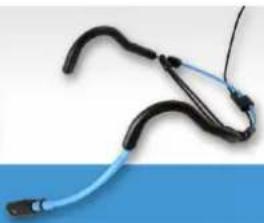
VT720W Waterproof Sports Headworn
natural_image
Close-up of a blue and black swimming cable with a blue cord, against a plain background (no text or symbols visible)
Hard workout? Not for your microphone.
The Voice Technologies VT720W is a noise-cancelling, waterproof headset microphone for sports and aerobics instructors as well as television field for wireless transmission and amplification voice.
The Bi-directional microphone head is waterproof and the condenser microphone capsule is a highly efficient noise canceller, which prevents feedback from loudspeakers or interference from crowd noise etc. The headband behind the neck is adjustable.
Colors: blue
Application area: Sports and aerobics instructors
The VT720W comes in an elegant case with the following accessories:
 | WS720 | WindscreenColors: black |
 | STRAP Colors: black |
 | Case4 Size: 190x210x100mm |
| Specifications: Wiring Configuration (3-wire): |
| Generating Element: | Electret Microphone |
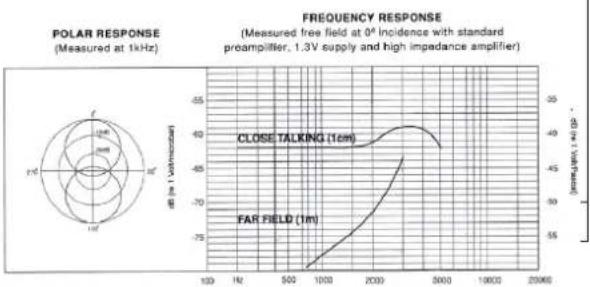
| Polar Pattern: | Super Cardioid |
| Frequency Response: 100Hz-10kHz |
| Sensitivity (3-wire): -44dB ±3dB 1V/microbar (6.3mV/Pa) |
| Bias/+VDC: 1.5-12V | |
| Colors: blue | |
| Current Drain: 50 uA | |
| Cable: Length 1,4m ∅ 1.5mm | |
| Weight: 50 g (1.76oz) | |
| |
| |
| Red +VDC | |
| Silver Ground | |
| Blue (White) NF | |
line
| Frequency Range | Polar Response (Hz) | Frequency Response (µHz) |
| --------------- | ------------------- | ------------------------ |
| 0 | -55 | -55 |
| 100 | -50 | -50 |
| 200 | -45 | -45 |
| 300 | -40 | -40 |
| 400 | -35 | -35 |
| 500 | -30 | -30 |
| 600 | -25 | -25 |
| 700 | -20 | -20 |
| 800 | -15 | -15 |
| 900 | -10 | -10 |
| 1000 | -5 | -5 |
| 1100 | 0 | 0 |
| 1200 | 5 | 5 |
| 1300 | 10 | 10 |
| 1400 | 15 | 15 |
| 1500 | 20 | 20 |
| 1600 | 25 | 25 |
| 1700 | 30 | 30 |
| 1800 | 35 | 35 |
| 1900 | 40 | 40 |
| 2000 | 45 | 45 |
| 2100 | 50 | 50 |
| 2200 | 55 | 55 |
| 2300 | 60 | 60 |
| 2400 | 65 | 65 |
| 2500 | 70 | 70 |
| 2600 | 75 | 75 |
| 2700 | 80 | 80 |
| 2800 | 85 | 85 |
| 2900 | 90 | 90 |
| 3000 | 95 | 95 |
| 3100 | 100 | 100 |
| 3200 | 105 | 105 |
| 3300 | 110 | 110 |
| 3400 | 115 | 115 |
| 3500 | 120 | 120 |
| 3600 | 125 | 125 |
| 3700 | 130 | 130 |
| 3800 | 135 | 135 |
| 3900 | 140 | 140 |
| 4000 | 145 | 145 |
| 4100 | 150 | 150 |
| 4200 | 155 | 155 |
| 4300 | 160 | 160 |
| 4400 | 165 | 165 |
| 4500 | 170 | 170 |
| 4600 | 175 | 175 |
| 4700 | 180 | 180 |
| 4800 | 185 | 185 |
| 4900 | 190 | 190 |
| 5000 | 195 | 195 |
| 5100 | 200 | 200 |
| 5200 | 205 | 205 |
| 5300 | 210 | 210 |
| 5400 | 215 | 215 |
| 5500 | 220 | 220 |
| 5600 | 225 | 225 |
| 5700 | 230 | 230 |
| 5800 | 235 | 235 |
| 5900 | 240 | 240 |
| 6000 | 245 | 245 |
| Note: The frequency response values are not explicitly provided in the code. The frequency response values are calculated based on the free field of the phase angle of the current field. There is no label for the frequency response values. The frequency response values are estimated based on the given parameter set of the phase angle. The frequency response values are estimated based on the same parameter set of the phase angle. The frequency response values are estimated based on the same parameter set of the phase angle. The frequency response values are estimated based on the same parameter set of the phase angle. The frequency response values are estimated based on the same parameter set of the phase angle. The frequency response values are estimated based on the same parameter set of the phase angle. The frequency response values are estimated based on the same parameter set of the phase angle. The frequency response values are estimated based upon the given parameter set of the phase angle. The frequency response values are estimated based upon the same parameter set of the phase angle. The frequency response values are estimated based upon the same parameter set of the phase angle. The frequency response values are estimated based upon the same parameter set of the phase angle. The frequency response values are estimated based upon the same parameter set of the phase angle. The frequency response values are estimated based upon the same parameter set of the phase angle. The frequency response values are estimated based upon the same parameter set of the phase angle. The frequency response values are estimated based on the given parameter set of the phase angle. The frequency response values are estimated based on the given parameter set of the phase angle. The frequency response values are estimated based on the given parameter set of the phase angle. The frequency response values are estimated based on the given parameter set of the phase angle. The frequency response values are estimated based on the given parameter set of the phase angle. The frequency response values are estimated based on the given parameter set of the phase angle. The frequency response values are estimated based upon the given parameter set of the phase angle. The frequency response values are estimated based upon the given parameter set of the phase angle. The frequency response values are estimated based upon the given parameter set of the phase angle. The frequency response values are estimated based upon the given parameter set of the phase angle. The frequency response values are estimated based upon the given parameter set of the phase angle. The frequency response values are estimated based upon the given parameter set of the phase angle. The frequency response values are inverted based on the magnitude of the measured field. The frequency response values are inverted based on the magnitude of the measured field as a function of the measured field value. The frequency response values are inverted based on the magnitude of the measured field as a function of the measured field value. The frequency response values are inverted based on the magnitude of the measured field as a function of the measured field value. The frequency response values are inverted based on the magnitude of the measured field as a function of the measured field value. The frequency response values are inverted based on the magnitude of the measured field as a function of the measured field value. The frequency response values are inverted by applying a normal distribution function (normal distribution) and a Gaussian distribution function (normal distribution).

