
SX-1800B - Orgel TECHNICS - Kostenlose Bedienungsanleitung
Finden Sie kostenlos die Bedienungsanleitung des Geräts SX-1800B TECHNICS als PDF.


| Produkttyp | Elektronische Orgel |
| Marke und Modell | Technics SX-1800B |
| Obere Manualtastatur | 44 Tasten (F – C) |
| Untere Manualtastatur | 44 Tasten (F – C) |
| Pedalklaviatur | 13 Pedale (C – C) |
| Klangfarben (Upper Manual) | Flöte, Orgel, Streicher |
| Klangfarben (Lower Manual) | Flöte, Cello |
| Klangfarben (Pedal) | Bass (mit Sustain) |
| Effekte | Vibrato, Brillanz |
| Automatik-Rhythmus | 5 Rhythmen (Slow Rock, Mambo, Bossa Rock, Foxtrott, Walzer I; Mischungen: Cha-Cha, Rock, Walzer II) |
| Auto Play Chord | One Finger Chord, Fingered Chord, Constant, Memory |
| Ausgangsleistung | 30 W (Spitzenwert) |
| Lautsprecher | 2 × 20 cm (8") |
| Stromversorgung | 50 W AC 100/120/220/240 V, 50/60 Hz (für Kanada: 120 V, 60 Hz) |
| Abmessungen (B × H × T) | 95,4 cm × 85,8 cm × 52,5 cm |
| Nettogewicht | 48 kg |
| Gehäuse | Nachbildung brasilianisches Rosenholz |
| Anschlüsse | Kopfhörerbuchse (6,3 mm Klinke) |
| Bedienelemente | Ein/Aus-Schalter, Hauptlautstärke, Expression-Pedal, Vibrato, Brillanz, Rhythmus-Lautstärke, Tempo, Start/Stopp |
| Besonderheiten | Tempolampe (auch als Betriebsanzeige), automatische Begleitung für Einzelfinger-Akkorde, Speicherfunktion |
| Reinigung und Pflege | Gehäuse mit weichem Tuch oder Möbelpolitur; Tasten mit feuchtem Tuch und weichem Tuch nachwischen; keine Verdünner oder chemische Polituren verwenden |
| Sicherheitshinweise | Gerät nach Gebrauch ausschalten; nicht in schneller Folge ein-/ausschalten; Rückwand nicht entfernen; bei Störungen Netzstecker ziehen und Händler kontaktieren |
| Ersatzteile und Reparatur | Nur Original-Ersatzteile verwenden; Wartung durch Fachhändler |
| Hersteller | Matsushita Electric Trading Co., Ltd., P.O. Box 288, Central Osaka, Japan |
Häufig gestellte Fragen - SX-1800B TECHNICS
Benutzerfragen zu SX-1800B TECHNICS
0 Frage zu diesem Gerät. Beantworten Sie die, die Sie kennen, oder stellen Sie Ihre eigene.
Eine neue Frage zu diesem Gerät stellen
Laden Sie die Anleitung für Ihr Orgel kostenlos im PDF-Format! Finden Sie Ihr Handbuch SX-1800B - TECHNICS und nehmen Sie Ihr elektronisches Gerät wieder in die Hand. Auf dieser Seite sind alle Dokumente veröffentlicht, die für die Verwendung Ihres Geräts notwendig sind. SX-1800B von der Marke TECHNICS.
BEDIENUNGSANLEITUNG SX-1800B TECHNICS
Technics
Electronic Organ
SX-1800B
Operating instructions

natural_image
Exterior view of a modern office building (no signage)OPERATING
INSTRUCTIONS
Contents
Introduction to the Electronic Organ 1
Parts Identification 2
Keyboards and Compass Chart 3
Controls and Their Operation 4
Automatic Rhythm 6
Auto Play Chord 7
Maintenance and Specifications 9
Introduction to the Electronic Organ
Thank you for selecting this organ, an instrument built with care by one of the most famous names in electronics. The quality of design and manufacture will ensure that you obtain excellent performance and reliability for many years and we are sure you will derive many hours of enjoyment and entertainment from this excellent musical instrument.
This organ is designed for playing musical performances from the simplest to the most complex and can be enjoyed by the beginner as well as the competent musician.
Manuals
Organs have various numbers of keyboards, from one to as many as five or six. They are known as manuals. The most popular organ in use today is the spinet organ which has either two 44 note keyboards (manuals) or two 49 note manuals with a pedal keyboard of 13 notes which is a complete octave from C to C.
The console organ is usually much bigger having at least two 61 note manuals and a 25 or 27 note pedalboard.
Tone Controls
Tone or voice controls are in effect volume controls which emphasise the individual organ sounds—flute organ, string, etc.
On most organs the three families of tone are available for selection. Electronic organs use tone generators to produce different wave forms, and it is these sound sources which produce the three families of tone.
Effect Controls
An organ is operated by two types of controls; tone or voice controls which produce sounds, and effect controls which although do not produce sounds are equally as important as voice controls. Effect controls effect the sound of the voice selected thereby making it more attractive to listen to.
Vibrato is a good example of an effect control. By selecting vibrato the sound of the tone selected is changed considerably as will be heard when this effect is operated.
Brilliance is another example of an effect control enableing the player to change the characteristics of a particular tone or voice.
Parts Identification

Keyboards and Compass Chart
Keyboards
Upper Manual
Generally, this manual is used for playing melodies, and played with the right hand.
Range
44 keys
from
F
to
C
Lower Manual
Generally, this manual is used for playing accompaniments, and played with the left hand.
Range
44 keys
from
F
to
: C
Pedal Keyboard
These 13 pedals of the pedal keyboard are played with the toe of the left foot. The tones of these pedals add a rhythm, or a "beat" to the music played. The pedal tone has sustain built in to produce an attractive string bass effect.
Range
13 pedals
from
C
to
C
Compass Chart

Controls and Their Operation

Tone Controls
The SX-1800B offers the player many varied sounds because the slider tone controls can be mixed.
The upper manual provides three tone controls.
| flute | A soft and clear tone like a flute. |
| organ | A fundamental organ tone. |
| string | A bright tone like a violin. |
The lower manual provides two tone controls.
| flute | A soft and mellow tone like a flute. |
| cello | A bright and rich tone like a cello. |
The pedal keyboard provides one tone control, bass, which has sustain built in to produce an attractive string bass effect. Volume is determined by setting the slider control to a position where the pedal volume matches that of the lower manual, or to suit the type of music played.
Effect Controls
vibrato
Various orchestral tones require different degrees of vibrato intensity. Set the vibrato control to suit the voice or tone combinations selected.
brilliance
This control is similar to the tone control of a good highfidelity amplifier system. Set to "0", the tone produced will be soft in sound and set to "6" a strident and brilliant sound will be produced. Set the brilliance control to suit your ear and/or tone required.
Power Switch & Main Volume
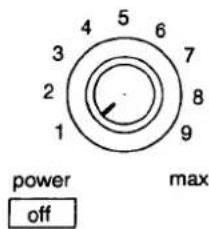

main volume
To switch the organ on, turn the combined on/off switch and volume control to the right. A pilot lamp situated on the rhythm board of the organ will light to indicate that the organ is functioning. Turn the control clockwise to increase volume level. It is suggested that the control is set to between 12 and 4 o'clock until the player has become familiar with the instrument.
Note: The pilot light has two functions, first as mentioned above to show that the organ is switched on and ready to operate; secondly, the light acts as a tempo lamp when the rhythm unit is in operation.
Expression Pedal
Total volume of the organ is normally controlled by the expression pedal. This is operated by the right foot and it enables the player to have full control of volume all the time he is playing, making crescendos and diminuendos at will, merely by pressure of his foot.
When you press downward with the ball of the foot the volume will increase gradually to maximum. Convesely if you press with the heel the volume will decrease to minimum, in fact to zero.
Headphones Jack
HEADPHONES

natural_image
Simple geometric shape: a black circle centered inside a white rectangle (no text or symbols)Headphones can be plugged into this set for personal listening. When the headphones are plugged in, the speakers are switched off and you can practice without interfering with, or being disturbed by other people in the room.
Automatic Rhythm
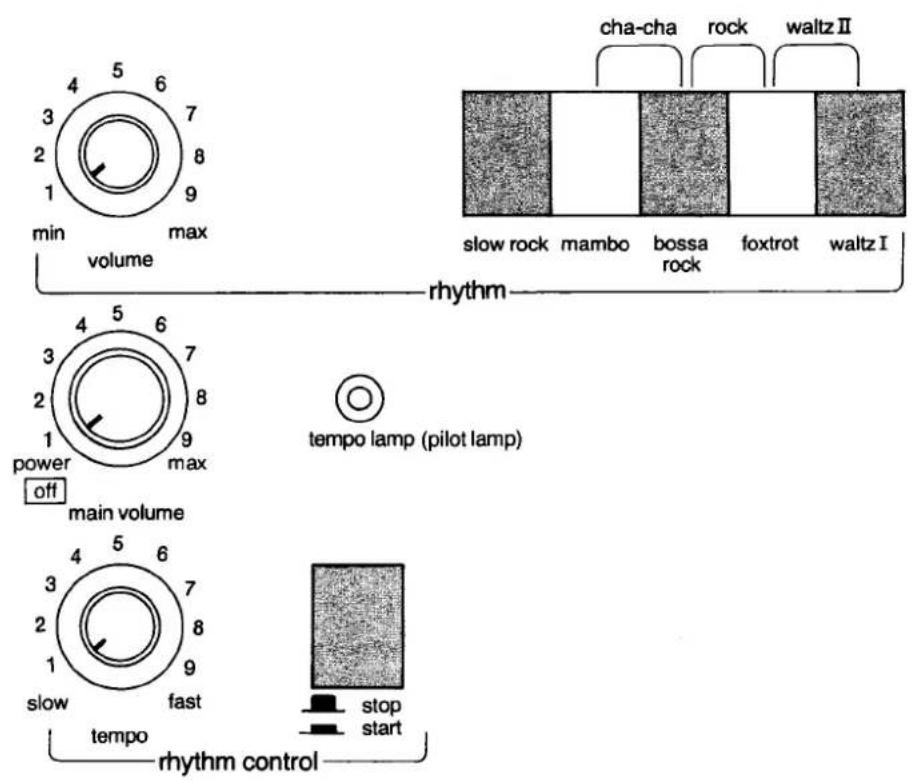
The automatic rhythm section has five rhythm selectors, two controls, a start switch and a tempo lamp.
Rhythm Selectors
These rhythm selectors are slow rock, mambo, bossa rock, fox trot and waltz I. These selectors can be used either separately or in combination. By pushing two or more selector buttons simultaneously many interesting rhythm pattern can be obtained. Combinations are shown below.
$$ ^ {\prime} \text { mambo } ^ {\prime} + ^ {\prime} \text { bossa rock } ^ {\prime} = ^ {\prime} \text { cha - cha } ^ {\prime} $$
$$ ^ {\prime} \text { b o s s a r o c k } ^ {\prime} + ^ {\prime} \text { f o x t r o t } ^ {\prime} = ^ {\prime} \text { r o c k } ^ {\prime} $$
$$ ^ {\prime} \text { fox trot } ^ {\prime} + ^ {\prime} \text { waltz I } ^ {\prime} = ^ {\prime} \text { waltz II } ^ {\prime} $$
Try other combinations and you will find many other interesting rhythm patterns.
Start Switch (stop/start)
The selected rhythm can be started by pushing this button to the "on" position. The tempo lamp will illuminate on the first beat of the rhythm.
To stop the rhythm, push the button again. The switch is reset to the "off" position and the rhythm will stop.
Controls
rhythm volume (volume)
This knob controls the volume of the rhythm. When turned to the right (clockwise) the volume of the rhythm will increase.
tempo
This knob controls the tempo of the rhythm. When turned to the right (clockwise) the tempo of the rhythm will increase.
This 'tempo' knob is also used to control the tempo of the auto play chord as is explained later.
Auto Play Chord

Fig. 1
The auto play chord system makes playing the SX-1800B an easy operation. It will be noted that there are four push button controls (Fig. 1).
one finger chord
By depressing a selected note within the auto play chord keyboard range (Fig. 2) the organ will sound a complete three note chord plus the appropriate pedal note. Either major or minor chords may be selected (Fig. 3). Having selected 'one finger chord' in order to obtain automatic rhythm-chord-bass, select the rhythm required and start the rhythm. This will produce a syncopated bass and chord in time with the rhythm. It will be noted that several rhythm patterns produce an alternating bass and as the rhythms may be mixed many interesting chord and bass patterns can be obtained.
The MATSUSHITA engineers have designed the auto play chord system in such a way as to ensure a) the easy and rapid progress of the beginner and b) a most satisfying automatic accompaniment to the advanced organist. Therefore with this organ all the family can enjoy creative music, even the youngest member of the family will quickly learn to play the SX-1800B even if he or she cannot reach the pedal keys.
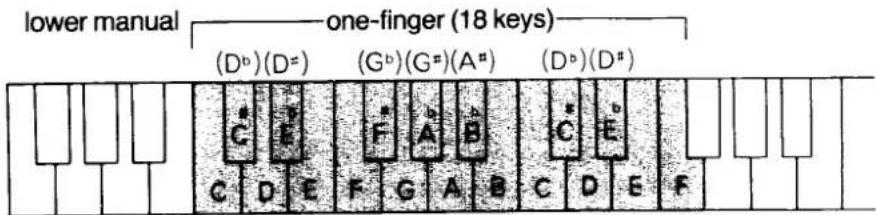
Fig. 2

Fig. 3
Major chord—finger one key only (lower manual) Minor chord—as above plus any black pedal key
fingered chord
Having mastered the 'one finger chord', the next step in mastering the organ is to progress the 'fingered chord'. In this mode, the player is required to play the complete chord using 3 or 4 fingers on the left hand. However, the pedal will still sound, being automatically keyed from the lower manual. In this situation there is complete freedom of chord formations i.e. seventh, minor seventh, major seventh, augmented, diminished, etc.
constant
There are times when it is helpful to produce a 'one finger chord' and pedal without the aid of auto play chord. The 'constant' feature does this, and in addition enables the player to produce a one finger chord/bass with the help of automatic rhythm only.
memory
This feature allows the one finger chord to sound, in rhythm when the hand is released from the keyboard. This operation will allow the beginner to make rapid changes from one chord to another without confusion. It will be noted that the pedal voice is also memorized and this function remains when the fingered chord feature is in use.
Maintenance and Specifications
Maintenance
This organ is a very high quality product and built to a standard to ensure good performance, long life and high reliability. Nevertheless, even the finest merchandise requires service occasionally. In the unlikely event of failure, please insist, when contacting your organ dealer, that genuine replacement parts are used so that your instrument will continue to give you many years of trouble-free pleasure.
However, the following do's and dont's will assist you in keeping the organ in top condition:
- Be sure to switch the instrument off after use, and do not switch the organ on and off in quick succession, as this places an undue load on the electronic components.
- Do not, under any circumstances, remove the rear board from the organ and tamper with the electronic circuitry. If a fault does develop, switch the organ off, unplug it from the electrical outlet and contact your nearest organ dealer. To assist your dealer, please explain the nature of the fault.
●To keep the lustre of the keys, simply use a damp cloth to clean and finish with a soft duster. Polish may be used but do not use thinners or petrol chemical based polishes.
●The cabinet may be polished with a wax polish, although you will find that a rub with a soft cloth will normally suffice.
Specifications
| Keyboards: | Upper Manual | 44 keys |
| Lower Manual | 44 keys | |
| Pedal Keyboard | 13 keys | |
| Tones: | Upper .....Flute, Organ, String | |
| Lower .....Flute, Cello | ||
| Pedal .....Bass | ||
| Effects: | Vibrato, Brilliance | |
| Automatic Rhythm: | Rhythm Selectors .....Slow Rock. Mambo, Bossa Rock, Fox Trot, Walz I (Cha-Cha, Rock, Waltz II) | |
| Rhythm Volume, Tempo, Start Switch, Tempo Lamp. (Pilot Lamp) | ||
| Auto Play Chord: | One Finger Chord, Fingered Chord, Constant, Memory | |
| Others: | Power Switch & Main Volume, Expression Pedal, Headphones Jack | |
| Output: | 30 W (Peak power) | |
| Speakers: | 20 cm (8'')×2 | |
| L.S.I.: | 2 | |
| IC's: | 10 | |
| Transistors: | 100 (FET 2) | |
| Diodes: | 180 | |
| Power Requirement: | 50 W AC 100/120/220/240 V 50/60 Hz | |
| 50 W AC 120 V 60 Hz only for Canada | ||
| Cabinet: | Simulated Brazilian Rosewood | |
| 95.4 cm (37.6'')(W)×85.8 cm (33.8'')(H)×52.5 cm (20.7'')(D) | ||
| Net Weight: | 48 kg. (106 lbs.) | |
Matsushita Electric Trading Co., Ltd.
P.O. Box 288, Central Osaka Japan

- Technics
- OPERATING
- INSTRUCTIONS
- Contents
- Introduction to the Electronic Organ
- Manuals
- Tone Controls
- Effect Controls
- Parts Identification
- Keyboards and Compass Chart
- Keyboards
- Pedal Keyboard
- Controls and Their Operation
- vibrato
- brilliance
- Power Switch & Main Volume
- Expression Pedal
- Headphones Jack
- Automatic Rhythm
- Rhythm Selectors
- Start Switch (stop/start)
- Controls
- rhythm volume (volume)
- tempo
- Auto Play Chord
- one finger chord
- fingered chord
- constant
- memory
- Maintenance and Specifications
- Maintenance
Marke : TECHNICS
Modell : SX-1800B
Kategorie : Orgel