
EMA 460 - Hi-Fi System BLAUPUNKT - Gratis brugsanvisning og manual
Find enhedens vejledning gratis EMA 460 BLAUPUNKT i PDF-format.


Brugerspørgsmål om EMA 460 BLAUPUNKT
0 spørgsmål om dette apparat. Besvar dem du kender, eller stil dit eget.
Stil et nyt spørgsmål om dette apparat
Download vejledningen til din Hi-Fi System i PDF-format gratis! Find din vejledning EMA 460 - BLAUPUNKT og tag din elektroniske enhed tilbage i hånden. På denne side er alle dokumenter nødvendige for brugen af din enhed offentliggjort. EMA 460 af mærket BLAUPUNKT.
BRUGSANVISNING EMA 460 BLAUPUNKT
BLAUPUNKT
EMA 460
4/3/2 Channel Power Amplifier

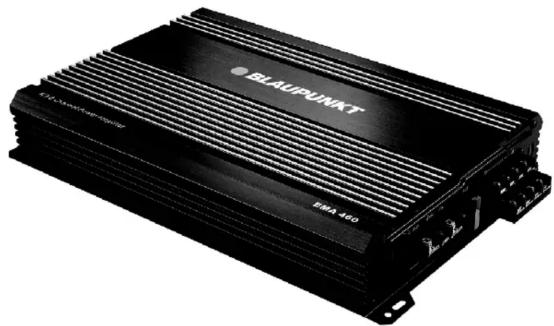
natural_image
Exterior view of a black BAUPUNKT audio amplifier (no visible text or symbols on body)Enjoy it
System Planning
Proper system planning is the best way to maximize your amplifier performance. By planning your installation carefully you can avoid situations where the performance of the reliability of your system is compromised. Your authorized dealer has been trained to maximize your system's sonic potential. Your dealer is a valuable resource in helping you with your system design and installation.
Speaker Requirements
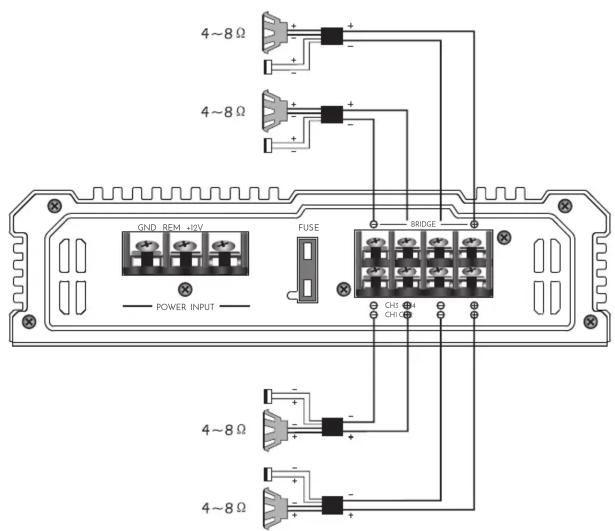
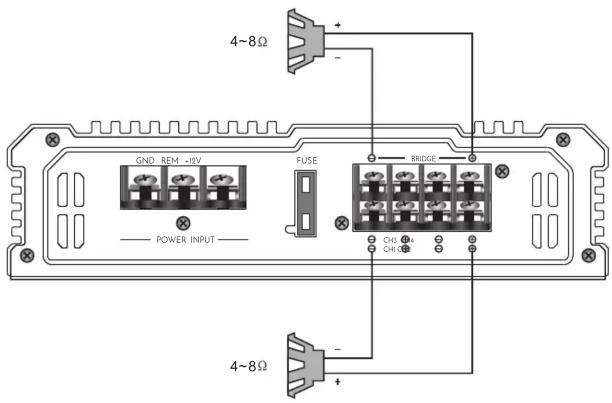
Each channel of your amplifier can easily drive 4Q speaker loads when used ion the stereo mode. When a channel-pair is bridged, the recommended minimum load impedance is 3Ω for subwoofer use, and 4Ω for full range operation. Although operation with lower impedances is not likely to cause immediate damage to the internal circuitry, the unit will most likely overheat, causing the thermal protection circuitry to shut down the amplifier. When the chassis cools down, normal operation will resume. Continuing to operate the amplifier under these conditions is not recommended and will reduce its life expectancy.
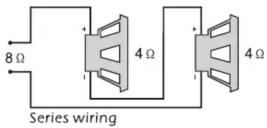
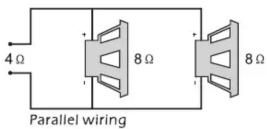
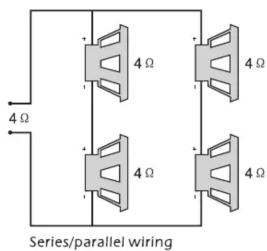
Most speakers designed for car audio operation are 4Ω impedance. Connecting two such speakers in parallel will result in a 2Ω nominal impedance, which is not recommended for use with bridged channels of your amplifier.
Symptom
Distorted output (cont'd)
Poor bass response
Battery fuse blowing
Amplifier fuse blowing
Possible Cause
Speakers are blown
Speakers wired wrong polarity causing cancellation at low frequencies
Crossover set incorrectly
Impedance load to amplifier too low
Short in power wire or incorrect power connections
Fuse used is smaller than recommended
Too much current being drawn
Short in power wire or incorrect
Fuse used is smaller than recommended
Action to take
Check system with known working speaker and repair or replace as needed
Check speaker polarity and repair as needed
Reset crossover referring to the multi-cross crossover configuration section of this manual for detailed instructions
Check speaker impedance load, if below 2 stereo or 4 mono rewire speakers to achieve a higher impedance
Check power and ground connections and repair as needed
Replace with proper fuse size
Check speaker impedance load, it below 2Ω stereo or 4Ω mono rewire speaker to achieve a higher impedance and replace with recommended fuse size
Check power and ground connections and repair as needed
Check speaker impedance load. It below 2 stereo or 4 mono rewire speakers to achieve a higher impedance and replace with recommended fuse size
Check power and ground connections and repair as needed Replace with proper fuse size
Trouble Shooting Power Connection Leads
| SymptomNo output | Possible CauseLow or no remote turn-on input | Action to TakeCheck remote turn-on voltage output at amplifier and correct as needed |
| Fuse down | Check power wire integrity and reversed polarity, repair as needed and replace fuse | |
| Power wires not connected | Check power wire and ground connections and repair of replace as needed | |
| Audio input not connected or no output from source | Check input connections and signal integrity, repair or replace as needed | |
| Speaker wires not connected | Check speaker wires and repair or replace as needed | |
| Audio cycles on and off | Speaker are blown | Check system with known working speaker and repair or replace speakers as needed |
| Thermal protection engages when amplifier heatsink temperature exceeds 90 °C | Make sure there is proper ventilation for amplifier and improve ventilation as needed | |
| Loose or poor audio input | Check input connections and repair or replace as needed | |
| Distorted output | Amplifier level sensitivity set too high; exceeding maximum output capability of amplifier | Reset gain referring to the turning section of the manual for detailed instructions |
| Impedance load to amplifier too low | Check speaker impedance load if below 2Ω stereo or 4Ω mono rewire speakers to achieve a higher impedance | |
| Shorted speaker wires | Check speaker wire connections and repair or replace as needed | |
| Speaker not connected to amplifier properly | Check speaker wiring and repair or replace as needed refer to the installation section of this manual for detailed instructions |
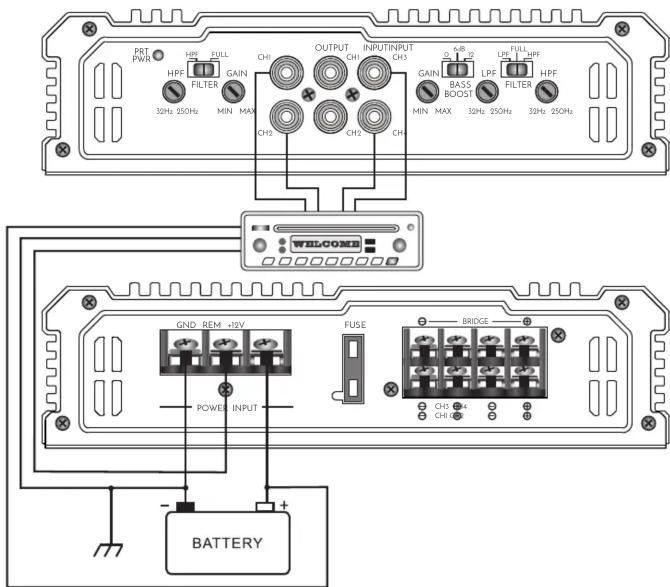
Notes on the power supply
Connect the +12V power input lead only after all other leads have been connected. Be sure to connect the ground wire of the unit securely to a metal part of the car. A lose connection may cause a malfunction of the amplifier.
REMOTE: The unit is turned on by applying +12Volts to this terminal. This terminal does not draw heavy current like the two power terminal so a thinner connecting wire is acceptable. Standard 18 GUAGE is fine and the standard color is yellow. If the power antenna wire is already in use, you can still splice into it. With this method, the unit will turn on automatically with the radio. Use the power supply lead with a fuse attached whose value is the same as original fuse.
Place the fuse in the power supply lead as close as possible to the car battery.
During a full power operation. Maximum current will run through the system. Therefore, Make sure that the leads to be connected to the +12V and GND terminals of the unit respectively must be larger than 10-Guage (AWG 10)
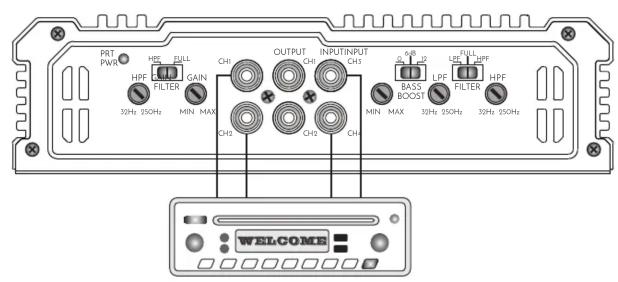
System 1 4 channel mode
· 3 ·
System 2 bridged connection subwoofer
Specifications
EMA 460
| RMS output power 4Ω (Watts) | 60W x 4 CH |
| RMS output power 2Ω (Watts) | 90W x 4CH |
| RMS bridged output power 4Ω (Watts) | 180W x 2 CH |
| THD | <0.05% |
| Frequency response (±2db) | 10Hz ~30KHz |
| Signal to noise ratio | >96dB |
| Sensitivity | 200mV~6V |
| Recommended fuse type | 30A x 1 |
| Dimensions | 300mm x 200mm x 51.5mm |
Mærke : BLAUPUNKT
Model : EMA 460
Kategori : Hi-Fi System