
SB-110 - Vibrationssliber HITACHI - Gratis brugsanvisning og manual
Find enhedens vejledning gratis SB-110 HITACHI i PDF-format.


Brugerspørgsmål om SB-110 HITACHI
0 spørgsmål om dette apparat. Besvar dem du kender, eller stil dit eget.
Stil et nyt spørgsmål om dette apparat
Download vejledningen til din Vibrationssliber i PDF-format gratis! Find din vejledning SB-110 - HITACHI og tag din elektroniske enhed tilbage i hånden. På denne side er alle dokumenter nødvendige for brugen af din enhed offentliggjort. SB-110 af mærket HITACHI.
BRUGSANVISNING SB-110 HITACHI
HITACHI
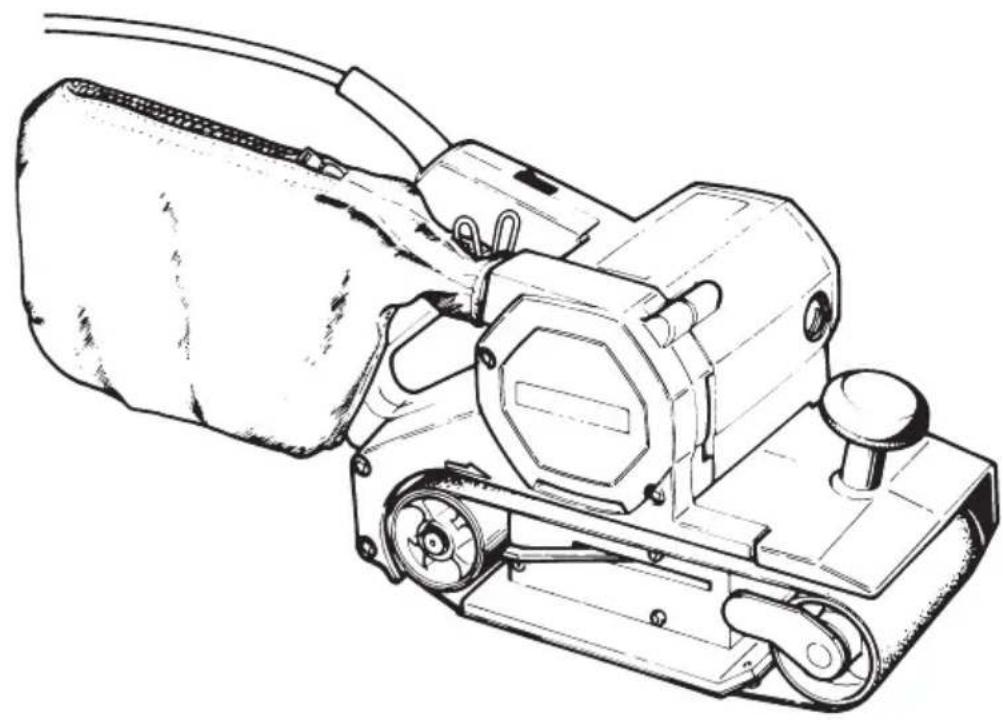
BELT SANDER
MODEL SB-110
INSTRUCTION MANUAL
natural_image
Technical line drawing of a mechanical device with gears and a housing (no text or symbols)Note
Before using this Electric Power Tool, carefully read through these HANDLING INSTRUCTIONS to ensure efficient, safe operation. It is recommended that these INSTRUCTIONS be kept readily available as an important reference when using this electric power tool.
We sincerely thank you for selecting a HITACHI ELECTRIC POWER TOOL. To operate this electric power tool safely and efficiently, please read this INSTRUCTION MANUAL carefully to get a good understanding of the precautions in operation, capacity of the electric power tool, use and the like.
IMPORTANT INFORMATION : SAFETY RULES FOR POWER TOOLS
WARNING : When using electric tools, basic safety precautions should always be followed to reduce the risk of fire, electric shock, and personal injury, including the following.
READ ALL INSTRUCTIONS
-
KEEP WORK AREA CLEAN. Cluttered areas and benches invite injuries.
-
CONSIDER WORK AREA ENVIRONMENT.
Don't expose power tools to rain.
Don't use power tools in damp or wet locations.
Keep work area well lit.
Don't use tool in presence of flammable liquids or gases.
Power tools produce sparks during operation. They also spark when switching ON/OFF. Never use power tools in dangerous sites containing lacquer, paint, benzine, thinner, gasoline, gases, adhesive agents, and other materials which are combustible or explosive.
-
GUARD AGAINST ELECTRIC SHOCK. Prevent body contact with grounded surfaces. For example; pipes, radiators, ranges, refrigerator enclosures.
-
KEEP CHILDREN AWAY. Do not let visitors contact tool or extension cord. All visitors should be kept away from work area.
-
STORE IDLE TOOLS. When not in use, tools should be stored in dry, and high or locked-up place—out of reach of children.
-
DON'T FORCE TOOL. It will do the job better and safer at the rate for which it was intended.
-
USE RIGHT TOOL. Don't force small tool or attachment to do the job of a heavy-duty tool. Don't use tool for purpose not intended—for example—don't use circular saw for cutting tree limbs or logs.
-
DRESS PROPERLY. Do not wear loose clothing or jewelry. They can be caught in moving parts.
Rubber gloves and non-skid footwear are recommended when working outdoors.
Wear protective hair covering to contain long hair.
- USE SAFETY GLASSES. Also use face or dust mask if cutting operation is dusty.
All persons in the area where power tools are being operated should also wear safety eye protectors and face or dust masks.
- DON'T ABUSE CORD. Never carry tool by cord or yank it to disconnect Keep cord from heat, oil and sharp edges.
from receptacle.
-
SECURE WORK. Use clamps or a vise to hold work. It's safer than using your hand and it frees both hands to operate tool.
-
DON'T OVERREACH. Keep proper footing and balance at all times.
-
MAINTAIN TOOLS WITH CARE. Keep tools sharp and clean for better and safer performance. Follow instructions for lubricating and changing accessories.
Inspect tool cords periodically and if damaged, have repaired by authorized service facility.
Inspect extension cords periodically and replace if damaged.
Keep handles dry, clean, and free from oil and grease.
-
DISCONNECT TOOLS. When not in use, before servicing, and when changing accessories, such as blades, bits, cutters.
-
REMOVE ADJUSTING KEYS AND WRENCHES. Form habit of checking to see that keys and adjusting wrenches are removed from tool before turning it on.
-
AVOID UNINTENTIONAL STARTING. Don't carry plugged-in tool with finger on switch. Be sure switch is off when plugging in.
-
OUTDOOR USE EXTENSION CORDS. When tool is used outdoors, use only extension cords intended for use outdoors and so marked.
-
STAY ALERT. Watch what you are doing. Use commom sense. Do not operate tool when you are tired.
-
CHECK DAMAGED PARTS. Before further use of the tool, a guard or other part that is damaged should be carefully checked to determine that it will operate properly and perform its intended function. Check for alignment of moving parts, binding of moving parts, breakage of parts, mounting, and any other conditions that may affect its operation.
A guard or other part that is damaged should be properly repaired or replaced by an authorized service center unless otherwise indicated elsewhere in this instruction manual.
Have defective switches replaced by authorized service center.
Do not use tool if switch does not turn it on and off.
- AVOID USING A POWER TOOL FOR APPLICATIONS OTHER THAN THOSE SPECIFIED.
Never use a power tool for applications other than those specified in the instruction manual.
- ENSURE SAFE OPERATION THROUGH CORRECT HANDLING.
Secure safe operation through correct handling by observing the instructions described herein.
Do not employ accessories other than those specified herein; otherwise, a hazardous condition may be created.
Never allow a power tool to be used by persons not familiar with correct handling (such as children) or by those who cannot handle the tool correctly.
-
CONFIRM THAT NO ITEMS SUCH AS AN ELECTRIC CABLE OR CONDUIT ARE BURIED INSIDE. In places where live wiring may be hidden behind a wall, floor, ceiling, etc. do not hold or contact any metal parts of the tool. In such cases, metal parts could become electrically live and present a serious shock hazard.
-
KEEP THE RIGHT PARTS IN THE RIGHT POSITIONS.
Do not remove covers and screws which have been factory-mounted. They perform important respective roles. Keep them in the right positions.
- SHOULD THE PLASTIC HOUSING OR HANDLE OF A POWER TOOL BE CRACKED OR DEFORMED, DO NOT USE IT.
Since cracked or deformed parts may lead to an operator receiving an electric shock, do not use such a power tool. Immediately have it repaired.
-
SECURELY MOUNT ACCESSORIES AND BLADES TO THE TOOL MAIN BODY. Extra care must be taken when using tools on elevated location (such as a roof ladder, scaffold, or the like) to prevent injury to someone on a lower level in the event the tool and/or accessory should drop.
-
ALWAYS KEEP THE MOTOR AIR VENT FULLY OPENED.
A constantly open motor air vent is necessary to allow air to come in and out for cooling the motor. Do not allow it to become clogged up, even if dust is blown through it.
- OPERATE POWER TOOLS AT THE RATED VOLTAGE.
Operate power tools at voltages specified on their nameplates.
- NEVER TOUCH THE MOVING PARTS.
Never touch the moving parts such as blades, bits, cutters and others.
- STOP OPERATION IMMEDIATELY IF ANY ABNORMALITY IS DETECTED.
Should a power tool be detected as out of order or should other abnormalities be observed during operation, stop using the tool immediately.
-
NEVER LEAVE TOOL RUNNING UNATTENDED. TURN POWER OFF. Don't leave tool until it comes to a complete stop.
-
CAREFULLY HANDLE POWER TOOLS.
Should a power tool be dropped or struck against hard materials inadvertently, it may be deformed, cracked, or damaged.
- DO NOT WIPE PLASTIC PARTS WITH SOLVENT.
Solvents such as gasoline, thinner, benzine, carbon tetrachloride, and alcohol may damage and crack plastic parts. Do not wipe them with such solvents. Wipe plastic parts with a soft cloth lightly dampened with soapy water.
- WHEN REPLACING A COMPONENT PART, ADOPT THE SAME TYPE.
When replacing a component part with a new one, adopt the same type of new part. Also, never attempt to repair a power tool yourself.
SAVE THESE INSTRUCTIONS
SERVICE AND REPAIRS
All quality tools will eventually require servicing or replacement of parts due to wear from normal use. These operations should ONLY be performed by an AUTHORIZED HITACHI POWER TOOL REPAIR SHOP.
REPLACEMENT PARTS
When servicing use only identical replacement parts.
POLARIZED PLUGS
To reduce the risk of electric shock, this equipment has a polarized plug (one blade is wider than the other).
This plug will fit in a polarized outlet only one way.
If the plug does not fit fully in the outlet, reverse the plug.
If it still does not fit, contact a qualified electrician to install the proper outlet.
Do not change the plug in any way.
DOUBLE INSULATION SYSTEM ENHANCES SAFE OPERATION
To enhance safe operation of this electric power tool, HITACHI has adopted a double insulation system. The term "double insulation" used here denotes an insulation system with two insulations physically separated and arranged between the electrically conductive material

connected to the power supply and the outer frame subject to contact by the operator. Thus, the power tool is termed double insulated and both the “回” mark and “Double insulation”, or either one is indicated on the name plate. While no external grounding is required with this system, normal safety precautions as outlined in this manual must still be followed.
To maintain the effectiveness of the double insulation system, follow the precautions described below:
- Always contact your dealer or an authorized HITACHI power tool repair shop when assembling, disassembling or replacing parts other than accessories or carbon brushes. Improper assembly and/or replacement with wrong parts may result in eliminating the double insulation-feature.
- Clean the exterior of the tool with a soft cloth moistened with soapy water, and dry thoroughly. Chloric solvent, gasoline, and thinner will cause plastic components to dissolve.
PRECAUTIONS ON USING BELT SANDER
- Align the inside arrow mark of the sanding belt with the revolving direction of the drive pulley.
- Sanding by applying impact and cutting by side-of-belt contact should be avoided.
- Be careful of sanding sparks.
- After operation sweep the sanding dust from the dust bag to avoid serious accidents.
- Don't use water, or oil as lubricant.
- Ascertain that the sanding workpiece contains neither nails nor other harmful foreign matter.
- Sanding glass fiber not recommended.
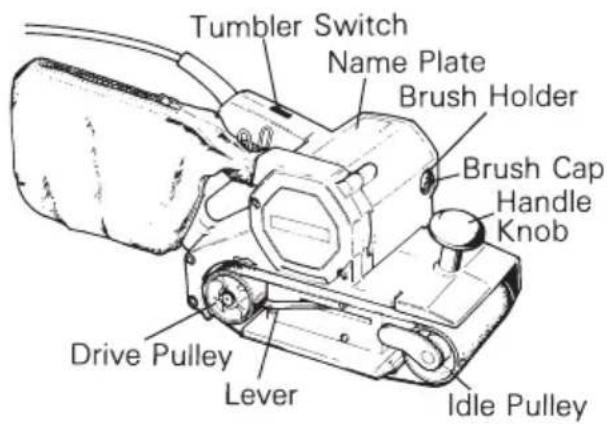
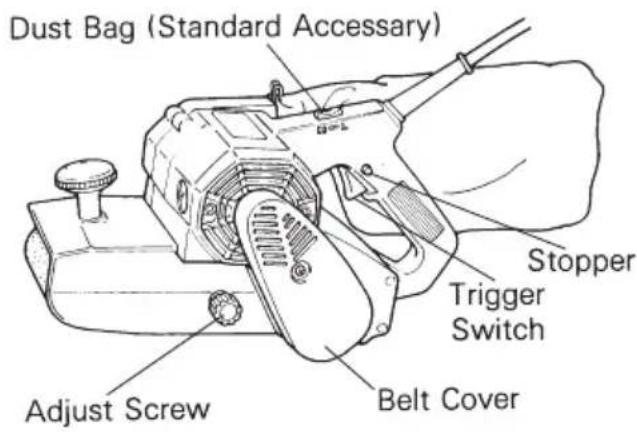
NAME OF PARTS
text_image
Tumbler Switch Name Plate Brush Holder Brush Cap Handle Knob Drive Pulley Lever Idle PulleyFig. 1-a
text_image
Dust Bag (Standard Accessory) Stopper Trigger Switch Belt Cover Adjust ScrewFig. 1-b
SPECIFICATIONS
Motor:
Protected Type, Single-Phase, Series-Wound Commutator Motor.
Power Source:
Single-Phase 115V AC. 60Hz
Sanding Belt Size:
4-1/4" × 24-3/8" (110mm × 620mm)
Input:
| High Speed | Low Speed |
| 950W | 860W |
| 1150ft/min (350m/min) | 985ft/min (300m/min) |
No-Load Belt Speed:
- 1lbs (7.7kg)
* This belt sander can also attach 4" × 24" (100mm × 610mm) sanding belt.
ACCESSORIES
Caution: Recommended accessories for this Electric Power Tool are mentioned in this manual. The use of any other attachment or accessory might be hazardous.
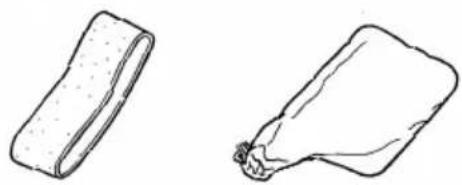
STANDARD ACCESSORIES
natural_image
Two hand-drawn sketches of rectangular objects, one plain and one with a bulbous tip (no text or symbols)-
Endless Sanding Belt (Grain size: #80) ……1
-
Dust Bag (Code No. 953078) 1
Fig. 2
OPTIONAL ACCESSORIES ....sold separately
- Endless Sanding Belts (4-1/4" × 24-3/8" (110mm × 620mm))
Table 1.
| Grain size | Grain type | Grain size | Grain type | Grain size | Grain type |
| 30 | AA, CC | 100 | AA, WA, CC | 240 | AA, WA, CC |
| 40 | AA, WA, CC | 120 | AA, WA, CC | 320 | AA, CC |
| 60 | AA, WA, CC | 150 | AA, WA, CC | 400 | AA, CC |
| 80 | AA, WA, CC | 180 | AA, WA, CC |
Note: The endless sanding belt is sold in packages of 10 belts of the same type. When ordering, specify the grain type and grain size desired.
2. Stationary Stand
When sanding small articles, use a stationary stand for convenience.
APPLICATIONS
○ Sanding finish and flooring finish of woodwork products.
○ Base polishing of Lumber-coated planes.
○ Sanding finishes of metal surfaces.
○ Base polishing of metal-coated planes, rust removal, or paint removal prior to refinishing.
- Surfacial finish of slate, concrete, and so on.
PREPARATION PRIOR TO OPERATION
Before using the Electric Power Tool, complete the following preparations.
1. Extension cord
Use an extension cord when the work site is removed from the power supply. In this case, an extension cord of sufficient thickness shall be used. Actually, use the shortest possible extension cord. Caution: Damaged cord must be replaced or repaired.
2. Confirming condition of the environment
Confirm that the work site is placed under appropriate conditions conforming to prescribed precautions.
BEFORE USE
Caution : Confirm the following points prior to connecting the plug to the power receptacle.
1. Confirm the applied power source
Be sure to operate the Electric Power Tool in the voltage specified on the name plate.
2. Confirm that the power switch is turned OFF
If the plug is connected to the power receptacle while the power switch is turned ON, the machine starts operating unexpectedly, inviting serious accidents. Prior to using the Electric Power Tool, be sure to confirm that the power switch is turned OFF.
3. Attach sanding belt
For details, refer to the item "HOW TO HANDLE SANDING BELT"
4. Confirm the power receptacle
If the power receptacle only loosely accepts the plug, the receptacle must be repaired. Contact the nearest electric store for repair service.
If such a faulty receptacle is used, it may cause overheating, resulting in a serious hazard.
HOW TO USE THE BELT SANDER
1. How to adjust sanding position.
Push switch and turn sanding belt to check position.
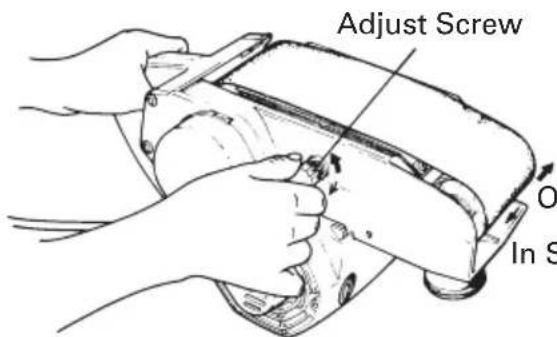
Adjust sanding belt so that both edges protrude 1/16" \~ 1/8" (2mm\~3mm) past edges of pulleys.
If sanding belt is operated too far on the inside, it may cause abrasion and damage machine.
text_image
Adjust Screw O In SAdjust sanding belt position by turning adjust screw (see Fig. 3)
Turn adjust screw clockwise to move belt in.
- Turn adjust screw counterclockwise to move belt out.
Caution: If sanding belt moves during operation, ad- Side justment can be made while in operation.
Fig. 3
2. To turn on switch
Turn on switch while holding machine away from surface to be worked on.
If machine is placed on surface when switch is pushed, surface may be badly scratched.
The same applies when stopping the machine.
3. How to hold machine
Grasp handle and handle knob and hold machine against surface to be worked on so that it contacts surface lightly.
Weight of machine itself is sufficient for sanding and polishing at highest efficiency.
Do not apply any additional pressure, for this would place unnecessary load on motor, shorten life of sanding belt and lower work efficiency.
4. How to move machine
Move machine forward first and then backward, repeating this motion.
5. How to select proper sanding belt
Choose sanding belt of proper grain size and grain type for your specific purpose, by referring to Tables 2 and 3 below.
Table 2.
| Derised finish | Proper grain size |
| Coarse finish | 30~40 |
| Medium finish | 40~100 |
| Semi fine finish | 80~240 |
| Fine finish | 180~400 |
Table 3.
| Grain type | Surface to be worked on |
| AA | Steel, Wood |
| WA | Wood, Bamboo (8 grain sizes are available # 40, 60, 80, 100, 120, 150, 180 and 240) |
| CC | Nonferrous metals, slate, plastics, concrete |
Cautions :
● For grain sizes, refer to Table 1.
- Sanding belt grain should be coarser than sandpaper used for manual work.
- Use sanding belt of same grain size until uniform surface is obtained.
Changing grain sizes may result in poor finish.
6. How to change belt speed
Either High-speed or low-speed operation can be selected according to the materials or the operating conditions. Selection sanding belt operating speed can be achieved by shifting the tumbler switch in a specified direction.
Table 4.
| Symbol | Speed |
| H | High-speed |
| L | Low-speed |
natural_image
Technical line drawing of a mechanical assembly with no visible text or symbolsFig. 4
7. How to operate switch
The power switch is turned ON when the trigger is pulled, and if the stopper is once depressed, the power switch becomes locked, allowing continuous operation.
The stopper can be released pulling the trigger.
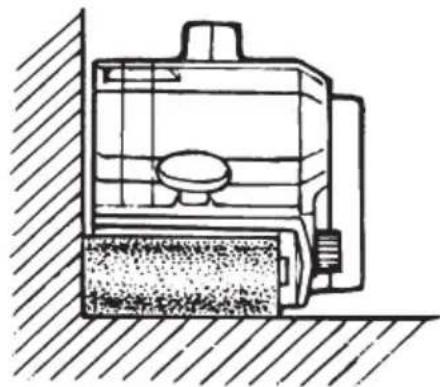
8. How to work on corner
Corners can be sanded and polished by using machine as in Fig. 4.
HOW TO HANDLE SANDING BELT
Caution: Be sure to switch power OFF and disconnect the attachment plug from the power receptacle to avoid serious trouble.
text_image
Lever Idle PulleyFig. 5
text_image
Drive Pulley Rotational Direction Sanding Belt Idle Pulley Shoe PlateFig. 6
1. How to attach sanding belt
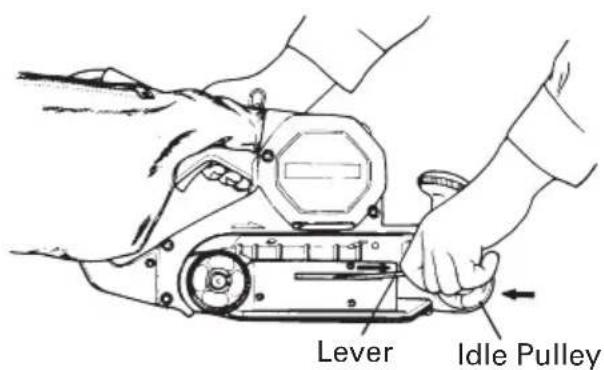
(1) Pull lever with finger, idle pulley will then move backward.
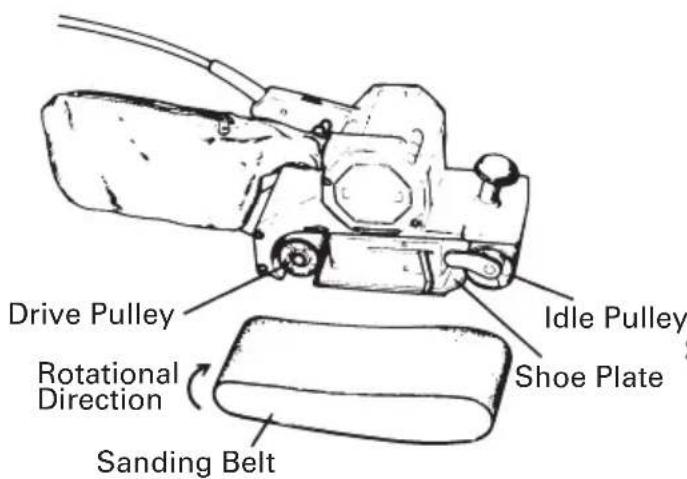
(2) Place on drive pulley and idle pulley passing it over the outside of shoe plate and making sure that arrow on inside of belt coincides with rotational direction of drive pulley.
Caution : Sanding belt installed in the wrong direction will lower work efficiency and shorten life of sanding belt.
(3) Push lever with finger, idle pulley will then move forward and give proper tension to sanding belt.
In this case, be careful not to be hit your finger by lever.
Then, adjust sanding belt position. (refer to page 7)
2. How to remove sanding belt.
Pull lever with finger, sanding belt will then sag and can be taken off pulleys easily.
DUST REMOVAL
When an excessive amount of dust is deposited in the dust bag, dust-collecting efficiency will sharply drop.
Remove dust from the bag when it is deposited up to about 2/3 the bag capacity, where by dust collecting efficiency (as well as working efficiency) will be ensured.
Remove dust from the bag as follows :
(1) Loosen the support bar and remove the dust bag.
(2) The bag inlet can be opened by unzipping the slide fastener.
MAINTENANCE AND INSPECTION
Caution: Be sure to switch power OFF and disconnect the plug during maintenance and inspection.
1. Inspecting the Sanding Belts.
If a loaded and blunt sanding belt is kept in use, efficiency will extremely drop.
Therefore, be sure to sand well the sanding belt in good time.
2. Inspecting tightness of various screws
Periodically inspect each screw tightness of individual components. If any screws are loosened, securely retighten them. Loosened screws, if unheeded, may cause a hazardous situation.
3. Inspecting the carbon brushes
The motor employs carbon brushes as expendable components.
If the brushes are worn, motor trouble may result. When brushes are worn down to the limit line, replace them with new brushes.
Also, keep the carbon brushes clean, so that they can be smoothly slide into the brush holders.

text_image
Wear limit 38 (6mm) 0.24" 0.67" (17mm) No. of Carbon BrushFig. 7
When replacing carbon brushes with new brushes, be sure to use those for Hitachi Electric Belt Sander Type SB-110 corresponding to the illustrated number (38).
To replace a carbon brush, use a minushead screwdriver to disassemble the brush cap (Fig. 1) then remove the carbon brush together with the spring.
Note:
Due to HITACHI's continuing program of research and development, the specifications herein are subject to change without prior notice.
natural_image
Line drawing of a quill pen in an inkwell (no text or symbols)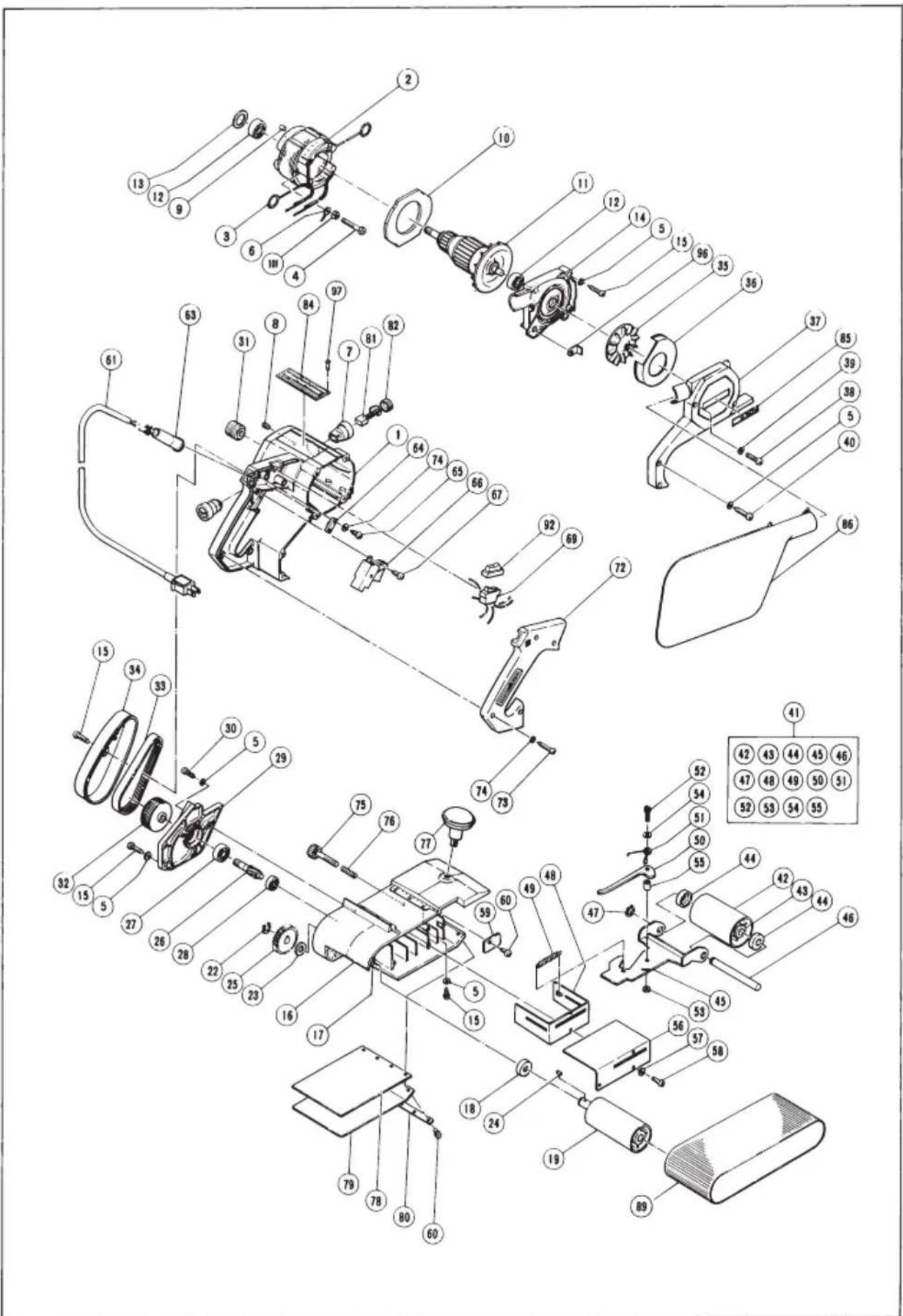
text_image
Exploded view diagram of a mechanical assembly with numbered parts for identification| Item No. | Part Name |
| 1 | Housing Ass'y |
| 2 | Stator Ass'y |
| 3 | Brush Terminal |
| 4 | Hexagon Hd. Tapping Screw D5 × 50 |
| 5 | Spring Lock Washer |
| 6 | Internal Wire Ass'y |
| 7 | Brush Holder |
| 8 | Slotted Set Screw D5 × 10 |
| 9 | Bearing Lock |
| 10 | Fan Guide |
| 11 | Armature |
| 12 | Ball Bearing (6200VVCM) |
| 13 | Washer |
| 14 | Inner Cover |
| 15 | Tapping Screw D5 × 20 |
| 16 | Body Ass'y |
| 17 | Metal Bush |
| 18 | Washer |
| 19 | Drive Pulley Ass'y |
| 22 | C-Type Retaining Ring |
| 23 | Bearing Washer |
| 24 | Feather Key 3 × 3 × 8 |
| 25 | Gear |
| 26 | Pinion |
| 27 | Ball Bearing (6200VCM) |
| 28 | Ball Bearing (608VVC2) |
| 29 | Gear Cover |
| 30 | Machine Screw M5 × 25 |
| 31 | Pulley (A) |
| 32 | Pulley (B) |
| 33 | Belt |
| 34 | Belt Cover |
| 35 | Dust Fan |
| 36 | Dust Guide |
| 37 | Dust Cover |
| 38 | Machine Screw M5 × 25 |
| 39 | Spring Lock Washer |
| 40 | Tapping Screw D5 × 30 |
| 41 | Belt Tensioner Ass'y |
| 42 | Idle Pulley Ass'y |
| 43 | Metal Bush |
| 44 | Washer |
| 45 | Fork |
| 46 | Shaft |
| 47 | C-Type Retaining Ring |
| 48 | Holder Plate |
| 49 | Spring |
| 50 | Lever |
| 51 | Spring |
| 52 | Hexagon Socket Hd. Bolt M4 × 16 |
| Item No | Part Name | |
| 53 | U-Nut | M4 |
| 54 | Bolt Washer | |
| 55 | Distance Piece | |
| 56 | Belt Tensioner Cover | |
| 57 | Spring Lock Washer | |
| 58 | Machine Screw | M4 × 14 |
| 59 | Striking Guide | |
| 60 | Machine Screw | M4 × 10 |
| 61 | Cord | |
| 63 | Cord Armor | 8.2 |
| 64 | Cord Clip | |
| 65 | Tapping Screw | D4 × 16 |
| 66 | Double Pole Switch (Screw Type) | |
| 67 | Tapping Screw | D4 × 12 |
| 69 | Tumbler Switch Ass'y | |
| 72 | Handle Cover | |
| 73 | Tapping Screw | D4 × 20 |
| 74 | Washer | |
| 75 | Adjust Screw | |
| 76 | Spring | |
| 77 | Handle Knob | |
| 78 | Shoe Cushion | |
| 79 | Shoe Plate | |
| 80 | Clamp Bar | |
| 81 | Carbon Brush | |
| 82 | Brush Cap | |
| 84 | Name Plate | |
| 85 | HITACHI Label | |
| 86 | Dust Bag | |
| 89 | Sanding Belt | WA # 80 |
| 92 | Tumbler Switch Cover | |
| 96 | Plate | |
| 97 | Rivet | D2.5 × 3.2 |
| 101 | Special Washer | |
Parts are subject to possible modification without notice due to improvements.
natural_image
Line drawing of a quill pen in an inkwell (no text or symbols)
natural_image
Line drawing of a quill pen in an inkwell (no text or symbols)WARNING:
Some dust created by power sanding, sawing, grinding, drilling, and other construction activities contains chemicals known to the State of California to cause cancer, birth defects or other reproductive harm. Some examples of these chemicals are:
- Lead from lead-based paints,
- Crystalline silica from bricks and cement and other masonry products, and
- Arsenic and chromium from chemically-treated lumber.
Your risk from these exposures varies, depending on how often you do this type of work. To reduce your exposure to these chemicals: work in a well ventilated area, and work with approved safety equipment, such as those dust masks that are specially designed to filter out microscopic particles.
Issued by
Hitachi Koki Co., Ltd.
Shinagawa Intercity Tower A, 15-1, Konan 2-chome,
Minato-ku, Tokyo 108-6020, Japan
Distributed by
Hitachi Koki U.S.A., Ltd.
3950 Steve Reynolds Blvd.
Norcross, GA 30093
Hitachi Koki Canada Co.
6395 Kestrel Road
Mississauga ON L5T 1Z5