Massak - Telt Sierra Designs - Gratis brugsanvisning og manual
Find enhedens vejledning gratis Massak Sierra Designs i PDF-format.


Brugerspørgsmål om Massak Sierra Designs
0 spørgsmål om dette apparat. Besvar dem du kender, eller stil dit eget.
Stil et nyt spørgsmål om dette apparat
Download vejledningen til din Telt i PDF-format gratis! Find din vejledning Massak - Sierra Designs og tag din elektroniske enhed tilbage i hånden. På denne side er alle dokumenter nødvendige for brugen af din enhed offentliggjort. Massak af mærket Sierra Designs.
BRUGSANVISNING Massak Sierra Designs
MASSAK
SIERRA DESIGNS
Your Sierra Designs MASSAK
tent is very easy to pitch and
maintain. Follow these in -
structions to pitch your tent
quickly, safely and easily.
MASSAK TENT CONTENTS
Tent Body & Rainfly: 1 Line Tighteners: 6
Tent Poles: 6 Pitching Instructions: 1
Tent Stakes: 13* Pole Sack: 1
Guy Cord: 6 Stake Sack:
1
* Sierra Designs tents include stakes for pitching the body and fly under normal conditions. Additional stakes may be required in severe conditions.
First Pitch
In order to familiarize yourself with your new tent, we suggest that you “test pitch” it before embarking on a wilderness trip.
Select a Site
Look for a level spot that is protected from the wind in order to ensure sleeping comfort. Clear the area of debris such as sharp stones and sticks which might abrade or puncture the tent floor. Choose an area that will drain well when it rains.
Unfurl the Tent and Assemble the Poles
Unfold the tent and lay the floor flat on the ground with the door un-zipped. Carefully unfold the shock corded pole sections and allow them to slide together. Do not allow the poles to snap together: This can lead to serious pole damage. Make certain that the insert of each pole section is fully inserted into the next pole section (Figure 1). You will have 6 poles
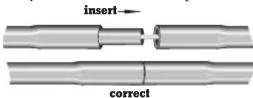
in total, 4 equal length poles and shorter vestibule pole and the shortest of the six is a curved vent pole.
Figure 1: Correct Pole Assembly
Stake Out the Floor
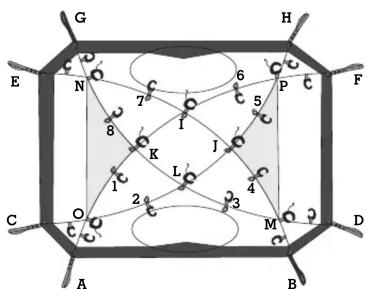
We recommend staking the floor prior to inserting the poles for greater pitching ease. Although the Massak is a freestanding tent, we suggest that you always stake out the floor for greater safety and stability, especially in high winds. First stake each of the webbing loops at points G & H, then stake out points E & F (Figure 2). Then move to the other side of the tent, pull the webbing loops at points A & B until the tent floor is squarely and semi-tautly positioned, and then stake them down. Finally, stake the points C & D, again pulling the tent floor semi-taut.
Erect the Tent
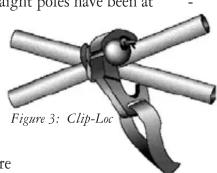
Insert the tips of one of the straight poles into the grommets at points B & E, and the tips of a second straight pole into the grommets at points D & G (Figure 2). Pick up pole B – E and hook the Clip-Loc over the pole at points I & J (Figure 3). Do not attach the bungee cord yet. Follow the same procedure for pole D – G, attaching but not engaging the Clip-Locs
flowchart
graph TD
    A["Node A"] -->|2| B["Node B"]
    B -->|3| C["Node C"]
    C -->|4| D["Node D"]
    D -->|5| E["Node E"]
    E -->|6| F["Node F"]
    F -->|7| G["Node G"]
    G -->|8| H["Node H"]
    H -->|9| I["Node I"]
    I -->|10| J["Node J"]
    J -->|11| K["Node K"]
    K -->|12| L["Node L"]
    L -->|13| M["Node M"]
    M -->|14| N["Node N"]
    N -->|15| O["Node O"]
at points K & L. Now attach the Swift Clips along the B – E & D
– G axis designated by the orange webbing, as well as, the Clip-Locs at points M &
N (do not attach the bungee cord yet). Now repeat this process with the two remain - ing long poles inserting the pole tips into the
Figure 2: Tent Body (top view)
grommets at points C & H & A & F. Pick up pole C – H and hook the Clip-Loc over the pole at points L & J attaching the Swift Clips along the axis as you go, the Swift Clips are designated with gray webbing. Follow the same procedure for pole A – F, attaching but not engaging the Clip-Locs at points K & I. Now that all the straight poles have been at
tached to the tent body, you can engage the Clip-Locs. Attach the bungee cord on the Clip-Locs by wrapping the bungee in the direction crossing the open gate of the clip. Wrap the cord around the pole intersection 2 to 4 times, depending on desired firmness, then, slide the cord into the groove on the backside of the clip to keep it taut (F 3).
Fly Sheet
Drape the fly over the tent and position the zippers over the tent doors and so that the navy blue fly attachment is aligned with one of the navy blue
natural_image
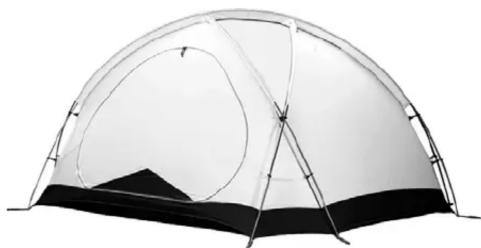
Exterior view of a modern dome-shaped tent with a black base and triangular roof (no text or symbols visible)stake loops on the tent points B & G (Figure 2). By attaching the blue webbing strap on the rainfly to the blue webbing strap on the tent body you are guaranteed a fast, proper rainfall set-up every time. At points N, O, P, & M (Figure 4) on the inside of the fly you will find 5/8" side release buckles. Attach these points to their mates on the tent body. At eight
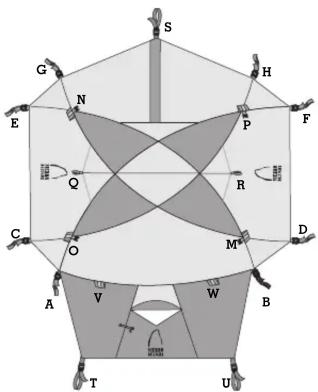
Figure 4: Flysheet (top view)
perimeter points on the fly are 3/4" LadderLoc fly attachments (Figure 5). These points correspond to the ends of the poles, points A-H. Before you attach the LadderLoc you will need to attach your vestibule pole. Take the longer of the two remaining poles and feed it through the sleeve that is provided on the outside of the tent. The vesti - bule pole sleeve is located above the vestibule window on the outside of the rainfly (A-B axis in Figure 4). After you have fed the pole through the vestibule sleeve insert the pole tips into the grom
mets at points A & B. Take the final curved vent pole and feed it through the pole sleeve located at the apex of the tent fly between points Q & R.
Once the pole is fed through the sleeve insert the pole tips into the grom mets at points Q & R. Now working your way around the perimeter of
the tent, hook the grommets at the ends of the adjustment straps over the pole tips at points A, B, G & H and then tighten the adjustment straps. Working you way around the tent again, follow the same procedure for points C, D, E, & F. Now stake out the adjustable vestibule straps located at points S, T, & U. Tighten these to desired tautness. Guying out points M, N, O, P, V, & W can increase strength and stability in high winds as well as increase airflow between the tent body and rainfall.
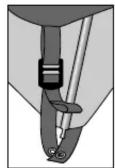
Figure 5: LadderLoc
Ventilation
Proper ventilation is essential for creating a comfortable living space inside your tent and the Massak provides various methods to increase the ventilation of the tent. There are two large roll down mesh panels on each side of the tent that can be opened for increased ventilation. In addition to the mesh panels on the tent body the rain fly has two vents that are located at points Q & R (Figure 4) that can be opened from inside the tent for maximum ventilation. In addition, the vestibule door panel can be rolled away for maximum ventilation. Because the rainfall has an awning over the door, you can often leave the door tied open in a rainstorm, provided the door faces away from the wind. When the door in the rear of the rainfall is left fully or partially open, it effectively improves flow-through ventilation. Additionally, the zippers at the top of the vestibules can be used to regulate ventilation.
Internal Guy System
Years ago, Sierra Designs was the first to introduce the revolutionary In ternal Guy System. This system remains a very important feature in our 4-Season tents. When installed this simple system will greatly increase the strength of your tent with the weight of a few guy cords. This system is very useful in extreme weather conditions, but is not necessary under nor mal conditions.
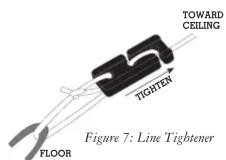
Installation: All attachments are made inside the tent. All that is needed are 4 pieces of guy cord of 72" lengths or longer (line tighteners may be used but are optional). Some of these items have been provided complimely tary with your tent. You may also purchase a Sierra Designs Internal Guy Kit at your local retailer. The internal loops that will be used in this system are the eight loops that are located in the corners of each stake points, A-H, as well as 8 of the 12 internal loops located at points 1-8 (Figure 3). Start by attaching one end of the cord through the webbing loop in the floor at point A. Secure the other end of the cord at point 3 with a double half hitch or a line tightener (Figure 7). Repeat this procedure for lines between points B & 2. Repeat this pro
cedure for lines between points C & 8, E & 1, G & 6, H & 7, F & 4, & D & 5. The Internal Guy System will partially obstruct the doorway. If you want to stow the cord out of the way when entering or exiting the tent, simply loosen the cord and pass it through the loop in the ceiling.