Meteor Light CD - Telt Sierra Designs - Gratis brugsanvisning og manual
Find enhedens vejledning gratis Meteor Light CD Sierra Designs i PDF-format.


Brugerspørgsmål om Meteor Light CD Sierra Designs
0 spørgsmål om dette apparat. Besvar dem du kender, eller stil dit eget.
Stil et nyt spørgsmål om dette apparat
Download vejledningen til din Telt i PDF-format gratis! Find din vejledning Meteor Light CD - Sierra Designs og tag din elektroniske enhed tilbage i hånden. På denne side er alle dokumenter nødvendige for brugen af din enhed offentliggjort. Meteor Light CD af mærket Sierra Designs.
BRUGSANVISNING Meteor Light CD Sierra Designs

Your Sierra Designs
METEOR LIGHT CD
(Computer-aided Design)
tent is very easy to pitch
and maintain. Follow these
instructions to pitch your tent
quickly, safely and easily.
METEOR LIGHT CD TENT CONTENTS
Tent Body & Rainfly: 1 Pitching Instructions: 1
Tent Poles: 3 Stake Sack: 1
Tent Stakes: 10* Pole Sack: 1
Guy Cord: 4
* Sierra Designs tents include stakes for pitching the body and fly under normal conditions. Additional stakes may be required in severe conditions.
First Pitch
In order to familiarize yourself with your new tent, we suggest that you “test pitch” it before embarking on a wilderness trip.
Select a Site
Look for a level spot that is protected from the wind in order to ensure sleeping comfort. Clear the area of debris such as sharp stones and sticks which might abrade or puncture the tent floor. Choose an area that will drain well when it rains.
Unfurl the Tent and Assemble the Poles
Unfurl the tent and lay the tent floor flat on the ground with the front door unzipped. Carefully unfold the shock corded pole sections and allow them to slide together. Do not allow the poles to snap together: This can lead to serious pole damage. Make certain that the insert of each pole section is fully inserted into the next pole section (Figure 1). You will have three poles of equal length.
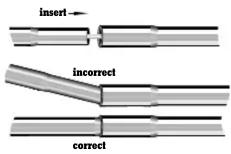
Figure 1: Correct Pole Assembly
Stake Out the Tent Floor
The Meteor Light CD is a freestanding tent. Staking out the floor is not necessary in order to pitch it. However, we recommend that you stake down the tent after it is pitched for greater stability in high winds.
Erect the Tent
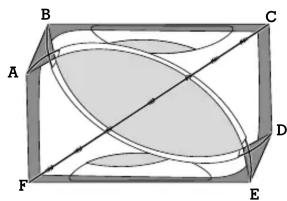
Insert one pole into the pole sleeve which runs from point A to point E (Figure 2). Insert another pole into the pole sleeve running from B to D. Insert the metal tips of the pole ends into their respective grommets at points A and B. Then, from the opposite end of the tent push the poles into the pole sleeves, one at a time, making them flex into an even curve, until you can insert the other ends of the poles into the grommets at points D and E. Next, insert the metal tips of the remaining pole into the grommets at
flowchart
graph TD
    A["A"] --> B["B"]
    B --> C["C"]
    C --> D["D"]
    D --> E["E"]
    E --> F["F"]
    F --> A
    style A fill:#f9f,stroke:#333
    style B fill:#ccf,stroke:#333
    style C fill:#cfc,stroke:#333
    style D fill:#fcc,stroke:#333
    style E fill:#cff,stroke:#333
    style F fill:#ffc,stroke:#333
Figure 2: Tent Body (top view)
natural_image
Exterior view of a white and blue camping tent with a circular opening (no text or symbols visible)points C and F. Locate the Swift Clip ^™ at the apex of the tent, along the C-F axis, and attach it to the C-F pole. Following the seam along the path of the pole, attach the remaining Swift Clips to the pole.
Flysheet
Drape the fly over the tent and position the vestibule zippers over the front and back door (Figure 3). Attach the fly to the tent poles via Velcro® attachments located underneath the fly at points L, M, N and O. At each pole end (points A, B, C, D, E and F) there are 34 " side-release "fly-clip" buckles. Clip these buckles into their corresponding mates on the tent floor and pull the straps until the fly is taut (Figure 4). Stake out the fly vestibule away from the tent body at points G and H. We recommend you stake out points I, J, and K for maximum ventilation. The tent may be guyed out from points L, M, N and O for maximum stability in high winds.
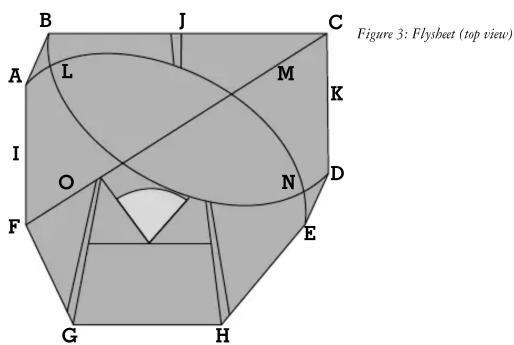
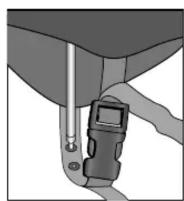
Figure 4: Fly Clip
Ventilation
Besides staking and guying out all the points listed above, optimal airflow through the tent itself can be obtained by leaving part of the double-zippered vestibule open.
Vestibule
The vestibule can be pitched in a variety of configurations to address different weather, storage, ventilation, or wind conditions. The vestibule door may be folded in half and attached to itself to form a half-door. The entire door may be guyed out from points G and H to form a large awning, or it may be folded in half to form a small awning. Or, the vestibule door may be rolled entirely out of the way, forming an unobstructed yet protected entrance.