
Octiv R+ - Høreapparat SIEMENS - Gratis brugsanvisning og manual
Find enhedens vejledning gratis Octiv R+ SIEMENS i PDF-format.


Brugerspørgsmål om Octiv R+ SIEMENS
0 spørgsmål om dette apparat. Besvar dem du kender, eller stil dit eget.
Stil et nyt spørgsmål om dette apparat
Download vejledningen til din Høreapparat i PDF-format gratis! Find din vejledning Octiv R+ - SIEMENS og tag din elektroniske enhed tilbage i hånden. På denne side er alle dokumenter nødvendige for brugen af din enhed offentliggjort. Octiv R+ af mærket SIEMENS.
BRUGSANVISNING Octiv R+ SIEMENS
miniTek™ wireless enhancement
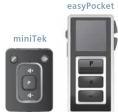
Your Octiv R+ hearing instrument can be used with the miniTek wireless enhancement system. miniTek provides a wireless connection from your Octiv R+ hearing instruments to your television, mobile phone, MP3 player and stereo. miniTek is also an easy-to-use remote control for your Octiv R+ hearing instruments for convenient and discreet program and volume adjustment. The miniTek package comprises the miniTek itself which controls the hearing instruments, a Tek transmitter and all cables necessary to link the miniTek into a variety of devices such as TVs, MP3 players, etc.
Optional
Octiv+ instruments are miniTek and easyPocket compatible. The easyPocket remote control is available as an optional accessory allowing for convenient and discreet hearing instrument adjustment.
It is extremely ergonomic, has an easy-to-read display and a modern, stylish look.

NOTICE
miniTek and easyPocket are additional products to your hearing instrument which may be available to purchase. If you think it would assist you in your day-to-day life talk to your NHS Provider about how you can obtain a miniTek or easyPocket. Further information is available on our website www.bestsound-technology.co.uk or email info-hearingaids.uk@sivantos.com

WARNING
Choking hazard! Your hearing instruments contain small parts which can be swallowed.
▶ Keep hearing instruments, batteries and accessories out of reach
of children and mentally disabled persons.
If parts have been swallowed consult a physician or hospital immediately.

CAUTION
Risk of injury!
▶ Always wear the tube with an ear piece.
Make sure that the ear piece is completely attached.

CAUTION
Risk of injury!
Insert the ear piece carefully and not too deeply into the ear.

CAUTION
Risk of Injury!
In very rare cases the ear piece could remain in your ear when removing the hearing instrument. If this happens, have the ear piece removed by a medical professional.
Important information
Intendeduse
Hearing instruments are intended to improve the hearing of hearing impaired persons. Diagnosis and impaired persons. Diagnosis and prescription of a hearing instrument must be performed by hearing health
specialists, e.g. acoustician audiologists or ENT doctors.

Use the hearing instruments and accessories only as described in this user guide.
Transport and storage conditions
During extended periods of transport and storage, please observe the following conditions:
| Storage Transport | ||
| Temperature 10 to 40 °C -20 to 60 °C | ||
| Relative humidity | 10 to 80 % 5 to 90 % | |
| Air pressure 700 to 1050 hPa | 200 to 1200 hPa | |
For other parts, such as batteries, other conditions may apply.
NOTICE
To avoid environmental pollution, do not throw batteries into household waste.
▶ Recycle or dispose of batteries according to national regulations or return them to your NHS Provider.
Conformance information With the CE marking Sivantos confi rms compliance with the European Directive 93142/EEC concerning medical devices. For the products with e2e wireless 2.0 Sivantos additionally confi rms compliance with the European Directive 9915/EC (R&TTE) concerning radio and telecommunications terminal equipment.
Technical information
FCC ID: SGI-WL002BTE IC: 267AB-WL002 Operating frequencies: Fc=3.28 MHz
Disposal information
Within the European Union, the marked equipment is covered by "Directive 2002/96/EC of the European Parliament and of the Council of 27
January 2003 on waste
electrical and electronic
equipment." Amended by "Directive 2003/108/EC" (M
NOTICE
Recycle hearing
instruments, accessories and packaging, according
and packaging according to national regulations.
In case of instrument failure
Is the instrument switched on?
Is the battery inserted correctly?
Is the battery run down?
Is the battery compartment
closed?
Is the sound opening in the ear mould clogged with wax?


NOTICE
Your hearing instruments are designed to comply with international standards on electromagnetic compatibility but interference with nearby electronic devices could occur. In this case, move away from the source of interference.
Tinnitus noiser
Your hearing instrument may be equipped with a tinnitus noiser. The use of the tinnitus noiser should be only on the advice and in consultation with your NHS Provider.

WARNING
Risk of further impairment to the user's hearing health.
There are some potential concerns associated with the use of any sound generating tinnitus therapy device. Discontinue use and seek medical evaluation if any of the following conditions occur:
▶ chronic skin irritation on, near, or around the site of device placement.
▶ unusual side effects (e.g. dizziness, nausea, headaches, heart
palpitations).
perceived decrease in auditory function (e.g. decreased loudness,
speech not as

WARNING
Risk of further impairment to the user's hearing health.
The volume of the tinnitus noiser can be set to a level which could lead to
permanent hearing damage when used for a prolonged period of time.
The tinnitus noiser should never be used at uncomfortable levels.
For NHS Providers:
The target population is primarily the adult population over 21 years of age. The patient may have some control of the level or volume of the signal and the patient should discuss this adjustment as well as his or her comfort level and
Important safety information
Personalsafety
WARNING
Risk of impairing the residual hearing of the user.
▶ Use only hearing instruments that have been fitted especially for your needs.

WARNING
Risk of injury!
Do not use obviously damaged devices and return them to point of sale.

WARNING
Risk of explosion!
Do not use your hearing instruments in explosive atmospheres
(e. g. in mining areas).

WARNING
Risk of affecting electronic equipment!
In areas where the use of electronics or wireless devices are
restricted, verify if your device has to be turned off.

WARNING
Risk of interference with active and non-active implants! If you wear an active or a non-active implant, e.g. a brain implant:
Prior to use, have the electromagnetic compatibility verified.
Consult the physician that implanted the device before using your hearing instruments.
Keep a safe distance of about 1.6 inches (4 cm) between the implant and hearing instruments.
sound of the signal with their NHS Provider.
WARNING
Risk of further impairment to the user's hearing health. The volume of the tinnitus noiser can be set to a level which could lead to permanent hearing damage when used for a prolonged period of time.
Should the tinnitus noiser be set to such a level in the hearing
instrument, advise the user of the maximum amount of time per
day he or she should use the tinnitus noiser.
For example, occupational safety guidelines restrict continuous noise
exposure of 80 dBA SPL to 8 hours per day.
The tinnitus noiser should never be used at uncomfortable levels.
WARNING
Risk of further impairment to the user's hearing health. An NHS Provider should advise a prospective tinnitus noiser user to consult promptly with a licensed physician (preferably an ear specialist) before using the tinnitus noiser if the NHS Provider determines through inquiry, actual observation, or review of any other available information concerning the prospective user that the prospective user has any of the following conditions: Visible congenital or traumatic deformity of the ear
▶ History of active drainage from the ear within the previous 90 days
History of sudden or rapidly progressive hearing loss within the
previous 90 days.
Acute or chronic dizziness.
▶ Unilateral hearing loss of sudden or recent onset within the previous
90 days
Audiometric air-bone gap equal to or greater than 15 dB at 500Hz,
1,000Hz and 2,000Hz
Visible evidence of significant cerumen accumulation or a foreign
body in the ear canal.
Pain or discomfort in the ear.
With the CE marking, Sivantos confi rms that this hearing instrument fulfi is all relevant European guidelines, in particular directive 93/42 EEC of the European Council applying to medical products.
For the products with e2e wireless 2.0 Sivantos additionally confi rms compliance with the European Directive 99/5/EC (R&TTE) concerning radio and telecommunications terminal equipment.
Our quality management system, certified by an independent authority, assures consistently high product quality and reliability to the customer.
2011/65/EU RoHs concerning the restriction of hazardous substances


UnitedKingdom
Sivantos Limited Platinum House
Sussex Manor Business Park
Gatwick Road, Crawley
West Sussex RHTU 9NH Email: info-hearingaids.uk@sivantos.com
。

LegalManufacturer
Sivantos GmbH
Henri-Dunant-Strasse 100 91058 Erlangen
91050 Ehangen Germany
Phone +49 9131 308 0
www.bestsound-technology.co.uk
Manufactured by Sivantos GmbH under Trademark License of Siemens AG Based on Document No. A91SAT-0214B-99T02-7600 EN | D00115574 JN7482 | Pt No: 10824117 | Issue 3 | © 05.2015 Siemens AG
SIEMENS
www.bestsound-technology.co.uk
Octiv R+ Instructions and guidance
Explanation of symbols

lead to serious minor injuries


your device better.
Indicates the legal manufacturer of

Optional symbol for custom models with wireless functions
models with wireless functionality.
CE compliance label, confi rms compliance with certain European
0123 Compliance with certain European Directives, refer to section
"Conformance information".
Do not dispose of the device
with general domestic
waste. Read more in section "Dip and information".
- Disposal Information
Read and follow the instructions in the user guide.
Your Octiv™+ hearing instrument
Getting to know your
hearing instruments
It is recommended to familiarise yourself with your new hearing.
yourself with your new hearing instruments. With the instruments
in your hand try using the controls
and note their location on the
instrument. This will make it easier for you to feel and press
easier for you to feel and press the controls while wearing the
the controls while wearing the hearing instruments.
Components and names
CAUTION
Read this user guide thoroughly and completely and follow the
and completely and follow safety information in this
document to avoid damage
or injury.

If you have problems pressing
the controls of your hearing
instruments while wearing them, you can ask your NHS
them, you can ask your NHS Provider about a remote
control option.
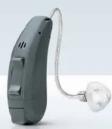
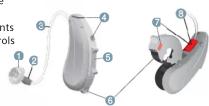
1 Ear piece
② Receiver
③ Receiver cable
4 Microphone openings
- Recker switch
- ROCKER SWITCH
6 Battery compartment
Side indicator
(red = right ear,
blue = left ear)
8 Receiver connection
Batteries
Changing the batteries
Open the battery compartment

2 Removecolouredsticker from new battery, place battery in drawer with + symbol on battery + side up. (You should only remove the protective sticker if you actually use the battery)
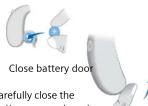
If you feel resistance, the battery is not inserted correctly. Do not attempt to close the battery compartment by force. It can be damaged.
Low Battery indicator
i Always use the right size batteries
Your hearing instrument may be programmed to inform you when the battery should be replaced for best system performance. You may hear an intermittent series of beeps and/or experience low amplification power or volume. Change the
battery when either of these occur. Remove empty batteries immediately and dispose of according to local regulations.
i Remember to have your replacement batteries with you at all times.
Daily use
Turning on and off
You have several options to turn your
hearing instruments on o Vie battery compartment
via battery compartment Turning on: Close th
- Turning on: Close the battery compartment. The default
volume and hearing program
are set Turning
turning on: Open the battery compartment.
- 2014年1月1日
Via rocker switch: ▶ Turning on or off: Press the
push button. Refer to section
"Controls" for your personal
setting
After turning on, the previously used volume and bearing
used volume and hearing program are set.
Via remote control:
▶ Follow the instr
remote control's user guide.
After turning on, the previously
used volume and hearing program are set.

When wearing the hearing
instruments, an optional
signal can indicate when an instrument is turned on
an instrument is turned on or off.
■ Remove the batteries if the
hearing instruments are not used for several days
When the power-on delay is
activated, the hearing instruments turn on after a delay of several
turn on after a delay of several seconds. During this time you can
insert the hearing instruments
without experiencing unpleasant whistling.
The "power-on delay" can be
activated by your NHS Provider.
Inserting
Your hearing instruments have bee
fine-tuned for your right and le
ear. Color the side:
■ red marker = right ear
blue marker = left ear
To insert the hearing instrument:
Hold the receiver cable at the hand
Carefully push the
ear piece in the
ear canal
▶ Twist it slightly
until it sits wel
Open and close your mouth to avoid
mouth to avoid accumulation of
accumulation of air in the ear canal.
▶ Lift the hearing instrument and
slide it over the top of your ear.

CAUTION
Risk of injury!
Insert the ear piece
carefully and not too deeply into the ear.

Insert the right hearing
instrument with the right hand and the left bearing
hand and the left hearing instrument with the left
instrument with the left hand.
If you have problems
inserting the ear piece, use
the other hand to gently
pull your earlobe down- wards. This opens the ear
wards! This opens the car canal and eases insertion
of the ear piece.
The optional concha lock
helps to securely retain
the ear piece in your ea To position the concha
to position the concha lock:
▶ Bend the concha
lock and position
it carefully into the
bowl of your ear


- miniTek™ wireless enhancement
- Optional
- NOTICE
- WARNING
- CAUTION
- Important information
- Intendeduse
- Technical information
- Disposal information
- In case of instrument failure
- Tinnitus noiser
- For NHS Providers:
- Important safety information
- Personalsafety
- sound of the signal with their NHS Provider.
- Explanation of symbols
- Your Octiv™+ hearing instrument
- Batteries
- Daily use
Mærke : SIEMENS
Model : Octiv R+
Kategori : Høreapparat