ProLite H481S - Televizioni IIYAMA - Manual falas për përdoruesin
Gjeni manualet e pajisjes falas ProLite H481S IIYAMA në format PDF.


Pyetjet e përdoruesve rreth ProLite H481S IIYAMA
0 pyetje rreth kësaj pajisjeje. Përgjigjuni atyre që njihni ose bëni tuajin.
Bëni një pyetje të re rreth kësaj pajisjeje
Shkarko udhëzimet për tuajin Televizioni në format PDF falas! Gjeni manualin tuaj ProLite H481S - IIYAMA dhe merrni pajisjen tuaj elektronike sërish në duar. Në këtë faqe janë publikuar të gjitha dokumentet e nevojshme për përdorimin e pajisjes suaj. ProLite H481S e markës IIYAMA.
MANUAL I PËRDORUESIT ProLite H481S IIYAMA

natural_image
Color palette bar with grayscale shades and a central crosshair (no text or symbols)iiyama
USER MANUAL
ProLite
LCD Monitor

Congratulations!
You have just purchased a TCO'99 approved and labelled product! Your choice has provided you with a product developed for professional use. Your purchase has also contributed to reducing the burden on the environment and also to the further development of environmentally adapted electronics products.
Why do we have environmentally labelled computers?
In many countries, environmental labelling has become an established method for encouraging the adaptation of goods and services to the environment. The main problem, as far as computers and other electronics equipment are concerned, is that environmentally harmful substances are used both in the products and during their manufacture. Since it is not so far possible to satisfactorily recycle the majority of electronics equipment, most of these potentially damaging substances sooner or later enter nature.
There are also other characteristics of a computer, such as energy consumption levels, that are important from the viewpoints of both the work (internal) and natural (external) environments. Since all methods of electricity generation have a negative effect on the environment (e.g. acidic and climate-influencing emissions, radioactive waste), it is vital to save energy. Electronics equipment in offices is often left running continuously and thereby consumes a lot of energy.
What does labelling involve?
This product meets the requirements for the TCO'99 scheme which provides for international and environmental labelling of personal computers. The labelling scheme was developed as a joint effort by the TCO (The Swedish Confederation of Professional Employees), Svenska Naturskyddsforeningen (The Swedish Society for Nature Conservation) and Statens Energimyndighet (The Swedish National Energy Administration).
Approval requirements cover a wide range of issues: environment, ergonomics, usability, emission of electric and magnetic fields, energy consumption and electrical and fire safety.
The environmental demands impose restrictions on the presence and use of heavy metals, brominated and chlorinated flame retardants, CFCs (freons) and chlorinated solvents, among other things. The product must be prepared for recycling and the manufacturer is obliged to have an environmental policy which must be adhered to in each country where the company implements its operational policy.
The energy requirements include a demand that the computer and/or display, after a certain period of inactivity, shall reduce its power consumption to a lower level in one or more stages. The length of time to reactivate the computer shall be reasonable for the user.
Labelled products must meet strict environmental demands, for example, in respect of the reduction of electric and magnetic fields, physical and visual ergonomics and good usability.
Below you will find a brief summary of the environmental requirements met by this product. The complete environmental criteria document may be ordered from:
TCO Development
SE-114 94 Stockholm, Sweden
Fax: +46 8 782 92 07
Email (Internet): development@tco.se
Current information regarding TCO'99 approved and labelled products may also be
obtained via the Internet, using the address: http://www.tco-info.com/
Environmental requirements
Flame retardants
Flame retardants are present in printed circuit boards, cables, wires, casings and housings. Their purpose is to prevent, or at least to delay the spread of fire. Up to 30% of the plastic in a computer casing can consist of flame retardant substances. Most flame retardants contain bromine or chloride, and those flame retardants are chemically related to another group of environmental toxins, PCBs. Both the flame retardants containing bromine or chloride and the PCBs are suspected of giving rise to severe health effects, including reproductive damage in fish-eating birds and mammals, due to the bio-accumulative* processes. Flame retardants have been found in human blood and researchers fear that disturbances in foetus development may occur.
The relevant TCO'99 demand requires that plastic components weighing more than 25 grams must not contain flame retardants with organically bound bromine or chlorine. Flame retardants are allowed in the printed circuit boards since no substitutes are available.
Cadmium\*\*
Cadmium is present in rechargeable batteries and in the colour-generating layers of certain computer displays. Cadmium damages the nervous system and is toxic in high doses. The relevant TCO'99 requirement states that batteries, the colour-generating layers of display screens and the electrical or electronics components must not contain any cadmium.
Mercury\*\*
Mercury is sometimes found in batteries, relays and switches. It damages the nervous system and is toxic in high doses. The relevant TCO'99 requirement states that batteries may not contain any mercury. It also demands that mercury is not present in any of the electrical or electronics components associated with the labelled unit.
CFCs (freons)
The relevant TCO'99 requirement states that neither CFCs nor HCFCs may be used during the manufacture and assembly of the product. CFCs (freons) are sometimes used for washing printed circuit boards. CFCs break down ozone and thereby damage the ozone layer in the stratosphere, causing increased reception on earth of ultraviolet light with e.g. increased risks of skin cancer (malignant melanoma) as a consequence.
Lead"
Lead can be found in picture tubes, display screens, solders and capacitors. Lead damages the nervous system and in higher doses, causes lead poisoning. The relevant TCO'99 requirement permits the inclusion of lead since no replacement has yet been developed.
* Bio-accumulative is defined as substances which accumulate within living organisms
**Lead, Cadmium and Mercury are heavy metals which are Bio-accumulative.
FCC DECLARATION OF CONFORMITY
Model Number: PLH431S / PLH481S
Trade Name: iiyama
Responsible party: IIYAMA North America, Inc.
Address: 65 West Street Road, Suite 101B, Warminster, PA18974 U.S.A.
Telephone number: 215-682-9050
This device complies with Part 15 of the FCC Rules. Operation is subject to the following two conditions: (1) This device may not cause harmful interference, and (2) this device must accept any interference received, including interference that may cause undesired operation.
This device has been tested and found to comply with the limits for Class B Personal Computers and peripherals, pursuant to Part 15 of the FCC Rules. These limits are designed to provide reasonable protection against harmful interference when the device is operated in a residential environment. This device generates, uses and can radiate radio frequency energy, and if not installed and used in accordance with the instructions, may cause harmful interference to radio communications. However, there is no guarantee that interference will not occur in a particular installation. If you determine the device does cause harmful interference to radio or television reception (this may be determined by monitoring the interference while turning the device off and on), you are encouraged to try to correct the interference by one of the following measures:
■ Reorient or relocate the receiving antenna.
■ Increase the separation between the device and receiver.
■ Connect the device into an outlet on a circuit different from that to which the receiver is connected.
■ Consult the dealer or an experienced radio or TV technician for help.
To meet the FCC requirements, you should use a signal cable with ferrite core at both ends.
CAUTION
Changes or modifications not expressly approved by iiyama could void the users authority to operate the device under FCC compliance regulations.
CANADIAN DEPARTMENT OF COMMUNICATIONS COMPLIANCE STATEMENT
This digital apparatus does not exceed the Class B limits for radio noise emissions from digital apparatus as set out in the radio interference regulation of the Canadian department of communications.
CE MARKING DECLARATION OF CONFORMITY
This LCD monitor complies with the requirements of the EC Directive 89/336/EEC "EMC Directive" and 73/23/EEC "Low Voltage Directive" as amended by Directive 93/68/EEC.
The electro-magnetic susceptibility has been chosen at a level that gives correct operation in residential areas, business and light industrial premises and small-scale enterprises, inside as well as outside of the buildings. All places of operation are characterised by their connection to the public low voltage power supply system.
■ We reserve the right to change specifications without notice.
■ All trademarks used in this user manual are the property of their respective owners.
As an ENERGY STAR® Partner, iiyama has determined that this product meets the ENERGY STAR® guidelines for energy efficiency.

natural_image
Color palette bar with grayscale shades and a central crosshair (no text or symbols)TABLE OF CONTENTS
FOR YOUR SAFETY 1
SAFETY PRECAUTIONS 1
SPECIAL NOTES ON LCD MONITORS 3
CUSTOMER SERVICE 3
CLEANING 3
BEFORE YOU OPERATE THE MONITOR 4
FEATURES 5
CHECKING THE CONTENTS OF THE PACKAGE 6
OPTIONAL PARTS 6
CONTROLS AND CONNECTORS : ProLite H431S 7
CONTROLS AND CONNECTORS : ProLite H481S 8
CONNECTING YOUR MONITOR 9
COMPUTER SETTING 10
ADJUSTING THE HEIGHT AND THE VIEWING ANG 11
PANEL ROTATION 11
OPERATING THE MONITOR 12
ADJUSTMENT MENU CONTENTS 13
SCREENADJUSTMENTS 20
POWER MANAGEMENT FEATURE 23
TROUBLE SHOOTING 24
APPENDIX 26
SPECIFICATIONS: ProLite H431S 26
SPECIFICATIONS: ProLite H481S 27
DIMENSIONS: ProLite H431S 28
DIMENSIONS: ProLite H481S 28
COMPLIANT TIMING 28
CONNECTOR PIN ASSIGNMENT 29





FOR YOUR SAFETY
SAFETY PRECAUTIONS
WARNING
STOP OPERATING THE MONITOR WHEN YOU SENSE TROUBLE
If you notice any abnormal phenomena such as smoke, strange sounds or fumes, unplug the monitor and contact your dealer or iiyama service center immediately. Further use may be dangerous and can cause fire or electric shock.
NEVER REMOVE THE CABINET
High voltage circuits are inside the monitor. Removing the cabinet may expose you to the danger of fire or electric shock.
DO NOT PUT ANY OBJECT INTO THE MONITOR
Do not put any solid objects or liquids such as water into the monitor. In case of an accident, unplug your monitor immediately and contact your dealer or iiyama service center. Using the monitor with any object inside may cause fire, electric shock or damage.
INSTALL THE MONITOR ON A FLAT, STABLE SURFACE
The monitor may cause an injury if it falls or is dropped.
DO NOT USE THE MONITOR NEAR WATER
Do not use where water may be splashed or spilt onto the monitor as it may cause fire or electric shock.
OPERATE UNDER THE SPECIFIED POWER SUPPLY
Be sure to operate the monitor only with the specified power supply. Use of an incorrect voltage will cause malfunction and may cause fire or electric shock.
PROTECT THE CABLES
Do not pull or bend the power cable and signal cable. Do not place the monitor or any other heavy objects on the cables. If damaged, the cables may cause fire or electric shock.
ADVERSE WEATHER CONDITIONS
It is advisable not to operate the monitor during a heavy thunder storm as the continual breaks in power may cause malfunction. It is also advised not to touch the plug in these circumstances as it may cause electric shock.
1 FOR YOUR SAFETY



natural_image
Color palette bar with grayscale shades and a central crosshair (no text or symbols)CAUTION
INSTALLATION LOCATION
Do not install the monitor where sudden temperature changes may occur, or in humid, dusty or smoky areas as it may cause fire, electric shock or damage. You should also avoid areas where the sun shines directly on the monitor.
DO NOT PLACE THE MONITOR IN A HAZARDOUS POSITION
The monitor may topple and cause injury if not suitably located. Please also ensure that you do not place any heavy objects on the monitor, and that all cables are routed such that children may not pull the cables and possibly cause injury.
MAINTAIN GOOD VENTILATION
Ventilation slots are provided to keep the monitor from overheating. Covering the slots may cause fire. To allow adequate air circulation, place the monitor at least 10 cm (or 4 inches) from any walls. Do not remove the tilt stand when operating the monitor. Ventilation slots on the back of the cabinet will be blocked and the monitor may overheat if the stand is removed. This may cause fire or damage. Operating the monitor on its back, side, upside down or on a carpet or any other soft material may also cause damage.
DISCONNECT THE CABLES WHEN YOU MOVE THE MONITOR
When you move the monitor, turn off the power switch, unplug the monitor and be sure the signal cable is disconnected. If you do not disconnect them, it may cause fire or electric shock.
UNPLUG THE MONITOR
If the monitor is not in use for a long period of time it is recommended that it is left unplugged to avoid accidents.
HOLD THE PLUG WHEN DISCONNECTING
To disconnect the power cable or signal cable, always pull it by the plug. Never pull on the cable itself as this may cause fire or electric shock.
DO NOT TOUCH THE PLUG WITH WET HANDS
Pulling or inserting the plug with wet hands may cause electric shock.
WHEN YOU INSTALL THE MONITOR ON YOUR COMPUTER
Be sure the computer is strong enough to hold the weight of the monitor, otherwise, you may damage your computer.
DO NOT PUT FLOPPY DISKS NEAR THE SPEAKERS
Magnetically recorded data, such as on a floppy disk, may become corrupted by the magnetic field produced by the speakers if the disks are placed on or near the speakers.
OTHERS
ERGONOMIC RECOMMENDATIONS
To eliminate eye fatigue, do not operate the monitor against a bright background or in a dark room. For optimal viewing comfort, the monitor should be just below eye level and 40-60 cm (16-24 inches) away from your eyes. When using the monitor over a prolonged time, a ten minute break every hour is recommended as looking at the screen continuously can cause eye strain.
FOR YOUR SAFETY
SPECIAL NOTES ON LCD MONITORS
The following symptoms are normal with LCD monitors and do not indicate a problem.
NOTE
■ When you first turn on the LCD monitor, the picture may not fit in the display area because of the type of computer that is used. In this case, adjust the picture position to the correct position.
■ Due to the nature of the backlight, the screen may flicker during initial use. Turn off the Power Switch and then turn it on again to make sure the flicker disappears.
■ You may find slightly uneven brightness on the screen depending on the desktop pattern you use.
■ Due to the nature of the LCD screen, an afterimage of the previous screen may remain after switching the image, when the same image is displayed for hours. In this case, the screen is recovered slowly by changing the image or turning off the Power Switch for hours.
■ Contact your dealer or iiyama service center for the backlight replacement when the screen is dark, flickering or not lighting up. Never attempt to replace it by yourself.
CUSTOMER SERVICE
NOTE
■ The fluorescent light used in the LCD monitor may have to be periodically replaced. For the warranty coverage on this component, please check with local iiyama service center.
■ If you have to return your unit for service and the original packaging has been discarded, please contact your dealer or iiyama service center for advice or replacement packaging.
CLEANING
WARNING
■ If you drop any materials or liquids such as water into the monitor when cleaning, unplug the power cable immediately and contact your dealer or iiyama service center.
■ For safety reasons, turn off the power switch and unplug the monitor before you clean it.
■ To protect the LCD panel, do not scratch or rub the screen with a hard object.
■ Never use any of the following strong solvents. These will damage the cabinet and the LCD screen.
CAUTION
Thinner
Spray-type cleaner
Benzine
Wax
Abrasive cleaner
Acid or Alkaline solvent
■ Touching the cabinet with any product made from rubber or plastic for a long time may cause degeneration or loss of paint on the cabinet.
CABINET
Stains can be removed with a cloth lightly moistened with a mild detergent solvent. Then wipe the cabinet with a soft dry cloth.
LCD
Periodic cleaning with a soft dry cloth is recommended.
SCREEN
Don't use tissue paper etc. because these will damage the LCD screen.
3 FOR YOUR SAFETY

natural_image
Color palette bar with grayscale shades and a central crosshair (no text or symbols)BEFORE YOU OPERATE THE MONITOR
The monitor functions as a hub when connected to a USB compliant computer and USB peripherals. However, with older operating systems and/or BIOS settings in your computer, the USB hub may not operate. In this case, please contact your computer dealer first for advice.
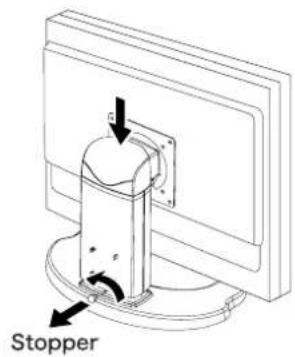
Please stand the monitor and then remove the stopper on the back of the stand slowly while pushing top face of the stand before you install the monitor. Careful attention is required as the monitor is sprung loaded and may expand quickly when removing it.
ENSOLID
BEFORE YOU OPERATE THE MONITOR
FEATURES
◆ ProLite H431S: 43cm (17.0") TFT Color LCD Monitor
◆ ProLite H481S: 48cm (19.0") TFT Color LCD Monitor
◆ Supports Resolutions up to 1280 × 1024
◆ High Contrast 700:1 / High Brightness 300cd/m²· / Quick Response Time 8ms
◆ ProLite H431S: 14.5mm Narrow Bezel & Slim Design
ProLite H481S: 19.8mm Narrow Bezel & Slim Design
◆ Multi-Color Control
Supports sRGB International Standard
◆ Gamma Control
Clear Display for Moving Pictures & Photographs
◆ Digital Character Smoothing
◆ Automatic Set-up
◆ Stereo Speakers
ProLite H431S: 2 × 1.5W Stereo Speakers & Headphone Connector
ProLite H481S: 2 × 2W Stereo Speakers & Headphone Connector
◆ Economy Mode
Reduced Power Consumption
◆ Plug & Play VESA DDC2B Compliant Windows® 95/98/2000/Me/XP Compliant
◆ Power Management (ENERGY STAR® and VESA DPMS Compliant)
◆ Ergonomic Design: TCO '99 and MPR III Approved
◆ Digital Input (DVI-D) for Clear Display
◆ 90° Panel Rotation Design
◆ VESA Mounting Standard (100mm×100mm) Compliant


CHECKING THE CONTENTS OF THE PACKAGE
The following accessories are included in your package. Check to see if they are enclosed with the monitor. If anything is missing or damaged, please contact your local iiyama dealer or regional iiyama office.
■ Power Cable*
■ D-Sub Signal Cable
■ DVI-D Signal Cable
■ Audio Cable
■ Stand
■ User Manual
■ Sample: Pivot® & Liquid Series software (CD)
Pivot®: This software enables to rotate the orientation of the screen to display in portrait or landscape mode.
Liquid View®: This software enables to scale icons up.
Liquid Surf™: This software supports Internet Explorer display.
Consult english.txt in CD-ROM for installation.
CAUTION
* The rating of the Power Cable enclosed in 120V area is 10A/125V. If you are using a power supply higher than this rating, then a power cable with a rating of 10A/250V must be used.
However, all guarantees and warranties are void for any problems or damage caused by a power cable not supplied by iiyama.
OPTIONAL PARTS
Optional parts as below are available for your LCD monitor. Please contact your local iiyama dealer or regional iiyama office for more details. The Protection Sheet may be attached to the LCD panel surface to protect it from stains or scratches.
■ Protection Sheet (Parts No. 832Z002-01)
CONTROLS AND CONNECTORS : ProLite H431S
flowchart
graph TD
    ① --> ②
    ② --> ③
    ③ --> ④
    ④ --> ⑤
    ⑤ --> ⑥
    ⑥ --> ⑦
    ⑦ --> ⑧
    ⑧ --> ①
    ① --> ②
    ② --> ③
    ③ --> ④
    ④ --> ⑤
    ⑤ --> ⑥
    ⑥ --> ⑦
    ⑦ --> ⑧
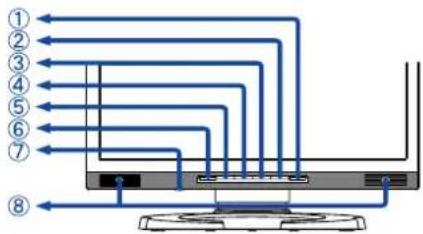
① Power Switch / Power Indicator ( ⏻ )
NOTE Green: Normal operation (ProLite H431S)
Blue: Normal operation (ProLite H431S-B)
Orange: Power Management
The monitor enters into power management mode which reduces the power consumption to less than 2W when receiving no horizontal and/or vertical sync signal.
② Input / Auto Button (INPUT / AUTO)
Input: Select either Analog or Digital for the signal input when both of the signal inputs are connected to a signal source. Switch D-SUB and DVI-D whenever pressing the input button.
NOTE When only one of the two signal inputs is connected to the signal source, the one connected is automatically selected. Input Button is not available if there is no signal input from the selected connector or during the power management mode.
Auto: Keep pressing the Input / Auto Button for 1-2 seconds. See page 14 for Auto Set-up.
③ Exit / Volume Button (EXIT / ▶)
④ + / Brightness Button (+ / ⚙)
⑤ - / Contrast Button (- / Ⓞ)
⑥ Menu Button (MENU)
⑦ Headphone Connector
⑧ Speakers
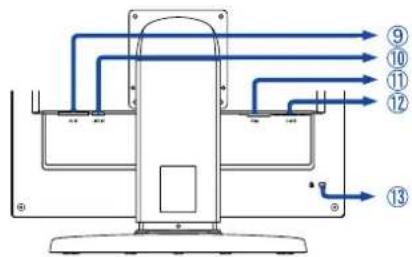
⑨ AC Connector (AC IN)
⑩ Audio Connector (LINE IN)
⑪ DVI-D 24pin Connector (DVI-D)
⑫ D-sub mini 15pin Connector (D-SUB)
⑬ Keyhole for Security Lock
NOTE You can fasten a security lock and cable to prevent the monitor from being removed without your permission.
7 BEFORE YOU OPERATE THE MONITOR
CONTROLS AND CONNECTORS : ProLite H481S
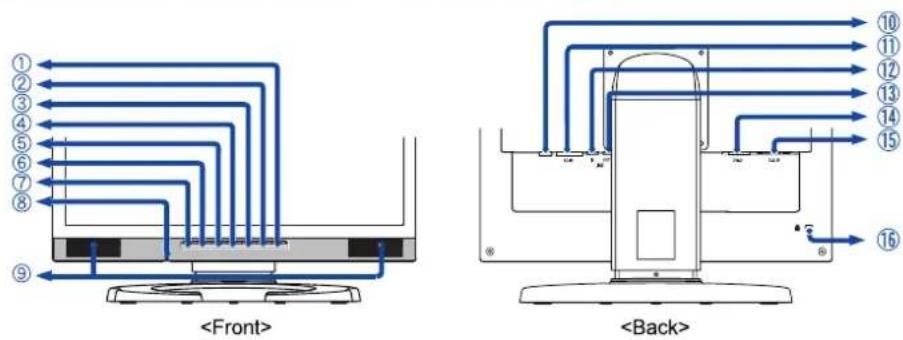
① Power Switch / Power Indicator ( ⏻ )
NOTE
Green: Normal operation (ProLite H481S)
Blue: Normal operation (ProLite H481S-B)
Orange: Power Management
The monitor enters into power management mode which reduces the power consumption to less than 2W when receiving no horizontal and/or vertical sync signal.
② Auto Button (AUTO)
See page 14 for Auto Set-up.
③ Exit / Volume Button (EXIT / ▶)
④ + / Brightness Button (+ / ⚙)
⑤ - / Contrast Button (- / Ⓞ)
⑥ Menu Button (MENU)
⑦ Input Button (INPUT)
Select either Analog or Digital for the signal input when both of the signal inputs are connected to a signal source. Switch D-SUB and DVI-D whenever pressing the input button.
NOTE
When only one of the two signal inputs is connected to the signal source, the one connected is automatically selected. Input Button is not available if there is no signal input from the selected connector or during the power management mode.
⑧ Headphone Connector
⑨ Speakers
⑩ Main Power Switch
⑪ AC Connector (AC IN)
⑫ Audio Connector (LINE IN)
⑬ Audio Connector (LINE OUT)
⑭ DVI-D 24pin Connector (DVI-D)
⑮ D-sub mini 15pin Connector (D-SUB)
⑯ Keyhole for Security Lock
NOTE
You can fasten a security lock and cable to prevent the monitor from being removed without your permission.
BEFORE YOU OPERATE THE MONITOR



CONNECTING YOUR MONITOR
① Ensure that both the computer and the monitor are switched off.
② Connect the computer to the monitor with the signal cable. (See page 29 for CONNECTOR PIN ASSIGNMENT.)
③ Connect the monitor to the audio equipment with the Audio Cable when using the audio features.
④ Connect the Power Cable to the monitor first and then to the power supply.
NOTE
■ The signal cables used for connecting the computer and monitor may vary with the type of computer used. An incorrect connection may cause serious damage to both the monitor and the computer. The cable supplied with the monitor is for a standard 15 pin D-Sub connector. If a special cable is required please contact your local iiyama dealer or regional iiyama office.
■ For connection to Macintosh computers, contact your local iiyama dealer or regional iiyama office for a suitable adaptor.
■ Make sure you tighten the finger screws at each end of the signal cable.
[Example of Connection]
ProLite H431S
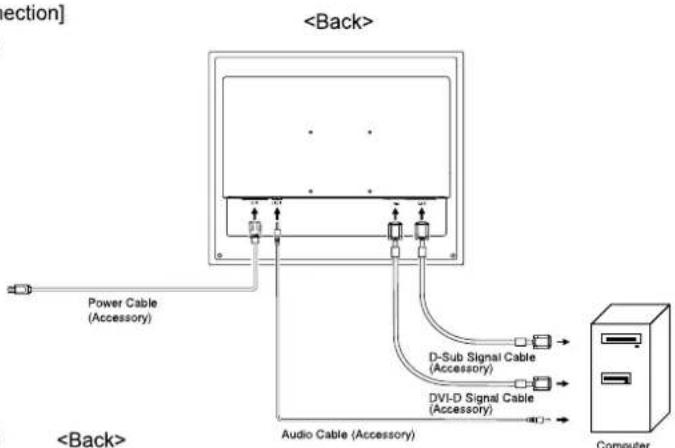
ProLite H481S
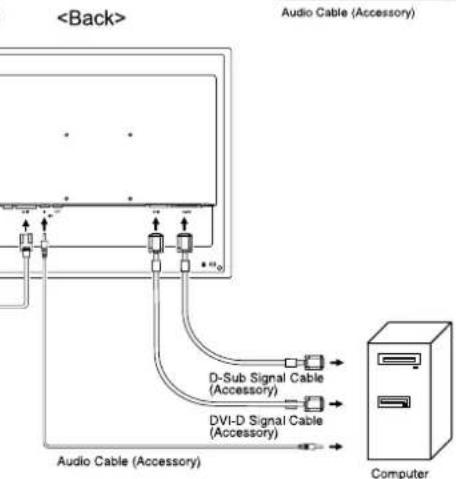
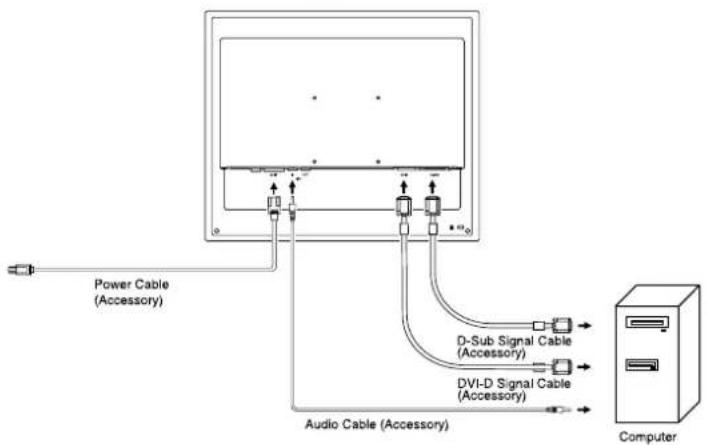
flowchart
graph TD
    A["Power Cable (Accessory)"] --> B["Audio Cable (Accessory)"]
    B --> C["D-Sub Signal Cable (Accessory)"]
    B --> D["DVI-D Signal Cable (Accessory)"]
    C --> E["Computer"]
    D --> E
    style A fill:#f9f,stroke:#333
    style B fill:#ccf,stroke:#333
    style C fill:#cfc,stroke:#333
    style D fill:#fcc,stroke:#333
    style E fill:#ffc,stroke:#333
9 BEFORE YOU OPERATE THE MONITOR



natural_image
Color palette bar with grayscale shades and a central crosshair (no text or symbols)[Cable Wiring]
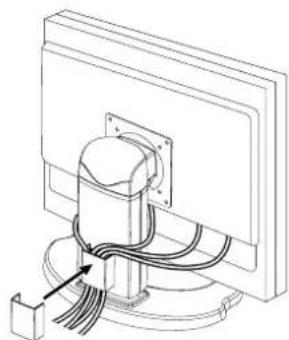
① Collect cable at the back of the stand.
② Hook the cable cover to the back of the stand.
natural_image
Diagram of a computer monitor with cable routing and a connector (no text or symbols)ENSOLID
COMPUTER SETTING
■ Signal Timing
Change to the desired signal timing listed on page 28: COMPLIANT TIMING.
■ Windows 95/98/2000/Me/XP Plug & Play
The iiyama LCD monitor complies with DDC2B of VESA standard. The Plug & Play function runs on Windows 95/98/2000/Me/XP by connecting the monitor to DDC2B compliant computer with the Signal Cable supplied. Windows 95/98/2000/Me/XP Monitor Information File for iiyama monitors may be necessary for your computer and obtained via the Internet, using the address:
http://www.iiyama.com
NOTE
■ For additional information on how to download the driver for your monitor, please access one of the internet sites noted above.
■ Monitor Drivers are not required in most cases for Macintosh or Unix operating systems. For further information, please contact your computer dealer first for advice.
ADJUSTING THE HEIGHT AND THE VIEWING ANGLE
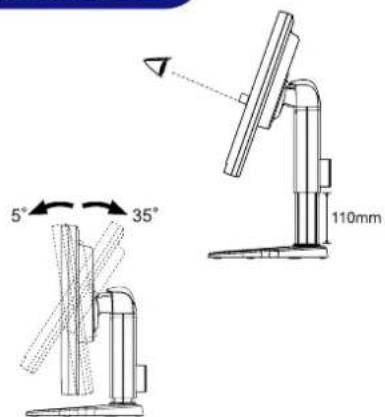
■ For optimal viewing it is recommended to look at the full face of the monitor, then adjust the monitor's Height and angle to your own preference.
■ Hold the stand so that the monitor does not topple when you change the monitor's angle.
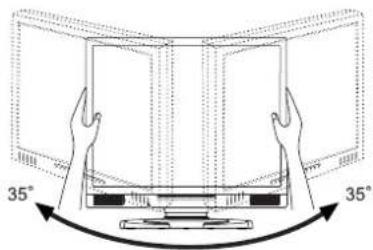
■ you are able to adjust the monitor's height up to 110mm, angle up to 35 degrees right and left, 35 degrees upward, 5 degrees downward.
NOTE
■ Do not touch the LCD screen when you change the angle. It may cause damage or break the LCD screen.
■ Careful attention is required not to catch your fingers or hands when you change the angle.
natural_image
Diagram of hands operating a computer monitor with 35-degree angle annotations (no text or symbols on the diagram itself)PANEL ROTATION
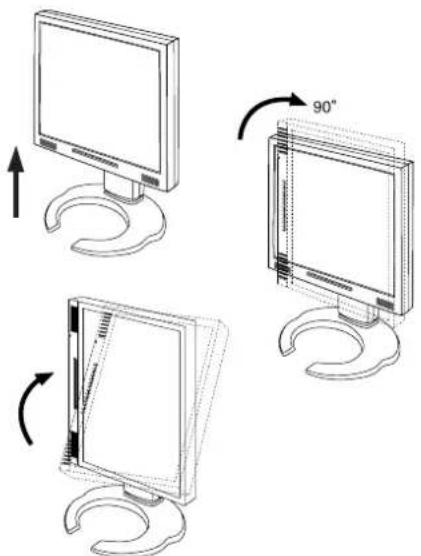
① Ajust the monitor's height to the maximum.
② Rotate the panel 90 degrees.
Portrait: Turn clockwise.
Landscape: Turn counter clockwise.
NOTE
■ Attempting to rotate without fully extending upward may cause damage to stand.
■ Please use attached Pivot® software for rotating the image on the screen.
③ Ajust the monitor's angle to your preference.
natural_image
Diagram showing three views of a computer monitor with curved legs and an arrow indicating rotation (no text or symbols)11 BEFORE YOU OPERATE THE MONITOR





OPERATING THE MONITOR
To create the best picture, your iiyama LCD monitor has been preset at the factory with the COMPLIANT TIMING shown on page 28. You are also able to adjust the picture by following the button operation shown below. For more detailed adjustments, see page 20 for SCREEN ADJUSTMENTS.
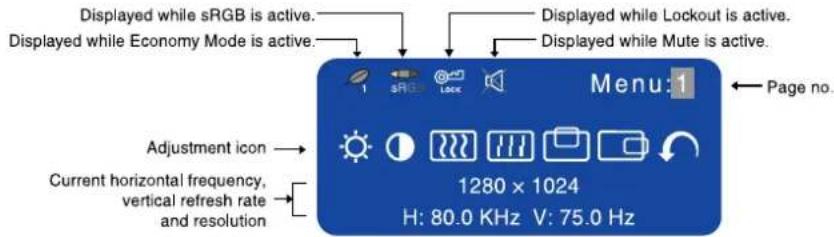
① Press the Menu Button to start the On Screen Display feature. There are additional Menu pages which can be switched by using the +/- Buttons.
ENSOLID
② Select the Menu page which contains the adjustment icon relating to the adjustment you want to make. Press the Menu Button again. Then, use the +/- Buttons to highlight the desired adjustment icon. Press the Menu Button again.
③ Use the +/- Buttons to make the appropriate adjustment or setting.
For example, to correct for vertical position, select Menu page number 1 and then press the Menu Button. Then, select ☐ (V-Position) by using the +/- Buttons.
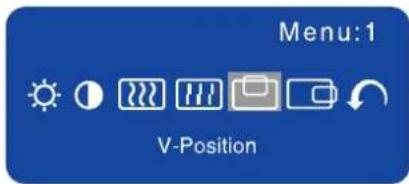
An adjustment scale appears after you press the Menu Button. Use the +/- Buttons to change the vertical position settings. The vertical position of the overall display should be changing accordingly while you are doing this.

■ The On Screen Display disappears several seconds after you stop pressing the buttons while performing an adjustment. The Exit Button can be used to exit OSD window immediately.
■ Any changes are automatically saved in the memory when the On Screen Display disappears. Turning off the power should be avoided while using the Menu.
■ Adjustments for Clock, Phase and Position are saved for each signal timing. Except for these adjustments, all other adjustments have only one setting which applies to all signal timings.
OPERATING THE MONITOR



ADJUSTMENT MENU CONTENTS
Analog Input
| Menu: 1 (Analog) | Menu: 1 1280 x 1024 H: 80.0 KHz V: 75.0 Hz | |
| Adjustment Item | Problem / Option | Button to Press |
| Brightness *1 Direct | Too dark Too bright | + - |
| Contrast Direct | Too dull Too intense | + - |
| Clock *2 | To correct flickering text or lines | + - |
| Phase *2 | To correct flickering text or lines | + - |
| V-Position | Too low Too high | + - |
| H-Position | Too far to the left Too far to the right | + - |
| Return to Menu | Highlight "Menu : 1" again. | |
*1 Adjust the Brightness when you are using the monitor in a dark room and feel the screen is too bright.
*2 See page 20 for SCREEN ADJUSTMENTS.
Direct
You can skip the Menu pages and display an adjustment scale directly by using the following button operations.
● Brightness: Press the Brightness Button when the Menu is not displayed.
- Contrast: Press the Contrast Button when the Menu is not displayed.
13 OPERATING THE MONITOR
| Menu:2(Analog) | |||||
| Adjustment Item | Problem / Option Button to Press | ||||
 Auto Set-up *3Direct Auto Set-up *3Direct | NO | Return to Menu. | |||
| YES | Adjust Clock, Phase, V-Position and H-Position automatically. | ||||
| Setting | Off | The Auto Set-up is not performed when the signal input is changed. | |||
| On | Adjust Clock, Phase, V-Position and H-Position automatically when the signal input is changed. | ||||
| NOTE ■ The brightness of screen varies for several seconds during the adjustment.■ This function is not performed automatically when changing the signal input because the factory-preset of "Setting" in Auto Set-up is set to Off. | |||||
 Color Temp. Color Temp. | 1 | Color 1: 9300K | |||
| 2 | Color 2: 7500K | ||||
| 3 | Color 3: 6500K | ||||
| s | sRGB | ||||
| (User) | MENU | R | Too weak Too strong | ||
| G | |||||
| B | |||||
| NOTE ■ sRGB is an international standard which defines and unifies the difference of color appearance between equipment.■ You can not adjust the Gamma and Economy Mode during sRGB mode because those settings are locked.■is displayed while sRGB is active. | |||||
 Sharpness Sharpness | 1 2 3 4 5Adjust the picture quality at resolutions of less than 1280 x 1024. You can change the picture quality from 1 to 5 (sharp to soft).Press the + Button to change the picture quality in numerical order. Press the - Button to change the picture quality in reverse numerical order. | ||||
*3 For best results, use the Auto Set-up in conjunction with the adjustment pattern. See page 20 for SCREENADJUSTMENTS.
Direct
You can skip the Menu pages and display an adjustment scale directly by using the following button operations.
● Auto Set-up: Press the Auto Button when the Menu is not displayed.
OPERATING THE MONITOR



| Menu:2(Analog) | |||
| Adjustment Item | Problem / Option | ||
 Gamma Gamma | Off | ||
| Mode1 | High contrast | ||
| Mode2 | Dark | ||
 Economy ModeDirect Economy ModeDirect | Off | Normal | |
| Mode1 | Brightness of back-light is reduced. | ||
| Mode2 | Brightness of back-light is reduced more than Mode1. | ||
| NOTE is displayed while Economy Mode is active. | |||
 Return to Menu Return to Menu | Highlight "Menu:2" again. | ||
Direct
You can skip the Menu pages and display an adjustment scale directly by using the following button operations.
- Economy Mode: When OSD menu is off, holding the Menu button for 1-2 seconds will toggle the Economy Mode switch Off, Mode1 and Mode2.
15 OPERATING THE MONITOR
| Menu:3(Analog) | Menu:31280 x 1024H: 80.0 KHz V: 75.0 Hz | ||
| Adjustment Item | Problem / Option Button to Press | ||
 Volume Volume  | Too soft[YSX3] Too loud | [ST32] | |
| NOTE is displayed while Mute is active. | |||
| [40AY] OSD Position | 1 2 3 4 5You can move the OSD display area to any one of the following 5 positions within the overall display:Press the + Button to move the OSD in numerical order. Press the - Button to move the OSD in reverse numerical order. | ||
 Language Language | English | English | |
| Deutsch | German | ||
| Français | French | ||
| Español | Spanish | ||
| Italiano | Italian | ||
| 日本語 | Japanese | ||
 Lockout Lockout | Off | Lockout is canceled. | |
| On | All adjustment items except this function are locked out. | ||
| NOTE is displayed while Lockout is active. | |||
 Reset Reset | NO | Return to Menu. | |
| YES | Factory-preset data is restored. | ||
| [SWX9] Signal Select* Direct | Analog | Select the Analog input (D-SUB). | |
| Digital | Select the Digital input (DVI-D). | ||
 Return to Menu Return to Menu | Highlight "Menu: 3" again. | ||
Direct
You can skip the Menu pages and display an adjustment scale directly by using the following button operations.
- Volume: Press the Volume Button when the Menu is not displayed. Holding the Volume Button for 1-2 seconds will switch the Mute function between ON and OFF.
- Signal Select: Press the Input Button when the Menu is not displayed.
OPERATING THE MONITOR



Digital Input
| Menu: 1 (Digital) | ||||
| Adjustment Item | Problem / Option Button to Press | |||
| Brightness *1 Direct | Too dark + Too bright - | |||
| Contrast Direct | Too dull + Too intense - | |||
| Color Temp. | 1 | Color 1: 9300K | ||
| 2 | Color 2: 7500K | |||
| 3 | Color 3: 6500K | |||
| s | sRGB | |||
| (User) | MENU | R | Too weak + Too strong - | |
| G | ||||
| B | ||||
| NOTE ■ sRGB is an international standard which defines and unifies the difference of color appearance between equipment. ■ You can not adjust the Gamma and Economy Mode during sRGB mode because those settings are locked. ■ is displayed while sRGB is active. | ||||
| Sharpness | 1 2 3 4 5 Adjust the picture quality at resolutions of less than 1280 × 1024. You can change the picture quality from 1 to 5 (sharp to soft). Press the + Button to change the picture quality in numerical order. Press the - Button to change the picture quality in reverse numerical order. | |||
| Gamma | Off | Normal | ||
| Mode1 | High contrast | |||
| Mode2 | Dark | |||
*1 Adjust the Brightness when you are using the monitor in a dark room and feel the screen is too bright.
Direct
You can skip the Menu pages and display an adjustment scale directly by using the following button operations.
● Brightness: Press the Brightness Button when the Menu is not displayed.
- Contrast: Press the Contrast Button when the Menu is not displayed.
17 OPERATING THE MONITOR



| Menu:1(Digital) | |||
| Adjustment Item | Problem / Option | ||
 Economy ModeDirect Economy ModeDirect ■is displayed while Economy Mode is active. ■is displayed while Economy Mode is active. | Off | Normal | |
| Mode1 | Brightness of back-light is reduced. | ||
| Mode2 | Brightness of back-light is reduced more than Mode1. | ||
 Return to Menu Return to Menu | Highlight "Menu:1" again. | ||
Direct
You can skip the Menu pages and display an adjustment scale directly by using the following button operations.
- Economy Mode: When OSD menu is off, holding the Menu button for 1-2 seconds will toggle the Economy Mode switch Off, Mode1 and Mode2.
| Menu:2(Digital) | |||
| Adjustment Item | Problem / Option | Button to Press | |
| Volume Direct | Too softToo loud | ||
| NOTE is displayed while Mute is active. | |||
 OSD Position OSD Position | 1 2 3 4 5You can move the OSD display area to any one of the following 5 positions within the overall display:Press the + Button to move the OSD in numerical order. Press the - Button to move the OSD in reverse numerical order. | ||
 Language Language | English | English | |
| Deutsch | German | ||
| Français | French | ||
| Español | Spanish | ||
| Italiano | Italian | ||
| 日本語 | Japanese | ||
 Lockout Lockout | Off | Lockout is canceled. | |
| On | All adjustment items except this function are locked out. | ||
| NOTE is displayed while Lockout is active. | |||
 Reset Reset | NO | Return to Menu. | |
| YES | Factory-preset data is restored. | ||
 Signal Select Direct Signal Select Direct | Analog | Select the Analog input (D-SUB). | |
| Digital | Select the Digital input (DVI-D). | ||
 Return to Menu Return to Menu | Highlight "Menu:2" again. | ||
Direct
You can skip the Menu pages and display an adjustment scale directly by using the following button operations.
● Volume: Press the Volume Button when the Menu is not displayed.
Holding the Volume Button for 1-2 seconds will switch the Mute function between ON and OFF.
- Signal Select: Press the Input Button when the Menu is not displayed.
19 OPERATING THE MONITOR
SCREEN ADJUSTMENTS
Adjust the image by following the procedure below to get the desired picture when selecting Analog input.
■ The screen adjustments described in this manual are designed to set image position and minimize flicker or blur for the particular computer in use.
■ The monitor is designed to provide the best performance at resolution of 1280 × 1024 , but can not provide the best at resolutions of less than 1280 × 1024 because the picture is automatically stretched to fit the full screen. It is recommended to operate at resolution of 1280 × 1024 in normal use.
■ Displayed text or lines will be blurred or irregular in thickness when the picture is stretched due to the screen enlargement process.
■ It is preferable to adjust the image position and frequency with the monitor controls, rather than the computer software or utilities.
■ Perform adjustments after a warm-up period of at least thirty minutes.
■ Additional adjustments may be required after the Auto Set-up depending on the resolution or signal timing.
■ The Auto Set-up may not work correctly when displaying the picture other than the screen adjustment pattern. In this case, manual adjustments are required.
There are two ways to adjust the screen. One way is automatic adjustment for Clock, Phase and Position. The other way is performing each adjustment manually.
Perform the Auto Set-up first when the monitor is connected to a new computer, or resolution is changed. If the screen has a flicker or blur, or the picture does not fit in the display area after performing the Auto Set-up, manual adjustments are required. Both adjustments should be made by using the screen adjustment pattern (Test.bmp) obtained via the IIYAMA web site (http://www.iiyama.com).
Adjust the image by following the procedure below to get the desired picture. This manual explains adjustment under Windows 95/98/2000/Me/XP.
① Display the picture at the optimum resolution.
② Enter the Test.bmp (screen adjustment pattern) to wallpaper.
NOTE
■ Consult the appropriate documentation for doing this.
■ Test.bmp is made at resolution of 1280 × 1024. Set the display position to center in the wallpaper setting dialogue box. If you use Microsoft® PLUS! 95/98 cancel the setting of "Stretch desktop wallpaper to fit the screen".
[Adjustment pattern]
![[adjustment pattern] Zebra pattern Color bar Picture frame This is the image displayed at 12](/content/2026/06/1178801/images/14187d6507464b2a62162281324e1679f8685e2d225dc2ed5b83b123968b2d63.jpg)
Color bar
Picture frame
This is the image displayed at 1280 × 1024.
OPERATING THE MONITOR 20



③ Press the Auto Button. (Auto Set-up)
④ Adjust the image manually by following procedure below when the screen has a flicker or blur, or the picture does not fit in the display area after performing the Auto Set-up.
⑤ Adjust the V-Position so that the top and bottom of the picture frame will fit to the display area.
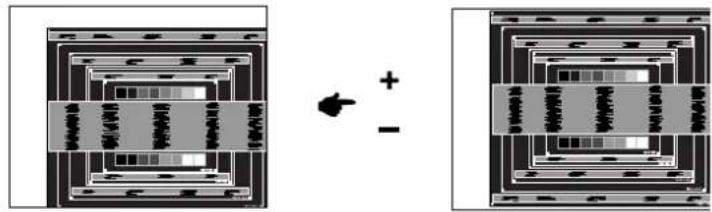
⑥ 1) Adjust the H-Position so that the left side of the picture frame will move to the left edge of the display area.
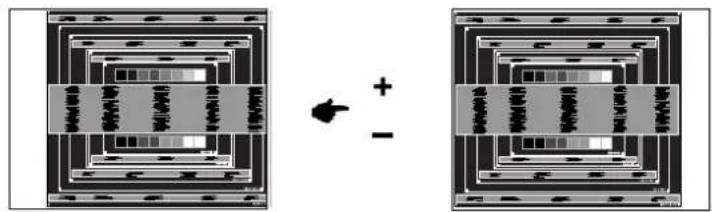
2) Stretch the right side of the picture frame to the right edge of the display area by adjusting the Clock.
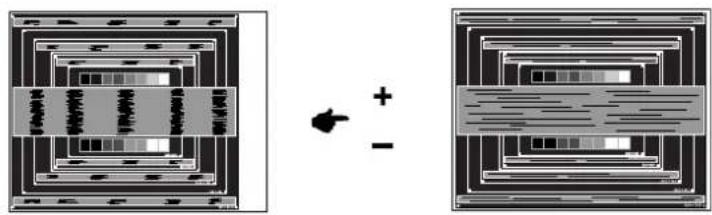
NOTE
■ When the left side of the picture frame moves apart from the left edge of the display area during the Clock adjustment, adjust steps 1) and 2).
■ Another way to make the Clock adjustment is to correct the vertical wavy lines in the zebra pattern.
■ The picture may flicker during the Clock, H-Position and V-Position adjustment.
In case the picture frame is bigger or smaller than the data display area after the Clock adjustment, repeat steps from ③.



natural_image
Color palette bar with grayscale shades and a central crosshair (no text or symbols)⑦ Adjust the Phase to correct horizontal wavy noise, flicker or blur in the zebra pattern.
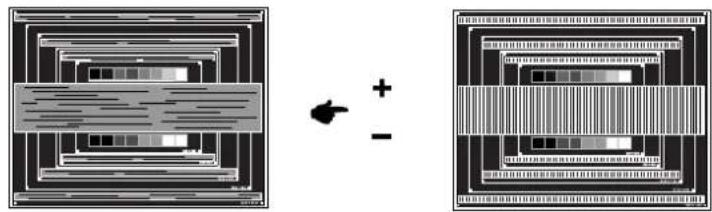
natural_image
Two abstract diagrams showing layered rectangular structures with a plus sign and a minus sign, no text or symbols present.NOTE
In case the strong flicker or blurs remain on a part of the screen, repeat steps ⑥ and ⑦ because the Clock may not be adjusted correctly. If the flicker or blurs still remain, set the refresh rate of computer to low (60Hz) and repeat steps from ③ again.
■ Adjust the H-Position after the Phase adjustment if the horizontal position moves during the adjustment.
⑧ Adjust the Brightness and Color Temp. to get the desired picture after you complete the Clock and Phase adjustments.
Put back your favorite wallpaper.

natural_image
Two isolated black crosshair markers on white background, no text or symbols present


POWER MANAGEMENT FEATURE
The power management feature of this product complies with every power saving requirement of ENERGY STAR® and VESA DPMS. When activated, it automatically reduces unnecessary power consumption of the monitor when your computer is not in use.
To use the feature, the monitor needs to be connected to a VESA DPMS compliant computer. There is a power management step the monitor takes as described below. The power management function, including any timer settings is configured by the operating system. Check your operating system manual for information on how this can be configured.
■ Power Management Mode
When the H-sync signal / V-sync signal / H and V sync signals from the computer are off, the monitor enters into Power Management Mode which reduces the power consumption to less than 2W. The screen becomes dark, and the power indicator turns to orange. From Power Management Mode, the image reappears in several seconds when either the keyboard or the mouse are touched again.
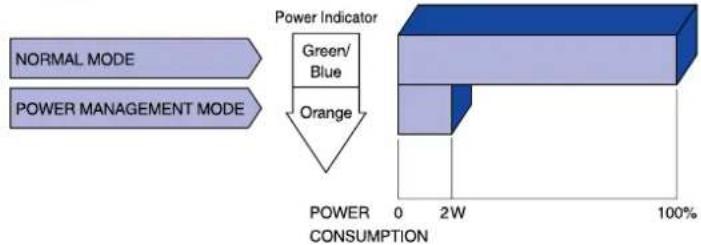
flowchart
graph LR
    A["NORMAL MODE"] --> B["Power Management Mode"]
    C["Power Indicator"] --> D["Green/Blue"]
    C --> E["Orange"]
    F["POWER CONSUMPTION"] --> G["0 2W 100%"]
NOTE
■ Even when using the power management mode, the monitor consumes electricity. Turn off the Power Switch whenever the monitor is not in use, during the night and weekends, to avoid unnecessary power consumption.
It is possible that the video signal from the computer may be on while the H or V sync signal is missing. In this instance, the POWER MANAGEMENT feature may not work properly.

TROUBLE SHOOTING
If the monitor fails to operate correctly, please follow the steps below for a possible solution.
- Perform the adjustments described in OPERATING THE MONITOR, depending on the problem you have. If the monitor does not get a picture, skip to 2.
- Consult the following items if you cannot find an appropriate adjustment item in OPERATING THE MONITOR or if the problem persists.
- If you are experiencing a problem which is not described below or you cannot correct the problem, discontinue using the monitor and contact your dealer or iiyama service center for further assistance.
Problem
① The picture does not appear.
(Power indicator does not light up.)
Check
□ The Power Cable is firmly seated in the socket.
☐ The Power Switch is turned ON.
☐ The AC socket is live. Please check with another piece of equipment.
(Power indicator is green/blue.)
☐ If the blank screen saver is in active mode, touch the keyboard or the mouse.
□ Increase the Contrast and/or Brightness.
□ The computer is ON.
☐ The Signal Cable is properly connected.
☐ The signal timing of the computer is within the specification of the monitor.
(Power indicator is orange.)
☐ If the monitor is in power management mode, touch the keyboard or the mouse.
□ The computer is ON.
☐ The Signal Cable is properly connected.
☐ The signal timing of the computer is within the specification of the monitor.
② The screen is not synchronized.
☐ The Signal Cable is properly connected.
☐ The signal timing of the computer is within the specification of the monitor.
☐ The video output level of the computer is within the specification of the monitor.
③ The screen position is not in the center.
☐ The signal timing of the computer is within the specification of the monitor.
④ The screen is too bright or too dark.
☐ The video output level of the computer is within the specification of the monitor.
⑤ The screen is shaking.
☐ The power voltage is within the specification of the monitor.
☐ The signal timing of the computer is within the specification of the monitor.

natural_image
Color palette bar with grayscale shades and a central crosshair (no text or symbols)Problem
Check
⑥ No sound.
☐ The audio equipment (computer etc.) is ON.
☐ The Audio Cable is properly connected.
□ The Volume is turned up.
□ The Mute is OFF.
☐ The audio output level of the audio equipment is within the specification of the monitor.
⑦ The sound is too loud or too quiet.
☐ The audio output level of the audio equipment is within the specification of the monitor.
⑧ A strange noise is heard.
☐ The Audio Cable is properly connected.
APPENDIX
SPECIFICATIONS : ProLite H431S
| LCD Panel | Driving system | a-Si TFT Active Matrix |
| Size | Diagonal: 43cm / 17.0" | |
| Pixel pitch | 0.264mm H × 0.264mm V | |
| Brightness | 300cd/m2 (Typical) | |
| Contrast ratio | 700 : 1 (Typical) | |
| Viewable angle | Right / Left: 75 degrees each, Up: 75 degrees, Down: 60 degrees | |
| Response time | 8ms (Black, white, black) | |
| Display Colors | Approx. 16.2 million | |
| Sync Frequency | Analog: Horizontal 24.0-80.0kHz, Vertical 55-75HzDigital: Horizontal 31.0-80.0kHz, Vertical 55-75Hz | |
| Dot Clock | 135MHz maximum | |
| Maximum Resolution | 1280 × 1024, 1.3 MegaPixels | |
| Input Connector | D-Sub mini 15pin, DVI-D 24pin | |
| Plug & Play | VESA DDC2BTM | |
| Input Sync Signal | Separate sync: TTL, Positive or NegativeComposite sync: TTL, Positive or NegativeSync on green: 0.3Vp-p, Negative | |
| Input Video Signal | Analog: 0.7Vp-p (Standard), 75Ω, PositiveDigital: DVI (Digital Visual Interface Standard Rev.1.0) compliance | |
| Input Audio Connector | ø 3.5mm mini jack (Stereo) | |
| Input Audio Signal | 0.7Vrms maximum | |
| Speakers | 1.5W × 2 (Stereo speakers) | |
| Headphone Connector | ø 3.5mm mini jack (Stereo) | |
| Maximum Screen Size | 337.9mm W × 270.3mm H / 13.3" W × 10.6" H | |
| Power Source | 100-240VAC, 50/60Hz, 1.5A | |
| Power Consumption | 39W maximum, Power management mode: 2W maximum* | |
| Dimensions / Net Weight | 368.5 × 357-467 × 242mm / 14.5 × 14.1-18.4 × 9.5" (W×H×D), 6.3kg / 13.9lbs | |
| Tilt Angle | Right / Left: 35 degrees each, Up: 35 degrees, Down: 5 degrees | |
| Environmental Considerations | Operating: Temperature 5 to 35°C / 41 to 95°FHumidity 10 to 80% (No condensation)Storage: Temperature -20 to 60°C / -4 to 140°FHumidity 5 to 85% (No condensation) | |
| Approvals | TCO '99, CE, TÜV-GS / MPR III (prEN50279) / ISO 13406-2, FCC-B, UL/C-UL, VCCI-B | |
NOTE
*Condition: Audio equipment is not connected.
APPENDIX 26
SPECIFICATIONS : ProLite H481S
| LCD Panel | Driving system | a-Si TFT Active Matrix |
| Size | Diagonal: 48cm / 19.0" | |
| Pixel pitch | 0.294mm H × 0.294mm V | |
| Brightness | 300cd/m2 (Typical) | |
| Contrast ratio | 700 : 1 (Typical) | |
| Viewable angle | Right / Left: 75 degrees each, Up: 75 degrees, Down: 60 degrees | |
| Response time | 8ms (Black, white, black) | |
| Display Colors | 16,777,216 maximum | |
| Sync Frequency | Analog: Horizontal 24.0-80.0kHz, Vertical 55-75HzDigital: Horizontal 31.0-80.0kHz, Vertical 55-75Hz | |
| Dot Clock | 135MHz maximum | |
| Maximum Resolution | 1280 × 1024, 1.3 MegaPixels | |
| Input Connector | D-Sub mini 15pin, DVI-D 24pin | |
| Plug & Play | VESA DDC2BTM | |
| Input Sync Signal | Separate sync: TTL, Positive or NegativeComposite sync: TTL, Positive or NegativeSync on green: 0.3Vp-p, Negative | |
| Input Video Signal | Analog: 0.7Vp-p (Standard), 75Ω, PositiveDigital: DVI (Digital Visual Interface Standard Rev.1.0) compliance | |
| Input Audio Connector | ø 3.5mm mini jack (Stereo) | |
| Input Audio Signal | 0.7Vrms maximum | |
| Speakers | 2.0W × 2 (Stereo speakers) | |
| Headphone Connector | ø 3.5mm mini jack (Stereo) | |
| Maximum Screen Size | 376.2mm W × 301.1mm H / 14.8" W × 11.9" H | |
| Power Source | 100-240VAC, 50/60Hz, 1.5A | |
| Power Consumption | 40W maximum, Power management mode: 2W maximum* | |
| Dimensions / Net Weight | 418 × 388-498 × 242mm / 16.5 × 15.3-19.6 × 9.5" (W×H×D), 7.7kg / 17lbs | |
| Tilt Angle | Right / Left: 35 degrees each, Up: 35 degrees, Down: 5 degrees | |
| Environmental Considerations | Operating: Temperature 5 to 35°C / 41 to 95°FHumidity 10 to 80% (No condensation)Storage: Temperature -20 to 60°C / -4 to 140°FHumidity 5 to 85% (No condensation) | |
| Approvals | TCO '99, CE, TÜV-GS / MPRIII (prEN50279) / ISO 13406-2, FCC-B, UL/C-UL, VCCI-B | |
NOTE
* Condition: Audio equipment is not connected.
27 APPENDIX



DIMENSIONS : ProLite H431S
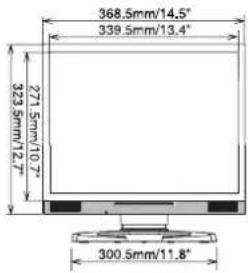
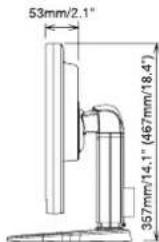
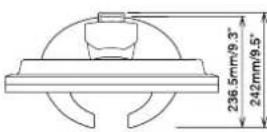
( ):Maximum adjustment range
DIMENSIONS : ProLlte H481S
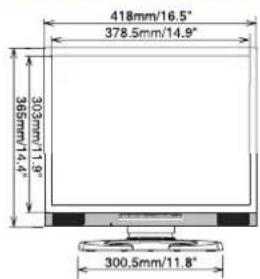
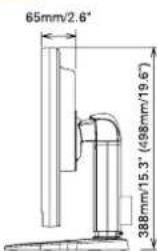
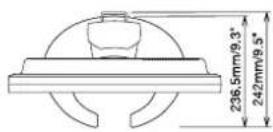
( ):Maximum adjustment range
COMPLIANT TIMING
| Video Mode | Horizontal Frequency | Vertical Frequency | Dot Clock | ||
| VESA | VGA 640 × 480 | 31.469kHz | 59.940Hz | 25.175MHz | |
| 37.500kHz | 75.000Hz | 31.500MHz | |||
| 37.861kHz | 72.809Hz | 31.500MHz | |||
| SVGA 800 × 600 | 35.156kHz | 56.250Hz | 36.000MHz | ||
| 37.879kHz | 60.317Hz | 40.000MHz | |||
| 46.875kHz | 75.000Hz | 49.500MHz | |||
| 48.077kHz | 72.188Hz | 50.000MHz | |||
| XGA 1024 × 768 | 48.363kHz | 60.004Hz | 65.000MHz | ||
| 56.476kHz | 70.069Hz | 75.000MHz | |||
| 60.023kHz | 75.029Hz | 78.750MHz | |||
| SXGA | 1152 × 864 | 67.500kHz | 75.000Hz | 108.000MHz | |
| 1280 × 1024 | 63.981kHz | 60.020Hz | 108.000MHz | ||
| 79.976kHz | 75.025Hz | 135.000MHz | |||
| VGA TEXT | 720 × 400 | 31.469kHz | 70.087Hz | 28.322MHz | |
| Macintosh | 640 × 480 | 35.000kHz | 66.667Hz | 30.240MHz | |
| 832 × 624 | 49.725kHz | 74.500Hz | 57.283MHz | ||
| 1024 × 768 | 60.150kHz | 74.720Hz | 80.000MHz | ||
| PC9801 | 640 × 400 | 24.827kHz | 56.424Hz | 21.053MHz | |
NOTE
* DVI input is not compliant.
APPENDIX 28

natural_image
Color palette bar with grayscale shades and a crosshair for selection (no text or symbols)CONNECTOR PIN ASSIGNMENT
■ D-Sub mini 15pin Connector
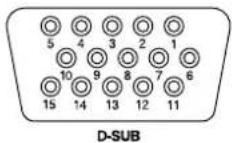
| Pin | Input Signal | Pin | Input Signal |
| 1 | Red video | 9 | |
| 2 | Green video / Sync on green | 10 | Ground |
| 3 | Blue video | 11 | Reserved port |
| 4 | Reserved port | 12 | Data line (SDA)* |
| 5 | Ground | 13 | H-Sync/HV-Sync |
| 6 | Red video ground | 14 | V-Sync |
| 7 | Green video ground | 15 | Clock line (SCL)* |
| 8 | Blue video ground | * Compliant to VESA DDC. | |
ENGLISH
■ DVI-D 24pin Connector
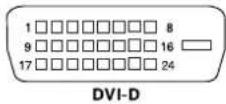
| Pin | Input Signal | Pin | Input Signal |
| 1 | T.M.D.S Data 2- | 13 | |
| 2 | T.M.D.S Data 2+ | 14 | |
| 3 | T.M.D.S Data 2 Ground | 15 | Ground |
| 4 | 16 | Hot Plug Detect | |
| 5 | 17 | T.M.D.S Data 0- | |
| 6 | Clock line (SCL) * | 18 | T.M.D.S Data 0+ |
| 7 | Data line (SDA) * | 19 | T.M.D.S Data 0 Ground |
| 8 | 20 | ||
| 9 | T.M.D.S Data 1- | 21 | |
| 10 | T.M.D.S Data 1+ | 22 | T.M.D.S Clock Ground |
| 11 | T.M.D.S Data 1 Ground | 23 | T.M.D.S Clock + |
| 12 | 24 | T.M.D.S Clock - |
*2 Compliant to VESA DDC.
29 APPENDIX
PLH431S-481S-e.P65
34
2005/03/25, 13:18