
AF260SA - Flash externe PENTAX - Notice d'utilisation et mode d'emploi gratuit
Retrouvez gratuitement la notice de l'appareil AF260SA PENTAX au format PDF.

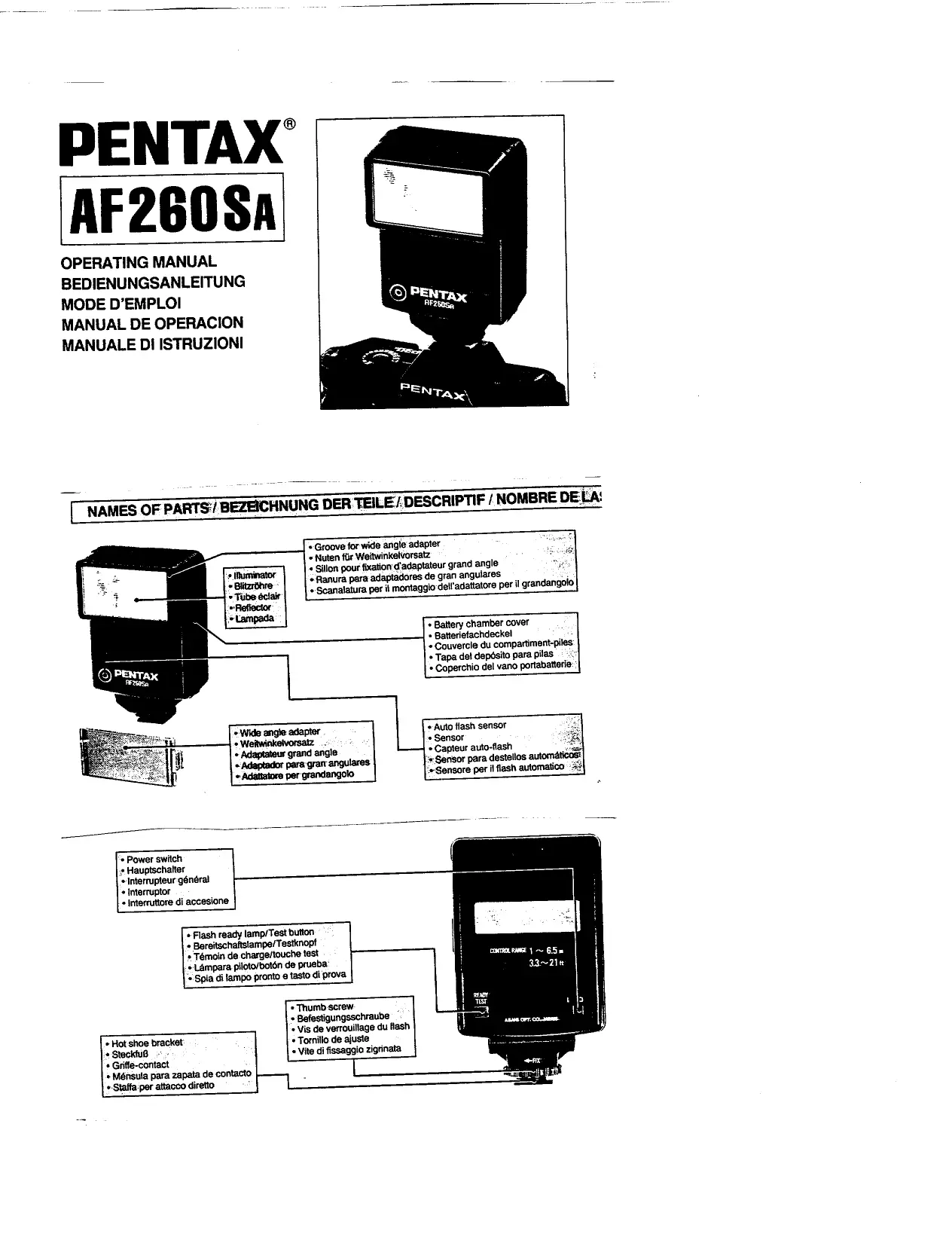
| Type de produit | Flash externe clip-on à thyristor automatique |
| Marque | PENTAX |
| Modèle | AF260SA |
| Dimensions | 70 mm (L) × 114 mm (H) × 55 mm (P) |
| Poids | 175 g (sans piles) |
| Alimentation | 4 piles AA (1,5 V) : manganèse, alcaline ou Ni-Cd |
| Nombre de flashes | Environ 60 (manganèse), 200 (alcaline), 90 (Ni-Cd) |
| Temps de recyclage | Environ 11 s (manganèse), 7 s (alcaline), 5 s (Ni-Cd) |
| Nombre guide (NG) | 26 (ISO 100, m) |
| Durée du flash | 1/1000 s (pleine puissance) à 1/15000 s (plus courte) |
| Angle de couverture | 55° horizontal, 38° vertical (couvre objectif 35 mm) |
| Température de couleur | Équivalente à la lumière du jour |
| Portée flash auto | 1,0 à 6,5 m (3,3 à 21 pi) |
| Sensibilité film compatible | ISO 25 à 800 |
| Compatibilité | Appareils Pentax programmés AE (P30N, P3N, 645, LX, etc.) |
| Modes d'exposition | Programmé AE, priorité ouverture AE, manuel |
| Synchro flash | Vitesse X automatique ou réglage manuel |
| Accessoires fournis | Adaptateur grand-angle |
| Fonctions dédiées | Témoin de charge, bouton test, marche/arrêt |
| Entretien | Essuyer avec un chiffon doux ; ne pas utiliser de solvants |
| Sécurité | Ne pas démonter, retirer les piles si inutilisé, ne pas jeter au feu |
| Réparabilité | Pièces détachées non spécifiées ; confier à un technicien qualifié |
FOIRE AUX QUESTIONS - AF260SA PENTAX
Questions des utilisateurs sur AF260SA PENTAX
0 question sur cet appareil. Repondez a celles que vous connaissez ou posez la votre.
Poser une nouvelle question sur cet appareil
Téléchargez la notice de votre Flash externe au format PDF gratuitement ! Retrouvez votre notice AF260SA - PENTAX et reprennez votre appareil électronique en main. Sur cette page sont publiés tous les documents nécessaires à l'utilisation de votre appareil AF260SA de la marque PENTAX.
MODE D'EMPLOI AF260SA PENTAX
PENTAX®
AF260SA
OPERATING MANUAL
BEDIENUNGSCANLEITUNG
MODE D'EMPLOI
MANUAL DE OPERATION
MANUALE DI ISTRUZIONI
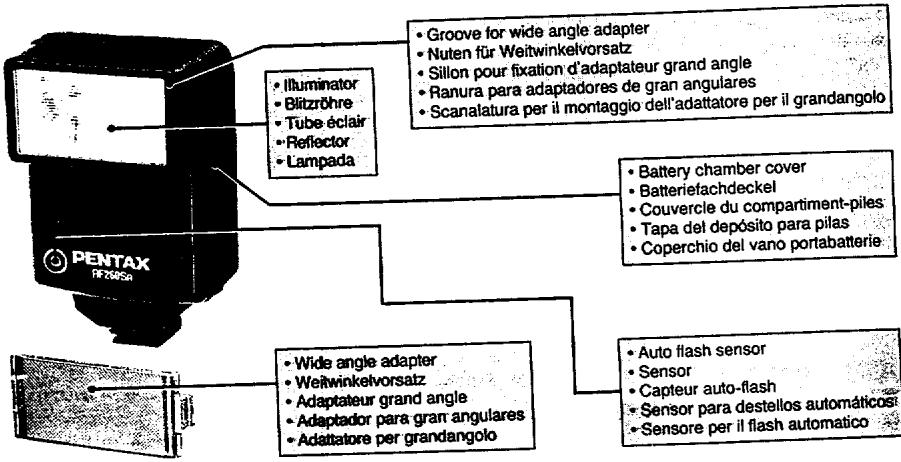
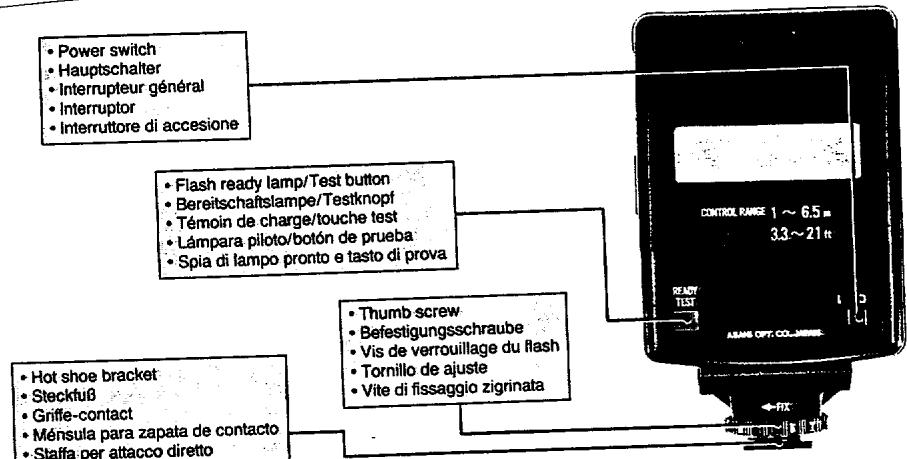
NAMES OF PARTS/BEZECHNUNG DER TEILE / DESCRIPTIF / NOME DE LAS
PRECAUTIONS / BESONDERE HINWEISE / PRECAUTIONS / PR
- The electric circuitry inside this flash unit operates using high voltage. Never attempt to disassemble the unit.
- Always keep batteries out of the reach of children. To prevent explosion, never throw used batteries into fire or expose them to excessive heat.
- The red eye phenomenon occurs because the flash illumination reflects off of the retina of a subject's eye when the pupil opens in the dark. The phenomenon cannot be prevented entirely, but can be minimized by lighting the location to about the EV8 level, or by shooting at a close distance to the subject.
- Remove batteries when not using the flash unit for long periods of time. Batteries tend to leak if left too long in the unit. This may cause serious damage.
- Replace all batteries at the same time. Do not mix battery brands and types, or mix old batteries with new ones.
- Do not leave the flash unit in a hot or humid place like in a car or near a heater. Shield the unit from vibration.
- Do not wipe the flash unit or its accessories using a solvent such as thinner, alcohol, ether, etc. Wipe them with a soft cloth.
INSERTING BATTERIES / EINLEGEN DER BATTERIEN / MISE EN
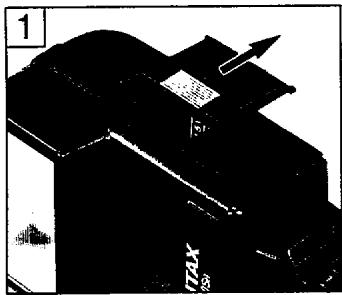
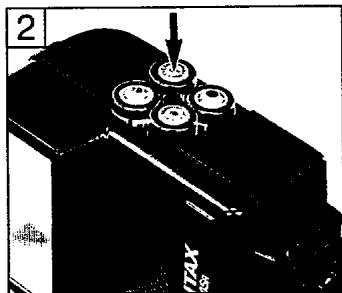
Use four AA-size batteries of one of the following types:
Manganese batteries
- Alkaline batteries
- Ni-Cd rechargeable batteries (You need a battery charger.)
1. Slide open the battery chamber cover.
2. Insert four AA-size batteries aligning (+) and (-) as indicated inside the chamber. Close the cover.
MOUNTING THE FLASH UNIT ONTO THE CAMERA / AUFSETZIMONTAJE DE LA UNIDAD DE FLASH EN LA CAMARA / MONT
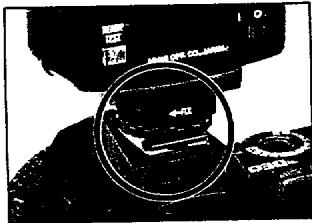
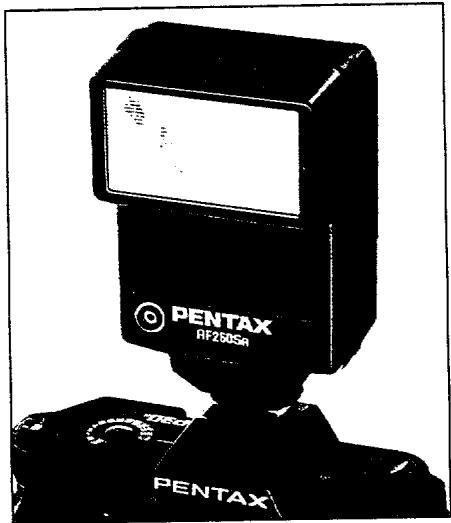
Slide the flash unit's hot shoe bracket completely into the camera's hot shoe, and tighten the thumb screw.
To dismount, loosen the thumb screw. Confirm that the flash ready lamp lights up, and the " " mark appears in the viewfinder several seconds after turning on the power switch. This indicates that the flash unit has been properly mounted.
COMPATIBLE CAMERAS AND EXPOSURE MODES / VERWEN
The AF260SA is designed to work with the Pentax programmed AE cameras. The AF260SA's dedicated functions are shown in Table No.1.
(Table No.1)
| Exposure mode | P30N·P3N K AF mount cameras 645 | LX |
| Programmed AE (Lens set to "A") | o* | - |
| Aperture Priority AE (Lens set not to "A") | o** | o** |
- Upon completion of charging, the X-shutter speed and programmed f-stop will be set automatically.
** Upon completion of charging, the X-shutter speed will be set automatically. However, the aperture should be set manually.
ISO FILM SPEED, APERTURE, FLASH RANGE / FILMEMPFIND
In programmed AE mode, the aperture is automatically set to the f-stop as shown in Table No. 2. The flash range (flash to subject distance) is fixed from 1.0 to 6.5m (3.3 - 21 ft.).
In the Aperture Priority AE and Manual Exposure control modes, a proper f-stop must be manually selected in accordance with Table No. 2. Otherwise, a proper exposure will not obtained.
(Table No. 2)
| Film Speed (ISO) | Aperture (f) | Flash Range |
| 25 | 2 | |
| 50 | 2.8 | |
| 100 | 4 | 1.0 - 6.5 m |
| 200 | 5.6 | (3.3 - 21 ft.) |
| 400 | 8 | |
| 800 | 11 |
OPERATION / BEDIENUNG / UTILISATION / OPERATION / FUI
- Turn the power switch to ON. When the flash-ready lamp on the flash lights up and the " " mark appears in the viewfender, flash is ready to fire.
- Make sure that the subject is within the flash range (10 - 15 ft) with a distance of 21 ft.). Focus on the subject, and release the shutter. The flash will fire in sync with the shutter release.
- Be sure to turn the switch to OFF after shooting.
USING WITH OTHER CAMERAS / BLITZEN MIT ANDEREN CAI
To use the AF260SA with any other Pentax non-programmed AE cameras:
- Set the camera's shutter speed to X (flash-sync speed).
- Set the camera to 0.
- Set the lens aperture according to Table No. 2 to obtain a proper exposure.
Caution:
Conclusion: If the AF260SA is used with any camera other than a Pentax, it may cause malfunction, or may harm the electronic circuitry of the camera.
FLASH-READY LAMP/TEST BUTTON / BLITZBEREITSCHAFTSLAMPARA PILOTO DEL FLASH/BOTON DE PRUEBA / SPIA DI L
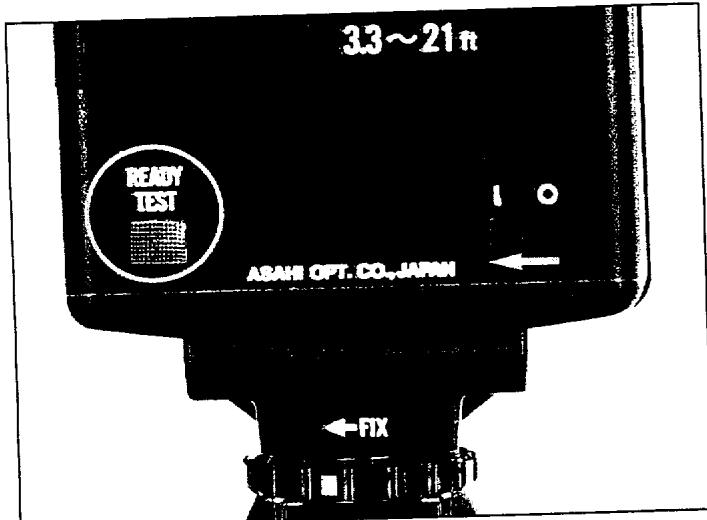
When the flash is charged, the flash ready lamp lights up. The ready lamp also works as the test button.
Note:
Turn off the power switch after use to save battery power.
WIDE ANGLE ADAPTER / WEITWINKELVORSATZ/ADAPTATEU ADAPTADOR PARA GRAN ANGULARES / ADATTATORE PERGI
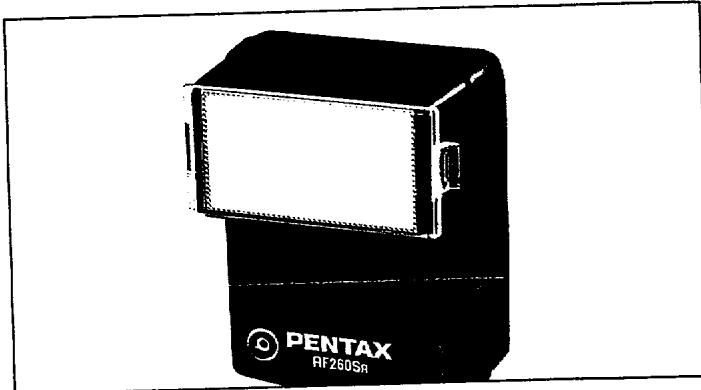
Snap on the wide angle adapter over the flash illuminator to use this flash with a 28 mm wide angle lens. The flash range with the wide adapter will be 1.0 - 4.4 m (3.3 - 14 ft.).
SPECIFICATIONS / TECHNISCHE DATEN / CHARACTERISTQUES
Type:
Clip-on type, automatic thyristor electronic flash.
Specially designed for use with Pentax programmed AE
cameras.
Guide Number:
26 (ISO 100, m)
Flash Duration:
1/1000 sec.(Auto, full output, 1/2 peak)
1/15000 sec.(Auto, shortest, 1/2 peak)
Number of Flashes and Recycling Time:
| Power source | Recycling time | Number of flashes |
| Manganese batteries | Approx. 11 sec. | Approx. 60 |
| Alkaline batteries | Approx. 7 sec. | Approx. 200 |
| Ni-Cd batteries | Approx. 5 sec. | Approx. 90 |
(Based on Pentax testing conditions)
Flash Coverage Angle:
55^ horizontally; 38^ vertically (covers picture area of 35mm lens.)
Color Temperature:
Equivalent to daylight.
Auto Flash Range:
1.0-6.5m(3.3-21ft)
Compatible Film Speed:
ISO 25-800
Aperture Auto Set Funciton:
With any Pentax programmed AE camera with its lens set to "A".
Power Source:
Four AA-size batteries (1.5 V x 4); Manganese, Alkaline or Ni-Cd.
Dimensions:
70 mm (W) × 114 mm (H) × 55 mm (D)
2.8^ × 4.5^ × 2.2^
Weight:
175 g (6.2 oz.) without battery.
Accessory:
Wide angle adapter.
Specifications are subject to change without any obligation on the part of the manufacturer.
NOTES ON FLASH PHOTOGRAPHY / BESONDERE HINWEISE Z
- If you take a flash photo of two persons, one very near and the other distant, in one picture, the near person tends to be overexposed. So, in such case, keep an extremely near subject out of the frame.
- If the subject you are shooting in place like a theater is small, not in the camera of the picture area, and the central background is black, it tends to be overexposed.
- PENTAX®
- AF260SA
- PRECAUTIONS / BESONDERE HINWEISE / PRECAUTIONS / PR
- INSERTING BATTERIES / EINLEGEN DER BATTERIEN / MISE EN
- MOUNTING THE FLASH UNIT ONTO THE CAMERA / AUFSETZIMONTAJE DE LA UNIDAD DE FLASH EN LA CAMARA / MONT
- COMPATIBLE CAMERAS AND EXPOSURE MODES / VERWEN
- ISO FILM SPEED, APERTURE, FLASH RANGE / FILMEMPFIND
- OPERATION / BEDIENUNG / UTILISATION / OPERATION / FUI
- USING WITH OTHER CAMERAS / BLITZEN MIT ANDEREN CAI
- Caution:
- FLASH-READY LAMP/TEST BUTTON / BLITZBEREITSCHAFTSLAMPARA PILOTO DEL FLASH/BOTON DE PRUEBA / SPIA DI L
- Note:
- WIDE ANGLE ADAPTER / WEITWINKELVORSATZ/ADAPTATEU ADAPTADOR PARA GRAN ANGULARES / ADATTATORE PERGI
- SPECIFICATIONS / TECHNISCHE DATEN / CHARACTERISTQUES
- NOTES ON FLASH PHOTOGRAPHY / BESONDERE HINWEISE Z
Marque : PENTAX
Modèle : AF260SA
Catégorie : Flash externe