Competence 3031 B-w - Ovn AEG - Gratis bruksanvisning og manual
Finn enhetens veiledning gratis Competence 3031 B-w AEG i PDF-format.


Brukerspørsmål om Competence 3031 B-w AEG
0 spørsmål om dette apparatet. Svar på dem du kjenner, eller still ditt eget.
Still et nytt spørsmål om dette apparatet
Last ned instruksjonene for din Ovn i PDF-format gratis! Finn veiledningen din Competence 3031 B-w - AEG og ta den elektroniske enheten tilbake i hendene. På denne siden er alle dokumenter som er nødvendige for bruken av enheten din publisert. Competence 3031 B-w av merket AEG.
BRUKSANVISNING Competence 3031 B-w AEG
COMPETENCE 3031
Build-in fanned single oven
Operating Instructions
TECHNICAL DETAILS
MODEL NO. COMP. 3031
Voltage: 230/240 Volts AC 50 Hz
Wattage: 2.4/2.6kW
Height: 595 mm
Width: 595 mm
Depth: 545 mm (excluding handles and knobs)
Weight: 37kg

natural_image
Pure electrical circuit symbol for a three-blade propeller inside a square frame (no text or labels)This appliance complies with: European Council Directive 73/23/EEC. EMC Directive 89/336/EEC. CE Marking Directive 93/68/EEC.
CONTENTS
Please follow these instructions step by step to install and operate your oven safely and easily.
Technical Details 2
Contents 3
Safety 5
Before Installation 5
During Operation 5
After Use 6
General 6
Installation Instructions 7
Things You Need To Know 7
Warnings 7
Things To Note 7
Getting Things Ready 7
Choice Of Electrical Connection 7
Preparing Cabinet For Fitting Oven 8
Recommended Cabinet Dimensions 9
How To Finish Unpacking 10
Tools Required 10
Making The Electrical Connections 10
Preparing Cable 10
To Remove Cover Of Mains Terminal 10
Connecting To The Mains Terminal 11
Connecting To A Hob Or Cooker Point 11
Checking Electrical Connections 11
Fitting Into The Cabinet 12
Introduction 13
Getting To Know Your Oven 13
Rating Plate 14
General Notes On Using Your Oven 14
When First Switching On 14
About Condensation And Steam 14
Cookware 14
The Cooling Fan For The Controls 14
Control Panel Indicator Neon 14
Grill And Oven Furniture 15
The Electronic Timer 16
The Grill 20
Selecting The Grill 20
Things To Note 20
The Grill Pan And Handle 20
Hints And Tips 21
Grilling Chart 22
The Fan Oven 23
Uses Of The Fan Oven 23
Selecting The Fan Oven 23
Things To Note 23
To Fit The Oven Shelves 23
Hints And Tips 24
Oven Cooking Chart 25
Roasting Chart 26
Thermal Grilling 27
Uses of Thermal Grilling 27
Selecting Thermal Grilling 27
Things To Note 27
Hints And Tips 28
Thermal Grilling Chart 28
Defrosting 29
Uses Of Defrost Feature 29
Selecting Defrost 29
Things To Note 29
Hints And Tips 29
Helpful Hints When Buying And Preparing Food 30
Care And Cleaning 31
Cleaning Materials 31
Cleaning The Outside Of The Cooker 31
Cleaning Inside The Oven 31
Cleaning The Grill Deflector, Grill Pan, Grill Pan Grid And Oven Shelves 31
Cleaning Between The Outer And Inner Door Glass 31
Replacing The Oven Light Bulb 32
Something Not Working 33
Service and Spare Parts 34
Guarantee Conditions 35
SAFETY
THESE WARNINGS ARE PROVIDED IN THE INTERESTS OF YOUR SAFETY. ENSURE THAT YOU UNDERSTAND THEM ALL BEFORE INSTALLING OR USING THE COOKER.
PLEASE READ CAREFULLY

natural_image
Simple line drawing of an open book inside a rounded rectangle (no text or symbols)BEFORE INSTALLATION

This cooker is heavy and care must be taken when moving it.

Ensure that all packaging, both inside and outside the cooker has been removed before the appliance is used.

Do not try to move the cooker by pulling the door handles.

The cooker must be installed according to the instructions supplied. Any electrical installation work must be undertaken by a qualified electrician/ competent person.
It is dangerous to alter or modify the specifications of the cooker in any way.

After installation, please dispose of the packaging with due regard to safety and the environment.
DURING OPERATION

Do not use this cooker if it is in contact with water. Never operate it with wet hands.
This cooker is designed to be operated by adults. Young children must not be allowed to tamper with the cooker or play with the controls.

Caution accessible parts especially around the grill area may become hot when the cooker is in use. Children should be kept away until it has cooled.

Take great care when heating fats and oils as they will ignite if they become too hot.
This cooker has been designed for cooking edible foodstuffs only, and must not be used for any other purposes.

Never place plastic or any other material which may melt in the oven or on the hob.

Ensure cooking utensils are large enough to contain foods to prevent spillages and boil overs.

Take care to follow the recommendations given for tending the food when grilling. Use the handle provided in the recommended way.

Do not leave the handle in position when grilling as it will become hot.

Always use oven gloves to remove and replace food in the oven. Similarly always use oven gloves to remove and replace the grill pan handle when grilling.
Recommendations given on page 20.

Ensure that you support the grill pan when it is in the withdrawn or partially withdrawn position.
Ensure that all vents are left unobstructed to ensure ventilation of the oven cavity.
Ensure that the anti-tilt shelves are put in place correctly. Refer to instructions on page 23.
Never line any part of the cooker with aluminium foil. Do not allow heatproof cooking material, e.g. roasting bags to come into contact with oven elements.

Always stand back from the cooker when opening the oven door to allow any build up of steam or heat to release.

Stand clear when opening the drop down oven door. Do not allow it to fall open - support it using the door handle until it is fully open.
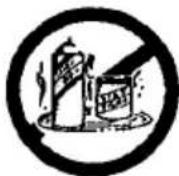
Do not place sealed cans or aerosols inside the oven. They may explode if they are heated.
AFTER USE
Ensure that all control knobs are in the OFF position when not in use.
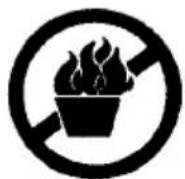
For hygiene and safety reasons this cooker should be kept clean at all times. A build-up of fats or other foodstuffs could result in a fire, especially in the grill pan.

Do not leave utensils containing foodstuffs, e.g. fat or oil in or on the cooker in case it is inadvertently switched ON.
Cookers and hobs become very hot, and retain their heat for a long period of time after use. Children should be kept well away from the cooker until it has cooled.
GENERAL

Under no circumstances should repairs be carried out by inexperienced persons as this may cause injury or serious malfunction. This cooker should be serviced by an authorised Service Engineer and only genuine approved spare parts should be used. Details of servicing and repair arrangements are supplied on page 34 of this book.

Do not stand on the cooker or on the open oven door.

Do not hang towels, dishcloths or clothes from the cooker or its handle. They are a safety hazard.

Always allow the cooling fan to cool the cooker down before switching off at the wall prior to carrying out any cleaning or maintenance work.

Only clean this cooker in accordance with the instructions given in this book.
Your safety is of paramount importance.
Therefore, if you are unsure about any of the meanings of these WARNINGS contact the:
Customer Services Department Details on Page 35.
INSTALLATION INSTRUCTIONS
THINGS YOU NEED TO KNOW WARNINGS:
- This cooker must be installed by a qualified electrician/competent person. Safety may be impaired if installation is not carried out in accordance with these instructions.
• This cooker must be earthed. - Do not remove the screws from the earth tab extending from the oven mains terminal block (Fig. 8).
- Before connecting the cooker make sure that the voltage of your electricity supply is the same as that indicated on the rating plate. The rating plate can be seen by opening the oven door and looking below the oven door seal.
- Do not alter the electrical circuitry of this cooker.
THINGS TO NOTE
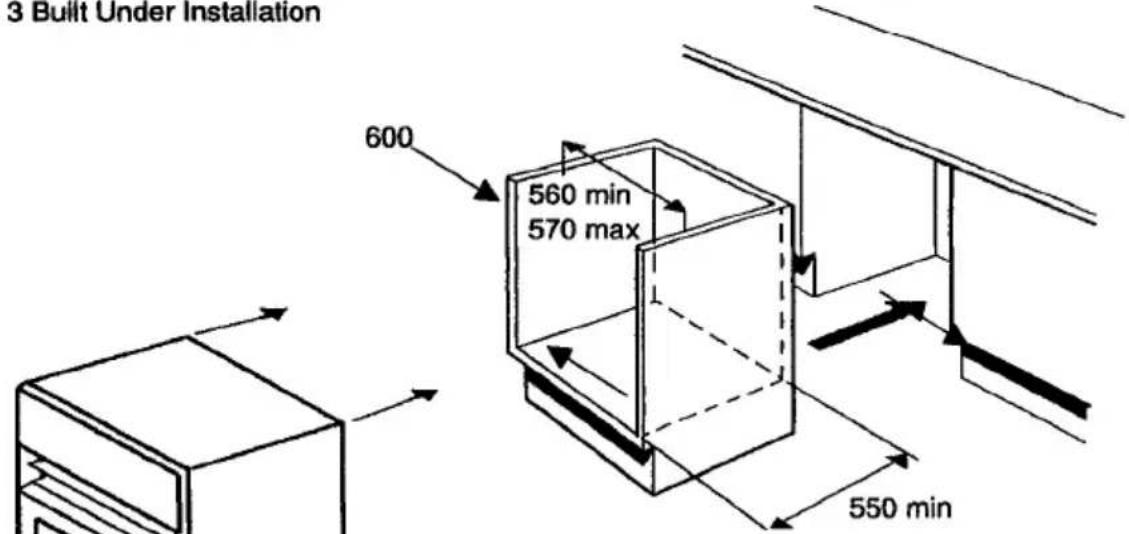
- This cooker is designed to be fitted in cabinets of the recommended dimensions as shown (Fig. 3 and 4) without any modification to the cabinet.
• If your cabinet interior dimension is between 565-570.mm the oven may still be fitted. However, a minor modification to the cabinet will be required.
• The dimensions given provide adequate air circulation around the unit within the cabinet, ensuring compliance with BS EN60-335. - Enquiries regarding the installation of the cooker point if required should be made to your Regional Electricity Company to ensure compliance with their regulations.
• The cooker point should be within 2m of the cooker to make it accessible to switch off the cooker in case of an emergency.
• To protect the hands wear gloves when lifting the oven into its housing.
NOTE: HOUSE CIRCUIT
Earth leakage and continuity tests must be carried out before the cooker is connected to the mains supply and re-checked after fitting.
GETTING THINGS READY
CHOICE OF ELECTRICAL CONNECTION
- There are two possible ways to connect your cooker, please choose from the most appropriate after reading the descriptions.
- It is recommended that this appliance is wired with suitably rated cable (min 13A), into fixed wiring using a double pole isolator with at least 3mm contact separation in all poles and neutral, located within 2m of the appliance. If this fixed wiring circuit is only supplying the cooker, then a fuse of 13A (or circuit breaker) should be incorporated. When the circuit combines oven and hob, then wire and fuse rating should be increased accordingly.
Subject to Regional Electricity Company regulations if you wish to connect the oven and hob to the power supply you may use one of the following two methods:-
- If you want to connect an oven and a hob to a cooker point you can:-
1) By connecting the oven and hob separately to the cooker point. Oven and hob units should be separately connected to a control panel. In this case the cooker should be operated from 6mm² twin core, and earth, PVC insulated multicore cable. See Fig. 1.

flowchart
graph TD
    A["Control Panel"] --> B["Oven"]
    A --> C["Hob"]
    style A fill:#f9f,stroke:#333
    style B fill:#ccf,stroke:#333
    style C fill:#cfc,stroke:#333
ii) By connecting the cooker point to the hob and then connecting the hob to the oven. Provided that the hob manufacturer permits it, connect the oven to the hob and the hob to the cooker point using the same cabling as described in (a) above. Check the hob terminal block is large enough to take two cables and is of suitable rating. If not b) i) on page 7 must be used. See Fig. 2.
NOTE: 13 amp cable is not suitable for connecting this application.

flowchart
graph TD
    A["Control Panel"] --> B["Hob"]
    A --> C["Oven"]
    B --> D["Circle"]
    B --> E["Circle"]
    B --> F["Circle"]
    C --> G["Circle"]
    C --> H["Circle"]
NOTE: It is good practice to:
- Fit an Earth Leakage Circuit Breaker to your house wiring.
- Wire your appliance to the latest IEE regulations.
PREPARING CABINET FOR FITTING OF OVEN
• Make sure the cabinet is the correct size for the appliance to be fitted (Ref. Fig. 3 and 4.)
- If the size is between 565-570mm, then the cabinet should be modified so that at the screw fixing points the recommended dimension of at least 560-565mm is maintained. The modification should ideally be localised to ensure that after screw fitment the oven is securely fixed into position.
- The cabinet must be stable and level by firmly securing it to the wall or floor. If necessary, make arrangements to ensure the shelf upon which the oven will rest is level.
RECOMMENDED CABINET DIMENSIONS (IN MILLIMETRES)
Fig. 3 Built Under Installation
text_image
3 Built Under Installation 600 560 min 570 max 550 min
natural_image
Isometric line drawing of a cabinet or storage unit with directional arrows indicating flow or movement (no text or symbols)Cross section through cabinet showing oven positioned

text_image
595 570 600 540
text_image
5 595 570 585 5 540 5Cross section through cabinet showing oven positioned

natural_image
Line drawing of a cabinet with arrows indicating direction (no text or symbols)
text_image
600 min 560 min 570 max 550 min 2000 RecommendedFig. 4 Built In Installation
HOW TO FINISH UNPACKING
- Place packed cooker next to the cabinet in which it will be installed.
- Remove the cooker packing except for bottom tray which should be left in position until the cooker is ready to be fitted into its cabinet.
- Ensure the owner is given these operating instructions.
TOOLS REQUIRED
The following tools will be needed and it helps to assemble them before starting to install the oven:-
A terminal screwdriver (3mm wide blade)
A pozidrive screwdriver
Pliers
Wirestrippers
Knife
Sidecutters
Adhesive Tape
Tape Measure
MAKING THE ELECTRICAL CONNECTIONS
Important: Switch off at mains, miniature circuit breaker and, if appropriate, remove fuse before commencing any electrical work
PREPARING CABLE
We recommend you use a new length of cable to ensure your safety.
- Ensure you have the correct length of cable appropriate to the wiring method you are using. When fitting new cable allow sufficient cable for removal of the unit at a later date, should it be necessary.
-
Score, but do not cut through, around the sheathing with a knife 100mm (4in) from each end of the cable and break through to the encased wires by bending the cable backwards and forwards to fatigue the sheathing.
-
Carefully score down from each end of the cable sheathing along the length of the bare earth wire (if a cut was made along the length of the live and neutral wires, it might cut into their sheathing) to the cuts already made.
- Carefully prise open the sheathing at each end of the cable to expose the encased wiring.
TO REMOVE COVER OF MAINS TERMINAL
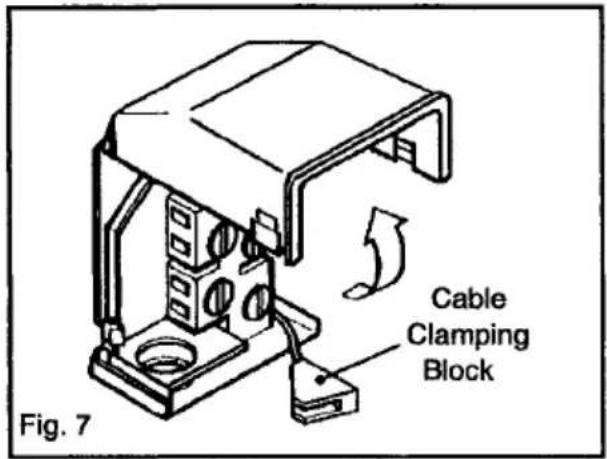
From the rear of the cooker, remove mains input terminal cover to gain access to terminal block.
- First remove retaining screw with pozidrive screwdriver. See Fig. 5.

text_image
Pozidrive Screwdriver Fig. 5- Prise cover loose using screwdriver in position (1) then lever off with screwdriver in position (2) at either side. See Fig. 6.

text_image
(2) Terminal Screwdriver (1)Fig. 6
- Lift cover and remove screw from cable clamp. See Fig. 7.
text_image
Cable Clamping Block Fig. 7CONNECTING TO THE MAINS TERMINAL WARNING: This cooker must be earthed.
• Make connection as shown in Fig. 8 by proceeding as follows:-

text_image
Red or Brown Blue or Black 5mm Mains Cable L N Earth (Green or Green / Yellow) Earth Tab Fig. 8• Preform wires to the appropriate shape to suit fitting into the mains terminal block.
- Strip inner insulation on wires using wirestrippers.
• Twist the bared wires using pliers.
- Cut bared wires 10mm away from the end of the inner insulation. Where uninsulated Earth wires are used ensure they are suitably sheathed to leave 10mm bare wire to fit into the terminal.
- Clamp bare wires into the relevant terminal and check they are held by tugging each one in turn.
- Clamp the mains cable securely ensuring 5mm of the outer insulation is inside the terminal block and that the wires are not taught but not so slack as to cause any fouling. See Fig. 8.
- Place fuse/miniature circuit breaker in circuit and switch on at mains.
CONNECTING TO A HOB OR COOKER POINT
- Either follow in general terms the instructions for connecting to the terminal block or refer to the hob suppliers installation instructions.
Feed the cable through the cabinet and arrange to route the cable away from the cooker which may become hot.
CHECKING ELECTRICAL CONNECTIONS
- Confirm the cooker is correctly connected by switching on and observing the various oven functions indicators.
• The electronic timer will flash on and off.
NOTE: HOUSE CIRCUIT
Earth leakage and continuity tests must be carried out before the cooker is connected to the mains supply and re-checked after fitting.
FITTING INTO THE CABINET
IMPORTANT: Ensure that the oven is switched off at the wall before any further work is carried out.
• Using a tape measure establish the internal width of the cabinet. Refer to page 7 if greater than 565mm.
- Position the cooker in front of the cabinet. See Fig. 9.
• Take out all oven furniture before installation to reduce the weight you need to lift. The oven door should be taped up to keep it closed whilst lifting.
• To place the cooker into the cabinetry follow the procedure below:-
• N.B. Two people will be required to carry out the lifting procedure.
a) Each person should squat either side of the cooker.
b) Tilt the cooker so that your hands can support the underside of the cooker.
c) Keeping your back straight, raise the appliance to the cabinet by straightening at the knees.
d) Rest the rear underside of the cooker on the cabinet floor while your hands support the front.
e) The cooker can be pushed fully into the cabinet. Take care to avoid fouling the mains lead.
f) Ensure the cooker is central in the cabinet and level.
g) When the cooker is fully housed, screw the stability screws (supplied with the cooker) into the side of the cabinet taking care not to distort the side trims (see Fig.10). It is advisable to turn each screw alternately to avoid damaging the trims.
h) Switch on the cooker then refer to the operating instructions in the following pages.

text_image
Fig. 9 Mains Cable Pack Base
text_image
Fixing Points for Stability Screws Fig.10INTRODUCTION
WARNING: THIS COOKER MUST BE EARTHED
GETTING TO KNOW YOUR OVEN

text_image
A AEG 88°88 B COMPETENCE C DA - Electronic Timer
B - Oven/Grill Indicator Neon
C - Fan Oven/Grill Temperature Control
D - Selector

Fan Oven

Grill

Thermal Grill
RATING PLATE
Record the model and serial numbers on the back cover of this instruction book from the rating plate. This is situated on the lower front frame of the cooker and can be seen upon opening the oven door.

text_image
AEG MODEL N° COMPETENCE **** PRODUCT N° ****** SERIAL N° ****** VOLTAGE ****V ~ ** Hz WATTAGE **** KW CE AEG BEAB ApprovedThe cooker must be protected by a suitably rated fuse or circuit breaker. The rating of the cooker is given on the rating plate.
GENERAL NOTES ON USING YOUR OVEN
We suggest that you run all the elements for a short period to burn off any residue from their surfaces.
During this period an unpleasant odour may be emitted, it is therefore advisable to open a window for ventilation.
WHEN FIRST SWITCHING ON
When the cooker is first switched on at the wall the timer will make an audible sound. To stop the sound press buttons and together.
If the oven / grill indicator neon does not glow when the controls are switched on, it is most likely that the timer is set for automatic cooking. See page 19.
ABOUT CONDENSATION AND STEAM
When food is heated it produces steam in the same way as a boiling kettle does. The oven is vented to allow some of this steam to escape. However, always stand back from the cooker when opening the oven door to allow any build up of steam or heat to release.
If the steam comes into contact with a cool surface on the outside of the cooker, e.g. a trim, it will condense and produce water droplets. This is quite normal and is not caused by a fault on the cooker.
To prevent discoloration, regularly wipe away condensation and also soilage from surfaces.
COOKWARE
Baking trays, oven dishes etc., should not be placed directly against the grid covering the fan at the back of the oven.
Do not use baking trays larger than 30cm x 35cm (12" x 14") as they will restrict the circulation of heat and may affect performance.
THE COOLING FAN FOR THE CONTROLS
The cooling fan comes on immediately when the grill is switched on and after a short time when the oven is in use.
During the initial period the cooling fan may cycle ON and OFF, this is quite normal.
It runs on after the controls are switched off until the appliance has cooled.
Do not switch off the cooker at its power point before the cooling fan has cooled the appliance down.
CONTROL PANEL INDICATOR NEON
This light indicates whether the oven or grill is switched ON. In the case of the oven, the neon also indicates when the set temperature has been reached.
If the neon does not operate as the instructions indicate the controls have been incorrectly set. Return all controls to zero and reset following the instructions for the required setting.
GRILL AND OVEN FURNITURE
The following items of oven furniture have been supplied with the cooker.
1 grill pan

natural_image
Simple line drawing of a rectangular tray or container with a handle (no text or symbols)1 grill pan handle

1 grill pan grid

natural_image
Line drawing of a grid-patterned metal grate or grating (no text or symbols)1 grill deflector

natural_image
Simple line drawing of a rectangular object with curved ends and a horizontal seam (no text or symbols)2 straight shelves
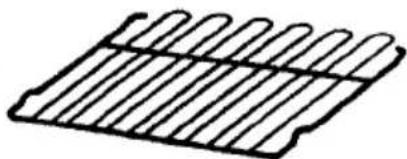
natural_image
Simple line drawing of a corrugated metal sheet with no text or symbolsTHE ELECTRONIC TIMER
KEY
A AUTO DISPLAY
B MINUTE MINDER BUTTON
C COOKING HOURS BUTTON
D STOP TIME BUTTON
E COOKING SYMBOL
F MANUAL SELECTOR BUTTON
G DECREASE CONTROL
H INCREASE CONTROL
NOTE:
Steps 1 and 2 below must be completed before the oven will operate manually.
1. SET THE TIME OF DAY
When the electricity supply is first switched ON, the display will flash both 0.00 and AUTO as Fig. 1.
Press the two buttons marked ( | | ) and ( | ) while holding them down, press the increase control button (+) and if necessary, the decrease control button (-) until the correct time on the 24 hour clock is reached, e.g. 10.00am as Fig. 2.
Note: The Increase and decrease control buttons operate slowly at first, and then more rapidly. They should be pressed separately.
The AUTO symbol will go out and the cooking symbol will illuminate ( ) as Fig. 2.
2. THE MINUTE MINDER
The minute minder givers an audible reminder at the end of any period of cooking up to 23 hrs 59 mins. It is not part of the automatic control.
To set, press the minute minder button ( 🔊 ) and the digital display will read 0.00 as Fig.3.
While holding it down, depress the increase control (+) until the display indicates the interval to be timed, e.g. 1hr 45 mins as Fig. 4. If necessary depress the decrease control (-) to achieve the correct time interval.
NOTE: This must be completed within 5 seconds of first pressing the minute minder button.

text_image
E 23.58 AUTO B C D F G H
text_image
0.00 Fig. 1
text_image
10:00 Fig. 2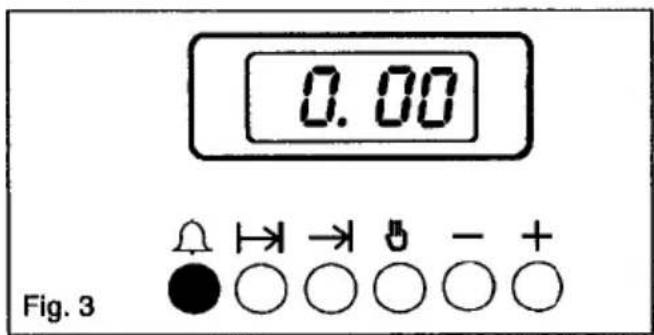
text_image
0.00 Fig. 3
text_image
1.45 Fig. 4Release the minute minder button and the display will return to the time of day after 5 seconds.
During the operation of the minute minder, the remaining time period can be shown in the display by pressing the minute minder button (☐) as Fig. 5.
The minute minder will sound intermittently for up to 2 minutes at the end of the timed period. The sound can be stopped by pressing any of the buttons.
3. HOW TO SET THE OVEN TIMER CONTROL
When using the timer control for the very first time, it is advisable to let it operate while you are at home. The displays can be checked to show that it is operating correctly and you will feel confident to leave a meal to cook automatically in the future.
A) TO SET THE TIMER TO SWITCH ON AND OFF AUTOMATICALLY
i) Ensure the electricity supply is switched ON and that the correct time of day is displayed, e.g. 9.a.m. as Fig. 6.
ii) Place food in oven.
iii) To set the length of cooking time, press the cooking hours button ( ) while holding it down, press the increase control (+) until the required length of cooking time is displayed, e.g. 2 hrs 15 mins as Fig. 7. If necessary depress the decrease control (-) until the correct time interval is achieved.
iv) Release the buttons. The AUTO display and cooking symbols will glow.
Remember, this must be completed within 5 seconds of first pressing the cooking hours button.
v) Set the STOP time. Press the stop time button (→), while holding it down, press the increase control (+) until the required stop time is displayed, e.g. 12.15p.m. as Fig. 8. If necessary depress the decrease control (-) until the correct time interval is achieved.
vi) Release the buttons. The cooking symbol will go out and the time of day will be displayed after 5 seconds.

text_image
.30 Fig. 5
text_image
9.00 Fig. 6
text_image
2.0° 15 AUTO Fig. 7
text_image
12.15 Fig. 8vii) Set the oven control to the required temperature and select the required function. The oven indicator neon should be OFF and the AUTO display will glow.
Note: When the automatic timed period starts, the oven indicator neon will cycle ON and OFF during cooking.
B) TO SET THE TIMER TO SWITCH OFF ONLY
i) Ensure the electricity supply is switched ON and that the correct time of day is displayed, e.g. 10.00am as Fig. 9.
ii) Place food in oven.
iii) To set the length of cooking time, press the cooking hours button ( ), while holding it down, depress the increase control (+) until the required length of cooking time is displayed, e.g. 2 hrs 15 mins as Fig. 10. Depress the decrease control (-) if necessary.
iv) Release the buttons. The AUTO display will glow and the time of day will be displayed after 5 seconds.
v) Set the oven temperature and select a function. The oven indicator neon should be ON.
vi) To check the stop time during the cooking period, simply press the stop time button (→) and the stop time will be displayed, as Fig. 11.
4 TO RETURN THE COOKER TO MANUAL OR TO CANCEL AN AUTOMATIC PROGRAMME
To cancel an automatic programme, or return the cooker to manual operation, follow the steps given below.
At the end of a timed cooking period, the AUTO light will flash and a bleeper will sound to up to 2 minutes. This can be stopped by pressing any of the buttons as Fig. 12.
Turn oven control to the OFF position. The AUTO display will continue to flash.
Press (☐) button. The AUTO display will go out and the cooking symbol will light (☐) as Fig.13.
Turn the selector and oven control ON to check that the oven operates manually. The oven indicator neon will glow.
Turn all oven controls OFF. No indicator neons should be displayed.

text_image
10:00 Fig. 9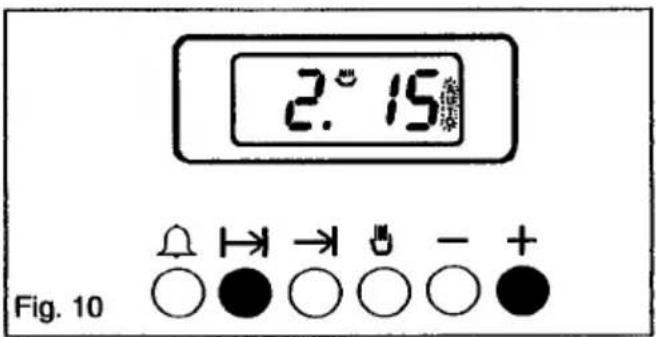
text_image
2.0° 15 Fig. 10
text_image
12.0° 15 Fig. 11
text_image
12.15 Fig. 12
text_image
12.0° 15 Fig. 135. THINGS TO NOTE
The time of day cannot be altered whilst the AUTO symbol is lit.
During the hours of 10 p.m. (22.00 hrs) and 6 a.m. the display will glow dim. If a function is selected the display will glow brighter until the function is complete. It will then revert back to the dim mode.
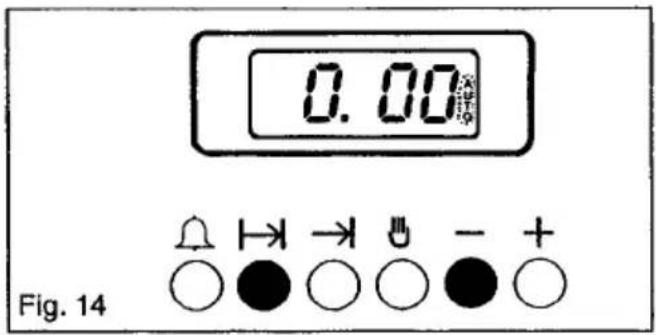
A programme may be cancelled by returning the cooking hours to zero. Press the cooking hours button ( ) while holding it down press (-) button until 0.00 is displayed as Fig. 14.
Release all buttons. The AUTO display will now flash and acts as a reminder to reset the cooker to manual.
In the event of an interruption of the electricity supply, the timer will reset itself to zero, and all programming will be cancelled.
6. AUTOMATIC COOKING
It is advisable to leave food in the oven for as short a time as possible before automatic cooking. Always ensure commercially prepared food is well within its use by date and that home prepared food is fresh and of good quality.
When cooking is complete, do not leave food to stand in the oven, but remove and cool it quickly if the food is not to be consumed immediately.
Always ensure food in the oven has been covered before cooking if it is not possible to remove food immediately after cooking.
text_image
0.00 Fig. 14THE GRILL
CAUTION - ACCESSIBLE PARTS MAY BECOME HOT WHEN THE GRILL IS IN USE. CHILDREN SHOULD BE KEPT AWAY.
SELECTING THE GRILL
AEG

text_image
80%80 △ H× - × - +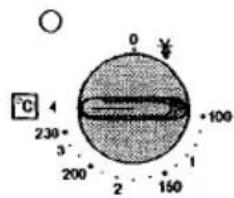
text_image
0 4 230° 3 200° 2 150 100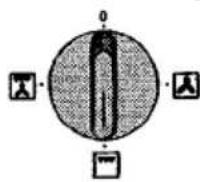
COMPETENCE

- To operate the grill turn the selector to
- Turn the grill control to the required setting. Setting 4 represents the grill on Full.
At settings 1,2 and 3 the grill may cycle on and off over time and you may prefer to use these settings for keeping food warm. - Close the door.
- The oven/grill indicator will light.
- The oven/grill neon indicator will cycle on and off periodically during grilling.
THINGS TO NOTE
• The grill cannot be used at the same time as the oven.
- Either of the two shelves can be used for grilling.
• The cooling fan for the controls will operate when grilling.
THE GRILL PAN AND HANDLE
The grill pan is supplied with a removable handle.
To insert the handle, press the button on the handle with the thumb and pivot the handle slightly upwards inserting the lip into widest part of the bracket. Move the handle towards the left, lower into position and release the button.
Ensure the handle is positively located.
When removing the handle, press the button on the handle with the thumb and pivot the handle slightly upwards and towards the right to remove from the bracket.
Ensure your hand is protected when inserting and removing the grill pan handle as the control panel trim and grill element can become very hot.
ALWAYS REMOVE THE GRILL PAN HANDLE DURING GRILLING.

natural_image
Diagram of a hand holding a device with an arrow indicating motion (no text or symbols present)To correctly locate the grill pan on the shelf, ensure that the cut out on the underside of the handle bracket locates over the front bar of the shelf.

natural_image
Pure technical line drawing of a mechanical bracket or bracket (no text or symbols)To check the progress of the food being grilled, the grill pan should be withdrawn on the shelf to attend to food during cooking or the carrier shelf can be lifted away from the cooker and rested on a heat resistant work surface.

natural_image
Line drawing of a gas stove with a handle and cooling unit (no text or symbols)HINTS AND TIPS
- Food should be thoroughly dried before grilling to minimise splashing. Brush lean meats and fish lightly with a little oil or melted butter to keep them moist during cooking.
- Adjust the grid and grill pan shelf position to allow for different heights of food.

natural_image
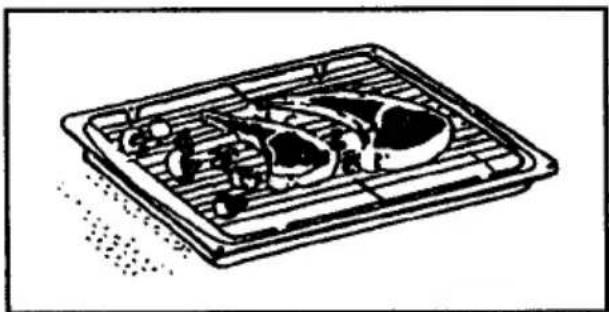
Line drawing of a microwave oven with three fans inside, showing airflow direction (no text or symbols)- Place food on the grill pan grid or directly onto grill pan base.
natural_image
Line drawing of a rectangular tray with internal compartments and small objects, no text or symbols present- Accompaniments such as tomatoes and mushrooms may be placed around the outer edges or underneath the grid when grilling meats.

natural_image
Line drawing of a rectangular tray with internal objects and speckles (no text or symbols)- When toasting bread use the shelf in position 5 with the grid in the high position and placing the bread in the centre of the grid.
• Preheat the grill on a full setting for three minutes before cooking. Adjust the shelf as necessary during cooking.
• The food should be turned over during cooking as required.
- When toasting bread, we suggest that the top runner position is used with the grid in its 'High' position.
GRILLING CHART
| FOOD | SHELF | GRILL TIME (mins in total) |
| Bacon Rashers | 4 | 2-3 each side |
| Beefburgers | 4 | 6-10 each side |
| Chicken Joints | 4 | 15-20 each side |
| Chops - Lamb | 4 | 7-10 each side |
| Pork | 4 | 10-15 each side |
| Fish - Whole Trout/Mackerel | 4 | 8-12 each side |
| Fillets - Plaice/Cod | 3 | 4-6 each side |
| Kebabs | 4 | 10-15 each side |
| Kidneys - Lamb/Pig | 4 | 4-6 each side |
| Liver - Lamb/Pig | 4 | 5-10 each side |
| Sausages | 4 | 10-15 each side |
| Steaks - Rare | 4 | 3-6 each side |
| Medium | 4 | 6-8 each side |
| Well Done | 4 | 7-10 each side |
| Toasted Sandwiches | 4 | 114 - 112 each side |
Shelf positions are counted from the bottom upwards.
The times quoted above are given as a guide and should be adjusted to suit personal taste.
THE FAN OVEN
USES OF THE FAN OVEN
The oven is heated by the element around the fan situated behind the back panel. The fan draws air from the oven, the element heats the air which is circulated into the oven via the vents in the back panel. The advantages of fanned oven cooking are:
PREHEATING
The fan oven quickly reaches its temperature, so it is not usually necessary to preheat the oven. Without preheating, however, you may find you need to add an extra 5-10 minutes on the recommended cooking times.
For recipes needing high temperatures, e.g. bread, pastries, scones, soufflés, etc., best results are achieved if the oven is preheated first.
COOKING TEMPERATURES
Fan oven cooking generally requires lower temperatures than conventional cooking. Follow the temperatures recommended in the chart on page 25. As a guide reduce temperatures by about 20^ C- 25^ C for your own recipes.
BATCH BAKING
The fan oven cooks evenly on both shelf levels, especially useful when batch baking.
SELECTING THE FAN OVEN
AEG

text_image
80:80 △ H→ → ○ - +
text_image
0 4 230° 3 200° 2 150 1 100 1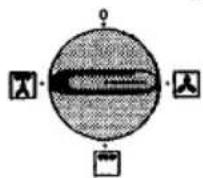
COMPETENCE
- Ensure the selector is set to Fan Oven

- Turn the temperature control to the required setting.
THINGS TO NOTE
- The oven neon will glow until the oven has reached the desired temperature and then go out. It will cycle ON and OFF periodically during cooking showing that the temperature is being maintained.
• The oven fan will operate continually during cooking.
• The interior oven light will come ON when the temperature is selected.
TO FIT THE OVEN SHELVES
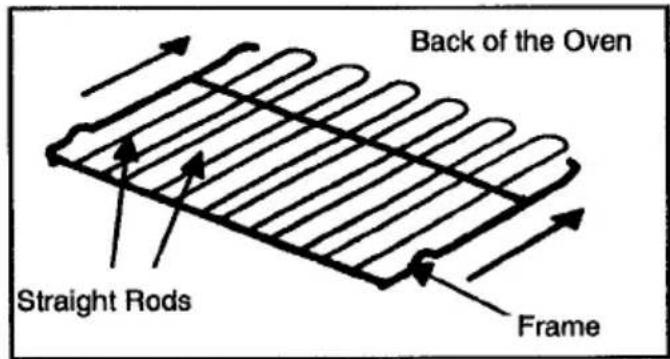
The shelves should be fitted with the straight rods uppermost on the frame and the forms towards the back of the oven. If not fitted correctly the anti-tilt and safety stop mechanism will be affected.
text_image
Back of the Oven Straight Rods FrameHINTS AND TIPS
- Arrange the shelves in the required positions before switching the oven ON. Shelves are numbered from the bottom upwards.

text_image
5 4 3 2 1- When cooking more than one dish in the fan oven, place dishes centrally on different shelves rather than cluster several dishes on one shelf, this will allow the heat to circulate freely for the best cooking results.
- When batch baking one type of food, e.g. Victoria sandwich cakes, those of similar size will be cooked in the same time.

natural_image
Line drawing of a storage unit with shelves and cups (no text or symbols)- It is recommended that when baking larger quantities the shelf positions should be evenly spaced to suit the load being cooked. A slight increase in cooking time may be necessary.
• DO NOT place baking trays directly on the oven floor as it interferes with the oven air circulation and can lead to base burning; use the lower shelf position. However, non-critical dishes may be placed on the oven base when more space is required.

natural_image
Simple line drawing of a kitchen appliance with a pan and lid, crossed by diagonal lines (no text or symbols)- The use of excessively high temperatures can cause uneven browning. It may be necessary to reduce temperatures slightly. Refer to the recommendations given in the oven cooking chart see page 25.
OVEN COOKING CHART
The oven temperatures are intended as a guide only. It may be necessary to increase or decrease the temperatures by 10^ C to suit individual preferences and requirements.
| FAN OVEN | |||
| FOOD | SHELF POSITION | COOKING TEMP °C | |
| Biscuits | 180-190 | ||
| Bread | 200-220 | ||
| Bread rolls/buns | Shelf | 200-220 | |
| Cakes: | Small & Queen | positions | 160-170 |
| Sponges | 160-170 | ||
| Victoria Sandwich | are not | 160-170 | |
| Madeira | critical | 140-150 | |
| Rich Fruit | 130-140 | ||
| Christmas | but ensure | 130-140 | |
| Gingerbread | that oven | 140-150 | |
| Meringues | 80-100 | ||
| Flapjack | shelves are | 170-180 | |
| Shortbread | 130-140 | ||
| Casseroles: | Beef/lamb | evenly | 140-160 |
| Chicken | spaced | 180-190 | |
| Convenience Foods | when more | Follow manufacturers instructions | |
| Fish | than one is | 170-190 | |
| Fish Pie (Potato Topped) | used | 190-200 | |
| Fruit Pies and Crumbles | 190-200 | ||
| Milk Puddings | 130-140 | ||
| Pasta, Lasagne etc. | 190-200 | ||
| Pastry: | Choux | 190-200 | |
| Eclairs, Profiteroles | 170-180 | ||
| Flaky/Puff Pies | 210-220 | ||
| Shortcrust-Mince Pies | 190-200 | ||
| Meat Pies | 190-210 | ||
| Quiches, Tarts, Flans | 180-210 | ||
| Patés and Terrines | 150-160 | ||
| Roasting Meat, Poultry | 160-180 | ||
| Scones | 210-220 | ||
| Shepherd's Pie | 190-200 | ||
| Soufflés | 170-180 | ||
| Vegetables: | Baked Jacket Potatoes | 180-190 | |
| Roast Potatoes | 180-190 | ||
| Stuffed Marrow | 180-190 | ||
| Stuffed Tomatoes | 180-190 | ||
| Yorkshire Puddings: | Large | 210-220 | |
| Individual | 200-210 | ||
ROASTING CHART
| ROASTING CHART | ||
| INTERNAL TEMPERATURES -Rare: 50-60°C; Medium: 60-70°C; Well:70-80°C | ||
| MEAT | FAN OVEN | COOKING TIME |
| Beef | 160-180°C | 20-35 min per 12 kg/1lb and 20-35 min over |
| Beef, boned | 160-180°C | 20-35 min per 12 kg/1lb and 25-35 min over |
| Mutton and Lamb | 160-180°C | 25-35 min per 12 kg/1lb and 25-35 min over |
| Pork and Veal | 160-180°C | 30-40 min per 12 kg/1lb and 30-40 min over |
| Ham | 160-180°C | 30-40 min per 12 kg/1lb and 30-40 min over |
| Chicken | 160-180°C | 15-20 min per 12 kg/1lb and 20 min over |
| Turkey and Goose | 160-180°C | 15-20 min per 12 kg/1lb up to 312 kg/7lb then 10 min per 12 kg/1lb |
| Duck | 160-180°C | 25-35 min per 12 kg/1lb and 25-30 min over |
| Pheasant | 160-180°C | 35-40 min per 12 kg/1lb and 35-40 min over |
| Rabbit | 160-180°C | 20 min per 12 kg/1lb and 20 min over |
| Potatoes with meat | 160-180°C | according to size |
| Potatoes without meat | 180-190°C | according to size |
The roasting temperatures and times given in the chart should be adequate for most joints, but slight adjustments may be required to allow for personal requirements and the shape and texture of the meat. However, lower temperatures and longer cooking times are recommended for less tender cuts or larger joints.
Wrap joints in foil if preferred, for extra browning uncover for the last 30 - 60 min. cooking time.
THERMAL GRILLING
USES OF THERMAL GRILLING
Thermal grilling offers an alternative method of cooking food items normally associated with conventional grilling.
The grill element and the oven fan operate together, circulating hot air around the food. The need to check and turn food is reduced. Thermal grilling helps to minimise cooking smells in the kitchen and allows you to grill with the oven door closed.
With the exception of toast and rare steaks you can thermal grill all the foods you would normally cook under a conventional grill.
The lower part of the oven can be used to cook accompaniments at the same time, e.g. tomatoes and mushrooms with a mixed grill or breakfast.
Dishes prepared in advance such as shepherd's pie, lasagne and au gratins can be heated through and browned on the top using the thermal grilling function.

natural_image
Simple line drawing of a train on a platform inside a dotted cloud-patterned border (no text or symbols)SELECTING THERMAL GRILLING
AEG

text_image
80:00 △ |→ → ○ - +O

text_image
0 4 230° 3 200° 2 150 1 -100 1COMPETENCE

1) Turn the selector to Thermal Grill.

2) Turn the oven temperature control to the required setting. (A temperature of between 140°C and 220°C is suitable for thermal grilling). Use the grilling chart on page 28 as a guide.
THINGS TO NOTE
• The oven/grill indicator neon will glow until the oven has reached the desired temperature and then go out. It will cycle ON and OFF showing that the oven temperature is being maintained.
• The cooling fan for the controls will operate immediately in conjunction with the thermal grilling function.
• Thermal grilling helps to minimise cooking smells in the kitchen and is carried out with the main oven door closed and the grill pan handle removed.
HINTS AND TIPS
• Prepare foods in the same way as for conventional grilling. Brush lean meats and fish lightly with a little oil or butter to keep them moist during cooking.

natural_image
Illustration of a hand pouring oil into a tray with small containers, next to a jar labeled 'OIL' (no text or symbols on the main subject)- Most food should be placed on the grill pan grid in the 'high' position in the grill pan to allow maximum circulation of air around the food.
natural_image
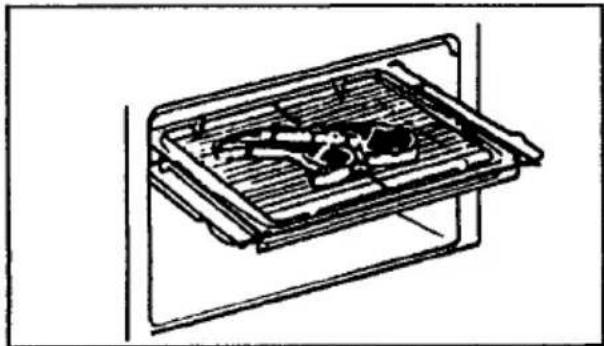
Line drawing of a microwave oven with two dish heads and a tray (no text or symbols)Accompaniments such as tomatoes and mushrooms may be placed below the grid when grilling meats, or in a separate dish on a lower shelf.

natural_image
Line drawing of a tray with food items and utensils (no text or symbols)- Foods will cook more quickly the closer they are to the grill element and the higher the temperatures selected. Be prepared to adjust temperatures and shelf positions during cooking if necessary.
• Turn food over during cooking as necessary.

natural_image
Line drawing of a hand using a tool to clean or store food inside an oven (no text or symbols)- Ensure that ready prepared or cooked chilled dishes e.g. shepherds pie, moussaka, lasagne, etc., are piping hot throughout before serving.
A temperature range of 140-220°C and shelf positions 3 and 4 are suitable for most foods. Be prepared to make suitable adjustments during cooking to suit individual requirements. If thermal grilling on more than one level, it may be necessary to interchange the food on the shelves during cooking.
COOKING TIMES
Cooking is more gentle, therefore food generally takes a little longer to cook when thermal grilling compared with conventional grilling. One of the advantages is that larger loads can be cooked at the same time.
A general guide to cooking times is given below but these times may vary slightly depending on the thickness and quantity of food being cooked.
THERMAL GRILLING CHART
| FOOD | SHELF | TEMP(°C) | TIME(mins in total) |
| Bacon Rashers | 3 | 200 | 8 -12 |
| Beefburgers | 3 | 190 | 10 -15 |
| Chicken Joints | 3 | 160 | 35 -45 |
| Chops -Lamb/Pork | 3 | 170 | 20 -25 |
| 3 | 170 | 25 -35 | |
| Fish -Whole | |||
| Trout/Mackerel | 3 | 170 | 10 -20 |
| Fillets -Plaice/Cod | 3 | 170 | 10 -15 |
| Kebabs | 4 | 170 | 20 -30 |
| Kidneys -Lamb/Pig | 3 | 180 | 10 -15 |
| Liver -Lamb/Pig | 3 | 180 | 20 -30 |
| Sausages | 3 | 190 | 10 -15 |
| Steaks -Medium | 4 | 220 | 8 -10(each side) |
| Steaks -Well Done | 4 | 220 | 10 -12(each side) |
| Heating through and Browning, e.g. au-gratin, lasagne, shepherd's pie. | 3 | 170 | 20-30 depends on size |
NOTE: Shelf positions are counted from the bottom of the oven.
The times quoted above are given as a guide and should be adjusted to suit personal taste.
DEFROSTING
USES OF DEFROST FEATURE
This function enables you to defrost most foods faster than some conventional methods as the oven fan circulates air around the food. It is particularly suitable for delicate frozen foods which are to be served cold e.g. cream filled gateaux, cakes covered with icings or frostings, cheesecakes, biscuits, scones, etc.

natural_image
Line drawing of a microwave oven with a tray holding a cake and two cutlery items (no text or symbols)It is preferable to thaw fish, meat and poultry slowly in the fridge. However, this process can be accelerated by using the defrost function.
SELECTING DEFROST
Small or thin fish fillets, frozen peeled prawns, cubed or minced meat, liver, thin chops, steaks etc., can be thawed in 1 - 2 hours.

natural_image
Line drawing of a rectangular tray with six cutlery items, possibly food or kitchen utensils (no text or symbols)A 1kg/2¼lb oven ready chicken will be thawed in approximately 5 hours. Remove the giblets as soon as possible during the thawing process.
Joints of meat up to 2kg/4½lb in weight can be thawed using the defrost function.
ALL JOINTS OF MEAT AND POULTRY MUST BE THAWED THOROUGHLY BEFORE COOKING.
ALWAYS COOK THOROUGHLY IMMEDIATELY AFTER THAWING.
AEG

text_image
00:00 △ ↗ → ⬆ - +
text_image
0 4 230° 3 200° 150 100 1
COMPETENCE
1. Turn the oven / grill control to
THINGS TO NOTE
• The oven light will illuminate.
• The indicator neon should remain unlit.
- When defrost is selected, the oven indicator neon may occasionally come ON. It will stay ON until the oven reaches room temperature and then go OFF.
It may cycle ON and OFF periodically during defrosting to maintain steady room temperature inside the oven.
- Care must always be taken when handling foods in the home. Always follow the basic rules of food hygiene to prevent bacterial growth and cross contamination when defrosting, preparing, cooking, cooling and freezing foods.
HINTS AND TIPS
- Place the frozen food in a single layer where possible and turn it over half way through the defrosting process.
- The actual speed of defrosting is influenced by room temperature. On warm days defrosting will be faster than on cooler days.
• DO NOT leave food at room temperature once it is defrosted. Cook raw food immediately or store cooked food in the fridge.
HELPFUL HINTS WHEN BUYING AND PREPARING FOOD
Care must be taken when handling foods in the home. Always follow the basic rules of food hygiene to prevent bacterial and microbial growth and cross contamination when preparing, reheating, cooking, cooling, defrosting and freezing foods.
- Always ensure food you purchase is of good quality and in prime condition. Shop at a reliable source and buy the 'freshest' looking package - avoid shop worn labels or produce covered in dust.
- Avoid buying chilled or frozen products if you cannot store them straight away. The use of an insulated container when shopping is advisable.
- Buy and consume foods prior to the 'Sell by' or 'Best Before' date.
- When you arrive home, place perishable foods in the refrigerator or freezer immediately. Ensure they are well covered to prevent them drying out and to prevent any possible cross contamination with bacteria from raw to cooked foods.
- Follow the cooking instructions on packets of prepacked and cook chill foods, but be prepared to adjust cooking times and temperatures to suit your particular oven. For example, the Fan Oven generally requires 20-25°C lower temperature than a conventional oven.
- Always ensure that cook chill foods are thoroughly reheated until they are piping hot throughout.
- It is preferable to defrost frozen foods slowly in the refrigerator. Alternatively, a microwave cooker or the Defrost function on your oven may be used.
- Always cook defrosted foods immediately after thawing. Thawed food should never be refrozen.
-
Joints of meat and poultry should be thoroughly defrosted before cooking.
-
Cook meat thoroughly - use a meat thermometer if preferred, which penetrates the joint to check that the centre temperature has reached the required temperature (see table below).
| MEAT | TEMPERATURES |
| Beef | Rare - 60°CMedium - 70°CWell Done - 80°C |
| Pork | Well Done - 80°C |
| Lamb | Medium - 70°CWell Done - 80°C |
- If not eaten straight away after cooking, food should be cooled as quickly as possible (within one hour) and then refrigerated or frozen as required. Do not put hot food into a refrigerator or freezer.
- In the kitchen keep worktops, chopping boards and utensils clean with hot soapy water between preparation stages. Ideally, keep one chopping board for raw meat and another for other foods. Keep your dish cloths and tea towels clean.
CARE AND CLEANING
BEFORE CLEANING THE COOKER ALWAYS ALLOW THE COOLING FAN TO COOL THE COOKER DOWN BEFORE SWITCHING OFF THE ELECTRICITY SUPPLY.
CLEANING MATERIALS
Before using any cleaning materials on your cooker, check that they are suitable and that their use is recommended by the manufacturer.
Cleaners that contain bleach should NOT be used as they may dull the surface finishes. Harsh abrasives should also be avoided.
CLEANING THE OUTSIDE OF THE COOKER
DO NOT use abrasive cleaning materials or scourers on the outside of the cooker as some of the finishes are painted and damage may occur. Regularly wipe over the control panel and oven doors using a soft cloth and liquid detergent.

natural_image
Line drawing of a hand cleaning a window with a brush (no text or symbols)DO NOT ATTEMPT TO REMOVE ANY OF THE CONTROL KNOBS FROM THE PANEL AS THIS MAY CAUSE DAMAGE AND IS A SAFETY HAZARD.

natural_image
Illustration of a hand pressing a button on a device with lightning bolts (no text or symbols)CLEANING INSIDE THE OVEN
The vitreous enamel coating in the oven cavity can be cleaned using normal oven cleaners or aerosol oven cleaners with care. Ensure that the manufacturers instructions are followed and that all parts are well rinsed afterwards.
CLEANING THE GRILL DEFLECTOR, GRILL PAN, GRILL PAN GRID AND OVEN SHELVES
All removable parts, except the grill pan handle can be washed in the dishwasher. Alternatively soak them in hot soapy water if heavily soiled. They will then clean more easily.
The grill pan and grill deflector may be cleaned using a soap impregnated steel wool pad. The grill pan grid and oven shelves should be cleaned using hot soapy water. Soaking first in soapy water will make cleaning easier.
CLEANING BETWEEN THE OUTER AND INNER DOOR GLASS
The outer door glass is removable for cleaning. TO REMOVE THE OUTER GLASS
- Open the oven door slightly to gain access to the two cross head screws on the top of the oven door.
- Loosen the two screws using a Pozidrive screwdriver.
- Hold the door glass securely in place with one hand before removing the screws completely with the other hand.
- Using both hands, gently tilt the top of the door glass towards you. Lift slightly to disengage the locators from the two bottom brackets.

natural_image
Diagram of a folding screen with a magnified inset showing a screwdriver inserted into the screen (no text or symbols present)- Clean the outer and inner glass using hot soapy water or Hob Brite. DO NOT try to clean the aluminium foil which is inside the door. The foil is there to help keep the door cool, if it is damaged it will not work. Ensure that all parts are well rinsed and thoroughly dry before attempting to replace the outer door glass.
TO REPLACE THE OUTER GLASS
- Holding the oven glass with both hands, gently place the locators into the holes of the brackets at the bottom of the oven door.
- Push the top of the oven glass towards the oven door, ensuring the screw location holes line up.
- Hold the glass in place with one hand and insert the cross head screws into the location holes with the other hand. Give the screws one turn to ensure the glass is secure.
- Tighten the screws positively with a Pozidrive screwdriver before closing the oven door.
DO NOT attempt to use the oven without the glass being in place.
TO CLEAN INSIDE THE INNER GLASS DOOR
The inner glass door is not removable. Clean using hot soapy water or Hob Brite and a soft cloth. Take care NOT to use abrasives as they may damage the glass or seal.

natural_image
Line drawing of a person inside an oven with a tray, no text or symbols presentREPLACING THE OVEN LIGHT BULB
The type of bulb required is a 300C 25 watt small Edison Screw. (Available through the Service Centres).
CAUTION: DISCONNECT THE COOKER FROM THE ELECTRICITY SUPPLY BEFORE REPLACING THE BULB.
Open door and remove the shelves to enable easy access to the oven light assembly. Insert a flat blade screwdriver between the oven side and the glass which covers the bulb.
Support the glass with your hand and prise out sufficiently to release the glass cover. Unscrew the bulb in an anticlockwise direction until it is possible to remove the bulb with ease.
Fit the new bulb by turning in a clockwise direction until it is secure. Ensuring the indent to the flange is pointing to the rear of the oven, replace the glass by pushing it firmly into the hole to cover the bulb assembly.
Replace the shelves. Restore the electricity supply and adjust the time of day and clock as necessary.
SOMETHING NOT WORKING
We strongly recommend that you carry out the following checks on your cooker before calling a Service Engineer. It may be that the problem is a simple one which you can solve yourself without the expense of a service call.
If our Service Engineer finds that the problem is listed below you will be charged for the call whether or not the cooker is under guarantee.
The grill, oven and timer do not work.
* Check that the cooker has been wired in and is switched on at the wall.
* Check that the main cooker fuse is working.
* Check that the timer is set to manual (see page 16).
If you have checked the above:
* Switch OFF cooker at the wall and allow the appliance to cool for a couple of hours. Switch ON again. The cooker should now be working normally.
The grill works but the oven does not:
* Check that the timer is set to manual operation (see page 16).
* Check that the grill control is in the OFF position.
* If you have checked that the timer is set for manual switch OFF at the wall to allow the oven to cool. Check that the oven is now working normally.
The timer/minute minder does not work.
* Check that the operating instructions are being closely followed.
The grill does not work or cuts out after being used for a long period of time.
Leave the oven to cool for a couple of hours.
Check that the grill operates normally. Ensure that the door is left open during grilling.
* If the cooling fan fails the grill will not work. Call the Customer Service Centre.
The oven temperature is too high or low:
* Check that the recommended temperatures are being used (see page 25). Be prepared to adjust up or down 10°C to achieve the results you want.
* Care should be taken if using an oven thermometer to check oven temperatures as they may be inaccurate.
The following factors should be considered.
* Ensure you purchase an accurate good quality instrument.
* Ovens will cycle about a set temperature and will no be constant.
If the oven is not cooking evenly.
* Check that the cooker is correctly installed and that it is level.
* Check that the recommended temperatures and shelf positions are being used.
The oven fan is noisy:
* Check that the oven is level.
* Check that bakeware and shelves are not vibrating in contact with the back panel in the oven.
SERVICE AND SPARE PARTS
If after carrying out the necessary checks there is still a fault with your appliance please contact your local AEG Service Centre.
In-Guarantee Customers should make sure that the checks have been made as the engineer will make a charge if the fault is not a mechanical or electrical breakdown.
Please note that proof of purchase is required for in-guarantee service calls.
Spare parts can be purchased through your local service centre.
To contact your local AEG Service Centre, please telephone:
0990 234 234
Help us to help you
Please determine your type of enquiry before writing or telephoning. When you contact us we need to know,
- Your name, address and post code.
- Your telephone number.
- Clear and concise details of the fault.
- The model, serial and product number.
- Date of purchase.
The model, serial and product number can be found on the rating plate on the lower front frame of the cooker upon opening the oven door. It is advisable to make a note on the inside back cover of this book for easy reference.
Customer Care
For general enquiries concerning your AEG appliance, or further information on AEG products, you are invited to contact our Customer Care Department by letter or telephone:
Customer Care Department
AEG Domestic Appliances Limited
PO Box 47
Newbury
Berkshire RG14 5XL
Tel: 01635 572700
Fax: 01635 42970
GUARANTEE CONDITIONS
AEG offer the following guarantee to the first purchaser of this appliance.
- The guarantee is valid for 12 months commencing when the appliance is handed over to the first retail purchaser, which must be verified by purchase invoice or similar documentation.
The guarantee does not cover commercial use.
- The guarantee covers all parts or components which fail due to faulty workmanship or faulty material. The guarantee does not cover appliances where defects or poor performance are due to misuse, accidental damage, neglect, faulty installation, unauthorised modification or attempted repair, commercial use or failure to observe requirements and recommendations set out in the instruction book.
This guarantee does not cover such parts as light bulbs, removable glassware.
-
Should guarantee repairs be necessary the purchaser must inform the nearest customer service office (manufacturer's service or authorised agent). AEG reserves the right to stipulate the place of the repair (i.e. the customer's home, place of installation or AEG workshop).
-
The guarantee or free replacement includes both labour and materials.
-
Repairs carried out under guarantee do not extend the guarantee period for the appliance. Parts removed during guarantee repairs become the property of AEG.
-
The Purchaser's statutory rights are not affected by this Guarantee.
RATING PLATE REFERENCE
| MAKE AND MODEL NO. | SERIAL NO. | PRODUCT NO. | DATE OF PURCHASE |
AEG Hausgeräte AG
Postfach 1036
D-90327 Nürnberg 1
© Copyright by AEG
PART NO. 311396601
CE
AEG Domestic Appliances Ltd
Customer Care Department
55-77 High Street
Slough
Berkshire SL1 1DZ
Telephone: 08705 350350