AMB600W - カーステレオ DUAL - 無料のユーザーマニュアル
デバイスのマニュアルを無料で見つける AMB600W DUAL PDF形式.


| 製品タイプ | マリンレシーバー(カーオーディオ) |
| ブランド | DUAL |
| モデル | AMB600W |
| ディスプレイ | LCD(バックライト付き) |
| 出力 | 18W×4ch RMS(4Ω、1% THD+N) |
| スピーカーインピーダンス | 4~8Ω |
| ライン出力電圧 | 2V RMS |
| FMチューナー | 87.5-107.9MHz、感度8.5dBf |
| AMチューナー | 530-1710kHz、感度22μV |
| CDプレーヤー | 10Hz-20kHz、チャンネルセパレーション>65dB |
| USB/SDカード | MP3/WMA再生、最大50,000ファイル、255フォルダ |
| Bluetooth | A2DP/AVRCP対応、ハンズフリー通話 |
| SiriusXM | 対応(チューナー別売) |
| 天気放送受信 | 対応(Weather Band) |
| 前面AUX入力 | 3.5mmステレオミニジャック |
| リアAUX入力 | RCA端子 |
| イコライザー | プリセット7種(フラット、ポップ、ジャズ、クラシック、ビート、ロック、ユーザー) |
| サブウーファー出力 | 可変(0~+12) |
| イルミネーション調光 | 3段階(高/中/低) |
| ディタッチャブルフェイス | あり |
| ヒューズ | 10A ATM |
| 寸法 | 178×178×51 mm |
| 保証期間 | 1年間(米国のみ) |
よくある質問 - AMB600W DUAL
ユーザーの質問 AMB600W DUAL
0 質問 この機器について。知っているものに答えるか、ご自身の質問をしてください。
この機器について新しい質問をする
デバイスの取扱説明書をダウンロード カーステレオ 無料でPDF形式で!マニュアルを見つける AMB600W - DUAL 電子デバイスをもとに戻しましょう。このページにはデバイスの使用に必要なすべての書類が掲載されています。 AMB600W ブランド DUAL.
使用説明書 AMB600W DUAL
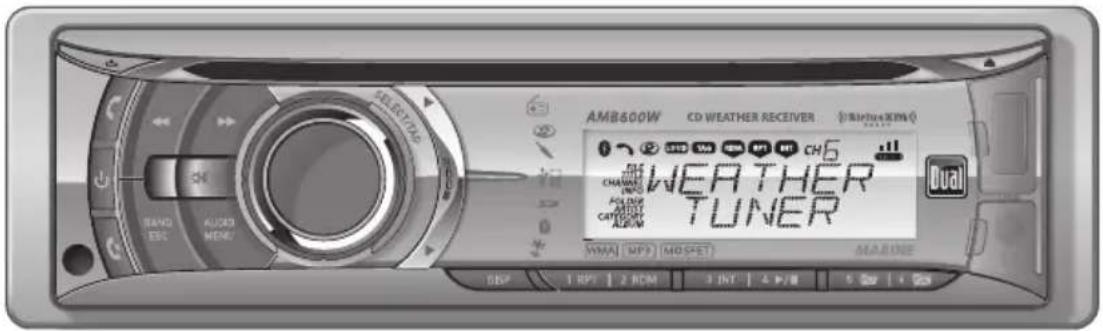
AMB600W
INSTALLATION/OWNER'S MANUAL
AM/FM/CD Marine Receiver with Detachable Face
Weather Band Tuner

AUX
Front and Rear Inputs

USB
MP3
COMPACT disc DIGITAL AUDIO
WMA
Made for

iPod

iPhone
((Siriusxm)) READY
Preparation
Please read entire manual before installation.
Before You Start
- Disconnect negative battery terminal. Consult a qualified technician for instructions.
- Avoid installing the unit where it would be subject to high temperatures, such as from direct sunlight, or where it would be subject to dust, dirt or excessive vibration.
Getting Started
- Remove trim ring from unit.
- Remove 2 transit screws located on top of the unit.
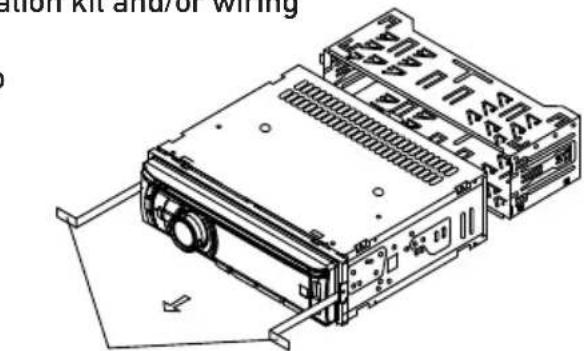
- Insert the supplied keys into the slots as shown, and slide the unit out of the mounting sleeve.
• Install mounting sleeve into opening, bending tabs to secure. - Connect wiring harness and antenna. Consult a qualified technician if you are unsure.
- Certain vehicles may require an installation kit and/or wiring harness adapter (sold separately).
- Test for correct operation and slide into mounting sleeve to secure.
- Snap trim ring into place.
natural_image
Technical line drawing of an electronic device chassis with cooling fans and a base panel (no text or symbols)Removal Keys
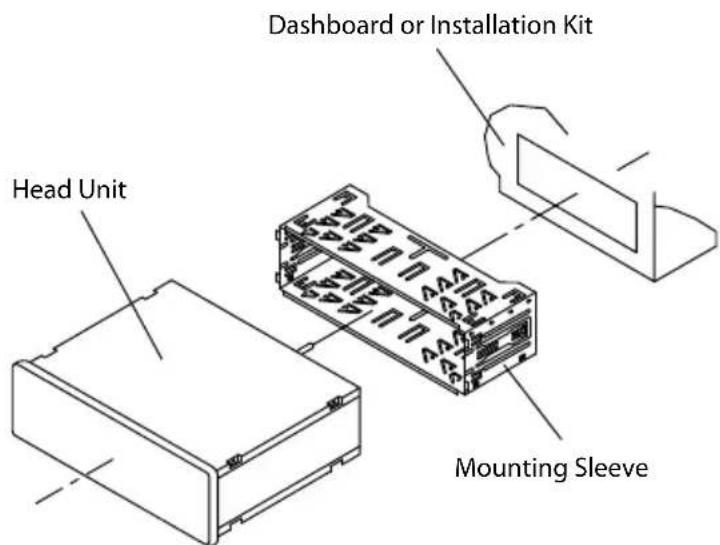
TYPICAL FRONT-LOAD DIN MOUNTING METHOD
Wiring Diagram
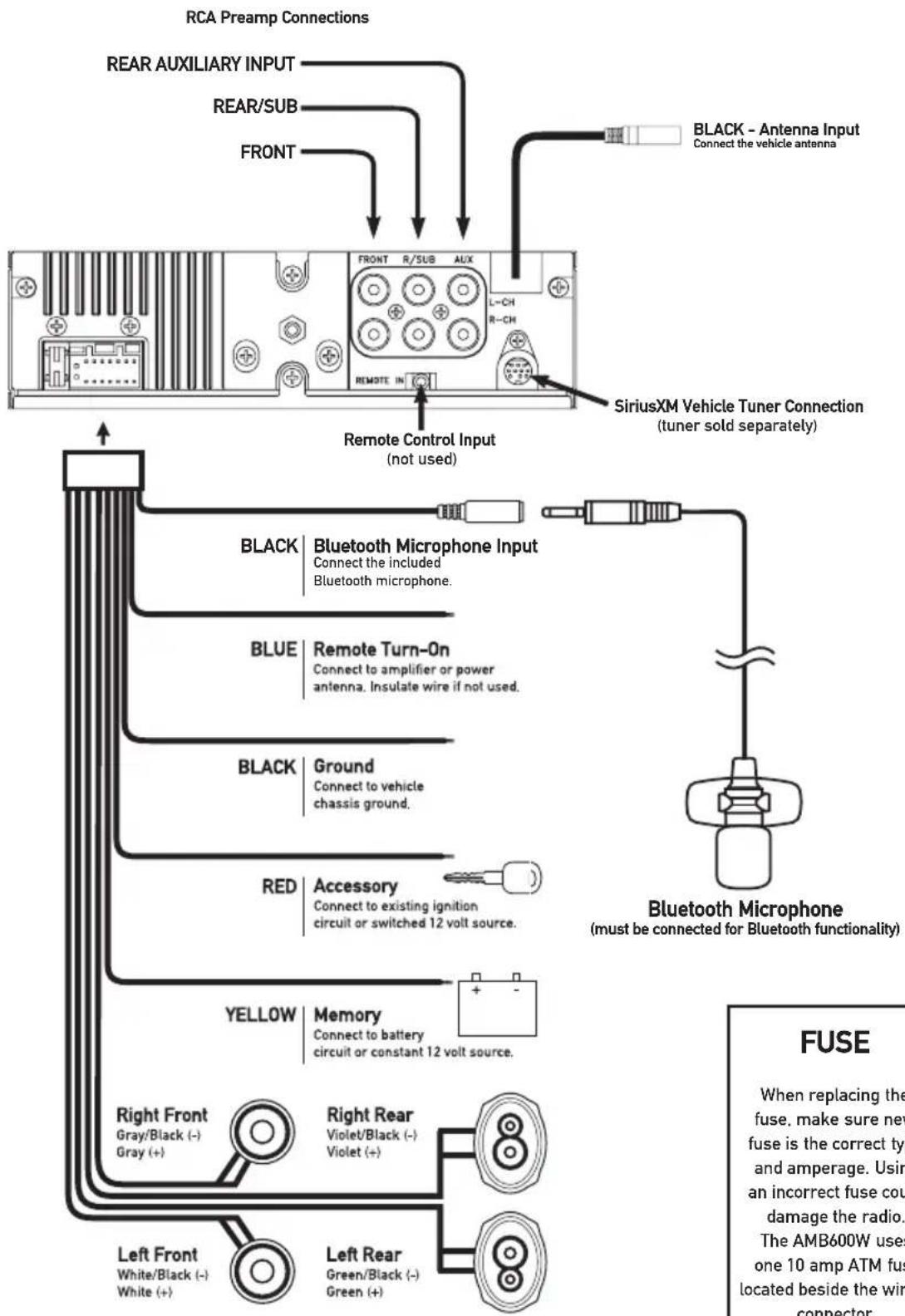
flowchart
graph TD
    A["RCA Preamp Connections"] --> B["REAR AUXILIARY INPUT"]
    A --> C["REAR/SUB"]
    A --> D["FRONT"]
    A --> E["SiriusXM Vehicle Tuner Connection (tuner sold separately)"]
    B --> F["FRONT R/SUB AUX"]
    C --> G["Black - Antenna Input Connect the vehicle antenna"]
    D --> H["REMOTE IN"]
    E --> I["Remote Control Input (not used)"]
    F --> J["BLACK | Bluetooth Microphone Input Connect the included Bluetooth microphone."]
    G --> K["BLUE | Remote Turn-On Connect to amplifier or power antenna. Insulate wire if not used."]
    H --> L["BLACK | Ground Connect to vehicle chassis ground."]
    I --> M["RED | Accessory Connect to existing ignition circuit or switched 12 volt source."]
    J --> N["YELLOW | Memory Connect to battery circuit or constant 12 volt source."]
    K --> O["Right Front Gray/Black (-) Gray (+)"]
    L --> P["Right Rear Violet/Black (-) Violet (+)"]
    M --> Q["Left Front White/Black (-) White (+)"]
    N --> R["Left Rear Green/Black (-) Green (+)"]
    O --> S["FUSE When replacing the fuse, make sure new fuse is the correct type and amperage. Using an incorrect fuse could damage the radio. The AMB600W uses one 10 amp ATM fuse located beside the wire connector."]
FUSE
When replacing the fuse, make sure new fuse is the correct type and amperage. Using an incorrect fuse could damage the radio.
The AMB600W uses one 10 amp ATM fuse located beside the wiring connector.
Control Locations - Receiver
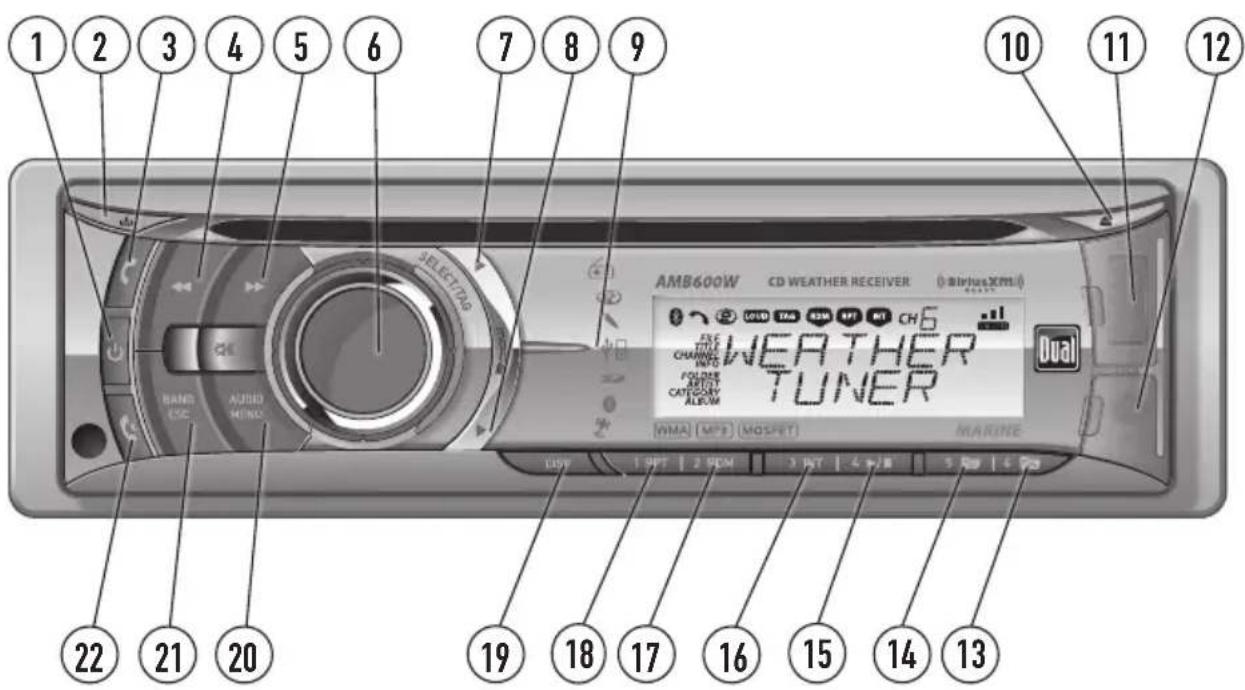
① Power
② Release
③ Talk
④ Tune / Track Down
⑤ Tune / Track Up
6 Volume (turn) or Select / Tag (push)
⑦ Mode Up
⑧ Mode Down
⑨ Mode Indicator
⑩ Eject
⑪ USB Port
12 Auxiliary Input
13 Preset 6 / Folder Up
14 Preset 5 / Folder Down
15 Preset 4 / Play / Pause
16 Preset 3 / Intro
17 Preset 2 / Random
18 Preset 1 / Repeat
19 Display
20 Audio / Menu
21 Band / Escape
22 End Call
Control Locations - Remote
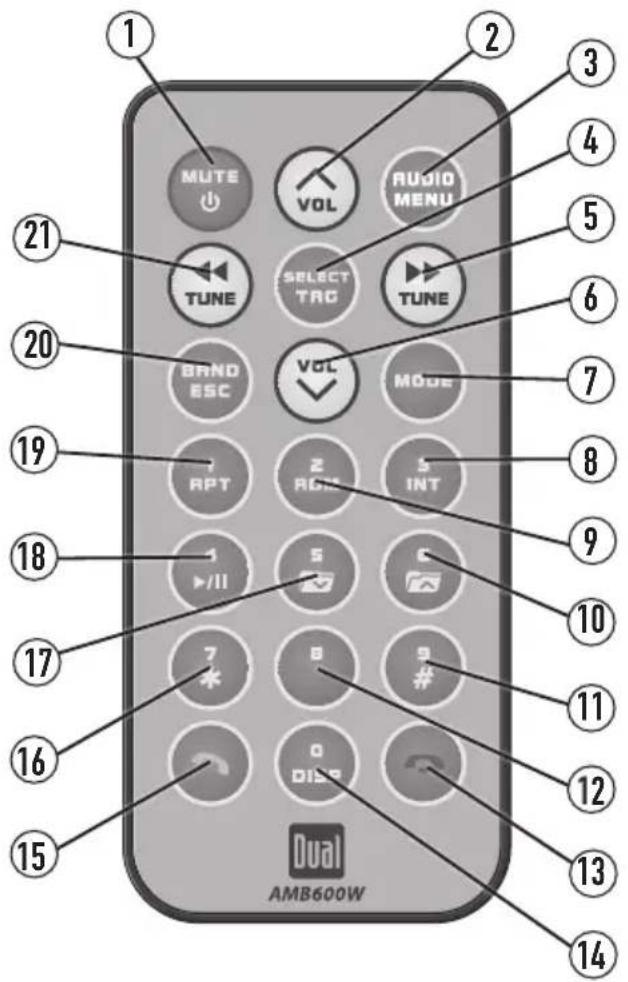
① Mute / Power
② Volume Up
③ Audio / Menu
4 Select / Tag
⑤ Tune / Track Up
6 Volume Down
⑦ Mode
⑧ Preset 3 / Intro
⑨ Preset 2 / Random
10 Preset 6 / Folder Up
⑪ Key 9 / Key #
⑫ Key 8
13 End Call
14 Key 0 / Display
15 Talk
16 Key 7 / Key *
17 Preset 5 / Folder Down
18 Preset 4 / Play / Pause
19 Preset 1 / Repeat
20 Band / Escape
21 Tune / Track Down
General Operation
| Power On/Off | Press or any other button (except EJECT) to turn the unit on. Press to turn the unit off. |
| Changing Modes | Press MODE DOWN to cycle down or press MODE UP to cycle up through the following operating modes. A mode indicator located to the left of the LCD will point to the current mode of operation. |
| AM/FM/WB Tuner Mode | |
| CD Player Mode | |
| Auxiliary Input (front/rear) Modes | |
| USB and Operation of iPod®/iPhone® Modes | |
| SD Card Mode | |
| Bluetooth Mode | |
| SiriusXM Satellite Radio Mode | |
| Available Modes | SiriusXM mode will not appear unless the SiriusXM Connect Vehicle Tuner (sold separately) is connected. |
| Operation of iPod mode will not appear unless an iPod device (sold separately) has been connected. | |
| CD, USB and SD modes will not appear unless a CD, USB device or SD card (sold separately) have been connected. | |
| Auxiliary Inputs | The AMB600W offers two auxiliary input ports, a 3.5 mm port on the front panel and an RCA connection on the back of the unit. Use either connection to connect audio device, MP3 player, etc. Press MODE UP/DOWN to select AUX FRONT or AUX REAR modes. |
| Volume | Adjust volume using volume knob (00-46). |
| Display | Press DISP to select between clock and different types of information, such as radio frequency, CD track/elapsed time or MP3/WMA song information. |
| Reset | Press RESET upon initial installation or if abnormal operation occurs. Reset button is located behind the front panel. |
| Set the Clock | With the unit on, press and hold DISP until the clock begins to flash, then release. Press TUNE ◀◀ to adjust the hours and TUNE ▶▶ to adjust the minutes. Press DISP momentarily to save the selected time. |
General Operation - Setup Menu
| Menu FunctionOptionsAction | ||
| Auto Station Store | AUTO PGM STATIONS | Press SELECT to seek and save 6 strong stations in the current band. (Tuner mode only) |
| Local/Distance Tuning | LOCAL OFF Activates distance tuning (Tuner mode only). | |
| LOCAL ON | Activates local tuning for strong station reception only (Tuner mode only). | |
| Tuner Frequency Spacing | FREQ'NCY USA | Programs the unit to USA tuner spacing.(200kHz for FM and 10kHz for AM). (Tuner mode only) |
| FREQ'NCY EURO | Programs the unit to European tuner spacing.(50kHz for FM and 9kHz for MW). (Tuner mode only) | |
| Selectable iPod Control | IPOD CNT FULL | Programs the head unit to advanced control of the iPod/iPhone device. |
| IPOD CNT MANUAL | Programs the head unit to manual control of the iPod/iPhone device and allows music to be controlled from the iPod/iPhone device. | |
| Loudness | LOUD ON | Enables the loudness feature, which enhances the bass and treble frequencies at low volumes. |
| LOUD OFF Disables the loudnes feature. | ||
| Clock Display | CLOCK OFF Programs unit to not display the clock when the power is off. | |
| CLOCK ON Programs unit to display the clock when the power is off. | ||
| Front Auxiliary Input | AUX-FRNT ON Enables the front panel 3.5mm auxiliary input. | |
| AUX-FRNT OFF Disables the front panel 3.5mm auxiliary input. | ||
| Rear Auxiliary Input | AUX-REAR ON Enables the rear RCA auxiliary input. | |
| AUX-REAR OFF Disables the rear RCA auxiliary input. | ||
| Rear/Sub RCA output | SUBWFR SUB Programs the rear/sub RCA preamp output to subwoofer. | |
| SUBWFR REAR Programs the rear/sub RCA preamp output to rear. | ||
| Beep Confirmation | BEEP OFF Disables the confirmation beep. | |
| BEEP ON Enables the confirmation beep. | ||
| Programmable Turn On Volume | PROG-VOL # | Programs unit to always turn on at a specific volume (default is OFF). Any volume level 1-46 can be selected. |
| Power on Message | MESSAGE OFF Disables power on message. (example: GOOD MORNING) | |
| MESSAGE ON Enables power on message to be displayed. | ||
| Scrolling Option | SCROLL 15 SEC Programs unit to scroll information once every 15 seconds (default). | |
| SCROLL ONCE Programs unit to scroll once, then show the first 8 characters on display. | ||
| SCROLL ON Programs unit to scroll continuously. | ||
| SCROLL OFF Programs unit to show the first 8 characters on the display. | ||
| Illumination Dimmer | DIMMER HIGH Programs unit to the brightest illumination level. | |
| DIMMER MEDIUM Programs unit to the middle illumination level. | ||
| DIMMER LOW Programs unit to the dimmest illumination level. | ||
| Demonstration Mode | DEMO OFF Disables the demonstration mode. | |
| DEMO ON Enables the demonstration message. | ||
| Bluetooth Options | See page 31 for menu options. | |
| SiriusXM Setup | (Press SELECT) | See page 12 for menu options. |
General Operation
| 12/24-hour Clock | The clock will display 12-hour AM/PM time in USA frequency spacing mode (PM 10:00). In European frequency spacing mode, the clock will display 24-hour time (22:00). |
| Audio | PressAUDIO momentarily to select between Bass, Treble, Balance, Fader, Equalizer, Subwoofer and Source Volume Level.→BASS → TREBLE → BALANCE → FADER → EQ → SUBWOOFER → SOURCE LEVEL |
| Bass | Press AUDIO until BASS appears, then rotate volume knob left/right to adjust (-6 minimum / +6 maximum). |
| Treble | Press AUDIO until TREBLE appears, then rotate volume knob left/right to adjust (-6 minimum / +6 maximum). |
| Balance | Press AUDIO until BALANCE appears, then rotate volume knob left/right to adjust (BALANCE LEFT 12 - BALANCE RIGHT 12). BALANCE EVEN represents equal balance. |
| Fader | Press AUDIO until FADER appears, then rotate volume knob left/right to adjust (FADER FRONT 12 - FADER REAR 12). FADER EVEN represents equal fader. |
| EQ | Press AUDIO until EQ appears, then rotate volume knob to select from the following equalization curves: FLAT (default), POP, JAZZ, CLASSIC, BEAT, ROCK and USER. Any manual adjustments to the bass and treble settings are automatically saved as USER. |
| Subwoofer | Press AUDIO until SUBWFR appears, then rotate volume knob left/right to adjust (0 minimum / +12 maximum).Note: Subwoofer option will not appear if the REAR/SUB option in the setup menu is set to REAR. Refer to page 7 for details. |
| Source Volume Level | The source volume level control allows a gain adjustment for each audio source: AM, FM, WB, CD, AUX FRONT/REAR, operation of iPod, USB, SD card, Bluetooth and SiriusXM. Set the source volume level for each mode, depending on the relative volume of each audio source.To set the source volume level, pressAUDIOuntil SOURCE LEVEL appears. After one second, the current mode will appear on the display. Turn thevolume knobto adjust the audio level of the current source (-6 minimum/+6 maximum).Note: Only the current mode will be available for adjustment. To adjust another mode of operation, pressMODE UP/DOWNuntil the desired mode is selected, then set the source volume level for that mode. |
AM/FM Tuner Operation
| Seek Tuning | Press TUNE ◀◀ or TUNE ▶▶ for more than one second to seek to the next strong station. Press and hold to advance quickly. |
| Manual Tuning | Press TUNE ◀◀ or TUNE ▶▶ momentarily to change radio frequency up or down one step at a time. |
| Band | Press BAND to select between FM1, FM2, FM3, AM1, AM2 and WB bands. |
| Storing and Recalling Station Presets | Up to 18 FM stations and 12 AM stations can be stored. To store a station, select the desired band and station. Press and hold the desired preset button (1-6) for more than 2 seconds.When stored, the preset number will appear in the display. The station can be recalled anytime by pressing the corresponding preset button. |
Weather Band Tuner Operation
| Band | Press BAND to select weather band (WB). |
| Manual Tuning | Press TUNE ◀◀ or TUNE ▶▶ momentarily to seek the next weather band station. |
| Storing and Recalling Presets | Up to 6 weather band stations can be stored. To store a station, select the weather band and the desired station. Press and hold the desired preset button (1-6) for more than 2 seconds.When stored, the preset number will appear in the display. The station can be recalled anytime by pressing the corresponding preset button. |
SiriusXM Vehicle Tuner Connections
Connecting the SiriusXM Vehicle Tuner (sold separately)
SiriusXM Satellite Radio operation requires the connection of the SiriusXM-Connect Vehicle Tuner (sold separately).
Note: The SiriusXM-Connect Vehicle Tuner must have the SiriusXM logo to be compatible with the AMB600W.
To connect the SiriusXM Vehicle Tuner, follow the instructions provided with the tuner. When connecting the tuner to the AMB600W, the cable orientation should be connected as shown below.
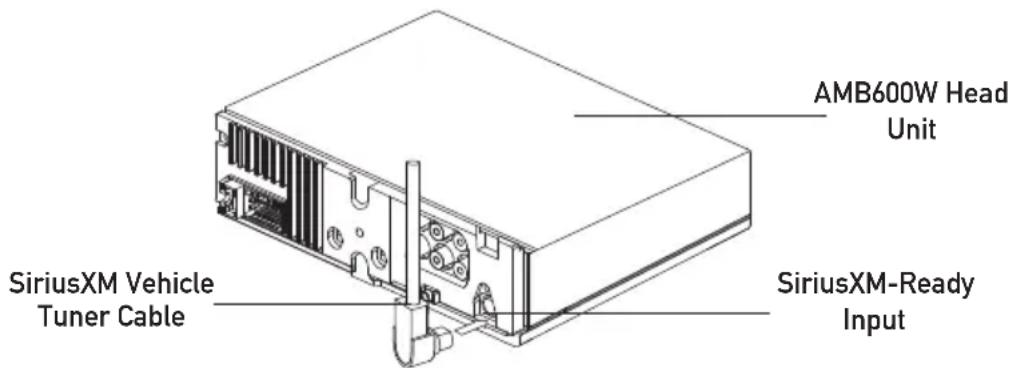
Line up the connector with the pins on the cable. It can only be inserted as shown above. Push the cable into the head unit's connector until it clicks. Attempting to insert the cable differently from shown above may cause damage to the cable or head unit.
SiriusXM Vehicle Tuner Operation
SiriusXM Satellite Radio Overview
Everything worth listening to is on SiriusXM, getting over 130 channels, including the most commercial-free music, plus the best sports, news, talk and entertainment. A SiriusXM Vehicle Tuner (sold separately) and Subscription are required. For more information, visit www.siriusxm.com.
Tuner Activation
Sirius, XM and all related marks and logos are trademarks of Sirius XM Radio Inc. and its subsidiaries. All other marks and logos are the property of their respective owners. All rights reserved.
To listen to SiriusXM Satellite Radio, a subscription is required. Activate the SiriusXM Vehicle Tuner using one of the two methods below:
- Online: Go to "www.siriusxm.com/activatenow" and choose ACTIVATE RADIO.
• Phone: Call 1-800-XM-RADIO (1-800-967-2346).
Activation typically takes 10-15 minutes, but may take up to an hour. It is recommended to leave your vehicle on until the "Subscription Updated" message appears.
SiriusXM Vehicle Tuner Operation
| Radio ID | To view the Radio ID on the LCD, press TUNE ▶▶ or TUNE ◀◀ until channel 0 appears. The 8 character Radio ID will appear on the display. The Radio ID is also printed on the underside of the SiriusXM Vehicle Tuner.Note: The Radio ID does not use the letters I, O, S, F. |
| Listening to SiriusXM Satellite Radio | After installation of the SiriusXM Vehicle Tuner, press SOURCE until SiriusXM mode appears to begin listening to SiriusXM Satellite Radio. |
| Changing Channels | Press TUNE ▶▶ or TUNE ◀◀ to change SiriusXM channels. Press and hold to advance quickly. |
| Band | Press BAND to select between the SXM1, SXM2 and SXM3 bands. Up to six presets can be programmed for each band, for a total of 18 SiriusXM Satellite Radio channel presets. |
| Setting Channel Presets | To store a channel, choose a Band (SXM1-SXM3), then tune to the desired channel. Press and hold a preset button (1-6) on the front panel or remote control for more than two seconds. When stored, a beep sound will be heard and the preset number will appear in the display. |
| Recalling Channel Presets | The preset channel can be recalled by pressing the corresponding preset button.Note: Buttons 7,8,9,0 on the remote control are not associated with channel presets. |
| Channel List | Press SELECT to enter the channel search menu. With "CHANNEL" highlighted, press SELECT to browse through a list of all available channels.Turn the volume knob to cycle through the list of channels.When the desired channel appears on the top line of the display, press SELECT to begin listening to that channel.Note: Press DISP to change between the channel name, artist name, song title or content info. |
| Category Search | Press SELECT to enter the channel search menu. With "CATEGORY" highlighted, press SELECT to browse through a list of all available channels.Turn the volume knob to cycle through the list of categories.Press SELECT to choose a category and display the channels in that category.Turn the volume knob to choose desired channel, then press SELECT to begin listening. |
SiriusXM Vehicle Tuner Operation
SiriusXM Setup Menu
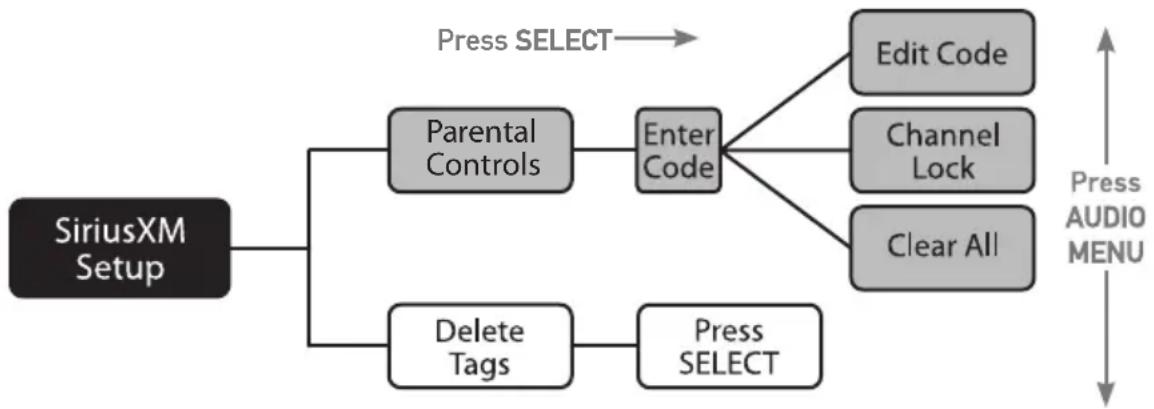
To access the SiriusXM setup menu options, press and hold AUDIO/MENU for more than 3 seconds, press AUDIO/MENU to cycle through menu options until "SIRIUSXM SETUP" appears, then press SELECT. Press AUDIO/MENU to cycle through the list of submenu options.
| Function Action Options Description | |||
| Parental Controls | *Enter Code (default: 0000) | EDIT CODE | Choose this option to program a new 4-digit code. Enter the new code using the input method described below*. |
| CHANNEL LOCK | Allows channels to be locked, requiring the 4-digit code to be entered before the channel becomes available in the channel lineup. Once selected, the channel list will appear.Turn the volume knob to browse through the list of channels.Press SELECT to lock the desired channel.Pressing SELECT on a locked channel will unlock it. | ||
| CLEAR ALL | Choose this option to reset the locked channels back to the factory default. All currently subscribed channels will be unlocked. | ||
| Delete Tags (iTunes Tagging) | Press SELECT to confirm | Deletes all Tags that are saved in memory. (Does not affect Tags that have been transferred to an iPod device.) | |
SiriusXM Setup Menu Navigation
flowchart
graph TD
    A["SiriusXM Setup"] --> B["Parental Controls"]
    A --> C["Delete Tags"]
    B --> D["Enter Code"]
    C --> E["Press SELECT"]
    D --> F["Edit Code"]
    D --> G["Channel Lock"]
    D --> H["Clear All"]
    E --> I["Press AUDIO MENU"]
    style A fill:#f9f,stroke:#333
    style B fill:#ccf,stroke:#333
    style C fill:#cfc,stroke:#333
    style D fill:#fcc,stroke:#333
    style E fill:#cff,stroke:#333
    style F fill:#ffc,stroke:#333
    style G fill:#ffc,stroke:#333
    style H fill:#ffc,stroke:#333
    style I fill:#ffc,stroke:#333
*To enter a 4 digit code, choose from the two options below:
- Enter the 4 digit code using the remote control, by pressing the numbers directly. The default code is "0000" if the code has not be changed with the "EDIT CODE" feature. Press SELECT to confirm.
- Turn the volume knob to select the first digit, then press SELECT. Continue with the remaining digits until all 4 digits have been entered. Press SELECT to confirm.
SiriusXM Vehicle Tuner Operation
Displayed Information
| Display | Press DISP to cycle between the following options: | |
| (LINE 1) |  | |
| (LINE 2) | ||
| CHANNEL | Displays the name of the SiriusXM channel. | |
| CATEGORY | Displays the category type of the current channel. | |
| TITLE | Displays the song title from the currently playing song. | |
| ARTIST | Displays the artist's name from the currently playing song. | |
| INFO | Displays special channel information from the current channel. | |
SiriusXM Advisory Messages
| Message Description | |
| CHECK TUNER | Check the SiriusXM tuner connection behind the AMB600W to ensure that its correctly connected. |
| CHECK ANTENNA | Ensure the SiriusXM antenna cable is connected to the SiriusXM tuner correctly.Check the SiriusXM antenna wire for breaks or sharp bends. Replace the antenna if necessary.Press RESET located behind the front panel. If the message remains, the antenna may have been damaged. |
| NO SIGNAL | The vehicle must be outside, and the antenna must have a clear view of the southern sky.The magnetic antenna must be mounted on the outside of the vehicle for the best reception. |
| CHANNEL UNSUB | This channel is not included in your SiriusXM subscription plan. Call 1-800-XM-RADIO (1-800-967-2346) to subscribe. |
| CHANNEL UNAVAIL | This channel is not a valid SiriusXM channel. The channel number has been entered incorrectly, or the channel was removed from the SiriusXM channel lineup. |
| CHANNEL LOCKED | The selected channel has been locked by the parental control option.A prompt to enter the unlock code will appear. Enter the unlock code as described on page 22. |
| SUBSCRIP UPDATED | An update to your SiriusXM subscription has been received by the SiriusXM tuner. Press any key to continue. |
iTunes® Tagging Operation
| Requirements | The iTunes Tagging feature of the AMB600W requires the optional SiriusXM Vehicle Tuner (sold separately). |
| Overview | iTunes Tagging allows the user to "Tag" songs that are playing on SiriusXM Satellite Radio channel and enables them to be purchased later through iTunes. With the touch of a button the unit will remember the title and artist song information, and then transfer that information to your iPod device the next time you connect it to the AMB600W. A new list called "Tagged" will appear in iTunes, giving you the option to purchase each song. |
| Tagging Music | |
| Step 1 | Tune to a SiriusXM channel. The TAG button on the LCD will illuminate, indicating that a valid artist name and song title are available. |
| Step 2 | Press and hold the TAG button. A confirmation will be displayed, indicating that the song information has been saved. The song information will be saved in memory until an iPod device is plugged in. Up to 64 SiriusXM Tags can be saved before they must be transferred or deleted. |
| Step 3 | Transfer Tags to an iPod/iPhone.·Connect an iPod/iPhone device. The mode will change to operation of iPod and Tags will be automatically transferred to the device, removing the Tags from the AMB600W's internal memory. A confirmation message will appear confirming the number of tags sent. The AMB600W must remain in operation of iPod mode until the "TAGS SENT" message is displayed.·If an iPod/iPhone device is connected when a song is tagged, Tags will transfer automatically to the device. The unit must remain in SiriusXM mode until the "TAGS SENT" message is displayed. (See page 15 for compatibility with iPod devices.)Note: Tags can only be sent from SiriusXM or operation of iPod modes. |
| Step 4 | Sync with iTunes. A list named "Tagged" will appear on the left in the iTunes software. Click on the "Tagged" list to view all the songs that have been tagged and click the "view" button for purchase information. |
| Deleting All Tags | Press and hold AUDIO/MENU to enter the setup menu and select the "Delete Tags" option. See page 12 for details.Note: Once transferred, Tags are managed from the iTunes software. |
iTunes® Tagging Operation
Troubleshooting
| Displayed Message | Description |
| CHECK iPod VER | There is a compatibility issue with the iPod device that is connected. Check the list of compatible iPod devices below. |
| If the attached iPod device is compatible, update the firmware to the latest version using iTunes. | |
| SENDING TAGS | Tags are being sent to the iPod device. This process can take several minutes depending on the number of Tags being sent. |
| iPod FULL | There is not enough space on the connected iPod device to transfer the iTunes Tags. Free up space using iTunes. |
| TRANSFER FAILED | Connection error. Ensure the iPod device is powered on and reconnect the iPod device until a confirmation is displayed. |
| ALREADY TAGGED | The same song has already been tagged from the same channel, and is currently saved in memory. The same song cannot be tagged twice - unless the song is tagged on a different channel, the Tags are sent to an iPod device or the tags are erased. |
| MEMORY FULL CONNECT iPod | The internal memory will hold 64 SiriusXM Tags. An iPod device must be connected to transfer the Tags, or the Tags must be deleted before more songs can be tagged. |
| NO TAG INFO | There is not sufficient information (artist or title) to tag the song. Some HD Radio stations or SiriusXM channels or certain songs may not fully support iTunes Tagging. |
| TAGGING FAILED | There was an error saving the Tag information to the internal memory. Press and hold the TAG button again. |
| NO TAGS STORED | There are no tags saved in the internal memory. The Delete Tags function can only delete Tags that are saved in the internal memory. |
Device Compatibility with iTunes Tagging
Compatible with:
- iPod touch (4th generation)
- iPod touch (3rd generation)
- iPod touch (2nd generation)
- iPod classic
- iPod nano (6th generation)
- iPod nano (5th generation)
- iPod nano (4th generation)
- iPhone 4
- iPhone 3GS
- iPhone 3G
Note: Some iPod devices may require you to select 'transfer purchases' in the context menu from the name of your iPod device to transfer Tags to iTunes.
Go to www.apple.com/itunes for the latest version of the iTunes software.
CD Player Operation
| Insert CD | With the label facing up, insert a standard size CD into the CD slot. The CD will automatically begin playback. |
| Eject CD | Press EJECT to eject the CD. The unit will change to previous mode of operation. If the disc is not removed within 10 seconds, the unit will reload the disc. The unit does not have to be turned on to eject CD. |
| Track Select | Press TRACK ►► to skip to the beginning of the next track. Press TRACK ◀◀ to return to the beginning of the current track. Pressing TRACK ◀◀ again skips to the beginning of the previous track. |
| Fast Forward and Reverse | Press and hold TRACK ►► or TRACK ◀◀ to fast forward or reverse a track. |
| Pause | Press ►/■ to temporarily stop CD playback. Press ►/■ again to resume playback. |
| Intro | Press INT to enter the Intro menu, then turn the volume knob to select one of the following options:OFF - Cancels the INT function.ALL - Plays the first 10 seconds of each track. |
| Repeat | Press RPT to enter the Repeat menu, then turn the volume knob to select one of the following options:ALL - Plays all tracks on CD.TRACK - Continuously repeats selected track. |
| Random | Press RDM to enter the Random menu, then turn the volume knob to select one of the following options:OFF - Cancels the RDM function.ALL - Plays all tracks in random order. |
| CD-R/CD-RW Compatibility | Some CD-Rs and CD-RWs may be incompatible with this unit, depending on media type and recording method. In addition, the following CDs may be incompatible with this unit:CDs exposed to extreme temperatures or direct sunlight for extended periods of time. CDs recorded in which a recording session failed or a re-recording was attempted and, or encrypted or copy-protected CDs which do not conform to the audio CD-DA red book recording standard. |
CD Player Operation - MP3/WMA Files
Playing an MP3/WMA Disc
When an MP3/WMA encoded disc is first inserted,
"MP3 CD READING" will appear in the display. Depending on the number of files and folders, this may take several seconds.
Displaying Information
Press DISP to select between the following display options.

flowchart
graph LR
    A["(LINE 1) FILE SOME TITLE\n(LINE 2)"] --> B["FOLDER NAME"]
    B --> C["ELAPSED TIME\nCLOCK"]
    C --> D["TRACK NUMBER\nTOTAL TRACKSARTIST"]
"NO ARTIST" or "NO TITLE" will be displayed if the MP3/WMA file contains no ID3 tag information.
"ROOT" will be displayed if the directory name of a root folder is not labeled.
Title Icon: TITLE
This icon will illuminate when the song title is displayed.
Artist Icon: ARTIST
This icon will illuminate when the artist name is displayed.
Folder Icon: FOLDER
This icon will illuminate when the folder name is displayed.
File Icon: FILE
This icon will illuminate when the file name is displayed.
Character Support
Maximum character display information
- Track name – 32 character maximum
- Directory name – 32 character maximum
- *Song title – 32 character maximum
- *Artist name – 32 character maximum
*Song title and Artist Name will only be displayed if included with the MP3/WMA file.
When referring to MP3/WMA playback, the following terms are synonymous:
- File name and track name
- Folder name and directory name
CD Player Operation - MP3/WMA Files
Folder/File Search Mode
MP3/WMA CD mode features a file and folder search mode. This search allows navigating through folders to find a specific MP3 or WMA file for playback.
Step 1
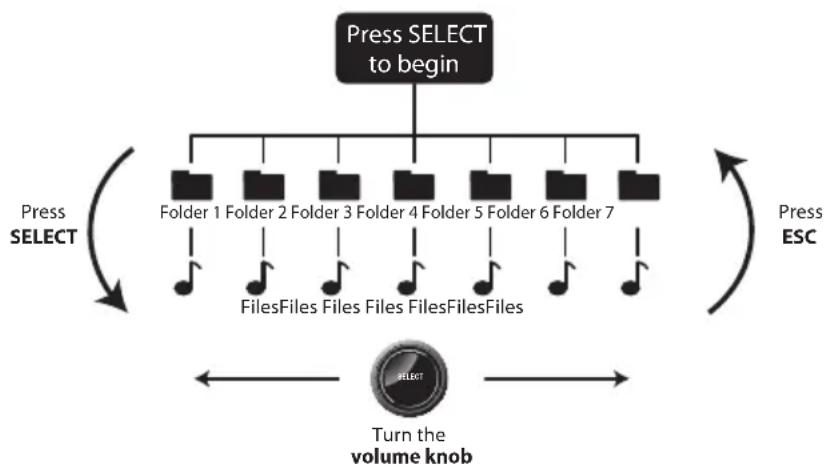
Press SELECT to enter the file/folder search mode. A list of all the folders on the CD will be displayed.
Note: Any files located in the root directory will be located in the folder named "ROOT". Press SELECT to view the files on the root folder.
Step 2
Turn the volume knob to cycle through all the folders on the device and press SELECT to choose the desired folder. The list of files in the selected folder will be displayed. Turn the volume knob to cycle through the list of files.
Note: Pressing ESC when viewing the contents of a folder will return to the list of folders on the CD. Press ESC again to exit the search menu.
Step 3
Once the desired song is displayed, press SELECT to begin playback of the desired song.
flowchart
graph TD
    A["Press SELECT to begin"] --> B["Folder 1 Folder 2 Folder 3 Folder 4 Folder 5 Folder 6 Folder 7"]
    B --> C["FilesFiles Files Files FilesFiles"]
    C --> D["Turn the volume knob"]
    D --> E["Press ESC"]
    E --> A
CD Player Operation - MP3/WMA Files
Folder Access
Press ☑ to select the previous folder.
Press 📂 to select the next folder.
Repeat
*Folder access is only available on MP3/WMA discs recorded with more than one folder.
Press RPT to enter the Repeat menu, then turn the volume knob to select one of the following options:
- ALL - Plays all tracks on CD.
- SONG - Continuously repeats selected track.
- FOLDER - Continuously repeats all files in selected folder.
Random
Press RDM to enter the Random menu, then turn the volume knob to select one of the following options:
- OFF - Cancels the RDM function.
- ALL - Plays all tracks in random order.
- FOLDER - Plays all tracks in folder in random order.
Note: Random mode is retained in memory when selecting between other modes and when the unit is turned on/off.
Intro
Press INT to enter the Intro menu, then turn the volume knob to select one of the following options:
- OFF - Cancels the INT function.
- ALL - Plays first 10 seconds of each track.
- FOLDER - Plays first 10 seconds of each track in folder.
Note: Folder repeat, random and intro options only function on MP3/WMA discs recorded with more than one folder.
CD Player Operation - MP3/WMA Files
| Media Compatibility | The following types of discs/files are compatible:CD-ROM (ISO), CD-R, CD-RWCD-DAMP3 dataWMA data |
| The following types of discs/files are not compatible:WMA files that are protected by DRM (Digital Rights Management).WMA lossless formatDiscs recorded with Track At Once or packet writingMP3 PRO formatMP3 playlistsWAV format | |
| Playback Order | MP3/WMA playback sequence is based on recorded order of files and begins in the root folder of the disc. Any empty folders or folders that do not include MP3/WMA files are skipped. This unit may not play files in the order they were recorded in. Refer to your recording software's user's manual for more information. |
| Compatible Recording Formats | ISO9660 level 1ISO9660 level 2Yellow Book MODE 1Yellow Book MODE 2 FORM 1Multi sessionMaximum files - 999Maximum folders - 255Maximum folder levels - 8MPEG-1/2/2.5 Audio Layer-3 |
| ISO9660 standards:Maximum nested folder depth is 8 (including the root folder).Valid characters for folder/file names are letters A-Z (all caps), numbers 0-9, and “_” (underscore). Some characters may not be displayed correctly, depending on the character type.This device can play back discs in Joliet, Romeo, and other standards that conform to ISO9660. MP3/WMA written in the formats other than the above may not play and/or their file names or folder names may not be displayed properly. |
CD Player Operation - MP3/WMA Files
| Additional MP3/WMA Information | An internal buffer provides ESP (Electronic Skip Protection) to virtually eliminate skipping. |
| When playing a disc recorded with regular audio files (CD-DA or .WAV) and MP3/WMA files, the unit will play the MP3/WMA files only. | |
| Only MP3 files with filename extension (.mp3) can be played. Only WMA files with filename extension (.wma) can be played. | |
| Do not attempt to play discs which contain non-MP3/WMA files with the MP3/WMA extension. | |
| Sampling Frequency Rates | |
| MP3 | 8kHz ~ 48kHz |
| WMA | 32kHz ~ 48kHz |
| Transfer Bit rates | |
| MP3 | 32kbps ~ 320kbps constantVariable bit rates |
| WMA | 32kbps ~ 192kbps constantVariable bit rates |
| Note: Some files may not play or be displayed correctly, depending on sampling rates and bit rates. | |
| MP3 Tag Display | ID3 tags Version 1.0 to 2.4.This model will not display ID3 Version 2.4 or greater tags. |
| Recommended Settings | For best results, use the following settings when burning an MP3 disc:128kbps or higher constant bit rate44.1kHz or higher sampling frequency |
| For best results, use the following settings when burning a WMA disc:64kbps or higher constant bit rate32kHz or higher sampling frequency | |
USB/SD Card Operation
| Connecting a USB Device (sold separately) | To play MP3/WMA files from most USB mass storage devices, line up the USB connector and insert the USB device into the AMB600W's USB port. |
| Connect an SD Card (sold separately) | To play MP3/WMA files from an SD Card, insert an SD card into the SD card slot, located behind the front panel. Insert the SD card with the label facing up, and press the card until it clicks into place. Remove the SD card by pressing in until it clicks, then pull to remove. |
| Playing Music | When a USB or SD card device is first connected, playback will begin momentarily. Depending on the number of files and folders, it may take several seconds for the device to begin playing. If no valid MP3/WMA files are detected, “NO FILE” will be displayed and the last mode will be resumed. |
| Track Select | Press TRACK ►► to skip to the beginning of the next track. Press TRACK ◀◀ to return to the beginning of the current track. Pressing TRACK ◀◀ again skips to the beginning of the previous track. |
| Fast Forward and Reverse | Press and hold TRACK ►► or TRACK ◀◀ to fast forward or reverse a track. |
| Pause | Press ►/ || to temporarily stop USB/SD Card playback. Press ►/ || again to resume playback. |
| File Search Step 1 | Press SELECT to enter the file/folder search mode. A list of all the folders from the USB/SD Card device will be displayed. |
| Step 2 | Note: Any files located in the root directory will be located in the folder named "ROOT". Press SELECT to view the files on the root folder. |
| Turn the volume knob to cycle through all the folders on the device and press SELECT to choose the desired folder. The list of files in the selected folder will be displayed. Turn the volume knob to cycle through the list of files. | |
| Step 3 | Note: Pressing ESC when viewing the contents of a folder will return to the list of folders on the USB/SD Card device. Press ESC again to exit the search menu. |
| Once the desired song is displayed, press SELECT to begin playback of the desired song. | |
| Note: Due to differences in USB/SD Card device transfer speeds, it is recommended to limit each folder to less than 30 songs. |
USB/SD Card Operation
Displaying Information
When a file is accessed, the clock and elapsed time will be displayed. Press DISP momentarily to select between song title, artist, file name, folder name, track number and clock/ elapsed time.
"NO TITLE" will be displayed if no song title information is available.
"NO ARTIST" will be displayed if no artist information is available.
Title Icon: TITLE
This icon will illuminate when the song title is displayed.
Artist Icon: ARTIST
This icon will illuminate when the artist name is displayed.
Folder Icon: FOLDER
This icon will illuminate when the folder name is displayed.
File Icon: FILE
This icon will illuminate when the file name is displayed.
Folder Access
Press to select the previous folder. Press to select the next folder.
Note: Folder access is only available on devices with more than one folder.
Repeat
Press RPT to enter the Repeat menu, then turn the volume knob to select one of the following options:
- ALL - Plays all tracks on the device.
- SONG - Continuously repeats selected track.
- FOLDER - Continuously repeats all files in selected folder.
Random
Press RDM to enter the Random menu, then turn the volume knob to select one of the following options:
- OFF - Cancels the RDM function.
- ALL - Plays all tracks in random order.
- FOLDER - Plays all tracks in folder in random order.
Note: Random mode is retained in memory when selecting between other modes and when the unit is turned on/off.
Intro
Press INT to enter the Intro menu, then turn the volume knob to select one of the following options:
- OFF - Cancels the INT function.
- ALL - Plays first 10 seconds of each track.
- FOLDER - Plays first 10 seconds of each track in folder.
USB/SD Card Operation
| Character Support | Maximum character display informationTrack name – 32 character maximumDirectory name – 32 character maximum*Song title – 32 character maximum*Artist name – 32 character maximum*Song title and artist name will only be displayed if included with the MP3/WMA file. |
| Media Compatibility | The following types of files are compatible:MP3 dataWMA dataThe following types of files are not compatible:WMA files that are protected by DRM (Digital Rights Management).WMA lossless formatMP3 PRO formatMP3 playlistsWAV format |
| Playback Order | MP3/WMA playback sequence is based on order the files are copied to the USB/SD Card device and begins in the root folder. Any empty folders or folders that do not include MP3/WMA files are skipped. Depending on your software, the playback order may vary. |
| Playback Capacity | Maximum number of files: 50,000Maximum number of folders: 255 plus the root directoryMaximum number of files in each folder and root: 50,000Note: If the number of files/folders exceeds the maximum outlined above, the additional files/folders will be ignored.Note: Devices that exceed the maximum number of files or folders may not function properly. |
| USB Device Compatibility | Due to the differences of USB/SD Card devices, some devices may not be compatible. USB/SD Card devices must be ‘mass storage class’ and formatted to the FAT or FAT32 file system in order to ensure compatibility. |
USB/SD Card Operation
| Additional MP3/WMA Information | Only MP3 files with filename extension (.mp3) can be played. Only WMA files with filename extension (.wma) can be played. Do not attempt to play non-MP3/WMA files with the MP3/WMA extension. |
| Sampling Frequency Rates | |
| MP3 | 8kHz ~ 48kHz |
| WMA | 32kHz ~ 48kHz |
| Transfer Bit rates | |
| MP3 | 32kbps ~ 320kbps constantVariable bit rates |
| WMA | 32kbps ~ 192kbps constantVariable bit rates |
| Note: Some files may not play or be displayed correctly, depending on sampling rates and bit rates. | |
| MP3 Tag Display | ID3 tags Version 1.0 to 2.4 |
| Note: If an invalid ID3 tag version is detected, "NO SUPPORT" will scroll on the display. | |
Operation of iPod/iPhone
Connecting an iPod/iPhone Device
USB Connection
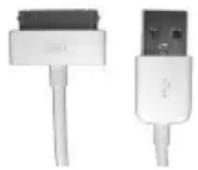
Using the "dock connector to USB" sync cable (provided with the iPod/iPhone device), plug the USB cable into the AMB600W's USB port. Once connected, playback will begin automatically.
Controlling a Device: Full Control
When the control of iPod/iPhone feature is set to "FULL" in the iPod Menu, use the following functions to control the device:
| Song Select | Press ▶▶ to skip to the beginning of the next song. Press◀◀ to return to the beginning of the current song. Pressing◀◀ again skips to the beginning of the previous song. |
| Fast Forward and Reverse | Press and hold ▶▶ or ◀◀ to fast forward or reverse a song. |
| Pause | Press ▶/■ to temporarily stop playback.Press ▶/■ again to resume playback. |
| Repeat | Press RPT to enter the Repeat menu, then turn the volume knob to select one of the following options:ALL - Repeats all tracks.SONG - Repeats selected track. |
| Random | Press RDM to enter the Random menu, then turn the volume knob to select one of the following options:OFF - Cancels the RDM function.ALL - Plays all tracks in random order.ALBUM - Plays all tracks in the selected album in random order. |
| Intro | Press INT to enter the Intro menu, then turn the volume knob to select one of the following options:OFF - Cancels the INT function.ON - Plays first 10 seconds of each track. |
Operation of iPod/iPhone
Controlling a Device: Full Control - Music Search Menu
The AMB600W features a powerful music search that simplifies the searching process. Follow the steps below to find the desired song:
Begin Searching
Press SELECT to begin the search. The main search menu will appear.
Select a Category
Turn the volume knob to select between artists, albums, songs, playlists, podcasts and audiobooks. Press SELECT to select the desired search category. Some categories have subcategories to navigate through. See the table below for details.
| Search Category | Menu Navigation |
| Artists | Menu → Artists → Albums → Songs |
| Albums | Menu → Albums → Songs |
| Songs | Menu → Songs |
| Playlists | Menu → Playlists → Songs |
| Podcasts | Menu → Podcasts |
| Audiobooks | Menu → Audiobooks |
Step Backwards
Press ESC to return to the previous menu, or exit the search menu when the main menu is shown.
Playing a Song
Navigate to the desired song/podcast/audiobook and press SELECT to begin playback.
Note: If a specific category is selected, the iPod/iPhone device playback will be limited to that category until another category is selected in the search menu.
Displayed Information
Displaying Information
Press DISP momentarily to select file/folder name (default), song title/artist, track number/clock & elapsed time.

flowchart
graph LR
    A["SONG TITLE\nARTIST"] --> B["SONG TITLE\nALBUM"]
    B --> C["ELAPSED TIME\nCLOCK"]
    C --> D["TRACK NUMBER\nTOTAL TRACKS"]
Character Support
Maximum character display information
• *Song Title – 32 character maximum
- *Artist Name – 32 character maximum
• *Album Name - 32 character maximum
*Song Title, Artist Name and Album Name will only be displayed if included with the file.
Operation of iPod/iPhone
Controlling a Device: Manual Control
When the control of iPod/iPhone feature is set to "MANUAL" in the iPod Menu, use the following functions to control the device:
| Manual Control for iPod | When "MANUAL" control is selected from the iPod Menu, the iPod or iPhone device can be controlled directly from the device's interface. All functions except for volume can be used from the iPod or iPhone device. |
| Basic Head Unit Control | In addition to manual control of the iPod/iPhone device, the following basic functions are still active: |
| Song Select | Press ▶▶ to skip to the beginning of the next song. Press ◀◀ to return to the beginning of the current song. Pressing ◀◀ again skips to the beginning of the previous song. |
| Pause | Press ▶/■ to temporarily stop playback. Press ▶/■ again to resume playback. |
| Volume | When playing an iPod device, the volume is adjustable using the volume knob. |
Device Compatibility
Made for
- iPod touch (4th generation)
- iPod nano (6th generation)
- iPod touch (3rd generation)
- iPod nano (5th generation)
- iPod touch (2nd generation)
- iPod nano (4th generation)
- iPod classic
- iPod touch (1st generation)
- iPod nano (3rd generation)
- iPod nano (2nd generation)
• *iPod nano (1st generation) - *iPod with video
- iPhone 4
- iPhone 3GS
- iPhone 3G
- iPhone
*These devices are not compatible with manual control mode.
Note: See page 15 for iPod and iPhone device compatibility with iTunes Tagging.
Bluetooth® Operation
Pairing a Device
| Preparation | Before you can use a Bluetooth device, it must be paired and connected. Make sure that Bluetooth is activated on your device before you begin the pairing process. |
| Pairing a New Device | The AMB600W broadcasts the pairing signal constantly when no devices are currently connected. Complete the pairing sequence from your Bluetooth device. Refer to the owner's manual for your device for more details.The device name is "DUAL BT"The Bluetooth passcode "1234"Note: The AMB600W can be in any mode of operation when pairing is performed. |
| Pairing Additional Devices | If a device is currently connected, press and holdto disconnect the current device before a new device can be paired. Then begin the pairing sequence from the new Bluetooth device. |
(Re)Connecting a Paired Device
Most Bluetooth devices support the auto-connect feature, and will connect automatically if the device is in range when the AMB600W is powered-on. If your device was previously paired but does not connect, use these instructions below. Some devices require authorization to allow the auto connect feature.
- If your most recently connected Bluetooth device becomes disconnected or does not reconnect, press \~ from Bluetooth mode to reconnect your mobile device.
- To connect a previously paired device that was not recently connected:
1) If applicable, press and hold 📄 to disconnect any connected mobile devices.
2) From Bluetooth mode, press SELECT. "Paired Devices" will appear on the LCD.
3) Turn the volume knob to cycle through the list of devices.
4) Press SELECT or ↗ to connect to the desired device. It must be in range to connect.
Note: If the Auto Connect setup menu setting is set to OFF, you must press 🔔 to connect you device after pairing, and each time the AMB600W is powered-on.
Disconnecting a Device
Press and hold for 3 seconds to disconnect a connected device. The device will remain paired and appear in the PAIRED DEVICES menu, but not be connected.
Bluetooth® Operation
Making a Phone Call
| Manual Dialing | Press once. "Enter Phone Number" will be shown, then an "_" will appear on the display.Using the remote control, enter the phone number using the 0-9 buttons. Press on the remote control or AMB600W front panel to begin dialing.Note: Placing a phone call from your cell phone will also use the Bluetooth function of the AMB600W. |
| Recent Calls List | Press SELECT from Bluetooth mode to view the 10 most recent phone calls that were dialed, received or missed while connected to the AMB600W.Turn the volume knob to cycle through the recent phone numbers. Press SELECT or to dial the phone number. |
| Redialing the last number | To redial the last phone number, press two times from Bluetooth mode. Dialing will begin automatically. |
Receiving and Ending Phone Calls
| Receiving a Phone Call | Incoming phone calls will automatically appear on the display and a ring tone will be heard. |
| Note: The volume of the ring tone depends on the volume level of the AMB600W. The incoming ring tone may not be heard if the volume is set to a low level or mute is activated. | |
| • Press →to receive the incoming phone call.• Press →to refuse the incoming phone call. | |
| Note: If Auto Answer is set to ON in the setup menu, all phone calls will be received automatically. | |
| Ending a Phone Call | During an active phone call, press →to end a phone call. If the phone call was received when listening to music in another mode, the AMB600W will resume the previous mode. |
Bluetooth® Operation
During a Phone Call
| Volume | Turn the volume knob to adjust the volume level during a phone call. Bluetooth mode has a separate volume level from the main volume of other modes. The AMB600W will remember the volume level in Bluetooth mode and always return to the last volume level for each phone call. |
| Microphone Mute | Press MUTE during a phone call to turn the AMB600W's external microphone off. Press MUTE again to resume microphone operation. |
| Audio Transfer | Press DISP during a phone call to transfer the call from the AMB600W to the cell phone. Press DISP again to toggle the audio back to the AMB600W. |
| Call Waiting | During a phone call, if there is a second incoming call, press to place the first call on hold and switch to the second phone call. Press again to switch back to the first call. |
| Call Hold | During a phone call, when there are no additional incoming calls, press to place the call on hold. Press again to resume the phone call.Note: Audio transfer, call waiting and call hold must be supported by the mobile phone and service provider to function properly. |
Bluetooth Setup Menu Options
| FunctionOptionsAction | ||
| Bluetooth | BL'TOOTH(ON/OFF) | Enables/disables Bluetooth functionality. |
| Auto Connect | AUTO CON(ON/OFF) | Set to ON to allow a Bluetooth device to connect automatically. Setting to OFF requires manually connecting the device. |
| Auto Answer | AUTO ANS(OFF/ON) | When set to ON, every incoming phone call will automatically be answered after 2-3 rings. When set to OFF, the button must be pressed to answer incoming phone calls. |
| Speaker Output | BT SPRKS(FRONT/ALL) | Set to FRONT to direct the Bluetooth audio output to the front speakers only. Set to ALL to enable Bluetooth audio to output from all 4 speakers. |
Bluetooth® Operation
Streaming Audio Operation
The AMB600W supports A2DP (advanced audio distribution profile) wireless streaming audio from your Bluetooth mobile device directly to your head unit. You can also control your music from the front panel of the head unit using AVRCP (audio video remote control profile).
Notes:
- To stream music to your head unit, your mobile device must support the A2DP and AVRCP Bluetooth profiles. Check the owner's manual of your mobile device for details.
- Streaming audio must be enabled from your mobile device. This option will vary depending on the device. Some devices allow streaming audio to be disabled.
After pairing, connecting and enabling streaming audio from a compatible mobile device, begin playing music using the music player on your mobile device. Once the music is playing, the following functions can be used to control the music:
- The ▶▶ button will skip to the next available audio track.
- The ◀◀ button will skip to the previous audio track.
- The ▶/Ⅲ button will toggle between play and pause during playback.
- The button will stop the audio playback.
Note: Some Bluetooth devices may not fully support these commands.
Bluetooth Reset
Resetting the Bluetooth module will remove the list of paired phones and delete the list of recent calls from memory.
To reset Bluetooth, perform the following steps:
1) Press MODE UP/DOWN until the head unit is in Bluetooth mode.
2) Press and hold MODE DOWN for 3 seconds to reset the Bluetooth settings back to the factory default.
Compatibility Note:
Due to the differences in Bluetooth technology, some mobile devices may be incompatible, function improperly or may not support all features when used with the AMB600W.
Limited One Year Warranty
This warranty gives you specific legal rights. You may also have other rights which vary from state to state.
Dual Electronics Corp. warrants this product to the original purchaser to be free from defects in material and workmanship for a period of one year from the date of the original purchase.
Dual Electronics Corp. agrees, at our option, during the warranty period, to repair any defect in material or workmanship or to furnish an equal new, renewed or comparable product (whichever is deemed necessary) in exchange without charges, subject to verification of the defect or malfunction and proof of the date of purchase. Subsequent replacement products are warranted for the balance of the original warranty period.
Who is covered? This warranty is extended to the original retail purchaser for products purchased from an authorized Dual dealer and used in the U.S.A.
What is covered? This warranty covers all defects in material and workmanship in this product. The following are not covered: software, installation/removal costs, damage resulting from accident, misuse, abuse, neglect, product modification, improper installation, incorrect line voltage, unauthorized repair or failure to follow instructions supplied with the product, or damage occurring during return shipment of the product. Specific license conditions and copyright notices for the software can be found via www.dualav.com.
What to do?
- Before you call for service, check the troubleshooting guide in your owner's manual. A slight adjustment of any custom controls may save you a service call.
- If you require service during the warranty period, you must carefully pack the product (preferably in the original package) and ship it by prepaid transportation with a copy of the original receipt from the retailer to an authorized service center.
- Please describe your problem in writing and include your name, a return UPS shipping address (P.O. Box not acceptable), and a daytime phone number with your shipment.
- For more information and for the location of the nearest authorized service center please contact us by one of the following methods:
• Call us toll-free at 1-866-382-5476
• E-mail us at cs@dualav.com
Exclusion of Certain Damages: This warranty is exclusive and in lieu of any and all other warranties, expressed or implied, including without limitation the implied warranties of merchantability and fitness for a particular purpose and any obligation, liability, right, claim or remedy in contract or tort, whether or not arising from the company's negligence, actual or imputed. No person or representative is authorized to assume for the company any other liability in connection with the sale of this product. In no event shall the company be liable for indirect, incidental or consequential damages.
Troubleshooting
| Problem Cause | Action | |
| Unit will not turn on (no power) | Yellow wire not connected or incorrect voltage Red wire not connected or incorrect voltage | Check connections for proper voltage (11~16VDC) |
| Black wire not connected Check | connection to ground | |
| Fuse blown Replace fuse | ||
| Unit has power (but no sound) | Speaker wires not connected Check | connections at speakers |
| One or more speaker wires touching each other or touching chassis ground | Insulate all bare speaker wires from each other and chassis ground | |
| Unit blows fuses | Yellow or red wire touching chassis ground | Check for pinched wire |
| Speaker wires touching chassis ground | Check for pinched wire | |
| Incorrect fuse rating Use fuse | with correct rating | |
| Excessive skipping | Unit is not mounted correctly or backstrap is not secure | Check mounting sleeve and backstrap support |
| Physical defect in media (CD, CD-R or CD-RW) | Check media for scratches | |
| ERROR 2 appears on display | Disc read error or disc is in upside down | Press eject or RESET |
| PROTECT appears on display | The WMA file is copy-protected by DRM (Digital Rights Management) | Write disc using WMA files that are not copy-protected |
| NO FILE appears on display | Selected file is not available in direct or alphanumeric search modes | Repeat search using valid parameters |
| Unit will not accept a disc | CD mechanism position out of alignment | Press and hold EJECT for 3 seconds to reset CD mechanism position |
| CD transit screws still in place | Remove 2 transit screws located on top of the unit | |
| NO SUPPORT appears on display | An invalid ID3 tag version is present | Version 1.0 to 2.4 ID3 tags are supported. |
| An ID3 tag character is not supported | Only ASCII characters are supported. | |
Specifications
CD Player
Frequency response: 10Hz-20kHz
Channel separation @ 1kHz: >65dB
D/A converter: 1 Bit
FM Tuner
Tuning range: 87.5MHz-107.9MHz
Usable sensitivity: 8.5dBf
50dB quieting sensitivity: 10dBf
Stereo separation @ 1kHz: 40dB
Frequency response: 30Hz-13kHz
AM Tuner
Tuning range: 530kHz-1710kHz
Usable sensitivity: 22uV
Frequency response: 30Hz-2.2kHz
General
Speaker output impedance: 4\~8 ohms
Line output voltage: 2 Volts RMS
Dimensions: 7" x 7" x 2" (178 x 178 x 51 mm)
Design and specifications subject to change without notice.

CEA-2006 Power Standard Specifications
(reference: 14.4VDC +/- 0.2V, 20Hz\~20kHz)
Power Output: 18 Watts RMS x 4 channels at 4 ohms and ≤1% THD+N
Signal to Noise Ratio: 75dBA (reference: 1 watt into 4 ohms)
FCC Compliance
This device complies with Part 15 of the FCC Rules. Operation is subject to the following two conditions:
(1) this device may not cause harmful interference, and
(2) this device must accept any interference received, including interference that may cause undesired operation.
Warning: Changes or modifications to this unit not expressly approved by the party responsible for compliance could void the user's authority to operate the equipment.
Note: This equipment has been tested and found to comply with the limits for a Class B digital device, pursuant to Part 15 of the FCC Rules. These limits are designed to provide reasonable protection against harmful interference in a residential installation. This equipment generates, uses and can radiate radio frequency energy and, if not installed and used in accordance with the instructions, may cause harmful interference to radio communications. However, there is no guarantee that interference will not occur in a particular installation. If this equipment does cause harmful interference to radio or television reception, which can be determined by turning the equipment off and on, the user is encouraged to try to correct the interference by one or more of the following measures:
• Reorient or relocate the receiving antenna.
- Increase the separation between the equipment and receiver.
- Connect the equipment into an outlet on a circuit different from that to which the receiver is connected.
- Consult the dealer or an experienced radio/TV technician for help.
Notes
Notes
Notes

Dual Electronics Corp.
Toll Free: 1-866-382-5476
www.dualav.com
©2012 Dual Electronics Corp. All rights reserved.
iPhone, iPod, iPod classic, iPod nano, and iPod touch are trademarks of Apple Inc., registered in the U.S. and other countries.
"Made for iPod" and "Made for iPhone" mean that an electronic accessory has been designed to connect specifically to iPod or iPhone, respectively, and has been certified by the developer to meet Apple performance standards. Apple is not responsible for the operation of this device or its compliance with safety and regulatory standards. Please note that the use of this accessory with iPod or iPhone may affect wireless performance.
SD is a trademark of SD-3C, LLC.
The Bluetooth® word mark and logos are owned by the Bluetooth SIG, Inc. and any use of such marks by Samsung is under license.
Sirius, XM and all related marks and logos are trademarks of Sirius XM Radio Inc. All rights reserved.
Other trademarks and trade names are those of their respective owners.