
JGBS14PCDWW - Pliit GE - Tasuta kasutusjuhend
Leidke seadme juhend tasuta JGBS14PCDWW GE PDF-formaadis.


Kasutajate küsimused teemal JGBS14PCDWW GE
0 küsimus selle seadme kohta. Vastake nendele, mida teate, või esitage oma.
Esita uus küsimus selle seadme kohta
Laadige alla juhend oma Pliit PDF-formaadis tasuta! Leidke oma juhend JGBS14PCDWW - GE ja võtke oma elektrooniline seade uuesti kätte. Sellel lehel on avaldatud kõik teie seadme kasutamiseks vajalikud dokumendid. JGBS14PCDWW kaubamärgi GE.
KASUTUSJUHEND JGBS14PCDWW GE
Free-Standing Gas Ranges
For a Spanish version of this manual, visit our Web site at GEAppliances.com.
Para consultar una version en español de este manual de instrucciones, visite nuestro sitio de internet GEAppliances.com.
Safety Instructions .....2-5
Oven 8-1
Broiling Compartment .....
Lighting Burners with a Match . 7
Lighting Oven with a Match . . .
Preheating 9
Shelves ....
Thermostat Adjustment . . . .
Surface Cooking 6,
Aluminum Foil ....
Burner Assembly ......
Burner Grates ....
Control Panel and Knobs. ..... 14
Cooktop 1
Door Removal. 15
Oven Bottom ....
Oven Vents ....
Racks 15
Replacing 9V Battery ....
Surface. . . . . . . . . . . . .
Operating Instructions
Care and Cleaning
Write the model and serial numbers here:
Model # ____
Serial # ____
You can find them on a label on the front of the range behind the warming drawer or lower oven drawer.
WARNING
If the information in this manual is not followed exactly, a fire or explosion may damage, personal injury or death.
- Do not store or use gasoline or other flammable vapors and liquids in the vicinity of this or any other appliance.
-
WHAT TO DO IF YOU SMELL GAS
-
Do not try to light any appliance.
- Do not touch any electrical switch; do not use any phone in your building.
Immediately call your gas supplier from a neighbor's phone. Follow the gas supplier's instructions.
If you cannot reach your gas supplier, call the fire department.
- Installation and service must be performed by a qualified installer, service agency or the gas supplier.
WARNING
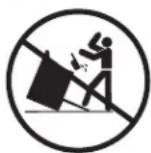
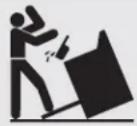
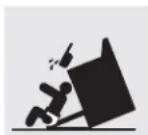
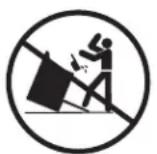
All ranges can tip.
■ BURNS or other SERIOUS INJURIES can result.
INSTALL and CHECK the anti-tip bracket following the instructions supplied with the bracket.
To reduce the risk of tipping the range, the range must be secured by a properly installed anti-tip bracket. See installation instructions shipped with the bracket for complete details before attempting to install.
To check if the bracket is installed and engaged properly, look underneath the range to see that the anti-tip arm attached to the side panel is engaged in the bracket. On some models, the storage drawer or kick panel can be removed for easier inspection. If visual inspection is not
possible, slide the range forward, confirm the anti-tip bracket is securely attached to the floor or wall, and slide the range back so the anti-tip arm slides just under the anti-tip bracket.
If the range is pulled from the wall for any reason, always repeat this procedure to verify the range is properly secured by the anti-tip bracket.
Never completely remove the leveling legs or the range will not be secured to the anti-tip device properly.
If you did not receive an anti-tip bracket with your purchase, call 1.800.626.8774 to receive one at no cost. For installation instructions of the bracket, visit GEAppliances.com (in Canada, GEAppliances.ca).
WARNING
IMPORTANT SAFETY NOTICE
The California Safe Drinking Water and Toxic Enforcement Act requires the Governor of California to publish a list of substances known to the state to cause cancer, birth defects or other reproductive harm, and requires businesses to warn customers of potential exposure to such substances.
The fiberglass insulation in self-clean ovens gives off a very small amount of carbon monoxide during the cleaning cycle. Exposure can be minimized by venting with an open window or using a ventilation fan or hood.
WARNING
GENERAL SAFETY INSTRUCTIONS
WARNING
NEVER use this appliance as a space heater to heat or warm the room. Doing so may result in carbon monoxide poisoning and overheating of the oven.
Use this appliance for its intended purpose as described in this owner's manual.
- Have your range installed and properly grounded by a qualified installer in accordance with the provided installation instructions. Any adjustment and service should be performed only by a qualified gas range installers or service technicians. Do not attempt to repair or replace any part of your range unless it is specifically recommended in this manual.
- Your range is shipped from the factory set for use with natural gas. It can be converted for use with LP gas. If required, these adjustments must be made by a qualified technician in accordance with the installation instructions and local codes. The agency performing this work assumes responsibility for the conversion.
- Have the installer show you the location of the range gas shut-off valve and how to turn it off if necessary.
Before performing any service, remove the 9V battery from the range to disable the spark ignition system.
- Be sure all packing materials are removed from the range before operating to prevent ignition of these materials.
Do not leave children alone or unattended in an area where an appliance is in use. They should never be allowed to climb, sit or stand on any part of the appliance.
Do not store items of interest to children above a range or on the backguard of a range—children climbing on the range to reach items could be seriously injured.
Do not allow anyone to climb, stand or hang on the oven door, drawer or cooktop. They could damage the range or tip it over causing severe injury or death.
Never block the vents (air openings) of the range. They provide the air inlets and outlets that are necessary for the range to operate properly with correct combustion. Air openings are located at the rear of the cooktop, at the top and bottom of the oven door, and at the bottom of the range under the warming drawer, lower oven drawer or kick panel.
Use only dry pot holders—moist or damp pot holders on hot surfaces may result in burns from steam. Do not let pot holders touch surface burners, burner grate, or oven heating element. Do not use a towel or other bulky cloth in place of pot holders.
- Be careful not to touch hot surfaces of the range. Potentially hot surfaces include burners, grates, cooktop, backguard, oven and door interior and crevices around the oven door.
Do not heat unopened food containers. Pressure could build up and the container could burst, causing an injury.
Cook meat and poultry thoroughly—meat to at least an internal temperature of 160^ F and poultry to at least an internal temperature of 180^ F. Cooking to these temperatures usually protects against foodborne illness.
WARNING
KEEP FLAMMABLE MATERIALS AWAY FROM THE RANGE
Do not store or use flammable materials in an oven or near the cooktop, including paper, plastic, pot holders, linens, wall coverings, curtains, drapes and gasoline or other flammable vapors and liquids.
Never wear loose-fitting or hanging garments while using the appliance. Avoid storing commonly used items in cabinets above the range and be careful when reaching over the range. Clothing in close proximity to burners or hot surfaces may ignite causing severe burns.
Do not let cooking grease or other flammable materials accumulate in or near the range. Grease in the oven or on the cooktop may ignite.
- Clean ventilating hoods frequently. Grease should not be allowed to accumulate on the hood or filter.
WARNING
IN THE EVENT OF A FIRE, TAKE THE FOLLOWING STEPS TO PREVENT INJURY AND FIRE SPREADING:
Do not use water on grease fires. Never pick up a flaming pan. Turn the controls off. Smother a flaming pan on a surface burner by covering the pan completely with a well-fitting lid, cookie sheet or flat tray. If necessary, use a multi-purpose dry chemical or foam-type fire extinguisher.
If there is a fire in the oven during baking, turn the oven off and keep the door closed until the fire goes out. If
necessary, use a multi-purpose dry chemical or foam type fire extinguisher.
If there is a fire in the oven during self-clean, turn the oven off and wait for the fire to go out. Do not force the door open. Introduction of fresh air at self-clean temperatures may lead to a burst of flame from the oven. Failure to follow this instruction may result in severe burns.
WARNING
COOKTOP SAFETY INSTRUCTIONS
Never leave the surface burners unattended at medium or high heat settings. Foods, especially oily foods, may ignite resulting in fire that could spread to surrounding cabinets.
Never leave oil unattended while frying. If allowed to heat beyond its smoking point, oil may ignite resulting in fire that may spread to surrounding cabinets. Use a deep fat thermometer whenever possible to monitor oil temperature.
To avoid oil spillover and fire, use a minimum amount of oil when shallow pan-frying and avoid cooking frozen foods with excessive amounts of ice.
Use proper pan size and avoid pans that are unstable or easily tipped. Select cookware that is matched to the size of the burner. Burner flames should be adjusted so that they do not extend beyond the bottom of the pan. Excessive flame may be hazardous.
■ Always use the LITE position when igniting the top burners and make sure the burners have ignited.
When using glass/ceramic cookware, make sure it is suitable for cooktop service; others may break because of sudden change in temperature.
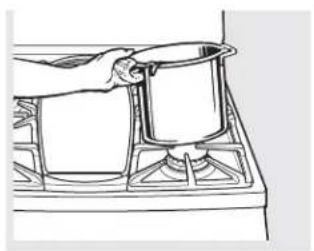
To minimize the possibility of burns, ignition of flammable materials and spillage, the handle of a container should be turned toward the center of the range without extending over nearby burners.
- When preparing flaming foods under a hood, turn the fan on.
Do not use a wok with a round metal support ring. The ring may trap heat and block air to the burner resulting in a carbon monoxide hazard.
Do not attempt to lift the cooktop if your range has sealed surface burners. Doing so may damage the gas tubing to the surface burners resulting in a gas leak and risk of fire.
Do not use aluminum foil to cover the grates or line any part of the cooktop. Doing so may result in carbon monoxide poisoning, overheating of the cooktop surfaces, or a potential fire hazard.
WARNING
OVEN SAFETY INSTRUCTIONS
WARNING
NEVER cover any slots, holes, or passages in the oven bottom or cover an entire rack with materials such as aluminum foil. Doing so blocks air flow through the oven and may cause carbon monoxide poisoning. Aluminum foil linings may also trap heat, causing a fire hazard.
Stand away from the range when opening the oven door. Hot air or steam which escapes can cause burns to hands, face and/or eyes.
- Keep the oven free from grease buildup. Grease in the oven may ignite.
Place oven racks in desired location while oven is cool. If rack must be moved while oven is hot, be careful to avoid touching hot surfaces.
Pull the oven rack to the stop-lock position when loading and unloading food from the oven. This helps prevent burns from touching hot surfaces of the door and oven walls.
Do not leave items such as paper, cooking utensils or food in the oven when not in use. Items stored in an oven can ignite.
Do not leave items on the cooktop near the oven vent which is at the rear edge of the cooktop. Items may overheat resulting in a risk of fire or burns.
- When using cooking or roasting bags in the oven, follow the manufacturer's directions.
- Never broil with door open. Open-door broiling is not permitted due to overheating of control knobs.
Using the gas surface burners.
Throughout this manual, features and appearance may vary from your model.
Before Lighting a Gas Burner
■ Make sure all burners are in place.
■ Make sure all grates on the range are properly placed before using any burner.
After Lighting a Gas Burner
Do not operate the burner for an extended period of time without cookware on the grate. The finish on the grate may chip without cookware to absorb the heat.
- Be sure the burners and grates are cool before you place your hand, a pot holder, cleaning cloths or other materials on them.
natural_image
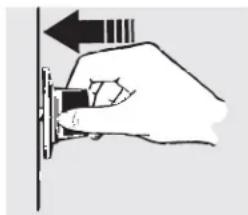
Hand holding a small mechanical component with an arrow indicating upward motion (no text or symbols)Push the control knob in and turn it to the LITE position.
How to Light a Gas Surface Burner
Make sure all the surface burners are placed in their respective positions.
Push the control knob in and turn it to the LITE position.
You will hear a little clicking noise—the sound of the electric spark igniting the burner.
Turn the knob to adjust the flame size. If the knob stays at LITE, it will continue to click.
When one burner is turned to LITE, all the burners spark. Do not attempt to disassemble or clean around any burner while another burner is on. An electric shock may result, which could cause you to knock over hot cookware.
natural_image
Simple line drawing of a cooking pot with a crossed-out black mark, no text or symbols presentHow to Select Flame Size
WARNING
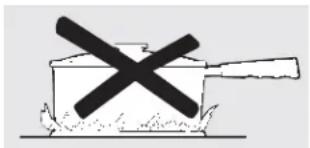
not covered by cookware may present a risk of burns or clothing ignition. Never let flames extend beyond the sides of the cookware.
Watch the flame, not the knob, as you adjust heat. When fast heating is desired, the flame size on a gas burner should match the cookware you are using.
Flames larger than the bottom of the cookware will not result in faster heating and may be hazardous.
Top-of-Range Cookware
Aluminum: Medium-weight cookware is recommended because it heats quickly and evenly. Most foods brown evenly in an aluminum skillet. Use saucepans with tight-fitting lids when cooking with minimum amounts of water.
Cast-Iron: If heated slowly, most skillets will give satisfactory results.
Enamelware: Under some conditions, the enamel of some cookware may melt. Follow cookware manufacturer's recommendations for cooking methods.
Glass: There are two types of glass cookware—those for oven use only and
those for top-of-range cooking (saucepans, coffee and teapots). Glass conducts heat very slowly.
Heatproof Glass Ceramic: Can be used for either surface or oven cooking. It conducts heat very slowly and cools very slowly. Check cookware manufacturer's directions to be sure it can be used on gas ranges.
Stainless Steel: This metal alone has poor heating properties and is usually combined with copper, aluminum or other metals for improved heat distribution. Combination metal skillets usually work satisfactorily if they are used with medium heat as the manufacturer recommends.
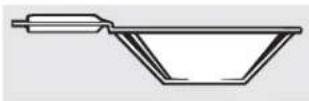
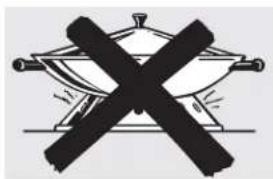
Use a flat-bottomed wok.
natural_image
Symbolic illustration of a pan with a crossed-out black 'X' on top, representing resistance or crossed-out cooking (no text present)Wok This Way
We recommend that you use a 14-inch or smaller flat-bottomed wok. Make sure the wok bottom sits flat on the grate. They are available at your local retail store.
Only a flat-bottomed wok should be used.
Do not use a wok support ring. Placing the ring over the burner or grate may cause the burner to work improperly, resulting in carbon monoxide levels above allowable standards. This could be dangerous to your health.
Replacing the 9V Battery
⚠️CAUTION Battery may explode or leak and cause burn injury, if recharged, disposed of in fire, inserted backwards, or missassembled.
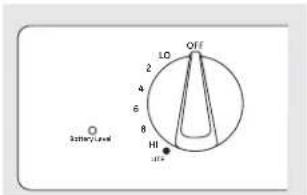
When a knob is turned to the LITE position, sparking will occur at the burners. A weak battery will cause the amount of time between sparks to increase. If the time between sparks exceeds one second, replace the battery. If a surface burner doesn't light within five seconds, turn gas off and wait one minute for gas to dissipate before attempting to light again.
On some models, a Battery Level indicator light is located to the left of the burner knobs. This light will glow as the burners are being lit if the battery has enough power. If this indicator light fails to glow during sparking, the battery power level is low and the battery should be replaced soon.
IMPORTANT: Replace with standard 9V alkaline battery. Follow all state and local requirements for disposing of the old battery.
Lighting Burners with a Match
If the battery is too weak to light the burners, you can light the gas surface burners on your range with a wooden kitchen match. Hold a lit match to the burner, then push in and turn the control knob to the LITE position. Use extreme caution when lighting burners this way. Surface burners in use when an electrical power failure occurs will continue to operate normally.
Using the oven.
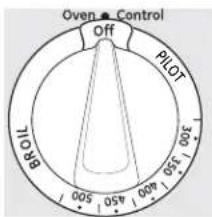
To operate the oven:
1 Ensure gas is available at the range by lighting any surface burner and turning it off again.
2 Push and turn knob to the PILOT position.
3 Push in completely and hold for 10 seconds, then release (Holding in on the oven control knob for less than 10 seconds at the PILOT position may cause the oven burner not to light.)
4 Push and turn to the temperature you want.
5 Check for oven burner flame by opening the oven door and looking through the hole at the front of the oven bottom.
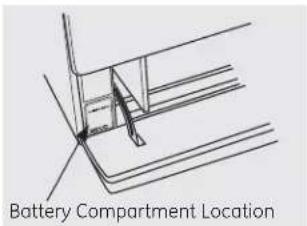
If no sparking noise is heard when the oven temperature knob is pushed in at the PILOT position, replace the battery with a fresh 9V alkaline battery. Battery compartment is located behind the broil door.
6 Turn the control knob to OFF when finished baking.
To avoid possible burns, place the shelves in the desired position before you turn the oven on.
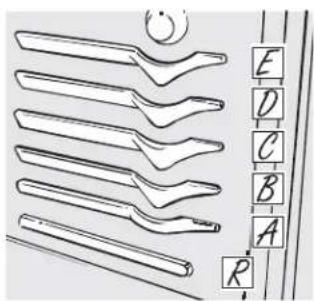
The oven has 5 shelf positions. It also has a special low shelf position (R) for extra large items, such as a large turkey.
Before you begin...
The shelves have stop-locks, so that when placed correctly on the shelf supports (A through E), they will stop before coming completely out, and will not tilt.
When placing and removing cookware, pull the shelf out to the bump on the shelf support.
CAUTION
When you are
using a rack in the lowest position (R), you will need to use caution when pulling the rack out. We recommend that you pull the rack out several inches and then, using two
pot holders, pull the rack out by holding the sides of it. The rack is low and you can be burned if you put your hand in the middle of the rack and pull all the way out.
To remove a shelf, pull it toward you, tilt the front end up and pull it out.
To replace, place the end of the shelf (stop-locks) on the support, tilt up the front and push the shelf in.
NOTE: The shelf is not designed to slide out at the special low shelf (R) position.
natural_image
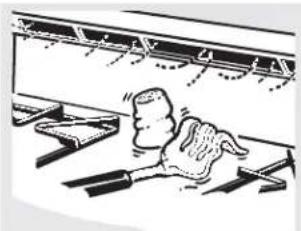
Illustration of a hand pressing down on a mechanical component (no text or symbols visible)Plastic items on the cooktop may melt if left too close to the vent. Vent appearance and location vary.
Upper Oven Vent
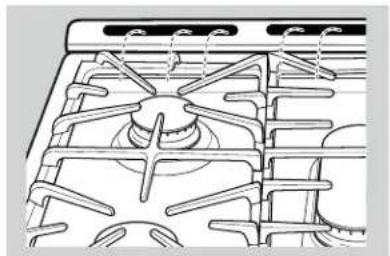
Your oven is vented through ducts at the rear of the range. Do not block these ducts when cooking in the oven—it is important that the flow of hot air from the oven and fresh air to the oven burner be uninterrupted. Avoid touching the vent openings or nearby surfaces during oven or broiler operation—they may become hot.
■ Handles of pots and pans on the cooktop may become hot if left too close to the vent.
Do not leave plastic or flammable items on the cooktop—they may melt or ignite if left too close to the vent.
Do not leave closed containers on the cooktop. The pressure in closed containers may increase, which may cause them to burst.
■ Metal items will become very hot if they are left on the cooktop, and could cause burns.
Do not leave closed containers on the cooktop. The pressure in closed containers may increase, which may cause them to burst.
■ Metal items will become very hot if they are left on the cooktop, and could cause burns.
natural_image
Diagram of a vehicle interior with structural beams and a hand holding a tool (no text or labels)Lighting the Oven with a Match
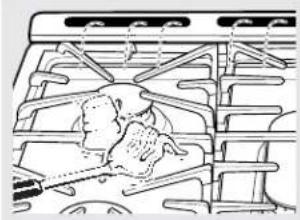
The oven of a battery-powered cordless range may be lit with a match and operated normally, even if the battery is too weak to activate the spark system. Follow these steps to match-light the oven burner:
- Remove the oven door, oven racks, and oven bottom. To remove oven bottom, remove two 1/4" hex head screws at the rear of the oven.
- Locate the oven burner pilot at the left rear of the oven burner.
-
Hold a lit match to the oven burner pilot. Turn the oven control knob to the PILOT position and push in completely.
-
After pilot lights, continue to hold in firmly on the knob for 10 seconds before releasing.
- Pilot should remain lit. If not, repeat steps 3 and 4.
- Replace oven bottom, racks, and oven door.
- Turn knob to the desired temperature setting. Oven will operate normally.
Turn oven control knob to OFF when finished baking.
If your model has a door latch, do not lock the oven door with the latch during baking or roasting. The latch is used for self-cleaning only.
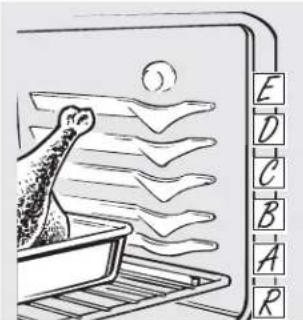
The oven has a special low shelf (R) position just above the oven bottom. Use it when extra cooking space is needed, for example, when cooking a large turkey. The shelf is not designed to slide out at this position.
Preheating and Pan Placement
To avoid possible burns, place the racks in the desired position before you turn on the oven.
Preheat the oven if the recipe calls for it. To preheat, set the oven at the correct temperature. Preheating is necessary for good results when baking cakes, cookies, pastry and breads.
For ovens without a preheat indicator light or tone, preheat 10 minutes.
Baking results will be better if baking pans are centered in the oven as much as possible. Pans should not touch each other or the walls of the oven. If you need to use two shelves, stagger the pans so one is not directly above the other, and leave approximately 1½" between pans, from the front, back and sides of the wall.
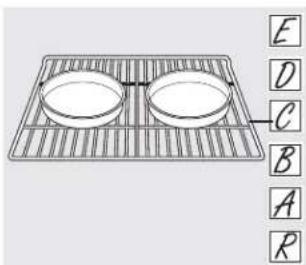
When baking on a single rack, use rack position C. Baking results will be better if baking pans are centered in the oven as much as possible.
Using the oven.
Aluminum Foil
Do not use aluminum foil to line oven bottoms. The foil will trap heat below and upset the performance of the oven. Foil can melt and permanently damage the oven bottom. Damage from improper use of aluminum foil is not covered by the product warranty.
Foil may be used to catch spills by placing a sheet on a lower rack, several inches below the food. Do not use more foil than necessary and never entirely cover an oven rack with aluminum foil. Keep foil at least 1-1/2" from oven walls to prevent poor heat circulation.
Oven Moisture
As your oven heats up, the temperature change of the air in the oven may cause water droplets to form on the door glass. These droplets are harmless and will evaporate as the oven continues to heat up.
How to Set the Broiler Compartment (on some models)
Broiling is cooking food by direct heat from above the food. Most fish and tender cuts of meat can be broiled. Follow these directions to keep spattering and smoking to a minimum.
Your range has a compartment below the oven for broiling.
Both the oven and broiler compartment doors must be closed during broiling.
Turn most foods once during cooking (the exception is thin fillets of fish; oil one side, place that side down on broiler grid and cook without turning until done). Time foods for about one-half the total cooking time, turn food, then continue to cook to preferred doneness.
You can change the distance of the food from the heat source by positioning the broiler pan and grid on one of three rack positions in the broiler compartment—A (bottom of broiler compartment), B (middle) and C (top).
2 Preheating the broiler or oven is not necessary and can produce poor results.
3 If meat has fat or gristle around the edge, cut vertical slashes through both about 2" apart. If desired, the fat may be trimmed, leaving a layer about 1/8" thick.
4 Arrange the food on the grid and position the broiler pan on the appropriate rack in the oven or broiling compartment. Placing food closer to the flame increases exterior browning of the food, but also increases spattering and the possibility of fats and meat juices igniting.
5 Close the oven and broiler compartment door.
6 Follow oven lighting instructions (see Using the Oven) and then turn the knob to BROIL.
When broiling is finished, turn the OVEN CONTROL knob to OFF. Remove the broiler pan from the broiler compartment and serve the food immediately. Leave the pan outside the range to cool.
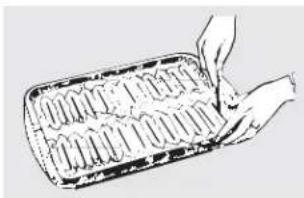
natural_image
Line drawing of a hand holding a tray with multiple rectangular objects (no text or symbols)Cut slits in the foil just like the grid.
Aluminum Foil
You can use aluminum foil to line your broiler pan and broiler grid. However, you must mold the foil tightly to the grid and cut slits in it just like the grid.
Broiling Compartment Guide Suggestions
Both the oven and broiler compartment doors must be closed during broiling.
■ Always use the broiler pan and grid that comes with your range. It is designed to minimize smoking and spattering by trapping juices in the shielded lower part of the pan.
For steaks and chops, slash fat evenly around the outside edges of the meat. To slash, cut crosswise through the outer fat surface just to the edge of the meat. Use tongs to turn the meat over to prevent piercing the meat and losing juices.
If desired, marinate meats or chicken before broiling. Or brush with barbecue sauce last 5–10 minutes only.
When arranging the food on the pan, do not let fatty edges hang over the sides because dripping fat could soil the oven.
The broiler compartment does not need to be preheated. However, for very thin foods, or to increase browning, preheat if desired.
Frozen steaks can be broiled by positioning the rack at the next lowest rack position and increasing the cooking time given in this guide 1½ times per side.
Adjust the oven thermostat—Do it yourself!
You may find that your new oven cooks differently than the one it replaced. Use your new oven for a few weeks to become more familiar with it. If you still think your new oven is too hot or too cold, you can adjust the thermostat knob yourself.
Do not use thermometers, such as those found in grocery stores, to check the temperature setting of your oven. These thermometers may vary 20–40 degrees.
NOTE: This adjustment will not affect the broiling temperature.
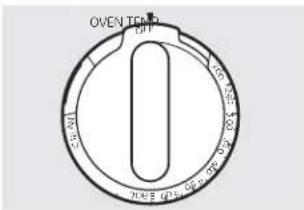
Front of OVEN TEMP knob (knob appearance may vary)
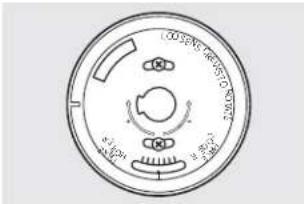
Back of OVEN TEMP knob (knob appearance may vary)
To Adjust the Thermostat (on models with an OVEN TEMP Knob)
1 Pull the OVEN TEMP knob off the range and look at the back side. To make an adjustment, loosen (approximately one turn), but do not completely remove, the two screws on the back of the knob.
With the back of the knob facing you, hold the outer edge of the knob with one hand and turn the front of the knob with the other hand.
To increase the oven temperature, move the top screw toward the right. You'll hear a click for each notch you move the knob. To decrease the oven temperature, move the top screw toward the left.
Each click will change the oven temperature approximately 10^ F. (Range is plus or minus 60^ F from the arrow.) We suggest that you make the adjustment one click from the original setting and check oven performance before making any additional adjustments.
3 After the adjustment is made, retighten screws so they are snug, but be careful not to overtighten.
4 Replace the knob, matching the flat area of the knob to the shaft, and check performance.
The type of margarine will affect baking performance!
Most recipes for baking have been developed using high-fat products such as butter or margarine (80% fat). If you decrease the fat, the recipe may not give the same results as with a higher-fat product.
Recipe failure can result if cakes, pies, pastries, cookies or candies are made with low-fat spreads. The lower the fat content of a spread product, the more noticeable these differences become.
Federal standards require products labeled "margarine" to contain at least 80% fat by weight. Low-fat spreads, on the other hand, contain less fat and more water. The high moisture content of these spreads affects the texture and flavor of baked goods. For best results with your old favorite recipes, use margarine, butter or stick spreads containing at least 70% vegetable oil.
Be sure electrical power is off and all surfaces are cool before cleaning any part of the range.
WARNING
If your range is removed for cleaning, servicing or any reason, be sure the anti-tip device is reengaged properly when the range is replaced. Failure to take this precaution could result in tipping of the range and cause injury.
To check if the bracket is installed and engaged properly, look underneath the range to see that the anti-tip arm attached to the side panel is engaged in the bracket. On some models, the storage drawer or kick panel can be removed for easier inspection. If visual inspection is not possible, slide the range forward, confirm the anti-tip bracket is securely attached to the floor or wall, and slide the range back so the anti-tip arm slides just under the anti-tip bracket.
If the range is pulled from the wall for any reason, always repeat this procedure to verify the range is properly secured by the anti-tip bracket.
If your range has no anti-tip bracket, call 1.800.626.8774 to receive one at no cost.
CAUTION:
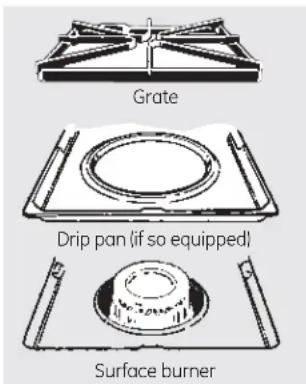
Do not operate the cooktop without all burner parts, drip pans (if so equipped) and grates in place.
natural_image
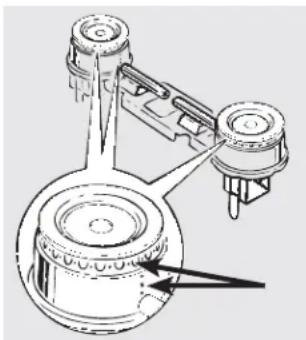
Technical line drawing of a mechanical device with two circular components and a central shaft (no text or symbols)Clean these holes thoroughly on each burner.
Standard Twin Burner Assemblies
On models with standard twin burners, the cooktop lifts up for easy access.
Turn all controls OFF before removing burner parts and drip pans (if so equipped).
The burner grates and drip pans (if so equipped) can be lifted off, making them easy to clean.
The holes in the surface burners of your range must be kept clean at all times for proper ignition and an even, unhampered flame.
You should clean the surface burners routinely, especially after bad spillovers, which could clog these holes.
Wipe off surface burners. If heavy spillover occurs, remove the surface burners from the range. Burners lift out for cleaning. Lift up the cooktop and then lift out the surface burners.
To remove burned-on food, soak the surface burner in a solution of mild liquid detergent and hot water. Soak the surface burner for 20 to 30 minutes.
For more stubborn stains, use a cleanser like Soft Scrub ^® brand or Bon Ami ^® brand. Rinse well to remove any traces of the cleanser that might clog the surface burner openings.
Do not use steel wool because it will clog the surface burner openings and scratch the surface burners. If the holes become clogged, clean them with a sewing needle or twist-tie.
Before putting the surface burner back, shake out excess water and then dry it thoroughly by setting it in a warm oven for 30 minutes. Then place it back in the range, making sure it is properly seated and level.
Check the flame pattern of each burner. If the flames are "jumpy" (not steady), clean the holes again with a sewing needle or twist-tie.
Cleaning Burner Grates
Lift out when cool. Grates should be washed regularly and, of course, after spillovers. Wash them in hot, soapy water and rinse with clean water. When replacing the grates, be sure they are positioned securely over the burners. Replace the grates so that continuous arcs are formed with the center ribs of all three grates.
Do not operate a burner for an extended period of time without cookware on the grate. The finish on the grate may chip without cookware to absorb the heat.
To get rid of burned-on food, place the grates in a covered container. Add 1/4 cup ammonia and let them soak several hours or overnight. Wash, rinse well and dry.
Although they are durable, the grates will gradually lose their shine, regardless of the best care you can give them. This is due to their continual exposure to high temperatures. You will notice this sooner with lighter color grates.
natural_image
Line drawing of a hand pouring liquid into a pan with three empty containers (no text or symbols)Cooktop Surface
To avoid damaging the porcelain-enamel surface of the cooktop and to prevent it from becoming dull, clean up spills right away. Foods with a lot of acid (tomatoes, sauerkraut, fruit juices, etc.) or foods with high sugar content could cause a dull spot if allowed to set.
When the surface has cooled, wash and rinse. For other spills such as fat spatterings, wash with soap and water once the surface has cooled. Then rinse and polish with a dry cloth.
natural_image
Line drawing of a car air conditioner unit with multiple outlets (no text or labels)Oven Air Vents
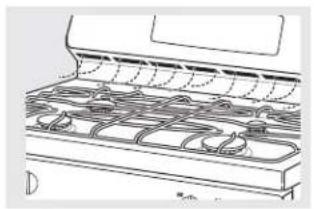
Never block the vents (air openings) of the range. They provide the air inlet and outlet that are necessary for the range to operate properly with correct combustion.
Air openings are located at the rear of the cooktop, at the top and bottom of the oven door, and at the bottom of the range.
natural_image
Line drawing of a gas stove burner with heat exchangers (no text or symbols)Vent appearance and location vary.
Surface burner knob
Front Control Panel and Knobs
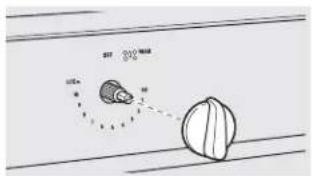
It's a good idea to wipe the control panel after each use of the oven. Use a damp cloth to clean or rinse. For cleaning, use mild soap and water or a 50/50 solution of vinegar and water. For rinsing, use clean water. Polish dry with a soft cloth.
Do not use abrasive cleansers, strong liquid cleaners, plastic scouring pads or oven cleaners on the control panel—they will damage the finish.
Do not try to bend knobs by pulling them up or down or by hanging a towel or other such loads. This can damage the gas valve shaft.
The control knobs may be removed for easier cleaning.
Make sure the knobs are in the OFF positions and pull them straight off the stems for cleaning.
The knobs can be cleaned in a dishwasher or they may also be washed with soap and water. Make sure the insides of the knobs are dry before replacing.
Replace the knobs in the OFF position to ensure proper placement.
Metal parts can be cleaned with soap and water. Do not use steel wool, abrasives, ammonia, acids or commercial oven cleaners. Dry with a soft cloth.
NOTE: Knobs are not interchangeable. Be sure to reinstall the knobs to the original location.
natural_image
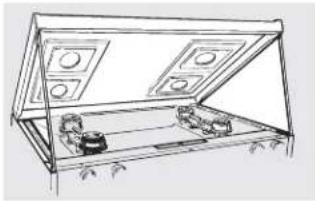
Line drawing of an open storage cabinet with internal compartments and doors (no text or symbols)Some models have dual support rods that will hold the cooktop up while you clean underneath it.
Lift-Up Cooktop (on models with standard twin burners)
Clean the area under the cooktop often. Built-up soil, especially grease, may catch on fire.
To make cleaning easier, the cooktop may be lifted up.
NOTE: Do not lift the cooktop on sealed burner models. Lifting the cooktop can lead to damage and improper operation of the range.
To raise the cooktop:
1 Be sure the burners are turned off.
2 Remove the grates.
3 Grasp the two front burner wells and lift up.
Clean under the cooktop with hot, soapy water and a clean cloth. If you removed your surface burners while cleaning, make sure they are properly seated when replacing them.
After cleaning, lower the cooktop (be careful not to pinch your fingers).
Oven Bottom
The oven bottom has a porcelain-enamel finish. To make cleaning easier, protect the oven bottom from excessive spillovers by placing a cookie sheet on the rack below the rack you are cooking on. This is particularly important when baking a fruit pie or other foods with a high acid content. Hot fruit fillings or other foods that are highly acidic
(such as tomatoes, sauerkraut and sauces with vinegar or lemon juice) may cause pitting and damage to the porcelain-enamel surface and should be wiped up immediately.
To clean up spillovers, use soap and water, an abrasive cleaner or soap-filled scouring pad. Rinse well to remove any soap before self-cleaning.
natural_image
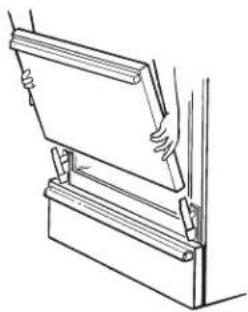
Line drawing of a mechanical assembly with two plates and metal brackets (no text or symbols)Lift the door straight up and off the hinges.
Lift-Off Oven Door (on some models)
The oven door is removable, but it is heavy. You may need help removing and replacing the door.
To remove the door:
1 Open it a few inches to the special stop position that will hold the door open.
2 Grasp firmly on each side and lift the door straight up and off the hinges.
NOTE: Be careful not to place hands between the hinge and the oven door frame since the hinge could snap back and pinch fingers.
To replace the door:
1 Make sure the hinges are in the special stop position. Position the slots in the bottom of the door squarely over the hinges.
2 Lower the door slowly and evenly over both hinges at the same time. If the hinges snap back against the oven frame, pull them back out.
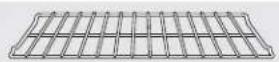
Oven Racks
All oven racks may be cleaned by hand with an abrasive cleaner or steel wool. After cleaning, rinse the racks with clean water and dry with a clean cloth. It will be necessary to grease all
oven rack side edges with a light coating of vegetable oil after cleaning them by hand or in the oven. This will help maintain the ease of sliding the racks in and out of the oven.
natural_image
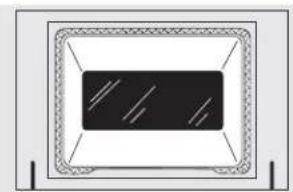
Simple diagram of a rectangular frame with a central black rectangle and diagonal lines, no text or symbols present.The gasket is designed with a gap at the bottom to allow for proper air circulation. Do not rub or clean the door gasket—it has an extremely low resistance to abrasion. If you notice the gasket becoming worn, froyed or damaged in any way or if it has become displaced on the door, you should have it replaced.
Cleaning the Door
To clean the inside of the door:
Do not allow excess water to run into any holes or slots in the door.
The area outside the gasket can be cleaned with a soap-filled plastic scouring pad.
To clean the outside of the door:
Use soap and water to thoroughly clean the top, sides and front of the oven door. Rinse well.
■ Spillage of marinades, fruit juices, tomato sauces and basting materials containing acids may cause discoloration and should be wiped up immediately. When the surface is cool, clean and rinse.
Do not use oven cleaners, cleansing powders or harsh abrasives on the outside of the door.
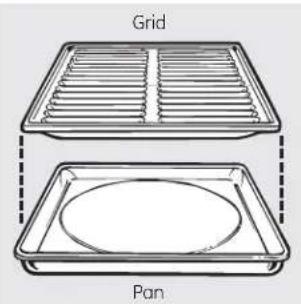
Broiler Pan and Grid
After broiling, remove the broiler pan from the broiler compartment. Remove the grid from the pan. Carefully pour out grease from the pan into a proper container. Wash and rinse the broiler pan and grid in hot water with a soap-filled or plastic scouring pad.
If food has burned on, sprinkle the grid with detergent while hot and cover with wet paper towels or a dishcloth. Soaking the pan will remove burned-on foods.
The broiler pan and grid may be cleaned with a commercial oven cleaner.
Both the broiler pan and grid can also be cleaned in a dishwasher.
Do not store a soiled broiler pan and grid anywhere in the range.
⚠️ CAUTION: Do not clean the broiler pan or grid in a self-cleaning oven.
Installation Instructions
Range
If you have questions, call 1.800.GE.CARES or visit our Web site at: GEAppliances.com
In the Commonwealth of Massachusetts
- This product must be installed by a licensed plumber or gas fitter.
- When using ball type gas shut-off valves, they shall be the T-handle type.
- A flexible gas connector, when used, must not exceed 3 feet.
BEFORE YOU BEGIN
Read these instructions completely and carefully. Installation of this range must conform with local codes, or in the absence of local codes, with the National Fuel Gas Code, ANSI Z223.1/NFPA.54, latest edition. In Canada, installation must conform with the current Natural Gas Installation Code, CAN/CGA-B149.1 or the current Propane Installation Code, CAN/CGA-B149.2, and with local codes where applicable. This range has been design-certified by CSA International according to ANSI Z21.1, latest edition and Canadian Gas Association according to CAN/CGA-1.1 latest edition.
As with any appliance using gas and generating heat, there are certain safety precautions you should follow. You will find these precautions in the Important Safety Information section in the front of this manual. Read them carefully.
- IMPORTANT – Save these instructions for local electrical inspector's use.
• IMPORTANT – Observe all governing codes and ordinances. - Note to Installer – Leave these instructions with the appliance after installation is completed.
- Note to Consumer – Keep this Owner's Manual and Installation Instructions for future reference.
- Note – This appliance must be properly grounded.
- Servicer – The electrical diagram is in an envelope attached to the back of the range.
• Proper installation is the responsibility of the installer. - Product failure due to improper installation is not covered under the Warranty.
Mobile Home - Additional Installation Requirements
The installation of this range must conform to the Manufactured Home Construction and Safety Standard, Title 24 CFR, Part 3280 (formerly the Federal Standard for Mobile Home Construction, use the Standard for Manufactured Home Installations, ANSI A225, 1/NFPA 501A or with local codes.
Mobile home installations require:
- When this range is installed in a mobile home, it must be secured to the floor during transit. Any method of securing the range is adequate as long as it conforms to the standards listed above.
FOR YOUR SAFETY
Do not store or use combustible materials, gasoline or other flammable vapors and liquids in the vicinity of this or any other appliance.
If you smell gas:
1 Open windows.
2 Don't touch electrical switches.
3 Extinguish any open flame.
4 Immediately call your gas supplier.
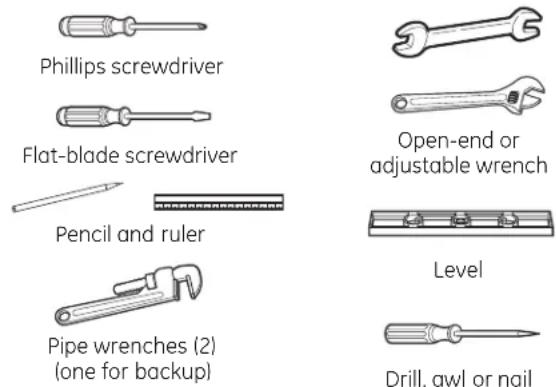
TOOLS YOU WILL NEED
MATERIALS YOU MAY NEED
• Gas line shut-off valve
- Pipe joint sealant or UL-approved pipe thread tape with Teflon* that resists action of natural and LP gases
- Flexible metal appliance connector (1/2" I.D.)
A 5-foot length is recommended for ease of installation but other lengths are acceptable. Never use an old connector when installing a new range.
- Flare union adapter for connection to gas supply line (3/4" or 1/2" NPT × 1/2" I.D.)
- Flare union adapter for connection to pressure regulator on range (1/2" NPT × 1/2" I.D.)
• Liquid leak detector or soapy water.
- Lag bolt or 1/2" O.D. sleeve anchor (for concrete floors only).
*Teflon: Registered trademark of DuPont
WARNING
INSTALLATION SAFETY INSTRUCTIONS
Read these instructions completely and carefully. Failure to follow these instructions can result in electrical shock, fire, serious injury, or death.
■ Improper installation, adjustment, alteration, service or maintenance can cause injury or property damage. Refer to this manual. For assistance or additional information, consult a qualified installer, service agency, manufacturer (dealer) or the gas supplier.
■ Never reuse old flexible connectors. The use of old flexible connectors can cause gas leaks and personal injury. Always use NEW flexible connectors when installing a gas appliance.
■ Leak testing of the appliance shall be conducted according to the manufacturer instructions.
■ Remove all packing material and literature from oven before connecting gas and electrical supply to range.
■ Do not attempt to operate the oven of this range during a power failure (Electric Ignition models only).
■ Have your range installed by a qualified installer.
- Your range must be electrically grounded in accordance with local codes or, in the absence of local codes, in accordance with the National Electrical Code (ANSI/NFPA 70, latest edition). In Canada, electrical grounding must be in accordance with the current CSA C22.1 Canadian Electrical Code Part 1 and/or local codes. See Electrical Connections in this section.
■ Before installing your range on linoleum or any other synthetic floor covering, make sure the floor covering can withstand 180°F without shrinking, warping or discoloring. Do not install the range over carpeting unless a sheet of 1/4" thick plywood or similar insulator is placed between the range and carpeting.
■ Make sure the cabinets and wall coverings around the range can withstand heat generated by the range up to 200°F.
■ Avoid placing cabinets above the range. To reduce the hazard caused by reaching over the open flames of operating burners, install a ventilation hood over the range that projects forward at least 5" beyond the front of the cabinets.
■ The ventilating hood must be constructed of sheet metal not less than 0.0122" thick. Install above the cooktop with a clearance of not less than 1/4" between the hood and the underside of the combustible material or metal cabinet. The hood must be at least as wide as the appliance and centered over the appliance. Clearance between the cooking surface and the ventilation hood surface MUST NEVER BE LESS THAN 24".
EXCEPTION: Installation of a listed microwave oven or cooking appliance over the cooktop shall conform to the installation instructions packed with that appliance.
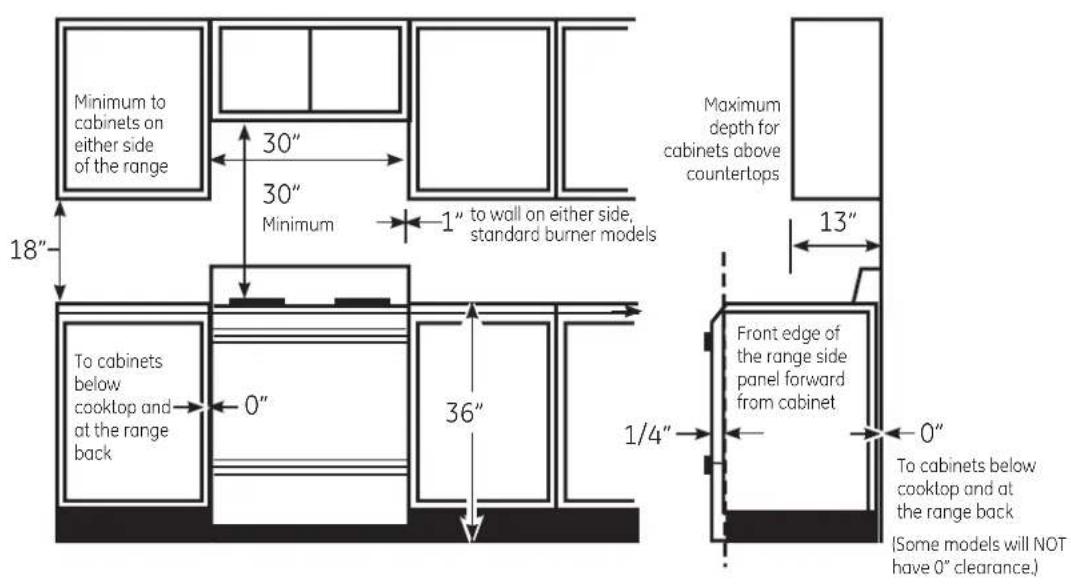
If cabinets are placed above the range, allow a minimum clearance of 30" between the cooking surface and the bottom of unprotected cabinets.
If a 30" clearance between cooking surface and overhead combustible material or metal cabinets cannot be maintained, protect the underside of the cabinets above the cooktop with not less than 1/4" insulating millboard covered with sheet metal not less than 0.0122" thick. Clearance between the cooking surface and protected cabinets MUST NEVER BE LESS THAN 24".
■ The vertical distance from the plane of the cooking surface to the bottom of adjacent overhead cabinets extending closer than 1" to the plane of the range sides must not be less than 18". (See the Dimensions and Clearances illustration in this section.)
■ Do not install this product with an air curtain hood or other range hood that operates by blowing air down on the cooktop. This airflow may interfere with operation of the gas burners resulting in fire or explosion hazard.
CAUTION - Only the GE Café branded series of Advantium® or microwave over-the-range ovens are designed to be installed above the GE Café range. Surfaces above a gas range can become hot. Installation of any other over-the-range oven above a GE Café range may result in surface temperatures that can cause burns.
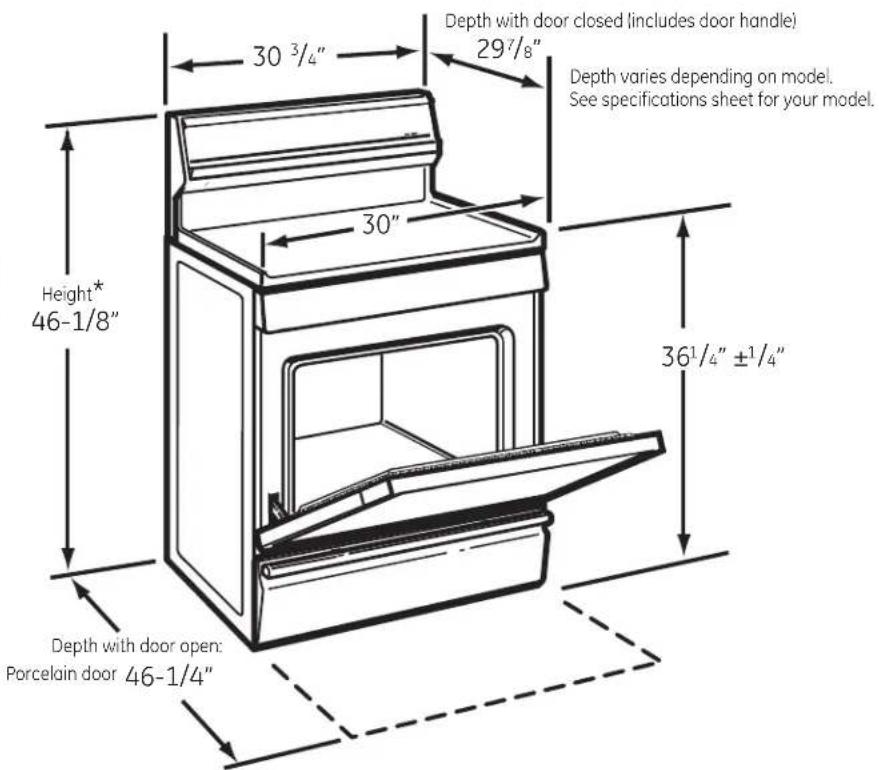
DIMENSIONS AND CLEARANCES
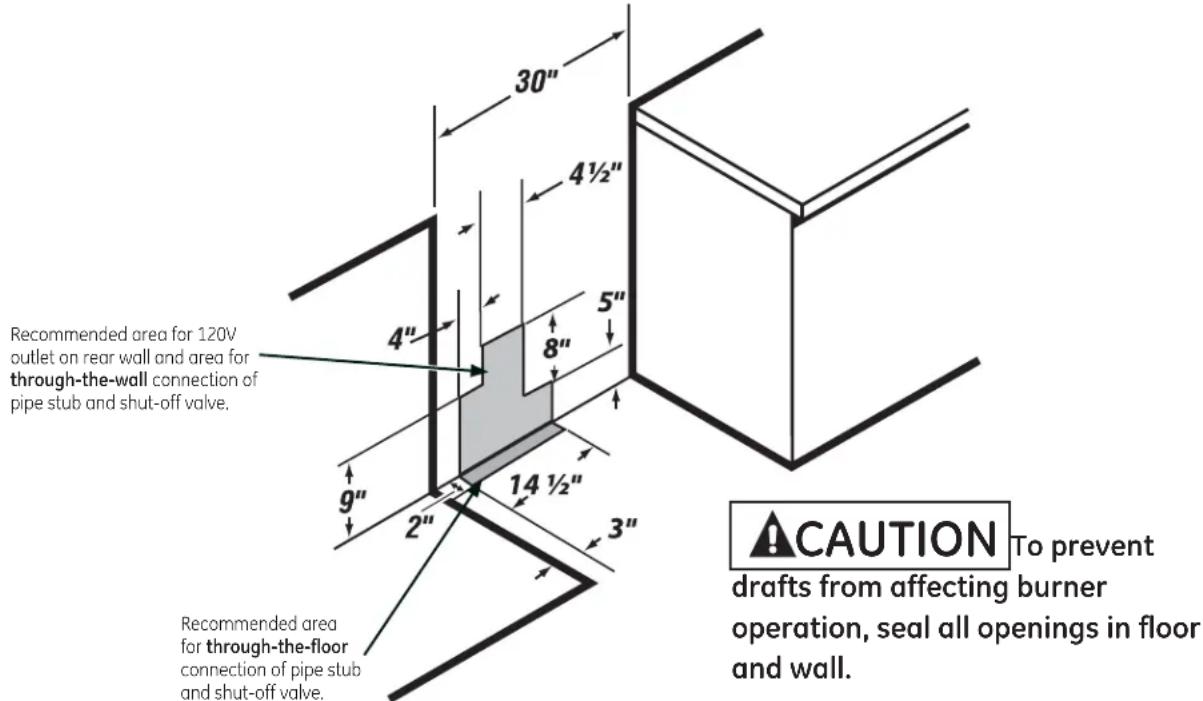
Provide adequate clearances between the range and adjacent combustible surfaces. These dimensions must be met for safe use of your range. The location of the electrical outlet and pipe opening (see Gas Pipe and Electric Outlet Locations) may be adjusted to meet specific requirements.
The range may be placed with 0" clearance (flush) at the back wall.
| Height | Model |
| 46-7/8" | JGBS14 |
| 39-7/8" | RGB518 |
LOCATION
Do not locate the range where it may be subject to strong drafts. Any openings in the floor or wall behind the range should be sealed. Make sure the openings around the base of the range that supply fresh air for combustion and ventilation are not obstructed by carpeting or woodwork.
Your range, like many other household items, is heavy and can settle into soft floor coverings such as cushioned vinyl or carpeting. Use care when moving the range on this type of flooring. It is recommended that the following simple and inexpensive instructions be followed to protect your floor.
The range should be installed on a sheet of plywood (or similar material). When the floor covering ends at the front of the range, the area that the range will rest on should be built up with plywood to the same level or higher than the floor covering.
This will allow the range to be moved for cleaning or servicing. Also, make sure your floor covering will withstand 180°F. (See the Installation Safety Instructions section.)
Make sure the wall coverings around your range can withstand the heat generated (up to 200°F) by the range. (See the Installation Safety Instructions section.)
IMPORTANT!
Remove all tape and packaging. Make sure the burners are properly seated and level.
Take the accessory pack out of the oven and/or drawer. Check to be sure that no range parts have come loose during shipping.
CONVERTING TO LP GAS (or converting back to natural gas from LP)
This range leaves the factory set for use with natural gas. If you want to convert to LP gas, the conversion must be performed by a qualified LP gas installer.
The conversion instructions and LP orifices can be found attached to the range next to the pressure regulator.
Keep these instructions and the orifices in case you want to convert back to natural gas.
1 PROVIDE ADEQUATE GAS SUPPLY
Your range is designed to operate at a manifold pressure of 4" of water column on natural gas or, if designed for LP gas (propane or butane), 10" of water column.
Make sure you are supplying your range with the type of gas for which it is designed.
This range is convertible for use on natural or propane gas. If you decide to use this range on LP gas, conversion must be made by a qualified LP installer before attempting to operate the range on that gas.
For proper operation, the pressure of natural gas supplied to the regulator must be between 5" and 13" of water column.
For LP gas, the pressure supplied must be between 11" and 13" of water column.
When checking for proper operation of the regulator, the inlet pressure must be at least 1" greater than the operating (manifold) pressure as given above.
The pressure regulator located at the inlet of the range manifold must remain in the supply line regardless of whether natural or LP gas is being used.
A flexible metal appliance connector used to connect the range to the gas supply line should have an I.D. of 1/2" and be 5 feet in length for ease of installation. In Canada, flexible connectors must be single wall metal connectors no longer than 6 feet in length.
2 CONNECT THE RANGE TO GAS
Shut off the main gas supply valve before disconnecting the old range and leave it off until the new hook-up has been completed. Don't forget to relight the pilot on other gas appliances when you turn the gas back on.
Because hard piping restricts movement of the range, the use of a CSA International-certified flexible metal appliance connector is recommended unless local codes require a hard-piped connection.
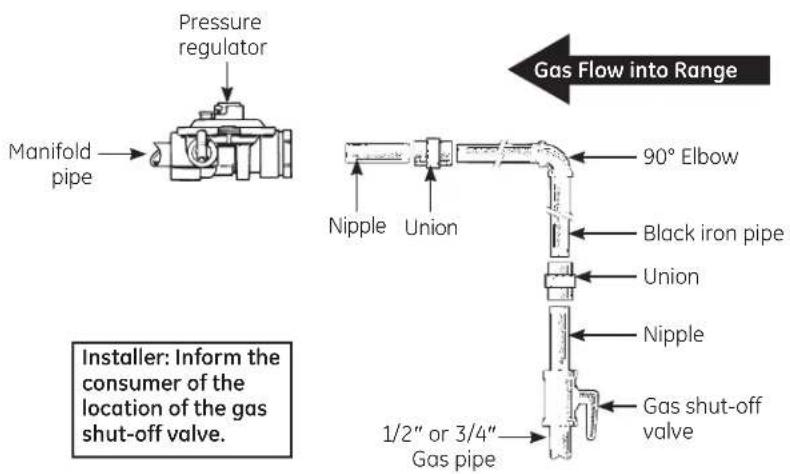
Never use an old connector when installing a new range. If the hard piping method is used, you must carefully align the pipe; the range cannot be moved after the connection is made.
To prevent gas leaks, put pipe joint compound on, or wrap pipe thread tape with Teflon* around, all male (external) pipe threads.
A. Install a manual gas line shut-off valve in the gas line in an easily accessed location outside of the range. Make sure everyone operating the range knows where and how to shut off the gas supply to the range.
B. Install male 1/2" flare union adapter to the 1/2" NPT internal thread at inlet of regulator. Use a backup wrench on the regulator fitting to avoid damage.
When installing the range from the front, remove the 90° elbow for easier installation.
C. Install male 1/2" or 3/4" flare union adapter to the NPT internal thread of the manual shut-off valve, taking care to back-up the shut-off valve to keep it from turning.
D. Connect flexible metal appliance connector to the adapter on the range. Position range to permit connection at the shut-off valve.
E. When all connections have been made, make sure all range controls are in the off position and turn on the main gas supply valve. Use a liquid leak detector at all joints and connections to check for leaks in the system.
WARNING
Fire hazard: Do not use a
flame to check for gas leaks.
When using test pressures greater than 1/2 psig to pressure test the gas supply system of the residence, disconnect the range and individual shut-off valve from the gas supply piping. When using test pressures of
1/2 psig or less to test the gas supply system, simply isolate the range from the gas supply system by closing the individual shut-off valve.
*Teflon: Registered trademark of DuPont
GAS PIPE AND ELECTRICAL OUTLET LOCATIONS
FLEXIBLE CONNECTOR HOOKUP
(for models equipped with Standard Twin Burners)
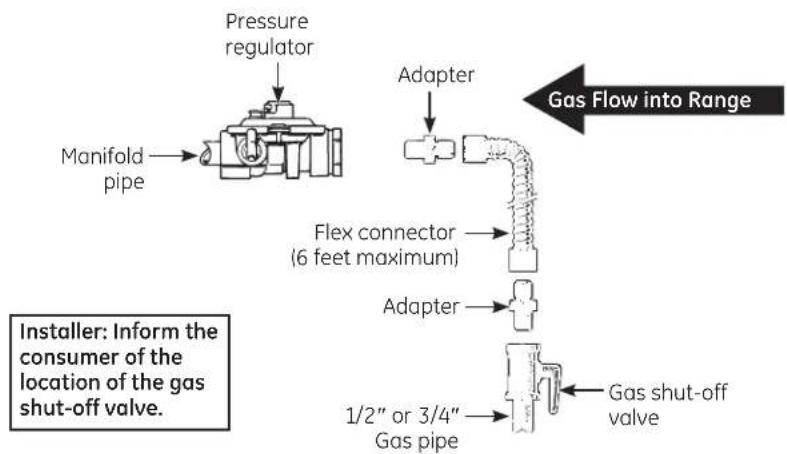
flowchart
graph TD
    A["Manifold pipe"] --> B["Pressure regulator"]
    B --> C["Adapter"]
    C --> D["Flex connector (6 feet maximum)"]
    D --> E["Adapter"]
    E --> F["1/2" or 3/4" Gas pipe"]
    F --> G["Gas shut-off valve"]
    style A fill:#f9f,stroke:#333
    style B fill:#ccf,stroke:#333
    style C fill:#cfc,stroke:#333
    style D fill:#fcc,stroke:#333
    style E fill:#cff,stroke:#333
    style F fill:#ffc,stroke:#333
    style G fill:#fcc,stroke:#333
RIGID PIPE HOOKUP (for models equipped with Standard Twin Burners)
3 INSTALLING THE BATTERY
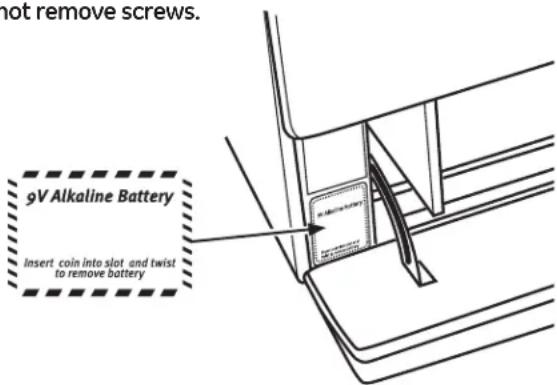
Operation of the spark ignition system requires that a 9V alkaline battery, packed with these instructions, be installed. The battery compartment is located behind the broil drawer on the lower left front of the range frame.
Place a coin or flat-blade screwdriver into the slot and twist to slide out the battery tray. Insert the battery into the tray making sure to observe correct polarity. Reinsert the tray into the compartment and push in to snap into place.
Do not remove screws.
4 SEAL THE OPENINGS
Seal any openings in the wall behind the range and in the floor under the range when hookups are completed.
5 LIGHT THE BURNERS
A Check Ignition of Surface Burners
Operation of all cooktop and oven burners should be checked after the range and gas supply lines have been carefully checked for leaks.
Select a top burner knob and simultaneously push in and turn to LITE position. You will hear a clicking sound indicating proper operation of the spark module. Once the air has been purged from the supply lines, burners should light within 4 seconds. After burner lights, rotate knob out of the LITE position. Try each burner in succession until all burners have been checked.
5 LIGHT THE BURNERS (CONT.)
Quality of Flames
The combustion quality of burner flames needs to be determined visually.
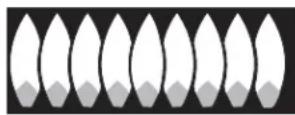
(A) Yellow flames—Call for service
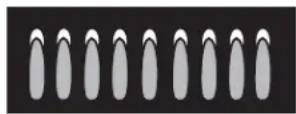
(B) Yellow tips on outer cones—Normal for LP gas
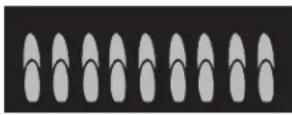
(C) Soft blue flames—Normal for natural gas
If burner flames look like (A), call for service. Normal burner flames should look like (B) or (C), depending on the type of gas you use.
With LP gas, some yellow tipping on outer cones is normal.
B Check Ignition of Oven Burner
The oven is designed to operate quietly and automatically. To operate the oven, turn the OVEN CONTROL knob to a setting above 300^ F. The oven burner will ignite and burn until the set temperature is reached.
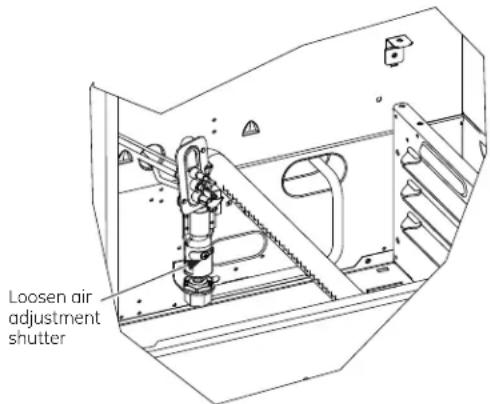
C Adjust Bake Burner Air Adjustment Shutter on Models with a Broiler Drawer, if Necessary
Determine if the bottom burner flames are burning properly.
natural_image
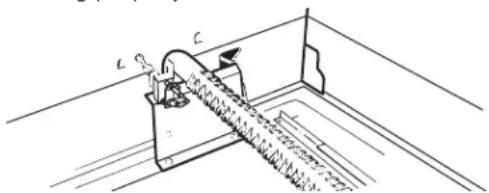
Technical line drawing of a mechanical assembly with labeled components (no text or symbols)With the oven bottom removed, properly adjusted flames should have approximately 1" blue cones and, if range is supplied with natural gas, should burn with no yellow tipping. (With most LP gas, small yellow tips at the end of outer cones are normal.) Flames should not lift off burner ports. If lifting is observed, gradually reduce air shutter opening until flames are stabilized.
The shutter for the oven burner is near the back wall of the oven and behind the broiler drawer.
5 LIGHT THE BURNERS (CONT.)
C Adjust Bake Burner Air Adjustment Shutter on Models with a Broiler Drawer, if Necessary (Cont.)
To Remove the Broiler Drawer:
- Pull the drawer out until it stops, then push it back in about one inch.
- Grasp handle, lift and pull broiler drawer out.
On some models, remove the metal shield at the rear of the cavity.
To adjust the flow of air to the burner, loosen the Phillips-head screw and rotate the shutter to allow more or less air into the burner tube.
D Replace Oven Parts
After all adjustments are made, replace the broiler drawer, oven bottom, racks and oven door.
6 LEVELING THE RANGE
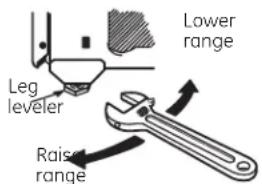
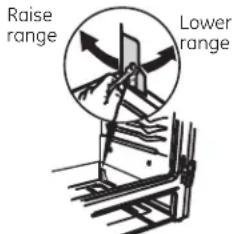
A. Install the oven shelves in the oven and position the range where it will be installed with front access to front leveling legs and rear access to rear leveling legs. All legs must be leveled BEFORE the product is installed.
(on some models)
(on some models)
B. Check for levelness by placing a spirit level or a cup, partially filled with water, on one of the oven shelves. If using a spirit level, take two readings—with the level placed diagonally first in one direction and then the other.
6 LEVELING THE RANGE (CONT.)
C. Remove the drawer (on some models). See the Care and cleaning of the range section. The front leveling legs can be adjusted from the bottom and the rear legs can be adjusted from the top (on some models) or the bottom.
D. Use an open-end or adjustable wrench to adjust the leveling legs until the range is level.

Never completely remove
the leveling leg as the range will not be secured to the anti-tip device properly.
E. After leveling the unit, slide it into final position and verify levelness.
F. After the range is level, slide the range away from the wall so that the Anti-Tip device can be installed.
7 INSTALLING THE ANTI-TIP DEVICE
▲ WARNING
ANTI-TIP DEVICE
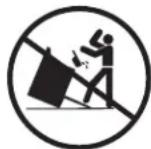
- All ranges can tip.
- BURNS or other SERIOUS INJURIES can result.
- INSTALL and CHECK the anti-tip bracket following the instructions supplied with the bracket.
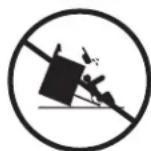
To reduce the risk of tipping the range, the range must be secured by a properly installed anti-tip bracket. Follow the instructions packaged with the bracket.
To check if the bracket is installed and engaged properly, look underneath the range to see that the rear leveling leg is engaged in the bracket. On some models, the storage drawer or kick panel can be removed for easy inspection. If visual inspection is not possible, slide the range forward, confirm the anti-tip bracket is securely attached to the floor or wall, and slide the range back so the rear leveling leg is under the anti-tip bracket.
If the range is pulled from the wall for any reason, always repeat this procedure to verify the range is properly secured by the anti-tip bracket.
If your range has no anti-tip bracket, call 1.800.626.8774 to receive one at no cost.
WHEN ALL HOOKUPS ARE COMPLETED
Make sure all controls are left in the off position. Make sure the flow of combustion and ventilation air to the range is unobstructed.
Before you call for service...

Troubleshooting Tips
Save time and money! Review the charts on the following
pages first and you may not need to call for service.
| Problem Possible Causes What To Do | ||
| Burners do not light | Gas supply not connected or turned on. | • See the Installation Instructions that came with your range. |
| Battery is weak/dead | • Replace battery (see Installing the Battery.) | |
| Port holes on the side of the burner may be clogged. | • Remove the burners and clean them. Check the electrode area for burned-on food or grease. See the Care and cleaning of the range section. | |
| Improper burner assembly. • Make sure the burner parts are installed correctly. See the Care and cleaning of the range section. | ||
| Burner parts not replaced correctly. | • See the Care and cleaning of the range section. | |
| Surface burners light but oven does not | Knob not pushed firmly in at LITE position and held in for 10 seconds. | • See the Using the oven section. |
| Burner flames very large or yellow | Improper air to gas ratio. • If range is connected to LP gas, contact the person who installed your range or made the conversion. | |
| Food does not bake or roast properly in the oven | Oven controls improperly set. • See the Using the oven section. | |
| Shelf position is incorrect. • See the Using the oven section. | ||
| Incorrect cookware or cookware of improper size being used. | • See the Using the oven section. | |
| Oven thermostat needs adjustment. | • See the Adjust the oven thermostat—Do it yourself! section. | |
| Aluminum foil used improperly in the oven. | • See the Care and cleaning of the range section. | |
| Oven bottom not securely seated in position. | • See the Installation of the range section. | |
| Food does not broil properly | Oven door not closed. | • Close open door. See the Using the upper oven section. |
| Food being cooked in a hot pan. | • For best results, use a pan designed for broiling. Make sure it is cool. | |
| Cookware not suited for broiling. | • For best results, use a pan designed for broiling. | |
| Oven temperature too hot or too cold | Oven thermostat needs adjustment. | • See the Adjust the upper oven thermostat—Do it yourself! section. |
| “Crackling” or “popping” sound | This is the sound of the metal heating and cooling during both the cooking and cleaning functions. | • This is normal. |
| “Burning” or “oily odor emitting from the vent | This is normal in a new oven and will disappear quickly. | • Open the windows to ventilate the room. |
| Strong odor | An odor from the insulation around the inside of the oven is normal for the first few times the oven is used. | • This is temporary. |
Notes.
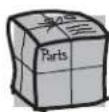
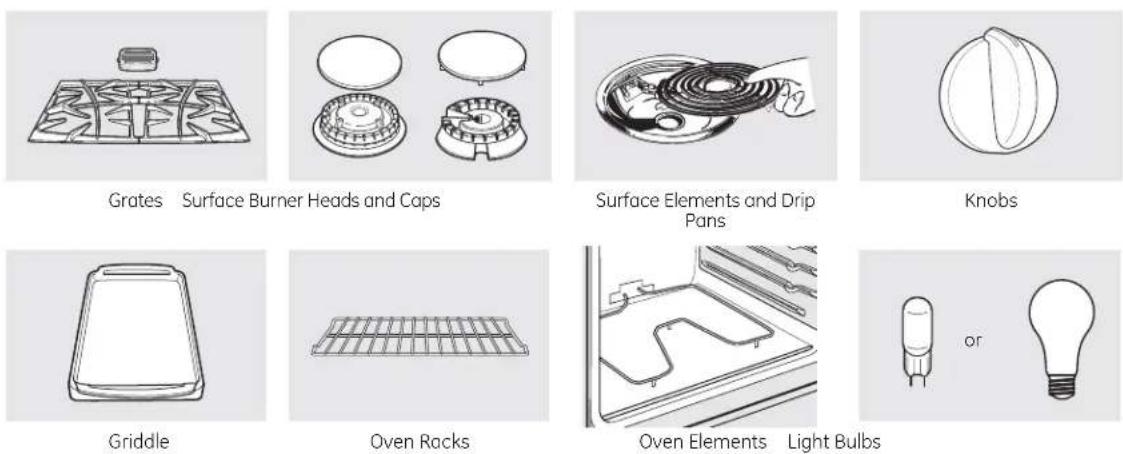
Looking For Something More? (Not all accessories are available for all models.)
You can find these accessories and many more at GEApplianceParts.com (U.S.) or www.GEAppliances.ca (Canada), or call 800.626.2002 (U.S.) or 800.661.1616 (Canada) (during normal business hours). Have your model number ready.
Experience these other great products to keep your kitchen looking great!

Cerama Bryte®
Ceramic Cooktop
Cleaning Kit:
Includes cleaner,
scraper and pad
WX10X117GCS
Cerama Bryte® Touch Up Spray
WX10X391
Citrushine
Stainless Steel
Wipes
WX10X10007
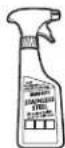
Cerama Bryte®
Stainless Steel
Appliance
Cleaner
PM10X311
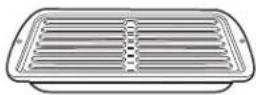
Get the most out of your Broiler Pan! (Not for use with Broiler Drawer models.)
Use your pan and grid cover to broil hamburgers, seafood, steaks, vegetables, bacon, chops and so much more! The pan below catches the excess fats and oils.
• Genuine GE Part
- Easy To Clean
• One-Year Warranty
Limited Time Offer! Free Shipping!
When you order your broiler pan within 30 days of purchasing your GE cooking product.
Small Large* XL**
U.S. Part # WB48X10055 WB48X10056 WB48X10057
Canada Part # 222D2097G001 222D2097G002 N/A
Dimensions 8-3/4"W x 1-1/4"H x 13-1/2"D 12-3/4"W x 1-1/4"H x 16-1/2"D 17"W x 1-1/4"H x 19-1/4"D
* The large (standard) broil pan does not fit in 20"/24" ranges.
** The XL pan does not fit in 24" wall ovens, 27" drop-ins or 20"/24" ranges.
To place your order, call 800.626.2002 (U.S.), 800.661.1616 (Canada) or mail this form to:
In the U.S.: GE Parts, P.O. Box 221027, Memphis, TN 38122-1027. In Canada: GE Parts, 1 Factory Lane, Moncton, N.B. E1C 9M3
Broiler Pan Order Form
| Quantity | Part Number |
Model Number ____ Serial Number ____ Brand ____ Date of Purchase ____
First Name Last Name
Address
City State Zip Code
Phone E-Mail
Check ____ Money Order ____
Call 800.626.2002 in the U.S. or 800.661.6161 in Canada for current pricing. All credit card orders must be called in.
Notes.
All warranty service provided by our Factory Service Centers, or an authorized Customer Care® technician. To schedule service, on-line, 24 hours a day, visit us at GEAppliances.com, or call 800.GE.CARES (800.432.2737). Please have serial number and model number available when calling for service.
Staple your receipt here. Proof of the original purchase date is needed to obtain service under the warranty.
For The Period Of: GE Will Replace:
| One Year From the date of the original purchase | Any part of the range which fails due to a defect in materials or workmanship. During this limited one-year warranty, GE will also provide, free of charge, all labor and in-home service to replace the defective part. |
What GE Will Not Cover:
■ Service trips to your home to teach you how to use the product.
- Improper installation, delivery or maintenance.
Product damage or failure of the product if it is abused, misused, modified, used for other than the intended purpose, or used commercially.
■ Replacement of house fuses or resetting of circuit breakers.
■ Damage to the product caused by accident, fire, floods or acts of God.
■ Incidental or consequential damage caused by possible defects with this appliance.
■ Damage caused after delivery.
■ Product not accessible to provide required service.
■ Replacement of battery on cordless models.
EXCLUSION OF IMPLIED WARRANTIES—Your sole and exclusive remedy is product repair as provided in this Limited Warranty. Any implied warranties, including the implied warranties of merchantability or fitness for a particular purpose, are limited to one year or the shortest period allowed by law.
This warranty is extended to the original purchaser and any succeeding owner for products purchased for home use within the USA. If the product is located in an area where service by a GE Authorized Servicer is not available, you may be responsible for a trip charge or you may be required to bring the product to an Authorized GE Service Location for service. In Alaska, the warranty excludes the cost of shipping or service calls to your home.
Some states do not allow the exclusion or limitation of incidental or consequential damages. This warranty gives you specific legal rights, and you may also have other rights which vary from state to state. To know what your legal rights are, consult your local or state consumer affairs office or your state's Attorney General.
GE Appliances Web Site In the U.S.: GEAppliances.com
Have a question or need assistance with your appliance? Try the GE Appliances Web site 24 hours a day, any day of the year! For greater convenience and faster service, you can now download Owner's Manuals, order parts or even schedule service on-line.
Schedule Service In the U.S.: GEAppliances.com
Expert GE repair service is only one step away from your door. Get on-line and schedule your service at your convenience 24 hours any day of the year! Or call 800.GE.CARES (800.432.2737) during normal business hours.
Real Life Design Studio
In the U.S.: GEAppliances.com
GE supports the Universal Design concept—products, services and environments that can be used by people of all ages, sizes and capabilities. We recognize the need to design for a wide range of physical and mental abilities and impairments. For details of GE's Universal Design applications, including kitchen design ideas for people with disabilities, check out our Web site today. For the hearing impaired, please call 800.TDD.GEAC (800.833.4322).
Extended Warranties In the U.S.: GEAppliances.com
Purchase a GE extended warranty and learn about special discounts that are available while your warranty is still in effect. You can purchase it on-line anytime, or call 800.626.2224 during normal business hours. GE Consumer Home Services will still be there after your warranty expires.
Parts and Accessories In the U.S.: GEAppliances.com
Individuals qualified to service their own appliances can have parts or accessories sent directly to their homes (VISA, MasterCard and Discover cards are accepted). Order on-line today, 24 hours every day or by phone at 800.626.2002 during normal business hours.
Instructions contained in this manual cover procedures to be performed by any user. Other servicing generally should be referred to qualified service personnel. Caution must be exercised, since improper servicing may cause unsafe operation.

Contact Us
In the U.S.: GEAppliances.com
If you are not satisfied with the service you receive from GE, contact us on our Web site with all the details including your phone number, or write to: General Manager, Customer Relations
GE Appliances, Appliance Park
Louisville, KY 40225
Register Your Appliance
In the U.S.: GEAppliances.com
Register your new appliance on-line—at your convenience! Timely product registration will allow for enhanced communication and prompt service under the terms of your warranty, should the need arise. You may also mail in the pre-printed registration card included in the packing material.
Instrucciones de seguridad 2 - 5
Instrucciones de Funcionamiento
Horno 8-1
Compartimiento para Asar. . 10
Cómo Encender el Quemador
con un Fósforo
Cómo Encender el Horno con
un Fósforo 9
Precalentamiento .....9
Estantes....8
Ajuste del Termostato ..... 1 2
Superficie de Cocción
Instrucciones de Instalación ..... 17-24
Ajuste del Aire ....
Dispositivo Anti-Volcaduras.
Batería 23
Control de Encendido de los
Quemadores 23
Conecte la Cocina al Gas . .21, 22
Dimensiones y Espacios ..... 2 1
Nivelación de la Cocina
LP 20
Manual del propietario & Instrucciones de Instalación
Limpieza
Estándar
Inalámbrico
JGBS14
RGB518
Consejos para Solucionar Problemas....25
Accesorios 27
Cuidado y Limpieza
Papel de Aluminio .....10, 11
Ensambles del Quemador . . . . 13
Parrillas de los Quemadores . . . 13
Panel de Control y Perillas. . . . . 14
Superficie de la Cocina .....15
Horno Inferior 15
Ventilaciones del Horno .....14
Estantes 15
Reemplazo de la Batería de 9V. . . 7
Superficie 14
Soporte al Cliente
Soporte al Cliente ....30
Escriba los números de modelo y de serie aquí:
N° de Modelo ____
N° de Serie ____
Los puede encontrar en la etiqueta que se encuentra en el frente de la cocina, detrás del cajón calentador o en el cajón inferior del horno.
INFORMACIÓN IMPORTANTE DE SEGURIDAD. LEA TODAS LAS INSTRUCCIONES ANTES DE USAR.
ADVERTENCIA
Si la información de este manual no se sigue exactamente, se podrá n, ocasionando daños sobre la propiedad, lesiones o la muerte.
- No guarde ni use gasolina u otros vapores inflamables y líquidos cerca de este ni de otros electrodomésticos.
- QUÉ DEBE HACER SI HUELE GAS
No intente iluminar ningún electrodoméstico.
No toque ningún interruptor eléctrico; no use teléfonos en su edificio.
De inmediato llame a su proveedor de gas desde el teléfono de un vecino.
Si no se puede comunicar con su proveedor de gas, llame al departamento de bomberos.
- La instalación y las reparaciones deberán ser realizadas por un instalador calificado, agencia de servicios o el proveedor de gas.
ADVERTENCIA
- Todas las cocinas pueden sufrir caídas.
Se pueden producir QUEMADURAS y otras LESIONES GRAVES
INSTALE y CONTROLE el soporte anti-volcaduras, siguiendo las instrucciones suministradas con el soporte.
A fin de reducir el riesgo de caída de la cocina, ésta deberá estar asegurada por un soporte antivolcaduras correctamente instalado. Consulte las instrucciones de instalación provistas con el soporte, para acceder a detalles completos antes de intentar realizar la instalación.
Para controlar si el soporte es instalado y ajustado de forma apropiada, controle que debajo de la cocina la pata niveladora trasera esté ajustada al soporte. En algunos modelos, el cajón de
almacenamiento o el panel de protección se pueden retirar para una fácil inspección. Si no es posible realizar una inspección visual, deslice la cocina hacia adelante, confirme que el soporte anti-volcaduras esté ajustado de forma segura al piso o la pared, y deslice la cocina hacia atrás de modo que la pata niveladora trasera se encuentre debajo del soporte anti-volcaduras.
En caso de que la cocina sea empujada de la pared por alguna razón, siempre repita este procedimiento para verificar que la cocina esté correctamente asegurada por el soporte anti-volcaduras.
Nunca retire completamente las patas niveladoras, ya que la cocina no estará asegurada de forma adecuada al dispositivo anti-volcaduras.
Si no recibió el soporte anti-volcaduras con su compra, llame al 1.800.626.8774 para recibir uno sin costo. Para acceder a instrucciones de instalación del soporte, visite GEAppliances.com.
ADVERTENCIA
AVISO DE SEGURIDAD IMPORTANTE
La Ley de Agua Potable Inocua y Tratamiento de Residuos Tóxicos de California (California Safe Drinking Water and Toxic Enforcement Act) solicita al Gobernador de California que publique una lista de sustancias que el estado reconoce que producen cáncer, defectos de nacimiento u otros daños reproductivos y solicita a los empresarios que adviertan a sus clientes sobre la posible exposición a tales sustancias.
El aislante de fibra de vidrio en los hornos de auto limpieza despide una pequeña cantidad de monóxido de carbono durante el ciclo de limpieza. La exposición puede ser minimizada si se ventila con una ventana abierta o si se usa un ventilador o campana.
GUARDE ESTAS INSTRUCCIONES
ADVERTENCIA
INSTRUCCIONES GENERALES DE SEGURIDAD
ADVERTENCIA
NUNCA use este electrodoméstico para calentar el ambiente. Como consecuencia de esto, se podrá producir envenenamiento con monóxido de carbono y el sobrecalentamiento del horno.
Use este electrodoméstico sólo para su propósito original, como se describe en el manual del propietario.
Solicite que un instalador calificado instale su cocina y que esté correctamente conectada a tierra, de acuerdo con las instrucciones de instalación provistas. Cualquier ajuste y trabajo de servicio técnico deberá ser realizado únicamente por instaladores de cocinas a gas calificados o por técnicos del servicio. No intente reparar o reemplazar ninguna parte de la cocina, a menos que esto se recomiende específicamente en este manual.
Su cocina es enviada desde la fábrica para uso con gas natural. Puede ser convertida para uso con gas LP. Si se requieren, estos ajustes deben ser realizados por un técnico calificado de acuerdo con las instrucciones de instalación y códigos locales. La agencia que realiza este trabajo asume la responsabilidad de la conversión.
Solicite que el instalador le muestre la ubicación de la válvula de cierre de la cocina a gas y cómo apagarla en caso de ser necesario.
Antes de realizar cualquier servicio técnico, retire la batería de 9V de la cocina a fin de desactivar el sistema de encendido a chispa.
Asegúrese de que todos los materiales de embalaje sean retirados de la cocina antes de su uso, a fin de evitar que estos materiales se incendien.
No deje a los niños solos o fuera de su radio de atención en el área donde el electrodoméstico se encuentre en uso. Nunca se les deberá permitir trepar, sentarse o pararse sobre ninguna parte del electrodoméstico.
No guarde artículos de interés para los niños sobre una cocina o en la parte trasera de la misma – Si un niño trepa sobre la cocina para alcanzar artículos, es posible que sufra lesiones graves.
No permita que nadie se trepe, se pare o se cuelgue de la puerta del horno, del cajón o de la parte superior de la cocina. Se podrá dañar la cocina o provocar su caída, ocasionando lesiones graves o la muerte.
Nunca bloquee las ventilaciones (aberturas de aire) de la cocina. Las mismas brindan las entradas y salidas de aire que son necesarias para que la cocina opere de forma correcta con la combustión adecuada. Las aberturas de aire están ubicadas en la parte trasera de la cocina, en la parte superior e inferior de la puerta del horno, y en la parte inferior de la cocina debajo del cajón calentador, del cajón del horno inferior o del panel de protección.
Use sólo sostenedores de ollas secos – los sostenedores húmedos sobre superficies calientes pueden producir quemaduras debido al vapor. No permita que los sostenedores de ollas tengan contacto con los quemadores superficiales, la parrilla de los quemadores, o el elemento de calefacción del horno. No use una toalla u otra tela voluminosa para reemplazar el mango de las cacerolas.
Tenga cuidado de no tocar las superficies calientes de la cocina. Las superficies potencialmente calientes incluyen los quemadores, parrillas, parte superior de la cocina, parte trasera, horno e interior de la puerta y aberturas alrededor de la puerta del horno.
No caliente envases de comida que no hayan sido abiertos. Se podría acumular presión y el contenedor podría explotar, ocasionando una lesión.
Cocine carnes y carnes de ave en forma completa – la carne por lo menos a una temperatura interior de 160° F y la carne de ave por lo menos a una temperatura interior de 180° F. Normalmente la cocción a estas temperaturas brinda una protección contra las enfermedades transmitidas por la comida.
INFORMACIÓN IMPORTANTE DE SEGURIDAD. LEA TODAS LAS INSTRUCCIONES ANTES DE USAR.
ADVERTENCIA
MANTENGA LOS MATERIALES INFLAMABLES ALEJADOS DE LA COCINA
No guarde ni use materiales inflamables en un horno o cerca de la parte superior de la cocina, incluyendo papel, plástico, sostenedores de ollas, trapos, cobertores de pared, cortinas, paños y gasolina u otros vapores y líquidos inflamables.
Nunca use prendas holgadas o que cuelguen mientras usa el electrodoméstico. Evite acumular artículos comúnmente usados en gabinetes sobre la cocina, y tenga cuidado al extender la mano sobre la cocina.
La ropa que se encuentre cerca de los quemadores o superficies calientes se podrá encender, ocasionando quemaduras graves.
No permita que la grasa de la cocción u otros materiales inflamables se acumulen en o cerca de la cocina. La grasa del horno o sobre la cocina se podrá incendiar.
Limpie las campanas de ventilación de forma frecuente. No se debe permitir la acumulación de grasa en la campana o el filtro.
ADVERTENCIA
EN CASO DE INCENDIO, SIGA LOS SIGUIENTES PASOS PARA EVITAR LESIONES O LA PROPAGACIÓN DEL FUEGO:
No use agua sobre el fuego de la grasa. Nunca tome una olla que se esté incendiando. Apague los controles. Extinga la olla que se esté incendiando sobre un quemador superficial, cubriendo la olla completamente con su tapa correspondiente, una hoja metálica de galletas o una bandeja plana. Si es necesario, use un químico seco multiuso o un extintor de chorro de espuma.
En caso de que haya fuego en el horno durante la cocción, apague el horno y mantenga la puerta cerrada
hasta que el fuego se extinga. Si es necesario, use un químico seco multiuso o un extintor de chorro de espuma.
En caso de que haya fuego en el horno durante el período de auto limpieza, apague el horno y espere a que el fuego se extinga. No fuerce la puerta para abrirla. La entrada de aire fresco sobre las temperaturas de auto limpieza podrá conducir a la producción de llamas en el horno. Si no se siguen estas instrucciones, se podrán producir quemaduras graves.
ADVERTENCIA
INSTRUCCIONES DE SEGURIDAD DE LA PARTE SUPERIOR DE LA COCINA
Nunca pierda de vista los quemadores cuando se encuentren en las configuraciones de calor media o alta. Las comidas, especialmente las que se preparan con aceite, se pueden incendiar, lo cual puede ocasionar un incendio que se propague a los gabinetes próximos.
Nunca pierda de vista el aceite cuando esté friendo. Si se calienta más allá de su punto de cocción, el aceite se puede quemar y provocar un incendio que se puede propagar a los gabinetes próximos. Use un termómetro para grasas profundas siempre que sea posible, a fin de monitorear la temperatura del aceite.
Para evitar derrames e incendios, use una cantidad mínima de aceite cuando esté friendo en una olla que no sea profunda y evite cocinar comidas congeladas con cantidades excesivas de hielo.
Use el tamaño de olla adecuado para evitar que sean inestables o que sufran caídas fácilmente. Seleccione utensilios que coincidan con el tamaño del quemador. Las llamas del quemador se deberán ajustar de modo que no se extiendan más allá de la parte inferior de la olla. Una cantidad excesiva de llama puede representar un riesgo.
Siempre use la posición LITE al encender los quemadores superiores y asegúrese de que estos se hayan encendido.
Al usar utensilios de vidrio/ cerámica, asegúrese de que sean adecuados para el servicio de cocina; otros se podrán romper debido a un cambio repentino de temperatura.
A fin de minimizar posibles quemaduras, incendio de materiales inflamables y derrames, la manija de un envase deberá ser inclinada hacia el centro de la cocina sin que se extienda sobre los quemadores cercanos.
Al preparar comidas llameantes debajo de una campana, encienda el ventilador.
No use un wok con un anillo con soporte de metal redondo. El anillo podrá atrapar calor y bloquear el aire hacia el quemador, produciendo el riesgo de emisión de monóxido de carbono.
No intente levantar la estufa si los quemadores de la superficie están sellados. Hacer esto podría dañar la tubería de gas hasta los quemadores superficiales, ocasionando una pérdida de gas y riesgo de incendio.
No use papel de aluminio para cubrir rejillas cualquier parte de la cocina. Si se hace esto se podrá producir envenenamiento con monóxido de carbono, sobrecalentamiento de las superficies de la cocina o un posible riesgo de incendio.
ADVERTENCIA
INSTRUCCIONES DE SEGURIDAD
ADVERTENCIA
NUNCA cubra ninguna
ranura, agujeros o pasajes en el fondo del horno ni cubra un estante entero con materiales tales como papel de aluminio. Hacer esto bloquea el flujo de aire a través del horno y puede ocasionar envenenamiento con monóxido de carbono. Los recubrimientos de aluminio también pueden atrapar el calor, causando riesgo de incendio.
Manténgase alejado de la cocina al abrir la puerta del horno. El aire caliente o el vapor que sale puede causar quemaduras en las manos, rostro y/u ojos.
Mantenga el horno libre de acumulación de grasa. La grasa en el horno se puede incendiar.
Coloque los estantes del horno en la ubicación correspondiente mientras éste se encuentra frío. Si es necesario retirar el estante mientras el horno se encuentra caliente, evite tocar las superficies calientes.
Coloque el estante del horno en la posición de bloqueo, al introducir y retirar comida del horno. Esto ayuda a evitar quemaduras por tocar superficies calientes de la puerta y las paredes del horno.
No deje productos tales como papel, utensilios de cocina ni comida en el horno cuando no esté en uso. Los artículos guardados en el horno se pueden incendiar.
No deje artículos en la parte superior de la cocina cerca de la ventilación, la cual está en el extremo trasero de la parte superior de la cocina. Los artículos se pueden sobrecalentar, y existe riesgo de incendio o quemaduras.
Al usar las bolsas para cocinar o dorar en el horno, siga las instrucciones del fabricante.
Nunca ase con la puerta abierta. Se prohíbe asar con la puerta abierta debido al sobrecalentamiento de las perillas de control.
Cómo usar los quemadores superficiales de gas.
Es posible que las funciones y apariencias varían con relación a su modelo a lo largo del manual.
Antes de Encender un Quemador de Gas
Asegúrese de que todos los quemadores estén en su lugar.
Asegúrese de que todas las parrillas de la cocina estén correctamente ubicadas antes de usar un quemador.
Luego de Encender un Quemador de Gas
No utilice el quemador durante un período de tiempo prolongado sin un utensilio de cocina sobre la parrilla. El acabado de la parrilla se puede resquebrajar si no hay un utensilio de cocina que absorba el calor.
Asegúrese de que los quemadores y las parrillas estén fríos antes de colocar la mano, tomar el mango de una olla, trapos de limpieza u otros materiales sobre estos..
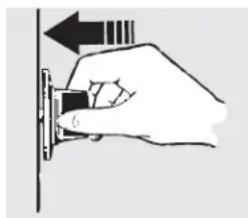
natural_image
Hand holding a small electronic component with an arrow indicating direction (no text or symbols present)Empuje el mango de control y gire el mismo hasta la posición LITE.
Cómo Encender un Quemador Superficial de Gas
Asegúrese de que todos los quemadores superficiales estén ubicados en sus posiciones respectivas.
Empuje el mango de control y gire el mismo hasta la posición LITE.
Escuchará un pequeño ruido de clic – el sonido de la chispa eléctrica que enciende el quemador.
Gire la perilla para ajustar el tamaño de la llama. Si la perilla permanece en LITE, continuará haciendo clic.
Cuando un quemador se gira a LITE, todos los quemadores hacen chispa. No intente desensamblar ni limpiar un quemador mientras otro quemador está encendido. Es posible que se produzca una descarga eléctrica, lo cual podría hacer que vuelque un utensilio de cocina caliente.
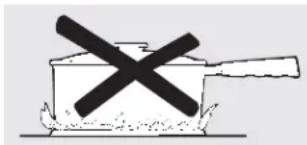
natural_image
Simple line drawing of a cooking pot with a crossed-out black mark (no text or symbols)Cómo Seleccionar el Tamaño de la Llama
ADVERTENCIA Las llamas
del quemador que no están cubiertas por el utensilio de cocina pueden presentar un riesgo de quemaduras o incendio de telas. Nunca permita que las llamas se extiendan más allá de los costados del utensilio.
Observe la llama, no la perilla, a medida que
reduce el calor. Cuando se desee calentar de forma rápida, el tamaño de la llama de un quemador de gas deberá ser equivalente con el utensilio de cocina que esté usando.
Cuando las llamas sean más grandes que la parte inferior del utensilio de cocina, no calentarán el utensilio más rápido y podrían ser riesgosas.
Utensilio sobre la Cocina
Aluminio: Se recomienda un utensilio de peso mediano, ya que calienta de forma rápida y pareja. La mayoría de las comidas se doran de forma pareja en un sartén de aluminio. Use cacerolas con tapa hermética cuando cocine con cantidades mínimas de agua.
Hierro Forjado: Si cocinará de forma lenta, la mayoría de los sartenes le darán resultados satisfactorios.
Utensilios de esmalte: Bajo ciertas condiciones, el esmalte de algunos utensilios de cocina se pueden derretir. Siga las recomendaciones sobre métodos de cocción del fabricante de utensilios de cocina.
Vidrio: Existen dos tipos de utensilios de cocina de vidrio – aquellos para uso con el horno únicamente y aquellos para la cocción en la
parte superior de la cocina (cacerolas, café y teteras). Los conductores de vidrio calientan de forma muy lenta.
Cerámica de Vidrio Resistente al Calor: Se pueden usar para cualquier superficie o para cocción en el horno. Conduce el calor de forma muy lenta y se enfría de forma muy rápida. Consulte las instrucciones del fabricante de utensilios de cocina para saber con seguridad si se puede usar con cocinas a gas.
Acero Inoxidable: Este metal posee propiedades de calentamiento limitadas y normalmente se combina con cobre, aluminio u otros materiales para una mejor distribución del calor. Los sartenes con combinación de metales normalmente funcionan de forma satisfactoria si se usan con calor medio, como lo recomienda el fabricante.
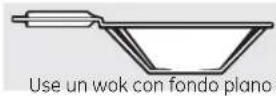
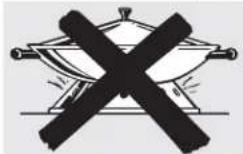
Use el Wok de Esta Forma
Recomendamos que use un wok de 14 pulgadas o más pequeño con fondo plano. Asegúrese de que el fondo del wok se apoye de forma plana sobre la parrilla. Están disponibles en su tienda minorista local.
Sólo se deberá usar un wok con fondo plano.
No use un anillo de soporte para wok. Colocar el anillo sobre el quemador o parrilla podrá hacer que el quemador funcione de forma inadecuada, produciendo niveles de monóxido de carbono que superan los estándares permitidos. Esto puede ser peligroso para su salud.
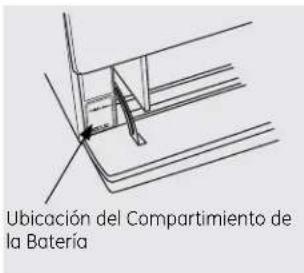
Reemplazo de la Batería de 9V
PRECAUCIÓN
La batería puede explotar o producir pérdidas y ocasionar quemaduras, si es recargada, descartada en el fuego, insertada hacia atrás, o ensamblada de forma incorrecta.
Cuando se gira una perilla hacia la posición LITE (Luz), se producirán chispas en los quemadores. Si la batería posee poca carga, esto hará que la cantidad de tiempo entre las chispas se incremente. Si el tiempo entre las chispas es superior a un Segundo, reemplace la batería. Si el quemador de la superficie no se enciende dentro de los cinco segundos, apague el gas y espere un minuto para que éste se disipe antes de intentar encenderlo nuevamente.
En algunos modelos, la luz indicadora del Nivel de Batería está ubicada sobre la izquierda de las perillas de los quemadores. Esta luz brillará a medida que los quemadores sean encendidos, si la batería cuenta con suficiente energía como. Si esta luz indicadora no brilla durante el chispeo, el nivel de energía de la batería es bajo y la misma debería ser reemplazada de inmediato.
IMPORTANTE: Reemplace por una batería alcalina estándar de 9V. Cumpla con todos los requisitos estatales y locales para descartar la batería anterior.
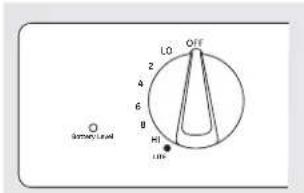
Cómo Encender los Quemadores con un Fósforo
Si la batería está demasiado descargada como para encender los quemadores, puede encender los quemadores de la superficie a gas de su cocina con un fósforo de madera para cocina. Acerque un fósforo prendido al quemador, y luego presione y gire la perilla de control hasta la posición LITE. Tenga especial cuidado al encender los quemadores de esta manera. Los quemadores que se estén usando cuando se produzca un corte de corriente eléctrica continuarán funcionando normalmente.
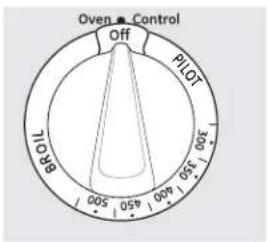
Para usar el horno:
Asegúrese de que haya gas disponible en la cocina, iluminando cualquier quemador de la superficie y apagando el mismo nuevamente.
2 Presione y gire la perilla a la posición PILOT (Piloto).
3 Mientras presiona la perilla hacia adentro, gire la perilla hacia la configuración que desee. (Sostener la perilla del control del horno durant e menos de 10 segundos en la posición LITE (Luz) podrá hacer que el quemador del horno no genere luz).
4 Presione y gire a la temperatura deseada.
5 Controle la llama del quemador del horno abriendo la puerta del horno y mirando a través del agujero frente al fondo del horno.
Si no se escuchan ruidos de chispas cuando la perilla de temperatura del horno es presionada hacia adentro en la posición LITE (Luz), reemplace la batería por una batería alcalina de 9V. El compartimiento de la batería está ubicado detrás de la puerta para asar.
6 Gire la perilla de control del horno hacia OFF (Apagado) al finalizar el horneado.
Para evitar posibles quemaduras, coloque los estantes en la posición deseada antes de encender el horno.
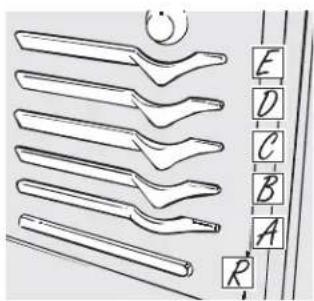
El horno tiene 5 posiciones de estantes. También cuenta con una posición especial del estante bajo (R) para cosas más grandes, tales como un pavo grande.
Antes de comenzar...
Los estantes poseen bloqueadores, de modo que al colocarlos correctamente sobre los soportes (A a E) se detendrán antes de salirse completamente y no se inclinarán.
Al colocar y retirar utensilios de cocina, empuje el estante hacia afuera del tope sobre el soporte del estante.
PRECAUCIÓN: Al usar
un estante en la posición más baja (R), se deberá tener cuidado al empujar el estante varias pulgadas hacia afuera y luego, utilizando dos sostenedores de olla, empuje el estante hacia afuera sosteniendo
los lados. El estante está en una posición baja y usted podría sufrir una quemadura si coloca la mano en medio del mismo al empujar hacia afuera.
Para retirar el estante, empuje el mismo hacia usted, incline el extremo frontal hacia arriba y empuje hacia afuera.
Para hacer un reemplazo, coloque el extremo del estante (bloqueadores) en el soporte, incline el frente hacia arriba y empuje el estante hacia adentro.
NOTA: El estante no está diseñado para deslizarse hacia afuera en la posición especial del estante bajo (R).
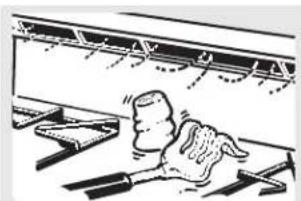
natural_image
Illustration of a hand pressing down on a mechanical component (no text or symbols visible)Los artículos de plástico sobre la parte superior del horno se podrán derretir si se los deja demasiado cerca de la ventilación.
La apariencia y la ubicación de la ventilación varían.
Ventilación del Horno Superior
Su horno es ventilado a través de conductos en la parte trasera de la cocina. No bloquee estos conductos al cocinar en el horno – es importante que el flujo de aire caliente desde el horno y el aire fresco hacia el quemador del horno no sean interrumpidos. Evite tocar las aberturas de la ventilación o superficies cercanas durante el funcionamiento del horno y el asador – se podrán calentar.
Las manijas de las ollas y cacerolas se podrán calentar al estar en la parte superior del horno si se las ubica demasiado cerca de la ventilación.
No deje artículos de plástico o inflamables sobre la parte superior de la cocina; se podrán derretir o incendiarse si se encuentran demasiado cerca de la ventilación
No deje envases cerrados en la parte superior de la cocina. La presión en envases cerrados se podrá incrementar, lo cual podrá hacer que exploten.
Los artículos de metal se calentarán demasiado si se los deja sobre la parte superior de la cocina y podrán ocasionar incendios.
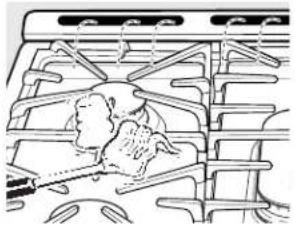
natural_image
Line drawing of a person inside a vehicle storage rack with no visible text or symbolsCómo Encender el Horno con un Fósforo
El horno de una cocina a batería sin cable se podrá encender con un fósforo y ser operado normalmente, incluso aunque la batería esté muy baja como para activar el sistema de encendido por chispa. Siga estos pasos para encender el quemador del horno con un fósforo:
- Retire la puerta del horno y la parte inferior del horno. Retire los estantes del horno.
- Ubique el piloto del quemador del horno en la parte trasera izquierda del quemador del horno.
-
Sostenga un fósforo encendido sobre el piloto del quemador del horno. Gire la perilla del control del horno hacia la posición PILOT (Piloto) y empuje hacia adentro completamente
-
Una vez encendido el piloto, continúe presionando de manera firme la perilla por 10 segundos antes de liberarla.
- El piloto deberá permanecer encendido. Si no es así, repita los pasos 3 y 4.
- Reemplace la parte inferior, los estantes y la puerta del horno.
- Gire la perilla hacia la configuración de temperatura deseada. El horno funcionará normalmente.
Gire la perilla de control del horno hacia OFF (Apagado) al finalizar el horneado.
Si su modelo cuenta con una traba para puerta, no bloquee la puerta con la traba durante el horneado o tostado. La traba se usa para la función de auto limpieza únicamente.
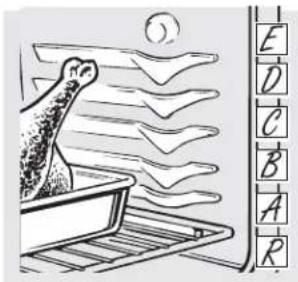
El horno cuenta con una posición especial para estante bajo (R) justo sobre la parte inferior del horno. Use esta posición cuando necesite espacio adicional para la cocción. Por ejemplo, cuando cocine un pavo grande. El estante no está diseñado para deslizarse y ser levantado en esta posición.
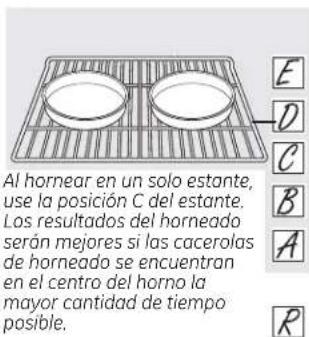
Precalentamiento y Ubicación de Ollas
Para evitar posibles quemaduras, coloque los estantes en la posición deseada antes de encender el horno.
Precaliente el horno si la receta lo requiere. Para calentar el horno previamente, ajuste la temperatura correcta. Es necesario precalentar el horno para el horneado por convección y para obtener buenos resultados al cocinar tortas, galletas, pasteles y panes.
Para hornos sin una luz o tono indicador de precalentamiento, precaliente durante 10 minutos.
Los resultados del horneado serán mejores si las cacerolas de horneado se encuentran en el centro del horno la mayor cantidad de tiempo posible. Las cacerolas no deben tocarse mutuamente ni tocar las paredes del horno. Si necesita usar dos estantes, escalone las ollas de modo que uno no esté directamente sobre el otro, y deje aproximadamente un espacio de 1 ½" entre las ollas, desde el frente, la parte trasera y los costados de la pared.
Papel de Aluminio
No use papel de aluminio para revestir el fondo del horno. El aluminio atrapará el calor inferior y alterará el funcionamiento del horno. El aluminio se puede derretir y dañar de forma permanente la parte inferior del horno. Los daños por uso inadecuado del papel de aluminio no están cubiertos por la garantía del producto.
Se podrá usar aluminio para evitar derrames, colocando una hoja sobre un estante inferior, varias pulgadas debajo de la comida. No use más aluminio que el necesario y nunca cubra totalmente el estante de un horno con papel de aluminio. Mantenga el aluminio a por lo menos 1 1/2" de las paredes del horno, para evitar una circulación deficiente del calor.
Humedad del Horno
A medida que el horno se caliente, el cambio de temperatura en el aire del horno podrá generar la formación de gotas de agua en el vidrio de la puerta. Estas gotas son inofensivas y se evaporarán a medida que el horno se siga calentando.
Cómo Configurar el Compartimiento para Asar (en algunos modelos)
Asar es cocinar la comida utilizando calor directamente desde arriba de la comida. Asar es cocinar la comida utilizando calor directamente desde arriba de la comida. Su cocina cuenta con un compartimiento para asar debajo del horno.
Tanto la puerta del horno como la del compartimiento para asar se deberán cerrar durante el asado.
Dé vuelta la mayoría de las comidas una vez durante la cocción (a excepción de los filetes finos de pescado; aceite un lado, coloque dicho lado hacia abajo en la parilla para asar y cocine sin dar vuelta hasta que esté listo). Cocine las comidas durante aproximadamente la mitad del tiempo de cocción, dé vuelta la comida y luego continúe cocinando hasta el punto de cocción preferido.
1 Usted puede cambiar la distancia de la comida desde la fuente de calor, posicionando la cacerola y la rejilla para asar en una de las tres posiciones de los estantes del compartimiento para asar – A (parte inferior del compartimiento para asar), B (parte intermedia) y C (parte superior).
2 No es necesario precalentar la parilla o el horno y esto puede producir malos resultados.
3 Si la carne posee grasa o cartilagos sobre el borde, corte tiras verticales sobre ambas a 2" de distancia. Si se desea, la grasa se podrá cortar, dejando una capa de un grosor de 1/8".
4 Ubique la comida en la rejilla y posicione la cacerola para asar en el estante apropiado del horno o del compartimiento para asar. Colocar comida más cerca de las llamas incrementa el dorado exterior de la comida, pero también incrementa el rociado y la posibilidad que se incendien las grasas y los jugos de la carne.
5 Cierre la puerta del horno y del compartimiento para asar.
6 Siga las instrucciones de uso de la luz del horno (lea Uso del Horno) y luego gire la perilla a BROIL (Asar).
7 Al finalizar de Asar, gire la perilla OVEN CONTROL (Temperatura del Horno) a OFF (Apagado). Retire la cacerola para asar del compartimiento para asar y sirva la comida de forma inmediata. Deje la cacerola fuera de la cocina para que se enfríe.
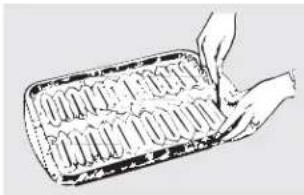
natural_image
Illustration of a hand holding a tray with ribbed contents (no text or symbols)Recorte las aberturas del papel de aluminio al igual que en la rejilla.
Papel de Aluminio
Usted puede usar papel de aluminio para alinear la cacerola para asar y la rejilla para asar. Sin embargo, deberá moldear el papel de aluminio de forma ajustada a la rejilla y cortar las aberturas al igual que en la rejilla.
Sugerencias de la Guía del Compartimiento para Asar
Tanto la puerta del horno como la del compartimiento para asar se deberán cerrar durante el asado.
Siempre use la cacerola y la rejilla para asar incluidas con su cocina. Fueron diseñadas para minimizar el humo y las salpicaduras, atrapando los jugos en la parte inferior cubierta de la cacerola.
Al cocinar en bistecs y trozos, corte la grasa de forma pareja alrededor de los extremos exteriores de la carne. Realice dicho corte en forma diagonal a través de la superficie de grasa exterior hasta el extremo de la carne. Use tenazas para dar vuelta la carne, a fin de evitar la perforación de la carne y la pérdida de jugos.
Si lo desea, marine las carnes o el pollo antes de asar. O cubra con salsa de barbacoa sólo los últimos 5 o 10 minutos.
Al ubicar la comida en la cacerola, no deje que los extremos con grasa cuelguen sobre los costados, ya que el goteo de grasa podría ensuciar el horno.
No es necesario precalentar el compartimiento para asar. Sin embargo, con cortes muy finos de comida, o para incrementar el dorado, precaliente si lo desea.
Los bistecs congelados se podrá asar posicionando el estante en la siguiente posición inferior del estante e incrementando el tiempo de cocción dado en esta guía 1 ½ veces por lado.
Ajuste los termostatos - ¡Hágalo usted mismo!
Es posible que encuentre que su horno nuevo cocina de forma diferente al que reemplazó. Use su horno nuevo durante algunas semanas para familiarizarse con el mismo. Si aún piensa que su horno nuevo está demasiado caliente o demasiado frío, podrá ajustar el termostato usted mismo.
No use termómetros, tales como los que se venden en las tiendas, para controlar la temperatura del horno. Estos termómetros pueden variar entre 20 y 40 grados.
NOTA: Este ajuste no afectará la temperatura de asado.
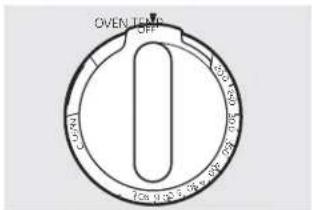
Front of OVEN TEMP knob (knob appearance may vary)
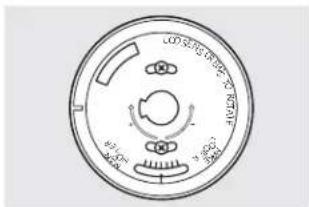
Back of OVEN TEMP knob (knob appearance may vary)
Para Ajustar el Termostato (en modelos con la Perilla OVEN TEMP (Temperatura del Hornol))
1 Empuje la perilla OVEN TEMP
(Temperatura del Horno) fuera del rango y observe la parte trasera. Para realizar un ajuste, afloje (aproximadamente un giro), pero sin quitar completamente, los dos tornillos en la parte trasera de la perilla.
2 Con la parte trasera del tornillo hacia usted, sostenga el extremo exterior de la perilla con una mano y gire el frente de la misma con a otra.
Para incrementar la temperatura del horno; mueva el tornillo superior hacia la derecha. Escuchará un sonido de clic por cada abertura que mueva la perilla.
Para reducir la temperatura del horno, mueva el tornillo superior hacia la izquierda.
Cada clic cambiará la temperatura del horno en aproximadamente 10° F. (El rango es de más 60° F o menos 60° F desde la flecha). Sugerimos que haga el ajuste de a un clic desde la configuración original y que controle el rendimiento del horno antes de hacer cualquier ajuste adicional.
3 Una vez realizado el ajuste, vuelva a ajustar los tornillos de modo que estén firmes, pero tenga cuidado de no ajustarlos en exceso.
4 Reemplace la perilla, enlazando el área plana de la misma con el hueco, y controle el funcionamiento.
¡El tipo de margarina afectará el rendimiento del horneado!
La mayoría de las recetas para hornear fueron desarrolladas utilizando productos con alto contenido de grasa tales como manteca o margarina (80% de grasa). Si se reduce la cantidad de grasa, es posible que la receta no dé los mismos resultados como con un producto con alto contenido de grasa.
Puede haber fallas en la preparación de la receta si las tortas, tartas, pasteles, galletas o dulces se preparan con productos untados con bajo contenido de grasa. Cuanto más bajo es el contenido de grasa del producto untado, más notorias son estas diferencias.
Los estándares federales requieren que los productos con la etiqueta "margarina" contengan por lo menos un 80% de grasa por peso. Por otra parte, los productos con bajo contenido de grasa poseen menos grasa y más agua. El alto contenido de humedad afecta la textura y el sabor de los productos horneados. Para un mejor resultado con sus viejas recetas favoritas, use margarina, manteca o productos para untar que contengan por lo menos un 70% de aceite vegetal.
Asegúrese de que la corriente eléctrica esté apagada y que todas las superficies estén frías antes de limpiar cualquier parte de la cocina.
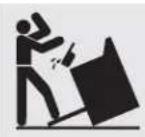
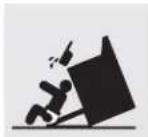
ADVERTENCIA
Si la cocina es retirada para su limpieza, servicio técnico o que el dispositivo anti-volcaduras vuelva a ser colocado de la instalada nuevamente. Si no se tiene esta precaución, se ha y provocar lesiones.
Para controlar que el soporte esté instalado y sujetado de forma adecuada, con cuidado incline la cocina hacia adelante. El soporte debería detener la cocina dentro de las 4 pulgadas. Si no lo hace, el soporte se deberá volver a instalar.
En caso de que la cocina sea empujada de la pared por alguna razón, siempre repita este procedimiento para verificar que la cocina esté correctamente asegurada por el soporte anti-volcaduras.
Si la cocina no cuenta con el soporte anti-volcaduras, llame al 1.800.626.8774 para recibir uno sin costo.
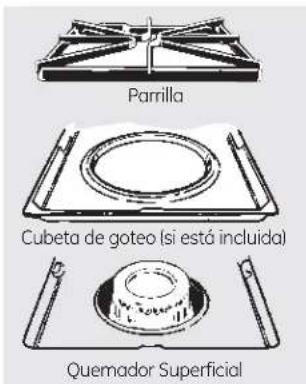
Ensambles del Quemador Doble Estándar
En modelos con quemadores dobles estándar, la parte superior de la estufa se levanta para fácil acceso.
Coloque todos los controles en OFF (Apagar) antes de retirar las partes del quemador y las cubetas de goteo (si se incluyen).
Las parrillas de los quemadores y las cubetas de goteo (si se incluyen) se pueden levantar, facilitando la limpieza.
Los agujeros de las cabezas de los quemadores de su cocina se deben mantener limpios en todo momento, para un correcto encendido y una llama pareja y sin obstrucciones.
Debería limpiar las cabezas de los quemadores de forma rutinaria, especialmente luego de derrames importantes, que podrían bloquear las aberturas.
Limpie las cabezas de los quemadores. Si se producen derrames importantes, retire las cabezas de los quemadores de la cocina. Los quemadores se pueden levantar para su limpieza. Levante la estufa y luego levante las cabezas de los quemadores.
Para retirar comida quemada, moje las cabezas de los quemadores en una solución de detergente líquido suave y agua caliente. Moje la cabeza del quemador por entre 20 y 30 minutos.
Si se trata de manchas difíciles, use un limpiador de las marcas Soft Scrub® o Bon Ami®. Enjuague bien para retirar cualquier rastro del limpiador que podría obstruir las aberturas de las cabezas de los quemadores.
No use estropajos, ya que obstruirán las aberturas de las cabezas de los quemadores y rayarán sus superficies. Si los agujeros son obstaculizados, limpie los mismos con una aguja de coser o un alambre doblado.
Antes de volver a colocar la cabeza del quemador, sacuda el exceso de agua y luego seque completamente colocando la cabeza en un horno caliente durante 30 minutos. Luego vuelva a colocar la cabeza en la estufa, asegurándose de que esté colocada y nivelada correctamente.
Controle el patrón de la llama de cada quemador. Si las llamas "saltan" (no están parejas", limpie los agujeros nuevamente con una aguja de coser o un alambre doblado.
Parrillas de los Quemadores
Levante las mismas cuando estén frías. Las parrillas se deben lavar de forma regular y, por supuesto, luego de derrames. Lave las parrillas con agua caliente y jabón y enjuague con agua limpia. Al reemplazar las parrillas, asegúrese de que estén posicionadas de forma segura sobre los quemadores. Reemplace las parrillas de modo que se formen arcos continuos con las líneas centrales de las tres parrillas.
No utilice el quemador durante un período de tiempo prolongado sin un utensilio de cocina sobre la rejilla. El acabado de la parrilla se puede resquebrajar si no hay un utensilio de cocina que absorba el calor.
Para liberarse de comidas quemadas, coloque las parrillas en un envase cubierto. Agregue una taza de 14 de amoníaco y deje que permanezcan mojadas varias horas durante la noche. Lave, enjuague bien y seque.
Aunque son durables, las parrillas perderán gradualmente su brillo, más allá del mejor cuidado que les pueda dar. Esto se debe a la exposición continua a altas temperaturas. Observará esto antes con parrillas de color claro.
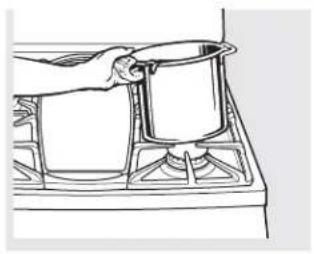
natural_image
Line drawing of a hand pouring liquid into a pan on an induction stove (no text or symbols)Superficie de la Parte Superior de la Cocina
A fin de evitar daños sobre la superficie esmaltada de porcelana sobre la parte superior de la cocina y para evitar que quede sin brillo, limpie los derrames de inmediato. La comida con mucho ácido (tomates, chucrut, jugos de fruta, etc.) o las comidas con alto contenido de azúcar pueden dejar un espacio sin brillo si no se limpian.
Cuando la superficie esté fría, lave y enjuague. Para otros derrames tales como salpicaduras de grasa, lave con agua y jabón una vez que la superficie se haya enfriado. Luego enjuague y pula con una tela seca.
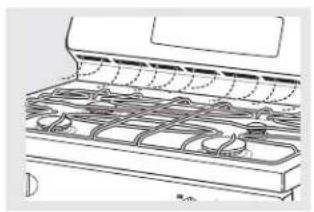
natural_image
Line drawing of a refrigerator interior with multiple compartments and doors (no text or symbols)Ventilaciones de Aire del Horno
Nunca bloquee las ventilaciones (aberturas de aire) de la cocina. Las mismas brindan las entradas y salidas de aire que son necesarias para que la cocina opere de forma correcta con la combustión adecuada.
Las aberturas de aire se encuentran ubicadas en la parte trasera de la cocina, en la parte superior e inferior de la puerta del horno, y en la parte inferior de la cocina.
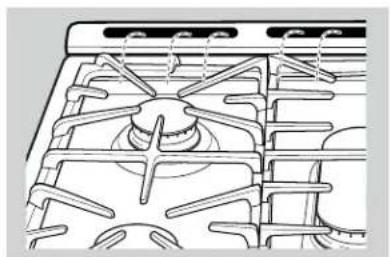
natural_image
Line drawing of a gas stove interior with multiple blades and heat sinks (no text or symbols)La apariencia y la ubicación de la ventilación varían.
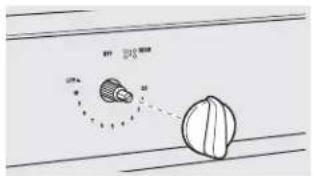
Perilla del quemador superficial
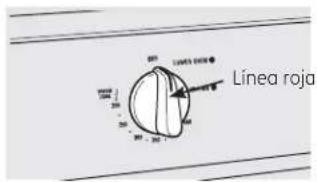
Panel de Control Frontal y Perillas
Una buena idea es limpiar el panel de control luego de cada uso del horno. Use una tela húmeda para limpiar o enjuagar. Para limpiar, use jabón suave y agua o una solución que sea mitad de vinagre y mitad de agua. Para enjuagar, use agua limpia. Pula en seco con una tela suave.
No use limpiadores abrasivos, limpiadores líquidos fuertes, almohadillas para fregar de plástico y limpiadores de horno en el panel de control; dañarán el acabado.
No intente inclinar las perillas empujando las mismas hacia arriba o hacia abajo o colgando una toalla u otras cargas de este tipo. Esto puede dañar el eje de la válvula de gas.
Las perillas de control se pueden retirar para facilitar la limpieza.
Asegúrese de que las perillas estén en las posiciones OFF (Apagado) y empuje las mismas desde los soportes de forma derecha para su limpieza.
Las perillas se pueden limpiar en un lavavajillas o también se pueden lavar con agua y jabón. Asegúrese de que los interiores de las perillas estén secos antes de volver a colocarlas.
Reemplace las perillas en la posición OFF (Apagado) para asegurar una ubicación adecuada.
Las piezas metálicas se pueden limpiar con agua y jabón. No use estropajos, abrasivos, amoníacos, ácidos o limpiadores para hornos comerciales. Seque con una tela seca.
NOTE: Las perillas no se pueden cambiar de lugar. Asegúrese de volver a instalar las perillas en sus ubicaciones originales.
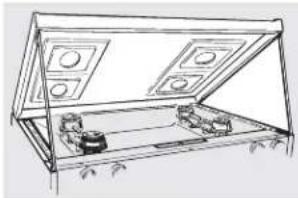
natural_image
Line drawing of a cabinet or storage unit with two internal compartments and circular vent indicators (no text or symbols)Algunos modelos cuentan con varas de soporte dual que sostendrán la estufa mientras limpia su parte inferior.
Elevador de la Estufa (en modelos con quemadores gemelos estándar)
Limpie el área debajo de la estufa con frecuencia. La suciedad acumulada, especialmente la grasa, se puede incendiar.
Para facilitar la limpieza, la estufa puede ser levantada.
NOTA: No levante la estufa en modelos con quemadores sellados. Levantar la cocina puede producir daños y un funcionamiento inapropiado de la estufa.
Para levantar la estufa:
1 Asegúrese de que los controles de la superficie estén apagados.
2 Retire las parrillass.
3 Tome los dos quemadores frontales y levántelos.
Limpie debajo de la estufa con agua caliente y jabón y una tela seca. Si retiró los quemadores durante la limpieza, asegúrese de que se encuentren correctamente posicionados al reemplazarlos.
Luego de la limpieza, baje la estufa (evite pincharse los dedos).
Parte Inferior del Horno
La parte inferior del horno posee un acabado de porcelana esmaltada. Para facilitar la limpieza, proteja el fondo del horno de derrames excesivos colocando una hoja de galletas en el estante que está debajo del estante sobre el cual está cocinando. Esto es particularmente importante al hornear una tarta de fruta u otras comidas con alto contenido de ácido. Los rellenos de fruta caliente u otras comidas con alto contenido de ácido
(tales como tomate, chucrut y salsas con vinagre o jugo de limón) pueden ocasionar fisuras y daños sobre la superficie de porcelana esmaltada y se deberán limpiar inmediatamente.
Para limpiar derrames, use agua y jabón, un limpiador abrasivo o una almohadilla para fregar llena de jabón. Enjuague bien para eliminar cualquier resto de jabón antes de la función de auto limpieza.
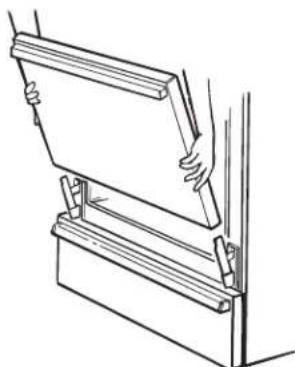
natural_image
Line drawing of a person holding a rectangular object above two stacked plates (no text or symbols)Levante la puerta hacia arriba y afuera de las bisagras.
Levante la Puerta del Horno (en algunos modelos)
La puerta del horno se puede retirar, pero es pesada. Es posible que necesite ayuda para retirar y reemplazar la puerta.
Para retirar la puerta:
1 Abra la misma unas pulgadas hasta la posición de detención específica que sostendrá la puerta abierta.
2 Sostenga la misma de manera firme sobre cada lado y levante la puerta hacia arriba y afuera de las bisagras.
NOTA: Asegúrese de no colocar las manos entre la bisagra y el marco de la puerta
del horno, ya que la bisagra podría hacer presión bruscamente y lastimar los dedos.
Para reemplazar la puerta:
7 Asegúrese de que las bisagras se encuentren en la posición de detención específica. Posicione las ranuras en la parte inferior de la puerta directamente sobre las bisagras.
2 Haga descender la puerta de forma lenta y pareja sobre ambas bisagras al mismo tiempo. Si las bisagras hacen presión bruscamente sobre el marco, empuje las mismas hacia afuera.
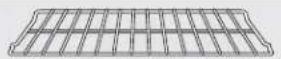
Estantes del Horno
Todas las parrillas del horno se podrán limpiar a mano con un limpiador abrasivo o viruta. Luego de la limpieza, enjuague las parrillas con agua limpia y seque con una tela limpia. Será necesario engrasar
todos los costados de la parrilla del horno con una capa suave de aceite vegetal luego de limpiarlas a mano o en el horno.
Esto ayudará a que las parrillas se puedan deslizar con facilidad fuera de horno.
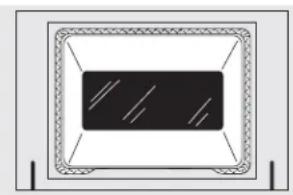
natural_image
Simple diagram of a rectangular frame with a central dark rectangle and diagonal lines, no text or symbols present.La junta está diseñada con un espacio en la parte inferior para permitir la circulación de aire adecuada.
No frote ni limpie la junta de la
puerta; posee una resistencia
extremadamente baja a la abrasión.
Si observa que la junta se vuelve caliente, se deshilacha o daña de cualquier forma y si quedó fuera de la puerta, deberá reemplazar la misma.
Limpieza de la Puerta
Para limpiar el interior de la puerta:
No permita que el excedente de agua entre a ningún agujero o ranuras de la puerta.
El área fuera de la junta se puede limpiar con una almohadilla para fregar de plástico con jabón.
Para limpiar el exterior de la puerta:
Use agua y jabón para limpiar completamente la parte superior, los lados y el frente de la puerta del horno. Enjuague bien. También puede usar un limpiador de vidrio para limpiar el vidrio de la parte exterior de la puerta.
El derrame de adobo, jugos de fruta, salsas de tomate y materiales glaseados que contengan ácidos pueden ocasionar descoloración y se deberán limpiar de inmediato. Cuando la superficie esté fría, lave y enjuague.
No use limpiadores para horno, polvos de limpieza o abrasivos duros sobre la parte exterior de la puerta.
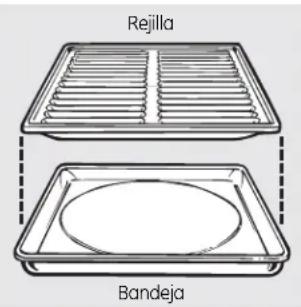
Bandeja para Asar y Rejilla
Luego de asar, retire la bandeja para asar del compartimiento para asar. Retire la rejila de la bandeja. Con cuidado vierta la grasa de la bandeja en un recipiente adecuado. Lave y enjuague la bandeja para asar y la parrilla en agua caliente con un estropajo para fregar plástico lleno de jabón.
Si la comida se quemó, rocíe la rejilla con detergente mientras está caliente y cubra con toallas de papel mojadas o con un paño de cocina. Remojar la bandeja eliminará las comidas quemadas.
La bandeja para asar y la rejilla se podrán limpiar con un limpiador de horno comercial.
La bandeja para asar y la rejilla también se podrán limpiar en un lavavajillas.
No guarde la bandeja para asar y la rejilla en ninguna parte de la cocina.
▲ PRECAUCIÓN: No limpie la bandeja para asar ni la rejilla en el horno de auto limpieza.
Instrucciones de Instalación
Cocina
Ante cualquier duda, llame al 1.800-GE-CARES o visite nuestro sitio web en: GEAppliances.com
En el Commonwealth de Massachusetts
- Este producto debe ser instalado por un plomero licenciado o un mecánico gasista..
- Al usar válvulas de cierre de gas tipo balón, deberán ser del tipo de manija T.
- Al usar un conector de gas flexible no deberá exceder los 3 pies.
ANTES DE COMENZAR
Lea estas instrucciones en su totalidad y atentamente. Esta cocina se deberá instalar de acuerdo con los códigos locales, o en la ausencia de códigos locales, con el Código de Gas Combustible Nacional, ANSIZ223.1/NFPA.54, última edición. En Canadá, la instalación deberá ser conforme con el Código de Instalación de Gas Natural actual, CAN/CGA-B149.1 o el Código de Instalación de Propano actual, CAN/CGA-B149.2, y con los códigos locales cuando corresponda. Esta cocina fue diseñada y certificada por CSA International, de acuerdo con ANSI Z21.1, última edición y con la Canadian Gas Association (Asociación de Gas de Canadá) CAN/CGA-1.1 última edición.
Al igual que con cualquier electrodoméstico que utilice gas y genere calor, existen ciertas precauciones de seguridad que se deberán seguir. Encontrará estas precauciones en la sección de Información Importante de Seguridad, en el frente de este manual. Lea las mismas detenidamente.
- IMPORTANTE Conserve estas instrucciones para uso del inspector de electricidad local.
- IMPORTANTE – Cumpla con todos los códigos y ordenanzas gubernamentales.
- Nota para el Instalador – Guarde estas instrucciones con el electrodoméstico una vez completada la instalación.
- Nota para el Consumidor – Guarde este Manual del Propietario y las Instrucciones de Instalación para referencia futura.
- Nota – Este electrodoméstico deberá estar conectado a tierra de forma adecuada.
- Servicio Técnico – El diagrama eléctrico se encuentra en un sobre adjunto al reverso de la cocina.
- La correcta instalación del producto es responsabilidad del instalador.
- Si se producen fallas en el producto debido a una instalación inadecuada, la Garantía no cubrirá las mismas.
Casa Rodante – Requisitos de Información Adicional Esta cocina se deberá instalar conforme con el Estándar de Construcción y Seguridad para Hogar, Título 24 CFR, Pieza 3280 (anteriormente Estándar Federal para las Construcciones en Casas Móviles, use el estándar para las Instalaciones de Casas Fabricadas, ANSI A225, 1/NFPA 501A o con códigos locales).
Las instalaciones en casas móviles requieren:
- Cuando la cocina es instalada en una casa móvil, se deberá asegurar al piso durante el tránsito. Cualquier método para asegurar la cocina es adecuado, siempre y cuando se realice conforme con los estándares que figuran a continuación.
PARA SU SEGURIDAD
No guarde ni use materiales combustibles, gasolina u otros vapores inflamables y líquidos cerca de éste ni de otros electrodomésticos.
Si huele gas:
1 Abra las ventanas.
2 No toque los enchufes eléctricos.
3 Extinga cualquier llama abierta.
4 Inmediatamente llame a su proveedor de gas.
HERRAMIENTAS NECESARIAS
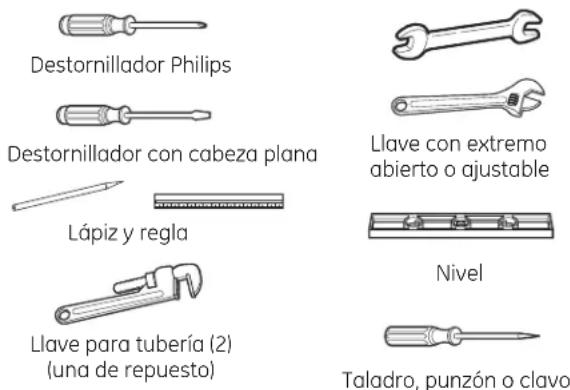
MATERIALES NECESARIOS
- Válvula de cierre para tubería de gas.
- Sellador para junta de tubería o UL – cinta para tubería aprobada con Teflón*, resistente a la acción de gases naturales o LP.
- Conector para artefacto metálico flexible (1/2" I.D.) Se recomienda una longitud de 5 pies para una fácil instalación, pero otras longitudes son aceptables. Nunca use un conector viejo al instalar una cocina nueva.
- Adaptador para unión cónica para la conexión al suministro de gas (3/4" o 1/2" NPT x 1/2" I.D.)
- Adaptador para unión cónica para la conexión al regulador de presión en la cocina (1/2" o ½" NPT x ½" I.D.)
- Detector de pérdida de líquido o agua con jabón.
- Tornillo de compresión o sujetador de manga de 12 " O.D. (sólo para pisos de concreto).
*Teflón: Marca registrada por DuPont
ADVERTENCIA
INSTRUCCIONES PARA UNA INSTALACIÓN SEGURA
Lea estas instrucciones en su totalidad y atentamente. Si no se siguen estas instrucciones se podrá producir descarga eléctrica, incendio, lesiones graves o la muerte.
■ Una instalación, ajuste, alteración, servicio o mantenimiento inadecuados pueden ocasionar lesiones o daños sobre la propiedad. Consulte este manual. Para recibir asistencia o información adicional, consulte a un instalador calificado, agencia de servicio, fabricante (comerciante) o proveedor de gas.
■ Nunca vuelva a usar conectores flexibles viejos. El uso de conectores flexibles viejos puede ocasionar goteras y lesiones personales. Siempre use conectores flexibles NUEVOS al instalar electrodomésticos a gas.
■ La prueba de goteras del electrodoméstico se deberá realizar de acuerdo con las instrucciones del fabricante.
■ Retire todo el material de embalaje y material escrito del horno antes de conectar el gas y el suministro de corriente a la cocina.
■ No intente utilizar el horno de esta cocina durante un corte de corriente (sólo en modelos de encendido eléctrico).
■ Solicite que su cocina sea instalada por un instalador calificado.
■ Su cocina deberá estar correctamente conectada a tierra de acuerdo con los códigos y ordenanzas locales o, en ausencia de códigos locales, de acuerdo con el Código Nacional de Electricidad (National Electric Code), (ANSI/NFPA NO. 70., última edición). En Canadá, la conexión a tierra se deberá realizar de acuerdo con la Parte 1 del Código de Electricidad de Canadá CSA C22.1 y/o los códigos locales. En esta sección, consulte las Conexiones Eléctricas.
■ Antes de instalar su cocina sobre linóleo y cualquier otro revestimiento de piso sintético, asegúrese de que el revestimiento del piso resista los 180° F sin contraerse, combarse o descolorarse. No instale la cocina sobre alfombras, a menos que haya una hoja de contrachapado de un grosor de 14 " o un aislante similar entre la cocina y la alfombra.
Asegúrese de que el gabinetes y revestimiento de pared alrededor de la cocina pueda resistir el calor de hasta 200° F generado por la cocina.
■ Evite usar gabinetes sobre la cocina. Para reducir el riesgo ocasionado por la extensión de las llamas abiertas de los quemadores en funcionamiento, instale una campana de ventilación sobre la cocina que se proyecte hacia adelante por lo menos a 5" del frente de los gabinetes.
La campana de ventilación deberá estar construida de una lámina de metal de no menos de 0.0122" de grosor. Instale sobre la parte superior de la cocina, dejando un espacio de no menos de 1/4" entre la campana y la parte inferior del gabinete de material combustible o metal. La campana deberá ser por lo menos tan ancha como el electrodoméstico y estar centrada sobre el mismo. El despeje entre la superficie de cocción y la superficie de la campana de ventilación NUNCA DEBE SER INFERIOR A 24".
EXCEPCIÓN: La instalación de un horno microondas o electrodoméstico de cocción que figuren en la lista sobre la parte superior de la cocina deberá cumplir con las instrucciones de instalación provistas con el electrodoméstico.
■ Si se ubican gabinetes sobre la cocina, deje un espacio mínimo de 30" entre la superficie de cocción y la parte inferior de los gabinetes desprotegidos.
Si no se puede mantener una distancia de 30" entre la superficie de cocción y el material combustible en la parte superior o los gabinetes de metal, proteja la parte inferior de los gabinetes sobre la parte superior de la cocina con no menos de 1/4" de cartulina común aislante cubierta con una lámina de metal de no menos de 0.0122" de grosor. El despeje entre la superficie de cocción y los gabinetes protegidos NUNCA DEBE SER INFERIOR A 24".
La distancia vertical desde el plano de la superficie de cocción hasta la parte inferior de los gabinetes adyacentes de la parte superior que se extienden más cerca que 1" al plano de los lados de la cocina no deberá ser inferior a las 18". (Consulte la ilustración de Dimensiones y Espacios en esta sección).
No instale este producto con una campana con cortina de aire u otra campana de cocina que funcione llevando aire a la placa de cocción. El flujo de aire podrá interferir en el funcionamiento de los quemadores de gas, produciendo riesgos de incendio o explosión.
APRECAUCIÓN: - Sólo la serie de marca de Café Advantium® de GE o los hornos microondas de calidad excepcional están diseñados para su instalación sobre el horno Café de GE. Es posible que las superficies sobre una cocina a gas se calienten. La instalación de cualquier otro horno excepcional sobre un horno Café de GE puede producir temperaturas superficiales que pueden ocasionar quemaduras.
DIMENSIONES Y ESPACIOS
Deje el espacio adecuado entre la cocina y las superficies combustibles adyacentes. Estas dimensiones se deberán cumplir para un uso seguro de su cocina. La ubicación del tomacorriente de electricidad y la abertura de la tubería (consulte Ubicaciones del Gas y el Tomacorriente Eléctrico) se podrán ajustar para cumplir con los requisitos específicos.
La cocina se deberá ubicar con un espacio (nivelado) de 0" con relación a la pared trasera.
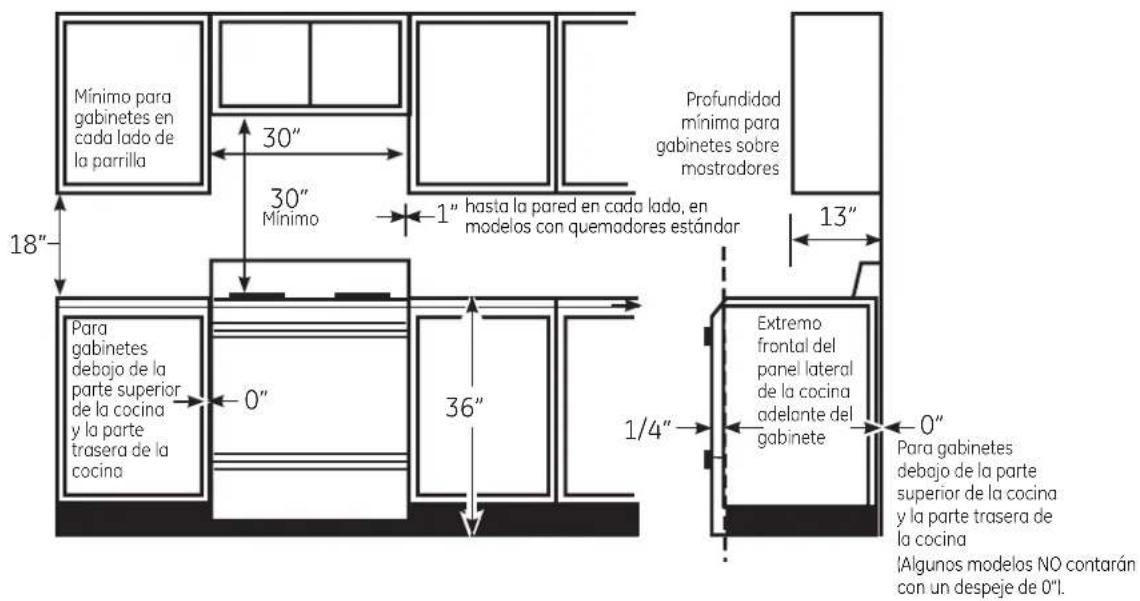
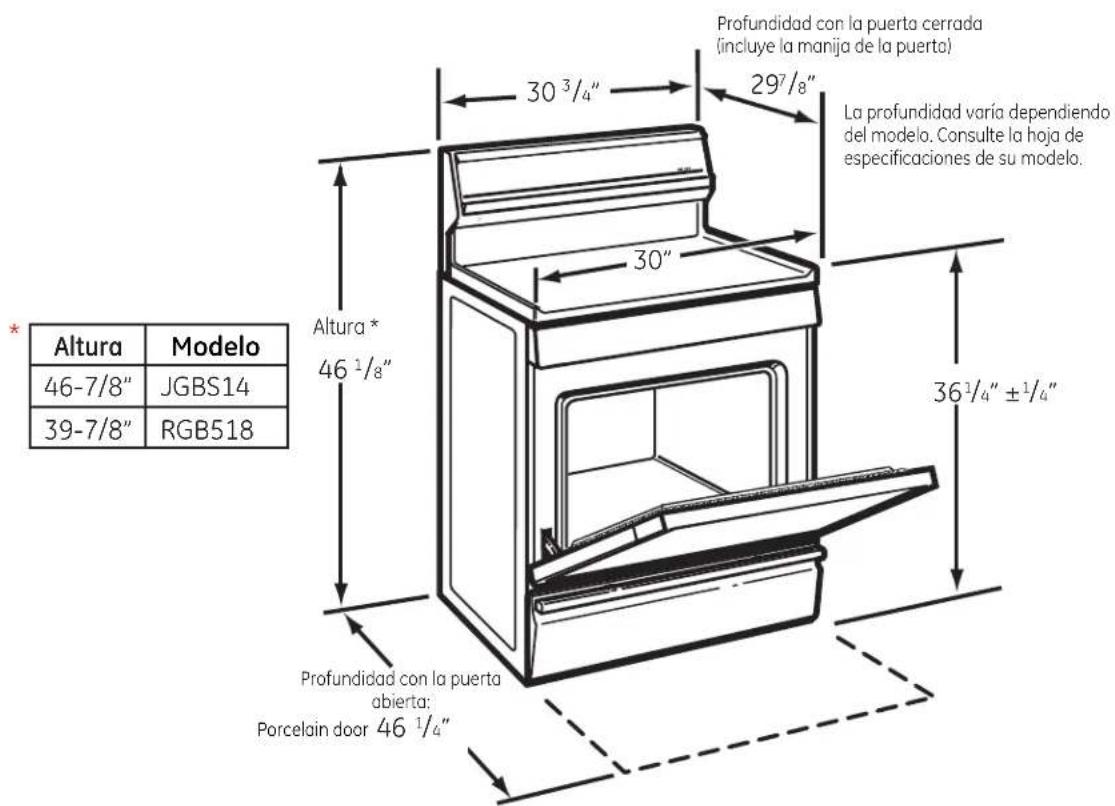
UBICACIÓN
No ubique la cocina donde pueda haber corrientes de aire fuertes. Cualquier abertura en el piso o la pared detrás de la cocina deberán estar selladas. Asegúrese de que las aberturas alrededor de la base de la cocina que brindan aire fresco para la combustión y ventilación no estén obstruidas por alfombras ni piezas de carpintería.
Su cocina, al igual que muchos otros artículos del hogar, es pesada y se puede colocar sobre revestimientos de piso suaves tales como alfombras o vinilo acolchonado. Tenga cuidado al mover la parilla en este tipo de pisos. Se recomienda que se sigan las siguientes instrucciones simples y económicas para proteger su piso.
La cocina se debería instalar sobre una lámina de madera contrachapada (o material similar). Cuando el revestimiento del piso finaliza frente a la cocina, el área donde la cocina se apoyará deberá ser de contrachapado, al mismo nivel o más alto que el revestimiento del piso.
Esto permitirá que la cocina pueda ser movida para su limpieza o reparaciones técnicas. Además, asegúrese de que el revestimiento de su piso resista los 180° F. (Consulte la sección de Instrucciones para una Instalación Segura).
Asegúrese de que el revestimiento de pared alrededor de la cocina pueda resistir el calor (de hasta 200° F) generado por la cocina. (Consulte la sección de Instrucciones para una Instalación Segura).
¡IMPORTANTE!
Remove all tape and packaging. Make sure the burners are properly seated and level.
Take the accessory pack out of the oven and/or drawer.
Check to be sure that no range parts have come loose during shipping.
CONVERTIR A GAS LP (o convertir nuevamente a gas natural de LP)
Esta cocina deja la configuración de fábrica para uso con gas natural. Si desea convertir a gas LP, la conversión deberá ser realizada por un instalador de gas LP calificado.
Las instrucciones de conversión y los orificios LP se pueden encontrar adjuntos a la cocina junto al regulador de presión.
Guarde estas instrucciones y los orificios en caso de que lo desee convertir nuevamente a gas natural.
1 BRINDE EL SUMINISTRO DE GAS ADECUADO
Su cocina fue diseñada para funcionar con una presión del colector de 4" sobre una columna de agua a gas natural o, si se desea usar con gas LP (propano y butano), una columna de agua de 10".
Asegúrese de que esté suministrando a su cocina el tipo de gas para el cual fue diseñada.
Esta cocina es convertible para uso con gas natural o gas propano. Si decide usar esta cocina con gas LP, un instalador de LP calificado deberá realizar la conversión antes de intentar utilizar la cocina con dicho gas.
Para una instalación adecuada, la presión del gas natural suministrado al regulador deberá ser de una columna de agua de entre 5" y 13".
Para el gas LP, la presión suministrada deberá ser de una columna de agua de entre 11" y 13".
Al controlar el funcionamiento adecuado del regulador, la presión de entrada deberá ser por lo menos 1" mayor que la presión de funcionamiento (tubo) como se indica más arriba.
El regulador de presión ubicado en la entrada del tubo de la cocina deberá permanecer en la línea de suministro, más allá de si el gas natural o LP está siendo usado.
Un conector de metal flexible del electrodoméstico usado para conectar la cocina al suministro de gas debería tener un I.D. de 12 " y 5 pies de longitud para una instalación más fácil. En Canadá, los conectores flexibles deberán ser conectores metálicos de pared simples, de no más de 6 pies de longitud.
2 CONECTE LA COCINA AL GAS
Cierre la válvula principal de suministro de gas antes de desconectar su vieja cocina y deje la misma apagada hasta que la nueva conexión se haya completado. No olvide volver a encender el piloto en otros electrodomésticos a gas cuando vuelva a encender el gas.
Debido a que las tuberías duras restringen el movimiento de la cocina, se recomienda el uso del conector para electrodomésticos de metal flexible con certificación internacional de CSA, a menos que los códigos locales requieran una conexión de tubería dura.
Nunca use un conector viejo al instalar una cocina nueva. Si se usa el método de tubería dura, deberá alinear la misma con cuidado; la cocina no se podrá mover una vez realizada la conexión.
Para evitar pérdidas de gas, coloque el compuesto de la junta de gas, o envuelva la cinta para roscas de tuberías con Teflón* alrededor de todas las roscas de tubería macho (externas).
A. Instale una válvula de cierre manual de la línea de gas en la línea de gas, en una ubicación de fácil acceso fuera de la cocina. Asegúrese de que todas las personas que usen la cocina sepan dónde y cómo cerrar el suministro de gas de la cocina.
B. Instale el adaptador de la unión cónica macho de 12 " a la rosca interna de 1/2" de NPT en la entrada del regulador. Use la llave de repuesto en el accesorio regulador para evitar daños.
Al instalar la cocina desde el frente, retire el codo de 90° para una instalación más fácil.
C. Instale un adaptador para unión cónica de 12 " o 34 " a la rosca interna de NPT de la válvula de cierre manual, procurando evitar que la válvula de cierre no gire.
D. Conecte el conector de metal flexible del electrodoméstico al adaptador de la cocina. Posicione la cocina para permitir la conexión en la válvula de cierre.
E. Cuando todas las conexiones se hayan realizado, asegúrese de que todos los controles de la cocina estén en la posición de apagado y encienda la válvula de suministro principal de gas. Use un detector de pérdida de líquido en todas las uniones y conexiones, para controlar pérdidas en el sistema.
ADVERTENCIA
Riesgo de
incendio: No use una llama para controlar las pérdidas de gas.
Al usar presión de prueba superior a 12 psig para controlar la presión del sistema de suministro de gas de la residencia, desconecte la cocina y la válvula de cierre individual de la tubería de suministro de gas. Al usar las presiones de prueba de 12 psig o menos para controlar el sistema de suministro de gas, simplemente aíslé la cocina del sistema de suministro de gas, cerrando la válvula de cierre individual.
*Teflón: Marca registrada por DuPont
UBICACIONES DE LA TUBERÍA DE GAS Y DEL TOMACORRIENTE ELÉCTRICO
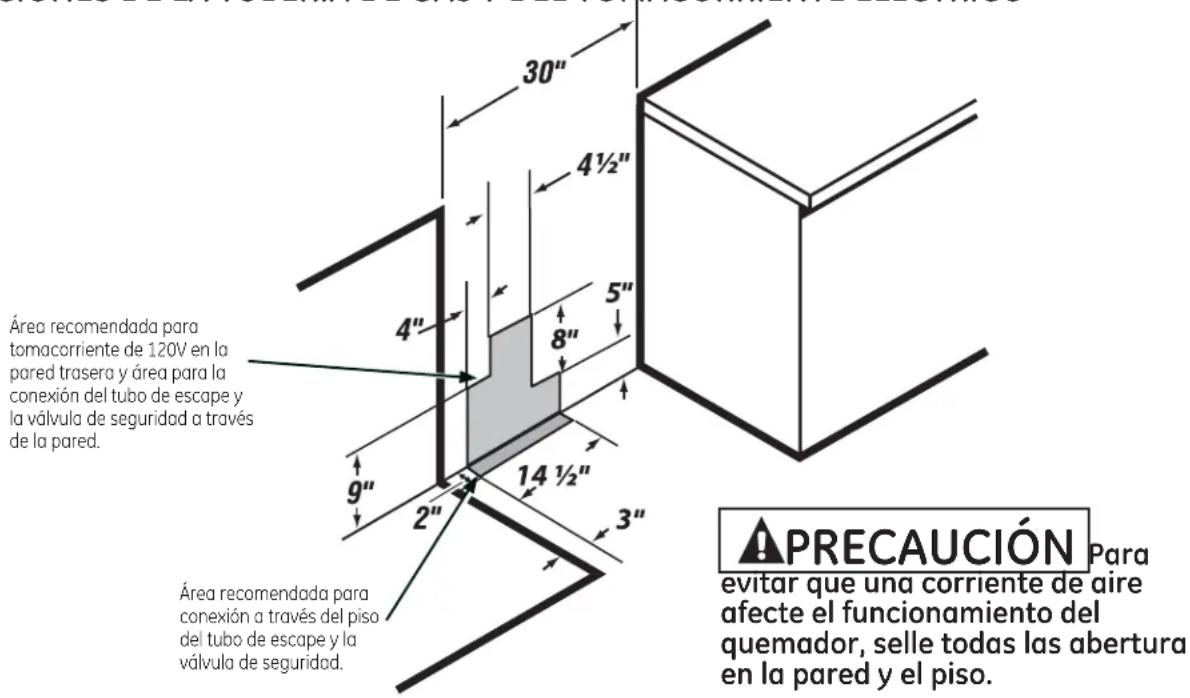
CONEXIÓN DEL CONECTOR FLEXIBLE
(para modelos equipados con Quemadores Dobles Estándar)
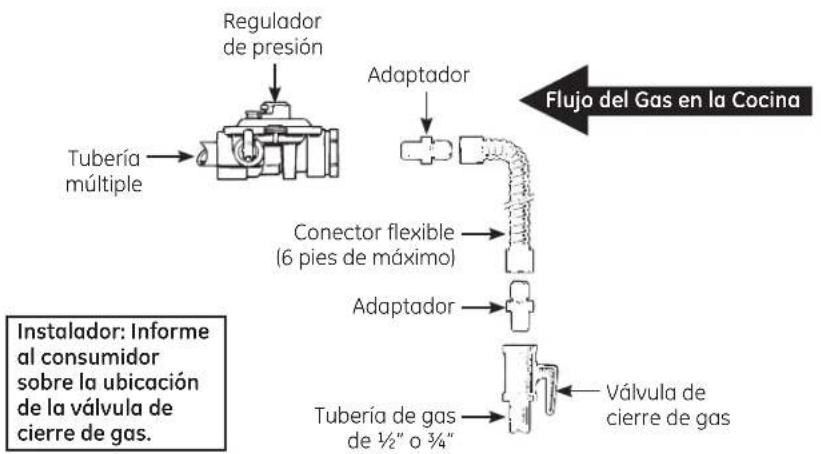
flowchart
graph TD
    A["Tubería múltiple"] --> B["Regulador de presión"]
    B --> C["Adaptador"]
    C --> D["Flujo del Gas en la Cocina"]
    D --> E["Conector flexible (6 pies de máximo)"]
    E --> F["Adaptador"]
    F --> G["Tubería de gas de ½" o ¾""]
    G --> H["Válvula de cierre de gas"]
CONECTOR DE TUBERÍA RÍGIDA (para modelos equipados con Quemadores Dobles Estándar)
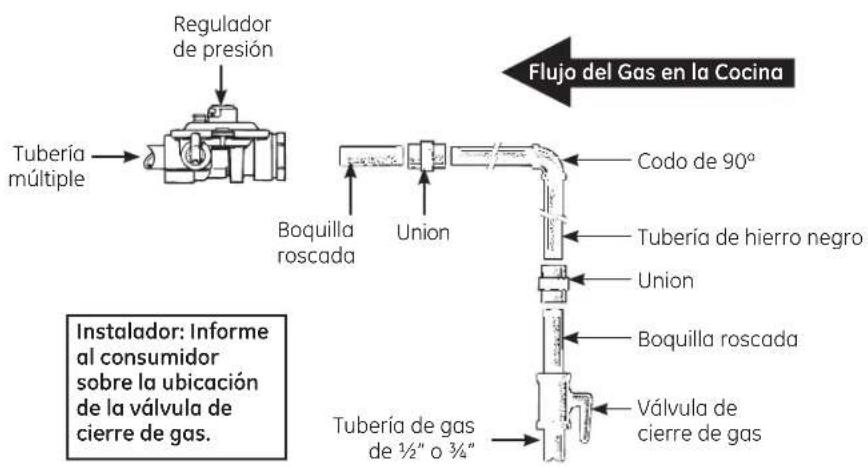
3 INSTALACIÓN DE LA BATERÍA
El funcionamiento del sistema a chispa requiere la instalación de una batería alcalina de 9V, la cual se encuentra junto con estas instrucciones. El compartimiento de la batería se encuentra ubicado detrás del cajón para asar, en la parte inferior izquierda del frente de la estructura de la cocina.
Coloque una moneda o un destornillador de punta plana en la ranura y enrosque para deslizar la bandeja de la batería hacia afuera. Inserte la batería en la bandeja, asegurándose de observar la polaridad correcta. Reinserte la bandeja en el compartimiento y empuje hacia adentro para insertarla en su lugar.
No retire los tornillos.
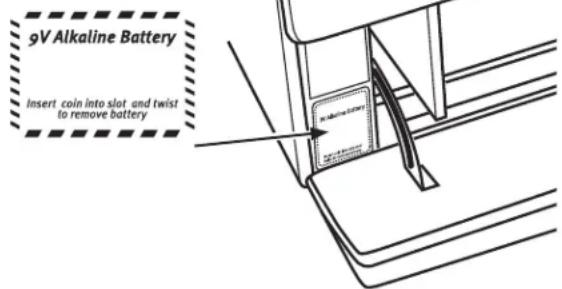
4 SELLADO DE ABERTURAS
Selle cualquier abertura en la pared, detrás de la cocina y en el piso debajo de la cocina cuando las conexiones se hayan completado.
5 ILUMINACIÓN DE LOS QUEMADORES
A Controle el Encendido de los Quemadores de la Superficie
El funcionamiento de todos los quemadores del horno y parte superior de la cocina se deben controlar una vez que la cocina y las líneas de suministro de gas hayan sido cuidadosamente controladas para verificar que no haya pérdidas. Seleccione la perilla de un quemador superior y de forma simultánea empuje el mismo y gire a la posición LITE (Luz). Escuchará un sonido de clic, que indica el funcionamiento adecuado del módulo de chispeo. Una vez que el aire se haya purgado de las líneas de suministro, los quemadores se deberán encender dentro de los 4 segundos. Luego de que los quemadores se iluminen, gire la perilla fuera de la posición LITE (Luz). Pruebe cada quemador de forma sucesiva hasta que todos los quemadores hayan sido controlados.
5 ILUMINACIÓN DE LOS QUEMADORES
Calidad de las Llamas
La calidad de combustión de las llamas del quemador se deberá determinar visualmente.
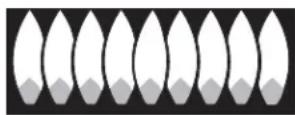
(A) Llamas amarillas —Llame al servicio técnico
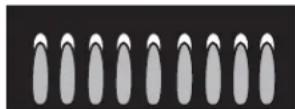
(B) Puntas amarillas en conos externos — Normal para el gas LP
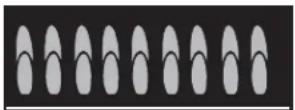
(C) Llamas azul suave —Normal para gas natural
Si las llamas del quemador se ven como en (A), llame al servicio técnico. El aspecto de la llama normal se ve como en (B) o (C), dependiendo del tipo de gas que use.
Con gas LP, es normal que haya algunas puntas amarillas en los conos externos.
B Controle el Encendido del Quemador del Horno
El horno se diseñó para funcionar de forma silenciosa y automática. Para utilizar el horno, gire la perilla OVEN CONTROL (Control del Horno) a una configuración superior a los 300°F. El quemador del horno se encenderá y quemará hasta que se alcance la temperatura configurada.
C Ajuste el Obturador de Ajuste de Aire del Quemador para Hornear en Modelos con un Cajón para Asar, si es Necesario
Determine si las llamas del quemador inferior se están quemando de forma apropiada.
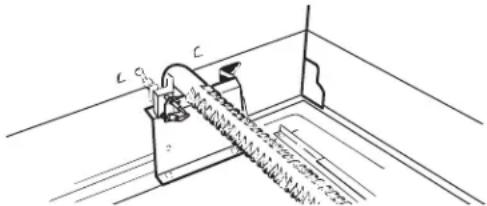
natural_image
Technical line drawing of a mechanical assembly with labeled components (no text or symbols)Una vez retirado el fondo del horno, las llamas correctamente ajustadas deben tener conos azules de aproximadamente 1" y, si la cocina es suministrada con gas natural, deberán quemar sin puntas amarillas. (Con la mayoría de los gases LP, las puntas de llama amarillas al final de los conos exteriores son normales). Las llamas no deben levantar los partes del quemador. Si se observa una elevación, reduzca gradualmente la abertura del obturador de aire hasta que las llamas se estabilicen.
5 ILUMINACIÓN DE LOS QUEMADORES
C El obturador del quemador del horno se encuentra cerca de la pared trasera del horno y detrás del cajón para asar.
Para retirar el Cajón para Asar:
- Empuje el cajón hacia afuera hasta que se detenga, luego empuje el mismo hacia adentro aproximadamente una pulgada.
- Toma la manija, levante y empuje el cajón para asar hacia afuera.
Para ajustar el flujo de aire hacia el quemador, afloje el tornillo tipo Phillips y gire el obturador para permitir que más o menos aire ingrese por el tubo del quemador.
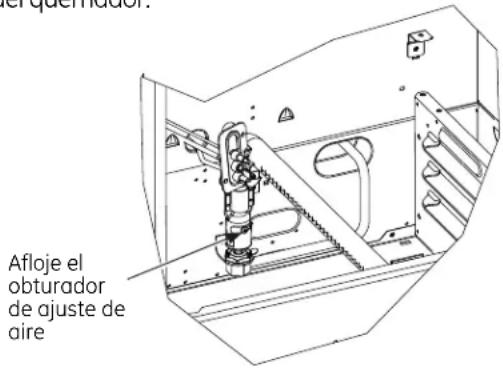
D Reemplace las Piezas del Horno
Una vez realizados todos los ajustes, reemplace el cajón para asar, el fondo del horno, los estantes y la puerta del horno.
6 NIVELACIÓN DE LA COCINA
A. Instale los estantes del horno en el mismo y posicione la cocina en el lugar donde será instalada, con acceso frontal a las patas niveladoras frontales y acceso trasero a las patas niveladoras traseras. Todas las patas deberán ser niveladas ANTES de que el producto sea instalado.
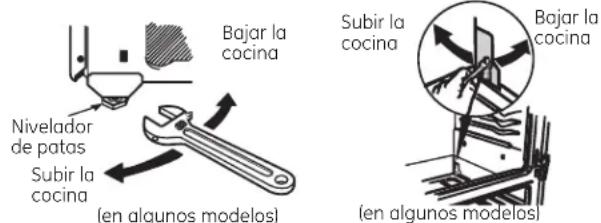
B. Controle la nivelación ubicando un nivel de burbuja o una taza, parcialmente llena de agua, en uno de los estantes del horno. Si usará un nivel de burbuja, haga dos lecturas: con el nivel ubicado de forma diagonal primero en una dirección y luego en la otra.
C. Retire el cajón (en algunos modelos). Consulte la sección de Cuidado y limpieza de la cocina Las patas niveladoras frontales se podrán ajustar desde la parte inferior y las patas traseras se podrán ajustar desde la parte superior (en algunos modelos) o desde la parte inferior.
D. Use una llave de tuercas o ajustable para ajustar las patas niveladoras hasta que la cocina esté nivelada.
ADVERTENCIA
Nunca retire
completamente las patas niveladoras, ya que la cocina no estará asegurada de forma adecuada al dispositivo anti-volcaduras.
E. Luego de nivelar la unidad, deslice hasta la posición final y verifique la nivelación.
F. Luego de que la cocina esté nivelada, aleje la cocina de la pared, de modo que se pueda instalar el dispositivo anti-volcaduras.
7 INSTALACIÓN DEL DISPOSITIVO ANTI- VOLCADURAS
ADVERTENCIA DISPOSITIVO ANTI-VOLCADURAS
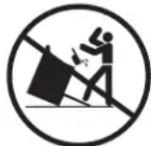
- Todas las cocinas pueden sufrir caídas.
- Se pueden producir QUEMADURAS y otras LESIONES GRAVES.
- INSTALE y CONTROLE el soporte anti-volcaduras, siguiendo las instrucciones suministradas con el soporte.
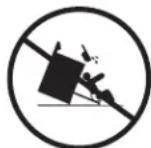
A fin de reducir el riesgo de caída de la cocina, ésta deberá estar asegurada por un soporte anti-volcaduras correctamente instalado. Siga las instrucciones embaladas con el soporte
Para controlar si el soporte es instalado y ajustado de forma apropiada, mire que debajo de la cocina la pata niveladora trasera esté ajustada al soporte. En algunos modelos, el cajón de almacenamiento o el panel de protección se pueden retirar para una fácil inspección. Si no es posible realizar una inspección visual, deslice la cocina hacia adelante, confirme que el soporte anti-volcaduras esté ajustado de forma segura al piso o la pared, y deslice la cocina hacia atrás de modo que la pata niveladora trasera se encuentre debajo del soporte anti-volcaduras.
En caso de que la cocina sea empujada de la pared por alguna razón, siempre repita este procedimiento para verificar que la cocina esté correctamente asegurada por el soporte anti-volcaduras.
Si la cocina no cuenta con el soporte anti-volcaduras, llame al 1.800.626.8774 para recibir uno sin costo.
CUANDO TODAS LAS CONEXIONES SE HAYAN COMPLETADO
Asegúrese de que todos los controles queden en la posición de apagado. Asegúrese de que el flujo de la combustión y el aire de ventilación a la cocina estén desobstruidos.

Consejos para la Solución de Problemas
¡Ahorre tiempo y dinero! Primero revise los cuadros que aparecen en las
siguientes páginas y es posible que no necesite solicitar reparaciones.
| Problema Causas Posibles Qué Hacer | ||
| El quemador no se enciende | Los agujeros al costado del quemador se podrán atascar. | Retire los quemadores o limpie los mismos. Controle que no haya comida quemada ni grasa en el área del electrodo. Consulte la sección de Cuidado y limpieza de la cocina. |
| Ensamble del quemador inapropiado. | Asegúrese de que las partes del quemador estén instaladas correctamente. Consulte Cuidado y limpieza en la sección de la cocina. | |
| El suministro de gas no fue conectado o encendido. | Consulte las Instrucciones de Instalación provistas con su cocina. | |
| La carga de la batería es baja/ descargada | Reemplace la batería (consulte sobre la instalación de la Batería). | |
| Los quemadores superficiales se encienden pero el horno no | La perilla no se mantuvo presionada de manera firme en la posición LITE (Luz) durante 10 segundos. | Consulte la sección Using the oven (Uso del Horno). |
| Llamas del quemador muy grandes o amarillas | Improper air to gas ratio. | Si la cocina es conectada a gas LP, contacte a la persona que instaló la cocina o que hizo la conversión. |
| La comida no se hornea ni se tuesta en el horno | Controles del horno configurados de forma incorrecta. | Lea la sección sobre Uso del horno. |
| La posición del estante es incorrecta. | Lea la sección sobre Uso del horno. | |
| Uso del utensilio incorrecto o de un utensilio de tamaño incorrecto. | Lea la sección sobre Uso del horno. | |
| El termostato del horno debe ser ajustado. | Lea la sección Ajuste el termostato del horno - ¡Hágalo usted mismo! | |
| El reloj no se configuró correctamente. | Lea la sección Uso del reloj y del temporizador. | |
| El fondo del horno no está correctamente ajustado en su posición. | Lea la sección Instalación de la cocina. | |
| La carga de la batería es baja | Reemplace la batería (consulte sobre la instalación de la Batería). | |
| Las piezas del quemador no fueron reemplazadas correctamen | Lea la sección Cuidado y limpieza de la cocina. | |
| La comida no asa de forma correcta | La puerta del horno no se cerró correctamente. | Cierre la puerta del horno. Lea la sección sobre Uso del horno superior. |
| Se cocinó comida en una olla caliente. | Para un mejor resultado, use una olla diseñada para asar. Asegúrese de que esté fría. | |
| Utensilio de cocina inadecuado para asar. | Para un mejor resultado, use una olla diseñada para asar. | |
| Temperatura del horno demasiado caliente o demasiado fría | El termostato del horno debe ser ajustado. | Lea la sección Ajuste el termostato del horno superior - ¡Hágalo usted mismo! |
| Sonido de “chisporroteo” o “traqueo” | Éste es el sonido de metal calentándose o enfriándose durante las funciones de cocción y limpieza. | Esto es normal. |
| Olor a “quemado” o “aceite” desde la ventilación | Esto es normal en un horno nuevo y desaparecerá con el rápidamente. | Abra la ventana para ventilar la habitación. |
| Olor fuerte | Un olar en la aislación alrededor del interior del horno es normal desde las primeras veces en que el horno es usado. | Esto es temporario. |
Notas.
¿Busca Algo Más? (Not all accessories are available for all models.)
Puede encontrar estos accesorios y mucho más en GEApplianceParts.com (EE.UU.) o en www.GEAppliances.ca (Canadá), o llamando al 800.626.2002 (EE.UU.) o al 888.261.3055 (Canadá) (durante el horario comercial habitual). Tenga a mano su número de modelo.
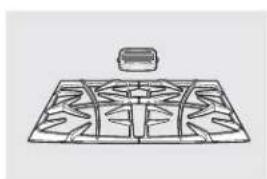
natural_image
Line drawing of a grid pattern with a small rectangular object above it (no text or symbols)Parrillas
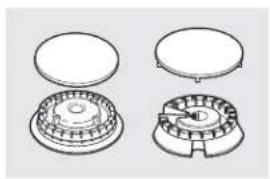
natural_image
Technical line drawing of four mechanical components with no visible text or symbolsCabezales o tapas de
quemadores de superficie
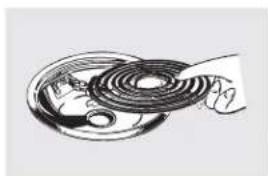
natural_image
Illustration of a coiled cable or wire with a hand holding it (no text or symbols visible)Elementos de superficie y
bandejas colectoras
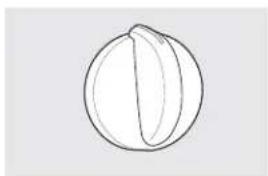
natural_image
Simple line drawing of a peach (no text or symbols)Perillas
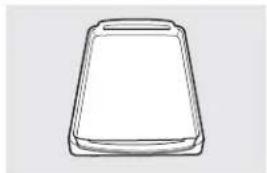
natural_image
Simple line drawing of a rectangular tray or tray with rounded edges (no text or symbols)Plancha
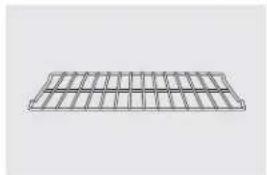
natural_image
Simple line drawing of a rectangular grid structure (no text or symbols)Estantes del Horno
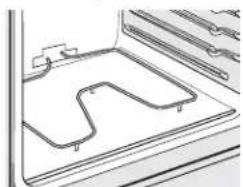
natural_image
Line drawing of a kitchen appliance with a rectangular tray and internal curved lines (no text or symbols)Elementos del horno
natural_image
Two simple line drawings of fluorescent bulbs, one with a bulb and the other with a bulb (no text or symbols)Lámparas de luz
¡Pruebe estos otros excelentes productos para que su cocina se vea estupenda!
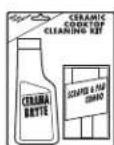
Cerama Bryte®
Kit de limpieza
de anafes
vitrocerámicos:
Incluye limpiador,
rasqueta y paño
WX10X117GCS
Cerama Bryte® Retocar Spray
WX10X391
Citrushine
Toallitas para
pulir artefactos
de acero
inoxidable
WX10X10007
Cerama Bryte®
Limpiador
de artefactos
de acero
inoxidable
PM10X311
¡Aproveche al máximo su bandeja para asar! (No para usar con modelos de cajón asador.)
¡Utilice su bandeja y tapa de rejilla para asar hamburguesas, frutos de mar, filetes, vegetales, panceta, costillas y mucho más! La bandeja inferior retiene el exceso de grasas y aceites.
- Pieza GE genuina
- Fácil de limpiar
• Garantía de un año
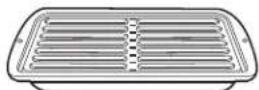
¡Oferta de tiempo limitado! ¡Envío sin cargo!
Cuando solicite la bandeja para asar dentro de los 30 días de haber adquirido su producto de cocina GE.
Pequeña Grande* Extra grande**
N° de pieza WB48X10055 WB48X10056 WB48X10057
Dimensiones 8-3/4" A x 1-1/4" A x 13-1/2" P 12-3/4" A x 1-1/4" A x 16-1/2" P 17" A x 1-1/4" A x 19-1/4" P
* La bandeja para asar grande (estándar) no entra en cocinas de 20/24 pulgadas.
** La bandeja extra grande no entra en hornos de paredes de 24 pulgadas, empotradas de 27 pulgadas o cocinas de 20/24 pulgadas.
Llame al 800.626.2002 o utilice este formulario para enviar su solicitud por correo:
GE Parts, P.O. Box 221027, Memphis, TN 38122-1027.

Formulario de solicitud de la bandeja para asar
Cantidad ____ Número de pieza ____
Número de modelo ____ Número de serie ____ Marca ____ Fecha de compra ____
Nombre ____ Apellido ____
Dirección
Ciudad Estado Código Postal
Teléfono ____ Correo electrónico ____
Check ____ Giro postal ____
Para consultar sobre los precios actuales llame al 800.626.2002. Todas las órdenes con tarjeta de crédito se deberán realizar en forma telefónica.
Notas.
Todo el servicio de garantía es provisto por nuestros Centros de Servicio de Fabricación, o un técnico autorizado de Servicio al Cliente (Customer Care®). Puede programar una consulta al servicio técnico a través del Internet, las 24 del día, visitándonos en GEAppliances.com, o llamando al 800. GE.CARES (800.432.2737). Cuando llame para solicitar el servicio, tenga los números de serie y de modelo disponibles.
Abroche su recibo aquí. Para acceder al servicio técnico de acuerdo con la garantía deberá contar con la prueba de la fecha original de compra.
Por el Período de: GE Reemplazará:
Un Año
Desde la fecha de la compra original el
Cualquier parte de la cocina que falle debido a un defecto en los materiales o la fabricación. Durante esta garantía limitada de un año, GE también proveerá, sin costo, todo el trabajo y el servicio en r relacionado con el reemplazo de la parte que presente defectos.
Qué No Cubrirá GE:
Viajes del técnico del servicio a su hogar para enseñarle a usar el producto.
■ Instalación inadecuada, entrega o mantenimiento.
PFallas o daños del producto en caso de abuso, mal uso, o uso para propósitos diferentes al original o uso comercial.
■ Reemplazo de fusibles de la casa o reinicio de disyuntores.
Daños ocasionados sobre el producto por accidente, incendio, inundaciones o catástrofes naturales.
Daños consecuentes o incidentales causados por posibles defectos sobre este producto.
Daño causado después de la entrega.
- Producto no accesible para brindar el servicio requerido.
■ Reemplazo de la batería en modelos inalámbricos.
EXCLUSIÓN DE GARANTÍAS IMPLÍCITAS—Su única y exclusiva alternativa es la reparación del producto, como se indica en la Garantía Limitada. Las garantías implícitas, incluyendo garantías implícitas de comerciabilidad o conveniencia sobre un propósito particular, se limitan a un año o al período más corto permitido por la ley.
Esta garantía se extiende al comprador original y a cualquier dueño subsiguiente de productos comprados para uso hogareño dentro de EE.UU. Si el producto se encuentra en un área donde no se encuentra disponible el servicio técnico de un Proveedor de Servicio de GE Autorizado, usted será responsable por el costo de un viaje o se podrá requerir que traiga el producto a una Ubicación del Servicio Técnico de GE Autorizado para recibir el servicio. En Alaska, la garantía excluye el costo de envío o llamadas del servicio a su hogar.
Algunos estados no permiten la exclusión o limitación de daños fortuitos o consecuentes. Esta garantía le da derechos legales específicos y es posible que tenga otros derechos legales que varían entre un estado y otro. Para conocer cuáles son sus derechos legales, consulte a la oficina de asuntos del consumidor local o estatal o al Fiscal de su Estado.
Sitio Web de Electrodomésticos de GE
En EE.UU.: GEAppliances.com
¿Desea realizar una consulta o necesita ayuda con su electrodoméstico? ¡Intente a través del Sitio Web de Electrodomésticos de GE las 24 horas del día, cualquier día del año! Para mayor conveniencia y un servicio más rápido, ahora puede descargar el Manual del Propietario, ordenar piezas o incluso programar el servicio técnico a través de Internet.
Servicio Programado
En EE.UU.: GEAppliances.com
El servicio de reparación de expertos de GE está a sólo un paso de su puerta. ¡Conéctese a través de Internet y programe su servicio a su conveniencia las 24 horas del día cualquier día del año! O llame al 800.GE.CARES (800.432.2737) durante el horario comercial habitual.
Estudio de Diseño de la Vida Real
En EE.UU.: GEAppliances.com
GE apoya el concepto de Diseño Universal – productos, servicios y ambientes que pueden ser usados por personas de todas las edades, tamaños y capacidades. Reconocemos la necesidad de realizar diseños para una amplia gama de habilidades e incapacidades físicas y mentales. Para más detalles sobre las aplicaciones de Diseño Universal de GE, incluyendo ideas de diseño de cocinas para personas con incapacidades, visite nuestro sitio web hoy. Sobre casos de incapacidad auditiva, comuníquese al 800.TDD.GEAC (800.833.4322).
Garantías Extendidas
En EE.UU.: GEAppliances.com
Adquiera una garantía extendida de GE y conozca sobre descuentos especiales que están disponibles mientras su garantía aún está vigente. La puede adquirir a través de Internet en cualquier momento o llamando al 800.626.2224 durante el horario comercial habitual. Los Servicios para el Consumidor Hogareño de GE aún estarán allí cuando su garantía caduque.
Piezas y Accesorios
En EE.UU.: GEAppliances.com
Individuos calificados para realizar el servicio técnico de sus propios electrodomésticos podrán solicitar el envío de piezas o accesorios directamente a sus hogares (se aceptan las tarjetas VISA, MasterCard y Discover). Ordene hoy a través de Internet, las 24 horas del día o en forma telefónica llamando al 800.626.2002, durante el horario comercial habitual. Las instrucciones que figuran en este manual cubren los procedimientos que serán realizados por cualquier usuario. Otros servicios técnicos generalmente deberían ser derivados a personal calificado del servicio. Se deberá tener cuidado, ya que una reparación indebida podrá ocasionar que el funcionamiento no sea seguro.

Contáctenos
In the U.S.: GEAppliances.com
Si no se encuentra satisfecho con el servicio que recibió de GE, comuníquese con nosotros a través de nuestro sitio web con todos los detalles, incluyendo su número telefónico, o escriba a: General Manager, Customer
Relations
GE Appliances, Appliance Park
Louisville, KY 40225
Registre su Electrodoméstico
In the U.S.: GEAppliances.com
Registre su electrodoméstico nuevo a través de Internet - ja su conveniencia! Un registro puntual de su producto permitirá una mejor comunicación y un servicio más puntual de acuerdo con los términos de su garantía, en caso de surgir la necesidad. También puede enviar una carta en la tarjeta de inscripción pre-impresa que se incluye con el material empaquetado.
- Free-Standing Gas Ranges
- Operating Instructions
- Care and Cleaning
- WARNING
- IMPORTANT SAFETY NOTICE
- GENERAL SAFETY INSTRUCTIONS
- KEEP FLAMMABLE MATERIALS AWAY FROM THE RANGE
- IN THE EVENT OF A FIRE, TAKE THE FOLLOWING STEPS TO PREVENT INJURY AND FIRE SPREADING:
- COOKTOP SAFETY INSTRUCTIONS
- OVEN SAFETY INSTRUCTIONS
- Using the gas surface burners.
- Before Lighting a Gas Burner
- After Lighting a Gas Burner
- How to Light a Gas Surface Burner
- How to Select Flame Size
- Top-of-Range Cookware
- Wok This Way
- Replacing the 9V Battery
- ⚠️CAUTION Battery may explode or leak and cause burn injury, if recharged, disposed of in fire, inserted backwards, or missassembled.
- Lighting Burners with a Match
- Using the oven.
- To operate the oven:
- Before you begin...
- CAUTION
- Upper Oven Vent
- Lighting the Oven with a Match
- Preheating and Pan Placement
- Aluminum Foil
- Oven Moisture
- How to Set the Broiler Compartment (on some models)
- Both the oven and broiler compartment doors must be closed during broiling.
- Broiling Compartment Guide Suggestions
- Adjust the oven thermostat—Do it yourself!
- To Adjust the Thermostat (on models with an OVEN TEMP Knob)
- The type of margarine will affect baking performance!
- CAUTION:
- Standard Twin Burner Assemblies
- Cleaning Burner Grates
- Cooktop Surface
- Oven Air Vents
- Front Control Panel and Knobs
- Lift-Up Cooktop (on models with standard twin burners)
- To raise the cooktop:
- Oven Bottom
- Lift-Off Oven Door (on some models)
- To remove the door:
- To replace the door:
- Oven Racks
- Cleaning the Door
- To clean the inside of the door:
- To clean the outside of the door:
- Broiler Pan and Grid
- Installation Instructions
- Range
- In the Commonwealth of Massachusetts
- BEFORE YOU BEGIN
- Mobile Home - Additional Installation Requirements
- Mobile home installations require:
- FOR YOUR SAFETY
- If you smell gas:
- MATERIALS YOU MAY NEED
- INSTALLATION SAFETY INSTRUCTIONS
- DIMENSIONS AND CLEARANCES
- LOCATION
- IMPORTANT!
- CONVERTING TO LP GAS (or converting back to natural gas from LP)
- PROVIDE ADEQUATE GAS SUPPLY
- CONNECT THE RANGE TO GAS
- flame to check for gas leaks.
- INSTALLING THE BATTERY
- SEAL THE OPENINGS
- LIGHT THE BURNERS
- A Check Ignition of Surface Burners
- LIGHT THE BURNERS (CONT.)
- Quality of Flames
- B Check Ignition of Oven Burner
- C Adjust Bake Burner Air Adjustment Shutter on Models with a Broiler Drawer, if Necessary
- C Adjust Bake Burner Air Adjustment Shutter on Models with a Broiler Drawer, if Necessary (Cont.)
- To Remove the Broiler Drawer:
- D Replace Oven Parts
- LEVELING THE RANGE
- LEVELING THE RANGE (CONT.)
- INSTALLING THE ANTI-TIP DEVICE
- ▲ WARNING
- ANTI-TIP DEVICE
- WHEN ALL HOOKUPS ARE COMPLETED
- Before you call for service...
- Notes.
- Looking For Something More? (Not all accessories are available for all models.)
- Experience these other great products to keep your kitchen looking great!
- Get the most out of your Broiler Pan! (Not for use with Broiler Drawer models.)
- Limited Time Offer! Free Shipping!
- Broiler Pan Order Form
- What GE Will Not Cover:
- GE Appliances Web Site In the U.S.: GEAppliances.com
- Schedule Service In the U.S.: GEAppliances.com
- Real Life Design Studio
- Extended Warranties In the U.S.: GEAppliances.com
- Parts and Accessories In the U.S.: GEAppliances.com
- Contact Us
- Register Your Appliance
- INFORMACIÓN IMPORTANTE DE SEGURIDAD. LEA TODAS LAS INSTRUCCIONES ANTES DE USAR.
- ADVERTENCIA
- - QUÉ DEBE HACER SI HUELE GAS
- AVISO DE SEGURIDAD IMPORTANTE
- GUARDE ESTAS INSTRUCCIONES
- INSTRUCCIONES GENERALES DE SEGURIDAD
- MANTENGA LOS MATERIALES INFLAMABLES ALEJADOS DE LA COCINA
- EN CASO DE INCENDIO, SIGA LOS SIGUIENTES PASOS PARA EVITAR LESIONES O LA PROPAGACIÓN DEL FUEGO:
- INSTRUCCIONES DE SEGURIDAD DE LA PARTE SUPERIOR DE LA COCINA
- INSTRUCCIONES DE SEGURIDAD
- Cómo usar los quemadores superficiales de gas.
- Antes de Encender un Quemador de Gas
- Luego de Encender un Quemador de Gas
- Cómo Encender un Quemador Superficial de Gas
- Cómo Seleccionar el Tamaño de la Llama
- ADVERTENCIA Las llamas
- Utensilio sobre la Cocina
- Use el Wok de Esta Forma
- Reemplazo de la Batería de 9V
- PRECAUCIÓN
- Cómo Encender los Quemadores con un Fósforo
- Para usar el horno:
- Antes de comenzar...
- PRECAUCIÓN: Al usar
- Ventilación del Horno Superior
- Cómo Encender el Horno con un Fósforo
- Precalentamiento y Ubicación de Ollas
- Papel de Aluminio
- Humedad del Horno
- Cómo Configurar el Compartimiento para Asar (en algunos modelos)
- Tanto la puerta del horno como la del compartimiento para asar se deberán cerrar durante el asado.
- Sugerencias de la Guía del Compartimiento para Asar
- Ajuste los termostatos - ¡Hágalo usted mismo!
- Para Ajustar el Termostato (en modelos con la Perilla OVEN TEMP (Temperatura del Hornol))
- Empuje la perilla OVEN TEMP
- ¡El tipo de margarina afectará el rendimiento del horneado!
- Ensambles del Quemador Doble Estándar
- Parrillas de los Quemadores
- Superficie de la Parte Superior de la Cocina
- Ventilaciones de Aire del Horno
- Panel de Control Frontal y Perillas
- Elevador de la Estufa (en modelos con quemadores gemelos estándar)
- Para levantar la estufa:
- Parte Inferior del Horno
- Levante la Puerta del Horno (en algunos modelos)
- Para retirar la puerta:
- Para reemplazar la puerta:
- Estantes del Horno
- Limpieza de la Puerta
- Para limpiar el interior de la puerta:
- Para limpiar el exterior de la puerta:
- Bandeja para Asar y Rejilla
- Instrucciones de Instalación
- Cocina
- En el Commonwealth de Massachusetts
- ANTES DE COMENZAR
- Las instalaciones en casas móviles requieren:
- PARA SU SEGURIDAD
- Si huele gas:
- HERRAMIENTAS NECESARIAS
- MATERIALES NECESARIOS
- INSTRUCCIONES PARA UNA INSTALACIÓN SEGURA
- DIMENSIONES Y ESPACIOS
- UBICACIÓN
- ¡IMPORTANTE!
- CONVERTIR A GAS LP (o convertir nuevamente a gas natural de LP)
- BRINDE EL SUMINISTRO DE GAS ADECUADO
- CONECTE LA COCINA AL GAS
- Riesgo de
- INSTALACIÓN DE LA BATERÍA
- SELLADO DE ABERTURAS
- ILUMINACIÓN DE LOS QUEMADORES
- A Controle el Encendido de los Quemadores de la Superficie
- B Controle el Encendido del Quemador del Horno
- C Ajuste el Obturador de Ajuste de Aire del Quemador para Hornear en Modelos con un Cajón para Asar, si es Necesario
- Para retirar el Cajón para Asar:
- D Reemplace las Piezas del Horno
- NIVELACIÓN DE LA COCINA
- INSTALACIÓN DEL DISPOSITIVO ANTI- VOLCADURAS
- ADVERTENCIA DISPOSITIVO ANTI-VOLCADURAS
- CUANDO TODAS LAS CONEXIONES SE HAYAN COMPLETADO
- Notas.
- ¿Busca Algo Más? (Not all accessories are available for all models.)
- ¡Pruebe estos otros excelentes productos para que su cocina se vea estupenda!
- ¡Aproveche al máximo su bandeja para asar! (No para usar con modelos de cajón asador.)
- ¡Oferta de tiempo limitado! ¡Envío sin cargo!
- Formulario de solicitud de la bandeja para asar
- Por el Período de: GE Reemplazará:
- Un Año
- Qué No Cubrirá GE:
- Sitio Web de Electrodomésticos de GE
- Servicio Programado
- Estudio de Diseño de la Vida Real
- Garantías Extendidas
- Piezas y Accesorios
- Contáctenos
- Registre su Electrodoméstico
Kaubamärk : GE
Mudel : JGBS14PCDWW
Kategooria : Pliit