
SL1TX - Sewing machine TOYOTA - Free user manual and instructions
Find the device manual for free SL1TX TOYOTA in PDF.


User questions about SL1TX TOYOTA
0 question about this device. Answer the ones you know or ask your own.
Ask a new question about this device
Download the instructions for your Sewing machine in PDF format for free! Find your manual SL1TX - TOYOTA and take your electronic device back in hand. On this page are published all the documents necessary for the use of your device. SL1TX by TOYOTA.
USER MANUAL SL1TX TOYOTA
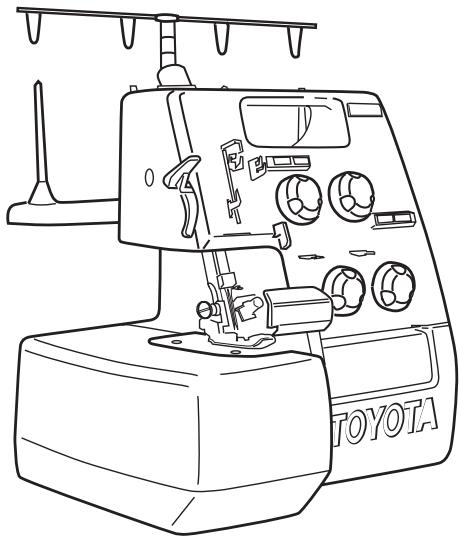
SL1T-X Series All Models
TOYOTA
English
UK ONLY
IMPORTANT
PLEASE READ CAREFULLY
The wires in this mains lead are coloured in accordance with the following code:
BLUE-NEUTRAL
BROWN-LIVE (OR ACTIVE)
As the colours of the mains lead of this appliance may not correspond with the coloured markings identifying the terminals in your plug - PROCEED AS FOLLOWS: The earth plug pin is unnecessary. As the Machine is designed under double insulation structure, the earth wire is removed from the machine. The wire coloured BROWN must be connected to the terminal marked L or A or coloured RED.
The wire coloured BLUE must be connected to the terminal marked N or coloured BLACK. Neither core is to be connected to the earth terminal of a three-pin plug.
English
IMPORTANT SAFETY INSTRUCTIONS
When using an electrical appliance, basic safety precautions should always be followed, including the following:
Read all instructions before using (this appliance).
DANGER — — To reduce the risk of electric shock:
An appliance should never be left unattended when plugged in. Always unplug this appliance from the electric outlet immediately after using and before cleaning.
WARNING — — To reduce the risk of burns, fire, electric shock, or injury to persons:
- Do not allow to be used as a toy. Close attention is necessary when this appliance is used by or near children.
- Use this appliance only for its intended use as described in this manual. Use only attachments recommended by the manufacturer as contained in this manual.
- Never operate this appliance if it has a damaged cord or plug, if it is not working properly, if it has been dropped or damaged, or dropped into water. Return the appliance to the nearest authorized dealer or service center for examination, repair, electrical or mechanical adjustment.
- Never operate the appliance with any air openings blocked. Keep ventilation openings of the sewing machine and foot controller free from the accumulation of lint, dust, and loose cloth.
- Never drop or insert any object into any opening.
- Do not use outdoors.
- Do not operate where aerosol (spray) products are being used or where oxygen is being administered.
- To disconnect, turn all controls to the off ("O") position, then remove plug from outlet.
- Do not unplug by pulling on cord. To unplug, grasp the plug, not the cord.
DANGER
- Always unplug before relamping. Replace the bulb with same type rated 15 watts.
- Do not reach for an appliance that has fallen into water. Unplug immediately.
- Do not place or store appliance where it can fall or be pulled into a tub or sink. Do not place or drop into water or other liquid.
English
WARNING
- Switch off or unplug the appliance when leaving it unatteneded.
- Unplug the appliance before carrying out maintenance or replacing lamps.
- Keep fingers away from all moving parts. Special care is required around the sewing machine needle.
- Always use proper needle plate. The wrong plate can cause the needle to break.
- Do not use bent needles.
- Do not pull or push fabric while stitching. It may deflect the needle causing it to break.
- Switch the sewing machine off ("O") when making any adjustments in the needle area, such as threading needle, changing needle, threading bobbin, or changing presser foot, etc.
- Always unplug sewing machine from the electrical outlet when removing covers, lubricating, or when making any other user servicing adjustments mentioned in the instruction manual.
- Never operate on a soft surface such as a bed or couch where the air openings may be blocked.
SAVE THESE INSTRUCTIONS
English
CONTENTS
- NAMES OF PARTS 1
- PREPARATION FOR SEWING 3
Connecting Power Cord 3
Setting Telescopic Thread Stand 4
Opening The Front Panel and Side Cover 5
How to Change Threads 6
Replacing Needles 7
Threading 8
Preparation for Sewing and Checking 13
- FOUR THREAD OVEREDGING STITCH USING 2 NEEDLES..... 14
Before Sewing 14
Presser Foot Lifter 14
Beginning and Ending of Sewing 15
Adjustment of The Presser Foot Pressure 16
Thread Tension Adjustment 16
Adjustments for the Differential Feed 22
Adjustments for Size of Bite 23
How to Adjust Stitch Length 24
Sewing for Curved Seams 24
StandardChartfortheThreadTension 25
4. SETTING WASTE TRAY 26
5. THREE THREAD OVEREDGING STITCH USING ONE NEEDLE 27
TWO THREAD OVERLOCK 28
- ROLL HEMMING 29
- PIN TUCKING 32
8.CORDEDOVERLOCK 34 - REPLACING THE CUTTING KNIVES 35
- CHANGING THE LIGHT BULB 37
- LUBRICATION 38
- TABLE OF SEWING MATERIALS, NEEDLES AND THREAD 39
13 ACCESSORIES 40 - SPECIFICATIONS 42
Section
1
SL1T-X
- NAMES OF PARTS / NOMBRE DE LAS PARTES / NOM DES PIECES / HAUPTTEILE DER MASCHINE / VOORNAAMSTE ONDERDELEN / ELENCO DEI COMPONENTI
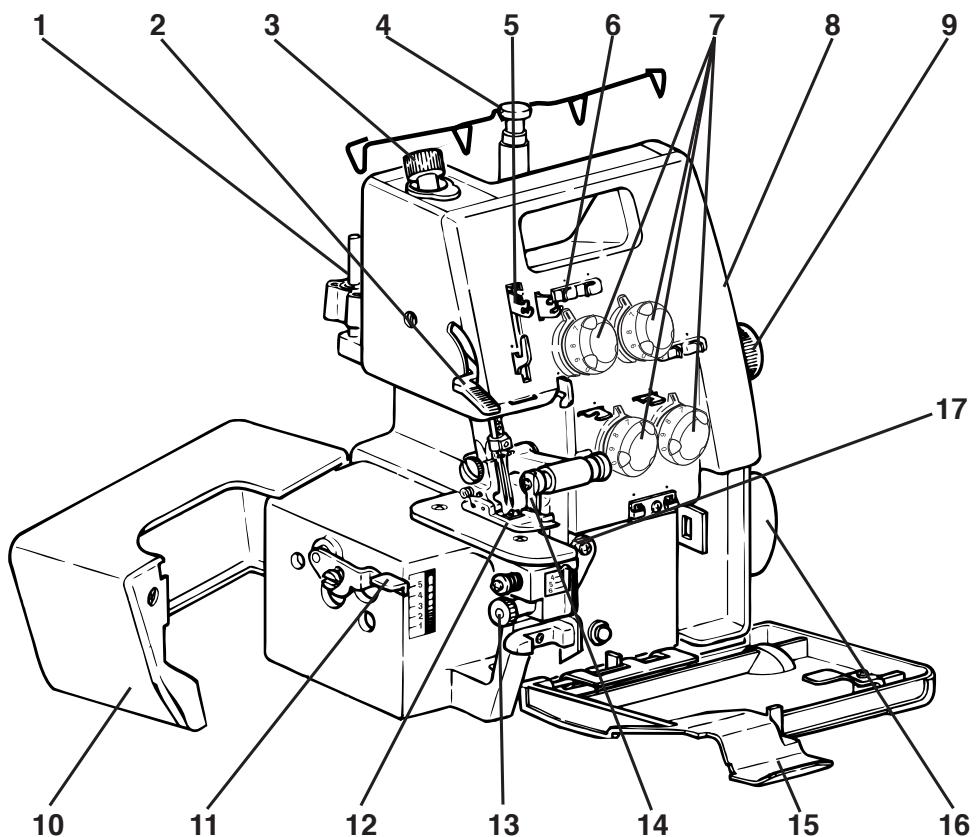
| English | François | Nederlands |
| 1. Spool pin | 1. Tige porte bobine | 1. Kloshouser |
| 2. Presser foot lifter | 2. Levier du pied de biche | 2. Hendel van het persvoetje |
| 3. Pressure regulator screw | 3. Vis de réglage de pression du pied de biche | 3. Schroef voor het regelen van de persvoetdruk |
| 4. Telescopic thread stand | 4. Guide fil à tube téléscopique | 4. Telescopische draadgeleider |
| 5. Thread take up lever | 5. Levier releveur de fil | 5. Hendel draadgeleider |
| 6. Thread tension support | 6. Support de tension de fil | 6. Draadgeleider |
| 7. Thread tension dials | 7. Boutons régulates de tension | 7. Knuppen draadspanning |
| 8. Front panel | 8. Cache avant | 8. Voorpaneel |
| 9. Differential feed dial | 9. Bouton d'entrainment (différentiel) | 9. Knop voor het differentieel transport |
| 10. Side cover | 10. Couvercle lateral | 10. Zij-afdekplaat |
| 11. Stitch length adjuster | 11. Réglage de longueur de point | 11. Steenklangte regelaar |
| 12. Presser foot | 12. Pied de biche | 12. Persvoetje |
| 13. Bite wicith adjusting dial | 13. Bouton de réglage de largeur de point | 13. Instelknop steenk bredte |
| 14. Upper knife | 14. Couteau supérieur | 14. Bovenste mes |
| 15. Front cover | 15. Couvercle frontal | 15. Voor-afdekplaat |
| 16. Handwheel (Right side of machine) | 16. Volant (à droite de la machine) | 16. Handwiel (aan de rechterzijde van de machine) |
| 17. Stitch finger lever | 17. Languette d'escamotage du doigt mailleur | 17. Naaitongschuifje |
| Espanol | Deutsch | Italiano |
| 1. Vástago porta carrete. | 1. Garnrollenstift | 1. Perno portarocchetti |
| 2. Palanca aladora. | 2. Nährfuß Lüfterhebei | 2. Leva di sollevamento piedino premistoffa |
| 3. Tornillo ajustador de presión. | 3. Füßchendruck-Regulierung | 3. Vite di regolazione pressione premistoffa |
| 4. Porta hilo telescópico (Guía hilo telescópico). | 4. Teleskop-Fadenführung | 4. Guida-filo a tubo telescopico |
| 5. Palanca de elevación del hilo. | 5. Gelenkfadenhebel | 5. Leva di sollevamento filo |
| 6. Soporte de tensión del hilo. | 6. Fadenführung | 6. Supporto di tensione filo |
| 7. Reguladores de tensión. | 7. Fadenspannungen | 7. Bottoni regolatori di tensione |
| 8. Panel frontal. | 8. Vorder Verkleidung | 8. Coperchio antoriere |
| 9. Botón de arrastre de suministro diferencial. | 9. Differential-Transport Einstellknopf | 9. Bottone di trasporto (differenziale) |
| 10. Tapa lateral. | 10. Seitenklappe | 10. Coperchio laterale |
| 11. Botón de ajuste pie largo de punta. | 11. Stichlängenregulierung | 11. Regolazione lunghezza punto |
| 12. Prensatelas. | 12. Nährfuß | 12. Piedino premistoffa |
| 13. Botón de ajuste del ancho de la punta. | 13. Stichbreiten-Einstellung | 13. Bottone di regolazione lunghezza punto |
| 14. Cuchillo superior. | 14. Beweglicher Abschneider | 14. Coltello superiore lame |
| 15. Tapa frontal. | 15. Frontklappe | 15. Coperchio frontale |
| 16. Volante, bajo derelo de la macquina. | 16. Handrad (rechts an der Maschine) | 16. Volantino (a destra della macchina) |
| 17. Tacón de la lengüeta de punta | 17. Rollsaumhebel (Kettelzungen-Einstellung) | 17. Cursore dell'indice |
English
PREPARATION FOR SEWING
Connecting Power Cord
Connect foot controller and power cord ① ②
Before plugging in your machine, be sure that the voltage is same as that of your machine.
(written on a plate at back of machine).
- Specifications vary from country to country.
Press the switch on the machine to turn on the power and the sewing light.
Always switch off or unplug machine when not in use.
The more you press foot controller, the faster the machine runs.
When the power switch is turned off, the machine will not operate even by pressure on the toot controller.
- Electronic type of controller
This foot controller is powerful and stable, even at a slow speed. It is possible to operate simply and produce neat finish, even detailed operation.
Espanol
PREPARACION PARA LA COSTURA
English: Electronic type of foot controller
Extend the telescopic thread stand to its full height, then turn it until the shaft clicks into its locked position.
Espanol
Instalacion Del Guia Hilos Telescopico
Opening The Front Panel and Side Cover
- How to Open the Front Panel:
a. Push panel to the right as far as it will go, and
b. Pull panel down towards you.
Espanol
English: Front panel
Espanol: Panel frontal
François: Panneau frontal
Deutsch:Frontklappe
-
How to Open Side Cover:
a. Push cover to the left to unlock, and b. Swing cover back away from you.
How to Close Side Cover:
a. Push cover to the right, and b. Lock into place. -
Cómo cerre la Tapa Lateral:
a. Presionar la tapa hacía la derecha, y b. Cerra conerrojo en sirio.
English: Side cover
Espanol: Tapa lateral
Cover the spool with the "NET" as chemical fibers (fibres) and the like are easily frayed.
Espanol
When using a real type thread spool, insert the spool adapter (supplied with the machine) (as shown).
Replace needles in the following way: Note: Be sure to take out the power supply plug before replacing needles.
(1) Bring needles to their highest position by turning handwheel towards you.
(2) Loosen the needle clamp screw and remove the two needles together.
(3) With the flat side away from you, insert the new two needles together into the groove of needle bar as far as it will go.
Use "HA × 1SP (705/130)" #11(80) or #14(90) or ones the same as for homeuse sewing machine.
Cambio De Agujas
Paracaebariagujas,siga lossigueres pasos:
English: Needle clamp screw
Espanol: Tornillo de cepo
François: Vis serre aiguille
When threading the machine from the beginning, threading must be carried out in the following sequence:
First: Lower looper threading (A)
Second :Upper looper threading (B)
Finally: Needle threading (C,D)
Lower looper threading
Push the front cover to the right, and fold it down towards you. Take the thread drawn from the spool and pass it, through guide ② of the thread stand and then, in order, through guides ③, ④, ⑤ and thread tension dial ⑥. (Fig. A)
Espanol
Enhebrado Del Hilo
Pass the thread through guides ⑦ ⑧ ⑨
and ⑥ Bring the lower looper to the far left position by turning handwheel towards you, and pass the thread ① through lower looper thread guide . Then, move the lower looper slightly to the right by turning the handwheel towards you. (Fig. B)
Pass the thread through lower looper thread guide ② as shown. (Fig. C) Then thread the hole of lower looper ③ using tweezzrs. Cut the thread leaving about 10 cm (4^ ) of spare thread. (Fig. D)
Upper looper threading
- Bring the upper looper to its lowest position by turning handwheel toward you.
- Draw thread from spool and pass it, through guide ② of the thread stand and then, in order, through guides ③ ~ (Fig. A).
- Thread the hole of upper looper using tweezers. Cut the thread leaving about 10cm (4^ ) of spare thread (Fig. E).
- Close the front cover.
Espanol
Pase el hilo a工程技术 de las guias ⑦,8 ⑨ 10.
Right needle threading
- For ease in threading, push the upper knife holder screw from side with the forefinger of your left hand and grasp the right end of the holder © and turn it in the direction of arrow ® with your right hand. (Fig. F)
Take the thread drawn from spool, and pass it through thread guide ② ⑧ then thread to the right-hand needle's eye ⑨ from front to back. Cut the thread leaving about 10cm (4^ ) of spare thread. (Fig. A)
Left needle threading
Take the thread drawn from spool, and pass it through thread guides ② ④ ⑥ ⑧ ,and thread the left-hand needle's eye ⑨ from front to back. (Fig.A,F)
Espanol
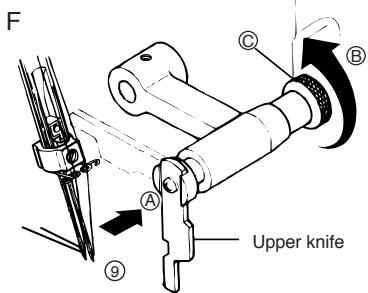
* As the upper knife is sharpened, care should be taken when moving this part.
Bring the lower looper to the far left position by turning handwheel towards you, and pass the thread through lower looper thread guide ⑨ Pass thread through lower looper slit ⑩ from behind.(Fig.B)
Then move the lower looper slightly to the right by turning the handwheel towards you.
Then thread the hole of lower looper using tweezers. Cut the thread leaving about 10cm (4^n) of spare thread. (Fig. C)
Upper looper threading
- Bring the upper looper to its lowest position by turning handwheel towards you.
- Draw thread from spool and pass it, through guide ① of the thread stand and then, in order, through guides ② ~ ⑧. (Fig. A)
- Thread the hole of upper looper ⑨ using tweezers. Cut the thread leaving about 10cm (4^ ) of spare thread. (Fig. D).
- Close the front cover.
Espanol
Right needle threading
- For ease in threading, turn the moveable knife to the non-operating position. Push the upper knife holder screw from with the forefinger of your left hand and grasp the right end of the holder and turn it in the direction of arrow 包 with your right hand. (Fig. E)
- Take the thread drawn from spool, and pass it through thread guide ① ⑦ . Then thread the eye of right-hand needle's eye ⑧ from front to back using tweezers.
Cut the thread leaving about 10cm (4^ ) of spare thread. (Fig. E)
Left needle threading
Take the thread drawn from spool, and pass it through thread guides ① ③ ④ ⑦ ,and thread the lefthand needle's eye ⑧ from front to back. (Fig.A,E)
- Return the moveable knife to the cutting position.
Espanol
E
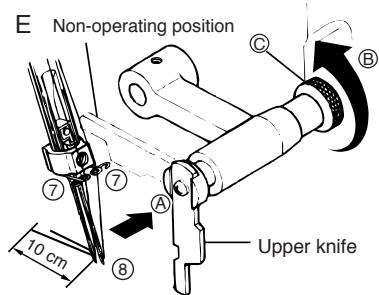
* As the upper knife is sharpened, care should be taken when moving this part.
Preparation for Sewing and Checking
- Check that no thread slips off or snaps.
- Confirm that the upper knife moves against the lower knife correctly by turning the handwheel slowly towards you. If it is not correct, check if there is any fabric or waste thread between knives.
- Turn the handwheel towards you with your right hand to check that the thread winds around the stitch finger of the needle plate.
If the thread doesn't wind around the stitch finger of the needle plate, check if any threads are threaded incorrectly.
Espanol
Revision Y Preparacion Para La Costura
FOUR THREAD OVEREDGING STITCH USING 2 NEEDLES Before Sewing
After threading is completed, and when the threads are not wound around the stitch finger, gently draw out the four threads under and behind the presser foot, and turn the handwheel towards you by hand two or three times to make the thread wind on to the needle plate.
Espanol
For setting average material, there is no need to lower the presser foot lifter. When beginning to sew, push the material just in front of the presser foot and it will be fed through. For the thick material, lower the presser foot lifter, place the material under the presser foot, then raise the presser foot lifter.
Palanca Alzadora
Beginning and Ending of Sewing
Beginning to sew
Just put your left hand on the material to push it slightly until the tip of the fabric comes exactly behind the presser foot.
Espanol
Make chain-stitches at the end of the sewing to prevent the thread from untying and to prepare for the next sewing.
Fin de la costura
Draw the finished fabric gently backwards and to the left as the machine is operating and make chain-stitches. This is called chain-stitch sewing. Then cut the thread 2 5cm (1-2") from the presser foot.
- Do not pull it out roughly as the needle will bend and break.
Adjustment of the Presser Foot Pressure
The presser foot pressure is preadjusted for materials of medium (standard) thickness.
Adjustment is necessary only when you work on very thin or very thick materials. Accordingly, sew thinner materials with less pressure and thicker materials with more pressure. Increase the pressure of the presser foot by tightening the adjustment screw.
Espanol
Ajustando La Presion Del Prensatelas
English: Tighten Loosen
Espanol: Apriete Afloje
Francais: Serrer Desserrer
Thread Tension Adjustment
Set the balance of the tension as weak as possible.
Balance of the Loopwer thread:
When the lower looper thread is pulled to the top of material, loosen tension dial ③ counterclockwise. (or tighten tension dial ④ clockwise.) When the upper looper thread is pulled to the underside, tighten tension dial ③ clockwise. (or loosen tension dial ④ counterclockwise.)
Ajustando La Tension Del Hilo
- Lower looper thread and upper thread should be well balanced with same tension. (Both looper threads should make crosses at the edge of the fabric.)
- Needle thread should not be slacken, or pulled.
Espanol
Tension correcta
Unbalanced upper looper thread wraps round and over the back
Tighten the thread tension of the upper looper (Dial ③) or loosen the thread tension of the lower looper (Dial ④).
Espanol
Unbalanced lower looper thread wraps round and over the face
Tighten the thread tension of the lower looper (Dial 4) or loosen the thread tension of the upper looper (Dial 3).
Espanol
Adjustments For The Differential Feed
Differential feeding performs the function of stretching or condensing the edge of the fabric, since two independent feed dogs, one in front and one behind the needles, can be adjusted to feed at different ratio.
The function has the effect of producing a neat finish of overedging for stretchable and condensable fabrics.
- “N” indicates the neutral position.
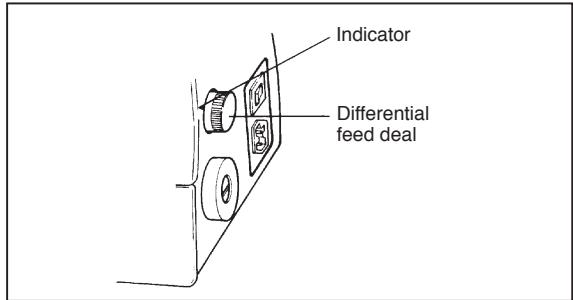
Refer to the below chart and test stitch performance on a scrap of material you are going to use.
| Fabric | Differential feed ratio is set “N”. | Differential feed ratio | Result of adjustment | |||
| Stretchable materials | Knit Jersey | N-2 | ||||
| Unstretchable and uncondensable materials | Medium woven fabrics | N | ||||
| Condensable materials | Georgette | 0.7-N | ||||
English
Adjustments for Size of Bight
- Adjust the size of the bight from 5mm (0.2^ ) to 7mm (0.28^ ) according to the kind of material.
The standard bight size is 5 mm (0.2") - Open the side cover to adjust the bight size.
(1) If the cutting width is narrower than the bight size, turn the bite width adjusting dial to the direction of arrow. (To bigger number)
(2) If the cutting width is wider than the bight size, turn the bite width adjusting dial to the direction of the arrow. (a smaller number)
Espanol
The right figure shows that the size of the bite between the left needle and the edge of the material 5 mm.
How to Adjust Stitch Length
The machine is pre-set to a 2.5mm stitch length for regular seaming and overedging. You may adjust the stitch length from 1mm (Narrow rolled hemming) to 5mm by one-touch of the stitch length adjustment lever.
- For normal overedging set the stitch length from 2.5mm to 5mm. A stitch length less than 2.5mm is used only for rolled hemming.
Sewing for Curved Seams
For a neat and clean finish of curved seams:
For inside curves, guide the fabric gently with the trimming line of the fabric under the right front of the presser foot, applying pressure to the fabric with your left hand, at the same time, apply a little pressure in the opposite direction with your right hand as shown.
For outside curves, apply pressure in the opposite directions of the above.
Espanol
Standard Chart for the Thread Tension
The tension for each of the thread tension dials should be different according to the pattern stitches as in the chart on the right.
Since the figures in the chart are for average strength of threads tension, it may be necessary to adjust the thread tension a little.
Thread tensions will differ according to the kind of fabric and the thread.
The differential feed ratio is normally "N". (See p.22)
Espanol
Guía Standard Para Tension Del Hilo
SETTING WASTE TRAY (Option on some models
(1) Insert the right guide ⑧ of the waste tray to the right leg of the overlock machine as illustrated. Turn the waste tray in the direction of arrow.
(2) Push the left end of the waste tray in the direction of arrow.
Espanol
INSTALANDO LA BANDEJA DE RECORTES
Though this machine is made mainly for 4 thread stitch overedging using 2 needles, three-thread stitch overedging using 1 needle can be easily operated by just removing 1 needle.
Espanol
(1) By removing the right needle
Three-thread overedging stitch using 1 needle for as wide as a 4-thread overedging stitch using 2 needles can be achieved.
Use the left thread tension. (Dial ①). the bite width is normally 5mm
* The differential feed ratio is normally "N. (See p.22)
English: Left needle
(2) By removing the left needle
The right needle sews with a narrow width bite.
Use the right thread tension. (Dial ②)
The bite width is normally 3mm
- The differential feed ratio is normally "N". (See p.22)
English: Right needle
- Open the front cover.
- Use one needle thread (left or right needle) and lower looper thread.
- Turn the handwheel toward you to move the upper looper to the right side of the needle.
- Hold the ① by hand and gently push it down.
Warning:
Pushing converter down too hard may bend converter.
- Insert the tip ② of the 2-thread converter into the eye ③ of the upper looper.
- Close the front cover.
For 3-thread/4-thread overlock sewing, set 2-thread overlock converter in the up position as illustrated, by removing the tip ② out of the eye ③ of the upper looper.
Espanol
(Option on some models)
Roll hemming is achieved by rolling the fabric and overlocking. The 2 types as illustrated on left is ideal for use with thin materials.
Espanol
ORILLADO DOBLE
The fabric is rolled by adjusting.
The thread tension and is overlocked with upper looper thread.
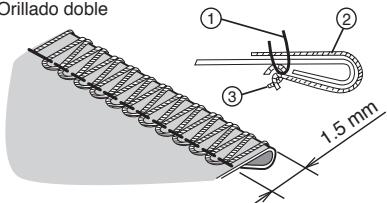
Orillado doble
The fabric is rolled and overlocked with upper and lower looper thread.
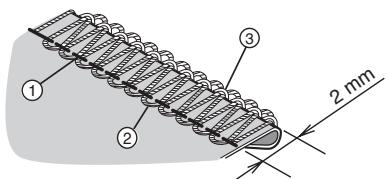
Orillado doble bajo
(1) Remove the left needle.
(2) Pull the stitch finger lever towards you.
(3) Set the stitch width adjusting dial to 5.
(4) Set the stitch length adjuster to 1.
Espanol
The figures in the above chart may be a little different according to the kind of the fabric and the threads. (See p.22 and p.39)
* For roll hem sewing, pass the needle thread to the left side (solid line) of thread guide ⑧ as illustrated. (For normal sewing, pass it to the right side (dotted line) of thread guide ⑧ )
(3) At the beginning of sewing, gently pull the end of the thread chain.
For roll hem sewing, pull the material gently towards the rear of the machine, and you'll get neater stitches.
Pin tucking is overlocked so avoid cutting the fabric by raising the upper knife.
Pin tucking is suited to the design of a child's clothing and a lady's blouse.
- Use the presser foot marked “A” and needle plate “A”.
(1) Remove the left or right needle to your required width. (Sew only with the one needle.)
(2) Raise the upper knife. (See p.10)
Lower the presser foot lifter.
(3) The tension is set the same as the one for overedging. (See p.25)
The fabric is ironed along the line of the pin tucking in advance.
* The differential feed ratio is normally "N".
Espanol
PINZAS, PESPUNTES
(4) Place the fabric under the presser foot with the hem edge in line with the side of the needle plate and start to sew. Raise up the presser ladder.
Make chain-stitch at the end of the sewing.
(5) The hem edge is ironed to one side when your sewing is finished.
Espanol
Cored overlock can be used to strengthen stitches when joining elastic materials such as knitted fabrics. There are two ways of corded overlock. Thread cord through hole on front of foot:
(1) Place the slightly wide cord (about 3mm ) under the right needle, and sew on.
(2) Sew a narrow cord, positioning it on the edge of the overlocked stitch.
Espanol
COSTURA OVERLOCK ENCORDELADA
REPLACING THE CUTTING KNIVES
The upper knife and lower knife are made of a special long-lasting steel and will seldom have to be replaced. However, when they do not cut the fabric even though they are set in the right position. Replace them in the following way: Before replacing the knife, be sure the power supply plug is take out.
Move the front cover to the right, then open it toward you.
Espanol
REEMPLAZANDO LOS CUCHILLOS
REEMPLACEMENT DES COUTEAUX
Loosen the lower knife clamp screw and change the knife for a new one. Align the top of the lower knife with the top of the needle plate.
(2) Replacing the upper knife:
Move the upper knife to its lowest position by turning the handwheel towards you.
Loosen the upper knife screw, while holding the upper knife. Change the knife for a new one.
Check if the biting position ⑧ of upper knife is positioned downwards 1.6 2.0 from the top of biting position of lower knife.
Tighten the upper knife screw.
Espanol
CHANGING THE LIGHT BULB
When the light does not come on even though it is switched on:
(1) Take out the power supply plug.
(2) Remove the lamp cover.
(3) Change the light bulb.
(4) Replace the lamp cover.
Espanol
CAMBIANDO LA AMPOLLETA
Lubrication is not necessary for this machine since the important parts are all made of a special oil impregnated sintered metal. However, one or two drops of oil will increase durability.
CLEANING
First disconnect machine from power supply by removing plug from the electric outlet.
- Open front cover and side cover.
- Using a brush which may or may not be supplied with your machine.
STORAGE
(Option on some models)
- When the machine is not in use, please disconnect it from the power supply by removing plug from the electric outlet.
- Using a vinyl cover which may or may not be supplied with your machine.
- Store away from bright and damp places.
SERVICING
Any questions regarding service and or operation is to be addressed to the store where the machine was purchased.
Espanol
LUBRICACION
TABLE OF SEWING MATERIALS NEEDLES AND THREAD
| HA×1SP Needle HA×1T (705/130) (For home-use sewing machine) | Thread | Thread tension (Needle thread) | Overedging width (Between left needle and edge) | Stitch length | |
| Thin material (crept, georgette) | #11 (80) | Polyestel (spun, filament) #60/2 Twisted thread ~ #80/2 twisted thread (#80/3 Twisted thread ~ #100/3 twisted thread) (Three-thread overedging stitch). | Loose | 5 mm | 2 ~ 2.5 mm |
| Medium to thick material (Serge, gabardine, etc.) | #11 or #14 (80) | #60/2 Twisted thread (Three or four-thread overedging stitch). | Medium | 5 mm | 2.5 ~ 3 mm |
| Thick material (thick denim) | #14 (90) | #50/2 Twisted thread ~ #60/2 twisted thread (Three or four-thread overedging stitch). | Tight | 5 mm | 2.5 ~ 3 mm |
Use ball point needles for Man-Made fibres or stretch fabrics
Section
13
ACCESSORIES / ACCESSORIOS / ACCESSOIRES / ZUBEHÖR / ACCESSOIRES / ACCESSORI
| 1 * | 4 * | 8 |
| 2 HA × 1SP HA × 1T (705/130) #14...3 (90) | 5 * | 9 |
| 6 | 10 | |
| 3 * | 7 * | 11 * |
| English | Français | Nederlands |
| 1. Screw drivers | 1. Tournevis | 1. Schroevedraaiers |
| 2. Needles | 2. Aiguilles | 2. Naalden |
| 3. Cleaning brush | 3. Brosse de nettoyage | 3. Schoonmaakborsteltje |
| 4. Accessory Box | 4. Boite d'accessoires | 4. Accessoires doos |
| 5. Lower knife | 5. Couteau inférieur | 5. Onderste mes |
| 6. Oiler | 6. Huile | 6. Oliespuitje |
| 7. Vinyl cover | 7. Housse | 7. Vinyl afdekhoes |
| 8. Net | 8. Fillet | 8. Net |
| 9.Tweezers | 9. Pinces | 9. Pincet |
| 10.Spool Adapter | 10. Suport bobine | 10. Spoelhulpstuk |
| 11.Waste tray | 11. Bac à déchets | 11. Afvalbak |
| *Accessories shown below in some case are optional | *Les accessoires ci-dessous sont, dans certains cas, en option | *Accessoires als hier onder afgebeeld zichin in sommige geallen als extra verkrijigbaar |
| Number of threads | 4 Threads (3 threads, 2 threads) | Stitch length | 0.8 ~ 5 mm |
| Number of needles | 2 Needles (1 needle) | Differential feed ratio | 1:0.7 ~ 2 |
| Needles | Standard HA × 1SP or HA × 1T (705/130) #11(80) #14(90) | Maximum sewing speed | 1500 RPM |
| Width between two needles | 2 mm | Machine dimensions | Width 300mm (Max. 320mm) Depth 230mm (Max. 255mm) Height 290mm (Max. 340mm~555mm) |
| Overedge width Size of bight | Standard 5mm (Range 5~7mm) | Weight (Head only) | 8.1 kg |

TOYOTA
"TOYOTA" FASHIONS YOUR FUTURE