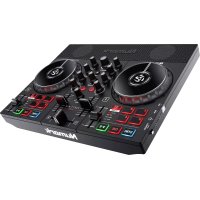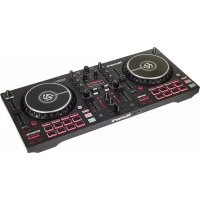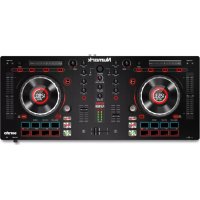
Mixtrack Platinum - DJ Equipment NUMARK - Free user manual and instructions
Find the device manual for free Mixtrack Platinum NUMARK in PDF.


Frequently Asked Questions - Mixtrack Platinum NUMARK
User questions about Mixtrack Platinum NUMARK
0 question about this device. Answer the ones you know or ask your own.
Ask a new question about this device
Download the instructions for your DJ Equipment in PDF format for free! Find your manual Mixtrack Platinum - NUMARK and take your electronic device back in hand. On this page are published all the documents necessary for the use of your device. Mixtrack Platinum by NUMARK.
USER MANUAL Mixtrack Platinum NUMARK
User Guide (English)
Introduction
Box Contents
Mixtrack Platinum
User Guide
USB Cable
Safety & Warranty Manual
Software Download Card
Support
For the latest information about this product (system requirements, compatibility information, etc.) and product registration, visit numark.com.
For additional product support, visit numark.com/support.
Setup
- Place Mixtrack Platinum on a flat, stable surface.
- Make sure all devices are turned off and all faders and gain knobs are set to "zero".
- If using a microphone, connect it to Mixtrack Platinum's microphone input.
- Connect Mixtrack Platinum's outputs to power amplifiers, tape decks, and/or other audio sources.
- Plug all devices into AC power and connect Mixtrack Platinum's USB port to a computer's USB port using the included USB cable.
- When powering everything on, power on your devices in the following order:
• (1) Your computer, (2) any amplifiers, speakers, or output devices
-
Locate the Serato DJ Intro installation card in the box to download and install the software.
-
Open your software program and load music to the decks.
-
Start DJ'ing!
-
When powering everything off, power off your devices in the following order:
• (1) Any amplifiers, speakers, or output devices, (2) your computer
Connection Diagram
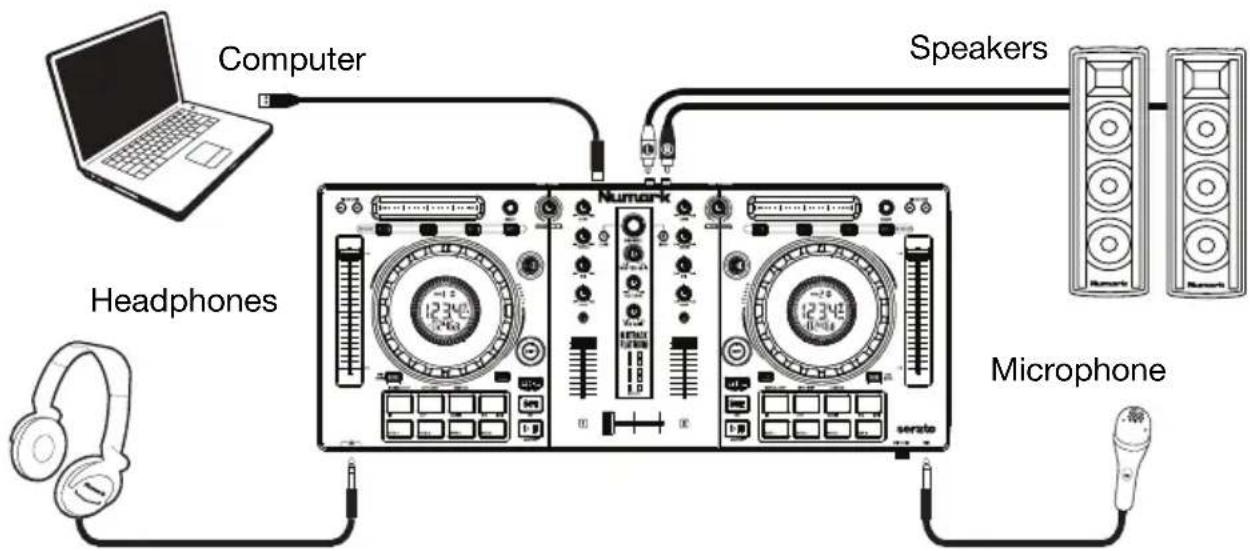
flowchart
graph TD
    A["Computer"] --> B["Numark"]
    C["Headphones"] --> B
    D["Microphone"] --> B
    B --> E[" Speakers"]
    style A fill:#f9f,stroke:#333
    style C fill:#f9f,stroke:#333
    style D fill:#f9f,stroke:#333
    style B fill:#ccf,stroke:#333
    style E fill:#cfc,stroke:#333
Items not listed under Introduction > Box Contents are sold separately.
Features
Top Panel
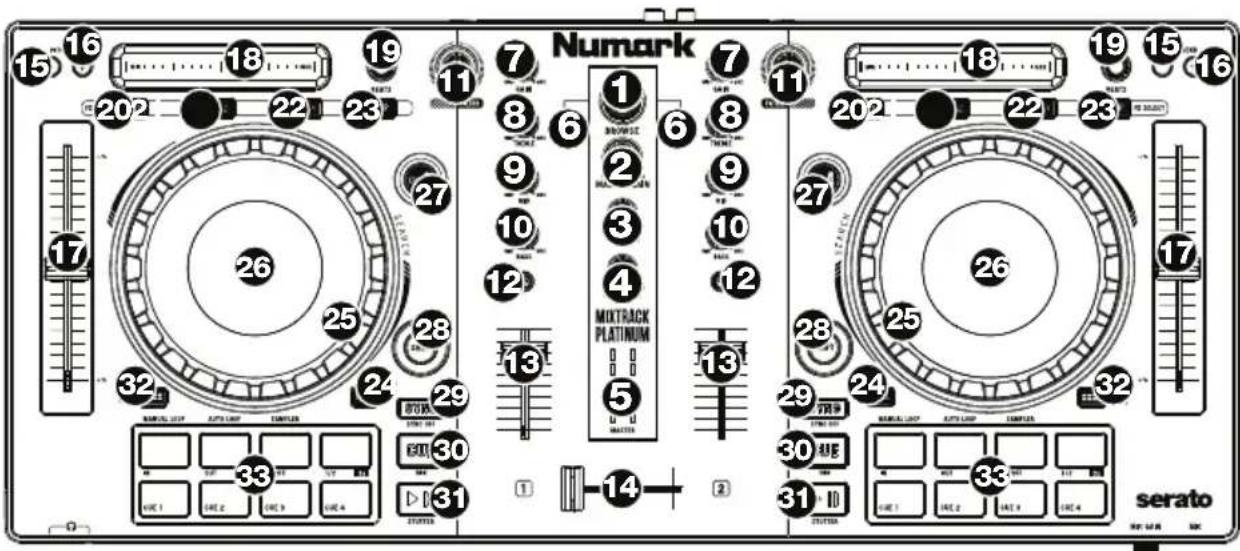
text_image
Numark MIXTRACK PLATINUM 1 2 3 4 5 6 7 8 9 10 11 12 13 14 15 16 17 18 19 20 21 22 23 24 25 26 27 28 29 30 31 32 33 34 35 36 37 38 39 40 41 42 43 44 45 46 47 48 49 50 51 52 53 54 55 56 57 58 59 60 61 62 63 64 65 66 67 68 69 70 71 72 73 74 75 76 77 78 79 80 81 82 83 84 85 86 87 88 89 90 91 92 93 94 95 96 97 98 99 100- Browse Knob: Rotate this knob to cycle through folders and tracks. Press the knob to cycle between the Crates and Library.
- Master Gain: Adjusts the master volume in the software.
Note: This control does not affect the microphone volume, which is summed with the final output of the Master Gain to the Master Output. Use the Mic Gain knob to control the microphone volume. - Cue Mix: Adjusts the software's audio output to the headphones, mixing between the cue output and the master mix output.
- Cue Gain: Adjusts the volume for headphone cueing in the software.
- Master Output LEDs: Displays the audio level going to the Master Output.
- Load: Press one of these buttons while a track is selected to assign it to Deck A or B, respectively, in the software.
- Gain: Adjusts the pre-fader, pre-EQ audio level of the corresponding channel in the software.
- High EQ: Controls the treble frequencies for the individual channels.
- Mid EQ: Controls the mid-range frequencies for the individual channels.
- Low EQ: Controls the bass frequencies for the individual channels.
- Filter: Adjusts the amount of the filter effect. Turning the knob left and right will produce a low-pass filter and high-pass filter, respectively.
- Cue/PFL: Sends pre-fader audio to the Cue Channel for headphone monitoring.
- Channel Fader: Adjusts the volume of the individual channels in the software.
- Crossfader: Controls the blend between the two decks.
- Pitch Bend Down: Press and hold to momentarily reduce the speed of the track.
- Pitch Bend Up: Press and hold to momentarily increase the speed of the track.
- Pitch Fader: This controls the speed of the music. Moving towards the "+" will speed the music up, while moving towards the "-" will slow it down.
Numark
- Touch Strip: Use the Touch Strip to adjust the assigned FX. Press Shift + Touch Strip to search through a track's timeline.
- Beats Multiplier: Increases and decreases the rate of the effects to the beat. When using a time-based effect, this knob adjusts its time division.
- FX1 On/Off: Turns FX1 on and off. Press Shift + FX1 to select from the list of available effects in the software.
- FX2 On/Off: Turns FX2 on and off. Press Shift + FX2 to select from the list of available effects in the software.
- FX3 On/Off: Turns FX3 on and off. Press Shift + FX3 to select from the list of available effects in the software.
- Tap BPM: Press this 4 or more times to manually enter a new BPM. The software will ignore the track's BPM and follow your manually entered tempo.
- Wheel Button: Activate this button to use the platter/jog wheel to grab and move the audio, "scratching" the track as you would with a vinyl record. Press Shift + Wheel to toggle the Display to show elapsed time or time remaining on the current song.
- Platter/Jog Wheel: This capacitive, touch-sensitive jog wheel controls the audio when the wheel is touched and moved. When the Wheel button is not active, use the jog wheel to bend the pitch of the track. When the Wheel button is active, use the jog wheel to grab and move the audio, "scratching" the track as you would with a vinyl record. You can also grab the non-touch-sensitive outer wheel to bend the pitch of the track.
- Display: Use this screen to view information about the current track. See Features > Display for more information.
- Layer: Selects which Layer in the software is controlled by that hardware Deck. Deck A can control Layer 1 or 3; Deck B can control Layer 2 or 4.
- Shift: Allows multiple control commands to be triggered when pressed first along with other buttons.
- Sync: Press this button to automatically match the corresponding Deck's tempo with the opposite Deck's tempo and phase. Press Shift and press this button to deactivate Sync.
- Cue (Transport Control): Sets and recalls the main Cue point in the current track. Hold down the Cue button for temporary play of the cue point. The track will play for as long as the button is held down and return to the cue point once it is released. Press Shift + Cue to return the play head to the start of the track.
- Play/Pause: Starts and suspends playback. Press Shift + Play/Pause to stutter the track from the last set cue point. If a cue point has not been set, the play head will return to the start of the track.
- Pad Mode: This is used to change the operation of the top 4 Performance Pads. See Operation > Performance Pad Modes for more information.
- Performance Pads: The top row of pads is used to trigger loop points or samples depending on the Pad Mode setting. See Operation > Performance Pad Modes for more information.
The bottom row of pads is used to trigger Cue points. If a Cue point has not already been set for the loaded track, this control will mark the Cue point. If a Cue point has already been set, this control will jump to Cue point.
Front Panel
-
Headphone Output: Connect headphones to these 1/4" (6.35 mm) and 1/8" (3.5 mm) jacks for monitoring the signal. The headphone volume is controlled using the Cue Gain knob.
-
Microphone Input: Connect a standard dynamic microphone to this 1/4" (6.35 mm) jack.
-
Mic Gain: Adjusts the level for the microphone input.
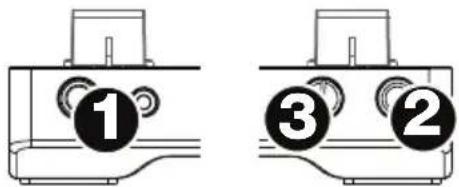
text_image
1 3 2Rear Panel
-
Master Output (RCA): Use standard RCA cables to connect this output to speakers or an amplifier system.
-
USB: Sends USB MIDI data to control various software parameters.
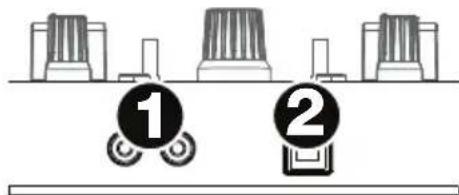
text_image
1 2Display
-
Platter Position: Displays the current track position.
-
Time Bars: Provides a visual reference of the time remaining for the current track. When the track is almost over, the bars will flash as a warning.
-
Active Deck: Indicates the currently active deck.
-
Time Remaining: Displays the time elapsed or time remaining for the current track.
-
BPM: Displays the current BPM for the selected track.
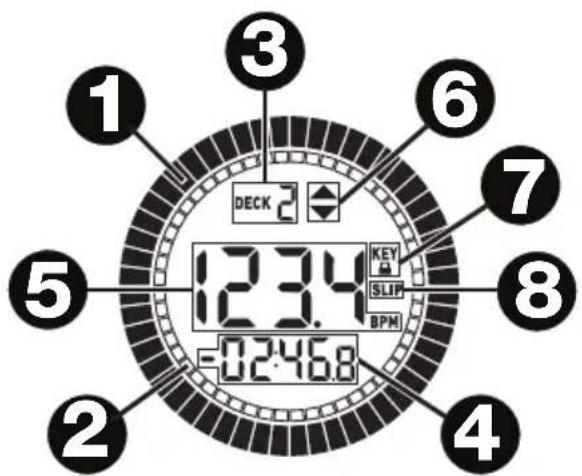
text_image
1 2 3 5 6 7 8 9 10 12:34 12:46.8-
Pitch Adjust: Indicates the direction to move the Pitch Fader to match the current track's BPM with the track on the opposite deck.
-
Keylock: This icon illuminates when Keylock is active for the current deck. See the Serato DJ Intro manual to learn about Keylock.
-
Slip: This icon illuminates when Slip mode is active for the current deck. See the Serato DJ Intro manual to learn about Slip mode.
Operation
Performance Pad Modes
The upper row of pads has different functions depending on their mode: Manual Loop Mode, Auto Loop Mode, and Sample Mode. To select a mode, hold down the Pad Mode button and press one of the upper pads. An LED under the pad section indicates the currently selected mode.
Manual Loop Mode: Hold Pad Mode and press the pad marked Manual Loop to assign the upper 4 pads to the functions listed below:
- Loop In: Sets the beginning of a loop. After a Loop Out point is set, when this button is pressed again, it will allow for fine adjustment of the Loop In point.
- Loop Out: Sets the end point for the loop. When this button has been pressed after a Loop Out point has been set, it will allow for fine adjustment of the Loop Out point.
- On/Off: When this is pressed inside a loop, this will turn the loop off. When pressed outside a loop, this will activate the loop and start playback from its Loop In point. If a loop has not been set, this button will have no effect.
- Loop x1/2: Cuts the currently playing loop in half. Press Shift + Loop x1/2 to double the length the currently playing loop.
Auto Loop Mode: Hold Pad Mode and press the pad marked Auto Loop to assign the upper 4 pads to the functions listed below:
- Auto 1: Sets and starts playback of a 1-beat auto loop. Press Shift + Auto 1 to set and start playback of a 1/16-beat loop roll.
- Auto 2: Sets and starts playback of a 2-beat auto loop. Press Shift + Auto 2 to set and start playback of a 1/8-beat loop roll.
- Auto 4: Sets and starts playback of a 4-beat auto loop. Press Shift + Auto 4 to set and start playback of a 1/4-beat loop roll.
- Auto 8: Sets and starts playback of an 8-beat auto loop. Press Shift + Auto 8 to set and start playback of a 1/2-beat loop roll.
Sample Mode: Hold Pad Mode and press the pad marked Sampler to assign the upper 4 pads to the functions listed below:
- Sample 1: Plays the sample assigned to Sample Pad 1. Press Shift + Sample 1 to stop playback, or to load a sample if the slot is empty.
- Sample 2: Plays the sample assigned to Sample Pad 2. Press Shift + Sample 2 to stop playback, or to load a sample if the slot is empty.
- Sample 3: Plays the sample assigned to Sample Pad 3. Press Shift + Sample 3 to stop playback, or to load a sample if the slot is empty.
- Sample 4: Plays the sample assigned to Sample Pad 4. Press Shift + Sample 4 to stop playback, or to load a sample if the slot is empty.
Demo Mode
Mixtrack Platinum will automatically enter a demonstration mode after 30 seconds if connected to a computer via USB without opening the software. To exit Demo Mode, open the Serato DJ Intro software.
text_image
Numark user 31 user 30 user 29 user 28 user 27 user 26 user 25 user 24 user 23 user 22 user 21 user 20 user 19 user 18 user 17 user 16 user 15 user 14 user 13 user 12 user 11 user 10 user 9 user 8 user 7 user 6 user 5 user 4 user 3 user 2 user 1 user 0 user -1 user -2 user -3 user -4 user -5 user -6 user -7 user -8 user -9 user -10 user -11 user -12 user -13 user -14 user -15 user -16 user -17 user -18 user -19 user -20 user -21 user -22 user -23 user -24 user -25 user -26 user -27 user -28 user -29 user -30 user -31 user -32 user -33 user -34 user -35 user -36 user -37 user -38 user -39 user -40 user -41 user -42 user -43 user -44 user -45 user -46 user -47 user -48 user -49 user -50 user -51 user -52 user -53 user -54 user -55 user -56 user -57 user -58 user -59 user -60 user -61 user -62 user -63 user -64 user -65 user -66 user -67 user -68 user -69 user -70 user -71 user -72 user -73 user -74 user -75 user -76 user -77 user -78 user -79 user -80text_image
1 2 3 5 6 7 8 12:34 02:46.8 DECK 2 KEY SIP BPMBetrieb
Performance Pad-Modi
Technical Specifications
| Outputs | 1 RCA stereo pair1 1/4" (6.35 mm) TRS1 1/8" (3.5 mm) TRS |
| Inputs 1 1/4" (6.35 mm) TS | |
| Power | USB bus power |
| Dimensions(width x depth x height) | 21.6" x 9.5" x 2.0"549 x 241 x 51 mm |
| Weight | 4.8 lbs.2.2 kg |
Specifications are subject to change without notice.
Trademarks & Licenses
Numark is a trademark of inMusic Brands, Inc., registered in the U.S. and other countries.
All other product or company names are trademarks or registered trademarks of their respective owners.