X5 - Mixer NUMARK - Free user manual and instructions
Find the device manual for free X5 NUMARK in PDF.


User questions about X5 NUMARK
0 question about this device. Answer the ones you know or ask your own.
Ask a new question about this device
Download the instructions for your Mixer in PDF format for free! Find your manual X5 - NUMARK and take your electronic device back in hand. On this page are published all the documents necessary for the use of your device. X5 by NUMARK.
USER MANUAL X5 NUMARK
Please go to http://www.numark.com to register your X5. Registering your product ensures that we can keep you up-to-date with any last-minute product developments and provide you with world-class technical support, should you run into any problems.
GROUND RULES
- Make sure all items listed in the BOX CONTENTS section are included in the box.
- READ SAFETY & WARRANTY INFORMATION BOOKLET BEFORE USING THE PRODUCT.
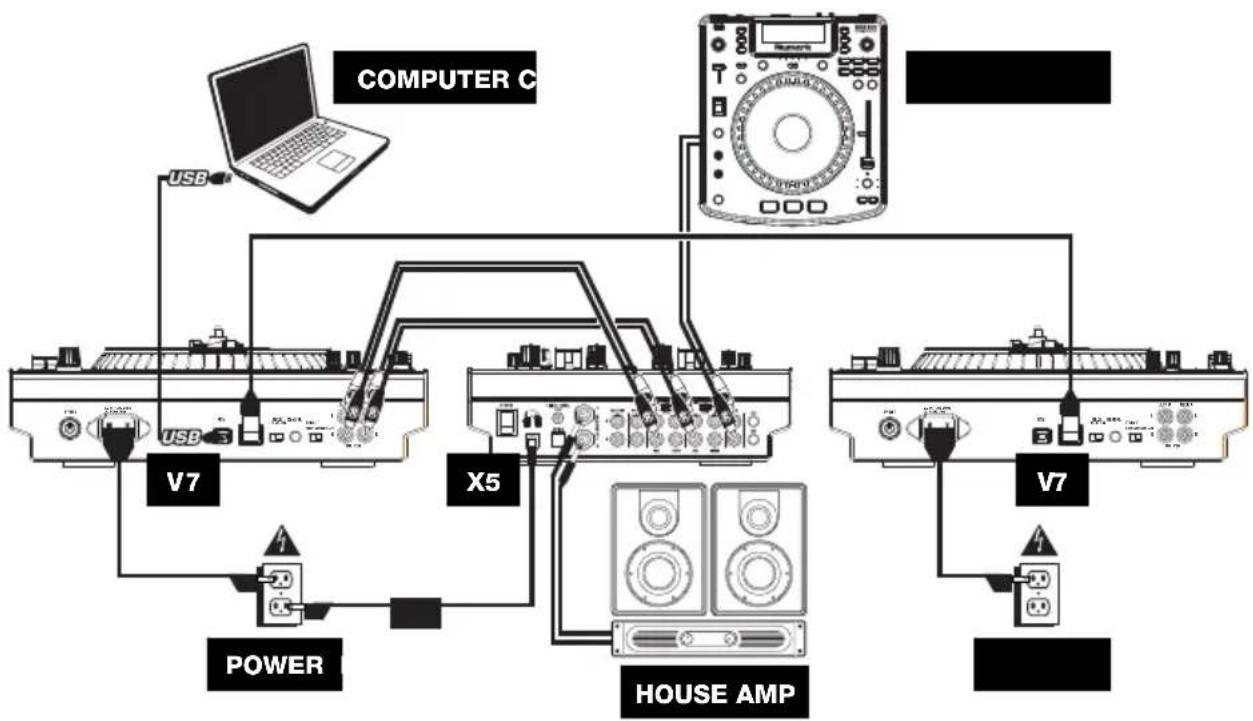
- Study the connection diagram in this guide.
- Place mixer in an appropriate position for operation.
- Make sure all devices are turned off and all faders and gain knobs are set to "zero"
- Connect all stereo input sources as indicated in the diagram.
- Connect the stereo outputs to power amplifier(s), tape decks, and/or other audio sources.
- Plug all devices into AC power.
- Switch everything on in the following order.
Audio input sources (i.e. turntables, CD players, etc.)
- Mixer
- Last, any amplifiers or output devices
-
When turning off, always reverse this operation by,
-
Turning off amplifiers
- Mixer
- Last, any input devices
CONNECTION DIAGRAM
FRONT PANEL FEATURES
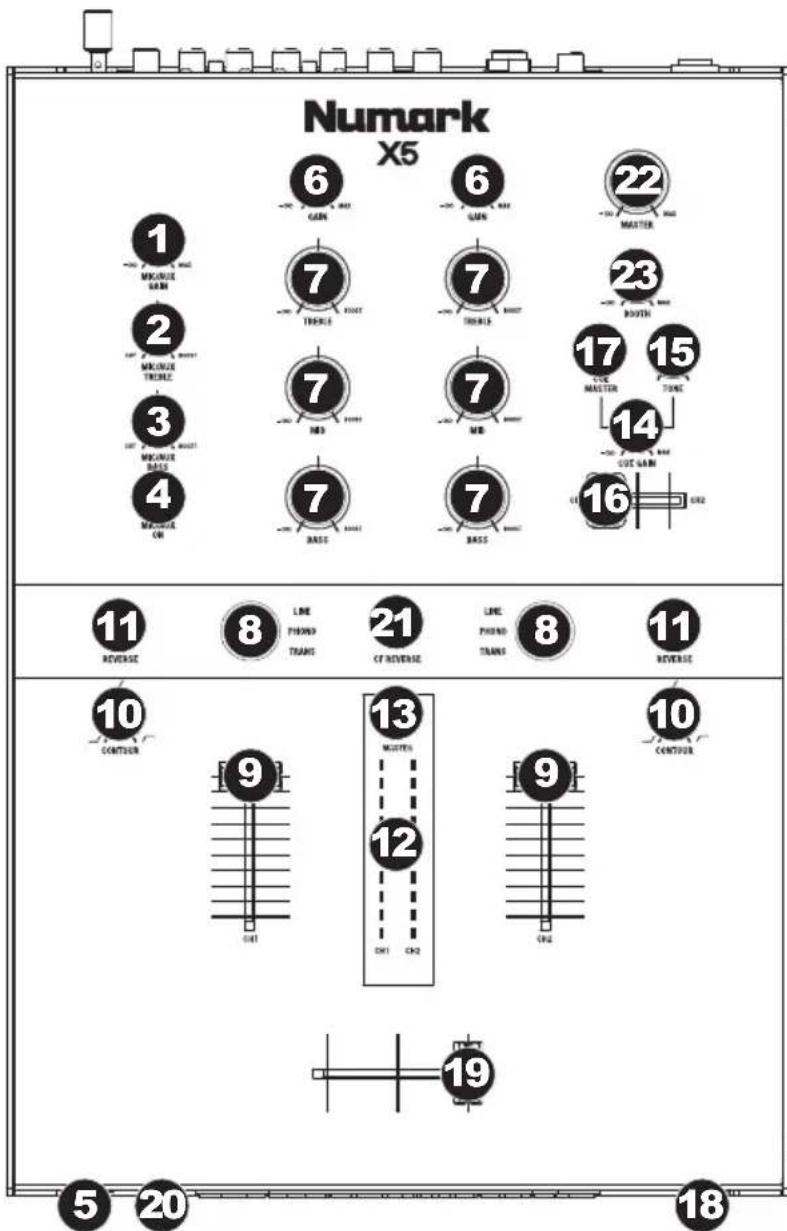
MICROPHONE / AUXILIARY INPUT CONTROLS
- MIC / AUX GAIN (Microphone / Auxiliary Gain): This knob adjusts the volume of both the main microphone and auxiliary inputs. The gain should be turned completely to MIN when connecting and disconnecting equipment. If both inputs are used simultaneously the inputs will be mixed together. (Note: This signal will not be heard in the Cue channel.)
- TREBLE (Microphone / Auxiliary High EQ): Adjusts the high (treble) frequencies of the microphone / auxiliary channel.
- BASS (Microphone / Auxiliary Low EQ): Adjusts the low (bass) frequencies of the microphone / auxiliary channel.
- MIC / AUX ON / OFF: Mutes and unmutes the microphone / auxiliary channel.
- MICROPHONE: Connect a 1 / 4'' microphone to this input. Microphone controls are located on the top panel.
PRIMARY MIXING CHANNEL CONTROLS
- GAIN KNOB (Input Level Trim): This rotary control adjusts the pre-fader input signal levels of the inputs. This level adjustment should be used with the pre-fader meter to match levels of both input channels.
7. EQ:
- Treble (Input Level High EQ): Adjusts the high (treble) frequencies of the corresponding channel. Turning the knob completely to the right increases the level, turning the knob completely to the left decreases the level to "off." This frequency "kill" control allows for unique mixing styles.
- Middle (Input Level Midrange EQ): Adjusts the mid-range frequencies of the corresponding channel. Turning the knob completely to the right increases the level, turning the knob completely to the left decreases the level to "off." This frequency "kill" control allows for unique mixing styles.
-
Bass (Input Level Low EQ): Adjusts the low (bass) frequencies of the corresponding channel. Turning the knob completely to the right increases the level, turning the knob completely to the left decreases the level to "off." This frequency "kill" control allows for unique mixing styles.
-
LINE / PHONO / TRANS SWITCH (Input Selector Switch): These three-position toggles select what input source is engaged among the connected units - and a flash position to allow rapid transforming (audio signal "kill") effect.
- CHANNEL FADER (VCA Fader): Adjusts the audio level on the corresponding channel.
Note: This fader is user replaceable if it should ever wear out. Simply remove the facepanel and then remove the screws holding it in position. Replace the fader with a quality authorized replacement from your local Numark retailer.
- CHANNEL FADER CONTOUR: Adjusts the slope of the channel fader curve. Flip switch to the left for a smooth fade or to the right for a sharp cut.
- REVERSE BUTTON (Channel Fader Reverse Control): Activation of this switch can reverse the fader direction.
CUEING/MONITOR CONTROLS
- STEREO LEVEL INDICATOR - Monitors the audio level of the Program mix or Cue Channel, depending on the position of the METER ASSIGN button.
-
METER ASSIGN BUTTON: Determines whether audio from the Program mix or the Cue channel is sent to the stereo level indicator.
-
When MASTER is indicated, this meter displays the stereo output levels of your mixed signal (Program Mix).
-
When CH1 - CH2 is indicated, the meter shows the pre-fader levels of channels 1 and 2 (Cue channel). You can use the channel "Gain" and "EQ" controls to match the levels of input signals while cueing.
-
CUE GAIN KNOB (Headphone Level): This rotary control adjusts the levels of the headphones connected to the front panel input.
- CUE TONE KNOB (Headphone Tone Control): This rotary knob adjusts the tone of the headphone output. The knob can be raised and lowered to hide away by pressing it down.
- CHANNEL CUE SLIDER: Channels 1 and 2 can be previewed using this mini-crossfader. Sliding this to the left plays the left channel-1 and sliding to the right plays the right channel-2.
- CUE / MASTER BUTTON: When lit, only the Program mix is heard. When off, only the Cue channel is heard.
- HEADPHONES: Connect your 1/4'' headphones to this output for cueing and mix monitoring. Headphone output controls are located on the top panel. The Volume should always be set at its lowest setting while connecting and disconnecting headphones to prevent damage to headphones and/or your hearing.
CROSSFADER CONTROLS
- CROSSFADER (Digital VCA Crossfader): This slide fader blends audio between CH-1 and CH-2. Its action can be modified with the "Mode," "Slope", and "Direction" controls. This digital mixer uses digital VCA technology to accurately determine slider position. Both the VCA and Digital technologies combined allow for some very powerful effects.
Note: This fader is user-replaceable if it should ever wear out. Simply remove the facepanel and then remove the screws holding it in position. Replace the fader with a quality authorized replacement from your local Numark retailer. - CROSSFADER CONTOUR: Adjusts the slope of the crossfader curve. Flip switch to the left for a smooth fade (mixing) or to the right for a sharp cut (scratching).
- CF REVERSE: Activation of this switch reverses the assignment of CH-1 and CH-2 on the crossfader.
OUTPUT CONTROLS
- MASTER KNOB: Adjusts the Master output level.
- BOOTH KNOB: Adjusts the Booth output level.
REAR PANEL FEATURES
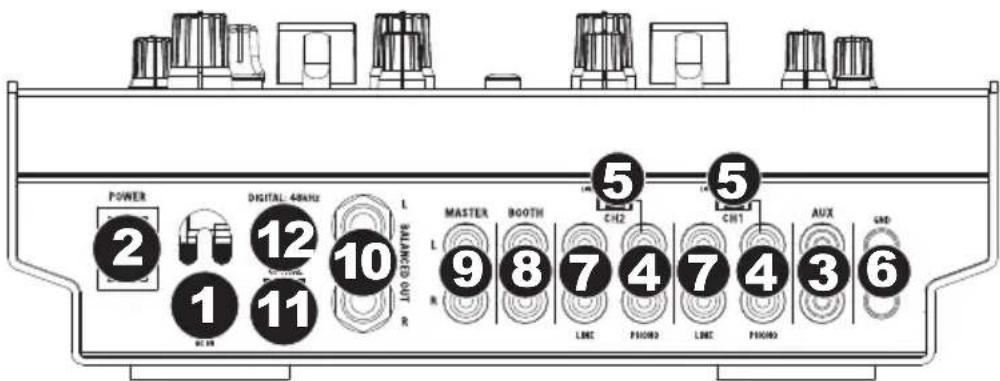
- AC IN: Use the included power adapter to connect the mixer to a power outlet. While the power is switched off, plug the power supply into the mixer first, then plug the power supply into a power outlet. Note: The mixer is designed to work with the included AC power supply only. Using an incompatible power supply could result in damage to the unit.
- POWER SWITCH: Turns the mixer on and off. Turn on the mixer after all input devices have been connected and before you turn on amplifiers. Turn off amplifiers before you turn off the mixer.
- AUX-SESSION INPUT (Auxiliary Input, RCA): The line level input is used to connect the output from an external mixers or additional CD players and other line level devices such as samplers, tape decks, keyboards, and line output turntables. This input is mixed with any connected microphone.
- LINE / PHONO INPUTS (RCA): Connect your audio sources to these inputs. These inputs can accept both line and phono-level signals. (See #3 below.)
- LINE / PHONO SOURCE SWITCH: Flip this switch to the appropriate position, depending on the device connected to the LINE / PHONO INPUTS. If you are using phono-level turntables, set this switch to "PHONO" to provide the additional amplification needed for phono-level signals. If using a line-level device, such as a CD player or sampler, set this switch to "LINE." Only turntables with phono level output should be assigned when the switch is in the phono position.
- GND (Grounding terminal): If using phono-level turntables with a grounding wire, connect the grounding wire to these terminals. If you experience a low "hum" or "buzz", this could mean that your turntables are not grounded.
Note: Some turntables have a grounding wire built into the RCA connection and, therefore, nothing needs to be connected to the grounding terminal.
- LINE INPUTS (RCA): Connect line-level devices, such as CD players, samplers or audio interfaces, to these inputs.
- BOOTH OUTPUT (RCA): This RCA output is for connecting a secondary external monitoring device such as a booth monitor or second stereo output. The level of the booth output signal will increase as the "Booth" volume control is increased.
- MASTER OUTPUT (UNBALANCED RCA): Use standard RCA cables to connect this output to a speaker or amplifier system. The level of this output is controlled by the MASTER knob on the top panel.
- MASTER OUTPUT (BALANCED 1/4"): Use standard 1/4'' TRS cables to connect this Master output to a speaker or amplifier system. The level of this output is controlled by the Master knob on the top panel. When possible, we recommend using these balanced outputs for your Master audio output. Balanced outputs are better suited for long cable runs and are less susceptible to noise and interference.
- DIGITAL OUTPUT (Optical): 48kHz, 24-bit S/PDIF output. The format is type 2, form 1, also known as S/PDIF (Sony/Phillips Digital Interface Format). This output can be connected to compatible devices such as CD burners, hard drive recorders, or other digital mixers. Higher audio fidelity is maintained from these outputs.
- DIGITAL OUTPUT (Coax): 48kHz, 24-bit S/PDIF output. The format is type 2, form 1, also known as S/PDIF (Sony/Phillips Digital Interface Format). This output can be connected to compatible devices such as CD burners, hard drive recorders, or other digital mixers.
CONTENIDO DE LA CAJA
Balanced Line: 11 V rms max
Unbalanced Line: 5.5 V rms max
Headphone: 0.5 W into 47 Ω
Distortion: 0.005% typical
SIGNAL-TO-NOISE RATIOS
(full mixing path, A-weighted)
Line: >102 dB
Microphone: >85 dB
Phono: >85 dB
FREQUENCY RESPONSE
Line: 20Hz - 20kHz (± 0.1 dB)
Phono: RIAA accuracy (± 0.5 dB)
GENERAL
Power consumption: 12 W typical
Dimensions: 10^ (W)× 14.5^ (H)× 3.5^ (D)
Weight: 9.5 lbs. (11.2 lbs. with transformer)
www.numark.com