 ManualGo.com
AVRX1200 - AV receiver DENON - Free user manual and instructions
Find the device manual for free AVRX1200 DENON in PDF.


Download the instructions for your AV receiver in PDF format for free! Find your manual AVRX1200 - DENON and take your electronic device back in hand. On this page are published all the documents necessary for the use of your device. AVRX1200 by DENON.
USER MANUAL AVRX1200 DENON
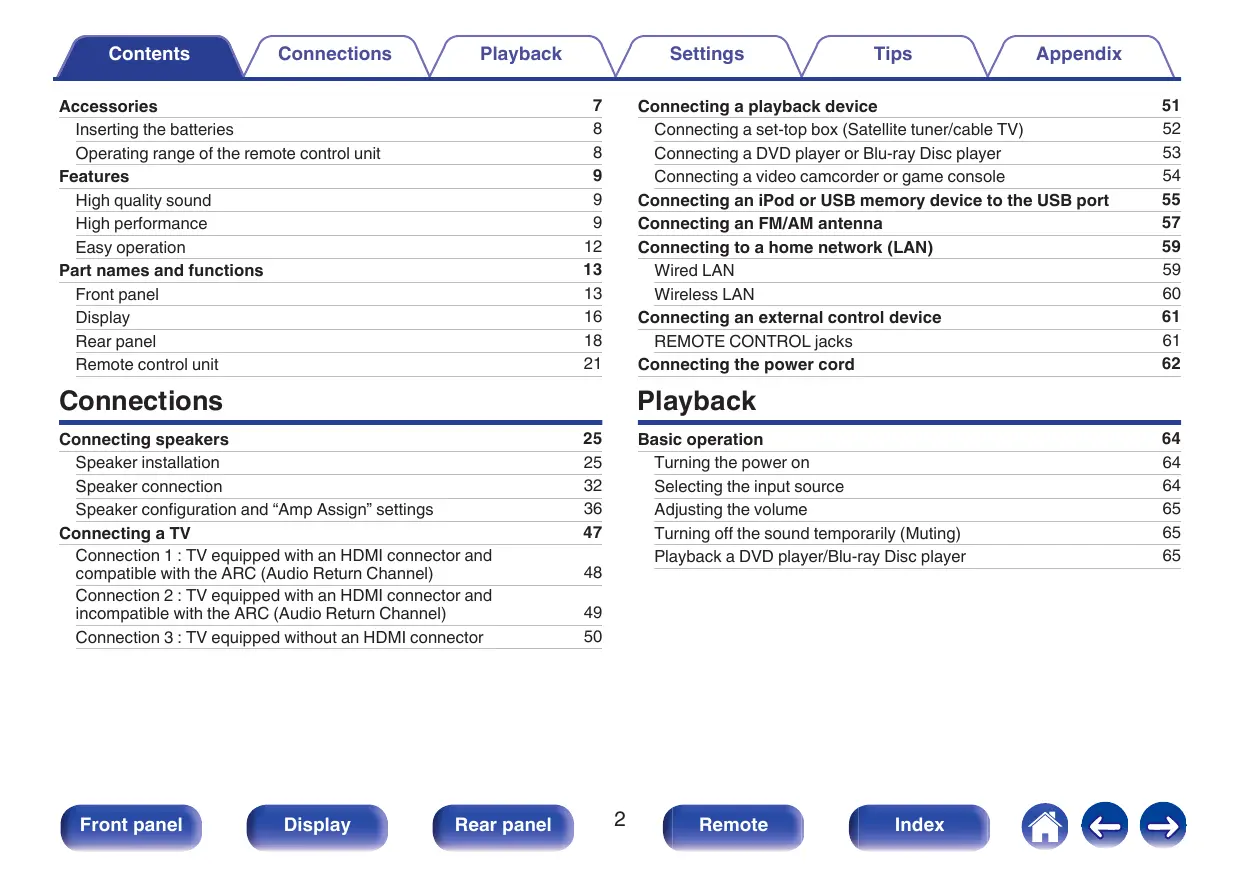
covers V4 Connections Playback Settings \/ Tips \/ Appendix Accessories 7 Connecting a playback device 51 Inserting the batteries 8 Connecting a set-top box (Satellite tuner/cable TV) 52 Operating range of the remote control unit 8 Connecting a DVD player or Blu-ray Disc player 53 Features 9 Connecting a video camcorder or game console 54 High quality sound 9 Connecting an iPod or USB memory device to the USB port 55 High performance 9 Connecting an FM/AM antenna 57 Easy operation 12 Connecting to a home network (LAN) 59 Part names and functions 13 Wired LAN 59 Front panel 13 Wireless LAN 60 Display 16 Connecting an external control device 61 Rear panel 18 REMOTE CONTROL jacks 61 Remote control unit 21 Connecting the power cord 62 Connections Playback Connecting speakers 25 Basic operation 64 Speaker installation 25 Turning the power on 64 Speaker connection 32 Selecting the input source 64 Speaker configuration and “Amp Assign” settings 36 Adjusting the volume 65 Connecting a TV 47 Turning off the sound temporarily (Muting) 65 Connection 1 : TV equipped with an HDMI connector and Playback a DVD player/Blu-ray Disc player 65 compatible with the ARC (Audio Return Channel) 48 Connection 2 : TV equipped with an HDMI connector and incompatible with the ARC (Audio Return Channel) 49 Connection 3 : TV equipped without an HDMI connector 50 : ©D Em 066
PO cr VEIETS Playback Settings \/ Tips \/ Appendix Playing an iPod 66 Listening to Internet Radio 87 Listening to music on an iPod 67 Listening to Internet Radio 88 iPod Browse Mode settings 68 Playing the last played Internet Radio station 89 Perlorming repeat playback 70 Using VTuner to add Internet Radio stations to favorites 90 Perlorming random playback 70 Playing back files stored on a PC and NAS 91 Playing a USB memory device 71 Applying media sharing settings e Playing files stored on USB memory devices 72 Playing back files stored on a PC and NAS 98 Listening to music on a Bluetooth device 74 Listening to Pandora® 95 Playing music from Bluetooth device 75 Listening to Pandora® 96 Pairing with other Bluetooth devices 77 Creating a new station 98 Reconnecting to this unit from a Bluetooth device 78 Listening to an existing station 99 Listening to FM/AM broadcasts 79 Listening to created radio stations at random 9° Listening to FM/AM broadcasts 80 Giving feedback and managing stations 100 Tuning in by entering the frequency (Direct Tune) 81 Sign Out 101 Changing the tune mode (Tune Mode) 82 Listening to SiriusXM Internet Radio 102 Tuning in to stations and presetting them automatically (Auto Listening to SiriusXM Internet Radio 108 Preset) Presetting the current broadcast station (Preset Memory) Listening to preset stations 82 signou 104
PO cr VEIETS Playback Settings \/ Tips \/ Appendix AirPlay function 105 Selecting a sound mode 119 Playing songs from your iPhone, iPod touch or iPad 106 Selecting a sound mode 120 Playing iTunes music with this unit 106 Direct playback 121 Selecting multiple speakers (devices) 107 Pure Direct playback 121 Perform iTunes playback operations with the remote control unit Auto surround playback 122 oftnis unit 107 HDMI control function 131 Spotify Connect function 108 Setting procedure 131 Playing Spotify music with this unit 108 Smart Menu function 132 Convenience functions 109 Sleep timer function 134 Performing repeat playback 110 Using the sleep timer 135 Performing random playback 110 Quick select plus function 136 Registering to Favorites 11 Caling up the settings 137 Playing back content added to the “Save to Favorite” at Changing the settings 135 Deleting content added to favorites 112 Web control function 139 Searching content with keywords (Text Search) 112 Contraling the unit from a web control 139 Playing back music and a favorite picture at the same time ï (Seau) 18 Playback in ZONE2 Separate room) 1 Setting the Slideshow Interval 114 ‘onnecting e Adjusting the volume of each channel to match the input source Playback in ZONE2 8 (Ch Level Adjust) 115 Adjusting the tone (Tone) 116 Displaying your desired video during audio playback (Video Select) 117 Playing the same music in all zones (All Zone Stereo) 118 on ææ 060
Contents Connections Playback Settings \/ Tips \/ Appendix Thank you for purchasing this Denon product. To ensure proper operation, please read this owner's manual carefully before using the product. After reading this manual, be sure to keep it for future reference. Accessories Check that the following parts are supplied with the product.
[ Contents \/ connections \/ Playback \/ Settings \/ Tips \/ Appendix \ Inserting the batteries 1 Remove the rear lid in the direction of the arrow and remove it.
2 Insert two batteries correctly into the battery compartment as indicated. RO3/AAA batteries 3 Put the rear cover back on.
Front panel Display + To prevent damage or leakage of battery fluid: + Do not use a new battery together with an old one. + Do not use two different types of batteries. + Remove the batteries from the remote control unit if it will not be in use for long periods. + Ifthe battery fluid should leak, carefully wipe the fluid off the inside of the battery compartment and insert new batteries. Operating range of the remote control unit Point the remote control unit at the remote sensor when operating it. Approx. 2:
[ Contents \/ connections \/ Playback \/ Settings \/ Tips Features High quality sound High performance + With discrete circuit technology, the power amplifier provides al quality for all 7-channels (120 Watts x 7-channels) For optimum realism and stunning dynamic range, the power amplifier section features discrete power devices (not integrated circuitry). By using high current, high power discrete power devices, the amplifier is able to easily drive high quality speakers. Dolby Atmos (tp. 250) This unitis equipped with a decoder that supports Dolby Atmos audio format. The placement or movement of sound is accuratelÿ reproduced by the addition of overhead speakers, enabling you to experience an incredibly natural and realistic surround sound field. DTS:X This unit is equipped with the DTS:X decoder technology. DTS:X brings the home theater experience to new heights with its immersive object based audio technology which removes the bounds of channels. The flexibiity of objects allows for sound to be scaled large or small and moved around the room with greater accuracy than ever before leading to a richer immersive audio experience. + 4K 60Hz input/output supported 4K 60p 4K 60p 4:44 4:44 When 4K Ultra HD (High Definition) is used, an input/output speed of 60 frames per second (60p) is achieved for video signals. When connected to 4K Ultra HD and 60p video signal input compatible TV, you can enjoy the sense of realism only available from high-definition images, even when viewing fast-moving video. This unit also supports image processing for 4K 60p, 4:4:4 and 24-bit videos. By processing the video at the original resolution, this unit lets you enjoy flawless, high-definition picture quality. + HDCP 2.2 This unitis compatible with HDCP2.2 copyright protection standard.
Contents Connections Playback Settings \/ Tips \/ Appendix + HDMI connections enable connection to various digital AV + The device is equipped with a AirPlay® function in addition to devices (6 inputs, 1 output) network functions such as Internet radio etc. (&#_p. 105) 6/1 D a. In Out This unit is equipped with 6 HDMI inputs and 1 HDMI output enabling connection to various HDMI compatible devices such as Blu-ray Disc You can enjoy a wide variety of content, including listening to Internet players, game consoles and HD video camcorders. Radio, playing audio files stored on your PC, and displaying photographs stored on your PC on our television. This unit also supports Apple AirPlay which lets you stream your music library from an iPhone®, iPad®, iPod touch® or iTunes®. Playback of DSD and FLAC files via USB and networks This unit supports the playback of high resolution audio formats such as DSD (2.8 MHz) and FLAC 192 kHz files. It provides high quality playback of high resolution files.
ON ED CD ‘ ED EBO066
Contents Connections Playback Settings \/ Tips \/ Appendix + Wireless connection with Bluetooth devices can be carried out easily (3° p. 74) d, Le à _=s
You can enjoy music simply by connecting wirelessy with your smartphone, tablet, PC, etc. + Compatible with the “Denon 2015 AVR Remote”* for performing basic operations of the unit with an iPad, iPhone or Androidr" devices (Google, Amazon Kindle Fire) “Denon 2015 AVR Remote” is application software that allows you to perform basic operations with an iPad, iPhone, Android smartphone or Android tablet such as turning the unit ON/OFF, controlling the volume, and switching the source. # Download the appropriate “Denon 2015 AVR Remote” for your iOS or Android devices. This unit needs to be connected to the same LAN or Wi-Fi (wireless LAN) network that the iPhone or iPod touch is connected to. " Œæ 060
You can select and play back the respective inputs in MAIN ZONE and ZONE2. In addition, when the AI Zone Stereo function is used, the music being played back in MAIN ZONE can be enjoyed in all the zones at the same time. This is useful when you want to let the BGM propagate throughout the whole house. + Energy-saving design This unit is equipped with an ECO Mode function that allows you to enjoy music and movies while reducing the power consumption during use, and also an auto-standby function that automatically turns off the power supply when the unit is not in use. This helps reduce unnecessary power use. + “Setup Assistant” provides easy-to-follow setup instructions First select the language when prompted. Then simply follow the instructions displayed on the TV screen to set up the speakers, network, etc. + Easy to use Graphical User Interface This unit is equipped with a Graphical User Interface for improved operability.
Contents Connections Playback Settings \/ Tips \/ Appendix © Power operation button (cb) Used to turn the power of the MAIN ZONE (room where this unit is located) on/off (standby). (p.64) @ Power indicator This is lit as follows according to the power status: + White: Power on + Off: Normal standby + Red: + When ‘HDMI Control” is set to “On” (p.165) + When “HDMI PassThrough" is set to “On” (17 p. 166) + When “Network Control is set to “Always On” (7 p. 203) © SOURCE SELECT knob This selects the input source. (p.64) @ Remote control sensor This receives signals from the remote control unit. (7_p. 8) @ Display This displays various pieces of information. (#5 p. 16) © MASTER VOLUME knob This adjusts the volume level. (p.65) Tuner preset channel buttons (TUNER PRESET CH +, -) These select preset broadcast stations. (p.83) ‘© ZONEZ2 ON/OFF button This turns the power of ZONE (separate room) on/off. (1° p. 143) © ZONEZ2 SOURCE button This selects the input source for ZONE2. (1#_p. 143) © DIMMER button Each press of this switches the brightness of the display. (p.210) @ STATUS button Each press of this switches the status information that is shown on the display. on “ ææ 060
Contents Connections Playback Tips Settings \/ \/ Appendix ® œ6 6 @ QUICK SELECT buttons With a single press of any of these buttons, you can call up various settings you've registered to each button such as the input source, volume level and sound mode settings. (5 p. 136) ® Headphones jack (PHONES) This is used to connect headphones. When the headphones are plugged into this jack, audio will no longer be output from the connected speakers or from the SUBWOOFER connectors. NOTE + To prevent hearing loss, do not raise the volume level excessively when using headphones. Front panel @ AUX-HDMI connector This is used to connect HDMI output compatible devices such as video camcorders and game consoles. (1° p. 54) ® USB port (<-) This is used to connect USB storages (such as USB memory devices) and the USB cable supplied with iPod. (p.55) ©® SETUP MIC jack This is used to connect the supplied Sound calibration microphone. (F p.178) ææ 060
Contents Connections Playback Settings \/ Tips \/ Appendix d ® ® © Input mode indicators @ Tuner reception mode indicators These light according to the audio input mode settings of each input These light up according to the reception conditions when the input source. (77 p.174) source is set to “Tuner”. @ Surround back indicator TUNED: Lights up when the broadcast is properly tuned in. This lights when audio signals are being output from the surround back STEREO: Lights up when receiving FM stereo broadcasts. speakers. (#7 p. 189) © Sleep timer indicator @ Decoder indicators This lights when the sleep mode is selected. (Xp. 134) These light when Dolby or DTS signals are input or when the Dolby or @ Circle indicator DTS decoder is running. This is displayed when the input source is “Online Music” or “iPod/USB" © Audyssey® indicator when you are playing back music. This lights when “MultEQ® XT”, “Dynamic EQ" or “Dynamic Volume” has been set up. (p.158) pu " Œææ 060
© Rod antennas for Bluetooth/wireless LAN Stand this antenna upright when connecting to a network via wireless LAN, or when connecting to a handheld device via Bluetooth. (p.60) \/ Appendix
+ The antenna clip can be removed from the rear panel @ Rotate the antenna clip 90 degrees to the left. @ Pull the antenna clip out towards yourself. + The antenna clip is needed when transportng this unit. Keep itin a safe place. + Attach the antenna clip by following the steps for removing it in reverse. @PRE OUT connectors Used to connect a subwoofer with built-in amplifier or power amplifier for ZONE2. + “Connecting the subwoofer’ (#7 p. 33) + “Connection 2 : Connection using an external amplifier” (7 p. 142) © Analog audio connectors (AUDIO) Used to connect devices equipped with analog audio connectors. (p.52) © Digital audio connectors (DIGITAL AUDIO) Used to connect devices equipped with digital audio connectors. “Connection 2 : TV equipped with an HDMI connector and incompatible with the ARC (Audio Return Channel)” (p.49) “Connection 3 : TV equipped without an HDMI connector" (-_p. 50) “Connecting a set-top box (Satellite tuner/cable TV)" (#_p. 52) © NETWORK connector Used to connect to a LAN cable when connecting to a wired LAN network. (Xp. 59) D D
Contents Connections Playback Settings \/ Tips © HDMI connectors Used to connect devices equipped with HDMI connectors. + “Connection 1 : TV equipped with an HDMI connector and compatible with the ARC (Audio Return Channel)" (4 D. 48) “Connection 2 : TV equipped with an HDMI connector and incompatible with the ARC (Audio Return Channel)” (7_p. 49) “Connecting a set-top box (Satellite tuner/cable TV)" (7. 52) “Connecting a DVD player or Blu-ray Disc player” (D. 53) Front panel \/ Appendix @ Video connectors (VIDEO) Used to connect devices equipped with video connectors. + “Connection 3 : TV equipped without an HDMI connector” (&# p. 50) + “Connecting a set-top box (Satellite tuner/cable TV)" (#_p. 52) © AC inlet (AC IN) Used to connect the power cord. (7_p. 62) © FM/AM antenna terminals (ANTENNA) Used to connect FM antennas and AM loop antennas. (1° p. 57) © Speaker terminals (SPEAKERS) Used to connect speakers. (p.32) @ REMOTE CONTROL jack Used to connect infrared receivers/transmitters in order to operate this unit and external devices from a different room. (1° p. 61) NOTE + Do not touch the inner pins of the connectors on the rear panel. Electrostatic discharge may cause permanent damage to the unit.
Contents Connections Playback Settings \/ Tips \/ Appendix © BACK button This returns to the previous screen. © System buttons These perform playback related operations. Tuning up / Tuning down buttons (TUNE +, -) These select either FM broadcast or AM broadcast. (1° p. 80) © QUICK SELECT buttons (1 - 4) These call up settings registered to each button, such as input source, volume level and sound mode settings. (#5 p. 136) @ Remote control signal transmitter This transmits signals from the remote control unit. (##°_p. 8) © ECO Mode button This switches to ECO Mode. (#7 p. 206) © POWER button (cb) This turns the power onoff. (1° p. 64) © SLEEP button This sets the sleep timer. (p.134) on : ææ 060
Connections Playback Settings \/ Tips \/ Appendix EH Contents EH Cables used for connections Connecting speakers 25 Provide necessary cables according to the devices you want to Connecting a TV 47 connect. Connecting a playback device 51 cQ (oË Connecting an iPod or USB memory device to the USB port 55 Speaker cable }—— A Connecting an FM/AM antenna 57 à Connecting to a home network (LAN) 59 |Subwoofercabie I— + 0 Connecting an external control device 61 Connecting the power cord 62 |HDMicable S D" C1 = NOTE Video cable © — + © + Do not plug in the power cord until all connections have been completed. However, when the “Setup Assistant” is running, follow the instructions in the Coaxial digital cable © ID (1 > © “Setup Assistant” (page 8 in the separate “Quick Start Guide”) screen for making connections. (During “Setup Assistant" operation, the input/output connectors do not conduct current.) Optical cable + Do not bundie power cords together with connection cables. Doing so can result in noise. Audio cable LAN cable
Connections Playback Settings \/ Tips \/ Appendix Connecting speakers Install speakers and connect them to this unit. (“Speaker installation” (47 p. 25), “Speaker connection” (7 p. 32)) Speaker installation Determine the speaker system depending on the number of speakers you are using and install each speaker and subwoofer in the room. FLFR Speaker installation is explained using this example of a typical installation. (Front speaker left/ right): Place the FRONT left and right speakers an equal distance from the main listening position. The distance between each speaker and your TV should also be the same.
(Center speaker): Place the CENTER speaker in between the front speakers and above or below your TV. SL/SR (Surround speaker left/ right): Place the SURROUND left and right speakers an equal distance to the left and right sides of the main listening position. If you don't have surround back speakers, move the surround speakers slightly behind your listening position. SBL/SBR (Surround back speaker left/ight): Place the SURROUND BACK left and right speakers an equal distance from the main listening position and directly behind the main listening position. When using a single surround back speaker (SB), place it directly behind the listening position. sw 1/2 (Subwoofer) : Place the SUBWOOFER at a convenient location near the front speakers. If you have two subwoofers, place them asymmetrically across the front of your room. = 009
Playback Settings \/ Tips \/ Appendix Place the FRONT HEIGHT left and right speakers on ht speaker ‘I'ecly above the front speakers. Mount them as lefUrighe close to the ceiling as possible and aim them : towards the main listening position. TFLTR Mount the TOP FRONT left and right speakers on (Top front speaker 12 Geling Slightiy in front of your main stening lefbrigh: position and aligned with the left and right front : speakers. TML/TMR Mount the TOP MIDDLE left and right speakers (Top middle speaker directly above the main listening position and lefright): aligned with the left and right front speakers. on . ææ 060
Connections Playback Settings \/ Tips \/ Appendix About Dolby Atmos Enabled speakers Dolby Atmos Enabled speakers reflect the sound off the ceiling to allow the sound to come from over your head by using a special upward- pointing speaker that is placed on the floor. You can enjoy the Dolby Atmos 3D sound even in an environment where speakers cannot be installed on the ceiling.
Place the FRONT Dolby Atmos Enabled speaker FDL/FDR on the front speaker. For a Dolby Atmos Enabled {Front Dolby speaker integrated with a front speaker, place the Dolby lefright): Atmos Enabled speaker instead of the front speaker. Place the SURROUND Dolby Atmos Enabled SDL/SDR speaker on the surround speaker. For a Dolby (Surround Dolby Atmos Enabled speaker integrated with a surround speaker left/right): speaker, place the Dolby Atmos Enabled speaker instead of the surround speaker. pu 7 Œææ 060
Connections Playback Settings \/ Tips \/ Appendix + This unit is compatible with Dolby Atmos and DTS:X which offers an even wider and deeper surround sensation. + Use the illustration below as a guide for how high each speaker should be installed. The height does not need to be exaclly the same. Top middle speaker Top front speaker Front height — Ho Surround - Point slightiy e dounwards speaker Surround LI back speaker Front speaker [Viewed from the side] #1:30°- 45° #2: 30° - 55° #3: 65° — 100° Height speakers layout FHL FHR [Viewed from the top] : © ŒB 066
Connections Playback Settings \/ Tips \/ Appendix HE When 7.1-channel speakers are installed using I When 5.1-channel speakers are installed surround back speakers Listening position *1:22°-80° *2:90°-110° *3:135° - 150° *1:22°-80° *2:120° + When using a single surround back speaker, place it directly behind the listening position. ED € . ææ 060
Connections Playback Settings \/ Tips \/ Appendix EH Layout including height speakers and top Q Top speaker layout example speakers Combination of 5.1-channel layout and top middle speakers. Q Height speaker layout example Combination of 5.1-channel layout and front height speakers. ED € . ææ 060
Connections Playback Settings \/ Tips \/ Appendix Q Dolby Atmos Enabled speaker layout example Combination of 5.1-channel layout and front Dolby speakers. DD ET s ξ 060
Playback \/ Settings \/ Tips \/ Appendix \ Speaker connection NOTE + Carry outthe following settings when using a speaker with an impedance of 4 - 6 Here we connect the speakers in the room to this unit. This section explains how to connect them using typical examples. + Disconnect this units power plug from the power outlet before connecting the speakers. Also, tum off the subwoofer. + Connect so that the speaker cable core wires do not protrude from the speaker terminal. The protection circuit may be activated if the core wires touch the rear panel or ifthe + and - sides touch each other. (“Protection circuit” (47° p. 258)) + Never touch the speaker terminals while the power cord is connected. Doing so could result in electric shock. When the “Setup Assistant” (page 8 in the separate “Quick Start Guide”) is running, follow the instructions in the “Setup Assistant” screen for making connections. (Power is not supplied to the speaker terminals while the “Setup Assistant” is running.) + Use speakers with an impedance of 4 - 16 9/ohms. ED € EM : Qohms.
1. Press and hold the main units ZONE2 SOURCE and STATUS at the same
time for at least 3 seconds. “V.Format-< NTSC>* appears on the display. Press DIMMER on the main unit twice. “Sp.imp.<Bohms>" appears on the display. . Press TUNER PRESET CH + or TUNER PRESET CH — on the main unit to select the impedance.
Select when he impedance for any of the connected speakers is 6 Qohms. 6ohm: Select when he impedance for any of the connected speakers is ohms: à ohms.
4. Press ihe main units STATUS to complete the setting.
Connections Playback HE Connecting the speaker cables
Settings \/ Tips \/ Appendix Carefully check the left (L) and right (R) channels and + (red) and — black) polarities on the speakers being connected to this unit, and be sure to connect the channels and polarities correctiy. Peel off about 3/8 inch (10 mm) of sheathing from the tip of the speaker cable, then either twist the core wire tightly or terminate it.
Turn the speaker terminal counterclockwise to loosen it.
Insert the speaker cable’s core wire to the hilt into the speaker terminal. HE Connecting the subwoofer Use a subwoofer cable to connect the subwoofer. Two subwoofers can be connected to this unit. The same signal is output from the respective subwoofer terminals. 0%0%0
Connectio: Playback Settings Tips Appendix HE About the cable label (supplied) for channel Speaker Color FRONT L White The channel display section for speaker terminals on the rear panel is FRONT A med color-coded for each channel to be identifiable. CENTER CEn Attach the cable label corresponding to each speaker to each speaker SURROUND L cable. SURROUND R This makes it easy to connect the correct cable to the speaker SURROUND BACK L terminals on the rear panel. SURROUND BACK R Ex
Connections Playback Settings \/ Tips \/ Appendix Attach the cable label for each channel to its speaker cable as shown in the diagram. Refer to the table and attach the label to each speaker cable. Then, make connection so that the color of the speaker terminal matches that of the cable label. L'How to attach the cable label ] Speaker © This unit on s ææ 060
Connections Playback Settings \/ Tips \/ Appendix Speaker configuration and “Amp Assign” settings This unit has a built-in 7-channel power amplifier. In addition to the basic 5.1-channel system, a variety of speaker systems can be configured by changing the “Amp Assign” settings to suit the application, such as 7.1-channel systems, bi-amp connections and 2-channel systems for multi-zone playback. (F p.186) Perform “Amp Assign” settings to suit the number of rooms and speaker configuration to be installed. (7 p. 186) Playback speaker and zone - u Connection “Amp Assign” settings MAIN ZONE ZONE2 page 5.1-channel 2-channel (Pre-out) | Can be set in all “Amp Assign” modes. 37 F.1-channel (surround back) 2-channel (Pre-out) Surround Back 38 .1-channel (front height) 2-channel (Pre-out) Front Height 39 F.1-channel (top front) 2-channel (Pre-out) Top Front 40 F.1-channel (top middle) 2-channel (Pre-out) Top Middle ai F.1-channel (front Dolby Atmos Enabled speaker) 2-channel (Pre-out) Front Dolby 42 .1-channel (surround Dolby Atmos Enabled speaker) 2-channel (Pre-out) Surround Dolby 43 5.1-channel (bi-amp connection for front speaker) 2-channel (Pre-out) Bi-Amp en 5.1-channel + front speaker of second unit 2-channel (Pre-out) Front B 45 5.1-channel nn ZONE? (Default) 46
+ The sound mode that can be selected varies according to the speaker configuration. See “Relationship between sound modes and channel output” (p.243) for the sound modes that are supported. ED ED ED ‘ CD EB000
Connections Playback Settings \/ Tips \/ Appendix E Standard configuration and connection Q 5.1-channel This serves as a basic 5.1-channel surround system. ED € s ææ 060
Connections Playback Settings \/ Tips \/ Appendix Q 7.1-channel (surround back) This 7.1-channel surround system is the same as a basic 5.1-channel system but with surround back speakers.
Connections Playback Settings \/ Tips \/ Appendix Q 7.1-channel (front height) This 7.1-channel surround system is the same as a basic 5.1-channel system but with front height speakers. ED € . ææ 060
Connections Playback Settings \/ Tips \/ Appendix Q 7.1-channel (top front) This 7.1-channel surround system is the same as a basic 5.1-channel system but with top front speakers. ED ED CD ‘ CD EB000
Connections Playback Settings \/ Tips \/ Appendix Q 7.1-channel (top middle) This 7.1-channel surround system is the same as a basic 5.1-channel system but with top middle speakers. SM TR ED ED ED ‘CD EB000
Connections Playback Settings \/ Tips \/ Appendix Q 7.1-channel (front Dolby Atmos Enabled) This 7.1-channel surround system is the same as a basic 5.1-channel system but with front Dolby Atmos Enabled speakers. ED € e ææ 060
Connections Playback Settings \/ Tips \/ Appendix Q 7.1-channel (surround Dolby Atmos Enabled speaker) This 7.1-channel surround system is the same as a basic 5.1-channel system but with surround Dolby Atmos Enabled speakers. ED € # ææ 060
Connections Playback Settings \/ Tips \/ Appendix H Applied configuration and connection Q 5.1-channel (bi-amp connection of front speaker) This is a method of connecting separate amplifiers to the tweeter terminals and woofer terminals of bi-amp compatible speakers. This connection enables back EMF (power returned without being output) from the woofer to flow into the tweeter without affecting the sound quality, producing a higher sound quality. NOTE + When making bi-amp connections, be sure to remove the short-circuiting plate or wire between the speaker's woofer and tweeter terminals.
Connections Playback Settings \/ Tips \/ Appendix Q 5.1-channel + front speaker of second unit This system enables switching playback between front speakers A and B as desired. ED € u ææ 060
Connections Playback Settings \/ Tips \/ Appendix Q 5.1-channel (MAIN ZONE) + 2-channel (ZONE2) This connection method constructs a 5.1-channel speaker system in the MAIN ZONE and a 2-channel system in ZONE2. MAIN ZONE EE — sw €
Connections Playback Settings \/ Tips \/ Appendix Connecting a TV Connect a TV to this unit so that the input video is output to the TV. You can also enjoy audio from the TV on this unit. How to connect a TV depends on the connectors and functions equipped on the TV. ARC (Audio Return Channel) function plays TV audio on this unit by sending the TV audio signal to this unit via HDMI cable. ls the TV equipped with an HDMI connector? Is the TV compatible with the ARC (Audio Return Channel) ? «| |e«— am “Connection 1 : TV equipped with an HDMI “Connection 2 : TV equipped with an HDMI “Connection 3 : TV equipped without connector and compatible with the ARC (Audio connector and incompatible with the ARC (Audio an HDMI connector” (EF p. 50) Return Channel)” (#7 p. 48) Return Channel)” (#”_p. 49) on ” ææ 060
Connection 1 : TV eq (Audio Return Channel) Use an HDMI cable to connect a TV that is compatible with the ARC function to this unit. Set“HDMI Control” to “On” when using a TV that supports the ARC function. (p.165) DD ET # Œœæ 060
Connection Veq (Audio Return Channel) Use an HDMI cable to connect the TV to this unit. To listen to audio from TV on this unit, use an optical cable to connect the TV to this unit. DD ET u Œœæ 060
Connections Playback \/ Settings \/ Tips \/ Appendix \ Connection 3 an HDMI connecto Use a video cable to connect the TV to this unit. To listen to audio from TV on this unit, use an optical cable to connect the TV to this unit. DD eZ . Œœæ 060
Connections Playback Settings \/ Tips \/ Appendix Connecting a playback device This unit is equipped with two types of video input connectors (HDMI and composite video) and three types of audio input connectors (HDMI, digital audio and audio). Select input connectors on this unit according to the connectors equipped on the device you want to connect. Ifthe device connected to this unit is equipped with an HDMI connector, it is recommended to use HDMI connections. In the HDMI connection, audio and video signals can be transmitted through a single HDMI cable. + “Connecting a set-top box (Satellite tuner/cable TV)" (#°_p. 52) + “Connecting a DVD player or Blu-ray Disc player’ (Æ7_p. 53) + “Connecting a video camcorder or game console” (Hp. 54)
+ Connect devices to this unit as indicated by the input sources printed on the audio/video input connectors of this unit. + The source that is assigned to the HDMI IN, DIGITAL AUDIO IN, VIDEO IN and AUDIO IN connectors can be changed. See “Input Assign” on how to change the input source assigned to the input connectors. (#-p. 171 + To play back audio signals that are input to this unit on a TV connected via HDMI, set in {he menu “HDMI Audio Out” to “TV”. (D. 164) + To enjoy content that is copyright protected by HDCP 2.2, use a playback device and TV compatible with HDCP 2.2 oniy. ED € s ææ 060
Connections Playback Settings \/ Tips \/ Appendix Connecting a set-top box (Satellite tuner/cable TV) This explanation uses the connection with a satellite tuner/cable TV STB as an example. Select the input connectors on this unit to match the connectors on the device that you want to connect to. (HDMI incompatible device) Satellite tuner/ Satellite tuner/ Cable TV Cable TV DD ET « Œæ 060
Connections Playback \/ Settings \/ Tips \/ Appendix \ Connecting a DVD player or Blu-ray Disc player This explanation uses the connection with a DVD player or Blu-ray Disc player as an example. DVD player/ Blu-ray Disc player
Connections Playback \/ Settings \/ Tips \/ Appendix \ Connecting a video camcorder or game console This explanation uses the connection with a video camcorders as an example. Connect a playback device to this unit, such as a video camcorder or game console. Video camcorder HDMI our
+ The 4K 60/50Hz video signal cannot be input to this connection using a format other than YCbCr 4:2:0. If your playback device does not support YCbCr 4:2:0 for the 4K 60/50Hz output format, use an HDMI connector on the rear panel.
Connections Playback Settings \/ Tips \/ Appendix Connecting an iPod or USB memory device to the USB port To connect an iPod to this unit, use the USB adapter cable that was supplied with the iPod. For operating instructions see “Playing an iPod” (17 p. 66) or “Playing a USB memory device" (1 p. 71). iPod USB memory device [| or Û E Û
+ Denon does not guarantee that all USB memory devices wil operate or receive power. When using a portable USB hard disk drive (HDD) which came with an AC adapter, use that device’s supplied AC adapter. NOTE + USB memory devices wil not work via a USB hub. + Itis not possible to use this unit by connecting the units USB port to a PC via a USB cable. + Do not use an extension cable when connecting a USB memory device. This may cause radio interference with other devices. ED € s ææ 060
HE Supported iPod/iPhone models + iPod classic
Connections Playback Settings \/ Tips \/ Appendix Connecting an FM/AM antenna Connect the antenna, tune in to a broadcast and then move the antenna to AM t the location where there is least noise. Then use tape, etc. to fix the loop antenna antenna in this location. (“Listening to FM/AM broadcasts” (# p. 79) (supplied) + If you are unable to receive a good broadcast signal, we recommend installing an outdoor antenna. For details, inquire at the retail store where you purchased the unit. + Do not connect two FM antennas simultaneousiy. + Make sure the AM loop antenna lead terminals do not touch metal parts of he panel FM indoor antenna (supplied) ED € s ææ 060
Connections Playback Settings \/ Tips \/ Appendix Æ Using the AM loop antenna M AM loop antenna assembly Suspending on a wall Suspend directly on a wall without assembling. Put the stand section through the bottom of the loop antenna from the rear and bend it forward. 2 Insert the projecting part into the square hole in the stand. Nail, tack, etc. Standing alone Loop antenna Use the procedure shown above to assemble. When assembling, refer to “AM loop antenna assembly”. ED € . ææ 060
Connections Playback Settings \/ Tips \/ Appendix Connecting to a home network (LAN) This unit can connect to a network using a wired LAN or wireless LAN. You can connect this unit to your home network (LAN) to enable various Wired N types of playback and operations as described below. To make connections via wired LAN, use a LAN cable to connect the + Playback of network audio such as Intemet Radio and from your media router to this unit as shown in the figure below. server(s) « Usi ü il NAS Using the Apple AirPlay function (Net taches + Operation on this unit via the network Storage) + Firmware Update For connections to the Internet, contact an ISP (Internet Service Provider) or a computer shop. LAN port/ LAN port” Ethemet Ethemet connector connector on . ææ 060
Playback Tips Wireless LAN When connecting to a wireless LAN network, stand the rod antenna for Bluetooth/wireless LAN connection upright on the rear panel. See “Wi-Fi Setup” on how to connect to a wireless LAN router. (p.198) Internet \ point le Settings \/ \/ Appendix
+ When using this unit, we recommend you use a router equipped with the following functions: + Buit-in DHCP server This function automatically assigns IP addresses on the LAN. + Builtin 100BASE-TX switch When connecting multiple devices, we recommend a switching hub with a speed of 100 Mbps or greater. + Only use a shielded STP or ScTP LAN cable (readily available at electronics stores). (CAT-5 or greater recommended) + The normal shielded-type LAN cable is recommended. Ifa flat-type cable or unshielded-type cable is used, other devices could be affected by noise. + When using a router that supports the WPS (Wi-Fi Protected Setup) function, Wi- Fi connection can be carried out easily. + When using this unit connected to a network with no DHCP function, configure the IP address, etc. in “Network”. (4°-p. 197) + The types of routers that can be used depend on the ISP. Contact your ISP or a computer shop for details. + This unitis not compatible with PPPOE. À PPPOE compatible router is required if your contracted line is not set using PPPOE. + Do not connect a NETWORK connector directly to the LAN port / Ethernet connector on your computer. + Various online services may be discontinued without prior notice.
Connections Playback Settings \/ Tips \/ Appendix Connecting an external control device REMOTE CONTROL jacks When this unit is installed in a location where the remote control signals cannot reach (installation in a cabinet etc.), it can still be controlled by the remote control by connecting a remote control receiver unit (sold separately). You can also use it to remotely control ZONE2 (separate room). Infrared Infrared retransmitter sensor
ex Input Output DD ET : ξ 060
Connections Playback Settings \/ Tips \/ Appendix Connecting the power cord After completing all the connections, insert the power plug into the power outlet. Power cord (supplied) To household power outlet (AC 120 V, 60 Hz) ED € . ææ 060
Contents Connections Playback Settings \/ Tips \/ Appendix EH Contents : : Playback network audio/service Basic o eration Listening to Internet Radio 87 P Playing back files stored on a PC and NAS 91 Tuming the power on 64 Listening to Pandora® 95 Selecting the input source 64 Listening to SiriusXM Internet Radio 102 Adjusting the volume 65 AirPlay function 105 Turing off the sound temporarily (Muting) 65 spotify Connect function 108 Selecting a sound mode 119 : Convenience functions Playback a device - - Convenience functions 109 Playing a DVD player/Blu-ray Disc player 65 HDMicontrolfunction 181 Playing an iPod 6 Smart Menu function 132 Playing a USB memory device 71° Sleep timer function 134 Listening to music on a Bluetooth device 74 Quick select plus function 136 Listening to FM/AM broadcasts 79 Other functions Web control function 139 Playback in ZONE2 (Separate room) 141 on s ææ 060
Contents Connections Playback Settings \/ Tips \/ Appendix Basic operation Turning the power on 1 Press POWER to turn on power to the unit. + You can press the input source select button when the unit is in standby mode to turn on the power. + You can also switch the power to standby by pressing & on ihe main unit. Selecting the input source VOLUME AY 1 Press the input source select button to be played back. The desired input source can be selected directly. POWER D Input source select buttons MUTE dx a + You can also select the input source by tuning SOURCE SELECT on the main unit. DD ET . ξ 060
[ Contents \/ Connections Settings \/ Adjusting the volume À Use VOLUME AY to adjust the volume. + The variable range differs according to the input signal and channel level setting. + You can also adjust the master volume by tuming MASTER VOLUME on the main unit. Turning off the sound temporarily (Muting) À Press MUTE dx. + MUTE indicator on the display flashes. + dX appears on the TV screen. + The sound is reduced to the level set at ‘Mute Level inthe menu. (47°p. 158) + To cancel mute, either adjust the sound volume or press MUTE dx again. Tips \/ Appendix \ Playback a DVD player/Blu-ray Disc player The following describes the procedure for playing DVD player/Blu-ray Disc player.
Prepare for playback. @ Turn on the power of the TV, subwoofer and player. @ Change the TV input to the input of this unit. Press POWER to turn on power to the unit. Press DVD/Blu-ray or Blu-ray to switch the input source of the player to be played back. Play the DVD player or Blu-ray Disc player. Surround playback (1 _p. 119) DD ET . Œœæ 060
mn a ë—— OPTION + You can use the USB cable provided with the iPod to connect the iPod with the units USB port and enjoy music stored on the iPod. + For information on the iPod models that can be played back with this unit, see “Supported iPod/iPhone models” (1° p. 56). + See “AirPlay function” (1° p. 105) on how to play a music file saved on an iPhone, iPod touch, iPad or iTunes on this unit via the network. ED ED ED ‘ CD ED 000
Contents Connections Settings \/ Tips \/ Appendix Listening to music on an iPod H Operations accessible through the option menu À Connect the iPod to the USB port. (@ p.55) This can be operated when the “iPod Browse Mode” is set to “From 2 Press iPod/USB to switch the input source to “iPod/ iPog - (92.68 inos” USD + “Pod Browse Mode settings” (Xp. 68) ‘Bonce from iPod” is displayed on the display of this uni + “Adjusting the volume of each channel to match the input source (Ch Level Adjust)” (#7 p. 115) - Nothingis displayed on the TV screen. + “Adjusting the tone (Tone)” (&# p. 116) Operate iPod itself while seeing the iPod screen to pla: + “Displaying your desired video during audio playback (Video 3 back music. 8 Prey Select} (p.117) + “Playing the same music in all zones (All Zone Stereo)" (#°_p. 118) “Pod Browse Mode” has two modes, “From iPod” and *On-Screen”. The default setting is “From iPod” that operate the iPod itself while looking at the iPod screen. + To change to “On-Screen”, where you perform operations while having the iPod information displayed on ihe TV screen, see “Pod Browse Mode setings” CF p.68). Depending on the type of iPod and the software version, some functions may not operate. + Note that Denon will accept no responsibility whatsoever for any problems arising with the data on an iPod when using this unit in conjunction with the iPod. pu d Œææ 060
Contents Connections Settings \/ Tips \/ Appendix od Browse Mode settings Operation buttons Function
Playback / Pause In this mode, various lists and screens during playback on the iPod are Skip to previous track / SKip to next track displayed on the TV screen. HD» This section describes the steps up to playing back tracks on the iPod in {Press and hold) Fast-reverse/Fast-forward “On-Screen”. Playback / Pause ENTER Pi d hold) St 1 Press OPTION when the input source is “iPod/USB”. (Press and hold) Stop : Lu Skip to previous track / Skip to next track The option menu screen is displayed. AV (Press and hold) Fast-reverse / Fast- 2 Select “iPod Browse Mode”, then press ENTER. forward The “Pod Browse Mode” screen is displayed. Switch to the previous page/next page in prey PAGE À V the list display 3 Use D to select “On-Screen”, then press ENTER. + The actions of the operation buttons may differ. + Operations available for “On-Screen” and “From iPod” are listed below. # F 1 = + The display switches between track till, artist name, and album title etc. each time UIBTENSEMEUS FORT OEEE the main units STATUS is pressed during playback with “Pod Browse Mode” set _ Music file 7 7 to “On-Screen” Playablefiles MS = + English letters, numbers and certain symbols are displayed. Incompatible characters are displayed as “? (period). Remote control Active buttons [unit (This unit) iPod 7 Ÿ Ua *Only the sound is played. 4 Use AV D to select the file to be played, then press ENTER. Playback starts. on . ææ 060
Contents Connections Playback Settings \/ Tips \/ Appendix HE Operations accessible through the option menu This can be operated when the “Pod Browse Mode” is set to “On- Screen”. (4 p. 68) + “Pod Browse Mode settings” (#°_p. 68) “Performing repeat playback" (p.70) “Performing random playback” (#7 p. 70) “Adjusting the volume of each channel to match the input source (Ch Level Adjust}" (7 p. 115) “Adjusting the tone (Tone)" (7 p. 116) “Displaying your desired video during audio playback (Video Select)” (4 p. 117) “Playing the same music in all zones (All Zone Stereo)" (D. 118) on . ææ 060
Contents Connections Settings \/ Tips \/ Appendix Performing repeat playback Performing random playback 1 Press OPTION with “iPod Browse Mode” set to “On- 1 Press OPTION with “iPod Browse Mode” set to “On- Screen”. Screen”. The option menu screen is displayed. The option menu screen is displayed. 2 Use AV to select “Repeat”, then press ENTER. 2 Use AV to select “Random”, then press ENTER.
Use <B> to select random playback mode. of : off : (Défaut : Repeat playback mode is canceled. (Defau: Disable random playback. One: A file being played is played repeatedly. On: Randomly play back all tracks in the AI: Allfiles in the folder currently being current playback folder. played are played repeatedly. 4 Press ENTER. 4 Press ENTER. The display returns to the playback screen. The display returns to the playback screen. æ + During random playback, each time playback of a track is completed, another Repeat set Lored for cach nout track is randomiy selected for playback from tracks in the folder. Therefore, its *_Repeat sellings are stored for each input source. possible that you may hear a track played back more than once during random playback. + “Random” settings are stored for each input source. pu n Œææ 060
Contents Connections Playback Settings \/ Tips \/ Appendix Playing a USB memory device + Playing back music or viewing still picture (JPEG) files stored on a USB memory device. + Only USB memory devices conforming to mass storage class standards can be played on this unit. + This unit is compatible with USB memory devices in “FAT 16" or “FATS2" format. + The audioWideo format types and specifications supported by this unit ss for playback are as follows. iPod/USB —-© ® Sen “Playback a USB memory device” for details. (#.p. 239) me PAGE AY © + WMA + MP3 + WAV
Contents Connections Playback Settings Tips Appendix Playing files stored on USB memory Operation buttons Function A DA Playback / Pause device S Skip to previous track / Skip to next track Hd» x e Connect the USB memory device to the USB port. (press and hold) Fast-reverse / Fast (p.55) ENTER Playback / Pause 2 Press iPod/USB to switch the input source to “iPod/ (Press and hold) Stop USB”. Skip to previous track / Skip to next track AV (Press and hold) Fast-reverse / Fast- forward Switch to the previous page/next page in PAGEAY the list display + When an MP3 music file includes album art data, the album art can be displayed while playing the file. + This unit plays back picture (JPEG) files in the order in which they are stored in the folder. 3 Use AV D to select the file to be played, then press NOTE ENTER. + Note that Denon will accept no responsibility whatsoever for any problems arising with the data on a USB memory device when using this unit in conjunction with the USB Playback starts. memory device. ED ED ED C2
Contents Connections Playback Settings \/ Tips \/ Appendix EH Operations accessible through the option menu “Performing repeat playback" (p.110) “Performing random playback” (1° p. 110) “Searching content with keywords (Text Search)" (p.112) “Playing back music and a favorite picture at the same time (Slideshow)" (p.113) “Setting the Slideshow Interval” (#7 p. 114) “Adjusting the volume of each channel to match the input source (Ch Level Adjust}" (p.115) “Adjusting the tone (Tone)" (7 p. 116) “Displaying your desired video during audio playback (Video Select)” (7 p. 117) “Playing the same music in all zones (All Zone Stereo)" (D. 118) on 7 ææ 060
Contents Connections Playback Settings \/ Tips \/ Appendix Listening to music on a Bluetooth device Music files stored on Bluetooth devices such as smartphones, digital music players, etc. can be enjoyed on this unit by pairing and connecting this unit with the Bluetooth device. Communication is possible up to a range of about 32.8 ft/10 m. + To play back music from a Bluetooth device, the Bluetooth device needs to support the A2DP profile. ©———— Bluetooth NE a ENTER Ë——— OPTION
Contents Connections Settings Tips Appendix Playing music from Bluetooth device 3 Select this unit when its name appears in the list of In order to enjoy music from a Bluetooth device on this unit, the Bluetooth device must first be paired with this unit. Once the Bluetooth device has been paired, it does not need to be paired again. 1 Press Bluetooth to switch the input source to “Bluetooth”. When using for the first time, the unit will go into the pairing mode automatically and “Pairing...” will appear on the display of the unit. 2 Activate the Bluetooth settings on your mobile device. Front panel Display 7: devices displayed on the screen of the Bluetooth device. Connect to the Bluetooth device while “Pairing” is being displayed on the display of the unit. Perform the connection with the Bluetooth device close to the unit (about 3.3 f/1 m). 4 When a number appears on the display of this unit, check that it is the same number as that shown on the screen of the Bluetooth device and then select “Pair” for both the Bluetooth device and the unit. Atthe end of the pairing, the device name appears on the display of this unit. 5 Play music using any app on your Bluetooth device. < The Bluetooth device can also be operated with the remote control of this unit. + The next time the input source is switched to Bluetooth, this unit automatically connects to the last Bluetooth device that was connected.
+ Enter *0000" when the password is requested on the screen of the Bluetooth device US ŒBO0e©
Contents Connections Playback Settings \/ Tips \/ Appendix Operation buttons Function DL Playback / Pause Skip to previous track / SKip to next track Had DD (Press and hold) Fast-reverse / Fast- forward Playback / Pause ENTER (Press and hold) Stop Skip to previous track / SKip to next track AV (Press and hold) Fast-reverse / Fast- forward
+ Press STATUS on this unit during playback to switch the display between Title name, Artist name, Album name, etc. + English letters, numbers and certain symbols are displayed. incompatible characters are displayed as“? (period). Front panel NOTE + To operate the Bluetooth device with the remote control of this unit, the Bluetooth device needs to support the AVRCP profile. + The remote control of this unit is not guaranteed to work with all Bluetooth devices. + Depending on the type of Bluetooth device, this unit outputs audio that is coupled to the volume setting on the Bluetooth device. M Operations accessible through the option menu + “Pairing with other Bluetooth devices" ( p. 77) “Performing repeat playback” (p.110) “Performing random playback” (1° p. 110) “Adjusting the volume of each channel to match the input source (Ch Level Adjust)" (Hp. 115) “Adjusting the tone (Tone)” (#7 p. 116) “Displaying your desired video during audio playback (Video Select)" (#7 p.117) “Playing the same music in all zones (All Zone Stereo)" (FD. 118) ææ 060
Contents Connections Playback Settings \/ Tips \/ Appendix g with other Bluetooth devices 2 Pair a Bluetooth device with this unit. 1 Activate the Bluetooth settings on your mobile device. Press OPTION when the input source is “Bluetooth”. The option menu screen is displayed. The device will go into the pairing mode. Select this unit when its name appears in the list of devices displayed on the screen of the Bluetooth device. 3 Use AV to select “Pairing Mode”, then press ENTER.
When a number appears on the display of this unit, check that it is the same number as that shown on the screen of the Bluetooth device and then select “Pair” for both the Bluetooth device and the unit. Atthe end ofthe pairing, the device name appears on the display of this unit. + This unit can be paired with a maximum of 8 Bluetooth devices. When a 9th Bluetooth device is paired, it will be registered in place of the oldest registered device. + Enter *0000" when the password is requested on the screen of the Bluetooth device. + Press and hold the Bluetooth button on the remote control for at least 3 seconds to go into pairing mode. CD Em 060
Tips \/ Appendix \ After pairing is completed, the Bluetooth device can be connected without performing any operations on this unit. This operation also needs to be performed when switching the Bluetooth device for playback. 1 If a Bluetooth device is currently connected, deactivate the Bluetooth setting of that device to disconnect it. Activate the Bluetooth setting of the Bluetooth device to be connected. 3 Select this unit from the Bluetooth device list on your Bluetooth device. Play music using any app on your Bluetooth device. + When the power of this unit is turned on, the input source will be automatically switched to “Bluetooth” if a Bluetooth device is connected. + When the “Network Control” setting of this unit is set to “Always On” and a Bluetooth device is connected with the unit in the standby state, the power of the unit wil be tumed on automatically. (4° p. 197) ms " Œæ 060
Contents Connections Playback Settings \/ Tips \/ Appendix Listening to FM/AM broadcasts You can use the built-in tuner of this unit to listen to FM broadcasts and AM broadcasts. Make sure the FM antenna and AM loop antenna are connected to this . | unit first. | CHANNEL +, - O—— TUNER OPTION TUNE +, -
Contents Connections Settings Listening to FM/AM broadcasts 5 Use 4P to select “FM” or “AM”, then press ENTER. 1 Connect the antenna. (“Connecting an FM/AM antenna” (7 p. 57)) 2 Press TUNER to switch the input source to “Tuner”. [TV screen] rune 3 Press OPTION. The option menu screen is displayed. 4 Use AV to select “FM/AM”, then press ENTER. This displays the reception band input screen. Front panel Display 80 Tips Appendix FM: When listening to an FM broadcast. AM: When listening to an AM broadcast. 6 Press TUNE + or TUNE - to select the station you want listen to. Scanning is performed until it finds an available radio station. When it finds a radio station, it stops the scan automatically and tunes in.
+ The modes for receiving FM broadcasts consists of “Auto” mode that automatically searches available broadcast stations and “Manual” mode that lets you tune in using buttons to change the frequency. The default setting is “Auto”. You can also use “Direct Tune” to tune in by entering the frequency directly. In “Auto” mode, you cannot tune in to radio stations if the reception is not good Ifthis is the case, then use the “Manual” mode or “Direct Tune” mode to tune in. Operation buttons Function TUNE +,- Selects the radio station (up/down) CHANNEL +, - Selects preset radio stations AV Selects the radio station (up/down) KA Selects preset radio stations US ŒB 060
Contents Connections Playback Settings \/ Tips \/ Appendix EH Operations accessible through the option Tuning in by entering the frequency menu (Direct Tune) + “Tuning in by entering the frequency (Direct Tune)” (#7 p. 81) _ : : + “Changing the tune mode (Tune Mode)" (1 p. 82 You can enter the receiving frequency directly to tune in. + “Tuning in to stations and presetting them automatically (Auto i is“ » Preset)" (7 p.82 1 Press OPTION when the input source is “Tuner”. + “Presetting the current broadcast station (Preset The option menu screen is displayed. Memory)" (FD. 83) api » + “Specify a name for the preset broadcast station (Preset Use AV to select “Direct Tune”, then press ENTER. Name)" (#- p. 84) The screen that lets you enter the frequency is displayed. “Skipping preset broadcast stations (Preset Skip)” (# p. 85) “Adjusting the volume of each channel to match the input source (Ch Level Adjust}" (7 p. 115) “Adjusting the tone (Tone)" (7 p. 116) “Displaying your desired video during audio playback (Video Select)” (7 p. 117) “Playing the same music in all zones (All Zone Stereo)" (D. 118) Use AV to select the number, then press >. + If<is pressed, the immediately preceding input is cancelled. Repeat step 3 and enter the frequency of the radio station you want to hear. When setting is completed, press ENTER. The preset frequency is tuned in. OO BB OO N DD ET : Œæ 060
[ Contents \/ Connections Settings \/ Tips \/ Appendix \ Changing the tune mode (Tune Mode) Tuning in to stations and presetting You can change the mode for tuning into FM and AM broadcasts. If you them automatically (Auto Preset) cannot tune in automatically with “Auto” mode, change the mode to _ a _ “Manual and tune in manualy. À maximum of 56 radio stations can be automatically preset. 1 Press OPTION when the input source is “Tuner”. 1 Press OPTION when the input source is “Tuner”. The option menu screen is displayed. The option menu screen Îs displayed. 2 Use AV to select “Tune Mode”, then press ENTER. 2 Use AV to select “Auto Preset”, then press ENTER. 3 Use <l> to select the tune mode, then press ENTER. 3 Press ENTER. The unit starts to tune in to radio stations automatically and preset Auto: Automatically search for and tune to a them. oi receivable radio station. + When presetting is completed, “Completed” is displayed for about Manual change the frequency one 5 seconds and the option menu screen turns off. Manual: step at a time each time the button is "2 pressed. + The preset memory is ovenwritten. Front panel Display
Contents Connections Playback Settings \/ Tips \/ Appendix Presetting the current broadcast (CHenns! Default settings - a 92.10 / 92.30 / 92.50 / 92.70 / 93.10 / 93.50 / 98.70 / 94.10 station (Preset Memory) 1-8 Mr Your favorite broadcast stations can be preset so that you can tune them 9-16 |°4-30/94.50/94.70/94.90 /95.10/ 95.80 / 95.50 / 95.70 in easily. MHz Up to 56 stations can be preset. 17-04 [98.10/98.30/98.50/ 98.70/ 98.90 /99.10/ 100.107 1 100.30 MHz Tune in the broadcast station you want to preset. 100.50 / 100.70 / 100.90/ 101.10/ 101.30/ 101.80/ (Listening to FM/AM broadcasts” (1 p. 80)) 25-32 |0170/101.90 MHz
103.10 / 103.30 / 103.50 / 103.70/ 103.90 / 104.10/
2 press OPTION denied 33-40 |104.30/ 104.50 MHz e option menu sereen is displayed. 21-40 [04707 104.907105.107 105.807 105.507 105.707 3 Use AV to select “Preset Memory”, then press ENTER. 105.90 / 106.10 MHz ñ is di 106.30 / 106.50 / 106.70 / 106.90/ 107.10/ 107.30 / The list of already preset channels is displayed. 4-56 | 07507 107.90 MHz 4 Use AV to select the channel you want to preset, then press ENTER. The current broadcast station that is preset. + To preset other stations, repeat steps 1 to 4. Listening to preset stations Use CHANNEL + or CHANNEL - to select the desired preset channel. + You can also select preset broadcast stations by pressing TUNER PRESET CH + or TUNER PRESET CH - on the main unit. DD ET . Œæ 060
Contents Connections Playback Settings \/ Tips \/ Appendix Specify a name for the preset broadcast station (Preset Name) You can set the name to the preset broadcast station or change it. Up to eight characters can be input. 1 Press OPTION when the input source is “Tuner”. The option menu screen is displayed. Use AV to select “Preset Name”, then press ENTER. The Preset Name screen is displayed. you want to name. Use AV to select the broadcast station you want to name, then press ENTER. 3 Use <> to select the group of the broadcast station Use AV to select a name label, then press ENTER. The screen that lets you edit the Preset Name is displayed. + If you select “Set Defaults”, then the unit returns to displaying the frequency. Enter the characters, then press “OK”. + For character input, see “Using the keyboard screen” (1 p. 150). Press OPTION to return to the previous screen. DD ET . Œæ 060
[ Contents \/ connections Settings \/ Tips \/ Appendix \ Skipping preset broadcast stations Q To set the stations you want to skip by stations (Preset Skip) @ Use 4 to select the group of broadcast stations you want to ina stat skip. Perform auto preset memory to save all the broadcasting stations that can , ; be received in the memory. Selecting a broadcast station becomes easier @ Use AV to select the broadcast station you want to skip. @) Use < D to select “Skip”. by skipping unnecessary memories. ? | : The station you selected is not displayed. 1 Press OPTION when the input source is “Tuner”. Pre: PTION to return to the previous screen. The option menu screen is displayed. 4 ss OPTIO| P ss 2 Use AV to select “Preset Skip”, then press ENTER. The “Preset Skip” screen is displayed. 3 Q To set the stations you want to skip by groups @ Use <P to select the group of broadcast stations you want to skip. @ Press A to select “Set No.* — *# to Skip”, then press ENTER. Skip all the broadcast stations that are included in the selected group “#-#". (# is the selected group number.) ms a Œæ 060
Contents Connections Settings \/ Tips \/ Appendix Cancelling Preset Ski 1 While the “Preset Skip” screen is displayed, use <> to select a group containing a broadcast station to cancel the skip for. Use AV to select a broadcast station to cancel the skip for. Use <> to select “On”. The skip is cancelled. + Preset skip cannot be cancelled for groups. DD ET . Œæ 060
Contents Connections Playback Settings \/ Tips \/ Appendix Listening to Internet Radio + Internet Radio refers to radio broadcasts distributed over the Internet. Internet Radio stations from around the world can be received. The Internet radio station list on this unit the database service provided by Tuner radio station. The audio format types and specifications supported by this unit for playback are as follows. See “Playing an Internet Radio Station” (#7 p. 242) for details. + WMA ONLINE PAGE AY : Ps
Contents Connections Settings Tips Appendix Listening to Internet Radio 4 Use AV to select the search method for the radio station that you wish to playback and then press 1 Prepare for playback. ENTER. + Check the network environment, then turn on this units power. Selectthe various regions. (‘Connecting to a home network (LAN)" (7. 59) Name of country: grons- Displays typical Internet Radio stations. 2 Press ONLINE MUSIC. Displays all Internet Radio stations that Search Stations : ini unit can À ’ + You can also press INTERNET RADIO to select the input source is unit can tune in to. “internet Radio” directly. Displays Internet Radio stations in the podcasts that this unit can tune in to. 3 Use AV<P to select “Internet Radio”, then press Recommended Displays recommended Internet Radio ENTER. Stations : stations. Displays Internet Radio stations added to favorites in VTuner. For instructions radiodenon.com : on how to add to favorites in VTuner, see “Using vTuner to add Intemet Radio stations to favorites” (L#” p. 90). Displays recently played Internet Radio Recently Played : stations. Up to 20 stations can be stored in “Recently Played”. Displays Internet Radio stations searched by keyword. For character input, see “Using the keyboard screen” (7 p. 150). Search Podcasts : PANDORA Search by Keyword : ID € « D ŒB 0060
Contents 5 Use AV D to select the station, then press ENTER. Playback starts once buffering reaches “100%”. Connections Playback Settings \/ Tips \/ Appendix Operation buttons Function CU Playback / Stop ENTER (Press and hold) Stop PAGEAY Switch to the previous page/next page in the list display + The display switches between track title and radio station name etc. each time the main unit's STATUS is pressed. + Any characters that cannot be displayed are replaced with “* (period). The radio station database service may be suspended or be otherwise unavailable without notice. Playing the last played Internet Radio {À Press INTERNET RADIO. The source switches to “internet Radio” and the last played radio station plays. E Operations accessible through the option menu + “Searching content with keywords (Text Search)" (p.112) “Playing back music and a favorite picture at the same time (Slideshow)" (3. p. 113) “Adjusting the volume of each channel to match the input source (Ch Level Adjust)” (p.115) “Adjusting the tone (Tone)” (#7 p. 116) “Displaying your desired video during audio playback (Video Select)" (D. 117) “Playing the same music in all zones (All Zone Stereo)" (FD. 118) pu . Œææ 060
Contents Connections Playback Settings \/ Tips Using vTuner to add Internet Radio stations to favorites There are many Internet Radio stations in the world, and this unit can tune into these stations. But finding the radio station you want to hear may be difficult, because there are too many stations. If this is the case, then please use VTuner, an Internet Radio station search website specifically designed for this unit. You can use your PC to search Internet Radio stations and add them as your favorites. This unit can play radio stations added to vTuner. 1 Check the MAC address of this unit. (‘information” ( _p. 197)) + The MAC address is necessary when you create an account for VTuner. Use your PC to access the vTuner website (http://www.radiodenon.com). Enter the MAC address of this unit, then click “Go”. Front panel \/ Appendix Enter your E-mail address and a password of your choice. Select the search cri etc.) of your choice. + You can also enter a keyword to search for a station you want to hear. ria (genre, region, language, Select the radio station of your choice from the list, and then click the Add to Favorites icon. Enter the name of the favorite group, then click “Go”. A new favorite group that includes the selected radio station is created. + Internet Radio stations added to favorites in vTuner can be played from “radiodenon.com" with this unit. (7_p. 88) + You can also add a radio station that is not in the Tuner list. ° CD ER 066
Contents Connections Playback Settings \/ Tips \/ Appendix Playing back files stored on a PC and NAS + This unit can play back music files and playlists (mu, wpl) stored on a PC and on Network Attached Storage (NAS) that supports DLNA. The network audio playback function of this unit connects to the server using technologies shown below. Windows Media Player Network Sharing Service The audio/video format types and specifications supported by this unit for playback are as follows. For details, see “Playing back a file saved on a PC or @ NAS” (7 p. 241). ONLINE PAGE AY nn MUSIC 1e L Durs + WAV oran OPTION + MPEG-4 AAC an 1 — + FLAC AVE 8 © ê « ALAC ENTER | (A Aa 12 + DSD BACK b-/11 + JPEG CRE) 4 >>]
Contents ngs Connections Playback Settings \/ Tips \/ Appendix Here, we apply the settings to share music files stored on a PC and NAS on the network. If you are using a Media Server, be sure to apply this setting first. E When using Windows Media Player 12 (Windows 7 / Windows 8) Start up Windows Media Player 12 on the PC. Select “More streaming options.” in the “Stream”. Select “Allowed” in the “Denon AVR-X1200W” drop- down list. Select “Allowed” in the drop-down list for “Media programs on this PC and remote connections...”. O1 BR © N = Follow the screen instructions to end the setting.
When using Windows Media Player 11 Start up Windows Media Player 11 on the PC. Select “Media Sharing” in the “Library”. Click the “Share my media” check box, select “Denon AVR-X1200W”, and then click “Allow”. As you did in step 3, select the icon of the device (other PCs and mobile devices) you want to use as a media controller, and then click “Allow”. Click “OK” to finish. Sharing media stored in NAS Change settings on the NAS to allow this unit and other devices (PCs and mobile devices) used as media controllers to access the NAS. For details, see the owner’s manual that came with the NAS. ED € . ææ 060
Contents Connections Playback Settings Playing back files stored on a PC and NAS Use this procedure to play music files, image files or playlists.
© ND Prepare for playback. @ Check the network environment, then turn on this unit's power. {‘Connecting to a home network (LAN)" (7 p. 59) @ Prepare the computer. (Computers operating instructions) Press ONLINE MUSIC. Use AV< > to select “Media Server”, then press ENTER. PANDORA Tips Appendix 4 Use AV to select the server including the file to be played, then press ENTER. 5 Use VA D to select the file, then press ENTER. Playback starts once buffering reaches “100%”. Operation buttons Function LL] Playback / Pause Skip to previous track / Skip to next track HD» (Press and hold) Fast-reverse / Fast- forward Playback / Pause ENTER (Press and hold) Stop Skip to previous track / SKip to next track AY (Press and hold) Fast-reverse / Fast- forward PAGEAY Switch to the previous page/next page in the list display
+ The display switches between track tie, artist name, and album title each time the main units STATUS is pressed. + When a WMA (Windows Media Audio), MP3 or MPEG-4 AAC file includes album art data, the album art can be displayed while the music files are playing. + If you use Ver.11 or later of Windows Media Player, the album art or WMA files can be displayed. + WMA Lossiess files can be played when using a server supporting transcoding, such as Windows Media Player (Ver.11 or later) + This unit plays back picture (JPEG) files in the order in which they are stored in the folder. NOTE + When playing back music files with your PC or NAS connected through wireless LAN, audio may be interrupted depending on your wireless LAN environment. In this case, connect using a wired LAN. + Depending on the size of the stil picture (JPEG) file, some time may be required for the file to be displayed. + The order in which the tracks/fles are displayed depends on the server specifications. Ifthe tracks/iles are not displayed in alphabetical order due to the server specifications, searching by the first letter may not work properiy. Connections Playback Tips Settings \/ \/ Appendix Operations accessible through the option menu + “Performing repeat playback” (7 p. 110) “Performing random playback" (1#° p. 110) “Searching content with keywords (Text Search)" (p.112) “Playing back music and a favorite picture at the same time (Slideshow)" (3. p. 113) “Setting the Slideshow Interval” (#7 p. 114) “Adjusting the volume of each channel to match the input source (Ch Level Adjust)” (p.115) “Adjusting the tone (Tone)” (p.116) “Displaying your desired video during audio playback (Video Select)" (#7 p. 117) “Playing the same music in all zones (All Zone Stereo)" (FD. 118) ED € . ææ 060
Contents Connections Playback Settings \/ Tips \/ Appendix Listening to Pandora® Pandora is an automated music recommendation and Internet Radio service created by the Music Genome Project. To listen to Pandora you will need a free Pandora account. If you do not have a Pandora account, you can create one at www.pandora.com or from the Pandora smartphone application. Playback of Pandora in this unit requires the Pandora account to be linked to the unit. Therefore, access http//www.pandora.com/denon from your personal computer and perform the linkage.
Contents Connections Settings Tips Appendix Listening to Pandora® 4 ti you have a Pandora account, use AV to select “ have a Pandora account”, then press ENTER. À Prepare for playback. + If you do not have a Pandora account, to select “l am to new to Pandora”, then press ENTER. The URL of Pandora and activation code are displayed. Access the Pandora web page from your PC and register the displayed activation code and account 2 Press ONLINE MUSIC. information. Then press ENTER. + Check the network environment, then turn on this unit's power. {‘Connecting to a home network (LAN)” (7 p. 59) 3 Use AV< D to select “Pandora”, then press ENTER. PANDORA This is an identification code required to register your purchased product to the Pandora service. This code is used to obtain your account. Froi ED ER 060
Contents Connections Playback Settings Tips Appendix Input “Email address” and “Password”. + For character input, see “Using the keyboard screen” (#7 p. 150). + Press BACK to cancel the input. When “Cancel input?" is displayed, select “Yes”, then press ENTER. After inputting the “Email address” and “Password”, select “OK”, then press ENTER. If the “Email address” and “Password” match, the top menu for Pandora is displayed. " ©D ER 000
Contents Connections Playback Settings \/ Creating a new stat You can create up to 100 radio stations. 1 Use AV to select “New Station”, then press ENTER. 2 Input a track or artist name, then press “OK”. + For character input, see “Using the keyboard screen” (4 p. 150). 3 Use AV to select “Search by Artist” or “Search by Track”, then press ENTER. You can search and display a list by track or artist. 4 Use AV, select a file from the list, press ENTER. New station is created. + Your new station will play music with similar qualties to the artist or track you entered. Tips \/ Appendix Operation buttons Function CTI Playback / Pause >> Skip to next track Playback / Pause ENTER (Press and hold) Stop Y Skip to next track PAGE AY Switch to the previous page/next page in the list display on . ææ 060
[ Contents \/ Connections Settings \/ Tips \/ Appendix \ Listening to an existing station Use AV and select the radio station that you want to listen to, then press ENTER. + You can skip up to 6 tracks that are being played back within 1 hour. Listening to created radio stations at random À Use AV to select “Shuffle”, then press ENTER. Created radio stations are selected at random, and tracks are streamed. DD ET . Œœæ 060
Contents Connections Playback Settings \/ Tips \/ Appendix Giving feedback and managing Bookmarks the artist currently being . played. stations Bookmark this track : You can check on a computer or iPhone etc. You can personalize your stations by providing feedback. For details, see the Pandora web page. Press D while a trackis playing Press when you don'tIike the track that Vm tired of this track: is being played. The Pandora menu screen is displayed. The track will not be played for 1 month. Press when you like the track that is ji ion : Press when you want to delete the ou being played. Delete this station: tion thatis being played. like this track : Playback a favorite track. Display the E3 (Thumbs up) icon. Press when you don't like the track that is being played. Delete that track from the radio station. Display the G3 (Thumbs down) icon. 1 don't like this track : Why is this track Displays the reason why Pandora playing? : selected this track. Create station : Creates a station for the track or artist being played. En “ED ED 006
Contents Connections Playback Settings \/ Tips \/ Appendix Disassociate this unit from your Pandora account. 1 Use AV to select “Sign Out”, then press ENTER. When the popup menu appears, use < > to select “Yes”, then press ENTER. H Operations accessible through the option menu + “Adjusting the volume of each channel to match the input source (Ch Level Adjust)” (7 p. 115) + “Adjusting the tone (Tone)" (1 p. 116) + “Displaying your desired video during audio playback (Video Select)" (p.117) + “Playing the same music in all zones (All Zone Stereo)" (p.118) DD ET v Œæ 060
Contents Connections Playback Settings \/ Tips \/ Appendix Listening to SiriusXM Internet Radio You can access SiriusXM to enjoy access to a wide range of unique content. An All Access package lets you listen to SiriusXM on your computer, smartphone, tablet or Lynx Portable. ONLINE 8 MUSIC En “CD ED 060
Contents Connections Playback Settings Tips Appendix Listening to SiriusXM Internet Radio Over 155 channels commercial-free music, plus play-by-play sports, exclusive talk, comedy and entertainment. 1 Prepare for playback. @ Check the network environment, then turn on this unit's power. {‘Connecting to a home network (LAN)" (7 p. 59) @ Access the following website from your PC and obtain a SiriusXM account. http}/hwww.siriusxm.com + If you already have SiriusXM Internet Radio credentials, select Sign in in step 4 and enter your SiriusXM username and password. If you need to setup a SiriusXM account or Internet Radio credentials, visit http//care.siriusxm.com 2 Press ONLINE MUSIC. Front panel Display 10 3 Use AV< > to select “SiriusXM”, then press ENTER. Oo BR Online Music PANDORA Select “Sign in” and then press ENTER. Input “Username” and “Password”. + For character input, see “Using the keyboard screen” (p.150). Select the “Sign in”, then press ENTER. The top menu of SiriusXM is displayed. US ŒBO0e©
Contents Connections Playback Settings \/ Tips \/ Appendix 8 Use AV to select the file, then press ENTER Disassociate this unit from your SiriusXM account. The selected file is displayed. 1 Use AV to select “Sign Out”, then press ENTER. Operation buttons Function When the popup menu appears, use < |> to select CTI Playback / Stop “Yes”, then press ENTER. Playback ENTER {Press and hold) Stop . : . PAGEAY Switch to he previous page/next page in M Operations accessible through the option the list display menu + “Adjusting the volume of each channel to match the input source (Ch Level Adjust)” (p.115) + “Adjusting the tone (Tone)" (#°_p. 116) + “Displaying your desired video during audio playback (Video Select)" (D. 117) + “Playing the same music in all zones (All Zone Stereo)" (#°_p. 118) ED € É ææ 060
Contents Connections Playback Settings \/ Tips \/ Appendix AirPlay function Music files stored on your iPhone, iPod touch, iPad or iTunes can be played on this unit via the network. PC Router
This unit + B is displayed on the menu screen while AirPlay is being operated. + Source input will be switched to “Online Music” when AirPlay playback is started. + You can stop AirPlay playback by pressing < or choosing other input source. + To see song and artist names together, press STATUS on the main unit. + For information about how to use iTunes, also see the Help for iTunes. + The screen may difier depending on the OS and software versions. ED € “ ææ 060
[ Contents \/ connections Playback Settings \/ Playing songs from your iPhone, iPod touch or iPad If you update your ‘iPhone/iPod touch/iPad” to iOS 4.2.1 or later, you can stream music stored in your “iPhone/iPod touch/iPad" directly to this unit. 1 Connect your iPhone, iPod touch or iPad Wi same network as this unit. + For details, see your device's manual. i to the 2 Play the song on your iPhone, iPod touch or iPad. ll is displayed on the iPhone, iPod touch or iPad screen. 3 Tapthe AirPlay icon La.
4 Select the speaker (devices) you want to use. Tips \/ Appendix \ Playing iTunes music with this unit
Install iTunes 10, or later, on a Mac or Windows PC that is connected to the same network as this unit. Turn this unit ON. Set “Network Control” to “Always On” for this unit. (1Æ p. 203) + When “Network Control is set to “Always On’, the unit consumes more standby power. Start iTunes and click the AirPlay icon [a] to select the main unit.
4 > >> O0 ‘G Choose a song and click play in iTunes. The music will stream to this unit. CD “ CD ED 060
[ Contents \/ connections Playback Settings \/ Selecting multiple speakers (devices) Itis possible to play iTunes songs on your homes AirPlay compatible speakers (devices) other than those of this unit. 1 Click the AirPlay icon [a] and select “Multiple”. 2 Check the speakers you want to use. + In playback using the AirPlay function, the sound is output at the iPhone, iPod touch, iPad or iTunes volume setting level. You should turn down the iPhone, iPod touch, iPad or iTunes volume prior to playback and then adjust it to a suitable level. CD "CD ED 060 Tips \/ Appendix \ Perform iTunes playback operations with the remote control unit of this unit With this unit's remote control unit, you can perform iTunes song play, pause, and auto search (cue) operations. 1 Select the “Edit” - “Preferences...” in the iTunes menu. 2 Select “Devices” in the iTunes setting window. 3 Check “Allow iTunes audio control from remote Speakers”, and then click “OK”.
+ This does not need to be set if using version 12 or later of iTunes.
Contents Connections Playback Settings \/ Tips \/ Appendix Spotify Connect function Spotify is the world's most popular streaming service. If you subscribe to Spotify Premium, you can control your new speaker with your phone or tablet. Because Spotiy is buiin o your speaker, you can st ake call Or | Doynioad the “Spoify App” onto your Android or iOS device beforehand. use other apps - the music never stops... App one peser \ : k , Ne To play a Spotify track in this unit, you need to register in the Spotify For information on how to set up and use Spotify Connect please visit premium account first. www.spotify.com/connect 1 Connect the Wi-Fi settings of the iOS or Android device Spotify server in the same network as this unit.
Launch the Spotify App. Play back the Spotify track. BON Tap the @ icon to select the unit. The music will stream to this unit. Spotify App This unit 6
Contents Connections Settings \/ Tips \/ Appendix Performing repeat playback Performing random playback Q Supported input sources: Q Supported input sources : USB / Media Server / Bluetooth USB / Media Server / Bluetooth 1 While content is playing, press OPTION. 1 While content is playing, press OPTION. The option menu screen is displayed. The option menu screen is displayed. Use AV to select “Repeat”, then press ENTER. Use AV to select “Random”, then press ENTER. © ND Use 41 to select repeat playback mode. © ND Use <> to select random playback mode. of : off : (Default: Repeat playback mode is canceled. (Defau: Disable random playback. One: A file being played is played repeatedly. On: Randomly play back all tracks in the AI: Allfiles in the folder currently being current playback folder. played are played repeatedly. 4 Press ENTER. 4 Press ENTER. The display returns to the playback screen. The display returns to the playback screen. 2 2 + During random playback, each time playback of a track is completed, another ; à : track is randomiy selected for playback from tracks in the folder. Therefore, is + This cannot be set up if the Bluetooth device does not support the repeat setting ‘ c ündor the AVROP prafle possible that you may hear a track played back more than once during random playback. + This cannot be set up if the Bluetooth device does not support the random setting under the AVRCP profile. + “Random” settings are stored for each input source. + “Repeat settings are stored for each input source. pu * D ŒB 060
Contents Connections Settings \/ Tips \/ Appendix Regjistering to Favorites Playing back content added to the You can register a total of 100 favorites. “Save to Favorite” Q Supported input sources : Internet Radio / Media Server / Pandora / SiriusXM Press ONLINE MUSIC. 1 While content is playing, press OPTION 2 Use AV<P to select “Favorites”, then press ENTER. The option menu screen is displayed. 2 Use AV to select “Save to Favorite”, then press ENTER. “Favorite added” is displayed, and the current content is added to favorites. + The display returns to the playback screen when the procedure is completed. PANDORA Use AV to select the content you want to play, then press ENTER. Playback starts. ED ED ED '' CD EBO0e0
Contents Connections Playback Settings \/ Tips \/ Appendix Deleting content added to favorites 1 Press ONLINE MUSIC. 2 Use AV< D to select “Favorites”, then press ENTER. 3 Use AV to select the content you want to delete from favorites, then press OPTION. The option menu screen is displayed. 4 Use AV to select “Remove from Fav.”, then press ENTER. “Favorite removed” is displayed, and the selected content is deleted from favorites. + The screen returns to the previous screen when the delete process is complete. Front panel Display 11 Searching content with keywords (Text Search) Q Supported input sources : USB / Internet Radio / Media Server 1 While the content is playing, press OPTION. The option menu screen is displayed. 2 Use AV to select “Text Search”, then press ENTER. The keyboard input screen is displayed. 3 Enter the first character of the Internet Radio station or file you want to search for, and then press “OK”. + For character input, see “Using the keyboard screen” (_p. 150). 4 Use AV to select the content you want to play, then press ENTER. Playback starts. + “Text Search” searches for Internet Radio stations or files that start with the entered first character from the displayed list. + Text Search may not work for some lists. CD ER 066
Contents Connections Playback Settings \/ Tips Playing back mu \/ Appendix Q Supported input sources : USB À Play backa still picture. + Playing back still pictures stored on USB memory devices. (p.71) 2 Play back a music file. (p.71) 3 Press OPTION. The option menu screen is displayed. 4 Use AV to select “Slideshow”, then press ENTER. The option menu disappears, and the picture you were viewing is shown on the screen. and a favorite picture at the same time (Slideshow) Q Supported input sources : Internet Radio / Media Server Play back a still picture. + Play back still pictures stored on Media Server. (7 p.91) Play back a music file of Media Server or Internet Radio station. + “Listening to Internet Radio” (#7 p. 87) + “Playing back files stored on a PC and NAS” (#7 p. 91) Press OPTION. The option menu screen is displayed. Use AV to select “Slideshow”, then press ENTER. The option menu disappears, and the picture you were viewing is shown on the screen. DD ET rs Œæ 060
Contents Connections Settings \/ Tips \/ Appendix Setting the Slideshow Interval # Set the playback interval when playing back a slideshow of still picture + The"Slideshow Time’ settings are reflected for all input sources. (PEG) files stored on a USB memory device or media server. Q Supported input sources: USB / Media Server 1 While the list is displayed, press OPTION. The option menu screen is displayed. Use AV to select “Slideshow Time”, then press ENTER. © ND Use 41 to set the display time. Off: The slide show is not played back. 5s - 605 Set the time for displaying a single Default 59): picture when playing back images in the ( Lo slide show. 4 Press ENTER. DD ET rs Œæ 060
[ Contents \/ connections Settings \/ Tips \/ Appendix \ Adjusting the volume of each channel "2 ïi + Select “Reset” and press ENTER if you want to restore the adjustment values of to match the input source (Ch Level Dee chan 1e 0-0 UE (Au D Adi ust) + Headphone volume can be adjusted when a headphone is connected. + “Ch Level Adjust” settings are stored for each input source. The volume of each channel can be changed while listening to music. You + You can oniy set this for speakers that output audio. In addition, you cannot set can set this for each input source. this when in the menu “HDMI Audio Out” is set to “TV”. (#7 p. 164) À Press OPTION. The option menu screen is displayed. Use AV to select “Ch Level Adjust”, then press ENTER. The “Ch Level Adjust” screen is displayed. 3 Use AV to select the channel that you wish to adjust. Use <F> to adjust the volume. —12.0 dB -+12.0 dB (Default : 0.0 dB) Use AV< D to select “Exit”, then press ENTER.
Contents Connections Playback Settings \/ Tips \/ Appendix Adjusting the tone (Tone) Adjusts the tonal quality of the sound. À Press OPTION. The option menu screen is displayed. 2 Use AV to select “Tone”, then press ENTER. The “Tone” screen is displayed. 3 Use <> to set the tone control function to on/off. On: Allow tone adjustment (bass, treble). Dataui: Playback without tone adjustment. Select “On” in step 3 and press V to select the sound range to be adjusted. Bass: Adjustbass. Treble: Adjust treble. 5 Use <B> to adjust the tone, then press ENTER. -6 dB - +6 dB (Default : 0 dB) + “Tone” settings are stored for each input source. + This cannot be set when the sound mode is set to “Direct” or “Pure Direct. + This item cannot be set when “Dynamic EQ' is set to “On”. (47°-p. 159) + You cannot set this when no audio signal is input or in the menu “HDMI Audio Out” is set to “TV”. (#7 p. 164) ‘CD ER 006
Contents Connections Playback Settings \/ Tips \/ Appendix Displaying your desired video during 4 If you selected “On” in step 3, press V and select audio playback (Video Select) “Source”. This unit can display video from a different source on TV during audio playback. You can set this for each input source. Q Supported input sources: iPod/USB / Tuner / Online Music / Bluetooth Use <> to select the input source for video you want to play back, then press ENTER. + “Video Select” settings are stored for each input source. 1 Press OPTION during audio playback. The option menu screen is displayed.
Contents Connections Playback Settings \/ Tips \/ Appendix E Stopping the All Zone Stereo mode Playing the same music in all zones (All Zone Stereo) À During playback in All Zone Stereo mode, press You can play back the music being played back in MAIN ZONE OPTION. ou simultaneously in ZONE2 (separate room). The option menu screen Îs displayed. Itis useful when you want to enjoy the same music at the same time in 2 Use AV to select ‘II Zone Stereo”, then press ENTER. multiple rooms during home party or when you want to play back the same BGM in th tire h . M in the entire house 3 Select “Stop”, then press ENTER. {À Press OPTION. The option menu screen is displayed. + « oO + The All Zone Stereo mode is canceled even when the power supply of the MAIN 2 Use AV to select “All Zone Stereo”, then press ENTER. ZONE is tumed off. + Inthe All Zone Stereo mode, only the “Multi Ch Stereo” and “Stereo” sound modes 3 Select “Start”, then press ENTER. can be selected. » The input source for ZONE2 is switched to the same input source as + When “HDMI Audio Out" is set to “TV”, the Al Zone Stereo mode is not available. for MAIN ZONE, and playback starts in the All Zone Stereo mode. (p.164) En “ED EB0e6
Contents Connections Playback Settings \/ Tips \/ Appendix Selecting a sound mode This unit allows you to enjoy various kinds of surround and stereo playback modes. Disc formats such as Blu-ray Disc and DVD, as well as being supported by digital broadcasting, and even by streaming movies and music from internet-based subscription services. @ This unit supports playback of almost all of these multi-channel audio formats. it also supports surround playback of audio formats other than & multi-channel audio such as 2-channel stereo audio. + For audio formats recorded on a disc, see the disc jacket or label. MOVIE MUSIC PURE GAME
Contents Connections Settings Tips Appendix Selecting a sound mode EH Switching the sound mode + Press MOVIE, MUSIC or GAME to display a list of the sound modes that can be selected. Each time you press MOVIE, MUSIC or GAME, the sound mode changes. + While the lists displayed, you can also use AV to select a sound 1 Press MOVIE, MUSIC or GAME to select a sound mode. MOVE: Switches to the sound mode suitable for mode. enjoying movies and TV programs. + Try out various sound modes and enjoy sound mode in your favorite MUST : Switches to the sound mode suitable for mode. : enjoying music. IExample] When MOVIE is pressed GAME: Switches to the sound mode suitable for enjoying games.
+ The MOVIE, MUSIC, or GAME button memorizes the last sound mode selected for its button. Pressing MOVIE, MUSIC, or GAME recalls the same sound mode as the one selected at the previous playback. + Ifthe content played back does not support the previously selected sound mode, the most appropriate sound mode for the content is automatically selected. This unit provides not only sound modes that conform to the formats recorded on discs such as Dolby and DTS, but also extended types of modes that match your speaker configuration and “original sound modes” that create atmosphere of Rock Arena and Jazz Club, etc. ID € “ © ŒB 066
[ Contents \/ connections Settings \/ Tips \/ Appendix \ Direct playback Pure Direct playback Sound recorded in source is played as is. À Press PURE to select “Direct”. Direct playback begins. This mode is for playback with higher sound quality than in Direct playback mode. This mode turns off the main unit display and analog video circuit. Doing so suppresses noise sources that affect sound quality. À Press PURE to select “Pure Direct”. The display goes dark, and Pure Direct playback begins. + In Direct and Pure Direct sound modes, the following items cannot be adjusted. + Tone (#-p. 116) + Restorer (7 p. 156) + MuitEQ® XT (Xp. 159) + Dynamic EQ (7 p. 159) + Dynamic Volume (3. 160) + Manual EQ (7 p.161) + Video signals are only output when HDMI signals are played in the Pure Direct mode. + When the Pure Direct mode has been selected, the display turns off after about 5 seconds.
[ Contents \/ connections Settings \/ Tips \/ Appendix \ Auto surround playback This mode detects the type of input digital signal, and automatically selects the corresponding mode for playback. Perform stereo playback when the input signal is PCM. When the input signal is Dolby Digital or DTS, the music is played back according to the respective channel number. À Press PURE to select “Auto”. Auto surround playback begins. CD -“ CD ED 060
Contents Connections Playback Settings \/ Tips \/ Appendix Description of sound mode types Dolby sound mode Sound mode type Description Dolby Surround This mode uses Dolby Surround Upmixer to extend various sources to natural and realistic multi channels for playback. Use ceiling speakers such as top middle speakers to realize a three-dimensional sound field. Dolby Digital [This mode can be selected when playing sources recorded in Dolby Digital. Dolby TrueHD [This mode can be selected when playing sources recorded in Dolby TrueHD. Dolby Digital Plus [This mode can be selected when playing sources recorded in Dolby Digital Plus. Dolby Atmos* This mode can be selected when playing back content encoded with Dolby Atmos. It decodes Dolby Atmos content and its positioning data in real time and outputs audio from the appropriate speakers, creating natural audio images regardiess of the speaker layout. Use ceiling speakers and Dolby Atmos Enabled speakers to realize a three-dimensional sound field.
- Can be selected when using the Surround Back, Front Height, Top Front, Top Middle, Front Dolby or Surround Dolby speakers. “ CD ŒB 000
Contents Connections Playback Settings \/ Tips \/ Appendix DTS sound mode Sound mode type Description DTS Surround This mode can be selected when playing sources recorded in DTS. DTS ES Dscrt6.1* This mode is suitable for playing discs recorded in DTS-ES. The surround back channel added using the discrete method is played as an independent channel. Since all channels are independent, the 360-degree spacial expressiveness and sound localization are enhanced. DTS ES Mtrx6.1* This mode is suitable for playing discs recorded in DTS-ES. The surround back channel added to the surround-left and surround-right channels by a matrix encoder at software recording time is decoded by this unit's matrix decoder and played from each channel (surround left, surround right, surround back). DTS 96/24 [This mode can be selected when playing sources recorded in DTS 96/24. DTS-HD This mode can be selected when playing sources recorded in DTS-HD. DTS Express [This mode can be selected when playing sources recorded in DTS Express. DTS:X This mode can be selected when playing back content encoded with DTS:X. It decodes DTS:X content and its positioning data in real time and outputs audio from the appropriate speakers, creating natural audio images regardiess of the speaker layout. Use height speakers to realize a three-dimensional sound field. DTS NeuralX This mode uses DTS Neural:X Upmixer to extend various sources to natural and realistic multi channels for playback. Use height speakers such as front height speakers to realize a three-dimensional sound field.
- This can be selected when “Speaker Config." - “Surround Back” is not set to “None”. (4#°-p. 189) PCM multi-channel sound mode Sound mode type Description Multi Ch In [This mode can be selected when playing multi-channel PCM sources. En ‘ED ED 060
Contents Connections Playback Settings \/ Tips \/ Appendix Original sound mode Sound mode type Description Multi Ch Stereo This mode is for enjoying stereo sound from all speakers. Stereo audio (2-channel) sources are played back via the front (L/R) speakers, the surround speakers and surround back speakers (if connected). Rock Arena This mode simulates the expansive sound of a live concert in an arena. Jazz Club [This mode simulates the experience of being in an intimate jazz club. Mono Movie This mode works with monaural audio sources and delivers a surround sound effect. For optimum channel balance and surround sound effects, connect the monaural source to both of the front (L/R) audio inputs. Video Game This mode provides an exciting, dynamic surround sound effect with your favorite action video games. Matrix [This mode adds a spacious surround sound effect with stereo music sources. Virtual This mode lets you experience an expansive surround sound effect when playing back through just the front (L/R) speakers only, and when listening with stereo headphones. Auto sound mode Sound mode type Description Auto In this mode, the type of digital signal input, such as Dolby Digital, Dolby TrueHD, Dolby Digital Plus, Dolby Digital EX, Dolby Atmos, DTS, DTS-HD, DTS:X, DTS-ES, PCM (multi-channel) is detected, and the playback mode switches automatically to the corresponding mode. Ifthe input signal is analog or PCM (2-channel), stereo playback is used. For Dolby Digital or DTS, the music is played back according to the respective channel number. En - CD ER 060
Contents Stereo sound mode Connections Playback Settings \/ Tips \/ Appendix Sound mode type Stereo Description This mode plays 2-channel stereo audio with no additional surround sound processing. + Sound is output from the front left and right speakers, and subwoofer if connected. + When multi-channel signals are inputted, they are mixed down to 2-channel audio and are played back with no additional surround sound processing. Direct sound mode Sound mode type Description Direct This mode plays back audio as recorded in the source. Pure Direct This mode plays back an even higher quality sound than the “Direct” mode. The following circuits are stopped in order to further improve sound quality. + Display indicator circuit of the main body (display will go off.) +_ The analog video input/output switcher and processor is disabled. “ ©D ŒB 000
Contents Connections Playback Settings \/ Tips \/ Appendix HE Sound mode that can be selected for each input signal + The following sound modes can be selected using the MOVIE, MUSIC and GAME buttons. + Adjust the sound field effect with the menu “Surr.Parameter” to enjoy surround sound the way you like it. (Hp. 152) Input signal Sound mode MOVIE button MUSIC button GAME button Stereo O O O Dolby Surround O oO e] DTS Neural:X *2 O O O Multi Ch Stereo O © © Mono Movie oO 2-channel *1 Rock Arena O Vazz Club © Matrix © Video Game o] [Virtual O O O #1. 2-channel also includes analog input. #2 This mode plays back 2-channel sources in 5.1 or 7.1-channel playback. it cannot be selected when headphones are used or when the speaker configuration is front speakers only. En ‘CD ER 060
Contents Connections Playback Settings \/ Tips \/ Appendix Input signal Sound mode MOVIE button MUSIC button GANE button Mul-channel #3 Stereo Q © Q = Dolby Digital © © © Dolby Digital Dolby Digital + Dolby Surround Ce] Ce] e] Dolby TrucHD Dolby TrueHD Q © © Dolby TrueHD + Dolby Surround © © © u Dolby Digital Plus Q © © Dolby Digital Plus Dolby Digital Plus + Dolby Surround re) re) e] Dolby Aimes Dolby Aimos © © © DTS Surround Q © © DTS ES Dscrt 6.1 e] e] Q DTs DTS ES Mix 6.1 Q © ©
DTS + NeuraiX o © © #3 The sound mode that can be selected differs depending on the audio format of the input signal and the number of channels. For details, see “Types of input signals, and corresponding sound modes” (1 p. 247). En “CD ER 060
Contents Connections Playback Settings \/ Tips \/ Appendix Input signal Sound mode MOVIE bution MUSIC button GAME button DTS-HD HIRES © © © DTS-HD/ DTS-HD MSTR o Q] Q] DTS Express DTS Express e] e] e] DTS-HD + NeuraïX Oo Q] Q] CES Q] e] e] DTSx DTS:XMSTR o o] o] Multi Ch in o Q] Q] Multi Ch In 7.1 O O © PGM multi-channel Mult in + Dolby Surround re] re] e] Mit Ch In + NeuraëX Q] e] e] Muiti Ch Stereo o o] o] Mono Movie Q] Rock Arena o] Multi-channel *3 Jazz Club e] Matrix © Video Game o] [Virtual e] e] O #3 The sound mode that can be selected differs depending on the audio format of the input signal and the number of channels. For details, see “Types of input signals, and corresponding sound modes” (1 p. 247). En “CD ER 060
Contents Connections Playback Settings \/ Tips \/ Appendix E Views on the display © Shows a decoder to be used.
- Inthe case ofthe Dolby Digital Plus decoder, “TI[I+" is displayed. @ Shows a decoder that creates sound output.
- “OUT” indicates that the Dolby Surround decoder is being used. en ‘CD ED 060
Contents HDMI control function Connections Playback Settings \/ Tips \/ Appendix A recent addition to the HDMI standard is CEC (Consumer Electronics Control), which allows control signals from one device to communicate with another device via the HDMI cable connection. Setting procedure
Enable the HDMI control function of this unit. Set “HDMI Control” to “On”. (K#°_p. 165) Turn the power on for all the devices connected by HDMI cable. Set the HDMI control function for all devices connected by HDMI cable. + Please consult the operating instructions for the connected devices to check the settings. + Carry out steps 2 and 3 should any ofthe devices be unplugged. Switch the television input to the HDMI input connected to this unit.
Switch the input source of this unit to check that video from the player connected by HDMI is played back correctly. When you turn the TV's power to standby, check that the power of this unit also goes to standby. + Some functions may not operate depending on the connected TV or player. Check the owners manual of each device for details beforehand. DD ET ” Œæ 060
Contents Connections Playback Settings Tips Appendix Smart Menu function This function can be used to configure the settings of this unit, select an E f input source and set Tuner and Internet Radio stations using the TV Now Playing remote control. Enjoy content from the input source currently selected on this unit. 1 Enable the HDMI control function of this unit and the E Source TV. (p.165) Switch the input of this unit. 2 Set “Smart Menu” to “On” on this unit. (tp. 168) If you select “Online Music”, ‘Pod/USB" or Tuner”, you can continue to operate this unit using the TV remote control. 3 Select “AV Receiver” in a TV menu such as “Input”* or “Operate Connected HDMI Device” *. M Sound Mode The Smart Menu of this unit is displayed on the TV. Change the sound mode of this unit. + This unit can be operated with the TV remote control while the You can select from the following three sound modes. Smart Menu is displayed. Surround sound playback according to the input signal.
- The selection method differs depending on your TV. Surround: Stereo: Stereo playback. Multi Ch Stereo: Multi-channel stereo playback.
Contents Connections Playback Settings \/ Tips \/ Appendix EH Setup Menu Displays a setup menu for configuring the settings of this unit. EH Quick Select Calls up the QUICK SELECT items registered to this unit. If the “HDMI Control” or “Smart Menu” settings have been changed, always reset the power to connected devices after the change. + The Smart Menu function may not work properiy depending on the specifications of your TV. In this case, set “Smart Menu” to “Off. CD “CD ED 060
Contents Connections Playback Settings \/ Tips \/ Appendix Sleep timer function You can have the power automatically switched to standby once a set time has elapsed. This is convenient for viewing and listening while going to sleep. on “ ææ 060
Contents Connections Settings \/ Tips \/ Appendix Using the sleep timer EH Checking the remaining time Press SLEEP when the sleep timer is in operation. À Press SLEEP and display the time you want to set. The remaining time appears on the display. + The SLEEP indicator lights up on the display and the sleeptimer Ill To cancel the sleep timer starts. + You can set the sleep timer in the range from 10 to 120 minutes in Press SLEEP to select “Off”. steps of 10 minutes. The SLEEP indicator on the display turns off. + The sleep timer setting is canceled when the unit switches to standby mode. + The sleep timer function cannot turn off the power of devices connected to this unit. To tum off the power of those connected devices, set up sleep timers on the connected devices themselves. CD “ CD ED 060
Contents Connections Playback Settings \/ Tips \/ Appendix Quick select plus function + Settings such as the input source, volume level and sound mode can be registered to the QUICK SELECT 1 - 4 buttons. You can simply press one of the registered QUICK SELECT buttons in = subsequent playbacks to switch to the group of saved settings in a batch. ; By saving frequently used settings at the QUICK SELECT 1 - 4 buttons, ne KB ce you will always be able to easily call up the same playback environment. L + The Quick select plus function can only be set for the MAIN ZONE. QUICK SELECT 1-4 En “CD ED 060
Contents Connections Settings \/ Tips \/ Appendix Calling up the settings 1 Press QUICK SELECT. The Quick Select settings registered to the button you pressed are called up. + The default settings for the input source and volume are as shown below. [MAIN ZONE] Button Input source Volume
QUICK SELECT 2 DVD/Blu-ray 40 QUICK SELECT 3 Media Player 40 QUICK SELECT 4 Online Music: 40 DD ET w ξ 060
Contents Connections Settings \/ Tips \/ Appendix hanging the settings 2 Press and hold the desired QUICK SELECT until “Quick* Memory” appears on the display. À Setthe items below to the settings you want to The current settings will be memorized. register. # is displayed the number for the QUICK SELECT button you The following settings from (D to (D) can be memorized for MAIN pressed. ZONE, and settings (D and (2 can be memorized for ZONE2. = à : @ mputsource (4 p.64) Changing the Quick Select Name @ Volume (p.65) The MAIN ZONE Quick Select name displayed on the TV screen or @ Sound mode (7 p. 119) display of this unit can be changed to a different name. @ Audyssey (Audyssey MultEQ® XT, Audyssey Dynamic EQ®, For the name change method, see “Quick Sel.Names” (#7 p. 210). Audyssey Dynamic Volume®) (Æ- p. 158) ® “Restore” (7 p. 156) ® “Adjusting the volume of each channel to match the input source (Ch Level Adjust}” (p.115) @ “Displaying your desired video during audio playback (Video Select)” (7 p. 117) + Press and hold QUICK SELECT while a radio station is being received or a rack is being played back with any of the following sources, the current radio station or track is memorized. + Tuner/Internet Radio / Media Server / Pandora / SiriusXM / Favorites / iPod/USB pu ù Œææ 060
Contents Connections Playback Settings Tips Appendix Web control function You can control this unit from a web control screen on a web browser. Controlling the unit from a web control Pc Router This unit 1 Switch the “Network Control” setting to “Always On”. " (æ _p. 203) (e) (e) 2 Check the IP address of this unit with “Information”. — | (Æ p.197)
Checking the IP address. Tablet + This unit and the PC or tablet need to be connected correctly to the network in order to use the web control function. (“Connecting to a home network 3 Startup the web browser. (LAN) (#7 D. 59)) + Depending on the settings of your security-related software, you may not be able to access this unit from your PC. this is the case, then change the settings of the security-related software. - © ŒB 060
Contents Connections Playback Settings Tips Appendix 4 Enter the IP address of this unit in browser’s address box. For example, if the IP address of this unit is “192.168.100.19”, enter “http://192.168.100.19”. 5 When the top menu is displayed, click on the menu item you want to operate. coi Elle _Ednt” View” FaVontes "Too!s" Help Save Load
+ You can use the “Save” and “Load” functions to store or recall various function settings using web control from a PC. + To memorize settings, click “Save” on the Setup Menu screen. + To call up setings, click “Load” on the Setup Menu screen. + We recommend using one of the following web browsers. Internet Explorer 10 and above Mozilla Firefox 24 and above Google Chrome 29 and above Safari 5.x and above ID € “ © ŒB 060
Contents Connections Playback Settings \/ Tips \/ Appendix Playback in ZONE2 (Separate room) You can operate this unit to enjoy audio in a room (ZONE2) that is different from the room where this unit is placed (MAIN ZONE). You can simultaneously play back the same source in both the MAIN ZONE and ZONE2. You can also play back separate sources in the MAIN ZONE and ZONE. Connecting ZONE2 You can use the following two methods to play back audio in ZONE2. M Connection 1: Connecting using a speaker + “Connecting using a speaker output terminal” (# p. 141) output terminal + “Connecting using an external amplifier” (#°_p. 142) When “Assign Mode” is set to “ZONE2” in the menu, ZONE2 audio is output from the SURROUND BACK speaker terminal. (1° p. 186) MAIN ZONE This unit
Contents Connections Playback Settings \/ Tips \/ Appendix HE Connection 2 : Connection using an external amplifier The audio signals of this units ZONE2 audio output connectors are output to the ZONE2 amplifiers and played on these amplifiers.
Power amplifier This unit En “CD ED 060
Contents Connections Playback Settings \/ Tips \/ Appendix Playback in ZONE2 1 Press ZONE2 to turn on the ZONEZ2 power. ZONE20— ZONE2 SOURCE ZONE2 VOLUME AY The EM indicator on the display lights. + Power in ZONEZ can be tumed on or off by pressing ZONE2 ON/OFF on the main unit. Press ZONE2 SOURCE to select the input source to be played. The audio signal of the selected source is output to ZONE2. + To perform an operation with the main unit, press ZONE2 SOURCE. Each time you press ZONE2 SOURCE, the input source changes. DD ET rs Œæ 060
Contents Connections Playback Settings \/ Tips \/ Appendix EH Adjusting the volume Use ZONE2 VOLUME AY to adjust the volume. + Attime of purchase, “Volume Limit” is set to “70 (-10 dB)”. (p.209) + Turn MASTER VOLUME after pressing ZONE2 SOURCE on the main unit to adjustthe volume. pu sw Œææ 060
Contents Connections Playback CR Tips Appendix Menu map When using menu operations, connect this unit to a TV and operate this unit while viewing the TV. The recommended settings are configured for this unit by default. You can customize this unit based on your existing system and your preferences. Setting items Detailed items Description Page Dialog Level This setting adjusts the output level to clarify the dialogue output from the center 151 channel. Subwoofer Level This setting adjusts the volume level for the subwoofer. 151 Surr.Parameter Adjusts surround sound parameters. 152 Audio Restorer Expands the low and high frequency components of compressed audio content such as 156 MP3 files to enable richer audio playback. Audio Delay Compensates for incorrect timing between video and audio. 157 Volume Sets the MAIN ZONE (room where the unit is located) volume setting. 157 Audyssey Makes Audyssey MultEQ® XT, Audyssey Dynamic EQ°® and Audyssey Dynamic 158 Volume® settings. Manual EQ Uses the graphic equalizer to adjust the tone of each speaker. 161 HDMI Setup Makes settings for HDMI video/audio output. 164 On Screen Disp. Contigures the on-screen display settings. 169 TV Format Sets the video signal format to be output for the TV you are using. 170 Video “ D ŒB 060
Contents Connections Playback A st V4 Tips Appendix Setting items Detailed items Description Page Input Assign Changes input connector assignment. ai Source Rename Changes the display name for input source. 173 Hide Sources Removes from the display input sources that are not used. 173 Source Level Adjusts the playback level ofthe audio input. 173 Inputs Input Select Sets the audio input mode and decode mode. 174 Audyssey® Setup [The acoustic characteristics of the connected speakers and listening room are 175 measured and the optimum settings are made automatically. Manual Setup Sets up the speakers manually or changes the Audyssey® Setup settings. 186 Speakers _ Information Displays network information. 197 Connection Selects whether to connect the home network to a wireless LAN or a wired LAN. 197 Settings Used for manually setting the IP address or when using a proxy server. 201 Network Control Enables network communication in standby power mode. 203 Network [Friendly Name The “Friendly Name” is the name of this unit displayed on the network. You can change 203 the Friendly Name according to your preferences. Diagnostics Used to check the network connection. 204 Maintenance Mode Used when receiving maintenance from a Denon service engineer or custom installer. 205 This mode is not designed for use by the end user, and should only be used by a trained service technician or custom installation professional. ID € “ © ŒB 066
Contents Connections Playback A st V4 Tips Appendix Setting items Detailed items Description Page Language Changes the language of the display on the TV screen. 206 Len ECO Contigures the ECO Mode and Auto Standby energy-saving functions. 206 ZONE2 Setup Makes settings for audio playback with ZONE2. 209 Zone Rename Changes the display title of each zone to one you prefer. 210 General Quick Sel.Names Changes the Quick Select Name display title to one you prefer. 210 Front Display Makes settings related to the display on this unit. 210 Firmware Checks for the latest firmware information about updates and upgrades, updates the 211 firmware, and sets up the notification message display. Information Shows information about this unit settings, input signals, etc. 213 Usage Data Selects whether or not to send anonymous usage data to Denon. 214 Setup Lock Protects settings from inadvertent changes. 215 Begin Setup... Perlorms basic installation/connections/settings from the beginning accordingtothe [Page 8of 3 guidance indicated on the TV screen. the separate Language Select Sets individual setting items according to the guidance displayed on the TV screen. a Start Speaker Setup Guide” Setup Assistant |Sp.Calibration Network Setup [TV Audio Connect Input Setup ID € “ ŒD ŒB 066
Contents Connections Playback A st V4 Tips \/ Appendix Menu opera À Press SETUP. The menu is displayed on the TV screen. Use AV Y to select the menu to be set or operated, then press ENTER. Use 41 to change to desired setting. Bo N Press ENTER to enter the setting. + To return to the previous item, press BACK. + Exiting the menu, press SETUP while the menu is displayed. The menu display disappears. SETUP DD ET re Œæ 060
Contents Connections Playback A st V4 Tips \/ Appendix Inputting characters On this unit, you can change the name displayed on the following screens to the names that you prefer. + Preset Name (#7 p. 84) + Text Search (#7 p. 112) + Source Rename (-_p. 173) + Friendly Name (p.203) + Zone Rename (#7 p. 210) + Quick Sel.Names (p.210) + Character input for the network functions on re ææ 060
Contents Connections Playback A st V4 Tips \/ Appendix Using the keyboard screen 1 Display the screen for inputting characters. 3 Press ENTER to move the cursor to the character that IExample] “Source Rename” screen you wish to change. - Each time ENTER is pressed, the cursor moves by one character. Select a character to be input with AV< > then press ENTER. Repeat steps 2 - 4 to change the name. oo 1 Use AV< > to select “OK”, then press ENTER. 2 Use AV<D to select or +. TD ET e ææ 060
Contents Connections \/ Appendix Sur rameter E Loudness Mngmt You can adjust the surround audio sound field effects to match your preferences. The items (parameters) that can be adjusted depend on the signal being input and the currently set sound mode. For details on the adjustable parameters, see “Sound modes and surround parameters” (## p. 244). + Some setting items cannot be set while playback is stopped. Make the settings during playback. + “Surr.Parameter" settings are stored for each sound mode. H Cinema EQ Gently softens the upper treble range of movie soundtracks to reduce possible harshness and improve clarity. On: “Cinema EQ"is used. Dataui: “Cinema EQ is not used. This sets whether to output as specified in “Dynamic Comp." or output directly without compressing the dynamic range of audio recorded in the disc. On Outputs are given based on enabling the (Défaut: settings made in “Dynamic Comp.” and ; Dialog normalization function. “Dynamic Comp." settings and ‘Dialogue off: Normalization” are disabled, and the signals on the disc are output as is. + “Loudness Mngmt can be set when Dolby Digital, Dolby Digital Plus, Dolby TrueHD and Dolby Atmos signal is input. En - ED EB0e6
Contents Connections Playback A st V4 Tips \/ Appendix EH Dynamic Comp. EH Low Frequency Compress dynamic range (difference between loud and soft sounds). Adjust the low frequency effects level (LFE). | Automatic dynamic range compression - Auto: onoff control according to source. “10 dB - 0 dB (Default: 0 dB) Low / Medium /High: These set the compression level. | Dynamic range compression is always æ Off: off. + For proper playback of the different sources, we recommend setting to the values below. e + Dolby Digital sources : 0 dB + DTS movie sources : 0 dB + “Dynamic Comp." can be set when Dolby Digital, Dolby Digital Plus, Dolby + DTS music sources: -10 dB TrueHD or Dolby Atmos signal is input. + The defauit setting is “Off”. When the input signal is the Dolby TrueHD or Dolby Atmos source, the default setting is “Auto”. E Dialog Control Adjust the volume of dialog in movies, vocals in music, etc. so these can be heard more easily. 0-6 (Default: 0) + This can be set when a DTS:X signal that is compatible with the Dialog Control function is input. ED € ss ææ 060
Contents Connections \/ Appendix EH Delay Time Adjust the audio delay time against video to extend the sound field EH Center Spread Center spread expands the center channel signal to left and right front speakers to create a wider frontal audio image for the listener. It is image. optimized and designed primary for playback of stereo music content. D ms = 300 ms (Default: 80 ms) On: Use “Center Spread”. EU Do not use “Center Spread”. # (Default): + You can set this when the sound mode is “Matrix”.
+ You can set this when sound mode is Dolby Surround. EH DTS Neural:X DTS Neural:X Expands the non-object based audio signals and optimizes them for your speaker configuration. Detaui: Use “DTS Neural:X”. Off: Do not use “DTS Neural:X”.
+ You can setthis when sound mode is DTS:X or DTS:X MSTR. H Effect Level Adjust the sound effect level of the current sound mode. 1-15 (Default : 10)
+ Set to a lower level the positioning and sense of phase of ihe surround signals seems unnatural. ææ 060
Contents Connections Playback A st V4 Tips \/ Appendix H Room Size EH Subwoofer Determine size of acoustic environment. Turn subwoofer output on and off. Small: Simulate acoustics of a small room. on. : The subwoofer is used, PPS Simulate acoustics of a medium-small (Default): 5 room. off: The subwoofer is not used. Medium Simulate acoustics of a medium room. (Default) : : e jf . Simulate acoustics of a medium-large + You can set this when the sound mode is “Direct” or “Stereo” and in the menu Medium large: room. “Subwoofer Mode” is set to “LFE+Main. (Xp. 195) Large: Simulate acoustics of a large room. H Set Defaults The “Surr.Parameter” settings are returned to the default settings. + “Room Size” does not indicate the size of the room in which sources are played. En - CD ER 060
Compressed audio formats such as MP3, WMA (Windows Media Audio) + This item can be set with analog signals or PCM signal (Sample Rate = and MPEG-4 AAC reduce the amount of data by eliminating signal 44-1/48 kHz) is input on . ‘components that are hard for the human ear to hear. The “Restorer” . This tem default setting for Online Music”, “Pod/USB” and “Bluetooth” is function generates the signals eliminated upon compression, restoring the a mode cotto “Direct or “Pure Direct sound to conditions near those of the original sound before compression. Restore set oted for ceeh nout : It also restores the original bass characteristics for a rich and expanded + Restorer sefings are sfored for each Input source. tonal range. HE Mode Optimized mode for compressed sources High: with very weak highs (64 kbps and under). Apply suitable bass and treble boost for Medium: all compressed sources (96 kbps and under). Low: Optimized mode for compressed sources . with normal highs (96 kbps and over). Off: Do no use “Restorer”. pu Œæ 060
Contents Connections Playback A st V4 Tips \/ Appendix Audio Delay M Limit ; _ ; ; Make a setting for maximum volume. Compensates for incorrect timing between video and audio. e 9 e D ms = 200 ms (Delsu: 0 ms) 60 (-20 dB) / 70 (-10 dB) / 80 (0 dB) Off (Default) ‘Audio Delay” settings are stored for each input source. EH Power On Level Define the volume setting that is active when the power is turned on. Volume L = - ast Use the memorized setting from the last Set the MAIN ZONE (room where the unit is located) volume setting. (Default) : session. Mute: Always use the muting on condition when E Scale ° power is turned on. Sethow volume is displayed. 1-98(-79dB-18dB): The volumes adjusted to the set level. 0-98 on - (Defaut}: Display in the range 0 (Min) to 98. E Eu . Display ---dB (Min), in the range 79.5 dB
79.5 dB - 18.0 dB: 10 18.0 dB.
+ “Scale” settings are reflected in all the zones. CD ‘ CD ED 060
[ Contents \/ connections \/ Playback A st V4 Tips \/ Appendix \ EH Mute Level Audyssey® Set the amount of attenuation when muting is on. Set Audyssey MultEQ® XT, Audyssey Dynamic EQ° and Audyssey Delaut: The sound is muted entirely. Dynamic Volume®. These can be selected after Audyssey® Setup has F been performed. 40 dB : The sounds attenuated by 40 dB down. For additional information on Audyssey technology, please see -20 dB: The sound is attenuated by 20 dB down. “Explanation of terms” (HF p. 250). + “MultEQ® XT”, “Dynamic EQ’, “Ref.Lev.Ofiset” and ‘Dynamic Volume” settings are stored for each input source. + When the sound mode is in the “Direct” or “Pure Direct mode, “MultEQ® XT”, “Dynamic EQ? and “Dynamic Volume” settings cannot be configured. CD “ CD ED 060
Contents Connections BH MuitEQ® XT MultEQ® XT compensates for both time and frequency characteristics ofthe listening area based on Audyssey® Setup measurement results. Selection is done from three types of compensation curves. We recommend the “Reference” setting. \/ Appendix Solves the problem of deteriorating sound quality as volume is decreased by taking into account human perception and room acoustics. Works with MultEQ® XT. EH Dynamic EQ Selects the default calibrated setting with Reference a slight roll off at high frequencies, which (Default): asigntr Ù is optimized for movies. Selects the reference setting, but L/R Bypass: bypasses MultEQ® XT on the front left and right speakers. Selects the calibrated setting which is optimized for small rooms where your Flat: optimized for sm! listening position is closer to the speakers. off: Do not use “MuItEQ® XT”.
+ When using headphones, “MultEQ® XT”is automatically set to “Off. Front panel Dotaut: Use Dynamic EQ. Off: Do notuse Dynamic EQ.
+ When the menu “Dynamic EQ" setting is “On”, i is not possible to do “Tone” adjustment. (p.116) “ CD ŒB 000
Contents Connections H Ref.Lev.Offset Audyssey Dynamic EQ is referenced to the standard film mix level. It makes adjustments to maintain the reference response and surround envelopment when the volume is tumed down from 0 dB. However, film reference level is not always used in music or other non-film content. Dynamic EQ Reference Level Offset provides three offsets from the film level reference (5 dB, 10 dB, and 15 dB) that can be selected when the mix level of the content is not within the standard. Recommended setting levels for content are shown below. 0 dB (Film Reference) - (Défaut: Optimized for content such as movies. Select his setting for content that has à 5 dB: very wide dynamic range, such as classical müsic. Select this setting for jazz or other music that has a wider dynamic range. This 10 dB: setting should also be selected for TV content as that is usually mixed at 10 dB below film reference. Selectinis setting for pop/rock music or 15 dB: other program material that is mixed at . very high listening levels and has à compressed dynamic range.
+ Setting is enabled when “Dynamic EQ" is “On”. (p.159) \/ Appendix Solves the problem of large variations in volume level between TV, movies and other content (between quiet passages and loud passages, etc.) by automatically adjusting to the user's preferred volume setting. EH Dynamic Volume Most adjustment to softest and loudest Heavy: Ÿ: sounds. Medium adjustment to loudest and softest sound. Least adjustment to loudest and softest misnt sounds. Dutaut: Do not use Dynamic Volume.
+ If“Dynamic Volume” is set to “Yes” in “Audyssey® Setup”, the setting is automatically changed to “Medium. (F-p. 175) En “CD ER 060
Contents Connections Playback A st V4 Tips \/ Appendix Uses the graphic equalizer to adjust the tone of each speaker. + Speakers for which “Manual EQ* can be set difier according to the sound mode. + This can be set when the “MutEQ® XT' setting is “Off. (17 p. 159) + This cannot be set when {he sound mode is set to “Direct” or “Pure Direct”. + Ifyou are using headphones, you can set the equalizer for headphones. (p.161) Q Headphone EQ Set whether to use the graphic equalizer for headphones or not. On: Use the graphic equalizer for 5 headphones. off Do not use the graphic equalizer for Default): headphones.
Contents Connections EH Speaker Select Select whether to adjust tones for individual speakers or for all speakers. AI: Adjust all speaker tones together. Left/Right Adjust the left and right speaker tones (Default) : together. Each: Adjust the tone for each speaker. \/ Appendix Adjust tonal balance for each frequency band. HE Adjust EQ
1. Select the speaker.
2. Select the adjustment frequency band.
63 Hz/ 125 Hz/ 250 Hz / 500 Hz / 1 KHz/2 KHz/ 4 kKHz/ 8 kHz/ 16 kHz
3. Adjust the level.
-20.0 dB - +6.0 dB (Default : 0.0 dB) + Front Dolby and Surround Dolby speakers can only be set when 63 Hz/125 Hz/250 Hz/500 Hz/1 kHz. En - CD ED 060
Contents Connections Playback A st V4 Tips \/ Appendix EH Curve Copy Copy the Flat correction curve created in the Audyssey® Setup. + “Curve Copy is displayed after Audyssey® Setup has been performed. + “Curve Copy” cannot be used when using headphones. H Set Defaults The “Manual EQ" settings are returned to the default settings. pu ù Œææ 060
Contents Connections Playback A st V4 Tips \/ Appendix Video Make video-related settings. Make settings for HDMI video/audio output. Select HDMI audio output device. AVR Play back through speakers connected to (Default): the unit. + When “HDMI Control” and “HDMI PassThrough” is set to “On”, it consumes more Play back through TV connected to he standby power. (‘HDMI Control” (_p. 165), “HDMI Pass Through” (Ep. 166) TV: If you are not using this unit for an extended period, it is recommended that you unit. unplug the power cord from the power outlet. e ; + When the HDMI control function is activated, priority is given to the TV audio M Auto Lip Sync setting. (Æ p.131 Make automatic compensation for timing shift in audio and video + When the power of this unit is on and “HDMI Audio Ouf’ is set to “TV”, audio is output. output as 2-channel from the HDMI OUT connector. On : (Detaut: Correct automatically. Off: Do not correct automatically. Front panel “ © ŒB 089
Contents Connections HE HDMI Control You can link operations with devices connected to HDMI and compatible with HDMI Control. \/ Appendix H ARC On the TV connected to the HDMI MONITOR connector, set whether 10 receive sound from the TV via HDMI. On: Use HDMI control function. On: Use ARC function. Dataui: Do not use HDMI control function. Dutaut: Do not use ARC function. + Please consult the operating instructions for each connected device to check the settings. + Refer to “HDMI control function" for more information about the HDMI control function. (#°p. 131) + Ifthe “HDMI Control” settings have been changed, always reset the power to connected devices after the change. Front panel Display 16: + You can adjust the volume of this unit using the TV remote control. + Ifusing this function, use a TV compatible with ARC (Audio Return Channel) and enable the HDMI control function of the TV. + When “HDMI Control" is set to “On”, the “ARC” settings automatically switch “On”. (p.165) + Ifthe “ARC” settings have been changed, always reset {he power to connected devices after the change. CD ER 000
Contents Connections EH HDMI PassThrough Selects how this unit will transmit HDMI signals to the HDMI output in standby power mode. On Transmits the selected HDMI input (Detaut: through the AV receiver's HDMI output ; when this unit is in standby power mode. No HDMI signals are transmitted through this units HDMI output in standby power mode. Off: \/ Appendix H Pass Source Sets the HDMI connector that inputs HDMI signals when in standby. Last The most recently used input source will 5 go into standby mode. CBL/SAT/ DVD/Blu-ray / Blu-ray / Game / AUX / Pass through the selected input source. Media Player {Default : CBL/SAT): + “Pass Source” can be set when “HDMI Control” is set to “On” or “HDMI PassThrough” is set to “On”. (“HDMI Control (p.165), “HDMI PassThrough” (Cp. 166) ææ 060
Contents Connections Playback A st V4 EH TV Audio Switching Sets automatic switching to the “TV Audio” input when a TV connected via HDMI sends an appropriate CEC control command to the AVR. On Selectthe “TV Audio” input automatically (Default): when receiving a command from the TV. Do not select the ‘TV Audio” input off: automatically when receiving a command from the TV. + “TV Audio Switching” can be set when “HDMI Control” is set to ‘On’. (p.165) EH Pow.Off Control Tips \/ Appendix Links the power standby of this unit to external devices.
(Default): IF power to a connected TV is turned off independenty of the input source, power to this unit is automatically set to standby. Video: With an input source being selected that is assigned either “HDMI” or “VIDEO”, when you turn the power of the TV off, power to this unit is automatically set to standby. (#7 p. 172) Off: This unit does not link with power to a TV. + “Pow.Off Control” can be set when “HDMI Control” is set to “On”. (#7 p. 165 En ‘CD ED 060
Contents Connections Playback A st V4 Tips \/ Appendix EH Power Saving H Smart Menu I:TV Speaker’ is set as the audio output setting of your TV, this unit is This function can be used to configure the settings of this unit, select automatically set to standby mode to reduce power consumption. an input source and set Tuner and Internet Radio stations using the TV This function is activated in the following cases. remote control. + When ‘TV Audio’ is selected as the input source of this unit On: Use Smart Menu function. + When playing content from a device connected by HDMI Off: Do notuse Smart Menu function. On: Use Power Saving function. Of : : æ (Defaut: Do not use Power Saving function. + “Smart Menu” can be set when “HDMI Control is set to “On”. (I#”_p. 165) + “Power Saving'can be set when “HDMI Control” is set to “On”. (1# p. 165) + Ifthe “Smart Menu” settings have been changed, always reset the power to connected devices after the change. + The Smart Menu function may not work properly depending on the specifications of your TV. In this case, set “Smart Menu” to “Of”. ED € u ææ 060
Contents Connections Playback A st V4 Tips \/ Appendix Selectthe on-screen display user interface preferences. Sets the display time for the playback display when the input source is “Online Music”, “Pod/USB", “Bluetooth” or “Tuner”. EH Volume Dane Show display continuously. Sets where to display the volume level. auto Off Show display for 30 seconds after Bottom Display at the bottom. Cperaron- (Default: Top: Display atihe 10p. Of: Turn display off. + When the master volume display is hard to see when superimposed text {closed captioning) or movie subtiles are present, set to “Top”. H Info Displays status of operation temporarily when the sound mode is changed, or input source is switched. faut: Shows the volume display. Of: Does not show the volume display. En “ ED ED 006
[ Contents \/ connections \/ Playback A st V4 Tips \/ Appendix \ A'AUEU Set the video signal format to be output for the TV you are using. EH Format NTSC (Default: Select NTSC output. PAL: Select PAL output. + “Format” can also be set by the following procedure. However, the menu screen is not displayed. Following the display content to make the setting.
1. Press and hold the main unis ZONE2 SOURCE and STATUS at the same
time for at least 3 seconds. “V.Format-eNTSC>" appears on the display.
3. Press the main units STATUS to complete the setting.
+ When a format other than the video format of {he connected TV is set, the picture wil| not be displayed properiy. CD "CD ED 060
Contents Connections Playback A st V4 Tips Appendix Inputs Perform settings related to input source playback. You do not have to change the settings to use the unit. Make settings when needed.
+ By default, each item is set as follows. By making connections as indicated by the input sources printed on the Input connector audio/video input connectors of this unit, you can just press one of the Input source input source select buttons to easily play back audio or video from a HDMI DIGITAL | ANALOG | VIDEO connected device. CBL/SAT 1 COAX 1 1 Please change the assignment of the HDMI input connector, digital audio DVD/Elu-ray 2 = = = input connector, analog audio input connector and video input connector Bi 3 when connecting an input source that differs from that printed to the audio/ urray = = = video input connectors of this unit. Game 5 = = = Media Player 3 OPT2 2 2 TV Audio = OPTI = = AUX FRONT. = = = DVD Blu-ray Blu-ray Q TV set top box/satellite users please note When using the digital audio output on a TV/satellite box: To play the video signal assigned to “HDMI” combined with the audio signal assigned at “Input Assign” - “DIGITAL”, you will also need to select “Digital” in the “Input Mode”. (7 p. 174) ID € " © ŒRB 060
Contents Connections E HDMI Set this to change the HDMI input connectors assigned to the input H ANALOG Tips \/ Appendix Set this to change the analog audio input connectors assigned to the sources. input sources. 1/2/3/415/ Assign an HDMI input connector to the 1/2: Assign a analog audio input connector to FRONT: selected input source. the selected input source. Do not assign an HDMI input connector - Do not assign a analog audio input - to the selected input source. connector to the selected input source. # H VIDEO + When “HDMI Control is set to “On” in the menu, “HDMI” cannot be assigned 10 “TV Audio”. (#° p. 165) + No information on changing the volume or sound mode is displayed when the 4K signal is input. Set this to change the composite video input connectors assigned to the input sources. 112 Assign the video input Connector to the 5 selected input source. Do not assign a video input connector to the selected input source. H DIGITAL =: Set this to change the digital audio input connectors assigned to the input sources. COAX (Coaxial) / OPT1 (Optical) / OPT2: H Set Defaults The “Input Assign” settings are returned to the default settings. Assign a digital audio input connector to the selected input source. Do not assign a digital audio input connector to the selected input source. En "CD Em 060
[ Contents \/ connections \/ Playback A st V4 Tips \/ Appendix \ Source Rename Hide Sources Change the display name for input source. This is convenient when the name of your device and the input source name of this unit are different. You can change the name to suit your needs. When the renaming is completed, the name is displayed on this units display and on the menu screen. CBL/SAT / DVD/Blu-ray / Blu-ray / Game / AUX / Media Player / TV Audi Change the display name for input source. The Source Rename settings are returned Set Defaults: to the default settings. + Up to 12 characters can be input. For character input, see “Using the keyboard screen’ (7 p. 150). Remove from the display input sources that are not used. Dateut) : Use this source. Hide: Do not use this source. Source Level This function corrects the playback level of the selected input source's audio input. Make this setting if there are differences in the input volume levels between the different sources. -12 dB - +12 dB (Default : O dB) + “Source Level” settings are stored for each input source.
Contents Connections Tips \/ Appendix Set the audio input mode and decode mode of each input source. The input modes available for selection may vary depending on the input source. + “input Select’ settings are stored for each input source. E Input Mode Set the audio input modes for the different input sources. Itis normally recommended to set the audio input mode to “Auto”. Auto Automatically detect input signal and (Default): perform playback. HDMI: Play only signals from HDMI input. Digital: Play only signals from digital audio input. Analog: Play only signals from analog audio input. + When digital signals are properly input, the BE indicator lights on the display. Ifthe BE indicator does not light, check “Input Assign” and the connections. (p.171) + IF*HDMI Control is set to “On” and a TV compatible with the ARC is connected via the HDMI MONITOR connectors, the input mode whose input source is “TV Audio” is fixed to ARC. Front panel Set the audio decode mode for input source. It is normally recommended to set the audio input mode to “Auto”. But we recommend changing it to “PCM” or “DTS” if the start of the source is clipped or noise occurs. Auto Detect type of digital audio input signal (Default): and decode and play automatically. PCM: Decode and play only PCM input signals. DTS: Decode and play only DTS input signals. + This item can be set for input sources for which “HDMI”" or “DIGITAL! is assigned at ‘Input Assign”. (#p. 171 Œæ 060
Contents Connections Speakers Tips \/ Appendix The acoustic characteristics of the connected speakers and listening room are measured and the optimum settings are made automatically. This is called “Audyssey® Setup”. You do not have to perform Audyssey® Setup when you have already performed “Sp.Calibration” in “Setup Assistant”. To set up the speakers manually, use “Manual Setup” on the menu. (p.186) Audyssey® Setup To perform measurement, place the Sound calibration microphone in multiple locations all around the listening area. For best results, we recommend you measure in six or more positions, as shown in the illustration (up to eight positions). When measuring the second and subsequent positions, install the Sound calibration microphone within 2 ft (60 cm) of the first measurement position {main listening position).
+ If you perform the Audyssey® Setup, the Audyssey MultEQ® XT, Audyssey Dynamic EQ® and Audyssey Dynamic Volume® functions are enabled. (F p.158) A SW C FR £8e & {æ:Measuring positions) Lune, st Listening position FL Front speaker (L) FR Front speaker (R) ©. Center speaker SW Subwoofer SL Surround speaker (L) SR Surround speaker (R) En "ED Em 060
Contents Connections H About the main listening position The main listening position is the position where listeners would normally sit or where one would normally sit alone within the listening environment. Before starting Audyssey® Setup, place the Sound calibration microphone in the main listening position. Audyssey MultEQ® XT uses the measurements from this position to calculate speaker distance, level, polarity, and the optimum crossover value for the subwoofer. Front panel \/ Appendix + Make the room as quiet as possible. Background noise can disrupt the room measurements. Close windows and turn off the power on electronic devices (radios, air conditioners, fluorescent lights, etc.). The measurements could be affected by the sounds emitted by such devices. + During the measurement process, place cell phones outside the listening room. Cell phone signals could disrupt the measurements. + Do not stand between the speakers and Sound calibration microphone or allowr obstacles in the path while the measurements are being made. Also, install the Sound calibration microphone at least 20 inches (50 cm) away from the wall. Failure to do so wil result in inaccurate readings. + During the measurement process, audible test tones will come from the speakers and subwoofer(s), but this is part of normal operation. If there is background noise inthe room, these test signals wil increase in volume. + Operating VOLUME À Y on the remote control unit or MASTER VOLUME on the main unit during the measurements will cancel the measurements. + Measurement cannot be performed when headphones are connected. Unplug the headphones before performing Audyssey® Setup. “ © ŒB 089
Contents Connections Playback A st V4 Tips \/ Appendix Procedure for speaker settings  Attach the Sound calibration microphone to the (©] supplied microphone stand or own tripod and install it (Audyssey Setup) at the main listening position. _ When installing the Sound calibration microphone, point the tip of ( Preparation ) the microphone toward the ceiling and adjust the height to match the Ÿ height of the ears of a listener in a seated position. 2 If using a subwoofer capable of the following [( Measurement ) adjustments, set up the subwoofer as shown below. Ÿ Q When using a subwoofer with a direct mode — Set the direct mode to “On” and disable the volume adjustment [( Calculation & Store ) and crossover frequency setting. Ÿ Q When using a subwoofer without a direct mode ( Check ) Make the following settings: + Volume : 12 o’clock position ÿ + Crossover frequency : Maximum/Highest Frequency T + Low pass filter : Off ( Finish ) + Standby mode : Off ED € m ææ 060
Contents Connections Playback A st V4 Tips Appendix Connect the Sound calibration microphone to the 4 Select “Next”, then press ENTER. SETUP MIC jack of this unit. When the Sound calibration microphone is connected, the following screen is displayed. D € " © ŒB 060
Contents Connections Playback A st V4 Tips Appendix 5 Select “Start”, then press ENTER. 6 Follow the instructions on the screen display and press Audyssey® Setup can also make the following settings. “Next” to proceed further. + Amp Assign . ie di “pooi The signals output from the SURROUND BACK speaker ven me Ten ns ENTER. displayed, select “Begin terminals can be switched in accordance with your speaker TER environment. (‘Amp Assign” (° p. 186) Start the measurement of the first position. Channel Select If channels that are not to be used are set in advance, measurement for the set channels is skipped, and measuring time can be reduced. You can also change the number of surround back speakers and subwoofer. Dolby Sp.Setup Set the distance between the Dolby Atmos Enabled speaker and the ceiling. This can be set when “Assign Mode” is set to “Front Dolby” or “Surround Dolby” in the “Amp Assign” settings. (1° p. 186) + Measurement requires several minutes. NOTE + If “Caution!” is displayed on TV screen: + Go to “Error messages” (t#”p. 184). Check any related items, and perform the necessary procedures. ID € " © ŒB 060
Tips Appendix Contents Connections Playback A st V4 Move the Sound calibration microphone to position 2, select “Continue”, then press ENTER. The measurement of the second position starts. Measurements can be made in up to eight positions. When the detected speaker is displayed, select “Next” 9 and then press ENTER. Q Stopping Audyssey® Setup @ Press BACK to display the popup screen. @ Press « to select “Yes”, then press ENTER. D € »* © ŒB 000
Contents Connections Playback A st V4 10 Repeat step 9, measuring positions 3 to 8. Tips Appendix 12 Perform the settings for Audyssey Dynamic EQ° and Audyssey Dynamic Volume®. # The following screen is displayed during the analysis. Configure the + To skip measuring the fourth and subsequent listening position, press < to settings as preferred. select “Complete” and press ENTER to proceed to step 12 11 Select “Continue”, then press ENTER.
Start the analysis and storage of the measurement results. + Analysis takes several minutes to complete. The more speakers and measurement positions that there are, the more time it takes to perform the analysis. NOTE + When the measurement results are being saved, make sure the power is not tumed off.
Tips Appendix Contents Connections Playback A st V4 + Dynamic EQ corrects the frequency response in consideration of When the analysis and storage ends, unplug the Sound the audio characteristics of the room and human hearing ability so calibration microphone from the SETUP MIC jack on the that sound can be heard even at low volume. main unit and then press “Next”. This is recommended when using the unit with the volume tumed down, e.g. when enjoying a movie or TV program in the middle of the night. Dynamic Volume adjusts the output volume to the optimal level while constantly monitoring the level of the audio input to the unit. Optimal volume control is performed automatically without any loss in the dynamism and clarity of the sound when, for example, the volume suddenly increases for commercials shown during television programs. + © ŒB 066 Froi
Contents Connections Playback A st V4 Tips \/ Appendix 14 Select “Details” and press ENTER to verify the measurement results. + Subwoofers may measure a greater reported distance than the actual distance due to added electrical delay common in subwoofers. + Do not change the speaker connection or subwoofer volume after Audyssey® Setup. these are changed, run Audyssey® Setup again in order to configure the optimum equalizer settings. DD ET " Œæ 060
Contents Connections Playback A st V4 Tips \/ Appendix rror messages An error message is displayed if Audyssey® Setup could not be completed due to speaker placement, the measurement environment, etc. If an error message is displayed, check the relevant items and perform the necessary measures. Be sure to turn off the power before checking speaker connections. Examples Error details Measures No speakers found. Sound calibration microphone is not detected. Not all speakers could be detected. + Connect the included Sound calibration microphone to the SETUP MIC jack of this unit. + Check the speaker connections. Ambient noise is too high or level is too low There is too much noise in the room. Speaker or subwoofer sound is too low. + Either turn off any device generating noise or move it away. + Perform again when the surroundings are quieter. + Check the speaker installation and the direction in which the speakers are facing. + Adjust the subwoofer's volume. Front R : None The displayed speaker could not be detected. + Check the connections of the displayed speaker. Front R : Phase The displayed speaker is connected with the polarity reversed. + Check the polarity of the displayed speaker. + For some speakers, this error message may be displayed even ifthe speaker is properly connected. If you are sure the connection is correct, press D> to select ‘lgnore”, then press ENTER. En “ ED ED 006
Contents Connections Playback A st V4 Tips \/ Appendix Retrieving Audyssey® Setup settings If you set “Restore...” to “Restore”, you can return to Audyssey® Setup measurement result (value calculated at the start by MultEQ® XT) even when you have changed each setting manually. “ ©D ŒB 060
Contents Connections Manual Setup Perform when setting the speakers manually or when changing settings made in Audyssey® Setup. + If you change the speaker settings after performing Audyssey® Setup, you will no longer be able to select Audyssey MultEQ® XT, Audyssey Dynamic EQ® or Audyssey Dynamic Volume®. (7 p. 158) + “Manual Setup” can be used without changing the settings. Please set if necessary. Front panel \/ Appendix Amp Assign Select the power amplifier usage method to match your speaker system. See “Speaker configuration and “Amp Assign” settings” (FD. 36) regarding the speaker configuration and connection. EH Assign Mode Select how to use the power amp. Seting for 7.1-channel playback using surround back speakers. Seting for 7.1-channel playback using Surround Back: Front Height: front height speakers... Setling for 7.1-channel playback using Top Front: top front speakers. Top Middle: Setling for 7.1-channel playback using P S top middle speakers. Front Dolby: Setling for 7.1-channel playback using front Dolby Atmos Enabled speakers. Seting for 7.1-channel playback using surround Dolby Atmos Enabled speakers. Surround Dolby: ‘CD ER 066
Contents Connections ZONE2 (Default): Setting to assign the units built-in power amplifier for ZONE2 and output the audio in stereo. Bi-Amp: Setting to use the front speakers via the bi-amp connection. Front B: Setting for playback using a Second front speaker. You can switch the playback between front speaker À and B according to your liking. Switch the front speaker using “Front Speaker” in the menu. (F p.196) Tips \/ Appendix Select whether or not speakers are present, playback capacity for low bass frequencies and speaker size. BE Front Setthe front speaker size. Large Use a large speaker that can adequately (Default): play back very low bass frequencies. Use a small speaker that has inadequate Small: playback capacity for very low bass frequencies. + When “Subwoofer” is set to “No”, “Front” is automatically set to “Large”. + When “Front” is set to “Small”, “Center”, “Surround”, “Sur. Back” and “Front Height” can not be set to “Large”. Em ‘“ ED EB0e6
Contents Connections Playback A st V4 Tips \/ Appendix EH Center Setthe presence and size of the center speaker. HE Surround Setthe presence and size of the surround speakers. Use a large speaker that can adequately Large: Large: Use a large speaker that can adequately ge: play back very low bass frequencies. ge: play back very low bass frequencies. Use a small speaker that has inadequate Use a small speaker that has inadequate Small layback capacity for very low bass Small layback capacity for very low bass (Default): playback capacity for very (Default): playback capacity for very frequencies. frequencies. Select when a center speakeris not Select when the surround speakers are None: None: connected. not connected. EH Subwoofer # Setthe presence of a subwoofer. + When “Surround” is set to “None”, “Surround Back” and “Surround Dolby" are automatically set to “None”. WDotau: Use a subwoofer. No: Select when a subwoofer is not connected. +“ CD ŒB 000
Contents Connections \/ Appendix E Front Height Setthe presence and size of the front height speakers. HE Surround Back Setthe presence, size and number of surround back speakers. Use a large speaker that can adequately Use a large speaker that can adequately Large: play back very low bass frequencies. Large: play back very low bass frequencies. Use a small speaker that has inadequate Use a small speaker that has inadequate Small ; Small (eau: playback capacity for very low bass (afaut): playback capacity for very low bass frequencies. frequencies. Select when the surround back speakers Select when he front height speakers are None: None: are not connected. not connected. 2 spkrs Use two surround back speakers. ® (Default): Ps + + When “Assign Mode" setting is “Front Height”, you can make this setting... 186) Use only one surround back speaker. (2.189 1 spkr: Connect to the L terminal to SURROUND BACK when this setting is selected.
+ When “Assign Mode” setting is “Surround Back”, you can make this setting, CF p.186) ææ 060
Contents Connections \/ Appendix E Top Middle Setthe presence and size of the top middle speakers. B Top Front Setthe presence and size of the top front speakers. Use a large speaker that can adequately Use a large speaker that can adequately Large: play back very low bass frequencies. Large: play back very low bass frequencies. Small Use a small speaker that has inadequate Small Use a small speaker that has inadequate (Defaut}: playback capacity for very low bass (afaut): playback capacity for very low bass 5 frequencies. F frequencies. None: Select when the top front speakers are None: Select when the top middle speakers are not connected. not connected. + When “Assign Mode” setting is Top Front”, you can make this setting. UF p.186) + When ‘Assign Mode” setting is “Top Middle”, you can make this setting. (FD. 186) En ‘CD Em 060
Contents Connections HE Surround Dolby \/ Appendix E Front Dolby Setthe presence and size of the front Dolby speakers. Setthe presence and size of the surround Dolby speakers. Use a large speaker that can adequately Use a large speaker that can adequately Large: play back very low bass frequencies. Large: play back very low bass frequencies. Small Use a small speaker that has inadequate Small Use a small speaker that has inadequate (Defaut}: playback capacity for very low bass (afaut): playback capacity for very low bass 5 frequencies. F frequencies. None: Select when the front Dolby speakers are None: Select when the surround Dolby not connected. speakers are not connected. + When “Assign Mode” setting is “Front Dolby”, you can make this setting. UF p.186) + When ‘Assign Mode” setting is “Surround Dolby”, you can make this setting. (FD. 186) ED ED ED CD EB000
Contents Connections Playback A st V4 Tips \/ Appendix Set distance from listening position to speakers. Measure beforehand the distance from the listening position to each speaker. HE Unit Set the unit of distance. Feet (Default) Meters E Step Set the minimum variable width of the distance. 1 #t/0.1 ft (Default: 1 ft) 0.1m/0.01m
0.0 ft - 60.0 ft / 0.00 m - 18.00 m
+ The speakers that can be selected differ depending on the “Amp Assign” and “Speaker Config." setings. (‘Amp Assign” (£7-.p. 186), “Speaker Config. (p.187) + Default settings : Front L/ Front R / Front Height L / Front Height R / Center /Front Dolby L/ Front Dolby R/ Subwoofer. 12.0 ft (3.60 m) Surround L / Surround R / Surround Back L / Surround Back R / Top Front L/ Top Front R/ Top Middle L / Top Middle R / Surround Dolby L / Surround Dolby R: 10.0 ft (3.00 m) + Set the difference in the distance between the speakers to less than 20.0 ft (6.00 m). DD ET we Œæ 060
Contents Connections Playback A st V4 Tips \/ Appendix HE Dolby Sp.Setup Set the distance between the Dolby Atmos Enabled speaker and the ceiling.
3.0 ft- 11.0 ft / 0.90 m - 3.30 m(Default : 6.0 ft / 1.80 m)
is can be set when “Front Dolby” or “Surround Dolby" is set to “Large” or ‘Small in “Speaker Config”. EH Set Defaults The “Distances” settings are returned to the default settings. Set the volume of the test tone to be the same at the listening position when it is output from each speaker. H Test Tone Start A test tone is output from the selected speaker. While listening to the test tone, adjust the volume output from the selected speaker. —12.0 dB -+12.0 dB (Default : 0.0 dB) + The set “Levels” are reflected in all sound modes. + If you wish to adjust the channel level for each input source, carry out the settings in “Ch Level Adjust” (-p. 115). + When headphones are connected to the PHONES connector on this unit, you cannot set “Levels”. H Set Defaults The “Levels” settings are returned to the default settings. CD ER 0686
Contents Connections Playback A st V4 Tips \/ Appendix Crossovers EH Set the crossover frequency Set in accordance with the lower limit frequency of the base frequencies 40 Hz/ 60 Hz/ 80 Hz / 90 Hz / 100 Hz / 110 Hz/120 Hz/150 Hz/ that can be played back through each speaker. See the speaker manual 200 Hz/250 Hz (Default : 80 Hz) for information concerning speaker crossover frequency. e EH Speaker Select + “Crossovers” can be set when the “Subwooer Mode” setting is “LFE+Main”, or when you have a speaker that is set to “Small”. (1 p. 195) + The default crossover frequency is “80 Hz”, which will work best with the Ai Sets the same crossover frequency for all widest variety of speakers. We recommend setting to a higher frequency that (Detaut: speakers the crossover frequency when small speakers are used. For example, set to - “250 Hz” when the frequency range of the speakers is 250 Hz - 20 kHz. Selects the crossover points for each + Sound below the crossover frequency is cut off from the output of the speaker individually. speakers set in “Small”. This cut off bass frequency is output from the subwoofer or front speakers. + The speakers hat can be set when “Individual is selected differ depending on to the “Subwoofer Mode” setting. (47°-p. 195) Selects how to set the crossover frequency. Individual: + When “LFE" is selected, speakers set to “Small at “Speaker Config.” can be set. fthe speakers are set to “Large”, “Full Band” is displayed and the setting cannot be made. (7 p. 187) + When “LFE+Main”is selected, speakers can be set regardless of the “Speaker Config.” setting. (D. 187 DD ET 1 Œæ 060
Contents Connections \/ Appendix Set subwoofer and LFE signal range playback. HE Subwoofer Mode Select low range signals to be reproduced by subwoofer. Set LFE signal playback range. Set this when you want to change the playback frequency (low pass filter point) of the subwoofer. 80 Hz / 90 Hz/ 100 Hz/110 Hz/ 120 Hz/150 Hz/ 200 Hz/ 250 Hz (Default : 120 Hz) LFE The low range signal of the channel setto (Detaut: “Small” speaker size is added to the LFE ; signal output from the subwoofer. The low range signal of all channels is added to the LFE signal output from the subwoofer. LFE+Main: ‘Subwoofer Mode” can be set when “Speaker Config - “Subwoofer” is set to other than “No”. (5 p. 188) + Play music or a movie source and select the mode offering the strongest bass. + f“Speaker Config.” - “Front” and “Center” are set to “Large”, and “Subwoofer Mode” is set to “LFE”, no sound may be output from the subwoofers, depending on the input signal or selected sound mode. (-p. 188) Select “LFE+Main” if you want the bass signals to always be produced from the subwoofer. En “ ED ED 006
[ Contents \/ connections \/ Playback A st V4 Tips \/ Appendix \ Front Speaker Set the front speaker A/B to use for every sound mode. Pstaut Front speaker À is used. B: Front speaker Bis used. AB: Both front speakers À and B are used. + This can be set when “Assign Mode” is set to “Front B”. (#7 p. 186) CD “ CD ED 060
[ Contents \/ connections \/ Playback A st V4 Tips \/ Appendix \ Network To use this unit by connecting it to a home network (LAN), you must configure network settings. If you set up your home network (LAN) via DHCP, set “DHCP” to “On”. (Use the default setting.) This allows this unit to use your home network (LAN). When assigning an IP address to each device manually, you need to assign an IP address to this unit using the ‘IP Address” settings, and enter information about your home network (LAN) such as the gateway address and subnet mask, etc. CCSN CT Display network information. Choose whether to connect the home network to a wireless LAN or a wired LAN. Friendly Name / Connection / SSID / DHCP / IP Address / ‘When connecting to the network using wired LAN, select MAC Address “Wired(Ethernet)" after connecting a LAN cable, When connecting to the network using wireless LAN, select “Wireless(Wi- œ Fi)" and configure the “Wi-Fi Setup”. (7 p. 198) + MAC Address is required to create a VTuner account. E Wi 1 You can stop the Wi-Fi function when connecting this unit to the network using Wired LAN. Enabled Leitocton. (Default: The Wi-Fi function is used. Disabled: The Wi-Fi function is stopped. Em ‘ ED ED 066
Contents Connections HE Connect Using Select the method for connecting to the home network (LAN). Wired(Ethernet): Use a LAN cable to connect to a network. Use the wireless LAN (Wi-Fi) function to Wireless(Wi-Fi): connect to a network. is can be set when “Wi-Fi” is set to “Enabled”. (7 p. 197) \/ Appendix Connect to a wireless LAN (Wi-Fi) router. The router can be connected in the following ways. Select the connection method to suit your home environment. EH Scan Networks Select the network you wish to connect to from the list of possible networks shown on the TV screen.
1. Select the network you wish to connect to from the list of wireless
networks. Select “Rescan” if the network cannot be found.
2. Enter your password and select “OK”.
M Use iOS Device Use your iOS device (iPhone/iPod/iPad) to connect to the network. By connecting your iOS device to this unit, the unit can be automatically connected to the same network as your device. This unit can be connected to your IOS device in two ways, using à USB cable and using Wi-Fi. CD ER 0686
Contents Connections Playback A st V4 Tips \/ Appendix Q When connecting using Wi-Fi EH WPS Router
1. Select “Wireless connection” on the TV screen. Use a WPS-compatible router to connect.
2. Check that your iOS device is connected to the wireless LAN There are two ways to connect, using the push button method or the (Wi-Fi) router and select “Denon AVR-X1200W" from “SET UP PIN code method. Select the connection method to match your router. NEW AIRPLAY SPEAKER... at the bottom of the Wi-Fi configuration screen of your iOS device. Q When connecting using the push button method
3. Tap “Next” on the screen ofthe iOS device. « .
1. Select “Push Button” on the TV screen.
# 2. Switch to the WPS mode by pressing the WPS button of the + The iOS device firmware version needs to support iOS 7 or later. router you wish to connect to. . + The time for pressing the button varies depending on the Q When using a USB cable router.
1. Select “USB cable” on the TV screen 3. Select “Connect” on the TV screen within 2 minutes.
2. Check that your IOS device is connected to the wireless LAN A When connecting using the PIN code method
{Wi-Fi) and connect it to the USB port on the front panel using a USB cable, 1. Select “PIN” on the TV screen.
3. Select “Connect” on the TV screen, 2. Register the PIN code of the unit in the router.
4. Tap “Allow” when the connection message appears on the
screen of your iOS device.
+ The iOS device firmware version needs to support iOS 5 or later. En ‘CD ER 060
Contents Connections EH Manual Enter the name (SSID) and password of the network you wish to connect to.
1. Set the following items.
Input the name of the wireless network SSID: (SSID). Selectthe encryption method according Security: to the encryption setting of the access point you are using. Password: Input the password. Selectihe Default Key. Default Key: When connecting to a “WEP” encrypted network, “Default Key” menu is displayed.
2. Select “Connect” at the end of the setting.
Front panel Display 20 \/ Appendix + The wireless LAN (Wi-Fi) settings of this unit can also be configured from a PC or tablet that supports wireless LAN connection. When using a device that has a firmware version of iOS7 or later, “When connecting using Wi-Fi (-.p. 199) in “Use OS Device”. Press and hold the DIMMER and STATUS buttons on the main unit for at least 3 seconds when the power of the unit is on. Connect the wireless LAN of the PC or tablet used to “Denon AVR-X1200W° when the message “Connect your Wi-Fi device to Wi-Fi network called “Denon AVR-X1200W°” appears in the display. Start up the browser and enter “192.168.1.16" in the URL. Use the browser to enter the settings, select “Connect” and then exit the settings.
Contents Connections Playback A st V4 Tips Appendix Configure the proxy settings and IP address. Selects how to connect to ihe network. + If you are using a broadband router (DHCP function), the information on Configure the network settings required for network connection such as the IP address will be (Default): automatically from your router. automatically configured since the DHCP function is set to “On” in the Off: Configure the network settings manually. default settings of this unit. + Set up the IP Address, Subnet Mask, Default Gateway and DNS server H IP Address information only when assigning a fixed IP address or when connecting A DROUE DH ur one Setthe IP address within the ranges shoun below. + Configure the proxy settings when using a proxy server to connect to * The Network Audio function cannot be used folher F addresses the Internet...
CLASS A:10.0.0.1 - 10.255.255.254
CLASS B:172.16.0.1 - 172.31.255.254
CLASS C:192.168.0.1 - 192.168.255.254
H Subnet Mask When connecting an xDSL modem or connector adapter directly to this unit, input the subnet mask indicated in the documentation supplied by your provider. Normally input 255.255.255.0. Froi
Contents Connections Playback H Default Gateway When connected to a gateway (router), input its IP address. E Primary DNS, Secondary DNS Ifthere is only one DNS address indicated in the documentation supplied by your provider, input it at “Primary DNS”. If two or more DNS are provided by your provider, enter both “Primary DNS” and “Secondary DNS”. HE Proxy Make this setting when connecting to the Internet via a proxy server. Make the proxy settings only when you connect to the Internet via a proxy server that is on your intemal network or provided by your provider, etc. On(Address): Select when inputting by address. On(Name): Select when inputting by domain name. off | (Defaut: Disables the proxy server. \/ Appendix EH Port Enter port number.
+ If you cannot connect to the Internet, recheck the connections and settings. (FD. 59) + If you do not understand about Internet connection, contact your ISP (Internet Service Provider) orthe store from which you purchased your computer. En - CD ER 060
[ Contents \/ connections \/ Playback A st V4 Tips \/ Appendix \ Network Control Friendly Name Enables network communication in standby power mode. Off In Standby: Suspend network function during standby. Network is on during standby. Main unit operable with a network compatible controller. Always On (Default) : + When using the web control function or Denon 2015 AVR Remote, use with the “Network Control" setting set to “Always On". + When “Network Control” is set to “Always On”, the unit consumes more standby power. The Friendly Name is the name of this unit displayed on the network. You can change the Friendly Name according to your preferences. H Name Selects Friendly Name from the list. When you select “Other”, you can change the Friendly Name according to your preferences. Home Theater / Living Room / Family Room / Guest Room / Kitchen / Dining Room / Master Bedroom / Bedroom / Den / Office / Other + Up to 63 characters can be input. For character input, see “Using the keyboard screen (C#-.p. 150). + The default Friendly Name on first use is “Denon AVR-X1200W". E Set Defaults Restores Friendly Name, which you had changed, to the default setting. CD ER 0689
Contents Connections Playback A st V4 Tips \/ Appendix Diagnostics H Internet Access Used to check the network connection: Checks whether this unit has access to the Intemet (WAN). EH Physical Connection Failed to connect to the Internet. Check Checks the physical LAN port connection: Error: the Internet connection environment or © router settings.
The LAN cable is not connected. Check Error: : the connection. + When connected using a wireless LAN, “Connection Wireless(Wi-Fi)" will be displayed. EH Router Access Checks the connection from this unit to the router.
Error: Failed to communicate with the router. ; Check the router settings. En «- ED ED 006
[ Contents \/ connections \/ Playback A st V4 Tips \/ Appendix \ Maintenance Mode Use when receiving maintenance from a Denon service engineer or custom installer. Ordinarily, this mode isn't suitable for use by the end user, only by a trained service technician or custom installation professional. Only use this function if so instructed by a Denon serviceperson or installer. CD “ CD ED 060
[ Contents \/ connections \/ Playback A st V4 Tips \/ Appendix \ General Make various other settings. Set the language for display the menu on the TV screen. Configure the settings of the ECO Mode and auto standby mode. English / Français / Español (Default : English) M ECO Mode 2 This mode can reduce the power consumption when the power of the + “Language” can also be set up by the following operation. However, the menu unitis on. green is not displayed. Watch he display while confgurng he setings. x Reduce 1h power consumpion.
1. Press and hold the main units ZONE2 SOURCE and STATUS at he same time
for at least 3 seconds. Auto: The power consumption is automatically “V.Format:< NTSC>" appears on the display. ‘ reduced to match the volume.
2. Press the main unif's DIMMER. Of -
“Lang.<ENGLISH >" appears on the display. (Defauit): Do not reduce the power consumption.
3. Use the main units TUNER PRESET CH + or TUNER PRESET CH - and set
4. Press the main units STATUS to complete the setting. e
+ When you want to output audio at a high volume level, it is recommended to set“ECO Mode” to “Off”. + Eco mode can also be switched by pressing ECO on the remote control unit.
Contents Connections Playback A st V4 Tips \/ Appendix EH Pow.On Default EH On Screen Disp. Set the mode to ECO when the power is on. Display the power consumption of this unit using a meter on the TV screen. Last The ECO Mode will be set to the previous (Defaut) : seting before the power was switched Always On: Always display the meter on the TV screen. When power is tumed on, the mode will Auto Display the meter when changing the On: always be switched to the ECO Mode in (Default): mode or volume. “On”. When power is tumed on, the mode will Auto: always be switched to the ECO Mode in “Auto”. When power is tumed on, the mode will off: always be switched to the ECO Mode in “Of”. Off: Do not display the meter. ” D ŒB 000
Sets the time for switching to auto standby when there are no audio or video signals input into this unit. Before the unit enters standby mode, “Auto Standby”is displayed on the unit display and the menu screen. Q ZONE2 When there are no operations for a certain period of time as set here, the power is automatically shut off even if there is audio or video input. Put ZONE2 in the standby state after 60 min: The unit goss into standby aïter 60 minutes. The unit goss into standby aïter 30 minutes. The unit goss into standby aîter 15 minutes. 8 hours: about 8 hours. a hours: Put ZONEZ in the standby state after : about 4 hours. 2 hours: Put ZONEZ in the standby state after : about 2 hours. Of Do not automatically put ZONEZ in the (Defauit}: standby state. (Default): The unit does not go into standby automatically. > © ŒB 000
Contents Connections Playback A st V4 Tips \/ Appendix Makes settings for audio playback with ZONE2. + Values set for “Volume Limit’ and “Pow.On Volume” are displayed according to the setting specified for the volume “Scale” (#-p. 157). EH Volume Level Set the volume output level. EH Volume Limit Make a setting for maximum volume. 60 (-20 dB) / 70 (-10 dB) / 80 (0 dB) (Default : 70 (-10 dB)) Off: + This can be set when “Volume Level" is set to “Variable”. (1#- p. 209) Do not set a maximum volume. TEE - H Pow.On Volume (Default) : Volume can be adjusted. Define the volume setting that is active when the power is turned on. 1-08 Volume is fixed atthe desired level. The Last Use the memorized setting from 1he last (295 dB - 18.0 dB}: lue Cannot be adjusting using the (Default) : session. remote control unit. Mute: AlWays use the muting on condition. Us dB - 18.0 dB): The volume is adjusted to the set level. + This can be set when “Volume Level" is set to “Variable”. (1#- p. 209) Œæ 060
[ Contents \/ connections \/ Playback A st V4 Tips \/ Appendix \ Zone Rename Front Display Change the display title of each zone to one you prefer. Makes settings related to the display on this unit. MAIN ZONE / ZONE2 : The default setingis restored for the edited M Dimmer u e default setting is restored for the edi Set Defaults: zone name. Adjust the display brightness of this unit. e (aa) : Normal display brighiness. + Up to 10 characters can be input. Dim: Reduced display brighiness. For character input, “Using the keyboard d" . 150). ” n PA ANEU see Dee MoN eo ss per (Cr EN) Dark: Very low display brightness. n Off: Turns the display off. Quick Sel.Names Change the quick select name that appears on the TV screen to one you æ prefer. + You can also adjust the display by pressing DIMMER on the main unit. Quick Select 1 / Quick Select 2 / Quick Select 3 / Quick Select 4 Set Defaults: The default setingis restored for the edited quick select name. + Up to 16 characters can be input. For character input, see “Using the keyboard screen” (#7 p. 150).
Contents Connections Playback A st V4 Tips \/ Appendix Checks for the latest firmware information about updates and upgrades, updates the firmware, and sets up the notification message display for updates and upgrades. EH Update When the latest firmware is available, a notification message is displayed on the TV screen at power on. The notification message is displayed for about 40 seconds when the power is tumed on. Update Updates the firmware of this unit. Eu saut Display update message. Execute the update process. When the . _ Update: update starts, the menu screen is shut Off: Do not display update message. pate: down. During the update, the progress is shown on the display. Upgrade On . 2 (Detaut: Display upgrade message. + This unit automatically retries updating if updating fails. lfthe update still fails, Off: Do not display upgrade message. either one of the following messages will appear on the screen. If the display reads as shown below, check the settings and network environment, then update again. Display Description Updating fail Updating failed. Login failed Failure to log into server. Serveris busy [Server is busy. Wait a while then try again. Connection fail |Failure in connecting to server. Download fail Downloading of the firmware has failed. ED ED ED CD ED 000
Contents Connections HE Add New Feature Display new features that can be downloaded to this unit and perform an upgrade. Tips \/ Appendix Notes concerning use of “Update” and “Add New Feature” Upgrade Package: Display the items to be upgraded. Display a list of the additional functions Upgrade Status: provided by the upgrade. Execute {he upgrade process. When the upgrade starts, the menu Upgrade Start: screen is shut down. During the upgrade, he amount of upgrade time which has elapsed is displayed.
+ See the Denon website for details about upgrades. + When the procedure is complete, “Registered” is displayed in this menu and upgrades can be carried out. If the procedure has not been carried out, “ is displayed The ID number shown on this screen is needed when carrying out the procedure. The ID number can also be displayed by pressing and holding the main units TUNER PRESET CH + and STATUS for at least 3 seconds. + Ifthe upgrade is not successful, an error message identical to those in “Firmware” - “Update” will appear on the display. Check the settings and network environment and then perform the upgrade again. + In order to use these functions, you must have the correct system requirements and settings for an Internet connection. (#7 p. 59) Do not turn off the power until updating or upgrading is completed. Approximately À hour is required for the updating/upgrading procedure to be completed. Once updating/upgrade starts, normal operations on this unit cannot be performed until updating/upgrading is completed. Furthermore, there may be cases where backup data is reset for the parameters, etc., set on this unit. Ifthe update or upgrade fails, press and hold the © on the main unit for more than 5 seconds, or remove and re-insert the power cord. “Update Retry” appears on the display and update restarts from the point at which update failed. Ifthe error continues despite this, check the network environment.
+ Information regarding the “Update” function and “Add New Feature” will be announced on the Denon website each time related plans are defined. ED € re ææ 060
Contents Connections Playback A st V4 Tips \/ Appendix Show information about this unit settings, input signals, etc. H Audio Show the audio information for MAIN ZONE. Sound Mode: The currently set sound mode. Input Signal: The input signal type. Format: The number of input signal channels {presence of front, surround, LFE). Sample Rate: The input signal”s sampling frequency. Offset: The dialogue normalization correction value. Flag: This is displayed when inputting signals including a surround back channel. “MATRIX is displayed with DTS-ES Matrix input signals, “DISCRETE” with DTS-ES Discrete signals. Show the HDMI input/output signals and HDMI monitor information for MAIN ZONE. HDMI Signal Resolution / Color Space / Pixel Depth HDMI Monitor Interface / Resolutions ZONE Show information about current settings. This item shows information about : settings for MAIN ZONE. The information MAIN ZONE: displayed differs according to the input source. This item shows information about ZONE2: settings for ZONE2. Firmware . Displays information for the current Version: firmware. DTS Version: Displays the current DTS version. En “CD Em 060
Contents Connections Playback A st V4 Tips Appendix EH Notifications Displays and sets notifications. Also, sets whether or not to display the notification when the power is turned on. To help us improve our products and customer service, Denon collects anonymous information about how you use your AV receiver (such as frequently used input sources and sound modes and speaker settings). Notif.Alerts Denon will never provide any information we collect to third parties. On ... u Provide information on the operating status (Detaut: Notification messages are displayed. Yes: of this unit, Off: Notification messages are not displayed. No: Do not provide information on the operating
+ Press INFO on the remote control unit to display current source name, volume, sound mode name, and other information at the bottom of the screen.
[ Contents \/ connections \/ Playback A st V4 Tips \/ Appendix \ Setup Lock Protect settings from inadvertent changes. H Lock On: Turn protection on. ataut: Turn protection off. + When cancelling the setting, set “Lock” to “Off”. + When “Lock” is set to “On”, no setting items are displayed except for “Setup Lock”. CD “CD ED 060
Contents Connections Playback Settings Tip: Appendix H Contents : Troubleshooting Tips Power does not tum on / Power is turned off 220 P Operations cannot be performed through the remote control unit 221 lwant the volume not to become too loud by mistake 217 Display onthis unit shows nothing 221 lwant to keep the volume at the same level when tunthe power on 217 No sound comes out 222 Lwant to have the subwoofer always output audio 217 Desired sound does not come out 223 lwant to make human voices in the movies clearer 217 Soundis interrupted or noise occurs 25 lwant to keep bass and clarity during playback at a lower volume No video is shown on the TV 226 level 217 - - - - The menu screen is not displayed on the TV 227 lwant to automatically adjust the volume level difference in content such as TV and movies 217 iPod cannot be played back 228 1want to set the optimized listening environment after changing the USB memory devices cannot be played back 229 configuration/position of the speakers or changing a speaker to a new File names on the iPod/USB memory device are not displayed one 218 properiy 230 lwant to combine a desired video with the current music 218 Bluetooth cannot be played back 230 l'want to skip unused input sources 218 The ntemet radio cannot be played back 231 want to enjoy the same music in all zones at the home party, etc. 218 Music files on PC or NAS cannot be played back 232 Lwant to operate this unit using the TV remote control 218 Various online services cannot be played 232 The HDMI control function does not work 233 Cannot connect to a wireless LAN network 234 En “CD Em 060
Contents Connections Playback Settings Appendix 1want the volume not to become too loud by mistake + Set the volume upper limit for “Volume Limit’ in the menu beforehand. This prevents children or others from increasing the volume too much by mistake. You can set this for each zone. (‘Volume” (= p. 157), “Volume Limit” (= p. 209) 1want to keep the volume at the same level when l turn the power on + By default, the volume setting when power was previously set to standby on this unit is applied at next power on with no change. To use a fixed volume level, set the volume level at power on for “Pow.On Volume” in the menu. You can set this for each zone. (‘Volume” (#”_p. 157), “Pow.On Volume” (#7 p. 209)) 1want to have the subwoofer always output audio + Depending on the input signals and sound mode, the subwoofer may not output audio. When “Subwoofer Mode” in the menu is set to “LFE+Main”, you can have the subwoofer always output audio. (_p. 195) 1'want to make human voices in the movies clearer + Use “Dialog Level” in the menu to adjust the level. (p.151) Iwant to keep bass and clarity during playback at a lower volume level + Set “Dynamic EQ' in the menu to “On”. This setting corrects the frequency characteristics to allow you to enjoy clear sound without the bass being lost even during playback at a lower volume level. (#7 p. 159) Iwant to automatically adjust the volume level difference in content such as TV and movies + Set “Dynamic Volume” in the menu. Volume level changes (between quiet scenes and loud scenes) in TV shows or movies are automatically adjusted to your desired level. (4 p. 160) Front panel
Contents Connections Playback Settings Ti Appendix 1want to set the optimized listening environment after changing the configuration/position of the speakers or changing a speaker to a new one. + Perform Audyssey® Setup. This automatically makes the optimized speaker settings for the new listening environment. (tp. 175) Iwant to combine a desired video with the current music + Set “Video Selec”in the option menu to “On”. You can combine the current music with your desired video source from a Set-top a Box or DVD, etc. while listening to music from the Tuner, Internet radio, USB or Bluetooth. (1Æ p. 117) Iwant to skip unused input sources + Set unused input sources for “Hide Sources” in the menu. This allows you to skip unused input sources when turning the SOURCE SELECT knob on this unit. (7 p. 173) Iwant to enjoy the same music in all zones at the home party, etc. + Set “All Zone Stereo” in the option menu to “Start”. This allows you to simultaneously play back the music that is being played back in MAIN ZONE in ZONEZ. (#7 p.118) I'want to operate this unit using the TV remote control + Select “AV Receiver” in a TV menu such as “Input'# or “Operate Connected HDMI Device"#*. The Smart Menu of this unit is displayed on the TV. This Smart Menu can be operated using the remote control of your TV. x The selection method differs depending on your TV. See the owners manual of your TV for details. En “CD Em 060
[ Contents \/ connections \/ Playback \/ Settings Troubleshooting If a problem should arise, first check the following:
1. Are the connections correct?
2. Is the set being operated as described in the owner's manual?
3. Are the other devices operating properly?
Ifthis unit does not operate properly, check the corresponding symptoms in this section. Ifthe symptoms do not match any of those described here, consult your dealer as it could be due to a fau in this unit. In this case, disconnect the power immediately and contact the store where you purchased this unit.
Contents Connections Playback Settings Appendix HE Power does not turn on / Power is turned off Symptom Cause / Solution Page Power does nottum on. | + Check whether the power plug is correctly inserted into the power outlet. 62 Power automatically tums | + The sleep timer is set. Turn on the power again. 134 of. + “Auto Standby"is set. “Auto Standby” is triggered when there is no operation for a set amount of time. To 208 disable “Auto Standby", set “Auto Standby” on the menu to “Off”. Power turns off andthe | The protection circuit has been activated due to a rise in temperature within this unit, Turn the power off, 258 power indicator flashes in | wait about an hour until this unit cools down sufficiently, and then turn the power on again. red approx. every 2 seconds. Please re-install this unit in a place having good ventilation. Power turns off andthe [+ Checkthe speaker connections. The protection circuit may have been activated because speaker cable 32 power indicator flashes in | _ core wires came in contact with each other or a core wire was disconnected from the connector and red approx. every 0.5 came in contact with the rear panel of this unit. After unplugging the power cord, take corrective action seconds. such as firmly re-twisting the core wire or taking care of the connector, and then reconnect the wire. + Tum down the volume and turn on the power again. 64 This units amplifier circuit has failed. Unplug the power cord and contact our customer service center. Power does nottum off |+ The power supply of ZONEZ is tumed to ON. To turn off the power supply of this unit (standby), press the leven when the power ZONE2 ON/OFF on the main unit, or press the © button on the remote control unit to turn off the power button is pressed, andthe | supply of ZONE2. display shows “ZONE2 On”. = © ŒB 000
Contents Connections Playback Settings Appendix HE Operations cannot be performed through the remote control unit Symptom Cause / Solution Page Operations cannot be + Batteries are worn out. Replace with new batteries. 8 performed through the + Operate the remote control unit within a distance of about 23 f7 m from this unit and at an angle of within 8 remote control unit. 30°. + Remove any obstacle between this unit and the remote control unit. + Insertthe batteries in the proper direction, checking the ® and © marks. 8 + The sets remote control sensor is exposed to strong light (direct sunlight, inverter type fluorescent bulb light, etc.). Move the set to a place in which the remote control sensor will not be exposed to strong light. + When using a 8D video device, the remote control unit of this unit may not function due to effects of infrared communications between units (such as TV and glasses for 3D viewing). In this case, adjust the direction of units with the 3D communications function and their distance to ensure they do not affect operations from the remote control unit of this unit. EH Display on this unit shows nothing Symptom Cause / Solution Page Display is off. + Set ‘Dimmer” on the menu to something other than “Of”. 210 + When the sound mode is set to “Pure Direct”, the display is off. 121 ED ED CM : ED ED 066
Contents Connections Playback Settings Appendix HE No sound comes out Symptom Cause / Solution Page No sound comes out of + Check the connections for all devices. 25 speakers. + Insert connection cables all the way in. + Check that input connectors and output connectors are not reversely connected. + Check cables for damage. + Check that speaker cables are properly connected. Check that cable core wires come in contact with the 32 metal part on speaker terminals. + Securely tighten the speaker terminals. Check speaker terminals for looseness. 32 + Check that a proper input source is selected. 64 + Adjust the volume. 65 + Cancel the mute mode. 65 + Check the digital audio input connector setting. 171 + Check the digital audio output setting on the connected device. On some devices, the digital audio output is set to off by default. + When a headphone is plugged into the PHONES jack on the main unit, sound is not output from the speaker terminal and SUBWOOFER connector. No sound comes out when | + When this unit is connected to a device equipped with a DVI-D connector, no sound is output, Make à using the DVI-D separate audio connection. connection. En - CD ED 000
Contents Connections Playback Settings H Desired sound does not come out Appendix Symptom Cause / Solution Page The volume does not + The maximum volume is set too low. Set the maximum volume using “Limit” on the menu. 157 increase. + Appropriate volume correction processing is performed according to the input audio format and settings, 50 the volume may not reach the upper limit. No sound comes out with | + Checkthe connection of the HDMI connectors. 48 the HDMI connection. + When outputting HDMI audio from the speakers, set “HDMI Audio Out” on the menu to “AVR”. To output 164 from the TV, set “TV”. + When using the HDMI control function, check that the audio output is set to the AV amplifier on the TV. 131 No sound comes outofa | + Check that speaker cables are properly connected. specific speaker. + Check that a selection other than “None” is set for the “Speaker Config.” setting in menu. 187 + Check the "Assign Mode” setting in the menu. 186 + When the sound mode is “Stereo” and “Virtual”, audio is only output from the front speakers and subwoofer. No soundis produced from | + Check the subwoofer connections. subwoofer. + Turn on the subwoofers power. + Set"Speaker Config; — “Subwoofer” on the menu to “Yes”. 188 + When “Speaker Config." - “Front” in he menu is set to “Large”, depending on the input signal and the 187 sound mode, no sound may be output from the subwoofer. + When no subwoofer audio signal (LFE) is included in the input signals, no sound may be output from the 195 subwoofer. + You can make the subwoofer always output sound by setting the “Subwoofer Mode” to “LFE+Main”. 195 DTS soundis notoutput. | + Checkthatthe digital audio output setting on the connected device is set to "DTS”. + Set"Decode Mode” on the menu to “Auto” or"DTS”. 174 Dolby Atmos, Dolby + Make HDMI connections. 52 TrueHD, DTS-HD, Dolby Digital Plus audio is not output. Check the digital audio output setting on the connected device. On some devices, “PCM” is set by default. En - CD Em 000
Contents Connections Playback Settings Appendix Symptom Cause / Solution Page DTS Neural:X mode cannot] + DTS Neural:X cannot be selected when using the headphones. be selected. Dolby Surround mode + Dolby Surround cannot be selected when using the headphones. cannot be selected. Audyssey MultEQ® XT, | + These cannot be selected when you have not performed Audyssey® Setup. 175 Audyssey Dynamic EQ® [+ Switch to a sound mode other than “Direct” or “Pure Direct”. 121 and Audyssey Dynamic M Tpese cannot be selected when using the headphones. Volume® cannot be selected. FRestorer” cannot be + Check that an analog signal or PCM signal (Sample Rate = 44.1/48 KHz) is input. For playback of 156 selected. multichannel signals such as Dolby Digital or DTS surround, “Restorer’ cannot be used. + Switch to a sound mode other than “Direct” or “Pure Direct”. 121 No soundis output when | + Digital signal audio input from the HDMI connector or digital audio connectors (OPTICAL/COAXIAL) using ZONE2. cannot be played back. Use analog connections. + When listening to the audio of a Bluetooth device in ZONE2, remove any obstructions between the Bluetooth device and this unit and use it within a range of about 32.8 ft/10 m. : ŒD ŒB 000
Contents Connections Playback Settings HE Soundis interrupted or noise occurs Symptom Cause / Solution Page During playback from the _ | + When the transfer speed ofthe USB memory device is slow, sound may occasionally be interrupted. Internet radio or USB memory device, sound is occasionally interrupted. When making a callon [+ When making a call, keep a distance of 0.7 f/20 cm or longer between IPhone and this unit. iPhone, noise occurs in audio output on this unit. Noise often occurs in + Change the antenna orientation or position. 57 FM/AM broadcasting. + The network communication speed is slow or the radio station is busy. + Separate the AM loop antenna from the unit. + Use an outdoor antenna. 57 + Separate the antenna from other connection cables. 57 The sounds appeartobe |+ Lowerthe volume. 65 distorted. + Set “Off” to the ECO Mode. When “On” or “Auto” is in the ECO Mode, the audio may by distorted when 206 the playback volume is high. Sound cuts out when using | + Ifnearby devices cause playback to cut out due to electronic interference, switch to a wired LAN 59 Wi-Fi connection. connection. + Particularly when you play back large music files, depending on your wireless LAN environment, the 198 playback sound may be interrupted. In this case, make the wired LAN connection. En - CD ED 000
Contents Connections Playback Settings H No video is shown on the TV Symptom Cause / Solution Page No picture appears. + Check the connections for all devices. 48 Insert connection cables all the way in. Check that input connectors and output connectors are not reversely connected. Check cables for damage. + Match the input settings to the input connector of the TV connected to this unit. 171 + Check that the proper input source is selected. 64 + Check the video input connector setting. 171 + Check that the resolution of the player corresponds to that of the TV. 213 + Check whether the TV is compatible with copyright protection (HDCP). If connected to a device not 238 compatible with HDCP, video will not be output correctiy. To enjoy content that is copyright protected by HDCP 2.2, use a playback device and TV compatible with HDCP 22 only. Use an “High Speed HDMI cable with Ethernet” or “High speed cable” that comes with the HDMI logo if you wish to playback 4K (60/50 Hz) video. No video is shown onthe | + With the DVI-D connection, on some device combinations, devices may not function properly due to the 238 TV with the DVI-D copy guard copyright protection (HDCP). connection. While the menu is being | + The video being played will not appear in the background of the menu when the menu is operated during displayed, no video is playback of the following video signals. shown on the TV. - Some images of 3D video content - Computer resolution images (example: VGA) - Video with an aspect ratio other than 16:9 or 4:3 - Some images of 4K video content En - CD ED 000
Contents Connections Playback Settings Appendix H The menu screen is not displayed on the TV Symptom Cause / Solution Page The menu screen or status | + The menu screen is only displayed on this unit and a TV connected with an HDMI cable. If this unit is information screen is not connected to a TV using a different video output connector, operate while watching the display on this displayed on the TV. unit. + The status information will not appear on the TV when the following video signals are being played. 214 - Some images of 3D video content - Computer resolution images (example: VGA) - Video with an aspect ratio other than 16:9 or 4:3 - Some images of 4K video content + When a 2D video is converted to a 8D video on the TV, the menu screen or status information screen is 214 not displayed properiy. + Inthe pure direct playback mode, the menu screen or status information is not displayed. Switch to a 120 sound mode other than the pure direct mode. + Setthe “TV Format” setting in the menu to a selection that is appropriate for the TV. 170 : ŒB ŒB 000
Contents Connections Playback Settings H iPod cannot be played back Symptom Cause / Solution Page iPod cannot be connected. | + When using iPod by connecting it to the USB port, some iPod variations are not supported. 55 + When iPod is connected by using a USE cable other than the genuine cable, iPod may not be recognized. Use a genuine USB cable. The AirPlay icon Lalis not | + This unit and PC / iPhone / iPod touch / iPad are not connected to the same network (LAN). Connect it to 59 displayed on iTunes / the same LAN as this unit. iPhone /iPod touch /iPad. |, The firmware on iTunes / iPhone / iPod touch /iPad is not compatible with AirPlay. Update the firmware to the latest version. Audio is not output. + The volume on iTunes / iPhone / iPod touch / iPad is set to the minimum level. The volume on iTunes / iPhone / iPod touch / iPad is linked with the volume on this unit. Set a proper volume level. + The AirPlay playback is not performed, or this unit is not selected. Click the AirPlay icon [a] on the 106 iTunes / iPhone / iPod touch / iPad screen and select this unit. Audio is interrupted during | + Quitthe application running in the background of the iPhone/iPod touchiPad, and then play using the AirPlay playback on AirPlay. iPhone / iPod touch / iPad. + Some external factors may be affecting the wireless connection. Modify the network environment by taking measures such as shortening the distance from the wireless LAN access point. iTunes cannot be played | + Enable the “Allow iTunes audio control from remote speakers” setting on iTunes. Then, you can perform back through the remote playback, pause, and skip operations through the remote control unit. control unit. : © ŒB 000
Contents Connections Playback Settings Appendix EH USB memory devices cannot be played back Symptom Cause / Solution Page FNo connection" is + This unit cannot recognize the USB memory device. Disconnect and reconnect the USB memory device. 55 displayed. - Mass storage class compatible USE memory devices are supported. This unit does not support a connection through a USB hub. Connect the USB memory device directly to the USB port. The USB memory device must be formatted to FAT16 or FAT32. Not all USB memory devices are guaranteed to work. Some USB memory devices are not recognized. When using a type of portable hard disc drive compatible with the USB connection that requires power from an AC adapter, use the AC adapter that came with the drive. Files of a type not supported by this unit are not displayed. I This unitis able to display files in a maximum of eight folder layers. À maximum of 5000 files (folders) can also be displayed for each layer. Modify the folder structure of the USB memory device. When multiple partitions exist on the USB memory device, only files on the first partition are displayed. Files are created in a format that is not supported by this unit. Check the formats supported by this unit. 239 You are attempting to play a file that is copyright protected. Files that are copyright protected cannot be played on this unit. Playback may not be possible if the album art file size exceeds 2 MB. Files on the USB memory device are not displayed. Files on a USB memory device cannot be played. En - CD ED 060
Contents Connections Playback Settings Appendix H File names on the iPod/USB memory device are not displayed properly Symptom Cause / Solution Page The file names are not + Characters that cannot be displayed have been used. On this unit, characters that cannot be displayed displayed properiy ("., are replaced with a “. period)”. etc). B Bluetooth cannot be played back Symptom Cause / Solution Page Bluetooth devices cannot | + The Bluetooth function in the Bluetooth device has not been enabled. See the Ouner's Manual of the be connected to this unit. | … Bluetooth device to enable the Bluetooth function. + Bring the Bluetooth device near to this unit. + The Bluetooth device cannot connect with this unit ifit is not compatible with the A2DP profile. + Tum the power of the Bluetooth device off and on again, and then try again. The soundis cut off. + Bring the Bluetooth device near to this unit. + Remove obstructions between the Bluetooth device and this unit. + To prevent electromagnetic interference, locate this unit away from microwave ovens, wireless LAN devices and other Bluetooth devices. + Reconnect the Bluetooth device.
Contents Connections Playback Settings Appendix H The Internet radio cannot be played back Symptom Cause / Solution Page A list of broadcasting + The LAN cable is not properly connected, or the network is disconnected. Check the connection status. 59 Stations is not displayed. | Performthe network diagnostic mode. Internet Radio cannot be | + The selected radio station is broadcasting in a format thatis not supported by this unit. Formats that can 242 played. be played back in this unit are MP3, WMA and AAC. + The firewall function is enabled on the router. Check the firewall setting. + The IP address is not properly set. 201 + Check the power of the routeris on. + To obtain the IP address automatically, enable the DHCP server function on the router. Also, setthe 201 DHCP setting to “On” on this unit. + To obtain the IP address manually, set the IP address and proxy on this unit. 201 + Some radio stations broadcast silently during some time period. In this case, no audio is output. Wait for a 88 while and select the same radio station, or select another radio station. Cannot connect to favorite | + Radio station is not currently in service. Register radio stations in service. radio stations. For some radio stations, | + The selected radio station is not in service. Select a radio station in service. Connection down” is displayed and station cannot be connected to. ED ED CD : ED ED 066
Contents Connections Playback Settings E Music files on PC or NAS cannot be played back Appendix Symptom Cause / Solution Page Files stored on a computer | Files are stored in a non-compatible format. Record in a compatible format. 241 cannot be played. - Files that are copyright protected cannot be played on this unit. + The sets USB port cannot be used for connection to a computer. + Media sharing settings are not correct, Change media sharing settings so that the unit can access the 92 folders on your computer. Server is not found, oritis | + The computers or routers firewallis activated. Check the computers or routers firewall settings. pot possible to connectio |, Computers power is not turned on. Turn on the power. + Serveris not running. Launch the server. + Sets IP address is wrong. Check the sets IP address. 197 Music files on PC cannot | + Evenif PC is connected to the USB port on this unit, music files on it cannot be played back. Connect PC 59 be played back. to this unit through the network. Files on PC or NAS are not | + Files of a type not supported by this unit are not displayed. 241 displayed. Music storedonaNAS | + If you use a NAS in conformity with the DLNA standard, enable the DLNA server function in the NAS cannot be played. setting. + If you use a NAS that does not conform with the DLNA standard, play the music via a PC. Set Windows 92 Media Players media sharing function and add NAS to the selected play folder. + lfconnection is restricted, set audio equipment as the connection target. E Various online services cannot be played Symptom Cause / Solution Page Various online services cannot be played. + The online service may have been discontinued.
Contents Connections Playback Settings Appendix & The HDMI control function does not work Symptom Cause / Solution Page The HDMI control function | + Check that “HDMI Control” in the menu is set to “On”. 165 does not work. + You cannot operate devices that are not compatible with the HDMI control function. In addition, 131 depending on the connected device or the settings, the HDMI control function may not work. In this case, operate the external device directly. Check that the HDMI control function setting is enabled on all devices connected to this unit. 131 When you make connection related changes such as connecting an additional HDMI device, the link 131 operation settings may be initialized. Turn off this unit and devices connected via HDMI, and turn them on again. s © ŒB 000
Contents Connections Playback Settings Appendix H Cannot connect to a wireless LAN network Symptom Cause / Solution Page Cannot connect to the + The network name (SSID), password and encryption setting have not been set up correctly. Configure the 200 network. network settings according to the setting details of this unit. Shorten the distance from the wireless LAN access point and remove any obstructions to improve access first before re-connecting again. Place the unit away from microwave ovens and other network access points. + Configure the access point channel settings away from channels that are being used by other networks. This unitis not compatible with WEP (TSN). Cannot connectto WPS. | + Check thatthe WPS mode of the router is operating. + Press the WPS button on the router and then press the “Connect” button displayed on the TV within 2 minutes. A router/settings that are compatible with WPS 2.0 standards are required. Set the encryption time to 200 “None”, “WPA-PSK (AES)" or WPA2-PSK (AES). Ifthe router encryption method is WEP/WPA-TKIPAWPA2-TKIP, you cannot connect by using the WPS button. In this case, use the “Scan Networks” or “Manual” method to connect. Cannot connect to the network using iPhone/iPod touch/iPad. Update the iPhone/iPod touch/iPad firmware to the latest version. + When using a USB cable to configure the settings, the IS device firmware version needs to support iOS 5 or later. When configuring the settings via a wireless connection, IOS 7 or later needs to be supported. En - CD ED 060
Contents Connections Playback Settings Appendi Resetting factory settings Perform this procedure if the display is abnormal or if operations cannot be performed. Various settings are reset to the factory default values. Make settings again.
Turn off the power using @b. Press d while simultaneously pressing TUNER PRESET CH + and TUNER PRESET CH -. Remove your fingers from the two buttons when “Initialized” appears on the display. NW OO N —
+ Before restoring the default setting, the “Save” function of the web control function can be used to store the various settings of the unit. (7 p. 140) However, account information for network content and information on registered favorites cannot be stored. + When deleting a Pandora account, carry out steps { to 3 after signing out in the Pandora service. (1#°-p. 101) En - CD ED 060
Contents Connections Playback Tips About HDMI HDMI is an abbreviation of High-Definition Multimedia Interface, which is an AV digital interface that can be connected to a TV or amplifier. With the HDMI connection, high definition video and high quality audio formats adopted by Blu-ray Disc players (Dolby Digital Plus, Dolby TrueHD, DTS-HD, DTS-HD Master Audio) can be transmitted, which is not possible with the analog video transmission. Furthermore, in the HDMI connection, audio and video signals can be transmitted through a single HDMI cable, while in conventional connections it is necessary to provide audio and video cables separately for connection between devices. This allows you to simplify the wiring configuration that tends to be quite complex in a home theater system. This unit supports the following HDMI functions. + Deep Color An imaging technology supported by HDMI. Uniike RGB or YCbCr, which uses 8 bits (256 shades) per color, it can use 10 bits (1024 shades), 12 bits (4096 shades), or 16 bits (65536 shades) to produce colors in higher definition. Both devices linked via HDMI must support Deep Color. + “x.v.Color” This function lets HDTVS display colors more accurately. It enables display with natural, vivid colors. “xv.Color” is trademark of Sony Corporation.
This unit supports input and output of 8D (3 dimensional) video signals of HDMI. To play back 3D video, you need a TV and player that provide support for the HDMI 3D function and a pair of 8D glasses.
This unit supports input and output of 4K (3840 x 2160 pixels) video signals of HDMI. Content Type Itautomatically makes settings suitable for the video output type {content information). Adobe RGB color, Adobe YCC601 color The color space defined by Adobe Systems Inc. Because it is a wider color space than RGB, it can produce more vivid and natural images. sYCC601 color Each of these color spaces defines a palette of available colors that is larger than the traditional RGB color model. En - CD ED 060
Contents Connections Playback Settings \/ Tips e Auto Lip Sync This function can automatically correct delay between the audio and video. Use a TV that is compatible with the Auto Lip Sync function. HDMI Pass Through Even when the power to this unit is set to standby, signals input from the HDMI input connector are output to a TV or other device that is connected to the HDMI output connector. HDMI Control If you connect the unit and an HDMI control function compatible TV or player with an HDMI cable and then enable the HDMI control function setting on each device, the devices will be able to control each other. + Power off link This unit power off can be linked to the TV power off step. + Audio output destination switching From the TV, you can switch whether to output audio from the TV or the AV amplifier. + Volume adjustment You can adjust this unit's volume in the TV volume adjustment operation. + Input source switching You can switch this unit input sources through linkage to TV input switching. When playing the player, this unit input source switches to the source for that player. Appendix + ARC (Audio Return Channel) This function transmits audio signals from the TV to this unit through the HDMI cable and plays back the audio from the TV on this unit based on the HDMI control function. If a TV without the ARC function is connected via HDMI connections, video signals of the playback device connected to this unit are transmitted to the TV, but this unit can not play back the audio from the TV. If you want to enjoy surround audio for TV program, a separate audio cable connection is required. In contrast, if a TV with the ARC function is connected via HDMI connections, no audio cable connection is required. Audio signals from the TV can be input to this unit through the HDMI cable between this unit and the TV. This function allows you to enjoy surround playback on this unit for the TV. "CD ER 000
Contents Connections Playback Settings \/ Tips Appendix EH Supported audio formats 2-channel Linear PCM 2-channel, 32 kHz — 192 kHz, 16/20/24 bit Multi-channel F7.1-channel, 32 KHz — 192 kHz, 16/20/24 bit Linear PCM Dolby Digital / DTS / Dolby Atmos / Dolby TrueHD / Bitstream Dolby Digital Plus / DTS-HD Master Audio / DTS-HD High Resolution Audio / DTS Express E Supported video signals + 480i + 576i + 720p 60/50Hz + 1080p 60/50/24Hz + 480p + 576p + 1080i 60/50Hz + 4K 60/50/30/25/24 Hz Copyright protection system In order to play back digital video and audio such as BD video or DVD video via HDMI connection, both this unit and the TV or player must to support the copyright protection system known as HDCP (High- bandwidth Digital Content Protection System). HDCP is copyright protection technology comprised of data encryption and authentication of he connected AV devices. This unit supports HDCP. + If a device that does not support HDCP is connected, video and audio are not output correctly. Read the owners manual of your television or player for more information.
+ When connecting this unit to a device that is compatible with the Deep Color, 4K and ARC functions, use a “High Speed HDMI cable with Ethernet” that bears the HDMI logo. En - CD ED 060
Contents Connections Playback Settings \/ Tips Appendix Playing back a USB memory devices + This unit is compatible with MP3 ID3-Tag (Ver. 2) standard. + This unit can show the artwork that was embedded by using MP3 ID3-Tag Ver. 2.3 or 2.4. + This unit is compatible with WMA META tags. + Ifthe image size (pixels) of an album artwork exceeds 500 x 500 (WMA/MP3AWAV/FLAC) or 349 x 349 (MPEG-4 AAC), then music may not be played back properly. H Compatible formats #1. Oniy files that are not protected by copyright can be played on this unit. Content downloaded from pay sites on the Internet are copyright protected. Also, files encoded in WMA format when ripped from a CD, etc. on a computer may be copyright protected, depending on the computer settings. #2 Copyright [2012] [D&M Holdings. Inc.] Licensed under the Apache License, Version 2.0 (the “License”); you may not use this file except in compliance with the License. You may obtain a copy of the License at htip/hww.apache.orglicenses/LICENSE-2.0
Contents Connections Playback Settings \/ Tips Appendix EH Maximum number of playable files and folder The limits on the number of folders and files that can be displayed by this unit are as follows. Media . Item USB memory device Memory capacity FAT16:2 GB, FAT32:2TB Number of folder directory levels *1 8levels Number of folders 500 Number of files*2 5000 #1. The limited number includes the root folder. #2 The allowable number of files may differ according to the USB memory device capacity and the file size.
Playing back a Bluetooth device This unit supports the following Bluetooth profile. + A2DP (Advanced Audio Distribution Profile): When a Bluetooth device that supports this standard is connected, monaural and stereo sound data can be streamed at a high quality. + AVRCP (Audio/Video Remote Control Profile): When a Bluetooth device that supports this standard is connected, the Bluetooth device can be operated from this unit. Æ About Bluetooth communications Radio waves broadcast from this unit may interfere with the operation of medical devices. Make sure you turn off the power of this unit and Bluetooth device in the following locations as radio wave interference may cause malfunctions. + Hospitals, trains, aircraft, petrol kiosks and places where flammable gases are generated + Near automatic doors and fire alarms ææ 060
Contents Connections Playback Settings \/ Tips Appendix Playing back a file saved on a PC or NAS + This unit is compatible with MP3 ID3-Tag (Ver. 2) standard. + This unit can show the artwork that was embedded by using MP3 ID3-Tag Ver. 2.3 or 2.4. + This unit is compatible with WMA META tags. + Ifthe image size (pixels) of an album artwork exceeds 500 x 500 (WMA/MP3AWAV/FLAC) or 349 x 349 (MPEG-4 AAC), then music may not be played back properly. + A server or server software compatible with distribution in the corresponding formats is required to play music files via a network. EH Specifications of supported files _ , - #1. Only files that are not protected by copyright can be played on this unit. Éempinarequency RE trEteN |Ertenston Content downloaded from pay sites on the Internet are copyright protected. WMA“ 1 32/44.1/48 kHz de 192 | wma Also, files encoded in WMA format when ripped from a CD, etc. on a computer ps may be copyright protected, depending on the computer's settings. MP3 32/44.1/48 kHz a 320 «mp3 #2. Copyright [2012] [D&M Holdings. Inc.] P Licensed under the Apache License, Version 2.0 (the “License”); you may not WAV 32/44.1/48/88.2/ _ wav use this file except in compliance with the License. You may obtain a copy of 96/176.4/192 kHz : he License at 16-20 | 47 btip:/nw apache.orglicenses/LICENSE-2.0 MPEG-4 AAC*1 32/44.1/48 kHz one | -méa P «mp4 32/44. 1148/88.2/ # FLAC 96/176.4/192 kHz ‘lac + InZONE2, itis not possible to play the DSD signal. 32/44.1/48/88.2/ ALAC*2 So - -méa “asÿ ps 2.8 MHz - PU 32/44.1/48/88.2/ “ai FRE 96/176.4/192 kHz [ caf 2 ææ 060
Contents Connections Playback Playing back Internet Radio Personal memory plus function EH Playable broadcast station specifications Sampling frequency |_Bitraïe_| Extension wma 32/44.1/48 kHz “ons wma mp3 32/44.1/48 kHz Fons mp3 MPEG-4 AAC 32/44.1/48 kHz ns a The most recently used settings (input mode, HDMI output mode, sound mode, tone control, channel level, MultEQ® XT, Dynamic EQ, Dynamic Volume, Restorer and audio delay, etc.) are saved for each input source.
+ “Surr.Parameter' settings are stored for each sound mode. Last function memory This function stores the settings which were made before going into the standby mode. En “CD ER 060
Contents Connections Playback Settings \/ Tips Appendix Sound modes and channel output O This indicates the audio output channels or surround parameters that can be set. © This indicates the audio output channels. The output channels depend on the settings of “Speaker Config”. (7 p. 187 Channel output Front DoBy | Surourd Doi LR LA DirecyPure Direct [2-channel] [e] O4 Direct/Pure Direct [Mult-channel Q © o ox1 O1 ox1 O1 CA CA o Stereo [e) o Mu Ch In o © o ox1 O+3 O+3 O%3 O+3 O+3 o Dolby Surround © o O%2 o © o © o o DTS NeuralX Q] © o © o © o o o o Dolby Digital [e) o o o O+3 O+3 O+3 O+3 O+3 o Dolby Digital Plus o © o ox1 O1 O+3 O+3 O+3 O%3 o Dolby TrueHD o © o ox1 O1 o+3 O+3 CE CE o Dolby Atmos o © o © © Q o o o o DTS Surround (e] o oO © Ox3 o+3 O+3 o+3 O+3 o DTS 96/24 o © o © O+3 o*3 o*3 O*3 o*3 o DTS-HD o © o ox1 Ox1 CE o%3 O+3 CE o DTS Express o © o © Ox3 o*3 o*3 O*3 o*3 o DTS:X O o o o o o o o o o Multi Ch Stereo Oo © o © © o o o o o Rock Arena O o o o o o o o o o Jezz Club eo] © o o © © o o o o Mono Movie [e) o o o o o o o o o Video Game Q] © o o © o o o o Ce] Matrix [e) o o o o o o o o o Virtual o o #1. A signal for each channel contained in an input signal is output as audio. #2. Audio is not output when “Speaker Config." - “Surround Back” in the menu is set to “1 spkr”. (7° p. 189) #3 Audio is output when the set sound mode name contains “+ Dolby Surround”. #4 Audio is output when “Subwoofer Mode” in the menu is set to “LFE+Main”. (-p. 195 ED € 2 ææ 060
Contents Connections Playback Settings \/ Tips Appendix an made Sur Parameter Tone —— ET _ _ Resorer Room Size | Center Spread | DTS Neuraix #7 ue us rene oune #10 DirecyPure Direct (2-channel #5 Direct/Pure Direct [Mult-channel) #5 Stereo Le] [e) Le] Le] Le] Multi Ch In o o Q Q Dolby Surround o Oo o © © o DTS NeuralX o o ce] Q Q] Dolby Digital Le] [e] Le] Le] Dolby Digital Plus o o Q Q Dolby TrueHD Le] [e] Le] Le] Dolby Atmos o o Q Q DTS Surround Le] O Le] Le] DTS 96/24 o o Q Q DTS-HD Le] O Le] Le] DTS Express o o Q Q DTSX Le] Le] [e] Le] Le] Multi Ch Stereo © o ce] Q ee] Rock Arena [e) © o Oo Oo © Jezz Club Q] o o Q Q e] Mono Movie [e) © o Oo Oo © Video Game Q] o o Q Q e] Matrix © [e) Oo Oo © Virtual o o el e) el *5, *7 - *10: “Sound modes and surround parameters” (7° p. 246) En “CD ED 060
Contents Connections Playback Settings \/ Tips #1. This item can be selected when a Dolby Digital, Dolby Digital Plus, Dolby TrueHD, Dolby Atmos, DTS:X or DTS signal is played. #2 This item can be selected when a Dolby TrueHD, Dolby Digital or DTS signal is played. #3 This item can be selected when a DTS:X signal that is compatible with the Dialog Control function is input. #4 This item can be selected when a Dolby Digital or DTS signal or DVD-Audio is played. #5 During playback in Pure Direct mode, the surround parameters are the same as in Direct mode. #6 This settingis available when “Subwoofer Mode” in the menu is set to “LFE+Main”. (7p. 195) #7 This item cannot be set when “Dynamic EQ' is set to “On”. (4° p. 159) #8 This item cannot be set when Audyssey® Setup (Speaker Calibration) has not been performed. #9 This item cannot be set when “MUItEQ® XT” is set to “Of”. (D. 159) #10 This item can be set when he input signal is analog, PCM 48 kHz or 44.1 kHz. DD ET ze Œæ 060
Contents Connections Playback Settings \/ Tips #1. This item can be selected when using any of the Surround Back, Front eight, Top Front, Top Middle, Front Dolby or Surround Dolby speaker. #2 This item can be selected when surround back speakers are used. #3 This item can be selected when the input signal is DTS-HD Master Audio. #4 This item can be selected when the input signal is DTS-HD Hi Resolution. #5 This item can be selected when the input signal is DTS 96/24. #6 This can be selected when the Dolby Atmos signal contains the Dolby TrueHD signal. #7 This can be selected when the Dolby Atmos signal contains the Dolby Digital Plus signal. #8 _The default sound mode forthe AirPlay playback is “Direct”. #9 This item can be selected when the input signals contain surround back signals. #10 This can be selected when the Dolby Atmos signal contains the Dolby TrueHD or Dolby Digital Plus signal. DD ET ze Œæ 060
Contents Connections Playback Tips Settings \/ Appendix Explanation of terms H Audyssey Audyssey Dynamic EQ® Dynamic EQ solves the problem of deteriorating sound quality as volume is decreased by taking into account human perception and room acoustics. Audyssey Dynamic EQ® works in tandem with Audyssey MultEQ® XT to provide well-balanced sound for every listener at any volume level. Audyssey Dynamic Volume® Dynamic Volume solves the problem of large variations in volume level between television programs, commercials, and between the soft and loud passages of movies. Audyssey Dynamic EQP is integrated into Dynamic Volume so that as the playback volume is adjusted automatically, the perceived bass response, tonal balance, surround impression, and dialog clarity remain the same. Audyssey MultEQ® XT Audyssey MultEQ® XT is a room equalization solution that calibrates any audio system so that it can achieve optimum performance for every listener in a large listening area. Based on several room measurements, MultEQ® XT calculates an equalization solution that corrects for both time and frequency response problems in the listening area and also performs a fully automated surround system setup. M Dolby Dolby Atmos Introduced first in the cinema, Dolby Atmos brings a revolutionary sense of dimension and immersion to the Home Theater experience. Dolby Atmos is an adaptable and scalable object based format that reproduces audio as independent sounds (or objects) that can be accurately positioned and move dynamically throughout the 3 dimensional listening space during playback. À key ingredient of Dolby Atmos is the introduction of a height plane of sound above the listener. CD ER 000
Contents Connections Playback Settings \/ Tips Dolby Atmos Stream Dolby Atmos content will be delivered to your Dolby Atmos enabled AV receiver via Dolby Digital Plus or Dolby TrueHD on Blu-ray Disc, dounloadable files and streaming media. À Dolby Atmos stream contains special metadata that describes the positioning of sounds within the room. This object audio data is decoded by a Dolby Atmos AV receiver and scaled for optimum playback through Home Theater speaker systems of every size and configuration. Dolby Digital Dolby Digital is a multi-channel digital signal format developed by Dolby Laboratories. A total of 5.1-channels are played: 3 front channels (‘FL”, “FR” and ‘C”), 2 surround channels (“SL” and “SR) and the “LFE” channel for low frequency effects. Because of this, there is no crosstalk between channels and a realistic sound field with a “three-dimensional feeling (sense of distance, movement and positioning) is achieved. This delivers a thrlling surround sound experience in the home. Dolby Digital Plus Dolby Digital Plus is an improved Dolby Digital signal format that is compatible with up to 7.1-channels of discrete digital sound and also improves sound quality thanks to extra data bit rate performance. It is upwardly compatible with conventional Dolby Digital, so it offers greater flexibility in response to the source signal and the conditions of the playback device. Dolby Surround Dolby surround is a next generation surround technology that intelligentiy up mixes stereo; 5.1 and 7.1 content for playback through your surround speaker system. Dolby surround is compatible with traditional speaker layouts, as well as Dolby Atmos enabled playback systems that employ in- ceiling speakers or products with Dolby speaker technology. : © ER 060
Contents Connections Playback Settings \/ Tips Appendix Dolby Speaker Technology (Dolby Atmos Enabled speakers) A convenient alternative to speakers buil into the ceiling, Dolby Atmos: Enabled speakers employ the ceiling above you as a reflective surface for reproducing audio in the height plane above the listener. These speakers feature a unique upward firing driver and special signal processing. These features can be buil into a conventional speaker or standalone speaker module. The features minimally impact the overall speaker footprint while providing an immersive listening experience during Dolby Atmos and Dolby surround playback. Dolby TrueHD Dolby TrueHD is a high definition audio technology developed by Dolby Laboratories, using lossiess coding technology to faithfully reproduce the sound of the studio master. This format provides the facility to support up to 8 audio channels with a sampling frequency of 96 kHz/24 bit resolution and up to 6 audio channels with a sampling frequency of 192 KHz/24 bit resolution. HE DTS Dialog Control Gives you control of the listening experience. You can lift the dialog out from the background sounds when clarity and intelligibility are desired. This requires that content has been authored to support Dialog Control. DTS This is an abbreviation of Digital Theater System, which is a digital audio system developed by DTS. DTS delivers a powerful and dynamic surround sound experience, and is found in the world's finest movie theaters and screening rooms. DTS 96/24 DTS 96/24 is a digital audio format enabling high sound quality playback in 5.1-channels with a sampling frequency of 96 kHz and 24 bit quantization on DVD-Video. DTS Digital Surround DTS" Digital Surround is the standard digital surround format of DTS, Inc., compatible with a sampling frequency of 44.1 or 48 KHz and up to 5.1-channels of digital discrete surround sound. CD ER 000
Contents Connections Playback Settings \/ Tips DTS-ES" Discrete 6.1 DTS-ES'" Discrete 6.1 is a 6.1-channel discrete digital audio format adding a surround back (SB) channel to the DTS digital surround sound. Decoding of conventional 5.1-channel audio signals is also possible according to the decoder. DTS-EST" Matrix 6.1 DTS-ES"" Matrix 6.1 is a 6.1-channel audio format that inserts a surround back (SB) channel to the DTS digital surround sound through matrix encoding. Decoding of conventional 5.1-channel audio signals is also possible according to the decoder. DTS Express DTS Express is an audio format supporting low bit rates (max. 5.1- channels, 24 to 256 kbps). DTS-HD This audio technology provides higher sound quality and enhanced functionality than the conventional DTS and is adopted as an optional audio for Blu-ray Disc. This technology supports multi-channel, high data transfer speed, high sampling frequency, and lossless audio playback. Maximum 7.1-channels are supported in Blu-ray Disc. Appendix DTS-HD High Resolution Audio DTS-HD High Resolution Audio is an improved version of the conventional DTS, DTS-ES and DTS 96/24 signals formats, compatible with sampling frequencies of 96 or 48 kHz and up to 7.1-channels of discrete digital sound. High data bit rate performance provides high quality sound. This format is fully compatible with conventional products, including conventional DTS digital surround 5.1-channel data. DTS-HD Master Audio DTS-HD Master Audio is a lossless audio format created by Digital Theater System (DTS). This format provides the facility to support up to 8 audio channels with a sampling frequency of 96 kHz/24 bit resolution and up to 6 audio channels with a sampling frequency of 192 KHz/24 bit resolution. It is fully compatible with conventional products, including conventional DTS digital surround 5.1-channel data. DTS:X DTS:X produces a hemisphere of audio, where flyovers as well as ambient backgrounds become truly enveloping. DTS:X objects enable audio to move smoothly from one speaker to any other creating life-lke realism. DTS Neural:X Enables an immersive audio experience for older content. DTS Neural:X can upmix your stereo, 5.1 or 7.1 content to take full advantage of all speakers in your surround sound system. CD ER 000
Contents Connections Playback Tips Settings \/ HE Audio ALAC (Apple Lossiess Audio Codec) This is a codec for lossless audio compression method developed by Apple Inc. This codec can be played back on iTunes, iPod or iPhone. Data compressed to approximately 60 — 70 % can be decompressed to exactly the same original data. FLAC (Free Lossless Audio Codec) FLAC stands for Free lossiess Audio Codec, and is a lossless free audio file format. Lossiess means that the audio is compressed without any loss in quality. The FLAC license is as shown below. Copyright (C) 2000, 2001, 2002, 2003, 2004, 2005, 2006, 2007, 2008, 2009 Josh Coalson Redistribution and use in source and binary forms, with or without modification, are permitted provided that the following conditions are met: + Redistributions of source code must retain the above copyright notice, this list of conditions and the following disclaimer. + Redistributions in binary form must reproduce the above copyright notice, this list of conditions and the following disclaimer in the documentation and/or other materials provided with the distribution. + Neither the name of the Xiph.org Foundation nor the names of its contributors may be used to endorse or promote products derived from this software without specific prior written permission. THIS SOFTWARE IS PROVIDED BY THE COPYRIGHT HOLDERS AND CONTRIBUTORS ‘AS IS” AND ANY EXPRESS OR IMPLIED WARRANTIES, INCLUDING, BUT NOT LIMITED TO, THE IMPLIED WARRANTIES OF MERCHANTABILITY AND FITNESS FOR A PARTICULAR PURPOSE ARE DISCLAIMED. IN NO EVENT SHALL THE FOUNDATION OR CONTRIBUTORS BE LIABLE FOR ANY DIRECT,
INDIRECT, INCIDENTAL, SPECIAL, EXEMPLARY, OR
CONSEQUENTIAL DAMAGES (INCLUDING, BUT NOT LIMITED TO, PROCUREMENT OF SUBSTITUTE GOODS OR SERVICES; LOSS OF USE, DATA, OR PROFITS; OR BUSINESS INTERRUPTION) HOWEVER CAUSED AND ON ANY THEORY OF LIABILITY, WHETHER IN CONTRACT, STRICT LIABILITY, OR TORT (INCLUDING NEGLIGENCE OR OTHERVWISE) ARISING IN ANY WAY OUT OF THE USE OF THIS SOFTWARE, EVEN IF ADVISED OF THE POSSIBILITY OF SUCH DAMAGE. LFE This is an abbreviation of Low Frequency Effect, which is an output channel that emphasizes low frequency effect sound. Surround audio is intensified by outputting 20 Hz to 120 Hz deep bass to the system subwoofer(s). MP3 (MPEG Audio Layer-3) This is an internationally standardized audio data compression scheme, using the “MPEG-1” video compression standard. lt compresses the data volume to about one eleventh its original size while maintaining sound quality equivalent to a music CD. ‘CD ER 000
Contents Connections Playback Settings \/ Tips MPEG (Moving Picture Experts Group), MPEG-2, MPEG-4 These are the names for digital compression format standards used for the encoding of video and audio. Video standards include “MPEG-1 Video”, “MPEG-2 Video”, “MPEG-4 Visual”, “MPEG-4 AVC". Audio standards include ‘MPEG-1 Audio”, “MPEG-2 Audio”, ‘MPEG-4 AAC”. WMA (Windows Media Audio) This is audio compression technology developed by Microsoft Corporation. WMA data can be encoded using Windows Media® Player. To encode WMA files, only use applications authorized by Microsoft Corporation. If you use an unauthorized application, the file may not work properly. Sampling frequency Sampling involves taking a reading of a sound wave (analog signal) at regular intervals and expressing the height of the wave at each reading in digitized format (producing a digital signal). The number of readings taken in one second is called the “sampling frequency”. The larger the value, the closer the reproduced sound is to the original. Appendix Speaker impedance This is an AC resistance value, indicated in Q (ohms). Greater power can be obtained when this value is smaller. Dialog normalization function This function operates automatically during playback of Dolby Digital, Dolby Digital Plus, Dolby TrueHD, Dolby Atmos, DTS or DTS-HD sources. It automatically corrects the standard signal level for individual program sources. Dynamic range The difference between the maximum undistorted sound level and the minimum discernible level above the noise emitted by the device. Downmix This function converts the number of channels of surround audio to a lower number of channels and plays back according to the system's configuration. CD ER 000
Contents Connections Playback Settings \/ Tips Appendix H Video Æ Network Progressive (sequential scanning) AïirPlay This is a scanning system of the video signal that displays 1 frame of video as one image. Compared to the interlace system, this system provides: images with less flickering and jagged edges. AirPlay sends (plays) contents recorded in iTunes or on an iPhone/iPod touch/Pad to a compatible device via the network. DLNA DLNA and DLNA CERTIFIED are trademarks and/or service marks of Digital Living Network Alliance. Some contents may not be compatible with other DLNA CERTIFIED® products. vTuner This is a free online content server for Internet Radio. For inquiries about this service, visit the vTuner site below. vTuner website http://www radiodenon.com This product is protected by certain intellectual property rights of Nothing Else Matters Software and BridgeCo. Use or distribution of such technology outside of this product is prohibited without a license from Nothing Else Matters Software and BridgeCo or an authorized subsidiary. CD ER 000
Contents Connections Playback Settings \/ Tips WEP Key (network key) This is key information used for encrypting data when conducting data transfer. On this unit, the same WEP key is used for data encryption and decryption, so the same WEP key must be set on both devices in order for communications to be established between them. Wi-Fi® Wi-Fi Certification assures tested and proven interoperability by the Wi-Fi Alliance, a group certifying interoperability among wireless LAN devices. WPA (Wi-Fi Protected Access) This is a security standard established by the Wi-Fi Alliance. In addition to the conventional SSID (network name) and WEP key (network key), it also uses a user identification function and encrypting protocol for stronger security. WPA2 (Wi-Fi Protected Access 2) This is a new version of the WPA established by the Wi-Fi Alliance, compatible with more secure AES encryption. Appendix WPA-PSK/WPA2-PSK (Pre-shared Key) This is a simple authentication system for mutual authentication when a preset character string matches on the wireless LAN access point and client. WPS (Wi-Fi Protected Setup) This is a standard drawn up by the Wi-Fi Alliance to ease the task of setting up wireless LAN connections and configuring security. Network Names (SSID: Service Set Identifier) When forming wireless LAN networks, groups are formed to prevent interference, data theft, etc. These groups are based on “SSID (network names)”. For enhanced security, a WEP key is set so that communication is unavailable unless both the “SSID” and the WEP key match. This is suitable for constructing a simplified network. CD ER 000
Contents Connections Playback Settings \/ Tips EH Others HDCP When transmitting digital signals between devices, this copyright protection technology encrypts the signals to prevent content from being copied without authorization. MAIN ZONE The room where this unit is placed is called the MAIN ZONE. Appendix
Pairing (registration) is an operation that is required in order to connect a Bluetooth device to this unit using Bluetooth. When paired, the devices authenticate each other and can connect without mistaken connections occurring. When using Bluetooth connection for the first time, you need to pair this unit and the Bluetooth device to be connected. Protection circuit This is a function to prevent damage to devices within the power supply when an abnormality such as an overload, excess voltage occurs or over temperature for any reason. - © Em 060
Contents Connections Playback Tips Settings \/ Appendix Trademark information Made for Pod [iPhone “Made for iPod” and “Made for iPhone” mean that an electronic accessory has been designed to connect specifically to iPod, or iPhone, respectively, and has been certified by the developer to meet Apple performance standards. Apple is not responsible for the operation of this device or its compliance with safety and regulatory standards. Please note that the use of this laccessory with iPod, or iPhone, may affect wireless performance. AirPlay, the AirPlay logo, iPad, iPhone, iPod, iPod classic, iPod nano, iPod shuffle and iPod touch are trademarks of Apple Inc., registered in the U.S. and other countries. + Individual users are permitted to use iPhone, iPod, iPod classic, iPod nano, iPod shuffle, and iPod touch for private copy and playback of non-copyrighted contents and contents whose copy and playback is permitted by law. Copyright infringement is prohibited by law. UDYSSEY MULTEQ XT DYNAMIC VOLUME Manufactured under license from Audyssey Laboratories". U.S. and foreign patents pending. Audyssey MultEQ® XT, Audyssey Dynamic EQ® and Audyssey Dynamic Volume® are registered trademarks of Audyssey Laboratories. O Bluetooth The Bluetooth® word mark and logos are registered trademarks owned by Bluetooth SIG, Inc. and any use of such marks by D&M Holdings Inc. is under license. Other trademarks and trade names are those of their respective owners. HI1DOLBY Manufactured under license from Dolby Laboratories. Dolby, Dolby Atmos, Dolby Surround, and the double-D symbol are trademarks of Dolby Laboratories. »« © ŒB 000
For DTS patents, see http://patents.dts.com. Manufactured under license from DTS, Inc. DTS, the Symbol, DTS in combination with the Symbol, DTS:X, and the DTSX logo are registered trademarks or trademarks of DTS, Inc. in the United States and/or other countries. © DTS, Inc. All Rights Reserved. HDMI" The terms HDMI and HDMI High-Definition Multimedia Interface, and the HDMI Logo are trademarks or registered trademarks of HDMI Licensing LLC in the United States and other countries. CERTIFIED The Wi-Fi CERTIFIED logo is a registered trademark of he Wi-Fi Alliance. Wi-Fi Certification provides assurance that the device has passed the interoperabiliy test conducted by the Wi-Fi Alliance, a group that certifies interoperability among wireless LAN devices. En ED EM - CD ER 000
Contents Connections Playback Settings \/ Tips Specifications Rated output: Front: 80 W + 80 W (8 Qohms, 20 Hz — 20 kHz with 0.08 % T.H.D.) 120 W + 120 W (6 Qohms, 1 kHz with 0.7 % T.H.D.) Center: 80 W (8 Q/ohms, 20 Hz - 20 kHz with 0.08 % T.H.D.) 120 W (6 Qohms, 1 kHz with 0.7 % T.H.D.) Surround: 80 W + 80 W (8 Qohms, 20 Hz — 20 kHz with 0.08 % T.H.D.) 120 W + 120 W (6 Qohms, 1 kHz with 0.7 % T.H.D.) Surround back: 80 W + 80 W (8 Qohms, 20 Hz — 20 kHz with 0.08 % T.H.D.) 120 W + 120 W (6 Qohms, 1 kHz with 0.7 % T.H.D.) Output connectors: 4-16 Qohms + Analog Input sensitivity/Input impedance: 200 mV/47 KQ/kohms Frequency response: 10 Hz- 100 KHz— +1, -3 dB (Direct mode) SIN: 98 dB (IHF-A weighted, Direct mode) on 2 ææ 060
Contents Connections Playback Settings \/ Tips H Video section + Standard video connectors Inputoutput level and impedance: 1 Vp-p, 75 Qohms Frequency response: 5Hz-10 MHz— 0, -3 dB H Tuner section [FM] [AM] (Note: LV at 75 Q/ohms, 0 dBf = 1 x 10-15 W) Reception frequency range: 87.5 MHz - 107.9 MHZ 520 kHz 1710 kHz Effective sensitivi 1.2 HV (12.8 dBf) 18uV 50 dB sensitivity: MONO — 2.8 HV (20.2 dB) SIN ratio: MONO — 70 dB (IHF-A weighted, Direct mode) STEREO — 67 dB (IHF-A weighted, Direct mode) Distortion: MONO — 0.7 % (1 kHz) STEREO — 1.0 % (1 kHz) on ze ææ 060
Contents Connections Playback Settings \/ Tips Append HE Wireless LAN section Network type (wireless LAN standard): Conforming to IEEE 802.11b Contorming to IEEE 802.11g Contorming to IEEE 802.11n (Wi-Fi® compliant)* 1 Security: WEP 64 bit, WEP 128 bit WPA/WPA2-PSK (AES) WPA/WPA2-PSK (TKIP) Radio frequency: 2.4 GHz No. of channels: 1-t1ch *1_ The Wi-Fi® CERTIFIED Logo and the Wi-Fi CERTIFIED On-Product Logo are registered trademarks of the Wi-Fi Alliance. on . ææ 060
Contents Connections Playback Settings \/ Tips Appendix H Bluetooth section Communications system: Bluetooth Version 2.1 + EDR (Enhanced Data Rate) Transmission power: Maximum 2.5 mW (Class 2) Maximum communication range: Approx. 32.8 f/10 m in line of sight*2 Frequency band: 2.4 GHz band Modulation scheme: FHSS (Frequency-Hopping Spread Spectrum) Supported profiles: A2DP (Advanced Audio Distribution Profile) 1.2 AVRCP (Audio Video Remote Control Profile) 1.4 Corresponding codec: SBC, AAC Transmission range (A2DP): 20 Hz - 20,000 Hz #2 The actual communication range varies depending on the influence of such factors as obstructions between devices, electromagnetic waves from microwave ovens, static electricity, cordiess phones, reception sensitivity, antenna performance, operating system, application software etc. E General Power supply: AC 120 V, 60 Hz Power consumption: 430W Power consumption in standby mode: 0.1 W Power consumption in CEC standby mode: 0.5W Power consumption in network standby mode: 27W For purposes of improvement, specifications and design are subject to change without notice. En - CD ED 060
CLONE S SSS TCOUOQUN |
Contents Connections Playback Settings \/ Tips License This section describes software license used for this unit. To mail the correct content, the original (English) is used. BBoost htip://wwwr.boost.org/ Boost Software License - Version 1.0 - August 171h, 2003 Permission is hereby granted, free of charge, to any person or organization obtaining a copy of the software and accompanying documentation covered by this license {the “Software”) to use, reproduce, display, distribute, execute, and transmit the Software, and to prepare derivative works of the Software, and to permit third-parties to whom the Software is furnished to do so, all subject to the following: ‘The copyright notices in the Software and this entire statement, including the above license grant, this restriction and the following disclaimer, must be included in all copies of the Software, in whole or in part, and all derivative works of the Software, unless such copies or derivative works are solely in the form of machine-executable object code generated by a source language processor. THE SOFTWARE IS PROVIDED “AS IS”, WITHOUT WARRANTY OF ANY KIND, EXPRESS OR IMPLIED, INCLUDING BUT NOT LIMITED TO THE WARRANTIES OF MERCHANTABILITY, FITNESS FOR À PARTICULAR PURPOSE, TITLE AND NON-INFRINGEMENT. IN NO EVENT SHALL THE COPYRIGHT HOLDERS OR ANYONE DISTRIBUTING THE SOFTWARE BE LIABLE FOR ANY DAMAGES OR OTHER LIABILITY, WHETHER IN CONTRACT, TORT OR OTHERWISE, ARISING FROM, OUT OF OR IN CONNECTION WITH THE SOFTWARE OR THE USE OR OTHER DEALINGS IN THE SOFTWARE. BExpat htip://wwwr jclark.com/xml/expat.htmi Expat License. Copyright (c) 1998, 1999, 2000 Thaï Open Source Software Center Lid En ED En : Permission is hereby granted, free of charge, to any person obtaining a copy of this software and associated documentation files (the “Software”), to deal in the Software without restriction, including without limitation the rights to use, copy, modify, merge, publish, distribute, sublicense, and/or sell copies of the Software, and to permit persons to whom the Software is furished to do so, subject to the following conditions: The above copyright notice and this permission notice shall be included in all copies or substantial portions of the Software. THE SOFTWARE IS PROVIDED “AS IS”, WITHOUT WARRANTY OF ANY KIND, EXPRESS OR IMPLIED, INCLUDING BUT NOT LIMITED TO THE WARRANTIES OF MERCHANTABILITY, FITNESS FOR À PARTICULAR PURPOSE AND NONINFRINGEMENT. IN NO EVENT SHALL THE AUTHORS OR COPYRIGHT HOLDERS BE LIABLE FOR ANY CLAIM, DAMAGES OR OTHER LIABILITY, WHETHER IN AN ACTION OF CONTRACT, TORT OR OTHERWISE, ARISING: FROM, OUT OF OR IN CONNECTION WITH THE SOFTWARE OR THE USE OR OTHER DEALINGS IN THE SOFTWARE. BFastDelegate http://wmww.codeproject.com/KB/cpp/FastDelegate.aspx THE WORK (AS DEFINED BELOW) IS PROVIDED UNDER THE TERMS OF THIS CODE PROJECT OPEN LICENSE (‘LICENSE"). THE WORK IS PROTECTED BY COPYRIGHT AND/OR OTHER APPLICABLE LAW. ANY USE OF THE WORK OTHER THAN AS AUTHORIZED UNDER THIS LICENSE OR COPYRIGHT LAW IS PROHIBITED. BY EXERCISING ANY RIGHTS TO THE WORK PROVIDED HEREIN, YOU ACCEPT AND AGREE TO BE BOUND BY THE TERMS OF THIS LICENSE. THE AUTHOR GRANTS YOU THE RIGHTS CONTAINED HEREIN IN CONSIDERATION OF YOUR ACCEPTANCE OF SUCH TERMS AND CONDITIONS. IF YOU DO NOT AGREE TO ACCEPT AND BE BOUND BY THE TERMS OF THIS LICENSE, YOU CANNOT MAKE ANY USE OF THE WORK. CD ER 000
Contents Connections Playback Tips Settings \/ Appendix Definitions. “Articles” means, collectively, al articles written by Author which describes how the Source Code and Executable Files for the Work may be used by a user. “Author” means the individual or entity that offers the Work under the terms of this License. “Derivative Work” means a work based upon the Work or upon the Work and other pre-existing works. “Executable Files” refer to the executables, binary files, configuration and any required data files included in the Work. “Publisher means the provider of the website, magazine, CD-ROM, DVD or other medium from or by which the Work is obtained by You. “Source Code” refers to the collection of source code and configuration files used to create the Executable Files. “Standard Version’ refers to such a Work i it has not been modified, or has been modified in accordance with the consent of the Author, such consent being in the full discretion of the Author. “Work” refers to the collection of files distributed by the Publisher, including the Source Code, Executable Files, binaries, data files, documentation, whitepapers and the Articles. “You” is you, an individual or entity wishing to use the Work and exercise your rights under this License. Fair Use/Fair Use Rights. Nothing in this License is intended to reduce, limit, or restrict any rights arising from fair use, fair dealing, first sale or other limitations on the exclusive rights of ihe copyright owner under copyright law or other applicable laws. License Grant. Subject to the terms and conditions of this License, the Author hereby grants You a worldwide, royalty-free, non-exclusive, perpetual (for the duration of the applicable copyright) license to exercise the rights in the Work as stated below: You may use the Standard version of the Source Code or Executable Files in Your own applications. You may apply bug fixes, portability fixes and other modifications obtained from the Public Domain or from the Author. À Work modified in such a way shall still be considered the standard version and wil be subject to this License. Front panel Display 27 You may othermise modify Your copy of this Work (excluding the Articles) in any way to create a Derivative Work, provided that You insert a prominent notice in each changed file stating how, when and where You changed that file. You may distribute the standard version of the Executable Files and Source Code or Derivative Work in aggregate with other (possibly commercial) programs as part of a larger (possibly commercial) software distribution. The Articles discussing the Work published in any form by the author may not be distributed or republished without the Authors consent. The author retains copyright to any such Articles. You may use the Executable Files and Source Code pursuant to this License but you may not repost or republish or otherwise distribute or make available the Anicles, without the prior written consent of the Author. Any subroutines or modules supplied by You and linked into the Source Code or Executable Files this Work shall not be considered part of this Work and wil| not be subject to the terms of this License. Patent License. Subject to the terms and conditions of this License, each Author hereby grants to You a perpetual, worldwide, non-exclusive, no-charge, royalty-free, irrevocable (except as stated in this section) patent license to make, have made, use, import, and otherwise transfer the Work. Restrictions. The license granted in Section 3 above is expressly made subject to and limited by the following restrictions: You agree not to remove any of the original copyright, patent, trademark, and attribution notices and associated disclaimers that may appear in the Source Code or Executable Files. You agree not to advertise or in any way imply that this Work is a product of Your own. The name of the Author may not be used to endorse or promote products derived from the Work without the prior written consent of the Author. You agree not to sell lease, or rent any part of the Work. This does not restrict you from including the Work or any part of the Work inside a larger software distribution that itself is being sold. The Work by itself, though, cannot be sold, leased or rented. CD ER 086
Contents Connections Playback Tips Settings \/ Appendix You may distribute the Executable Files and Source Code only under the terms of this License, and You must include a copy of, or the Uniform Resource Identifier for, this License with every copy of the Executable Files or Source Code You distribute and ensure that anyone receiving such Executable Files and Source Code agrees that the terms of this License apply to such Executable Files and/or Source Code. You may not offer or impose any terms on the Work that alter or restrict the terms of this License or the recipients’ exercise of the rights granted hereunder. You may not sublicense the Work. You must keep intact all notices that refer to this License and to the disclaimer of warranties. You may not distribute the Executable Files or Source Code with any technological measures that control access or use of the Work in a manner inconsistent with the terms of this License. You agree not to use the Work for illegal, immoral or improper purposes, or on pages containing illegal, immoral or improper material. The Work is subject to applicable export laws. You agree to comply with all such laws and regulations that may apply to the Work after Your receipt of the Work. Representations, Warranties and Disclaimer. THIS WORK IS PROVIDED “AS IS”, “WHERE IS” AND “AS AVAILABLE”, WITHOUT ANY EXPRESS OR IMPLIED WARRANTIES OR CONDITIONS OR GUARANTEES. YOU, THE USER, ASSUME ALL RISK IN ITS USE, INCLUDING COPYRIGHT INFRINGEMENT, PATENT INFRINGEMENT, SUITABILITY, ETC. AUTHOR EXPRESSLY DISCLAIMS ALL EXPRESS, IMPLIED OR STATUTORY WARRANTIES OR CONDITIONS, INCLUDING WITHOUT LIMITATION, WARRANTIES OR CONDITIONS OF
MERCHANTABILITY, MERCHANTABLE QUALITY OR FITNESS FOR À
PARTICULAR PURPOSE, OR ANY WARRANTY OF TITLE OR NON- INFRINGEMENT, OR THAT THE WORK (OR ANY PORTION THEREOF) IS CORRECT, USEFUL, BUG-FREE OR FRÈE OF VIRUSES. YOU MUST PASS THIS DISCLAIMER ON WHENEVER YOU DISTRIBUTE THE WORK OR DERIVATIVE WORKS. Indemnity. You agree to defend, indemnify and hold harmiess the Author and the Publisher from and against any claims, suits, losses, damages, liabilties, costs, and expenses (including reasonable legal or attomeys' fees) resulting from or relating to any use of the Work by You: Limitation on Liability. EXCEPT TO THE EXTENT REQUIRED BY APPLICABLE LAW, IN NO EVENT WILL THE AUTHOR OR THE PUBLISHER BE LIABLE TO YOU ON ANY LEGAL THEORY FOR ANY SPECIAL, INCIDENTAL, CONSEQUENTIAL, PUNITIVE OR EXEMPLARY DAMAGES ARISING OUT OF THIS LICENSE OR THE USE OF THE WORK OR OTHERWISE, EVEN IF THE AUTHOR OR THE PUBLISHER HAS BEEN ADVISED OF THE POSSIBILITY OF SUCH DAMAGES. Termination. En ED ED - This License and the rights granted hereunder will terminate automatically upon any breach by You of any term of this License. Individuals or entities who have received Derivative Works from You under this License, however, will not have their licenses terminated provided such individuals or entities remain in full compliance with those licenses. Sections 1, 2, 6, 7, 8, 9, 10 and 11 will survive any termination of this License. If You bring a copyright, trademark, patent or any other infringement claim against any contributor over infringements You claim are made by the Work, your License from such contributor to the Work ends automatically. Subject to the above terms and conditions, this License is perpetual (for the duration of the applicable copyright in the Work). Notwithstanding the above, the Author reserves the right to release the Work under different license terms or to stop distributing the Work at any time; provided, however that any such election will not serve to withdraw this License (or any other license that has been, or is required to be, granted under the terms of this License), and this License wil continue in full force and effect unless terminated as stated above Publisher. The parties hereby confirm that the Publisher shall not, under any circumstances, be responsible for and shall not have any liability in respect of the subject matter of this License. The Publisher makes no warranty whatsoever in connection with the Work and shall not be liable to You or any party on any legal theory for any damages whatsoever, including without limitation any general, special, incidental or consequential damages arising in connection to this license. The Publisher reserves the right to cease making the Work available to You at any time without notice Miscellaneous This License shall be govemed by the laws of the location of the head office of ie Author or ifthe Author is an individual, the laws of location of the principal place of residence of the Author. If any provision of this License is invalid or unenforceable under applicable law, it shall not affect the validity or enforceabilty of the remainder of the terms of this License, and without further action by the parties Lo this License, such provision shall be reformed to the minimum extent necessary to make such provision valid and enforceable. D D
Contents Connections Playback Tips Settings \/ Appendix No term or provision of this License shall be deemed waived and no breach consented to unless such waiver or consent shall be in writing and signed by the party to be charged with such waiver or consent. This License constitutes the entire agreement between the parties with respect to the Work licensed herein. There are no understandings, agreements or representations with respect to the Work not specified herein, The Author shall not be bound by any additional provisions that may appear in any communication from You. This License may not be modified without the mutual written agreement of the Author and You Blibogg htip://wwwr.xiph.org/ogg/ Copyright (c) 2002, Xiph.org Foundation Redistribution and use in source and binary forms, with or without modification, are permitted provided that the following conditions are met: + Redistributions of source code must retain the above copyright notice, this list of conditions and the following disclaimer. + Redistributions in binary form must reproduce the above copyright notice, this list of conditions and the following disclaimer in the documentation and/or other materials provided with the distribution. + Neither the name of the Xiph.org Foundation nor the names of its contributors may be used to endorse or promote products derived from this software without specific prior written permission. THIS SOFTWARE IS PROVIDED BY THE COPYRIGHT HOLDERS AND CONTRIBUTORS “AS IS° AND ANY EXPRESS OR IMPLIED WARRANTIES, INCLUDING, BUT NOT LIMITED TO, THE IMPLIED WARRANTIES OF MERCHANTABILITY AND FITNESS FOR À PARTICULAR PURPOSE ARE. DISCLAIMED. IN NO EVENT SHALL THE FOUNDATION OR CONTRIBUTORS BE LIABLE FOR ANY DIRECT, INDIRECT, INCIDENTAL, SPECIAL, EXEMPLARY, OR CONSEQUENTIAL DAMAGES (INCLUDING, BUT NOT LIMITED TO, PROCUREMENT OF SUBSTITUTE GOODS OR SERVICES; LOSS OF USE, DATA, OR PROFITS; OR BUSINESS INTERRUPTION) HOWEVER CAUSED AND ON ANY THEORY OF LIABILITY, WHETHER IN CONTRACT, STRICT LIABILITY, OR TORT (INCLUDING NEGLIGENCE OR OTHERWISE) ARISING IN ANY WAY OUT OF THE USE OF THIS SOFTWARE, EVEN IF ADVISED OF THE POSSIBILITY OF SUCH DAMAGE. En ED ED - Hiibvorbis http://www xiph.org/vorbis/ Copyright (c) 2002-2004 Xiph.org Foundation Redistribution and use in source and binary forms, with or without modification, are permitted provided that the following conditions are met: + Redistributions of source code must retain the above copyright notice, this list of conditions and the following disclaimer. + Redistributions in binary form must reproduce the above copyright notice, this list of conditions and the following disclaimer in the documentation and/or other materials provided with the distribution. + Neither the name of the Xiph.org Foundation nor the names of its contributors may be used to endorse or promote products derived from this software without specific prior written permission. THIS SOFTWARE IS PROVIDED BY THE COPYRIGHT HOLDERS AND CONTRIBUTORS “AS IS” AND ANY EXPRESS OR IMPLIED WARRANTIES, INCLUDING, BUT NOT LIMITED TO, THE IMPLIED WARRANTIES OF MERCHANTABILITY AND FITNESS FOR À PARTICULAR PURPOSE ARE DISCLAIMED. IN NO EVENT SHALL THE FOUNDATION OR CONTRIBUTORS BE LIABLE FOR ANY DIRECT, INDIRECT, INCIDENTAL, SPECIAL, EXEMPLARY, OR CONSEQUENTIAL DAMAGES (INCLUDING, BUT NOT LIMITED TO, PROCUREMENT OF SUBSTITUTE GOODS OR SERVICES; LOSS OF USE, DATA, OR PROFITS; OR BUSINESS INTERRUPTION) HOWEVER CAUSED AND ON ANY THEORY OF LIABILITY, WHETHER IN CONTRACT, STRICT LIABILITY, OR TORT (INCLUDING NEGLIGENCE OR OTHERWISE) ARISING IN ANY WAY OUT OF THE USE OF THIS SOFTWARE, EVEN IF ADVISED OF THE POSSIBILITY OF SUCH DAMAGE. BB Tremolo htp://wss.co.uk/pinknoise/tremolo Copyright (C) 2002 — 2009 Xiph.org Foundation Changes Copyright (C) 2009 - 2010 Robin Watts for Pinknoise Productions Ltd Redistribution and use in source and binary forms, with or without modification, are permitted provided that the following conditions are met: CD ER 000
Contents Connections Playback Tips Settings \/ Appendix + Redistributions of source code must retain the above copyright notice, this list of conditions and the following disclaimer. + Redistributions in binary form must reproduce the above copyright notice, this list of conditions and the following disclaimer in the documentation and/or other materials provided with the distribution. + Neither the name of the Xiph.org Foundation nor the names of its contributors may be used to endorse or promote products derived from this software without specific prior written permission. THIS SOFTWARE IS PROVIDED BY THE COPYRIGHT HOLDERS AND CONTRIBUTORS “AS IS” AND ANY EXPRESS OR IMPLIED WARRANTIES, INCLUDING, BUT NOT LIMITED TO, THE IMPLIED WARRANTIES OF MERCHANTABILITY AND FITNESS FOR À PARTICULAR PURPOSE ARE. DISCLAIMED. IN NO EVENT SHALL THE FOUNDATION OR CONTRIBUTORS BE LIABLE FOR ANY DIRECT, INDIRECT, INCIDENTAL, SPECIAL, EXEMPLARY, OR CONSEQUENTIAL DAMAGES (INCLUDING, BUT NOT LIMITED TO, PROCUREMENT OF SUBSTITUTE GOODS OR SERVICES; LOSS OF USE, DATA, OR PROFITS; OR BUSINESS INTERRUPTION) HOWEVER CAUSED AND ON ANY THEORY OF LIABILITY, WHETHER IN CONTRACT, STRICT LIABILITY, OR TORT (INCLUDING NEGLIGENCE OR OTHERWISE) ARISING IN ANY WAY OUT OF THE USE OF THIS SOFTWARE, EVEN IF ADVISED OF THE POSSIBILITY OF SUCH DAMAGE. BTremor htip:/hwiki xiph.orgfndex.php/Tremor Copyright (c) 2002, Xiph.org Foundation Redistribution and use in source and binary forms, with or without modification, are permitted provided that the following conditions are met: + Redistributions of source code must retain the above copyright notice, this list of conditions and the following disclaimer. + Redistributions in binary form must reproduce the above copyright notice, this list of conditions and the following disclaimer in the documentation and/or other materials provided with the distribution. + Neither the name of the Xiph.org Foundation nor the names of its contributors may be used to endorse or promote products derived from this software without specific prior written permission. En ED ED - THIS SOFTWARE IS PROVIDED BY THE COPYRIGHT HOLDERS AND CONTRIBUTORS “AS IS” AND ANY EXPRESS OR IMPLIED WARRANTIES, INCLUDING, BUT NOT LIMITED TO, THE IMPLIED WARRANTIES OF MERCHANTABILITY AND FITNESS FOR À PARTICULAR PURPOSE ARE DISCLAIMED. IN NO EVENT SHALL THE FOUNDATION OR CONTRIBUTORS BE LIABLE FOR ANY DIRECT, INDIRECT, INCIDENTAL, SPECIAL, EXEMPLARY, OR CONSEQUENTIAL DAMAGES (INCLUDING, BUT NOT LIMITED TO, PROCUREMENT OF SUBSTITUTE GOODS OR SERVICES; LOSS OF USE, DATA, OR PROFITS; OR BUSINESS INTERRUPTION) HOWEVER CAUSED AND ON ANY THEORY OF LIABILITY, WHETHER IN CONTRACT, STRICT LIABILITY, OR TORT (INCLUDING NEGLIGENCE OR OTHERWISE) ARISING IN ANY WAY OUT. OF THE USE OF THIS SOFTWARE, EVEN IF ADVISED OF THE POSSIBILITY OF SUCH DAMAGE. H Mersenne Twister http://www.math.sci.hiroshima-u.ac.jp/-m-mat/MT/MT2002/CODES/mt19937ar.c Copyright (C) 1997 - 2002, Makoto Matsumoto and Takuji Nishimura, Al rights reserved. Redistribution and use in source and binary forms, with or without modification, are permitted provided that the following conditions are met: Redistributions of source code must retain the above copyright notice, this list of conditions and the following disclaimer. Redistributions in binary form must reproduce the above copyright notice, this list of conditions and the following disclaimer in the documentation and/or other materials provided with the distribution. The names of its contributors may not be used to endorse or promote products derived from this software without specific prior written permission. CD ER 000
Contents Connections Playback Tips Settings \/ Appendix THIS SOFTWARE IS PROVIDED BY THE COPYRIGHT HOLDERS AND CONTRIBUTORS “AS IS" AND ANY EXPRESS OR IMPLIED WARRANTIES, INCLUDING, BUT NOT LIMITED TO, THE IMPLIED WARRANTIES OF MERCHANTABILITY AND FITNESS FOR À PARTICULAR PURPOSE ARE DISCLAIMED. IN NO EVENT SHALL THE COPYRIGHT OWNER OR CONTRIBUTORS BE LIABLE FOR ANY DIRECT, INDIRECT, INCIDENTAL, SPECIAL, EXEMPLARY, OR CONSEQUENTIAL DAMAGES (INCLUDING, BUT NOT LIMITED TO, PROCUREMENT OF SUBSTITUTE GOODS OR SERVICES: LOSS OF USE, DATA, OR PROFITS; OR BUSINESS INTERRUPTION) HOWEVER CAUSED AND ON ANY THEORY OF LIABILITY, WHETHER IN CONTRACT, STRICT LIABILITY, OR TORT (INCLUDING NEGLIGENCE OR OTHERWISE) ARISING IN ANY WAY OUT OF THE USE OF THIS SOFTWARE, EVEN IF ADVISED OF THE POSSIBILITY OF SUCH DAMAGE. Bziib http:/Awwn.zlib.net/ Zib.h — interface of the “zlib” general purpose compression library version 1.2.3, July 18th, 2005 Copyright (C) 1995 - 2004 Jean-loup Gailly and Mark Adler This software is provided “ass”, without any express or implied warranty. In no event will the authors be held liable for any damages arising from the use of this software. Permission is granted to anyone to use this software for any purpose, including commercial applications, and to alter it and redistribute it freely, subject to the following restrictions: The origin of this software must not be misrepresented: you must not claim that you wrote the original software. If you use this software in a product, an acknowledgment in the product documentation would be appreciated but is not required. Altered source versions must be plainly marked as such, and must not be misrepresented as being the original software. This notice may not be removed or altered from any source distribution. Jean-loup Gailly loup@gzip.org, Mark Adler madler@alumni.caltech.edu En ED En - BcURL http://curl.haxx.se
COPYRIGHT AND PERMISSION NOTICE
Copyright (c) 1996-2011, Daniel Stenberg, <daniel@haxx.se>. Al rights reserved. Permission to use, copy, modify, and distrbute this software for any purpose with or without fee is hereby granted, provided that the above copyright notice and this permission notice appear in all copies. THE SOFTWARE IS PROVIDED “AS IS”, WITHOUT WARRANTY OF ANY KIND, EXPRESS OR IMPLIED, INCLUDING BUT NOT LIMITED TO THE WARRANTIES OF MERCHANTABILITY, FITNESS FOR À PARTICULAR PURPOSE AND NONINFRINGEMENT OF THIRD PARTY RIGHTS. IN NO EVENT SHALL THE AUTHORS OR COPYRIGHT HOLDERS BE LIABLE FOR ANY CLAIM, DAMAGES OR OTHER LIABILITY, WHETHER IN AN ACTION OF CONTRACT, TORT OR OTHERWISE, ARISING FROM, OUT OF OR IN CONNECTION WITH THE SOFTWARE OR THE USE OR OTHER DEALINGS IN THE SOFTWARE. Except as contained in this notice, the name of a copyright holder shall not be used in advertising or otherwise to promote the sale, use or other dealings in this Software without prior written authorization of the copyright holder. Bc-ares http//c-ares.haxx.se Copyright 1998 by the Massachusetts Institute of Technology. Permission to use, copy, modify, and distrbute this software and its documentation for any purpose and without fee is hereby granted, provided that the above copyright notice appear in all copies and that both that copyright notice and this permission notice appear in supporting documentation, and that the name of M.I.T. not be used in advertising or publicity pertaining to distribution of the software without specific, written prior permission. M.I.T. makes no representations about the suitability of this software for any purpose. Itis provided “as is” without express or implied warranty. ‘CD ER 000
Contents Connections Playback Settings \/ Tips Appendix E License information for the software used in the unit About GPL (GNU-General Public License), LGPL (GNU Lesser General Public License) License This product uses GPL/LGPL software and software made by other companies. After you purchase this product, you may procure, modify or distribute the source code of the GPL/LGPL software that is used in the product. Denon provides the source code based on the GPL and LPGL licenses at the actual cost upon your request to our customer service center. However, note that we make no guarantees concerning the source code. Please also understand that we do not offer support for the contents of the source code. En “CD ER 060