Spirit eMotion 7010 - Washing machine Schulthess - Free user manual and instructions
Find the device manual for free Spirit eMotion 7010 Schulthess in PDF.


User questions about Spirit eMotion 7010 Schulthess
0 question about this device. Answer the ones you know or ask your own.
Ask a new question about this device
Download the instructions for your Washing machine in PDF format for free! Find your manual Spirit eMotion 7010 - Schulthess and take your electronic device back in hand. On this page are published all the documents necessary for the use of your device. Spirit eMotion 7010 by Schulthess.
USER MANUAL Spirit eMotion 7010 Schulthess
Instructions for the use of
washing machines in private homes

Follow the safety instructions!

Only use washing machine
after first reading these instructions!

Produkte-Nr.
Product No. 7010.1
Instruktions-Nr.
Instruction No. 536 418.AB

SCHULTHESS
Spirit eMotion 7010
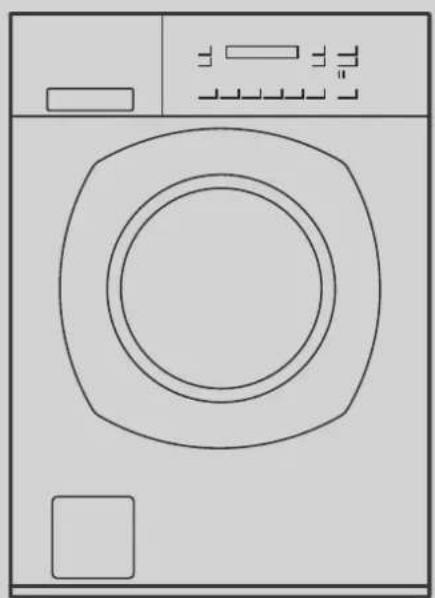
natural_image
Line drawing of a washing machine with control panel and door (no text or symbols)WA 08
We are pleased that you have chosen a Schulthess washing machine.
Your new washing machine is the result of many years of development work. The highest quality requirements, both in development and manufacture, guarantee a long lifetime.
Its design meets all the current and future demands of modern laundry care. It offers you a varied and individual choice of programmes.
With its extremely efficient use of water, energy and detergent, it helps to reduce the pollution of our environment and ensures you the maximum possible efficiency in the operation of your washer.
Please read these instructions carefully to enable you to use all the possibilities and advantages of your new washing machine.
Please note in particular the chapter «Safety information» and the enclosed guarantee and customer services booklet.
We hope you will be very happy with your new Schulthess machine.
Your
natural_image
Line drawing of a hand inserting a drawer into a file (no text or symbols)natural_image
Line drawing of a hand inserting a device into a machine (no text or symbols visible)natural_image
Line drawing of a drawer with an open drawer containing internal compartments (no text or symbols)text_image
Diagram of a refrigerator interior showing door, seat, and drawer with labeled dimensions in millimetersnatural_image
Diagram of a hand inserting a component into a circular housing with a valve (no text or symbols)natural_image
Line drawing of a hand inserting a device into a drawer with arrows indicating direction (no text or symbols)natural_image
Line drawing of a mechanical assembly with a downward arrow indicating motion (no text or symbols)natural_image
Diagram showing a faucet spraying water onto a storage tray, with no text or symbols present.natural_image
Line drawing of a mechanical assembly with a component being inserted into a tray (no text or symbols)
natural_image
Line drawing of a drawer with an arrow indicating direction (no text or symbols)natural_image
Simple line drawing of a device with a curved arrow pointing to its side panel (no text or symbols)natural_image
Diagram of a mechanical device with rotating arrow and circular base (no text or symbols)natural_image
Diagram of a mechanical device with an arrow indicating rotation or movement, no text or symbols presentnatural_image
Line drawing of a faucet with a handle and threaded base (no text or symbols)natural_image
Diagram of a pipe connection setup with pliers and tubing (no text or symbols)natural_image
Illustration of a faucet and tap wrench being adjusted for a valve (no text or symbols present)natural_image
Mechanical assembly diagram showing two components with arrows indicating motion (no text or symbols)Waste disposal advice
▶ Packaging from your new machine 28
▶ Disposal of your old machine 28
Safety information 28/29
How to wash correctly and environmentally friendly
▶ Water hardness 30
▶ Detergents 30/31
▶ Stain removal 31
▶ Washing tips 31
Machine description
▶ Control and display area 32
▶ Detergent drawer 33
First-time use
▶ First wash cycle 34
Washing
▶ Standard programmes 35
▶ Special programmes 36
▶ Particular programmes 36
▶ Washing 37
▷ Preparation 37
▷ Opening the loading door 37
▷ Selecting the wash programme 37
▷ Selecting additional programmes 37
▷ Selecting additional functions 37
▷ Adding laundry
▷ Closing the door 37
▷ Adding the detergent 37
▷ Starting the programme 38
Programme time/programme status 38
▷ Changing the programme before starting 38
▷ Cancelling the programme 38
▷ Ending the programme with rinsing stop 38
▷ Programme end 38
▷ Removing the laundry 38
▷ Switching off the machine 38
▶ Special programmes
▷ Hand wash 39
▷ Wool 39
▷ Delicates 39
▷ Curtains 39
▷ Nappies/Incontinence linen 39
▷ Spin 39
▶ Additional programmes
▷ Gentle programme 40
▷ Express programme 40
▷ Intensive 40
▷ Pre-wash 40
Additional functions
▷ Start time preselect 40
▷ Reducing the temperature 40
▷ Spin speed 40/41
▷ Rinsing stop 41
▷ Quick wash button 41
Basic settings
▷ Additional rinse 41
▷ Water level during washing 41
▷ Water level during rinsing 41
▷ Spin speed reduction 41
▷ Time 42
▷ Language 42
▶ Extended basic settings
▷ Skincare function 42
▷ Child lock 42
▷ Rinsing stop 42
▷ Memory function 42
▷ Soap wash programme 42
▷ Soak programme 42
▷ Cool down function 42
▷ Loosening up at programme end 42
▷ Wash time reduction 42
▷ LCD Brightness 43
▷ LCD Contrast 43
▷ Summer noise level 43
▷ Standby function 43
▷ Optical interface 43
▷ Reduced mains connection 43
▷ Default language 43
▷ Door opening at programme end 43
▷ Information for testing institutes and users 43
Cleaning and Maintenance
▶ Cleaning the machine 44
▷ Descaling the machine 44
▷ Cleaning the drum 44
▷ Water supply hose 44
▷ Frost protection 44
▷ Emptying the drain pump 44
▷ Emptying the water supply hose 44
▷ Cleaning the detergent drawer 44/45
▷ Emergency emptying 45
▶ Cleaning the filter in the water inlet 45/46
Problems
▶ Error messages on the display 46/47
▶ Troubleshooting 47/49
Customer Services
▶ Product- and Serial no. 49
Warranty subscription 49
Notes 50
Safety information and warnings
indicates work steps which must be executed one after the other
- enumerations, general useful hints
Waste Disposal Advice
Packaging from your new machine
Dispose of all packaging materials properly.
⚠️ Packaging materials are not toys.
Processing and reuse saves raw materials and reduces waste volumes.
The packaging can be returned to the retailer or supplier. All packaging materials used are environmentally friendly and reusable. All card is made of 80-100% recycled paper.
Wood is not chemically treated. Films are made of polyethylene (PE), banding is made of polypropylene (PP).
These materials are pure hydrocarbon compounds and are recyclable.
Disposal of your old machine
⚠️ Worn out machines should be made unusable:
After unplugging the machine or after an electrician has removed the connection, cut through and remove the mains cable. Destroy or remove the door lock so that playing children cannot become locked in and put their lives at risk.
Components from your old machine must not be reused. The old machine contains valuable materials which should be sent for recycling.
Please ensure that your old machine is disposed of properly.
Please do not keep your old machine and under no circumstances dispose of it in your normal waste.
Additional information on the recycling of this product can be obtained from your commune, your waste disposal contractor or the shop in which you bought the product. In this way you can help to ensure environmentally friendly disposal and/or recycling methods.
Safety Information
This machine meets the stringent safety regulations for electronic devices. It is not intended for use by persons (including children) with reduced physical, sensory or mental capabilities, or lack of experience and knowledge. Please observe the safety instructions in these operating instructions and the appurtenant mounting instructions.
Observe before start-up:
Read the enclosed documents carefully before using your washer-extractor. They contain important information on the installation, use and safety of the machine. Keep the documents safe for other users or subsequent owners.
⚠️ Remove the transport-securing device and store it in a safe place.
Have the machine installed according to the mounting instructions by qualified and trained personnel. If the machine is to be placed on a plinth, it must be mounted according to the installation instructions, otherwise this involves danger of tipping or falling.
Do not connect an appliance which displays visible damage.
You must use a new hose kit to connect the device to the water supply. Old hose kits should not be reused. Check the hose kit at regular intervals to ensure it can be changed in time to prevent water damage.
Check that the pump cover is inserted and fastened securely. Otherwise water can leak from the machine and cause a slipping or scalding hazard.
When operating the washing machine at 2000 m above sea level, it is absolutely imperative to activate the temperature limiter to prevent the water from boiling (see service instructions or ask the customer service and/or retailer).
Observe when washing:
The machine is exclusively intended for washing or wet cleaning and spinning of all fabrics bearing a care label indicating their suitability for these methods.
Do not leave children unattended near the machine and do not let them play with it, especially during the waiting phase of start time preselection. If required activate child lock (see chapter «Extended basic settings»).
⚠️ Keep pets away from the machine.
If there is a puddle on the floor near the machine (hose rupture, leakage or similar), wipe it dry and eliminate the cause (see chapter «Problems»), otherwise slipping hazard.
Do no place any objects on the top cover of the machine: They might slip off and fall to the floor during the spinning process.
Only use detergents, washing agents and other additives, which are intended for use in household washing machines: softeners, colouring and bleaching agents, starch, etc. Only add laundry starch in the final rinse (conditioner), because there is a risk of explosion at other stages of the wash.
Under no circumstances use any solvent-based detergents in the washing machine. Textiles which contain inflammable chemicals, solvent-based detergents, must be rinsed well in clear water by hand before washing. There is a risk that parts of the machine could be damaged and poisonous vapour released. There is also a risk of fire and explosion.
Before starting a wash programme make sure that there is no foreign body in the drum and the detergent drawer (coins, nails, paper clips, etc.).
When closing the door, make sure not to pinch your fingers.
When washing at high temperatures, do not touch the hot loading window (danger of burns).
⚠️ Never loosen the pump cover or open the door during an active wash programme, as this might cause a scalding hazard and/or a hazard of personal injury due to the rotating drum.
⚠️ Please observe that after interrupting a wash programme, the laundry may still be very hot: Burn hazard. Only remove cooled laundry from the drum.
Observe at the end of the programme:
Do not reach into the spinning drum.
⚠️ Turn off the tap and switch off the power.
If the main switch (on the building side) is turned off without closing the water tap, the overflow protection installed in the machine is ineffective.
When transporting your machine:
⚠️ Fit the transport securing device.
Take care when transporting the machine! (risk of injury!) Do not lift the machine by the fittings on the front!
General safety information:
Do not stand on the machine.
Do not sit, lean or support yourself on the loading door. (danger of tipping!)
Under no circumstances spray the machine with water or clean it with a steam cleaner.
Do not immerse the aqua-stop valve in water: Electric shock hazard.
If the machine is not needed for a longer period of time, turn off the tap and disconnect it from the power supply.
⚠️ Touch the power plug with dry hands only. Only pull the plug, do not pull the cable.
⚠️ Repair work may only be executed by qualified and trained personnel and defective components may only be replaced with original spare parts by Schulthess. Inexpert repairs can cause considerable damage and risk to the user. Modifications to the appliance are only admissible after consultation with the manufacturer.
If the mains lead to this device becomes damaged, it must be replaced with a special lead available from the manufacturer or the manufacturer's customer service.
Detergents and laundry care agents must be kept out of children's reach. Store laundry detergents, aids and other additives in a dry, cool place, as clumpy detergent can lead to functional problems.
In case of doubt, ask Customer Service or a dealer.
How to wash correctly and environmentally friendly
Water hardness
Water hardness plays an essential role in washing and it is divided in the following groups:
| French hardness | German hardness |
| ^ | ^ |
| soft 0 - 15 0 - 8 |
| medium 15 - 25 8 - 14 |
| hard > 25 > 14 |
If you do not know it, ask your local government.
Detergents
You can use all powder, compact (concentrated), tablet and liquid detergents commonly available for use in automatic washing machines.
Use the right detergent for the type and colour of your fabrics:
● Strong detergent for whites
- Coloured detergent for coloureds
● Gentle detergent for synthetics, viscose and microfibre
- Wool detergent for wool, silk and outerwear
Detergent dosing
Good washing results can only be obtained with correct dosing. Follow the dosing recommendations on the laundry packaging. Bear in mind that the dosing quantities given on the packaging refer to full drum loads.
For smaller wash loads reduce the dosing quantity (with automatic load metering follow display recommendations).
Rule of thumb: If during the washing a foam layer of the approximate thickness of 2cm above the washing liquid and/or laundry surface is detected, the dosing quantity has not been selected properly.
The correct detergent quantity is dependent on
● the water hardness:
If this is unknown, check with your local water supplier. Adjust the detergent dose according to the hardness (see above).
- the degree of soiling:
lightly soiled
No visible soiling or stains, the clothing has only absorbed body odour for example.
Reduce the quantity of detergent in accordance with the recommended dose.
Wash these fabrics in the express programme.
normal soiling
Visible soiling and a few faint stains. Normal dosing as per the dosing recommendation. Wash these fabrics in the standard programme.
heavily soiled
Clearly visible soiling and stains. Increased dosing as per the dosing recommendation. Pre-treat or soak stains if necessary, pre-wash fabrics or wash in the «sanaPlus» programme.
● the quantity of laundry:
With a half-full drum, reduce the quantity of detergent by one third.
Please note:
● Insufficient detergent
- only becomes apparent after repeated underdosing
- causes the laundry to become grey or not properly clean
- causes the laundry to become hard (board-like)
- may cause grey-brown greasy spots to form on the laundry
- may lead to calcified heating elements
- Excess detergent results in
- poorer washing results
- foaming over of the detergent and breakdowns
- higher water consumption and costs
- increased washing programme length
- unnecessary environmental pollution
Liquid detergent and start time preselection
Use the divider for liquid detergent in the detergent drawer or use dosing aids such as dosing balls or bags supplied with the detergent.
When using start time preselection, use a dosing ball for liquid detergent
If poured directly into the detergent drawer, liquid detergent slowly runs out and thickens.
If this happens several times, it can lead to blockages due to detergent deposits.
Remove the dosing ball at the end of the programme!
Soap-based detergents
Your washing machine has a special programme for washing with soap-based detergents, which you can select in the basic programme settings (see chapter «Extended basic settings»).
Because soap does not contain anything to prevent lime-scale, you should only use it with soft or medium-hard water, together with a separate water softener.

Otherwise, limescale and soap residue can build up in the machine, which will be deposited on laundry in the form of grease spots or as limescale on the heating element.
Water softeners
Special water softening aids can be used in the water hardness ranges «medium» and «hard».
Follow the instructions on the packaging!
In this case add the detergent according to hardness range «soft». First add the detergent, then softener in the same chamber. In this way the agents will be washed in better.
Soaking agents
Add to chamber I of the detergent drawer.
Choose soaking programme (see chapter «Extended basic settings»).
Fabric softener, fabric conditioner
Add to chamber Do not exceed the max. volume of 200 ml otherwise the fabric conditioner will flow out through the overflow. Before adding thick fabric softener add water and stir to ensure that it is free of lumps so that the siphon does not get blocked.
Bleach, stain removal salt
Powder bleaches and stain removal safts can be also used for fabrics with bleachable spots. First fill the detergent and then the bleach powder or stain removal salt in chamber II. In this way the agents will be washed in better.
Impregnating agent
The clothes are impregnated evenly and durably by adding impregnating agent to the washing machine.
Breathable all-weather clothing such as GoreTex or SympaTex must only be treated with the specifically designated impregnating agent. Otherwise you risk blocking the breathing membranes.
Stain removal
If possible, stains should be removed or at least pretreated immediately, as long as they are fresh, before washing the laundry in the washing machine. Stains which have already dried, in particular in sun light, are much more difficult to remove, if this is possible at all. Try water, soap (curd soap) and prewashing agents. Dab it on, slightly rub it in and let it soak, then rinse the textile. In this way it is possible to completely or almost completely remove many typical household stains like gravy, coffee, chocolate, wine, fat, oil, fruit juices, blood, etc. Attention: Stains which have not been pretreated may be fix in the textiles during the wash process. Then it will be almost impossible to remove them or only by means of a strong bleaching agent.
It may sometimes be necessary to pretreat, wash or soak textiles several times in order to remove tenacious and dried stains.
Washing tips
Sorting the laundry
Follow the care symbols in the fabrics.
Laundry marked with the following care symbol may not be washed in the machine:
- do not wash
Sort the laundry by fabric type and degree of soiling.
Sort the laundry by colour. Wash whites and coloureds separately, otherwise white laundry will become grey. Do not wash new coloureds with other laundry due to the risk of discoloration!
Knitwear made wholly or partly from wool must also be labelled «non-felting» or «machine washable», otherwise there is a risk of felting during the washing process.

▶ Remove foreign bodies such as safety pins, paper clips, coins etc from the laundry.
▶ Brush out sand from the pockets and turn-ups.
▶ Close zips, hooks, eyelets and Velcro closures.
▶ Button up duvet covers and pillowcases and tie fabric belts and apron strings together.
Washing tips
▶ Do not exceed the maximum loading quantities. This is because overfilling detracts from the washing result and may lead to fabric damage.
▶ Wash particularly delicate laundry, such as pantyhose or net curtains, or small items of laundry such as socks or handkerchiefs in a net laundry bag or pillowcase.
▶ Turn trousers, knitwear or knitted fabrics, e.g. jerseys, T-shirts, sweatshirts inside out.
▶ Check that brassieres are machine washable.

Wash brassieres with stiffeners in a fine-mesh laundry bag because of the risk of the wires becoming detached in the wash and falling through the drum perforations with resultant damage.

Textiles with metal reinforcements can damage the components of the machine and must not be washed in the washing machine.
● Dispense with a pre-wash for normally soiled laundry and save water, energy, detergent and time.
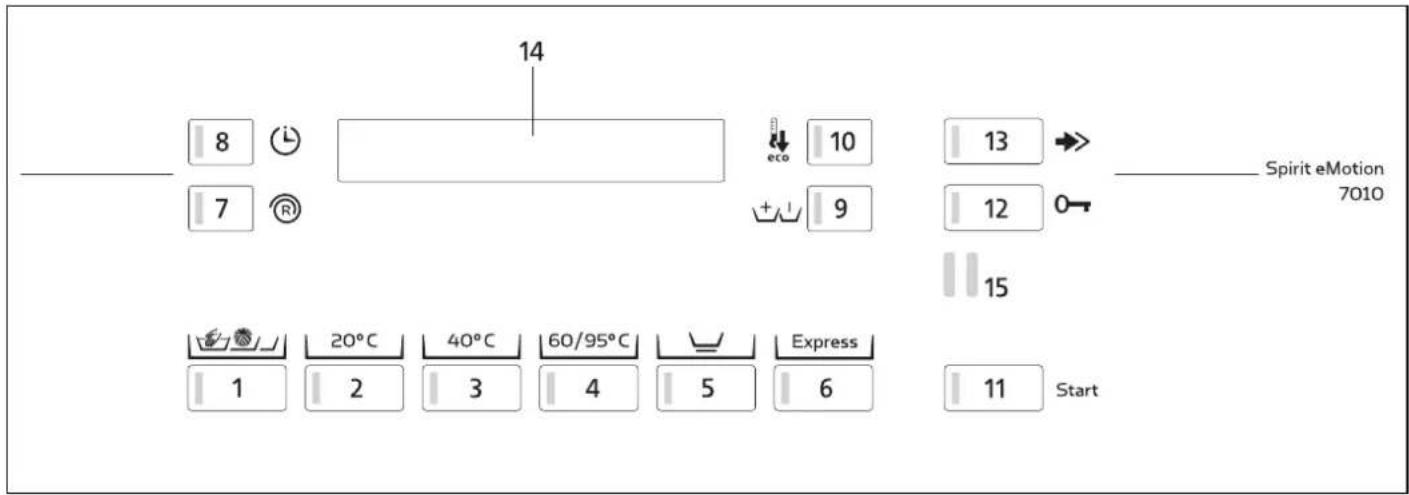
Control and display area
text_image
8 7 14 eco 10 9 13 12 15 11 Start Spirit eMotion 7010 20°C 40°C 60/95°C Express 1 2 3 4 5 6Programmes
1 Special programmes
2 Coloureds 20°C
3 Coloureds 40°C
4 Coloureds and Boil 60°/95°C
Additional functions
5 Gentle programme for easy care fabrics
6 Express programme
7 Spin speed / Rinsing stop
8 Pre-set starting time
9 Intensive/Pre-wash
10 Washing temperature
11 Programme start
12 Open door
13 Quick wash
Displays
14 Display
Interfaces
15 SCS-Schulthess Control System (PC-Interface)
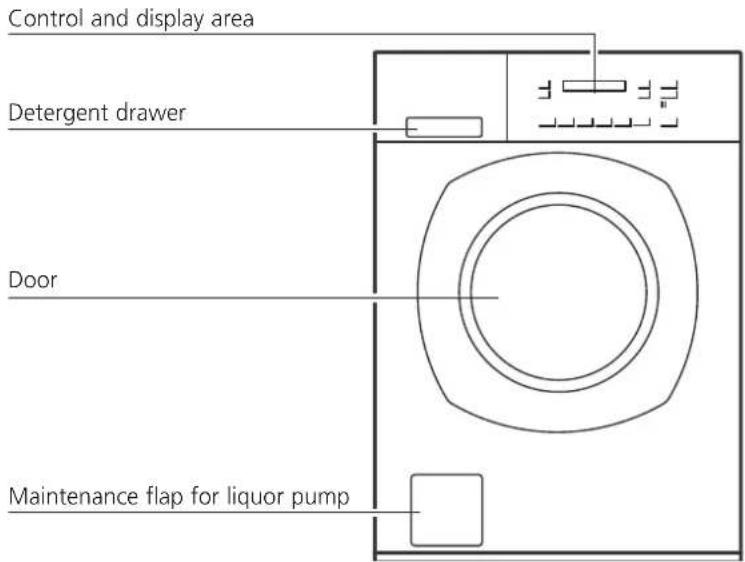
text_image
Control and display area Detergent drawer Door Maintenance flap for liquor pumpDetergent Drawer

natural_image
Line drawing of a hand inserting a drawer into a file (no text or symbols)▶ Pull out the detergent drawer until it reaches the stop. Add detergent or conditioner to sections I, II or ☒:
Section I: Detergent for prewash and soaking.
Section II: Detergent for the main wash, bleach, modular detergent, starch, water softener for soap programme.
Section ⑧ conditioning additives for the last rinse, e.g. fabric softener.
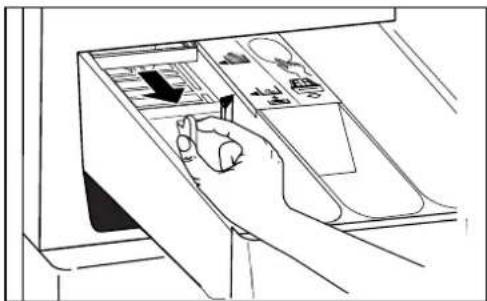
natural_image
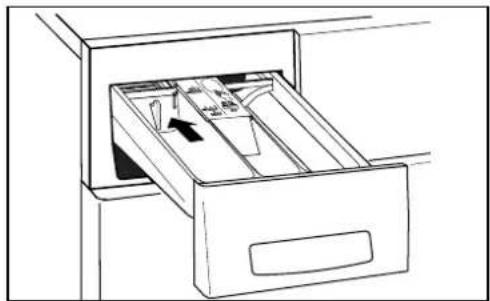
Line drawing of a hand inserting a device into a drawer (no text or symbols)The divider in Section II can be moved for different types and quantities of detergent. If you use small quantities of washing powder, e.g. compact detergent:
▶ Pull the divider forward. The arrow on the divider points to the symbol
natural_image
Line drawing of a file drawer with an open drawer containing documents (no text or symbols visible)If you use large quantities of washing powder or tablets:
▶ Push the divider all the way back (supplied in this position).
The arrow on the divider points to the symbol

text_image
Diagram of a refrigerator interior showing door, seat, and drawer with labeled dimensions in millimetersIf you use liquid detergent:
▶ Pull the divider forward to the stop and press it down. The arrow on the divider points to the symbol ≈ ≈ ≈ ≈ ≈ ≈ ≈ ≈ ≈ ≈ ≈ ≈ ≈ ≈ ≈ ≈ ≈ ≈ ≈ ≈ ≈ ≈ ≈ ≈ ≈ ≈ ≈ ≈ ≈ ≈ ≈ ≈ ≈ ≈ ≈ ≈ ≈ ≈ ≈ ≈ ≈ ≈ ≈ ≈ ≈ ≈ ≈ ≈ ≈ ≈ ≉
Note
Use a dosing ball for liquid detergents for washing programmes using the time preselect, placing it inside the drum with the laundry.
First-time use

Install the machine according to the installation instructions.
First wash cycle (without laundry)
Run the first wash cycle without laundry, to remove any water remaining from the manufacturing process.
-
Check that the transport packaging on the rear of the machine has been removed (see installation instructions).
-
Turn on the water supply.
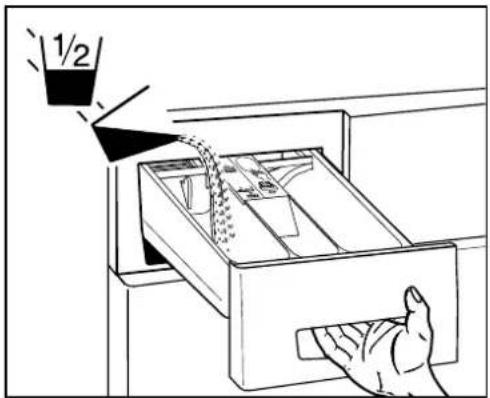
text_image
1/2-
Pull out the detergent drawer until it reaches its stop.
-
Add half a scoop of all purpose detergent to section II (on the left). Do not use gentle or wool detergent, because it will produce too much foam.
-
Select the washing programme «Coloureds 60°C»
-
Press the start button. The programme should start.
-
After the end of the programme, the machine is ready for use.
Standard programmes
| Care Washing Programme symbol load Fabric / Wash Type selection button minutes cons. litre cons. kWh | ||||||
| 3,5 kg | Easy care laundry 20°C▶ lightly soiled easy care cotton or non-iron mixed fibres or outerwear | 20°C + | 61 / 36* | 59 | 0,3 | |
| 3,5 kg | Easy care laundry 40°C▶ Easy care cotton or non-iron mixed fibres, outerwear, shirts, blouses | 40°C + | 61 / 36* | 59 | 0,7 | |
| 3,5 kg | Easy care laundry 60°C▶ Easy care cotton or non-iron mixed fibres | 60/95°C + | 67 / 44* | 59 | 1,4 | |
| 3,5 kg | Easy care laundry 95°C▶ Cotton with boil wash finish▶ Sensitive fabrics made of white or colourfast cotton, non-iron▶ Nappies, bed linen, baby clothes | 2x 60/95°C + | 77 / 57* | 59 | 2,3 | |
| 7 kg | Coloureds 20°C▶ lightly soiled coloured cotton, non-colourfast dyed▶ Jeans, jumpers | 20°C | 61 / 25* | 63 | 0,3 | |
| 7 kg | Coloureds 40°C▶ Coloured, non-colourfast dyed cotton▶ Sportswear, jeans, jumpers | 40°C | 61 / 25* | 63 | 0,7 | |
| 7 kg | Coloureds 60°C▶ Coloured cotton, linen▶ Bed linen, aprons, jeans, towels, underwear | 60/95°C | 69 / 32* | 49 | 1,19 | |
| 7 kg | Boil 95°C▶ White and colourfast cotton and linen▶ Bed and table linen, towels, underwear | 2x 60/95°C | 84 / 49* | 63 | 2,5 | |
* Express programme length, press the «Express» button after selecting the programme. Reduces wash time as well as electricity and water consumption.
Special programmes
| Care Washing Programme symbol load Fabric / Wash Type | max. Approx. Approach Aways check the care symbols on the fabrics duration water power type selection button minutes cons. litre cons. kWh | |||||
| 2,3 kg | Hand wash 20°C▶ Fabrics made of hand washable wool or wool mixture | 1x | 39 | 49 | 0,1 | |
| 2,3 kg | Wool 30°C▶ Wool mark stating «non-felting»or «machine washable»▶ Machine washable fabrics made of or containing wool | 2x | 39 / 27* | 47 | 0,3 | |
| 2,8 kg | Delicates 40°C▶ Especially sensitive fabrics made of cotton or mixed fibres, synthetics▶ Curtains, dresses, blouses, skirts | 3x | 55 / 35* | 47 | 0,7 | |
| 3,5 kg | Curtains 40°C▶ Mixed fibre fabrics or synthetics | 4x | 61 | 86 | 0,9 | |
| 7 kg | Nappies/Inkontinence linen 95°C▶ White and colourfast cotton | 5x | 114 | 92 | 3,3 | |
| 7 kg | Spin▶ Spin only | 6x | 9 | - | 0,1 |
* Express programme length, press the «Express» button after selecting the programme. Reduces wash time as well as electricity and water consumption.
Particular programmes
Separate rinse
| Cotton, linen | 40°C | + Start + ➞ | 33 | |
| Easy care mixed fibres | 40°C | + | + Start + ➞ | 30 |
| Delicates | + | + Start + ➞ | 23 |
Separate conditioning, starching
| ▶ Cotton, linen | 40°C | + | Start + ➕ ➕ + ➕ ➕ | 16 | |
| ▶ Easy care mixed fibres | 40°C | + | ∨ | + Start + ➕ ➕ + ➕ ➕ | 18 |
| ▶ Delicates | ∅∅∅ | + | ∅∅∅ | + Start + ➕ ➕ + ➕ ➕ | 17 |
Consumption values
The consumption values and programme durations given are approximate values which were determined under standard conditions. Fluctuations of up to 10 % are possible.
Reduced mains connection
On machines with reduced mains connection, the programme times will be extended accordingly.
Hot water supply
In the case of washing machines with a hot water supply, the following points should be noted:

The max. permissible hot water temperature is 70^ .
- For prewash, delicates programmes and programmes ≤ 30°C only cold water is used.
- In the temperature range ≥ 40^ , the water is mixed automatically to the programmed washing temperature.
- In the case or textiles soiled with blood or proteins, select a programme with prewash so that the stains will be washed out below 30°C to ensure that they cannot become fixed to the fabric at higher temperatures in the main washing cycle.
Washing
Preparation
Check that:
▶ the pump cover is screwed on.
(see chapter «Cleaning and Maintenance»)
▶ the mains plug or the wall switch is turned on.
▶ the water tap is turned on.
The machine is ready for use when all pilot lamps are flashing or are switched off in standby mode.
Opening the loading door

▶ Press the «Open door» button.
● The loading door springs open.
▶ Note: The loading door only springs open if the main power supply is switched on.
Selecting the wash programme

text_image
20°C 40°C 60/95°C▶ Press the programme button
● The control light for the selected programme lights up.
● The display shows the wash temperature, the selected programme and the programme duration.
Selecting additional programmes

text_image
40°C COLOUREDS 00±25h EXPRESS
text_image
20°C 40°C 60/95°C Express▶ Press the desired selector button (see chapter «Additional programmes»).
● The text for the selected additional programme appears on the display.
Select additional functions

text_image
40°C COLOUREDS 01±01h eco
text_image
20°C 40°C 60/95°C ExpressAfter selecting the programme, the control light for the additional functions that can be selected if required will flash.
▶ Press desired function button(s). (See chapter «Additional Functions»).
- The control light(s) for the selected function(s) will light up.
- The new programme values such as time and spin speed will be displayed.
Adding laundry
▶ Place the laundry loosely in the drum, small and large pieces mixed together.
Closing the door
▶ Close the door by pushing it until the lock audibly engages.
▶ Ensure that no items of laundry are trapped between the door and the rubber seal.

If the door is not closed, a safety switch prevents the machine from starting.
Adding the detergent
Dose the detergent according to the chapter «Detergent drawer»

Close the detergent drawer carefully after dosing until you feel it look.
▶ Risk of water damage!
Starting the programme

- Lightly press the Start button. - The pilot lamp illuminates and the programme runs through automatically.

With child lock activated: ▶ Hold down the Quick wash button and actuate the Start button.
Programme time / programme status

text_image
40°C COLOURED'S WASHING 0045h eco
text_image
20°C 40°C 60/95°C ExpressThe individual programme steps and remaining time are displayed during the washing programme.
Changing the programme before starting
▶ Lightly press the desired programme button once again.
▶ Select additional programmes.
▶ Select any additional functions that may be needed.
Cancelling the programme

Cancel the programme by repeatedly pressing the «Quick wash» button until «Open door» is displayed.

With child lock activated:
▶ Hold down the start button while selecting a new programme.

When restarting the programme:
▶ Repeat the detergent addition.
Ending the programme with rinsing stop
You have selected the additional rinsing stop function. The laundry will be held in the last rinse water. The display will show «Rinsing stop». You have 2 options for ending the programme:
The laundry can be spun
▶ If the spin speed was not changed when the programme was selected, this can be done using the selection button for the spin speed
▶ Press the start button.
● The water will be pumped out and the laundry spun.

The laundry can be removed dripping wet
▶ Press the Quick Wash button twice.
● The rinse water is pumped out.
▶ By pressing the button, the spin can be ended early to be kind to your laundry (e.g. curtains).

With child lock activated: ▶ Hold the start button down at the same time.
Programme end
The programme end is shown by the time 00:00h and the words «Open door».
Tumbling the washing
The tumbling phase at the end of the programme lasts 5 minutes (excluding especially gentle wash programmes such as wool, e.g.) and prevents creasing the laundry.
Removing the laundry
● During the loosening up phase: (Drum is still turning / Time indicator 00:00h)
Press the Quick Wash button once.
(Halt programme)


Press the door open button and ▶ remove the laundry.
- At the end of the loosening-up phase:
Press the door opening button and ▶remove the laundry.


Remove any foreign objects (e.g. paperclips) from the drum and rubber seal!
Otherwise there is a risk of rust!

natural_image
Line drawing of a hand pressing down on a circular component with a cable attached (no text or symbols)Leave the loading door ajar to allow the machine dry out.
Switching off the machine
▶ Close the water taps
▶ In machines with Aquastop this is not required, as this safety equipment will automatically stop the water inflow behind the tap at the end of the programme.

Aqua-Stop

▶ Switch off the main switch (on the building side) In case of fitted models, the power supply must not be interrupted to ensure the function of overflow protection.
Selecting special programmes
Your washing machine also offers you 6 special programmes.
The specific procedures of some programmes make the proper dosing of detergent and detergent aids imperative.
Selecting special programmes

▶One of the special programmes can be selected by pressing this button several times up to six.
● The control light comes on.
● The display shows the wash temperature, the special programme and the programme duration.
Selecting additional functions
Setting the additional functions temperature reduction, spin speed reduction, start time preselect and rinse hold is the same as for other programmes (see chapter «additional functions»).
Adding laundry / Closing the door
▶ This function is the same as the standard programmes
Special programmes
Hand wash 20°C
▶ Fabrics made of hand washable wool or wool mixtures. For drying handwash see next section «wool 30°C»
Wool 30°C
▶ Machine washable fabrics made of wool or wool mix, with wool mark label «non felting» or «Mashine washable». If wool is not to be dried in a dryer after washing, but in the air, spread the wool textiles loosely on a terry towel and let them dry completely. When drying in a dryer, please follow the dryer instructions.
For light soiled wool use the programme «Wool Express».
Delicates 40°C
▶ Especially sensitive fabrics made of cotton or mixed fibres, synthetics
▶ Curtains, dresses, blouses, skirts
For light soiled delicate fabrics use the programme «Delicates Express».
Curtains 40° C
▶ Mixed fibre fabrics
Wash programme with high water level for wash and rinse and low speed spin.
▶ When washing curtains, place metal rings or plastic hooks in a laundry net or bag (cushion cover).

Older curtains are often very bleached by the sun and no longer very resistant. Machine washing can therefore cause slight damage.
To prevent creasing at the end of the programme, it is advisable to use the rinse stop function.
Nappies/Inkontinence linen 95°C
▶ White and colourfast cotton.
- In this programme the laundry will first be pre-rinsed with cold water. Subsequently fill the detergent into the compartments I and II, then prewash will be started at 60°C and main wash at 95°C.
Spin
▶ For spinning fabrics (without rinsing).
▶ The spin speed settings can be altered using the additional function 📐.

Please note the spin speed! (see chapter «Basic Settings/Spin speed reduction»)
Additional programmes
▶ Selecting additional programmes: see chapter «Washing/Selecting additional programmes».
Alongside the various standard wash programmes, your machine offers you the opportunity to design your own programmes.
By selecting one or more additional programmes, you can tailor your wash programme to the specifics of your laundry.
▶ You also have the opportunity to tailor your machine to your needs by changing the basic settings (see chapter «Basic settings»).
Gentle programme for easy care fabrics

For easy care and particularly sensitive fabrics made of cotton, mixed fibres, synthetics.
Express programme

Express programme for lightly soiled fabrics. Reduces the washing time.
For small loads of washing or light soiling, reduce the amount of detergent used according to the recommended dosage.
Intensive

This programme is for heavily soiled fabrics, especially those with bleachable stains (e.g. fruit, coffee, tea, red wine).
The intensive programme can be used for boil or coloured washes as well as for easy care fabrics. The wash time will be extended.
Hint
- The programmes «Intensive», «Express» and «Pre-wash» exclude each other, this means that only one of these additional programmes can be selected.
Pre-wash

For particularly heavily soiled laundry, bad stains or occupational laundry (e.g. blood or oil stains, nappies). The wash temperature is 30^ C.
Add 14 of the detergent to section I.
Caution: There is no prewash on wool programmes to protect the fibres.
Additional functions
▶ Selecting additional functions: see chapter «Washing/ Selectingadditional functions».
Start time preselect

By pressing the «Pre-set starting time» button one or more times, the programme start time can be delayed by up to 23.5 hours.
This makes it possible to take advantage of cheaper night-time electricity, for example. The start time and consequently also the end time of a programme can be tailored to your individual lifestyle.
The start time and the anticipated programme end time are shown on the display.
The preselected time starts when the start button is pressed.
When the start time is reached, the selected programme starts automatically. The current programme duration will be displayed.
Note
- The start time preselect only works if no soaking programme has been selected (see also chapter «Extended basic settings/ Soaking programme»).
- In the event of a power cut, the current time is saved. The duration of the power cut is not taken into account.
- When using start time preselection, use a dosing ball for liquid detergent. If poured directly into the detergent drawer, liquid detergent slowly runs out and thickens.
If this happens several times, it can lead to blockages due to detergent deposits.
Reducing the temperature

▶ Pressing the «Washing Temperature» button several times reduces the wash temperature in 10°C stages (15°C stages above 80°C).
The new temperature will be displayed. It can also be changed during the first two minutes of the programme. The lower temperature is compensated by an extension of the post-wash time, which achieves the same result for less energy.
Spin speed

This function is used to select a lower spin speed or a rinse stop for a more gentle treatment of the laundry, for example with delicate laundry (see next section). Without spin speed reduction the laundry will be spun at normal spin speed (see chapter «Basic settings/ spin speed reduction»). The spin speed depends on the programme chosen. By pressing the button repeatedly it can be reduced in 200 or 100 rpm increments. The slowest possible spin speed is 200 rpm.
The spin speed can also be changed while a programme is operating but not during the spin cycle however.
Increased spin speed
If the button spin speed is pressed again after «00», you can select an increased spin speed (1400 rpm).
The spinning intensity of the laundry will be increased.
Money-saving tip
If the laundry is to be dried in a tumble dryer, select a high spin speed since well-drained laundry needs much less energy and time for machine drying.
Rinsing stop

The «Rinsing stop» function is used to avoid creasing of sensitive fabrics. The laundry is held in the last rinse water. Select rinsing stop by reducing the spin speed until you see «rinsing stop» on the display.
You can end the programme by draining the laundry without spinning or by spinning (see chapter «Washing/Ending the programme with rinsing stop»).
Quick wash button

The programme can be shortened or aborted by pressing the Quick wash button.
▶ See chapter «Washing/Cancelling the programme»).
This button can also be used to select special programmes.
▶ See «Particular programmes» in the chapter «Washing».
Basic Settings
The machine has basic settings from the factory. It can be adapted to the user's individual needs either when first used or later using the following functions.
The basic settings can only be changed if no wash programme is running. To change a basic setting, it is first necessary to hold the programme button pressed and then press the quick wash button. The corresponding function is shown on the digital display. The display changes when the quick wash button is pressed repeatedly with the programme button held down.
Example:
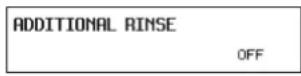
Function switched off
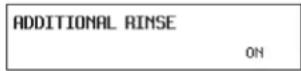
Function switched on
Additional rinse (ex factory OFF)

To improve the rinse results in soft water areas or for allergy sufferers, switch on the extra rinse.
Water level when washing (ex factory NORMAL)

If the function is set to «increased», the water level is higher during washing.
Water level when rinsing (ex factory NORMAL)

If the function is set to «increased», the water level is higher during rinsing.
Spin speed reduction (ex factory OFF)

Wash programmes Spin speed in rpm
Off Level 1 Level 2
reduction reduction
Boil / Coloured wash 1400 1200 1000
Easy care wash 800 800 600
Delicates 600 600 400
Wool 800 600 400
Special programmes 600 600 400
Time (the clock is not set ex factory)

The hours can be set using the button and the minutes using the button.
Language (ex factory GERMAN)

This setting is temporarily valid for the selected programme and reverts back to the default language a few minutes after completion of the programme. (See «Extended basic settings/Default language»)
Extended basic settings

▶ By pressing these three buttons at the same time, the display shows the extended basic settings.
▶ Repeatedly pressing the button shows the possible settings.
▶ Pressing the button allows the settings to be changed.
▶ Pressing the button interrupts the display of the settings.
Skincare function (ex factory OFF)
Select «Extended basic settings»!
If the skincare function is switched on, two extra rinses are added to each wash programme. These additional rinses can prevent skin allergies.
Child lock (ex factory OFF)
Select «Extended basic settings»!
The child lock is to prevent accidental starting, changing or deletion of a programme by small children.
Operating the machine with the child lock switched on:

Hold the start button down and press the quick wash button.
Rinsing stop (ex factory INDIVIDUAL)
Select «Extended basic settings»!
If this function is switched on, all easy care, fine wash or shirt programmes automatically add a rinsing stop.
Load metering (ex factoryOFF)
That function is not relevant for this model.
Memory function (ex factory OFF)
Select «Extended basic settings»!
If the memory function is switched on, the selected temperature and spin additional functions are saved for each programme. If the same programme is selected again, the stored values are automatically used. The values can then be altered.
Soap wash programme (ex factoryOFF)
Select «Extended basic settings»!
When this programme is switched on, an extra rinse is added.
Soak programme (ex factoryOFF)
Select «Extended basic settings»!
When this programme is switched on:
soaking time of up to 12 hours.
▶ Set the desired soaking time by pressing the function «Soaking» once or several times.
▶ The soaking time starts when the start button is pressed.
▶ Add soaking detergent in section I of the detergent drawer and your usual detergent in section II.
▶ The soaking programme must be reprogrammed for each wash.
▶ Soaking can be interrupted and the wash programme started by pressing the Quick wash button.
The current soaking time is stored in the event of a power cut. The duration of the power cut is not taken into account.
Note:
Cool down function (ex factoryOFF)
Select «Extended basic settings»!
Detergent solution cooling: When the detergent solution cooling function is switched on, boiling water is cooled with cold water at the end of the washing process.

This helps to prevent damage to older drains.
This cooling always takes place in the easy care programme, irrespective of this setting. This helps to prevent creases.
Loosening up at programme end (ex factoryON)
Select «Extended basic settings»!
When this function is selected, the laundry is tumbled for 5 minutes at the end of the programme.
Wash time reduction (ex factory ON)
Select «Extended basic settings»!
When this function is switched off, the boil, coloured and easy care programmes are longer
LCD Brightness setting (ex factory220)
Select «Extended basic settings»!
The button can be used to alter the brightness or text on the display.
LCD Contrast setting (ex factory26)
Select «Extended basic settings»!
The button can be used to alter the contrast on the display.
Alarm volume (ex factoryVOLUME 2)
Select «Extended basic settings»!
With the Alarm setting switched on, a signal sounds at regular intervals at the end of the programme.
The level can be adjusted in 3 levels using the button.
Off
Noise level 1
Noise level 2
Noise level 3
Standby function (ex factoryON)
Select «Extended basic settings»!
When the standby function is switched on, the controls switch off when wash programme is running or laundry weighing is carried out in energy saving mode.
All displays are dark.
Optical interface (ex factoryOFF)
Select «Extended basic settings»!
If the optical interface (SCS) is switched on, customer services can communicate with the machine by PC.
Reduced mains connection (ex factoryOFF)
Select «Extended basic settings»!
If the mains voltage is reduced, the programme times will be extended accordingly.
Off = 400 V 2N \~ 4,2 kW / 10 AT
Off = 400 V 1N \~ 4,2 kW / 16 AT
On = 230 V 1N \~ 2,3 kW / 10 AT
Default language (ex factory GERMAN)
Select «Extended basic settings»!
If another language is temporarily selected via the buttons Express and 4 minutes after programme end, in standby mode or after a long standstill, the setting reverts back to the default language.
Door opening at programme end (ex factoryOFF)
Select «Extended basic settings»!
If this function is switched on, the door will open automatically at the end of the programme.
Information for testing institutes and users
In the goods declaration this washing extractor is awarded the best grade A according to the energy-label classification on the basis of the standard programmes EN 60456 in the washing effectiveness class. However, standard wash programmes which were especially developed for the Swiss consumers' needs were pre-set at the factory, as on the basis of today's wearing and washing habits, modern textiles can be washed with shorter programmes.
You can, however, set the standard programme times according to the energy label via the extended basic settings by setting the parameter Wash time reduction to OFF.
● The machine is now generally set to the longer wash times according to the energy label.
Standard programme pursuant to EN 60456
Cotton 60°C: 136 Min / 49 l / 1,19 kWh
Cleaning and Maintenance
Cleaning the machine
⚠ Ensure that the power supply is switched off before any cleaning, care or maintenance work.
Under no circumstances spray the machine with water or clean it with a steam cleaner.
Do not use solvents! These substances can damage parts of the machine, produce poisonous vapour and carry the risk of explosion.
Casings and control areas should only be cleaned with soap or a commercially available, solvent-free, non-abrasive cleaning product.
The side walls of machines with a chrome steel finish should not be cleaned with chrome steel cleaner under any circumstances.
Descaling the machine
If the correct amounts of detergent are used, descaling is no longer necessary in general.
⚠️ Descalers contain acids, can attack parts of the machine and cause discolouration of laundry.
If you do, however, wish to descale the machine, follow the manufacturer's instructions on the packet.
Limescale formation depends largely on the hardness of the water. To avoid water damage, we recommend having this checked by a specialist after around 5 years of fault-free operation.
Cleaning the drum
Rust marks caused by metal parts standing still for lengthy periods can be removed with a chlorine-free cleaning product (look at the description of the ingredients on the pack).
Never use steel wool!
Water supply hose
Only for machines without Aquastop. To avoid water damage, we recommend having this checked by a specialist after around 5 years of fault-free operation.
Frost protection
If the machine is in a room susceptible to frost, all residual water must be removed from the detergent pump and water supply and drain hoses immediately after use.
Emptying the drain pump
See chapter «Emergency emptying».
Emptying the water supply hose
- Turn off the water supply
On machines without AquaStop
- Screw off the hose at the tap, let the water run into a bowl.
- Screw the hose back onto the tap.
On machines with AquaStop
- Screw off the hose at the tap, place it in a bowl, switch on any optional wash programme and terminate after approx. 40 seconds using the fast forward button. The residual water will flow out from the water inflow hose, let the water run into the bowl.
- Screw the hose back onto the tap.
Cleaning the detergent drawer
- Pull the detergent drawer out until it stops.
- Press down in the middle of the softener section cover, and pull the drawer all the way out.

natural_image
Line drawing of a hand inserting a device into a drawer with arrows indicating direction (no text or symbols)- Remove the divider.
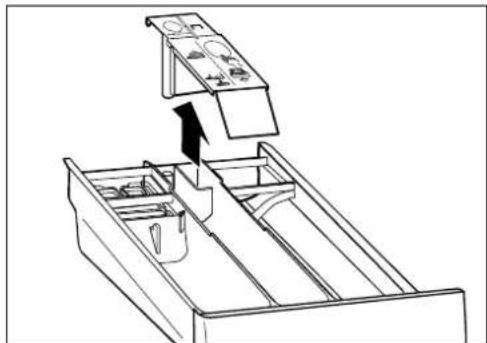
natural_image
Line drawing of a mechanical assembly with a component being inserted into a tray (no text or symbols)- Clean the chambers and insert under running water.
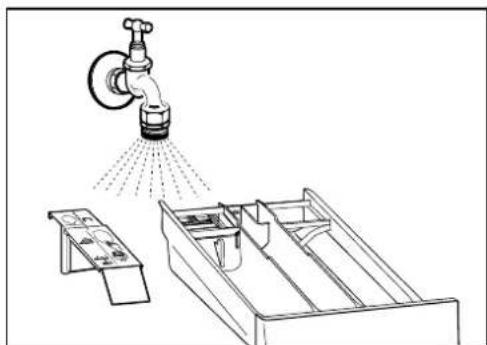
natural_image
Line drawing of a faucet spraying water onto a storage tray (no text or symbols)- Replace the divider in the detergent drawer.
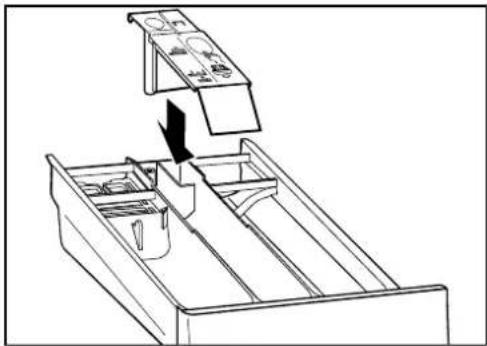
natural_image
Line drawing of a mechanical assembly with a downward arrow indicating force or motion (no text or symbols)- Replace the drawer in the machine.
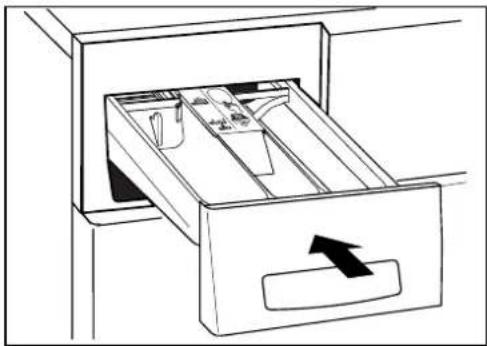
natural_image
Line drawing of a drawer with an arrow indicating direction (no text or symbols)Emergency emptying
Emergency emptying is necessary if:
- The error message «Check drain» appears.
● The pump is blocked by a foreign body (e.g. buttons, paper clip, fluff) and the water cannot be pumped out.
Up to 20 litres can flow from a blocked pump. Have a bucket ready.
Risk of scalding! Allow hot detergent solution to cool.
Cleaning procedure
- ⚠️ Switch off the mains power supply
- Open the maintenance hatch at the machine front
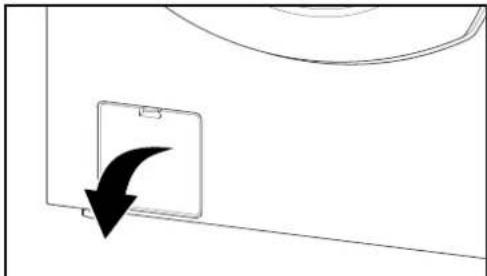
natural_image
Simple line drawing of a device with a curved arrow pointing to its base (no text or symbols)- Push the flat container underneath the maintenance hatch Loosen the pump cover slightly and allow the residual water in the machine to drain off into the container. Empty the container when full. If required repeat the process several times, until all water has drained off. Attention: Only open pump cover stepwise, danger of flooding.

natural_image
Diagram of a device being shifted with an arrow, showing mechanical components and a circular base (no text or symbols)- Remove the pump cover. Remove foreign bodies and deposits of fluff. Clean the pump interior. It must be possible to rotate the pump impellers. Screw on the pump cover.
- Close the maintenance hatch.
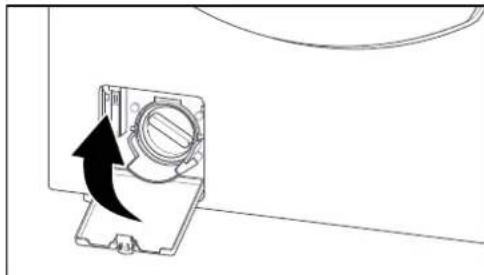
natural_image
Diagram of a mechanical device with an arrow indicating rotation or movement, no text or symbols present- Switch the mains power back on. Select a washing programme and as soon as the water inlet stops, select programme end with the fast run button. This procedure prevents detergent from flowing unused into the drainage system at the next wash.
Cleaning the filter in the water inlet
The filter in the water inlet must be cleaned if no water or insufficient water flows into the appliance when the tap is turned on. The fault message «Check water inlet and start» is displayed.
The filter are located in the threaded hose coupling on the water tap and at the back of the machine.
Cleaning procedure
- Turn the water tap off.
- Select a programme, start it and after approx. 20 seconds select «Programme end» with the fast run button. As a result, the water pressure in the inlet hose can be reduced.
On machines without AquaStop
- Switch off the mains power supply.
- Unscrew the hose from the water tap and rinse out the filter under running water.
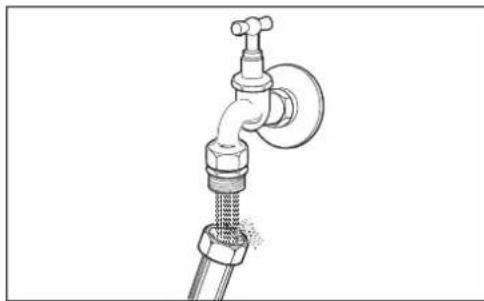
natural_image
Line drawing of a faucet with a screw inserted into a pipe (no text or symbols)- Connect the hose again.
- Unscrew the hose only from the back of the machine.
- Pull out filter using a pair of flat-nose pliers. Clean and reinsert it.
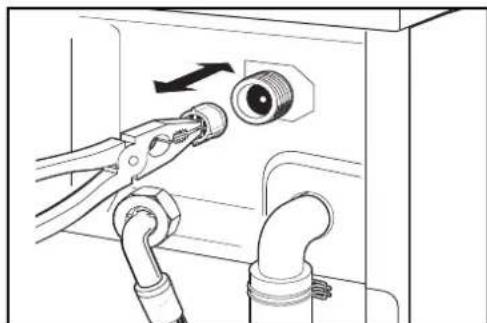
natural_image
Diagram of a pipe connection setup with a valve and tubing (no text or symbols)- Connect the hose again.
- Turn the water tap on and make sure that no water escapes.
- Turn the water tap off.
On machines with AquaStop
- Switch off the mains power supply
- Unscrew the hose only from the water tap.
- Pull out filter using a pair of flat-nose pliers. Clean and reinsert it.
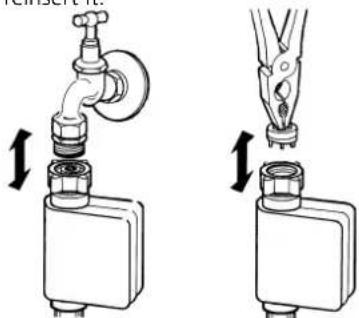
natural_image
Illustration of two mechanical components: a faucet and a valve, both with directional arrows indicating assembly or adjustment (no text or symbols present)- Connect the hose again.
- Turn the water tap on and make sure that no water escapes.
- Turn the water tap off.
Problems
!
Repairs, alterations or intervention on electronic equipment should only be carried out by qualified specialists. Inexpert repairs can cause considerable damage and risk to the user.
!
Only original spare parts should be used for repairs.
Please find below minor faults which you can rectify yourself.
Error messages on the display
If the following error messages are displayed, the programme can be restarted by pressing the start button once the error has been rectified.
«CHILD LOCK ACTIVE»
▶ Hold the «Quick wash» button down and press the start button.
«PLEASE CLOSE DOOR»
▶ Push the door closed until the lock catches properly. The selected programme starts automatically.
«CHECK WATER SUPPLY»
▶ Turn on the tap and start again.
▶ Filter in water supply is blocked: Clean the filter, see chapter «Cleaning and Maintenance/Cleaning the filter in the water inlet».
«CHECK DRAIN»
▶ Check whether the drainage hose is blocked.
▶ Foreign bodies block the drain pump: clean pump according to chapter «Cleaning and Maintenance/Emergency emptying».
The water drain provided by the customer is blocked: Carry out an emergency discharge according to chapter «Cleaning and Maintenance» and clean the drain siphon (built-in siphon).
▶ The position of the drain hose is too high.
The maximum pumping height is 1m above ground.
▶ Excessive imbalance. Laundry not spun.
▶ Press the Start button and then the «Quick wash» button to end the wash programme.
▶ Open the door and redistribute the load.
▶ Repeat the spin cycle with the separate spin programme.
General information:
- Avoid loading the drum with one single heavy item. Wash large and small laundry together.
«FOAM, PROG. EXTEND»
● The washing machine has detected foam and taken adequate measures. The spinning cycle of the laundry could be completed.
- In future, please reduce the detergent quantity.
«FOAM, PROG.CANCEL»
▶ Due to extremely intensive foaming, the washing machine could not complete the spinning cycle and the wash programme had to be aborted.
▶ Repeat the wash programme without adding any detergent.
▶ In future, please reduce the detergent quantity (if required use washing powder instead of liquid detergent).
«WATER LEVEL TOO HIGH»
- Too much foam in the washing machine, spinning has not been effected. There are two possibilities to solve the problem:
a) Press the «Start» button and then interrupt the programme by pressing the «Quick Wash» button several times until the display «Open door» appears. Mix approx. 30 ml conditioner and approx. 1 litre water. Start the previously selected wash programme (it may take several minutes until the machine is released for the selection of a new programme). After the water supply has been completed, switch forward immediately to «Conditioning» by pressing the «Quick wash» button and add the conditioner-water mixture into compartment I of the detergent drawer. The programme should now end as usually and the spinning process should take place. Afterwards repeat the desired programme, however without any detergent.
or
b) Press the «Start» button and then interrupt the programme by pressing the «Quick wash» button several times until the display «Open door» appears. Wait for approx. 1 hour and start the previously selected wash programme, move forward immediately to «spinning» using the «Quick Wash» button. Usually the laundry will be spun. If not, repeat the procedure including waiting for 1 hour. Afterwards repeat the desired programme, however without any detergent.
The maximum admissible water level is reached. Wait until the water has been pumped out completely and press the start button. The programme will continue.
«WATER IS BEING PUMPED OUT»
● Too much water is in the washing machine. Water is pumped off to the set level.
- If you see a lot of foam in the door glass, this means that too much foam is in the washing machine. To eliminate this problem proceed as for the error message
- In future, please reduce the detergent quantity.
If the appliance shows a function fault F - -:
▶ Stop the programme with the Quick Wash button and select a new programme.
In the event of repeated error messages:
▶ Disconnect the electricity for approx. 1 minute and then switch on again. (Withdraw the mains plug or switch off the main building switch.)
▶ The machine is ready to operate once again when the programme pilot lamps flash.
▶ Select a new programme.
If the error message still appears:
▶ Make a note of the error message
▶ Switch off the water tap and withdraw the mains plug or switch off the main building switch.
▶ Inform Customer Service.
Troubleshooting
Other minor faults, which you can rectify yourself.
Machine operation
Display is dark:
▶ The machine is in standby mode. No error. To operate the machine press any key.
The machine cannot be switched on, display remains dark even after pressing a key:
▶ Check whether the mains power is switched on at the wall and the plug is in.
▶ Check whether all the fuses are intact or the safety switch has tripped.
▶ Mains blockage, generally at noon. Operate the machine after the mains blockage has ended.
The machine does not start:
▶ The start button has not been pressed.
▶ Start time preselect has been set. Only starts at the preselected start time.
Loading door cannot be opened:
▶ Programme not yet finished.
▶ «Rinsing stop» selected. No error; see chapter «Washing/Ending the programme with rinsing stop».
▶ Mains blockage or appliance defect: see below.
Open the door in the event of a power failure or appliance defect as follows:
Check that the drum is standing still.
▶ Turn off the water tap
▶ Switch off the mains power supply.
▶ Carry out emergency emptying (see chapter «Cleaning and Maintenance»).
▶ Pull on the door opener (emergency opening).
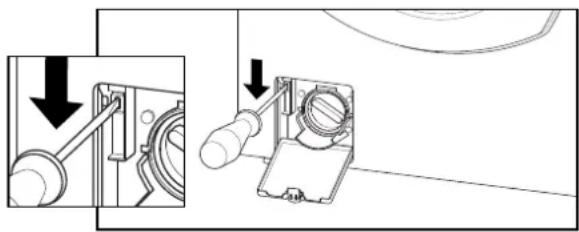
natural_image
Mechanical assembly diagram showing a valve mechanism and a close-up of the component (no text or symbols)- The door will open.
Drum lighting does not work:
The electric light bulb is defective. For safety reasons the lamp must only be replaced by the customer service or a qualified specialist.
Washing and washing result
Detergent residue in the detergent drawer:
▶ Damp or clumpy detergent: Dry the detergent drawer before adding detergent. Use dosing aids for compact or liquid detergents. Add the detergent to the dosing aid and put it in the drum with the laundry.
● The divider for liquid detergent has been pressed down: Move the divider to the position for powder detergent
- Viscous conditioner will remain in the compartment ✉ Remedy: Dilute the viscous conditioner with approx. 100ml water and fill it in the compartment .
Attention: Do not exceed the mark «max». If required, clean the conditioner compartment cover and the siphon (see chapter «Cleaning and Maintenance»).
Water not visible during wash:
- No error! The water is below the visible level in the machine.
Laundry does not get clean:
▶ Laundry was soiled more heavily than expected.
▶ Stain removal before washing.
▶ Select the maximum permitted temperature for the fabric.
▶ Select a stronger wash programme.
▶ Dose detergent sufficiently according to the manufacturer's data.
Detergent residue on the washing:
This is not due to poor rinse performance of your washing machine, but insoluble residues found in a few phosphate-free detergents, which tend to be deposited as pale specks on laundry.
▶ Remedy: dry and brush off or repeat the whole rinse process immediately. Use liquid detergent and wash programmes with a higher water level (Easy care).
Activate the extra rinse function.
Grey residue (soap scum) on the washing:
▶ The normal amount of detergent is not always sufficient for soiling from ointments, fats or oils, increase the amount for the next wash.
Remedy: select the maximum permitted temperature for the fabrics.
Grey stains on the washing:
▶ These stains may be caused by cosmetics or fabric softener and may have appeared on the laundry outside the machine before washing.
Remedy: some stains can be washed out after soaking in liquid detergent.
The laundry is hard and/or like a board:
▶ If the laundry is dried in the air after washing, use a conditioner for the next wash. Or dry the laundry in a tumble drier.
Drum and tank are dirty (e.g. scraps of paper, oil):
▶ Tissues or similar objects have not been removed from the laundry before washing. Clean drum and tank with the wash programme «Coloureds 60°C» (without laundry and detergent, but with increased water level during wash and rinse).
Laundry smells unpleasant (e.g. of sweat or rottenness):
▶ Laundry has been washed too long at only a low temperature and contains too many odour-producing germs. Wash laundry from time to time at 60^ C and/or the maximum admissible temperature, best with a general-purpose detergent (with bleaching agent). For washing at 20/30^ C use a special detergent which is active at low temperatures.
Odour accumulation in the machine:
▶ Odour-producing germs have accumulated in the washing machine or in the drain. Remedy: Clean the machine and drain from time to time by means of the wash programme «Coloureds 60°C» (without laundry and detergent, but with increased water level during wash and rinse).
Laundry mats (pilling):
▶ Delicates such as wool can mat due to the high mechanical load. Use a gentle special programme in the future suited for delicates.
Tear and hole formation, fibre wear of the laundry:
▶ Before washing remove foreign bodies from the laundry.
▶ Close zip fasteners and hooks before washing.
▶ Wash delicate laundry in a laundry net.
▶ Normal wear and/or mechanical damage of the textiles, which had already existed before washing.
Foam and leakage
Foam is visible after the last rinse:
- Some detergents tend to produce more foam, which does not affect the rinse results.
Too much foam is visible in the door glass during washing, foam fills the entire drum:
▶ Detergent dose too high. Too much foam deteriorates the washing effect. Remedy: Mix approx. 20ml conditioner with 12 liter water and add it into compartment II of the detergent drawer. If required, repeat the process. Reduce detergent dose in the future.
Foam leaks from the detergent drawer during washing or rinsing:
▶ Detergent dose too high. Remedy: Mix approx. 20ml conditioner with 12 liter water and add it into compartment II of the detergent drawer. If required, repeat the process. Reduce detergent dose in the future.
Foam leaks from the detergent drawer during spinning:
▶ Foam leaks from the detergent drawer during spinning. Interrupt programme by means of the «Quick Wash» button. To eliminate this problem proceed as for the error message «Water level too high».
▶ In future, please reduce the detergent quantity (if required use washing powder instead of liquid detergent).
Machine leaks, puddles and/or water stains form on the floor:
▶ Detergent dose too high. Reduce detergent dose in the future.
▶ Check whether the supply and drain hose connections are watertight and have been effected properly.
Spinning and noise
Pump noise:
- No malfunction! Intake noise and «Emptying» noise (i.e. when the tank is sucked empty) by the detergent solution pump is normal.
Repeated spinning:
● The imbalance control system detected an imbalance and is rectifying the imbalance by spinning repeatedly.
Poor spin result:
- The imbalance control system has detected an imbalance that it was unable to rectify. With underloads or critical laundry pieces such as bath mats, the laundry is insufficiently distributed. The spin speed is reduced depending on the load and imbalance, safeguarding the appliance against being overstressed.
Loud noise and «machine movements» during spinning:
▶ The transport securing devices have not been removed. See the information in the Setting-up Instructions!
▶ Machine feet were not locked when setting-up the machine. Relevel the machine with a spirit level and securely lock the feet as described in the Installation Instructions.
Programme duration extended:
● The machine has recognised foam and implemented remedy. No error.
● The machine has recognised imbalance and implemented remedy. No error
- The machine has recognised excessive soiling and/or too turbid rinse water and has extended the programme. No error.
Customer Services
Before you call customer services, check whether you can rectify the problem yourself (see chapter «Troubleshooting»).
If advice is required, costs may be incurred if a service technician is required, even during the guarantee period. The guarantee does not cover faults caused by improper use and by blocked filtres or foreign bodies.
If you cannot rectify a problem yourself, unplug the machine or switch it off at the wall, turn off the tap and call customer services.
Dial the central customer services number (see back cover). You will be automatically connected to the customer services branch for your region.
Give customer services the F—— error message and the product and serial numbers. You will find this information on the type label inside the opened door.
Note the numbers for your machine here:
Product No.:
Serial No.:
Warranty subscription
After the normal warranty period of 2 years has expired, it is possible to extend the warranty by means of a warranty subscription as desired. We are happy to send you the requested documents. Please observe the enclosed guarantee and customer services booklet.
Notizen / Notes Notizen / Notes / Note

