BH-318S - Unspecified Bliss Outdoors - Free user manual and instructions
Find the device manual for free BH-318S Bliss Outdoors in PDF.


User questions about BH-318S Bliss Outdoors
0 question about this device. Answer the ones you know or ask your own.
Ask a new question about this device
Download the instructions for your Unspecified in PDF format for free! Find your manual BH-318S - Bliss Outdoors and take your electronic device back in hand. On this page are published all the documents necessary for the use of your device. BH-318S by Bliss Outdoors.
USER MANUAL BH-318S Bliss Outdoors
READ THIS PAGE FIRST BEFORE ASSEMBLING & USING THIS PRODUCT
IMPORTANT: Please save this instruction and information sheet in the event that the manufacturer has to be contacted.
SAFETY & MAINTENANCE INFORMATION
CAUTION: If you are not familiar with construction, please use a qualified general contractor to install. Improper installation may cause injury. Swinging with the ROPE CLIMBER SWING involves an inherent risk that can cause serious injury or even death. ROPE CLIMBER SWING is more dangerous than a regular swing. Head injuries and strangulation is possible and can cause brain injury. Use with caution. Purchaser and users assume all risk, responsibility, and liability for use of the ROPE CLIMBER SWING, including any resulting loss or damage to persons or property. Do not install home playground equipment over concrete, asphalt, packed earth, grass, carpet, or any other hard surface. A fall onto a hard surface can result in serious injury or death to the equipment user. To prevent serious injury, cautionary statements shall be included which warn that children must not use the equipment until properly installed. Bliss Hammocks, Inc. assumes no liability arising from the use and application of this product and specifically disclaims any and all consequential and incidental damages.
MAINTENANCE:
At the beginning of each play season:
- Tighten all hardware.
- Lubricate all metallic moving parts per manufacturer's instructions.
- Check all protective coverings on bolts, pipes, edges, and corners. Replace if they are loose, cracked, or missing.
- Check all moving parts including swing seats, ropes, cables, and chains for wear, rust, or other deterioration. Replace as needed.
- Check all moving parts including swing seats, ropes, cables, and chains for wear, rust, or other deterioration. Replace as needed.
- Check metal parts for rust. If found, sand and repaint using a non-lead-based paint meeting the requirements of 16 CFR 1303.
- Check all wood members for deterioration and splinters. Sand down splinters and replace deteriorating wood members.
- Reinstall any plastic parts, such as swing seats or any other items that were removed for the cold season.
- Rake and check depth of loose fill protective surfacing materials to prevent compaction and to maintain appropriate depth. Replace as necessary.
Twice a month during play season:
- Tighten all hardware.
- Check all protective coverings on bolts, pipes, edges, and corners. Replace if they are loose, cracked, or missing.
- Rake and check depth of loose fill protective surfacing materials to prevent compaction and to maintain appropriate depth. Replace as necessary.
Once a month during play season:
- Lubricate all metallic moving parts per manufacturer's instructions.
- Check all moving parts including swing seats, ropes, cables, and chains for wear, rust, or other deterioration. Replace as needed.
At the end of each play season or when the temperature 32^ F
- Remove plastic swing seats and take indoors or do not use.
- Rake and check depth of loose fill protective surfacing materials to prevent compaction and to maintain appropriate depth. Replace as necessary.
Owners shall be responsible for maintaining the legibility of the warning labels.
OPERATING INFORMATION: Observing the following statements and warnings reduces the likelihood of serious or fatal injury.
Instruct children not to walk close to, in front of, behind, or between moving items. Instruct children not to twist swing chains or ropes or loop them over the top support structure since this may reduce the strength of the chain or rope. Instruct children not to swing an empty swing. Instruct children not to use the equipment in a manner other than intended. Make sure children do not get off equipment while it is in motion. Instruct children not to attach the item to the playground equipment that is not specifically designed for use with the equipment, such as, but not limited to, jump ropes, clothesline, pet leashes, cables and chain as they may cause a strangulation hazard. Make sure to dress children with well-fitting and full foot enclosing footwear. Examples of inappropriate footwear are clogs, flip flops, and sandals. Never add extra length to chain or rope. The chains or ropes provided are the maximum lengths designed for the swinging elements(s). Do not use around vehicles or power lines. Recommending on-site adult supervision for children of all ages, Warning the owner to teach children to sit in the center of the swings with their full weight on the seats, Warning the owner to instruct children not to climb when the equipment is wet, Warning the owner to verify that suspended climbing ropes, chain, or cable cannot be looped back on itself. Warning the owner to instruct children to remove their bike or other sports helmet before playing on the playground equipment.
DISPOSAL INSTRUCTIONS: Disassemble and dispose of the playground equipment in such a way that no unreasonable hazards will exist at the time the equipment is discarded. Follow all local disposal requirements.
CONSUMER INFORMATION SHEET FOR PLAYGROUND SURFACING MATERIALS
The U.S Consumer Product Safety Commission (CPSC) estimates that about 100,000 playground equipment related injuries resulting from falls to the ground surface are treated annually in the U.S hospital emergency rooms. Injuries involving this hazard pattern tend to be among the most serious of all playground injuries, and have the potential to be fatal, particularly when the injury is to the head. The surface under and around the playground equipment can be a major factor in determining the injury causing potential of a fall. It is self evident that a fall onto a shock-absorbing surface is less than likely to cause a serious injury than a fall onto a hard surface. Playground equipment should never be placed on hard surfaces such as concrete of asphalt and while grass may appear to be acceptable, it may juicy turn to hard packed earth in areas of high traffic. Shredded bark, wood chips, find sand or fine gravel are considered to be acceptable shock-absorbing surfaces when installed and maintained at a sufficient depth under and around playground equipment.
Table 1 lists the maximum height from which a child would not be expected to sustain a life-threatening head injury in a fall onto different loose-fill surfacing materials if they are installed and maintained at depths of 6, 9, and 12 inches. However, it should be recognized that all injuries due to falls cannot be prevented no matter what surfacing material is used.
It is recommended that a shock-absorbing material should extend a minimum of 6 ft. In all directions from the perimeter of stationary equipment such as climbers and slides. However, because children may deliberately jump from a moving swing, the shock absorbing material should extend to the front and rear of a swing a minimum distance of 2 times height of pivot point measured from a point directly beneath the pivot on the supporting structure.
This information is intended to assist in comparing the relative shock-absorbing properties of various materials. No particular material is recommended over another. However, each material is only effective when maintained. Materials should be checked periodically and replenished to maintain correct depth as determined necessary for your equipment. The choice of a material depends on the type and height of the playground equipment, the availability of the material in. Your area, and its cost.
\*\*The maximum fall height for this product is 60 in (152 cm). We recommend using 6 in (15 cm) of Double Shredded Bark Mulch. \*\*
TABLE 1 — Depth of Surfacing Material Required Based on Fall Heights
| Material / Fall Height | 5 ft(150 cm) | 6 ft(150 cm) | 7 ft(213 cm) | 9 ft(274 cm) | 10 ft(305 cm) | 11 ft(250 cm) | 12 ft(340 cm) |
| Double Shredded Bark Mulch | -- | 6 in(15 cm) | -- | -- | 9 in(23 cm) | 12 in(30 cm) | -- |
| Wood Chips | -- | 6 in(15 cm) | 9 in(23 cm) | -- | -- | -- | 12 in(30 cm) |
| Fine Sand | 6 in(15 cm) | -- | 9 in(23 cm) | 12 in(30 cm) | -- | -- | -- |
| Fine Gravel | -- | 6 in(15 cm) | 9 in(23 cm) | -- | 12 in | -- | -- |
| Shredded Tires*** | -- | -- | -- | -- | 6 in(15 cm) | -- | -- |
"This information has been extracted from the CPSC publications 'Playground Surfacing—Technical Information Guide' and "Handbook for Public Playground Safety." Copies of these reports can be obtained by sending a postcard to the Office of Public Affairs, U.S. Consumer Product Safety Commission, Washington, D.C., 2020? or call the toll-free hotline: 1-800-638-2172.
***This data is from tests conducted by independent testing laboratories on a 6-inch depth of uncompressed shredded tire samples produced by four manufacturers. It is recommended that persons seeking to install shredded tires as a protective surface request test data from the supplier showing the critical height of the material when it was tested in accordance with ASTM F1292.
ADDITIONAL SAFETY TIPS:
- On-site adult supervision is required.
- Teach children not to push empty seats. The seat may hit them and cause injury.
- Teach children to sit in the center of swings with their full weight on the seats.
- Teach children to hold on tight and secure feet on footer before climbing rope.
- Teach children not to climb when the equipment is wet.
- One of the most important things you can do to reduce the likelihood of serious head injuries is to install shock-absorbing protective surfacing under and around your play equipment. The protective surfacing should be applied to a depth that is suitable for the equipment height in accordance with CPSC. There are different types of surfacing to choose from; whichever product you select, please refer to the "Consumer Information Sheet for Playground Surfacing Materials" section and "TABLE — Depth of Surfacing Material Required Based On Fall Heights" If any of the following conditions are noted they should be removed, corrected or repaired immediately to prevent injuries:
- Hardware that is loose, or worn, or those that have protrusions or projections.
- Scattered debris, litter, rocks or tree roots.
- Missing or damaged equipment components, such as swing seats.
- Remove plastic swing seats and take indoors (or do not use) when the temperature drops below 32°F.
- Oil all metallic moving parts monthly during the usage period.
- Check swing seats, ropes, cables, and chains monthly during usage season for evidence of deterioration. Replacement should be made of any swing seat or climbing footers that have developed cracks in the plastic. Ropes, cables, and chains should be removed and replaced if excessive wear is found.
After reading all the safety information on this page and the first page, you may now start to assemble your wooden skateboard swing using the following directions.
PIECES: Make sure all parts are present & place them side by side for easy identification

text_image
Hanging Rope x1 x1 Disc Swing Carabiner x1INSTALLATION:
- Do not install Disc Swing over concrete, asphalt, packed earth, or any other hard surface. See the "Consumer Information Sheet for Playground Surfacing Materials" section for more information on proper protective surfacing material.
- Confirm that the supporting structure is secure, it will support at least 250 pounds, is over level ground, and is no less than 6 feet on all sides from vertical elements.
- Attach the carabiner hook to the hanging rope. Wrap this rope around the support structure and thread it though itself. Pull taut.
- Attach the "O" ring of the Disc Swing to the carabiner.


natural_image
Simple line drawing of a hanging hook tied with strings, enclosed in a circle (no text or symbols)
natural_image
Simple line drawing of a rope tied with a loop, enclosed in a circular frame (no text or symbols)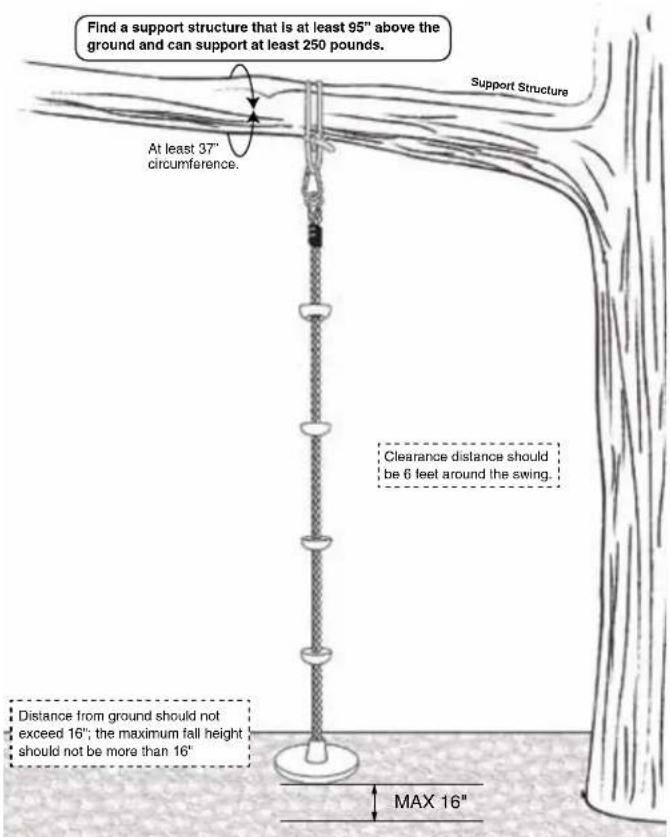
text_image
Find a support structure that is at least 95" above the ground and can support at least 250 pounds. Support Structure At least 37" circumference. Clearance distance should be 6 feet around the swing. Distance from ground should not exceed 16"; the maximum fall height should not be more than 16" MAX 16"X2. SECTION 4 OF THE CONSUMER PRODUCT SAFETY COMMISSION'S OUTDOOR HOME PLAYGROUND SAFETY HANDBOOK ^7
X2.1 Select Protective Surfacing—One of the most important things you can do to reduce the likelihood of serious head injuries is to install shock-absorbing protective surfacing under and around your play equipment. The protective surfacing should be applied to a depth that is suitable for the equipment height in accordance with ASTM Specification F1292. There are different types of surfacing to choose from; whichever product you select, follow these guidelines:
X2.1.1 Loose-Fill Materials:
X2.1.1.1 Maintain a minimum depth of 9 in. (229 mm) of loose-fill materials such as wood mulch/chips, engineered wood fiber (EWF), or shredded/recycled rubber mulch for equipment up to 96 in. (2438 mm) high; and 9 in. (229 mm) of sand or pea gravel for equipment up to 60 in. (1524 mm) high. NOTE: An initial fill level of 12 in. (305 mm) will compress to about a 9 in. (229 mm) depth of surfacing over time. The surfacing will also compact, displace, and settle, and should be periodically refilled to maintain at least a 9 in. (229 mm) depth.
X2.1.2 Use a minimum of 6 in. (152 mm) of protective surfacing for play equipment less than 48 in. (1219 mm) in height. If maintained properly, this should be adequate. (At depths less than 6 in. (152 mm), the protective material is too easily displaced or compacted.)
NOTE: Do not install home playground equipment over concrete, asphalt, or any other hard surface. A fall onto a hard surface can result in serious injury to the equipment user. Grass and dirt are not considered protective surfacing because wear and environmental factors can reduce their shock absorbing effectiveness. Carpeting and thin mats are generally not adequate protective surfacing. Ground level equipment – such as a sandbox, activity wall, playhouse or other equipment that has no elevated play surface – does not need any protective surfacing.
X2.1.4 Poured-In-Place Surfaces or Pre-Manufactured Rubber Tiles—You may be interested in using surfacing other than loose-fill materials – like rubber tiles or poured-in-place surfaces.
X2.1.4.1 Installations of these surfaces generally require a professional and are not "do-it-yourself" projects.
X2.1.4.2 Review surface specifications before purchasing this type of surfacing. Ask the installer/manufacturer for a report showing that the product has been tested to the following safety standard: ASTM F1292 Standard Specification for Impact Attenuation of Surfacing Materials within the Use Zone of Playground Equipment. This report should show the specific height for which the surface is intended to protect against serious head injury. This height should be equal to or greater than the fall height – vertical distance between a designated play surface (elevated surface for standing, sitting, or climbing) and the protective surfacing below – of your play equipment.
X2.1.4.3 Check the protective surfacing frequently for wear.
X2.1.5 Placement—Proper placement and maintenance of protective surfacing is essential. Be sure to:
X2.1.5.1 Extend surfacing at least 72 in. (1829 mm) from the equipment in all directions.
X2.1.5.2 For to-fro swings, extend protective surfacing in front of and behind the swing to a distance equal to twice the height of the top bar from which the swing is suspended.
X2.1.5.3 For tire swings, extend surfacing in a circle whose radius is equal to the height of the suspending chain or rope, plus 6 ft in all directions.

text_image
Denotes Use Zone with Protective Surfacing 72 in. (1829 mm) 72 in. (1829 mm) 72 in. (1829 mm) Use Zone for Single-Axis Swings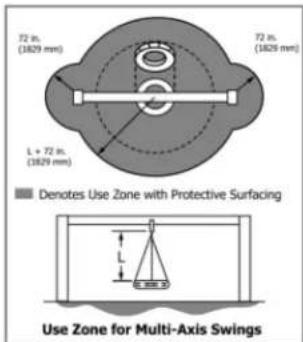
text_image
72 m. (1829 mm) 72 m. (1829 mm) L + 72 m. (1829 mm) Denotes Use Zone with Protective Surfacing Use Zone for Multi-Axis SwingsFIG. X2.1 Use Zone for Single- and Multi-Axis Swings