FourTrax Rancher TRX420FA5 (2019) - ATV Honda - Free user manual and instructions
Find the device manual for free FourTrax Rancher TRX420FA5 (2019) Honda in PDF.


User questions about FourTrax Rancher TRX420FA5 (2019) Honda
0 question about this device. Answer the ones you know or ask your own.
Ask a new question about this device
Download the instructions for your ATV in PDF format for free! Find your manual FourTrax Rancher TRX420FA5 (2019) - Honda and take your electronic device back in hand. On this page are published all the documents necessary for the use of your device. FourTrax Rancher TRX420FA5 (2019) by Honda.
USER MANUAL FourTrax Rancher TRX420FA5 (2019) Honda
OWNER'S MANUAL 20192019
TRX420FA5 4x4 ATTRX420FA5 4x4 AT TRX420FA6 4x4 AT with Power Steering TR FOURTRAX RANCHERFOURTRAX RANCH

natural_image
Abstract black and white geometric pattern with no text or symbolsRead this manual carefully, it contains important safety information.
Minimum recommended operator age: 16
Models sold in and used in California: The removal or modification of evaporative emission-related parts on this OHRV is illegal. Violators may be subject to civil and/or criminal penalties as provided under California and federal law.

text_image
QR code image containing encoded data, no visible human-readable textPart Number
This manual should be considered a permanent part of the ATV and should remain with the ATV when it is resold.
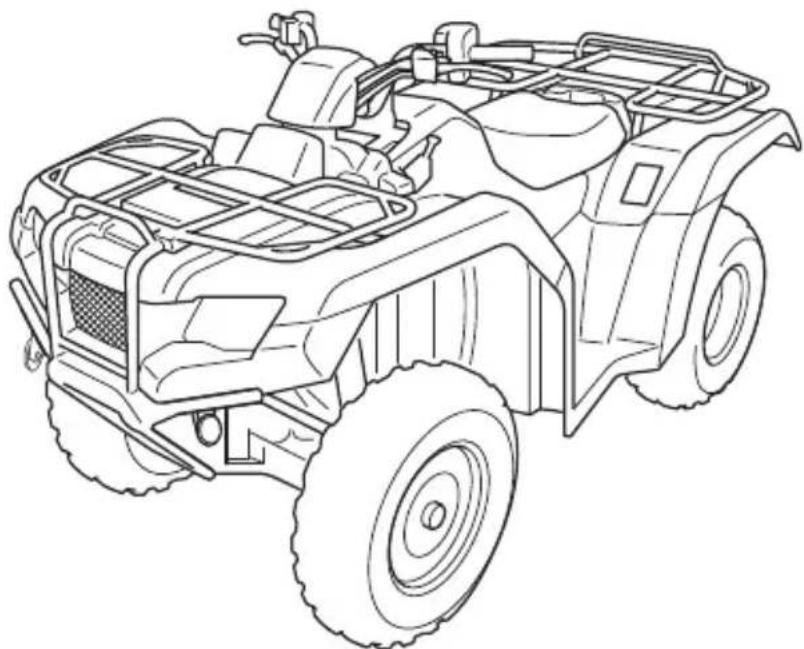
This Owner's Manual covers the TRX420FA5 and TRX420FA6 models. You may find descriptions of equipment and features that are not on your particular model. All illustrations are based on the TRX420FA6 model.
This publication includes the latest production information available before printing. Honda Motor Co., Ltd. reserves the right to make changes at any time without notice and without incurring any obligation.
No part of this publication may be reproduced without written permission.
This vehicle pictured in this owner's manual may not match your actual vehicle.
2019
Honda
TRX420FA5 4x4
TRX420FA6 4x4 with Power Steering
FOURTRAX RANCHER AT
OWNER'S MANUAL
natural_image
Line drawing of a multi-axle off-road vehicle with visible tracks, wheels, and structural brackets (no text or symbols)FOR OFF-ROAD USE ONLY
This vehicle is designed and manufactured for off-road use only.
USA only:
It conforms to US EPA Noise Emission regulations, but does not conform to Federal Motor Vehicle Safety Standards or US EPA On Highway Exhaust Emission regulations, and operation on public streets, roads, or highways is illegal. The vehicle is equipped with a USDA qualified spark arrester. Obey local laws and regulations.
It conforms to US EPA and Environment Climate Change Canada emission regulations for ATVs.
Congratulations on choosing your Honda ATV.
When you own a Honda, you're part of a worldwide family of satisfied customers — people who appreciate Honda's reputation for building quality into every product.
Your Honda was designed as a recreational ATV for off-road use by one rider only.
Before riding, take time to get acquainted with your ATV and how it works. To protect your investment, we urge you to take responsibility for keeping your ATV well maintained. Scheduled service is a must, of course. But it's just as important to observe the break-in guidelines, and perform all pre-ride and other periodic checks detailed in this manual.
We also recommend that you read this owner's manual before you ride. It's full of facts, instructions, safety information, and helpful tips. To make it easy to use, the manual contains a detailed list of topics at the beginning of each section and an index at the back of the book.
As you read this manual, you will find information that is preceded by a NOTICE1. This information is intended to help you avoid damage to your Honda, other property, or the environment.
Read the Warranties Booklet (page 247) thoroughly so you understand the coverages that protect your new Honda and are aware of your rights and responsibilities.
Whenever you ride, tread lightly. By staying on established trails and riding only in approved areas, you help protect the environment and keep off-road riding areas open for the future.
Introduction
If you have any questions, or if you ever need special service or repairs, remember that your dealer knows your ATV best and is dedicated to your complete satisfaction.
Please report any change of address or ownership to your dealer so we will be able to contact you concerning important product information.
You may also want to visit our website at
USA: www.powersports.honda.com.
Canada: www.honda.ca.
Happy riding!
A Few Words About Safety
Your safety, and the safety of others, is very important. And operating this ATV safely is an important responsibility.
To help you make informed decisions about safety, we have provided operating procedures and other information on labels and in this manual. This information alerts you to potential hazards that could hurt you or others.
Of course, it is not practical or possible to warn you about all hazards associated with operating or maintaining an ATV. You must use your own good judgment.
You will find important safety information in a variety of forms, including:
Safety Labels — on the ATV.
Safety Messages — preceded by a safety alert symbol ⚠ and one of three signal words: DANGER, WARNING, or CAUTION.
These signal words mean:
DANGER
You WILL be KILLED or SERIOUSLY HURT if you don't follow instructions.
WARNING
You CAN be KILLED or SERIOUSLY HURT if you don't follow instructions.
CAUTION
You CAN be HURT if you don't follow instructions.
Safety Headings — such as Important Safety Reminders or Important Safety Precautions.
Safety Section — such as ATV Safety.
Instructions — how to use this ATV correctly and safely.
This entire manual is filled with important safety information — please read it carefully.
Contents
These pages give an overview of the contents of your owner's manual.
The first page of each section lists the topics covered in that section.
ATV Safety 1
Important safety information you should know, plus a look at the safety related labels on your ATV.
Instruments & Controls 9
The location and function of indicators and controls on your ATV and operating instructions for various controls and features.
Before Riding ....49
The importance of wearing a helmet and other protective gear, how to make sure you and your ATV are ready to ride, and important information about loading.
Basic Operation & Riding ....65
How to start and stop the engine, shift gears, and brake. Also, riding precautions.
Contents
Servicing Your Honda 103
Why your ATV needs regular maintenance, what you need to know before servicing your Honda, an owner maintenance schedule, and instructions for specific maintenance and adjustment items.
Tips 193
How to store and transport your ATV and how to be an environmentally responsible rider.
Taking Care of the Unexpected....203
What to do if you have a flat tire, your engine won't start, etc.
Technical Information ......229
ID numbers, technical specifications, and other technical facts.
Consumer Information 245
Information on warranties, emission controls, how to get Honda service manuals.
Index....252
Quick Reference
Handy facts about fuel, engine oil, tire sizes, and air pressures.
This section presents some of the most important information and recommendations to help you ride your ATV safely. Please take a few moments to read these pages. This section also includes information about the location of safety labels on your ATV.
Important Safety Information.... 2
Safety Labels 5
Important Safety Information
Your ATV can provide many years of service and pleasure if you take responsibility for your own safety and understand the challenges you can meet while riding.
There is much that you can do to protect yourself when you ride. You'll find many helpful recommendations throughout this manual. The following are a few that we consider to be most important.
Follow the Age Recommendation
The minimum recommended age for this ATV model is 16. Children under age 16 should never operate this vehicle. Refer to the age warnings provided in this manual and on the ATV.
Always Wear a Helmet
It's a proven fact: helmets significantly reduce the number and severity of head injuries. So always wear an approved motorcycle helmet. We also recommend that you wear eye protection, sturdy boots, gloves, and other protective gear (page 50).
Never Carry a Passenger
Your ATV is designed for one person only. There are no handholds, footrests, or seat for a second person, so never carry a passenger. A passenger could interfere with your ability to move around to maintain your balance and control of the ATV.
Important Safety Information
Ride Off-road Only
Your ATV is designed and manufactured for off-road use only. The tires are not made for pavement, and the ATV does not have turn signals and other features required for use on public roads. If you need to cross a paved or public road, get off and walk your ATV across.
Take Time to Learn & Practice
Even if you have ridden other ATVs, take time to become familiar with how this ATV works and handles. Practice in a safe area until you build your skills and get accustomed to the ATV's size and weight.
Because many crashes involve inexperienced or untrained riders, we urge all riders to take a ATV operator course approved by the ATV Safety Institute (ASI). See page 52.
Contact an authorized ATV dealer or call 1-800-887-2887 (USA only) to find out about the training courses nearest you.
Be Alert for Off-road Hazards
The terrain can present a variety of challenges when you ride off-road. Continually “read” the terrain for unexpected turns, drop-offs, rocks, ruts, and other hazards. Always keep your speed low enough to allow time to see and react to hazards.
Important Safety Information
Ride within Your Limits
Pushing limits is another major cause of ATV crashes. Never ride beyond your personal abilities or faster than conditions warrant. Remember that alcohol, drugs, fatigue, and inattention can significantly reduce your ability to make good judgments and ride safely.
Don't Drink and Ride
Alcohol and riding don't mix. Even one drink can reduce your ability to respond to changing conditions, and your reaction time gets worse with every additional drink. So don't drink and ride, and don't let your friends drink and ride either.
Keep Your Honda in Safe Condition
It's important to keep your ATV properly maintained and in safe riding condition. Having a breakdown can be difficult, especially if you are stranded off-road far from your base. To help avoid problems, inspect your ATV before every ride and perform all recommended maintenance.
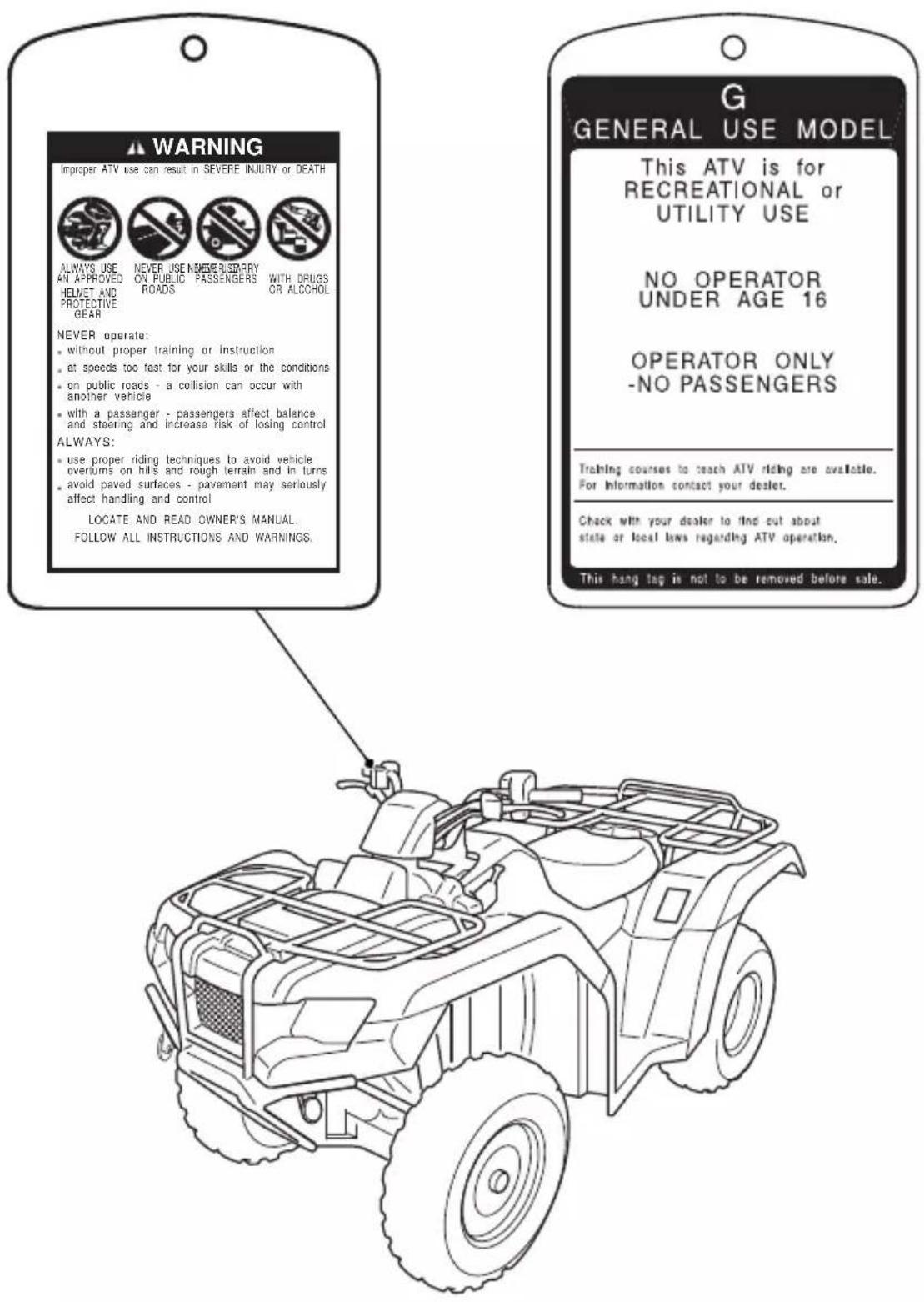
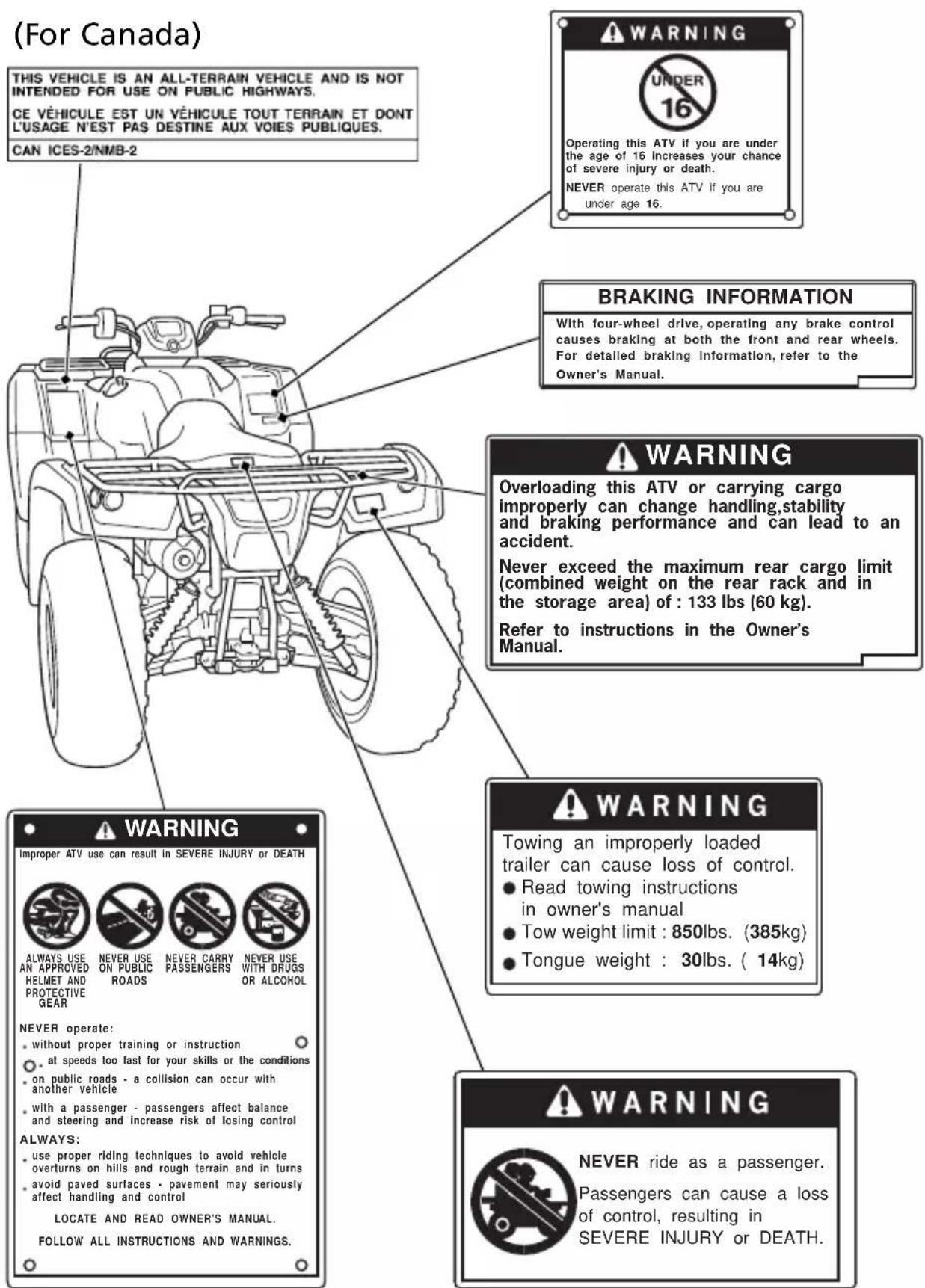
Your ATV comes with a hang tag and several labels containing important safety information. Anyone who rides the vehicle should read and understand this information before riding.
The labels should be considered permanent parts of the vehicle. If a label comes off or becomes hard to read, contact your dealer for replacements.
text_image
WARNING Improper ATV use can result in SEVERE INJURY or DEATH ALWAYS USE NEVER USE NEVER LIMBRY WITH DRUGS AN APPROVED ON PUBLIC PASSENGERS OR ALCOHOL HELMET AND PROTECTIVE GEAR NEVER operate: • without proper training or instruction • at speeds too fast for your skills or the conditions • on public roads - a collision can occur with another vehicle • with a passenger - passengers affect balance and steering and increase risk of losing control ALWAYS: • use proper riding techniques to avoid vehicle overlums on hills and rough terrain and in turns • avoid paved surfaces - pavement may seriously affect handling and control LOCATE AND READ OWNER'S MANUAL. FOLLOW ALL INSTRUCTIONS AND WARNINGS. GENERAL USE MODEL This ATV is for RECREATIONAL or UTILITY USE NO OPERATOR UNDER AGE 16 OPERATOR ONLY -NO PASSENGERS Training courses to teach ATV riding are available. For Information contact your dealer. Check with your dealer to find out about state or local laws regarding ATV operation. This hang tag is not to be removed before sale.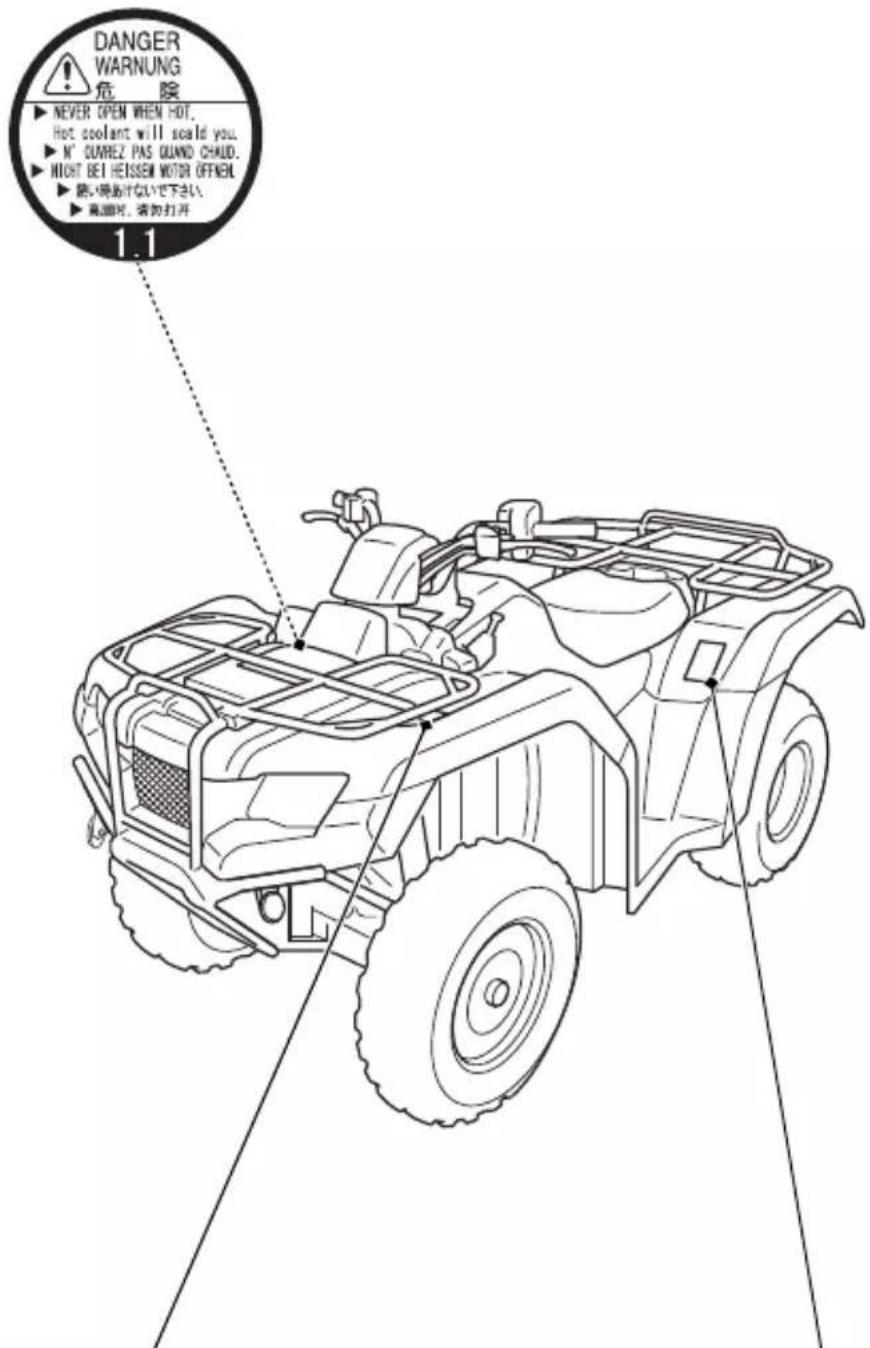
text_image
DANGER WARNING 危 险 ▶ NEVER OPEN WHEN HOT. Hot coolant will scald you. ▶ N' OUVREZ PAS GUND CHAUD. ▶ NICHT BEI HEISSEN MOTOR OFFEN. ▶ 距い場あけないで下さい. ▶ 禹頭対,请的打开 1.1
WARNING
Overloading this ATV or carrying cargo improperly can change handling, stability and braking performance and can lead to an accident.
Never exceed the maximum front cargo limit of : 66 lbs (30 kg).
Refer to instructions in the Owner's Manual.

WARNING
Improper tire pressure or overloading can cause loss of control.
Loss of control can result in severe injury or death.
• Cold tire pressure :
Front : 4.4psi (30kPa)
Rear : 4.4psi (30kPa)
• Maximum weight capacity : 485lbs. (220kg)
Safety Labels
text_image
(For Canada) THIS VEHICLE IS AN ALL-TERRAIN VEHICLE AND IS NOT INTENDED FOR USE ON PUBLIC HIGHWAYS. CE VÉHICULE EST UN VÉHICULE TOUT TERRAIN ET DONT L'USAGE N'EST PAS DESTINE AUX VOIES PUBLIQUES. CAN ICES-2/NMB-2 WARNING UNDER 16 Operating this ATV if you are under the age of 16 Increases your chance of severe injury or death. NEVER operate this ATV if you are under age 16. BRAKING INFORMATION With four-wheel drive, operating any brake control causes braking at both the front and rear wheels. For detailed braking information, refer to the Owner's Manual. WARNING Overloading this ATV or carrying cargo improperly can change handling,stability and braking performance and can lead to an accident. Never exceed the maximum rear cargo limit (combined weight on the rear rack and in the storage area) of : 133 lbs (60 kg). Refer to instructions in the Owner's Manual. WARNING Towing an improperly loaded trailer can cause loss of control. ● Read towing instructions in owner's manual ● Tow weight limit : 850lbs. (385kg) ● Tongue weight : 30lbs. ( 14kg) WARNING NEVER ride as a passenger. Passengers can cause a loss of control, resulting in SEVERE INJURY or DEATH.Instruments & Controls
This section shows the location of all indicators and controls you would normally use before or while riding your ATV.
The items listed on this page are described in this section.
Instructions for other components are presented in other sections of this manual where they will be most useful.
Operation Component Locations 11
Indicators & Displays.... 14
Multi-function Display.... 20
Speed and Mileage Unit Changing.... 23
4WD Indicator 23
Gear Position Indicator.... 24
Fuel Gauge 25
Digital Clock 27
Odometer....28
Tripmeter....28
Coolant Temperature Gauge 29
Hour meter.... 31
Maintenance Tripmeter & Maintenance Hour meter.... 32
(cont'd)
Instruments & Controls
Controls & Features.... 34
Ignition Switch.... 34
2WD/4WD Select Lever.... 35
Start Button.... 36
Engine Stop Switch.... 36
Headlight Switch 37
Headlight Dimmer Switch 37
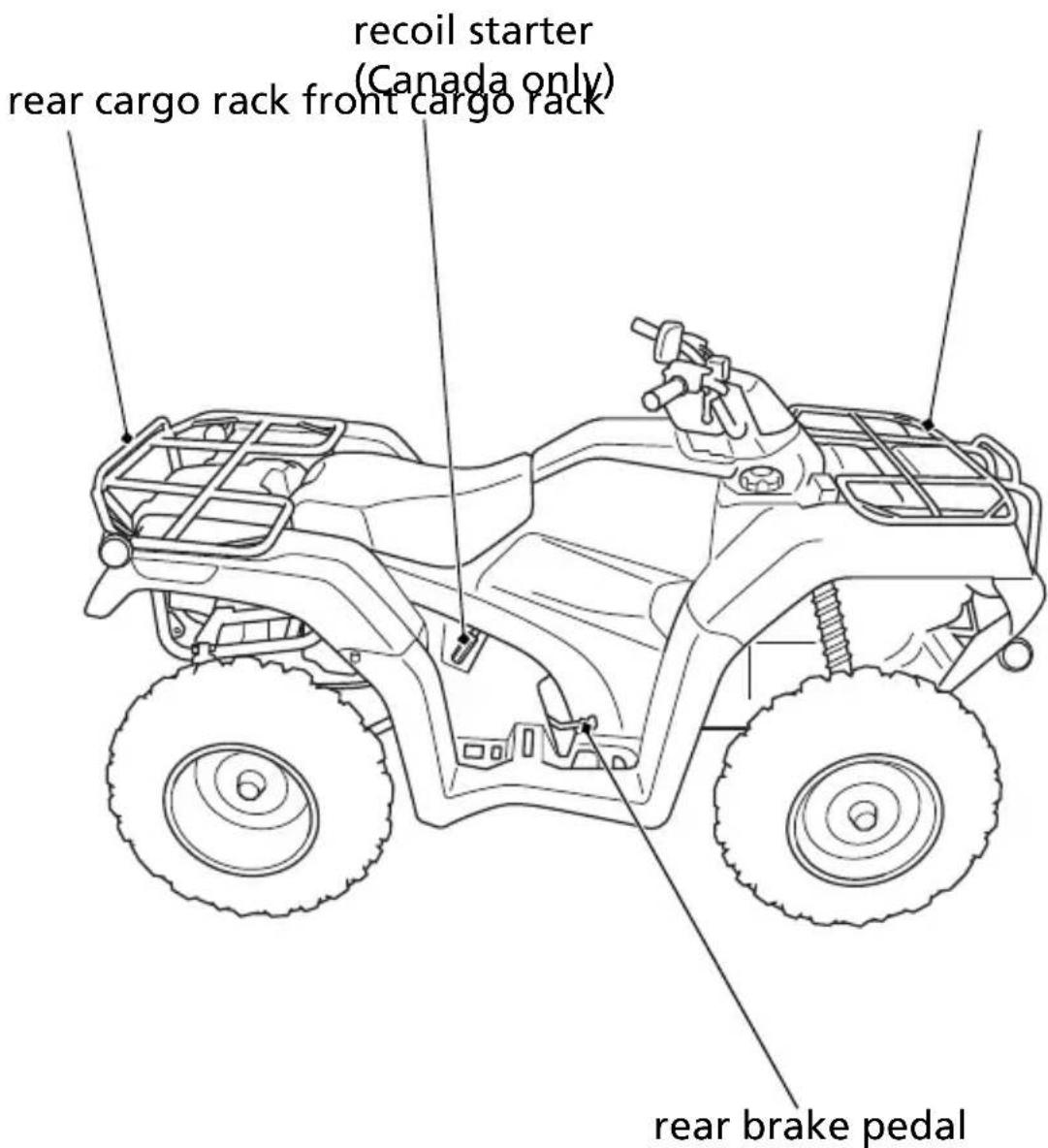
Recoil Starter (Canada only).... 38
Throttle Lever 39
Drive Mode Select Switch 40
Gearshift Switch 41
Front Brake Lever 42
Rear Brake Lever/Parking Brake Lever 42
Rear Brake Pedal.... 42
Parking Brake/Reverse Lever (P/R Lever) 43
Flag Pole Bracket 45
Trailer Hitch 46
Storage Compartment 47
EPS (Electric Power Steering) (TRX420FA6 only) 48
Operation Component Locations

text_image
rear brake lever/ parking brake lever headlight dimmer switch P/R lever headlight switch front brake lever gearshift switches start button engine stop switch 2WD/4WD select lever throttle lever drive mode select switch ignition switchOperation Component Locations
text_image
recoil starter (Canada only) rear cargo rack front cargo rack rear brake pedalOperation Component Locations

text_image
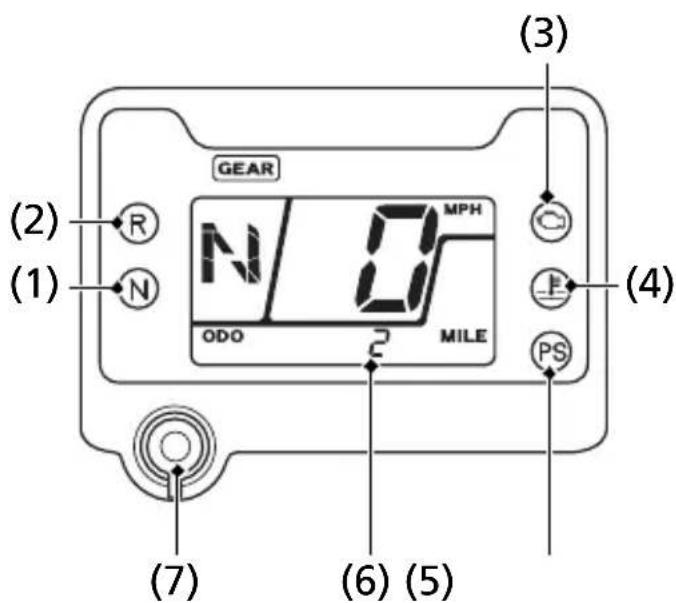
flag pole bracket storage compartment trailer hitchThe indicators and displays on your ATV keep you informed, alert you to possible problems, and make your riding safer and more enjoyable. Refer to the indicators frequently. Their functions are described on the following pages.
text_image
(2) (1) GEAR N MPH ODO MILE (3) (4) PS (6) (5) (7)(1) neutral indicator
(2) reverse indicator
(3) PGM-FI indicator
(4) high coolant temperature indicator
(5) PS (Electric Power Steering) indicator (TRX420FA6 only)
(6) multi-function display
(7) mode button
Lamp Check
Initial lamp check:
The indicators come on for a few seconds and then go off when you turn the ignition switch to ON (1).
The high coolant temperature indicator and PGM-FI indicator will temporarily come back on for a few seconds and then go off after initial lamp check.
TRX420FA6 only:
The PS (Electric Power Steering) indicator comes back on and remains on until the engine is started after initial lamp check.
These indicators are identified in the table on page 17 with the words: Lamp Check.
When applicable, the reverse or neutral indicators come back on and remain on until you shift out of reverse or neutral after initial lamp check.
If one of these indicators does not come on when it should, have your dealer check for problems.
Indicators & Displays
Display Check
When the ignition switch is turned on, the multi-function display (1) will temporarily show all the modes, digital segments and initial message. Make sure the liquid crystal display is functioning properly.
The displays are identified in the table on page 18 with the words: Display Check.
If any part of these displays does not come on when it should, have your dealer check for problems.

text_image
GEAR R N 4WD 88 MPH KM/H 1 2 ODO TRIP 0000000000000000000000000000000000000000000000000000000000 MILE HKM PS (1)(1) multi-function display
Indicators & Displays
| 1 Neutral indicator Lights when the transmission is in neutral. Lamp Check. | |
| 2 Reverse indicator Lights when the transmission is in reverse. Lamp Check. | |
| 3 PGM-FI indicator Lights when there is any abnormality in the PGM-FI (Programmed Fuel Injection) system. Should also light for a few seconds and then go off when the ignition switch is turned on. If the indicator comes on at any other time, reduce speed and take your vehicle to your dealer as soon as possible. Lamp Check. | |
| 4 High coolant temperature indicator | Lights when coolant temperature is high enough to adversely affect the service life of the engine. If the high coolant temperature indicator comes on while you are riding, immediately bring the vehicle to a stop, turn the engine off and let it cool. See page 218. Lamp Check. |
| 5 PS (Electric Power Steering) indicator (TRX420FA6 only) | Lights when there is an abnormality in the EPS (Electric Power Steering) system. See page 48. Lamp Check. |
Indicators & Displays
| 6 Multi-function display | The display includes the following functions. Display Check. | |
| 4WD indicator Shows when the 4WD drive mode engages (page 23). | ||
| Gear position indicator Shows the gear position (page 24). | ||
| Speedometer Shows riding speed. | ||
| Fuel gauge Shows approximate fuel supply available (page 25). | ||
| Digital clock Shows the time (hour and minutes) (page 27). | ||
| Odometer Shows accumulated mileage (page 28). | ||
| Tripmeter Shows mileage per trip (page 28). | ||
| Coolant temperature gauge Shows approximate coolant temperature (page 29). | ||
| Hour meter Shows hours and tenths of hours of engine operation (page 31). | ||
| Maintenance minder indicator Shows when specified maintenance interval is reached (page 32). | ||
| Maintenance tripmeter Inform when the mileage or operating hours on your ATV approaches and passes the interval specified on the maintenance schedule (page 32). | ||
| Maintenance hour meter | ||
Indicators & Displays
| 7 Mode button Selects display in the lower parts of multi-function display (page 21). This button also used to change the speed and mileage unit (page 23), adjusts the clock (page 27) and resets tripmeter, maintenance tripmeter and maintenance hour meter (page 32). |
Multi-function Display
The multi-function display (1) includes the following functions:
4WD indicator Digital clock
Gear position indicator Odometer
Maintenance minder Tripmeter
indicator Coolant temperature gauge
Speedometer Hour meter
Fuel gauge Maintenance tripmeter
Maintenance hour meter

text_image
(3) GEAR R N 4WD MPH KM/H 1 2 (2) ODO TRIP MILE HKM (1) (4) (5) PS (6)(1) multi-function display
(2) 4WD indicator
(3) gear position indicator
(4) speedometer
(5) maintenance minder indicator
(6) fuel gauge/digital clock/ odometer/tripmeter/coolant temperature gauge/hour meter/maintenance tripmeter/maintenance hour meter
Each time you press the mode button, mode will change as shown in the illustration.

flowchart
graph TD
    A["Fuel gauge (page 25)"] --> B["Digital clock (page 27)"]
    B --> C["Odometer (page 28)"]
    C --> D["Tripmeter (page 28)"]
    D --> E["Coolant temperature gauge (page 29)"]
    E --> F["When ATV is moving"]
    E --> G["When ATV is not moving"]
    H["Hour meter (page 31)"] --> I["Maintenance tripmeter (page 32)"]
    I --> J["Maintenance hour meter (page 32)"]
Indicators & Displays
If there is a fuel warning with your ATV, the display will automatically change to the fuel gauge.
If you try to change the display back to ordinary display, it will automatically return to the fuel gauge.
If there is a coolant temperature warning with your ATV, the display will automatically change to the coolant temperature gauge. If you try to change the display back to ordinary display, it will automatically return to the coolant temperature gauge.
Speed and Mileage Unit Changing
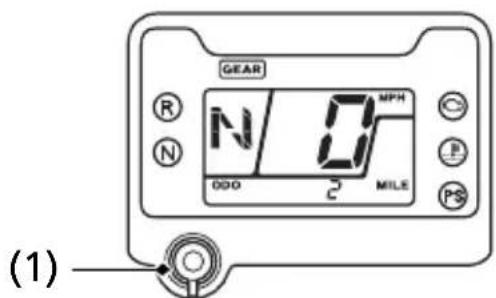
The speedometer, odometer, tripmeter and maintenance tripmeter show in either "MPH" and "MILE" or "KM/H" and "KM".
To change the speed and mileage unit, press and hold the mode button (1) for more than 5 seconds in odometer (page 28) with the ATV stopped.
text_image
GEAR N 0 MPH DDD 2 MILE PS (1)
flowchart
graph LR
    A["MPH"] --> B["MILE"]
    B --> C["KM/H"]
    C --> D["KM"]
(1) mode button
4WD Indicator
The 4WD indicator (1) appears when the 4WD mode engages (page 35).

text_image
GEAR N 4WD 0 0 0 0 0 0 0 0 0 0 0 0 0 0 0 0 0 0 0 0 0 0 0 0 0 0 0 0 0 0 0 0 0 0 0 0 0 0 0 0 0 0 0 0 0 0 0 0 0 0 1 (1)(1) 4WD indicator
Gear Position Indicator
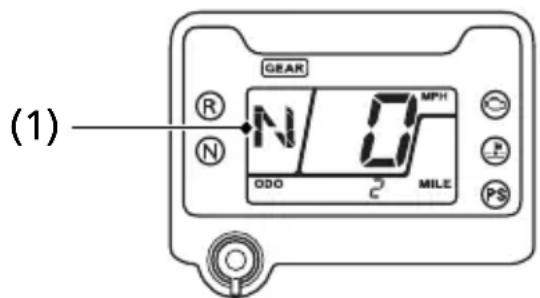
The gear position indicator (1) shows the gear position when the ignition switch is in the ON (I) position.
AUTO (automatic shift mode):
The indicator displays N for neutral, R for reverse, and D for drive.
ESP (manual shift mode):
The indicator displays N for neutral, R for reverse, and 1 – 5 for the five forward gears.
“-” will be displayed on the gear position indicator when the transmission is not shifted into gear properly. Before riding, check that the gear position is properly displayed on the gear position indicator.
If the gear position indicator shows “−” or blinks, turn the ignition switch to the OFF (O) position, and then turn it back to the ON (I) position again. If the gear position indicator shows “−”, rock the vehicle back and forth and make sure the gear position indicator is displayed properly and then if the gear position indicator still shows “−” or blinks, see your dealer.
If the “-” on the gear position indicator is blinking, see your dealer.
text_image
(1) GEAR N MPH ODO C MILE PS(1) gear position indicator
24 Instruments & Controls
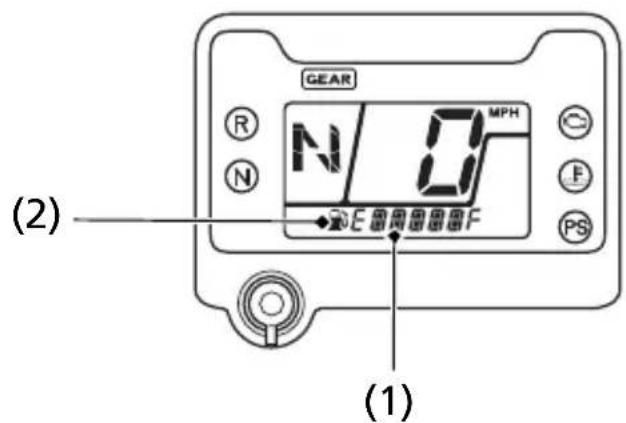
Fuel Gauge
The fuel gauge (1) shows the approximate fuel supply available with fuel mark (2). The fuel tank capacity is:
3.88 US gal (14.7 ℓ)
text_image
GEAR N 0 MPH (2) E F PS (1)(1) fuel gauge
(2) fuel mark
Regardless of what mode the display is in, when the fuel level reaches only 1st segment (3), the display will automatically switch to the fuel gauge display. You should refuel as soon as possible. The amount of fuel remaining when there is only 1st segment is approximately:
1.82 US gal (6.9 ℓ)
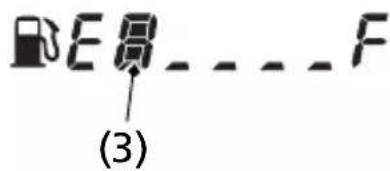
text_image
E B .... F (3)(3) 1st segment
Indicators & Displays
When the fuel gauge show E ____ F (4) and LO FUEL (5) blink 3 times alternately and fuel mark blinks, you should refill the tank as soon as possible.
The amount of fuel reserve is approximately:
1.29 US gal (4.9 ℓ)

flowchart
graph TD
    RE["RE"] --> F["F"]
    F --> (4)
    F --> (5)
(4) E_ _ _ _ _ _ F
(5) LO FUEL
Fuel gauge failure:
If the fuel gauge function fails E - - - - - F (6) will blink.
See your dealer.
(The fuel mark disappears except the fuel gauge display)

text_image
E F (6)(6) E - - - - - F
Digital Clock
The digital clock (1) displays hours and minutes with the clock mark (2), when the ignition switch is ON (1).
To adjust the time, proceed as follows:
- Turn the ignition switch ON (I) to display the clock (page 21).
- Press and hold the mode button (3) until the display start blinking.
-
To advance the display 1 minute at a time, press and release the mode button for 0.5 seconds.
Press and hold the mode button for more than 0.5 seconds, the display will begin advancing fast. -
Release the mode button when the display reaches the desired time.
-
To set the clock, press and release the mode button for less than 0.5 seconds.
The clock can also be set by turning the ignition switch off and then on.
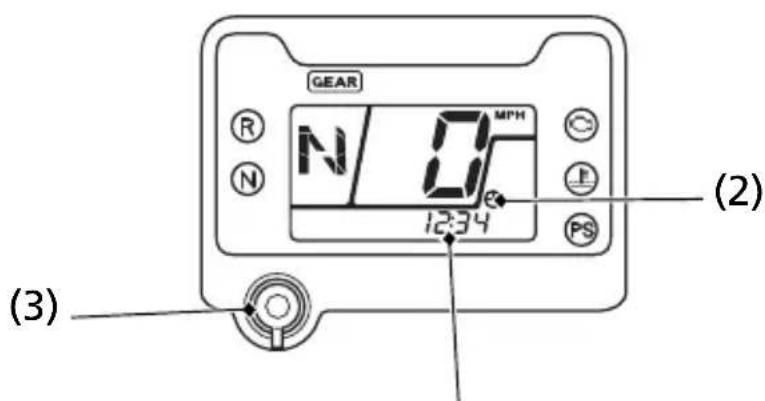
text_image
GEAR N 0 MPH 12:34 (2) (3)(1) digital clock
(2) clock mark
(1)
(3) mode button
After the battery is reconnected (page 186), check the clock. Readjust the clock if necessary.
Odometer
The odometer (1) registers total distance traveled in mileage while the ignition is ON (1) with the ODO display (2). The odometer locks at 999,999 when the read-out exceeds 999,999.

text_image
(2) (1)(1) odometer (2) ODO display
Tripmeter
The tripmeter (1) shows mileage per trip with the TRIP display (2), while the ignition is ON (1) since you last reset the tripmeter. The tripmeter returns to 0.0 when the read-out exceeds 999.9. To reset the tripmeter to 0.0, press the mode button (3) and hold it in for at least 2 seconds in the tripmeter mode.

text_image
(2) (1) (3)(1) tripmeter (3) mode button
(2) TRIP display
Coolant Temperature Gauge
The coolant temperature gauge (1) with the coolant temperature mark (2) shows the coolant temperature.
When coolant temperature is low, the coolant temperature gauge will display "Lo".

text_image
GEAR N 0 MPH C 0 0 0 - H (1) (2) (3)(1) coolant temperature gauge (3) high coolant
(2) coolant temperature mark temperature indicator
If all sections of the coolant temperature gauge and high coolant temperature indicator are on (automatically appears in the display) while you are riding, immediately stop the vehicle, turn the engine off and check the coolant reserve tank level. See page 140.
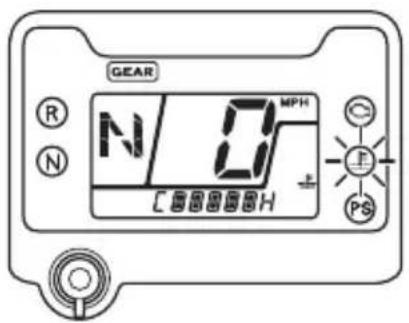
text_image
GEAR N 0 MPH C N PSNOTICE
Continuing to ride with an overheated engine can cause serious engine damage.
Coolant temperature gauge failure:
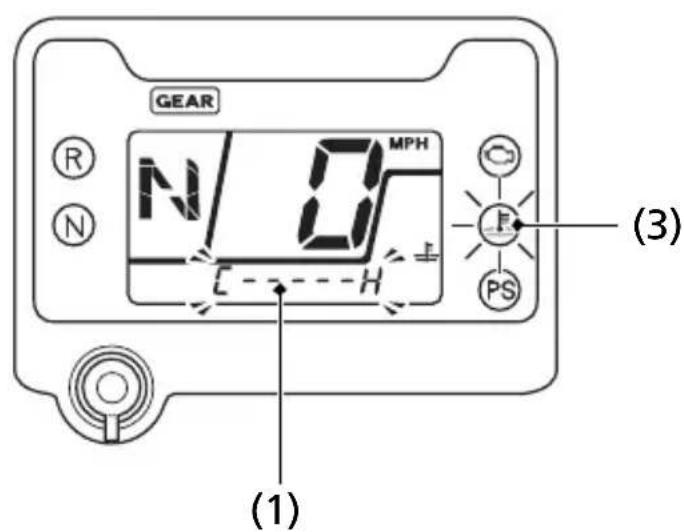
If the coolant temperature system has an error, the coolant temperature gauge (1) will blink and preferentially appear in the display, and/or high coolant temperature indicator (3) will turn on. If this occurs, see your dealer as soon as possible.
text_image
GEAR N/0 MPH R N C H (1) (3) PS(1) coolant temperature gauge (3) high coolant temperature indicator
Hour meter
The hour meter (1) shows accumulated hours while the ignition switch is ON (I) with the hour meter mark (2). The hour meter provides accurate service period information for initial and regular maintenance. The hour meter locks at 99,999.9 when the read-out exceeds 99,999.9.

text_image
GEAR N 0 MPH 123 H (1) (2) PS(1) hour meter (2) hour meter mark
Maintenance Tripmeter & Maintenance Hour meter
The maintenance tripmeter (1), the maintenance hour meter (2) and maintenance minder indicator (3) inform you when the mileage or operating hours on your ATV approaches and passes the maintenance interval specified on the maintenance schedule (page 110).

text_image
GEAR N/0 MPH ----600 MILE (3) (1)
text_image
GEAR N/0.5 MPH (3) (2)(1) maintenance tripmeter (3) maintenance minder (2) maintenance hour meter indicator
The maintenance tripmeter, or the maintenance hour meter and maintenance minder indicator will blink, when they reach their setting values.

text_image
(3) MILE (1)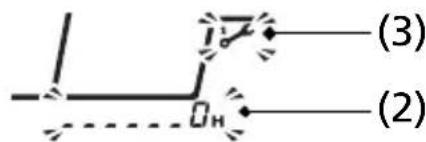
chemical
Simple chemical structure diagram with labeled positions (2) and (3)Reset the meters after each scheduled maintenance.
To reset the maintenance tripmeter and the maintenance hour meter, press and hold the mode button and turn the ignition switch to ON (1). Continue to hold the mode button, the maintenance minder indicator will light up, and after 2 seconds will blink twice, the maintenance minder indicator is reset.
Also the maintenance tripmeter and maintenance hour meter will reset.
Maintenance Minder Indicators:
 | Initial MaintenanceAppears at 100 miles (150 km) or 20 operating hours, whichever comes first. |
 | Regular Maintenance Interval 1Appears 600 miles (1,000 km) or 100 operating hours after the Initial Maintenance or Regular Maintenance Interval 2 is performed and maintenance minder is reset, whichever comes first in the maintenance schedule. |
 | Regular Maintenance Interval 2Appears 600 miles (1,000 km) or 100 operating hours after Regular Maintenance Interval 1 is performed and maintenance minder is reset, whichever comes first in the maintenance schedule. |
If the maintenance is done before the setting interval, be sure to reset the meters after the maintenance.
Controls & Features
Ignition Switch
The ignition switch (1) is used for starting and stopping the engine (page 72). Insert the key and turn it to the right for the ON (1) position.
The ignition switch is also used to reset the maintenance tripmeter and the maintenance hour meter (page 33).
| Key Position Function |
| ON (1) Electrical circuits on. |
| OFF (○) No electrical circuits function. |
CENTER OF HANDLEBAR

text_image
OFF ON (1)(1) ignition switch
I ON
○ OFF
2WD/4WD Select Lever
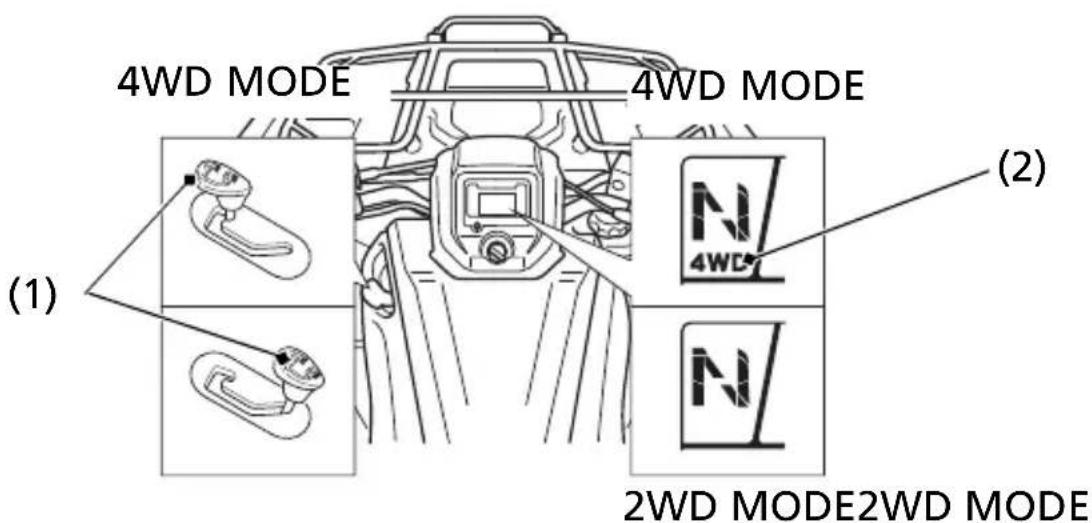
Your ATV is equipped with a 2WD/4WD select lever (1), which permits a choice between the “2WD” and “4WD” drive modes. Select a drive mode that’s suitable for your riding.
Keep both hands on the handlebar while machine is in motion and come to a complete stop before using the 2WD/4WD select lever.
The 2WD/4WD select lever is located on the left side of the fuel tank. To select the drive mode, shift the 2WD/4WD select lever to the desired position.
After using the 2WD/4WD select lever, the mode may not mechanically engage until forward motion begins.
To check your present drive mode, look at the 4WD indicator (2).
2WD mode: the 4WD indicator goes off when the 2WD mode engages. 4WD mode: the 4WD indicator goes on when the 4WD mode engages.
text_image
4WD MODE 4WD MODE (1) (2) 2WD MODE2WD MODE(1) 2WD/4WD select lever (2) 4WD indicator
Start Button

LEFT HANDLEBAR
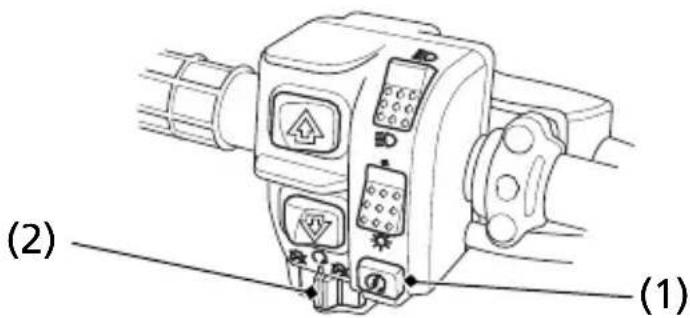
text_image
(2) (1)(1) start button
START
(2) engine stop switch
OFF
RUN
The start button (1) is used for starting the engine. Pushing the button in starts the engine. See Starting Procedure, page 74.
When the start button is pushed, the starter motor will crank the engine. The starter motor will not operate if the engine stop switch is in the OFF (✗) position when the start button is pushed.
Engine Stop Switch


The engine stop switch (2) is used to stop the engine in an emergency. To operate, slide the switch to the OFF (☒) position. The switch must be in the RUN (Ω) position to start the engine, and it should normally remain in the RUN (Ω) position even when the engine is OFF.
If your ATV is stopped with the ignition switch ON (I) and the engine stop switch OFF (☒), the battery will discharge. Turn the ignition switch to OFF (O) to prevent battery discharge.
Headlight Switch

LEFT HANDLEBAR

text_image
(1) (2)(1) headlight switch ON
- OFF
(2) headlight dimmer switch
≡D HI
DLO
The headlight switch (1) is used to turn the headlights ON (💡) or OFF (●). To operate, turn the switch to ON (💡) or OFF (●).
Headlight Dimmer Switch

The headlight dimmer switch (2) is used to change between the high and low beams of the headlight. To operate, turn the switch to HI (≡D) for high beam, LO (≡D) for low beam.
Recoil Starter (Canada only)
RIGHT SIDE

text_image
(1)(1) recoil starter
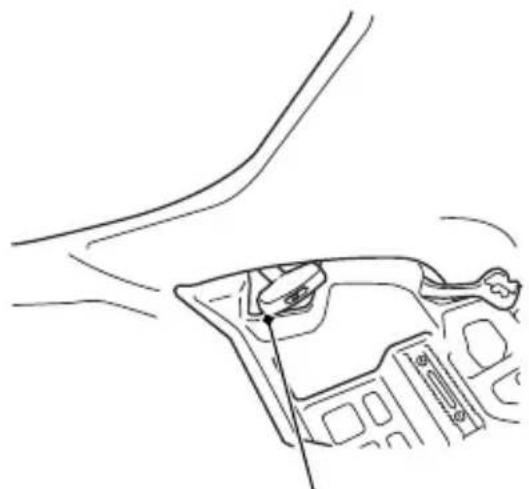
The recoil starter (1) is used to start the engine when the battery is low. See Using the Recoil Starter (Canada only) page 78.
Throttle Lever
RIGHT HANDLEBAR

text_image
(A) (1)(1) throttle lever
(A) to open the throttle
The throttle controls engine rpm (speed). To increase engine rpm, press the throttle lever (1) with your thumb. To reduce engine rpm, release pressure on the throttle lever. The throttle will automatically return to the closed position (engine idle) when you remove your thumb.
Drive Mode Select Switch
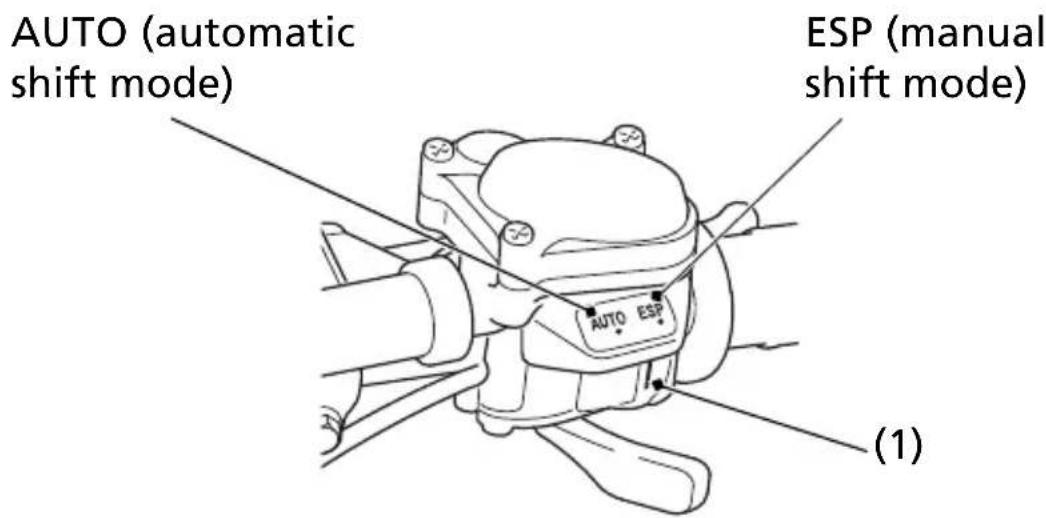
The drive mode select switch (1) has two positions, AUTO (automatic shift mode) and ESP (manual shift mode).
See Shifting Gears page 79.
RIGHT HANDLEBAR
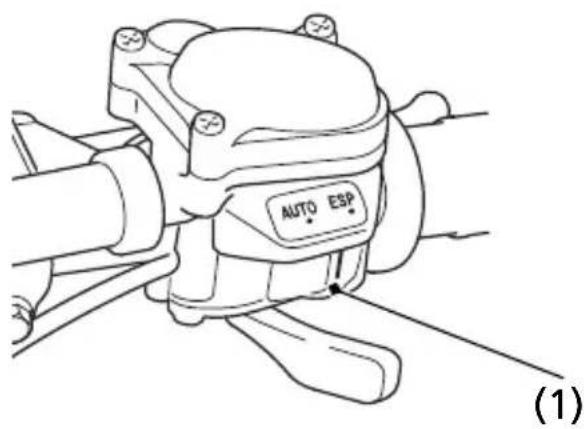
text_image
AUTO ESP (1)(1) drive mode select switch
Gearshift Switch
AUTO (automatic shift mode):
These gearshift switches [upshift switch (1) and downshift switch (2)] are used to select the drive (D), neutral (N) and reverse (R).
See Shifting Gears, page 79 and Riding in Reverse, page 85.
ESP (manual shift mode):
These gearshift switches are used to select the next higher or lower gear in the transmission. To operate, press the upshift switch (1) to engage the next higher gear or press the downshift switch (2) to engage the next lower gear.
See Shifting Gears, page 79 and Riding in Reverse, page 85.
LEFT HANDLEBAR

text_image
(1) (2)(1) upshift switch
(2)downshift switch
Front Brake Lever
The front brake lever is used to slow or stop your ATV. To operate, pull the lever. For information on braking techniques, see page 87.
Rear Brake Lever/Parking Brake Lever
The rear brake lever/parking brake lever is used to slow or stop your ATV. To operate, pull the lever. For information on braking techniques, see page 87.
Rear Brake Pedal
The rear brake pedal is used to slow or stop your ATV. To operate, depress the pedal. For information on braking techniques, see page 87.
Parking Brake/Reverse Lever (P/R Lever)
LEFT HANDLEBAR

text_image
(1) (2)(1) P/R lever
(2) rear brake lever/parking brake lever
The P/R lever (1) on the rear brake lever/parking brake lever (2) is used to apply the parking brake or to shift the transmission into reverse.
Controls & Features
To apply the parking brake:
Bring the vehicle to a complete stop, make sure the transmission is in neutral.
Squeeze the rear brake lever/parking brake lever (1), then rotate the P/R lever (2) clockwise until it engages the slot on the rear brake lever/parking brake lever bracket.
For more information on Parking, see page 102.

text_image
(1) (2)(1) rear brake lever/parking brake lever
(2) P/R lever
To release the parking brake:
Squeeze the rear brake lever/parking brake lever until the P/R lever is released from the slot on the rear brake lever/parking brake lever bracket.
The brake light is activated by applying the parking brake. When using the parking brake, be sure to turn the ignition switch to OFF (O) to avoid discharging the battery.
To shift the transmission into reverse:
See Riding in Reverse, page 85.
44 Instruments & Controls
Flag Pole Bracket
RIGHT REAR
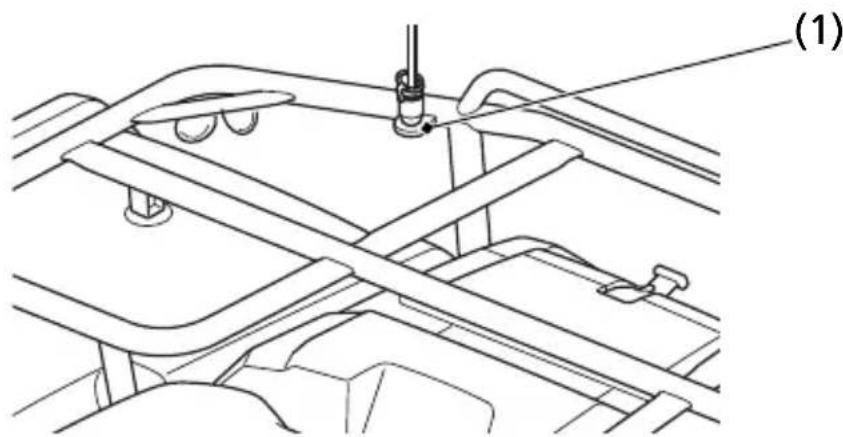
natural_image
Technical line drawing of a mechanical assembly with no visible text or symbols(1) flag pole bracket
Flag poles are optional equipment available from your dealer. To mount a pole in the bracket (1), follow the instructions that come with the flag pole kit.
Flag poles are required in some riding areas. Check local regulations before riding.
Trailer Hitch
REAR

text_image
(1) (2)(1) trailer hitch
(2) ball
The trailer hitch (1) is located on the rear frame. To use the hitch, you'll need a proper size ball (2) as specified by the trailer manufacturer.
To attach the ball and properly hook up a trailer, follow the trailer manufacturer's instructions. For load limits and operational guidelines, see page 59.
Storage Compartment
The storage compartment (1) is located below the rear cargo rack (2).
To open the compartment, unhook the rubber strap (3).
Be careful not to flood this area when washing your ATV.
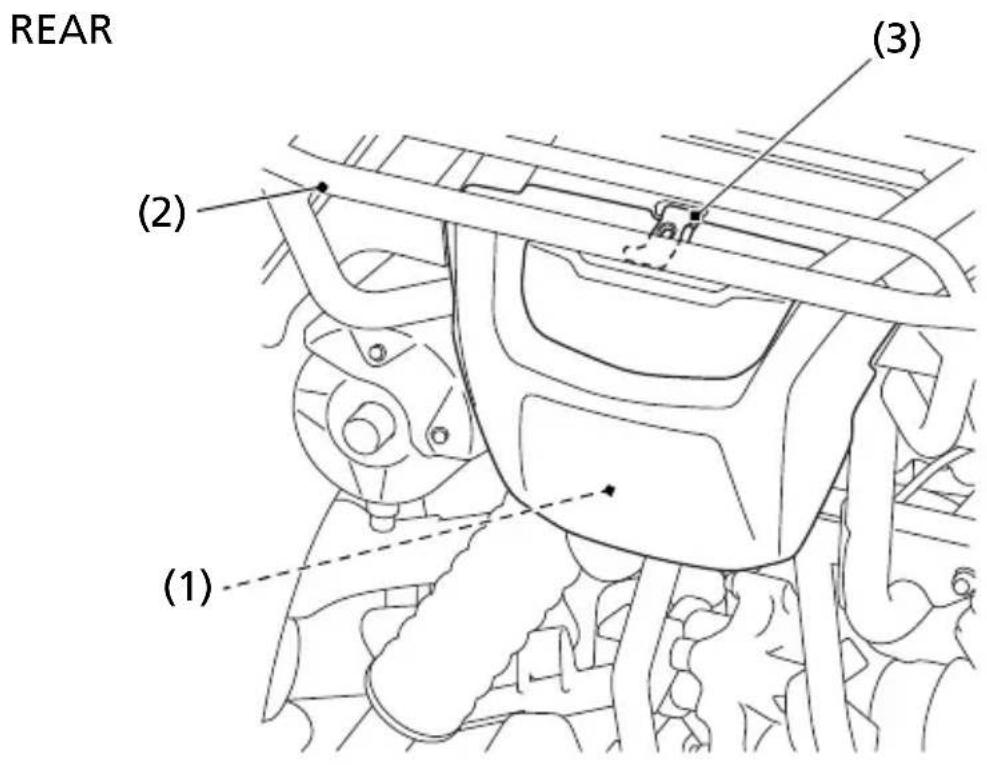
text_image
REAR (1) (2) (3)(1) storage compartment
(2) rear cargo rack
(3) rubber strap
EPS (Electric Power Steering) (TRX420FA6 only)
This ATV is equipped with an electronically controlled, electric-power-assisted steering system.
While the engine is running, the EPS (Electric Power Steering) system provides power from the electric motor, which helps you to turn the ATV's handlebar more easily.
The EPS system on this ATV utilizes an overheat protection feature to prevent damage to system components. In certain extended, repetitive high-load situations, the system will reduce or even disable power steering assist. The steering will perform as a normal non-EPS system during this brief period. After cooling down, it will then return to normal EPS operation.
The PS indicator should light when the ignition switch is turned on and remain on until the engine is started.
The PS indicator also lights when there is any abnormality in the EPS system. If this occurs, the electric power assist for turning will not be available, but the manual steering system will perform as usual.
If the PS indicator lights at any time while riding, reduce speed and take your ATV to your dealer as soon as possible. Continuing to ride with a EPS system problem can cause system damage.
Do not modify your Electric Power Steering system. In case of a malfunction, take your ATV to your dealer.
Before each ride, you need to make sure you and your Honda are both ready to ride. To help get you prepared, this section discusses how to evaluate your riding readiness, what items you should check on your ATV, and adjustments to make for your comfort, convenience, or safety. This section also includes important information about loading.
Are You Ready to Ride? 50
Protective Apparel 50
Rider Training 52
Age Recommendation 53
No Passengers 53
No Alcohol or Drugs 54
Is Your ATV Ready to Ride? 55
Pre-ride Inspection 55
Load Limits & Guidelines.... 59
Loading 59
Load Limits 60
Loading Guidelines 61
Accessories & Modifications.... 62
Accessories.... 62
Modifications.... 63
Are You Ready to Ride?
Before you ride your ATV for the first time, we urge you to:
- Read this owner's manual and the labels on your ATV carefully.
- Make sure you understand all the safety messages.
- Know how to operate all the controls.
Before each ride, be sure:
- You feel well and are in good physical and mental condition.
- You are wearing an approved motorcycle helmet (with chin strap tightened securely), eye protection, and other protective clothing.
- You don't have any alcohol or drugs in your system.
Protective Apparel
For your safety, we strongly recommend that you always wear an approved motorcycle helmet, eye protection, boots, gloves, long pants, and a long-sleeved shirt or jacket whenever you ride.
Although complete protection is not possible, wearing proper gear can reduce the chance of injury when you ride.
Following are suggestions to help you choose the proper gear.
Helmet and Eye Protection
Your helmet is your most important piece of riding gear because it offers the best protection against head injuries. A helmet should fit your head comfortably and securely.
An open-face helmet offers some protection, but a full-face helmet offers more. Regardless of the style, look for a DOT (Department of Transportation) sticker on any helmet you buy (USA only). Always wear a face shield or goggles to protect your eyes and help your vision.
WARNING
Operating this ATV without wearing an approved motorcycle helmet, eye protection, and protective clothing could increase your chances of severe injury or death in the event of a crash.
Always wear an approved motorcycle helmet that fits properly and wear eye protection (goggles or face shield), gloves, boots, long-sleeved shirt or jacket and long pants.
Additional Riding Gear
In addition to a helmet and eye protection, we also recommend:
- Sturdy off-road motorcycle boots to help protect your feet, ankles, and lower legs.
- Off-road motorcycle gloves to help protect your hands.
- Riding pants with knee and hip pads, a riding jersey with padded elbows, and a chest/shoulder protector.
Rider Training
Developing your riding skills is an on-going process. Even if you have ridden other ATVs, take time to become familiar with how this ATV works and handles. Practice riding the ATV in a safe area to build your skills. Do not ride in rough terrain until you get accustomed to the ATV's controls, and feel comfortable with its size and weight.
We urge all riders to take a ATV operator course approved by the ATV Safety Institute (ASI). For information about the ASI training course nearest you, call the national toll-free number; (800) 887-2887 (USA only).
Other riding tips can be found in the Tips & Practice Guide for the ATV Rider booklet that came with your ATV (USA only).
WARNING
Operating this ATV without proper instruction could increase your risk of a crash which could lead to serious injury or death.
Beginning and inexperienced operators should complete the certified training course offered by Honda. They should then regularly practice the skills learned in the course and the operating techniques described in the owner's manual.
Age Recommendation
The minimum recommended age for this ATV model is 16. For safety, never let children under 16 years old operate this vehicle.
WARNING
A child using an ATV that is not recommended for their age could lose vehicle control while riding, resulting in severe injury or death.
A child under 16 should never operate an ATV with engine size greater than 90cc.
No Passengers
This ATV is designed as an operator-only vehicle. The long seat is designed to allow the rider to change body position, not for carrying a passenger. Never let a passenger ride on the seat or on the front or rear cargo racks.
WARNING
Carrying a passenger on this ATV greatly reduces your ability to balance and control this ATV and could cause a crash and you or your passenger could be injured or killed.
Never carry a passenger on this ATV.
No Alcohol or Drugs
Alcohol, drugs and ATVs don't mix. Even a small amount of alcohol can impair your ability to operate an ATV safely. Likewise, drugs — even if prescribed by a physician — can be dangerous while operating an ATV. Consult your doctor to be sure it is safe to operate a vehicle after taking medication.
WARNING
Operating this ATV after consuming alcohol or drugs can seriously affect your judgment, cause you to react more slowly, affect your balance and perception, and result in serious injury or death.
Never consume alcohol or drugs before or while operating this ATV.
Before each ride, it's important to inspect your ATV and make sure any problem you find is corrected. A pre-ride inspection is a must, not only for safety, but because having a breakdown, or even a flat tire, can be a major inconvenience.
If your ATV has overturned or been involved in a collision, do not ride the vehicle until it has been inspected by your dealer. There may be damage or other problems you cannot see.
WARNING
Improperly maintaining this ATV or failing to correct a problem before riding can cause a crash in which you can be seriously hurt or killed.
Always perform a pre-ride inspection before every ride and correct any problems.
Pre-ride Inspection
Check the following items before you get on the ATV:
Engine Oil Check the level and add oil if needed
(page 129).
Check for leaks.
Radiator Coolant Check the coolant level and add coolant if needed (page 140).
Check for leaks.
(cont'd)
Is Your ATV Ready to Ride?
Fuel Check the level and add fuel (page 124) if
needed. Also make sure the fuel fill cap is securely fastened.
Check for leaks.
Tires Use a gauge to check the air pressure. Adjust
if needed. Also look for signs of damage or excessive wear (page 172).
Drivetrain Boots Check for damage (pages 182, 183).
Guards Check for damage or looseness (pages 179, 180, 181).
Nuts & Bolts
Check the wheels to see that the axle nuts are tightened. Use a wrench to make sure all accessible nuts, bolts, and fasteners are tight.
Underbody & Exhaust System
Check for, and remove, any dirt, vegetation or other debris that could be a fire hazard or interfere with the proper operation of the vehicle.
Air Cleaner Housing Drain Tube
Check for deposits in the drain tube. If necessary, clean the tube (page 151) and check the air cleaner housing.
Leaks, Loose Parts Walk around your ATV and look for anything that appears unusual, such as a leak or loose cable.
Is Your ATV Ready to Ride?
Cable Check the cable housings for wear. Check
the fittings for looseness. Replace or tighten as needed.
Lights Make sure the headlight, brake light and tail
light are working properly.
If you are carrying cargo, also check the following:
Loading Limits Make sure you do not exceed the load limits (page 60).
Cargo Check that all cargo is secure.
Check these items after you get on the ATV:
Throttle Check the freeplay and adjust if needed.
Press the throttle to make sure it moves smoothly without sticking, and snaps shut automatically when it is released, in all steering positions (page 152).
Brakes Squeeze the front brake lever and rear
brake lever/parking brake lever and step on the rear brake pedal to check that the controls operate normally. Depress the rear brake pedal several times, then check for proper rear brake lever/parking brake lever freeplay (pages 169). Make sure there is no brake fluid leakage.
Reverse Assist Lever Check the freeplay and adjust if needed (page 154). Make sure the lever operates smoothly without sticking.
(cont'd)
Is Your ATV Ready to Ride?
Headlight and
Headlight Dimmer
Switch
Check for proper function (page 37).
Engine Stop Switch Check for proper function (page 36).
Steering Check that the wheels turn properly as you
steer the handlebar. Move the handlebar right and left and check that there is no excessive backlash.
Remember, be sure to take care of any problem you find, or have your dealer correct it before you ride.
Your Honda was designed as a rider-only ATV. It was not designed to carry a passenger. It can carry cargo on the cargo racks, however, carrying cargo anywhere else or carrying a passenger could interfere with your balance and control of the ATV.
In addition, exceeding the weight limits or carrying an unbalanced load can seriously affect your ATV's handling, braking and stability. Adding accessories or making modifications that change this ATV's design and performance can also make it unsafe. Also, the weight of any accessories will reduce the maximum load the ATV can carry.
More specific information on load limits, accessories, and modifications follows.
Loading
How much weight you put on your ATV, and how you load it, are important to your safety. If you decide to carry cargo, you should be aware of the following information.
WARNING
Overloading, improper loading, or carrying a passenger can cause a crash and you can be seriously hurt or killed.
Follow all load limits and other loading guidelines in this manual.
Load Limits
Following are the load limits for your ATV:
There are limits to how much weight can be carried on your ATV and be pulled in a trailer.
The following load limits apply to standard equipment only. Modifying your ATV, using non-standard equipment, or riding on terrain that is not flat and smooth could further reduce these limits.
maximum weight capacity 485 lb (220 kg)
(includes the weight of the rider, all cargo, and accessories.)
front cargo rack weight limit = 66 lb (30 kg)
rear cargo rack weight limit = 133 lb (60 kg)
tow weight limit = 850 lb (385 kg)
(Combined weight of the trailer and all cargo in the trailer)
tongue weight = 30 lb (14 kg) recommended
(Weight on the trailer tongue)
tongue and rear cargo weight = 133 lb (60 kg) maximum
(Combined weight on the trailer tongue and on the rear cargo rack)
Tongue weight can be measured with an ordinary bathroom scale. Place the scale under the tongue, using either a tongue jack or other support to keep the trailer level.
The weight of added accessories will reduce the maximum cargo weight you can carry.
Loading Guidelines
Carrying cargo or pulling a trailer will affect how your ATV handles and greatly reduce its ability in accelerating, braking and making turns and other maneuvers.
Be sure to observe the weight limits and follow these guidelines:
- Check that the tires are properly inflated.
- Do not place cargo anywhere on the ATV other than on the front and rear racks. Otherwise, operating stability may be adversely affected.
- Never ride with a passenger on the front or rear cargo racks. The ATV is not designed to carry a passenger.
- Use the trailer hitch to tow another vehicle or trailer. Do not tow by tying a rope or cable to the rear rack.
- Load cargo on the rear rack as far forward as possible. Make sure cargo on the front rack does not interfere with handlebar movement.
- Do not allow cargo to extend beyond the edges of either the front or rear racks.
- Make sure all cargo is secured before riding.
• Balance cargo weight evenly on both sides. - Never exceed the maximum weight limit.
- When towing a trailer, take care to maintain balance and stability. Distribute cargo between the front and rear of the trailer to obtain the recommended tongue weight.
- Allow extra room for starting, stopping and turning whenever you carry cargo or pull a trailer.
- Avoid riding on steep slopes when carrying cargo or pulling a trailer.
- Never cross a slope when towing a trailer.
Modifying your ATV or using non-Honda accessories can make your ATV unsafe.
Before you consider making any modifications or adding an accessory, be sure to read the following information.
WARNING
Improper accessories or modifications can cause a crash in which you can be seriously hurt or killed.
Follow all instructions in this owner's manual regarding accessories and modifications.
Accessories
We strongly recommend that you use only Honda Genuine Accessories that have been specifically designed and tested for your ATV. Because Honda cannot test all other accessories, you must be personally responsible for proper selection, installation, and use of non-Honda accessories.
Check with your dealer for assistance and always follow these guidelines:
- Make sure the accessory does not obscure any lights, reduce ground clearance, limit suspension travel or steering travel, or interfere with operating any controls.
- Make sure the accessory does not interfere with your ability to shift body position on the seat or operate hand and foot controls.
- Do not add any electrical equipment that will exceed the vehicle's electrical system capacity (page 235). A blown fuse can cause a loss of lights or engine power (page 220).
Modifications
We strongly advise you not to remove any original equipment or modify your ATV in any way that would change its design or operation. Such changes could seriously impair your ATV's handling, stability, and braking, making it unsafe to ride.
We also advise you not to make any modifications or remove any equipment (such as the USDA qualified spark arrester or emission control system components) that would make your ATV illegal in your area.
Removing or modifying your lights, exhaust system, emission control system, or other equipment can also make your ATV illegal.
Basic Operation & Riding
This section gives basic riding instructions, including how to start and stop your engine, and how to use the throttle and brakes. It also provides important information on riding with cargo.
To protect your new engine and enjoy optimum performance and service life, refer to Break-in Guidelines (page 237).
Safe Riding Precautions 67
Off-road Use Only.... 67
Keep Hands and Feet on Controls.... 68
Control Speed 69
Use Care on Unfamiliar or Rough Terrain 70
Do Not Perform Stunts.... 71
Starting & Stopping the Engine.... 72
Preparation....73
Starting Procedure 74
Flooded Engine.... 75
Bank Angle Sensor Ignition Cut-off System.... 75
Stalled Engine.... 76
How to Stop the Engine.... 77
Using the Recoil Starter (Canada only) 78
Shifting Gears....79
Riding in Reverse 85
(cont'd)
Basic Operation & Riding
Braking....87
Riding Your ATV 89
Making Turns 89
Skidding or Sliding.... 91
Riding Up Hills 92
Riding Down Hills 96
Crossing or Turning on Hills or Slopes 97
Riding Over Obstacles 99
Riding Through Water 100
Parking.... 102
Before riding your ATV for the first time, please review the ATV Safety section beginning on page 1, and the Before Riding section beginning on page 49.
Even if you have ridden other ATVs, take time to become familiar with how this ATV works and handles. Practice in a safe area until you build your skills and get accustomed to the ATV's size and weight.
Off-road Use Only
Your ATV and its tires are designed and manufactured for off-road use only, not for pavement. Riding on pavement can affect handling and control. You should not ride your ATV on pavement.
WARNING
Operating this ATV on paved surfaces may seriously affect handling and control of the ATV, and may cause the vehicle to go out of control.
Never operate the ATV on any paved surfaces, including sidewalks, driveways, parking lots and streets.
When riding off-road, also remember to always obey local off-road riding laws and regulations. Obtain permission to ride on private property. Avoid posted areas and obey “no trespassing” signs.
Safe Riding Precautions
You should never ride your ATV on public streets, roads or highways, even if they are not paved. Drivers of street vehicles may have difficulty seeing and avoiding you, which could lead to a collision. In many states it is illegal to operate ATVs on public streets, roads and highways.
WARNING
Operating this ATV on public streets, roads or highways could cause you to collide with another vehicle.
Never operate this ATV on any public street, road or highway, even a dirt or gravel one.
Keep Hands and Feet on Controls
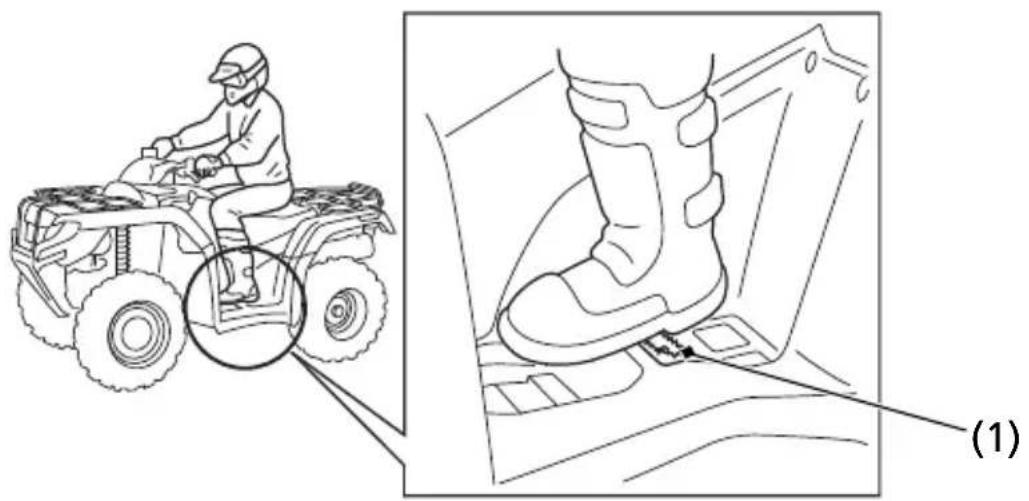
Always keep both hands on the handlebars and both feet on the footpegs when riding your ATV. This is important to maintain your balance and to control the vehicle. Removing even one hand from the handlebars or one foot from the footpegs can reduce your ability to control the ATV or could cause you to lose your balance and fall off the ATV.
WARNING
Removing hands from handlebars or feet from footpegs during operation can reduce your ability to control the ATV or could cause you to lose your balance and fall off of the ATV.
Always keep both hands on the handlebars and both feet on the footpegs of your ATV during operation.
natural_image
Line drawing of a person riding an off-road vehicle, with a close-up inset showing the foot's seat and foot positioning (no text or symbols)(1) footpeg
Control Speed
Riding at excessive speed increases the chance of a crash. In choosing a proper speed, you need to consider the capability of your vehicle, the terrain, visibility and other operating conditions, plus your own skills and experience.
WARNING
Operating this ATV at excessive speeds increases your chances of losing control of the ATV, which can result in a crash.
Always go at a speed that is proper for your vehicle, the terrain, visibility and other operating conditions, and your experience.
Use Care on Unfamiliar or Rough Terrain
Before riding in a new area, always check the terrain thoroughly. Don't ride fast on unfamiliar terrain or when visibility is limited. (It's sometimes difficult to see obstructions like hidden rocks, bumps, or holes in time to react.)
WARNING
Failure to use extra care when operating this ATV on unfamiliar terrain could result in the ATV overturning or going out of control.
Go slowly and be extra careful when operating on unfamiliar terrain. Always be alert to changing terrain conditions when operating the ATV.
Never ride past the limit of visibility. Maintain a safe distance between your ATV and other off-road vehicles. Always exercise caution, and use extra care on rough, slippery and loose terrain.
WARNING
Failure to use extra care when operating on excessively rough, slippery or loose terrain could cause loss of traction or vehicle control, which could result in a crash, including an overturn.
Do not operate on excessively rough, slippery or loose terrain until you have learned and practiced the skills necessary to control the ATV on such terrain. Always be especially cautious on these kinds of terrain.
Do Not Perform Stunts
You should always operate your ATV in a safe and reasonable manner. When riding, always keep all four wheels on the ground.
WARNING
Attempting wheelies, jumps, and other stunts increases the chance of a crash, including an overturn.
Never attempt stunts, such as wheelies or jumps. Don't try to show off.
Starting & Stopping the Engine
Always follow the proper starting procedure described below.
For your safety, avoid starting or operating the engine in an enclosed area such as a garage. Your ATV's exhaust contains poisonous carbon monoxide gas which can collect rapidly in an enclosed area and cause illness or death.
WARNING
Running the engine of your vehicle while in an enclosed or even partially enclosed area can cause a rapid build-up of toxic carbon monoxide gas.
Breathing this colorless, odorless gas can quickly cause unconsciousness and lead to death.
Only run your vehicle's engine when it is located in a well ventilated area outdoors.
If you turn the ignition switch to the OFF (O) position while in reverse, the transmission will automatically return to neutral (N) when the ignition switch is turned to the ON (I) position.
The starter motor will operate when the transmission is in neutral or the front brake lever is pulled in.
Preparation

natural_image
Line drawing of a kitchen appliance with a dial and control knob (no text or symbols)(1)

text_image
(2) GEAR N 0 MPH ODO 2 MILE PS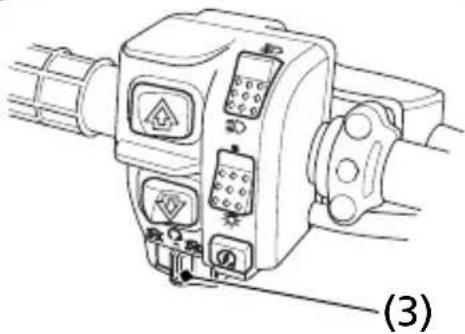
text_image
(3)(1) ignition switch
(3) engine stop switch
(2) neutral indicator
-
Before starting, make sure the vehicle is on a level surface and lock the parking brake (page 43).
-
Turn the ignition switch (1) to ON (I).
Confirm the following:
- The transmission is in neutral, and the neutral indicator (2) is ON.
- The engine stop switch (3) is set to RUN () .
Starting & Stopping the Engine
Starting Procedure
This ATV is fuel-injected with an automatic choke.
Follow the procedure indicated below.
Any Air Temperature
- Press the start button with the throttle completely closed.
The engine will not start if the throttle is fully open (because the electronic control module cuts off the fuel supply).
Snapping the throttle or fast idling for more than 5 minutes may cause exhaust pipe and muffler discolorations.
Flooded Engine
If the engine fails to start after repeated attempts, it may be flooded with excess fuel. To clear a flooded engine:
- Leave the engine stop switch set to RUN (Ω).
- Open the throttle fully.
- (USA)
Press the start button for 5 seconds.
(Canada)
Press the start button for 5 seconds (or operate the recoil starter several times). - Follow the normal starting procedure.
- If the engine starts, then open the throttle slightly if idling is unstable.
If the engine does not start, wait 10 seconds, then follow steps 1 – 4 again.
If the engine still won't start, refer to If Your Engine Quits or Won't Start, page 206.
Bank Angle Sensor Ignition Cut-off System
Your vehicle's banking (lean angle) sensor system is designed to automatically stop the engine if the vehicle is overturned.
Before restarting the engine, you must turn the ignition switch to the OFF (O) position and then back to ON (I). The engine will not restart until you perform this procedure.
Starting & Stopping the Engine
Stalled Engine
You can restart the engine while the vehicle is stopped by squeezing the front brake lever and pressing the start button.
Do not press the throttle lever while starting in gear. The engine will not start if the throttle is fully open (because the electronic control module cuts off the fuel supply).
Once you have started the engine, release the front brake lever, then apply throttle gradually.
How to Stop the Engine
Normal Engine Stop
To stop the engine, make sure the transmission is in neutral by checking that the neutral indicator light is on, then turn the ignition switch to OFF (O).
The engine stop switch should normally remain in the RUN ( ) position even when the engine is OFF.
If your ATV is stopped with the engine stop switch OFF (✗) and the ignition switch ON (I), the battery will discharge.
Emergency Engine Stop
To stop the engine in an emergency, use the engine stop switch. To operate, slide the switch to either OFF (✗) position.
Starting & Stopping the Engine
Using the Recoil Starter (Canada only)
The recoil starter is used to start the engine when the battery is low. To operate the recoil starter:
- Turn the ignition switch to ON and engine stop switch to RUN.
- Check that the transmission is in neutral.
- Grasp the starter grip (1) firmly, then pull it out slowly approximately 4 in (100 mm).
- Pull the grip up briskly and fully.
- After the engine starts, allow the starter grip to return slowly.
If the starter grip does not return smoothly (because of dirt in the assembly), see your dealer.
RIGHT SIDE
natural_image
Line drawing of a car interior showing dashboard and steering wheel (no text or symbols)(1)
(1) starter grip
Your ATV has two shift modes: AUTO (automatic shift mode) and ESP (manual shift mode).
You can select the desired shift mode with the drive mode select switch.
AUTO (automatic shift mode):
Use this mode for everyday riding. The transmission automatically shifts to keep the engine at the best speed for the riding condition. The gear position indicator will show “D” for forward gears, “N” for neutral, and “R” for reverse. Select gear position with the gear shift switches.
ESP (manual shift mode):
In this mode, you can shift gears much like a manual transmission, but without operating a clutch. You can select five forward gears, neutral and reverse by operating the gear shift switches.
The gear position indicator will show “1, 2, 3, 4, or 5” for forward gears, “N” for neutral, and “R” for reverse.
When you tow a trailer, select the 1st shift position for proper performance.
Drive mode select (AUTO/ESP)
The drive mode select switch (1) is located on the right handlebar. To select the drive mode, release the throttle, then slide the drive mode select switch to the desired position. With the throttle fully closed, the drive mode can be changed while riding.
RIGHT HANDLEBAR
text_image
AUTO (automatic shift mode) ESP (manual shift mode) AUTO ESP (1)(1) drive mode select switch
Gear Position selection AUTO (D/N/R), Manual (1-5/N/R)
Two gearshift switches are located next to the left handlebar grip: Upshift (△ and downshift ( )
To shift between a forward gear (D or 1), neutral (N), or reverse (R), bring the ATV to complete stop, and press a shift switch to select gear position.
Select neutral (N) when you start the engine, or if it is necessary to stop briefly with the engine idling.
The gear position indicator shows "N".
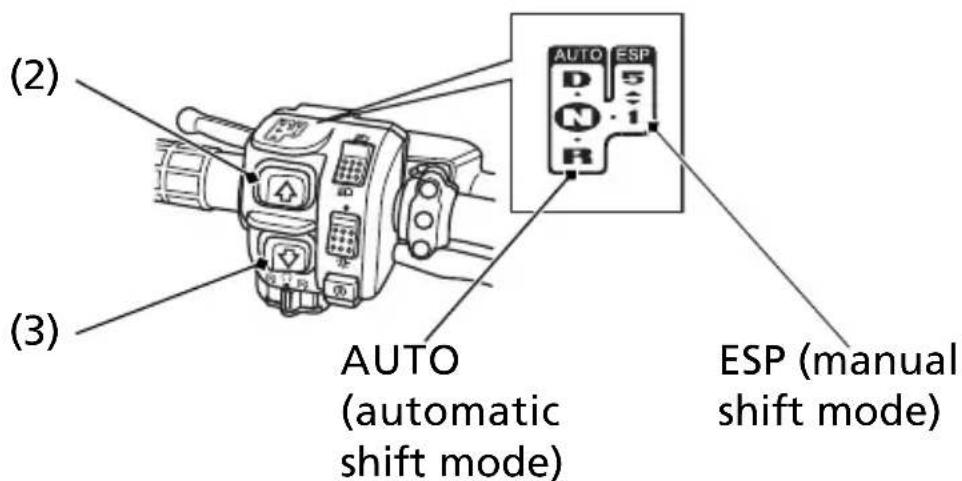
To select a forward gear (D or 1) from neutral (N), press the upshift switch (2) once.
- In AUTO (automatic shift mode) the gear position indicator shows "D"
- In ESP (manual shift mode) the gear position indicator shows "1"
To select reverse (R) from neutral (N), use the P/R lever and press the downshift switch (3) once. See Riding in Reverse (page 85).
LEFT HANDLEBAR
text_image
(2) AUTO (automatic shift mode) ESP (manual shift mode) (3)(2) upshift switch
(3)downshift switch
Driving in AUTO (automatic shift mode):
After starting the engine and letting it warm up, follow these procedures:
- With the transmission in neutral, release the parking brake (page 44), but continue to squeeze the rear brake lever/parking brake lever.
- With the throttle closed, select the AUTO (automatic shift mode), and then press the upshift switch once to shift into drive (D).
- The gear position indicator shows "D".
- Release the rear brake lever/parking brake lever and increase engine speed by gradually opening the throttle.
Driving in ESP (manual shift mode):
After starting the engine and letting it warm up, follow these procedures:
- With the transmission in neutral, release the parking brake (page 44), but continue to squeeze the rear brake lever/parking brake lever.
- With the throttle closed, select the ESP (manual shift mode), and then press the upshift switch ( (2) once to shift into 1st gear.
- The gear position indicator shows "1".
- Release the rear brake lever/parking brake lever and increase engine speed by gradually opening the throttle.
- When speed increases, release the throttle and upshift to 2nd gear by pressing the upshift switch once.
- Repeat this sequence to progressively upshift to 3rd, 4th and 5th (top) gear.
- To downshift, press the downshift switch (✗(3) once. Remember to close the throttle each time you shift to the next lower gear.
UPSHIFTING SEQUENCE
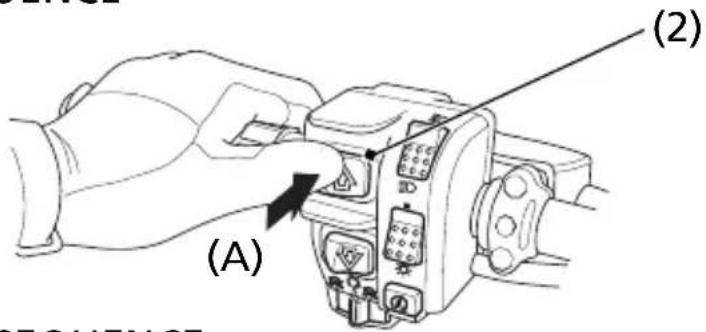
text_image
(A) (2)82 Basic Operation & Riding
The transmission cannot be upshifted from neutral to 1st gear or D-mode when the engine speed is above 2,300 rpm or the ground speed is above 2 mph (3 km/h).
The transmission cannot be downshifted from 1st gear or D-mode to neutral when the ground speed is above 1 mph (1.5 km/h) or engine speed is above 2,300 rpm.
In ESP (manual shift mode), if the ground speed decreases under a set speed (see table) the transmission will automatically downshift to the next lower gear.
| Gear | Down Shift Speed | |
| mph km/h | ||
| From 5th to 4th 7 12 | ||
| From 4th to 3rd 6 10 | ||
| From 3rd to 2nd 5 8 | ||
If the ATV is at a complete stop, 2nd gear, 3rd gear, 4th gear or 5th gear cannot be selected.
If the electric shift system malfunctions, the transmission cannot be shifted by pressing the gearshift switches. See your dealer. (In an emergency, a gear may be selected manually so you may move the vehicle. See Emergency Gear Selection & Operation page 212).
Learning when to shift gears comes with experience. Keep the following tips in mind:
- As a general rule, shift while moving in a straight line.
- Close the throttle completely before shifting. Improper shifting may damage the engine, transmission, and drivetrain.
- Upshift to a higher gear or reduce throttle before engine rpm (speed) gets too high. Learn the relationship between engine sound and the normal shifting points.
- Downshift to a lower gear before you feel the engine laboring (lugging) at low rpm.
- Avoid downshifting to help slow your ATV when engine rpm is high. Downshifting when engine speed is near its allowable maximum may over-rev the engine and possibly cause damage.
- To prevent transmission damage, do not coast or tow the ATV for long distances with the engine off.
Recommended Shift Points
Ride in the highest gear that lets the engine run and accelerate smoothly. This will give you good fuel economy and effective emissions control.
If you need to ride in reverse, make sure the area behind you is clear and only operate the ATV at low speed.
WARNING
Improperly operating in reverse could cause you to hit an obstacle or person behind you, resulting in serious injury.
Make sure there are no obstacles or people behind you before selecting reverse gear. When it is safe to proceed, go slowly.
- Bring the vehicle to a complete stop, then make sure the transmission is in neutral.
- Be sure there are no obstacles or people in the way.
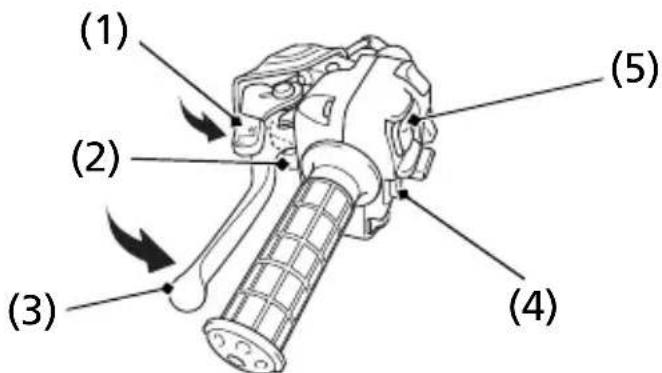
- Fully rotate the P/R lever (1) counterclockwise to engage the P/R lever with the reverse assist lever (2).
- While continuing to hold the P/R lever, squeeze the rear brake lever/parking brake lever (3), then press the downshift switch (4) once to shift into "R" (reverse) gear.
- Make sure that the reverse indicator comes on and the gear position indicator shows "R".
LEFT HANDLEBAR
text_image
(1) (2) (3) (4) (5)(1) P/R lever
(2) reverse assist lever
(3) rear brake lever/parking brake lever
(4)downshift switch
(5) upshift switch
NOTICE
Your ATV may be equipped with a reverse speed limiter, which helps the vehicle to maintain a safe speed while riding in reverse gear.
- Release the rear brake lever/parking brake lever.
- Open the throttle gradually and ride slowly. Do not open the throttle suddenly or make abrupt turns.
- To stop, close the throttle and gradually apply both the front and rear brakes. Do not abruptly apply the rear brake alone.
- To shift out of reverse and into neutral, press the upshift switch (5) once to shift into "N" (neutral) gear.
The transmission cannot be shifted from neutral back into reverse when the engine speed is above 2,300 rpm or speed of your ATV is above 2 mph (3 km/h).
The transmission cannot be shifted from reverse up to neutral when the engine speed is above 2,300 rpm or if the speed of your ATV is above 1 mph (1.5 km/h).
If you turn the ignition switch to the OFF (O) position while in reverse, the transmission will automatically return to neutral (N) when the ignition switch is turned to the ON (I) position.
WARNING
Applying only the rear brake abruptly when operating in reverse gear could cause the front wheels to lift off the ground and the ATV could overturn backwards.
Carefully apply both the front and rear brakes when stopping in reverse gear.
Your ATV is equipped with disc brakes on both front wheels which are hydraulically activated by operating the right brake lever. The single disc brake of the rear drivetrain is hydraulically activated by pressing down on the brake pedal and mechanically activated by operating the rear brake lever/parking brake lever.
Although the front and rear brakes have separate controls, all four wheels are interconnected when your ATV is in the 4WD mode. So operating any brake control in the 4WD mode will cause braking at both the front and rear wheels.
As a general rule, the front braking system provides about 70 percent of total stopping power.
For full braking effectiveness, use both the pedal and lever simultaneously. Using both braking systems will stop your ATV faster with greater stability.
To slow or stop, apply the brake lever and brake pedal smoothly, while downshifting to match your speed when your ATV is in the ESP (manual shift mode).
Gradually increase braking as you feel the brakes slowing your speed. The increase in engine compression from downshifting will help slow your ATV when your ATV is in the ESP (manual shift mode).
Applying the brakes too hard may cause the wheels to lock and slide, reducing control of your ATV. If this happens, release the brake controls, steer straight ahead until you regain control, then reapply the brakes more gently.
When possible, reduce your speed or complete braking before entering a turn. Avoid braking or closing the throttle quickly while turning. Either action may cause one or more wheels to slip and reduce your control of your ATV.
Your ability to brake in a turn and to brake hard in an emergency situation are important riding skills.
When descending a long, steep grade, use engine compression braking by downshifting (in the ESP mode), with intermittent use of both brakes. Continuous brake application can overheat the brakes and reduce their effectiveness.
Riding with your foot resting on the brake pedal or your hands on the brake levers may overheat the brakes, reducing effectiveness.
For information on how to apply the brakes in various riding situations, see the following section, Riding Your ATV.
Making Turns
Learn how to turn your ATV properly. Practice the techniques outlined in this section on level ground and at low speeds until you are confident in making turns.
WARNING
Turning improperly can make the ATV go out of control, causing a collision or overturn.
- Always follow proper procedures for turning as described in this owner's manual.
- Practice turning at low speeds before attempting to turn at faster speeds.
- Do not turn at excessive speeds.
natural_image
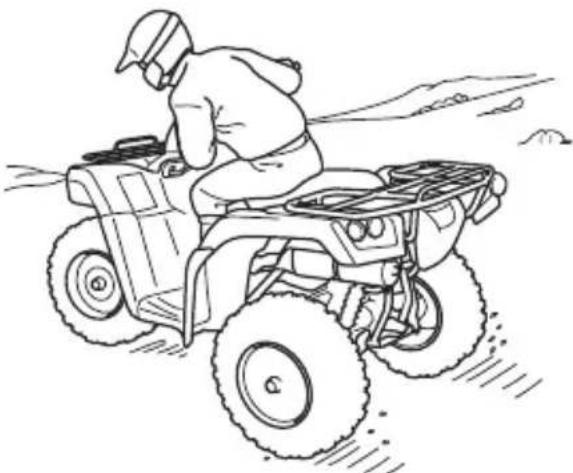
Line drawing of a person riding a multi-axle off-road vehicle with motion blur (no text or symbols)Lean your body to the inside of a turn and forward.
To make a turn on level ground: Steer the handlebar and lean your body toward the inside of the turn. Leaning helps balance the vehicle, and it feels more comfortable. Leaning into a turn is an important technique to master in riding an ATV.
To make a sharp turn at low speed: It helps to shift your body slightly forward on the seat, and lean inside, as you steer the handlebar. Shifting weight forward allows the rear wheels to turn easier, and it also improves front-wheel steering.
To make a turn from a full stop: Apply the throttle gradually when you turn and start at the same time. Remember to shift your body forward to make sharp low-speed turns and whenever you turn while accelerating from a full stop.
Skidding or Sliding
The terrain surface can be a major factor affecting turns. Skidding during a turn is more likely to occur on slippery surfaces, such as snow, ice, mud and loose gravel. If you skid on ice, you may lose all directional control. To avoid skidding on slippery terrain, keep your speed low and ride with caution.
WARNING
Skidding or sliding improperly may cause you to lose control of this ATV. You may also regain traction unexpectedly, which may cause the ATV to overturn.
Learn to safely control skidding by practicing at low speeds and on level, smooth terrain.
If your ATV skids sideways during a turn, steer in the direction of the skid. Avoid hard braking or accelerating until you have regained directional control.
Riding Your ATV
Riding Up Hills
The ATV's ability to safely climb hills largely depends on the rider's skill and judgment. Begin by practicing on smooth, gentle slopes. As you gain experience, you'll learn the hazards and your own limitations. You may then proceed to ride on more difficult terrain. However, you must be able to decide which hills or hazards might cause the ATV to overturn. Avoid excessively steep hills.
Operating on excessively steep hills can cause the vehicle to overturn more easily than operating on level surfaces or small hills.
Never operate the ATV on hills too steep for the ATV or for your abilities.
When climbing hills, you must shift weight toward the front wheels to help keep them on the ground. To do this, shift your body slightly forward on the seat and lean forward. For greater weight shift, move your body farther forward and lean forward.
Climbing hills improperly could cause loss of control or cause the ATV to overturn.
Always follow proper procedures for climbing hills as described in this owner's manual.

natural_image
Line drawing of a person riding a off-road vehicle through rough terrain (no text or symbols)Shift weight forward when climbing hills.
• Always check the terrain carefully before you start up any hill.
- Never climb hills with excessively slippery or loose surfaces.
- To climb a hill, take a running start in an appropriate gear and speed for the conditions. Maintain a steady speed as you ascend the hill.
- Never open the throttle suddenly or make sudden gear changes. The ATV could flip over backward.
- Never go over the top of any hill at high speed. An obstacle, a sharp drop, or another vehicle or person could be on the other side of the hill.
Stalling the ATV and/or Rolling Backwards:
If you incorrectly estimate climbing capability or terrain conditions, the ATV may not have enough power or traction to continue uphill. If this happens, the ATV can stall and/or roll backwards.
WARNING
Stalling, rolling backwards or improperly dismounting while climbing a hill could result in the ATV overturning.
Always follow proper procedures for climbing a hill as described in this owner's manual.
What to do if the ATV stalls or rolls backwards when climbing a hill:
If you are about to lose all forward speed:
- Using the front and rear brakes together, bring the ATV to a stop with the vehicle pointed straight uphill.
- Get off the ATV while you continue holding the brakes.
- Shift into neutral, set the parking brake and turn the engine off.
- Then assess the situation.
If the ATV starts rolling backwards before you begin braking:
- Keep your weight uphill.
- Carefully apply the front brakes first, then carefully apply the rear brake. Do not apply either brake abruptly if you are rolling backwards, or the vehicle may overturn.
If the ATV continues sliding backwards:
After you've applied the brakes, get off and away from the vehicle.
Remember that operating any brake control in the 4WD mode will cause braking at both the front and rear wheels.
What to do after the ATV has stalled or rolled backwards:
If the hill is too steep or too slippery, or if you have any doubt whether you can safely walk the ATV back down the hill, leave the vehicle where it is and get help. If possible, block the wheels so the vehicle doesn't roll backwards.
If the hill is not too steep and you have good footing, you may be able to walk the ATV back down the hill. Make sure your intended path is clear in case you lose control of the ATV.

natural_image
Line drawing of a person riding a multi-rotor vehicle in a field (no text or symbols)Be sure your legs are clear of the wheels.

natural_image
Line drawing of a person riding a heavy-duty off-road vehicle through rough terrain (no text or symbols)Body position for backing down a hill.
- Stand with your body facing downhill, beside the vehicle so you can reach the rear brake lever/parking brake lever with your right hand.
- Be sure your legs are clear of the wheels.
Check your footing. - Slowly and carefully back the ATV down the hill using the rear brake lever/parking brake lever to control speed.
- If you lose control of the ATV, for your safety, get away from the vehicle.
Riding Down Hills
It's usually advisable to descend hills with the ATV pointed straight downhill. Avoid angles that would cause the vehicle to lean sharply to one side.
WARNING
Going down a hill improperly could cause loss of control or cause the ATV to overturn.
Always follow proper procedures for going down hills as described in this owner's manual.

natural_image
Line drawing of a person riding a multi-axle off-road vehicle in motion (no text or symbols)On downhills, shift your weight back.
As you approach a downhill, stop and survey the terrain below. Never ride past the limit of your visibility. Never go down a hill at high speed.
When you've selected a safe downhill path, shift into a lower gear, shift your weight back with your arms extended and braced against the handlebar, then go down slowly with the throttle closed.
Use mainly the rear brake to control speed. Avoid using either the front brake or rear brake hard or abruptly when riding down hills.
Remember that operating any brake control in the 4WD mode will cause braking at both the front and rear wheels.
Remember, braking effectiveness is reduced on any hill with a loose surface.
Crossing or Turning on Hills or Slopes
Riding on hills or slopes is different from riding on level terrain. Be careful when riding on any hill. Make sure that you practice on gentle, smooth slopes before attempting to ride on steeper or more difficult terrain.
WARNING
Improperly crossing hills or turning on hills could cause loss of control or cause the ATV to overturn.
Always follow proper procedures for crossing or turning on slopes as described in this owner's manual. Avoid crossing steep hills if possible.
Riding Your ATV
Crossing Hills or Slopes
- To maintain balance and stability when riding across a slope, you need to shift weight toward the uphill side of the vehicle. To do this, move your body off the center of the seat and lean toward the uphill side.
- On a slippery or loose surface, you may also need to steer slightly uphill to maintain a straight course across the slope.
- Avoid crossing hills that are excessively steep, slippery or rough.

natural_image
Line drawing of a person riding an ATV off-road terrain (no text or symbols)Shift weight uphill when crossing slopes
Making Turns on Slopes
- Compared to riding on level ground, you may need to shift more weight and lean more when making turns on slopes.
- Do not make turns on any slopes until you have first mastered the techniques for making turns on level terrain.
Riding Over Obstacles
Before operating in a new area, check for obstacles. Watch out for bumps, rain ruts, potholes and other obstacles in the terrain. When you approach any obstacle, reduce your speed and be prepared to stop.
Never try to ride over large obstacles, such as large rocks or fallen logs.
WARNING
Improperly operating over obstacles could cause loss of control or a collision and could cause the ATV to overturn.
When you go over obstacles, always follow proper procedures as described in this owner's manual.
Riding Through Water
Your ATV is designed to travel through water up to approximately 10 inches (254 mm) deep. Before crossing a stream, make sure the water is not too deep or flowing too fast.
WARNING
The ATV tires have some ability to float. Operating this ATV through deep or fast-flowing water may cause a loss of traction and loss of control, which could lead to a crash.
Never operate this ATV in fast-flowing water or in water deeper than that specified in this owner's manual.
NOTICE
Water entering the muffler may damage the oxygen sensor and result in emissions control system malfunction. Have your ATV dealer inspect the oxygen sensor immediately after water enters the muffler.
- Choose a path where both banks have gradual slopes.
- Proceed through the water at a slow, steady speed.
- Watch out for submerged obstacles and slippery rocks.
- Avoid getting the spark plug or air cleaner wet, as this would cause the engine to stop.
-
After leaving the water, always test both the front and rear brakes.
-
Riding through water can make the brakes less effective than normal, and may reduce stopping ability.
- If necessary, apply the brakes repeatedly until they dry out and operate normally.
Parking
- Look for level parking area. Make sure the ground surface is firm.
- After bringing your ATV to a stop, hold the brakes while you shift into neutral.
- Set the parking brake. (page 43)
- Turn the ignition switch to OFF (O).
If it is necessary to start the engine when your ATV in gear and is stopped on a grade, rock the vehicle back and forth to allow shifting the transmission into neutral.
The brake light is activated by applying the parking brake. When using the parking brake, be sure to turn the ignition switch to OFF (O) to avoid discharging the battery.
Parking on a Steep Incline or a Loose or Slippery Surface
If you must park your ATV on a steep incline or loose or slippery surface, use the following procedure:
- While holding the brakes, set the parking brake.
- Turn the ignition switch to OFF (O) and release the brakes.
- If the ATV begins to move, either while sitting on it or after you dismount, find a better parking location.
- If rocks or other objects are available, you can block the wheels as shown for additional security.
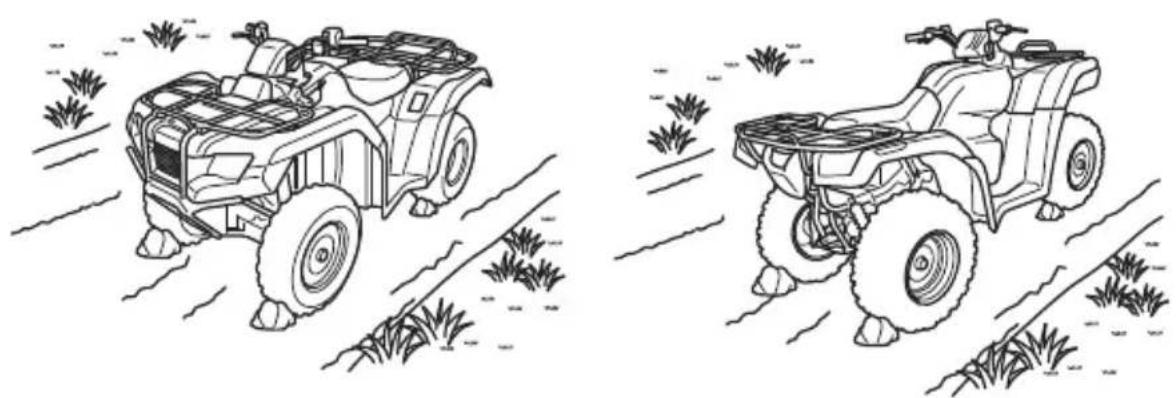
natural_image
Two line drawings of a grassy field with an open-top off-road vehicle, no text or symbols present.To help keep your ATV in good shape, this section includes a Maintenance Schedule for required service and step-by-step instructions for specific maintenance tasks. You'll also find important safety precautions, information on fuels and oils, and tips for keeping your Honda looking good.
For information about replacing fuses, see page 220.
For information about the exhaust emission and noise requirements of the U.S. Environmental Protection Agency (EPA) and Environment Climate Change Canada (ECCC), see page 238.
USA only
Maintenance, replacement or repair of the emission control devices and systems may be performed by any ATV repair establishment or individual using parts that are “certified” to EPA standards.
Before You Service Your Honda
The Importance of Maintenance.... 105
Maintenance Safety.... 106
Important Safety Precautions 107
Maintenance Schedule 108
Maintenance Record.... 112
Service Preparations
Maintenance Component Locations 113
Tool Kit 116
Owner's Manual Storage 117
Seat Removal.... 118
Tank Cover Assembly Removal 119
Rear Fender Cover Removal 121
Clip Removal 122
(cont'd)
Servicing Your Honda
Service Procedures
Fluids & Filters
Fuel.... 123
Engine Oil & Filter 126
Rear Final Gear Oil.... 134
Front Final Gear Oil.... 137
Coolant 139
Air Cleaner 146
Engine
Throttle 152
Reverse Inhibitor System 154
Spark Plug 155
Valves.... 158
Spark Arrester 159
Chassis
Suspension 160
Brakes 163
Tires 172
Guards 179
Drivetrain Boots.... 182
Electrical
Battery 184
Appearance Care.... 189
The Importance of Maintenance
A well-maintained ATV is essential for safe, economical, and trouble free riding. It will also help reduce air pollution. Careful pre-ride inspections and good maintenance are especially important because your ATV is designed to be ridden over rough off-road terrain.
To help you properly care for your ATV, this section of the manual provides a Maintenance Schedule. The service intervals in this schedule are based on average riding conditions.
WARNING
Improperly maintaining this ATV or failing to correct a problem before you ride can cause a crash in which you can be seriously hurt or killed.
Always follow the inspection and maintenance recommendations and schedules in this owner's manual.
Frequent servicing of the air cleaner is especially important to help you avoid a possible costly engine repair.
If your ATV overturns or is involved in a crash, be sure your dealer inspects all major parts, even if you are able to make some repairs.
This section includes instructions on how to perform some important maintenance tasks. If you have basic mechanical skills, you can perform many of these tasks with the tools provided with your ATV.
Other tasks that are more difficult and require special tools are best performed by professionals. Removing the wheels should normally be handled only by a Honda technician or other qualified mechanic. Instructions are included in this manual only to assist in emergency service.
Some of the most important safety precautions follow. However, we cannot warn you of every conceivable hazard that can arise in performing maintenance. Only you can decide whether or not you should perform a given task.
WARNING
Failure to properly follow maintenance instructions and precautions can cause you to be seriously hurt or killed.
Always follow the procedures and precautions in this owner's manual.
Important Safety Precautions
- Make sure the engine is off before you begin any maintenance or repairs. This will help eliminate several potential hazards:
Carbon monoxide poisoning from engine exhaust. Be sure there is adequate ventilation whenever you operate the engine.
Burns from hot ATV parts. Let the engine and exhaust system cool before touching.
Injury from moving parts. Do not run the engine unless instructed to do so.
- Read the instructions before you begin, and make sure you have the tools and skills required.
- To reduce the possibility of a fire or explosion, be careful when working around gasoline. Use only non-flammable solvent, not gasoline, to clean parts. Keep cigarettes, sparks, and flames away from all fuel-related parts.
Remember that your Honda dealer knows your ATV best and is fully equipped to maintain and repair it. To ensure the best quality and reliability, use only new Honda Genuine Parts or other equivalents for repair and replacement. If you have the tools and skills required for additional maintenance jobs, you can purchase an official Honda Service Manual (page 246).
The required Maintenance Schedule that follows specifies how often you should have your ATV serviced, and what things need attention. It is essential to have your ATV serviced as scheduled to maintain safe, dependable performance and proper emission control.
The service intervals in this Maintenance Schedule are based on average riding conditions. Some items will need more frequent service if you ride in unusually wet or dusty areas or at full throttle. Consult your dealer for recommendations applicable to your individual needs and use.
Some items in the Maintenance Schedule can be performed with basic mechanical skills and hand tools. Procedures for these items are provided in this manual. Other items involve more extensive procedures and may require special training, tools, and equipment. We recommend that you have your dealer perform these tasks unless you have advanced mechanical skills and the required tools and equipment. Procedures for such items in this schedule are provided in an official Honda Service Manual available for purchase (page 246).
If you do not feel capable of performing a given task or need assistance, remember that your Honda dealer knows your ATV best and is fully equipped to maintain and repair it. If you decide to do your own maintenance, use only Honda Genuine Parts or their equivalents for repair or replacement to ensure the best quality and reliability.
Perform the pre-ride inspection (page 55) and owner maintenance on this section at each scheduled maintenance period.
Each item on the maintenance schedule requires some mechanical knowledge. Certain items (particularly those marked * and **) may require more technical information and tools. Consult your dealer.
*Should be serviced by your dealer, unless the owner has proper tools and service data and is mechanically qualified. Refer to the official Honda Service Manual (page 246).
**In the interest of safety, we recommend these items be serviced only by your dealer.
Summary of Maintenance Schedule Notes & Procedures:
NOTES:
- Service more frequently when riding in dusty areas, sand or snow.
- Service more frequently after riding in very wet or muddy conditions.
- Replace every 2 years. Replacement requires mechanical skill.
Maintenance Schedule
Maintenance Procedures:
I: inspect and clean, adjust, lubricate, or replace, if necessary
C: clean
A: adjust
L: lubricate
R: replace
| FREQUENCYITEMS NOTE HOURS 20 100 200 | WHICHEVERCOMES FIRST | INITIAL REGULARMAINT. MAINT. INTERVAL | Refer to page | |||
| mi 100 600 1200 | ||||||
| km 150 1000 2000 | ||||||
| MONTH | 1 | 6 | 12 | |||
| *FUEL LINE I — | ||||||
| *THROTTLE OPERATION | I | 152 | ||||
| AIR CLEANER | NOTE 1 | C | C | |||
| AIR CLEANER HOUSING DRAIN TUBE | NOTE 2 | I | I | |||
| SPARK PLUG | I | I | ||||
| * | VALVE CLEARANCE | I | I | I | ||
| ENGINE OIL | INITIAL=100 mi (150km), 20operating hours or 1month: RREGULAR=Every 600 mi (1,000 km),100 operating hours or 12months: R | 126 | ||||
| ENGINE OIL FILTER | 131 | |||||
| RADIATOR COOLANT | NOTE 3 | I | I | |||
| *COOLING SYSTEM | NOTE 2 | I | I | |||
* Should be serviced by your dealer, unless the owner has proper tools and service data and is mechanically qualified. Refer to the official Honda Service Manual (page 246).
Maintenance Schedule
| FREQUENCYITEMS NOTE | WHICHEVERCOMES FIRST | INITIAL REGULARMAINT. MAINT. INTERVAL | Refer to page | |||
| mi 100 | 600 1200 | |||||
| km 15 | 0 1000 2000 | |||||
| MONTH 1 | 6 | 1 | 2 | |||
| HOURS 20 | 100 200 | |||||
| DRIVETRAIN BOOTS I | I | 182 | ||||
| FRONT/ REAR FINAL GEAR OIL | (R: EVERY 2 YEARS) | I | ||||
| * | 2WD/4WD SELECT SYSTEM | I | ||||
| * | BRAKE FLUID | NOTE 3 | I | I | ||
| * | BRAKE PADS WEAR | NOTE 1, 2 | I | |||
| * | BRAKE LIGHT SWITCH | I | I | I | ||
| BRAKE SYSTEM | I | I | I | |||
| * | REVERSE INHIBITOR SYSTEM | I | I | I | ||
| GUARDS | I | I | ||||
| * | SUSPENSION | I | I | |||
| * | SPARK ARRESTER | C | C | |||
| * | NUTS, BOLTS, FASTENERS | I | I | |||
| ** | WHEELS/TIRES | I | I | I | ||
| ** | TIE-ROD AND JOINT BOOTS | I | I | I | ||
| ** | STEERING SHAFT HOLDER BEARINGS | I | ||||
| ** | STEERING SYSTEM | I | ||||
* Should be serviced by your dealer, unless the owner has proper tools and service data and is mechanically qualified. Refer to the official Honda Service Manual (page 246).
**In the interest of safety, we recommend these items be serviced only by your dealer.
Maintenance Record
Keeping an accurate maintenance record will help ensure that your ATV is properly maintained. Retain detailed receipts to verify the maintenance was performed. If the ATV is sold, these receipts should be transferred with the ATV to the new owner. Make sure whoever performs the maintenance completes this record. All scheduled maintenance, including the 100 mile (150 km) or 1 month or 20 hours initial maintenance, is considered a normal owner operating cost and will be charged for by your dealer. Use the space under Notes to record anything you want to remind yourself about or mention to your dealer.
| Miles (km) or months or hours | ODO or HOUR | Date Performed By: | Notes |
| 100 (150) or 1 or 20 | |||
| 600 (1,000) or 6 or 100 | |||
| 1,200 (2,000) or 12 or 200 | |||
| 1,800 (3,000) or 18 or 300 | |||
| 2,400 (4,000) or 24 or 400 | |||
| 3,000 (5,000) or 30 or 500 | |||
| 3,600 (6,000) or 36 or 600 | |||
| 4,200 (7,000) or 42 or 700 | |||
| 4,800 (8,000) or 48 or 800 |
Maintenance Component Locations
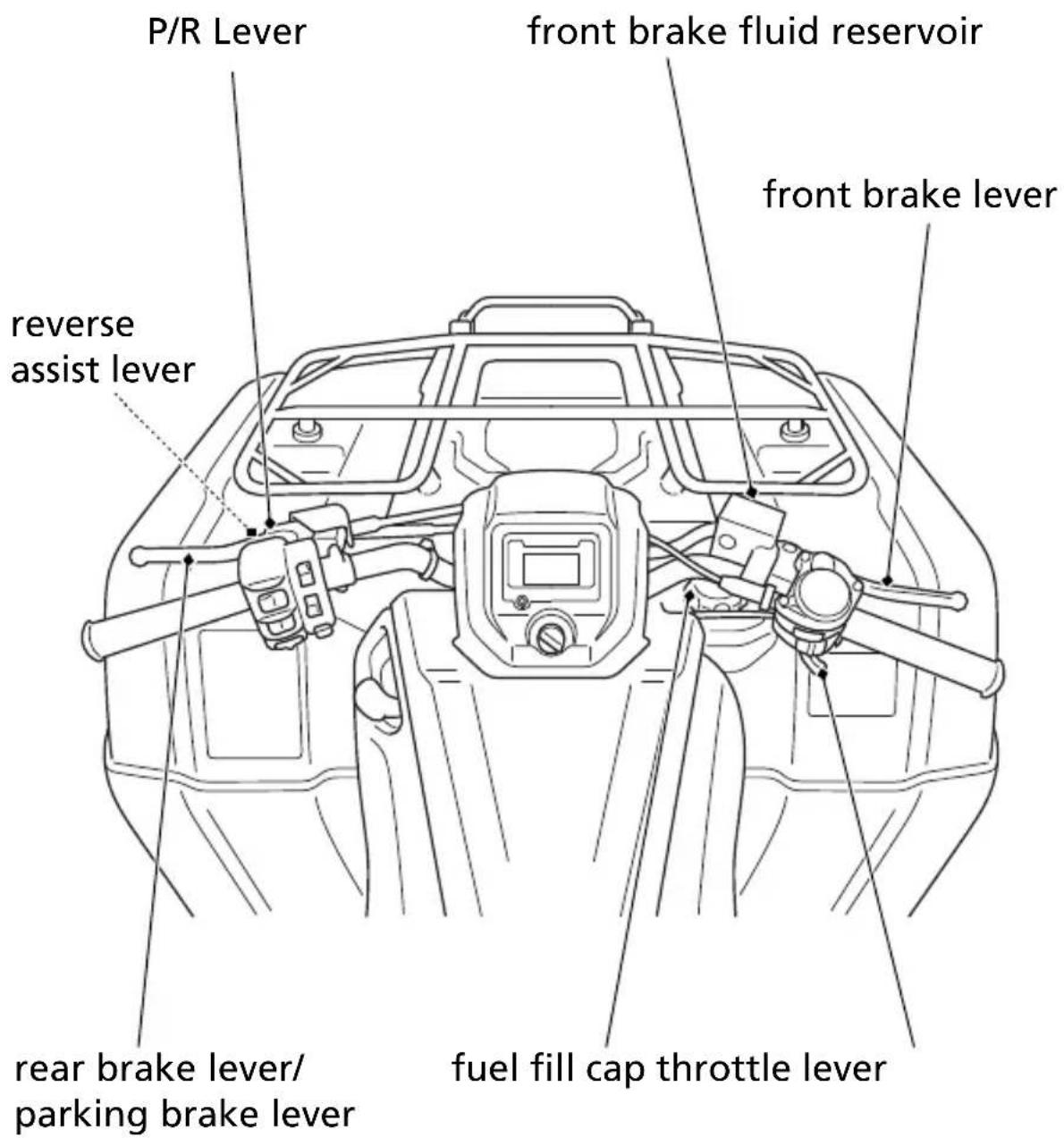
text_image
P/R Lever front brake fluid reservoir front brake lever reverse assist lever rear brake lever/ parking brake lever fuel fill cap throttle leverMaintenance Component Locations
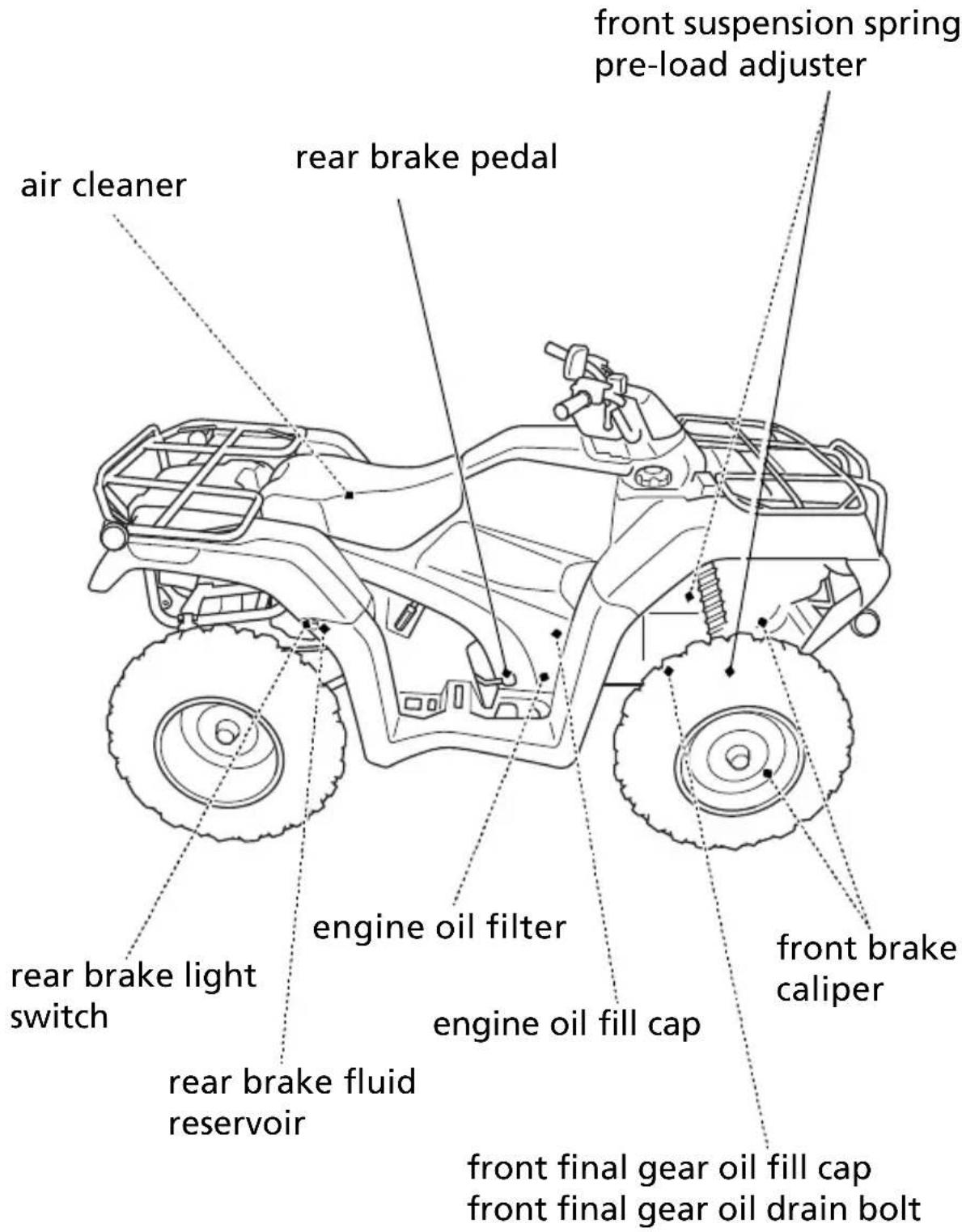
text_image
front suspension spring pre-load adjuster rear brake pedal air cleaner engine oil filter rear brake light switch engine oil fill cap rear brake fluid reservoir front brake caliper front final gear oil fill cap front final gear oil drain bolt114 Servicing Your Honda
Maintenance Component Locations

text_image
owner's manual air pressure gauge battery fuse box main fuse 1 main fuse 2 EPS fuse (TRX420FA6 only) coolant reserve tank tool kit gear change tool spark arrester engine oil dipstick spark plug engine oil drain bolt air cleaner housing drain tube rear suspension spring pre-load adjuster rear final gear oil fill cap rear final gear oil drain boltTool Kit
The tool kit (1) and the gear change tool (2) are stored in the storage compartment (page 47).
After using the tool kit or the gear change tool, be sure to use the rubber band (3) to fasten the tool kit and the gear change tool securely.
An optional, larger tool kit may be available. Check with your dealer's parts department.
REAR
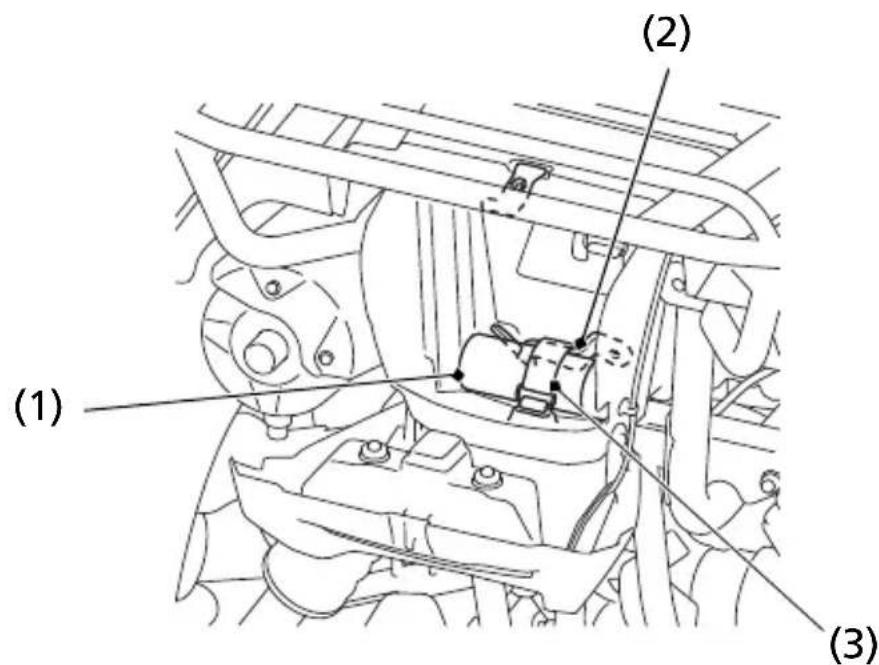
text_image
(1) (2) (3)(1) tool kit
(2) gear change tool
(3) rubber band
Owner's Manual Storage
Your ATV provides storage for the owner's manual so you'll have it with you for easy reference. Store your owner's manual (1) in the plastic document bag (2) underside of the rear fender cover (3).
The owner's manual and air pressure gauge (4) should be stored in the plastic document bag and fastened with the rubber band (5).
To remove the rear fender cover, see page 121.
Be careful not to flood this area when washing your ATV. REAR FENDER COVER UNDERSIDE

text_image
(1) (2) (3) (4) (5)(1) owner's manual
(2) plastic document bag
(3) rear fender cover
(4) air pressure gauge
(5) rubber band
Refer to Safety Precautions on page 107.
The seat must be removed for the air cleaner, engine oil, engine oil filter, spark plug, battery and fuse maintenance and to remove the rear fender cover and tank cover assembly, to access the owner's manual, and air pressure gauge.
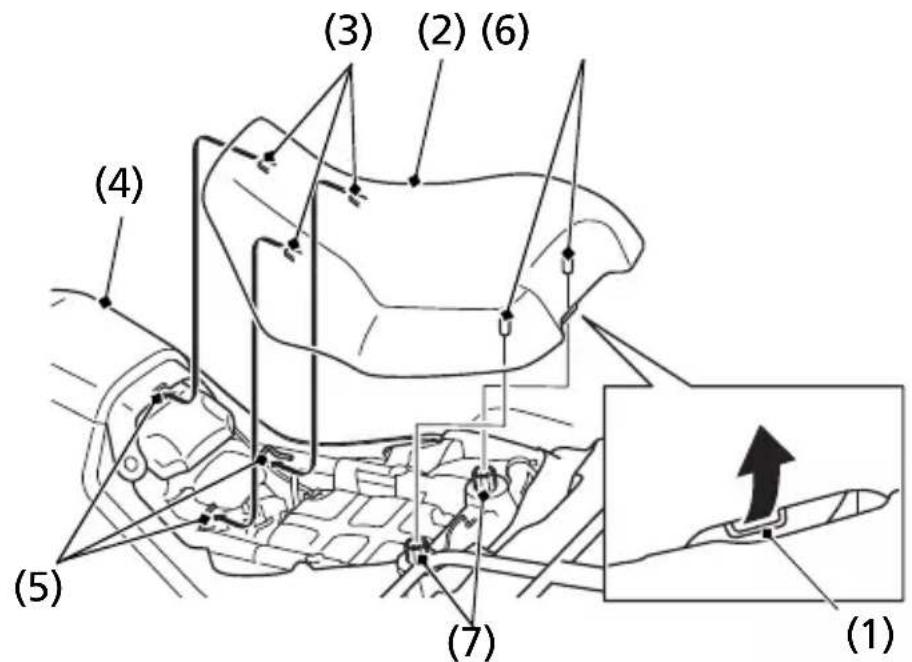
- Pull the seat latch (1) at the rear of the seat.
- Slide the seat (2) back and lift it.
Installation
- Insert the front prongs (3) into the backside of the tank cover (4) and hooks (5) on the frame, and press the studs (6) into the grommets (7).
- Press down on the seat until locks.
118 Servicing Your Honda
Tank Cover Assembly Removal
Refer to Safety Precautions on page 107.
The tank cover assembly must be removed for the engine oil, engine oil filter and spark plug maintenance.
RIGHT SIDE
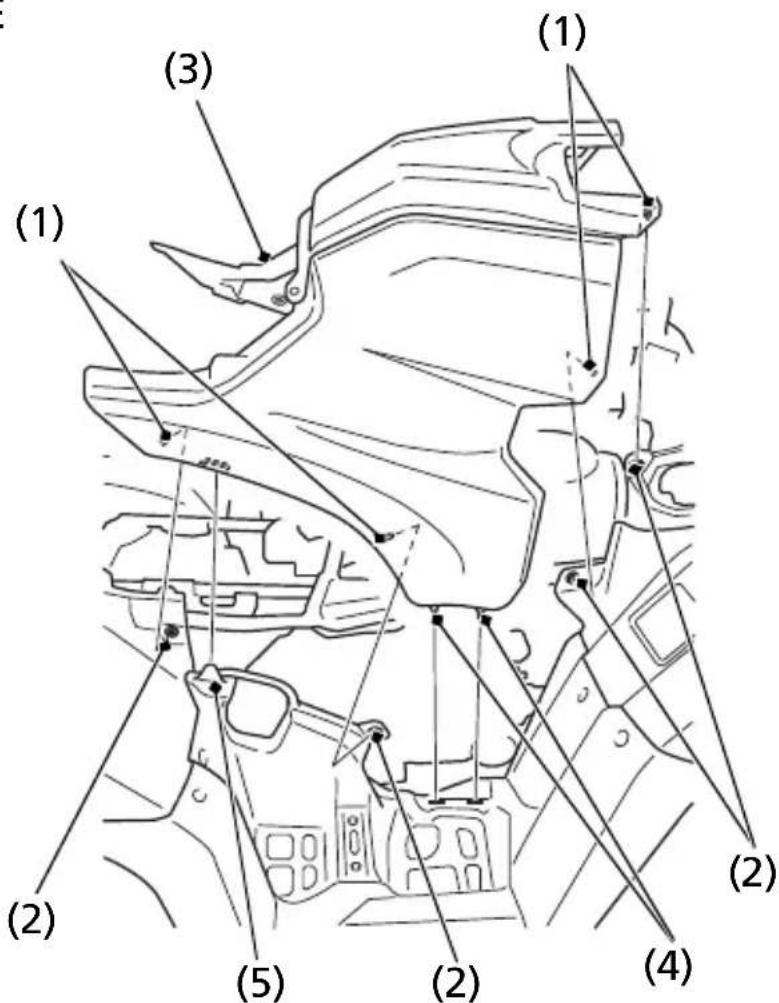
text_image
(1) (2) (3) (4) (5) (2) (1)(1) prongs
(4) tabs A
(2) grommets
(5) tabs B
(3) tank cover assembly
Removal
- Remove the seat (page 118).
- Remove the prongs (1) from the grommets (2).
- Remove the tank cover assembly (3) by releasing the tabs A (4) and tabs B (5).
Tank Cover Assembly Removal
LEFT SIDE
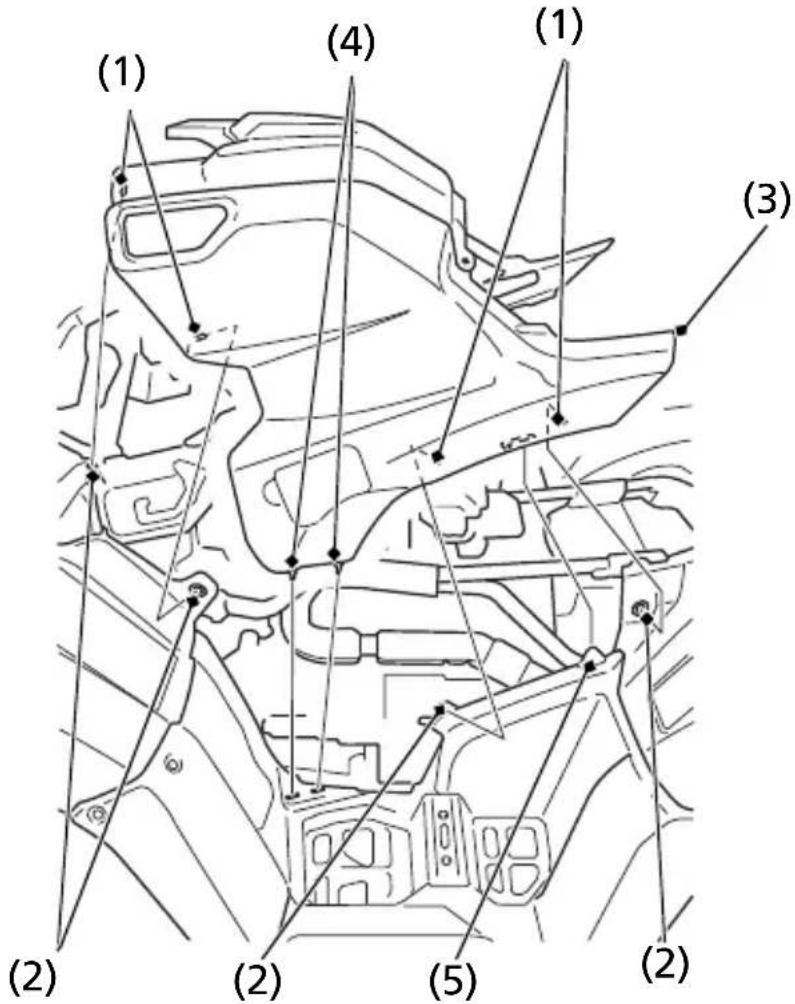
text_image
(1) (2) (4) (1) (3) (2) (5)(1) prongs
(4) tabs A
(2) grommets
(5) tabs B
(3) tank cover assembly
Installation
Install the parts in the reverse order of removal.
Make sure that all prongs and tabs are installed securely in position.
Rear Fender Cover Removal
Refer to Safety Precautions on page 107.
The rear fender cover must be removed for battery, fuse maintenance and to access the owner's manual, and air pressure gauge.
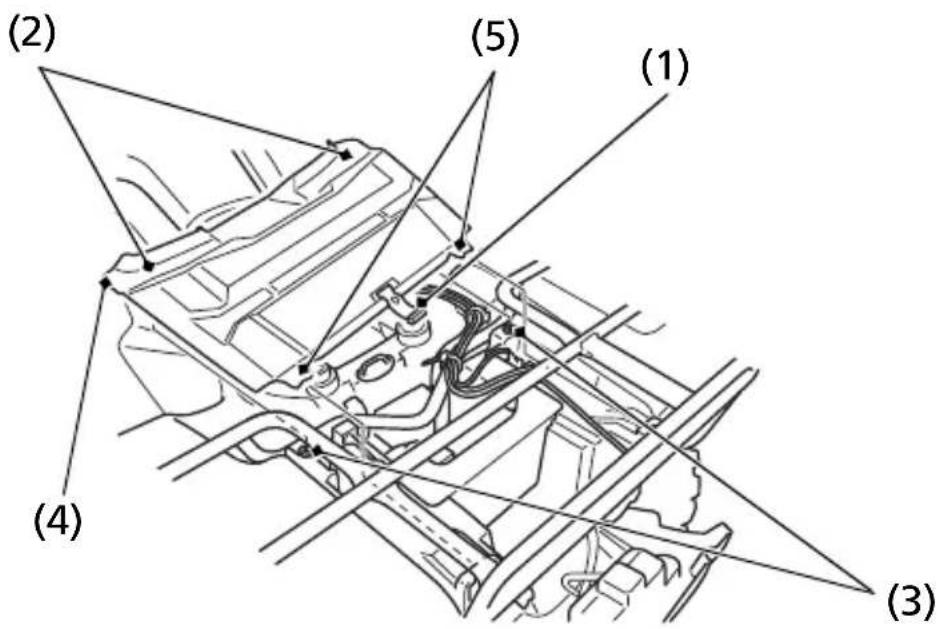
text_image
(2) (5) (1) (4) (3)(1) rubber strap
(4) rear fender cover
(2) prongs
(5) tabs
(3) grommets
Removal
- Remove the seat (page 118).
- Unhook the rubber strap (1).
- Firmly pull the prongs (2) from their grommets (3).
- Slide the rear fender cover (4) forward to disengage the tabs (5).
- Remove the rear fender cover.
Installation
Install the parts in the reverse order of removal.
Clip Removal
Removal
- Pull up the center pin to release the lock.
- Pull out the clip of the hole.
1.2.

natural_image
Two mechanical component diagrams showing a pin or knob assembly with directional arrows (no text or symbols)Installation
- Insert the clip into the hole.
- Press down the center pin securely to lock the clip.
1.2.

natural_image
Diagram showing two mechanical components with arrows indicating direction of movement (no text or symbols)122 Servicing Your Honda
Refer to Safety Precautions on page 107.
Fuel Recommendation
| type unleaded | |
| pump octane number 86 | (or higher) |
Use only unleaded fuel in your Honda. If you ride your Honda in a country where leaded fuel might be available, take precautions to use only unleaded fuel.
Your engine is designed to use any unleaded gasoline that has a pump octane number of 86 or higher. Gasoline pumps at service stations normally display the pump octane number. For information on the use of oxygenated fuels, see page 242.
Use of lower octane gasoline can cause persistent “pinging” or “spark knock” (a loud rapping noise) which, if severe, can lead to engine damage. Light pinging experienced while operating under a heavy load, such as climbing a hill, is no cause for concern.
If pinging or spark knock occurs at a steady engine speed under normal load, change brands of gasoline. If pinging or spark knock persists, consult your dealer.
Never use stale or contaminated gasoline or an oil/gasoline mixture. Avoid getting dirt, dust, or water in the fuel tank.
Fuel Capacity
Fuel tank capacity, including reserve:
3.88 US gal (14.7 ℓ)
Reserve capacity:
1.29 US gal (4.9 ℓ)
When there is only one segment left in the fuel gauge (page 25), fuel will be low and you should refuel as soon as possible.
Refueling Procedure
Refer to Safety Precautions on page 107.
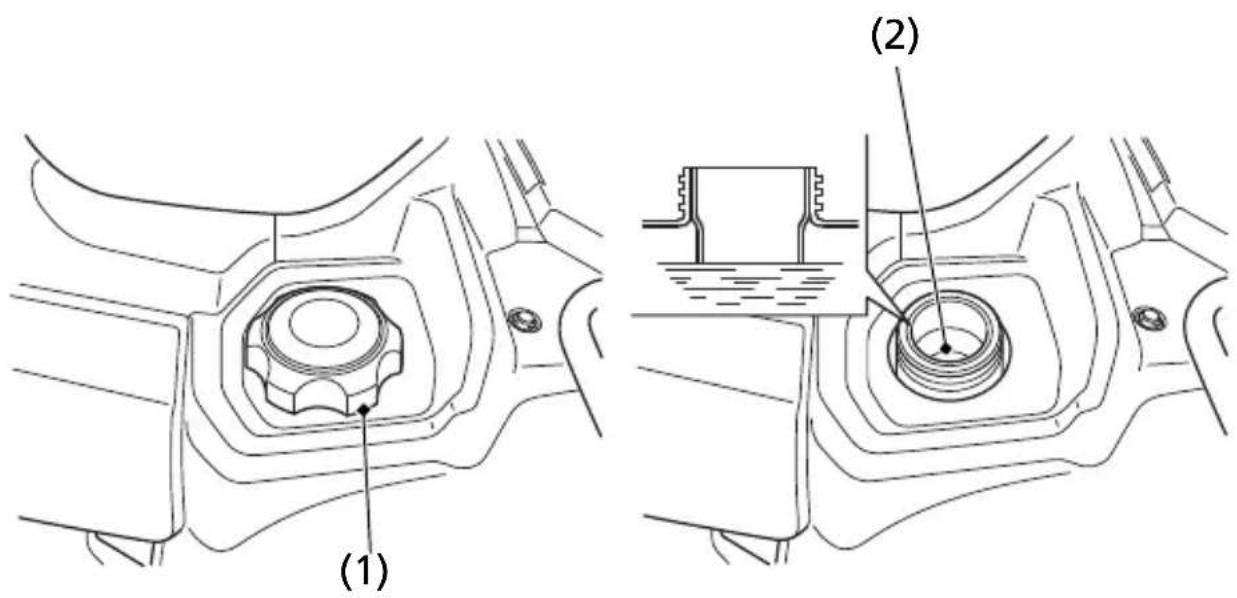
text_image
(1) (2)(1) fuel fill cap
(2) bottom of filler neck
124 Servicing Your Honda
- To open the fuel fill cap (1), turn it counterclockwise.
- Add fuel until the level reaches the bottom of the filler neck (2). Avoid over filling the tank. There should be no fuel in the filler neck.
WARNING
Gasoline is highly flammable and explosive. You can be burned or seriously injured when handling fuel.
- Stop the engine and keep heat, sparks and flame away.
- Handle fuel only outdoors.
-
Wipe up spills immediately.
-
After refueling, turn the fuel fill cap clockwise securely.
If you replace the fuel fill cap, use a Honda Genuine replacement part or equivalent.
NOTICE
Gasoline can damage the camouflage coating. Do not allow spilled gasoline to pool on camouflage colored bodywork. Also do not allow gasoline soaked rags to be placed on camouflage bodywork.
Engine oil quality is a major factor that affects both the performance and the service life of the engine.
Using the proper oil (page 127) and filter, and regularly checking, adding, and changing oil will help extend your engine's life. Even the best oil wears out. Changing oil helps get rid of dirt and deposits in the engine. Operating the engine with old or dirty oil can damage your engine. Running the engine with insufficient oil can cause serious damage to the engine and transmission.
Change the engine oil as specified in the maintenance schedule on page 110. When running in very dusty conditions, oil changes should be performed more frequently than specified in the maintenance schedule.
Oil Recommendation
| API classification SG or | higher except oils labeled as energy conserving or resource conserving on the circular API service label |
| viscosity (weight) SAE | 10W-30 |
| JASO T 903 standard | MA |
| suggested oil* | Pro Honda GN4 4-stroke oil (USA & Canada), or Honda 4-stroke oil, or an equivalent motorcycle oil. |
* Suggested oils are equal in performance to SJ oils that are not labeled as energy conserving or resource conserving on the circular API service label.
- Your ATV does not need oil additives. Use the recommended oil.
- Do not use oils with graphite or molybdenum additives. They may adversely affect clutch operation.
- Do not use API SH or higher oils displaying a circular API “energy conserving” or “resource conserving” service label on the container. They may affect lubrication and clutch performance.
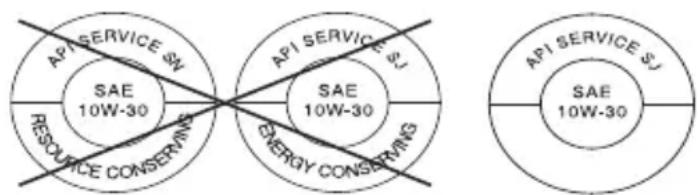
text_image
API SERVICE SN SAE 10W-30 RESOURCE CONSERVING API SERVICE SN SAE 10W-30 ENERGY CONSERVING API SERVICE SN SAE 10W-30NOT RECOMMENDED RECOMMENDED
- Do not use non-detergent, vegetable, or castor based racing oils.
Engine Oil & Filter
Other viscosities shown in the following chart may be used when the average temperature in your riding area is within the indicated range.
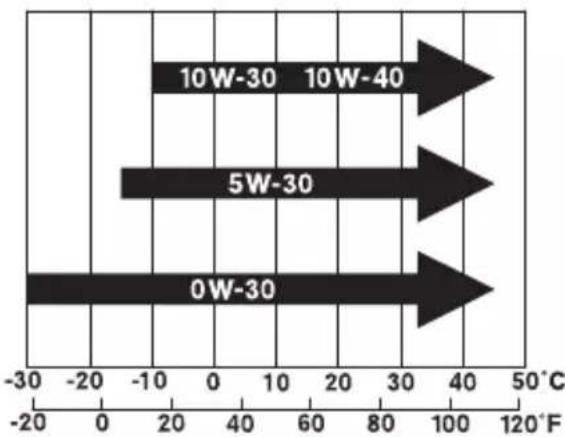
bar
| Range | Value | |---|---| | 10W-30 | -12 | | 5W-30 | -8 | | 0W-30 | -4 |JASO T 903 standard
The JASO T 903 standard is an index for engine oils for 4-stroke motorcycle engines.
There are two classes: MA and MB.
Oil conforming to the standard is labeled on the oil container. For example, the following label shows the MA classification.
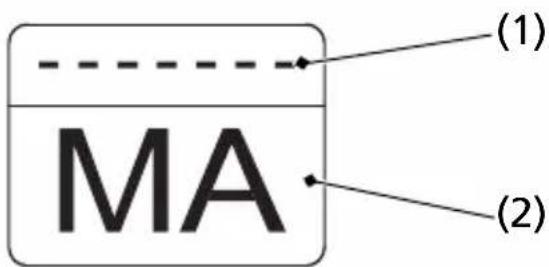
text_image
MA (1) (2)(1) oil code
(2) oil classification
Checking & Adding Oil
Refer to Safety Precautions on page 107.
Check the engine oil level each day before operating your ATV and add if needed.
Before riding your ATV, check the engine oil level.
- Park your ATV on a firm, level surface.
-
Start the engine in a well-ventilated area and let it idle for 3 – 5 minutes. If the air temperature is below 10^ C ( 50^ F), let the engine idle for an additional 5 minutes (a total of 10 minutes).
-
Stop the engine and wait 2 - 3 minutes.
-
Remove the oil check lid (1).
-
Remove the dipstick (2) from the front left crankcase cover and wipe it clean.
-
Insert the dipstick without screwing it in, then remove the dipstick and check the oil level. The oil level should be between the upper level mark (3) and the lower level mark (4) on the dipstick.
LEFT SIDE

text_image
(1) (2) (3) (4)(1) oil check lid
(2) dipstick (3) upper level mark
(4) lower level mark
(cont'd)
Engine Oil & Filter
- If the oil level is near or below the lower level mark, remove the seat (page 118) and the tank cover assembly (page 119). Remove the oil fill cap (5) from the front right crankcase cover and add the specified oil into the fill cap hole, up to the upper level mark on the dipstick.
Do not over fill.
- Reinstall the oil fill cap and dipstick.
- Install the tank cover assembly.
- Install the seat.
- Install the oil check lid.
NOTICE
Running the engine with an improper oil level can cause serious engine damage.
RIGHT SIDE
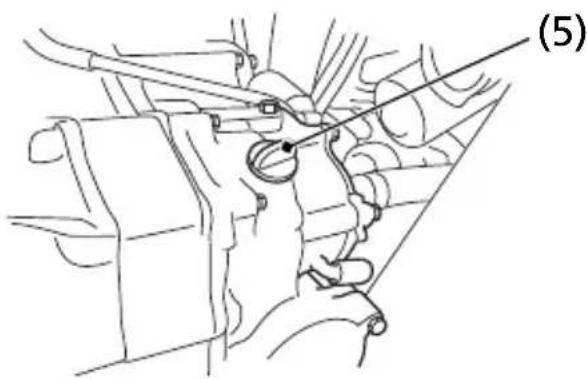
natural_image
Mechanical assembly diagram showing a valve mechanism with no visible text or symbols(5) oil fill cap
Changing Engine Oil & Filter
Refer to Safety Precautions on page 107.
Your ATV's oil filter has very specific performance requirements. Use a new Honda Genuine oil filter specified for your model or a filter of equal quality.
NOTICE
Using the wrong oil filter may result in leaks or engine damage.
This procedure requires mechanical skill and professional tools such as a torque wrench as well as a means for disposing of the drained fluid (page 202). If you do not have the skills or the tools, see your dealer.
Change the oil with the engine warm to assure complete and rapid draining.
Drain the Engine Oil:
- With the ATV on the level ground, remove the seat (page 118) and the tank cover assembly (page 119), and then remove the oil fill cap from the front right crankcase cover.
- Place an oil drain pan under the crankcase and remove the engine oil drain bolt (1) and sealing washer (2).
UNDER ENGINE
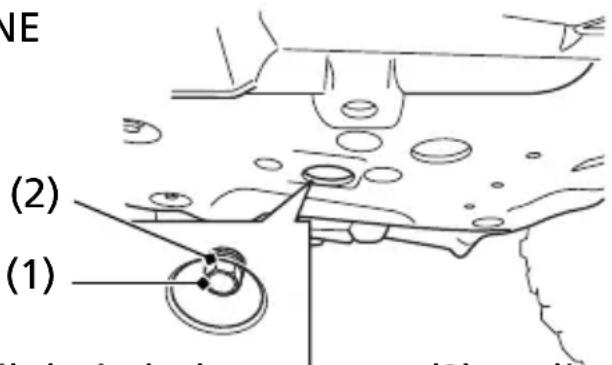
text_image
(1) (2)(1) engine oil drain bolt
(2) sealing washer
(cont'd)
Install a New Engine Oil Filter:
Place shop towels under the oil filter cover because oil will flow out.
-
Remove the oil filter cover (1) and O-ring (2) by removing the bolts (3). Let the remaining oil drain out. Discard the oil filter (4) in an approved manner (page 202).
-
Apply engine oil to a new O-ring and install it to the oil filter cover. Then install a new oil filter. Use only the Honda Genuine oil filter or a filter of equivalent quality specified for your model. Using the wrong Honda filter or a non-Honda filter which is not of equivalent quality may cause engine damage.
-
Install a new oil filter with the rubber seal (5) facing inward, toward the engine. Make sure the spring (6) and the "OUT-SIDE (TOWARDS FILTER COVER)" mark (7) faces away from the engine, toward the oil filter cover.
NOTICE
Improper installation of the oil filter can cause serious engine damage.
RIGHT SIDE
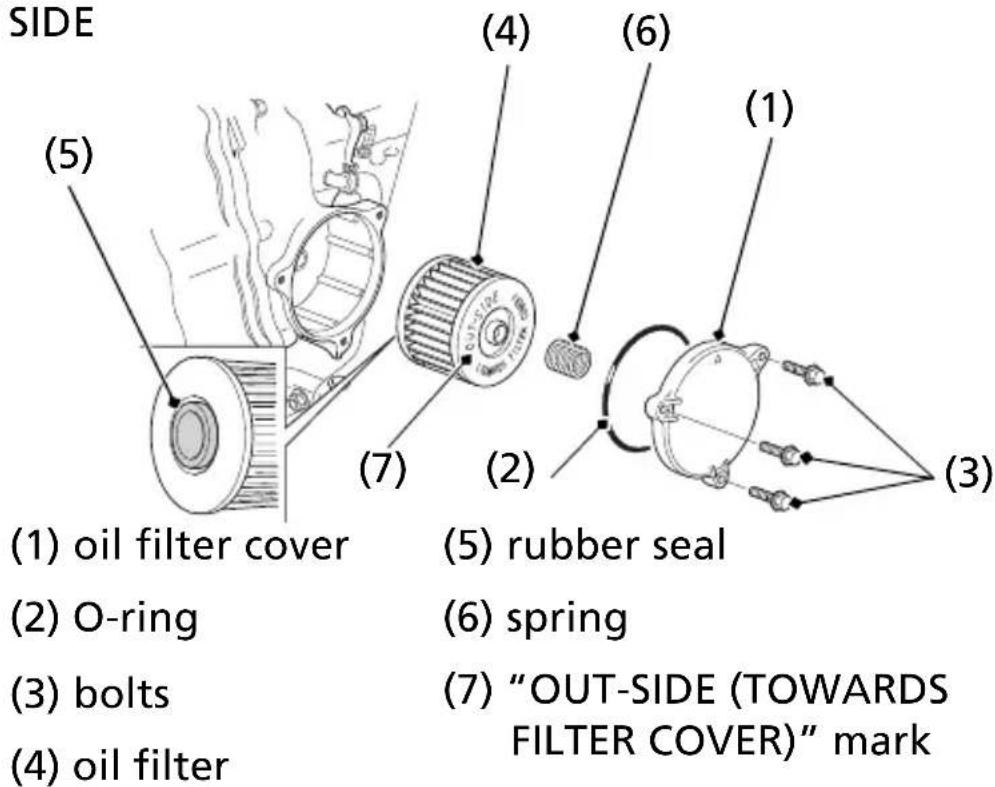
text_image
(1) oil filter cover (2) O-ring (3) bolts (4) oil filter (5) (7) (4) (6) (1) (2) (3) (5) rubber seal (6) spring (7) "OUT-SIDE (TOWARDS FILTER COVER)" mark132 Servicing Your Honda
- Reinstall the oil filter cover, making sure the bolts are tightened to the specified torque:
9 lbf·ft (12 N·m, 1.2 kgf·m)
- Pour the drained oil into a suitable container and dispose of it in an approved manner (page 202).
NOTICE
Improper disposal of drained fluids is harmful to the environment.
Add Engine Oil:
- Reinstall the oil drain bolt with the new sealing washer and tighten it to the specified torque:
18 lbf·ft (25 N·m, 2.5 kgf·m)
- Fill the crankcase with the recommended grade oil approximately:
3.8 US qt (3.6 ℓ)
-
Reinstall the oil fill cap and dipstick.
-
Start the engine and let it idle for 3 - 5 minutes.
-
Stop the engine, wait 2 – 3 minutes and check the oil level. Make sure the oil is between the upper and lower level marks on the dipstick. If necessary, add more oil but do not overfill.
-
Check that there are no oil leaks.
-
Install the tank cover assembly (page 119).
-
Install the seat (page 118).
If a torque wrench is not used for installation, see your dealer as soon as possible to verify proper assembly.
Oil Recommendation
| type hypoid gear oil | |
| viscosity (weight) SAE | 80W-90 |
| suggested oil Honda shaft drive oil or equivalent | |
Changing Oil
Refer to Safety Precautions on page 107.
Change the oil with the rear final gear at normal operating temperature to assure complete and rapid draining.
- Park your ATV on a firm, level surface.
REAR
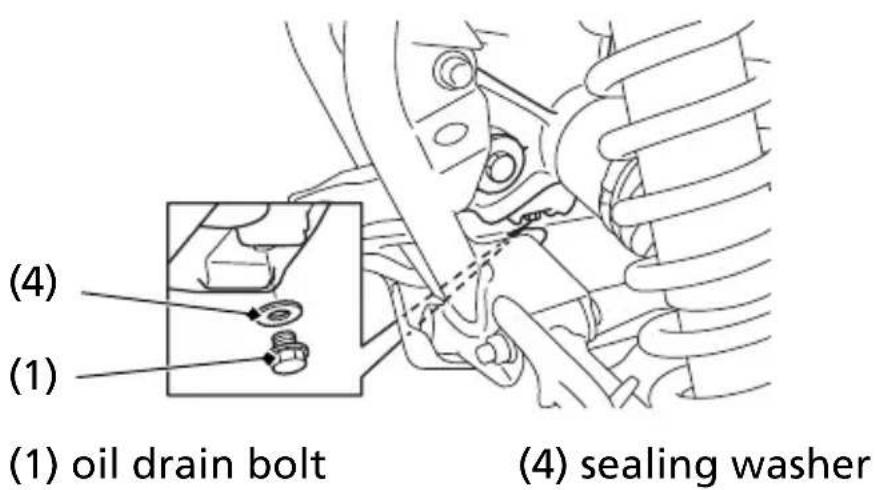
- Place an oil drain pan under the oil drain bolt (1).
- Remove the oil fill cap (2), O-ring (3), drain bolt and sealing washer (4).
REAR
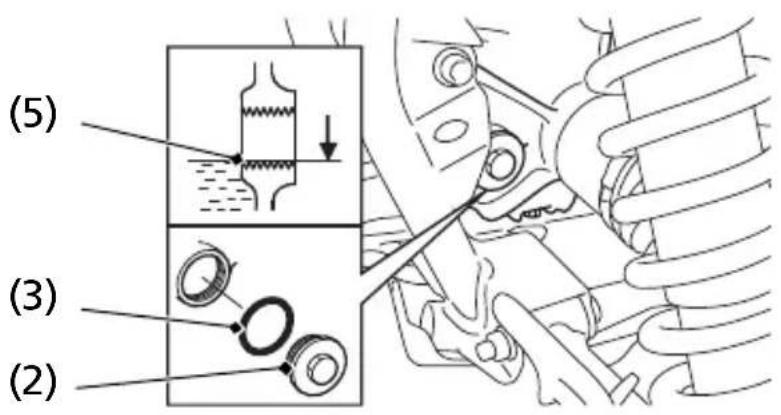
text_image
(5) (3) (2)(2) oil fill cap
(5) oil fill inspection hole
(3) O-ring
- After the oil has completely drained, reinstall the drain bolt with a new sealing washer and tighten it to the specified torque:
9 lbf·ft (12 N·m, 1.2 kgf·m)
(cont'd)
- Fill the rear final gear with the recommended oil.
4.2 US oz (125 cm ^3 )
Make sure the oil level is at the lower edge of the oil fill inspection hole (5).
- Coat a new O-ring with grease and install it into the fill cap groove and tighten it to the specified torque:
9 lbf·ft (12 N·m, 1.2 kgf·m)
- Pour the drained oil into a suitable container and dispose of it in an approved manner (page 202).
NOTICE
Improper disposal of drained fluids is harmful to the environment.
Oil Recommendation
| type hypoid gear oil | |
| viscosity (weight) SAE | 80W-90 |
| suggested oil Honda shaft drive oil or equivalent | |
Changing Oil
Refer to Safety Precautions on page 107.
Change the oil with the front final gear at normal operating temperature to assure complete and rapid draining.
Front Final Gear Oil
- Park your ATV on a firm, level surface.
- Place an oil drain pan under the oil drain bolt (1).
- Remove the oil fill cap (2), O-ring, drain bolt and sealing washer.
- After the oil has completely drained, reinstall the drain bolt with a new sealing washer and tighten it to the specified torque:
9 lbf·ft (12 N·m, 1.2 kgf·m)
- Pour the drained oil into a suitable container and dispose of it in an approved manner (page 202).
NOTICE
Improper disposal of drained fluids is harmful to the environment.
- Fill the front final gear with the recommended oil.
7.1 US oz (210 cm ^3 )
Make sure the oil level is at the lower edge of the oil fill inspection hole (3).
- Coat a new O-ring with grease and install it into the fill cap groove and tighten it to the specified torque:
9 lbf·ft (12 N·m, 1.2 kgf·m)
FRONT
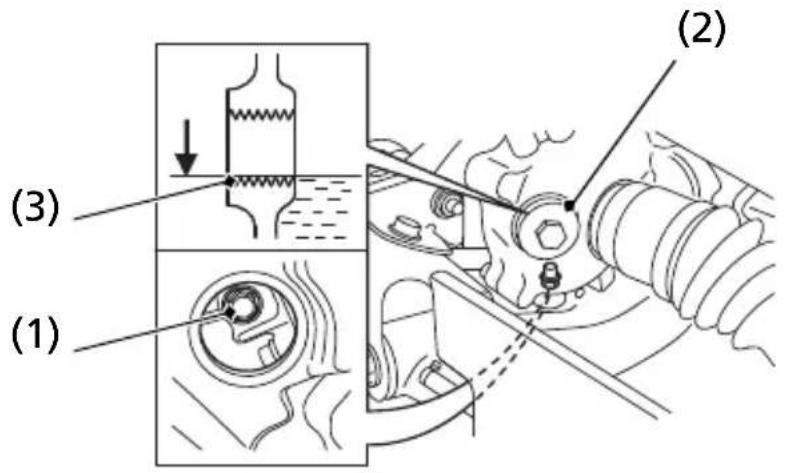
text_image
(1) (3) (2)(1) oil drain bolt
(2) oil fill cap
(3) oil fill inspection hole
Your ATV's liquid cooling system dissipates engine heat through the coolant jacket that surrounds the cylinder and cylinder head.
Maintaining the coolant will allow the cooling system to work properly and prevent freezing, overheating, and corrosion.
Coolant Recommendation
Use Pro Honda HP Coolant or an equivalent high quality ethylene glycol antifreeze containing corrosion protection inhibitors specifically recommended for use in aluminum engines. Check the antifreeze container label.
Use only distilled water as a part of the coolant solution. Water that is high in mineral content or salt may be harmful to the aluminum engine.
NOTICE
Using coolant with silicate inhibitors may cause premature wear of water pump seals or blockage of radiator passages. Using tap water may cause engine damage.
The factory provides a 50/50 solution of antifreeze and water in this ATV. This coolant solution is recommended for most operating temperatures and provides good corrosion protection.
Decreasing the concentration of antifreeze to less than 40% will not provide proper corrosion protection.
Coolant
Increasing the concentration of antifreeze is not recommended because it decreases cooling system performance. Higher concentrations of antifreeze (up to 60%) should only be used to provide additional protection against freezing. Check the cooling system frequently during freezing weather.
Checking & Adding Coolant
Refer to Safety Precautions on page 107.
Check the engine coolant level each day before operating your ATV and add if needed.
LEFT FRONT
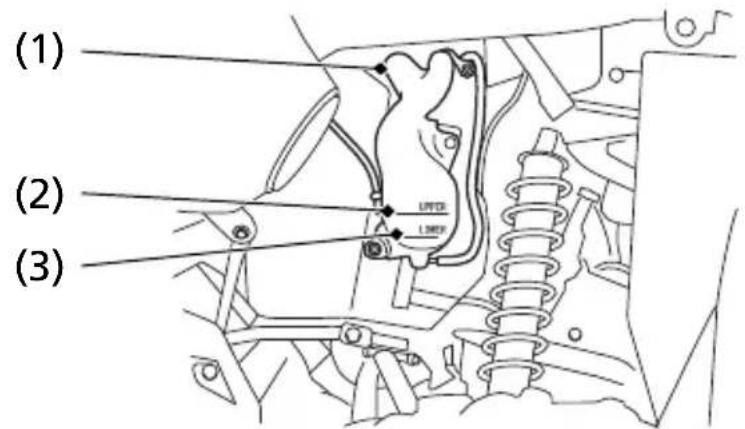
text_image
(1) (2) (3)(1) reserve tank
(3) LOWER level mark
(2) UPPER level mark
- Make sure the vehicle is on level ground.
-
With the engine at normal operating temperature, check the coolant level in the reserve tank (1). It should be between the UPPER (2) and LOWER (3) level marks.
If the reserve tank is empty, or if coolant loss is excessive, check for leaks and see your dealer for repair. -
Remove the radiator cap lid (4) and reserve tank cap (5).
Always add coolant to the reserve tank. Do not attempt to add coolant by removing the radiator cap.
- Add coolant to the reserve tank as required to bring the coolant level to the UPPER level mark.

text_image
FRONT (4) (5)(4) radiator cap lid
(5) reserve tank cap
- After adding coolant, install the parts in the reverse order of removal.
Coolant Replacement
Refer to Safety Precautions on page 107.
Coolant should be replaced by your dealer, unless you have the proper tools and service data, and are mechanically qualified. Refer to the official Honda Service Manual (page 246).
WARNING
Removing the radiator cap while the engine is hot can cause the coolant to spray out, seriously scalding you.
Always let the engine and radiator cool down before removing the radiator cap.
To properly dispose of drained coolant, refer to You & the Environment, page 202.
NOTICE
Improper disposal of drained fluids is harmful to the environment.
Radiator Core
Refer to Safety Precautions on page 107.
Check the air passages for clogging or damage. Remove insects, mud, or any obstruction with low water pressure. Have the radiator checked by your dealer if the air flow is restricted over more than 20% of the radiator surface.
Clean the radiator core after riding the ATV in mud.
To clean the radiator core and radiator grill cover:
- Unhook the reserve tank tube (1).
- Remove the reserve tank (2) from the left radiator grill cover (3) by removing the bolt (4) and clip (5).
- Remove the clips (6).
- Unhook the tab A (7) and tab B (8) on both of the left and right side.
- Unhook the left side of the center radiator grill cover hook (9) and slide the left radiator grill cover.
- Remove the left radiator grill cover.
NOTICE
Do not apply pressured water directly to the radiator core.
The pressured water can damage the radiator core.
(cont'd)
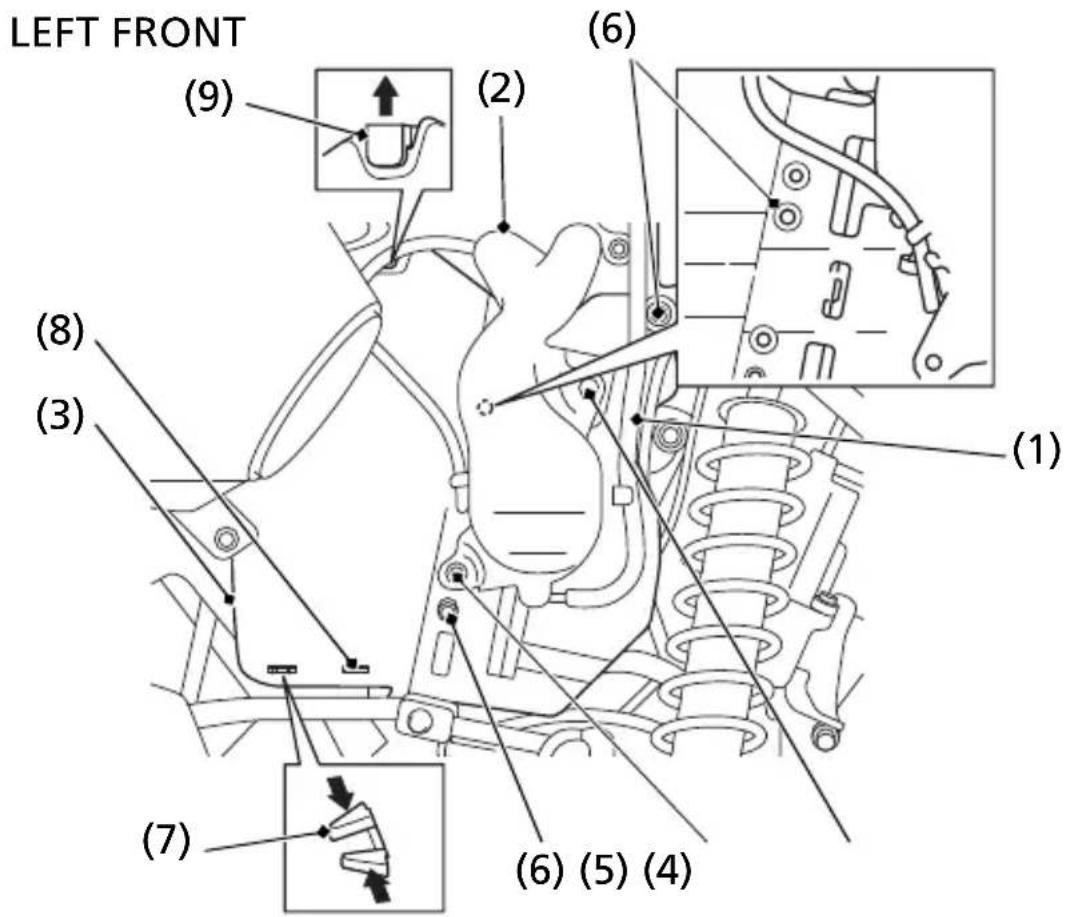
text_image
LEFT FRONT (9) (2) (6) (1) (8) (3) (7) (6) (5) (4)(1) reserve tank tube
(2) reserve tank
(3) left radiator grill cover
(4) bolt
(5) clip
(6) clips
(7) tab A
(8) tab B
(9) center radiator grill cover hook
RIGHT FRONT

text_image
(8) (7)(7) tab A (8) tab B
- Remove the center radiator grill cover (10) by unhooking the right side of the center radiator grill cover hook (11).
- Wash the radiator core (12) and center radiator grill cover.
LEFT FRONT

text_image
(10) (11) (12)(10) center radiator grill cover (11) center radiator grill cover hook (12) radiator core
- Install the removed parts in reverse order of removal.
Refer to Safety Precautions on page 107.
Proper air cleaner maintenance is very important for off-road vehicles.
A dirty, water-soaked, worn-out, or defective air cleaner will allow dirt, dust, mud, and other impurities to pass into the engine.
Service the air cleaner more frequently if you ride in unusually wet or dusty areas. Your dealer can help you determine the correct service interval for your riding conditions.
Your ATV's air cleaner has very specific performance requirements. Use a new Honda Genuine air cleaner specified for your model or an air cleaner of equal quality.
NOTICE
Using the wrong air cleaner may result in premature engine wear.
Proper air cleaner maintenance can prevent premature engine wear or damage, expensive repairs, low engine power, poor gas mileage, and spark plug fouling.
NOTICE
Improper or lack of proper air cleaner maintenance can cause poor performance and premature engine wear.
Cleaning
- Remove the seat (page 118).
UNDER SEAT
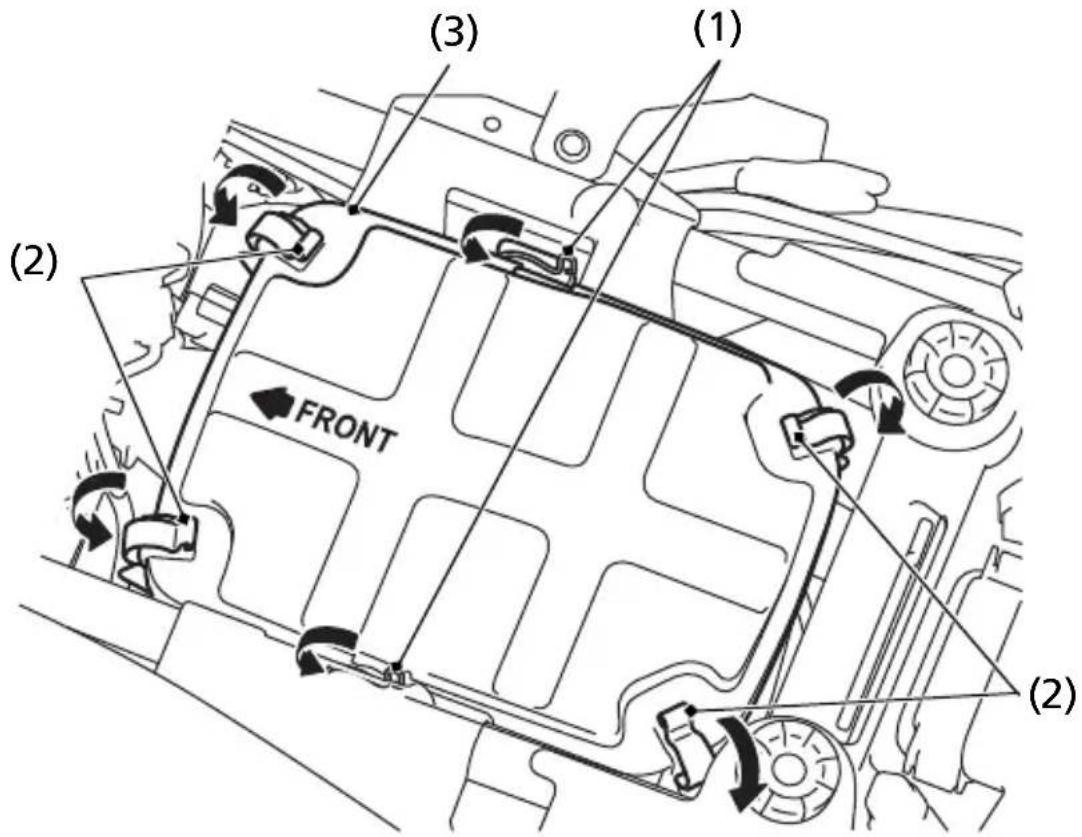
text_image
(1) (2) (3) FRONT (2)(1) spring hooks (3) air cleaner housing cover
(2) retainer clips
- Unlatch the spring hooks (1) and retainer clips (2).
- Remove the air cleaner housing cover (3).
(cont'd)
-
Loosen the screw (4) and remove the air cleaner assembly (5) from the air cleaner housing.
-
Remove the clamp (6).
-
Remove the air cleaner (7) from the air cleaner body (8).
-
Gently wash the air cleaner in clean, non-flammable (high flash point) solvent such as kerosene — not gasoline. After cleaning, gently squeeze out the remaining solvent. Avoid twisting or wringing the air cleaner. This can tear the foam.
-
Inspect for tears or cracks in the foam or seams of the air cleaner. Replace the air cleaner if it is damaged.
-
Allow the air cleaner to dry thoroughly before applying oil. A wet air cleaner will not fully absorb the oil.
-
Pour clean Pro Honda Foam Filter Oil or an equivalent (Canada: Honda Foam Filter Oil or an equivalent) over the entire surface of the air cleaner. Use both hands to evenly spread the oil into the air cleaner. Gently squeeze out any excess oil. (To keep your hands dry, place the air cleaner in a clean plastic bag before spreading the oil into the air cleaner.)
UNDER SEAT
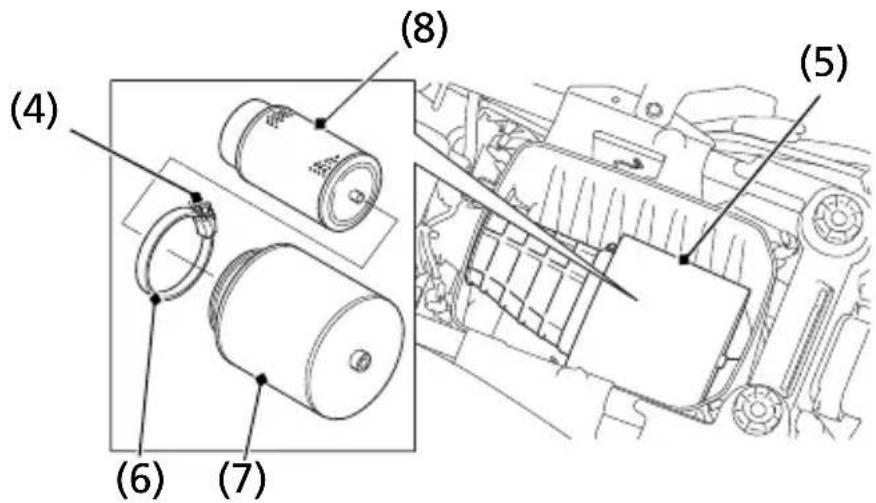
text_image
(4) (6) (7) (8) (5)(4) screw
(5) air cleaner assembly
(6) clamp
(7) air cleaner
(8) air cleaner body
-
Install the air cleaner on the air cleaner body.
-
Install the clamp.
-
Insert the air cleaner assembly into the air cleaner housing.
-
Fasten the screw.
-
Reassemble by reversing the disassembly sequence.
• Install the air cleaner housing cover with the FRONT mark (9) facing forward and fit the cut out of the tab (10) at the end of the air cleaner.
UNDER SEAT

text_image
(9) FRONT (10) (10)(9) FRONT mark
(10) tab
Dust Cover
UNDER SEAT

text_image
(1) (2)(1) dust cover (2) breather joint
Do not push the dust cover (1) too far into the breather joint (2). If the dust cover is dirty, clean it.
Air Cleaner Housing Drain Tube
The air cleaner housing drain tube should be serviced in accordance with the Maintenance Schedule. (Riding through water may require more frequent inspection.) If deposits can be seen in the drain tube, the tube must be cleaned before starting the vehicle.
REAR
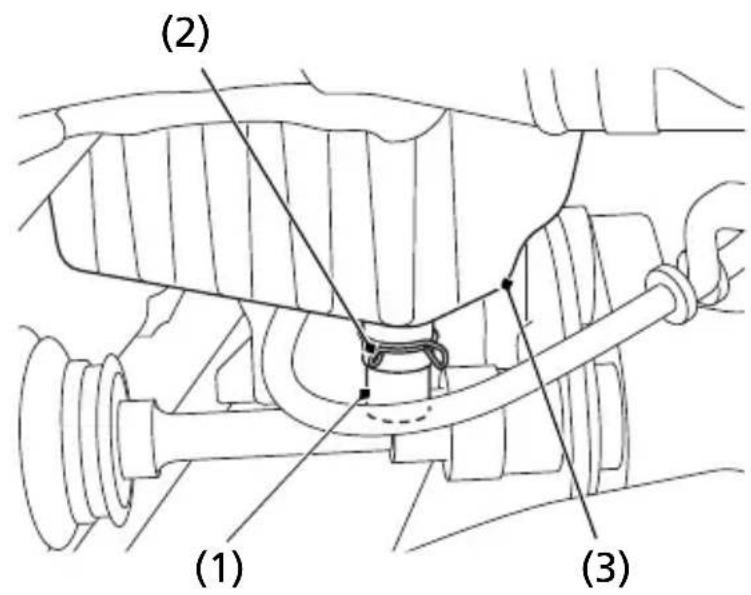
text_image
(2) (1) (3)(1) drain tube (3) air cleaner housing
(2) clip
- Remove the drain tube (1) by removing the clip (2) under the air cleaner housing (3).
- Drain the deposits.
- Reinstall the drain tube, securing it with the clip.
Throttle Freeplay
Refer to Safety Precautions on page 107.
RIGHT HANDLEBAR
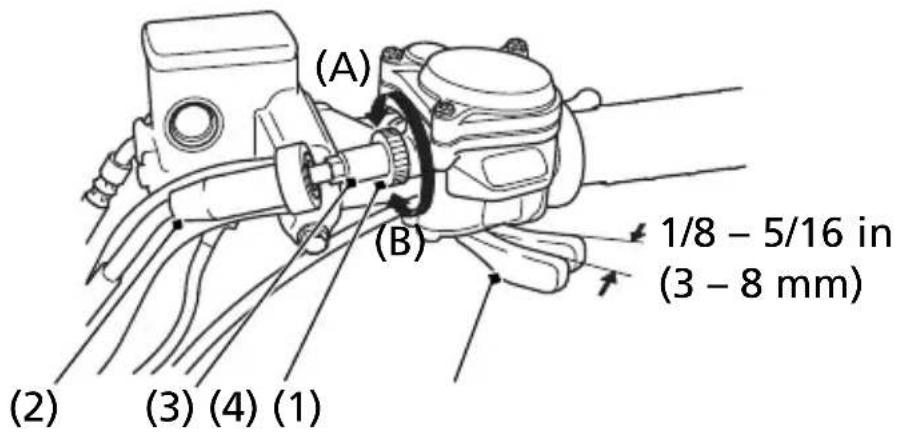
text_image
(A) (B) 1/8 - 5/16 in (3 - 8 mm) (2) (3) (4) (1)(1) throttle lever
(2) rubber sleeve
(3) throttle cable adjuster
(4) lock nut
(A) decrease freeplay
(B) increase freeplay
Inspection
Check freeplay at the throttle lever (1).
Freeplay:
$$ 1 / 8 - 5 / 1 6 \text { in } (3 - 8 \mathrm{mm}) $$
Adjustment
- Slide the rubber sleeve (2) back to expose the throttle cable adjuster (3).
- Loosen the lock nut (4).
- Turn the adjuster to obtain the correct freeplay.
- Tighten the lock nut and reinstall the sleeve.
- After adjustment, check for smooth operation of the throttle lever from fully closed to fully open in all steering positions.
Throttle Inspection
Refer to Safety Precautions on page 107.
- Check that the throttle assembly is positioned properly and the securing bolts are tight.
- Check for smooth operation of the throttle lever from fully open to fully closed in all steering positions. If there is a problem, see your dealer.
- Inspect the condition of the throttle cable from the throttle lever down to the throttle body. If the cable is kinked or chafed, have it replaced.
- Check the throttle cable for tension or stress in all steering positions.
- Lubricate the throttle cable with a commercially available cable lubricant to prevent premature wear and corrosion.
Reverse Inhibitor System Adjustment
Refer to Safety Precautions on page 107.
LEFT HANDLEBAR

text_image
HANDLEBAR (1) (2) (3) (4) (5) 1/16 - 3/16 in (2 - 4 mm)(1) dust cover
(2) reverse assist lever
(3) rubber sleeve
(4) lock nut
(5) adjusting nut
- Turn over the dust cover (1).
- Check the reverse assist lever (2) freeplay, measured at the reverse assist lever end near the cable:
- To adjust, slide the rubber sleeve (3), loosen the lock nut (4) and turn the adjusting nut (5) to obtain the correct freeplay.
After adjustment, tighten the lock nut securely. - Return the dust cover and rubber sleeve.
$$ 1 / 1 6 - 3 / 1 6 \text { in } (2 - 4 \mathrm{mm}) $$
Other Checks
Check the reverse assist lever and cable for loose connections or other damage. If the cable is worn or kinked, have it replaced by your dealer.
Spark Plug Recommendation
| standard spark plug BKR5 | E-11 (NGK) or K16PR-U11 (DENSO) |
Use only the recommended type of spark plug in the recommended heat range.
NOTICE
Using spark plugs with an improper heat range can cause engine damage.
Spark Plug Inspection & Replacement
Refer to Safety Precautions on page 107.
- Remove the seat (page 118) and tank cover assembly (page 119).
- Clean any dirt from around the spark plug base.
- Disconnect the spark plug cap (1). Take care to avoid damaging the spark plug wire when disconnecting the cap.
- Using a spark plug wrench provided in the tool kit, remove the spark plug.
- Inspect the electrodes and center porcelain for deposits, corrosion, or carbon fouling. If the corrosion or deposits are heavy, replace the plug. Clean a carbon or wet-fouled plug with a plug cleaner, if available, or a wire brush. Inspect the spark plug electrodes for wear. The center electrode (2) should have a flat tip and sharp edges, and the side electrode (3) should not be eroded. If the electrodes and insulator tip appear unusually fouled or burned, we suggest that you contact your dealer.
-
Discard the spark plug if there is apparent wear or if the insulator is cracked or chipped.
-
Using a wire-type feeler gauge, check the spark plug gap (4). If adjustment is necessary, bend the side electrode carefully.
The gap should be:
0.039 - 0.043 in (1.00 - 1.10 mm)
LEFT SIDE
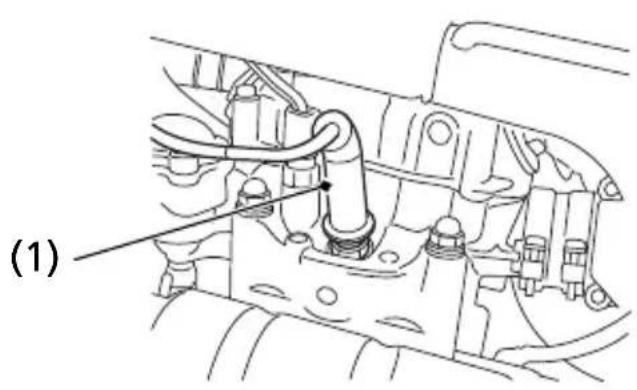
text_image
(1)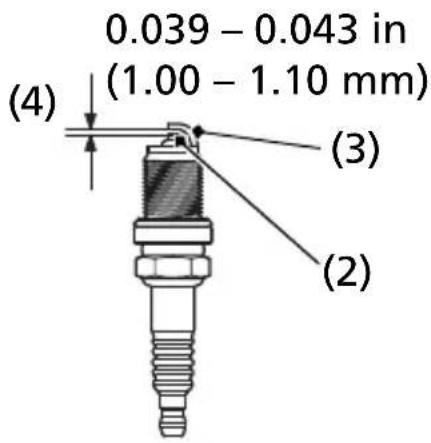
text_image
0.039 - 0.043 in (1.00 - 1.10 mm) (4) (3) (2)(1) spark plug cap
(2) center electrode
(3) side electrode
(4) spark plug gap
-
With the plug washer attached, thread the spark plug in by hand to prevent cross-threading.
-
Tighten the spark plug:
- If the old plug is good:
1/8 turn after it seats.
- If installing a new plug, tighten it twice to prevent loosening:
a) First, tighten the plug:
NGK: 3/4 turn after it seats.
DENSO: 1/2 turn after it seats.
b) Then loosen the plug.
c) Next, tighten the plug again:
1/8 turn after it seats.
NOTICE
An improperly tightened spark plug can damage the engine. If a plug is too loose, the piston may be damaged. If a plug is too tight, the threads may be damaged.
-
Connect the spark plug cap. Take care to avoid pinching any cables or wires.
-
Install the remaining parts in the reverse order of removal.
Valve Inspection
Refer to Safety Precautions on page 107.
Valve clearance should be:
intake: 0.006 in (0.15 mm)
exhaust: 0.009 in (0.23 mm)
Excessive clearance will cause noise. Insufficient clearance will cause loss of power and possibly damage the valves.
For those who are mechanically proficient and have the proper tools, instructions on adjusting valve clearances are given in the official Honda Service Manual. Otherwise, the valves should be adjusted by your dealer.
Refer to Safety Precautions on page 107.
The spark arrester must be serviced every 100 operating hours to maintain its efficiency.
Regular servicing prevents carbon build up (which can diminish engine performance) and also complies with USDA regulations for regular maintenance to assure proper function. The spark arrester prevents random sparks from the combustion process in your engine from reaching the environment.
The use of safety glasses is recommended for this procedure.
Because of the possible fire hazard, check that there are no combustible materials in the area before purging the spark arrester.
REAR

natural_image
Mechanical assembly diagram showing a turning tool interacting with a bracket (no text or symbols present)(1) bolt
-
Select a well-ventilated area free of combustible materials and make sure the exhaust pipe is cool.
-
Remove the bolt (1).
-
Start the engine and rev it up approximately twenty times while momentarily creating exhaust system back pressure by blocking the end of the muffler with a shop towel.
-
Stop the engine and allow the exhaust pipe to cool.
-
Reinstall the bolt securely.
Your front and rear suspension systems use springs and hydraulic damping devices that suspend your weight and most of the weight of your ATV.
The oil damper systems hydraulically control the natural compression and rebound of the suspension springs so that traction and comfort are maintained as the wheels ride over rough terrain.
The spring pre-loads for your front and rear suspension systems adjust the amount of force required to begin compression of the spring.
Consider adjusting your suspensions pre-load whenever you change your normal load, by adding or subtracting cargo, accessories, or when riding conditions change.
The way you ride your ATV and the type of ride you want to experience can also influence your suspension needs.
Lower spring pre-load provides a softer ride and is usually preferred for light loads and smooth terrain. Higher spring pre-load provides a firmer ride and is recommended for heavy loads and rough terrain.
Suspension Adjustment
Using a pin spanner, which is available from your dealer, the suspensions can be adjusted for rider weight and riding conditions by changing the spring pre-load.
Do not attempt to disassemble, service, or dispose of the damper; see your dealer. The instructions found in this owner's manual are limited to adjustments of the shock assembly only.
Suspension Spring Pre-Load
Refer to Safety Precautions on page 107.
FRONT REAR

text_image
(1) (2)1 2 3 4 5 1 2 3 4 5 (1)(1) spring pre-load adjuster
(2) pin spanner
The spring pre-load adjuster (1) has 5 positions for different load or riding conditions.
Use the pin spanner (2) to adjust the shock spring pre-load.
Suspension
Position 1: for a light load and smooth terrain.
Position 2: standard position.
Positions 3 to 5: for when the ATV is more heavily loaded. (Also increase spring pre-load for stiffer suspension.)
Make sure that both shock absorbers are adjusted to the same position.
Always adjust the shock absorber position in sequence (1-2-3-4-5 or 5-4-3-2-1). Attempting to adjust directly from 1 to 5 or 5 to 1 may damage the shock absorber.
The hydraulic disc brakes (front) and a single hydraulic/mechanical disc brake (rear) on your ATV dissipate the heat generated by the friction of the brake pads on the discs as the wheels are slowed.
As the brake pads wear, the brake fluid level will drop. A leak in the system will also cause the level to drop.
There are no adjustments to perform, but fluid level and pad wear must be inspected periodically. The system must be inspected frequently to ensure there are no fluid leaks.
If the brake lever or brake pedal freeplay does not feel within the normal range while riding, check the brake pads for wear (page 167).
Worn pads should be replaced. If the pads are not worn beyond the recommended limit, there is probably air in the brake system. See your dealer to have the air bled from the system.
Brake Fluid Recommendation
brake fluid Honda DOT 4 Brake Fluid
The recommended brake fluid is Honda DOT 4 Brake Fluid, or any brake fluid of equal quality and performance. Use fresh brake fluid from a sealed container. Be sure to read the label before opening the sealed container. An opened container may be contaminated or may have absorbed moisture from the air.
Fluid Level Inspection
Refer to Safety Precautions on page 107.
If your inspection indicates a low fluid level, have your dealer add the recommended fluid.
Do not add or replace brake fluid, except in an emergency. If you do add fluid, have your dealer check the system as soon as possible.
NOTICE
Brake fluid can damage plastic and painted surfaces. Handle with care.
Wipe up spills immediately. Avoid brake fluid contact with skin or eyes. If it comes in contact with your eyes, wash them out with clean water and immediately call a doctor. If it comes in contact with your skin, wash with clean water and, if necessary, call a doctor.
Front Brake Fluid Level
RIGHT HANDLEBAR

text_image
(1)(1) LOWER level mark
With the ATV on a level surface, check the fluid level. It should be above the LOWER level mark (1). If the level is at or below the LOWER level mark, check the brake pads for wear (page 167).
Worn brake pads should be replaced. If the pads are not worn, have your brake system inspected for leaks.
Rear Brake Fluid Level
RIGHT REAR

text_image
(1) (2) UPPER LOWER(1) UPPER level mark
(2) LOWER level mark
With the ATV on a level surface, check the fluid level. It should be between the UPPER (1) and LOWER (2) level marks. If the level is at or below the LOWER level mark, check the brake pads for wear (page 167).
Worn brake pads should be replaced. If the pads are not worn, have your brake system inspected for leaks.
Other Inspections
• Make sure there are no fluid leaks.
- Check for deterioration or cracks in the hoses and fittings. If the hoses are worn or cracked, have them replaced by your dealer.
Brake Pad Wear
Refer to Safety Precautions on page 107.
Brake pad wear will depend upon the severity of usage and riding conditions. The pads will wear faster in wet or muddy conditions. Inspect the pads visually during all regular service intervals to determine the pad wear.
RIGHT FRONT (Left side similar)
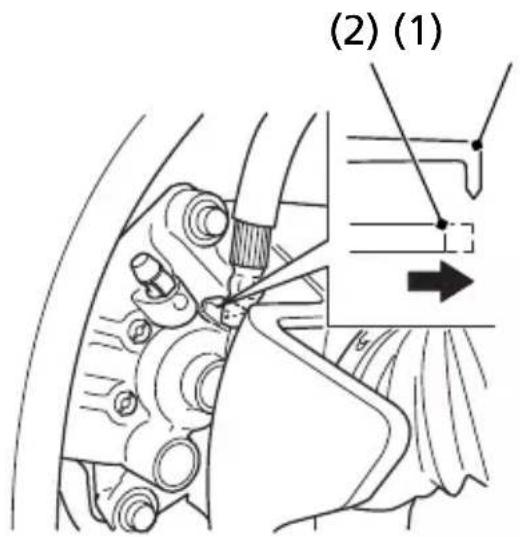
text_image
(2) (1)(1) wear indicator (2) edge of reference mark
Check the wear indicator (1). If the wear indicator aligns with the edge of the reference mark (2), both pads must be replaced, see your dealer for this replacement.
Always inspect both pads in both the right and left front brake calipers.
RIGHT REAR
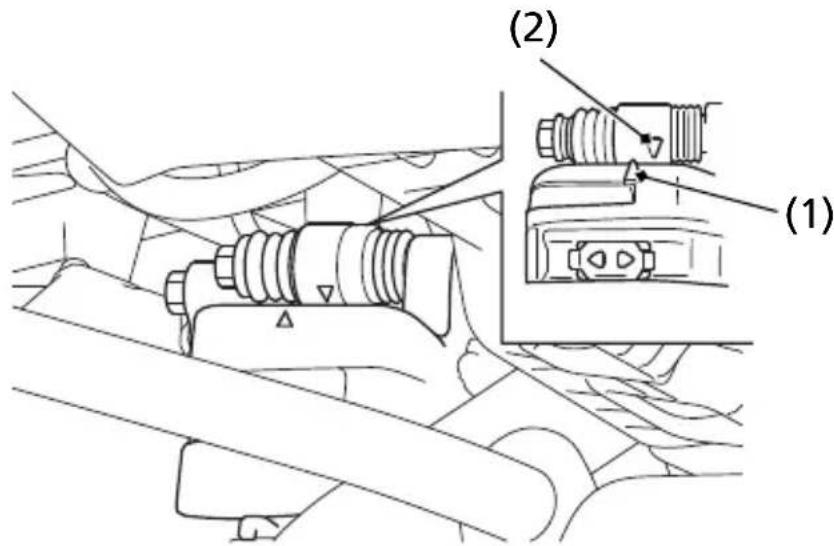
text_image
(2) (1)(1) wear indicator (2) reference mark
Check the wear indicator (1). If the wear indicator aligns with the reference mark (2), both pads must be replaced, see your dealer for this replacement.
Rear Brake Lever Freeplay
LEFT HANDLEBAR
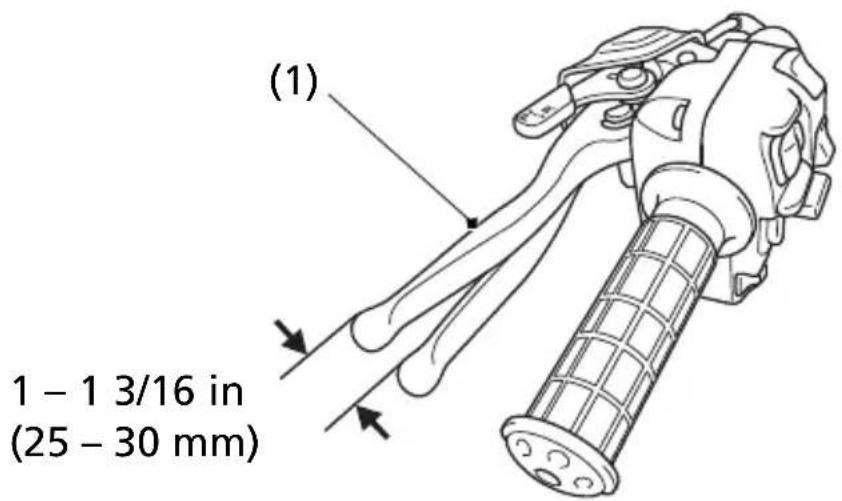
text_image
(1) 1 - 1 3/16 in (25 - 30 mm)(1) rear brake lever/parking brake lever
Inspection
- Press down on the rear brake pedal several times.
- Measure the distance the rear brake lever/parking brake lever (1) moves before the brake starts to take hold. Freeplay (measurement at the tip of the end of the brake lever) should be: 1 – 1 3/16 in (25 – 30 mm)
- If necessary, adjust to the specified range.
Adjustment
RIGHT REAR

text_image
(2) (A) (B) (3)(2) brake lever adjusting nut
(A) increase freeplay
(3) brake arm pin
(B) decrease freeplay
Turn the brake lever adjusting nut (2), located on the brake operating rod at the brake caliper. Make sure the cutout on the adjusting nut is properly seated on the brake arm pin (3).
Other Inspections
- Check that the brake lever and brake pedal assemblies are positioned properly and the securing bolts are tight.
- Make sure that the brake cables, brake arm, spring, P/R lever, and fasteners are in good condition.
Brake Light Switch Adjustment
Refer to Safety Precautions on page 107.
Rear Brake Only:
Check the operation of the rear brake light switch (1) at the right side behind the engine from time to time. Adjustment is done by turning the adjusting nut (2). Hold the rear brake light switch and turn the nut in direction (A) if the switch operates too late and in direction (B) if the switch operates too soon.
RIGHT REAR

text_image
(1) (A) (2) (B)(1) rear brake light switch
(2) adjusting nut
To safely operate your ATV, your tires must be the proper type and size, in good condition with adequate tread, and correctly inflated.
WARNING
Using tires that are excessively worn or improperly inflated can cause a crash in which you can be seriously hurt or killed.
Follow all instructions in this owner's manual regarding tire inflation and maintenance.
This ATV is equipped with low pressure tubeless tires. Although the tires are designed specifically for off-road use, they are not immune to punctures. Always select your riding area with care.
The following pages give detailed information on how and when to check your air pressure, how to inspect your tires for wear and damage, and our recommendations for tire repair and replacement.
Air Pressure
Refer to Safety Precautions on page 107.
Properly inflated tires provide the best combination of handling, tread life, and riding comfort. Generally, underinflated tires wear unevenly, adversely affect handling, and are more likely to fail from being overheated. Overinflated tires make your ATV ride harshly, are more prone to damage from surface hazards, and wear unevenly.
Make sure the air valve caps are secure. If necessary, install new caps.
Tires
Always check air pressure when your tires are “cold.” If you check air pressure when your tires are “warm” — even if your ATV has only been ridden for a few miles — the readings will be higher. If you let air out of warm tires to match the recommended cold tire pressures, the tires will be underinflated. Be sure to check tire pressure at the riding site, since changes in altitude can affect air pressure.
The recommended "cold" tire pressures are:
| FRONT REAR | ||
| RECOMMENDED PRESSURE | 4.4 psi (30 kPa) 4.4 | psi (30 kPa) |
A manually operated tire pump should be used rather than the high pressure system found in service stations. This will minimize the possibility of tire damage from overinflation. If you use a high pressure system at a service station, add air in small amounts and check the pressure increase frequently to prevent possible tire damage from overinflation.
WARNING
Operating this ATV with improper tires, or with uneven tire pressure may cause loss of control, and you could be seriously injured or killed.
- Always use the size and type tires specified in this owner's manual for this vehicle.
- Always maintain proper tire pressure as described in this owner's manual.
Inspection
Refer to Safety Precautions on page 107.
Whenever you check the tire pressures, you should also look for:
- Bumps or bulges in the side of the tire or the tread. Replace any tire that has a bump or bulge.
- Cuts, slits, or cracks in the tires. Replace the tire if you can see fabric or cord.
- Nails or other foreign objects embedded in the side of the tire or tread.
- Excessive tread wear.
Also, if you hit a pothole or other hard object while riding, stop as soon as you safely can and carefully inspect the tires for damage.
Tread Wear
FRONT
REAR

text_image
(2) NEW Replace 3/16 in (4 mm) (1) 3/16 in (4 mm) (3) Replace NEW(1) groove depth
(2) wear indicator
(3) wear indicator location mark
To check the condition of a tire tread, measure the groove depth (1) in the center of the tire, or check the wear indicator (2).
For best performance, you should replace a tire before the tread depth at the center reaches the following limits:
| front 3/16 | in (4 mm) |
| rear 3/16 | in (4 mm) |
Tire Repair
Refer to Safety Precautions on page 107.
A tire that is repaired, either temporarily or permanently, will have lower speed and performance limits than a new or undamaged tire.
A temporary repair can sometimes be made in an emergency situation. However, since a temporary repair may not hold, you must ride very slowly, preferably without any cargo, and have the tire replaced or permanently repaired as soon as possible. (For more information on temporary repairs, see If You Have a Flat Tire, page 214.)
A permanent repair, such as an internal plug patch, can be made if a tire has only a small puncture in the tread area. However you may not be able to safely carry as much weight. If you choose to have a tire repaired, be sure the repair work is performed by a professional.
If you have a tire professionally repaired at a non-Honda facility, we recommend that you have the work checked by your dealer.
Tire Replacement
Refer to Safety Precautions on page 107.
The tires that came on your ATV were designed to match the performance capabilities of your ATV and provide the best combination of handling, braking, and comfort.
It is best to replace all four tires, however if that is not possible, you must replace the tires in pairs (front or rear) with tires of the same size and type as the originals. Never replace just one tire.
WARNING
Installing improper tires on your ATV can affect handling and stability. This can cause a crash in which you can be seriously hurt or killed.
Always use the size and type of tires recommended in this owner's manual.
The recommended tires for your ATV are:
| front AT24 × 8-1 | 2★★MAXXIS M977 |
| rear AT24 × 10-1 | 1★★MAXXIS M978 |
When you replace a tire, remember:
Have the tire replaced by your dealer if possible.
If you have a tire professionally replaced at a non-Honda facility, we recommended that you have the work checked by your dealer.
Skid Plate & Engine Guard
Refer to Safety Precautions on page 107.

text_image
(1) (2)(1) engine guard
(2) skid plate
The engine guard (1) protects the frame, front final gear case and engine crankcase.
The skid plate (2) protects the rear final gear case. Check the guard and plate for cracks, damage or looseness at intervals shown in the Maintenance Schedule.
Have the engine guard and skid plate replaced if they are cracked or damaged. If the guard and plate bolts are loose, tighten them securely.
Front Boot Guards & Front Driveshaft Guards
Refer to Safety Precautions on page 107.
FRONT

text_image
(1) (2)(1) front boot guards (2) front driveshaft guards
Check the front boot guards (1) and front driveshaft guards (2) for cracks, damage or looseness.
Tighten any loose fasteners. Replace the front boot guards and front driveshaft guards as required.
Rear Boot Guards
Refer to Safety Precautions on page 107.

natural_image
Top-down line drawing of a vehicle chassis showing front, rear, and side views (no text or symbols)(1)
(1) rear boot guards
Check the rear boot guards (1) for cracks, damage or looseness. Tighten any loose fasteners. Replace the rear boot guards as required.
Propeller Shaft Boots & Yoke Joint Boot
Refer to Safety Precautions on page 107.

text_image
(1) (2) (1)(1) propeller shaft boots
(2) yoke joint boot
Check the propeller shaft boots (1) and yoke joint boot (2) for damage or leaking grease. If necessary, have your dealer replace them.
Front Driveshaft Boots & Rear Driveshaft Boots
Refer to Safety Precautions on page 107.
FRONT
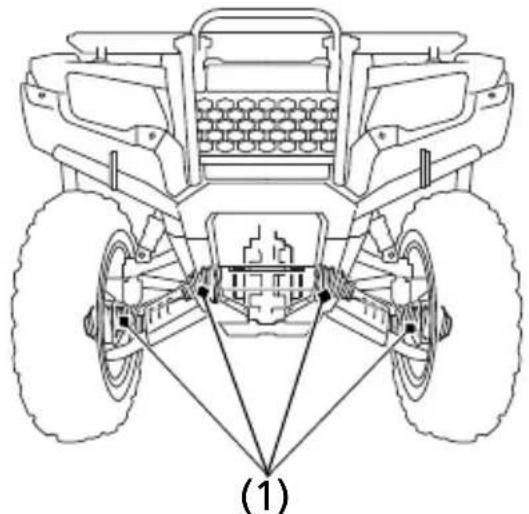
natural_image
Line drawing of a vehicle chassis with exposed tires and suspension components (no text or symbols)REAR
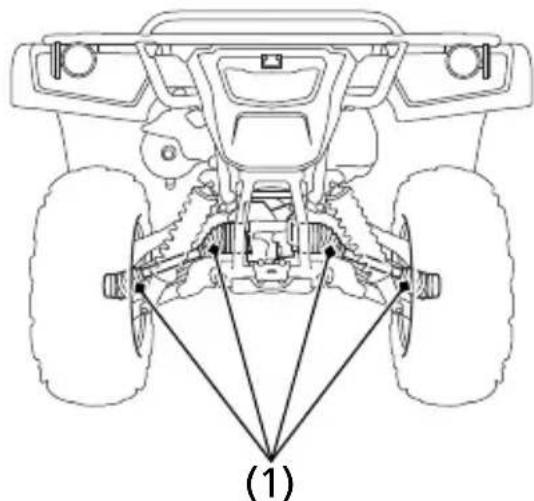
natural_image
Top-down line drawing of a vehicle chassis with four wheels and labeled components (no text or symbols beyond label)(1) driveshaft boots
Check the driveshaft boots (1) for cuts, damage or leaking grease. If necessary, have your dealer replace them.
Your ATV has a maintenance-free type battery. You do not have to check the battery electrolyte level or add distilled water as you would with a conventional-type battery.
NOTICE
Your battery is a maintenance-free type and can be permanently damaged if the cap strip is removed.
Electrical accessories use current from the battery, even when the ignition is OFF (O). Limited operation also allows the battery to discharge.
If you have electrical accessories on your ATV or do not ride frequently, we recommend that you charge the battery frequently (see Battery Charging, page 188).
If you do not expect to ride your ATV for at least two weeks, we recommend you remove the battery, or at least disconnect the battery cables (negative cable first).
If you plan to store your ATV, see Battery Storage, page 185.
If your battery seems weak and/or is leaking electrolyte (causing slow starting or other electrical problems), see your dealer.
WARNING: Battery posts, terminals and related accessories contain lead and lead compounds. Wash your hands after handling.
Battery Storage
Refer to Safety Precautions on page 107.
If you plan to store your ATV, we recommend you remove the battery and store it where it can be charged at least every 30 days to maintain its service life.
If you do not remove the battery, we recommend disconnecting the battery cables (negative cable first).
You will get the best storage results from removing the battery and slow charging it every 30 days (see Battery Charging, page 188).
Before you remove the battery, be sure to read all the information that follows, as well as the information on the battery label.
WARNING
The battery gives off explosive hydrogen gas during normal operation.
A spark or flame can cause the battery to explode with enough force to kill or seriously hurt you.
Wear protective clothing and a face shield, or have a skilled mechanic do the battery maintenance.
The battery is located in a compartment under the rear fender cover.
UNDER REAR FENDER COVER

text_image
(2) (1) (4) (5) (3) (5)(1) rubber band
(4) positive (+) terminal lead
(2) negative (−) terminal lead (5) terminal nuts
(3) battery
Removal
- Make sure the ignition switch is OFF (O).
- Remove the seat (page 118).
- Remove the rear fender cover (page 121).
- Release the rings and remove the rubber band (1).
-
Disconnect the negative (−) terminal lead (2) from the battery (3) first, then disconnect the positive (+) terminal lead (4).
-
Remove the battery and take care not to drop the terminal nuts (5).
- Charge the battery (see following section).
- Store your battery in an easy-to-reach location off the floor, in an area protected from freezing temperature and direct sunlight.
- Clean the compartment after removing the battery for storage. Dry the compartment.
- Slow charge the battery (see following section) once every 30 days.
Installation
- Check that the battery rubber (6) for damage. If necessary, replace the battery rubber.
- Make sure the battery rubber is properly installed.
- Reinstall the battery in the reverse order of removal. Be sure to connect the positive (+) terminal first, then the negative (−) terminal.
- Make sure all bolts and other fasteners are secure.
- Install the removed parts in reverse order of removal.
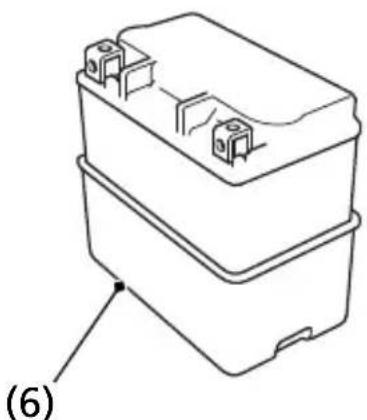
natural_image
Line drawing of a rectangular electronic component with two terminals and a labeled section (6), no text or symbols present.(6) battery rubber
(cont'd)
Battery Charging
Refer to Safety Precautions on page 107.
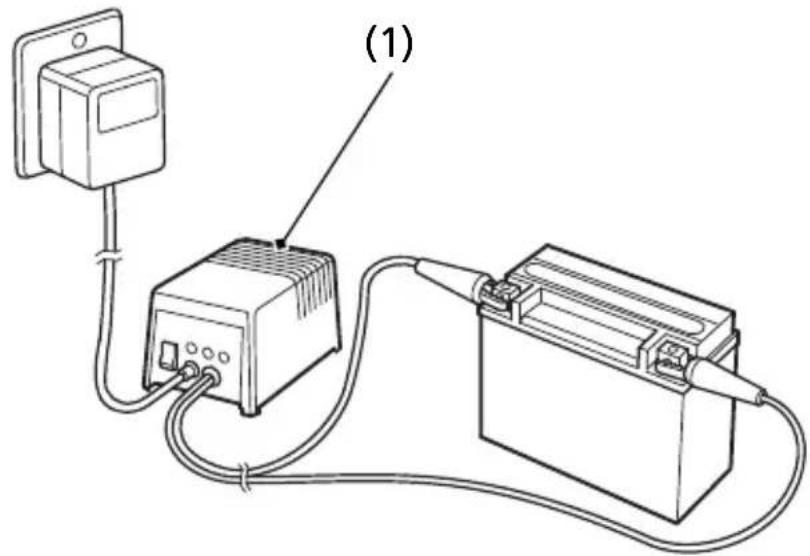
text_image
(1)(1) charger
Be sure to read the information that came with your battery charger and follow the instructions on the battery. Improper charging may damage the battery.
We recommend using a charger (1) designed specifically for your Honda, which can be purchased from your dealer. These units can be left connected for long periods without risking damage to the battery. However, do not intentionally leave the charger connected longer than the time period recommended in the charger's instructions. Avoid using an automotive-type battery charger. An automotive charger can overheat an ATV battery and cause premature damage.
Frequent cleaning and polishing will keep your Honda looking newer longer.
Frequent cleaning also identifies you as an owner who values his ATV.
A clean ATV is also easier to inspect and service.
General Recommendations
Refer to Safety Precautions on page 107.
- To clean your ATV, you may use:
- water
- Hondabrite
- a mild, neutral detergent and water
- a mild spray and wipe cleaner/polisher
- a mild spray and rinse cleaner/ degreaser and water
- Avoid products that contain harsh detergents or chemical solvents that could damage the metal, paint, plastic, and camouflage coating on your ATV (Honda MUV).
- If your ATV is still warm from recent operation, give the engine and exhaust system time to cool off.
- Park in a shady area. Washing your ATV in bright sunlight may cause the finish to fade because water droplets intensify the sun's brightness.
- Spotting is also more likely because surface water can dry before you have time to wipe it off.
- Clean your ATV regularly to protect surface finishes.
- We recommend the use of a low pressure garden hose to wash your ATV. High pressure washers (like those at coin-operated car washers) can damage certain parts of your ATV.
NOTICE
High pressure water (or air) can damage certain parts of your ATV. Water entering the muffler may damage the oxygen sensor.
- After cleaning, inspect for damage, wear, and leaks (fuel, oil, coolant and brake fluid).
Washing Your ATV with a Mild Detergent
Refer to Safety Precautions on page 107.
- Cover or plug the exhaust outlet prior to washing your ATV.
- Rinse your ATV thoroughly with cool water to remove loose dirt.
- Fill a bucket with cool water. Mix in a mild, neutral detergent, such as dish washing liquid or a product made especially for washing motorcycles or automobiles.
- Wash your ATV with a sponge or soft towel. As you wash, check for heavy grime. If necessary, use a mild cleaner/ degreaser to remove the grime.
- After washing, rinse your ATV thoroughly with plenty of clean water to remove any residue. Detergent residue can corrode alloy parts.
- Dry your ATV with a chamois or a soft towel. Leaving water on the surface to air dry can cause dulling and water spots. As you dry, inspect for chips and scratches.
- Remove the cover or the plug from exhaust outlet. Then, start the engine and let it idle for several minutes. The engine heat will help dry moist areas.
- As a precaution, ride your ATV at a slow speed and apply the brakes several times. This will help dry the brakes and restore normal braking performance.
Spray Cleaning Your ATV
Refer to Safety Precautions on page 107.
Avoid using spray cleaner products on the tires or suspension components.
Suggestions for using spray cleaner(s) follow:
| ATV condition Recommended | Deced Cleaning |
| Dust and fingerprint smudges. | Apply a spray cleaner/polish and wipe paint, chrome, glass, and clear plastic. |
| Light road grimes. Spray | any difficult-to-reach or very dirty areas with a spray cleaner/ degreaser.Rinse and dry.Apply a spray cleaner/polish and wipe with a non-abrasive cloth. |
| Heavy grime. Oil leaks. Brake dust. | Use a spray cleaner/ degreaser.If necessary, rub with a sponge.Rinse and dry.Apply a spray cleaner/polish and wipe with a non-abrasive cloth. |
| Dull, corroded chrome or aluminum. | Apply a high quality chrome/aluminum polish and wipe with a non-abrasive cloth. |
Finishing Touches
Refer to Safety Precautions on page 107.
After washing your ATV, consider using a commercially available spray cleaner/polish or quality liquid or paste wax to finish the job. Use only a non-abrasive polish or wax made specifically for motorcycles or automobiles. Apply the polish or wax according to the instructions on the container.
If a surface on your ATV is chipped or scratched, your dealer has touch-up paint to match your ATV's color. Be sure to use your ATV's color code (page 231) when you buy touch-up paint.
If the frame has a chip that exposes the metal, first apply primer (to prevent corrosion) and then apply the touch-up paint. Several thin layers of touch-up paint are better than one thick coat.
Exhaust Pipe and Muffler Maintenance
The exhaust pipe and muffler are stainless steel but may become stained by mud or dust.
To remove mud or dust, use a wet sponge and a liquid kitchen abrasive, then rinse well with clean water. Dry with chamois or a soft towel.
If necessary, remove heat stains by using a commercially available fine texture compound. Then rinse by the same manner as removing mud or dust.
Here's helpful advice on how to prepare for an off-road adventure, how to transport and store your Honda, and how to be an environmentally responsible ATV owner.
Preparing for a Ride.... 194
What to Take to the Riding Area.... 194
What to Take on the Trail 195
Transporting Your Honda 196
Storing Your Honda.... 198
Preparation for Storage.... 199
Removal from Storage 201
You & the Environment 202
A safe and enjoyable ride begins with good planning and preparation. Always ride with at least one other person in case you have trouble, and let someone know where you're going and when you expect to return.
Before riding in an unfamiliar area, find out in advance if you need special permits, get maps so you can study the terrain, and talk to other riders who know the area. The Forest Service and the Bureau of Land Management (USA only), the Ministry of Natural Resources (Canada only), riding clubs, and off-road magazines are good sources of information.
What to Take to the Riding Area
Along with your ATV and riding gear, you should take along some tools and supplies in case you have a problem. For some of the difficulties you might encounter, see Taking Care of the Unexpected, which begins on page 203.
We recommend that you always take water, food, a first aid kit, and your owner's manual. Other items you should consider loading on your truck or trailer include:
- a tool kit
- tire repair supplies and tools, and tires
- extra parts, control levers, cables, and spark plugs
- wire, duct tape, and rope
- extra gasoline
For safety, all refueling should be done at a gas station on the way to the riding area or at your base camp.
What to Take on the Trail
What you take with you during a ride depends on the kind of terrain, how long you expect to ride, how far you might go from your base camp or help, and how experienced you or your companions are in making repairs.
If you decide to take some tools, spare parts, or other supplies on the trail, be sure you can carry them safely and know how to use them. Also, be sure to follow the loading guidelines and weight limit (page 60).
Transporting Your Honda
Do not tow your ATV behind a car or other vehicle.
When you transport your ATV, we recommend that you carry the vehicle in its normal operating position (on all four wheels). Do not incline the vehicle upright on its rear end. This can damage the vehicle, and leaking gasoline could be a hazard.
Follow these procedures:
- Set the parking brake.
Transporting Your Honda
-
Secure the vehicle with tie-down straps in the areas shown.
-
Suitable tie-down straps are available from your dealer.
-
Ordinary rope is not recommended because it can stretch under load.
• Using tie-down straps in any other areas can damage your ATV. -
Rock the vehicle back and forth to make sure the tie-down straps are tight and the vehicle is secure.

natural_image
Line drawing of a tracked vehicle with attached suspension legs and structural components (no text or symbols)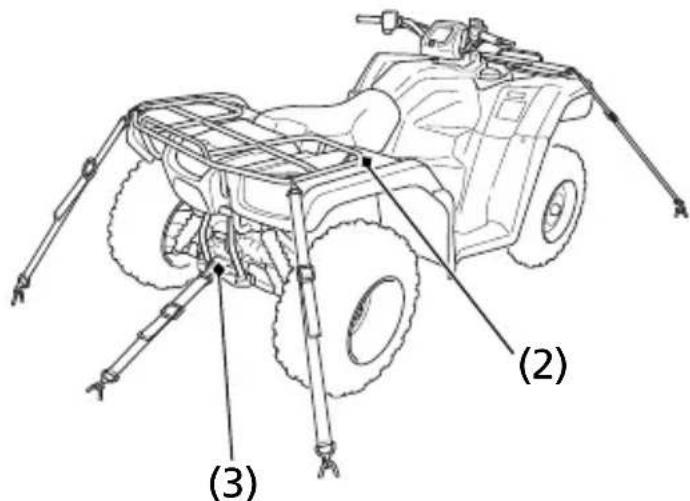
text_image
(2) (3)(1) front cargo rack
(2) rear cargo rack
(3) trailer hitch
Storing Your Honda
If you won't be riding for an extended period, such as during the winter, thoroughly inspect your ATV and correct any problem before storing it. That way, needed repairs won't be forgotten and it will be easier to get your ATV running again.
For more information about storage, refer to the Honda Winter Storage Guide, available from your dealer (USA only).
We suggest you perform the following procedures to keep your ATV in top condition. These storage procedures will reduce the deterioration that can occur during storage.
Preparation for Storage
Refer to Safety Precautions on page 107.
- Change the engine oil and filter (page 129).
- Make sure the cooling system is filled with a 50/50% antifreeze solution (page 139).
- Fill the fuel tank. Make sure the fuel fill cap is properly installed.
-
To prevent rusting in the cylinder, perform the following:
-
Remove the spark plug cap from the spark plug (page 155).
- Remove the spark plug.
Do not connect the spark plug to the spark plug cap.
- Pour a tablespoon (15 – 20 cc) of clean engine oil into the cylinder and cover the spark plug hole with a piece of cloth.
- With the engine stop switch in the RUN (Ω) position, press the start button several times to crank the engine and distribute the oil.
- Reinstall the spark plug and spark plug cap.
- Remove the battery and charge it fully. Store it in an area protected from freezing temperatures and direct sunlight. Slow charge the battery (page 188) once a month.
WARNING
The battery gives off explosive hydrogen gas during normal operation.
A spark or flame can cause the battery to explode with enough force to kill or seriously hurt you.
Wear protective clothing and a face shield, or have a skilled mechanic do the battery maintenance.
- Wash and dry your ATV. Wax all painted surfaces.
- Inflate the tires to their recommended pressures (page 174).
- Store your ATV in an unheated area, free of dampness, away from sunlight, with a minimum of daily temperature variation.
- Place your ATV on blocks to lift all tires off the floor.
- Cover your ATV with a porous material. Avoid using plastic or similar non-breathing, coated materials that restrict air flow and allow heat and moisture to accumulate.
NOTICE
Do not store your ATV in an upright position for extended periods of time. The ATV should be stored with all four tires on the ground. This can damage the vehicle, and leaking gasoline could be a hazard.
Removal from Storage
Refer to Safety Precautions on page 107.
- Uncover and clean your ATV.
- If your ATV has been stored for more than four months — change the engine oil (page 131).
- If your ATV has been stored for more than two months — ask your dealer to drain and replace the fuel.
- Charge the battery (page 188) as required. Install the battery.
- Perform a pre-ride inspection (page 55), then test-ride your ATV at low speeds.
Owning and riding an ATV can be enjoyable, but you must do your part to protect nature. When you show respect for the land, wildlife, and other people, you also help preserve the sport of off-road riding.
Following are tips on how you can be an environmentally responsible ATV owner.
- Tread Lightly. Stay on existing roads and trails, avoid surfaces that are easily damaged, and ride only in areas approved for off-road vehicles.
- Keep the Noise Down. Loud vehicles can be offensive. Ride as quietly as possible, don’t remove your spark arrester, and don’t modify the muffler or any other part of your air intake and exhaust systems. Such modifications not only increase noise, they also reduce engine performance and may be illegal.
- Choose Sensible Cleaners. Use a biodegradable detergent when you wash your ATV. Avoid aerosol spray cleaners that contain chlorofluorocarbons (CFCs) which damage the atmosphere's protective ozone layer. Don't throw cleaning solvents away; see the following guidelines for proper disposal.
- Recycle Wastes. It's illegal and thoughtless to put used engine oil in the trash, down a drain, or on the ground. Used oil, gasoline, and cleaning solvents contain poisons that can hurt refuse workers and contaminate our drinking water, lakes, rivers, and oceans. Before changing your oil, make sure you have the proper containers. Put oil and other toxic wastes in separate sealed containers and take them to a recycling center. Call your local or state office of public works or environmental services to find a recycling center in your area, and to get instructions on how to dispose of non-recyclable wastes.
Taking Care of the Unexpected
With all the challenges you can encounter off-road, there's a chance that sometime something may go wrong. This section gives practical advice to help you deal with a wide range of problems. Take time to read this section before you ride. Also review the tips in Preparing for a Ride (page 194).
General Guidelines 204
If Your Engine Quits or Won't Start 206
If the Transmission Is Not Functioning Properly 209
Emergency Gear Selection & Operation 212
If You Have a Flat Tire.... 214
If the High Coolant Temperature Indicator Lights.... 218
If a Fuse Blows.... 220
If You Crash 225
If You Lose Your Key 226
If the Battery Is Low (or Dead).... 227
If a Component Fails.... 228
General Guidelines
Keeping your ATV well-maintained is the best way to reduce the possibility of having a problem while riding. However, problems can arise even with well-maintained machines.
Remember to take along your owner's manual, the tool kit that came with your ATV, and any other items (such as tire repair supplies and additional tools) that might help you solve a problem on your own.
If something goes wrong during a ride, the first thing to do is stop as soon as you safely can. Do not continue riding if you have a flat tire, or you hear an unusual noise, or your ATV just doesn't feel right. If you continue riding, you could cause more damage and endanger your own safety.
After stopping, take time to assess the situation. Carefully inspect your ATV to identify the problem, then consider your options before you decide what to do.
If a problem is relatively minor and you have the tools, supplies, and skills to make a permanent repair, you may be able to fix it on the trail and continue riding. Or, you may be able to make a temporary repair that allows you to slowly ride back to your base where you can make a permanent repair or get help.
When a problem is more serious — or you don’t have the tools, supplies, experience, or time to deal with it — you need to choose the safest way to get yourself and your ATV back to base. For example, if you are close enough, you (or you and another person) might be able to push it back.
204 Taking Care of the Unexpected
Taking Care of the Unexpected
Should you ever have a problem while riding, please follow these guidelines:
• Always put personal safety first.
- Take time to assess the situation and your options before deciding what to do.
- If the problem is relatively minor and you have the tools, supplies, and skills to make a temporary repair, be sure to have permanent repairs made as soon as possible.
- Do not continue riding if you are hurt or your ATV is not in safe riding condition.
Additional recommendations for specific problems follow.
If Your Engine Quits or Won't Start
Proper operation and maintenance can prevent starting and engine performance problems. In many cases, the cause of the problem may be a simple operational oversight.
If you have a problem starting the engine — or experience poor engine performance — the following information may help you. If you can't correct the problem, see your dealer.
If your ATV won't start, listen as you press the start button. If you don't hear the starter motor turning, refer to the Starter motor doesn't operate symptom. If you can hear the starter motor working normally, refer to the Starter motor works, but the engine won't start symptom.
| SYMPTOM: Starter motor doesn’t operate. | |
| POSSIBLE CAUSE WHAT TO DO | |
| ignition switch OFF Turn the ignition switch ON. | |
| engine stop switch OFF Slide the engine stop switch to RUN. | |
| transmission not in neutral | Shift into neutral or squeeze the front brake lever. |
| blown fuse Replace with a new fuse of the same rating (page 220). | |
| battery lead loose Tighten the battery lead. | |
| low (or dead) battery Charge the battery (page 188).If charging doesn’t help, see your dealer. | |
| faulty starter motor If all possible causes are negative, the starter motor may be faulty. See your dealer. | |
| SYMPTOM: Starter motor works, but the engine won’t start. | |
| POSSIBLE CAUSE WHAT TO DO | |
| out of fuel Fill the fuel tank. | |
| flooded engine See Flooded Engine (page 75). | |
| loose or unconnected spark plug cap | Install the spark plug cap securely. If the engine still won’t start, see your dealer. |
| loose battery cables Tighten the battery terminal bolts. | |
| weak battery Charge the battery (page 188).If charging doesn’t help, see your dealer. | |
If Your Engine Quits or Won't Start
| SYMPTOM: Engine starts, but runs poorly. | |
| POSSIBLE CAUSE WHAT TO DO | |
| high coolant temperature | Check the coolant temperature gauge and high coolant temperature indicator.Refer to If the High Coolant Temperature Indicator Lights, page 218. |
| runs erratically, misfires See your dealer. | |
| blubbers (rich fuel mixture) | See your dealer. |
| sooty exhaust (rich fuel mixture) | See your dealer. |
| detonates or pings under load | If applicable, switch to the recommended octane gasoline (page 123) or change your brand of gasoline. If the problem persists, see your dealer. |
| afterburn (backfires) See your dealer. | |
| pre-ignition (runs on after ignition switched OFF) | See your dealer. |
| SYMPTOM: Engine starts, but runs poorly or dies when hot. | |
| POSSIBLE CAUSE WHAT TO DO | |
| poor or inadequate fuel flow due to clogged fuel filter | See your dealer.(ensure clean fuel supply) |
If the Transmission Is Not Functioning Properly
ESP (manual shift mode):
If one or both shift switches do not function, see the following instruction. If proper function cannot be restored, see your dealer.
When the engine is running:
- Stop the ATV.
- Turn the ignition switch to the OFF (O) position.
- After the engine stops, turn the ignition switch to the ON (I) position.
- Press both shift switches and check that they are functioning.
- If both switches are functioning, shift into neutral and restart the engine.
If one or both switches are not functioning, see Emergency Gear Selection & Operation, page 212.
When the engine is stopped and the ignition switch is "ON" (1):
- Turn the ignition switch to the OFF (O) position.
- Turn the ignition switch to the ON (1) position.
- Press both shift switches and check that they are functioning.
- If both switches are functioning, shift into neutral and restart the engine.
If one or both switches are not functioning, see Emergency Gear Selection & Operation, page 212.
If the Transmission Is Not Functioning Properly
AUTO (automatic shift mode):
When the automatic transmission is not shifting properly, the gear position indicator will show “—” and blink.
See your dealer to check and restore the automatic transmission.
If the gear position indicator shows “—” and blink while riding, perform the following:
- Stop the ATV.
- Turn the ignition switch to the OFF (O) position.
- After the engine stops, turn the ignition switch to the ON (I) position.
- Check the gear position indicator.
If these efforts do not restore proper operation, have your ATV inspected by your dealer.
When the “−” is blinking in the gear position indicator:
Restart the engine; drive the ATV to a location where it can be loaded and transported to your dealer.
When the display on the gear position indicator returns to normal:
You may drive on the ATV as usual after restarting the engine. However, we urge you to have your ATV inspected by your dealer.
If the Transmission Is Not Functioning Properly
If the ATV does not move, even through “-” is not blinking in the gear position indicator:
If your ATV won't move, it is possible the transmission is locked. Use the following procedure to unlock the transmission.
- Make sure the transmission is in neutral.
- Apply the parking brake.
- Turn the ignition switch to the OFF (O) position.
- Loosen the screw (1) and release the lock plate (2).
- Turn the emergency valve (3) by the screwdriver using the inside of the front fender hole (4) all the way in. With the engine running, your ATV will move forward slowly at idle.
- See your dealer as soon as possible.

(1) screw
(3) emergency valve
(2) lock plate
(4) inside of the front fender hole
When the battery is low (or dead):
• See If the Battery Is Low (or Dead), page 227.
Emergency Gear Selection & Operation
If the shift switches do not operate, use the following procedure to manually select a gear so you may drive the vehicle to a location where it can be loaded and transported to your dealer.
- Turn the ignition switch to the ON (I) position.
- Remove the seat (page 118), and tank cover assembly (page 119).
- Remove the gear change tool from the storage compartment (page 116).
- Check the neutral indicator. If the transmission is in neutral, go to step 5. If the transmission is not in neutral, use the gear change tool to shift to neutral so you will be able to start the engine. Refer to How to Shift Gears Manually: (page 213).
- Apply the parking brake.
- Press the start button to start the engine.
- Set 2nd gear position. Refer to How to Shift Gears Manually: (page 213).
- Return the gear change tool to the storage location.
- Install the tank cover assembly and seat.
- Get on the ATV. Ride it at a safe speed to a place where it can be repaired or serviced.
Emergency Gear Selection & Operation
How to Shift Gears Manually:

text_image
(A) (B) (1)(1) gear change tool
(A) downshift (counterclockwise) (B) upshift (clockwise)
- With the ATV unoccupied, align the hexagonal hole of the gear change tool (1) with the hexagonal end of the secondary spindle which is located on the front crankcase.
- To downshift, turn the gear change tool to direction (A). To upshift, turn the gear change tool to direction (B).
- If the transmission does not shift, rock the vehicle back and forth and try again.
- Return the gear change tool to the storage location.
Do not attempt to shift gears manually using the gear change tool while riding.
If the transmission is shifted manually when the electric shift system is functioning, the system will shutdown automatically and the shift switches will not operate. To reactivate the system, turn the ignition switch to the OFF (O) position, then turn it back to the ON (I) position.
How you handle a flat tire on the trail depends on how serious the tire damage is, and what tools and supplies you have with you.
If you have a slow leak or a minor puncture, use the plug method to make a temporary repair. (The plug method is applied from the outside of the tire and is the same as that for conventional tubeless tires.)
A plug-type repair kit, available at most auto parts stores or service stations, provides a plug, an installation tool, tire cement, and an instruction sheet. Follow the instructions provided with the repair kit to make a temporary repair.
As soon as possible, have the tire permanently repaired by your dealer. Any tire that cannot be repaired should be replaced.
Whenever the ATV is to be operated far from service facilities or available transportation, we recommend that you carry a tire pump and a repair kit with the vehicle.
If the leak is more serious, or a temporary repair doesn't hold, the tire must be replaced. The tire will also need to be replaced if it is damaged (page 178). Replacing a tire involves removing and reinstalling the wheel (page 216).
If you are unable to repair a flat tire on the trail, you will need to send for help. We strongly recommend that you do not try to ride with a flat tire. The ATV will be hard to handle, and if the tire comes off the rim, it may lock up the wheel and cause you to crash.
WARNING
Riding your ATV with a temporary tire repair can be risky.
If the temporary repair fails, you can crash and be seriously injured or killed. If you must ride with a temporary tire repair, ride slowly and carefully until the tire is permanently repaired or replaced.
Emergency Wheel Removal/Installation
Refer to Safety Precautions on page 107.

text_image
(1)
text_image
(1) (2)(1) wheel nuts (2) wheel rim
Removal
- Park your ATV on a firm, level surface.
- Loosen — but do not remove — the wheel nuts (1).
- Raise the front (or rear) wheels off the ground and place a support block under the vehicle.
- Remove the wheel nuts.
- Remove the wheel.
- Avoid getting grease, oil, or dirt on the front brake disc or pad surfaces when removing and installing each wheel. Any contamination can cause poor brake performance or rapid pad wear after reassembly.
Installation
- Position the wheel.
- Position the wheel nuts so that the tapered sides face the wheel rim (2).
- Hand-tighten the wheel nuts on the wheel, then lower the ATV to the ground before tightening the nuts in a crisscross (rather than circular) pattern to the specified torque:
47 lbf·ft (64 N·m, 6.5 kgf·m)
If a torque wrench was not used for installation, see your dealer as soon as possible to verify proper assembly. Improper assembly may lead to loss of braking capability.
If the High Coolant Temperature Indicator Lights
Normally, the high coolant temperature indicator will only light momentarily when you turn the ignition to ON (1).
High coolant temperature may be caused by restriction of air flow to the radiator (such as mud caked on the radiator), extended idling, an oil leak, a coolant leak, a low oil level, a low coolant level, or extended operation under adverse conditions.
If the all segment of the coolant temperature gauge and high coolant temperature indicator are on while you're riding, don't ignore it. Pull safely to a stop. Stop the engine as soon as it's safe to do so, and let it cool.
NOTICE
Continuing to ride with high coolant temperature or an overheated engine can cause serious engine damage.
- A steaming engine indicates a coolant leak. Shut the engine off and wait until the steaming stops. Look for a leak, but don't touch the engine or radiator system. Let everything cool off first.
- Check for any restriction of air flow to the radiator.
- If there's no obvious problem, leave the engine on so the fan and coolant circulating system can continue working. Monitor the coolant temperature gauge and high coolant temperature indicator. The indicator may turn off after a brief stop with no load on the engine.
- Check the radiator fan.
If the fan is not working, turn the engine off. Open the fuse box (page 221) and check the radiator fan fuse. If the fuse is blown, replace it with the proper (same rating) spare fuse. Start the engine. If the all segment of the coolant temperature gauge and high coolant temperature indicator stays on, turn the engine off. If the radiator fan is working, visually check the coolant level in the reserve tank, located under the left front fender. It isn't necessary to touch the radiator system.
If the High Coolant Temperature Indicator Lights
- If the reserve tank is low or empty, don't ride without adding coolant (page 140). After adding coolant, turn the engine on and check the coolant temperature gauge and high coolant temperature indicator.
If the indicator doesn't turn off, do not ride. The engine needs repair.
Transport your ATV to your dealer (page 196).
If the temperature drops to normal, check the coolant level. If it has gone down, add more coolant.
- Check for an oil leak.
- Check the oil level. If necessary, add the recommended oil (page 131) to the upper level mark. If you must leave your ATV to get oil, secure it as much as possible.
- Start the engine, and check that the coolant temperature gauge and high coolant temperature indicator goes off.
If you are able to resume riding, continue to monitor the coolant temperature gauge and high coolant temperature indicator frequently.
If there is an oil leak — do not ride the ATV until the leak is repaired by your dealer (page 196).
If there's a mild coolant leak, you can ride for awhile, carefully watching the coolant temperature gauge and indicator. Be prepared to stop and add more coolant or water. If the leak is bad, transport your ATV to your dealer (page 196).
If a Fuse Blows
All of the electrical circuits on your ATV have fuses to protect them from damage caused by excess current flow (short circuit or overload).
If something electrical on your ATV stops working, the first thing you should check for is a blown fuse (1).
Check all the fuses before looking elsewhere for another possible cause of the problem. Replace any blown fuses and check component operation.

text_image
(1)(1) blown fuse
The main fuse and the circuit fuses are located under the rear fender cover.
TRX420FA6 only:
The EPS (Electric Power Steering) block fuse is located under the rear fender cover.
Recommended Fuses
| main fuse 1 30 A | |
| main fuse 2 10 A | |
| shift motor fuse 30 A | |
| other fuses 20 A × 2, 10 A | |
| EPS (Electric Power Steering) fuse (TRX420FA6 only) | 40 A |
220 Taking Care of the Unexpected
Main and Shift Motor Fuses Access
- To prevent an accidental short circuit, turn the ignition switch to OFF (O) before checking or replacing the fuses.
- Remove the seat (page 118).
- Remove the rear fender cover (page 121).
- To access the main fuses (2) (3) and shift motor fuse (4), remove the fuse box cover (5).
UNDER REAR FENDER COVER

text_image
(5)(6)
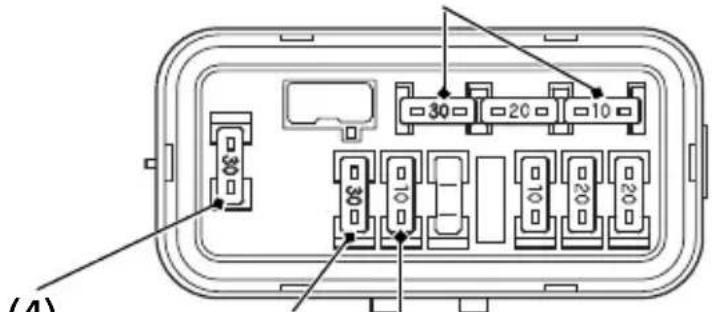
text_image
(4)(2)
(2) main fuse 1 (5) fuse box cover
(3) main fuse 2
(6) spare fuses
(4) shift motor fuse
- Pull the main fuse out.
If it is blown, install the spare fuses (6).
(cont'd)
Circuit Fuses Access
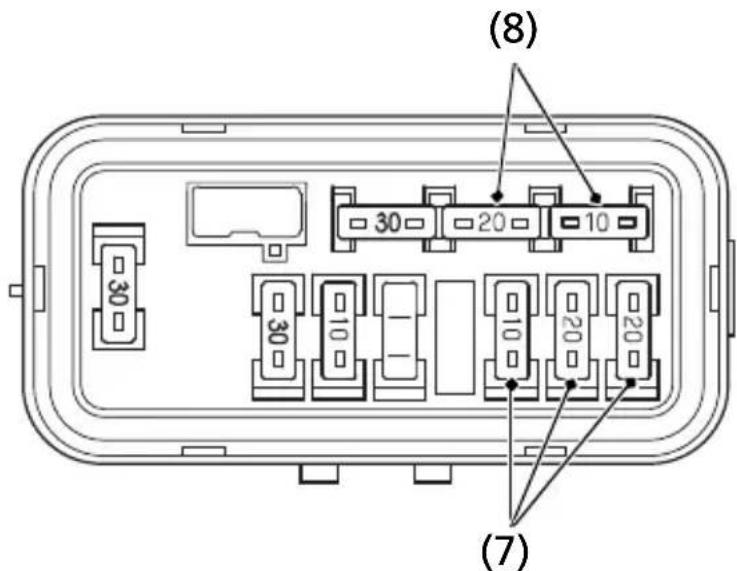
text_image
(8) 30 20 10 30 10 10 20 20 (7)(7) circuit fuses (8) spare fuses
- To check or replace a circuit fuse (7), pull the old fuse out of its retaining clips.
If the fuse is blown, replace it with a spare fuse (8) of the same rating.
If you do not have a replacement fuse with the proper rating for the circuit, install one with a lower rating.
NOTICE
Replacing a fuse with one that has a higher rating greatly increases the chance of damage to the electrical system.
- Install the fuse box cover.
- Install the rear fender cover.
- Install the seat.
222 Taking Care of the Unexpected
EPS (Electric Power Steering) Fuse Access (TRX420FA6 only)
- Turn the ignition switch to OFF (O) before checking the fuse.
- Remove the seat (page 118).
- Remove the rear fender cover (page 121).
- To access the EPS block fuse (1), remove the EPS fuse block cover (2).
If the EPS block fuse is blown, see your dealer for this service. - Install the EPS fuse box cover.
- Install the rear fender cover.
- Install the seat.
UNDER REAR FENDER COVER
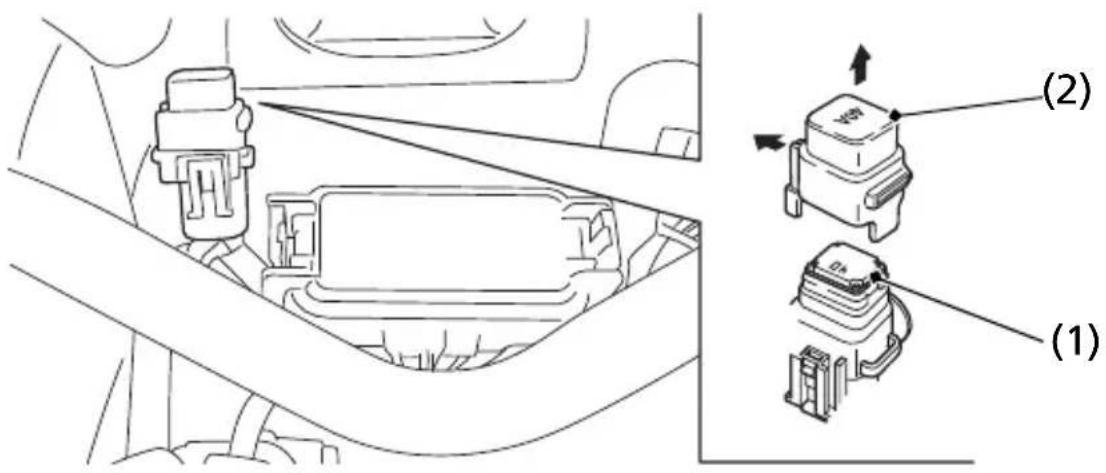
text_image
Technical diagram showing car interior and internal components with labeled parts (1) and (2)(1) EPS fuse (2) EPS fuse block cover
If a Fuse Blows
If you do not have a spare fuse and you cannot ride the ATV without fixing the problem, take a fuse of the same rating or a lower rating from one of the other circuits that you can do without temporarily.
If you replace a blown fuse with a spare fuse that has a lower rating, replace the fuse with the correct rating as soon as you can. Also remember to replace any spare fuses that were installed.
If the replacement fuse of the same rating burns out in a short time, there is probably a serious electrical problem on your ATV. Leave the blown fuse in that circuit and have your ATV checked by your dealer.
Personal safety is your first priority after a crash. If you or anyone else has been injured, take time to assess the severity of the injuries and whether it is safe to continue riding. If you cannot ride safely, send someone for help. Do not ride if you will risk further injury.
If you decide you are capable of riding safely, carefully inspect your ATV for damage and determine if it is safe to ride. Check the tightness of critical nuts and bolts securing such parts as the handlebar, control levers, brakes, and wheels.
If there is minor damage, or you are unsure about possible damage but decide to try riding the ATV back to your base, ride slowly and cautiously.
Sometimes, crash damage is hidden or not immediately apparent. When you get home, thoroughly check your ATV and correct any problems you find. Also, be sure to have your dealer check the frame and suspension after any serious crash.
If You Lose Your Key
Be sure to record your key number (1). Store the spare key and recorded key number in a safe location. You'll need this number to have a duplicate key made.
If you lose your key and aren't carrying a duplicate, either get your spare or have one made. If you don't know your key number, call the dealer where you purchased your Honda ATV. They may have it listed in their records. If they don't, transport your ATV to them or the nearest dealer. The dealer will probably have to remove the ignition switch assembly to find the key number so they can make a key for you.
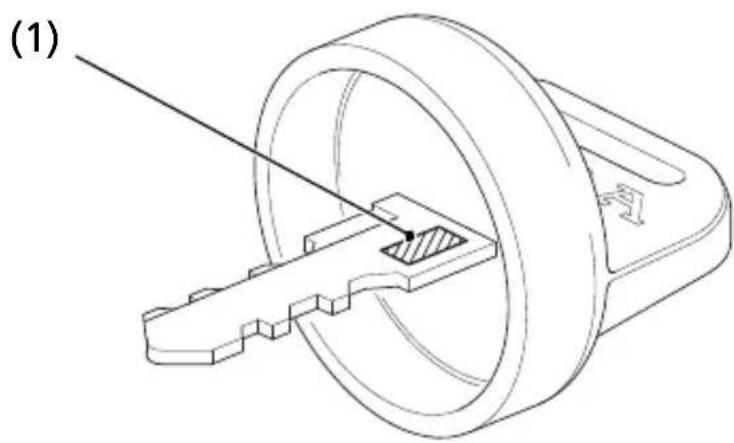
natural_image
Technical line drawing of a mechanical component with a labeled section (1), showing internal structure and part outline (no text or symbols beyond label)(1) key number
Jump starting is not recommended, especially if you use an automobile battery. The greater amperage of an automobile battery when the car engine is running can damage your ATV's electrical system.
Bump starting is also not recommended.
If you can't charge the battery or it appears unable to hold a charge, contact your dealer.
(Canada only)
Your ATV will operate even if the battery is low (or dead), as long as the engine is running. If the engine is not running, it may be started using the recoil starter.
- Turn the ignition switch to the "ON" (I) position.
- Check if the transmission is in neutral by moving the vehicle back and forth.
- If the transmission is in neutral, the vehicle will move easily. Go to step 6. If the transmission is not in neutral, the vehicle will not move.
- Remove the gear change tool from the storage compartment (page 116).
- Use the gear change tool to shift to neutral so you will be able to start the engine. Refer to How to Shift Gears Manually: (page 213).
- Apply the parking brake.
- Turn the ignition switch to the "OFF" (O) position, then turn it back to the "ON" (I) position.
- Use the recoil starter (page 78) to start the engine.
If a Component Fails
The brake levers or pedal, control cables, and other components can be damaged as you ride in dense brush or over rocky terrain. Making a trailside repair depends on how serious the damage is and what tools and supplies you have with you.
- If any component of the brake system is damaged, you may be able to ride carefully back to your base using the other brake components for slowing or stopping.
- If you damage a throttle cable or other critical component, your ATV may be unsafe to ride. Carefully assess the damage and make any repairs that you can. But if there is any doubt, it's best to be conservative and safe.
Technical Information
This section contains dimensions, capacities, and other technical data, plus information on government requirements and how to break-in your ATV.
Vehicle Identification 230
Specifications 232
Break-in Guidelines.... 237
Emission Control Systems 238
Oxygenated Fuels 242
Serial Numbers
The VIN and engine serial number may be required when ordering replacement parts. You may record these numbers in the Quick Reference section at the rear of this manual.
The VIN (1) is stamped on the front of the frame.
FRONT
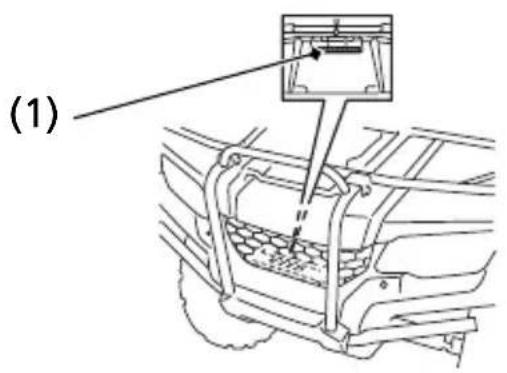
text_image
(1)(1) VIN
The engine number (2) is stamped on the upper side of the rear crankcase.
LEFT REAR
(2)
natural_image
Technical line drawing of a mechanical assembly with no visible text or symbols(2) engine number
Color Label & Code
The color label (1) is attached on the left side of the frame.
The color code is helpful when ordering replacement parts. You may record the color and code in the Quick Reference section at the rear of this manual.
LEFT SIDE

natural_image
Line drawing of a car's side panel showing keyway and seat components (no text or symbols)(1) color label
Specifications
| Dimensions | |
| overall length 84.6 in (2,148 mm) | |
| overall width 47.4 in (1,205 mm) | |
| overall height 46.8 in (1,189 mm) | |
| wheelbase 50.9 in (1,294 mm) | |
| ground clearance 9.2 in (233 mm) |
| Fuel & Lubricants | |
| fuel recommendation | unleaded gasoline, pump octane number of 86 or higher |
| fuel tank capacity 3.88 US gal (14.7 ℓ) including reserve | |
| fuel tank reserve 1.29 US gal (4.9 ℓ) | |
| engine oil capacity | after disassembly: 4.2 US qt (4.0 ℓ) after draining: 3.6 US qt (3.4 ℓ) after draining & oil filter change: 3.8 US qt (3.6 ℓ) |
| engine oil recommendation | API Service Classification SG or higher except oils labeled as energy conserving or resource conserving on the circular API service label, SAE 10W-30, JASO T 903 standard MA, Pro Honda GN4 4-stroke oil (USA & Canada), or Honda 4-stroke oil, or an equivalent motorcycle oil |
| Fuel & Lubricants (cont'd) | |
| cooling system recommendation | Pro Honda HP Coolant or an equivalent high quality ethylene glycol antifreeze containing corrosion protection inhibitors specifically recommended for use in aluminum engines |
| cooling system capacity | 1.7 US qt (1.6 l) |
| Capacities | |
| passenger capacity | operator only |
| maximum weight capacity | 485 lb (220 kg) rider, all cargo and accessories |
| Engine Specifications | |
| displacement 25.6 cu-in (420 cm3) | |
| bore & stroke 3.4055 × 2.8150 in(86.500 × 71.500 mm) | |
| compression ratio 9.9 : 1 | |
| spark plug(standard) | BKR5E-11 (NGK) orK16PR-U11 (DENSO) |
| spark plug gap 0.039 – 0.043 in (1.00 – 1.10 mm) | |
| valve clearance(cold) | intake: 0.006 in (0.15 mm)exhaust: 0.009 in (0.23 mm) |
| idle speed 1,400 ± 100 rpm(NO ADJUSTMENT) | |
Specifications
| Power Transmission | ||
| primary reduction 2.680 | ||
| secondary reduction 1.480 | ||
| final reduction front | 3.231 | |
| rear 3.154 | ||
| transmission ratio 1st | 3.058 | |
| 2nd 2.157 | ||
| 3rd 1.541 | ||
| 4th 1.178 | ||
| 5th 0.848 | ||
| reverse 3.996 | ||
| final drive shaft | ||
| Chassis & Suspension | ||
| caster 2° | ||
| trail 0.2 in (4 mm) | ||
| tire size, front | AT24 × 8-12★★ | MAXXIS M977 |
| tire size, rear | AT24 × 10-11★★ | MAXXIS M978 |
| tire pressure,front & rear (cold) | front:4.4 psi (30 kPa)rear:4.4 psi (30 kPa) | |
| Electrical | |
| battery GYZ16H | 12 V-16 Ah (10HR) |
| generator 0.45 kW/5,000 rpm | |
| Lights | |
| head light 12 V | 35/35W × 2 |
| brake/tail light LED | |
| neutral indicator LED | |
| reverse indicator LED | |
| high coolant temperature indicator | LED |
| PGM-FI indicator LED | |
| PS (Electric Power Steering) indicator (TRX420FA6 only) | LED |
| Fuses | |
| main 1 30 A | |
| main 2 10 A | |
| shift motor 30 A | |
| other 20 A × 2, 10 A | |
| EPS (Electric Power Steering) (TRX420FA6 only) | 40 A |
Specifications
| Torque Specification | |
| engine oil drain bolt | 18 lbf·ft (25 N·m, 2.5 kgf·m) |
| engine oil filter cover bolts | 9 lbf·ft (12 N·m, 1.2 kgf·m) |
| rear final gear oil drain bolt | 9 lbf·ft (12 N·m, 1.2 kgf·m) |
| rear final gear oil fill cap | 9 lbf·ft (12 N·m, 1.2 kgf·m) |
| front final gear oil drain bolt | 9 lbf·ft (12 N·m, 1.2 kgf·m) |
| front final gear oil fill cap | 9 lbf·ft (12 N·m, 1.2 kgf·m) |
| wheel nuts 47 lbf·ft | (64 N·m, 6.5 kgf·m) |
Help assure your ATV's future reliability and performance by paying extra attention to how you ride during the first operating day or 15 miles (25 km).
During this period, avoid full-throttle starts, rapid acceleration, and constant rpm operation.
Emission Control Systems
Exhaust Emission Requirements
The U.S. Environmental Protection Agency (EPA) and Environment Climate Change Canada (ECCC) require that your ATV comply with applicable exhaust emissions standards during its useful life, when operated and maintained according to the instructions provided.
The Vehicle Emission Control Information Label (1) is attached on the left front of the frame.
(Canada only)
The Vehicle Emission Control Information Label (2) is attached on the left side of the frame.
LEFT FRONT
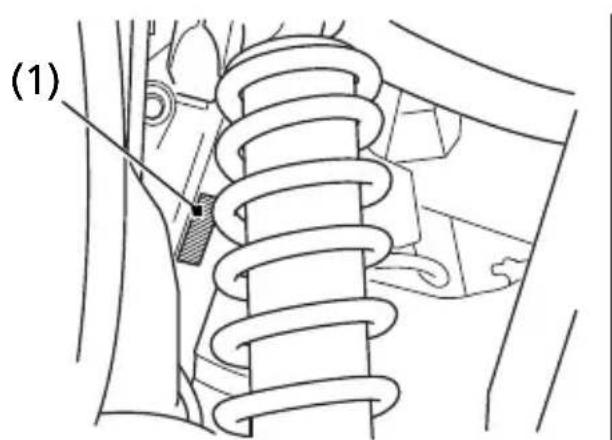
natural_image
Technical line drawing of a mechanical spring assembly (no text or symbols)LEFT SIDE
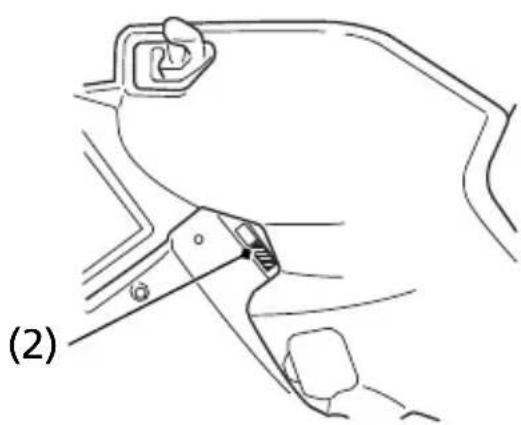
natural_image
Line drawing of a car's side panel showing keyway and seat components (no text or symbols)(1) vehicle emission control information label
(2) vehicle emission control information label (Canada only)
Source of Exhaust Emissions
The combustion process produces carbon monoxide (CO), oxides of nitrogen (NOx) and hydrocarbons (HC). Control of hydrocarbons and oxides of nitrogen is very important because, under certain conditions, they react to form photochemical smog when subjected to sunlight. Carbon monoxide does not react in the same way, but it is toxic.
Honda Motor Co., Ltd. utilizes various systems to reduce carbon monoxide, oxides of nitrogen and hydrocarbons.
Exhaust Emission Control System
The exhaust emission control system includes a PGM-FI system and oxygen sensor.
No adjustment to this system should be made although periodic inspection of the components is recommended.
The exhaust emission control system is separate from the crankcase emission control system.
Crankcase Emission Control System
The engine is equipped with a closed crankcase system to prevent discharging crankcase emissions into the atmosphere. Blow-by gas is returned to the combustion chamber through the air cleaner.
Emission Control Systems
Problems That May Affect ATV Exhaust Emissions
If you are aware of any of the following symptoms, have the vehicle inspected and repaired by your ATV dealer.
Symptoms:
- Hard starting or stalling after starting
- Rough idle
- Misfiring or backfiring during acceleration
- After-burning (backfiring)
- Poor performance (driveability) and poor fuel economy
Federal regulations prohibit removing or disabling a device or element of design that may affect your engine's emission performance unless your ATV will be used exclusively in competition. If you modify your engine for use in sanctioned competition events, you must deface or destroy the emission control information label.
If you loan, sell, or give your competition modified Honda ATV to someone else, according to applicable law, you must inform the new owner/operator in writing that the vehicle is to be used for competition only.
Noise Emission Control System
TAMPERING WITH THE NOISE CONTROL SYSTEM IS PROHIBITED: State laws prohibit, or Canadian provincial laws may prohibit, the following acts or the causing thereof: (1) The removal or rendering inoperative by any person, other than for purposes of maintenance, repair or replacement, of any device or element of design incorporated into any new vehicle for the purpose of noise control prior to its sale or delivery to the ultimate purchaser or while it is in use; or (2) the use of the vehicle after such device or element of design has been removed or rendered inoperative by any person.
AMONG THOSE ACTS PRESUMED TO CONSTITUTE TAMPERING ARE THE FOLLOWING ACTS:
- Removal of, or puncturing the muffler, baffles, header pipes or any other component which conducts exhaust gases.
- Removal of, or puncturing of any part of the intake system.
- Lack of proper maintenance.
- Removing or disabling any emissions compliance component, or replacing any compliance component with a non-compliant component.
Fuel Permeation Emission Control System
This vehicle complies with the Fuel Permeation Emission Control regulations of the U.S. Environmental Protection Agency (EPA) and Environment Climate Change Canada (ECCC).
The fuel tank, fuel hoses, and fuel vapor charge hoses used on this vehicle incorporate fuel permeation control technologies.
Tampering with the fuel tank, fuel hoses, or fuel vapor charge hoses to reduce or defeat the effectiveness of the fuel permeation technologies is prohibited by federal regulations.
Oxygenated Fuels
Some conventional gasolines are being blended with alcohol or an ether compound. These gasolines are collectively referred to as oxygenated fuels. To meet clean air standards, some areas of the United States and Canada use oxygenated fuels to help reduce emissions.
If you use an oxygenated fuel, be sure it is unleaded and meets the minimum octane rating requirement.
Before using an oxygenated fuel, try to confirm the fuel's contents. Some states/provinces require this information to be posted on the pump.
The following are the EPA-approved percentages of oxygenates for non-road vehicles:
ETHANOL (ethyl or grain alcohol) up to 10% by volume You may use gasoline containing up to 10% ethanol by volume. Gasoline containing ethanol may be marketed under the name "Gasohol".
Do not use gasoline containing more than 10% ethanol by volume. The use of gasoline containing a higher percentage (e.g. E15, E20, E85) of ethanol has not been approved for use in this vehicle and may cause starting and/or performance problems and can also damage metal, rubber, and plastic parts of the fuel system and are not be covered by the Distributor's Limited Warranty.
METHANOL (methyl or wood alcohol) up to 5% by Volume You may use gasoline containing methanol containing up to 5% methanol by volume as long as it also contains cosolvents and corrosion inhibitors to protect the fuel system. Gasoline containing more than 5% methanol by volume may cause starting and/or performance problems. It may also damage metal, rubber, and plastic parts of your fuel system.
If you notice any undesirable operating symptoms, try another service station or switch to another brand of gasoline.
Fuel system damage or performance problems resulting from the use of an oxygenated fuel containing more than the percentages of oxygenates mentioned above are not covered under warranty.
Oxygenated fuels can damage paint and plastic. Be careful not to spill fuel when filling the fuel tank. Wipe up any spills immediately.
NOTICE
Oxygenated fuels can damage paint and plastic. Damage caused by spilled fuel is not covered by warranty.
Consumer Information
This section contains information on your warranty and how to get an official Honda service manual.
Authorized Manuals 246
Warranty Coverage 247
Warranty Service 248
Contacting Honda.... 249
Your Honda Dealer 250
Authorized Manuals
The Service Manual used by your authorized dealer is available from your Honda dealer or Helm, Inc. (USA only, Canada: See your dealer to order authorized manuals.)
Also available but not necessary to service your model is the Honda Common Service Manual which explains theory of operation and basic service information for various systems on Honda motorcycles, scooters, ATVs, SxSs and PWCs.
The Winter Storage Guide in conjunction with the Owner's Manual and Service Manual can help you prepare your Honda motorcycle, scooter, ATV, and SxS for winter storage.
These Honda manuals are written for the professional technician, but most mechanically capable owners should find them easy to use if they have the proper tools and observe proper safety standards. Special Honda tools are necessary for some procedures.
| Publication Item No. Description | |
| 61HR305 2019 TRX420TM1/TM2/TE1/FM1/FM2/FE1/FA1/FA2/FA5/FA6Service Manual | |
| 61CSM00 Common Service Manual | |
| S9507 Winter Storage Guide | |
| 31HR7640 2019 TRX420FA5/FA6Owner's Manual |
Order On-Line: www.helminc.com
Order Toll Free: 1-888-CYCLE93 (1-888-292-5393)
(NOTE: For Credit Card Orders Only)
Monday - Friday 8:00 AM - 6:00 PM EST
Your new Honda is covered by these warranties:
- TRX Limited Warranty
- Emission Control System Warranty
There are responsibilities, restrictions, and exclusions which apply to these warranties. Please read the Warranties Booklet given to you by your Honda dealer at the time of purchase. Be sure to keep your Honda owner's card with your Warranties Booklet.
Canada: Please refer to the Warranty Booklet posted on our website at www.honda.ca.
It is important to realize that your warranty applies to defects in material or workmanship of your Honda. Your warranty coverage does not apply to normal wear or deterioration associated with using the ATV.
Your warranty coverage will not be voided if you choose to perform your own maintenance. However, you should have the proper tools and service information, and be mechanically qualified. Failures that occur due directly to improper maintenance are not covered.
Almost all of your warranty coverage can be extended through the Honda Protection Plan (USA only). For more information, see your dealer.
Please remember that recommended maintenance interval servicing is not included in your warranty coverage. Additionally, your warranty does not apply to the normal wear of items (such as brakes, tires, etc.).
If you believe you have a problem with your ATV, call the service department of your dealer. Make an appointment for an inspection and diagnosis. Remember, as the owner of the ATV, you will be asked to authorize that inspection. Your dealer will give you the results of the inspection. If the problem is covered under warranty, your dealer will perform the warranty repairs for you.
If you have questions about warranty coverage or the nature of the repair, it is best to talk to the Service Manager of your dealer.
Sometimes, in spite of the best intentions of all concerned, a misunderstanding may occur. If you aren't satisfied with your dealer's handling of the situation, we suggest you discuss your problem with the appropriate member of the dealership's management team. If the problem has already been reviewed with the Service Manager, Parts Manager, Sales Manager, etc., contact the Owner of the dealership or their designated representative.
Your owner's manual was written to cover most of the questions you might ask about your Honda. Any questions not answered in the owner's manual can be answered by your dealer. If your dealer doesn't have the answer right away, they will get it for you.
If you have a difference of opinion with your dealer, please remember that each dealership is independently owned and operated. That's why it's important to work to resolve any differences at the dealership level.
If you wish to comment on your experiences with your Honda or with your dealer, please send your comments to the following address:
Motorcycle Division, American Honda Motor Co., Inc., P.O. Box 2200, Torrance, CA 90509-2200, mailstop: 100-4C-7B, telephone: (866) 784-1870.
Canada: Honda Canada Inc., Customer Relations Dept, 180 Honda Boulevard, Markham, Ontario L6C 0H9, telephone: (888) 946-6329, facsimile: (877) 939-0909.
E-mail: honda_cr@ch.honda.com
Please include the following information in your letter:
- name, address, and telephone number
• product model, year, and VIN - date of purchase
- dealer name and address
We will likely ask your dealer to respond, or possibly acknowledge your comments directly.
Your Honda Dealer
Once you purchase your new Honda, get familiar with the organization of your Honda dealer so you can utilize the full range of services available.
The service department is there to perform regular maintenance and unexpected repairs. It has the latest available service information from Honda. The service department will also handle warranty inspections and repairs.
The parts department offers Honda Genuine Parts, Pro Honda products, Honda Genuine Accessories (USA only), and Honda accessories and products (Canada only). The same quality that went into your Honda can be found in Honda Genuine replacement parts. You'll also find comparable quality in the accessories and products available from the parts department.
The sales department offers the Honda Protection Plan to extend almost all of your warranty coverage (USA only).
Your Honda dealer can inform you about competition and other riding events in your area. You'll also find that your dealer is a source of information about safety training available in your local area.
We're sure you'll be as pleased with the service your Honda dealer continues to provide after the sale as you are with the quality and dependability of your Honda.
Index
A
accessories 62
age recommendation ....53
air cleaner,
dust cover 150
filter 146
housing drain tube 151
air pressure,
gauge 117
tire 173
American Honda, contacting 249
apparel, protective ....50
appearance care 189
authorized manuals 246
B
bank angle sensor ignition cut-off system 75
battery 184
brake light switch adjustment 171
brakes,
cables 170
fluid 163
front brake lever 42
pad wear 167
parking 43
rear brake lever 42
rear brake lever freeplay 169
rear brake pedal 42
braking 87
break-in guidelines 237
button, mode 14, 19
C
capacity, fuel 124
care, appearance 189
cargo,
loading and operational guidelines ....61
weight limit 60
cleaning, appearance care 189
climbing hills 92
clip 122
color label 231
compartment,
owner's manual 117
storage 47
tool kit 116
component fails 228
consumer information 245
controls & features 34
coolant temperature gauge 29
crash, if you 225
crossing or turning on hills or slopes 97
customer service 249
D
digital clock 27
dimmer switch, headlight 37
dipstick 129
display check 16
display, multi-function .....20
drive mode select switch 40
driveshaft boots 183
drivetrain boots 182
Index
E
electric power steering (EPS) 48
emission control systems 238
engine,
flooded 75
guards 179
number 230
oil 126
pinging 123
starting 72
stop switch 36
stopping 77
won't start 206
environment 202
exhaust system,
cleaning 56
purging 159
F
final gear,
front 137
rear 134
flag pole bracket 45
flat tire 214
flooded engine 75
front boot guards 180
front driveshaft boots 183
front driveshaft guards 180
fuel,
fill cap 113
gauge 25
oxygenated 242
recommendation 123
refueling 124
reserve fuel supply 124
tank capacity 124
fuses 220
G
gap, spark plug 155, 233
gasohol 242
gasoline 123
gear shifting 79
gearshift switch 41
guards 179
H
headlight dimmer switch 37
headlight switch 37
high coolant temperature indicator 14, 17, 218
hills,
crossing or turning on slopes 97
riding down hills 96
riding up hills 92
stopping on hills 94
Honda service manual 246
Honda,
contacting 249
dealer 250
hour meter 31
Index
|
identification, vehicle ....230
ignition switch 34
indicators,
4WD indicator 14, 18, 23
gear position indicator 24
high coolant temperature indicator 14, 17, 218
maintenance minder indicator ....32
neutral indicator 14, 17
PGM-FI indicator 14, 17
PS (Electric Power Steering) indicator (TRX420FA6 only) .....14, 17
reverse indicator 14, 17
inspection, pre-ride 55
K
key,
lost 226
number 226
kit, tool 116
L
labels, safety ....5
lamp check 15
lever,
2WD/4WD select 35
P/R 43
limit, weight 60
load limits 60
loading guidelines 61
lubrication,
engine oil 126
front final gear oil 137
rear final gear oil 134
M
maintenance,
component locations ....113
hour meter 32
importance 105
minder indicator 32
precautions 107
record 112
safety 106
schedule 108
tripmeter 32
manual, service 246
maximum weight limit 60
mode button 14, 19
modifications 63
multi-function display 20
N
neutral indicator 14, 17
noise emission control system 241
numbers, serial 230
0
obstacles, riding over 99
odometer 28
oil,
engine 126
front final gear 137
rear final gear ....134
operation component locations 11
owner's manual storage 117
oxygenated fuels 242
Index
P
P/R lever 43
parking 43,102
passengers, no carrying 53
pavement, no riding on 67
pinging, engine 123
plug, spark 155
pre-ride inspection 55
problems, unexpected 204
propeller shaft boots & yoke joint boot 182
protective apparel ....50
EPS (Electric Power Steering) (TRX420FA6 only) 48
R
rear boot guards ....181
rear driveshaft boots ....183
rear final gear oil 134
recoil starter (Canada only) 38,78
removal,
rear fender cover ....121
seat 118
tank cover assembly 119
reverse,
assist cable 154
assist lever 154
gear, shifting into 85
indicator 14, 17
riding in 85
rider training 52
riding,
basic operation 65
clothing 50
over obstacles 99
precautions 67
preparing for 194
safety 2
safety precautions 67
through water 100
S
safety,
important precautions 107
labels 5
riding precautions 67
schedule, maintenance 108
seat removal 118
select lever,
2WD/4WD 35
serial numbers 230
service,
customer 249
manuals 246
warranty 248
shifting gears 79
skid plate 179
skidding or sliding 91
spark arrester 159
spark knock 123
spark plug 155
specifications 232
speedometer 18,20
stalled engine 76
Index
stalling on a hill 94
start button 36
starting,
engine 72
troubleshooting 206
stop switch, engine 36
stopping engine 77
storage,
ATV 198
owner's manual 117
suspension,
adjustment 160
spring pre-load 161
switch,
downshift 41,82
drive mode select 40
engine stop 36
headlight 37
headlight dimmer 37
ignition 34
upshift 41,82
T
throttle,
cable 152, 153
lever 39,152,153
tires,
air pressure 173
flat 214
repairing 177
replacing 178
tread conditions 175, 176
tool kit 116
Index
trailer hitch 46
trailer towing, operational guidelines ....61 weight limits ....60
training, rider 52
transporting your ATV 196
tripmeter 28
trouble, unexpected 203
troubleshooting, starting 206
turning, on hills or slopes ....97 on level ground ....89
V
valve clearance 158
vehicle identification no. (VIN) 230
W
warning labels 5
warranty, coverage ....247 extended ....248 service ....248
washing your ATV ....190 water, riding through ....100 weight limit ....60 wheel removal ....216
The following is a brief, but important collection of information you need to know about your Honda. You'll also find space to record important notes.
How To Avoid Costly Repairs
The engine of your Honda can be the most expensive component to repair. Proper maintenance, especially the use of the recommended fluids and filters, prevents premature wear and damage.
Frequent causes of costly repairs are:
- Engine oil — insufficient quantity, improper oil.
- Air cleaner — dirty, leaking because of improper installation (poor seal).
Record important information on the following page:
Quick Reference
| Engine No. | |
| VIN | |
| Color Label | |
| Owner's Name | |
| Address | |
| City/State | |
| Phone | |
| Dealer's Name | |
| Address | |
| City/State | |
| Phone | |
| Service Mgr. |
Quick Reference
| Scheduled Maintenance | Initial: 100 miles (150 km) Regular: every 600 miles (1,000 km) |
| Pre-ride Inspection | Check the following items each time before you ride (page 55): engine oil, radiator coolant, fuel, tires, drivetrain boots, guards, nuts & bolts, underbody & exhaust system, air cleaner housing drain tube, leaks, loose parts, cables, lights, throttle, brakes, reverse assist lever, switches, steering. |
| Fuel/Capacity unleaded gasoline, pump octane number 86 or higher 3.88 US gal (14.7 ℓ) reserve: 1.29 US gal (4.9 ℓ) | |
| Engine Oil/ Capacity | API Service Classification SG or higher except oils labeled as energy conserving or resource conserving on the circular API service label, SAE 10W-30, JASO T 903 standard MA, Pro Honda GN4 4-stroke oil or equivalent after draining: 3.6 US qt (3.4 ℓ) after draining & oil filter change: 3.8 US qt (3.6 ℓ) |
| Maximum Weight Capacity | 485 lb (220 kg) rider, all cargo and accessories |
| Tires Front: AT24 × 8-12★★MAXXIS M977Rear: AT24 × 10-11★★MAXXIS M978 | |
| Tire Pressure (cold) | Front: 4.4 psi(30 kPa)Rear: 4.4 psi(30 kPa) |
| Spark Plugs standard:BKR5E-11 (NGK) or K16PR-U11 (DENSO) | |
| Coolant ethylene glycol antifreeze (silicate-free)for aluminum engines in 50/50 solution with Pro Honda HP Coolant or an equivalent distilled water | |
| Fuses main 1: 30 A | main 2: 10 Ashift motor: 30 Aother: 20 A × 2, 10 AEPS (Electric Power Steering)(TRX420FA6 only): 40 A |
These symbols are used in Controls & Features section:
| SYMBOL | COMPONENT SEE PAGE | |
| ION — | ignition switch 34 | |
| OFF — | ignition switch 34 | |
| 2WD/2WD select lever 35 | ||
| START button 36 | ||
| RUN — | engine stop switch 36 | |
| OFF — | engine stop switch 36 | |
| ON — | headlight switch 37 | |
| OFF — | headlight switch 37 | |
| ID | HI — headlight dimmer switch | 37 |
| ID | LO — headlight dimmer switch | 37 |
| AUTO | automatic shift mode — drive mode select switch | 40 |
| ESP | manual shift mode — drive mode select switch | 40 |
| ◇ | upshift switch — gearshift switch | 41 |
| ◇ | downshift switch — gearshift switch | 41 |
| P_tR | Parking Brake/Reverse Lever (P/R lever):P — parking brakeR — riding in reverse | 43 |
WARNING
Operating, servicing and maintaining a passenger vehicle or off-highway motor vehicle can expose you to chemicals including engine exhaust, carbon monoxide, phthalates, and lead, which are known to the State of California to cause cancer and birth defects or other reproductive harm. To minimize exposure, avoid breathing exhaust, do not idle the engine except as necessary, service your vehicle in a well-ventilated area and wear gloves or wash your hands frequently when servicing your vehicle. For more information go to www.P65Warnings.ca.gov/passenger-vehicle.

MADE FROM 50% RECYCLED PAPER MINIMUM 10% POST-CONSUMER CONTENT
HONDA
The Power of Dreams
WARNING
Improper ATV use can result in SEVERE INJURY or DEATH
natural_image
Circular logo with stylized animal figures and goggles, no text or symbols presentALWAYS USE AN APPROVED HELMET AND PROTECTIVE GEAR
text_image
Prohibition sign with silhouette of cyclist crossing a road, featuring bicycle symbol and 'No Road' textNEVER USE ON PUBLIC ROADS
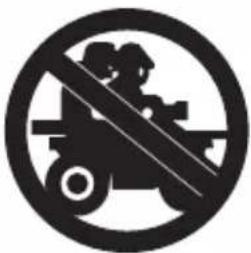
natural_image
Prohibition sign with no text, featuring a silhouette of a person on a construction vehicle (no text or symbols)NEVER CARRY PASSENGERS

text_image
Prohibition sign with beer bottle and syringe symbol crossed out, indicating no smoking or alcohol useNEVER USE WITH DRUGS OR ALCOHOL
NEVER operate:
- without proper training or instruction
• at speeds too fast for your skills or the conditions - on public roads - a collision can occur with another vehicle
• with a passenger - passengers affect balance and steering and increase risk of losing control
ALWAYS:
- use proper riding techniques to avoid vehicle overturns on hills and rough terrain and in turns
- avoid paved surfaces - pavement may seriously affect handling and control
LOCATE AND READ OWNER'S MANUAL.
FOLLOW ALL INSTRUCTIONS AND WARNINGS.