PowerEdge 650 - Server DELL - Free user manual and instructions
Find the device manual for free PowerEdge 650 DELL in PDF.


| Product Type | Server, Tower Form Factor |
| Dimensions (H x W x D) | 44.5 x 20.4 x 50.6 cm (17.5 x 8.0 x 19.9 inches) |
| Weight | Approximately 16 kg (35.3 lbs) without drives |
| Power Supply | Single 350W AC power supply, 100-240 VAC, 50/60 Hz |
| Processor | Intel Xeon up to 3.06 GHz, 800 MHz FSB |
| Memory | Up to 4 GB DDR333 SDRAM, 4 DIMM slots |
| Storage | Up to 4 internal SCSI or SATA hard drives, hot-swap optional |
| Expansion Slots | 5 PCI slots: 2 PCI-X 64-bit/100 MHz, 3 PCI 32-bit/33 MHz |
| Networking | Dual embedded Broadcom 10/100/1000 Gigabit Ethernet |
| Cooling | 4 hot-swappable fans with redundant option |
| Supported Operating Systems | Microsoft Windows Server 2003, Red Hat Enterprise Linux, Novell NetWare |
| Included Accessories | Keyboard, mouse, power cable, documentation CD |
| Maintenance | Easy-open chassis, tool-less access to internal components |
| Safety | Complies with UL, CE, FCC Class A; ESD precautions recommended |
| Spare Parts & Repairability | Field-replaceable units (FRUs): power supply, fans, hard drives, memory modules |
| General Information | Manufactured by Dell, released circa 2003; manual available in PDF |
Frequently Asked Questions - PowerEdge 650 DELL
User questions about PowerEdge 650 DELL
0 question about this device. Answer the ones you know or ask your own.
Ask a new question about this device
Download the instructions for your Server in PDF format for free! Find your manual PowerEdge 650 - DELL and take your electronic device back in hand. On this page are published all the documents necessary for the use of your device. PowerEdge 650 by DELL.
USER MANUAL PowerEdge 650 DELL
Dell™ PowerEdge™ 650 Systems Installation and Troubleshooting Guide
Introduction
Indicators, Messages, and Codes
Finding Software Solutions
Running the System Diagnostics
Troubleshooting Your System
Installing System Components
Installing Drives
Getting Help
Jumpers, Switches, and Connectors
I/O Connectors
Abbreviations and Acronyms

NOTE: A NOTE indicates important information that helps you make better use of your computer.

NOTICE: A NOTICE indicates either potential damage to hardware or loss of data and tells you how to avoid the problem.

CAUTION: A CAUTION indicates a potential for property damage, personal injury, or death.
Information in this document is subject to change without notice.
© 2003 Dell Computer Corporation. All rights reserved.
Reproduction in any manner whatsoever without the written permission of Dell Computer Corporation is strictly forbidden.
Trademarks used in this text: Dell, the DELL logo, PowerEdge, Dell OpenManage, DellNet, Dell Precision, Dimension, Inspiron, OptiFlex, and Latitude are trademarks of Dell Computer Corporation; Intel is a registered trademark of Intel Corporation; MS-DOS is a registered trademark of Microsoft Corporation.
Other trademarks and trade names may be used in this document to refer to either the entities claiming the marks and names or their products. Dell Computer Corporation disclaims any proprietary interest in trademarks and trade names other than its own.
Initial release: May 2003
Back to Contents Page
Jumpers, Switches, and Connectors
Dell™ PowerEdge™ 650 Systems Installation and Troubleshooting Guide
Jumpers—A General Explanation
System Board Jumpers
System Board Connectors
Backplane Board Connectors
Riser Card Connectors
● Disabling a Forgotten Password
This section provides specific information about the system jumpers. It also provides some basic information on jumpers and switches and describes the connectors on the various boards in the system.
Jumpers—A General Explanation
Jumpers provide a convenient and reversible way of reconfiguring the circuitry on a printed circuit board. When reconfiguring the system, you may need to change jumper settings on circuit boards or drives.
Jumpers
Jumpers are small blocks on a circuit board with two or more pins emerging from them. Plastic plugs containing a wire fit down over the pins. The wire connects the pins and creates a circuit. To change a jumper setting, pull the plug off its pin(s) and carefully fit it down onto the pin(s) indicated, Figure A-1 shows an example of a jumper.
Figure A-1. Example Jumper

A jumper is referred to as open or unjumped when the plug is pushed down over only one pin or if there is no plug at all. When the plug is pushed down over two pins, the jumper is referred to as jumpered. The jumper setting is often shown in text as two numbers, such as 1-2. The number 1 is printed on the circuit board so that you can identify each pin number based on the location of pin 1.
Figure A-2 shows the location and default settings of the server-module jumper blocks. See Table A-1 for the designations, default settings, and functions of the jumpers.
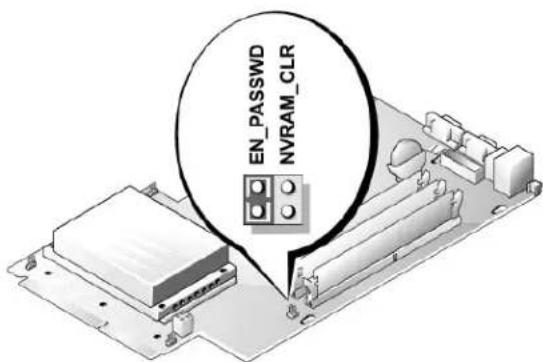
System Board Jumpers
Figure A.2 shows the location of the configuration jumpers on the system board. Table A.1 lists the jumpers settings.
Figure A-2. System Board Jumpers
text_image
EN_PASSWD NVRAM_CLRTable A-1. System Board Jumper Settings
| Jumper | Setting | Description |
| EN_PASSWD | (default) | The password feature is enabled. |
| The password feature is disabled. | ||
| NVRAM_CLR | (default) | The configuration settings in NVRAM are retained at system boot. |
| The configuration settings in NVRAM are cleared at next system boot. | ||
| ### | ||
System Board Connectors
See Figure A-3 and Table A-2 for the location and description of the system board connectors.
Figure A-3. System Board Connectors

text_image
JP2 JP7 processor and heat sink CN2 JP4 DIMM C BT1 J7 DIMM A DIMM BTable A-2. System Board Connectors
| Connector | Description |
| JP7 | Power connector for the processor fan |
| CN2 | 12 V power connector for the system board |
| JP4 | Power connector for the memory modules fan |
| DIMM n | Memory modules (3) |
| J7 | Power connector for the remote access card |
| BT1 | Connector for the 3.0 V coin battery |
Backplane Board Connectors
See Figure A-4 and Table A-3 for the location and description of the backplane board connectors.
Figure A-4. Backplane Board Connectors

text_image
IDE0 IDE1 J3 JP1 JP2 CN1 hard drive side system board side J2 U3 SLT1Table A-3. Backplane Board Connectors
| Connector | Description |
| IDE0 | Data interface connector for the IDE hard drive 0 |
| JP1 | Power connector for the IDE hard drive 0 |
| IDE1 | Data interface connector for the IDE hard drive 1 |
| JP21 | Power connector for the IDE hard drive 0 |
| CN1 | Interface connector for the CD diskette drives |
| J3 | Control panel interface connector |
| J2 | Power supply connector |
| U3 | +12 V connector |
| SLT1 | System board interface connector |
Riser Card Connectors
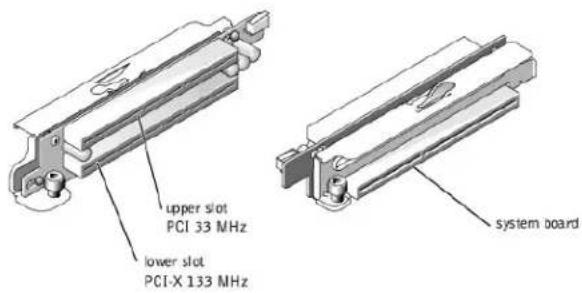
See Figure A-5 and Table A-4 for the location and description of the backplane board connectors.
Figure A-5. Riser Card Connectors
text_image
upper slot PCI 33 MHz lower slot PCI-X 133 MHz system boardTable A-4. Riser Card Connectors
| Connector | Description |
| Upper slot PCI 33 MHz | DRAC III/XT must be installed in the upper slot. |
| Lower slot PCI-X 133 MHz | For optimal performance, install RAID and SCSI controllers in the lower slot. |
| System board | System board interface connector. |
Disabling a Forgotten Password
The system's software security features include a system password and a setup password, which are discussed in detail in "Using the System Setup Program" in your User's Guide. The password jumper enables these password features or disables them and clears any password(s) currently in use.

CAUTION: See your System Information Guide for complete information about safety precautions, working inside the computer, and protecting against electrostatic discharge.
- Turn off the system and attached peripherals, and disconnect the system from the electrical outlet.
- Open the system. See "Opening the System" in "Troubleshooting Your System."
- Remove the password jumper plug.
See Figure A-2 to locate the password jumper on the system board.
- Close the system. See "Closing the System" in "Troubleshooting Your System."
- Reconnect the system to the electrical outlet, and turn on the system.
The existing passwords are not disabled (erased) until the system boots with the password jumper plug removed. However, before you assign a new system and/or setup password, you must install the jumper plug.

NOTE: If you assign a new system and/or setup password with the jumper plug still removed, the system disables the new password(s) the next time it boots.
- Turn off the system, including any attached peripherals, and disconnect the system from the electrical outlet.
- Open the system.
- Install the password jumper plug.
See Figure A-2 to locate the password jumper on the system board.
- Close the system, reconnect the system to the electrical outlet, and turn on the system.
- Assign a new system and/or setup password.
Back to Contents Page
Back to Contents Page
I / O Connectors
Dell™ PowerEdge™ 650 Systems Installation and Troubleshooting Guide
I/O Connectors
Serial Connector
PS/2-Compatible Keyboard and Mouse Connectors
Video Connector
USB Connector
NIC Connector
Network Cable Requirements
I/O Connectors
I/O connectors are the gateways that the system uses to communicate with external devices, such as a keyboard, mouse, printer, or monitor. This section describes the various connectors on your system. If you reconfigure the hardware connected to the system, you may also need the pin number and signal information for these connectors. Figure B-1 illustrates the connectors on the system.
Figure B-1. I/O Connectors

text_image
USB connectors (2) mouse connector keyboard connector serial connector video connectorTable B-1 shows the icons used to label the connectors on the system.
Table B-1. I/O Connector Icons
| Icon | Connector |
| HOOD | Serial connector |
| Mouse connector | |
| Keyboard connector | |
| Video connector | |
| USB connector |
Serial Connector
Serial connectors support devices such as external modems, printers, and mice that require serial data transmission. Serial connectors are also used for console redirection. The serial connector uses a 9-pin D-subminiature connector.
Serial Connector Autoconfiguration
The default designation of the integrated serial connector is COM1. When you add an expansion card containing a serial connector that has the same designation as the integrated connector, the system's autoconfiguration feature remaps (reassigns) the integrated serial connector to the next available designation. Both the new and the remapped COM connectors share the same IRQ setting. COM1 and COM3 share IRQ4, while COM2 and COM4 share IRQ3.

NOTE: If two COM connectors share an IRQ setting, you may not be able to use them both at the same time. In addition, if you install one or more expansion cards with serial connectors designated as COM1 and COM3, the integrated serial connector is disabled.
Before adding a card that remaps the COM connectors, check the documentation that came with the software to make sure that the software can accommodate the new COM connector designation.
Figure B-2 illustrates the pin numbers for the serial connector and Table B-2 defines the pin assignments for the connector.
Figure B-2. Serial Connector Pin Numbers

Table B-2. Serial Connector Pin Assignments
| Pin | Signal | I / O | Definition |
| 1 | DCD | I | Data carrier detect |
| 2 | SIN | I | Serial input |
| 3 | SOUT | O | Serial output |
| 4 | DTR | O | Data terminal ready |
| 5 | GND | N/A | Signal ground |
| 6 | DSR | I | Data set ready |
| 7 | RTS | O | Request to send |
| 8 | CTS | I | Clear to send |
| 9 | RI | I | Ring indicator |
| Shell | N/A | N/A | Chassis ground |
PS/ 2-Compatible Keyboard and Mouse Connectors
The PS/2-compatible keyboard and mouse cables attach to 6-pin, miniature DIN connectors. Figure B-3 illustrates the pin numbers for these connectors and Table B-3 defines the pin assignments for these connectors.
Figure B-3. PS/2-Compatible Keyboard and Mouse Connector Pin Numbers

Table B-3. Keyboard and Mouse Connector Pin Assignments
| Pin | Signal | I/O | Definition |
| 1 | KBDATA or MFDATA | I/O | Keyboard data or mouse data |
| 2 | NC | N/A | No connection |
| 3 | GND | N/A | Signal ground |
| 4 | FVoc | N/A | Fused supply voltage |
| 5 | KBCLK or MFCLK | I/O | Keyboard clock or mouse clock |
| 6 | NC | N/A | No connection |
| Shell | N/A | N/A | Chassis ground |
Video Connector
You can attach a VGA-compatible monitor to the system's integrated video controller using a 15-pin high-density D-subminiature connector. Figure B-4 illustrates the pin numbers for the video connector and Table B-4 defines the pin assignments for the connector.

NOTE: Installing a video card automatically disables the system's integrated video controller.
Figure B-4. Video Connector Pin Numbers
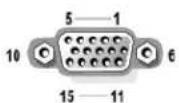
Table B-4. Video Connector Pin Assignments
| Pin | Signal | I/ O | Definition |
| 1 | RED | O | Red video |
| 2 | GREEN | O | Green video |
| 3 | BLUE | O | Blue video |
| 4 | NC | N/A | No connection |
| 5-8, 10 | GND | N/A | Signal ground |
| 9 | VCC | N/A | Vcc |
| 11 | NC | N/A | No connection |
| 12 | DDC data out | O | Monitor detect data |
| 13 | HSYNC | O | Horizontal synchronization |
| 14 | VSYNC | O | Vertical synchronization |
| 15 | NC | N/A | No connection |
USB Connector
The system's USB connectors support USB-compliant peripherals such as keyboards, mice, and printers and may also support USB-compliant devices such as diskette drives and CD drives. Figure B-5 illustrates the pin numbers for the USB connector and Table B-5 defines the pin assignments for the connector.

NOTICE: Do not attach a USB device or a combination of USB devices that draw a maximum current of more than 500 mA per channel or +5 V. Attaching devices that exceed this threshold may cause the USB connectors to shut down. See the documentation that accompanied the USB devices for their maximum current ratings.
Figure B-5. USB Connector Pin Numbers

Table B-5. USB Connector Pin Assignments
| Pin | Signal | I / O | Definition |
| 1 | Vcc | N/A | Supply voltage |
| 2 | DATA | I | Data in |
| 3 | +DATA | O | Data out |
| 4 | GND | N/A | Signal ground |
NIC Connector
The system's NIC provides fast communication between servers and workstations. Figure B-6 illustrates the pin numbers for the NIC connector and Table B-6 defines the pin assignments for the connector.
Figure B-6. NIC Connector

text_image
link indicator activity indicator 1——8Table B-6. NIC Connector Pin Assignments
| Pin | Signal | I/O | Definition |
| 1 | TD+ | O | Data out (+) |
| 2 | TD- | O | Data out (-) |
| 3 | RD+ | I | Data in (+) |
| 4 | NC | N/A | No connection |
| 5 | NC | N/A | No connection |
| 6 | RD- | I | Data in (-) |
| 7 | NC | N/A | No connection |
| 8 | NC | N/A | No connection |
Network Cable Requirements
The NIC supports a UTP Ethernet cable equipped with a standard RJ45-compatible plug. Observe the following cabling restrictions.

NOTICE: To avoid line interference, voice and data lines must be in separate sheaths.
1 Use Category 5 or greater wiring and connectors.
Do not exceed a cable run length (from a workstation to a hub) of 100 m (328 ft).
For detailed guidelines about the operation of a network, see "Systems Considerations of Multi-Segment Networks" in the IEEE 802.3 standard.
Abbreviations and Acronyms
Dell™ PowerEdge™ 650 Systems Installation and Troubleshooting Guide
A
ampere(s)
AC
alternating current
ANSI
American National Standards Institute
APM
advanced power management
BIOS
basic input/output system
C
Celsius
CD
compact disc
cm
centimeter(s)
CMOS
complementary metal-oxide semiconductor
CPU
central processing unit
DC
direct current
DHCP
Dynamic Host Configuration Protocol
DIMM
dual in-line memory module
DMA
direct memory access
DMI
desktop management interface
dpi
dots per inch
DRAM
dynamic random-access memory
DRACIII/XT
Dell Remote Access Card III/XT
ECC
error checking and correction
EDO
extended-data out
EGA
enhanced graphics adapter
EI DE
enhanced integrated drive electronics
EMI
electromagnetic interference
EMM
expanded memory manager
EMS
Expanded Memory Specification
EPP
Enhanced Parallel Port
EPROM
erasable programmable read-only memory
ESD
electrostatic discharge
ESDI
enhanced small-device interface
ESM
embedded server management
F
Fahrenheit
FAT
file allocation table
FCC
Federal Communications Commission
ft
feet
g
gram(s)
GB
gigabyte(s)
GUI
graphical user interface
Hz
hertz
1/0
input/output
ID
identification
IDE
integrated drive electronics
IPX
Internet packet exchange
IRQ
interrupt request
ISA
Industry-Standard Architecture
KB
kilobyte(s)
KB/ sec
kilobyte(s) per second
kg
kilogram(s)
kHz
kilohertz
L2
Level 2
LAN
local area network
lb
pound(s)
LED
light-emitting diode
LVD
low voltage differential
m
meter(s)
mA
milliampere(s)
mAh
milliampere-hour(s)
MB
megabyte(s)
MHz
megahertz
mm
millimeter(s)
m s
millisecond(s)
MS-DOS®
Microsoft ^® Disk Operating System
m V
millivolt(s)
NAS
network attached storage
NIC
network interface controller
NIS
network information service
NiCad
nickel cadmium
NMI
nonmaskable interrupt
ns
nanosecond(s)
NTFS
NT File System
NVRAM
nonvolatile random-access memory
PCI
Peripheral Component Interconnect
PDU
power distribution unit
PGA
pin grid array
POST
power-on self-test
RAID
redundant array of independent disks
RAM
random-access memory
RAS
remote access services
RGB
red/green/blue
ROM
read-only memory
rpm
revolutions per minute
RTC
real-time clock
SCA
Single Controller Architecture
sec
second(s)
SDRAM
synchronous dynamic random-access memory
SIMM
single in-line memory module
SMBus
system management bus
SNMP
Simple Network Management Protocol
SDRAM
synchronous dynamic random-access memory
TCP/IP
Transmission Control Protocol/Internet Protocol
UART
universal asynchronous receiver-transmitter
UPS
uninterruptible power supply
UTP
unshielded twisted pair
v
volt(s)
VAC
volt(s) alternating current
VDC
volt(s) direct current
VGA
video graphics array
VRAM
video random-access memory
w
watt(s)
WH
wall-hour(s)
ZIF
zero insertion force
Back to Contents Page
Introduction
Dell™ PowerEdge™ 650 Systems Installation and Troubleshooting Guide
Other Documents You May Need
Your system includes the following significant service and upgrade features:
System diagnostics, which checks for hardware problems (if the system can boot)
The following system upgrade options are available:
1 Processor
1 Memory
PCI expansion card
Other Documents You May Need
The System Information Guide provides important safety and regulatory information. Warranty information may be included within this document or as a separate document.
The Rack Installation Guide included with your rack solution describes how to install your system into a rack.
The Setting Up Your System document provides an overview of initially setting up your system.
The User's Guide provides information about system features and technical specifications.
1 Systems management software documentation describes the features, requirements, installation, and basic operation of the software.
Operating system documentation describes how to install (if necessary), configure, and use the operating system software.
1 Documentation for any components you purchased separately provides information to configure and install these options.
Updates are sometimes included with the system to describe changes to the system, software, and/or documentation.
NOTE: Always read the updates first because they often supersede information in other documents.
Release notes or readme files may be included to provide last-minute updates to the system or documentation or advanced technical reference material intended for experienced users or technicians.
Back to Contents Page
Indicators, Messages, and Codes
Dell™ PowerEdge™ 650 Systems Installation and Troubleshooting Guide
Front-Panel Indicators and Features
Back-Panel Indicators and Features
System Messages
System Beep Codes
Warning Messages
- Diagnostics Messages
Alert Messages
Applications, operating systems, and the system itself are capable of identifying problems and alerting you to them. When a problem occurs, a message may appear on the monitor or a beep code may sound.
A variety of messages can indicate when the system is not operating properly:
1 System messages
1 Beep codes
1 Warning messages
1 Diagnostics messages
1 Alert messages
The system indicators and the front- and back-panel features are illustrated in this section. This section also describes each type of message and lists the possible causes and actions you can take to resolve any problems indicated by a message.
Front-Panel Indicators and Features
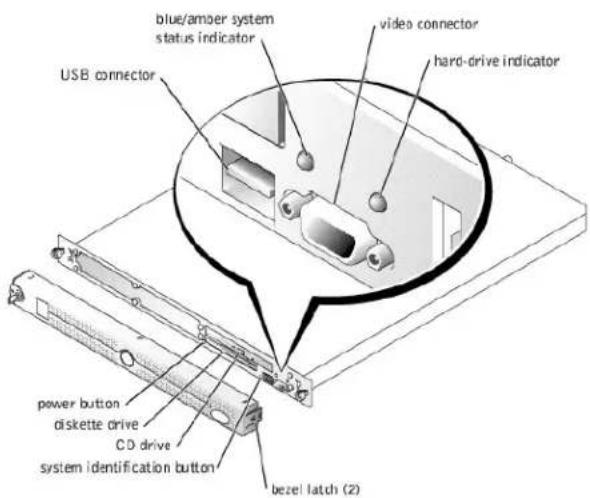
Figure 2-1 shows the front-panel indicators for system status and hard drive activity. The power button has a status indicator built into the button. Also, the CD and diskette drives have activity indicators. Table 2-1 details the conditions associated with each front-panel indicator code.
Figure 2-1. Front-Panel Indicators and Features
text_image
blue/amoer system status indicator video connector hard-drive indicator USB connector power button diskette drive CD drive system identification button bezel latch (2)Table 2-1. Front-Panel Indicator Codes
| Indicator Type | Activity Indicator | Indicator Code |
| Power | Off | The system is off and AC power is not connected to the system. |
| Green blinking | AC power is connected to the system, but the system is not powered on. | |
| Green | Indicates that the system is powered on. | |
| Blue/amber system status | Off | The system is off. |
| Blue | The system is operating normally. | |
| Blue blinking | The system is identifying itself due to the pressing of the identification button.NOTE: Systems management software causes the indicator to blink to identify the system. | |
| Amber blinking | Indicates a fault with the system. | |
| Hard drive | Green blinking | Indicates hard drive activity. |
The power button controls the power input to the system's power supply.
The two system identification buttons on the front and back panels can be used to locate a particular system within a rack. When one of these buttons is pushed or the system management software is used to identify the system, the blue system status indicators on the front and back of the system blink. (To stop the indicator from blinking press one of the identification buttons a second time, or use the systems management software.)
The front panel also incorporates a USB connector and a video connector. See Figure 2-1.
Back-Panel Indicators and Features
Figure 2-2 shows the back-panel indicators and features. Table 2-2 details the conditions associated with each back-panel indicator code.
Figure 2-2. Back-Panel Indicators and Features

text_image
serial connector USB connectors (2) mouse connector keyboard connector power supply connector video connector PCI slot PCI-X slot system identification button blue/amber system status indicatorTable 2-2. Back-Panel LED Codes
| LED Indicator | Normal Operation | Error Condition |
| Status | Off | The system is off. |
| Blue | The system is operating normally. | |
| Blue blinking | The system is identifying itself due to the pressing of the identification button.NOTE: Systems management software causes the indicator to blink to identify the system. | |
| Amber blinking | Indicates a fault with the system. |
System Messages
System messages appear on the console during POST to notify you of a possible problem with the system. If you are performing console redirection, system messages will appear on the console. Table 2-3 lists the system messages that can occur and the probable cause and corrective action for each message.

NOTE: If you receive a system message that is not listed in Table 2-3, check the documentation for the application program that is running when the message appears or the operating system's documentation for an explanation of the message and recommended action.
Table 2-3. System Messages
| Message | Causes | Corrective Actions |
| Address mark not found | Faulty diskette/CD-drive subsystem or hard-drive subsystem. | Ensure that the diskette/CD-drive subsystem and hard drives are properly installed. If the problem persists, replace the diskette/CD-drive subsystem. See "Removing the CD and Diskette Drives" in "Installing Drives." If the problem persists, replace the faulty hard drive. See "Hard Drives" in "Installing Drives." If the problem persists, see "Getting Help." |
| Alert! Cover was previously removed! | The chassis has been opened. | Information only. |
| Alert! CEO fan was not detected. | Specified fan is missing, faulty, or Improperly Installed. See Figure 5-3 to identify the fans. | Ensure that the specified fan is properly installed. If the problem persists, replace the fan. See "Fan Assemblies" in "Installing System Components." |
| Alert! Memory fan was not detected. | ||
| Alert! PCI fan was not detected. | ||
| Alert! Previous CPU fan failure. | Specified fan failed before last system startup. See Figure 5-3 to identify the fans. | Information only. |
| Alert! Previous Memory fan failure. | ||
| Alert! Previous PCI fan failure. | ||
| Alert! Previous voltage failure. | Power supply failed before last system startup. | Information only. |
| Alert! Processor thermal probe failure detected. | Microprocessor fan is missing, faulty, or improperly installed. | Ensure that the processor fan is properly installed. See Figure 5-3 for the processor fan location. If the problem persists, replace the fan. See "Fan Assemblies" in "Installing System Components." |
| Alert! Previous shutdown due to Processor thermal event. | Processor fan failed before the last system startup | Information only. |
| Alert! Unsupported memory | Unsupported or faulty memory module(s). | Ensure that all memory modules are properly installed. If the problem persists, replace the memory module(s). See "Removing Memory Modules" and "Installing Memory Modules" in "Installing System Components." |
| Amount of available memory limited to 256MB: | OS Install Mode is enabled in the System Setup program. | Disable OS Install Mode in the System Setup program. See "Using the System Setup Program" in your User's Guide. |
| Auxiliary device failure | Loose or improperly connected mouse or keyboard cable; faulty mouse or keyboard. | Replace the mouse. If the problem persists, replace the keyboard. |
| BIOS Update Attempt failed! | Remote BIOS update attempt failed. | Retry the BIOS update. If the problem persists, see "Getting Help." |
| Caution! NVRAM_CLR jumper is installed on system board. Please run SETUP | Incorrect configuration settings in System Setup program; NVRAM_CLR jumper is installed; faulty system battery. | Check the System Setup configuration settings. See "Using the System Setup Program" in your User's Guide. Remove the NVRAM_CLR jumper. See Figure A-2 for jumper location. |
| Data error | Faulty diskette, diskette drive, CD drive, or hard drive. | Replace the diskette. Ensure that the diskette/CD-drive subsystem and hard drives are properly installed. If the problem persists, replace the diskette/CD-drive subsystem. See "Removing the CD and Diskette Drives" in "Installing Drives." If the problem persists, replace the faulty hard drive. See "Hard Drives" in "Installing Drives." |
| Decreasing available memory | Faulty or improperly installed memory modules. | Ensure that all memory modules are properly installed. If the problem persists, replace the memory module(s). See "Removing Memory Modules" and "Installing Memory Modules" in "Installing System Components." |
| Diskette drive 0 seek failure | Incorrect configuration settings in System Setup program. | Run the System Setup program to correct the settings. See "Using the System Setup Program" in your User's Guide. |
| Faulty or improperly installed diskette, loose diskette/CD interface cable, or loose power cable. | Replace the diskette. Ensure that the diskette/CD-drive subsystem is properly installed. If the problem persists, replace the diskette/CD-drive subsystem. See "Removing the CD and Diskette Drives" in "Installing Drives." | |
| Diskette read failure | Faulty or improperly inserted diskette. | Replace the diskette. |
| Diskette subsystem reset failed | Faulty diskette/CD-drive controller. | Ensure that the diskette/CD-drive subsystem is properly installed. If the problem persists, replace the diskette/CD-drive subsystem. See "Removing the CD and Diskette Drives" in "Installing Drives." If the problem persists, see "Getting Help." |
| Diskette write protected | Diskette write-protect feature enabled. | Move the write-protect tab on the diskette to disable the write-protect feature. |
| Drive not ready | Diskette missing or improperly inserted in diskette drive. | Reinsert or replace the diskette. |
| Embedded server management error | Faulty or improperly installed remote access card, or loose cable connection. | Ensure that the remote access card's cable is properly connected. Ensure that the remote access card is properly installed. See "Expansion Cards" in "Installing System Components." If the problem persists, replace the remote access card. If the problem persists, see "Getting Help." |
| Embedded server management is not present | Remote access card not installed, improperly installed, or faulty. | Ensure that the remote access card is installed and installed properly. See "Expansion Cards" in "Installing System Components." If the problem persists, replace the remote access card. If the problem persists, see "Getting Help." |
| Error: More than one RAC detected, system halted. | Two remote access cards are installed, or faulty or improperly installed remote access card. | Ensure that there is only one remote access card installed and that it is installed in the upper slot. Ensure that the remote access card is properly installed. See "Expansion Cards" in "Installing System Components." If the problem persists, replace the remote access card. If the problem persists, see "Getting Help." |
| Error: Remote Access Card initialization failure. | Faulty or improperly installed remote access card. | Ensure that the remote access card is properly installed. See "Expansion Cards" in "Installing System Components." If the problem persists, replace the remote access card. If the problem persists, see "Getting Help." |
| Error: RAC is not in the correct PCI slot, system halted. | Remote access card not installed in the proper PCI slot. | Ensure that the remote access card is installed in the upper slot. |
| Error: RAC cannot be used with an add-in video card in this slot. | Add-in video card is installed. | Remove the add-in video card. See "Removing an Expansion Card" in "Installing System Components." To use the add-in video card, remove the remote access card. |
| Gate A20 failure | Faulty keyboard controller (faulty system board). | See "Getting Help." |
| General failure | Operating system corrupted or improperly installed. | Reinstall the operating system. |
| Hard disk controller failure | Incorrect configuration settings in System Setup program. | Run the System Setup program to correct the settings. See "Using the System Setup Program" in your User's Guide. |
| Faulty or improperly installed hard drive, or loose power cable. | Ensure that the hard-drive subsystem is properly installed. If the problem persists, replace the faulty hard drive. See "Hard Drives" in "Installing Drives." | |
| invalid memory configuration detected. Potential corruption exists! | Memory module installation guidelines have not been properly followed. | Ensure that the memory modules are properly populated. See "Memory Module Installation Guidelines" in "Installing System Components." |
| Keyboard controller failure | Faulty keyboard controller (faulty system board). | See "Getting Help." |
| Keyboard data line failure | Loose or improperly connected keyboard cable; faulty keyboard; faulty keyboard controller. | Ensure that the keyboard is properly connected. If the problem persists, replace the keyboard. If the problem persists, see "Getting Help." |
| Keyboard failure | ||
| Keyboard stuck key failure | ||
| Memory address line failure at address, read value expecting value | Faulty or improperly installed memory modules, or faulty system board. | Ensure that all memory modules are properly installed. If the problem persists, replace the memory module(s). See "Removing Memory Modules" and "Installing Memory Modules" in "Installing System Components." If the problem persists, see "Getting Help." |
| Memory double word logic failure at address, read value expecting value | ||
| Memory odd/even logic failure at start address to end address | ||
| Memory write/road failure at address, read value expecting value | ||
| Memory allocation error | Faulty application program. | Restart the application program. |
| Memory bank population error! | Memory modules are not installed in decreasing size with the largest size of memory modules in bank 1; faulty memory module(s); memory modules are not installed sequentially. | Ensure that the memory modules are properly installed. Ensure that the memory modules are populated sequentially. See "Memory Module Installation Guidelines" in "Installing System Components." If the problem persists, replace the specified memory modules. See "System Memory" in "Installing System Components." |
| Memory parity interrupt at address | Faulty or improperly installed memory modules. | Ensure that all memory modules are properly installed. If the problem persists, replace the memory module(s). See "Removing Memory Modules" and "Installing Memory Modules" in "Installing System Components." |
| Memory tests terminated by keystroke | The spacebar was pressed during POST to terminate the memory test. | Information only. |
| No boot device available | Faulty or missing diskette/CD-drive subsystem, hard drive, or hard-drive subsystem. | Check the Integrated Devices configuration settings in the System Setup program. See "Using the System Setup Program" in your User's Guide. Ensure that either SCSI Controller, Diskette Controller, or IDE CD-ROM Controller is enabled. If booling from a SCSI controller, ensure that the controller is properly connected. If the problem persists, replace the diskette/CD drive subsystem. See "Removing the CD and Diskette Drives" in "Installing Drives." If the problem persists, replace the faulty hard drive. See "Hard Drives" in "Installing Drives." |
| No boot sector on hard-disk drive | No operating system on hard drive. | Check the hard-drive configuration settings in the System Setup program. See "Using the System Setup Program" in your User's Guide. |
| No Timer Lick interrupt | Faulty system board. | See "Getting Help." |
| Faulty diskette, diskette/CD-drive assembly, hard drive, or hard-drive | Use a bootable diskette. If the problem persists, replace the diskette/CD-drive subsystem. See "Removing the CD and Diskette Drives" in "Installing Drives." If the | |
| Non-system disk or disk error | subsystem; no operating system on diskette or hard drive. | problem persists, replace the faulty hard drive. See "Hard Drives" in "Installing Drives." |
| Not a boot diskette | No operating system on diskette. | Use a bootable diskette. |
| PCI BIOS failed to install | Loose cables to expansion card(s); faulty or improperly installed expansion card. | Ensure that all appropriate cables are securely connected to the expansion cards. If the problem persists, remove and reseat the expansion cards. See "Expansion Cards" in "Installing System Components." If the problem persists, replace the expansion card(s). |
| Plug & Play Configuration Error | Error encountered in initializing PCI device; faulty system board. | Install the NVRAM_CLR jumper and reboot the system. See Figure A-2 for jumper location. Check for a BIOS update. If the problem persists, remove and reseat the expansion cards. See "Expansion Cards" in "Installing System Components." If the problem persists, replace the expansion card(s). If the problem persists, see "Getting Help." |
| Primary drive n not found | Incorrect configuration settings in System Setup program. Drive set as Auto, no disk installed. | Run the System Setup program to correct the settings. See "Using the System Setup Program" in your User's Guide. |
| Read fault Requested sector not found | Faulty diskette, diskette/CD-drive assembly, hard drive, or hard-drive subsystem. | Replace the diskette/CD-drive subsystem. See "Removing the CD and Diskette Drives" in "Installing Drives." If the problem persists, replace the faulty hard drive. See "Hard Drives" in "Installing Drives." |
| Reset failed | Improperly connected drive interface or power cable. | Ensure that the interface cable is securely connected between the diskette/CD interposer board and the backplane board. Ensure that the interface and power cables are securely connected to the backplane board. |
| ROM bad checksum - address | Faulty or improperly installed expansion card. | Remove and reseat the expansion cards. See "Expansion Cards" in "Installing System Components." If the problem persists, replace the expansion card(s). |
| Secondary drive n not found | Incorrect configuration settings in System Setup program. Drive set as Auto, no disk installed. | Run the System Setup program to correct the settings. See "Using the System Setup Program" in your User's Guide. |
| Sector not found | Faulty diskette or hard drive. | Replace the diskette. If the problem persists, replace the hard drive. See "Hard Drives" in "Installing Drives." |
| Seek error | ||
| Seek operation failed | ||
| Shutdown failure | Shutdown test failure. | Ensure that all memory modules are properly installed. If the problem persists, replace the memory module(s). See "Removing Memory Modules" and "Installing Memory Modules" in "Installing System Components." |
| Time-of-day clock stopped | Faulty battery. | Replace the system battery. See "Replacing the Battery" in "Installing System Components." |
| Time-of-day not set - please run SETUP program | Incorrect Time or Date settings; faulty system battery. | Check the Time and Date settings See "Using the System Setup Program" in your User's Guide. If the problem persists, replace the system battery. See "Replacing the Battery" in "Installing System Components." |
| Timer chip counter 2 failed | Faulty system board. | See "Getting Help." |
| Unexpected interrupt in protected mode | Faulty or Improperly installed memory modules or faulty system board. | Ensure that all memory modules are properly installed. If the problem persists, replace the memory module(s). See "Removing Memory Modules" and "Installing Memory Modules" in "Installing System Components." If the problem persists, see "Getting Help." |
| Unsupported CPU stopping detected | Microprocessor is not supported by the system. | Check for a BIOS update. If the problem persists, install a supported microprocessor. See "Upgrading the Processor." |
| Utility partition not available | key was pressed during POST, but no utility partition exists on the boot hard drive. | Create a utility partition on the boot hard drive. See "Using the Dell OpenManage Server Assistant CD" in your User's Guide. |
| Firmware is out-of-date. | Update the firmware, see "Getting Help." | |
| Warning! Firmware is out-of-date | ||
| Warning! Invalid board serial number. | Corrupt NVRAM or the serial number not programmed | See "Getting Help." |
| Warning! No microcode update loaded for processor | New or unsupported microprocessor. | Update the BIOS firmware, see "Getting Help." |
| Write fault | Faulty diskette, diskette/CD-drive assembly, hard drive, or hard-drive subsystem. | Replace the diskette. Replace the diskette/CD-drive subsystem. See "Removing the CD and Diskette Drives" in "Installing Drives." If the problem persists, replace the faulty hard drive. See "Hard Drives" in "Installing Drives." |
| Write fault on selected drive |
System Beep Codes
When an error that cannot be reported on the monitor occurs during a boot routine, the system may emit a series of beeps that identify the problem.
When a beep code is emitted, record it on a copy of the Diagnostics Checklist in "Getting Help," and then look it up in Table 2-4. If you are unable to resolve the problem by looking up the meaning of the beep code, use system diagnostics to identify a more serious cause. If you are still unable to resolve the problem, see "Getting Help."
NOTE: If the system boots without a keyboard, mouse, or monitor attached, the system will not issue beep codes related to those peripherals.
NOTE: Before you perform any procedures described in Table 2-4, see "Safety First—For You and Your System" in "Troubleshooting Your System."
Table 2-4. Server Module Beep Codes
| Code | Cause | Corrective Action |
| 1-1-2 | CPU register test failure | See "Troubleshooting the Microprocessor" in "Troubleshooting Your System." |
| 1-1-3 | CMOS write/read failure; faulty server module board | Faulty system board. See "Getting Help." |
| 1-1-4 | BIOS error | Reflash the BIOS. |
| 1-2-1 | Programmable interval timer failure; faulty server module board | Faulty system board. See "Getting Help." |
| 1-2-2 | DMA initialization failure | See "Troubleshooting System Memory" in "Troubleshooting Your System." |
| 1-2-3 | DMA page register write/read failure | |
| 1-3-1 | Main-memory refresh verification failure | |
| 1-3-2 | No memory installed | |
| 1-3-3 | Chip or data line failure in the first 64 KB of main memory | |
| 1-3-4 | Odd/even logic failure in the first 64 KB of main memory | |
| 1-4-1 | Address line failure in the first 64 KB of main memory | |
| 1-4-2 | Parity failure in the first 64 KB of main memory | |
| 1-4-3 | Fail-safe timer test failure | |
| 1-4-4 | Software NMI port test failure | |
| 2-1-1 through 2-4-4 | Bit failure in the first 64 KB of main memory | |
| 3-1-1 | Slave DMA-register failure | Faulty system board. See "Getting Help." |
| 3-1-2 | Master DMA-register failure | |
| 3-1-3 | Master interrupt-mask register failure | |
| 3-1-4 | Slave interrupt-mask register failure | |
| 3-2-2 | Interrupt vector loading failure | |
| 3-2-4 | Keyboard-controller test failure | |
| 3-3-1 | CMOS failure | |
| 3-3-2 | System configuration check failure | |
| 3-3-3 | Keyboard controller not detected | |
| 3-3-4 | Video memory test failure | |
| 3-4-1 | Screen initialization failure | |
| 3-4-2 | Screen-retrace test failure | |
| 3-4-3 | Video ROM search failure | |
| 4-2-1 | No timer tick | |
| 4-2-2 | Shutdown test failure | |
| 4-2-3 | Gate A20 failure | |
| 4-2-4 | Unexpected interrupt in protected mode | See "Troubleshooting an Expansion Card" in "Troubleshooting Your System." |
| 4-3-1 | Improperly installed or faulty memory modules | See "Troubleshooting System Memory" in "Troubleshooting Your System." |
| 4-3-2 | No memory modules installed in the first memory module connector | Install a memory module in the first memory module connector. See "Installing Memory Modules" and "Memory Module Installation Guidelines" in "Installing System Components." |
| 4-3-3 | Faulty server module board | Faulty system board. See "Getting Help." |
| 4-3-4 | Time-of-day clock stopped | See "Troubleshooting System Memory" in "Troubleshooting Your System." |
| 4-4-1 | Super I/O chip failure; faulty server module board | Faulty system board. See "Getting Help." |
| 4-4-4 | Cache test failure; faulty microprocessor | See "Troubleshooting the Microprocessor" in "Troubleshooting Your System." |
Warning Messages
A warning message alerts you to a possible problem and asks you to take corrective action before the system continues a task. For example, before you format a diskette, a message may warn you that you may lose all data on the diskette. Warning messages usually interrupt the procedure and require you to respond by typing v (yes) or n (no).

NOTE: Warning messages are generated by either the application program or the operating system. For more information, see "Finding Software Solutions" and the documentation that accompanied the operating system or application program.
Diagnostics Messages
When you run a test group or subtest in system diagnostics, an error message may result. Diagnostic error messages are not covered in this section. Record the message on a copy of the Diagnostics Checklist (see "Getting Help"), and then follow the instructions in that section for obtaining technical assistance.
Alert Messages
Systems management software generates alert messages for your system. For example, the software generates messages that appear in the SNMP trap log file. Alert messages consist of information, status, warning, and failure messages for drive, temperature, fan, and power conditions. For more information, see the systems management software documentation.
Back to Contents Page
Finding Software Solutions
Dell™ PowerEdge™ 650 Systems Installation and Troubleshooting Guide
Before You Begin
Troubleshooting Errors and Conflicts
Software problems can be caused by:
Improper installation or configuration of an application
1 Application conflicts
1 Input errors
1 Interrupt assignment conflicts
Ensure that you are installing the software application according to the software manufacturer's recommended procedures. If a problem occurs after you install the software, you might need to troubleshoot your software application and your system.
See the documentation that accompanied the software or contact the software manufacturer for detailed troubleshooting information.

NOTE: If all of the system diagnostic tests complete successfully, then the problem is most likely caused by the software and not the hardware.
Before You Begin
1 Scan the software media with antivirus software.
Read the software documentation before you run the installation utility.
1 Be prepared to respond to prompts from the installation utility.
The installation utility may require you to enter information about your system, such as how the operating system is configured, and the type of peripherals that are connected to the system. Have this information available before running the installation utility.
Troubleshooting Errors and Conflicts
While configuring and running software, problems might occur that are caused by input errors, application conflicts, and/or IRQ assignment conflicts. The problems are sometimes indicated by error messages.
Error messages are generated by system hardware or software. "Indicators, Messages, and Codes" provides information about error messages that are hardware-based. If you receive an error message that is not listed, see your operating system or software program documentation for troubleshooting information.
Input Errors
Pressing a specific key or set of keys at the wrong time may produce unexpected results. See the documentation that came with the software application to ensure that the values or characters you are entering are valid.
Ensure that your operating system is configured properly to run the application. Remember that whenever you change the parameters of the operating system, the changes can conflict with an application's operating requirements. After you configure the operating system, you may need to reinstall or reconfigure a software application so that it can run properly in its new environment.
Application Conflicts
Some applications can leave unnecessary files or data behind after they are deleted from your system. Device drivers can also create application errors. If application errors occur, see your application device driver or operating system documentation for troubleshooting information.
IRQ Assignment Conflicts
Most PCI devices can share an IRQ with another device, but they cannot use an IRQ simultaneously. To avoid this type of conflict, see the documentation for each PCI device for specific IRQ requirements. Table 3-1 lists the IRQ assignment defaults.
Table 3-1. IRQ Assignment Defaults
| IRQ Line | Assignment |
| IRQ0 | System timer |
| IRQ1 | Keyboard controller |
| IRQ2 | Interrupt controller 1 to enable IRQ8 through IRQ15 |
| IRQ3 | Remote access controller serial port (when applicable) |
| IRQ4 | Serial port 1 (COM1 and COM3) |
| IRQ5 | Remote access controller |
| IRQ6 | Diskette-drive controller |
| IRQ7 | Parallel port |
| IRQ8 | Real-time clock |
| IRQ9 | ACPI functions (used for power management) |
| IRQ10 | Available |
| IRQ11 | Available |
| IRQ12 | PS/2 mouse port unless the mouse is disabled through the System Setup program |
| IRQ13 | Math coprocessor |
| IRQ14 | IDE CD-drive controller |
| IRQ15 | Available |
Back to Contents Page
Back to Contents Page
Running the System Diagnostics
Dell™ PowerEdge™ 650 Systems Installation and Troubleshooting Guide
Using Server Administrator Diagnostics
System Diagnostics Features
When to Use the System Diagnostics
Running the System Diagnostics
System Diagnostics Testing Options
Using the Advanced Testing Options
Error Messages
If you experience a problem with your system, run the diagnostics before calling for technical assistance. The purpose of the diagnostics is to test your system's hardware without requiring additional equipment or risking data loss. If you are unable to fix the problem yourself, service and support personnel can use diagnostics test results to help you solve the problem.
Using Server Administrator Diagnostics
To assess a system problem, first use the online Server Administrator diagnostics. If you are unable to identify the problem, then use the system diagnostics.
To access the online diagnostics, log into the Server Administrator home page, and then click the Diagnostics tab. For information about using diagnostics, see the online help. For additional information, see the Server Administrator User's Guide.
System Diagnostics Features
The system diagnostics provides a series of menus and options for particular device groups or devices. The system diagnostics menus and options allow you to:
1 Run tests individually or collectively.
1 Control the sequence of tests.
1 Repeat tests.
1 Display, print, or save test results.
1 Temporarily suspend testing if an error is detected or terminate testing when a user-defined error limit is reached.
View help messages that briefly describe each test and its parameters.
View status messages that inform you if tests are completed successfully.
View error messages that inform you of problems encountered during testing.
When to Use the System Diagnostics
If a major component or device in the system does not operate properly, component failure may be indicated. As long as the microprocessor and the system's input/output devices (monitor, keyboard, and diskette drive) are functioning, you can use the system diagnostics to help identify the problem.
Running the System Diagnostics
The system diagnostics can be run either from the utility partition on your hard drive or from a set of diskettes that you create using the Dell OpenManage Server Assistant CD.

NOTICE: Use the system diagnostics to test only your system. Using this program with other systems may cause invalid results or error messages. In addition, use only the program that came with your system (or an updated version of that program).
From the Utility Partition
- As the system boots, press
during POST. - From the utility partition main menu under Run System Utilities, select Run System Diagnostics.
From the Diagnostics Diskettes
- Create a set of diagnostics diskettes from the Dell OpenManage Server Assistant CD. See "Using the Dell OpenManage Server Assistant CD" in your User's Guide for information on creating the diskettes.
- Insert the first diagnostics diskette.
- Reboot the system.
If the system fails to boot, see "Getting Help."
When you start the system diagnostics, a message is displayed stating that the diagnostics are initializing. Next, the Diagnostics menu appears. The menu allows you to run all or specific diagnostics tests or to exit the system diagnostics.

NOTE: Before you read the rest of this section, start the system diagnostics so that you can see the utility on your screen.
System Diagnostics Testing Options
To select an option from the Diagnostics menu, highlight the option and press
Table 4-1 provides a brief explanation of testing options.
Table 4-1. System Diagnostics Testing Options
| Testing Option | Function |
| Quick Tests | Performs a quick check of the system. Select Test All Devices and then select Quick Tests. This option runs device tests that do not require user interaction. Use this option to quickly identify the source of your problem. |
| Test One Device | Tests a particular device. |
| Extended Tests | Performs a more thorough check of the system. Select Test All Devices and then select Extended Tests. |
| Advanced Testing | Checks a particular area of the system. |
| Information and Results | Displays test results. |
| Program Options | Sets various test parameters. |
| Device Configuration | Displays an overview of the devices in the system. |
| Exit to MS-DOS | Exits the diagnostics and returns to the System Utilities menu. |
Using the Advanced Testing Options
When you select Advanced Testing from the Diagnostics menu, the main screen of the diagnostics appears and displays the following information:
Two lines at the top of the screen identify the diagnostics utility, the version number, and the system's service tag number.
The left side of the screen under Device Groups lists the diagnostic device groups in the order that they are tested if you select All under the Run Tests submenu. Press the up- or down-arrow keys to highlight a particular device group. Press the left- or right-arrow keys to select the options on the menu. As you move from one menu option to another, a brief explanation of the highlighted option appears at the bottom of the screen.
The right side of the screen under Devices for Highlighted Group lists the specific devices within a particular test group.
The menu area consists of two lines at the bottom of the screen. The first line lists the menu options that you can select; press the left- or right-arrow key to highlight an option. The second line provides information about the highlighted option.
For more information about a device group or device, highlight the Help option and press
Error Messages
When you run a system diagnostics test, you may receive an error message during testing. Record the message on a copy of the Diagnostics Checklist. For a copy of the Diagnostics Checklist and instructions for obtaining technical assistance, see "Getting Help."
Back to Contents Page
Troubleshooting Your System
Dell™ PowerEdge™ 650 Systems Installation and Troubleshooting Guide
Safety First—For You and Your System
External Connections
Checking Specific System Problems
Start-up Routine
Opening the System
Closing the System
Checking the Equipment
Inside the System
Troubleshooting a Wet System
Troubleshooting a Damaged System
Troubleshooting the System Battery
Troubleshooting the Power Supply
Troubleshooting the Cooling Fans
Troubleshooting an Expansion Card
Troubleshooting the Microprocessor
Troubleshooting System Memory
Troubleshooting the System Board
Troubleshooting a Diskette Drive
Troubleshooting a CD Drive
Troubleshooting IDE Hard Drives
Troubleshooting SCSI Hard Drives
If your system is not working as expected, begin troubleshooting using the procedures in this section. This section guides you through initial checks and procedures that can solve basic system problems and provides troubleshooting procedures for components inside the system. Before you start any of the procedures in this section, perform the following steps:

Read "Safety Instructions" in your System Information Guide.
Read "Running the System Diagnostics" for information about running diagnostics.
Safety First—For You and Your System
To perform certain procedures in this document, you must remove the system cover and work inside the system. While working inside the system, do not attempt to service the system except as explained in this guide and elsewhere in your system documentation.

Always follow the instructions closely, and ensure that you review all information in "Safety Instructions" in the System Information Guide.

CAUTION: See your System Information Guide for complete information about safety precautions, working inside the computer, and protecting against electrostatic discharge.
External Connections
Loose or improperly connected cables are the most likely source of problems for the system, monitor, and other peripherals (such as a keyboard, mouse, or other external device). Ensure that all external cables are securely attached to the external connectors on your system. See Figure 2-2 for the back-panel connectors on your system. See "I/O Connectors" for more information about the functionality of each connector type.
Checking Specific System Problems
- Turn off the system and attached peripherals. Disconnect all the power cables from their electrical outlets.
- If the system is connected to a power distribution unit (PDU), turn the PDU off and then on again.
If the system is not receiving power, plug it into another electrical outlet. If it still is not receiving power, try another PDU.
- Reconnect the system to the electrical outlet or PDU.
Start-up Routine
It is important to look and listen to your system when trying to determine the source of a problem. Look and listen during the system's start-up routine for the indications described in Table 5-1.
Table 5-1. Start-Up Routine Indications
| Look/ listen for: | Action |
| An error message displayed on the monitor | See "System Messages" in "Indicators, Messages, and Codes." |
| A series of beeps emitted by the system | See "System Beep Codes" in "Indicators, Messages, and Codes." |
| Alert messages from the Dell OpenManageTM Server Administrator software | See your systems management software documentation. |
| The monitor's power indicator | See "Troubleshooting the Video Subsystem." |
| The keyboard indicators | See "Troubleshooting the Keyboard." |
| The diskette-drive activity indicator | See "Troubleshooting a Diskette Drive." |
| The CD drive activity indicator | See "Troubleshooting a CD Drive." |
| The hard-drive activity indicators | See "Troubleshooting IDE Hard Drives." |
| An unfamiliar constant scraping or grinding sound when you access a drive | See "Getting Help." |
Opening the System
The system is enclosed by a bezel and cover. To upgrade or troubleshoot the system, remove the bezel and cover to access the CD and diskette drives, hard drives, power supply, and other internal system components.
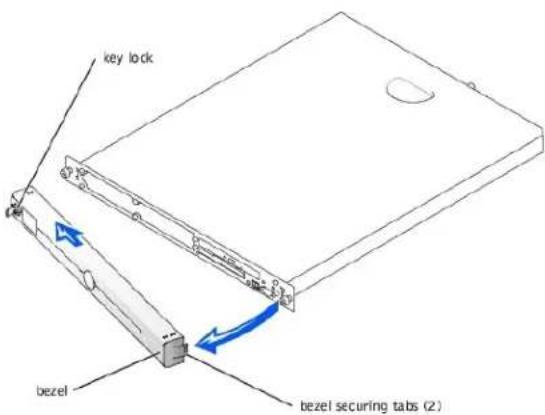
- If applicable, remove the bezel. See Figure 5.1.
a. If applicable, unlock the bezel.
b. While grasping the bezel, slide it toward the key lock.
c. Rotate the right side of the bezel away from the front panel.
d. Pull the bezel away from the system.
Figure 5-1. Removing the Bezel
text_image
key lock bezel bezel securing tabs (2)- Observe the precautions in "Safety First—For You and Your System."
- Turn off the system and attached peripherals, and disconnect the system from the electrical outlet.
- To remove the system cover, loosen the thumbscrew at the back of the system. See Figure 5-2.
- While pressing down on the cover indentation, slide the cover backward about an inch, and grasp the cover on both sides.
- Carefully lift the cover away from the system.
Figure 5-2. Removing and Replacing the System Cover

text_image
thumbscrew system cover cover indentionClosing the System
- Ensure that you did not leave tools or parts inside the system.
- Place the cover over the sides of the chassis, and slide the cover forward until it snaps into place. See Figure 5-2.
- Tighten the thumbscrew at the back of the system to secure the cover.
- To replace the bezel. See Figure 5-1.
a. Align the hole in the left-side bezel securing tab with the tab on the front panel.
b. While rotating the bezel toward the front panel, slide the bezel toward the key lock until the bezel snaps into place.
- Reconnect the system to the electrical outlet, and turn on the system.
Checking the Equipment
This section provides troubleshooting procedures for components that connect directly to the I/O panel of the system. Before performing any of these procedures, see "External Connections."
Troubleshooting the Video Subsystem
Problem
1 Monitor
1 Monitor interface cable
1 Video memory
1 Video logic
Action
- Check the system and power connections to the monitor.
- Determine whether the system has a remote access card and a video expansion card installed.
The system supports only the embedded video when using a remote access card.
If a video expansion card is not installed, go to step 3.
If a video expansion card is installed, remove the video card. See "Removing an Expansion Card" in "Installing System Components." If the problem persists, go to step 3.
- Run the video tests in the system diagnostics.
If the tests run successfully, the problem is not related to video hardware. Go to *Finding Software Solutions.*
If the tests did not run successfully, see "Getting Help."
Troubleshooting the Keyboard
Problem
System message indicates a problem with the keyboard.
1 Keyboard cable.
Action
- Press each key on the keyboard, and look at the keyboard and its cable for any signs of damage.
If the keyboard appears to be free of physical damage, go to step 3.
If the keyboard is damaged, continue to step 2.
- Swap the faulty keyboard with a working keyboard.
If the problem is resolved, you must replace the faulty keyboard. See "Gelling Help."
- Run the keyboard test in the system diagnostics. See "Running the System Diagnostics."
If the test fails, see *Getting Help.*
Troubleshooting the Mouse
Problem
1 System message indicates a problem with the mouse.
1 Mouse cable.
Action
- Click each button on the mouse, and look at the mouse and its cable for any signs of damage.
If the mouse appears to be free of physical damage, go to step 3.
If the mouse is damaged, continue to step 2.
- Swap the faulty mouse with a working mouse.
If the problem is resolved, you must replace the faulty mouse. See "Getting Help."
- Enter the System Setup program, and ensure that the mouse controller is enabled. See "Using the System Setup Program" in your User's Guide.
If the problem is not resolved, continue to step 4.
- Run the pointing devices test in the system diagnostics. See "Running the System Diagnostics."
If the test fails, see "Getting Help."
Troubleshooting Basic I/O Functions
Problem
1 Error message indicates a problem with a serial port.
Device connected to a serial port is not operating properly.
Action
- Enter the System Setup program and ensure that the serial port is enabled. See "Using the System Setup Program" in your User's Guide.
- If the problem is confined to a particular application, see the application documentation for specific port configuration requirements that the program may require.
- Run the appropriate online diagnostic test. See "Using Server Administrator Diagnostics" in "Running the System Diagnostics."
If the tests run successfully but the problem persists, see "Troubleshooting a Serial I/O Device."
Troubleshooting a Serial I/O Device
Problem
Device connected to the serial port is not working.
Action
- Remove the bezel. See "Opening the System."
- Turn off the system and any peripheral devices connected to the serial port.
- Swap the interface cable with a known working cable.
- Turn on the system and the serial device.
If the problem is resolved, the interface cable must be replaced. See "Getting Help."
5. Turn off power to the system and the serial device, and swap the device with a comparable device.
6. Turn on the system and the serial device.
If the problem is resolved, the serial device must be replaced.
If the problem is not resolved, see "Getting Help."
Troubleshooting a USB Device
Problem
1 System error message indicates a problem.
Device connected to the port is not working.
Action
- Enter the System Setup program and ensure that the USB ports are enabled. See "Using the System Setup Program" in the User's Guide.
- Remove the bezel. See "Opening the System."
- Turn off the system and any USB devices.
If only one USB device is connected to the system, go to step 6.
- Disconnect all USB devices, and connect the malfunctioning device to the other USB port.
- Turn on the system and the reconnected device.
If the problem is resolved, the USB port may be defective. See "Getting Help."
- If possible, swap the interface cable with a known working cable.
If the problem is resolved, the interface cable must be replaced. See "Getting Help."
- Turn off the system and the USB device, and swap the device with a comparable device.
- Turn on the system and the USB device.
If the problem is resolved, the USB device must be replaced.
If the problem is not resolved, see "Getting Help."
Inside the System
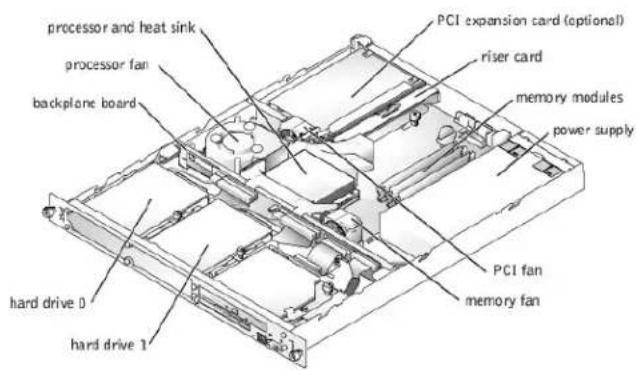
In Figure 5-3, the bezel and system cover are removed to provide an interior view of the system.
Figure 5-3. Inside the System
text_image
processor and heat sink processor fan backplane board PCI expansion card (optional) riser card memory modules power supply PCI fan memory fan hard drive D hard drive 1The system board holds the system's control circuitry and other electronic components. Several hardware options such as the processors and memory are installed directly on the system board. Using a riser card, the system can accommodate up to two expansion cards. The upper slot supports PCI 64-bit, 33-MHz
expansion cards and the lower slot supports PCI-X 64-bit, 133-MHz expansion cards.
The hard-drive bays provide space for up to two IDE or SCSI drives and a CD/diskette drive combination. The SCSI hard drives must be connected to a controller card. Power is supplied to the backplane board, the system board, and internal peripherals through a single nonredundant power supply.
Troubleshooting a Wet System
Problem
1 Liquid spills
1 Splashes
1 Excessive humidity
Action
- Open the system. See "Opening the System."
- Remove any expansion cards, if installed. See "Removing an Expansion Card" in "Installing System Components."
- Allow the system to dry thoroughly for at least 24 hours.
- Close the system. See "Closing the System."
- Remove the bezel. See "Opening the System."
- Turn on the system.
- If the system starts up normally, shut down the system and reinstall the expansion cards you removed in step 2.
- Close the system. See "Closing the System."
- Run the system board tests in the system diagnostics to confirm that the system works properly. See "Running the System Diagnostics."
If the tests did not complete successfully, see "Getting Help."
Troubleshooting a Damaged System
Problem
1 System dropped or damaged.
Action
- Open the system. See "Opening the System."
- Check the following connections:
Riser-card connections to the system board
Drive-carrier connections to the backplane board
- Ensure that all cables are properly connected and all component connectors are properly seated.
- Close the system. See "Closing the System."
- Run the system board tests in the system diagnostics. See "Running the System Diagnostics."
If the tests did not complete successfully, see "Getting Help."
Troubleshooting the System Battery
Problem
1 Error message shows problem with the battery.
System Setup utility loses the system configuration information.
1 System date and time do not stay current.
Action
- Open the system. See "Opening the System."
- Check the connection of the battery to the system board.
See "Replacing the Battery" in "Installing System Components."

CAUTION: There is a danger of a new battery exploding if it is incorrectly installed. Replace the battery only with the same or equivalent type recommended by the manufacturer. Discard used batteries according to the manufacturer's instructions.
- Close the system. See "Closing the System."
- If the problem is not resolved by reseating the battery, replace the battery. See "Replacing the Battery" in "Installing System Components."
If the problem is not resolved by replacing the battery, see "Getting Help."
Troubleshooting the Power Supply
Problem
The power LED on the front of the system is not lit.
Action
- Check the connection of the power cable to the power supply and the outlet.
- Remove the bezel. See "Opening the System."
- Turn on the system.
If the problem is not resolved, continue to the next step.
- Open the system. See "Opening the System."
- Ensure that the power supply cable is properly connected to the backplane board.
- Close the system. See "Closing the System."
If the problem is still not resolved, replace the power supply. See "Power Supply" in "Installing System Components."
Troubleshooting the Cooling Fans
Problem
1 One or more of the system fans does not work.
Action
-
Open the system. See "Opening the System."
-
Lift the fan from the chassis. See "Removing a Fan Assembly" in "Installing System Components."
- Reseat the fan.
Ensure that the fan connector is firmly seated.
- Close the system. See "Closing the System."
If the problem persists, replace the fan.
- If the replacement fan does not operate, one of the fan connectors is faulty. See "Getting Help."
Troubleshooting an Expansion Card
Problem
1 Expansion card does not perform as expected.
Action
- Open the system. See "Opening the System."
- Verify that the expansion card is firmly seated in its connector and the riser card is firmly seated in the riser-card connector.
- Verify that the appropriate cables are firmly connected to the expansion-card connector.
- Close the system. See "Closing the System."
If the problem persists, continue to the next step.
- Open the system. See "Opening the System."
- Remove all the expansion cards. See "Removing an Expansion Card" in "Installing System Components."
- Close the system. See "Closing the System."
- Run the Quick Tests in the system diagnostics. See "Running the System Diagnostics."
If the tests do not complete successfully, see "Getting Help."
If the tests run successfully, continue to the next step.
- Open the system. See "Opening the System."
- Reinstall one of the expansion cards.
- Close the system. See "Closing the System."
- Remove the bezel (see "Opening the System"), turn on the system, and repeat step 8.
If the tests still fail, see "Getting Help."
If the tests are successful, continue to the next step.
- Open the system. See "Opening the System."
- Reinstall the other expansion card.
- Close the system. See "Closing the System."
- Remove the bezel (see "Opening the System"), turn on the system, and repeat step 8.
If the tests fail, the expansion card might be faulty. See "Getting Help."
Troubleshooting the Microprocessor
Problem
1 Error message indicates a microprocessor problem.
A heat sink is not installed for the processor.
Action
CAUTION: See your System Information Guide for complete information about safety precautions, working inside the computer, and protecting against electrostatic discharge.
- Run the appropriate online diagnostics test. See "Using Server Administrator Diagnostics" in "Running the System Diagnostics."
- Open the system. See "Opening the System."
- Ensure that the processor and heat sink are properly installed. See "Replacing the Processor" in "Installing System Components."
- Close the system. See "Closing the System."
- Run Quick Tests in the system diagnostics. See "Running the System Diagnostics."
If the tests fail or the problem persists, see "Getting Help."
Troubleshooting System Memory
Problem
1 Faulty memory module
1 Faulty system board
Action
- Remove the bezel. See "Opening the System."
- Turn on the system and attached peripherals.
If no error messages occur during POST, go to step 13.
CAUTION: See your System Information Guide for complete information about safety precautions, working inside the computer, and protecting against electrostatic discharge.
- Open the system. See "Opening the System."
- Reseat the memory modules in their sockets. See "System Memory" in "Installing System Components."
- Close the system. See "Closing the System."
If no error messages occur during POST, go to step 13.
- Open the system. See "Opening the System."
- Remove all the memory modules. See "Removing Memory Modules" in "Installing System Components."
- Install a known working memory module in DIMM A. See "Installing Memory Modules" in "Installing System Components."
- Close the system. See "Closing the System."
If no error messages occur during POST, continue to the next step.
If there are error messages, the system board might be faulty. See "Getting Help."
- Open the system. See "Opening the System."
- Remove the memory module from DIMM A and reinstall one of the memory modules that you removed in step 7.
- Close the system. See "Closing the System."
If no error messages occur during POST, reinstall one of the memory modules that you removed in step 7 and repeat this step for the remaining memory module.
If there are error messages, the memory module is faulty. Replace the memory module. See "System Memory."
- Run the system memory test in the system diagnostics. See "Running the System Diagnostics."
If the test does not complete successfully, see "Getting Help."
Troubleshooting the System Board
Problem
1 Error message indicates a system board problem.
Action
- Open the system. See "Opening the System."
- Remove the expansion cards, if installed. See "Removing an Expansion Card" in "Installing System Components."
- Close the system. See "Closing the System."
- Run the system board tests in the system diagnostics. See *Running the System Diagnostics."
If the tests do not run successfully, see "Getting Help."
- Open the system. See "Opening the System."
- Reinstall the one of the expansion cards that you removed in step 2. See "Installing an Expansion Card" in "Installing System Components."
- Close the system. See "Closing the System."
- Run the system board tests again.
If the tests do not complete successfully, the expansion card might be faulty. See "Getting Help."
If the tests complete successfully, repeat step 5 through step 8 for the remaining expansion card, if applicable.
Troubleshooting a Diskette Drive
Problem
1 Error message indicates a diskette drive problem.
Action
- Enter the System Setup program and verify that the diskette drive is configured correctly. See "Using the System Setup Program" in the User's Guide.
- Run the appropriate online diagnostic test. See "Using Server Administrator Diagnostics" in Running System Diagnostics."
- Run the diskette drive tests to see whether the diskette drive works correctly. See "Running the System Diagnostics."
If the tests fail, continue to the next step.
CAUTION: See your System Information Guide for complete information about safety precautions, working inside the computer, and protecting against electrostatic discharge.
- Open the system. See "Opening the System."
- Ensure that the CD/diskette drive interface cable is securely connected to the interposer board and the backplane board.
- Close the system. See "Closing the System."
- Run the diskette drive tests to see whether the diskette drive works correctly.
- Open the system. See "Opening the System."
-
Remove all expansion cards installed in the system. See "Removing an Expansion Card" in "Installing System Components."
-
Close the system. See "Closing the System."
-
Run the diskette-drive tests to see whether the diskette drive works correctly.
If the tests run successfully, an expansion card may be conflicting with the diskette drive logic, or an expansion card may be faulty. Continue to the next step.
If the tests fail, see "Getting Help."
- Open the system. See "Opening the System."
- Reinstall one of the expansion cards you removed in step 9. See "Installing an Expansion Card" in "Installing System Components."
- Close the system. See "Closing the System."
- Run the diskette drive tests to see whether the diskette drive works correctly.
- Repeat step 12 through step 15 until all expansion cards are reinstalled, one of the expansion cards causes the tests to fail, or the system cannot boot from a diskette.
If the problem is not resolved, see "Getting Help."
Troubleshooting a CD Drive
Problem
System cannot read data from a CD in an IDE drive.
1 CD drive indicator does not blink during boot.
Action
- Try using a different CD that you know works properly.
- Enter the System Setup program and ensure that the drive's IDE or SCSI controller is enabled. See "Using the System Setup Program" in the User's Guide.
- Run the appropriate online diagnostic test. See "Using Server Administrator Diagnostics" in "Running System Diagnostics."
- Run the IDE devices tests in the system diagnostics to determine whether the drive works correctly. See "Running the System Diagnostics."
If the tests failed, continue to the next step.
CAUTION: See your System Information Guide for complete information about safety precautions, working inside the computer, and protecting against electrostatic discharge.
- Open the system. See "Opening the System."
- Ensure that the CD/diskette-drive interface cable is securely connected to the interposer board and to the backplane board.
- Close the system. See "Closing the System."
- Run the IDE devices tests in the system diagnostics to determine whether the CD drive works correctly.
If the problem is not resolved, see "Getting Help."
Troubleshooting IDE Hard Drives
Problem
1 Faulty hard drive
1 Faulty backplane board
1 Faulty or loose cable connections
Action
CAUTION: See your System Information Guide for complete information about safety precautions, working inside the computer, and protecting against electrostatic discharge.
NOTICE: This troubleshooting procedure can destroy data stored on the hard drive. Before you proceed, back up all the files on the hard drive.
-
Enter the System Setup program, and verify that the system is configured correctly. See "Using the System Setup Program" in your User's Guide.
-
Run the hard drive and IDE devices tests in the system diagnostics to determine whether the hard drive operates properly. See "Running the System Diagnostics."
-
Open the system. See "Opening the System."
-
Ensure that the hard-drive interface cable is properly connected between the drive and the backplane board.
-
If the hard drive is the boot drive, ensure that the drive is configured and connected properly. See "Configuring the Boot Drive" in "Installing Drives."
-
Ensure that a power cable is properly connected to the drive.
-
Close the system. See "Closing the System."
-
Partition and logically format the hard drive. See the operating system documentation.
-
If possible, restore the files to the drive.
If the problem persists, see "Getting Help."
Troubleshooting SCSI Hard Drives
Problem
1 Faulty hard drive
Faulty or loose cable connections to a controller card
Action
CAUTION: See your System Information Guide for complete information about safety precautions, working inside the computer, and protecting against electrostatic discharge.
NOTICE: This troubleshooting procedure can destroy data stored on the hard drive. Before you proceed, back up all the files on the hard drive.
- Run the SCSI controllers test and the hard drive tests in the system diagnostics. See "Running the System Diagnostics."
For information about testing the controller, see the SCSI controller's documentation.
If the tests fail, continue to step 2.
- Reboot the system and enter the SCSI configuration utility.
To enter the utility, press
-
Ensure that the primary SCSI channel is enabled, and restart the system. See the documentation for your SCSI controller.
-
Ensure that any required device drivers are installed and are configured correctly.
For information on installing device drivers, see the Dell OpenManage Server Assistant CD and the documentation that accompanied the controller card.
-
Open the system. See "Opening the System."
-
Ensure that the hard-drive interface cable is properly connected between the drive and the controller card. See the documentation that accompanied the controller card.
-
If the hard drive is the boot drive, ensure that the drive is configured and connected properly. See "Configuring the Boot Drive" in "Installing Drives."
-
Ensure that a power cable is properly connected to the drive.
-
Ensure that the hard drive is configured with a unique SCSI ID number and that the drive is terminated or not terminated as appropriate.
See the documentation for the hard drive for instructions on configuring the SCSI ID and enabling or disabling termination.
- Close the system. See "Closing the System."
If the problem persists, continue to step 11.
-
Partition and logically format the hard drive. See the operating system documentation.
-
If possible, restore the files to the drive.
If the problem persists, see "Getting Help."
Back to Contents Page
Installing System Components
Dell™ PowerEdge™ 650 Systems Installation and Troubleshooting Guide
System Board Components
Fan Assemblies
Expansion Cards
System Memory
Upgrading the Processor
System Battery
Power Supply
This section describes how to install the following system components:
1 Fan assemblies
1 Expansion cards
1 Memory upgrades
1 Processor upgrades
1 System battery
1 Power supply
System Board Components
When installing and replacing system board components, use Figure 6-1 to locate the components.
Figure 6-1. System Board Components and Connectors
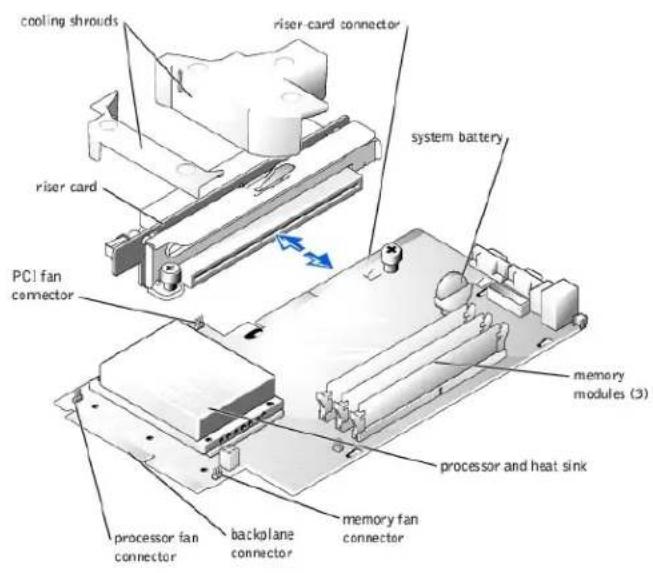
text_image
cooling shrouds riser card connector system battery PCI fan connector memory modules (3) processor and heat sink memory fan connector backplane connector processor fan connectorFan Assemblies
Your system contains three fan assemblies. The three assemblies provide cooling for the processor, memory modules, and expansion cards.
Removing a Fan Assembly

CAUTION: See your System Information Guide for complete information about safety precautions, working inside the computer, and protecting against electrostatic discharge.
- Open the system. See "Opening the System" in Troubleshooting Your System."
- Lift the fan assemblies out of the chassis carefully, making sure that the connector disconnects from the system board. See Figure 6-2. Figure 6-3, and Figure 6-4 for the locations of the fan assemblies.
If you are removing the processor fan assembly, remove the two cooling shrouds before removing the fan assembly. See Figure 6-1 for the location of the cooling shrouds.
Figure 6-2. Removing the Processor Fan Assembly
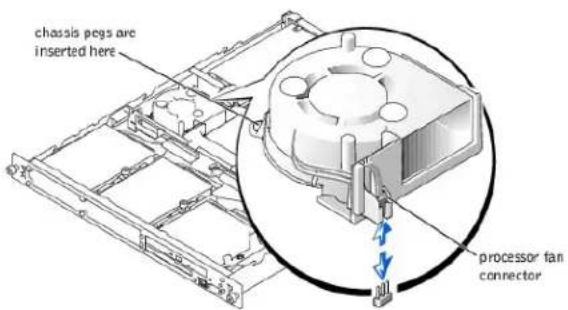
text_image
chassis pegs are inserted here processor fan connectorFigure 6-3. Removing the Memory Fan Assembly

text_image
memory fan connector chassis peg is inserted hereFigure 6-4. Removing the PCI Fan Assembly

text_image
chassis peg is inserted here PCI fan connectorInstalling a Fan Assembly
- Align the replacement fan assembly's connector with the connector on the system board and the pegs on the chassis. See Figure 6-2, Figure 6-3, and Figure 6-4 for the locations of the fan assemblies.
- Push down on the lan assembly until it is properly seated on the chassis pegs and to the three-pin connector on the system board.
If you are installing the processor fan assembly, install the two cooling shrouds after installing the processor fan assembly. See Figure 6-1 for the location of the cooling shrouds.
- Close the system. See "Closing the System" in "Troubleshooting Your System."
Expansion Cards
The system supports up to two PCI expansion cards, which are installed in connectors on a riser board. The upper slot supports 64-bit, 33-MHz cards and the lower slot supports 64-bit, 133-MHz cards. See Figure A-5. If you are installing a remote access controller card, it must be installed in the upper slot of the riser board. Install most RAID controller cards and SCSI controllers in the lower slot.
Installing an Expansion Card
- Open the system. See "Opening the System" in Troubleshooting Your System."
- Remove the expansion-card retainer adjacent to the PCI slots.
- Remove the filler bracket on the slot you will be using.
NOTE: Keep this bracket in the event you need to remove the expansion card. Filler brackets must be installed over empty expansion card slots to maintain Federal Communications Commission (FCC) certification of the system. The brackets also keep dust and dirt out of the system and aid in proper cooling and airflow inside the system.
- Insert the expansion card firmly into the expansion-card connector on the riser board until the card is fully seated, being careful not to remove the riser card from the system board.
If you are installing a SCSI or RAID controller card, route the interface cable through the openings in the backplane bracket and the PCI fan bracket before connecting the cable to the controller card. After routing the interface cable, ensure that the cable is securely connected to the controller card and the hard drives.
NOTE: Ensure that the expansion-card bracket is also inserted into the securing slot on the chassis's back panel.
- Replace the expansion-card retainer. See Figure 6-5.
- Connect any external cable(s) to the expansion card.
- Close the system. See "Closing the System" in "Troubleshooting Your System."
Figure 6-5. Installing an Expansion Card

text_image
expansion-card retainer PCI slot 1 PCI slot 2 expansion card expansion-card connector (on riser board)Removing an Expansion Card

CAUTION: See your System Information Guide for complete information about safety precautions, working inside the computer, and protecting against electrostatic discharge.
- Open the system. See "Opening the System" in Troubleshooting Your System."
- Disconnect any external cable(s) that are connected to the expansion card.
- Remove the expansion-card retainer adjacent to the PCI slots. See Figure 6-5.
- Grasp the expansion card and carefully pull it away from the riser-board connector.
If you are removing a SCSI controller card, disconnect the cables from the card that connects to the SCSI hard drives.
- If you are permanently removing the card, replace the metal filler bracket over the empty card-slot opening.

NOTE: Filler brackets must be installed over empty expansion-card slots to maintain FCC certification of the system. The brackets also keep dust and dirt out of the system and aid in proper cooling and airflow inside the system.
- Replace the expansion-card retainer.
- Close the system. See "Closing the System" in "Troubleshooting Your System."
System Memory
The three memory module sockets are located on the system board adjacent to the power supply. See Figure 6-1.
You can upgrade the system memory by installing combinations of registered memory modules. If you receive an error message stating that maximum memory has been exceeded, see "Indicators, Messages, and Codes" for more information. You can purchase memory upgrade kits from Dell.

NOTE: The memory modules must be PC-2100 compliant.
Memory Module Installation Guidelines
If only one memory module is installed, it must be installed in the DIMM A socket.
1 Install the memory modules with the largest capacity in DIMM A and the least capacity in DIMM C.
1 Install the memory modules sequentially, which means that there can be no empty memory module sockets between the first and last installed socket.
Installing Memory Modules
- Open the system. See "Opening the System" in Troubleshooting Your System."
- Locate the memory module sockets. See Figure 6-1.
- Press the ejectors on the memory module socket down and out, as shown in Figure 6-6, to allow the memory module to be inserted into the socket.
- Align the memory module's edge connector with the alignment keys of the memory module socket, and insert the memory module in the socket.
NOTE: The memory module socket has two alignment keys that allow you to install the memory module in the socket in only one way.
- Press down on the memory module with your thumbs while pulling up on the ejectors with your index fingers to lock the memory module into the socket.
When the memory module is properly seated in the socket, the ejectors on the memory module socket align with the ejectors on the other sockets that have memory modules installed.
- Repeat step 2 through step 5 of this procedure to install the remaining memory modules.
- Close the system. See "Closing the System" in "Troubleshooting Your System."
- (Optional) Press
to enter the System Setup program, and check the System Memory setting on the main Setup screen.
The system should have already changed the value to reflect the newly installed memory.
- If the value is incorrect, one or more of the memory modules may not be installed properly. Repeat step 1 through step 8 of this procedure, checking to ensure that the memory modules are firmly seated in their sockets.
- Run the system memory test in the system diagnostics. See "Running the System Diagnostics."
Figure 6-6. Installing and Removing a Memory Module
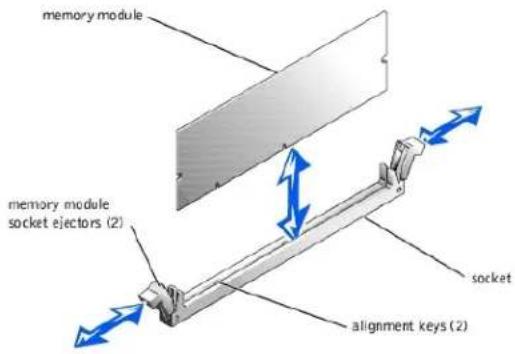
text_image
memory module memory module socket ejectors (2) socket alignment keys (2)Removing Memory Modules
CAUTION: See your System Information Guide for complete information about safety precautions, working inside the computer, and protecting against electrostatic discharge.
- Open the system. See "Opening the System" in Troubleshooting Your System."
- Locate the memory module sockets. See Figure 6-1.
- Press down and out on the ejectors on each end of the socket until the memory module pops out of the socket. See Figure 6-6.
- Close the system. See "Closing the System" in "Troubleshooting Your System."
Upgrading the Processor
It is possible to upgrade your processor to take advantage of future options in speed and functionality. Each processor and its associated level 2 (L2) cache memory are contained in a pin grid array (PGA) package that is installed in a ZIF socket on the system board.
The following items are included in the processor upgrade kit:
1 Processor
1 Heat sink
Replacing the Processor

CAUTION: See your System Information Guide for complete information about safety precautions, working inside the computer, and protecting against electrostatic discharge.
- Open the system. See "Opening the System" in Troubleshooting Your System."

NOTICE: The processor and heat sink can become extremely hot. Be sure the processor has had sufficient time to cool before handling.
- Remove both pieces of the cooling shroud.
- Pushing down with one hand on the securing clip's rubber coated tab, use the other hand to pull the latch on the securing clip on the left to release the securing clip from the heat-sink posts. See Figure 6-7.
- Remove the securing clip.

NOTICE: Never remove the heat sink from a processor unless you intend to remove the processor. The heat sink is necessary to maintain proper thermal conditions.
- Repeat step 3 and step 4 to remove the securing clip on the right.
Figure 6-7. Removing the Securing Clip
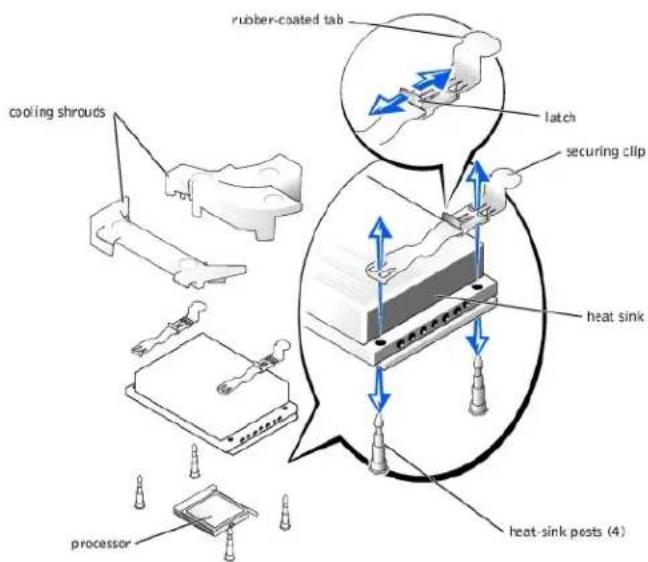
text_image
rubber-coated tab latch securing clip cooling shrouds heat sink processor heat-sink posts (4)- Remove the heat sink.
If the heat sink uses a foil thermal interface material, set the heat sink upside down so as not to contaminate the interface material.
- Pull the socket-release lever straight up until the processor is released from the socket. See Figure 6-8.
- Lift the processor out of the socket and leave the release lever up so that the socket is ready for the new processor.

NOTICE: Be careful not to bend any of the pins when removing the processor. Bending the pins can permanently damage the processor.
- Unpack the new processor.
If any of the pins on the processor appear bent, see "Getting Help."
- Align the pin-1 corner of the processor with the pin-1 corner of the ZIF socket. See Figure 6-8.

NOTE: Identifying the pin-1 corners is critical to positioning the processor correctly.
Identify the pin-1 corner of the processor by locating the tiny gold triangle on one corner of the processor. Place this corner in the same corner of the ZIF socket identified by a corresponding triangle.
- Install the processor in the socket.
Figure 6-8. Installing the Processor in the Socket

text_image
processor pin-1 corner ZIF socket socket-release lever pin-1 corner of socket
NOTICE: Positioning the processor incorrectly can permanently damage the processor and the system when you turn it on. When placing the processor in the socket, be sure that all of the pins on the processor enter the corresponding holes. Be careful not to bend the pins.
If the release lever on the processor socket is not positioned all the way up, move it to that position.
With the pin-1 corners of the processor and socket aligned, set the processor lightly in the socket, making sure all pins are matched with the correct holes in the socket. Because the system uses a ZIF processor socket, do not use force, which could bend the pins if the processor is misaligned. When the processor is positioned correctly, it drops down into the socket with minimal pressure.
When the processor is fully seated in the socket, rotate the socket release lever back down until it snaps into place, securing the processor.
- Install the heat sink.
If the new heat sink uses a foil thermal interface material strip, align the holes on both sides of the heat sink with the heat-sink posts on the system chassis.
If the new heat sink has a thermal grease tab, remove the tab and then align the holes on both sides of the heat sink with the heat-sink posts on the system chassis.
- Orient the securing clips as shown in Figure 6-7.
- Position each securing clip over the heat-sink posts, then snap them onto the posts.
- While holding down the rubber-coated tab with one hand, push the latch on the securing clip on the right until it locks the clip onto the post. Repeat this step for the securing clip on the left.
- Replace the cooling shrouds.
- Close the system. See "Closing the System" in "Troubleshooting Your System."
As the system boots, it detects the presence of the new processor and automatically changes the system configuration information in the System Setup program.
- Press
to enter the System Setup program, and check that the processor information matches the new system configuration.
See your User's Guide for instructions about using the System Setup program.
- Run the system diagnostics to verify that the new processor operates correctly.
System Battery
The system battery maintains your system's configuration, date, and time information in a special section of memory when you turn off the system. The operating life of the battery ranges from 2 to 5 years, depending on how you use the system (for example, if you keep the system turned on most of the time, the battery gets little use, and therefore lasts longer).
You might need to replace the battery if an incorrect time or date displays during the boot routine along with a message about the wrong time, invalid configuration information, or bad CMOS checksum.
To determine if the battery needs replacing:
- Re-enter the time and date through the System Setup program. For more information about using the System Setup program, see your User's Guide.
- Remove the bezel, if applicable. See "Opening the System" in "Troubleshooting Your System."
- Turn off the system and disconnect it from electrical power for a few hours.
- After several hours, reconnect the system to a power source and turn it back on.
- Enter the System Setup program.
If the date and time are not correct in the System Setup program, replace the battery.
NOTE: Some software might cause the system time to speed up or slow down. If the system seems to operate normally except for the time kept in the System Setup program, the problem may be caused by software rather than by a defective battery.
NOTE: If the system is turned off for long periods of time (for weeks or months), the SDRAM may lose its system configuration information. This loss is not caused by a defective battery.
You can operate the system without a battery; however, the system configuration information maintained by the battery in SDRAM is erased each time you shut down the system. Therefore, you must re-enter the system configuration information and reset the options each time the system boots until you replace the battery. The battery is a 3.0-volt (V) battery.
Replacing the Battery
CAUTION: See your System Information Guide for complete information about safety precautions, working inside the computer, and protecting against electrostatic discharge.
- Enter the System Setup program and, if possible, make a printed copy of the System Setup screens.
See "Using the System Setup Program" in the User's Guide.
- Open the system. See "Opening the System" in Troubleshooting Your System."
- Locate the battery on the system board. See Figure A-3 for the battery location.
- Grasp the battery with your fingers and pull up to remove the battery from the battery socket.
- Place the new battery with the side labeled *+ facing toward the open side of the battery socket. See Figure 6-9.
Figure 6-9. Replacing the Battery
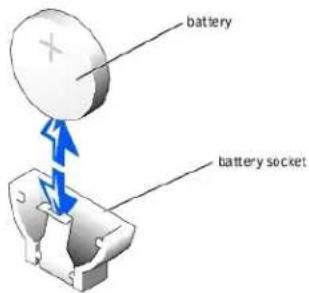
text_image
battery battery socket- Close the system. See "Closing the System" in "Troubleshooting Your System."
- Enter the System Setup program to confirm that the battery operates properly.
- From the main screen, select System Time to enter the correct time and date.
Also, re-enter any system configuration information that is no longer displayed on the System Setup screens, and then exit the System Setup program.
- To test the newly installed battery, turn off the system and disconnect it from electrical power for at least an hour.
- After an hour, reconnect the system to a power source and turn it on.
- Enter the System Setup program. If the time and date are still incorrect, see "Getting Help."
Power Supply
The system supports a single power supply.
Removing the Power Supply

CAUTION: See your System Information Guide for complete information about safety precautions, working inside the computer, and protecting against electrostatic discharge.
- Open the system. See "Opening the System" in Troubleshooting Your System."
- Disconnect the power supply's cable from the backplane board.
- Remove the power-supply retaining bracket that secures the power supply inside the system. See Figure 6-10.
- Slide the power supply backward and lift straight up to remove the power supply from the chassis.
Figure 6-10. Replacing the Power Supply
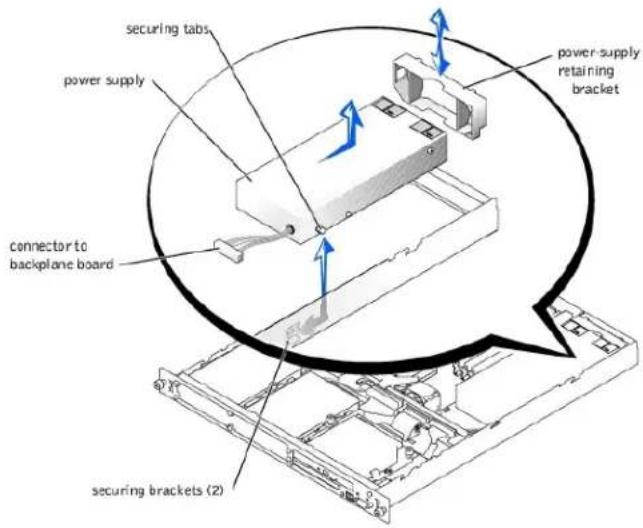
text_image
securing tabs power supply connectorto backplane board power-supply retaining bracket securing brackets (2)Installing the Power Supply
- Lower the power supply into the chassis and slide it forward until the securing tabs on the power supply are engaged into the securing brackets.
- Connect the power-supply cable to the backplane.
- Replace the power-supply retaining bracket.
- Close the system. See "Closing the System" in "Troubleshooting Your System."
Back to Contents Page
Back to Contents Page
Installing Drives
Dell™ PowerEdge™ 650 Systems Installation and Troubleshooting Guide
• SCSI Configuration Information
Configuring the Boot Drive
Hard Drives
Installing a RAID or SCSI Controller Card
CD/ Diskette Drives
The hard drive bays provide space for up to two IDE or SCSI hard drives and a CD/diskette drive combination. The IDE hard drives connect to the backplane board and the SCSI hard drives must be connected to a controller card. The cables that connect to the controller card are routed through openings in the backplane bracket and the PCI fan bracket.
SCSI Configuration Information
Although SCSI drives are installed in essentially the same way as other drives, their configuration requirements are different. To install and configure a SCSI drive, follow the guidelines in the following subsections.
SCSI Interface Cables
SCSI interface connectors are keyed for correct insertion. Keying ensures that the pin-1 wire in the cable connects to pin 1 in the connectors on both ends. When you disconnect an interface cable, take care to grasp the cable connector, rather than the cable itself, to avoid stress on the cable.
SCSI ID Numbers
Each drive attached to a SCSI controller must have a unique SCSI ID number from 0 to 15.
The SCSI hard drive from which the system boots is configured as SCSI ID 0.
If you install optional SCSI drives or change your SCSI configuration, see the documentation for each SCSI drive for information on setting the appropriate SCSI ID number.

NOTE: There is no requirement that SCSI ID numbers be assigned sequentially or that drives be attached to the cable in order by ID number.
Device Termination
SCSI logic requires that termination be enabled for the two drives at opposite ends of the SCSI chain and disabled for all drives in between. For internal SCSI drives, termination is configured automatically. See the documentation provided with any optional SCSI drive you purchase for information on disabling termination.
Configuring the Boot Drive
The drive or device from which the system boots is determined by the boot order specified in the System Setup program. See "Using the System Setup Program" in your User's Guide. To boot the system from a hard drive or drive array, the drive(s) must be connected to the appropriate controller:
To boot from a single IDE hard drive, the master drive (drive 0) must be connected to the IDE 0 connector on the backplane board. To identify system board connectors, see Figure A-3.
To boot from a single SCSI hard drive, the drive must be connected to the SCSI controller card. See the documentation that accompanied the controller card.
To boot from an IDE or SCSI RAID array, the drive must be connected to the RAID controller card. See the documentation that accompanied the controller card.
Hard Drives
Your system contains up to two non-hot-pluggable IDE or SCSI hard drives. If your system contains SCSI hard drives, they must be connected to a SCSI controller board. The cables for the SCSI hard drives are routed through openings in the backplane bracket and the PCI fan bracket, to the controller.
The procedures for removing and installing IDE or SCSI hard drives are the same.
Removing a Hard Drive

CAUTION: See your System Information Guide for complete information about safety precautions, working inside the computer, and protecting against electrostatic discharge.
- Open the system. See "Opening the System" in "Troubleshooting Your System."
- Disconnect the power and interface cables from the hard drive.
The interface cables for IDE hard drives are connected to the backplane board.
The interface cables for SCSI hard drives are connected to a controller card.
- Loosen the thumbscrew that secures the hard-drive carrier to the chassis. See Figure 7-1.
Figure 7-1. Removing and Installing a Hard Drive
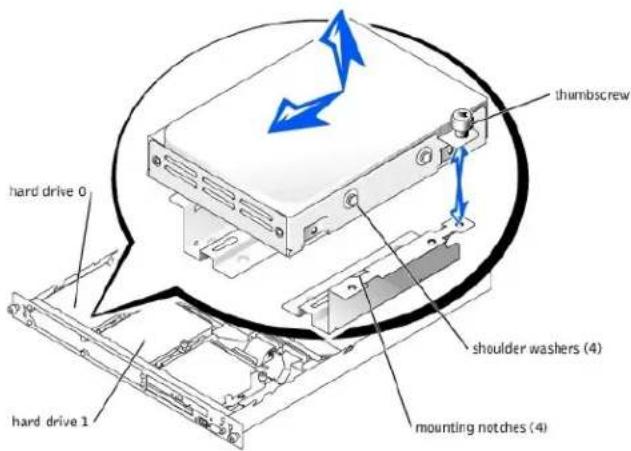
text_image
hard drive 0 hard drive 1 mounting notches (4) shoulder washers (4) thumbscrew- Slide the hard-drive carrier backward and lift the carrier out of the chassis.
- Using a #2 Phillips screwdriver, remove the four screws that secure the hard drive to the carrier and remove the drive from the carrier. See Figure 7-2.
Figure 7-2. Removing the Hard Drive From the Drive Carrier
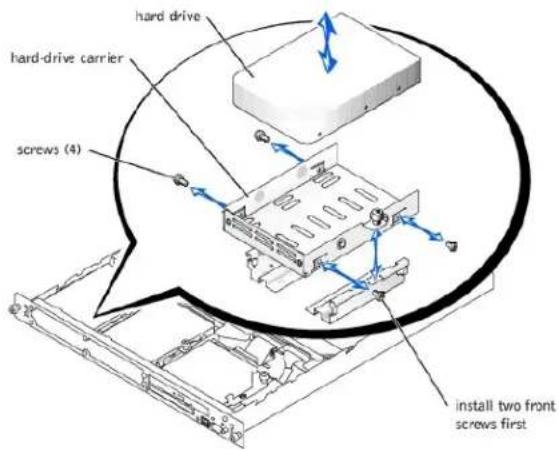
text_image
hard drive hard-drive carrier screws (4) install two front screws firstInstalling a Hard Drive
- Align the hard-drive mounting holes with the holes in the drive carrier.
- Using a #2 Phillips screwdriver, install the four screws that secure the hard drive to the carrier. See Figure 7-2.

NOTE: Install the two screws at the front of the hard-drive carrier first.
- Align the hard-drive carrier so that the shoulder washers on the carrier slide into the mounting notches in the chassis.
- Slide the carrier forward until it stops.
- Tighten the thumbscrew that secures the hard-drive carrier to the chassis.
- Connect the power and interface cables to the new drive.
The interface cables for IDE hard drives are connected to the backplane board.
The interface cables for SCSI hard drives are connected to a controller card.
- Close the system. See "Closing the System" in "Troubleshooting Your System."
Installing a RAID or SCSI Controller Card
See "Installing an Expansion Card" in "Installing System Components" for instructions about installing the card and routing the cables.
CD/ Diskette Drives
The CD diskette drives are mounted on a tray that is secured to the chassis using a thumbscrew. The drives are connected using and interposer card, which connects to the backplane board.
Removing the CD/ Diskette Drive Tray

CAUTION: See your System Information Guide for complete information about safety precautions, working inside the computer, and protecting against electrostatic discharge.
- Open the system. See "Opening the System" in "Troubleshooting Your System."
- Disconnect the interlace cable from the CD/diskette drive's interposer card.
- Loosen the thumbscrew that secures the CD/diskette drive tray to the chassis. See Figure 7-3.
- Slide the tray backward and lift it out of the chassis.
Figure 7-3. Removing the CD/ Diskette Drive Tray
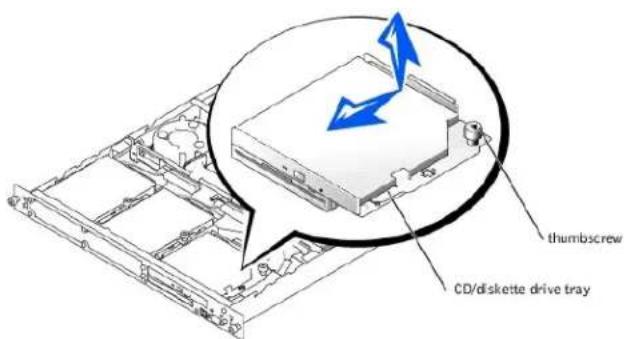
text_image
thumbscrew CD/diskette drive trayInstalling the CD/ Diskette Drive Tray
- Align the drive tray so that the shoulder washers on the tray slide into the mounting notches in the chassis.
- Slide the tray forward until it stops.
- Tighten the thumbscrew that secures the drive tray to the chassis.
- Connect the interface cable to the CD/diskette drive's interposer card.
- Close the system. See "Closing the System" in "Troubleshooting Your System."
Removing the CD and Diskette Drives

CAUTION: See your System Information Guide for complete information about safety precautions, working inside the computer, and protecting against electrostatic discharge.
- Remove the CD/diskette-drive tray. See "Removing the CD/Diskette Drive Tray."
- Remove the two fasteners that secure the interposer card to the drive tray. See Figure 7-4.
a. On the side of the card that is between the card and the drive, push the plunger of each fastener back into the fastener barrel, using the flat surface of a flat-tipped screwdriver or other small flat object.
b. On the side of the interposer card closest to the backplane board, grasp the plunger head and pull the plunger completely out of the drive tray.
- Disconnect the interposer card from the CD drive.
- While squeezing the labs on the drive tray securing lever, rotate the lever all the way open. See Figure 7-4.
- Remove the CD and diskette drives from the drive tray.
If you are replacing the diskette drive, disconnect the interface cable from the diskette drive that connects to the interposer card.
Figure 7-4. Removing the CD and Diskette Drives
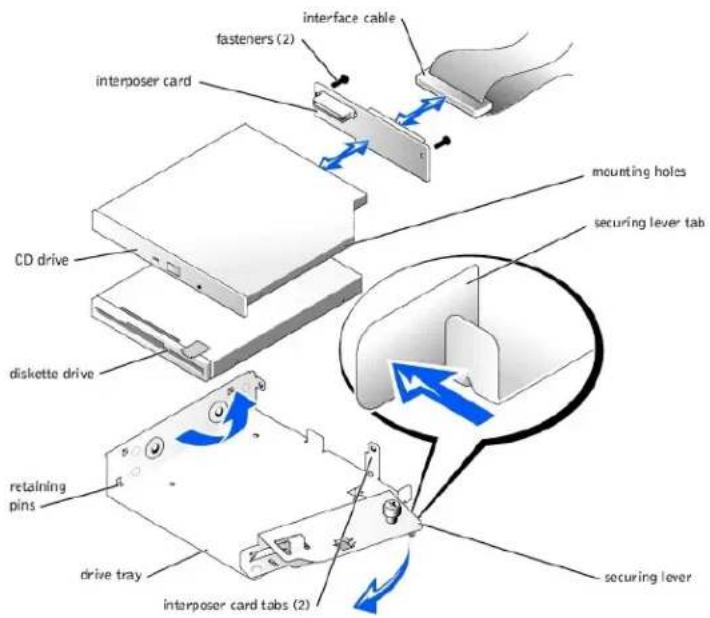
text_image
interface cable fasteners (2) interposer card mounting holes securing lever tab CD drive diskette drive retaining pins drive tray interposer card tabs (2) securing leverInstalling the CD and Diskette Drives
- Align the diskette drive's mounting holes with the retaining pins on the drive tray. See Figure 7-4.
If the diskette drive is replaced, connect the interface cable from the interposer card to the new diskette drive.
- Align the CD drive's mounting holes with the retaining pins on the drive tray. See Figure 7-4.
- Rotate the drive tray's securing lever until it snaps into place.
- Connect the interposer card to the CD drive.
Ensure that the fastener barrels are inserted through the interposer card and the tabs on the drive tray.
- Insert the plungers into the fastener barrels until they snap into place.
- Install the CD/diskette-drive tray. See "Installing the CD/Diskette Drive Tray."
Getting Help
Dell™ PowerEdge™ 650 Systems Installation and Troubleshooting Guide
Technical Assistance
Dell Enterprise Training and Certification
Problems With Your Order
Product Information
- Returning Items for Warranty Repair or Credit
Before You Call
Contacting Dell
Technical Assistance
If you need assistance with a technical problem, perform the following steps:
- Complete the procedures in "Troubleshooting Your System."
- Run the system diagnostics and record any information provided.
- Make a copy of the Diagnostics Checklist, and fill it out.
- Use Dell's extensive suite of online services available at Dell Support at support.dell.com for help with installation and troubleshooting procedures.
For more information, see "Online Services."
- If the preceding steps have not resolved the problem, call Dell for technical assistance.
NOTE: Call technical support from a phone near or at the system so that technical support can assist you with any necessary procedures.
NOTE: Dell's Express Service Code system may not be available in all countries.
When prompted by Dell's automated telephone system, enter your Express Service Code to route the call directly to the proper support personnel. If you do not have an Express Service Code, open the Dell Accessories folder, double-click the Express Service Code icon, and follow the directions.
For instructions on using the technical support service, see "Technical Support Service" and "Before You Call."
NOTE: Some of the following services are not always available in all locations outside the continental U.S. Call your local Dell representative for information on availability.
Online Services
You can access Dell Support at support.dell.com. Select your region on the WELCOME TO DELL SUPPORT page, and fill in the requested details to access help tools and information.
You can contact Dell electronically using the following addresses:
1 World Wide Web
www.dell.com/
www.dell.com/ap/ (for Asian/Pacific countries only)
www.euro.dell.com (for Europe only)
www.dell.com/ la (for Latin American countries)
1 Anonymous file transfer protocol (FTP)
ftp.dell.com/
Log in as user:anonymous, and use your e-mail address as your password.
Electronic Support Service
support@us.dell.com
apsupport@dell.com (for Asian/Pacific countries only)
support.euro.dell.com (for Europe only)
Electronic Quote Service
sales@dell.com
apmarketing@dell.com (for Asian/Pacific countries only)
Electronic Information Service
info@dell.com
AutoTech Service
Dell's automated technical support service—AutoTech—provides recorded answers to the questions most frequently asked by Dell customers about their portable and desktop computer systems.
When you call AutoTech, use your touch-tone telephone to select the subjects that correspond to your questions.
The AutoTech service is available 24 hours a day, 7 days a week. You can also access this service through the technical support service. See the contact information for your region.
Automated Order-Status Service
To check on the status of any Dell products that you have ordered, you can go to support.dell.com, or you can call the automated order-status service. A recording prompts you for the information needed to locate and report on your order. See the contact information for your region.
Technical Support Service
Dell's technical support service is available 24 hours a day, 7 days a week, to answer your questions about Dell hardware. Our technical support staff use computer-based diagnostics to provide fast, accurate answers.
To contact Dell's technical support service, see "Before You Call" and then see the contact information for your region.
Dell Enterprise Training and Certification
Dell Enterprise Training and Certification is available; see www.dell.com/training for more information. This service may not be offered in all locations.
Problems With Your Order
If you have a problem with your order, such as missing parts, wrong parts, or incorrect billing, contact Dell for customer assistance. Have your invoice or packing slip available when you call. See the contact information for your region.
Product Information
If you need information about additional products available from Dell, or if you would like to place an order, visit the Dell website at www.dell.com. For the telephone number to call to speak to a sales specialist, see the contact information for your region.
Returning Items for Warranty Repair or Credit
Prepare all items being returned, whether for repair or credit, as follows:
- Call Dell to obtain a Return Material Authorization Number, and write it clearly and prominently on the outside of the box.
For the telephone number to call, see the contact information for your region. - Include a copy of the invoice and a letter describing the reason for the return.
- Include a copy of any diagnostic information (including the Diagnostics Checklist) indicating the tests you have run and any error messages reported by the system diagnostics.
- Include any accessories that belong with the item(s) being returned (such as power cables, media such as CDs and diskettes, and guides) if the return is for credit.
- Pack the equipment to be returned in the original (or equivalent) packing materials.
You are responsible for paying shipping expenses. You are also responsible for insuring any product returned, and you assume the risk of loss during shipment to Dell. Collect-on-delivery (C.O.D.) packages are not accepted.
Returns that are missing any of the preceding requirements will be refused at our receiving dock and returned to you.
Before You Call

NOTE: Have your Express Service Code ready when you call. The code helps Dell's automated-support telephone system direct your call more efficiently.
Remember to fill out the Diagnostics Checklist. If possible, turn on your system before you call Dell for technical assistance and call from a telephone at or near the computer. You may be asked to type some commands at the keyboard, relay detailed information during operations, or try other troubleshooting steps possible only at the computer system itself. Ensure that the system documentation is available.

CAUTION: Before servicing any components inside your computer, see your System Information Guide for important safety information.
| Diagnostics Checklist |
| Name: |
| Date: |
| Address: |
| Phone number: |
| Service tag (bar code on the back of the computer): |
| Express Service Code: |
| Return Material Authorization Number (if provided by Dell support technician): |
| Operating system and version: |
| Peripherals: |
| Expansion cards: |
| Are you connected to a network? Yes No |
| Network, version, and network card: |
| Programs and versions: |
| See your operating system documentation to determine the contents of the system's start-up files. If possible, print each file. Otherwise, record the contents of each file before calling Dell. |
| Error message, beep code, or diagnostic code: |
| Description of problem and troubleshooting procedures you performed: |
Contacting Dell
To contact Dell electronically, you can access the following websites:
www.dell.com
support.dell.com (technical support)
premiersupport.dell.com (technical support for educational, government, healthcare, and medium/large business customers, including Premier, Platinum, and Gold customers)
For specific web addresses for your country, find the appropriate country section in the table below.
NOTE: Toll-free numbers are for use within the country for which they are listed.
When you need to contact Dell, use the electronic addresses, telephone numbers, and codes provided in the following table. If you need assistance in determining which codes to use, contact a local or an international operator.
| Country (City) International Access Code Country Code City Code | Department Name or Service Area, Website and E-Mail Address | Area Codes, Local Numbers, and Toll-Free Numbers |
| Anguilla | General Support | toll-free: 800-335-0031 |
| Antigua and Barbuda | General Support | 1-800-805-5924 |
| Argentina (Buenos Aires) | Website: www.dell.com.ar | |
| International Access Code: 00 | Tech Support and Customer Care | toll-free: 0-800-444-0733 |
| Sales | 0-810-444-3355 | |
| Country Code: 54 | Tech Support Fax | 11 4515 7139 |
| City Code: 11 | Customer Care Fax | 11 4515 7138 |
| Aruba | General Support | toll-free: 800-1578 |
| Australia (Sydney) | E-mail (Australia): au_tech_support@dell.com | |
| International Access Code: 0011 | E-mail (New Zealand): nz_tech_support@dell.com | |
| Home and Small Business | 1-300-65-55-33 | |
| Country Code: 61 | Government and Business | toll-free: 1-800-633-559 |
| Preferred Accounts Division (PAD) | toll-free: 1-800-060-889 | |
| City Code: 2 | Customer Care | toll-free: 1-800-819-339 |
| Corporate Sales | toll-free: 1-800-808-385 | |
| Transaction Sales | toll-free: 1-800-808-312 | |
| Fax | toll-free: 1-800-818-341 | |
| Austria (Vienna)International Access Code: 900Country Code: 43City Code: 1 | Website:support.euro.dell.com | |
| E-mail:tech_support_central_europe@dell.com | ||
| Home/Small Business Sales | 01 795 67602 | |
| Home/Small Business Fax | 01 795 67605 | |
| Home/Small Business Customer Care | 01 795 67603 | |
| Preferred Accounts/Corporate Customer Care | 0660 8056 | |
| Home/Small Business Technical Support | 01 795 67604 | |
| Preferred Accounts/Corporate Technical Support | 0660 8779 | |
| Switchboard | 01 491 04 0 | |
| Bahamas | General Support | toll-free: 1-866-278-6818 |
| Barbados | General Support | 1-800-534-3066 |
| Belgium (Brussels)International Access Code: 00Country Code: 32City Code: 2 | Website:support.euro.dell.com | |
| E-mail:tech_be@dell.com | ||
| E-mail for French Speaking Customers:support.euro.dell.com/be/fr/emaildell/ | ||
| Technical Support | 02 481 92 88 | |
| Customer Care | 02 481 91 19 | |
| Home/Small Business Sales | toll-free: 0800 16884 | |
| Corporate Sales | 02 481 91 00 | |
| Fax | 02 481 92 99 | |
| Switchboard | 02 481 91 00 | |
| Bermuda | General Support | 1-800-342-0671 |
| Bolivia | General Support | toll-free: 800-10-0238 |
| BrazilInternational Access Code: 00Country Code: 55City Code: 51 | Website:www.dell.com/br | |
| Customer Support,Technical Support | 0800 90 3355 | |
| Tech Support Fax | 51 481 5470 | |
| Customer Care Fax | 51 481 5480 | |
| Sales | 0800 90 3390 | |
| British Virgin Islands | General Support | toll-free: 1-866-278-6820 |
| BruneiCountry Code: 673 | Customer Technical Support (Penang, Malaysia) | 604 633 4966 |
| Customer Service (Penang, Malaysia) | 604 633 4949 | |
| Transaction Sales (Penang, Malaysia) | 604 633 4955 | |
| Canada (North York, Ontario)International Access Code: 011 | Automated Order-Status System | toll-free: 1-800-433-9014 |
| AutoTech (automated technical support) | toll-free: 1-800-247-9362 | |
| Customer Care (from outside Toronto) | toll-free: 1-800-326-9463 | |
| Customer Care (from within Toronto) | 416 758-2400 | |
| Customer Technical Support | toll-free: 1-800-847-4096 | |
| Sales (direct sales-from outside Toronto) | toll-free: 1-800-387-5752 | |
| Sales (direct sales-from within Toronto) | 416 758-2200 | |
| Sales (federal government, education, and medical) | toll-free: 1-800-567-7542 | |
| Sales (major accounts) | toll-free: 1-800-387-5755 | |
| TechFax | toll-free: 1-800-950-1329 | |
| Cayman Islands | General Support | 1-800-805-7541 |
| Chile (Santiago)Country Code: 56City Code: 2 | Sales, Customer Support, and Technical Support | toll-free: 1230-020-4823 |
| China (Xiamen)Country Code: 86City Code: 592 | Tech Support website:support.ap.dell.com/china | |
| Tech Support E-mail:cn_support@dell.com | ||
| Tech Support Fax | 818 1350 | |
| Home and Small Business Technical Support | toll-free: 800 858 2437 | |
| Corporate Accounts Technical Support | toll-free: 800 858 2333 | |
| Customer Experience | toll-free: 800 858 2060 | |
| Home and Small Business | toll-free: 800 858 2222 | |
| Preferred Accounts Division | toll-free: 800 858 2062 | |
| Large Corporate Accounts GCP | toll-free: 800 858 2055 | |
| Large Corporate Accounts Key Accounts | toll-free: 800 858 2628 | |
| Large Corporate Accounts North | toll-free: 800 858 2999 | |
| Large Corporate Accounts North Government and Education | toll-free: 800 858 2955 | |
| Large Corporate Accounts East | toll-free: 800 858 2020 | |
| Large Corporate Accounts East Government and Education | toll-free: 800 858 2669 | |
| Large Corporate Accounts Queue Team | toll-free: 800 858 2572 | |
| Large Corporate Accounts South | toll-free: 800 858 2355 | |
| Large Corporate Accounts West | toll-free: 800 858 2811 | |
| Large Corporate Accounts Spare Parts | toll-free: 800 858 2621 | |
| Colombia | General Support | 980-9-15-3978 |
| Costa Rica | General Support | 0800-012-0435 |
| Czech Republic (Prague)International Access Code: 00Country Code: 420City Code: 2 | Website:support.euro.dell.com | |
| E-mail:czech_dell@dell.com | ||
| Technical Support | 02 22 83 27 27 | |
| Customer Care | 02 22 83 27 11 | |
| Fax | 02 22 83 27 14 | |
| TechFax | 02 22 83 27 28 | |
| Switchboard | 02 22 83 27 11 | |
| Denmark (Copenhagen)International Access Code: 00Country Code: 45 | Website:support.euro.dell.com | |
| E-mail Support (portable computers):den_nbk_support@dell.com | ||
| E-mail Support (desktop computers):den_support@dell.com | ||
| E-mail Support (servers):Nordic_server_support@dell.com | ||
| Technical Support | 7023 0182 | |
| Customer Care (Relational) | 7023 0184 | |
| Home/Small Business Customer Care | 3287 5505 | |
| Switchboard (Relational) | 3287 1200 | |
| Fax Switchboard (Relational) | 3287 1201 | |
| Switchboard (Home/Small Business) | 3287 5000 | |
| Fax Switchboard (Home/Small Business) | 3287 5001 | |
| Dominica | General Support | toll-free: 1-866-278-6821 |
| Dominican Republic | General Support | 1-800-148-0530 |
| Ecuador | General Support | toll-free: 999-119 |
| El Salvador | General Support | 01-899-753-0777 |
| Finland (Helsinki)International Access Code: 990Country Code: 358City Code: 9 | Website:support.euro.dell.com | |
| E-mail:fin_support@dell.com | ||
| E-mail Support (servers):Nordic_support@dell.com | ||
| Technical Support | 09 253 313 60 | |
| Technical Support Fax | 09 253 313 81 | |
| Relational Customer Care | 09 253 313 38 | |
| Home/Small Business Customer Care | 09 693 791 94 | |
| Fax | 09 253 313 99 | |
| Switchboard | 09 253 313 00 | |
| France (Paris) (Montpellier)International Access Code: 00Country Code: 33City Codes: (1) (4) | Website:support.euro.dell.com | |
| E-mail:support.euro.dell.com/fr/fr/emaildell/ | ||
| Home and Small Business | ||
| Technical Support | 0825 387 270 | |
| Customer Care | 0825 823 833 | |
| Switchboard | 0825 004 700 | |
| Switchboard (calls from outside of France) | 04 99 75 40 00 | |
| Sales | 0825 004 700 | |
| Fax | 0825 004 701 | |
| Fax (calls from outside of France) | 04 99 75 40 01 | |
| Corporate | ||
| Technical Support | 0825 004 719 | |
| Customer Care | 0825 338 339 | |
| Switchboard | 01 55 94 71 00 | |
| Sales | 01 55 94 71 00 | |
| Fax | 01 55 94 71 01 | |
| Germany (Langen) | Website:support.euro.dell.com | |
| International Access Code: 00Country Code: 49City Code: 6103 | E-mail: tech_support_central_europe@dell.com | |
| Technical Support | 06103 766-7200 | |
| Home/Small Business Customer Care | 0180-5-224400 | |
| Global Segment Customer Care | 06103 766-9570 | |
| Preferred Accounts Customer Care | 06103 766-9420 | |
| Large Accounts Customer Care | 06103 766-9560 | |
| Public Accounts Customer Care | 06103 766-9555 | |
| Switchboard | 06103 766-7000 | |
| Grenada | General Support | toll-free: 1-866-540-3355 |
| Guatemala | General Support | 1-800-999-0136 |
| Guyana | General Support | toll-free: 1-877-270-4609 |
| Hong KongInternational Access Code: 001Country Code: 852 | Technical Support (DimensionTM and InspironTM) | 296 93188 |
| Technical Support (OptiPlexTM, LatitudeTM, and Dell PrecisionTM) | 296 93191 | |
| Customer Service (non-technical, post-sales issues) | 800 93 8291 | |
| Transaction Sales | toll-free: 800 96 4109 | |
| Large Corporate Accounts HK | toll-free: 800 96 4108 | |
| Large Corporate Accounts GCP HK | toll-free: 800 90 3708 | |
| India | Technical Support | 1600 33 8045 |
| Sales | 1600 33 8044 | |
| Ireland (Cherrywood)International Access Code: 16Country Code: 353City Code: 1 | Website: support.euro.dell.com | |
| E-mail: dell_direct_support@dell.com | ||
| Ireland Technical Support | 1850 543 543 | |
| U.K. Technical Support (dial within U.K. only) | 0870 908 0800 | |
| Home User Customer Care | 01 204 4095 | |
| Small Business Customer Care | 01 204 4444 | |
| U.K. Customer Care (dial within U.K. only) | 0870 906 0010 | |
| Corporate Customer Care | 01 204 4003 | |
| Ireland Sales | 01 204 4444 | |
| U.K. Sales (dial within U.K. only) | 0870 907 4000 | |
| SalesFax | 01 204 0144 | |
| Fax | 01 204 5960 | |
| Switchboard | 01 204 4444 | |
| Italy (Milan)International Access Code: 00Country Code: 39City Code: 02 | Website: support.euro.dell.com | |
| E-mail: support.euro.dell.com/ it/ it/ emaildell/ | ||
| Home and Small Business | ||
| Technical Support | 02 577 826 90 | |
| Customer Care | 02 696 821 14 | |
| Fax | 02 696 821 13 | |
| Switchboard | 02 696 821 12 | |
| Corporate | ||
| Technical Support | 02 577 826 90 | |
| Customer Care | 02 577 825 55 | |
| Fax | 02 575 035 30 | |
| Switchboard | 02 577 821 | |
| Jamaica | General Support (dial from within Jamaica only) | 1-800-682-3639 |
| Japan (Kawasaki)International Access Code: 001Country Code: 81City Code: 44 | Website: support.jp.dell.com | |
| Technical Support (servers) | toll-free: 0120-1984-98 | |
| Technical Support outside of Japan (servers) | 81-44-556-4162 | |
| Technical Support (DimensionTM and InspironTM) | toll-free: 0120-1982-26 | |
| Technical Support outside of Japan (Dimension and Inspiron) | 81-44-520-1435 | |
| Technical Support (Dell PrecisionTM, OptiPlexTM, and LatitudeTM) | toll-free:0120-1984-33 | |
| Technical Support outside of Japan (Dell Precision, OptiPlex, and Latitude) | 81-44-556-3894 | |
| 24-Hour Automated Order Service | 044-556-3801 | |
| Customer Care | 044-556-4240 | |
| Business Sales Division (up to 400 employees) | 044-556-1465 | |
| Preferred Accounts Division Sales (over 400 employees) | 044-556-3433 | |
| Large Corporate Accounts Sales (over 3500 employees) | 044-556-3430 | |
| Public Sales (government agencies, educational institutions, and medical institutions) | 044-556-1469 | |
| Global Segment Japan | 044-556-3469 | |
| Individual User | 044-556-1760 | |
| Faxbox Service | 044-556-3490 | |
| Switchboard | 044-556-4300 | |
| Korea (Seoul)International Access Code: 001Country Code: 82City Code: 2 | Technical Support | toll-free: 080-200-3800 |
| Sales | toll-free: 080-200-3600 | |
| Customer Service (Seoul, Korea) | toll-free: 080-200-3800 | |
| Customer Service (Penang, Malaysia) | 604 633 4949 | |
| Fax | 2194-6202 | |
| Switchboard | 2194-6000 | |
| Latin America | Customer Technical Support (Austin, Texas, U.S.A.) | 512 728-4093 |
| Customer Service (Austin, Texas, U.S.A.) | 512 728-3619 | |
| Fax (Technical Support and Customer Service) (Austin, Texas, U.S.A.) | 512 728-3883 | |
| Sales (Austin, Texas, U.S.A.) | 512 728-4397 | |
| SalesFax (Austin, Texas, U.S.A.) | 512 728-4600or 512 728-3772 | |
| LuxembourgInternational Access Code: 00Country Code: 352 | Website: support.euro.dell.com | |
| E-mail: tech_be@dell.com | ||
| Technical Support (Brussels, Belgium) | 02 481 92 88 | |
| Home/Small Business Sales (Brussels, Belgium) | toll-free: 080016884 | |
| Corporate Sales (Brussels, Belgium) | 02 481 91 00 | |
| Customer Care (Brussels, Belgium) | 02 481 91 19 | |
| Fax (Brussels, Belgium) | 02 481 92 99 | |
| Switchboard (Brussels, Belgium) | 02 481 91 00 | |
| MacaoCountry Code: 853 | Technical Support | toll-free: 0800 582 |
| Customer Service (Penang, Malaysia) | 604 633 4949 | |
| Transaction Sales | toll-free: 0800 581 | |
| Malaysia (Penang)International Access Code: 00Country Code: 60City Code: 4 | Technical Support | toll-free: 1 800 888 298 |
| Customer Service | 04 633 4949 | |
| Transaction Sales | toll-free: 1 800 888 202 | |
| Corporate Sales | toll-free: 1 800 888 213 | |
| MexicoInternational Access Code: 00Country Code: 52 | Customer Technical Support | 001-877-384-8979or 001-877-269-3383 |
| Sales | 50-81-8800or 01-800-888-3355 | |
| Customer Service | 001-877-384-8979or 001-877-269-3383 | |
| Main | 50-81-8800or 01-800-888-3355 | |
| Montserrat | General Support | toll-free: 1-866-278-6822 |
| Netherlands Antilles | General Support | 001-800-882-1519 |
| Netherlands (Amsterdam)International Access Code: 00Country Code: 31City Code: 20 | Website: support.euro.dell.com | |
| E-mail: support.euro.dell.com/ nl/ nl/ emaildell/ | ||
| Technical Support | 020 674 45 00 | |
| Home/ Small and Medium Business | 020 674 55 00 | |
| Home/ Small and Medium Business Fax | 020 674 47 75 | |
| Home/ Small and Medium Business Customer Care | 020 674 42 00 | |
| Corporate | 020 674 50 00 | |
| Corporate Fax | 020 674 47 79 | |
| Corporate Customer Care | 020 674 43 25 | |
| New ZealandInternational Access Code: 00Country Code: 64 | E-mail (New Zealand): nz_tech_support@dell.com | |
| E-mail (Australia): au_tech_support@dell.com | ||
| Home and Small Business | 0800 446 255 | |
| Government and Business | 0800 444 617 | |
| Sales | 0800 441 567 | |
| Fax | 0800 441 566 | |
| Nicaragua | General Support | 001-800-220-1006 |
| Norway (Lysaker)International Access Code: 00Country Code: 47 | Website:support.euro.dell.com | |
| E-mail Support (portable computers):nor_nbk_support@dell.com | ||
| E-mail Support (desktop computers):nor_support@dell.com | ||
| E-mail Support (servers):nordic_server_support@dell.com | ||
| Technical Support | 671 16882 | |
| Relational Customer Care | 671 17514 | |
| Home/Small Business Customer Care | 23162298 | |
| Switchboard | 671 16800 | |
| Fax Switchboard | 671 16865 | |
| Panama | General Support | 001-800-507-0962 |
| Peru | General Support | 0800-50-669 |
| Poland (Warsaw)International Access Code: 011Country Code: 48City Code: 22 | Website:support.euro.dell.com | |
| E-mail:pl_support@dell.com | ||
| Customer Service Phone | 57 95 700 | |
| Customer Care | 57 95 999 | |
| Sales | 57 95 999 | |
| Customer Service Fax | 57 95 806 | |
| Reception Desk Fax | 57 95 998 | |
| Switchboard | 57 95 999 | |
| PortugalInternational Access Code: 00Country Code: 35 | E-mail:support.euro.dell.com/es/es/emaildell/ | |
| Technical Support | 800 834 077 | |
| Customer Care | 800 300 415 or800 834 075 | |
| Sales | 800 300 410 or 800 300 411 or800 300 412 or121 422 07 10 | |
| Fax | 121 424 01 12 | |
| Puerto Rico | General Support | 1-800-805-7545 |
| St. Kitts and Nevis | General Support | toll-free: 1-877-441-4731 |
| St. Lucia | General Support | 1-800-882-1521 |
| St. Vincent and the Grenadines | General Support | toll-free: 1-877-270-4609 |
| Singapore (Singapore)International Access Code: 005Country Code: 65 | Technical Support | toll-free: 800 6011 051 |
| Customer Service (Penang, Malaysia) | 604 633 4949 | |
| Transaction Sales | toll-free: 800 6011 054 | |
| Corporate Sales | toll-free: 800 6011 053 | |
| South Africa (Johannesburg)International Access Code:09/091Country Code: 27City Code: 11 | Website:support.euro.dell.com | |
| E-mail:dell_za_support@dell.com | ||
| Technical Support | 011 709 7710 | |
| Customer Care | 011 709 7707 | |
| Sales | 011 709 7700 | |
| Fax | 011 706 0495 | |
| Switchboard | 011 709 7700 | |
| Southeast Asian and Pacific Countries | Customer Technical Support, Customer Service, and Sales (Penang, Malaysia) | 604 633 4810 |
| Spain (Madrid)International Access Code: 00Country Code: 34City Code: 91 | Website:support.euro.dell.com | |
| E-mail:support.euro.dell.com/es/es/emaildell/ | ||
| Home and Small Business | ||
| Technical Support | 902 100 130 | |
| Customer Care | 902 118 540 | |
| Sales | 902 118 541 | |
| Switchboard | 902 118 541 | |
| Fax | 902 118 539 | |
| Corporate | ||
| Technical Support | 902 100 130 | |
| Customer Care | 902 118 546 | |
| Switchboard | 91 722 92 00 | |
| Fax | 91 722 95 83 | |
| Sweden (Upplands Vasby)International Access Code: 00Country Code: 46City Code: 8 | Website:support.euro.dell.com | |
| E-mail:swe_support@dell.com | ||
| E-mail Support for Latitude and Inspiron:Swe-nbk_kats@dell.com | ||
| E-mail Support for OptiPlex:Swe_kats@dell.com | ||
| E-mail Support for Servers:Nordic_server_support@dell.com | ||
| Technical Support | 08 590 05 199 | |
| Relational Customer Care | 08 590 05 642 | |
| Home/Small Business Customer Care | 08 587 70 527 | |
| Employee Purchase Program (EPP) Support | 20 140 14 44 | |
| Fax Technical Support | 08 590 05 594 | |
| Sales | 08 590 05 185 | |
| Switzerland (Geneva)International Access Code: 00Country Code: 41City Code: 22 | Website:support.euro.dell.com | |
| E-mail:swisstech@dell.com | ||
| E-mail for French-speaking HSB and Corporate Customers:support.euro.dell.com/ch/fr/emaildell | ||
| Technical Support (Home and Small Business) | 0844 811 411 | |
| Technical Support (Corporate) | 0844 822 844 | |
| Customer Care (Home and Small Business) | 0848 802 202 | |
| Customer Care (Corporate) | 0848 821 721 | |
| Fax | 022 799 01 90 | |
| Switchboard | 022 799 01 01 | |
| TaiwanInternational Access Code: 002Country Code: 886 | Technical Support (portable and desktop computers) | toll-free:00801 86 1011 |
| Technical Support (servers) | toll-free:0080 60 1256 | |
| Transaction Sales | toll-free:0080 651 228or 0800 33 556 | |
| Corporate Sales | toll-free:0080 651 227or 0800 33 555 | |
| ThailandInternational Access Code: 001Country Code: 66 | Technical Support | toll-free:0880 060 07 |
| Customer Service (Penang, Malaysia) | 604 633 4949 | |
| Sales | toll-free:0880 060 09 | |
| Trinidad/Tobago | General Support | 1-800-805-8035 |
| Turks and Calcos Islands | General Support | toll-free:1-866-540-3355 |
| U.K. (Bracknell)International Access Code: 00Country Code: 44City Code: 1344 | Website:support.euro.dell.com | |
| Customer Care website:dell.co.uk/ Ica/customerservices | ||
| E-mail:dell_direct_support@dell.com | ||
| Technical Support (Corporate/Preferred Accounts/PAD [1000+ employees]) | 0870 908 0500 | |
| Technical Support (direct/PAD and general) | 0870 908 0800 | |
| Global Accounts Customer Care | 01344 373 185or 01344 373 186 | |
| Home and Small Business Customer Care | 0870 906 0010 | |
| Corporate Customer Care | 0870 908 0500 | |
| Preferred Accounts (500-5000 employees) Customer Care | 01344 373 196 | |
| Central Government Customer Care | 01344 373 193 | |
| Local Government & Education Customer Care | 01344 373 199 | |
| Health Customer Care | 01344 373 194 | |
| Home and Small Business Sales | 0870 907 4000 | |
| Corporate/Public Sector Sales | 01344 860 456 | |
| Uruguay | General Support | toll-free:000-413-598-2521 |
| U.S.A. (Austin, Texas)International Access Code: 011Country Code: 1 | Automated Order Status Service | toll-free:1-800-433-9014 |
| AutoTech (portable and desktop computers) | toll-free:1-800-247-9362 | |
| Consumer (Home and Home Office) | ||
| Technical Support | toll-free:1-800-624-9896 | |
| Customer Service | toll-free:1-800-624-9897 | |
| DellNetTM Service and Support | toll-free:1-877-Dellnet(1-877-335-5638) | |
| Software Application Support | toll-free: 1-800-433-9005 | |
| Employee Purchase Program (EPP) Customers | toll-free: 1-800-695-8133 | |
| Financial Services website: www.dellfinancialservices.com | ||
| Financial Services (lease/loans) | toll-free: 1-877-577-3355 | |
| Financial Services (Dell Preferred Accounts [DPA]) | toll-free: 1-800-283-2210 | |
| Business | ||
| Service and Technical Support | toll-free: 1-800-822-8965 | |
| Employee Purchase Program (EPP) Customers | toll-free: 1-800-695-8133 | |
| Projectors Technical Support | toll-free: 1-877-459-7298 | |
| Public (government, education, and healthcare) | ||
| Service and Technical Support | toll-free: 1-800-456-3355 | |
| Employee Purchase Program (EPP) Customers | toll-free: 1-800-234-1490 | |
| Dell Sales | toll-free: 1-800-289-3355or toll-free: 1-800-879-3355 | |
| Dell Outlet Store (Dell relurbished computers) | toll-free: 1-888-798-7561 | |
| Software and Peripherals Sales | toll-free: 1-800-671-3355 | |
| Spare Parts Sales | toll-free: 1-800-357-3355 | |
| Extended Service and Warranty Sales | toll-free: 1-800-247-4618 | |
| Fax | toll-free: 1-800-727-8320 | |
| Dell Services for the Deaf, Hard-of-Hearing, or Speech-Impaired | toll-free: 1-877-DELLTTY(1-877-335-5889) | |
| U.S. Virgin Islands | General Support | 1-877-673-3355 |
| Venezuela | General Support | 8001-3605 |
Back to Contents Page
Back to Contents Page
Dell™ PowerEdge™ 650 Systems Installation and Troubleshooting Guide
Notes. Notices, and Cautions
Abbreviations and Acronyms
Notes, Notices, and Cautions

NOTE: A NOTE indicates important information that helps you make better use of your computer.

NOTICE: A NOTICE indicates either potential damage to hardware or loss of data and tells you how to avoid the problem.

CAUTION: A CAUTION indicates a potential for property damage, personal injury, or death.
Abbreviations and Acronyms
For a complete list of abbreviations and acronyms, see the "Abbreviations and Acronyms."
Information in this document is subject to change without notice.
© 2003 Dell Computer Corporation. All rights reserved.
Reproduction in any manner whatsoever without the written permission of Dell Computer Corporation is strictly forbidden.
Trademarks used in this text: Dell, the DELL logo, PowerEdge, Dell OpenManage, DellNet, Dell Precision, Dimension, Inspiron, OptiPlex, and Latitude are trademarks of Dell Computer Corporation; Intel is a registered trademark of Intel Corporation; MS-DOS is a registered trademark of Microsoft Corporation.
Other trademarks and trade names may be used in this document to refer to either the entities claiming the marks and names or their products. Dell Computer Corporation disclaims any proprietary interest in trademarks and trade names other than its own.
Back to Contents Page