WPS-0100USB - Printer LEVELONE - Free user manual and instructions
Find the device manual for free WPS-0100USB LEVELONE in PDF.


User questions about WPS-0100USB LEVELONE
0 question about this device. Answer the ones you know or ask your own.
Ask a new question about this device
Download the instructions for your Printer in PDF format for free! Find your manual WPS-0100USB - LEVELONE and take your electronic device back in hand. On this page are published all the documents necessary for the use of your device. WPS-0100USB by LEVELONE.
USER MANUAL WPS-0100USB LEVELONE
Safety Instructions 2
Package Contents 3
Models 3
LED Indicators 6
Diagnostic Push Button....6
Chapter 2 LAN Installation 8
Procedure 8
Chapter 3 LevelOne Printer Server Configuration 10
Overview....10
Using the Windows Wizard 10
Alternatives to the Windows Wizard 11
Advanced Configuration and Management.... 12
Chapter 4 Client PC Configuration 13
Overview....13
Wireless Settings for client PCs 13
Printing Methods....14
Windows Peer-to-peer Print Driver....16
Windows SMB Printing....20
Windows with Server-based Print Queues 21
Windows using NDPS 22
Macintosh (AppleTalk)....23
Chapter 5 BiAdmin Management Utility 26
Requirements....26
Installation....26
Operation....27
Chapter 6 Web Interface Setup 33
Overview....33
Preparation 33
Connecting to the LevelOne Printer Server 34
Configuration Screens.... 34
Chapter 7 Special Features 44
Overview....44
Internet Printing Protocol (IPP)....44
Internet Mail Printing....49
Printing through the Internet....53
SNMP....54
Wireless Configuration....55
Chapter 8 Troubleshooting 60
Overview....60
Hardware & LAN Problems 60
AppleTalk (Macintosh)....61
Novell NetWare 63
Windows Printing Problems 64
Appendix A Specifications 68
General Specifications....68
Protocol Support 70
Feature Support 70
Regulatory Approvals 71
Appendix B Network Server Configuration 71
Windows NT Server....71
Windows 2000 Server....73
Novell NetWare 73
Unix Systems 78
Features
Congratulations on the purchase of your new LevelOne Printer Server. This device was designed to provide a simple and efficient network printing solution. It is packed with features, including:
Versatility. The LevelOne Printer Server supports up to five protocols: NetWare, TCP/IP, SMB (Service Message Block), AppleTalk (EtherTalk), and NetBEUI. It features one or two Ethernet interface ports and operating system support includes Unix, Novell, and Microsoft Windows.
Easy Installation. The LevelOne Printer Server makes adding printers or plotters to your network simple. Depending on your model, it will support 10BaseT only, 10Base2 and 10BaseT, or 10BaseT and 100BaseT. The auto-sensing feature on the LAN interface means that there is no need to set jumpers or perform software configuration to select the network interface used.
Easy Setup. A number of utility programs are supplied to simplify setup. For Windows 95/98/NT/2000/XP users, the BiAdmin program makes it easy to configure the LevelOne Printer Server for a variety of network and server configurations.
Web-based Interface. On 100BaseT models, the Web-based interface provides an easy method of configuration in TCP/IP networks.
Compact Size. This allows the LevelOne Printer Server to be used even where space is limited.
Remote Management Tools. A variety of software tools are provided. In most environments, both the LevelOne Printer Server and attached bi-directional printers can be configured remotely.
SNMP Support. The LevelOne Printer Server can act as a SNMP agent, with it own MIB. This allows TCP/IP users to monitor, configure and troubleshoot the LevelOne Printer Server using their existing SNMP management tools.
JetAdmin Support. 100BaseT models support the HP JetAdmin program. If you are already using JetAdmin, you can also use this program to manage your LevelOne Printer Server.
Internet Printing Protocol (IPP) Support. Some LevelOne Printer Server models can act an IPP (Internet Printing Protocol) Server, allowing clients, suppliers, colleagues and others to print to your printer from anywhere on the Internet. Windows IPP Client software is also supplied.
Safety Instructions
For your own safety, and to protect your LevelOne Printer Server, please observe the following safety advice.
- Unplug this device from its power source before cleaning. Use only a slightly dampened cloth for cleaning. Do not use liquid or aerosol cleaners.
- Avoid using this product near water. Exposure to water poses an electric-shock hazard.
- Do not place the LevelOne Printer Server on an unstable surface. The device may fall causing serious damage to the device.
- This device should only be used with the power supply type specified on the marking label. If you are not sure of type of your local power supply, consult your dealer or the local power company.
- Do not pinch, crimp or otherwise damage the power cord. If exposed to foot traffic, ensures that the cable is properly shielded and does not pose a tripping hazard.
- If using an extension cord, makes sure the total ampere rating of the products using the cord does not exceed the extension cord's ampere rating.
- Do not attempt to service this device, as opening or removing casing may expose you to dangerous voltage points or other risks. Refer all servicing to qualified service personnel.
- The LevelOne Printer Server should be serviced by qualified service personnel under the following conditions:
• The power cord is damaged or frayed.
• Liquid has been spilled onto the product.
• The product has been exposed to rain or water.
• The product does not operate normally in accordance with the operating instructions.
• The device has been dropped or the casing has been damaged.
Package Contents
You should find the following items packaged with your LevelOne Printer Server. If any items are missing, contact your dealer immediately.
• The LevelOne Printer Server
- Power Adapter
• One CD-ROM containing all support programs and this manual
- Quick Install Guide
• Wireless PCMCIA Card (for WPS-0100 and WPS-0100USB)
Models
This manual covers the following LevelOne Printer Server models. Details of the LEDs and DIP Switches are in this Chapter. Further details of each model are contained in Appendix A - Specifications.
WPS-0100
▶ 1 Parallel Printer Port
▶ IEEE 802.11b Wireless Station
▶ 10/100BaseT

text_image
PCM CIA Wireless Card 10/100 BaseT Port Parallel Port Diagnostic Button WLAN LED LAN LED ACT LED Error LED 12V PowerWPS-0100USB
▶ 1 USB Printer Port
▶ IEEE 802.11b Wireless Station
▶ 10/100BaseT
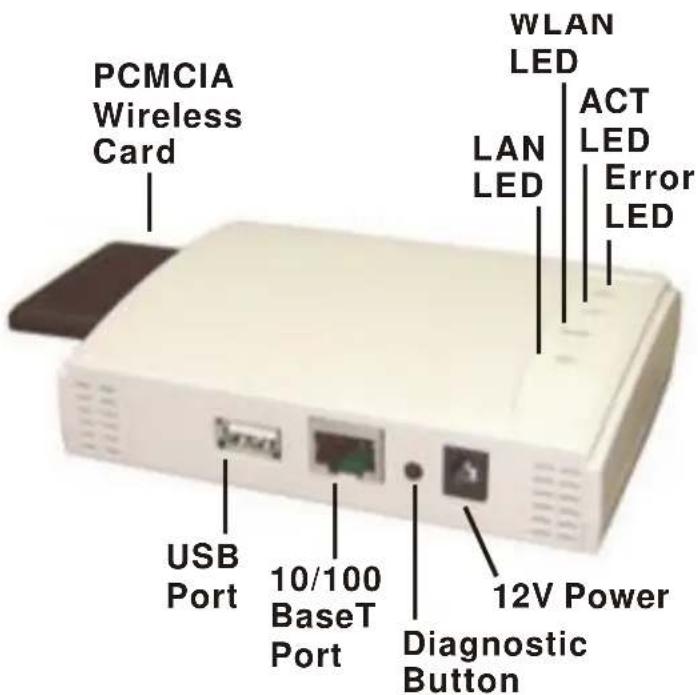
text_image
PCM CIA Wireless Card USB Port 10/100 BaseT Port WLAN LED LAN LED ACT LED Error LED 12V Power Diagnostic ButtonLED Indicators
All models have two LED indicators on the top. The Status/Error LED is orange or red. The Power/Link indicator LED is green. The LED indicator modes are described in the following table.
| Green LED | Red/Orange LED | Status Description |
| Off Off No power. | ||
| On | On | Hardware error. |
| Flashing | Flashing | Firmware upgrade in progress. |
| On | Flashing (USB only) | No printer connected to the USB port. |
| On | Off | Normal operation - idle. |
| Flashing | Off | Normal operation - transmitting or receiving packets from the network. |
LEDs - WPS-0100 and WPS-0100USB
The WPS-0100 and WPS-0100USB have 2 additional LED indicators as follows:
| LED Description | |
| WLAN ACT | Off - IdleFlashing - Transmitting or receiving data through the Wireless LAN. |
| LAN ACT | Off - IdleFlashing - Transmitting or receiving data through the LAN. |
Diagnostic Push Button
LevelOne Printer Server models WPS-0100 and WPS-0100USB are fitted with a Diagnostic Push Button. The button is recessed; a pin or paper clip can be used to press it. This button has 2 functions:
- Restore the factory default settings
• Print a test page containing all current settings.
To restore the factory default settings:
- Turn the LevelOne Printer Server OFF.
- Press and hold the diagnostic button. While pressing the button, switch the LevelOne Printer Server ON.
- If you continue pressing the button for 10 seconds, a diagnostic page will be printed, showing the new (default) settings.
To generate a Diagnostic print out
- Ensure that both the LevelOne Printer Server and the printer attached to port 1 are ON.
-
Press the diagnostic button, and hold it in for 2 seconds.
-
The test page, containing the current settings, will be printed.
Note:
PostScript printers are unable to print this page. If you have a PostScript printer on Port 1, the test page will not be printed.
This chapter describes how to install the LevelOne Printer Server in your Local Area Network.
Procedure
1. Preparation
- Ensure the power is OFF. Do not connect the LevelOne Printer Server while power is On.
- For the PS 7100 and WPS-0100USB only, the PCMCIA wireless card must be inserted into the PCMCIA slot on the rear.
With the LEDs on the PCMCIA card facing UP, slide the card into the PCMCIA slot until it encounters some resistance. Push firmly and it will click into position. - Find the Default Server Name for your LevelOne Printer Server. The Default Server Name is shown on a sticker on the base of the device. It consists of 8 letters and/or digits. Record this name; it may be needed during configuration.
2. Connect the Printer or Printers
Connect the printer or plotter to the LevelOne Printer Server's printer port(s), as appropriate:
- USB Ports - Use the USB cable supplied with your printer to connect the printer to the LevelOne Printer Server's USB port
- Parallel Ports - Use standard Parallel port cables to connect the printer to the parallel port on the LevelOne Printer Server. Parallel printer cables should be less than 3 meters long.
- Serial Port - Use a standard Serial port cable to connect the printer to the serial port on the LevelOne Printer Server.
3. Connect the Network Cable
- Connect the network cable to the proper connector on the LevelOne Printer Server. The LevelOne Printer Server will automatically recognize whichever connector is used.
• Note that if your LevelOne Printer Server has both BNC and UTP (10BaseT or 10/100BaseT) connectors, only ONE (1) connection can be used.

On the WPS-0100 and WPS-0100USB, connecting the LAN cable will disable the Wireless interface, because the default "Infrastructure mode" wireless setting can NOT be used with the LAN interface.
To use both the LAN and Wireless interfaces, the Wireless mode must be set to "Ad-hoc".
After configuration, the LAN interface can be disconnected if not required.
4. Power Up
Plug in the power adapter cable and power up. Start-up will take only a few seconds.

Use only the Power Supply unit provided with the device. Power Supply units for different models are not interchangeable.
5. Check the LEDs
- The Red Error LED should flash, then turn Off. When the Red LED goes off and the Green LED remains lit or flashes, the LevelOne Printer Server is ready.
- For models with USB ports, the Red Error LED will remain flashing if the LevelOne Printer Server can't connect to the printer.
- If your model supports 10BaseT and 100BaseT, check the 10/100BaseT link LED or LEDs next to the LAN connection. If the auto negotiation Fails, the LED (or both LEDs, if there are 2) will be Off. In this case, set the DIP switches to suit your LAN, as described in the DIP Switch Table in Chapter 1.
Chapter 3
LevelOne Printer Server
Configuration
This chapter provides an overview of the configuration process.

Overview
The LevelOne Printer Server is designed to support many different platforms, and the configuration required would depend upon the environment in which it is installed.
- The LevelOne Printer Server usually requires configuration. A Windows-based setup Wizard is provided on the CD-ROM to simplify this task.
• PCs wishing to use the printer attached to the LevelOne Printer Server always require configuration. See Chapter 4 - Client Configuration for details. -
If using a NetWare Server (V3, 4, or 5 in "compatibility" mode), the supplied Setup Wizard can also configure the NetWare Server for basic operation.
-
For advanced configuration and management, the BiAdmin program (detailed in Chapter 6 - BiAdmin Management Utility) is recommended.
• If using NDPS, refer to Appendix B - Network Server Configuration.
- If you wish to use a queue-based printing system using Windows NT Server/Windows 2000, the Network Server must be configured as detailed in Appendix B - Network Server Configuration. However, it is not necessary to use a Network Server-based queue; client PCs can print directly to the LevelOne Printer Server using the Peer-to-peer Print Driver installed by the User setup option on the CD-ROM.
Using the Windows Wizard
The Windows-based Wizard runs on Windows 95, 98, NT4.0, Windows 2000 and XP.
It will configure the LevelOne Printer Server for your Network environment.
If using NetWare, the Wizard can also configure the NetWare Server, provided:
• You are logged into the required NetWare server with ADMIN rights.
• NetWare Client32 is installed on the PC you are using for configuration.
Procedure
- Insert the supplied CD-ROM into your drive. If the setup program does not start automatically, run SETUP in the root folder.
- Select the Administrator installation option. This will install both the Wizard and the BiAdmin management program. (See Chapter 5 for details on using BiAdmin.)
- Follow the prompts to complete the installation.
- Run the Setup Wizard, either by using this option on the final installation screen, or by selecting it from the menu created by the installation.
- Within the Setup Wizard, select the LevelOne Printer Server you wish to configure, click Configure, and step through the Wizard.
If the desired LevelOne Printer Server is not listed:
• Check all cables to the LevelOne Printer Server.
• Check the LevelOne Printer Server's LEDs:
• The Red LED should be OFF and the Green LED should be ON or flashing.
- If your model supports 10BaseT and 100BaseT, check the 10/100BaseT link LED next to the LAN connection. If the auto negotiation fails, the 10/100BaseT Link LED will not light when the device is powered up. (If there are 2 LEDs, neither will light.)
- Check that your PC has either the TCP/IP or NetBEUI network protocols installed. See Checking your Network Protocols for details.
- If you PC can't configure the LevelOne Printer Server correctly (in Infrastructure mode), then try to connect to LAN and disable the Wireless.
Wireless Configuration
For the WPS-0100 and WPS-0100USB, which include Wireless Stations, the Wizard will display a "Wireless" configuration screen.
For further details about the WPS-0100 and WPS-0100USBs' Wireless Station feature, refer to Wireless Configuration in Chapter 7 - Special Features.

The WPS-0100 and WPS-0100USB do NOT allow both a LAN connection and "Infrastructure" mode. To use "Infrastructure" mode, you must DISCONNECT the LAN cable after configuration.
If using "Ad-hoc" mode, the LAN cable can be left connected, and both the LAN and Wireless interfaces are available.
Alternatives to the Windows Wizard
If you do not have a Windows 32 platform available, use one of the following methods to configure the LevelOne Printer Server.
Web Browser
Only available on 100BaseT models. See Chapter 6 - Web Interface Setup for details.
FTP
Using this method, the configuration file is downloaded from the LevelOne Printer Server, edited, then sent back. No software needs to be installed.
See the UNIX manual for details. The Unix manual is on the CD-ROM, in the Manual\Unix folder
WPConfig
This program requires Windows 3.1, and the IPX/SPX protocol.
This program is on the CD-ROM, in the Utilities\WPConfig folder. Instructions for using the program are in a sub-folder of the Manual folder on the CD-ROM.
PSConfig
Menu-based DOS program, intended only to configure the LevelOne Printer Server for use with NetWare V2, 3 and 4.
This program is on the CD-ROM, in the Utilities\DOS folder. Instructions for using the program are in a sub-folder of the Manual folder on the CD-ROM.
Quickset
Command-line DOS program, intended only to configure the LevelOne Printer Server for use with NetWare V2, 3 and 4. This program also has a limited ability to configure the NetWare Server itself.
This program is on the CD-ROM, in the Utilities\DOS folder. Instructions for using the program are in a sub-folder of the Manual folder on the CD-ROM.
Advanced Configuration and Management
The BiAdmin management utility is provided for advanced configuration and management. This program is installed by default when the Administrator install option is chosen.
• See Chapter 5 for details on using BiAdmin.
- For instructions on using BiAdmin for NetWare configuration, see the NetWare manual on the CD-ROM. It is located in the Manual/Netware folder.
Chapter 4
Client PC Configuration

The chapter details the client configuration required on LAN clients to use the printer or printers attached to the LevelOne Printer Server.
Overview
Before performing client configuration, the following conditions must be met:
• LevelOne Printer Server must be installed on your LAN
• LevelOne Printer Server must be configured (refer to Chapter 3).
- Both the LevelOne Printer Server and the attached printer must be powered ON.
- If the client PC uses a Wireless connection to communicate with the LevelOne Printer Server, the PC's wireless settings must be correct, as described below.
Wireless Settings for client PCs
The WPS-0100 and WPS-0100USB incorporate Wireless Stations for IEEE 802.11b devices. This section is only relevant to users of the WPS-0100 and WPS-0100USB.
To print to the WPS-0100 and WPS-0100USB, Wireless stations must ensure that the following Wireless Settings are correct.
| Ad-hoc Mode | Infrastructure Mode | |
| SSID Must match | the other Wireless stations, (WPS-0100 or WPS-0100USB) unless the SSID isnullor "any".If its SSID isnullor "any", a Wireless station can join any Ad-hoc group. | Must match the Access Point. |
| Channel Should | match the other Wireless stations (WPS-0100 or WPS-0100USB).However, when joining an existing ad-hoc group, a Wireless station must use the Channel in use, rather than its own Channel. | Access Point sets the Channel used.Wireless stations automatically locate the correct channel. |
| WEP Settings Must match the other Wireless stations. (WPS-0100 or WPS-0100USB) | Must match the Access Point. | |
To change these settings on your PC, use the software provided with your Wireless card.
If your PC's wireless settings are not correct, you will not be able to print to the WPS-0100 or WPS-0100USB via a Wireless connection.
Printing Methods
The LevelOne Printer Server supports a number of printing methods:
- Peer-to-peer Print Driver is used by the User installation on the CD-ROM. The print jobs are stored (queued) on your PC, and sent to the LevelOne Printer Server when it is available.
- Server-based Print Queue means that the all print jobs are stored (queued) on the Network Server (e.g. NetWare, Windows NT/2000) and then sent to the LevelOne Printer Server. This allows the Network Administrator to modify the Print Queue. For example, an important job can be moved to the head of the queue.
- Windows SMB printing is a Microsoft standard for using a "Network Printer". No additional software needs to be installed on your Windows PC, and printing from MS-DOS programs is supported. However, because the LevelOne Printer Server can not store files, large print jobs may cause problems.
- AppleTalk is also supported, and normally no configuration of the LevelOne Printer Server is required. See the Macintosh section of this chapter for details of client configuration.
Which printing method should I use?
- If using Windows 95, 98, NT, XP, or 2000, the easiest method is to install the Peer-to-peer Print Driver on the CD-ROM, by selecting the User installation.
- If using Windows, and you need to print from MS-DOS programs, or you don't wish to install additional software, use SMB.
However, SMB is not suitable for large, complex documents, so if you need this as well as MS-DOS printing, you should install BOTH the Peer-to-peer Print Driver and SMB printing. MS-DOS programs can use the SMB printer, Windows programs should use the Peer-to-peer Print Driver. - If your LAN has Network Servers (e.g. Windows NT, Windows 2000 Server, NetWare) use the method advised by your Network Administrator. The LevelOne Printer Server can print via a queue located on a Network server, if desired.
- Unix users - refer to the Unix Manual on the CD-ROM, in the Manual/Unix directory.
• Macintosh users - refer to the Macintosh section of this chapter.
Checking your Network Protocols (Windows)
Your PC must have EITHER the TCP/IP or NetBEUI protocols installed.
• If using the Peer-to-peer Print Driver, the installation program will check this for you.
- If using Windows SMB Printing, you must check manually, as described below. (This is for Windows 95 only. All later versions of Windows have TCP/IP installed by default.)
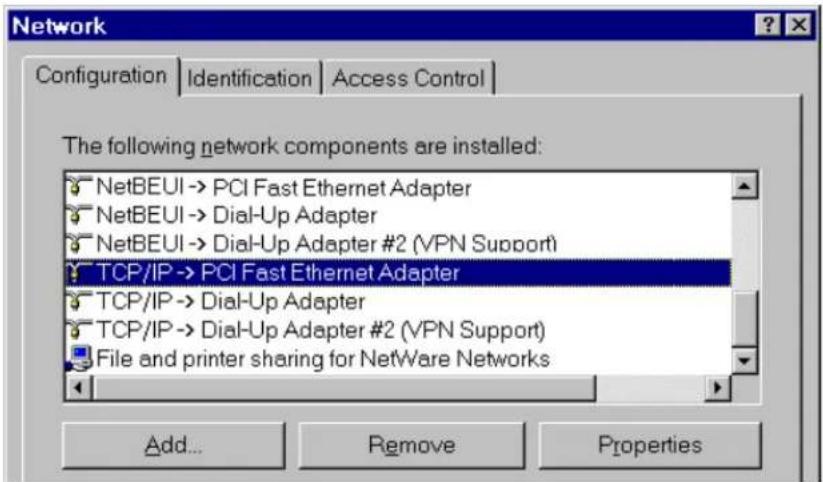
- Select the Settings - Control Panel - Network option on the Start Menu. You should see a screen like the one following:
text_image
Network Configuration | Identification | Access Control | The following network components are installed: NetBEUI -> PCI Fast Ethernet Adapter NetBEUI -> Dial-Up Adapter NetBEUI -> Dial-Up Adapter #2 (VPN Support) TCP/IP -> PCI Fast Ethernet Adapter TCP/IP -> Dial-Up Adapter TCP/IP -> Dial-Up Adapter #2 (VPN Support) File and printer sharing for NetWare Networks Add... Remove PropertiesFigure 1: Network Configuration
- The top line in the list (NetBEUI -> PCI Fast Ethernet Adapter) indicates that the NetBEUI protocol is installed on this PC. Your PC will show the name of the your Network card rather than "PCI Fast Ethernet Adapter".
-
The highlighted line (TCP/IP -> PCI Fast Ethernet Adapter) indicates that TCP/IP is installed. Your PC will show the name of the your Network card rather than "PCI Fast Ethernet Adapter".
-
If neither line is present:
• Install the NetBEUI protocol by selecting Add - Protocol - Microsoft - NetBEUI - OK. You may be prompted for your Windows CD-ROM.
- If required, you can also install TCP/IP. However, depending on your LAN environment, TCP/IP may require further configuration.
- If either protocol is already installed, proceed with installation.
Windows Peer-to-peer Print Driver
With this printing method, print jobs are stored (queued) on your PC, and then sent to the LevelOne Printer Server when it is available.
Setup
Before performing the following procedure, the LevelOne Printer Server must be installed on your LAN, and configured as described in Chapter 3. Both the LevelOne Printer Server and the attached printer should be powered ON.
- Insert the supplied CD-ROM into your drive. If the setup program does not start automatically, run SETUP in the root folder.
- Select the Installation icon, then choose the User option in the "Setup Type" screen. This will install the Peer-to-peer Print Driver.
- Follow the prompts to complete the installation. (Refer to the Windows section of Chapter 8 - Troubleshooting if there is a problem with the installation.)
- The Print Driver Setup will then run.
- The LAN will be searched for LevelOne Printer Servers, and a screen like the following will be displayed.
• If desired, change the Workgroup name and click Refresh. - Select List all LevelOne Printer Servers to list all LevelOne Printer Servers, regardless of Workgroup.
- The name of the attached printer will be displayed if possible. If "No printer" is displayed, check that the printer is properly connected and powered on.
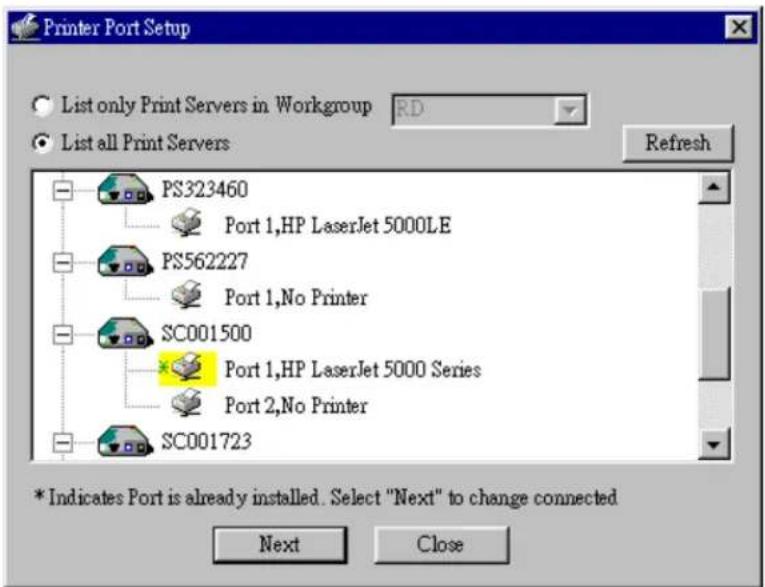
text_image
Printer Port Setup List only Print Servers in Workgroup R.D List all Print Servers Refresh PS323460 Port 1,HP LaserJet 5000LE PS562227 Port 1,No Printer SC001500 Port 1,HP LaserJet 5000 Series Port 2,No Printer SC001723 * Indicates Port is already installed. Select "Next" to change connected Next CloseFigure 2: Printer Port Setup (Peer-to-peer Print Driver)
If your LevelOne Printer Server is not listed:
- Select "List all LevelOne Printer Servers", and click the "Refresh" button.
- Check that both the LevelOne Printer Server and the printer are properly connected, and powered on.
- Check that the LevelOne Printer Server has been configured. (Use the Setup Wizard on the CD-ROM.)
-
If using TCP/IP, try installing the NetBEUI protocol. See the earlier section Checking your Network Protocols for details. Then uninstall and re-install the Peer-to-peer Print Driver.
-
Select the desired printer port, and then click the "Next" button. A pop-up message will inform you if the port has been created successfully.

If you see the following error message, either install Internet Explorer 4 or later, or follow the procedure in the "Trouble Shooting - Windows" section of Chapter 8.

text_image
Error Starting Program A required .DLL file, SETUPAPI.DLL, was not found. OK- Then a screen like the following will be displayed:
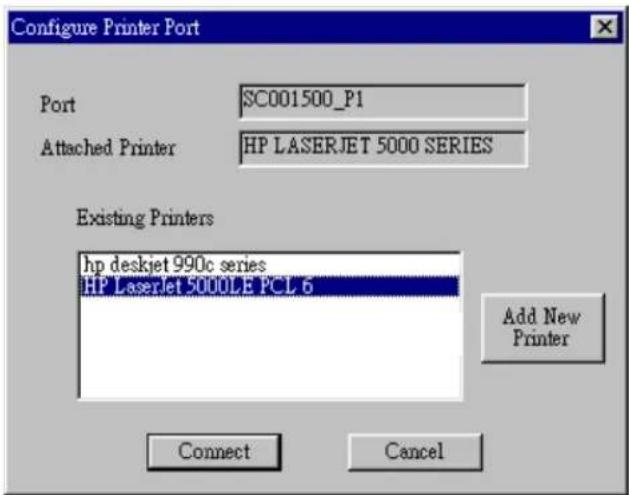
text_image
Configure Printer Port Port SC001500_P1 Attached Printer HP LASERJET 5000 SERIES Existing Printers hp deskjet 990c series HP LaserJet 5000LE PCL 6 Add New Printer Connect CancelFigure 3: Configure Printer Port
- Select the correct Windows printer in the Existing Printers list, and click the "Connect" button.
If the correct printer type is not listed, click "Add New Printer" to run the Windows Add Printer wizard. Step through the Wizard and install the required printer:
- Select the correct Printer Manufacturer and Model, or use the "Have Disk" option if appropriate.
• We recommend changing the Printer name to indicate which device is on. (e.g. HP2100 on SCA43600_P1)
• If prompted about Sharing the printer, do NOT enable Sharing
- When the Printer installation is finished, it will be listed in the Configure Printer Port screen above. Select it and click "Connect".
- You can now print using this printer.
• To install additional Printers, repeat steps 6 to 8.
- Use the Start menu to run this program in future. The default installation is Start - Programs - Printer Server Utility - Printer Server Setup.
Management
- Print jobs can be managed like any Windows printer. Open the Printers folder (Start - Settings - Printers) and double-click any printer to see the current print jobs.
- If the printer attached to the LevelOne Printer Server is changed, just run this program again, and select the correct printer.
• To delete a port created by this setup program, use the Windows Delete Port facility:
• Right-click any printer in the Printers folder, and select Properties.
- Locate the Delete Port button. This button is on the Details or Ports tab, depending on your version or Windows.
- If the LevelOne Printer Server's IP Address is changed, and you can no longer print, delete the port (see procedure above) and re-install it.
Port Options
The options for the Peer-to-peer Print Driver are accessed via the Port Settings button.
Use Start - Settings - Printers to open the Printers folder, then right-click the Printer, and select Properties. The Port Settings button is on the Details or Ports tab, depending on your version of Windows.
An example screen is shown below:

text_image
HP LaserJet 4 Plus Properties General Details Paper Graphics Fonts Device Options HP LaserJet 4 Plus Print to the following port: SC300014_P1 (PrintServer) Print using the following driver HP LaserJet 4 Plus Capture Printer Port... Timeout settings Not selected: 15 Transmission retry: 45 Configure PrintServer Port Device Name: SC300014 Browse Select Device Port >> Parallel 1 Port Name: SC300014_P1 Banner Enable Banner PostScript User Name: SPool Settings... Port Settings... OK Cancel Apply Retry Interval 50 (secs) Driver Version: NetBEUI 2.00 OK CancelFigure 4: Port Settings (Peer-to-peer Driver)
Items shown on this screen are as follows:
| Port | If desired, clickBrowseto select a different LevelOne Printer Server. If the selected device has multiple ports, theSelect Device Portbutton can be used to select the port.ThePort Namecan not be changed after installation. This name is shown in the Printer's Properties. |
| Banner | Check this option to print a banner page before each print job.If using a PostScript Printer, check thePostScriptbox.TheUser Namewill be printed on the banner page. |
| Retry Interval | Sets how often Windows will poll the LevelOne Printer Server to establish a connection when the printer is busy. Increase this value if you get too many warning messages. |
Windows SMB Printing
This method requires no additional software to be installed, but the NetBEUI or TCP/IP protocol must be installed on your PC. Use the following procedure to install the LevelOne Printer Server's printer as a Windows SMB network printer:
- Double-click the Network Neighborhood icon on the desktop.
- On the View menu, select Details.
- Locate the desired LevelOne Printer Server, as shown below:
• If it is the same Workgroup as your PC, it will be listed on screen.
- If it is in a different workgroup, double-click Entire Network, then double-click the appropriate Workgroup to open it.

text_image
WORKGROUP File Edit View Go Favorites Help Address WORKGROUP Name Comment SC000034 Print Server P3F6N8Figure 5: Network Neighborhood
- Double-click the LevelOne Printer Server icon to view a Printer icon for each printer port. The "Comment" field may indicate what type of printer is connected to the port.
- To install a printer, right-click the desired printer icon, and choose "Install", as shown below. This will start the Add Printer wizard.

text_image
SC300014 File Edit View Go Favorites Help Address \\SC300014 Name Comment P1 HP 2100 PCL6 Open Install... Capture Printer Port... Create Shortcut PropertiesFigure 6: Install SMB Printer
-
Follow the prompts to complete the installation.
-
For information about the question "Do you print from MS-DOS programs?", see Printing from MS-DOS Programs below.
-
Select the Printer Manufacturer and Model to match the printer connected to this port on the LevelOne Printer Server, and complete the Wizard.
-
This printer will now appear in your Printers folder (Start - Settings - Printers) and can be used like any other printer. However, SMB printing is not suitable for large complex print jobs - you should use the Peer-to-peer Print Driver instead.
Printing from MS-DOS Programs
Windows can redirect print data from a parallel port on your PC (e.g. LPT1) to a network printer. This redirection is called "Capture Printer Port", and is useful for MS-DOS programs. The MS-DOS program is configured to use LPT1 (parallel port 1 on the PC), but Windows "captures" the print data and sends it to the network printer.
Capture settings can be set by:
- Saying "Yes" to the prompt "Do you print from MS-DOS programs?" when installing a Network Printer.
• OR, using the Capture Printer Port menu option shown in Figure 6 above.
This will result in a dialog like the following, where you can select the port on the PC to be captured. Normally, this will be LPT1 (parallel port 1 on the PC).
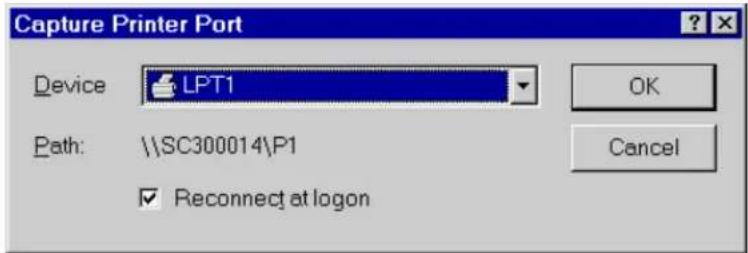
text_image
Capture Printer Port Device LPT1 Path: \\SC300014\P1 ✓ Reconnect at logon OK CancelFigure 7: Capture Printer Port
The File menu in the Printers folder also has options for Capture Printer Port and End Capture.
Windows with Server-based Print Queues
- Open your Printers folder, and start the Add Printer Wizard.
- When prompted, select Network Printer.
- When prompted for Network Path or Queue Name, click the Browse button, and locate the Server and Printer (or Print Queue) which your Network Administrator advised you to use.
- Click OK, then Next.
- Select the correct printer Manufacturer and Model, as advised by your Network Administrator, and click Next.
- Follow the prompts to complete the Wizard.
The new printer will be listed with any other installed printers, any may be selected when printing from any Windows application.
Windows using NDPS
Before using NetWare NDPS (NetWare Distributed Printing Service), one or more NDPS Printer Agents must be created on the NetWare Server. See Appendix B for details of this procedure.
Also, on your workstation, ensure that:
• Novell IntranetWare Client v2.2 (or later) is installed on your PC.
• You have access to the Novell Printer Manager utility (e.g. Nwpmw32.exe).
Procedure
- Start the Novell Printer Manager utility.
- Select Printer - New from the menu, then click Add.
- Select the required printer and click Install, then Close.

text_image
NDPS Manager:SerMGR Printer Agent List Name: SerPrinter Status: Idle New... Delete... Refresh Identification Access Control Printer Agent ListFigure 8: NDPS Manager - Client
- The printer (e.g. SerPrinter in the example above) appears in the main Printer Manager window in the Name list, and is available for print jobs. Printer drivers are automatically downloaded from the server as required.
- The printer will appear in your Windows printer list, and may be used from by any Windows application.
Macintosh (AppleTalk)
The LevelOne Printer Server supports AppleTalk (EtherTalk), PAP, ATP, NBP, ZIP and DDP protocols, enabling Macintosh computers on the network to view and use the LevelOne Printer Server as a regular AppleTalk printer.
Normally, no configuration is required. For advanced users, the PSTool program has been provided specifically for the Macintosh environment.
Software Requirements
System 7.x OS or newer.
AppleTalk Setup
- Click the apple icon and choose Control Panel.
- Click Network.
- Ensure that EtherTalk is selected under AppleTalk Connection.
- Click Chooser. The Chooser panel will open.
- Click on either the LaserWriter 8 icon (recommended) or the LaserWriter 7 icon. LaserWriter 8 makes use of the fonts installed in the printer itself, so the printing response time is quicker. LaserWriter 7 uses the fonts installed in the computer, which increases network traffic and takes more printing time.
- Select a LevelOne Printer Server from the printer list by clicking on the appropriate name. The LevelOne Printer Server's name is recorded on a label on the bottom of the LevelOne Printer Server as "Server Name". This name consists of 8 digits and/or numbers.
- Click on the Close box. Configuration is now complete.
Printing
Printing with the LevelOne Printer Server installed in an AppleTalk network is identical to normal printing. Just select File - Print and choose the desired printer.
Advanced Setup and Management
In a mixed Windows PC/Macintosh environment, you can use BiAdmin to configure the LevelOne Printer Server. See Chapter 5 for details on installing and using BiAdmin.
On the Mac, you can use SimpleText to edit the LevelOne Printer Server's CONFIG file and the supplied PSTool program to send it to the LevelOne Printer Server. The procedure is as follows:
- Copy the following files from the Utility\Apple folder on the CD-ROM to an appropriate folder on your hard disk.
PSTool
CONFIG.xxx
Select the appropriate CONFIG file for your model as follows:
config.1p Single parallel port models
config2p
Dual parallel port models
config.2p1s
Two parallel ports, 1 serial port model
config.3p Models with 3 parallel ports
- Use Chooser to select the desired LevelOne Printer Server.
- Double click the CONFIG file, and edit it. The appropriate values for each line are described in the following section. The file should look like the example below, but may vary depending on your model.
Begin CMD
0001 Device Name: xxxxxxxxx
3000 Apple Zone : *
3001 Printer Type (P1): LaserWriter
3002 Printer Type (P2) LaserWriter
3003 Printer Type (SP): LaserWriter
3004 Printer Type (P3) LaserWriter
3101 AP_PCOMM1: No
3102 AP_PCOMM2: No
3103 AP_PCOMM3: No
3104 AP_PCOMM4: No
Serial Port Configuration
0030 Baud Rate: 9600
0031 Stop Bits: 1
0032 Parity: None
0033 Data Bits: 8
0034 Handshake: HARDWARE
9002

Do NOT modify the following lines:
beginCMD
9002:
- Save the file.
- Double click the icon for PSTool.
- Click the Printer submenu and choose Download Postscript File. A panel will appear with a list of files.
- Click the CONFIG file. Then click Download.
AppleTalk Settings
When editing the CONFIG file, only the parameter should be changed. The parameter is the last part of the line, after the colon (:) Ensure that you use only valid parameters.
| 0001 Device Name | The Device Name will initially be the Default Server Name. The Default Server Name is shown on a sticker on the base of the device. The Device Name can be changed, but the new name MUST NOT exceed 19 characters in length. |
| 3000 Apple Zone | The default value "*" allows all AppleTalk zones to access the LevelOne Printer Server's printers. To restrict access to a particular zone, enter the zone name here |
| Printer Type | These are text fields, used to describe the printer driver used for each port. P1, P2, P3 refer to the parallel ports, while SP refers to the Serial Port The name can be up to 19 characters long. |
| AP_PCOMMn Values for n | These settings determine whether the port uses ASCII or Binary Communication Protocol. Enter NO for ASCII or YES for Binary.·Binary communication is twice as fast as ASCII. |
| 1 = parallel port 12 = parallel port 23 = serial port4 = parallel port 3 | ASCII communication is more reliable.The computer, LevelOne Printer Server and printer MUST all be configured to use the SAME protocol. Check your printer manual for details of printer configuration, and use the Print menu to configure your computer, so that they use the same settings as the LevelOne Printer Server. |
Chapter 5
BiAdmin Management Utility

This chapter describes the installation and operation of the BiAdmin Configuration & Management program.
Requirements
This program requires:
• Windows 95, Windows 98 or ME
• Windows NT 3.51, Windows NT 4.0, Windows 2000 or XP
Additional Recommendations:
• Screen resolution of 800 * 600 or greater.
- If using Novell NetWare, installation of Novell's Client 32 for Windows is strongly recommended. This will greatly enhance the ability to BiAdmin to work with NetWare servers.
Installation
Use the supplied CD-ROM. This CD-ROM will usually auto-run. If auto-run is disabled on your PC, run the SETUP program in the root folder.
• BiAdmin is always installed if the Administrator option is chosen.
• If using the Custom option on the CD-ROM, select BiAdmin Management Utility.
Operation
• Start the program by using the icon created by the setup program.
- When run, the program searches the network for all active LevelOne Printer Servers, then lists them on screen, as shown by the example screen below.
Main Screen
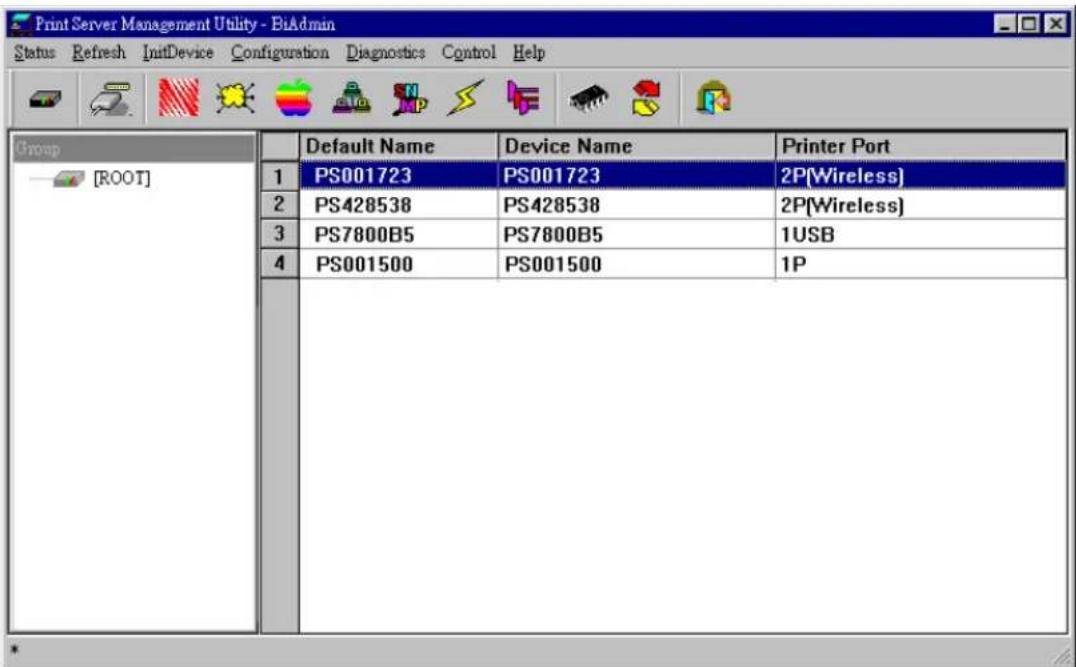
text_image
Print Server Management Utility - BiAdmin Status Refresh InitDevice Configuration Diagnostics Control Help Group [ROOT] Default Name Device Name Printer Port 1 PS001723 PS001723 2P(Wireless) 2 PS428538 PS428538 2P(Wireless) 3 PS7800B5 PS7800B5 1USB 4 PS001500 PS001500 1P *Figure 9: BiAdmin Main Screen
Groups
On the left side of the screen is a column for Groups. Each LevelOne Printer Server may be placed in a group, using the Configuration-System Configuration-Groups menu option.
- If a group is selected, only LevelOne Printer Servers in that group will be listed on the right side of the screen.
- By default, all LevelOne Printer Servers will appear in the [ROOT] group.
- A LevelOne Printer Server can only be a member of one (1) group, and will always be a member of a group.
- Use the Configuration-System Configuration-Groups menu option to select a group for the current LevelOne Printer Server.
- To create a new Group and add the current LevelOne Printer Server to it, just enter a group name in the dialog. (See example screen below)
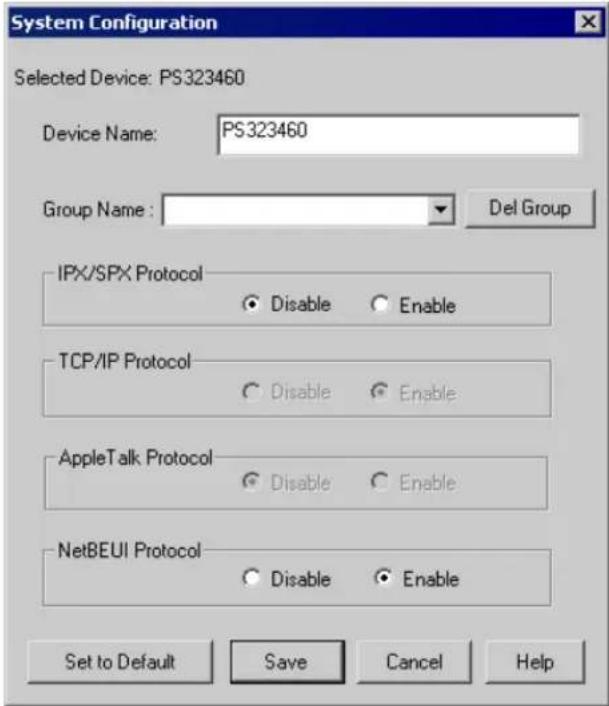
text_image
System Configuration Selected Device: PS323460 Device Name: PS323460 Group Name: Del Group IPX/SPX Protocol Disable Enable TCP/IP Protocol Disable Enable AppleTalk Protocol Disable Enable NetBEUI Protocol Disable Enable Set to Default Save Cancel HelpFigure 10: System Configuration - Groups
Device List
On the right side of the screen is a list of all LevelOne Printer Servers found on the network. For each device, the following data is shown:
- Default Name. The Default Server Name is shown on a sticker on the base of the device.
- Device Name. If you have not changed the name, this will be the same as the Default Server Name.
• Printer Port. The number and type of ports is shown in the right column.
If the desired LevelOne Printer Server is not listed, try the following:
- Check that the device is installed and ON, then Refresh the list.
- Use the InitDevice - Find menu option to search for the LevelOne Printer Server. You need to know the Default Name of the LevelOne Printer Server. The Default Server Name is shown on a sticker on the base of the device.
- If the LevelOne Printer Server is on another LAN segment, use the InitDevice - Attach Remote menu option to locate and display the LevelOne Printer Server.
- For networks using ONLY TCP/IP, LevelOne Printer Servers without an IP Address will not appear. Use the InitDevice - Set IP Address menu option to assign an IP Address, then Refresh the list. You need to know the Default Name of the unlisted device in order to assign an IP Address. The Default Server Name is shown on a sticker on the base of the device.
Status Icons
Once a LevelOne Printer Server has been selected, the Icons become active.

The icons provide status information as well as access to the selected LevelOne Printer Server settings. If an icon is grayed out, that option or protocol is unavailable.

Device Information
Menu equivalent: Status - Backup/Restore Device Information
All of the settings for the current device are displayed in a read-only scrollable list in the left panel.
You can use the "Save to File" and "Restore to Device" buttons on this screen to save a copy of the selected device's CONFIG file to your PC, or restore a previously saved file to the selected LevelOne Printer Server.

Port Status
Menu equivalent: Status - Port Status
After selecting this icon, a Detail button will be available to show more information about the printer.
Configuration Icons
The following icons are available. Refer to the on-line help for details of the data on each screen.

NetWare
Menu equivalent: Configuration - NetWare
BiAdmin supports configuration of both the LevelOne Printer Server and Novell NetWare servers.
- You need to be logged into the NetWare server(s) with ADMIN rights.
- The screens you will see, and the operations which can be performed, depend on whether or not you have Novell NetWare Client 32 installed.
- If Novell NetWare Client 32 is installed on your PC, BiAdmin allows you to configure both the LevelOne Printer Server and the NetWare server from within BiAdmin.
- If this Novell NetWare Client 32 is NOT installed, you can configure only the LevelOne Printer Server itself, not the NetWare server.
- The NetWare Manual (in the Manual\NetWare folder on the CD-ROM) contains detailed information on using BiAdmin with NetWare Servers.

TCP/IP Configuration
Menu equivalent: Configuration - TCP/IP
Selecting this icon will allow configuration for TCP/IP. Some models may have checkboxes for DHCP, Bootp, and Rarp. Some models may also display the setup data for the proprietary "Internet Printing" feature (printing via E-Mail).

AppleTalk Configuration
Menu equivalent: Configuration - AppleTalk
Generally, no LevelOne Printer Server configuration is required in order to use AppleTalk.

NetBEUI Configuration
Menu equivalent: Configuration - NetBEUI

SNMP Configuration
Menu equivalent: Configuration - SNMP
Configuration is only required if using Simple Network Management Protocol. See Chapter 7 for details.

Wireless Configuration
This Icon will be active if the selected device has the capability to serve as a Wireless Station for your LAN. See Wireless Configuration in Chapter 7 - Special Features for details.

Logical Port Configuration
Menu equivalent: Configuration - Logical Port
Logical port (printers) can be used in the NetWare and Unix environments.
Other Icons

Upgrade
Menu Equivalent: InitDevice - Upgrade
This option allows you to upgrade the firmware for the selected LevelOne Printer Server. Before using this option, you need to obtain the .BIN file for the firmware upgrade, and copy it to the same directory as BiAdmin.

Refresh
Menu Equivalent: None
Select this icon to update the LevelOne Printer Server device listing after changing the name or IP Address.

Exit
Menu Equivalent: Help - Exit
Exit the BiAdmin program. This does not save any changes you have made; you must Save to Device on each screen.
Menu Options
Status Menu
Device Info
Same as Device button.
Display all the configuration and status information about the selected LevelOne Printer Server. The data is presented in a scrolling, read-only window.
Port
Same as Port Status buttons.
| Attach Remote | This is used to connect to a LevelOne Printer Server device on another LAN segment. If your LAN does not have a Router, ignore this option. |
| Connected Protocol | This option allows you to designate which LAN protocol will be used for communication between the selected device and this application. You should select ONE protocol only. |
| Find | Use this option to use the IPX/SPX protocol to locate a LevelOne Printer Server on the LAN. Simply enter the Default Name of the LevelOne Printer Server you wish to locate. The Default Server Name is shown on a sticker on the base of the device. |
| Reset Device | This will cause the device to reboot. This should be done after making any configuration changes, or if the device stops responding after some problems. |
| Restore Factory Default | This will restore ALL device values to their factory defaults. To restore only the current screen, use the Set to Default button on the screen. |
| Set IP Address | For TCP/IP networks only:If a LevelOne Printer Server does not appear on the main screen, use this option to set a Device IP Address, Gateway IP Address, and Network Mask to the LevelOne Printer Server.This should only be necessary if your LAN is using ONLY the TCP/IP protocol. In other cases, BiAdmin will use IPX/SPX to locate the LevelOne Printer Server even if it doesn't have a valid IP Address.To locate the LevelOne Printer Server, enter the Default Name. The Default Server Name is shown on a sticker on the base of the device.Enter the required IP Address, Network Mask, and Gateway IP Address.After saving the data to the device, refresh the listing. The LevelOne Printer Server should then appear in the device list on the main screen. |
| Upgrade | Upgrade the firmware in a LevelOne Printer Server. See Upgrade Icon for details. |
Configuration Menu
The System option allows you to:
• Change the name of the selected LevelOne Printer Server.
- Change the "Group" for the selected LevelOne Printer Server.
- Set the Network Protocols used the selected LevelOne Printer Server. (Any protocols not used on your LAN may be disabled. This may improve performance.)
The Configuration Menu also contains selections for each of the following. These have the same effect as the corresponding Icon:
- NetWare
- TCP/IP
- AppleTalk
- NetBEUI
- Logical Port
- SNMP
- Wireless
Diagnostics menu
Print Test Page
Use this option to print a test sheet from the selected LevelOne Printer Server port. The test print out will include status information.
Control Menu
Abort Mail Print Job
This menu option refers to print jobs which has been received through the proprietary "Internet Printing" feature (printing via E-Mail). This menu option can be used to terminate a print job which is not printing correctly.

Some models support the IPP (Internet Printing Protocol) standard. The "Abort Mail Print Job" menu option does NOT cancel IPP print jobs.
Overview
100BaseT LevelOne Printer Server models incorporate the HTTP server. This allows you to connect to the LevelOne Printer Server and configure it using your Web Browser. Most browsers should work, provided they support tables and forms.
Preparation
Because it supports dynamic IP Address allocation using DHCP, BOOTP, or RARP, the LevelOne Printer Server ships with an IP Address of 0.0.0.0. This is NOT a valid IP Address.
Therefore, you must do ONE of the following:
- Check your DHCP server (if you have one), and determine the IP Address allocated to the LevelOne Printer Server.
- Use the Diagnostic Button (if fitted) to print a to print a report which includes the current IP address. (Press the Diagnostic Button, and hold it for 2 seconds.)
- Use the Setup Wizard, BiAdmin or another LevelOne Printer Server utility to allocate a valid IP Address to the LevelOne Printer Server.
- Add an entry to the arp table to associate the hardware address of the LevelOne Printer Server with the desired IP address, as follows:
arp -s IP_Address 00:c0:02:xx:xx:xx (Unix)
arp -s IP_Address 00-c0-02-xx-xx-xx (Windows)
Where:
IP_Address is the IP Address you wish to assign to the LevelOne Printer Server. 00:c0:02:xx:xx:xx is the hardware address of the LevelOne Printer Server.
Example (Unix):
arp -s 192.168.0.21 00:c0:02:12:34:56
Example (Windows):
arp -s 192.168.0.21 00-c0-02-12-34-56
Note: The hardware address of the LevelOne Printer Server is shown on a sticker on the base of the device.
Connecting to the LevelOne Printer Server
- Start your Web Browser.
- In the Address box, enter HTTP://followed by the IP Address of the LevelOne Printer Server.
e.g.
http://192.168.0.21
- You will then be prompted for the password. If no password has been set, just press ENTER.
- Use the menu bar on the top of the screen to move about. Remember to save each screen before changing to a different screen.
Configuration Screens
AppleTalk
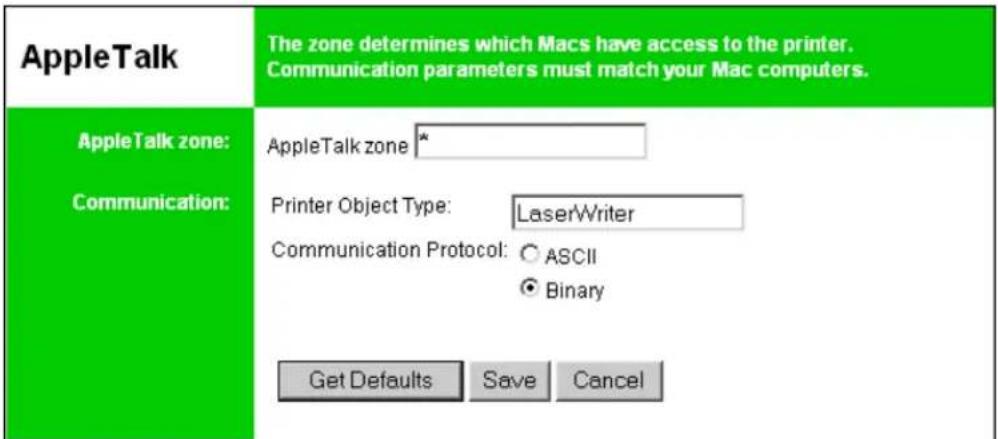
text_image
AppleTalk The zone determines which Macs have access to the printer. Communication parameters must match your Mac computers. AppleTalk zone: AppleTalk zone * Communication: Printer Object Type: LaserWriter Communication Protocol: ASCII Binary Get Defaults Save CancelFigure 11: AppleTalk Screen
| AppleTalk zone | This determines which Apple systems can gain access to this printer. |
| Printer Object Type | These are text fields, used to describe the printer driver used for each port. The LevelOne Printer Server is designed to work with LaserWriter (or 100% compatible) printers. |
| Communication Protocol | Sets whether the port uses ASCII or Binary Communication Protocol.. The default is Binary. |
NetBEUI
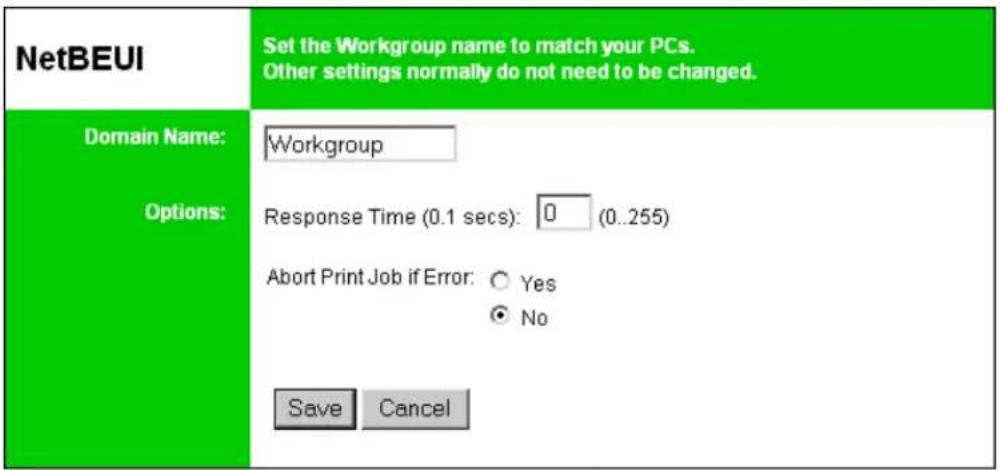
text_image
NetBEUI Set the Workgroup name to match your PCs. Other settings normally do not need to be changed. Domain Name: Workgroup Options: Response Time (0.1 secs): 0 (0..255) Abort Print Job if Error: ○ Yes ○ No Save CancelFigure 12: NetBEUI Screen
| Domain Name | Enter the designated work group to be serviced by the LevelOne Printer Server. This field is not case sensitive, so names with different case will be considered to be the same name. |
| Response Time | Set how fast jobs are sent to the printer. The default value of zero (0) delay should be increased only if your printer cannot cope with no delays. |
| Abort Print Job if Error | YES terminates a print job if a printing error occurs. NO (default) will try to continue but may cause print errors. If print errors occur, try setting this value to YES. |
NetWare
The NetWare screen will not be available WPS-0100 and WPS-0100USB.
| NetWare | Configure for use with NetWare Servers. Using Print Server mode is recommended. |
| General: | NetWare mode: ○ Print Server Mode ○ Remote Printer Mode Frame types: ✓ 802_2 ✓ 802_3 ✓ SNAP ✓ Ethernet II |
| Remote Printer Mode: | NetWare Printer Server for parallel port 1: |
| NetWare Printer Server for parallel port 2: | |
| Print Server Mode: | NDS Tree Name: FAST NDS Context: .TAIWAN.SERVER Master File Server: (Bindery Mode only) NetWare Password: Job Notification: ○ Originating Workstation only ● All log-ins Polling Queue Interval: 1 (1..255) |
| Save Cancel |
Figure 13: NetWare Screen
| General | |
| NetWare Mode | Select LevelOne Printer Server or Remote Printer, as appropriate. The default is LevelOne Printer Server. |
| Frame Type | Select the frame types used by your network. (Ethernet 802.2, Ethernet 802.3, Ethernet SNAP, and Ethernet II) By default, all frame types are enabled. |
| Remote Printer Mode | |
| Novell LevelOne Printer Server for P1 | NetWare LevelOne Printer Server to service the LevelOne Printer Server's parallel port 1. |
| Novell LevelOne Printer Server for P2 | NetWare LevelOne Printer Server to service the LevelOne Printer Server's parallel port 2 (P2), if fitted. |
| LevelOne Printer Server Mode | |
| NDS Tree Name (NDN mode only) | The File Server's NDS tree name. (root name) |
| LevelOne Printer Server NDS Context (NDS Mode only) | Path to the NDS Context. This does not include the Context itself, and each OU should be separated by a period. e.g. department.company |
| Master File Server (Bindery Mode only) | Name of the LevelOne Printer Server's master file server. |
| NetWare Password | The password on the NetWare Server. The LevelOne Printer Server device needs this password to connect to the NetWare server. |
| Job Notification | The options are:• Job notification at only the workstation where the print job originated.• Job notification at all workstations that you have logged into. |
| Polling Queue Interval | Defines how often the LevelOne Printer Server will poll the queues to be serviced. |
SNMP (Simple Network Management Protocol)
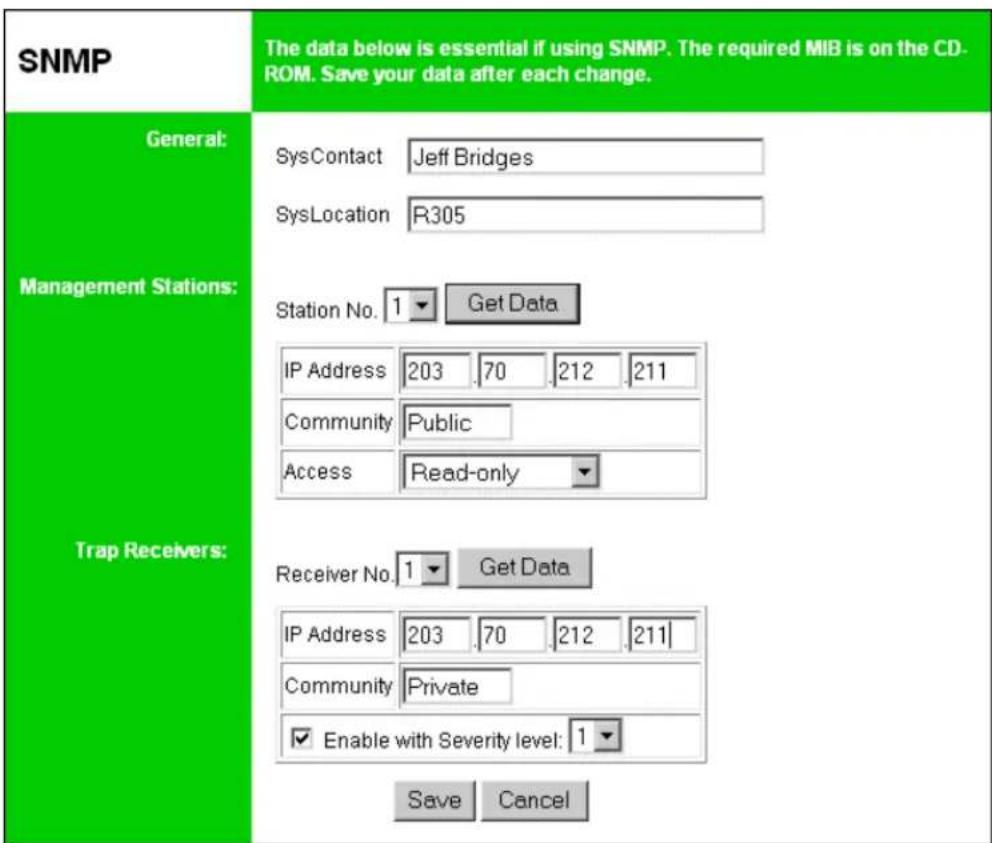
text_image
SNMP The data below is essential if using SNMP. The required MIB is on the CD-ROM. Save your data after each change. General: SysContact Jeff Bridges SysLocation R305 Management Stations: Station No. 1 Get Data IP Address 203 70 212 211 Community Public Access Read-only Trap Receivers: Receiver No. 1 Get Data IP Address 203 70 212 211 Community Private ✓ Enable with Severity level: 1 Save CancelFigure 14: SNMP Screen
| SysContact | Text Field - Name of the contact person. |
| SysLocation | Text Field - Location of the contact person. |
| Management Stations | |
| Station No. | Select the Management station (1..4), and click the Get Data button to update the display for the selected item. |
| IP Address | Enter the IP Address of the management station, which has the SNMP program installed. |
| Community | This is a text field. Enter the name of the community. |
| Access | Select the desired level of access. |
| Trap Receivers | |
| Receiver No. | Select the Trap Receiver number (1..4), and click the Get Data button to update the display for the selected item. |
| IP Address | Enter the IP Address of the Trap Receiver, which will be sent the Trap message. |
| Community | This is a text field. Enter the name of the community. |
| Enable | Check to enable; select the severity level.Note: Currently, all traps are level 1. |
TCP/IP
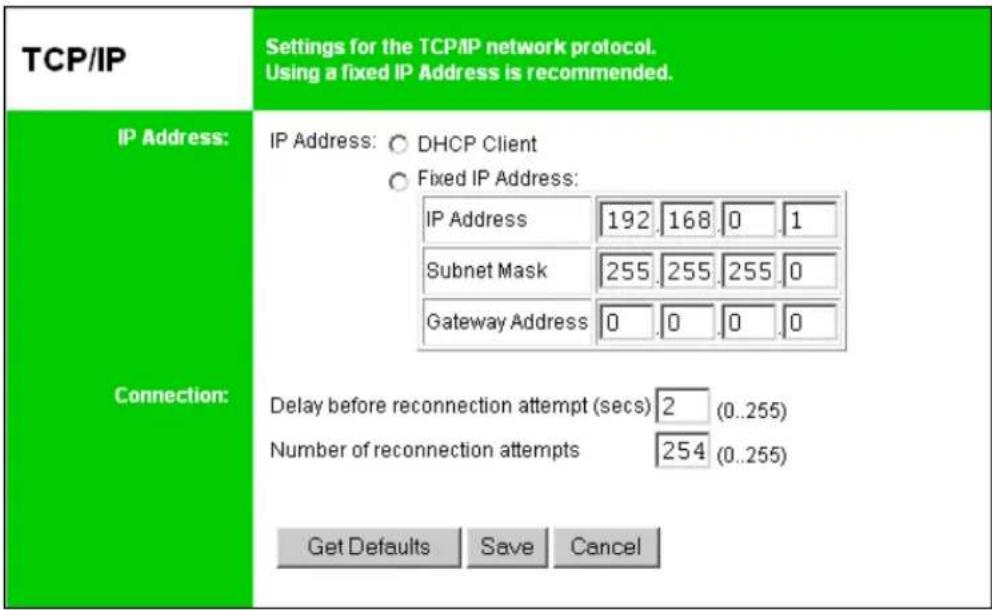
text_image
TCP/IP Settings for the TCP/IP network protocol. Using a fixed IP Address is recommended. IP Address: IP Address: ○ DHCP Client ○ Fixed IP Address: IP Address 192.168.0.1 Subnet Mask 255.255.255.0 Gateway Address 0.0.0.0 Connection: Delay before reconnection attempt (secs) 2 (0..255) Number of reconnection attempts 254 (0..255) Get Defaults Save CancelFigure 15: TCP/IP Screen
| IP Address | IP Address assigned to this device. If using dynamic IP Addresses (DHCP, BOOTP, rarp), this should be left at 0.0.0.0. |
| Subnet Mask (Network Mask) | If the Router (Gateway) Address is 0.0.0.0, the Subnet Mask should also be left at 0.0.0.0. If you have a router, enter the Subnet mask for the segment to which the LevelOne Printer Server is attached. |
| Gateway Address | If your network segment has a router or gateways, enter its IP Address here. Otherwise, leave the address as 0.0.0.0. |
| Connection | |
| Delay before reconnection attempts | Sets how long the LevelOne Printer Server should wait before retrying a TCP/IP connection which is lost. Allowable values are from 0 to 255 seconds, with 2 as the default. |
| Number of reconnection attempts | Set how many attempts at reconnection will be made. After that, the TCP/IP session will be terminated.Allowable values are from 0 to 255, with 254 as the default. |
Configure Server
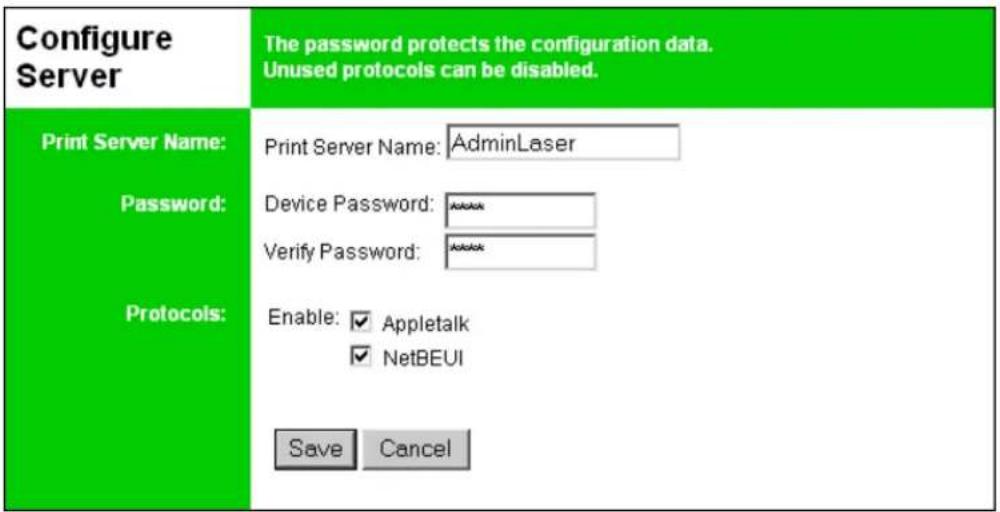
text_image
Configure Server The password protects the configuration data. Unused protocols can be disabled. Print Server Name: Print Server Name: AdminLaser Password: Device Password: Verify Password: Protocols: Enable: Appletalk NetBEUI Save CancelFigure 16: Configure Server Screen
| LevelOne Printer Server Name | Change the default name if you wish. The new name must not contain any spaces or blanks. |
| Password | Enter the device password, and again in the Verify field. Once a password is entered, it is required in order to gain access and change the configuration. |
| Enable Protocols | Non-TCP/IP protocols may be disabled if they are not required on your LAN. |
Wireless Configuration
On the WPS-0100 and WPS-0100USB, this Wireless screen will be available.
The settings on this screen must match the other Wireless stations in order for communication to occur.
| Wireless | SSID and WEP settings must match the Wireless stations using this Access Point. | |
| Configuration: | Regulatory Domain: USA Station Name: SC000014 SSID (Service Set Identifier) | |
| Channel No: 1 Network Type: Infrastructure Link Info | ||
| WEP Data Privacy: | ○ Off - no data encryption ○ 64 Bit Encryption using this key table Default Key 1 Key 1: Key 2: Key 3: Key 4: ○ 128 Bit Encryption using this key WEP Authentication: Open System Get Defaults Save Cancel | |
Figure 17: Wireless Screen
| Configuration | |
| Regulatory Domain | It is illegal to use this device in any location outside of the regulatory domain. |
| Station name | This is the same as theDevice (Host) Nameon the WAN screen. On your PC, some Wireless status screens may display this name as the Access Point in use. |
| SSID (ESSID) | To communicate, all Wireless stations MUST use the same SSID/ESSID.The default value isnull.Note! The SSID is case sensitive. |
| Channel No. | The default Channel for the USA and Canada is 3.Select the value you wish to use on your Wireless LAN. If you experience lost connections and/or slow data transfers you may need to experiment with different channels to see which is the best. |
| Network Type | Select the correct value for your Wireless LAN.802.11 Ad-hocmode is used when there is no Wireless Access Point, and each Wireless station communicates directly with other Wireless stations. This is the current standard.Ad-hocmode is used when there is no Wireless Access Point, and each Wireless station communicates directly with other Wireless stations. This is the older standard.Infrastructuremode is used when each Wireless station connects to the Wireless Access point. This also provides access to the wired LAN. |
| Link Info Button | Click this button will open the sub screen. |
| WEP Data Privacy | |
| Off | If OFF (default), data is NOT encrypted before being transmitted. |
| 64 Bit Encryption | If selected, data is encrypted, using the default key, before being transmitted.The receiving station must be set to 64 Bit Encryption, and have the same Key value in the same position in its key table. Otherwise, it will not be able to decrypt the data.Default KeySelect the key you wish to be the default. Transmitted data is ALWAYS encrypted using the Default Key; the other Keys are for decryption only.Key Table:This table is used when Encrypting and Decrypting data. All stations, including this Access Point, always transmit data encrypted using their default key. The key number (1, 2, 3, 4) is also transmitted. The receiving station will use the key number (1, 2, 3, 4) to determine which key value to use for decryption. If the key value does not match the transmitting station, decryption will fail.The easiest way to ensure there are no problems is to have every Station, including the Access Point, use the same key table (all entries identical). Then, it does not matter which key is used as the default key. |
| 128 Bit Encryption | If selected, data is encrypted using the key before being transmitted. The receiving station must be set to use 128 Bit Encryption, and have the same Key value. Otherwise, it will not be able to decrypt the data.KeyEnter the key value you wish to use. Other stations must have the same key |
| WEP Authentication | Options are "Open System" or "Shared Key".Some Wireless cards do not support both methods. Check your Wireless card's documentation to determine the correct value.Ensure that all Wireless stations use the same setting as the Access Point. |
Other Screens
Server Status
This screen shows server system data and the current settings for all of the other screens. It is read-only; no data can be input on this screen.
Printer Ports
This screen displays the current status of each port. For each port, the following data is listed:
- Connected Printer- the model name of the printer connected to the port, if the printer name is known. (If the printer is not bi-directional, this information is unavailable.)
- Status - the current status of the printer (On-line, Off-line, Out of paper)
- Printing Information - this will show either Idle or Printing.
Serial Port Configuration
If fitted, the Serial Port Screen can be accessed by clicking the Configuration button on the Printer Ports Screen.
If the default values do not work, check your serial printer to determine what settings should be used.
Logical Printers
Logical Printers (ports) can be used under Unix or NetWare. For each Logical Printer, the following fields are available:
| Logical Printer (Port) | Select the Logical Printer Port you wish to configure. (L1 to L3 or L1 to L8, depending on your model)Click the Get Data button to update the display with the current data for the selected logical printer. |
| Port | Select the Printer Port which the Logical printer will use. |
| Pre-string | The printer control string (in hex) to be sent to the printer before each print job. This string cannot exceed 15 characters. |
| Post String | The printer control string (in hex) to be sent to the printer after each print job. This string cannot exceed 15 characters. |
| Convert LF to CR+LF | If checked, LF (line feed) characters are changed to CR+LF (carriage return + line feed). |
Chapter 7
Special Features

This chapter covers the special features of the LevelOne Printer Server.
Overview
The LevelOne Printer Server has four (4) special features:
• Some LevelOne Printer Servers support IPP (Internet Printing Protocol).
• All model support the proprietary Internet Mail Printing system.
• SNMP (Simple Network Management Protocol) is supported by all models.
- Wireless Station - supported by WPS-0100 and WPS-0100USB only.
Internet Printing Protocol (IPP)
IPP (Internet Printing Protocol) is a new standards-based system to allow remote printing from a PC to any accessible printer. Normally, the printer will be attached to a computer or other device which functions as an IPP Server.
For client PCs, it is necessary to install a compatible IPP Client program. The Client must also know the IP Address or URL or the IPP Server.
IPP Server Configuration
The LevelOne Printer Server contains the necessary firmware to act as an IPP Server. No additional configuration is necessary. However, the following requirements must be met.
- The LevelOne Printer Server must have a valid IP Address. For printing via the Internet, the LevelOne Printer Server's IP Address must be external (allocated by your ISP), rather than an IP Address on your local LAN.
- Any Router, Gateway or Firewall linking your LAN to the Internet must NOT block the IPP protocol.
- You must advise clients of the correct URL or IP Address of the IPP Server. To use a URL rather than an IP Address, you need to register the domain name for the URL.
- Unless clients are using Windows 2000, you must provide your clients with the supplied IPP Client software. If it is not convenient to provide the CD-ROM, supply the IPP_CLIENT.EXE file, located in the IPP folder.
IPP Client Setup - Windows 95/98/ME/NT 4.0
The IPP Client Software can be installed on any of the following systems:
- Window 95/98/ME
- Windows NT 4.0
Installing from the CD-ROM
- Insert the CD-ROM in your drive. If the program does not start automatically, run the SETUP program in the top-level folder.
- Follow the prompts until you reach the Select Installation screen, and select IPP Client.
- At the next screen, select the Install IPP Client option.
- Click Next, and step though the remaining screens to complete the installation.
Installing using IPP\_CLIENT.EXE
- Run this program to unzip the included files.
- The IPP Setup program will then run.
- Follow the prompts to complete the installation.
IPP Client Configuration (Windows 95/98/ME/NT 4.0)
- Run the "Add IPP Port" program entry created by the installation. A screen like the following will be displayed.

text_image
Configure IPP Port IPP Server IP Address (Intranet) or URL (Internet): 172.31.2.24 Select Device Port >> Parallel 1 Port Name: IPP_172.31.2.24_P1 Proxy Server Access IPP Server via Proxy Server Proxy Address Port Number: Retry Interval 5 (secs) Retry count 50 (times) Driver Version: IPP 2.11 Save CloseFigure 18: IPP Port
- If Internet access from your location is via a Proxy Server, check Access IPP Server via Proxy Server, and enter details of your Proxy Server. (This will be the same as your Browser configuration.)
- Enter the IP Address or URL of the IPP Server.
-
Click Select Device Port to view the available ports on the IPP Server, and select the appropriate port. A connection to the IPP Server will be established at this time.
-
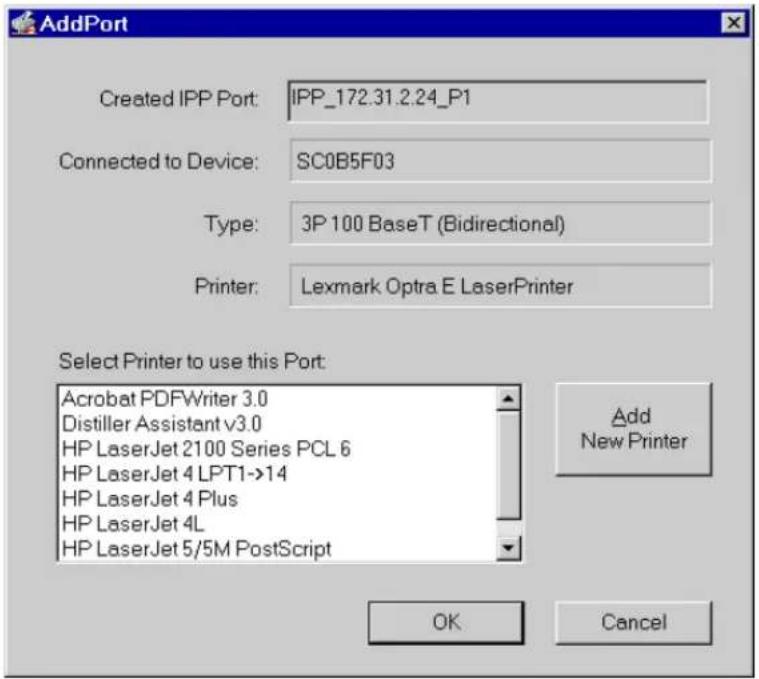
Click Save to create the IPP port on your system. You will see a message confirming that the port has been created, then the following dialog:
text_image
AddPort Created IPP Port: IPP_172.31.2.24_P1 Connected to Device: SC0B5F03 Type: 3P 100 BaseT (Bidirectional) Printer: Lexmark Optra E LaserPrinter Select Printer to use this Port: Acrobat PDFWriter 3.0 Distiller Assistant v3.0 HP LaserJet 2100 Series PCL 6 HP LaserJet 4 LPT1->14 HP LaserJet 4 Plus HP LaserJet 4L HP LaserJet 5/5M PostScript Add New Printer OK CancelFigure 19: Select Printer for IPP Port
- Either select an existing printer to use the new port, and click OK. OR
Click the Add New Printer button to create a new printer to use the IPP port. This will start the Add Printer wizard. Follow the prompts to complete the process. Ensure that the new printer uses the IPP port.
Installation is now complete.
• To create additional IPP Ports, repeat the entire procedure.
• The Proxy Server and other options are set individually for each IPP Port.
Changing the IPP Port Settings
After the IPP port is created, you can reach the screen shown in Figure 18: IPP Port using the Windows Port Settings button:
- Open the Printers folder (Start - Settings - Printers)
- Right-click the IPP Printer, and select Properties.
- Locate and click the Port Settings button (Details or Port tab, depending on your version of Windows).
There are 2 settings - Retry Interval and Retry Count - which can be adjusted if you have problems connecting to the IPP Server.
- Retry Interval sets the time interval (in seconds) between connection attempts. Increase this number if you have a poor connection, or the remote server is very busy.
- Retry Count sets how many connection attempts will be made. Increase this number if you have a poor connection, or the remote server is very busy.
IPP Client Setup - Windows 2000
Windows 2000 has its own IPP Client, and there is no need to install the supplied IPP Client Software. To use Windows 2000's IPP Client with the LevelOne Printer Server, follow this procedure:
- Start the Add Printer wizard.
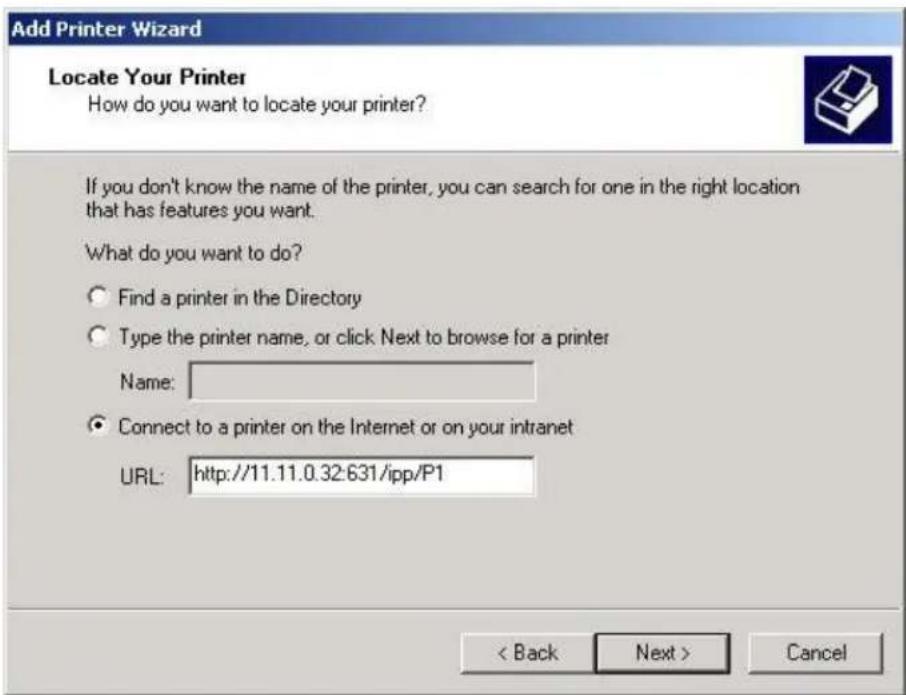
- Select Network Printer, and click "Next" to see the Locate your Printer screen, as shown below.
text_image
Add Printer Wizard Locate Your Printer How do you want to locate your printer? If you don't know the name of the printer, you can search for one in the right location that has features you want. What do you want to do? ○ Find a printer in the Directory ○ Type the printer name, or click Next to browse for a printer Name: ● Connect to a printer on the Internet or on your intranet URL: http://11.11.0.32:631/ipp/P1 < Back Next > CancelFigure 20: Windows 2000 - Locate your Printer
- Select Connect to a printer on the Internet or on your Intranet, and enter the URL of the IPP Server as follows, where ip_address represents the IP Address of the IPP Server, and 631 is the port number.
Parallel Port 1 ip_address:631/ipp/P1
Parallel Port 2 (if exists) ip_address:631/ipp/P2
Parallel Port 3 (if exists) ip_address:631/ipp/P3

These entries are case sensitive. They must be entered as shown, with "ipp" in lower case, and P1, P2 and P3 in UPPER case.
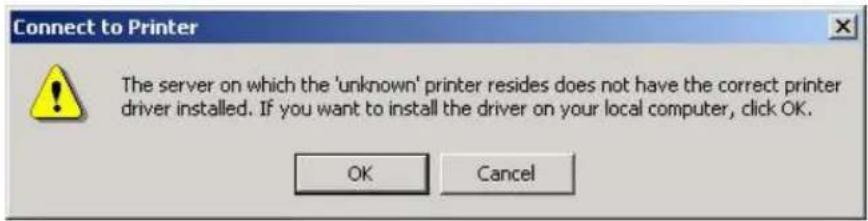
- If the connection can be established, and the printer on that port is on-line, the following dialog will be displayed.
text_image
Connect to Printer The server on which the 'unknown' printer resides does not have the correct printer driver installed. If you want to install the driver on your local computer, click OK. OK CancelFigure 21: Windows 2000: No printer driver
- Click "OK", and then select the printer manufacturer and model to match the printer connected to the port on the IPP Server.
- Click "Next", and complete the Wizard. The IPP printer is now ready for use.
Using IPP Printers
The IPP Printer can be selected and used like any other Windows printer. If the IPP Server is not on your network, your Internet connection needs to be active.
If you wish to check the availability of the remote IPP Server, you can use the Query IPP Printer program installed with Add IPP Port.
An IPP Server may be unavailable for any of the following reasons:
- It is powered off.
- A printer problem has caused the IPP Server to cease responding, and a restart (reboot) is required.
• The Server's IP Address has changed.
• The Internet connection for the IPP Server is down.
• Network congestion causes the connection attempt to time out.
If using the supplied IPP Client software, there are 2 settings - Retry Interval and Retry Count - which can be adjusted if you have problems connecting to the IPP Server.
See the previous section Changing the IPP Port Settings for details.
Internet Mail Printing
The Internet Mail Printing System allows users to print data to your printer across the Internet. Users send the Internet LevelOne Printer Server an E-Mail, with the print job normally sent as an attachment to the E-Mail. The LevelOne Printer Server will retrieve the E-Mail and print it.
System Requirements
Mail Server
- Accessibility. The Mail Server must be accessible by the intended clients or users. Normally, this means a permanent connection to the Internet.
- Protocols. The Mail Server must support the POP3 and SMTP protocols. The Internet Printing System uses these protocols and the most common E-Mail formatting standards:
• MIME (Multipurpose Internet Mail Extensions)
• Base64 Encoding (for mail attachments)
Internet LevelOne Printer Server
• TCIP/IP Protocol. The LAN must use the TCP/IP protocol.
- Mail Server Access. The LevelOne Printer Server must be able to access the Mail Server using a single IP address.
- Mail Account. The LevelOne Printer Server must have a Mail Account. Users print by sending an E-Mail to this mail account.
User (Client) Requirements
- Internet Connection. Either through a LAN, or dial-up.
- E-Mail address. This is used to notify the user that their print job has been done, or if there any problems.
- Printer Driver. Users must have a printer driver which matches the printer connected to the remote Internet LevelOne Printer Server.
- Print Capture Software. To print more than plain text, users require InterNet Printing Port software to capture the print job and convert it into an E-Mail attachment. The Internet Printing Port software is available for the following operating systems:
- Microsoft Windows 95
• Microsoft Windows NT 3.51 or later.
Internet Mail Printing Configuration
The LevelOne Printer Server must be configured with the data in the following table.
The supplied BiAdmin utility program, or the Web interface (on 100BaseT models) can be used to set the following entries on the TCP/IP screen.
| Mail Server IP Address | The IP Address of the E-Mail Server used by the LevelOne Printer Server. |
| Mail Account | The name of the E-Mail Account used by the LevelOne Printer Server. |
| Mail Account Password | Enter the password for the above Mail Account here. |
| Check Mail Interval | Sets how often to check for mail. Values range from 0 to 65,535 minutes, with 0 meaning a continuous connection and 1 as the default. |
| Print Banner | If YES (default), a banner page is printed to identify the owner of the print job. |
| Redirect Mail Account | Jobs which can not be printed will be sent to this account. If blank, unprintable jobs will be discarded. |
| Default Printer Number | Printer number for all Internet print jobs. Only one port can be selected. Users on the LAN can also use this port. |
| Print every E-Mail | If ON, then all E-Mail received is printed. Otherwise, only E-Mail from the InterNet Printing Port will be printed. |
| Activate Response Mail | If YES, all print jobs receive an E-Mail response. If NO, only users who set this option in their InterNet Printing Port software receive an E-Mail. |
| Printer Model ID String | This text field identifies the printer used for Internet printing. This value is sent to remote users upon request. |
User Software
The software provided for remote users (InterNet Printing Port) should be installed by everyone intending to use Internet printing. Otherwise, remote users can print correctly only if:
- They send an E-Mail directly to the LevelOne Printer Server Mail Account, using their normal E-Mail application.
• The E-Mail contains plain text only.
• The Internet LevelOne Printer Server is configured with Print every E-Mail ON.
Installation of the InterNet Printing Port software will create a new printer port. After attaching the correct printer to this port, users can print to the Internet Printer using any Windows application.
Installation - User Software
- Run the InterNet Printing Port installation program SETUP.EXE
- Default values for the installation are:
- Directory - C:\Program Files\Internet_Printer
• Start Menu folder - InterNet Printing Port Driver
- You will then see the Configure Port screen, as shown in the following screenshot.

text_image
InterNet Printing Port Driver Configuration (ver 1.0) Port Name : WAN Remote Printer E-mail address PrintServer@customer.com Your E-mail information Mail Server Name or IP Address pop3serv.mycompany.com Your Internet E-mail address (e.g. username@company.com) myname@mycompany.com Retry Interval: 30 Sec. Reply Notification E-mail OK Cancel HelpFigure 22 InterNet Printer Port
- The following data must be provided.
| Port Name | Enter a descriptive name (e.g. "WAN") for the new printer port. |
| Remote Printer E-mail Address | The E-Mail address for the Internet printer. Your print jobs will be sent to this E-Mail address. |
| Mail Server Name or IP Address | This is the name or IP Address of your Mail Server. If you are on a LAN, ask the LAN Administrator. If using a dial-up connection, use the data provided by your ISP. |
| Your Internet E-mail Address | The normal address that people use to send you E-mail. |
| Retry Interval (Seconds) | If unable to connect to the E-Mail server, retry after this time period (1 to 255 seconds, 30 is usually OK). |
| Reply Notification Mail | Check to receive an E-Mail when your print job has been processed. |
- On completion, a new printer port will have been created.
Using the new Port
The Windows Control Panel is used to connect the correct printer to the InterNet Printing Port. In Windows 95/NT, the procedure is:
- Select the Printer which matches the remote printer, then choose Properties, as shown in the example below.
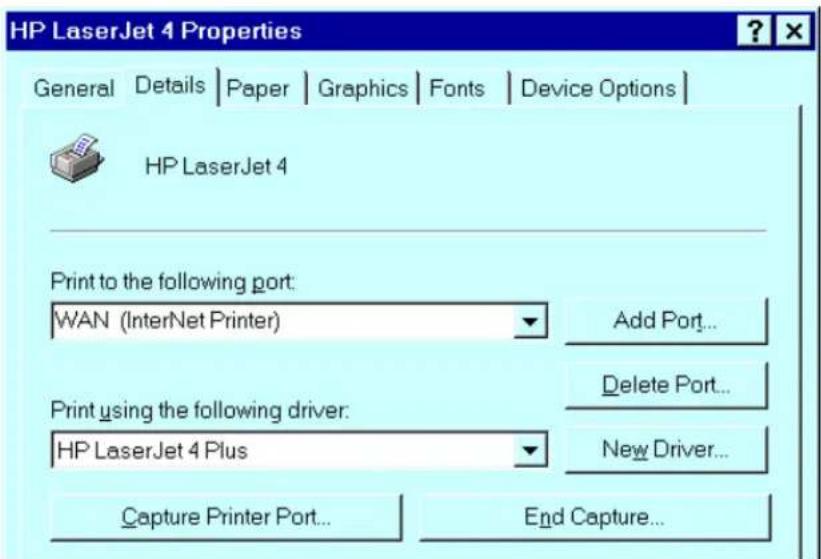
text_image
HP LaserJet 4 Properties General Details Paper Graphics Fonts Device Options | HP LaserJet 4 Print to the following port: WAN (InterNet Printer) Add Port... Print using the following driver: HP LaserJet 4 Plus New Driver... Capture Printer Port... End Capture...Figure 23 InterNet Printer Properties
-
Select the new port - WAN (InterNet Printer) in the example - as the port for this printer.
-
If you do not have the correct printer driver, or you wish to create another printer using an existing driver, use the Windows Add Printer facility.
• Using the Windows Port Settings or Configure Port facility will reveal the same Configure Port screen shown in Figure 22 InterNet Printer Port on page 51. - If you wish to print to multiple Internet Printers, use the Windows Add Port facility to add a new InterNet Printer port. Ensure that the correct data is entered in each port, and that each port has a unique name.
Checking the Printer Driver
To make sure that the correct printer driver for the remote printer is installed on your system, you can use the InterNet Printing Port to send an E-Mail to the Internet Printer. The procedure is as follows:
- Connect your default printer to the InterNet Printing Port.
- Check that "Reply Notification Mail" in the InterNet Printing Port is ON.
- From Notepad or another text editor, print a short message (e.g. "This is a test print") to the Internet Printer.
You will receive a reply E-Mail containing the "Printer ID" which will identify the printer attached to the LevelOne Printer Server. If this does not match the printer driver you are using, install the correct printer driver.
Printing through the Internet
- Create or open the document you wish to print.
- Select the Printer connected to the InterNet Printing Port.
-
If you do not have a permanent Internet connection, establish a connection now. (Note: The InterNet Printing Port will NOT establish a dial-up connection, but it will send the E-Mail the next time you are connected.)
-
Print the document.
-
The InterNet Printing Port will generate an E-Mail and send it to the remote printer. The document will be encoded and sent as an attachment to the E-Mail. You will see a progress screen similar to the example below:
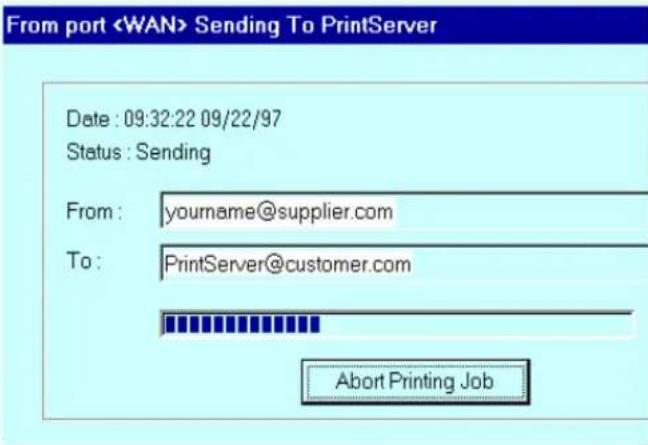
text_image
From portFigure 24 InterNet Printing Progress
- Close the Internet connection if you opened it in Step 3.
- If the "Notify after print job" option is set, you will receive an E-Mail when your job is printed.
Canceling a Print Job
Users cannot cancel a Print Job once it has been sent, but Print Jobs can be canceled at the LevelOne Printer Server. In BiAdmin, the Control - Abort Mail Print Job menu option can be used to cancel a print job which has already started printing.
SNMP
The LevelOne Printer Server supports SNMP (Simple Network Management Protocol). This allows network supervisors to monitor and control the LevelOne Printer Server using network management platforms such as HP OpenView, IBM SystemView, etc.
The appropriate MIB file must be imported into your SNMP management program using the Import-Compile command. Check your management program for details on this procedure. The MIB files are provided in the Mib folder on the CD-ROM, as follows:
Miblp.mib Single port models.
Mib2p.mib Models with 2 parallel ports
Mib2p1s.mib Two parallel ports, 1 serial port model.
Mib3p.mib Models with 3 parallel ports
Configuring the LevelOne Printer Server for SNMP
Before using a SNMP Management station to manage the LevelOne Printer Server, the following settings should be assigned to it, in addition to the IP Address, Gateway Address, and Subnet Mask.
SNMP Settings
| SysContact | Text Field - Name of the contact person. |
| SysLocation | Text Field - Location of the contact person. |
| Management StationIP Address(s) | Up to 4 Management Stations can be entered. |
| Trap ReceivingIP Address(s) | Up to 4 Trap Receiving Stations can be entered. |
Management Station Settings
| For each Management Station, the following fields are available: | |
| Access Permission | Options are:Read OnlyRead/WriteNot Accessible |
| Community String | Leaving this blank will disable management by this station. |
Trap Receiving Station Settings
For each Trap Receiving Station, the following fields are available:
| Community String | Leaving this blank will disable management by this station. |
| Trap Enable | Use this option to Enable/Disable Trap Receiving by this station. |
Trap Severity In this version, all traps are level 1.
Models WPS-0100 & WPS-0100USB
The WPS-0100 and WPS-0100USB are Wireless stations, NOT access points. Like all other Wireless stations, they have 3 modes:
- 802.11 Ad Hoc mode - no Access Point is used, Wireless stations communicate directly with each other. This is the current standard.
- Ad Hoc mode - no Access Point is used, Wireless stations communicate directly with each other. This is the older standard.

Of the two (2) Ad-hoc modes, "802.11 Ad Hoc" mode is recommended. If your Wireless LAN Card doesn't provide "802.11 Ad Hoc" mode, try "Ad Hoc" mode on the PC and "802.11 Ad Hoc" on the WPS-0100/7800. If this fails, select "Ad-hoc" mode on the LevelOne Printer Server.
- Infrastructure (Default) - all Wireless stations connect to the Access Point. This allows connection to both other Wireless stations and the wired LAN.

The WPS-0100 and WPS-0100USB do NOT allow both a LAN connection and "Infrastructure" mode. In "Infrastructure" mode, connecting a LAN cable will disable the Wireless interface. To use the LAN interface, "Ad-hoc" mode must be used.
Required configuration
| Ad-hoc Mode | Infrastructure Mode | |
| SSID Must match | the other Wireless stations,unless the SSID isnullor "any".If its SSID isnullor "any", a Wireless station can join any Ad-hoc group.But since the WPS-0100 and WPS-0100USB are fixed devices (rather than roaming), their SSID should not benullor "any".It's recommended to assign value to SSID for WPS-0100 and WPS-0100USB. | Must match the Access Point. |
| Channel Should | match the other Wireless stations.However, when joining an existing ad-hoc group, a Wireless station must use the Channel in use, rather than its own Channel.For a device like the WPS-0100 or WPS-0100USB0 in a fixed location, it is best to set them to the Channel providing the least interference and best performance. | Access Point sets the Channel used.Wireless stations automatically locate the correct channel. |
Two (2) methods are available to perform the required configuration:
• BiAdmin management utility program - see below for details.
• Web-based setup - see Chapter 6 for details.
BiAdmin Wireless Screen
Installation and use of the BiAdmin Windows utility is described in Chapter 5.
Clicking the Wireless icon, or selecting Configuration - Wireless on the menu, will display the following screen.

text_image
Wireless Configuration Regulatory Domain: Unknown Station Name: F2-71-00-00-00-00 SS ID (Service Set Identifier): Channel No: 11 Network Type: Infrastructure Encryption WEP Disabled Default Key: KEY 1 WEP Enabled WEP Keys 64 bits 128 bits Key1 Key2 Key3 Key4 WEP Authentication Open System Shared Key Link Info Set to Default Save to Device Cancel HelpFigure 25: Wireless Screen
| Regulatory Domain | It is illegal to use this device in any location outside of the regulatory domain. |
| Station Name | The name used to identify this Wireless station. |
| SSID | If using an ESS (Extended Service Set, with multiple access points) this ID is called an ESSID (Extended Service Set Identifier).To communicate, all Wireless stations MUST use the same SSID/ESSID. Change this value, or change the other Wireless stations, to ensure each Wireless station has the same value.The default value is "null", so the Wireless station can join any Ad-hoc group.Note! The SSID is case sensitive. |
| Channel No | To communicate in "802.11 Ad-hoc" or "Ad hoc" mode, all Wireless stations MUST use the same Channel number.If using "802.11 Ad-hoc" or "Ad-hoc" mode, select the value you wish to use on your Wireless LAN.If using "Infrastructure" mode, the Channel is selected automatically, to match the Channel used by the Access Point.If you experience interference (shown by lost connections and/or slow data transfers) you may need to experiment with different channels to see which is the best. |
| Network Type | Select the correct value for your Wireless LAN.802.11 Ad-hocmode is used when there is no Wireless Access Point, and each Wireless station communicates directly with other Wireless stations. This is the current standard.Ad-hocmode is used when there is no Wireless Access Point, and each Wireless station communicates directly with other Wireless stations. This is the older standard.Infrastructuremode is used when each Wireless station connects to the Wireless Access point. This also provides access to the wired LAN. |
| Encryption | |
| WEP Disabled/Enabled | If Disabled (default), data is NOT encrypted before being transmitted. If Enabled, you must provide either the 64 Bit key table or the 128 Bit keys, as described below. The key is used to encrypt the data before transmission. |
| 64 Bit | If selected, data is encrypted, using the default key, before being transmitted. The receiving station must be set to 64 Bit Encryption, and have the same Key value in the same position in its key table. Otherwise, it will not be able to decrypt the data.Default Key - select the key you wish to be the default. Transmitted data is ALWAYS encrypted using the Default Key; the other Keys are for decryption only.Key Table:This table is used when Encrypting and Decrypting data. All stations, including this Access Point, always transmit data encrypted using their default key. The key number (1, 2, 3, 4) is also transmitted. The receiving station will use the key number (1, 2, 3, 4) to determine which key value to use for decryption. If the key value does not match the transmitting station, decryption will fail.The easiest way to ensure there are no problems is to have every Station, including the Access Point, use the same key table (all entries identical). Then, it does not matter which key is used as the default key. |
| 128 Bit | If selected, data is encrypted using the key before being transmitted. The receiving station must be set to use 128 Bit Encryption, and have the same Key value. Otherwise, it will not be able to decrypt the data. |
| WEP Authentication | Options are "Open System" or "Shared Key".Some Wireless cards and Access Points do not support both methods. Check your documentation to determine the correct value to use. |
After clicking the "Link Info" button on the Wireless Screen, a screen like the example below will be shown.
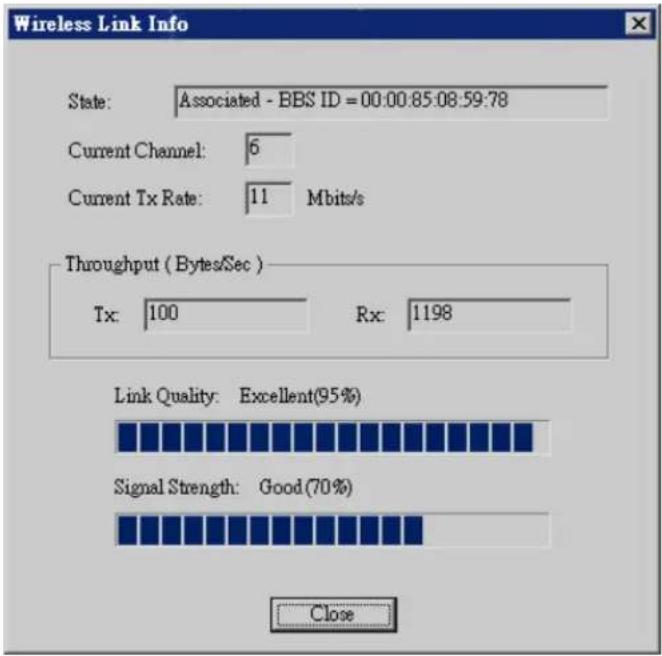
text_image
Wireless Link Info State: Associated - BBS ID =00:00:85:08:59:78 Current Channel: 6 Current Tx Rate: 11 Mbits/s Throughput (Bytes/Sec) Tx: 100 Rx: 1198 Link Quality: Excellent(95%) Signal Strength: Good(70%) CloseFigure 26: Link Info Screen
| State | This indicates which access point is currently in use. |
| Current Channel | The current channel which has been used. |
| Current TX Rate | The current transmitting speed. |
| Throughput (Tx) | This will show how much data has been transmitted per second. |
| Throughput (Rx) | This will show how much data has been received per second. |
| Link Quality | This indicates the quality of the Wireless connection |
| Signal Strength | This indicates the strength of the Wireless signal being received. |

The "Link Quality" and "Signal Strength" data is not available if using "Ad-hoc" or "802.11 Ad-hoc" mode.
Chapter 8
Troubleshooting

This chapter describes some problem situations, which may arise, and the solutions to them.
Overview
If you encounter printing difficulties, please refer to the appropriate section.
If, after following the advice in these documents, the LevelOne Printer Server still does not function properly, please contact your dealer for further advice.
Hardware & LAN Problems
| Problem No. 1 | All the LevelOne Printer Server's LEDs are off. |
| Solution No. 1 | Check the power supply or power connection. |
| Problem No. 2 | LevelOne Printer Server's status light continuously stays lit. |
| Solution No. 2 | Reset LevelOne Printer Server by unplugging the power supply and plugging it back in. |
| Problem No. 3 | LevelOne Printer Server's status light and power light stay on continuously and do not turn off. |
| Solution No. 3 | Reset the LevelOne Printer Server by unplugging the power supply or by pushing the reset push button, if fitted. |
| Problem No. 4 | The LevelOne Printer Server unit can not be found on the LAN, so configuration is not possible. |
| Solution No. 4 | If using 10/100BaseT:Check the Hub. The link LED for the port to which the LevelOne Printer Server is connected should be ON. If it is Off, there is a problem in the network cable.On the LevelOne Printer Server, check the LED(s) next to the connector. If the LED is not ON (or neither LED is On, if there are 2), the network connection is not working.Check the Ethernet cable and connectors. If they seem OK, set the DIP Switches of the LevelOne Printer Server to match your LAN environment.If using TCP/IP:Ensure that there are no routers between the LevelOne Printer Server and the PC used for configuration.Ensure that the PC used for configuration has the TCP/IP network protocol installed. Test its network connection by seeing if you can locate other LAN devices from the PC. (e.g. Use Network Neighborhood and try to browser the network.) |
| Problem No. 5 | I am using DHCP, and getting an IP Address conflict involving theLevelOne Printer Server. |
| Solution No. 5 | If the LevelOne Printer Server is left on, but the DHCP server is turned off, then the LevelOne Printer Server will retain its IP Address without the DHCP Server being aware of it. Simply reset the LevelOne Printer Server so it will obtain a new IP Address.This problem would also arise if you assigned static IP Address, which is within the range used by the DHCP server. If so, use another address which is NOT within the range used by the DHCP server. |
AppleTalk (Macintosh)
| Problem No. 1 Why do I get an incorrect printout? | |
| Solution No. 1 | Some possible reasons are:You may have chosen Binary encoding to print the file. Try to use ASCII encoding.Some of the fonts, which are in your print file may not be supported by the printer. Try selecting LaserWriter 7 instead of LaserWriter 8. |
| Problem No. 2 | Can't find the LevelOne Printer Server's name in the Chooser. |
| Solution No. 2 | Try the following:Make sure that AppleTalk is on (the button next to Active is highlighted in the Chooser).Make sure the printer has been on and in the READY state for a few minutes.Make sure the printer has not been renamed since its last appearance in the Chooser.If the printer resides on a network with multiple zones, make sure the correct zone is selected from the AppleTalk Zones box in the Chooser. |
| Problem No. 3 | My document didn't print to the right printer. |
| Solution No. 3 | Check the following:Another LevelOne Printer Server with the same name may have received your print job. Use the PSTOOL to reconfigure your LevelOne Printer Server name and ensure all LevelOne Printer Servers have unique names.Make sure your application output encode is set to ASCII. If not, change it to ASCII. |
| Problem No. 4 | My file doesn't print with the correct fonts. |
| Solution No. 4 | Try changing your printer driver to LaserWriter 7. |
| Problem No. 5 | My EPS file doesn't print with the correct fonts. |
| Solution No. 5 | This is a problem that occurs in some application programs. Try downloading the fonts contained in the EPS file before printing the saved EPS file. |
| Problem No. 6 | I can't select the "Remaining from:" item in the print dialog box. |
| Solution No. 6 | If you have selected the Layout value, "2 Up", or "4 Up", you cannot access the Remaining from item. Choose other selections. |
| Problem No. 7 | A cover page prints either on the first or the last page of the document. |
| Solution No. 7 | Select one of these solutions:Turn the cover page feature off.Insert extra page breaks in your document to avoid the cover page printing on the first or last page of your document.Install the Apple LaserWriter 7 driver. You are having trouble printing with the Apple LaserWriter 8 driver. |
| Problem No. 8 | Why do I have trouble printing with the LaserWriter 8? |
| Solution No. 8 | Your application software may not be compatible with the LaserWriter 8 driver or your system may not meet the requirements of the LaserWriter 8 driver. Use the Apple LaserWriter 7 driver instead. |
| Problem No. 9 | The colors on my printed output do not match the colors on my computer screen. |
| Solution No. 9 | When the printer receives a color file, it tries to match the printed output color to the screen color. Sometimes the printer cannot match up the colors as closely as wanted. To alleviate this problem, perform the following steps:Choose "Calibrated Color/Grayscale" in the Print pop-up menu in the Print Options dialog box. The printer will make adjustments to match the colors.Check your monitor to make sure all settings (for example, brightness) are adjusted correctly. |
| Problem No. 10 | When I send a print job, I get a PostScript Command error or no print out. |
| Solution No. 10 | Check the communication protocols. The computer, LevelOne Printer Server and printer must all be configured to the same communication protocol.(either Binary or ASCII).To configure your system:Choose which protocol you are going to use. You should check your printer; it may not give you a choice.Set your printer to the correct protocol.Use the computer's Print submenu to configure your computer to use the protocol you have chosen.Configure the LevelOne Printer Server to use the same protocol as the printer and computer. |
Novell NetWare
| Problem No. 1 | My LevelOne Printer Server cannot print the jobs sent to the print queue. |
| Solution No. 1 | Try the following:Check if the printer attached to the LevelOne Printer Server is on-line.Check if your LevelOne Printer Server is logged into the file server (See Problem 2 below.).Check the current status of the queues used by the LevelOne Printer Server, and ensure the queues are active.Check if the NetWare printer number is correct.0 = parallel port 1 of the LevelOne Printer Server.1 = parallel port 2 of the LevelOne Printer Server.2 = serial port or parallel port 3.Check to see if the LevelOne Printer Server is a static queue server to the queue.Locate the LevelOne Printer Server Object, and check the Queues Serviced by Printer. Ensure that the correct queues are on the list.The total number of queues to be serviced may be over the limit of 56. If so, reduce the number of queues. |
| Problem No. 2 | My LevelOne Printer Server is configured as a Novell LevelOne Printer Server, and cannot log in to a File Server. |
| Solution No. 2 The following steps may solve this problem:Check the Novell file server's name. If it is over 20 characters long, rename it using no more than 20 characters.Check that the LevelOne Printer Server's configuration data, especially the password, is correct.Check the NetWare server. If using Bindery mode, check the master file server to see if the login status of the LevelOne Printer Server is Ready. If it is not, check the error message and perform the required corrective action.If the LevelOne Printer Server is servicing more than one file server, check to see that all required file servers are in the list of "File Servers To Be Serviced". If not, insert the required file server name to the list. | |
Windows Printing Problems
| Problem No. 1 | When I tried to install the Printing software for Peer-to-Peer printing, I received an error message and the installation was aborted.. |
| Solution No. 1 | This may be caused by an existing installation of the printer port software. Before attempting another installation:Remove the existing installationRestart your PCTo remove an existing printer port installation:Open Start - Settings - Control Panel - Add/Remove ProgramsLook for an entry with a name like "Shared Port", "Shared Printer Port", "LevelOne Printer Server Driver" or " LevelOne Printer Server Port".Select this item, click "Add/Remove", and confirm the deletion. |
| Problem No. 2 | On Windows 95, I installed the Print Port Driver for Peer-to-Peer Printing, but when I selected a port on a LevelOne Printer Server and clicked "Add", the printer was not installed. |
| Solution No. 2 | Try installing the Printer using the standard Windows tools, as follows:Start the Add Printer Wizard.Select Network Printer when prompted "How is the printer attached to your Computer?", and click Next.When prompted for the Network Path or Queue, enter a dummy value such as shown below. (Do NOT select Yes for "Do you print for MS-DOS programs?") 4. The printer wizard will display a message stating that "The Network Printer is off-line". This is OK. Continue the Add Printer Wizard until finished.Go to the Printers folder (Control Panel-Printers). The printer icon will be grayed out indicating the printer is not ready.Right-click the Printer, and select Properties. Then select the Details 4. The printer wizard will display a message stating that "The Network Printer is off-line". This is OK. Continue the Add Printer Wizard until finished.Go to the Printers folder (Control Panel-Printers). The printer icon will be grayed out indicating the printer is not ready.Right-click the Printer, and select Properties. Then select the Details |
tab, as shown below.
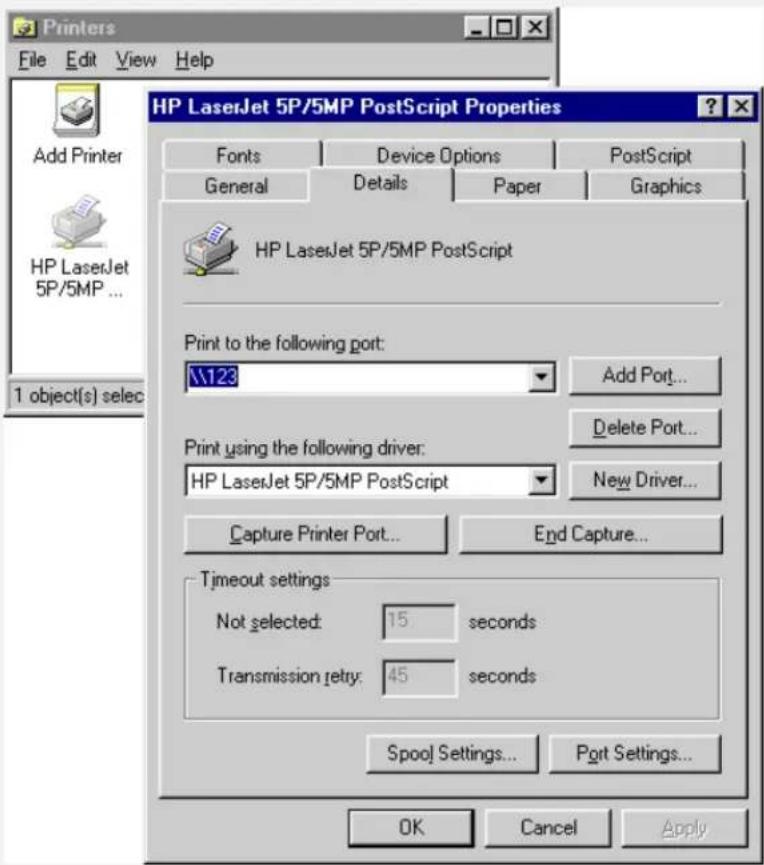
text_image
Printers File Edit View Help Add Printer HP LaserJet 5P/5MP ... 1 object(s) select HP LaserJet 5P/5MP PostScript Properties Fonts Device Options PostScript General Details Paper Graphics HP LaserJet 5P/5MP PostScript Print to the following port: \123 Add Port... Print using the following driver: HP LaserJet 5P/5MP PostScript New Driver... Capture Printer Port... End Capture... Timeout settings Not selected: 15 seconds Transmission retry: 45 seconds Spool Settings... Port Settings... OK Cancel Apply- Click the Add Port button. On the resulting screen, select Other, then LevelOne Printer Server, as the port to add, as shown below.
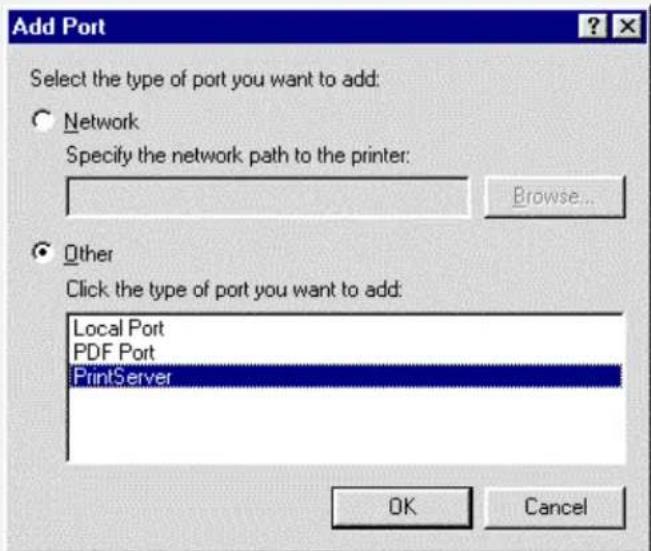
text_image
Add Port Select the type of port you want to add: ○ Network Specify the network path to the printer: Browse... ○ Other Click the type of port you want to add: Local Port PDF Port PrintServer OK Cancel- Click OK to see the Print Port Configuration screen, as shown below.

text_image
Configure PrintServer Port Device Name: SC300014 Browse Select Device Port >> Parallel 1 Port Name: SC300014_P1 Retry Interval 50 (secs) Driver Version: NetBEUI 2.00 Banner Enable Banner PostScript User Name: OK Cancel-
Click the Browse Device button, select the desired LevelOne Printer Server, and click OK.
-
Click OK to return to the Printers folders, and right-click on the Printer. Ensure that the Work off-line option is NOT checked.
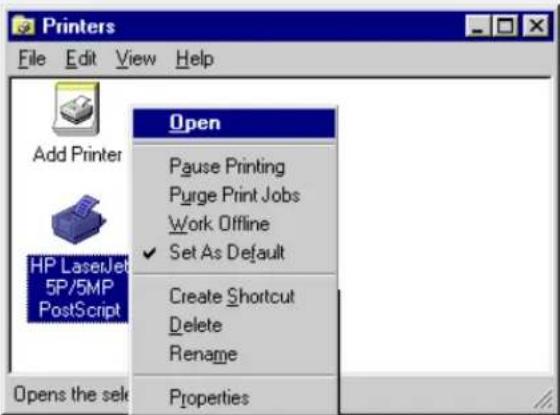
text_image
Printers File Edit View Help Add Printer HP LaserJet 5P/5MP PostScript Open Pause Printing Purge Print Jobs Work Offline ✓ Set As Default Create Shortcut Delete Rename PropertiesThe Printer should no longer be grayed out, and is ready for use.
| Problem No. 3 | I connected and configured a WPS (Windows Printing System) printer as described, but I can't get the print job to print. |
| Solution No. 3 | Printer drivers for WPS printers poll the printer before sending print data. Since the printer is networked, the printer is not found and no data is sent. The solution is to add your printer as a network printer as described in Solution 1 above.Note:The screens shown in Solution 1 are from Windows 95. Other versions of Windows may look slightly different, but the process is identical. If using Window NT or 2000, do NOT enable Sharing for the printer. |
| Problem No. 4 | When printing from some software applications such as Power Point, it takes a long time and the print out is incorrect. |
| Solution No. 4 | The problem is due to the printer, which is being configured to Start printing after the first page is spooled. To change this setting:Go to Control Panel - Printers and click on your printer.Then select File - Properties - Details.When the Details screen appears, click the Spool Settings button.When the Spool Settings dialogue box appears, choose Startprinting after last page is spooled and click OK. |
| Problem No. 5 | A printing device connected to the LevelOne Printer Server port cannot print or prints garbage. |
| Solution No. 5 | Check the following:• Cable connection between LevelOne Printer Server and printer.• Serial port configuration, if a serial device.• Printer driver in the application program or Windows matches the printer. |
| Problem No. 6 | The Configuration button on the Printer Status screen in BiAdmin is grayed out, even though my printer is bi-directional. |
| Solution No. 6 | The button is unavailable if the printer is busy. You must wait until the printer is idle. |
General Specifications
| WPS-0100 | |
| Power Consumption 3w max. | |
| External Power Adapter 12V DC | |
| LEDs 4 | |
| Parallel Port | 1 Centronic female DB-25 connector |
| Ethernet Connector 10/100BaseT | |
| FCC/CE Class B | |
| WPS-0100USB | |
| Power Consumption 3w max. | |
| External Power Adapter 12V DC | |
| LEDs 4 | |
| USB Port (1.1) 1 | |
| Ethernet Connector 10/100BaseT | |
| FCC/CE Class B | |
| Environmental Specifications (all Models) | |
| Operating Temperature 0 ~ 40°C | |
| Storage Temperature | -10 ~ 70°C |
| Shipping Temperature | -40 ~ 70°C |
| Operating Humidity 10 ~ 80% | |
| Storage Humidity 5 ~ 90% | |
| Shipping Humidity 5 ~ 100% | |
Parallel Port Pin Assignments
| Other Models | ||
| Pin | Signal Name | Direction |
| 1 | - Strobe | To printer |
| 2 | +Data 0 | To printer |
| 3 | +Data 1 | To printer |
| 4 | +Data 2 | To printer |
| 5 | +Data 3 | To printer |
| 6 | +Data 4 | To printer |
| 7 | +Data 5 | To printer |
| 8 | +Data 6 | To printer |
| 9 | +Data 7 | To printer |
| 10 | - ACK | To Server |
| 11 | + Busy | To Server |
| 12 | + Paper End | To Server |
| 13 | + Select | To Server |
| 14 | - Auto Feed | To printer |
| 15 | - Error | To Server |
| 16 | - Init | To printer |
| 17 | - Select In | To printer |
| 18-25 | GND | Ground |
Protocol Support
| Model | TCP/IP | NetBEUI | NetWare | AppleTalk | FTP/Telnet |
| WPS-0100 | v | v | v | ||
| WPS-0100USB | v | v | v |
Feature Support
| Model HTTP Setup | E-mail Printing | IPP | JetAdmin | SNMP |
| WPS-0100 | V | V | V | V |
| WPS-0100USB | V | V | V | V |
Models WPS-0100 and WPS-0100USB can also act as IEEE 802.11b Wireless Stations.
Appendix B
Network Server Configuration
Windows NT Server
Preparing for TCP/IP Printing
If using Windows NT 3.51 or Windows NT 4.0, Microsoft TCP/IP Printing Support must be installed.
• If it is already installed, proceed to Adding a TCP/IP Remote Printer.
• Otherwise, the procedure to install TCP/IP printing support is as follows.
Windows NT 3.51
- Start the Network option in Control Panel. When the Network Settings dialog box appears, click the Add Software button to display the Add Network Software dialog box.
- Select TCP/IP Protocol And Related Components in the Network Software list box, and then click the Continue button.
- In the Windows NT TCP/IP Installation Options dialog box, check the TCP/IP Network Printing Support option.
- Click the OK button. Windows NT Setup will display a message asking for the full path to the Windows NT distribution files. Provide the appropriate location and click the Continue button. All necessary files will be copied to your hard disk.
- If you did not check the Enable Automatic DHCP Configuration option in the Windows NT TCP/IP Installation Options dialog box, you must complete all the required TCP/IP configuration procedures manually.
- After you finish configuring TCP/IP, the Network Settings dialog box will reappear, click the Close button and then restart your computer for the changes to take effect.
Windows NT 4.0
- Go to Start-Settings-Control Panel-Network.
- Click the Service option and ensure that Microsoft TCP/IP Printing is enabled. If it is not enabled, select the Add option and enable it as usual.
- If you added services in step 2, reboot the computer for the changes to take affect.
Windows 3.51
- From the Printer menu in Print Manager, select Create Printer.
- In the resulting dialog box, enter data as follows:
| Printer Name | Enter a name (up to 32 characters). This name appears in the title bar of the printer window. |
| Driver | Select the appropriate driver for the attached printer. |
| Description | Enter a printer description for other network users to reference. |
| Print To | Select Other. |
- A Print Destinations dialog box will appear after selecting Other. In the Available Print Monitor list, select LPR Port, then OK.
- An Add LPR compatible printer window will appear. Enter data in the fields as follows:
| Name Or Address Of Host Providing LPD | Enter the IP address of the LevelOne Printer Server. |
| Name Of Printer On That Machine | Enter the appropriate logical printer number. (e.g. L1) |
- When the Create Printer dialog box reappears, check the Share This Printer On The Network option.
- The resource name shown in the Share Name box can be changed if you wish. In the Location box, you can enter information concerning the printer location. Network users will see this information when browsing to find this printer.
- Complete any other configuration information in the Create Printer dialog box, save and exit.
Client PCs can now be configured as described in Chapter 4 - Client Configuration.
Windows NT 4.0
- Go to Start-Settings-Printer and invoke the Add Printer wizard.
- When prompted with This printer will be managed by, select My Computer and click Next.
- Select Add Port..., then select LPR Port and click New Port.
- In the Name of Address of server providing lpd: Dialog box, enter the LevelOne Printer Server's IP address.
- In the Name of printer or print queue on that server dialog box, enter the appropriate logical printer number (L1..L3, or L1..L8, depending on the model) as previously configured on the LevelOne Printer Server.
- Click OK. When returned to the Printer Ports window, simply select Close and then install your printer driver as usual.
- When prompted whether or not the printer will be shared, select the Sharing radio button.
- In the Shared dialog box, enter the shared printer name. (The shared name is how other users will see this printer.) Click OK to save and exit.
Client PCs can now be configured as described in Chapter 4 - Client Configuration.
Windows 2000 Server
- Start the Add Printer Wizard, select Network Printer, then click Next to browse for the LevelOne Printer Server.
- Locate and double-click the LevelOne Printer Server, select the desired port, and click Next.
The following message will be displayed:
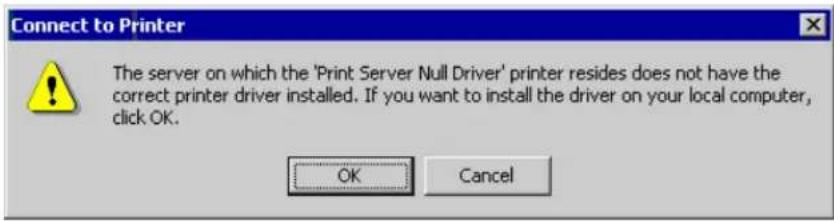
text_image
Connect to Printer The server on which the 'Print Server Null Driver' printer resides does not have the correct printer driver installed. If you want to install the driver on your local computer, click OK. OK CancelFigure 27: Windows 2000 Message
- Click "OK", and select the correct Manufacturer and Model for this printer.
- Follow the prompts to complete the installation.
-
In the Printers folder, right-click the new printer, and select Sharing.
-
Select "Shared As:" and enter an appropriate name for this printer. Users will see this name when browsing for the printer during installation.
-
If desired, click "Additional Drivers" and install printer drivers for other versions of Windows, such as Windows 98. This will assist users during the installation process.
-
Click OK to close this Window. Configuration is now complete.
Client PCs can now be configured as described in Chapter 4 - Client Configuration.
Novell NetWare
The LevelOne Printer Server fully supports both Bindery and NDS Novell systems.
With either Bindery or NDS, two (2) NetWare operating modes are possible - LevelOne Printer Server and Remote Printer. LevelOne Printer Server mode is recommended.
Novell Distributed Printing Services (NDPS) under NetWare 5 is also supported.
Configuration Methods (Bindery or NDS)
The following configuration methods are available. In each case, you must be logged into the required NetWare Server with ADMIN rights.
Also, if using Windows, Novell's Client32 should be installed on your PC. Without Client32, only limited configuration changes can be made on the NetWare Server.
Setup Wizard
Using the Setup Wizard is recommended. This allows configuration of the LevelOne Printer Server in NetWare LevelOne Printer Server Mode, which is the recommended system.
BiAdmin
For more control and flexibility, or to use NetWare Remote Printer Mode, you can use the supplied BiAdmin management utility. Provided you have Novell's Client 32 installed, BiAdmin will allow you to configure the NetWare Server as well as the LevelOne Printer Server.
• BiAdmin is installed by the Administrator menu option on the CD-ROM.
• See Chapter 5 for general information on using BiAdmin.
- The NetWare Manual (in the Manual\NetWare folder on the CD-ROM) contains detailed information on using BiAdmin with NetWare Servers.
Other Methods
If you are unable to use Windows-based programs for configuration, the following methods are available to configure the LevelOne Printer Server:
WPConfig This program requires Windows 3.1, and the IPX/SPX protocol.
PSConfig Menu-based DOS program, intended only to configure the LevelOne Printer Server for use with NetWare V2, 3 and 4.
Quickset Command-line DOC program, intended only to configure the LevelOne Printer Server for use with NetWare V2, 3 and 4. This program also has a limited ability to configure the NetWare Server itself.
• These programs are provided on the CD-ROM, in the Utility folder.
- WPConfig has a SETUP program; the other programs need only to be copied to the desired folder on your PC.
- The documentation for these programs is provided in sub-folders of the Manual folder on the CD-ROM.
- PSConfig and WPConfig do NOT configure your NetWare Server. It is necessary to use PCONSOLE to create the necessary print object and queues, and ensure the appropriate users have access rights to the print queues.
Configuration Data
The LevelOne Printer Server requires the following "General" data, and the data for the mode (LevelOne Printer Server or Remote Printer) you are using.
| General | |
| Device Name | The device name (Default Server Name) is shown on a sticker on the base of the device. Change this if you wish. The new name MUST NOT exceed 19 characters, nor contain any spaces. |
| Device Password | Default is NULL (no password). |
| NetWare Mode | LevelOne Printer Server or Remote Printer. |
| Frame Type | Select the frame types used by your network. (Ethernet 802.2, Ethernet 802.3, Ethernet SNAP, and Ethernet II) By default, all frame types are enabled. |
| Novell Remote Printer Mode | |
| Novell LevelOne Printer Server for P1 | NetWare LevelOne Printer Server to service the LevelOne Printer Server's parallel port 1. |
| Novell LevelOne | NetWare LevelOne Printer Server to service the LevelOne Printer |
| Printer Server for P2, P3 & SP (if exist) | Server's parallel port 2 (P2), parallel port 3 (P3), or Serial port (SP), if these port exist. |
| Novell LevelOne Printer Server Mode | |
| NDS Tree Name Not applicable.(NetWare NDS mode only) | |
| LevelOne Printer ServerNDS Context | Not applicable.(NetWare NDS mode only) |
| Master File Server (Bindery mode only) | Name of the LevelOne Printer Server's master file server. |
| Polling Queue Interval | Defines how often the LevelOne Printer Server will poll the queues to be serviced. |
| Job Notification by Connection ID | Set to Yes to receive a job notification at only the workstation where the print job originated, No to receive a job notification at all workstations that you have logged on. |
| NetWare Password | The password on the NetWare Server. The LevelOne Printer Server device needs this password to connect to the NetWare Server. |
Setup for NDPS (NetWare 5)
Overview
- The LevelOne Printer Server must be configured as a valid device on your TCP/IP network.
- To use NDPS (Novell Distributed Printing Services), the Novell server must be running Novell NetWare 5, and the PCs (clients) must be running IntranetWare Client V2.2. or later.
The following procedure is designed to enable Public Access Printing under NDPS. Public Access Printing allows anybody on the network to access the printer.
Creating an NDPS Manager Object
If an NDPS Manager Object already exists, skip this procedure and proceed to Creating an NDPS Printer Agent.
- Login to NetWare 5.0 Server as Admin and start the NetWare Administrator program Nwadmn32.exe.
- Select the container on NetWare Administrator where you want the NDPS Manager object to reside. (e.g. TeSupp)
- Select Create - Object from the menu bar to view the New Object dialog.
- Select NDPS Manager as the object to create. The Create NDPS Manager Object window shown below will appear.
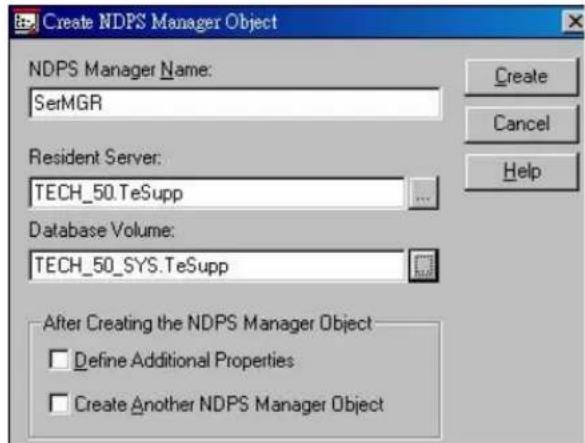
text_image
Create NDPS Manager Object NDPS Manager Name: SerMGR Resident Server: TECH_50.TeSupp Database Volume: TECH_50_SYS.TeSupp After Creating the NDPS Manager Object Define Additional Properties Create Another NDPS Manager Object Create Cancel HelpFigure 28: Create NDPS Manager Object
- Type a name in the NDPS Manager Name.(e.g. SerMGR in Figure 1 above)
- Browse the Resident Server and select where you want the NDPS Manager object to be assigned. (e.g. TECH_50.TeSupp in figure 1 above)
- Browse the Database Volume and select where you want the NDPS Manager database to be assigned. (e.g. TECH_50_SYS.TeSupp in figure 1 above)
- Click Create. The new NDPS Manager will appear in the main browser window.
• To start the NDPS Manager in future, enter the following command at the console: LOAD NDPSM then select the NDPS Manager object.
- To start the NDPS Manager whenever you bring up the server, add a command like the following to your server's AUTOEXEC.NCF file: LOAD NDPSM SerMGR.TeSupp The last item is the name of the NDPS Manager object you wish to load.
- After creating an NDPS Manager, you can create NDPS printers by using NetWare Administrator, as explained below.
Creating an NDPS Printer Agent
To create Public Access Printers using the NDPS Manager Object in NetWare Administrator, follow this procedure:
- Start the NDPS Manager object you will be using to control the Printer Agent.
- At the Identification page, click the Printer Agent List.
- Click New to see the Create Printer Agent window, as shown below.
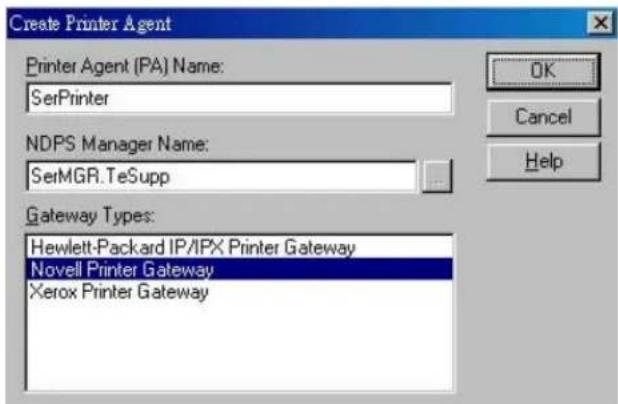
text_image
Create Printer Agent Printer Agent (PA) Name: SerPrinter NDPS Manager Name: SerMGR.TeSupp Gateway Types: Hewlett-Packard IP/IPX Printer Gateway Novell Printer Gateway Xerox Printer GatewayFigure 29: Create Printer Agent
- Enter the desired name for the Printer Agent (PA) Name.
- Normally, the NDPS Manager will be the NDPS Manger object you are using.
- Select Novell Printer Gateway in the Gateway Type. (see figure2 above)
- Click OK and then select the available printer.
- Select Remote (LPR on IP) in the Connection Type.
- Click Next to see the following Configure Port Handler screen.
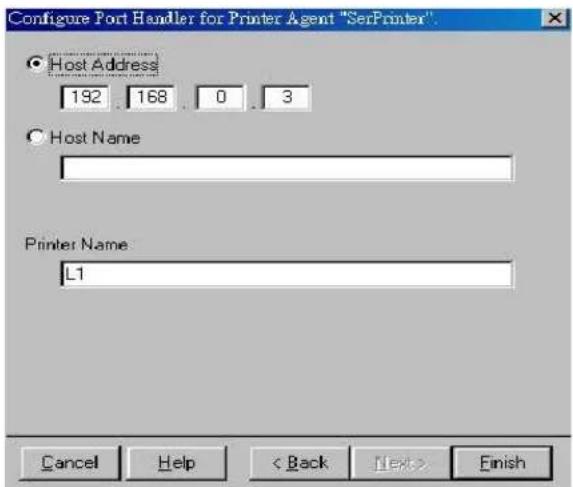
text_image
Configure Port Handler for Printer Agent "SerPrinter". Host Address 192 168 0 3 Host Name Printer Name: L1 Cancel Help < Back Next> FinishFigure 30 Configure Port Handler
- In the Host address IP field, enter the IP Address previously assigned to the LevelOne Printer Server device.
- In the Printer Name field, enter the Logical Port name on the LevelOne Printer Server. (e.g.: L1)
Note: For LevelOne Printer Servers with one parallel port, the logical ports are named L1, L2 and L3. For devices with three parallel ports, the logical ports are named L1 to L8.
- Click Finish, then select appropriate drivers for Windows 3.1, Windows 95/98 and Windows NT 4.
- The new Printer Agent will now appear in the Printer Agent List window.
Repeat this procedure for any other ports on the LevelOne Printer Server, or for any other logical printers you wish to use.
Client PCs can now be configured as described in Chapter 4 - Client Configuration.
Unix Systems
Your LevelOne Printer Server can be configured using FTP, and it supports the following Unix printing methods:
• LPD
- FTP
- Direct Socket Interface
• PSfilter (proprietary printing method)
For full details on using Unix systems with your LevelOne Printer Server, refer to the Unix manual in the /Manual/Unix directory on the CD-ROM.