CV14DBL - Multifunction tool HiKOKI - Free user manual and instructions
Find the device manual for free CV14DBL HiKOKI in PDF.


User questions about CV14DBL HiKOKI
0 question about this device. Answer the ones you know or ask your own.
Ask a new question about this device
Download the instructions for your Multifunction tool in PDF format for free! Find your manual CV14DBL - HiKOKI and take your electronic device back in hand. On this page are published all the documents necessary for the use of your device. CV14DBL by HiKOKI.
USER MANUAL CV14DBL HiKOKI
natural_image
Line drawing of a handheld device with a circular frame (no text or symbols)保留备用
Keep for future reference

使用说明书
Handling instructions
目次
电动工具通用安全警告 2
充电式多功能切割打磨机安全警告……5
其它安全警告....5
锂离子电池使用注意事项......6
锂离子电池运输....8
符号....8
标准附件....9
用途....10
规格....10
电池的拆卸 / 安装法.....10
充电....11
作业之前....13
切割、锯切和刮削....17
打磨....17
应用工具的选择....18
维护和检查....18
选择附件....20
电动工具通用安全警告
警告!
natural_image
Illustration of a hand using a handheld device to lift a motor (no text or symbols present)图 1
中文
text_image
开关 LED灯 I O图6
7. 调整运行速度(图 7)
natural_image
Isometric line drawing of a mechanical device with internal components (no text or symbols)natural_image
Line drawing of a briefcase with internal compartments and mounting brackets (no text or symbols)产品编号:337684 箱子

natural_image
Line drawing of a rectangular toolbox with a handle and lid (no text or symbols)产品编号:337685 附件箱

natural_image
Technical line drawing of a mechanical assembly with two components (no text or symbols)产品编号:337936 集尘适配器套装
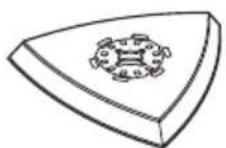
产品编号:335903
垫板

natural_image
Simple line drawing of a mechanical component with a circular top and rectangular base (no text or symbols)产品编号:335881 刀片
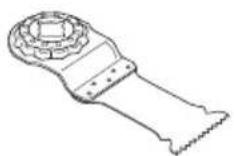
产品编号:374811
刀片
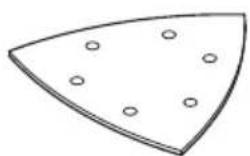
60, 80, 100,
120, 180, 240 砂纸

natural_image
Technical line drawing of a mechanical component with a central circular feature and flanged ends (no text or symbols)产品编号:335868 切割锯
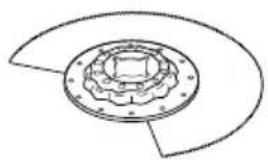
natural_image
Technical line drawing of a mechanical flange assembly (no text or symbols)产品编号:374810 切割锯
ADDITIONAL SAFETY WARNINGS ....25
CAUTION ON LITHIUM-ION BATTERY 27
REGARDING LITHIUM-ION BATTERY TRANSPORTATION ....28
SYMBOLS 29
STANDARD ACCESSORIES ....30
APPLICATIONS....30
SPECIFICATIONS....31
REMOVAL AND INSTALLATION METHOD OF BATTERY....31
CHARGING 31
CUTTING, SAWING AND SCRAPING ....39
SANDING 40
SELECTION OF APPLICATION TOOL 41
MAINTENANCE AND INSPECTION 41
SELECTING ACCESSORIES 42
GENERAL POWER TOOL SAFETY WARNINGS

WARNING
Read all safety warnings, instructions, illustrations and specifications provided with this power tool.
Failure to follow all instructions listed below may result in electric shock, fire and/or serious injury.
Save all warnings and instructions for future reference.
The term “power tool” in the warnings refers to your mains-operated (corded) power tool or battery-operated (cordless) power tool.
1) Work area safety
a) Keep work area clean and well lit.
Cluttered or dark areas invite accidents.
b) Do not operate power tools in explosive atmospheres, such as in the presence of fl ammable liquids, gases or dust.
Power tools create sparks which may ignite the dust or fumes.
c) Keep children and bystanders away while operating a power tool.
Distractions can cause you to lose control.
2) Electrical safety
a) Power tool plugs must match the outlet.
Never modify the plug in any way.
Do not use any adapter plugs with earthed (grounded) power tools.
English
Unmodified plugs and matching outlets will reduce risk of electric shock.
b) Avoid body contact with earthed or grounded surfaces, such as pipes, radiators, ranges and refrigerators.
There is an increased risk of electric shock if your body is earthed or grounded.
c) Do not expose power tools to rain or wet conditions.
Water entering a power tool will increase the risk of electric shock.
d) Do not abuse the cord. Never use the cord for carrying, pulling or unplugging the power tool.
Keep cord away from heat, oil, sharp edges or moving parts.
Damaged or entangled cords increase the risk of electric shock.
e) When operating a power tool outdoors, use an extension cord suitable for outdoor use.
Use of a cord suitable for outdoor use reduces the risk of electric shock.
f) If operating a power tool in a damp location is unavoidable, use a residual current device (RCD) protected supply.
Use of an RCD reduces the risk of electric shock.
3) Personal safety
a) Stay alert, watch what you are doing and use common sense when operating a power tool.
Do not use a power tool while you are tired or under the influence of drugs, alcohol or medication.
A moment of inattention while operating power tools may result in serious personal injury.
b) Use personal protective equipment. Always wear eye protection.
Protective equipment such as a dust mask, non-skid safety shoes, hard hat or hearing protection used for appropriate conditions will reduce personal injuries.
c) Prevent unintentional starting. Ensure the switch is in the off -position before connecting to power source and/or battery pack, picking up or carrying the tool.
Carrying power tools with your finger on the switch or energising power tools that have the switch on invites accidents.
d) Remove any adjusting key or wrench before turning the power tool on.
A wrench or a key left attached to a rotating part of the power tool may result in personal injury.
e) Do not overreach. Keep proper footing and balance at all times.
This enables better control of the power tool in unexpected situations.
f) Dress properly. Do not wear loose clothing or jewellery. Keep your hair, clothing and gloves away from moving parts.
Loose clothes, jewellery or long hair can be caught in moving parts.
g) If devices are provided for the connection of dust extraction and collection facilities, ensure these are connected and properly used.
Use of dust collection can reduce dust-related hazards.
h) Do not let familiarity gained from frequent use of tools allow you to become complacent and ignore tool safety principles.
A careless action can cause severe injury within a fraction of a second.
4) Power tool use and care
a) Do not force the power tool. Use the correct power tool for your application.
The correct power tool will do the job better and safer at the rate for which it was designed.
b) Do not use the power tool if the switch does not turn it on and off.
Any power tool that cannot be controlled with the switch is dangerous and must be repaired.
c) Disconnect the plug from the power source and/or remove the battery pack, if detachable, from the power tool before making any adjustments, changing accessories, or storing power tools.
Such preventive safety measures reduce the risk of starting the power tool accidentally.
d) Store idle power tools out of the reach of children and do not allow persons unfamiliar with the power tool or these instructions to operate the power tool.
Power tools are dangerous in the hands of untrained users.
e) Maintain power tools and accessories. Check for misalignment or binding of moving parts, breakage of parts and any other condition that may affect the power tool's operation.
If damaged, have the power tool repaired before use.
Many accidents are caused by poorly maintained power tools.
f) Keep cutting tools sharp and clean.
Properly maintained cutting tools with sharp cutting edges are less likely to bind and are easier to control.
g) Use the power tool, accessories and tool bits etc. in accordance with these instructions, taking into account the working conditions and the work to be performed.
Use of the power tool for operations different from those intended could result in a hazardous situation.
English
h) Keep handles and grasping surfaces dry, clean and free from oil and grease.
Slippery handles and grasping surfaces do not allow for safe handling and control of the tool in unexpected situations.
5) Battery tool use and care
a) Recharge only with the charger specified by the manufacturer. A charger that is suitable for one type of battery pack may create a risk of fi re when used with another battery pack.
b) Use power tools only with specifically designated battery packs.
Use of any other battery packs may create a risk of injury and fire.
c) When battery pack is not in use, keep it away from other metal objects, like paper clips, coins, keys, nails, screws or other small metal objects, that can make a connection from one terminal to another.
Shorting the battery terminals together may cause burns or a fire.
d) Under abusive conditions, liquid may be ejected from the battery; avoid contact. If contact accidentally occurs, fl ush with water. If liquid contacts eyes, additionally seek medical help.
Liquid ejected from the battery may cause irritation or burns.
e) Do not use a battery pack or tool that is damaged or modified. Damaged or modified batteries may exhibit unpredictable behaviour resulting in fire, explosion or risk of injury.
f) Do not expose a battery pack or tool to fire or excessive temperature.
Exposure to fire or temperature above 130 °C may cause explosion.
g) Follow all charging instructions and do not charge the battery pack or tool outside the temperature range specified in the instructions.
Charging improperly or at temperatures outside the specified range may damage the battery and increase the risk of fire.
6) Service
a) Have your power tool serviced by a qualified repair person using only identical replacement parts.
This will ensure that the safety of the power tool is maintained.
b) Never service damaged battery packs.
Service of battery packs should only be performed by the manufacturer or authorized service providers.
CAUTION
Keep children and infi rm persons away.
When not in use, tools should be stored out of reach of children and infi rm persons.
CORDLESS MULTI TOOL SAFETY WARNINGS
- Hold power tool by insulated gripping surfaces, when performing an operation where the cutting accessory may contact hidden wiring.
Cutting accessory contacting a "live" wire may make exposed metal parts of the power tool "live" and could give the operator an electric shock.
ADDITIONAL SAFETY WARNINGS
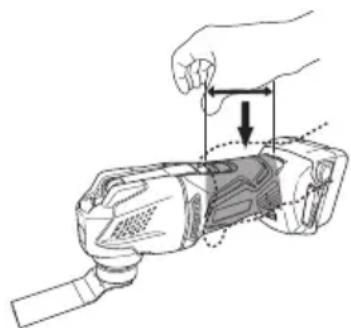
- Always hold the tool firmly with one hand on housing (Fig. 1). Do not touch the metal part.
-
Make sure that the area to be cut is absolutely free of any hidden obstructions including electrical wiring, water, or gas pipes. Cutting into the aforementioned may result in electric shock or short circuit, gas leak or other hazards that can cause serious accidents or injuries.
-
Make sure to securely hold the tool during operation. Failure to do so can result in accidents or injuries.
-
Secure the workpiece. A workpiece clamped with clamping devices or in a vice is held more secure than by hand.
-
Setting up and checking the work environment. Check if the work environment is suitable by following the precaution.
-
Dust particles such as silica or asbestos are hazardous to your health. When working with materials containing these components, take appropriate dust-proofing measures.
-
Working with metal can cause sparks. Make sure there are no fl ammable and combustible materials in the vicinity and that they are stored in a safe location.
-
Do not allow foreign matter to enter the hole for connecting the rechargeable battery.
-
Never disassemble the rechargeable battery and charger.
-
Never short-circuit the rechargeable battery. Shortcircuiting the battery will cause a great electric current and overheat. It results in burn or damage to the battery.
-
Do not dispose of the battery in fire. If the battery is burnt, it may explode.
-
Bring the battery to the shop from which it was purchased as soon as the post-charging battery life becomes too short for practical use. Do not dispose of the exhausted battery.
-
Do not insert object into the air ventilation slots of the charger. Inserting metal objects or infl ammables into the charger air ventilation slots will result in electrical shock hazard or damaged charger.
natural_image
Illustration of a hand using a handheld device to adjust a component (no text or symbols visible)Fig. 1
English
- After use for continuous cutting or grinding works, rest the unit for 15 minutes or so when replacing the battery. The temperature of the motor, switch, etc., will rise if the work is started again immediately after battery replacement, eventually resulting in burnout.
- The motor may stop in the event the tool is overloaded. In this should occur, release the tool's switch and eliminate the cause of the overload.
- The use of the battery in a cold condition (below 0 degree Centigrade) can sometimes result in the weakened tightening torque and reduced amount of work. This, however, is a temporary phenomenon, and returns to normal when the battery warms up.
- Do not look directly into the light. Such actions could result in eye injury.
- Do not touch the application tool, its attachment area or other metal surfaces immediately after use as they will be hot. Doing so may result in burns or injury.
The metal is hot and can easily burn your skin.
-
Make sure that there is no one below when operating the tool in high locations. Dropping the tool or materials may result in accident or injury.
-
Never apply any unreasonable force to the application tool when working. Doing so may break the application tool or damage the motor.
-
Do not leave the tool running unattended on the floor, table or other locations. Doing so may result in injury.
-
When attaching application tools, be careful not to get your fingers or other extremities caught in the lever.
-
If the application tool seems to be loose or uneven after attaching it to the unit, re-attach the tool. Operating the unit with a loose or uneven application tool may result in injury.
-
When switching on the tool, make sure the application tool is not in contact with any processing materials. Failure to do so may result in injury.
-
For cutting efficiency, switch the mode of the application tool according to task conditions and materials to be cut.
-
After use, be sure not to place the tool near chips or sawdust before it comes to a full stop as the tool may suck in those particles.
-
Do not polish wood with sanding paper used for metal polishing.
-
Do not use worn or clogged sanding paper.
CAUTION ON LITHIUM-ION BATTERY
To extend the lifetime, the lithium-ion battery equips with the protection function to stop the output.
In the cases of 1 to 3 described below, when using this product, even if you are pulling the switch, the motor may stop. This is not the trouble but the result of protection function.
- When the battery power remaining runs out, the motor stops. In such a case, charge it up immediately.
- If the tool is overloaded, the motor may stop. In this case, release the switch of tool and eliminate causes of overloading. After that, you can use it again.
- If the battery is overheated under overload work, the battery power may stop.
In this case, stop using the battery and let the battery cool. After that, you can use it again.
Furthermore, please heed the following warning and caution.
WARNING
In order to prevent any battery leakage, heat generation, smoke emission, explosion and ignition beforehand, please be sure to heed the following precautions.
- Make sure that swarf and dust do not collect on the battery.
During work make sure that swarf and dust do not fall on the battery.
○ Make sure that any swarf and dust falling on the power tool during work do not collect on the battery.
○ Do not store an unused battery in a location exposed to swarf and dust.
Before storing a battery, remove any swarf and dust that may adhere to it and do not store it together with metal parts (screws, nails, etc.). - Do not pierce battery with a sharp object such as a nail, strike with a hammer, step on, throw or subject the battery to severe physical shock.
- Do not use an apparently damaged or deformed battery.
- Do not use the battery in reverse polarity.
- Do not connect directly to an electrical outlets or car cigarette lighter sockets.
- Do not use the battery for a purpose other than those specified.
- If the battery charging fails to complete even when a specified recharging time has elapsed, immediately stop further recharging.
- Do not put or subject the battery to high temperatures or high pressure such as into a microwave oven, dryer, or high pressure container.
English
- Keep away from fi re immediately when leakage or foul odor are detected.
- Do not use in a location where strong static electricity generates.
- If there is battery leakage, foul odor, heat generated, discolored or deformed, or in any way appears abnormal during use, recharging or storage, immediately remove it from the equipment or battery charger, and stop use.
- Do not immerse the battery or allow any fluids to flow inside. Conductive liquid ingress, such as water, can cause damage resulting in fi re or explosion. Store your battery in a cool, dry place, away from combustible and fl ammable items. Corrosive gas atmospheres must be avoided.
CAUTION
- If liquid leaking from the battery gets into your eyes, do not rub your eyes and wash them well with fresh clean water such as tap water and contact a doctor immediately.
If left untreated, the liquid may cause eye-problems.
- If liquid leaks onto your skin or clothes, wash well with clean water such as tap water immediately.
There is a possibility that this can cause skin irritation.
- If you find rust, foul odor, overheating, discolor, deformation, and/or other irregularities when using the battery for the first time, do not use and return it to your supplier or vendor.
WARNING
If a conductive foreign matter enters in the terminal of lithium ion battery, the battery may be shorted, causing fi re. When storing the lithium ion battery, obey surely the rules of following contents.
○ Do not place conductive debris, nail and wires such as iron wire and copper wire in the storage case.
To prevent shorting from occurring, load the battery in the tool or insert securely the battery cover for storing until the ventilator is not seen.
REGARDING LITHIUM-ION BATTERY TRANSPORTATION
When transporting a lithium-ion battery, please observe the following precautions.
WARNING
Notify the transporting company that a package contains a lithium-ion battery, inform the company of its power output and follow the instructions of the transportation company when arranging transport.
- If the BSL36B18 (sold separately) is installed in the power tool, the power output will exceed 100 Wh and the unit will be classified as Dangerous Goods for freight classification.
● Lithium-ion batteries that exceed a power output of 100Wh are considered to be in the freight classification of Dangerous Goods and will require special application procedures.
- For transportation abroad, you must comply with international law and the rules and regulations of the destination country.

text_image
Power Output Wh 2 to 3 digit numberFig. 2
SYMBOLS
WARNING
The following show symbols used for the machine. Be sure that you understand their meaning before use.
 | CV14DBL: Cordless Multi Tool |
 | To reduce the risk of injury, user must read instruction manual. |
 | Rated voltage |
 | No-load speed |
 | Oscillation per minute |
 | Switching ON |
 | Switching OFF |
 | Disconnect the battery. |
 | Lock |
| [2A2C] | Unlock |
| [27D6] | Prohibited action |
STANDARD ACCESSORIES
In addition to the main unit (1 unit), the package contains the accessories in Table 1. See (NN) in Table 1 for NN Type accessories.
Table 1
| CV14DBL | |||
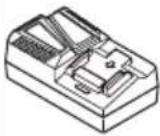 | Charger 1 — | ||
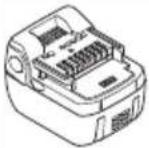 | Battery 2 — | ||
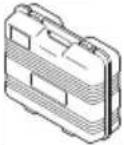 | Case 1 — | ||
 | Battery cover 1 — | ||
 | Pad 1 1 | ||
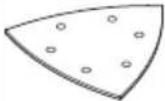 | Sanding paper 5 5 | ||
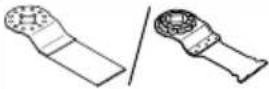 | Blade 1 1 | ||
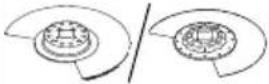 | Cutsaw 1 1 | ||
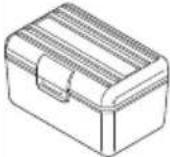 | Accessory case 1 — | ||
APPLICATIONS
○ Flush cutting and pocket cutting of various materials
○ Peeling of tiles, caulking, etc.
○ Polishing wood materials, etc.
SPECIFICATIONS
| CV14DBL | ||
| Rated voltage 14.4 V | ||
| No-load speed | 1 — 5 6000 — 20000 /min | |
| A 15000 /min | ||
| Oscillation angle, Total (left / right) 3.2° (1.6°) | ||
| Weight 1.9 kg (BSL1430) | ||
REMOVAL AND INSTALLATION METHOD OF BATTERY
1. Battery removal
Hold the handle tightly and push the battery latch to remove the battery (See Fig. 3).
CAUTION
Never short-circuit the battery.
2. Battery installation
Insert the battery while observing its polarities (see Fig. 3).
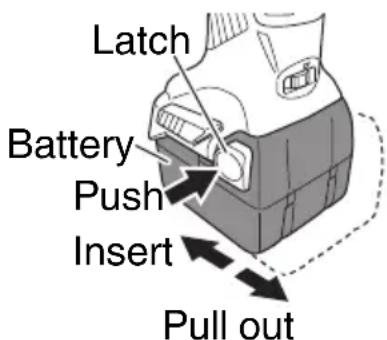
text_image
Latch Battery Push Insert Pull outFig. 3
CHARGING
Before using the power tool, charge the battery as follows.
- Connect the charger's power cord to the receptacle.
When connecting the plug of the charger to a receptacle, the pilot lamp will blink in red (At 1-second intervals).
English
- Insert the battery into the charger.
Firmly insert the battery into the charger as shown in Fig. 4.
- Charging
When inserting a battery in the charger, charging will commence and the pilot lamp will light continuously in red.
When the battery becomes fully recharged, the pilot lamp will blink in red. (At 1-second intervals) (See Table 2)
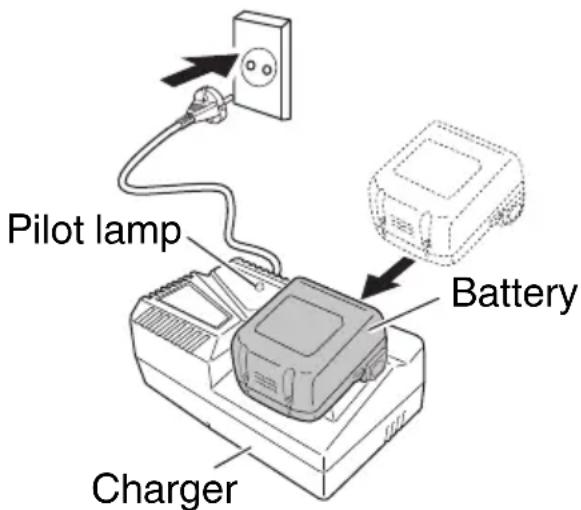
text_image
Pilot lamp Battery ChargerFig. 4
● Pilot lamp indication
The indications of the pilot lamp will be as shown in Table 2, according to the condition of the charger or the rechargeable battery.
Table 2
| Indications of the pilot lamp | ||||
| Pilot lamp(red) | Beforecharging | Blinks | Lights for 0.5 seconds. Does not light for 0.5 seconds. (off for 0.5 seconds) | |
| Whilecharging | Lights | Lights continuously | ||
| Chargingcomplete | Blinks | Lights for 0.5 seconds. Does not light for 0.5 seconds. (off for 0.5 seconds) | ||
| Overheatstandby | Blinks | Lights for 1 second. Does not light for 0.5 seconds. (off for 0.5 seconds) | Batteryoverheated.Unable tocharge.(Charging willcommence whenbattery cools) | |
| Chargingimpossible | Flickers | Lights for 0.1 seconds. Does not light for 0.1 seconds. (off for 0.1 seconds) | Malfunction inthe battery or thecharger | |
● Regarding the temperatures and charging time of the battery.
The temperatures and charging time will become as shown in Table 3.
Table 3
| Battery\Charger | UC18YFSL | |
| Charging voltage V | 14.4 – 18 | |
| Weight kg 0.5 | ||
| Temperatures at which the battery can be recharged | 0°C – 50°C | |
| Charging time for battery capacity, approx. (At 20°C) | ||
| 1.5 Ah | min. | 22 |
| 2.0 Ah | min. | 30 |
| 2.5 Ah | min. | 35 |
| 3.0 Ah | min. | 45 |
| 4.0 Ah | min. | 60 |
| 5.0 Ah | min. | 75 |
| Number of battery cells 4 – 10 | ||
NOTE
The recharging time may vary according to temperature and power source voltage.
CAUTION
When the battery charger has been continuously used, the battery charger will be heated, thus constituting the cause of the failures. Once the charging has been completed, give 15 minutes rest until the next charging.
- Disconnect the charger's power cord from the receptacle.
- Hold the charger firmly and pull out the battery.
NOTE
Be sure to pull out the battery from the charger after use, and then keep it.
CAUTION
☐ If the battery is charged while it is heated because it has been left for a long time in a location subject to direct sunlight or because the battery has just been used, the pilot lamp of the charger lights for 1 second, does not light for 0.5 seconds (off for 0.5 seconds). In such a case, first let the battery cool, then start charging.
When the pilot lamp flickers (at 0.2-second intervals), check for and take out any foreign objects in the charger's battery connector. If there are no foreign objects, it is probable that the battery or charger is malfunctioning. Take it to your authorized Service Center.
English
○ Since the built-in micro computer takes about 3 seconds to confirm that the battery being charged with charger is taken out, wait for a minimum of 3 seconds before reinserting it to continue charging. If the battery is reinserted within 3 seconds, the battery may not be properly charged.
○ If the pilot lamp does not blink in red (every second) even though the charger cord is connected to the power, it indicates that the protection circuit of the charger may be activated.
Remove the cord or plug from the power and then connect it again after 30 seconds or so. If this does not cause the pilot lamp to blink in red (every second), please take the charger to the HiKOKI Authorized Service Center.
PRIOR TO OPERATION
- Preparing and checking the work environment
Make sure that the work site meets all the conditions laid forth in the precautions.
- Checking the battery
Make sure that the battery is installed firmly. If it is at all loose it could come off and cause an accident.
- Power switch
Ensure that the power switch is in the OFF position.
If the battery is installed while the power switch is in the ON position, the power tool will start operating immediately, which could cause a serious accident.
- Checking the Accessory
○ Check to see if the application tool is a genuine component recommended by the manufacturer and that there are no cracks or other damage.
○ Check to see if the application tool is properly installed as instructed.
- Changing application tools (Fig. 5)
CAUTION
○ Be sure to switch power OFF and disconnect the battery from the body when changing application tools.
- Never touch the application tool immediately after use. The metal is hot and can easily burn your skin.
○ The lever is attached to a strong spring. Be very careful not to get your fingers caught when pushing the lever down.
NOTE
○ Make sure the facing of the application tool is correct.
○ Make sure the application tool is properly set on the protrusion of the attachment ring.
(1) Pull the lever up. There will be some resistance, but make sure the lever is pulled until it is parallel with the main unit.
(2) Pull and turn the guide sleeve until “▽” is aligned with the “■” mark.
(3) Pull out the tool shaft.
(4) Attach the application tool to the attachment ring, making sure the tool's hole is fitted to the ring's protrusion. The angle of attachment for the application tool can be set in 30^ increments.
(5) Insert the tool shaft.
(6) Align the guide sleeve's "☐" mark to the "▽" position.
(7) Push down the lever.
(8) Align the holes when sticking the sanding paper to the pad.
English

flowchart
graph TD
    A["Lever"] --> B["Tool Shaft"]
    B --> C["Sanding Paper"]
    C --> D["Guide Sleeve Pad"]
    D --> E["Blade"]
    E --> F["Ring's Protrusion"]
    F --> G["No Restriction"]
    G --> H["Extrusive Robot"]
    H --> I["Switch"]
    I --> J["Warning/No"]
Fig. 5
- Sliding the switch towards I will switch on, simultaneously activating the LED light which will light the application tool. (Fig. 6)
To turn the main unit off, slide the switch towards 0.
CAUTION
Do not look directly into the light from the LED lamp. Continuous and direct exposure to the light from the LED lamp can injure your eyes.

text_image
LED light Switch I OFig. 6
- Adjusting operating speed (Fig. 7)
The tool is equipped with two modes: "Standard mode" and "AUTO Mode".
(1) Standard Mode
You can change the vibration frequency between 6000 to 20000 /min by adjusting the dial from “1” to “5”.
(2) AUTO Mode
Depending on the workload, AUTO Mode "A" will automatically change the vibration frequency to 15000 /min or 20000 /min.
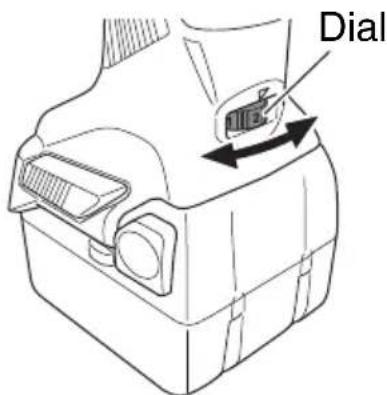
text_image
DialFig. 7
This has the effect of lowering vibration and noise prior to and during operation.
Adjust the dial for the mode and speed that best suits your task conditions and materials.
Table 4 Operating speed
| Model Dial | Vibration Frequency | |
| Standard mode | 1 – 5 6000 – 20000 /min | |
| AUTO Mode A | No load: 15000 /minWith load: 20000 /min |
With AUTO Mode, the vibration frequency may not reach 20000 /min or return to 15000 /min depending on variables such as the type of work or the attachment in use.
English
- About remaining battery indicator When pressing the remaining battery indicator switch, the remaining battery indicator lamp lights and the battery remaining power can be checked. (Fig. 8) When releasing your finger from the remaining battery indicator switch, the remaining battery indicator lamp goes off. The Table 5 shows the state of remaining battery indicator lamp and the battery remaining power.
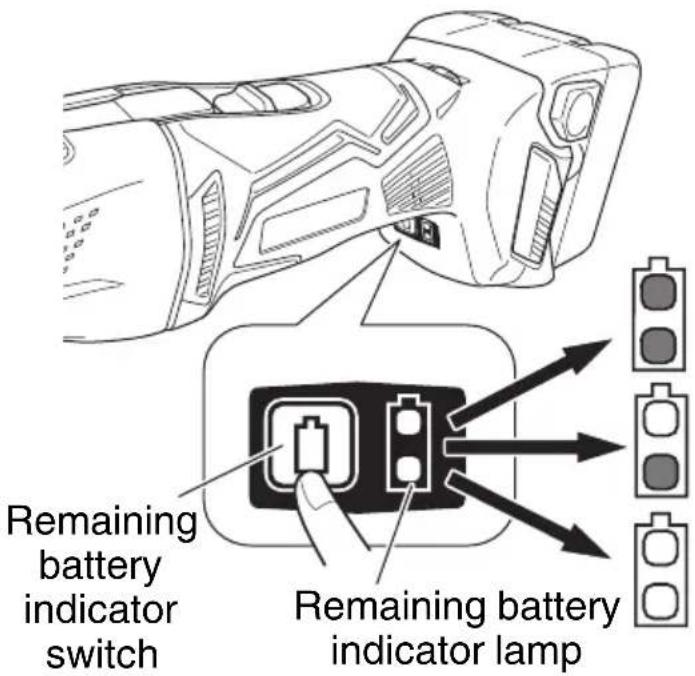
text_image
Remaining battery indicator switch Remaining battery indicator lampFig. 8
Table 5
| State of lamp Battery remaining power | |
| The battery remaining power is enough. | |
| The battery remaining power is a half. | |
| The battery remaining power is nearly empty.Re-charge the battery soonest possible. | |
As the remaining battery indicator shows somewhat differently depending on ambient temperature and battery characteristics, read it as a reference.
NOTE
Do not give a strong shock to the switch panel or break it. It may lead to a trouble.
To save the battery power consumption, the remaining battery indicator lamp lights while pressing the remaining battery indicator switch.
CAUTION: on lithium-ion battery
To extend the lifetime, the lithium-ion battery equips with the protection function to stop the output. Therefore, if the tool is overloaded, the motor may stop. However, this is not the trouble but the result of protection function. In this case, release the switch of tool and eliminate the causes of overloading.
CAUTION
When switching on the tool, make sure the application tool is not in contact with the material to be processed. Failure to do so may result in injury.
☐ For cutting efficiency, switch the speed of the application tool according to task conditions and materials to be cut.
○ Do not apply any unnecessary pressure when operating the tool. Doing so may damage the application tool.
○ After use, be sure not to place the tool near chips or sawdust before it comes to a full stop as the tool may suck in those particles.
CUTTING, SAWING AND SCRAPING
Sawing and scraping tasks require specific application tools (sold separately).
WARNING
○ Be absolutely sure to keep the switch turned off and the battery removed to prevent any accident.
During operation, do not place your face or hands near the application tool of the unit.
-
Switch the unit on and use the dial to set the speed of the application tool.(Fig. 9)
-
Lightly place the application tool on the material and move the application tool forward at a pace where the movement isn't slowed. (Fig. 9)
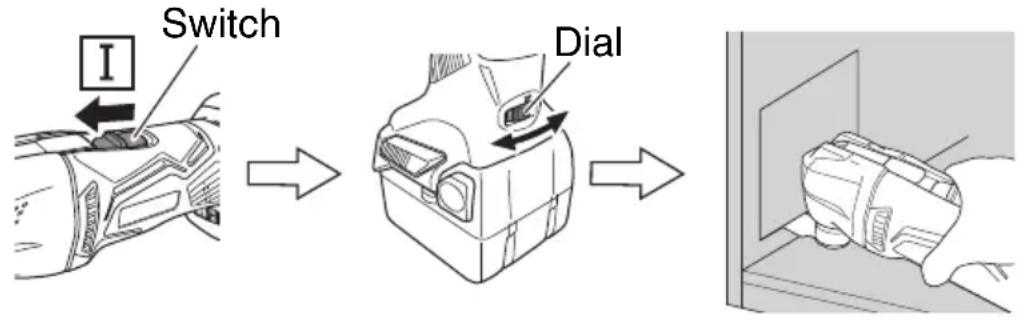
text_image
Switch I DialFig. 9
SANDING
Sanding tasks require specific application tools (sold separately).
WARNING
○ Be absolutely sure to keep the switch turned off and the battery removed to prevent any accident.
During operation, do not place your face or hands near the application tool of the unit.
-
Switch the unit on and use the dial to set the speed of the application tool.(Fig. 10)
-
Lightly place the application tool on the material and move the application tool back and forth at a pace where the movement isn't slowed. (Fig. 10)
CAUTION
○ Do not polish wood with sanding paper used for metal polishing.
○ Do not use worn or clogged sanding paper.

text_image
Switch DialFig. 10
Tips on SANDING
○ How to place the sandpaper
Lightly press the tool to the surface to be processed; making sure that the sandpaper is evenly applied to the surface. Applying unnecessary pressure will place stress on the motor and shorten the sandpaper's life, reducing polishing efficiency.
○ How to move the tool
Using your hand, repeatedly push out and pull back in a back and forth motion.
○ New coarse sandpaper with rougher grit
New coarse sandpaper with rougher grit may cause the unit to jerk. During the start of the task, slightly tilt the unit towards the front or back for a while, maintaining the tilted position. The jerking will stop as the sandpaper adapts to the task.
○ Until the surface being processed is polished
Use the same grade of sandpaper until the surface being processed is evenly polished. Switching to a different grade of sandpaper when the task is not completed may result in an uneven fi nish.
○ Testing
Before starting a task, it is recommended that you check the vibration frequency using excess material.
SELECTION OF APPLICATION TOOL
○ Application tools
To ensure maximum operating efficiency and results, it is very important to select the appropriate blade best suited to the type and thickness of the material to be cut.
For details contact HiKOKI Authorized Service Center.
MAINTENANCE AND INSPECTION
1. Inspecting the application tool
Continued use of a dull or damaged application tool will result in reduced cutting efficiency and may cause overloading of the motor. Replace the application tool with a new one as soon as excessive abrasion is noted.
2. Inspecting the mounting screws
Regularly inspect all mounting screws and ensure that they are properly tightened. Should any of the screws be loose, retighten them immediately. Failure to do so could result in serious hazard.
3. Maintenance of the motor
The motor unit winding is the very “heart” of the power tool. Exercise due care to ensure the winding does not become damaged and/or wet with oil or water.
4. Cleaning on the outside
When the power tool is stained, wipe with a soft dry cloth or a cloth moistened with soapy water. Do not use chloric solvents, gasoline or paint thinner, for they melt plastics.
5. Storage
Store the power tool in a place in which the temperature is less than 40^ C and out of reach of children.
NOTE
○ Make sure that the battery is fully charged when stored for a long period (3 months or more). The battery with smaller capacity may not be able to be charged when used, if stored for a long period.
○ Storing lithium-ion batteries.
Make sure the lithium-ion batteries have been fully charged before storing them.
Prolonged storage of batteries with a low charge may result in performance deterioration, significantly reducing battery usage time or rendering the batteries incapable of holding a charge. However, significantly reduced battery usage time may be recovered by repeatedly charging and using the batteries two to five times.
English
If the battery usage time is extremely short despite repeated charging and use, consider the batteries dead and purchase new batteries.
CAUTION
In the operation and maintenance of power tools, the safety regulations and standards prescribed in each country must be observed.
SELECTING ACCESSORIES
Select accessories that are suited to a specific task. For details contact HiKOKI Authorized Service Center.
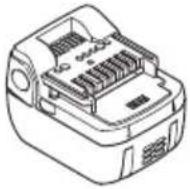
BSL14..
natural_image
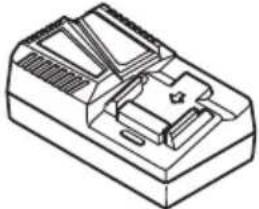
Isometric line drawing of a mechanical component with internal compartments and mounting holes (no text or symbols)UC18YFSL (14.4V - 18V) Charger

Part Number: 329897
Battery cover

natural_image
Line drawing of a mechanical device casing with internal compartments (no text or symbols)Part Number: 337684 Case

natural_image
Line drawing of a rectangular box with a handle and lid (no text or symbols)Part Number: 337685 Accessory case
natural_image
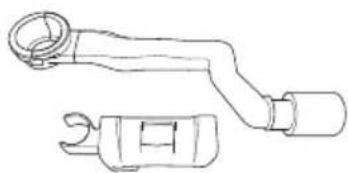
Technical line drawing of a mechanical assembly with two components (no text or symbols)Part Number: 337936 Dust collection adapter set

Part Number: 335903
Pad

Part Number: 335881 Blade
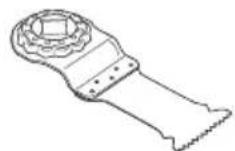
Part Number: 374811 Blade
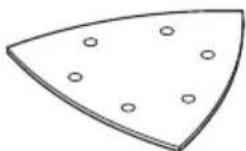
60, 80, 100,
120, 180, 240 Sanding paper

natural_image
Technical line drawing of a mechanical component with concentric circular features and central hub (no text or symbols)Part Number: 335868 Cutsaw

natural_image
Technical line drawing of a mechanical component with concentric rings and mounting holes (no text or symbols)Part Number: 374810 Cutsaw
Important notice on the batteries for the HiKOKI cordless power tools
Please always use one of our designated genuine batteries. We cannot guarantee the safety and performance of our cordless power tool when used with batteries other than these designated by us, or when the battery is disassembled and modified (such as disassembly and replacement of cells or other internal parts).
服务中心
高壹工机商业(上海)有限公司