EHBC 559 IX - Autres appareils de cuisine BOMANN - Free user manual and instructions
Find the device manual for free EHBC 559 IX BOMANN in PDF.


User questions about EHBC 559 IX BOMANN
0 question about this device. Answer the ones you know or ask your own.
Ask a new question about this device
Download the instructions for your Autres appareils de cuisine in PDF format for free! Find your manual EHBC 559 IX - BOMANN and take your electronic device back in hand. On this page are published all the documents necessary for the use of your device. EHBC 559 IX by BOMANN.
USER MANUAL EHBC 559 IX BOMANN
HOUSEHOLD-OSECHORDIC LDERENT EHBC 559 IX

natural_image
Interior view of a modern kitchen oven with digital temperature display and control knobs (no text or symbols on main components)ContentsContents
Introduction Page 3
General Notes Page 3
Special safety Information for this Unit Page 4
Unpacking the Appliance Page 6
Appliance Equipment Page 6
Installation Page 6
Startup / Operation Page 8
Cleaning and Maintenance Page 13
Troubleshooting Page 15
Technical Data Page 15
Disposal Page 15
EU Product data sheet Page 17
Introduction Introduction
Thank you for choosing our product. We hope you will enjoy using the appliance.
Symbols in these Instructions for UseSymbols in these
Important information for your safety is specially marked. It is essential to comply with these instructions to avoid accidents and prevent damage:

WARNING: WARNING:
This warns you of dangers to your health and indicates possible injury risks.

CAUTION:CAUTION:
This refers to possible hazards to the machine or other objects.

NOTENOTE highlights tips and information.
- When not in use, for cleaning, user maintenance works or with disruption, switch off the appliance and disconnect the plug (pull the plug itself, not the lead) or turn off the fuse.
- The appliance and if possible the mains lead have instructions for Use to be checked regularly for signs of damage. If damage is found the appliance must not be used.
- For safety reasons, alterations or modifications of the appliance are prohibited.
- In order to ensure your children's safety, please keep all packaging (plastic bags, boxes, polystyrene etc.) out of their reach.

WARNING: WARNING:
Do not allow small children to play with the foil.
There is a danger of suffocation!danger of suffocation!
General Notes General Notes
Read the operating instructions carefully before putting the appliance into operation and keep the instructions including the warranty and the receipt. If you give this device to other people, also pass on the operating instructions.

NOTENOTE
Illustrations can deviate from the original appliance.
- The appliance is designed exclusively for private use and for the envisaged purpose. This appliance is not fit for commercial use.
- The appliance is only to be used as described in the user manual. Do not use the appliance for any other purpose. Any other use is not intended and can result in damages or personal injuries.
- Operate the appliance only properly installed, properly installed.
- Do not use it outdoors. Keep it away from sources of heat, direct sunlight and humidity.
- Do not operate the appliance without surveillance.
Special safety information for this UnitSpecial safety inform

WARNING: Dagger from electrical current! Dantact with live loads current components can be fatal! components can be fatal!
- The connection of the appliance must satisfy the relevant standards and regulations and may only be performed by an authorized specialist.
- The hob may not be used if the glass surface has cracks or is broken.
- Make sure that the appliance is turned off from the power supply (fuse) before changing the bulb in the oven.
- The use of high-pressure cleaners or steam cleaners is prohibited. Ingress of liquids can lead to electric shock. Put the appliance never under water.

WARMARGINHCGsurfaceHRSkuofaBurning!Risk of Burning!
- During operation the appliance will be hot. Special caution is required to avoid touching heating elements inside the oven and the cooking zones.
- During operation the appliance and its accessible parts become hot. Special care must be taken to avoid touching heating elements. Children younger than 8 years must be kept away from the appliance.
- Grasp the oven only on the door handle and switches. Use potholders if you want to remove or insert the accessories.
- Let the appliance cool down before cleaning or maintenance.

WARNING: Risk of Fire!
- Unattended cooking on cooking hobs with fats or oil can be dangerous and can be cause fires. NEVER attempt to extinguish a fire with water but turn the unit off and then cover the flames e.g. with a lid or a plate.
- CAUTION: TAE Tooking process must be observed. A short cooking operation is to be observed continuously.
- Never store objects on the cooking surface.
- The appliance is not intended for operation with an external timer or external remote-control system.
- Make sure that with installing adequate air circulations ensured and the ventilation slots are not blocked.
- Never pour liquids into a hot oven! Scalding by rising water vapor as well as possible damage to enamel.
- Do not place any objects on the open appliance door.
- Do not store any cleaning agents or flammable materials in the appliance or in the immediate vicinity.
- This appliance can be used by children and guide from 8 years and above and persons with reduced physical, sensory or mental capabilities or lack of experience and knowledge if they have been given supervision or instruction concerning use of the appliance use of the appliance understand the hazards involved.
- ChildrenShidrent play with the appliance.
- Cleaning and user maintenance shall maintain a trade by children, children, they are older than 8 years and are supervised.
- Do not use harsh abrasive cleaners or sharp metal objects for cleaning the glass surface. The glass can be scratched or destroyed.
- Do not try to repair the appliance on your own. Always contact an authorized technician. If the supply cord is damaged, it must be replaced by the manufacturer, its service agent or similarly qualified persons avoid a hazard.
Unpacking the Appliance Unpacking the Appliance
Installation Installation
- Remove the appliance from its packaging.
- Remove all packaging material, such as foils, filler and cardboard packaging.
- To prevent hazards, check the appliance for any transport damage.
- In case of damage, do not put the appliance into operation. Contact your distributor.
i NOTENOTE
Production residue or dust may have collected on the appliance. We recommend cleaning the appliance according to chapter “Cleaning and Maintenance”.
Appliance Equipment Appliance Equ
Appliance Overview Appliance Overview
OvenOven
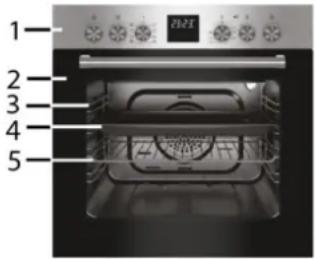
text_image
1 2 3 4 51 Control panel
2 Unit door
3 Side racks
4 Oven tray
5 Grill grid
HobHob
i NOTENOTE
The listed power settings can vary depending on the material and/or size of the cookware.
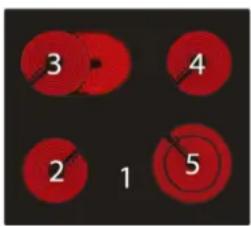
text_image
3 4 2 1 51 Residual heat indicator
2 ∅ 15.5 cm / 1200 W
3 ∅ 15.5/26.0 cm / 1800 W
(roasting zone)
4 ∅ 15.5 cm / 1200 W
5 ∅ 12.5/18.5 cm / 1700 W
(double cooking zone)
Delivery scopelivery scope
1x oven tray, 1x grill grid, installation material
WARNING: WARNING:
The installation and the connection to the main power may only be performed by an authorized specialist.
CAUTION:
- The worktop, the cabinet, veneers, plastic coatings, used adhesives etc. must be sufficient heat-resistant.
- The appliance must be installed so that heat can be dissipated. The ventilation openings must not be blocked.
- Do not mount any heat protection strips in order to ensure an adequate supply of cooling air.
Keep a sufficient distance from the rear of the unit for air circulation.
i NOTEN Recommendation!
- When installing, ask another person to assist.
- Wear protective gloves to avoid injuries at possible sharp edges.
- When carrying the appliance use the hollows at the housing sides.
- Hob and oven must be from the same manufacturer and marked with the same type designation.
- Do not install the appliance directly next to refrigerators of freezers. The escaping heat would result in an unnecessary increase of energy consumption of those appliances.
- Make sure that the oven and the hob are located centrally to each other.
Cabinet opening and appliance dimensions
Prepare the cabinet opening according to the dimensional drawings.
Dimensions in mm

text_image
560 550 600 600 85 30 22 595 565 555 22 595 545Preparing the worktop for Installation of the working installation

CAUTION:CAUTION:
Before cutting secure the outer cutout edge with wide adhesive tape to avoid traces of jigsaw on the work-top.
- The worktop must be leveled horizontally and are sealed to the wall side against overflowing liquids or moisture.
- The hob must be completely surrounded by min. 60 mm work surface.
- The cut surfaces (cutout edges) must be sealed with special varnish, silicone rubber or cast raisin in order to prevent swelling caused by humidity.
- Clean and dry the worktop in the cutout area thoroughly.
Worktop cutoutWorktop cutout
Prepare the cutout of the worktop according to the dimensional drawing.
Dimensions in mm

text_image
520 590 60 560 490 60 60Installing the hobInstalling the hob

NOTENOTE
To avoid damage, place the hob with the top of the cooking surface on a padded base.
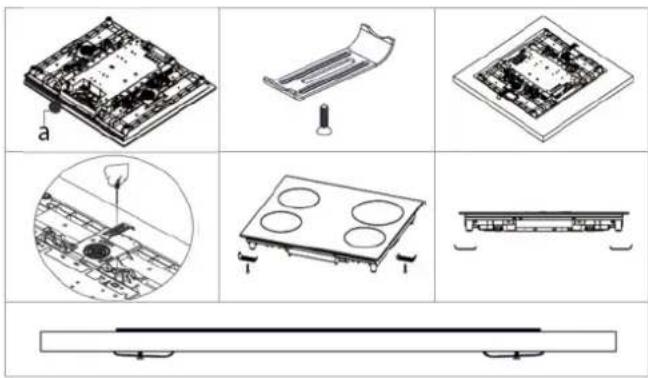
- Before installing the hob, the supplied gasket (aa) must be mounted on the underside of the hob frame. For this place the hob with the hob top on a padded surface to prevent it from damage.
- Place the hob according to the hob drawing under "Appliance Overview" and with the connecting cable first centrally into the prepared cutout of the
worktop. Make sure that the distances to the cut-on of the hob ting are equal on all four sides and that the seal is resting on the worktop.
- Secure the hob from below with the supplied clamps and screws on the worktop.
Installing the ovenInstalling the oven
- Put the appliance with the connecting cable first into the prepared cabinet a bit.
- Do the connection to the hob as well as to the mains, see "Electrical connection".
- Insert the oven into the cabinet opening completely. Make sure that the cables does not restricted (bent, squeezed or twisted).
- Attach and secure the oven by using the supplied screws on the side walls of the cabinet. The provided mounting holes are visible after opening the oven door on the left and right frame.

natural_image
Line drawing of a kitchen oven with a magnified inset showing a screw (no text or symbols)Electrical connection Electrical connection
Information for the authorized expert authorized expert
WARNING: WARNING:
- The installation to the mains supply must conform to the local standards and regulations.
- Connecting the appliance to a domestic power socket or using multiple sockets or extension cables is not permitted.
- Improper connection may cause to an electric electric shockshock
- Before connecting, ensure that the power supply corresponds with the information on the rating label (door frame) and the wiring diagram.
- The appliance is suitable for three-phase and AC current (220-240/380-415V 3N\~50Hz).
- The appliance can be adjusted for single-phase current by a respective bypass on the terminal block, based on the circuit diagram below. Select a suitable cord as mains cable, considering the connection type and nominal power of the oven.
• Fix the mains cable in the tension relief.
- Make sure to connect the protective ground to the terminal of the marked terminal block.
- The electrical installation of the oven should be equipped with an emergency switch, which switches off the whole appliance from the mains supply in an emergency. The distance between the contacts of the emergency switch must be at least 3 mm.
- Arrange the mains cable in such a way that it does not get in contact with any hot components of the appliance. Do not lead it over sharp edges or corners.
Connection wiring diagramConnection wiring diagram
Permissible connection methods Permissible connection methods
CAUTION:CAUTION:
Each connection requires the protective ground of the mains to be connected to the E terminal.
i NOTENOTE
L1, L2, L3 = Phase | N = Neutral
E ⏻ Protective ground
220-240V\~50Hz
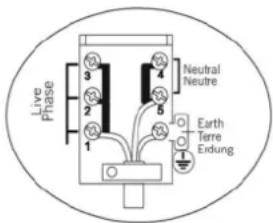
text_image
Live Phase Neutral Neutre 1 2 3 4 5 Earth Terre EndungH05 VV-F 3G 4mm²
380-415V 3N\~50Hz
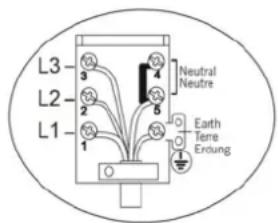
text_image
L3 Neutral Neutre L2 Earth Terre Erdung L1 1 2 3 4 5 6H05 VV-F 5G 1.5mm ^4
Startup / Operation
Before initial use
- Clean the oven interior with all therein located accessories. Follow the instructions that we give you in the chapter "Cleaning and Maintenance".
- In order to burn any manufacturing residue, heat the closed oven for approx. 40 minutes at 200°C. Use the heating function [Upper/lower heating]. Then switch to the heating function [Grill] for another 20 minutes.
i NOTENOTE
The occurring odor and possibly a slight smoke development cannot be avoided. Therefore ensure for a good ventilation of the room during heating.
Connecting the hob to the ovenConnecting the hob to the oven
Insert the plugs at the end of the hob circuit group in
the appropriate socket of the oven terminal block.
OperationOperation
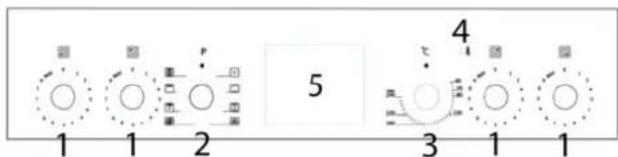
text_image
1 2 5 3 1 11 Level regulator of cooking zonesLevel regulator of cooking zones The time and the various functions of the timer are
CAUTION: CAUTION:
Turn the level regulator of the double cooking and roasting tin zone only clockwise and back again. Otherwise the switches will be damaged.
The temperature setting is set for each cooking zone separately by using the respective level regulator.
= Position of cooking zone
0 = Off-position
1 = Lowest setting (keep food warm)
9 = highest setting (quick heating and cooking, roasting)
2 Oven function selector switchOven function selector switch
The function selector switch is used to set the type of heating. Rotate the function selector switch until the icon for the desired type of heating points upwards.
3 Oven temperature selector switch temperature selector switch
CAUTION:CAUTION:
Turn the temperature selector switch only clockwise and back again. Otherwise the switch will be damaged.
The temperature selector switch is used to adjust the oven temperature. The thermostat allows the temperature setting from 40°C to 240°C.
4 Oven temperature control lampOven temperature control
The temperature control lamp indicates the heating operation. If the lamp goes off, the set oven temperature is reached.
During operation, the oven must continuously reheat to keep the temperature stable. When reheating the control lamp is lighting (thermostat function).
i NOTENOTE
If the recipe recommends putting the food in the preheated oven only, this should not be done before the control lamp turns off for the first time.
5 LED Display / Timer
The time and the various functions of the timer are set via the display. Use the buttons + and - to make the settings:
After connecting to the power supply, the symbol and the time of day 12:00 (factory setting) is flashing in the display. Adjust the current time first, see "Setting the time", in order to put the appliance into operation.
Setting the time
Set the current time of day:
- Press the button ⏻ to activate the setting mode of the time of day.
- Keep pressing the buttons + and - at the same time for a few seconds. The dot between the hour and minute indication on the display is flashing.
- switch
- Make the adjustment with the buttons + and -
- Confirm the setting with the button
Timer functions
i GENERAL NOTES to the timer functions
- By repeatedly pressing the button ⏻ you switch to the next function.
- A while after the last button press or by immediate pressing the button ⏻, the setting is saved. The symbol of the corresponding operating function lights up continuously.
- After setting the respective function, you can optionally display the remaining time of the function or the time of day by pressing the button 🔒.

Using the timer as reminder function after
XX:XX hours
Alarm function without oven operation. The selector switches remains in the off position.
- Press the button ⏻ until the symbol ✗ is flashing in the display.
- Set the alarm time up to 10 hours by using the buttons + and -.

Using the timer to switch off the operation after
XX:XX hours
- Press the button ⏻ until the symbol Ⓐ is flashing in the display.
- The indication du'r and the cooking time are flashing alternately.
- Set the cooking time by using the buttons + and -.
- Select the required heating function and temperature to start the operation.

Using the using the delay the cooking time and time
switch off the operation at XX:XX o'clockswitch off the op
- First set the cooking time as described in " Using the timer to switch off the operation after XX:XX hours".
- Press the button again, beside the indication End, the symbol and the cooking time are flashing alternately.
- Select the required heating function and temperature.
- By using the previously set cooking time, the appliance calculate the time of day at which the operation will be started automatically in order to achieve the selected time of day for switch off.
- At the end of the set cooking time or when reaching the preset time of day, the operation automatically switches off.
- The symbol for the corresponding function flashes and several beep sounds until any button is
pressed. Otherwise the beeps will sound for a few more minutes.
Set the alarm volume
- Keep pressing the button ⏻ for about 3 seconds to activate the setting mode of the alarm volume.
- You have the option of selecting 3 different volume levels. Use the buttons and to set the volume.
- Confirm the setting with the button ⏻.
Adjust the display brightness
- Keep pressing the button + for about 3 seconds to activate the setting mode of the brightness.
- You have the option of selecting 8 brightness levels. Adjust the brightness using the buttons
and - Confirm the setting with the button .


Child safety lock
The child safety lock is activated approx. 30 seconds to delay the cooking time and after the last button press. The display shows the operation at XX:XX o'clock activation with the symbol
Keep pressing the button for about 3 seconds to deactivate the child safety lock.
The symbol in the display goes out.
Oven lighting
The oven lighting automatically turns on as soon as the oven is in operation.
Using the accessory

CAUTION:
Always insert the accessory completely into the oven; otherwise the glass door can be scratched.
text_image
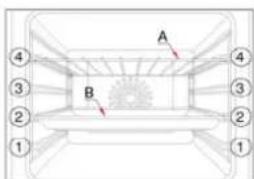
A B ④ ③ ② ① ④ ③ ② ①Inside the oven are side racks 1-4 for inserting the accessories A+B.
The accessories are safely used between the side levels.
is added via a switching point. Now you can select the temperature level.
• After the end of the cooking process turn the level of odkware regulator back to the off-state.
Selecting appropriate cookwareSelecting appropriate

CAUTION:CAUTION:
The cooking surface and the base of the cookware must always be clean and dry.
Wrong!Wrong
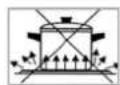
Cookware is too small.
Heat loss!

Cookware ground uneven.
Poor heat transfer!

Lid does not close properly.
Heat loss!
Correct! To save time and energy, slaveetirgye a
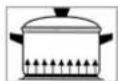
Diameter of the cookware corresponds with the diameter of the hob.
The cookware base is fully resting, and the lid closes properly.
Switching on and off Switching on and off
...the oven...the oven
The oven is equipped with various functions. Baking can be done with upper-, lower-, grill- and convection heat. Set the required operating conditions.
- Set the oven function selector switch to the appropriate position.
- Turn the oven temperature selector switch in clockwise direction to the desired temperature.
- To switch the oven off, both switches must be turned to the off-position again.
...the hobthe hob
- Place suitable cookware on the respectively cooking zone.
- Turn the corresponding level regulator to the desired temperature level.
- Doublecooking and roasting tin zone: Byrotatingking and roasting tin zone: the respective level regulator clockwise until it stops (about level 9), the additional heating zone
Residual heat indicator

WARNING: Risk of burns!
Do not touch the cooking zones while the residual heat indicator lights up.
After switching off the cooking zones the residual heat indicator of the corresponding cooking zone lights up. This warns against touching the zone.
Oven functions
| Symbol | Description |
| 0 | Off-Position: Switching the oven off. |
 | Defrost: The air circulation at room temperature allows rapid defrosting of frozen food (without the use of heating elements). It is a gentle but quick way to speed up the defrosting. |
 | Upper/lower heating: Up or relative heating: in a conventional manner. The dish gets evenly heated from the top and bottom. Suitable for baking and frying on a level. |
 | Upper/lower heating with fan: In this type of heating the heat produced by the upper and lower heat is evenly distributed by an additional fan. |
 | Convection: With an additional heating behind the oven fan the dish gets heated evenly from all sides by a heated airflow. Suitable for simultaneous cooking on several levels. |
  | Steam Cleaning: It enables cleaning the soils softened thanks to the steam to be generated in the oven (see “Cleaning the oven”).Half Grill with Fan: Flat Grilleletm Far and the fan are turned on. The grill fan system replaces e.g. the rotating spit for meat preparation. |
 | Grill: Grilly the grill heating element is in operation. Ideal for scalloping or grilling meat, casseroles, toast etc. |
 | Upper/lower heat with convection (Inten-Upsive heating): fifth heating mode, upper heating, lower heating and convection (rear heating element) are used. The food is cooked uniformly and quickly from all sides. Suitable for simultaneous cooking on several levels. |
- When using the grill grid for roasting, we recommend placing a baking sheet with some water on the lower level.
- At least once after half of the cooking time, the roast should be reversed; sprinkle the roast during cooking now and then with the resulted roast liquid or with hot, salty water, thereby not using cold water.
per/lower heat with convection (Inten-
Grilling

CAUTION:
- Grill exclusively with the oven door closed!
- Supervise the grilling process, the grilling food can burn rapidly due to the intense heat!
- Turn the function selector switch in the corresponding position.
- Preheat the oven for approx. 5 minutes.
- Brushes the grill grid with a little oil, so that the grilling food does not stick on it.
- Slide an empty baking tray for dripping grease to directly lower level, below the grill grid. Pour some water into the baking tray for later easily cleaning.
Notes for baking, boating labeling in the whole
i NOTENOTE
- Use the included accessory.
- In principle, you may use any heat-resistant cookware for your food.
- Unsuitable is cookware of bright, shiny aluminum, unglazed clay and tableware made of plastic or with plastic handles.
- Follow the instructions for the duration of the completion in your recipes and preparation instructions on the product packaging.
BakingBaking
- For good baking results, preheating is recommended up to the desired temperature.
- After finishing the baking process, we recommend resting the food for about 5 minutes in the oven.
- Before removing the cake, check if it is done by using a wooden stick. When the cake is done, no dough residue will stick to the wooden stick.
Cooking and roasting meat & fish
- Only cook meat of maximum 1 kg in the oven. We recommend roasting or cooking smaller portions on the cooking hob.
Energy saving tips
- Only preheat if it is specified in the recipe.
- Use dark, black painted or enameled tins. They absorb the heat particularly well.
- Open the oven door as less as possible during operation.
- Use the residual heat after cooking process. Switch the oven off a few minutes before ending the cooking / baking time. So your baking product even cooked in the stored oven heat.
- Put on the cookware before switching on the cooking zone.
- The base of the cookware and the cooking zone should use the same size.
- If possible, always cover the cookware on the cooking zone with a lid.
- Switch off the cooking zones before ending the cooking time, to use the residual heat.
- If a selection of cooking time is specified, always use the lowest recommended temperature.
- Use the residual heat by switching back to mini-
Information to reduce the environmental effect of environmental effect of cooking (acking O (EU) No. 66/2014 appendix I, (acc. VO (EU) No. 66/2014 appendix I, cooking time.
No. 2) No. 2)
Hob / Induction hobHob / Induction hob
- Use pans and pots with flat floors. Uneven floors increase the energy consumption.
- The diameter of the pot and pan floors should be according to the size of the cooking zone, or bigger. Pans and pots, which are too small on the cooking zone lead to energy losses. Note: Dishes producer partly indicate the upper pot diameter. It is usually larger than the diameter of the pot floor.
- Use a small pot for small quantities. A large pot, which is only slightly filled, required a lot of energy.
- Use as little water as possible. This saves energy. Vegetables retain their vitamins.
- Always close pots with a suitable lid. When cooking without lid you need four times more energy. When using glass lids, more energy can be saved because you can see into the pot without open the lid.
- Use a quick cooker to clearly reduce the cooking time and save energy.
■ After boiling or frying, switch off the used cooking zones to a smaller power level. - Use the residual heat of the pan, the pot and the food. Switch off the cooking zones 5-10 minutes before cooking time.
OvenOven
- We recommend the use of dark baking molds and plates, because they conduct the heat better.
- Any unnecessary accessories should be removed from the baking chamber before using the appliance.
- During cooking, the oven door should remain closed to avoid unnecessary heat loss.
- Only preheat the oven if required by the recipe.
■ Save electricity! If you do not need the oven, switch off functions such as interior lighting, program, temperature
- Clean the oven after each application, to keep the cleaning effort as low as possible. We recommend the use of biological cleaners.
Cleaning and Maintenance Cleaning and Main
WARNING: WARNING:
- Always switch off the appliance completely and where required, disconnect the plug or turn off / unscrew the fuse before cleaning and user maintenance.
- Allow the unit to cool down before cleaning.
- Do not use steam cleaners for cleaning the appliance; moisture could enter electrical components. Risk of electric shock! Electric shock should damage the plastic parts.
- Never use flammable substances, such as thinner, kerosene, gasoline or acids for cleaning.
- The unit must be dry before restarting operation.
CAUTION:
- Do not use a wire brush or other sharp, abrasive items.
- Do not use harsh abrasive cleaners or sharp metal objects for cleaning the glass surface. The surfaces can be scratched or destroyed.
- Always consider the application and safety notes of the detergent.
Cleaning the hobCleaning the hob
| StainingSle | Cleaning methodCle | Cleaning toolsCle |
| Dirt has accumulated | Use warm water and a sponge to rub dry. | Special cleaning sponge for glass ceramic |
| Pools and lime deposits | Apply warm vinegar and wipe off with a dry cloth or use special cleaning agent. | Special cleaning agent for glass ceramic |
| Sugar, melted aluminum, or plastic | Remove by using a glass ceramic scraper. | Special cleaning agent and scraper for glass ceramic |
Removing the oven doorRemoving the oven door
You may remove the oven door to facilitate cleaning and to get better access to the oven interior.
- Open the appliance door completely.
- Fold up the retaining brackets (a) of the hinges on both sides.
- Slightly close the door and lift it up to remove it.
- When reinstalling the door, make sure the notch of the hinge is properly aligned with the protrusion of the hinge holder.
- The eppressdoworthleretaininggobanklets (a) again, Then otherwise the hinges could get damaged when closing the oven door.
Cleaning the ovenCleaning the oven
i NOTENOTE
By cleaning after each use, you avoid that food residuals and soiling will be burning-in at the next operation. Then the cleaning is only possible with a lot of effort.
- Clean the appliance and accessories depending on the soiling degree and depending on the surface only with a soft, damp cloth and commercially, food safe cleaners.

- Soak heavily soiled areas with some warm soapy water or a vinegar cleaner.
Alternatively: Alter the even function [Steam Cleaning] the oven fu
- Remove all accessories in the oven.
- Pour 12 water into the oven tray and place it at the oven bottom.
- Set the function [Steam Cleaning] and temperature to 70°C.
- After operating the oven for 30 minutes, open the oven door and..
- ..wipe off grease residues – in the cooking chamber / from the sealing framed the cooking chamber.
- Use a soft absorbent cloth for drying after cleaning.
Cleaning the side racks
Always remove the side racks, if you want to clean the oven walls thoroughly. Highly soiled side racks can be soaked in the removed state, which makes cleaning easier.
- Remove the rack by slightly bending the lowest metal rod to loosen it from the lower mounting holes and pulling it towards the oven center.
- Lift the rack upwards out of the upper mounting press down the retaining brackets (a) again, holes.
- Replace the racks after cleaning and thoroughly drying them.
Cleaning the glass panel
If necessary, clean the inside of the glass panel.

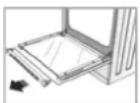

- Open the appliance door.
- Remove the retaining strip by pressing the release tabs on the side and simultaneously pulling the strip forward forwards.
• Take off the glass carefully forward.

natural_image
Line drawing of an oven with a door, showing internal structure and ventilation slots (no text or symbols)- Replace the glass panel and the retaining strip properly; after you've cleaned the glass and dried it thoroughly.
Reverse the bulb Reverse the bulb
WARNING: WARNING:
- Make sure that the appliance is turned off from the power supply (fuse).
- Allow the lamp to cool down before replacing the bulb. There is risk of burns! There is risk of burns!
i NOTENOTE
Use the correct bulb, heat resistant up to 300^ C:
1 x 15 W, 220-240240 22
- Unscrew the lamp cover, clean it with a dry cloth.
- Change the bulb.
- Reattach the lamp cover, check the functionality.
Technical Data
Electrical connection....
Connection voltage: .....220-240/380-415V 3N\~ 50Hz
Connection power: 8300 W
Fuse protection: 3 x 16 A
Protection class: I / IP20
Dimension H x W x D / Weight....
Hob installation: 56.0 x 49.0 cm
Oven installation: 60.0 x 56.0 x 55.0 cm
Net weight: 36.7 kg
The right to make technical and design modifications during continuous product development remains reserved.
This appliance has been tested according to all relevant current CE guidelines, such as electromagnetic compatibility and low voltage directives, and has been constructed in accordance with the latest safety regulations.
Troubleshooting Troubleshooting
Before you contact an Befoorized specialist authorized specialist
| Problem | Possible causes | What to do |
| Unit does not work | The power supply is disconnected. | Check the fuse of your domestic wiring system. |
| Oven lamp does not work | Bulb is defective, has been inserted incorrectly or not firmly. | Check the bulb, see “Reverse the bulb”. |
| Strong formation of smoke | Grease residue in the oven. | Switch off the oven and allow to cool down before cleaning. |
i NOTE:
If a problem persists after following the steps above, contact your distributor or an authorized technician.

Disposal
Meaning of the "Dustbin" Symbol
Protect our environment; do not dispose of electrical equipment in the domestic waste.
Please return any electrical equipment that you will no longer use to the collection points provided for their disposal.
This helps avoid the potential effects of incorrect disposal on the environment and human health.
This will contribute to the recycling and other forms of reutilization of electrical and electronic equipment.
Information concerning where these can be disposed of can be obtained from your local authority.
WARNING:WARNING:
Remove or disable any existing snap and bolt locks, if you take the unit out of operation or dispose it.
- a communal collection point waste disposal authority,
- a dedicated disposal company, offering a return system,
Information to professional users for disassembly Information to professional users for disassembly - a resident electric trader, who voluntary with- (acc. VO (EU) No. 66/2014 appendix I, No. 2)(acc. VO (EU) No. 66/2014 appendix I, No. 2) draws electrical appliances.
Information for non-destructive disassembly for maintenance purposes
Hob / Induction hobHob / Induction hob
- A further disassembly for maintenance purposes by the user is not provided. Do not disassemble the unit.
- For repair and replacement of defective parts, please contact our customer service.
■ Accumulators are not included.
OvenOven
- Remove the lamp as described in the manual.
- For maintenance purposes, the oven door can be unhinged out and reinstalled, for the procedure please refer to the manual.
- A further disassembly for maintenance purposes is not provided.
- If you would like to exchange defective components, please contact our customer service.
■ Accumulators are not included.
Information for disassembly in terms of recycling, recovery and disposal at the end of the life of the appliance
Hob / Induction hob / Oven Hob / Induction hob / Oven
- The disassembly of appliances with a gas connection should only be carried out by a licensed gas and water installer.
- The disassembly of appliances with electrical connections should be carried out by a licensed electrician.
- For the recycling and recovery of resources give the appliance to:
EU Product data sheet EU Product data sheet
Product information for domestic Electric hobs according EU 66/2014 electric hobs according EU 66/2014
| Position Symbol Value | Value Value | Unit Unit | ||
| BrandBrand BOMANN | BOMANN | |||
| Model identification | EHBC | 559 IX EHBC 559 IX | ||
| Type of hob | Hob of a built-in oven | |||
| Number of cooking zones and/or areas | 4 | |||
| Heating technology (induction cooking zones and cooking areas, radiant cooking zones, solid plates) | Radiant cooking zones | |||
| For circular cooking zones or area: diameter of useful surface area per electric heated cooking zone, rounded to the nearest 5 mm | Rear left | ∅ | 15.5 / 26.0 | cm |
| Rear right | 15.5 | |||
| Front right | 12.5 / 18.5 | |||
| Front left | 15.5 | |||
| For non-circular cooking zones or areas: length and width of useful surface area per electric heated cooking zone or area, rounded to the nearest 5 mm | LB | 26.015.5 | cm | |
| Energy consumption per cooking zone or area calculated per kg | Rear left | EC_electric cooking | 193.0 | Wh/kg |
| Rear right | 193.0 | |||
| Front right | 194.0 | |||
| Front left | 193.0 | |||
| Energy consumption for the hob calculated per kg | EC_electric hob | 193.3 Wh/kg | ||
Product Production for domestic ovens according EU 65+66/2014-66/2014 domestic ovens according EU 65
| SymbolSymbol | ValueValue | UnitUnit | |
| BrandBrADMANN | BOMANNBOMANN | ||
| Model identification | EHBC 559 IX | ||
| Type of oven | Built-in | ||
| Mass of the appliance | M | 29.0 | kg |
| Number of cavities | 1 | ||
| Heat source per cavity (electricity or gas) | Electricity | ||
| Volume per cavity | V | 60 | l |
| Energy consumption (electricity) required to heat a standardised load in a cavity of an electric heated oven during a cycle in conventional mode per cavity (electric final energy) | EC_electric cavity | 0.76 | kWh/cycle |
| Energy consumption required to heat a standardised load in a cavity of an electric heated oven during a cycle in fan-forced mode per cavity (electric final energy) | EC_electric cavity | 0.75 | kWh/cycle |
| Energy consumption required to heat a standardised load in a gas-fired cavity of an oven during a cycle in conventional mode per cavity (gas final energy) | EC_gas cavity | - | MJ/cyclekWh/cycle (1) |
| Energy consumption required to heat a standardised load in a gas-fired cavity of an oven during a cycle in fan-forced mode per cavity (gas final energy) | EC_gas cavity | - | MJ/cyclekWh/cycle |
| Energy Efficiency Index per cavity | EEI_cavity | 93.8 | |
| Energy efficiency class (2) | A |
(1) 1 kWh/cycle = 3.6 MJ/cycle
(2) A+++ (highest efficiency) to D (lowest efficiency)