EFL4750 - Remote control toy E-flite - Free user manual and instructions
Find the device manual for free EFL4750 E-flite in PDF.


| Product Type | Radio-Controlled Toy (Aircraft) |
| Brand | E-flite |
| Model Number | EFL4750 |
| Power Source | LiPo Battery (Included) |
| Battery Capacity | 1800mAh (Typical) |
| Charging Method | USB Charger (Included) |
| Control Frequency | 2.4GHz |
| Control Range | Up to 300 meters |
| Dimensions (Wingspan) | 600 mm (Approx.) |
| Weight (Ready to Fly) | 250 g (Approx.) |
| Main Materials | EPS Foam, Plastic, Carbon Fiber |
| Flight Time | 10-15 minutes |
| Channels | 4 (Throttle, Rudder, Elevator, Aileron) |
| Functions | Takeoff, Landing, Loops, Rolls, Gliding |
| Safety Features | Low Voltage Alarm, Auto-Power Off, Throttle Cut |
| Recommended Age | 14+ |
| Maintenance | Clean with dry cloth, store in dry place, check propellor before use |
| Spare Parts Availability | Replacement propellers, landing gear, and batteries available online |
| Repairability | Modular design with replaceable components, user manual includes repair guides |
| General Information | This E-flite toy is ideal for intermediate RC pilots, offering stable flight and agile maneuvers. |
Frequently Asked Questions - EFL4750 E-flite
User questions about EFL4750 E-flite
0 question about this device. Answer the ones you know or ask your own.
Ask a new question about this device
Download the instructions for your Remote control toy in PDF format for free! Find your manual EFL4750 - E-flite and take your electronic device back in hand. On this page are published all the documents necessary for the use of your device. EFL4750 by E-flite.
USER MANUAL EFL4750 E-flite
natural_image
Line drawing of a two-engine model airplane with visible propellers and tail fin (no text or symbols)Instruction Manual
Bedienungsanleitung
All instructions, warranties and other collateral documents are subject to change at the sole discretion of Horizon Hobby, LLC. For up-to-date product literature, visit www.horizonhobby.com and click on the support tab for this product.
Meaning of Special Language:
The following terms are used throughout the product literature to indicate various levels of potential harm when operating this product:
NOTICE: Procedures, which if not properly followed, create a possibility of physical property damage AND little or no possibility of injury.
CAUTION: Procedures, which if not properly followed, create the probability of physical property damage AND a possibility of serious injury.
WARNING: Procedures, which if not properly followed, create the probability of property damage, collateral damage, and serious injury OR create a high probability of superficial injury.

WARNING: Read the ENTIRE instruction manual to become familiar with the features of the product before operating. Failure to operate the product correctly can result in damage to the product, personal property and cause serious injury.
This is a sophisticated hobby product. It must be operated with caution and common sense and requires some basic mechanical ability. Failure to operate this Product in a safe and responsible manner could result in injury or damage to the product or other property. This product is not intended for use by children without direct adult supervision. Do not use with incompatible components or alter this product in any way outside of the instructions provided by Horizon Hobby, LLC. This manual contains instructions for safety, operation and maintenance. It is essential to read and follow all the instructions and warnings in the manual, prior to assembly, setup or use, in order to operate correctly and avoid damage or serious injury.
14+
AGE RECOMMENDATION: Not for children under 14 years. This is not a toy.

WARNING AGAINST COUNTERFEIT PRODUCTS: If you ever need to replace your Spektrum receiver found Horizon Hobby product, always purchase from Horizon Hobby, LLC or a Horizon Hobby authorized dealer to enauthentic high-quality Spektrum product. Horizon Hobby, LLC disclaims all support and warranty with regards, not limited to, compatibility and performance of counterfeit products or products claiming compatibility with or Spektrum.
Safety Precautions and Warnings
As the user of this product, you are solely responsible for operating in a manner that does not endanger yourself and others or result in damage to the product or the property of others.
- Always keep a safe distance in all directions around your model to avoid collisions or injury. This model is controlled by a radio signal subject to interference from many sources outside your control. Interference can cause momentary loss of control.
- Always operate your model in open spaces away from full-size vehicles, traffic and people.
- Always carefully follow the directions and warnings for this and any optional support equipment (chargers, rechargeable battery packs, etc.).
- Always keep all chemicals, small parts and anything electrical out of the reach of children.
• Always avoid water exposure to all equipment not specifically designed and
protected for this purpose. Moisture causes damage to electronics.
- Never place any portion of the model in your mouth as it could cause serious injury or even death.
- Never operate your model with low transmitter batteries.
• Always keep aircraft in sight and under control.
• Always use fully charged batteries.
• Always keep transmitter powered on while aircraft is powered.
• Always remove batteries before disassembly.
• Always keep moving parts clean.
• Always keep parts dry.
• Always let parts cool after use before touching.
• Always remove batteries after use.
• Always ensure failsafe is properly set before fl ying.
- Never operate aircraft with damaged wiring.
- Never touch moving parts.
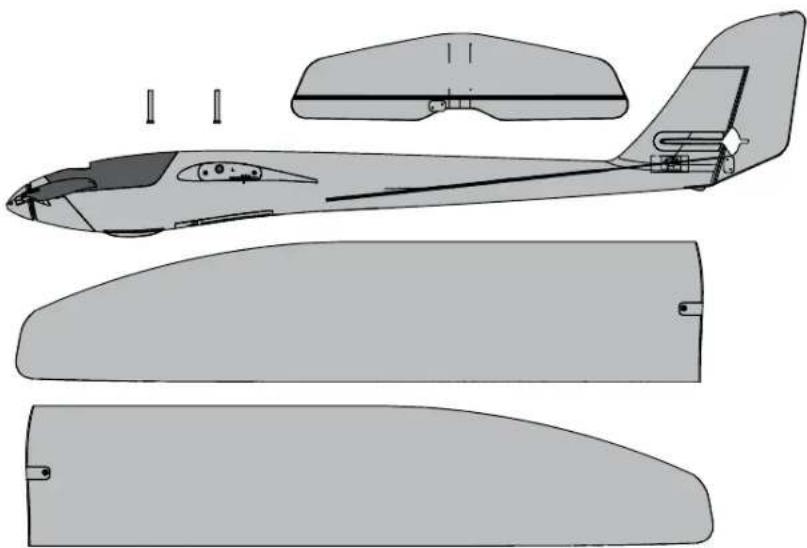
Box Contents
| Quick Start Information | |||
| Transmitter Setup | Blank (Acro) Model | ||
| Servo Reversing:Rudder: ReverseElevator: ReverseAileron: ReverseDO NOT Reverse Throttle | |||
| Dual Rates | Dual Rates: 100% / 70% | ||
| Hi Rate Low | Rate | ||
| Ele | ▲=12mm▼=12mm | ▲=9mm▼=9mm | |
| Rud | ►=40mm◄=40mm | ►=25mm◄=25mm | |
| Center of Gravity (CG) | 2 1/2 inches (63mm) back from leading edge at the root. | ||
| Flight Timer Setting | 7-10 minutes | ||
natural_image
Side-view diagram of a small aircraft with internal components and structural outlines (no text or symbols)Specifications
 | ||
| Motor: 480B BL Outrunner Motor;960Kv Reverse Shaft PKZ4716 | Installed | |
| ESC: 30A Brushless ESC(EFLA1031) | Installed | |
| Servo: Mini Servo (3W) with Arms,Short Lead PKZ1060 | Installed | |
| Receiver: SpektrumTM AR4004-Channel Sport Receiver(SPMAR400) | Installed | |
| Recommended Battery:1300mAh 3S 11.1V 20C Li-Po withEC3 Connector (EFLB13003S20) | Required to Complete | |
| Recommended Battery Charger:3-cell Li-Po battery balancingcharger | Required to Complete | |
| Recommended Transmitter:Full-Range 4 channel (or more)2.4GHz with SpektrumTMDSM2®/DSMX® technology withadjustable Dual Rates. | Required to Complete |
text_image
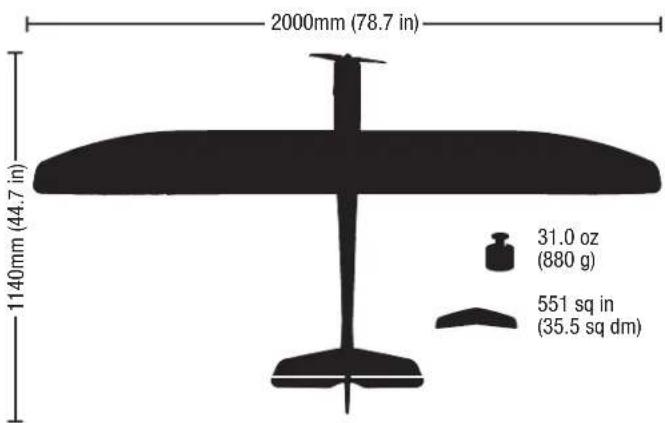
2000mm (78.7 in) 1140mm (44.7 in) 31.0 oz (880 g) 551 sq in (35.5 sq dm)Table of Contents
Preflight 4
Model Assembly 4
Control Horn and Servo Arm Settings ....5
Transmitter and Receiver Binding 6
Battery Installation and ESC Arming 7
Center of Gravity (CG) 8
Control Direction Test 8
Flying Tips and Repairs 9
Post Flight 10
Motor Service ....10
Troubleshooting Guide 11
AMA National Model Aircraft Safety Code 12
Limited Warranty 13
Contact Information ....14
FCC Information ....14
IC Information ....14
Compliance Information for the European Union ....14
Replacement Parts 51
Optional Parts ....51
To register your product online, visit www.e-fl iterc.com
Preflight
| 1 | Remove and inspect contents. |
| 2 | Read this instruction manual thoroughly. |
| 3 | Charge the fl ight battery. |
| 4 | Fully assemble the airplane. |
| 5 | Install the fl ight battery in the aircraft (once it has been fully charged). |
| 6 | Check the Center of Gravity (CG). |
| 7 | Apply Dual Rate values to your transmitter |
| 8 | Find the aircraft to your transmitter. |
| 9 | Make sure linkages move freely. |
| 10 | Perform the Control Direction Test with the transmitter. |
| 11 | Adjust fl ight controls and transmitter. |
| 12 | Perform a radio system Range Test. |
| 13 | Find a safe open area to fl y. |
| 14 | Plan fl ight for fl ying fi eld conditions. |
Model Assembly
Tail Installation
- Slide the horizontal stabilizer (A) into the slot of the fuselage.
- Center the horizontal stabilizer and then secure into place with the 4 included pieces of tape (B).
- Connect the clevis to the elevator control horn (C) as shown.
Connecting a Clevis
- Pull the tube from the clevis to the linkage.
- Carefully spread the clevis, then insert the clevis pin into the desired hole in the control horn.
- Move the tube to hold the clevis on the control horn.

text_image
1. 2. 3.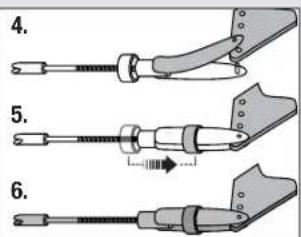
text_image
4. 5. 6.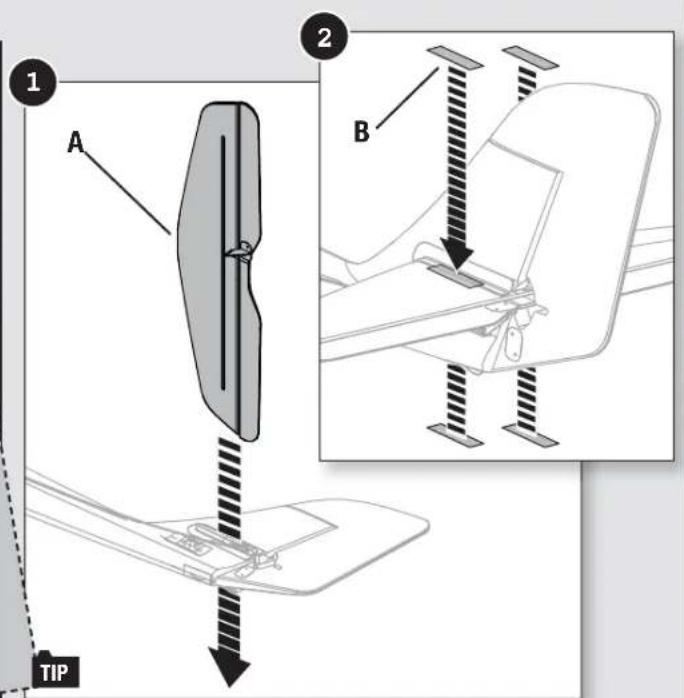
text_image
1 A 2 B TIPControl Surface Centering
After assembly and transmitter setup, confi rm that the control surfaces are centered. If the control surfaces are not centered, mechanically center the control surfaces by adjusting the linkages.
If adjustment is required, turn the clevis on the linkage to change the length of the linkage between the servo arm and the control horn.
After binding a transmitter to the aircraft receiver, set the trims and sub-trims to 0, then adjust the clevises to center the control surfaces.

natural_image
Technical line drawing of a mechanical device with a pointed tip and lever mechanism (no text or symbols)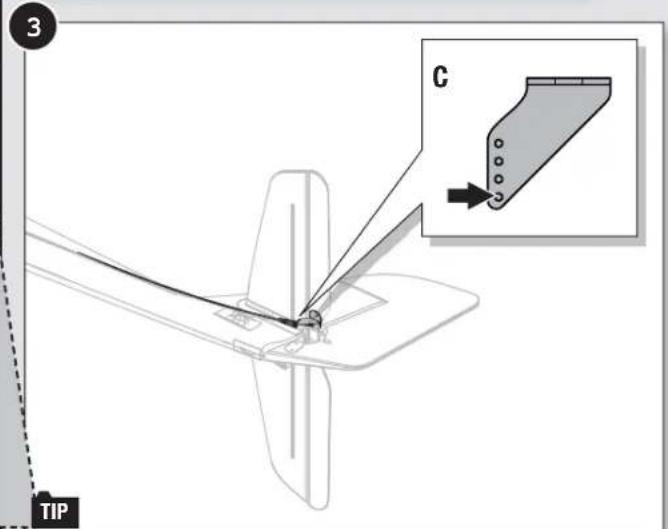
text_image
3 C TIPModel Assembly Continued
Wing Installation
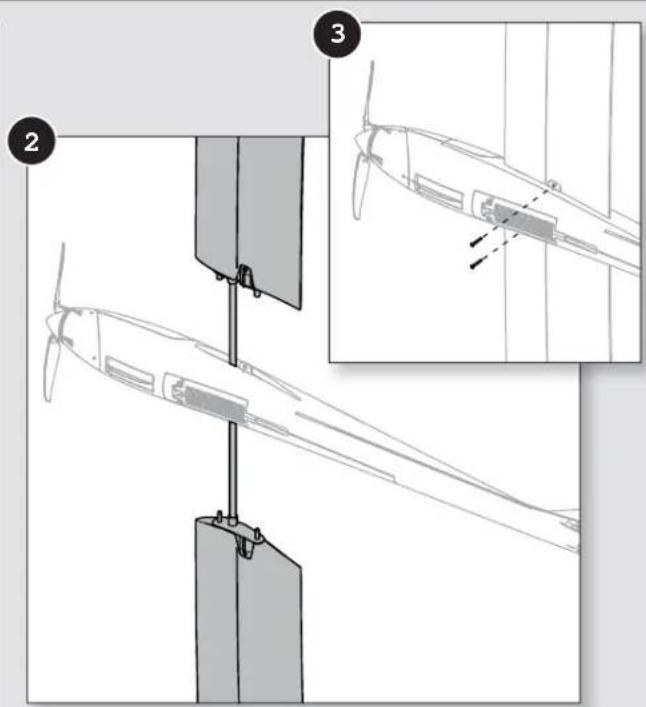
- Slide the wing tube (A) into the fuselage.
- Install the left and right wing over the wing tube until seated into the wing slot of the fuselage.
- Secure the wings to the fuselage using the included 2 screws (B) as shown.
Disassemble in reverse order.
text_image
Technical diagram showing three-step installation of a propeller or fan assembly with labeled components and directional arrows.Control Horn and Servo Arm Settings
The table to the right shows the factory settings for the control horns and servo arms. Fly the aircraft at factory settings before making changes.
After fl ying, you may choose to adjust the linkage positions for the desired control response. See the table to the right.
| Horns Arms | ||
| Elevator |  | 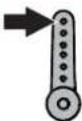 |
| Rudder | 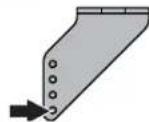 |  |
More control throw Less control throw

text_image
Diagram showing four different mechanical or electrical component configurations with directional arrows indicating motion or force directions.Transmitter and Receiver Binding
Binding is the process of programming the receiver to recognize the GUID (Globally Unique Identifier) code of a single specific transmitter. You need to 'bind' your chosen Spektrum™ DSM2®/DSMX® technology equipped aircraft transmitter to the receiver for proper operation.
IMPORTANT: Before binding a transmitter, read the Transmitter Setup section of this manual to ensure that your transmitter is properly programmed for this aircraft.
| IMPORTANT: The included AR400 receiver has been programmed for operation specifi cally for this aircraft. Refer to the receiver manual for cor-rect setup if the receiver is replaced or is used in another aircraft. |
| Read the transmitter instructions for binding to a receiver (location of transmitter's Bind control). Please visit www.bindnfl y.com for a com-plete list of compatible transmitters. |
| CAUTION: When using a Futaba® transmitter with a Spektrum DSM module, you must reverse the throttle channel and rebind. Refer to your Spektrum module manual for binding and failsafe instructions. Refer to your Futaba transmitter manual for instructions on reversing the throttle channel. |
| 1. Make sure the transmitter is powered off. |
| 2. Move the transmitter controls to neutral (fl ight controls: rudder, elevators and ailerons) or to low positions (throttle, throttle trim).** |
| 3. Install a bind plug in the receiver bind port. |
| 4. Connect the fl ight battery to the ESC. The ESC will produce a series of sounds. 3 short tones confi rm that the LVC is set correctly for the ESC. The orange bind LED on the receiver will begin to fl ash rapidly. |
| 5. Power on the transmitter while holding the transmitter bind button or switch. Refer to your transmitter's manual for binding. |
| 6. When the receiver binds to the transmitter, the orange bind light on the receiver will turn solid and the ESC will produce ascending tones. The tones indicate the ESC is armed, provided the throttle stick and throttle trim are low enough to trigger arming. |
| 7. Remove the bind plug from the bind port. |
| 8. Safely store the bind plug (some owners attach the bind plug to their transmitter using two-part loops and clips). |
| 9. The receiver should retain the binding instructions received from the transmitter until another binding is done. |
| * The throttle will not arm if the transmitter's throttle control is not put at the lowest position. If you encounter problems, follow the binding instructions and refer to the transmitter troubleshooting guide for other instructions. If needed, contact the appropriate Horizon Product Support offi ce. |
\*\*Failsafe
If the receiver loses transmitter communication, the failsafe will activate. When activated, the airplane controls return to the neutral position established during step 2 of the binding procedure.
Bind Plug Installation

text_image
SPEKTRUM AR400 HIGH SPORT RECEIVER GND QHHL 3TW AF3 CCOR BIND PLUGBattery Installation and ESC Arming
Battery Selection
We recommend the E-fl ite® 1300mAh 11.1V 3S 20C Li-Po battery (EFLB13003S20). Refer to the Optional Parts List for other recommended batteries. If using a battery other than those listed, the battery should be within the range of capacity, dimensions and weight of the E-fl ite Li-Po battery packs to fit in the fuselage. Be sure the model balances at the recommended CG.
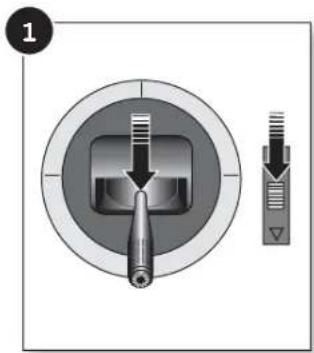
- Lower the throttle and throttle trim to the lowest settings. Power on the Transmitter, then wait 5 seconds.
- Carefully lift the canopy hatch (B) to remove.
- Install a fully charged battery (C) and secure it into place using the hook and loop strap (D). See the Adjusting the Center of Gravity instructions for more information.
- Connect the battery to the ESC (the ESC is now armed).
- The ESC will sound a series of tones (refer to step 6 of the binding instructions for more information).
- An LED will light on the receiver.
If the ESC sounds a continuous double beep after the flight battery is connected, recharge or replace the battery.
- Reinstall the canopy hatch.
text_image
1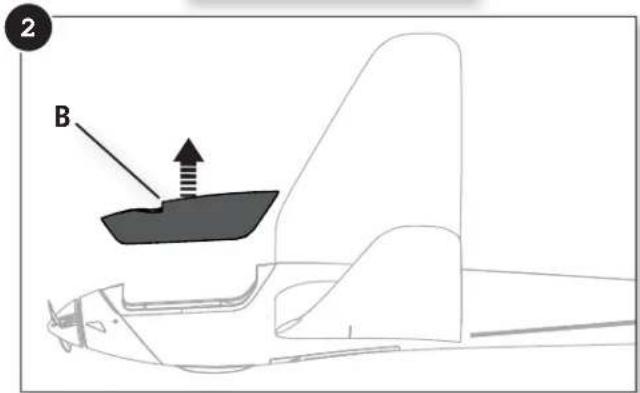
text_image
B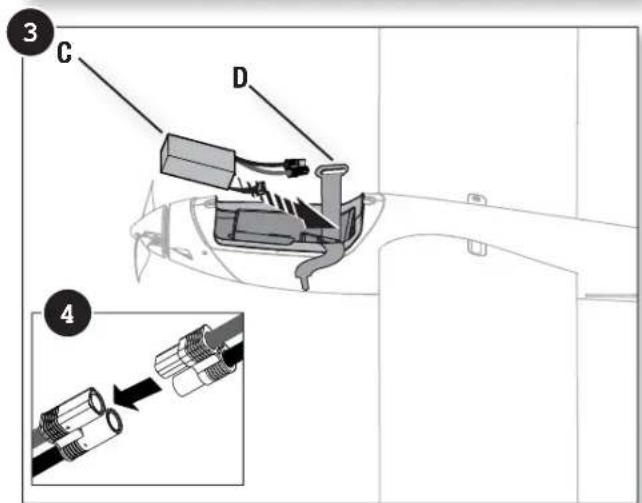
text_image
3 C D 4
natural_image
Illustration of a propeller airplane in flight with visible aerobatic airflow (no text or symbols)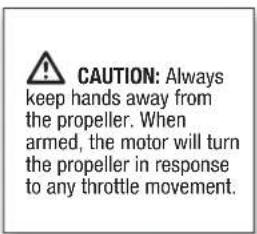
text_image
CAUTION: Always keep hands away from the propeller. When armed, the motor will turn the propeller in response to any throttle movement.Center of Gravity (CG)
The CG location is measured from the leading edge of the wing at the root. This CG location has been determined with the recommended Li-Po battery (EFLB13003S20) installed all the way forward in the battery compartment.
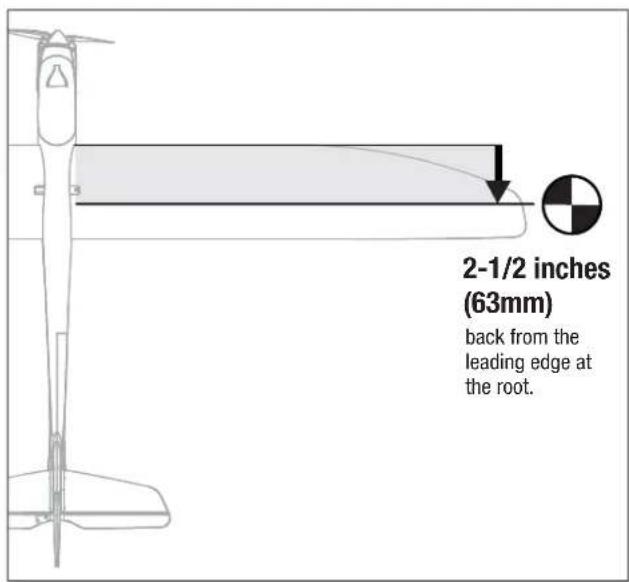
text_image
2-1/2 inches (63mm) back from the leading edge at the root.Control Direction Test
Move the controls on the transmitter to make sure the aircraft control surfaces move in the proper direction.
| Transmitter Command | Aircraft Reaction | |
| Elevator | Up Elevator Command |  |
| Down Elevator Command |  | |
| Rudder | Stick Left |  |
| Stick Right |  |
Flying Tips and Repairs
Consult local laws and ordinances before choosing a fl ying location.
Range Check your Radio System
Before you fly, range check the radio system. Refer to your specific transmitter instruction manual for range test information.
Hand Launch
Set your dual rate switches to low rate. Hold the aircraft fuselage under the wing and gradually increase the throttle to 34 . Launch the aircraft into the wind with the wings level. Allow the aircraft to climb to a comfortable altitude.

text_image
Diagram illustrating wind-induced aircraft movement with a person carrying an airplane and wind direction indicated by arrowsFlying
Always choose a wide-open space for fl ying your aircraft. It is recommended that you fl y at a designated RC fl ying fi eld. Always avoid fl ying near houses, trees, wires and buildings. Avoid fl ying in areas where there are many people, such as parks, schoolyards, or soccer fi elds.
In Flight Trimming
During your fi rst fl ight, trim the aircraft for level fl ight at 1/2 throttle. Make small trim adjustments with your transmitter's trim switches to straighten the aircraft's fl ight path.
After landing, adjust the linkages mechanically to account for trim changes and then reset the trims to neutral. Ensure the aircraft will fly straight and level with no trim or sub-trim.
Landing
For your fi rst fl ights with the recommended battery pack (EFLB13003S30), set your transmitter timer or a stopwatch to 7 minutes. After 7 minutes, land the aircraft. Adjust your timer for longer or shorter fl ights once you have fl own the model. If at any time the motor pulses, land the aircraft immediately to recharge the flight battery. See the Low Voltage Cutoff (LVC) section for more details on maximizing battery health and run time.
Make sure to land into the wind. Due to the high lifting efficiency of the sailplane design, landing requires a large landing area. While on your downwind leg, remember that the sailplane glides much better than other aircraft. You will need to setup for landing lower and with a more shallow descent than you may be used to. As you are on approach for landing, ensure that the model is descending slowly, but also not accelerating. Maintain this descent and speed, and, as the model nears the ground (approximately 6 inches (15 cm)), slowly apply a small amount of up elevator. Before the aircraft touches down, always fully decrease throttle to avoid damage to the propeller, motor, ESC or other components.
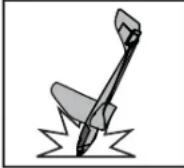
NOTICE: If a crash is imminent, reduce the throttle and trim fully. Failure to do so could result in extra damage to the airframe, as well as damage to the ESC and motor.
NOTICE: After any impact, always ensure the receiver is secure in the fuselage. If you replace the receiver, install the new receiver in the same orientation as the original receiver or damage may result.
NOTICE: Crash damage is not covered under warranty.
NOTICE: When you are fi nished fl ying, never leave the aircraft in direct sunlight or in a hot, enclosed area such as a car. Doing so can damage the aircraft.

Low Voltage Cutoff (LVC)
When a Li-Po battery is discharged below 3V per cell, it will not hold a charge. The ESC protects the fl light battery from over-discharge using Low Voltage Cutoff (LVC). Before the battery charge decreases too much, LVC removes power supplied to the motor. Power to the motor pulses, showing that some battery power is reserved for fl light control and safe landing.
Disconnect and remove the Li-Po battery from the aircraft after use to prevent trickle discharge. Charge your Li-Po battery to about half capacity before storage. During storage, make sure the battery charge does not fall below 3V per cell. LVC does not prevent the battery from over-discharge during storage.
NOTICE: Repeated fl ying to LVC will damage the battery.
Tip: Monitor your aircraft battery's voltage before and after fl ying by using a Li-Po Cell Voltage Checker (EFLA111, sold separately).
Repairs
Thanks to the Z-Foam™ material in this aircraft, repairs to the foam can be made using virtually any adhesive (hot glue, regular CA, epoxy, etc). The horizontal tail is not made of the same material, so use only foam-compatible CA on the horizontal tail.
When parts are not repairable, see the Replacement Parts List for ordering by item number. For a listing of all replacement and optional parts, refer to the list at the end of this manual.
NOTICE: Use of CA accelerant on your aircraft can damage paint. DO NOT handle the aircraft until accelerant fully dries.
Post Flight
| 1 | Disconnect the fl ight battery from the ESC (Required for Safety and battery life). |
| 2 | Power OFF the transmitter. |
| 3 | Remove the fl ight battery from the aircraft. |
| 4 | Recharge the fl ight battery. |
| 5 | Repair or replace all damaged parts. |
| 6 | Store the fl ight battery apart from the aircraft and monitor the battery charge. |
| 7 | Make note of the fl ight conditions and fl ight plan results, planning for future fl ights. |
Motor Service

CAUTION: Always disconnect the flight battery before performing motor service.
Disassembly
- Remove the 2 screws (A) and spinner (B) from the spinner backplate (C).
- Remove the propeller nut (D), backplate from the prop adapter (E). You will need a tool to loosen the spinner nut.
- Push the propeller pins (F) from the spinner backplate to remove the propeller blades (G).
4 Remove the set screw (H) from the prop adapter and remove it from the motor shaft. - Remove the 3 cowl screws (J) from the motor mount/cowling (K) and remove it from the fuselage.
- Remove the 4 screws (L) and motor (M) from the motor mount/cowling.
- Disconnect the motor wires from the ESC wires.
Assembly
Assemble in reverse order.
- Correctly align and connect the motor wire colors with the ESC wires.
- The propeller size numbers (9.75x 7.5) must face forward toward the nose of the aircraft for correct propeller operation.
- A tool is required to tighten the lock nut on the collet.

text_image
G C E H J K E B L A D F Not all wires are shown. 9.75 X 7.5Troubleshooting Guide
| Problem Possible Cause Solution | ||
| Aircraft will not respond to throttle but responds to other controls | Throttle not at idle and/or throttle trim too high | Reset controls with throttle stick and throttle trim at lowest setting |
| Throttle servo travel is lower than 100% Make sure throttle servo travel is 100% or greater | ||
| Throttle channel is reversed Reverse throttle channel on transmitter | ||
| Motor disconnected from ESC Make sure motor is connected to the ESC | ||
| Extra propeller noise or extra vibration | Damaged propeller and spinner, collet or motor Replace damaged parts | |
| Propeller is out of balance Balance or replace propeller | ||
| Prop nut is too loose Tighten the prop nut | ||
| Spinner is not tight or fully seated in place Inspect spinner to ensure it is fully seated | ||
| Reduced flight time or aircraft under-powered | Flight battery charge is low Completely recharge flight battery | |
| Propeller installed backwards Install propeller with numbers facing forward | ||
| Flight battery damaged Replace flight battery and follow flight battery instructions | ||
| Flight conditions may be too cold | Make sure battery is warm before use | |
| Battery capacity too low for flight conditions | Replace battery or use a larger capacity battery | |
| Aircraft will not bind (during binding) to transmitter | Transmitter too near aircraft during binding process | Move powered transmitter a few feet from aircraft, disconnect and reconnect flight battery to aircraft |
| Aircraft or transmitter is too close to large metal object, wireless source or another transmitter | Move aircraft and transmitter to another location and attempt binding again | |
| The bind plug is not installed correctly in the bind port | Install bind plug in bind port and bind the aircraft to the transmitter | |
| Flight battery/transmitter battery charge is too low | Replace/recharge batteries | |
| Bind switch or button not held long enough during bind process | Power off transmitter and repeat bind process. Hold transmitter bind button or switch until receiver is bound | |
| Aircraft will not connect (after binding) to transmitter | Transmitter too near aircraft during connecting process | Move powered transmitter a few feet from aircraft, disconnect and reconnect flight battery to aircraft |
| Aircraft or transmitter is too close to large metal object, wireless source or another transmitter | Move aircraft and transmitter to another location and attempt connecting again | |
| Bind plug left installed in bind port | Rebind transmitter to the aircraft and remove the bind plug before cycling power | |
| Aircraft bound to different model memory (ModelMatchTM radios only) | Select correct model memory on transmitter | |
| Flight battery/Transmitter battery charge is too low | Replace/recharge batteries | |
| Transmitter may have been bound to a different aircraft using different DSM protocol | Bind aircraft to transmitter | |
| Control surface does not move | Control surface, control horn, linkage or servo damage | Replace or repair damaged parts and adjust controls |
| Wire damaged or connections loose | Do a check of wires and connections, connect or replace as needed | |
| Transmitter is not bound correctly or the incorrect airplanes was selected | Re-bind or select correct airplanes in transmitter | |
| Flight battery charge is low Fully recharge flight battery | ||
| BEC (Battery Elimination Circuit) of the ESC is damaged | Replace ESC | |
| Controls reversed | Transmitter settings are reversed | Perform the Control Direction Test and adjust the controls on transmitter appropriately |
| Motor power pulses then motor loses power | ESC uses default soft Low Voltage Cutoff (LVC) | Recharge flight battery or replace battery that is no longer performing |
| Weather conditions might be too cold | Postpone flight until weather is warmer | |
| Battery is old, worn out, or damaged | Replace battery | |
| Battery C rating might be too small | Use recommended battery | |
AMA National Model Aircraft Safety Code
Effective January 1, 2014
A. GENERAL
A model aircraft is a non-human-carrying aircraft capable of sustained fl ight in the atmosphere. It may not exceed limitations of this code and is intended exclusively for sport, recreation, education and/or competition. All model fl ights must be conducted in accordance with this safety code and any additional rules specifi c to the fl ying site.
- Model aircraft will not be flown:
(a) In a careless or reckless manner.
(b) At a location where model aircraft activities are prohibited.
- Model aircraft pilots will:
(a) Yield the right of way to all man carrying aircraft.
(b) See and avoid all aircraft and a spotter must be used when appropriate. (AMA Document #540-D.)
(c) Not fly higher than approximately 400 feet above ground level within three (3) miles of an airport, without notifying the airport operator.
(d) Not interfere with operations and traffic patterns at any airport, heliport or seaplane base except where there is a mixed use agreement.
(e) Not exceed a takeoff weight, including fuel, of 55 pounds unless in compliance with the AMA Large Model Aircraft program. (AMA Document 520-A.)
(f) Ensure the aircraft is identified with the name and address or AMA number of the owner on the inside or affixed to the outside of the model aircraft. (This does not apply to model aircraft flown indoors).
(g) Not operate aircraft with metal-blade propellers or with gaseous boosts except for helicopters operated under the provisions of AMA Document #555.
(h) Not operate model aircraft while under the influence of alcohol or while using any drug which could adversely affect the pilot's ability to safely control the model.
(i) Not operate model aircraft carrying pyrotechnic devices which explode or burn, or any device which propels a projectile or drops any object that creates a hazard to persons or property. Exceptions:
- Free Flight fuses or devices that burn producing smoke and are securely attached to the model aircraft during flight.
- Rocket motors (using solid propellant) up to a G-series size may be used provided they remain attached to the model during flight. Model rockets may be flown in accordance with the National Model Rocketry Safety Code but may not be launched from model aircraft.
- Offi cially designated AMA Air Show Teams (AST) are authorized to use devices and practices as defined within the Team AMA Program Document (AMA Document #718).
(j) Not operate a turbine-powered aircraft, unless in compliance with the AMA turbine regulations. (AMA Document #510-A).
- Model aircraft will not be flown in AMA sanctioned events, air shows or model demonstrations unless:
(a) The aircraft, control system and pilot skills have successfully demonstrated all maneuvers intended or anticipated prior to the specific event.
(b) An inexperienced pilot is assisted by an experienced pilot.
- When and where required by rule, helmets must be properly worn and fastened. They must be OSHA, DOT, ANSI, SNELL or NOCSAE approved or comply with comparable standards.
B. RADIO CONTROL
- All pilots shall avoid flying directly over unprotected people, vessels, vehicles or structures and shall avoid endangerment of life and property of others.
- A successful radio equipment ground-range check in accordance with manufacturer's recommendations will be completed before the first flight of a new or repaired model aircraft.
- At all fl ying sites a safety line(s) must be established in front of which all fl ying takes place (AMA Document #706.)
(a) Only personnel associated with fl ying the model aircraft are allowed at or in front of the safety line.
(b) At air shows or demonstrations, a straight safety line must be established.
(c) An area away from the safety line must be maintained for spectators.
(d) Intentional fl ying behind the safety line is prohibited.
- RC model aircraft must use the radio-control frequencies currently allowed by the Federal Communications Commission (FCC). Only individuals properly licensed by the FCC are authorized to operate equipment on Amateur Band frequencies.
- RC model aircraft will not operate within three (3) miles of any pre-existing fl ying site without a frequency-management agreement (AMA Documents #922 and #923.)
- With the exception of events fl own under offi cial AMA Competition Regulations, excluding takeoff and landing, no powered model may be fl own outdoors closer than 25 feet to any individual, except for the pilot and the pilot's helper(s) located at the fl ight line.
- Under no circumstances may a pilot or other person touch a model aircraft in flight while it is still under power, except to divert it from striking an individual.
- RC night fl ying requires a lighting system providing the pilot with a clear view of the model's attitude and orientation at all times. Hand-held illumination systems are inadequate for night fl ying operations.
- The pilot of a RC model aircraft shall:
(a) Maintain control during the entire flight, maintaining visual contact without enhancement other than by corrective lenses prescribed for the pilot.
(b) Fly using the assistance of a camera or First-Person View (FPV) only in accordance with the procedures outlined in AMA Document #550.
(C) Fly using the assistance of autopilot or stabilization system only in accordance with the procedures outlined in AMA Document #560.
Please see your local or regional modeling association's guidelines for proper, safe operation of your model aircraft.
Limited Warranty
What this Warranty Covers
Horizon Hobby, LLC, (Horizon) warrants to the original purchaser that the product purchased (the "Product") will be free from defects in materials and workmanship at the date of purchase.
What is Not Covered
This warranty is not transferable and does not cover (i) cosmetic damage, (ii) damage due to acts of God, accident, misuse, abuse, negligence, commercial use, or due to improper use, installation, operation or maintenance, (iii) modification of or to any part of the Product, (iv) attempted service by anyone other than a Horizon Hobby authorized service center, (v) Product not purchased from an authorized Horizon dealer, or (vi) Product not compliant with applicable technical regulations.
OTHER THAN THE EXPRESS WARRANTY ABOVE, HORIZON MAKES NO OTHER WARRANTY OR REPRESENTATION, AND HEREBY DISCLAIMS ANY AND ALL IMPLIED WARRANTIES, INCLUDING, WITHOUT LIMITATION, THE IMPLIED WARRANTIES OF NON-INFRINGEMENT, MERCHANTABILITY AND FITNESS FOR A PARTICULAR PURPOSE. THE PURCHASER ACKNOWLEDGES THAT THEY ALONE HAVE DETERMINED THAT THE PRODUCT WILL SUITABLY MEET THE REQUIREMENTS OF THE PURCHASER'S INTENDED USE.
Purchaser's Remedy
Horizon's sole obligation and purchaser's sole and exclusive remedy shall be that Horizon will, at its option, either (i) service, or (ii) replace, any Product determined by Horizon to be defective. Horizon reserves the right to inspect any and all Product(s) involved in a warranty claim. Service or replacement decisions are at the sole discretion of Horizon. Proof of purchase is required for all warranty claims. SERVICE OR REPLACEMENT AS PROVIDED UNDER THIS WARRANTY IS THE PURCHASER'S SOLE AND EXCLUSIVE REMEDY.
Limitation of Liability
HORIZON SHALL NOT BE LIABLE FOR SPECIAL, INDIRECT, INCIDENTAL OR CONSEQUENTIAL DAMAGES, LOSS OF PROFITS OR PRODUCTION OR COMMERCIAL LOSS IN ANY WAY, REGARDLESS OF WHETHER SUCH CLAIM IS BASED IN CONTRACT, WARRANTY, TORT, NEGLIGENCE, STRICT LIABILITY OR ANY OTHER THEORY OF LIABILITY, EVEN IF HORIZON HAS BEEN ADVISED OF THE POSSIBILITY OF SUCH DAMAGES. Further, in no event shall the liability of Horizon exceed the individual price of the Product on which liability is asserted. As Horizon has no control over use, setup, fi nal assembly, modification or misuse, no liability shall be assumed nor accepted for any resulting damage or injury. By the act of use, setup or assembly, the user accepts all resulting liability. If you as the purchaser or user are not prepared to accept the liability associated with the use of the Product, purchaser is advised to return the Product immediately in new and unused condition to the place of purchase.
Law
These terms are governed by Illinois law (without regard to conflict of law principals). This warranty gives you specific legal rights, and you may also have other rights which vary from state to state. Horizon reserves the right to change or modify this warranty at any time without notice.
WARRANTY SERVICES
Questions, Assistance, and Services
Your local hobby store and/or place of purchase cannot provide warranty support or service. Once assembly, setup or use of the Product has been started, you must contact your local distributor or Horizon directly. This will enable Horizon to better answer your questions and service you in the event that you may need any assistance. For questions or assistance, please visit our website at www.horizonhobby.com, submit a Product Support Inquiry, or call the toll free telephone number referenced in the Warranty and Service Contact Information section to speak with a Product Support representative.
Inspection or Services
If this Product needs to be inspected or serviced and is compliant in the country you live and use the Product in, please use the Horizon Online Service Request submission process found on our website or call Horizon to obtain a Return Merchandise Authorization (RMA) number. Pack the Product securely using a shipping carton. Please note that original boxes may be included, but are not designed to withstand the rigors of shipping without additional protection. Ship via a carrier that provides tracking and insurance for lost or
damaged parcels, as Horizon is not responsible for merchandise until it arrives and is accepted at our facility. An Online Service Request is available at http://www.horizonhobby.com/content/_service-center_render-service-center. If you do not have internet access, please contact Horizon Product Support to obtain a RMA number along with instructions for submitting your product for service. When calling Horizon, you will be asked to provide your complete name, street address, email address and phone number where you can be reached during business hours. When sending product into Horizon, please include your RMA number, a list of the included items, and a brief summary of the problem. A copy of your original sales receipt must be included for warranty consideration. Be sure your name, address, and RMA number are clearly written on the outside of the shipping carton.
NOTICE: Do not ship LiPo batteries to Horizon. If you have any issue with a LiPo battery, please contact the appropriate Horizon Product Support offi ce.
Warranty Requirements
For Warranty consideration, you must include your original sales receipt verifying the proof-of-purchase date. Provided warranty conditions have been met, your Product will be serviced or replaced free of charge. Service or replacement decisions are at the sole discretion of Horizon.
Non-Warranty Service
Should your service not be covered by warranty, service will be completed and payment will be required without notification or estimate of the expense unless the expense exceeds 50% of the retail purchase cost. By submitting the item for service you are agreeing to payment of the service without notification. Service estimates are available upon request. You must include this request with your item submitted for service. Non-warranty service estimates will be billed a minimum of 12 hour of labor. In addition you will be billed for return freight. Horizon accepts money orders and cashier's checks, as well as Visa, MasterCard, American Express, and Discover cards. By submitting any item to Horizon for service, you are agreeing to Horizon's Terms and Conditions found on our website http://www.horizonhobby.com/content/_service-center_render-service-center.
ATTENTION: Horizon service is limited to Product compliant in the country of use and ownership. If received, a non-compliant Product will not be serviced. Further, the sender will be responsible for arranging return shipment of the un-serviced Product, through a carrier of the sender's choice and at the sender's expense. Horizon will hold non-compliant Product for a period of 60 days from notification, after which it will be discarded.
Contact Information
| Country of Purchase Horizon Hobby Phone Number/Email Address Address | |||
| United States of America | Horizon Service Center (Repairs and Repair Requests) | servicecenter.horizonhobby.com/RequestForm/ | 4105 Fieldstone RdChampaign, Illinois, 61822 USA |
| Horizon Product Support (Product Technical Assistance) | www.quickbase.com/db/bghj7ey8c?a=GenNewRecord888-959-2305 | ||
| Sales | sales@horizonhobby.com888-959-2305 | ||
| United Kingdom | Service/Parts/Sales: Horizon Hobby Limited | sales@horizonhobby.co.uk+44 (0) 1279 641 097 | Units 1–4 , Ployters Rd, Staple TyeHarlow, Essex, CM18 7NS, United Kingdom |
| Germany | Horizon Technischer Service service@horizonhobby.deSales: Horizon Hobby GmbH +49 (0) 4121 2655 100 | Christian-Junge-Straße 125337 Elmshorn, Germany | |
| France | Service/Parts/Sales: Horizon Hobby SAS | infofrance@horizonhobby.com 11+33 (0) 1 60 18 34 90 | Rue Georges Charpak77127 Lieusaint, France |
| China | Service/Parts/Sales: Horizon Hobby – China | info@horizonhobby.com.cn Room +86 (021) 5180 9868 | 506, No. 97 Changshou Rd.Shanghai, China 200060 |

FCC Information
Operation is subject to the following two conditions: (1) This device may not cause harmful interference, and (2) this device must accept any interference received, including interference that may cause undesired operation.

CAUTION: Changes or modifications not expressly approved by the party responsible for compliance could void the user's authority to operate the equipment.
This product contains a radio transmitter with wireless technology which has been tested and found to be compliant with the applicable regulations governing a radio transmitter in the 2.400GHz to 2.4835GHz frequency range.
IC Information
This device complies with Industry Canada licence-exempt RSS standard(s). Operation is subject to the following two conditions: (1) this device may not
cause interference, and (2) this device must accept any interference, including interference that may cause undesired operation of the device.
Compliance Information for the European Union

EFL Radian BNF Basic (EFL4750)
EU Compliance Statement: Horizon Hobby, LLC hereby declares that this product is in compliance with the essential requirements and other relevant provisions of the R&TTE and EMC Directive.
A copy of the EU Declaration of Conformity is available online at: http://www.horizonhobby.com/content/support-render-compliance.
Instructions for disposal of WEEE by users in the European Union
This product must not be disposed of with other waste. Instead, it is the user's responsibility to dispose of their waste equipment by handing it over to a designated collections point for the recycling of waste electrical and electronic equipment. The separate collection and recycling of your waste equipment at the time of disposal will help to conserve natural resources and ensure that it is recycled in a manner that protects human health and the environment. For more information about where you can drop off your waste equipment for recycling, please contact your local city office, your household waste disposal service or where you purchased the product.
Replacement Parts • Ersatzteile • Pièces de rechange • Pezzi di ricambio
| Part # | Nummer Numéro | Codice | enoizircseDnoitpircseDgnub | |||
| EPKZ1017 | Propeller Blades: Radian Propeller: Radian | Radian Radian - Pales Eliche: Radian | ||
| PKZ1018 | Prop Adapter & Spinner Set: Radian | Luftschraubenmitnehmer und Spinner: Radian | Radian - Set adaptateur d'hélice & cône | Set adattatore elica & ogiva: Radian |
| PKZ1060 | Mini Servo (3W) with Arms, Short Lead | Mini Servo, 3 adrig, kurzes Kabel | Mini Servo (3 fi ls) avec Palonniers, câble court | Servocomando mini (3W) con braccetti, cavo corto |
| PKZ4713 | Canopy: Radian | Parkzone Kabinenhaube:Radian | Radian -Verrière | Parafiamma con viti: Radian |
| PKZ4714 | Firewall w/Screws: Radian | Motorschott : Radian | Radian - Cloison Pare-feu avec Vis | Parafiamma con viti: Radian |
| PKZ4716 | PKZ 480 Outrunner Brushless Motor: Radian | Parkzone Radian BL Motor 480b | Radian - Moteur Brushless 480 à cage tournante | PKZ 480 motore outrunner brushless: Radian |
| PKZ5422 | Pushrods with Clevis: Radian | Parkzone Gestängeset: Radian Pro | Radian - Tringlerie avec chapes | Squadrette con forcelle: Radian |
| PKZ4725 | Tail Wing Set: Radian | Parkzone Leitwerk : Radian | Radian - Empennages Horizontal | Set ali di coda: Radian |
| EFLA1030 | 30-Amp Pro SB Brushless ESC | E-flite 30A Pro SB Regler | Contrôleur Brushless 30A Pro | 30A Pro SB ESC brushless |
| EFL6910 | Decal Sheet: Brave | E-flite Dekorbogen: Brave | Radian - Planche de décoration | Decal Sheet: Brave |
| EFL4701 | Bare Fuselage: Radian BNF | E-flite Rumpf ohne Kabinenhaube | Radian BNF - Fuselage nu | Fusoliera vuota: Radian BNF |
| EFL4702 | Wing with spar: Radian BNF | E-flite Tragfläche mit Holm: Radian BNF | Radian BNF - Aile avec clé | Ala con longherone: Radian BNF |
| EFL4703 | Decal Sheet: Radian BNF | Dekoborgen: Radian BNF | Radian BNF - Planche de décoration | Decalcomanie: Radian BNF |
Optional Parts • Optionale Bauteile • Pièces optionnelles • Pezzi opzionali
| Part # I Nummer Numéro I Codice | Description | Beschreibung | Description | Descrizione |
| EFLA250 | Park Flyer Tool Assortment, 5 pc | Park Flyer Werkzeugsortiment, 5 teilig | Assortiment d'outils park flyer, 5pc | Park Flyer assortimento attrezzi, 5 pc |
| EFLAEC302 | EC3 Battery Connector, Female (2) | EC3 Akkukabel, Buchse (2) | Prise EC3 femelle (2pc) | EC3 Connettore femmina x batteria (2) |
| EFLAEC303 | EC3 Device/Battery Connector, Male/Female | EC3 Kabelsatz, Stecker/Buchse | Prise EC3 male/femelle | EC3 Connettore batteria maschio/femmina |
| EFLB22003S50 | 11.1V 3S 30C 3200MAH Li-Po | 11.1V 3S 30C 3200mAh LiPo | 11.1V 3S 30C 3200MAH Li-Po | 11.1V 3S 30C 3200MAH Li-Po |
| DYNC2020A | Prophet Sport Duo 50W x 2 AC Battery Charger | Dynamite Prophet Sport Duo 50W x 2 AC Ladegerät, EU | Chargeur Prophet Sport Duo 50W x 2 AC | Prophet Sport Duo 50W x 2 AC caricabatteria |
| DYNC2010CA | Prophet Sport Plus 50W AC DC Charger | Dynamite Ladegerät Prophet Sport Plus 50W AC/DC EU | Chargeur Prophet Sport Plus 50W AC DC | Caricabatterie Prophet Sport Plus 50W AC DC |
| EFLA111 | Li-Po Cell Voltage Checker | Li-Po Cell Voltage Checker | Testeur de tension d'éléments Li-Po | Voltmetro verifica batterie LiPo |
| DYN1405 | Li-Po Charge Protection Bag, Large | Dynamite LiPoCharge Protection Bag groß | Sac de charge Li-Po, grand modèle. | Sacchetto grande di protezione per carica LiPo |
| DYN1400 | Li-Po Charge Protection Bag, Small | Dynamite LiPoCharge Protection Bag klein | Sac de charge Li-Po, petit modèle | Sacchetto piccolo di protezione per carica LiPo |
| DX6i DSMX 6-Channel Transmitter | Spektrum DX6i DSMX 6-Kanal Sender | Emetteur DX6i DSMX 6 voies | DX6i DSMX Trasmettitore 6 canali | |
| DX6 DSMX 6-Channel Transmitter | Spektrum DX6 DSMX 6-Kanal Sender | Emetteur DX6 DSMX 6 voies | DX6 DSMX Trasmettitore 6 canali | |
| DX7 DSMX 7-Channel Transmitter | Spektrum DX7 DSMX 7 Kanal Sender | Emetteur DX7 DSMX 7 voies | DX7 DSMX Trasmettitore 7 canali | |
| DX9 DSMX 9-Channel Transmitter | Spektrum DX9 DSMX 9 Kanal Sender | Emetteur DX9 DSMX 9 voies | DX9 DSMX Trasmettitore 9 canali | |
| DX18 DSMX 18-Channel Transmitter | Spektrum DX18 DSMX 18 Kanal Sender | Emetteur DX18 DSMX 18 voies | DX18 DSMX Trasmettitore 18 canali |
© 2015 Horizon Hobby, LLC.
E-fl ite, DSM, DSM2, DSMX, the DSMX logo, Bind-N-Fly, Z-Foam, ModelMatch, EC3, Celectra and the Horizon Hobby logo are trademarks or registered trademarks of Horizon Hobby, LLC.
The Spektrum trademark is used with permission of Bachmann Industries, Inc.
Futaba is a registered trademark of Futaba Denshi Kogyo Kabushiki Kaisha Corporation of Japan.
All other trademarks, service marks and logos are property of their respective owners.
Patents pending.
http://www.e-fliterc.com/